




Abstract
This article addresses the important question of why those in paid employment might be hesitant to start their own businesses. In particular, we predict how diminished work-related creativity of employees might mediate the relationship between their perceptions that societal norms do not support initiative taking and their own entrepreneurial intentions. In addition, we consider how risk tolerance and passion for work might buffer this process. Survey data, collected among public-sector employees in the United Arabic Emirates, confirm these predictions with the exception of indications for a buffering role of passion for work. For entrepreneurship stakeholders, this research reveals a critical factor – a diminished propensity to generate new ideas at work – by which employee beliefs about limited normative support for enterprising efforts may escalate into a reluctance to consider an entrepreneurial career. It also identifies how this process can be muted when employees are willing to take risks.
Keywords
Introduction
Why might employees who hold a steady job consider an entrepreneurial career? There are both positive and negative aspects to this question. On the positive side, if they are willing to start their own businesses, they may enjoy greater decision autonomy, job control, financial rewards and a sense of meaning (Delanoë-Gueguen and Liñán, 2019; Parasuraman and Simmers, 2001). For society at large, employees who launch their own ventures promise heightened innovation levels, new job creation and an infusion of new and improved products or processes (Acs et al., 2013). However, the decision to leave a solid job and embark on an entrepreneurial career path is not easy or straightforward. Thus, on the negative side, employees might resist entrepreneurial moves due to their concerns about giving up a secure source of income, uncertainty about whether the new business will succeed, the risk of losing their professional reputation or the prospect of the seemingly relentless efforts required to keep a business afloat (Hormiga et al., 2013; Prottas and Thompson, 2006).
These challenges may be exacerbated if employees believe that the broader macro-environment inhibits rather than facilitates enterprising efforts (Kebaili et al., 2017; Solesvik et al., 2014). Resistance to the idea of creating a new firm becomes especially problematic when societal environments discourage such activities in parallel. For example, entrepreneurial propensities might be subdued when people perceive insufficient financial support mechanisms, excessive red tape, administrative burdens or poor legal protection for new product ideas (Feola et al., 2019; Fernández-Serrano and Romero, 2014; Reynolds et al., 2005). Another critical inhibitor might stem from beliefs that the norms that permeate society simply do not encourage personal initiative (Solesvik et al., 2014; Sperber and Linder, 2019). Yet, research into the negative relationship between unsupportive societal norms and entrepreneurial intentions predominantly features samples of students or young adults, just starting out in their careers (Ephrem et al., 2019; Siu and Lo, 2013). Compared with these informants, securely employed potential entrepreneurs may confront additional hurdles and considerations, particularly with respect to how broader societal norms may inform organisational leader’s attitudes towards ‘entrepreneurship-friendly’ behaviours at work (Chiu and Kwan, 2010; Chua et al., 2015).
Accordingly, with a sample of well-ensconced employees, we consider how greater or lesser engagement of employees in work-related creativity might inform the ways in which their perceptions that norms discourage initiative taking determine their own entrepreneurial intentions. Work-related creativity refers to the extent to which employees devise with new solutions to organisational problems in the course of their work (Oldham and Cummings, 1996). If employees sense that the surrounding environment does not value personal initiative, they might be reluctant to generate new ideas in their current jobs, because they would worry that organisational authorities will regard these efforts negatively, which could compromise their organisational standing (Chua et al., 2015). An important consequence, we assert, might be that their reluctance then spills over into reduced perceptions of their ability to leverage their creativity in other settings, such as by starting their own businesses (Hormiga et al., 2013; Lee et al., 2011).
We also consider some ways in which this negative process might be contained, such as if employees possess valuable personal resources that diminish their fear of a tarnished organisational standing even if they were to undertake creative activities at work. That is, the extent to which employees exhibit conservative behavioural tendencies in response to adverse normative conditions, with respect to enterprising efforts, likely decreases when they have access to personal resources that mitigate the experienced fear (De Clercq and Belausteguigoitia, 2019; Hobfoll and Shirom, 2000). We thus postulate that risk tolerance and passion for work, as two personal resources, might diminish the chances that employees avoid creative behaviours at work in the presence of normative adversity, with positive consequences for their entrepreneurial intentions. Risk tolerance captures the extent to which employees are willing to try new things, even if the outcomes are uncertain (Zhao et al., 2005). Passion for work instead refers to the extent to which people derive personal joy from working hard (Baum and Locke, 2004).
With these predictions, we seek to make several research contributions. First, we argue and empirically demonstrate that employee perceptions of adverse normative macro-environments can reduce the propensity to start a new firm, given fears that a diminished organisational reputation leaves them reluctant to undertake creative work-related efforts that contradict prevailing norms (Amabile, 1996; Hormiga et al., 2013). Organisational behaviour research has already established that employee propensity to limit creative behaviours is an intermediate mechanism that connects adverse work conditions, such as role stressors (Mishra and Shukla, 2012) and surface acting (Liu et al., 2013), with negative work outcomes. We examine a similar mediator in a novel context, pertaining to the plans employees make to start their own business when they perceive a lack of normative support for entrepreneurial efforts in their external environments (Sperber and Linder, 2019). Formally, we posit that the reduced likelihood that employees are creative in the course of their work functioning —an underexplored manifestation of entrepreneurial inaction relevant for entrepreneurial intention formation (Wood et al., 2017) —is an important mechanism that may explain why their perceptions of unsupportive societal norms diminish the probability that they make plans to start their own business. This is an important mechanism that may explain why perceptions of unsupportive societal norms diminish the probability of business creation.
Second, we address calls for more research that applies contingency approaches to the combined effects of factors that operate at different levels when predicting entrepreneurial intentions (Schillo et al., 2016; Siu and Lo, 2013). In particular, we generate expanded insights into how diminished entrepreneurial intentions, as a response to macro-level normative adversity, might be mitigated by pertinent personal resources that employees can leverage to guard against negative consequences if exhibiting creativity at work. Employees are likely to react differently to unfavourable normative conditions; one element that determines their behavioural reactions is their ability to deal effectively with related challenges (Hobfoll and Shirom, 2000). By considering specifically how employee risk tolerance (Zhao et al., 2005) and passion for work (Ho et al., 2011) may mitigate the mediating effect by which diminished work-related creativity channels normative adversity into diminished plans to start a business, we seek insights for policy makers and other stakeholders interested in spurring entrepreneurship. To diminish the risk that unfavourable societal norms negatively interfere with an employee’s interest in starting a new firm, they should encourage greater willingness to take risks among these employees or heed the personal excitement they show in their work.
To explore these issues, the article is organised as follows. First, we outline the theory and hypotheses development. Next, we present the methodology and statistical results. We conclude with a discussion of the study’s key theoretical insights, limitations and future research directions, and implications for practice.
Theoretical background and context
To establish our contributions, we address the specific question of how employee work-related creativity might serve as a conduit through which perceptions of unfavourable societal norms inform entrepreneurial intentions. Considering this distinct type of work behaviour is important and relevant, in light of its opportunities and challenges. Employees can contribute effectively to their organisation’s success by developing and introducing novel ideas to improve its current situation (Maimone and Sinclair, 2014; Oltra and Vivas-López, 2013). Such creative activities also offer opportunities for personal growth and can generate a sense of personal accomplishment (Kim et al., 2009; Mishra and Shukla, 2012). Yet, the pursuit of novel ideas, which by definition upset the status quo, also creates important risks for employees. Other members, including organisational authorities, may find such efforts upsetting and perceive them as undermining prevailing organisational practices (Van Dijk and Van Dick, 2009; Yuan and Woodman, 2010). For example, organisational leaders may interpret these behaviours as challenges to the quality of their decisions or fear that implementing the novel ideas will compromise their personal turf and privileges (Hon et al., 2014; Sutton and Hargadon, 1996). Employees might, therefore, think twice before they risk expressing work-related creativity to avoid resistance or rejection by those in authority.
These challenges should be particularly prominent when employees believe that society at large regards disruptive, change-invoking initiatives negatively and this informs how organisational leaders evaluate such initiatives in work settings (Borins, 2002; Chiu and Kwan, 2010). Creative work behaviours clearly can be discouraged by organisational or industry factors, but we propose that employees may also avoid such behaviours in response to external forces that indirectly determine how the internal organisation evaluates such behaviours (Chua et al., 2015). The connection between perceptions of normative adversity and work-related creativity is indirect and somewhat remote. Therefore, for this study, we select public-sector organisations as our empirical context, noting that the members of these organisations, including their leaders, should be strongly influenced by norms that permeate society at large (Van Wart, 2013). That is, the employees of government organisations should be particularly inclined to believe that their perceptions of societal norms mirror those held by those in authority (Elenkov and Manev, 2005). With this logic, we propose that employee beliefs about normative adversity towards initiative taking may leave them reluctant to undertake creative efforts at work, for fear that these efforts will be poorly received by leaders (Chiu and Kwan, 2010). 1
Moreover, dedicated creative efforts may be challenging for public-sector employees in general, to the extent that these efforts contradict the prevailing bureaucratic rules set by government mandates (Borins, 2002; Moussa et al., 2018). Government bureaucracies already have a tendency to discourage work behaviours that upset the status quo, so it becomes particularly relevant to examine how variations in employee beliefs about societal norms related to initiative taking may enter the workplace and inform the variations in their work-related behavioural responses. That is, our focus on public-sector organisations enables us to investigate how the likelihood that employees will develop disruptive ideas at work depends on the extent to which they believe the wider normative environment is (un)supportive of these efforts (Sperber and Linder, 2019), beyond any organisation-specific bureaucracy, and importantly, to pinpoint the implications of their work-related behavioural responses for their plans to start a business (Hormiga et al., 2013).
Conservation of resources theory
Even if this empirical focus on public-sector employees is highly relevant, our theoretical arguments also should apply across different sectors and settings, 2 in that the links between employee perceptions of limited normative support for enterprising efforts, work-related creativity and entrepreneurial intentions are anchored in conservation of resources (COR) theory (Hobfoll, 1989; Hobfoll et al., 2018). According to this theory, work-related activities and preferences of employees reflect their desire to shield their existing resource reservoirs and avoid resource losses, which sets the stage for two key premises. First, the threat of resource drainage caused by adverse situations tends to elicit behavioural responses that enable employees to counter such drainage (Hobfoll and Shirom, 2000). Second, certain personal features can mitigate this process, especially those that make it less probable that the experienced adversity converts into actual resource drainage (Hobfoll and Shirom, 2000).
A broad conceptualisation of the notion of ‘resources’ entails all ‘those objects, personal characteristics, conditions, or energies that are valued in their own right or that are valued because they act as conduits to the achievement or protection of valued resources’ (Hobfoll, 2001: 339). In our proposed theoretical framework, the role of organisational standing of employees should be especially relevant, and it also reflects one of the key COR resources (status at work) that Hobfoll (2001: 342, Table 2) identifies. We propose, in particular, that employee perceptions of normative adversity with respect to taking initiatives diminish their work-related creativity given efforts to protect workplace standing (Fiske, 2010). That is, the perceived threat to their organisational position if employees were to propose novel ideas in the presence of normative conditions that reject such efforts may steer them towards more conservative, rather than disruptive, work behaviours (Chua et al., 2015). In essence, diminished work-related creativity is a behavioural response by employees seeking to maintain their organisational standing and avoid negative judgements of their work-related actions (Hobfoll and Shirom, 2000).
In a further application of COR theory, we postulate that this protective behavioural response is less likely to the extent that employees can draw on personal resources that make the response less needed (Hobfoll and Shirom, 2000). In particular, employee motivation to protect their organisational reputation by avoiding work-related creativity, in the presence of normative adversity, likely is subdued when they possess the personal resources of risk tolerance (Zhao et al., 2005) and passion for work (Baum and Locke, 2004). As we detail in the ‘Hypotheses’ section, employees who perceive normative adversity but are more risk prone or excited about work may experience less need to reduce their work-related creativity to shield their organisational standing, so they then have more chances to identify opportunities for new business creation (Hormiga et al., 2013).
The focus on these two personal resources is not random but informed by their complementary roles. That is, even if both of these personal resources, conceptualised as moderators in our proposed framework, can help employees cope with the challenges of unsupportive social norms for initiative taking, they do so in different ways. Employee risk tolerance is primarily cognitive in nature, capturing how they make decisions when they recognise the likelihood of uncertain outcomes (Dinis et al., 2013). This passion for work speaks to the positive emotions experienced in the course of executing work tasks (De Clercq et al., 2013). Together, these two resources provide a consistent, encompassing perspective of whether and how employee beliefs about normative adversity might escalate into reduced entrepreneurial intentions, through their diminished work-related creativity.
Hypotheses
The proposed conceptual framework is summarised in Figure 1. We theorise that normative adversity thwarts entrepreneurial intentions, because the fear of diminished organisational standing steers employees away from undertaking creative activities at work. Risk tolerance and passion for work serve as two complementary buffers of this connection. We detail the arguments for the constitutive hypotheses in this section.
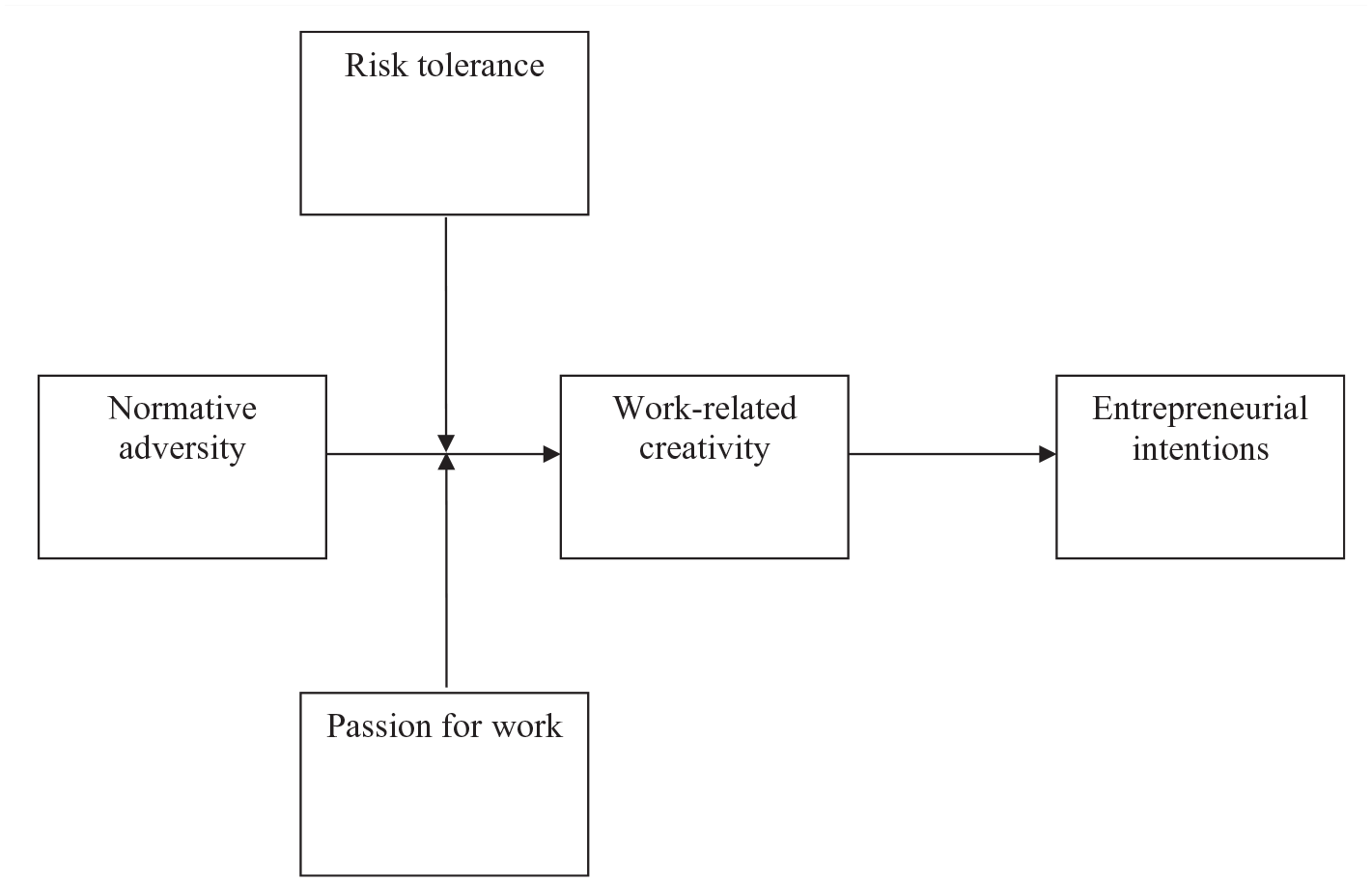
Conceptual model.
Mediating role of work-related creativity
According to the tenets of COR theory, employee propensity to engage in certain work behaviours is influenced by motivation to conserve existing resource bases and diminish the chances of further resource depletion, particularly in the presence of unfavourable circumstances (Hobfoll and Shirom, 2000). If societal norms seem unsupportive of initiative taking, employees may fear that exhibiting creativity at work will jeopardise their organisational standing as those in authority take negative views of such behaviours (Chua et al., 2015; Sperber and Linder, 2019). Such beliefs generate a discouraging sense overall so employees have little motive to exert the effort needed to devise novel solutions to work-related problems (Anderson, 1992; Hormiga et al., 2013). That is, a broader normative environment that appears to discourage initiative taking may compromise employee motivation to be creative in their jobs as they fear these activities will undermine their reputation at work (Chiu and Kwan, 2010). Conversely, if employees believe that broader societal norms encourage personal initiative taking, they are more likely to engage in creative work behaviours, because such behaviours can generate resource gains, including positive recognition from organisational leaders (Chua et al., 2015; Hobfoll et al., 2018).
Similarly, if employees perceive a lack of support for initiative taking, and believe that organisational decision makers are influenced by the same norms (Chua et al., 2015), the discouraging environment might seem like a form of disrespect for their creative efforts. This further undermines motivation to allocate energy to new idea generation within the workplace (Ryan and Deci, 2000). That is, employees may justify their diminished creative efforts by referring to the lack of normative support that such ideas receive (Anderson, 1992; Chiu and Kwan, 2010). Consistent with the COR logic (Hobfoll et al., 2018), refusing to engage in creative activities at work provides a protective mechanism that conserves organisational standing (key resource) in the presence of norms that conflict with such activities (Hobfoll, 2001). If employees are convinced that society does not look favourably on personal initiative, they will not waste valuable time devising new work-oriented ideas likely to be ignored by leaders engrained with societal norms. With these arguments, we postulate the following hypothesis:
We also argue that the extent to which employees avoid work-related creativity has a negative relationship upon entrepreneurial intentions. Although the form of creativity we analyse refers to employee efforts within their existing jobs, such diminished creativity may spill over and limit their ability to make plans to create a new firm. If they do not engage in efforts to find solutions to problems encountered at work, they are less well positioned to detect other opportunities to exploit through a new business (Hormiga et al., 2013; Lee et al., 2011); rather, attention rests on how to maintain and preserve current employment. Frequent anecdotal accounts indicate that new business ideas tend to result from problems or deficiencies that employees encounter at work (Barringer and Ireland, 2019); empirical research affirms that limited creativity at work leads to lower entrepreneurial intentions (Biraglia and Kadile, 2017). Conversely, the premises underpinning COR theory suggest that employees may be motivated to leverage work-related insights, derived from their creative work behaviours, in plans to attain additional personal resource gains (Hobfoll and Shirom, 2000). Employees who display creative efforts in the workplace are more optimistic about the chances of success from commercialising their ideas within a new business (Biraglia and Kadile, 2017), expecting enhanced financial rewards, work-related freedom or a sense of personal accomplishment (Delanoë-Gueguen and Liñán, 2019). We therefore hypothesise the following:
The integration of these hypotheses implies a critical mediating role of work-related creativity. Employee beliefs about adverse societal norms in relation to taking initiative may diminish their entrepreneurial intentions as they are reluctant to undertake significant effort to devise novel ideas that might resolve work-related problems (Chua et al., 2015). Extant research similarly reveals a mediating role of diminished entrepreneurial attitudes and perceived control in the connection between perceptions of societal corruption and entrepreneurial intentions (Traikova et al., 2017). We add to such research by exploring how employee beliefs of uncertain supportive societal norms prevent plans to create a new firm; this reflects self-protective behavioural responses to such norms, including curtailing creative activities at work.
Moderating role of risk tolerance
In COR theory, negative work-related behavioural responses to adverse, resource-draining conditions vary with access to personal resources that inform an employee’s ability to cope with these conditions (Abbas et al., 2014; Hobfoll, 2001). To engage in creative activities, in the absence of normative support for initiative taking, employees must be able to deal with the fear of diminished organisational standing if their creative behaviours were to be resisted by norm-guided organisational leaders who find such behaviours inappropriate (Chiu and Kwan, 2010; Chua et al., 2015). If employees are highly tolerant to risk, this personal resource might diminish this fear (Arnesen and Foster, 2016). That is, the probability that employees experience normative environments as impediments to their organisational stature, if they were to engage in work-related creative activities, should be subdued when they are willing to take risks (Hobfoll and Shirom, 2000; Kim and Choi, 2018). In contrast, employees with a low risk tolerance are less well able to protect themselves against reputation-related fears that arise from unfavourable norms with respect to work-related creative efforts (Kim and Choi, 2018; Mmobuosi, 1988). Beliefs about normative adversity, accordingly, are more likely to translate into a reluctance to undertake potentially disruptive creative activities at work.
These arguments, together with the aforementioned mediating role of work-related creativity, suggest a moderated mediation effect (Preacher et al., 2007). That is, employee risk tolerance represents an important contingency in the indirect relationship between beliefs about normative adversity and entrepreneurial intentions, through diminished work-related creativity (Zhao et al., 2005). Among risk-tolerant employees, the role of diminished work-related creative effort as a factor that explains the escalation of resource-draining, unsupportive societal norms into lower entrepreneurial intentions is less evident (Hobfoll and Shirom, 2000). Conversely, their reluctance to seek novel solutions to work problems – as informed by their fear that such actions may backfire and undermine their organisational standing (Chua et al., 2015; Hobfoll, 2001) – should be especially strong when employees are more risk averse (Amabile, 1996). In such cases, the hardships of an unfavourable normative environment discourage them from developing start-up plans (Sperber and Linder, 2019). When employees are unwilling to take risks, their limited work-related creativity becomes a more critical factor for explaining how beliefs about normative adversity contribute to reduced entrepreneurial intentions.
Moderating role of passion for work
We suggest a similar buffering effect of passion for work. In line with the same COR logic, this personal resource should diminish protective behavioural responses of the employees to the experience of resource-draining normative adversity with respect to taking initiatives (Hobfoll, 2001). Employees equipped with a strong passion for work are motivated to do something useful with their individual talents and energy (Vallerand et al., 2003), so it becomes more likely that they seek creative solutions to organisational problem situations, even in the presence of unsupportive societal norms (Klaukien et al., 2013). As passionate employees pay significant attention to how they can make meaningful work contributions, rather than focus on the potential negative consequences that their creative efforts might have on organisational standing, due to unfavourable societal norms (Baum and Locke, 2004), they should be less affected by beliefs about normative adversity. As such, they should be more focused upon resolving work-related problems (De Clercq and Belausteguigoitia, 2017a). In addition, employee passion for work might make challenging normative conditions somewhat appealing as finding ways to generate novel ideas in such conditions generates a sense of personal accomplishment (Ho et al., 2011). That is, the gratification they derive from their ability to remain creative at work in the face of resource-draining normative adversity may outweigh their refusal to exert creative efforts at work due to fears about norm-driven, sceptical organisational leaders (Ryan and Deci, 2000).
Similar to the case we made for risk tolerance, these considerations point to a moderated mediation dynamic (Preacher et al., 2007). Employee passion for work may serve as a buffer that mitigates the indirect relationship between their beliefs about normative adversity and their limited interest in starting their own companies, due to a reluctance to undertake creative behaviours at work. For employees who derive joy from working hard, diminished work-related creativity efforts should be less influential in terms of escalating adverse societal norms into lower entrepreneurial intentions (Klaukien et al., 2013). This buffer not only protects employees against the hardships that arise with discouraging norms but also provides a source of personal excitement if they can successfully overcome the norms (De Clercq and Belausteguigoitia, 2017a).
Research method
Sample and data collection
The hypotheses were tested with survey data collected among public-sector employees in the United Arab Emirates (UAE). This empirical context helps us address calls for more research on the antecedents of people’s entrepreneurial intentions in Middle Eastern countries (Imran and Khan, 2019; Karimi et al., 2016; Kebaili et al., 2017). Organisational norms inherently affect employee creativity levels, but societal norms have especially strong influences on how people make work-related decisions in collectivist societies such as the UAE, where members, including organisational authorities, tend to conform to macro-level traditions and practices (Hofstede et al., 2010). Moreover, government employment is mainly restricted to local nationals at all levels, including those in leadership position who share similar characteristics and values, informed by their Bedouin lifestyle (Mansour, 2008; Wilkins, 2001). In this national context, employees are likely to hold strong beliefs that their own perceptions about societal norms, including those with respect to initiative taking, match those in authority within the organisation (Chua et al., 2015; Elenkov and Manev, 2005).
The UAE also offers an interesting context in light of two potentially opposing forces that may inform the likelihood that employees consider starting their own businesses, in response to normative adversity towards initiative taking. On one hand, the UAE has launched programmes in the past decade to encourage public-sector employees to consider careers as entrepreneurs, to reduce dependence on full-time government jobs related to oil and gas production (Jabeen et al., 2017; Tipu and Ryan, 2016). On the other hand, and as is the case for many government organisations, public-sector employees in the UAE encounter significant rigidity and regulation, such that creative efforts in normative employment contexts tend to be discouraged (Hanouz and Yousef, 2007; Mansour, 2008). The prevalence of this second force emphasises the challenges that employees may encounter, related to their limited ability to leverage valuable work-related experiences as new business opportunities. In addition, there is a potentially instrumental role of individual risk tolerance and passion for work in mitigating the harmful effects of beliefs about discouraging societal norms on work-related creativity and subsequent entrepreneurial intentions. In light of these considerations, the UAE represents a compelling setting in which to examine the likelihood that employee beliefs about unsupportive norms may spill over into diminished plans to start their own business.
We took several measures to protect the rights of the research participants and diminish the chances of social desirability biases (Spector, 2006). In particular, the participants did not have to disclose their names when completing the online survey; the invitation statement that accompanied the survey offered a guarantee of complete confidentiality. It also emphasised that the objective was to analyse aggregate, not individual, data patterns; that participation was entirely voluntary and that participants could withdraw from the study at any time. The invitation statement further indicated that there were no correct or incorrect answers and that it was important, for the validity of the results, that the questions were answered truthfully.
The names of the target participants were randomly selected from a database maintained by the university of a one of the co-authors containing about 1200 employees who work for one of three organisations that operate in the public sector. We administered the survey to 1000 employees selected by a random digit generator; we received 316 completed surveys. To check for non-response bias, we performed an independent-group t test and compared the values for the focal constructs across early and late respondents (median split), consistent with the well-accepted argument that late respondents share similarities with non-respondents (Armstrong and Overton, 1977; Jiao et al., 2011). No significant differences emerged between these groups (p values ranged between .371 and .806), which reduces concerns about non-response bias. The sample consisted of 65% women, 63% of the participants were younger than 30 years, 92% had a bachelor’s degree or higher, 70% had a monthly income of 10,000 Arab Emirates Dirham (AED) or higher (£2000 British Pounds) and 42% had prior participation experience in an entrepreneurship training programme; the employing organisations engaged in economic development (37%), education (38%) or municipal services (25%). All respondents were employed full-time.
Measures
The assessments of the focal constructs used items drawn from previous studies. The 7-point Likert-type anchors for each scale ranged from 1 (‘strongly disagree’) to 7 (‘strongly agree’).
Normative adversity
Employee beliefs that societal norms are not supportive of initiative taking were measured with a six-item, reverse-coded scale of informal environment support (Sperber and Linder, 2019). Two sample items were ‘Societal norms emphasise personal initiative, self-sufficiency, and autonomy’ and ‘Societal norms are highly supportive of success achieved through one’s own personal efforts’ (Cronbach’s α = .93).
Work-related creativity
To assess the extent to which employees generated novel solutions to organisational problems, we applied four items drawn from previous research on work-related creativity (Biraglia and Kadile, 2017). For example, the respondents indicated their agreement with statements such as ‘I often come up with creative solutions to problems at work’ and ‘I often provide a fresh approach to problems at work’ (Cronbach’s α = .94).
Entrepreneurial intentions
The extent to which employees consider starting their own businesses was measured with three items used in prior research on entrepreneurial intentions (Kickul et al., 2009). The respondents mentioned, for example, whether ‘I am likely to start my own business soon’ and ‘I often think of having my own business’ (Cronbach’s α = .84).
Risk tolerance
We assessed an employee’s propensity to tolerate risks with three items from extant research on risk taking (Zhao et al., 2005). Two example statements were ‘I am willing to take significant risk if the possible rewards are high enough’ and ‘One should try new things even if there is a risk they might fail’ (Cronbach’s α = .78).
Passion for work
To measure the extent to which employees tend to feel excited about diligent work, we applied a five-item scale of passion for work (Baum and Locke, 2004). Two example statements were ‘I derive most of my life satisfaction from working hard’ and ‘I love to work hard’ (Cronbach’s α = .91).
Control variables
The statistical models included six control variables: employee gender (1 = female); age (in years); education level (1 = high school, 2 = bachelor’s degree, 3 = master’s degree, 4 = doctorate); monthly income, to provide a (rough) proxy for employees’ job level (1 = below 10,000 AED, 2 = 10,000–19,999 AED, 3 = 20,000–29,999 AED, 4 = 30,000–39,999 AED, 5 = 40,000–49,999 AED, 6 = 50,000 AED or more); participation in entrepreneurial training in the past (1 = never, 2 = once or twice a year, 3 = three or more times a year) and the type of government organisation that employs them (economic development, education or municipal services; the last category serves as the base case). Employee gender tends to influence creative and entrepreneurial endeavours (Baer and Kaufman, 2008), as does confidence relating to success (Amabile, 1996), which in turn may depend on age, education level, financial means and entrepreneurship training. Including the organisation type also accounts for potential organisation-level influences on work-related creativity and entrepreneurial intentions, even if all the organisations are government agencies.
Construct validity
We assessed the construct validity of the five focal constructs by estimating a five-factor measurement model with a confirmatory factor analysis. The fit of this model was good: χ2(480) = 601.96, confirmatory fit index = .92, incremental fit index = .92, Tucker–Lewis index = .91, root mean square error of approximation = .08 and standardised root mean square residual = .07. In support of the presence of convergent validity for the five constructs, each item loaded very strongly (p < .001) on its corresponding construct, and the average variance extracted (AVE) values were higher than the benchmark of .50. Evidence for the presence of discriminant validity appeared, in that all AVE values were greater than the squared correlations of the associated construct pairs. The fit of the models with unconstrained construct pairs (correlation between constructs was free to vary) also was significantly better than the fit of the constrained counterparts (correlation between constructs was forced to equal 1), for all 10 construct pairs
Statistical technique
We tested the research hypotheses with the PROCESS macro (Hayes et al., 2017). It estimates individual paths, together with a comprehensive assessment of mediation and moderated mediation effects; it is applied in many studies that test such effects (Skiba and Wildman, 2019; Wang et al., 2018). An important difference between the PROCESS macro and the traditional Sobel (1982) or Baron and Kenny (1986) procedures is that the former does not assume normality for indirect and conditional indirect effects. It instead relies on a bootstrapping technique that explicitly accounts for the potentially asymmetric distributions of these effects, which may deviate from normality (MacKinnon et al., 2004).
To check for the presence of mediation, we assessed the indirect relationship between normative adversity and entrepreneurial intentions through work-related creativity, together with the associated confidence interval (CI), based on the PROCESS macro’s Model 4. In the first step, we assessed the signs and significance levels of the associated direct paths between normative adversity and work-related creativity and between work-related creativity and entrepreneurial intentions. In the second step, we assessed the presence of moderated mediation by calculating two sets of conditional indirect effects of normative adversity (and the corresponding CIs) at distinct levels of risk tolerance and passion work. As established by the PROCESS macro, these CIs reflect two scenarios, namely, when the moderator is one standard deviation (SD) below and above its mean. Consistent with the proposed theoretical framework, the estimated models included the moderating effects of risk tolerance and passion for work on the relationship between normative adversity and work-related creativity but not between work-related creativity and entrepreneurial intentions (i.e. Model 7 in the PROCESS macro). 3
Results
Table 1 reports the correlation coefficients and descriptive statistics, and Table 2 reports the mediation results obtained from the PROCESS macro. The results for the control variables indicated positive relationships of education level (β = .375, p < .01) and entrepreneurship education (β = .314, p < .01) with entrepreneurial intentions. Normative adversity diminished work-related creativity (β = –.154, p < .001, Hypothesis 1), which in turn diminished entrepreneurial intentions (β = .226, p < .01, Hypothesis 2). The formal test for mediation revealed an effect size of –.035 for the indirect relationship between normative adversity and entrepreneurial intentions through work-related creativity; the CI did not include 0 [–.076, –.006], which affirmed the presence of mediation (Hypothesis 3).
Correlation table and descriptive statistics (N = 316).
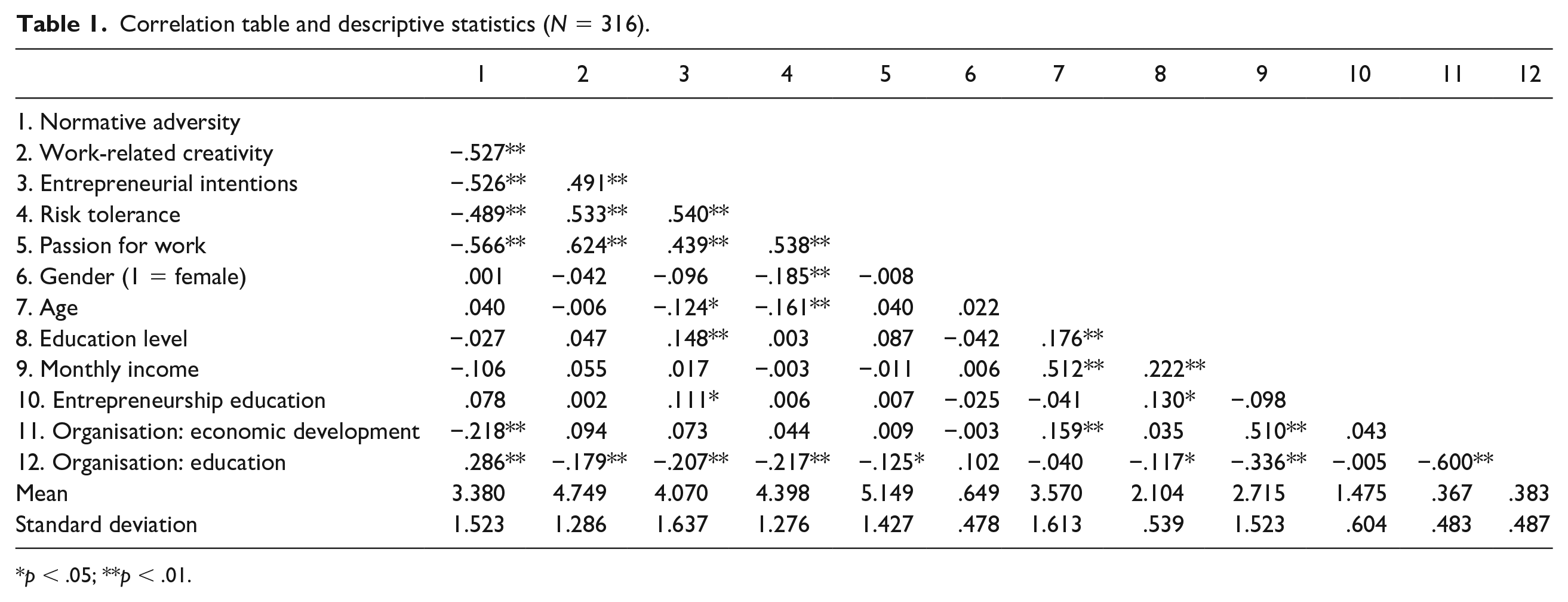
p < .05; **p < .01.
Mediation results (PROCESS macro) (N = 316).
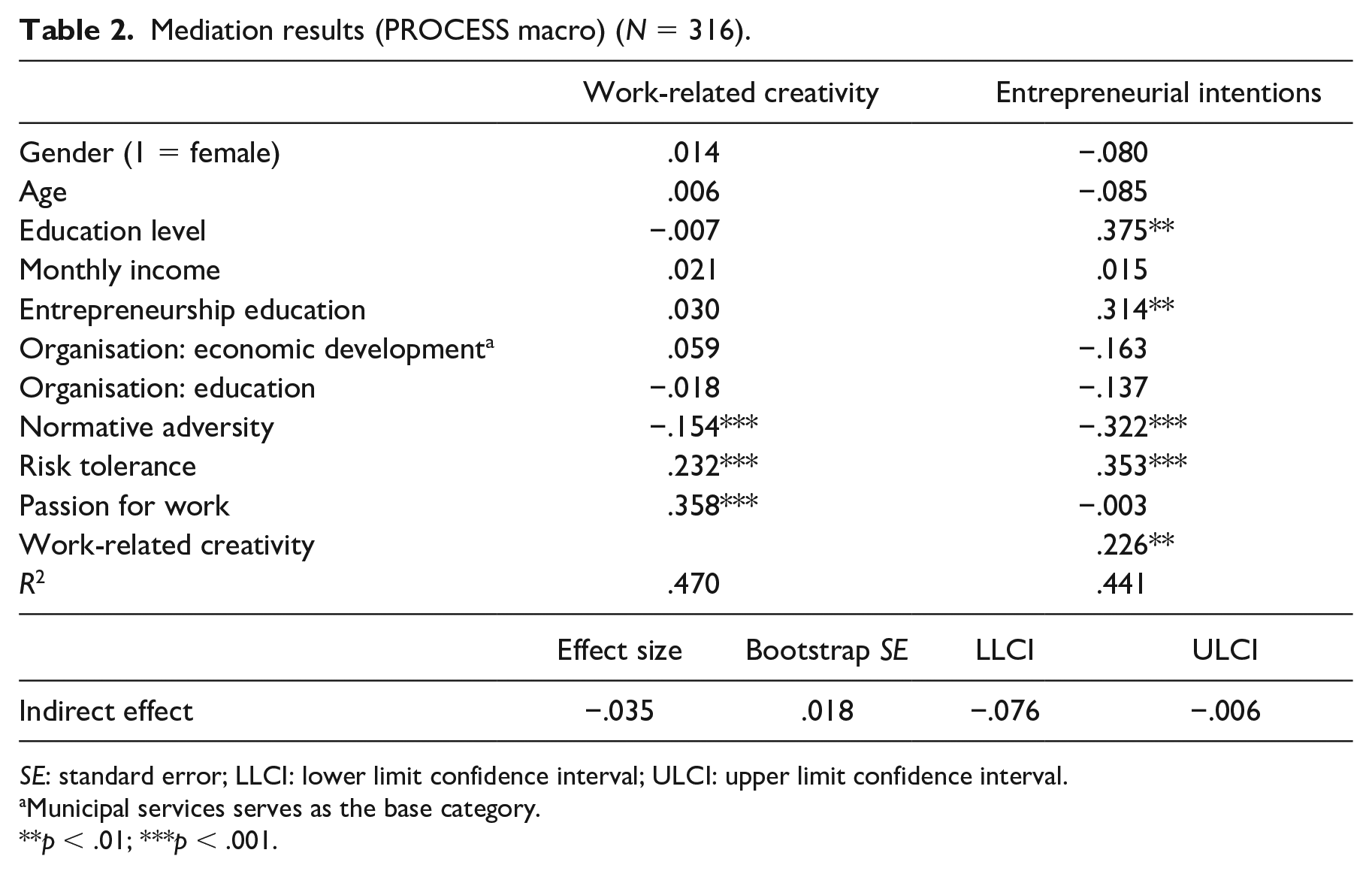
SE: standard error; LLCI: lower limit confidence interval; ULCI: upper limit confidence interval.
Municipal services serves as the base category.
**p < .01; ***p < .001.
The PROCESS macro findings, as reported in Table 3, Panel A, indicated a positive, significant effect of the normative adversity × risk tolerance interaction term (β = .121, p < .001) for predicting work-related creativity, consistent with the expected buffering role of risk tolerance. That is, the negative relationship between normative adversity and work-related creativity was weaker at heightened levels of risk tolerance (–.323 at 1 SD below the mean and .001 at 1 SD above the mean). The CI did not include zero at the lower level of the moderator ([–.434, –.211]), but the CI included zero at its higher level ([–.108, .107]), which indicates a non-significant effect at this higher level. Figure 2 depicts this interaction effect. The assessment of the presence of moderated mediation included a comparison of the strength of the conditional indirect relationship between normative adversity and entrepreneurial intentions through work-related creativity at different levels of risk tolerance. Table 3 reveals diminishing effect sizes at higher levels of the moderator: from –.073 at 1 SD below the mean, to .001 at 1 SD above the mean. The CI did not include zero at the lower levels of the moderator ([–.136, –.021]) but did at its higher level ([–.035, .031]). With a more explicit test of moderated mediation, we assessed the index of moderated mediation and its corresponding CI (Hayes, 2015). This index equalled .027, and its CI did not include 0 ([.008, .050]), in support of Hypothesis 4.
Moderated mediation results (PROCESS macro) (N = 316).
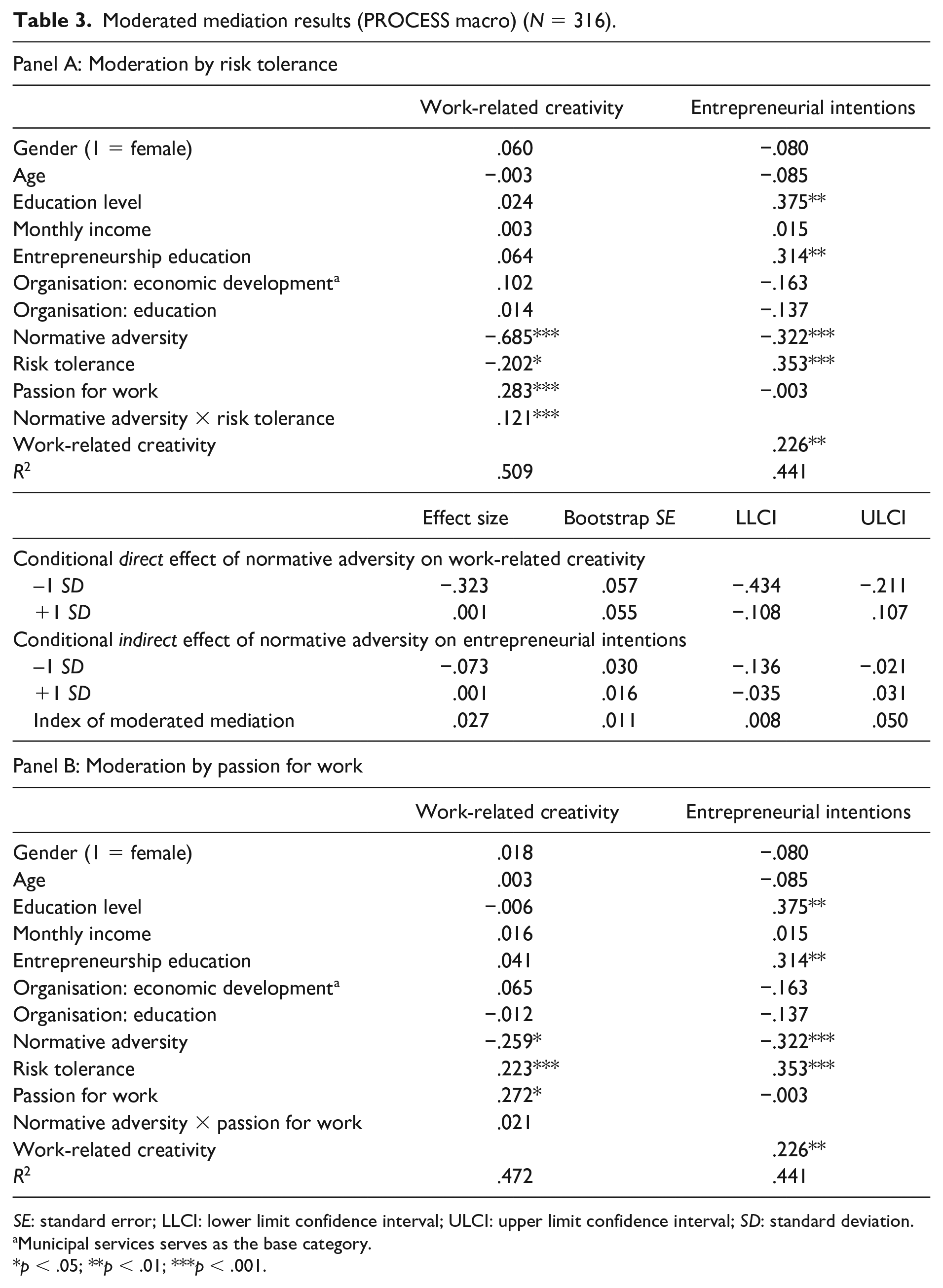
SE: standard error; LLCI: lower limit confidence interval; ULCI: upper limit confidence interval; SD: standard deviation.
Municipal services serves as the base category.
p < .05; **p < .01; ***p < .001.
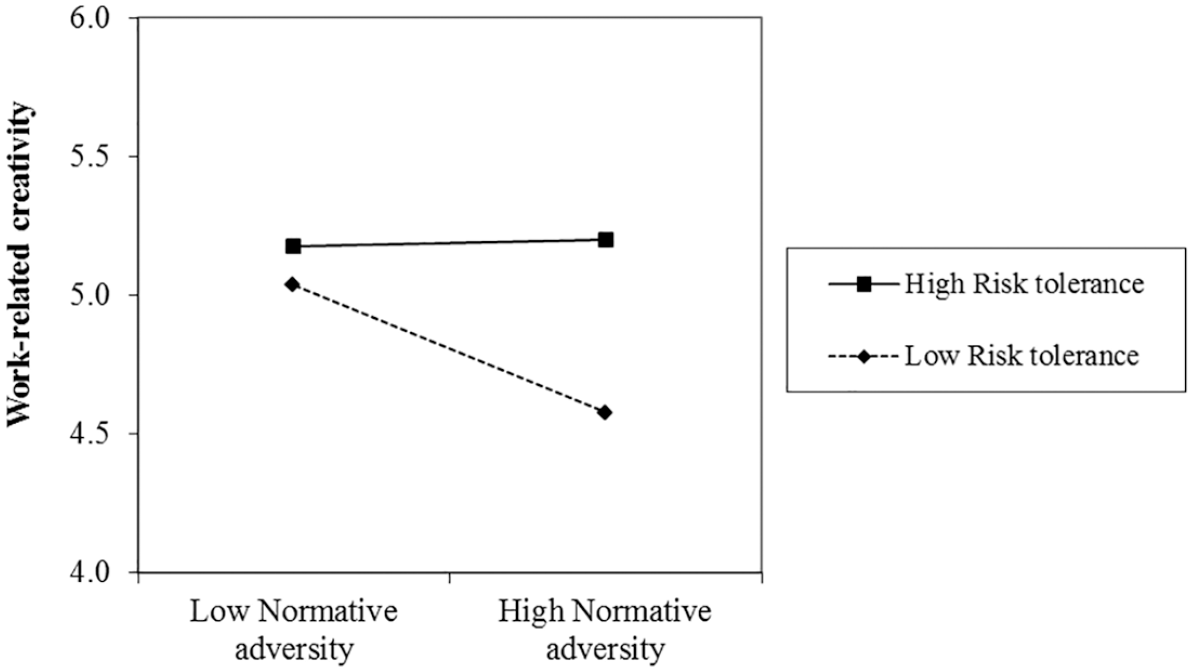
Moderating effect of risk tolerance on the relationship between normative adversity and work-related creativity.
However, the findings in Table 3, Panel B, did not support Hypothesis 5. That is, we found no significant effect of the normative adversity × passion for work interaction term (β = .021, ns) in predicting work-related creativity. The unreported results of the moderated mediation test revealed that each of the CIs for the indirect relationship between normative adversity and entrepreneurial intentions failed to include zero, so the negative indirect relationship was significant across the entire range of passion for work. The index of moderation equalled .005, and the CI of this index included zero ([–.007, .021]). Overall, the empirical results showed that risk tolerance, not passion for work, mitigated the negative indirect relationship between normative adversity and entrepreneurial intentions through work-related creativity.
Discussion
This study contributes to entrepreneurship research by investigating the role that perceived macro-level normative adversity has in predicting the entrepreneurial intentions of employees, with a particular focus on pertinent factors that explain or influence this process. Research that connects unfavourable macro-level influences upon plans for new firm creation (Feola et al., 2019; Kebaili et al., 2017) tends to rely on student samples, rather than employees, and do not address why, or when, they shy away from plans to create a new business related to beliefs about unfavourable societal norms. We have drawn upon COR theory (Hobfoll et al., 2018) to propose (1) that a diminished probability of starting one’s own firm in the presence of normative adversity with respect to initiative taking can be explained by an employee’s diminished propensity to be creative at work and (2) that risk tolerance, but not passion for work, buffers this effect.
A first theoretical insight that arises from the empirical findings is the importance of work-related behaviours (creativity), as conduits through which employee beliefs about societal norms translate into diminished plans for business creation. Consistent with COR theory, reflections upon broader norms that discourage personal initiative diminish creative efforts at work reflecting employee concerns that such efforts might undermine their workplace status (valuable resource) among organisational leaders (Chiu and Kwan, 2010; Hobfoll, 2001). The link between beliefs about societal norms and workplace behaviour reflects the premise that employees believe that organisational leader opinion, regarding what constitutes acceptable behaviour, mirrors those of society at large (Elenkov and Manev, 2005). This premise should be valid in many settings, but perhaps even more so in organisations whose leaders are expected to support the common good (e.g. government), as well as in collectivistic countries in which shared beliefs about what is acceptable spill over into the workplace (Hofstede et al., 2010). As this study reveals, employees who decide not to act entrepreneurially at work, indicated by their limited creativity in the work setting, and in response to the limited normative support for enterprising efforts, are ultimately less well positioned to consider an entrepreneurial career. Thus, we contribute to extant research on entrepreneurial inaction (Wood et al., 2017) by specifying an underexplored source and manifestation of such inaction, in the context of paid employment, regarding employee beliefs about unfavourable macro-level norms and their subsequent reluctance to develop new solutions to workplace problems.
A second critical insight notes the intermediate role of work-related entrepreneurial inaction is subdued by risk tolerance; this also aligns with a COR logic. Hesitation about engaging in disruptive activities that contradict prevailing norms about the (in)appropriateness of initiative taking, which may threaten to undermine reputations among organisational authorities, is mitigated if employees can rely on pertinent personal resources to assist in avoiding fears about reputation losses (Hobfoll et al., 2018). Employees who are risk tolerant are less concerned about the negative consequences that their potentially controversial work activities might evoke (Arnesen and Foster, 2016). As such, they are better equipped to avoid a scenario in which beliefs about normative adversity compromise plans to start a business bolstered by a willingness to undertake creative activities at work (Kim and Choi, 2018).
It is significant that identifying the buffering role of risk tolerance complements previous studies regarding the direct beneficial effects of stimulating propensities to embark upon entrepreneurial careers (Bell, 2019; Brandstatter, 2011). Thus, we identify how diminished work-related creativity and entrepreneurial intentions, due to unfavourable normative conditions, might be averted by a tolerance for risk; this helps employees cope with their fears under such conditions (Arnesen and Foster, 2016). To the extent that employees are willing to take risks, they are better able to contain concerns about the negative consequences that unsupportive normative conditions may have on their organisational standing, if they engage in creative activities at work. Notably, the lack of evidence of a similar buffering role of passion for work indicates that an employee’s cognitive energy, as manifested by risk tolerance, is more important in this process than emotional energy, in the form of passion. As a possible explanation, we posit that our conceptualisation of passion for work might capture the excitement employees feel about their work in general (Baum and Locke, 2004), rather than activities that entail elements of novelty. It would be useful to investigate the role of employee passion for creativity, which might be more effective for diminishing the chances that they resort to self-protective, conservative behaviours at work, in response to adverse societal norms.
Finally, we offer novel theoretical insights by bridging different levels. In particular, we connect employee beliefs about expectations that permeate society at large with behavioural actions in the realm of daily organisational work noting how this informs the likelihood that they may consider a career as an entrepreneur. We explicate how a tendency to curtail creative behaviours at work functions as a critical mechanism that links perceptions of adverse normative circumstances to diminished entrepreneurial intentions, with risk tolerance as an effective buffer.
Limitations and future research
This study has some weaknesses that open up possible areas for further research. First, the presence of reverse causality cannot be completely excluded in the results because of the cross-sectional research design. The very process of thinking about starting a new firm might spur the creative abilities of employees, which could generate more favourable perceptions about the surrounding environment. Our hypotheses are anchored in the well-established COR framework, according to which resource-depleting normative adversity fuels a desire to avoid potentially disruptive creative activities, which then has a curtailing influence on new business opportunity recognition (Hobfoll and Shirom, 2000). Longitudinal designs that measure the focal constructs at different points in time would be useful to estimate cross-lagged effects (Antonakis et al., 2010). 4 Such research could also assess whether entrepreneurial intentions lead to actual business creation, what motivates employees to act and what types of new businesses they form, which in turn might reveal the economic value created for society. A related extension would be to examine how the escalation of entrepreneurial inaction in the workplace (diminished creativity) into the avoidance of an entrepreneurial career and actual business creation might be mitigated by pertinent factors such as anticipated regret or proactive personality (Hatak and Snellman, 2017; Neneh, 2019).
Second, we relied on COR theory to argue that the negative link between normative adversity and work-related creativity can be explained by employee motivation to protect organisational standing (Hobfoll, 2001). Future research could measure this motivation explicitly and test a sequential mediation model that includes the intermediate roles of organisational reputation protection and work-related creativity in translating normative adversity into diminished entrepreneurial intentions. Continued studies also might investigate other mechanisms, beyond work creativity, such as problem-focused voice (De Clercq and Belausteguigoitia, 2017b), or idea championing (Walter et al., 2011), or goal commitment (De Clercq et al., 2009). An interesting extension might detail the explanatory power of each behaviour, including creativity, and simultaneously assess their roles.
Third, we predicted that risk tolerance and passion for work, as personal resources, buffer the escalation of normative adversity into reduced work-related creativity and then diminished entrepreneurial intentions. Future studies could examine other contingent personal resources such as employee resilience (Pérez-López et al., 2016), creative self-efficacy (Tierney and Farmer, 2011) or emotional stability (Beehr et al., 2015). Such studies might also consider previous work experience in entrepreneurship or business in general; these were not included in our data collection. Furthermore, other types of resources could subdue the harmful process by which concerns about unsupportive societal norms translate into lower work-related creativity and entrepreneurial intentions, such as the extent to which creative and entrepreneurial endeavours are part of a team effort (Knipfer et al., 2018), or whether employees can draw from formal institutional support mechanisms provided by universities or government (Saeed et al., 2015). It would be interesting to compare the relative potency of each alternative buffer, as well as specify the mitigating role of risk tolerance in their presence.
Fourth, the empirical context reflects a specific sector (government) and country (UAE). As noted in the ‘Theoretical background and context’ section, our arguments are anchored in COR theory and expected to apply to various settings. Yet, the current study setting is particularly relevant, because the likelihood that beliefs about societal norms spill over into the workplace and influence work behaviours of employees should be higher in organisations in which senior leaders (i.e. government officials) are strongly influenced by broader societal norms, as well as in collectivistic countries. That is, even if we expect that the nature of the hypothesised relationships remains the same, their strength might vary across organisations, industries or countries. Comparative studies that test the proposed theoretical framework in diverse organisations, spanning different sectors of the economy, thus would be useful. Such studies also could investigate the relative importance of societal-level normative adversity versus organisation-specific factors, such as size or the extent to which the organisational climate discourages change (Scott and Bruce, 1994) or is unforgiving of mistakes (Guchait et al., 2016). Cross-country comparisons similarly could reveal the roles of pertinent cultural values, such as uncertainty avoidance, that tend to influence the sensitivity of employees to societal norms that discourage them from taking initiative (Hofstede et al., 2010).
Practical implications
The study findings have important implications for entrepreneurs and societal stakeholders with an interest in boosting start-up activities. When employees are preoccupied by the lack of normative support for initiative taking, they may halt their efforts to find novel solutions to problems, for fear that organisational leaders will criticise these efforts, which ultimately can hamper their ability to detect relevant opportunities for new business creation. These employees also seem unlikely to openly criticise or complain about such societal norms, whether because they worry they might be the only ones with this opinion or because they do not want to gain a reputation as a critic (Chiu and Kwan, 2010; Solesvik et al., 2014). Educators and policy makers accordingly should be proactive in identifying fears about negative reactions to novel ideas at work; more broadly, they should actively promote a climate, in organisations and society at large, that encourages enterprising activities. Even if the adverse norms may change only relatively slowly, they can be altered or improved by complementary forces, such as educational programmes that expose people to the appeal of creativity and entrepreneurship at an early age (Elert et al., 2015).
Beyond this general advice to establish societal norms to support initiative taking, this study provides some recommendations for countries in which this goal is unrealistic in the short term. For example, historical patterns and persistent values might create shame-based responses to entrepreneurial failures (Fernández-Serrano and Romero, 2014). To the extent that pertinent educational programmes and government initiatives (e.g. tax breaks) diminish risk perceptions, it may be less likely that potential entrepreneurs halt their work-related creative activities, even when faced with these unfavourable societal norms, which should have positive consequences for the likelihood that they ultimately start a business. Even before they enter the job force, entrepreneurship educators should recognise the risks that employees might encounter if they devise new ideas in conflict with prevailing societal expectations (Chiu and Kwan, 2010; Sperber and Linder, 2019). To increase the likelihood that risk-averse employees still generate new solutions, even in the presence of normative adversity, educators could showcase role models with similar risk profiles who have been successful in launching their own businesses, due to their creative efforts at work.
Conclusion
This article has detailed the process by which employee perceptions of normative adversity, with respect to initiative taking may escalate into a diminished propensity to create their own firms, as well as explicated the ramifications of such perceptions for behavioural choices at work. The tendency to avoid creative activities is an important factor that explains this process. In turn, the buffering role of risk tolerance informs entrepreneurs and their stakeholders about a specific means through which they can disrupt the process. With these insights, this study has potential to act as a platform for further investigations of why employees consider entrepreneurial careers, even when they encounter challenges from society at large.
Footnotes
Funding
The author(s) disclosed receipt of the following financial support for the research, authorship, and/or publication of this article: The research is funded by United Arab Emirates University (UAEU Startup Grant #31B085).
