



Abstract
Cross-border e-commerce can enable smaller firms to quickly reach many foreign markets. This article examines how effectual market creation affects the international performance of small and medium-sized enterprises (SMEs) engaged in cross-border e-commerce. Building upon effectuation theory, we suggest that firms can drive foreign market demand by creating new ways to interact and engage with customers in the digital space. Analysing a sample of 99 Swedish e-commerce SMEs, we find that effectual market creation has a positive effect on their international performance. We also find that this positive effect is enabled by insidership in international markets, illustrated by activities related to international marketing analytics and international networking. Through these findings, we contribute to theory development on the internationalisation of small digital firms.
Keywords
Introduction
Cross-border e-commerce is enabled by the growth of digital markets, new consumer behaviours, and supportive policies for digital trade. Although this trend has accelerated in the era of the Covid 19 pandemic, cross-border e-commerce was already growing by 29% annually before the virus outbreak; twice the rate of domestic e-commerce (Accenture, 2019: 3). In Europe, 71% of e-shoppers buy from retailers and marketplaces located abroad (Cbcommerce, 2021). There are global political initiatives aiming to bolster e-commerce exports; for example, by the creation of improved logistic infrastructures (harbours, trade-hubs and freight networks), supporting regulations (subsidies and tariff exemptions) and a focus on creating digital markets, for example, through the EU Digital Single Market Initiative (European Parliament, 2020) and the China Belt and Road Initiative (Xiao and Zhang, 2020). Small e-commerce firms are recognising how e-commerce can serve as an enabler of international expansion but are, arguably, still held back by resource constraints (Qi et al., 2020), home-bias such that customers prefer domestically produced goods (Gomes-Herrera et al., 2014) and lack of digital capabilities (Tolstoy et al., 2021). Moreover, large digital marketplaces (AliExpress, Amazon and eBay) are shaping e-commerce on a global scale. Although marketplaces can facilitate cross-border transactions for smaller firms, they may also inhibit the autonomy of these firms and prevent them from gathering knowledge about, and connecting closely with, foreign market customers.
The rapid development of cross-border e-commerce has intensified calls for further theoretical and empirical analyses regarding how smaller firms can enhance international performance in the digital-sphere of business (Jean et al., 2020; Zahra, 2021; Zuccella, 2021). E-commerce retail concepts are idiosyncratic with specialised features that can limit their transferability to foreign markets (Park and Sternquist, 2008). Cross-border e-commerce firms may therefore, need to adopt marketing approaches where they actively drive the development of market segments. From a theoretical perspective, the processes by which markets and new business opportunities are created, rather than identified and exploited, have been described as “effectuation processes” (Sarasvathy, 2001). The specific notion of effectual market creation thus builds on the idea that markets are not “out there” but are being created in dynamic interaction between entrepreneurs and actors in the surrounding business environment (Sarasvathy, 2001). Drawing on Werhahn et al. (2015), effectual market creation is understood as entrepreneurial activity that exerts a controlling and shaping influence on the external environment for the purpose of expanding business.
In this article, we draw on recent research that advocates an integration of effectuation theory and network perspectives (Galkina and Chetty, 2015; Kerr and Coviello, 2020; Schweizer et al., 2010). Creating market opportunities through effectuation requires not only resources already possessed by the entrepreneur, but is also dependent on external resources (Sarasvathy, 2001). Hence, effectual market creation is deemed to be enabled by insidership in foreign markets where a favourable position links firms to critical resources (Johanson and Vahlne, 2009; Kerr and Coviello 2020; Monaghan et al., 2020). Insidership is understood as a secured market entry that comprises relationships and resources that enable firms to pursue opportunities (Monaghan et al., 2014). The means for acquiring such resources have partly shifted from the physical to the digital space. Hence, we argue that insidership pertains both to the digital business environment (access to market intelligence and digital analytics) as well as the physical business environment (access to partners, marketplaces and logistics). By immersing and tapping into the business environment for resources, small and medium-sized enterprises (SMEs) engaged in cross-border e-commerce may develop entrepreneurial opportunities through effectuation, ultimately affecting their international performance. In line with this reasoning, the purpose of this article is to examine how effectual market creation affects the international performance of SMEs engaged in cross-border e-commerce.
International performance is captured by financial indicators including return on investments (ROI), sales growth, profitability growth and revenue growth in international business. Furthermore, insidership mechanisms are captured by the constructs of international networking and international marketing analytics. International networking comprises connected business relations that facilitate the entry and business development in foreign markets (Tolstoy and Agndal, 2010). International marketing analytics is defined as the collection, management and analysis of data to obtain useful insights into marketing performance to support marketing decision-making in international business settings (Cao and Tian, 2020; Wedel and Kannan, 2016). Although research has made significant advances regarding cross-border e-commerce (Colton et al., 2010; Goldman et al., 2021; Lee et al., 2019; Tolstoy et al., 2021), empirical and conceptual verification of the drivers of international performance remain scarce. In this article, we aim to make two principal theoretical contributions to cross-border e-commerce research which can have external validity in adjacent research areas related to digital-enabled international business:
First, we aim to empirically substantiate and build on the findings of Tolstoy et al. (2021), by examining the presumed effect of effectual market creation on international performance of e-commerce SMEs. Entering foreign markets with a digital business concept is different from that of a physical concept; entrepreneurial opportunities may not be easily exploited but need to be formed by interactions with customers. Effectual market creation can thus, offer an explanation regarding how firms can become successful in foreign markets within the digital realm of business. Insights into this area advance theory development in international entrepreneurship studies, especially those focussing on digital modes of internationalisation (Zahra, 2021; Zuccella, 2021). Consequently, we respond to calls to undertake further research into international digital entrepreneurship (Zahra, 2021) to explain how technological artifacts and features affect firm behaviour and various aspects of internationalisation (Monaghan et al., 2020). Second, we draw attention to the contingent and contextual influences of effectual market creation in cross-border e-commerce by using insidership-theory. Research has specifically linked insidership dynamics to the effectuation framework, arguing that effectual market creation is underpinned by relationship development and learning in foreign market networks (Kerr and Coviello, 2020; Schweizer et al., 2010). However, the digital context calls for a new understanding of insidership as the spatial conditions and modalities for interaction have changed. In this article, we contribute to this theory with conceptual adaptations that are more attuned to international digital business; we also provide empirical evidence explaining how insidership enables effectual market creation in cross-border e-commerce.
Literature review: cross-border E-commerce in SMEs
Cross-border e-commerce is defined as the process by which firms sell goods and services to customers located outside their home markets by using information- and communication-technologies (ICTs) (Giuffrida et al., 2017; Qi et al., 2020). Transactions are made via the firm’s own website, or through the sites of internet-based intermediaries such as an online retailer or a platform-marketplace. Within the international business field, there is an ongoing discussion on how the growth of digital markets and e-commerce have radically shifted the international business landscape and enabled cross-border activity by firms in general, and SMEs in particular (Autio et al., 2021; Coviello et al., 2017; Tolstoy et al., 2016). E-commerce has offered many SMEs a low-cost medium to internationalisation (Jean et al., 2020; Tolstoy et al., 2016) facilitating the exploitation of new international opportunities with contemporary research clearly articulating how the adoption of cross-border e-commerce can enable SMEs to access untapped customer segments and further international growth (Hånell et al., 2020; Ojala et al., 2018; Tolstoy et al., 2016).
Despite the inherent opportunities connected to cross-border e-commerce, there are also substantial challenges when conducting online business across international borders. In fact, many empirical studies on cross-border e-commerce have focused on the impediments of such endeavours, and how to overcome them. For example, Van Heel et al. (2014) identify factors involving unreliable and lengthy transit times, complex and ambiguous return processes, bottlenecks at customs, limited transparency on delivery, price opacity and limited ability to alter delivery times and locations. Gomez-Herrera et al. (2014) study market failures within the EU digital market zone and find that effects of distance in fact are less important in online business settings, as compared to offline business settings. The evolving nature of online operations in international firms, in combination with the innate challenges of connecting with customers in cross-border e-business, have intensified the need to understand the actual drivers of performance in cross-border e-commerce (Goldman et al., 2021), particularly in the SME (Cassia and Magno, 2021). Some have explored this issue by focussing on firm characteristics rather than external circumstances, for example, studying how different strategic inclinations can enable SMEs to effectively manage cross-border e-commerce (Jean et al., 2020; Ojala et al., 2018).
This approach offers some explanation for the variance in performance in such ventures. For example, by studying a sample of 446 small firms from 20 European countries, Goldman et al. (2021) investigate the impact of growth orientations, customer orientations, and foreign market orientations on international performance in a split sample study comprising one group of firms from mature European markets, and from emerging European markets. Although the effect of the foreign market orientation was quite high in both samples, the customer orientation had a weak effect on international performance in the mature firm sample and a negative effect in the emerging market sample. Interestingly, this finding suggests that while a general understanding of foreign market conditions may benefit firms, it can even be harmful for firms to focus too determinately on detectable needs and wants in extant consumer segments. Reflecting this notion, Tolstoy et al. (2021) indicate that the international performance of cross-border e-commerce firms is more accurately determined by effectuation, where firms try out untested ideas by engaging customers through devising digital customer experiences. One case in this study marketed antiques and memorabilia to foreign customers through online interactions involving chats, live online streaming, innovative product displays. The firm avoided a superficial approach by focussing on markets where it could engage customers through executing compelling digital marketing offerings and, by so doing, drive the development of such markets. Hence, business development can take place in tandem with a digital transformation process within the organisation where firms break away from old business practices and reshape their business models to appeal to new markets. In this study, we build on this research by testing the relationship between effectual market creation and international performance; we also examine how this relationship is conditioned by strategic factors at the firm level.
Research has called for studies using effectuation theory to further our understanding of how small internationalising firms manage to exploit new opportunities abroad (Chetty et al., 2018; Jones et al., 2011). Effectual entrepreneurs seek to avoid Knightian uncertainty; for example, new and inherently unpredictable market conditions by creating markets, instead of predicting markets (Sarasvathy, 2001, 2008). To do so, effectual entrepreneurs need to engage with critical actors in the international market environment; specifically, they need to become insiders. In this vein, a conceptual fit has been proposed between effectuation theory and insidership theory to better understand acts of international entrepreneurship (Johanson and Vahlne, 2009; Kerr and Coviello, 2020; Prashantham et al., 2019; Schweizer et al., 2010). The term insidership implies that a lack of connections to relevant business relationships inhibits internationalisation by disconnecting firms from potentially valuable commitments and privileged information in foreign markets. For this reason, internationalising firms build relationships and work to become insiders in networks in their home, host and target markets (Monaghan et al., 2020).
Networks provide extended resource-bases that are essential for processes of effectuation. For example, Kerr and Coviello (2020) describe effectuation as “a network-driving and network dependent phenomenon” and argue that effectuation is exerted in network settings. Insidership theory is, however, calibrated for a non-digitised world where the insidership position is secured and upheld by social bonds developed within the physical realm. Internationalisation based on digital business models contest extant theories in international business studies by shifting focus from traditional market relationships to the electronic interfaces by which firms connect with their foreign customers (Banalieva and Dhanaraj, 2019; Singh et al., 2005; Wang et al., 2020). Within cross-border e-commerce settings the assumption of physical market presence could, therefore, be relaxed and more attention could be directed to digital market presence (Dillon et al., 2020; Penco et al., 2020). In this article, the relationship- and knowledge-dimensions of insidership theory are applied through the concepts international networking and international marketing analytics to capture both the physical and virtual dimensions of market immersion that can be beneficial for internationalising e-commerce firms (c.f. Dillon et al., 2020). In the following section we will discuss how the concepts of effectual market creation and insidership relate to international performance.
Conceptual framework and hypotheses development
The independent variable: Effectual market creation
Effectual market creation highlights distributed agency and places significant importance on engaging with relevant market actors for the purpose of shaping the future (Dew et al., 2009; Sarasvathy, 2001). This involves anticipating customer needs that they are yet unaware of, and developing business proactively (Sarasvathy, 2001). From this perspective, individual entrepreneurial entities and markets are not disconnected but entwined in value-creating processes (Dew et al., 2009). Although predictive logic and effectual logic can co-exist, uncertainty is a widely accepted boundary condition for effectuation (Chandler et al., 2011). Firms engaging in cross border e-commerce are facing a variety of markets with different levels of maturity related to digital business. Policy makers, for example, in the European Union, are striving to make markets better connected and more homogenous (European Parliament, 2020). Trade barriers (transportation costs, different languages and payment systems), resource constraints and information disadvantages, mean that smaller firms struggle to compete based on scale-advantages (Nambisan et al., 2019).
Recent case studies on cross-border e-commerce in SMEs have, however, provided empirical examples of firms that are able to tackle uncertainties by developing business in a gradual manner. Firms following these processes may start out using controlled resources that are continually refined by ideas that are born in the process of interacting with customers; for example, related to payment options, automated transactions, marketing content, integrity preferences, service/product features and campaigns (Hånell et al., 2020; Tolstoy et al., 2021). According to Tolstoy (2019), this process commences by a firm receiving unsolicited orders from a specific type of customer located abroad. Based on insights generated about these early customers, the firm develops resonating digital features. The malleability of the electronic transaction service itself (Monaghan et al., 2020) provides the means for e-commerce firms to effectuate business development in international markets. Hence, firms can build on early business acumen and continually expand international business by attracting more customers in a market space that the firm itself is defining. This in turn, may drive international performance in terms of increased sales volumes.
Effectual market creation has a positive effect on international performance of SMEs engaged in cross-border e-commerce.
The mediating variables: International networking and international marketing analytics
International networking connects the firm to other industrial actors and is instrumental to access resources and reduce uncertainty when creating an infrastructure for digital business (Cesinger et al., 2016; Chetty et al., 2015; Galkina and Chetty, 2015) or to create inroads to new foreign markets (Sandberg, 2014). As suggested by Johanson and Vahlne (2009), insidership may be more important for smaller firms as larger firms may already possess knowledge about the market. Networks—whether they are pre-existing or emergent—contextualise business and influence the structural, cognitive and behavioural aspects of effectuation (Kerr and Coviello, 2020). Such networks also allow smaller firms to leverage external resources by opening avenues for resource combinations, distributing perceived risk among multiple actors, and minimising costs of experimentation and, thereby, ultimately enhancing innovation and performance (Chandler et al., 2011; Tolstoy and Agndal, 2010). Through networks of suppliers, distributors and customers, SMEs can also strengthen internal capacities and capabilities to their advantage (Fraccastoro et al., 2021; Rovira Nordman and Melén, 2008). Network relationships provide means for transaction modality and resource-flows (Jarillo, 1988). Critical relations for cross-border e-commerce ventures may include actors that provide distribution through a marketplace (Shopify, Amazon and eBay), suppliers (operating through warehousing solutions or drop shipping where the product is shipped directly to the end-customer without passing by the merchant), and logistic providers that organise distribution, warehousing and fulfils the “last mile” delivery (see FedEx). Hence, international networking provides means that may be required to effectuate business opportunities related to cross-border e-commerce. The presence of international networking allows firms to iteratively develop sales, using low capital expenditures, that resonates with customers in foreign markets, ultimately improving international performance.
International networking mediates the effect that effectual market creation has on international performance of SMEs engaged in cross-border e-commerce. A physical market presence and knowledge generated through human-to-human interactions is not the only form of market immersion enabling insidership. Modern era technologies have moved a significant portion of business encounters to the virtual realm (Dillon et al., 2020), creating an arena for electronic interactions and information processing (Gregory et al., 2019). In this study, international marketing analytics serves as a dimension of insidership in digital business settings; these allow firms to acquire knowledge from their interactions with customers abroad. The ability to process information into business acumen is central for firms that operate on digital business models in international markets (Kerr and Coviello, 2020) as this acts as a vehicle for digitally aided learning. International marketing analytics are critical for firms engaging in cross-border e-commerce; this approach to effectively analyse collected data is relevant for dealing with customers (Hånell et al., 2020). Digitisation is providing an increasing number of tools for smaller firms to compete in international markets by facilitating the automated capture of online clickstream, word-of-mouth, location data, and order fulfilment (Wedel and Kannan, 2016). Digital interfaces applied in cross-border e-commerce may, thus, reduce the variable cost of data collection and offer insights into consumer behaviour in greater depth and granularity. Alford and Page (2015) argue that analysing online behaviour can cultivate a test-and-learn culture among smaller enterprises conducive to adapt, and fine-tune, goals based on the means at their disposal. In cross-border e-commerce settings, international marketing analytics offer possibilities to improvise and act upon behavioural cues to optimise payment methods, deliveries, offerings, campaigns, integrity preferences and electronic interactions. Tolstoy et al. (2021), illustrate how e-commerce SMEs, drawing upon insights about the behavioural patterns of foreign customers, gradually re-defined the online customer experience in the firm’s most important offshore markets. Effectual market creation is thus, contingent upon marketing analytics, both to gather insights about customer behaviour but also to assess outcomes of new digital solutions.
International marketing analytics mediates the effect that effectual market creation has on international performance of SMEs engaged in cross-border e-commerce. Figure 1 summarises the proposed linkages among the constructs in a theoretical model. The model describes how effectual market creation affects international performance in SMEs engaged in cross-border e-commerce. The model shows how two components of insidership, namely international networking and international marketing analytics, enable the effect that effectual market creation has on international performance.
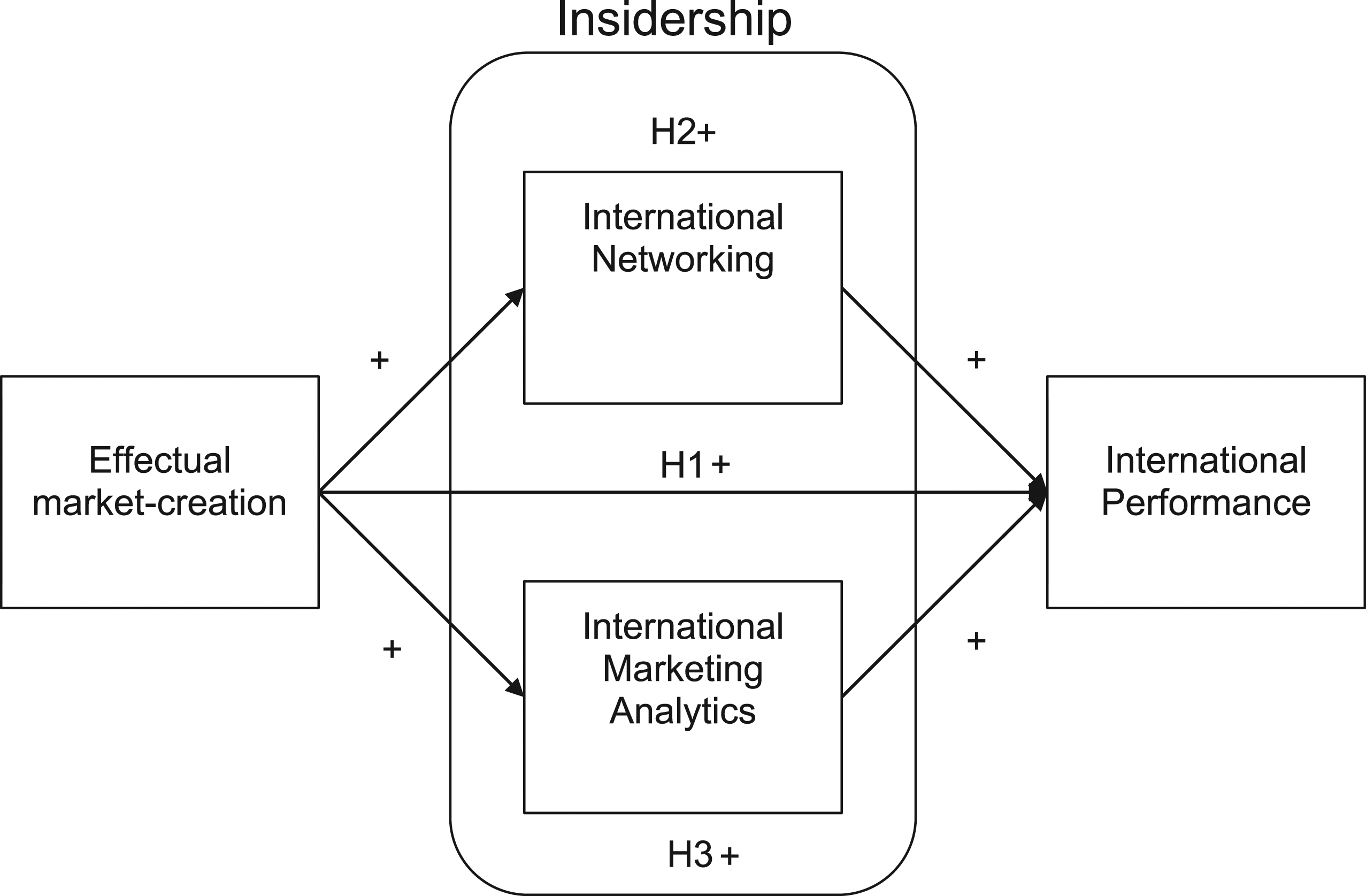
The conceptual model and the hypothesised relationships.
Method
In this study, we use survey data to test an empirical model. From the survey, we extracted conceptual constructs that, subsequently, were placed within a causal structure. This approach is suitable for testing theories by examining the relationship among variables (Creswell and Creswell, 2017). A survey was collected from Swedish retail SMEs deemed suitable as they are developing e-commerce involving consumer facing services and business concepts. The survey-items are developed through a three-stage process: (1) a literature review of international business research, (2) a review of international-oriented questions from previous questionnaires (Eriksson et al., 1997; Hånell et al., 2018) and (3) a literature review that identified new research issues concerning e-commerce and international knowledge acquisition in SMEs.
Based on the themes discussed in the literature reviews, a qualitative and longitudinal case study project was conducted (building on archival data and face-to-face interviews with founders and managers) in five internationalising SMEs in the retail industry. The respondents were interviewed in depth about challenges and opportunities in the internationalisation processes. Insights gathered in these studies motivated the inclusion of effectuation concepts in the survey. A strength of the questionnaire is, thus, that it is based on input from both theory and practice. Two retail SMEs were selected for a pilot-study; the respondents completed the survey and commented on its readability and perceived relevance. We used the feedback to modify the survey, ensuring that the respondents could understand all questions. The respondents were asked to answer questions about their engagements in important foreign markets, specifically focussing on their online strategies. Most survey items were measured on a five-point item scale, with ratings ranging from low (1) to high (5).
Sampling and data collection
Swedish SMEs that met the following three formal criteria were targeted: (1) at least 5% of their turnover were generated from export sales, (2) the firm had between 5 and 250 employees and (3) they were organised under the SNI industry code 47 (containing Swedish retail businesses except for motor vehicles and motorcycles). By using these criteria, data with information about 334 firms from different parts in Sweden was bought from Statistics Sweden’s Business Register. The next step was to review the responses to determine their fit to the study; as we wanted to maintain a Swedish sample, we decided to only include firms that had Swedish head-offices. We also decided to exclude firms that were dormant (firms that did not report any recent turnover), and those in reconstruction processes or bankruptcy. After this reduction, 278 firms remained as potential respondents.
The survey was distributed via the online survey platform Qualtrics in several rounds between 2018 and 2019. The study used a single key informant approach, common in marketing research (Phillips, 1981). Researchers used a combination of methods to identify key respondents (marketing managers or online sales managers). The first step was to look for contact-information on official websites; if no contact information was provided, the firms were contacted by telephone which generally provided e-mail addresses for the missing respondents. Attached to the survey was a letter that stated the purpose of the project; it also stressed confidentiality (to mitigate social desirability bias). We also offered the respondents a reward of a lottery ticket.
In the first round we only collected 36 responses. When commencing the second round of data collection, we contacted the identified key respondents by telephone and on LinkedIn to remind them about the survey. This increased our sample to 122 firms (with 99 complete and 23 partially answered questionnaires). Thus, the total response rate is 44%—comparable with other studies on Swedish samples of SMEs (Thorgren and Wincent, 2015). For this study we added an additional selection criterion and only selected firms engaged in cross-border e-commerce. By applying this criterion and rejecting responses with too many missing values, we had a final sample of 99 firms. Even though many respondents opted not to participate, mainly due to a lack of time, the response rate is sufficient for the purpose of this project. Because non-response bias is a concern, the investigators have compared the secondary data from the Statistics Sweden Business Register between responding and non-responding firms. No significant differences were detected between these two groups regarding size, location and level of internationalisation. Non-response bias is, therefore, unlikely to be problematic when interpreting the findings.
Descriptive statistics reveal that the firms often diversified their sales-channels in to pursue international markets. Normally they used a combination of partnerships and managing their own online sales-channels. About half of the respondents diversify their sales channels using both online channels and partnerships. Moreover, 73% of the firms managed their own e-commerce websites. On average, approximately one third of the total e-commerce revenue stream came from foreign markets and international sales accounts for 44% of total business.
Data
We used regression analysis and mediation analysis to test the direct and indirect effects of international networking and market analytics on performance. Data were analysed by using the software Statistical Package for Social Sciences (IBM SPSS version 27). For the mediation analysis, we also used the PROCESS-macro (version 2.16.3) developed by (Hayes, 2013). Although structural equation modelling remains the most common method for mediation analysis, we choose the PROCESS-technique as it is convenient for estimating parsimonious modes (not involving sequenced mediation). Furthermore, inference about important statistics applied by the programme related to mediations are based on bootstrapping methods which effectively deal with irregular sampling distributions (Hayes, 2013). Specifically, bias-corrected bootstrapping is considered a powerful method to detect mediation (Memon et al., 2018). In practice, studies have demonstrated little discrepancy between mediation analyses by structural equation modelling and studies based on the PROCESS-macro (Hayes 2013). Mediation is assessed by studying the indirect effect of X (the independent variable) on Y (the dependent variable) through M (the mediating variable). This effect can be determined as significant independent of the nature of the direct effect (the effect of X on Y) and the total effect (the effect on Y when both X and M are set as predictors). As Memon et al. (2018) point out, mediation analysis is an increasingly acclaimed method in many research fields. The method enables analysis of causal inferences and can overcome some of the problems related to endogeneity in cross-sectional samples. Most studies claiming to conduct mediation analysis, however, merely discern causal paths and do not measure the mediation effect itself. The application of mediation analysis, estimating the effects of mediation, can, thus, be regarded as a novel methodology in the field of international business, allowing granular contributions to theory.
All variables are factors that include at least three items. The factors are reflective, meaning that they all mirror a higher order concept and that they, for this reason, are expected to correlate with each other. As the correlation matrix shows, however, no independent variables or mediators have a higher correlation coefficient than >0.5 which is a first sign of discriminant validity. Worth noting in the correlation matrix is that international export intensity and cross-border e-commerce intensity measures are positively correlated with each other. This condition is expected since volumes of total sales are likely to be near proportional to online sales.
Independent variable
Although there are variations of scales used for effectuation (Chandler et al., 2011), this study focusses on one specific facet of this concept, namely the process by which opportunities are formed which, according to the effectuation framework, is a control feature (Sarasvathy, 2001). Effectual entrepreneurs control the pursuit of business opportunities by proactively shaping the market in the formative stages of business development. This phenomenon is captured by a four-scale measure by Werhahn et al. (2015) that is applied in this study. We have removed the co-creation indicator from the scale which is judged to have a conceptual overlap with the international networking indicators.
Mediating variables
Correlation matrix.
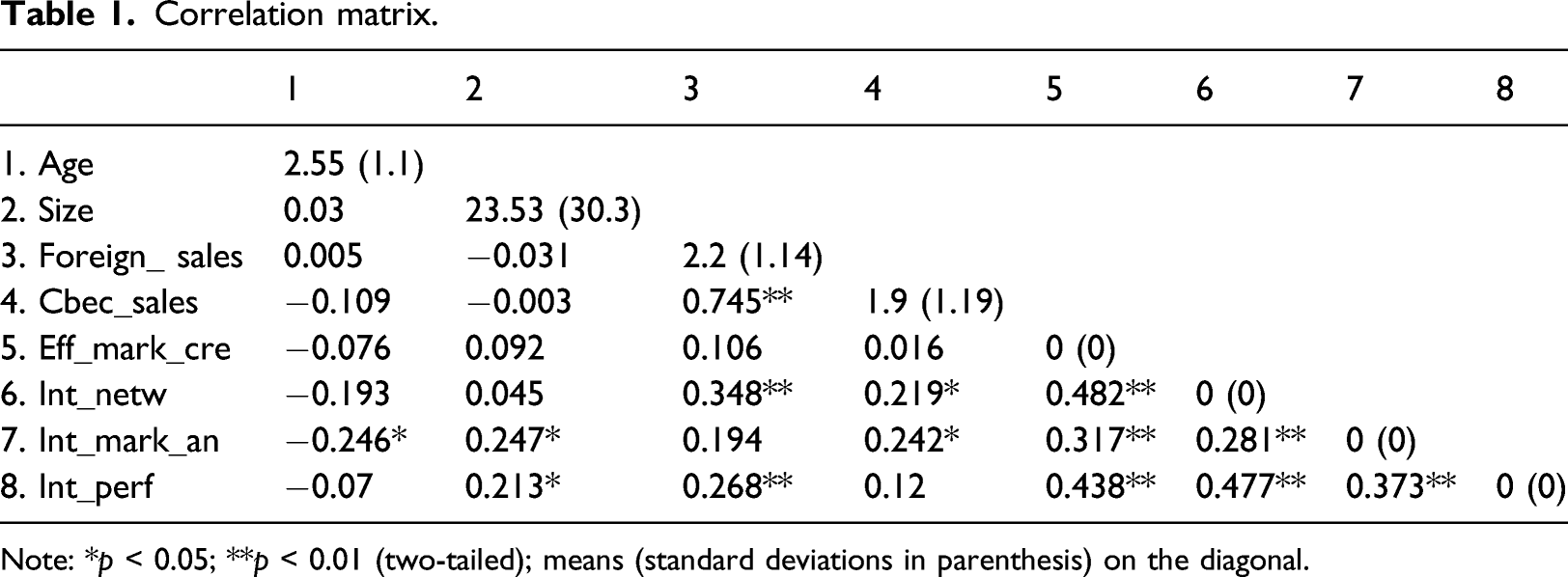
Note: *p < 0.05; **p < 0.01 (two-tailed); means (standard deviations in parenthesis) on the diagonal.
Dependent variable
International performance is based on a four-item measure of self-reported ratings regarding ROI, sales growth, profitability growth, and revenue growth. These measures are performance indicators well-established in the field of international business (Shoham, 1998). Growth and profitability are relative measures that allow for comparisons between larger and smaller firms (Shoham, 1998). Further, the use of primary data for measuring performance in IB is particularly appropriate when the researcher is aiming to identify not only the goals associated with a specific strategy, but also the interpretation of an organisation’s performance goals by managers. Hence, perceptual measures capture performance in areas where it matters to managers (Brouthers, 2002). As a robustness check we tested the correlation between the perceptual measure and the objective revenue estimate reported by each firm. The correlation was positive (0.26) and significant (at the 0.05-level).
Control variables
Finally, four control variables were included in the study. The first was duration in foreign markets in the categories a.) less than 6 years; b.) 6–10 years; c.) 11–20 years, d.) more than 20 years. We also used firm size (number of employees), intensity of international sales (a ratio measure of the share of international sales of total sales in percentage), and intensity of cross border e-commerce sales (a ratio-measure where intensity of cross border sales is the percentage of e-commerce sales divided by percentage of total international sales). These variables mirror basic firm characteristics, level of internationalisation, and e-commerce intensity all of which, plausibly, could have an impact on the model.
Reliability and validity of measures
The constructs and their indicators.
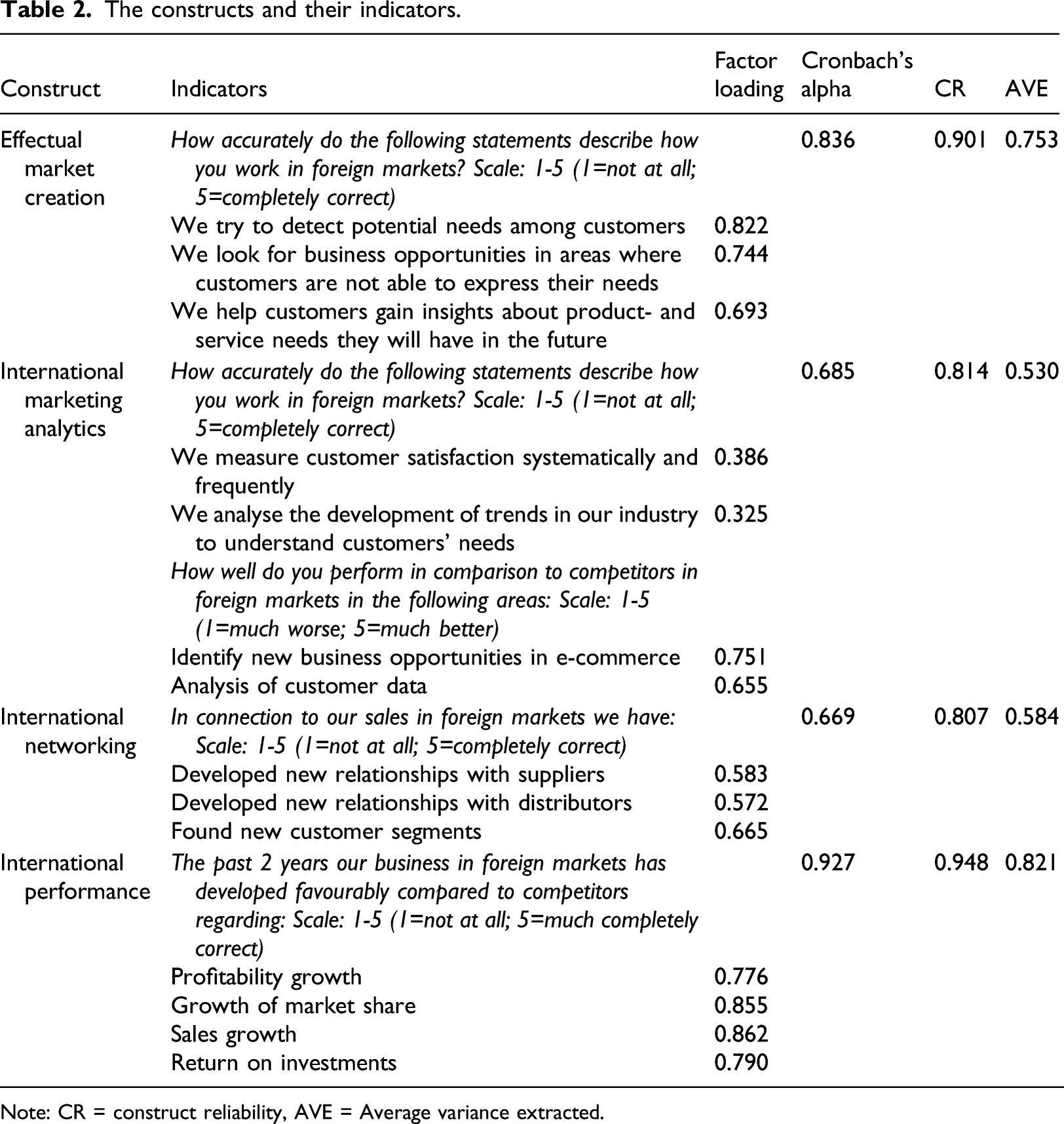
Note: CR = construct reliability, AVE = Average variance extracted.
Common method variance
Operating on the assumption that an ounce of prevention is worth a pound of cure, ex-ante measures were taken to avoid common method variance (Podsakoff et al., 2003). For example, measures were captured by different scale ranges and different anchor labels. Scores derived from the survey were used to create the factors used in the analysis. Furthermore, we avoided putting related questions in clusters. This was designed to prevent respondents from becoming biased by their initial responses and use them as reference when answering the remaining questions (Podsakoff et al., 2012). We also checked for common method variance by using post hoc analysis through a series of tests. We conducted a principal component analysis based on a varimax rotation test to check for systematic measurement errors. When conducting this test, four components emerged with an eigenvalue over one; together, they represented 71% of the total variance. The largest component did not explain most of the total variance (40%), which can be a sign of a systematic measurement error. Furthermore, a Harman’s single-factor and a marker variable test were conducted. Both these tests were favourable to our analysis because none of the models fit the data. These results indicate that common method variance does not pose a serious threat to the validity of the results.
Results
Mediation analysis.
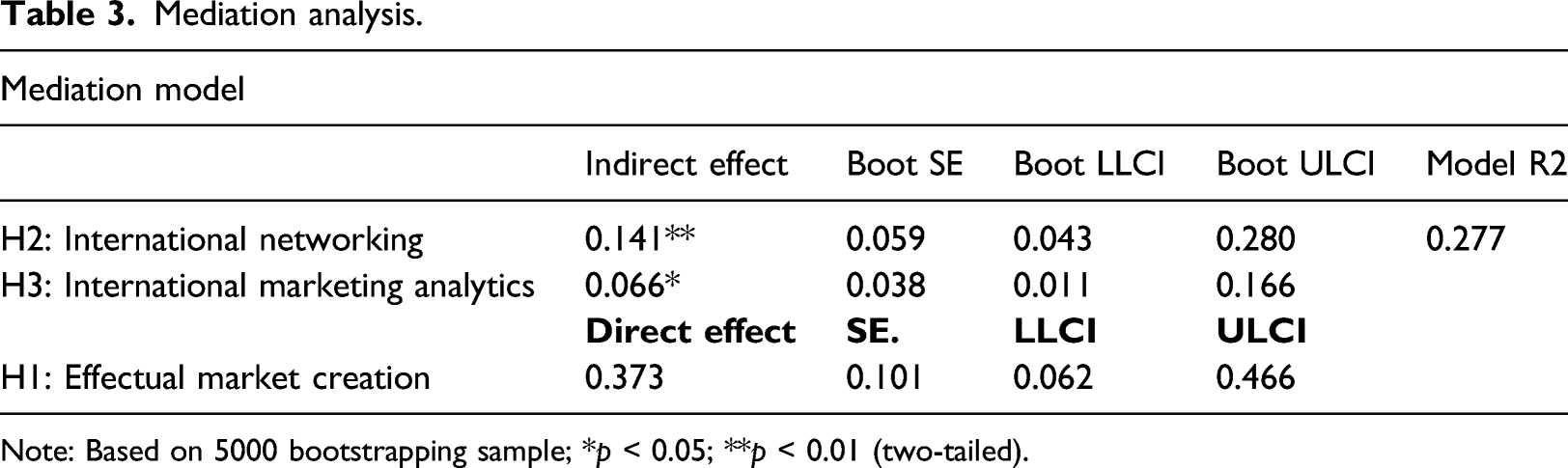
Note: Based on 5000 bootstrapping sample; *p < 0.05; **p < 0.01 (two-tailed).
Table 3 also shows the estimates of the mediation analysis. The values of the 95% (or the 99%) bias-corrected bootstrap confidence interval did not straddle a 0 in between, indicating the presence of mediation. Contemporary literature (Hayes and Rockwood, 2016; Rucker et al., 2011) argues that all mediation effects in social sciences studies are partial. Full mediation implies that a researcher has completely explained the process by which X influences Y and no additional research is needed to search for further mediators (Hayes and Rockwood, 2016). To achieve full mediation, one would have to include all possible mediators and suppressors in the model and measure them without error. Hence, interpretations of full mediation should be taken with caution. Based on the statistics, it can be concluded that both international networking and international marketing analytics mediate the relationship between effectual market creation and international performance within the realm of the specified model, thus supporting Hypothesis two and Hypothesis 3. The results thus, indicate that effectual market creation is possible if firms have established different types of connections to foreign markets, either related to knowledge inflow (international marketing analytics) or to business contacts (international networking). The theoretical and practical implications of these effects will be addressed in the discussion.
As a robustness check, it is worth noting that the investigated mediators both have discrete direct effects on international performance (International networking = 0.22; International marketing analytics = 0.175). All effects are displayed in Figure 2. Our tests of control variables show no significant effect of the control variables within the realm of the full model. Results of analysis. Note: *p < 0.05; **p < 0.01 (two-tailed).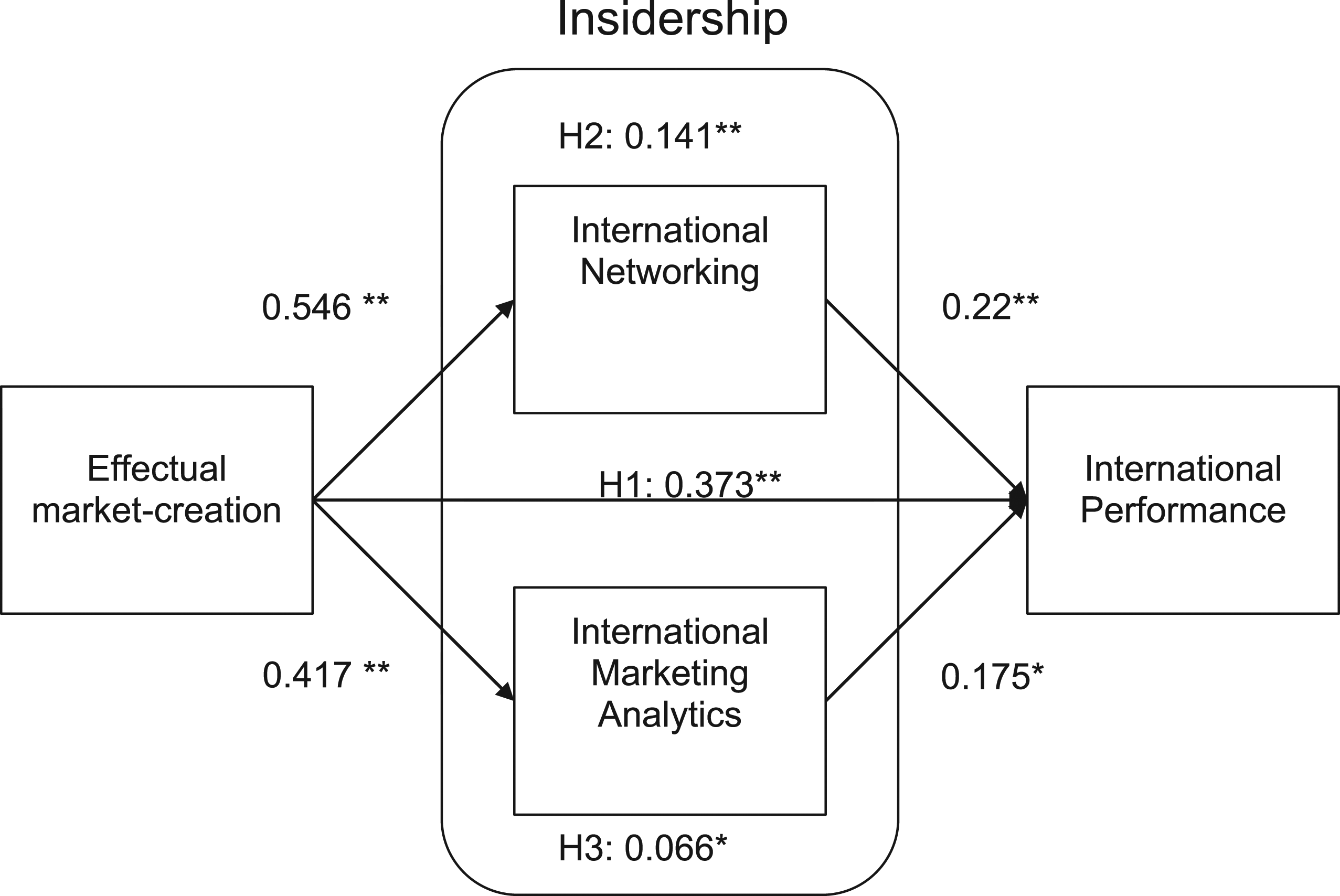
Discussion
This article has developed a model that seeks to explain how effectual market creation affects international performance in SMEs engaged in cross-border e-commerce. In so doing, we take a different perspective from research that examines cross-border e-commerce operations through a marketing strategy lens, estimating the impact of various customer-oriented strategies and tactics. For example, Goldman et al. (2021), argue that marketing and growth orientation enable firms to accurately adapt their online services and offerings to different customer segments on a global basis. Although these studies have provided valuable explanations to how firms can develop business effectively in existing, and established, markets they arguably offer lower explanatory power in settings of high uncertainty (Hånell et al., 2020; Tolstoy et al., 2021). When expanding digital business internationally, merely adapting to overt needs is insufficient for firms to claim a stake in foreign markets and stand out amongst competitors. Firms both exhibit and seem to benefit from effectual behaviour where they drive the development of new market segments. This article offers new insights on this issue and makes two principal contributions:
The first contribution lies in the empirical insights generated in exploratory case-studies related to effectual business development in cross-border e-commerce (Tolstoy et al., 2021). By showing that effectual market creation positively influences the international performance of e-commerce SMEs, we demonstrate that digital business development in international markets can follow a trajectory where firms gradually and creatively build upon pre-existing resources and competences. This analysis contributes to our understanding about digital-enabled international entrepreneurship, suggesting that effectuation frameworks can offer relevant and useful perspectives to explain international performance. Our evidence also qualifies the idea that effectual market creation enables firms to control the innate uncertainties of digital business in international settings.
An effectual approach implies that you do not need all the answers for embarking upon international business at the outset. Firms can explore ideas and concepts and may, in the process, identify areas where traction can be gained amongst key customers. Effectual entrepreneurship can, therefore, be an engine for international expansion among firms using digital business models. Previous studies in international entrepreneurship using effectuation frameworks have primarily focused on traditional markets where individual entrepreneurs find ways to create their own opportunities and scale up their businesses (Chetty et al., 2018). There have, however, been fewer studies focussing on effectuation in situations where business is based on digital transactions. We argue that digital business is suited to study through the lens of effectual market creation. The digital space is highly malleable with room to offer customised service and product content. At the same time, establishing a position for an e-commerce concept in a foreign market is challenging. Firms cannot rely on physical cues such as stores, product demonstrations, and local presence to become visible and gain initial recognition.
As our evidence suggests, success may be gained not by depending upon established approaches but rather, expanding the firm using insights and contacts gathered during the commercialisation process. Effectual market creation in the digital market therefore, implies creating digital market offerings that go beyond what is currently available. In the process of effectual market creation, firms may find new ways of communicating with customers, new ways of facilitating transactions, and new ways of framing products and services on digital platforms. Along with e-commerce becoming increasingly globalised and boundaryless, we argue it is becoming more relevant to learn how entrepreneurship is effectuated in this area and its implications for the shaping of cross-border e-commerce in a broader sense. We do not attest to the causes of effectual market creation but argue that circumstances may explain how such processes translate into international performance. Such circumstances relate to insidership in foreign markets associated with the second principal contribution of this study.
The second contribution of this article is the finding that insidership provides a conduit for effectual market creation in cross-border e-commerce. Reflecting arguments by Kerr and Coviello (2020), we find that extant theories of internationalisation can be useful to analyse digital modes of internationalisation. Our analysis draws upon empirical which shows that firms who immerse themselves in foreign markets by building partnerships may become better equipped to develop marketing concepts that resonate with foreign market customers. Insidership in international networks may provide access to logistic infra-structures, integrated value-chains market intelligence through interactions (Cesinger et al., 2016) and entry node customers upon which firms can build (Sandberg, 2014). We also make a theoretical contribution to insidership theory by adding the dimension of international marketing analytics; this is particularly relevant in the context of cross-border e-commerce. We build on the notion by Dillon et al. (2020), who assert that digital entrepreneurship implies digital market immersion by connecting to customers in the virtual space. Taking marketing analytics into account could inject the digital business dimension into insidership-theory and make the framework apt to analyse digital modes of internationalisation.
Monaghan et al. (2020) argue that while extant studies on digital entrepreneurship provide insights about how digital artefacts affect internationalisation possibilities and behaviours, there is a need for further research to analyse the connection between the creation of digital market offerings and internationalisation. Our article has provided evidence of how such connections are created, indicating they are gradually developed by entrepreneurs through effectuation. Drawing upon Alford and Page (2015), our findings can be used to suggest that marketing analytics provides leeway for firms engaged in cross-border e-commerce ventures to test and try new ways of serving customers at relatively low risk. This article thus, makes a conceptual contribution to insidership theory by capturing a digital dimension of market immersion.
Managerial relevance
We explore an issue of great relevance, particularly for managers in firms that wish to scale e-commerce operations beyond home-markets (see Goldman et al., 2021; Tolstoy et al., 2021). To effectuate new markets, it is necessary to explore the needs of future customers. To do so, the attention of managers should not be limited to how markets work at present but they should also concern themselves with what areas customers could be engaged in the future. This could relate to product offerings, but also involve the digital service encounter. Picking up cues from consumer behaviours is thus critical to know how to drive business development. Potential barriers to gain such insight could be lack of market presence, lack of networks, lack of cultural understanding or lack of language skills. It could also have to do with a lack of expertise on how to interact with customers on digital platforms, to generate value, and to gain market intelligence. These problems may be alleviated by sourcing expertise in digital business and/or social media that can translate insights about foreign market customers into digital marketing offerings. Effective interfaces between seller and buyers could create dynamic relationships, enabling firms to take leading roles and help customers to gain insights about their future product- and service-needs. Buyers and sellers in the digital space are still experimenting with ways to interact and negotiating the terms of their exchange. The evolutionary nature of cross-border e-commerce creates space for entrepreneurs to develop digital concepts and services that they may not have been fully aware of until overtly presented to them. In this environment, firms need to be transparent and let consumers know that they act on feedback and are willing to re-evaluate and adapt product and service content.
Limitations and directions for future research
The empirical evidence presented in this article is built on a parsimonious model which is not completely exhaustive nor mutually exclusive vis-a-vis alternative explanations. The study focuses upon the market creation aspects of effectuation originally deemed to be a control mechanism used by entrepreneurs to address uncertainty. Rather than facing the unknown, this practice enables entrepreneurs to take matters into their own hands. The effectuation framework, however, also includes other dimensions important for entrepreneurial activity (for example, affordable risk, leveraging contingencies and personal commitment of entrepreneurs) that could be elaborated upon in future studies related to cross-border e-commerce and in adjacent domains of research.
Although attracting an increasing amount of interest, cross-border e-commerce is still a nascent area of research which deserves further attention given the fast pace of development and business relevance of this field. This article has shed light on how factors related to the firm and its business interactions affect international performance. However, to fully grasp the development of cross-border e-commerce this perspective may be too narrow. Cross-border e-commerce is dependent on global trade conditions involving policies, tariffs, and logistic/digital infrastructure. For example, the EU Digital Services Act, which is currently being negotiated, is likely to have a decisive impact on e-commerce in the EU-region. Moreover, China, which has been deemed the leading country in cross-border e-commerce, is constantly developing policies and solutions to facilitate online transactions to increase the global reach of its e-commerce firms. Hence, we encourage scholars to closely examine how transitions in trade, in a variety of business environments worldwide, influence cross-border e-commerce. The split-sample study by Goldman et al. (2021) examining cross-border e-commerce ventures in both western markets and emerging markets is a promising step in this direction, but more precise information is needed about the institutional and economic context of cross-border e-commerce ventures to draw further conclusions about the influence of the surrounding business environment. Finally, while logistic solutions and emerging technologies form the basis of cross-border e-commerce, this study has not delved into this issue. To provide the whole picture of how to scale operations, how to develop the customer experience, and how to improve e-commerce services in cross-border e-commerce, this dimension ought to be further explored.
Conclusion
This article has analysed how effectual market creation affects the international performance of SMEs engaged in cross-border entrepreneurship. Based on a parsimonious model, we examined the mediating effects of insidership, specifically along the dimensions of international networking and international marketing analytics. We learnt that the effectual framework and insidership theory can be fruitfully combined in the analyses of digital international ventures manifested by cross-border e-commerce. As international trade becomes more digitised, theory development and theory testing in emergent digital areas of international business is necessary (Zahra, 2021; Zucchella, 2021). By showing that effectual market creation is a viable force in cross-border e-commerce settings, we answer such calls for further research (Monaghan et al., 2020). Specifically, we offer a novel perspective useful for analysing the development of entrepreneurship in digital international market settings, setting a foundation for future studies to build upon. The findings of the study are likely to have external validity stretching beyond the realm of cross-border e-commerce ventures. We believe that there is scope to use an effectuation-based model, proposed in this article, to analyse various types of digital ventures in the international marketplace such as digital market communication, digital-enabled brand building and digital services marketing.
Footnotes
Declaration of conflicting interests
The author(s) declared no potential conflicts of interest with respect to the research, authorship, and/or publication of this article.
Funding
The author(s) received no financial support for the research, authorship, and/or publication of this article.
