



Abstract
Contemporary research has highlighted entrepreneurial sensemaking as a dynamic, socially embedded action undertaken to reduce uncertainty, but scholars have yet to fully address the role of routine-like immanent sensemaking employed when entrepreneurs try to understand their task environment. Defined as a routinised way of making sense of how to proceed in novel situations, we investigate how entrepreneurs use immanent sensemaking as they continuously seek to make sense of their consumer context. Our study reveals that entrepreneurs absorb individual, social and cultural signals from consumers to support their judgement and action. The findings suggest that entrepreneurs use immanent sensemaking not only for unusual events but also construct multilevel frames to understand their customers as individual, social and cultural beings in their everyday encounters.
Introduction
Entrepreneurs seek and create circumstances under which entrepreneurial outcomes – essentially in the form of new products, services or business models – can be profitably introduced to markets (Venkataraman and Sarasvathy, 2001). This pursuit of entrepreneurial opportunities depends on the insights, sensemaking and actions of the entrepreneurs involved (McMullen and Dimov, 2013; McMullen and Shepherd, 2006; Sarasvathy, 2001). Entrepreneurs apply sensemaking to consumer needs to understand which offerings will be most attractive to the customer (Selden and Fletcher, 2015). Sensemaking is continuously and socially shaped, discussed and interpreted (Dimov, 2007) and is a crucial component in both understanding and resolving problems (Kimmit and Muñoz, 2018).
Nevertheless, the interpretation of consumer desires and the act of understanding their needs is shaped by uncertainty. In the sensemaking literature, uncertainty and ambiguity are typically embedded in organisational contexts. Disruptive events occurring in a venture’s environment challenge standard ways of running a business (Maitlis and Christianson, 2014; Sandberg and Tsoukas, 2015). The issue with this approach being that it treats uncertainty as complete unknowingness (Townsend et al., 2018) and therefore, neglects the immanent sensemaking entrepreneurs utilise when faced by lesser degrees of uncertainty (Sandberg and Tsoukas, 2015). In everyday interactions with customers, uncertainty arises when the entrepreneur does not know the precise nature of customer needs or how to address them (Packard et al., 2017). It is at this point they call upon immanent sensemaking to understand novel or unexpected cues in consumer behaviour to continue to enact with the environment (Maitlis and Christianson, 2014; Weick, 1995) and envision the workings of the consumer’s world (Hill and Levenhagen, 1995). We reference the arguments of Sandberg and Tsoukas (2015) in suggesting that the understanding applied by entrepreneurs is characterised by routines; this defines immanent sensemaking as routinised sensemaking and so guides them upon how to proceed in novel situations.
Routines refer to the standard-like ways utilised to process and rationalise one’s surroundings. Hence, routines reduce uncertainty when entrepreneurs face novel situations (Giménez Roche and Calcei, 2021). Maitlis (2005) emphasises that sensemaking enables individuals to work with uncertainty by rationalising their surroundings and illuminating the actions necessary to navigate such uncertainty (Fisher et al., 2020). This sensemaking is immanent and involves the concept of absorbed coping, according to which individuals become immersed in action without the awareness of being involved (Sandberg and Tsoukas, 2011). As most aspects of organising are characterised by routines, rather than interruptions (Jones and Li, 2017; Sandberg & Tsoukas, 2015, 2020), it is logical to address immanent sensemaking as the mundane, routinised interpretation of surroundings. Accordingly, when facing new situations, entrepreneurs make sense, start connecting the dots (Baron, 2006) and simultaneously react to a particular situation as it unfolds.
This article investigates how entrepreneurs make sense of their task environment, the core of which consists of current and potential customers (Foss et al., 2019). By drawing on immanent sensemaking as an everyday practice and analysing the narratives of 10 entrepreneurs operating in the field of tourism, our underlying research objective is to explore how they seek to understand customers in order to serve their needs. While prior studies have used stories, narratives and rhetoric to identify the activities undertaken to acquire and negotiate legitimacy with stakeholders (Holt and Macpherson, 2010; Lounsbury and Glynn, 2001; Maclean et al., 2012; Van Werven et al., 2015), our study explores the manners in which entrepreneurs use immanent sensemaking to create frames to reveal consumer needs. Entrepreneurs involved in tourism deal with a wide range of consumers, including potential customers, from diverse cultural backgrounds and must thus, routinely make sense of consumers and their needs. The tourists, who are seeking new experiences often have different backgrounds to the entrepreneurs who facilitate these experiences so the latter must adjust their own understanding of the world to account for the social context of the consumer. Prior research has addressed issues including the role of physical, scenic and geographic components in consumer consumption decisions (Lerner and Haber, 2001); yet, there is relatively little attention afforded to how entrepreneurs interpret the differing ways in which consumers assess a valuable experience. This article contributes to this gap by arguing that immanent sensemaking enables entrepreneurs to understand and simplify the complex and dynamic nature of the consumer environment. By so doing we respond to the call to understand the immersive encounters involved in interactive framing (Reinecke and Ansari, 2021).
Our findings contribute to discussions on sensemaking as a socially immersed activity (Hoyte et al., 2019; Kimmitt and Muñoz, 2018; Reinecke and Ansari, 2021) that is more immanent (Sandberg and Tsoukas, 2015) than an action triggered by a crisis. Entrepreneurs use at least three levels of frames when they employ sensemaking to understand the consumer task environment. Such sensemaking frames the recognition of how consumers use products and services to express themselves and their social selves, and how such consumption reflects wider trends. Moreover, going beyond the simple identification of stereotypical consumers, entrepreneurs create multidimensional market spaces within which they can act. These frames are dynamic and offer support when navigating the uncertainty inherent in routinised encounters by locating assumptions about consumers and their needs.
This article is structured as follows. First, we introduce sensemaking and framing as our theoretical basis. Second, we describe our data and methodological choices. Thereafter we present our findings and discuss the role of sensemaking frames for the understanding of the interactive aspect of the entrepreneurial process. Finally, we present our framework of entrepreneur’s immanent sensemaking, discuss some limitations of our study and highlight the role of immanent sensemaking in understanding how entrepreneurs interpret their consumer environment.
Theoretical grounding
Sensemaking
In essence, sensemaking is a continuous activity through which individuals work to understand novel issues or events triggered by uncertainty (Weick, 1995). Different streams of research demonstrate considerable variation in their approaches to sensemaking (Maitlis and Christianson, 2014). Some interpret sensemaking as a cognitive process occurring chiefly in an individual’s mind (Klein et al., 2006; Starbuck and Milliken, 1988). Others argue that sensemaking is a product of interactions between people with this interpretation relating more closely to social processes and the concomitant consequences of adopted actions (Maitlis, 2005; Porac et al., 1989; Weick, 1995; Weick et al., 2005).
Such differences notwithstanding, the approaches have common elements. First, sensemaking is understood to be triggered by moments of uncertainty (Hill and Levenhagen, 1995). Those facing uncertainty examine the nature of events and how they will affect subsequent action thereby, often creating a significant discrepancy between their prior expectations and observed experience (Maitlis and Christianson, 2014). Second, sensemaking is a dynamic process (Balogun and Johnson, 2004; Cornelissen, 2012; Gephart et al., 2010; Sonenshein, 2010; Weick, 1995) that unfolds as a sequence (Weick et al., 2005) that both precedes and follows decision-making (Maitlis, 2005). In other words, sensemaking feeds into decision-making, but because decision-making often spurs surprises and confusion, decisions necessitate more sensemaking. Third, sensemaking is social (Kimmitt and Muñoz, 2018), in that an individual’s thoughts, feelings and actions are influenced by the actual, imagined or implied presence of others, even when individuals engage in making sense on their own (Maitlis, 2005). Finally, sensemaking is a continuous effort directed at understanding connections between people, places and events and acting effectively in a complicated world (Klein et al., 2006).
Immanent sensemaking
The majority of research on sensemaking connects sensemaking with various types of crises, be they financial (Höllerer and Jancsary, 2018), organisational failure (Maitlis and Lawrence, 2003) or natural disasters (Harries et al., 2018; Olcott and Oliver, 2014). Those crises are often described as disruptive events that cause organisations and individuals to explain and unfold the event and its outcomes (Maitlis and Christianson, 2014; Weick, 1988). However, entrepreneurs are forced to continuously navigate uncertainty (Fisher et al., 2020) to make sense of novel or unexpected cues inherent in regular types of consumer behaviour. Maitlis (2005) emphasises that sensemaking enables individuals to work with uncertainty by creating rational accounts of their surroundings.
Sandberg and Tsoukas (2015) introduced immanent sensemaking as a response to the strong focus on distinct disruptive episodes which trigger sensemaking. According to Sandberg and Tsoukas (2020), immanent sensemaking is practical and by undertaking different tasks, individuals adjust their actions based on sensory and verbal information gained through interaction. Nevertheless, their approach remains close to the traditional field of sensemaking that focuses on how meaning is constructed and transmitted (Garfinkel, 1967; Weick, 1969). In line with calls to approach sensemaking as a continuous action (Gephart et al., 2010; Maitlis and Christianson, 2014), our focus on immanent sensemaking highlights the everyday practices through which actors interact with, interpret and account for their experience of reality (Garfinkel, 1967). Sandberg and Tsoukas (2015) argue that most aspects of organising are characterised by routines rather than interrupted activities requiring to be restarted. However, doing things routinely does not indicate that actors are sense-less or mind-less. In contrast, sense is made of something in ‘a mode of engagement whereby actors are immersed in practice without being aware of their involvement: they spontaneously respond to the developing situation at hand’ (Sandberg and Tsoukas, 2011: 344). Consequently, their everyday task environment requires entrepreneurs to simultaneously make sense of their customers and their reactions to the actions of the entrepreneurs as the interaction unfolds.
Sensemaking creates order from confusion and involves disrupting the status quo and creating disorder, at least temporarily. Nevertheless, sensemaking is also concerned with constructing new meanings, especially those that underpin new ways of understanding (Maitlis and Christianson, 2014). By going beyond cognition, sensemaking involves the enactment of people, places and events (Sutcliffe, 2013; Weick, 1995; Weick et al., 2005). That enactment is premised on the idea that people play a key role in creating the environment in which they operate (Orton, 2000; Weick, 1988; Weick 1995; Weick et al., 2005). Accordingly, sensemaking is the means by which ‘people create and maintain an intersubjective world’ (Balogun and Johnson, 2004: 524) and ‘produce, negotiate, and sustain a shared sense of meaning’ (Gephart et al., 2010: 285).
Immanent sensemaking and framing
Entrepreneurs continuously operate under conditions of uncertainty. Without knowing clearly which information is relevant (Dew and Sarasvathy, 2007), their action to achieve a desired future is based on observations (Kirzner, 1985). Therefore, entrepreneurs should not be regarded purely analytically, as objectively rational, or be treated as goal-setting agents. Instead, they are best understood as interpretive agents (Gilbert-Saad et al., 2018) who utilise knowledge (Dimov, 2020; Randall et al., 2014) to exercise creative judgement. That is also how entrepreneurs create novel products and services (Chiles et al., 2010; Erikson and Korsgard, 2016).
While entrepreneurs are aware of the skills and resources they possess, the immanent sensemaking of the task environment helps to match and adjust how those skills and resources are employed. Previous research acknowledges the importance of interaction with networks, places and communities (McKeever et al., 2015; Shepherd, 2015) in knowledge acquisition (Priem et al., 2012) whilst entrepreneurs also apply their decision-making ability to co-create social artefacts and control an unpredictable future (Dew et al., 2015; Sarasvathy, 2001). Alternatively, they employ the available resources to unlock new sources of value (Baker and Nelson, 2005). Entrepreneurs undertake practical immanent sensemaking to interact with and interpret their task environment; this kind of sensemaking can be routinised and adjusted (Sandberg and Tsoukas, 2015). When making decisions, actions are based on available knowledge (Shackle, 1961) that often depends on interactions with the environment (Anderson, 2003; Tribble, 2005).
The act of framing, that is, the adjustment of language and social interactions (Cornelissen and Werner, 2014), allows entrepreneurs to organise their reality (Tuchman, 1978) and interpret novel information (Gavetti and Levinthal, 2000; Shah et al., 2002). Individuals use frames as part of their immanent sensemaking to simplify and attend to aspects of their environment (Kaplan, 2008) or draw inferences in specific contexts (Benner and Tripsas, 2012). Furthermore, framing is used to support assumptions about unfamiliar issues (Weick, 1995) and predict the consequences of actions (Starbuck and Milliken, 1988). Sensemaking goes beyond cognition and interpretation as it involves the active authoring of events and frames for understanding (Sutcliffe, 2013; Weick, 1995; Weick et al., 2005). Hence, sensemaking is about framing a given context (Weick, 1995) and is, therefore, intertwined with individual judgement and action (Gheondea-Eladi, 2016). When combined with immanent sensemaking, such framing creates a new reality in the present, founded on things turning out in a certain way. It follows that the image of the future cannot remain an immediate state of mind, since it needs to be communicated to others for it to be seen (Dimov, 2017). Frames are not neutral but commensurate with the perspectives held by the entrepreneur (Purdy et al., 2017); they guide the perception and representation of social reality and shape the perceptions individuals adopt to interpret the world. Accordingly, frames are generated during an interaction to make sense of what is occurring (Goffman, 1974). In turn, what is occurring affects the frames relied upon by the entrepreneur. Sandberg and Tsoukas (2020) point out that immanent sensemaking permits entrepreneurs to routinely undertake a framing exercise as they adjust their actions based on sensory and verbal information acquired through interaction.
Methodology, research design and methods
Methodology
Within this study, we adopt an interpretative research stance enacted through a qualitative methodology. Our approach is aligned with a social constructionist perspective appropriate for studying the language through which perceptions of the social world are constructed This perspective emphasises social practices and everyday interactions between people and how they use language to construct their reality (Burr, 2003). From a social constructionist perspective, individuals develop understandings of themselves and their reality through interaction and interpretation. (Lindgren and Packendorff, 2009). As our research objective is to analyse the meanings individuals attribute to their sensemaking activities in a particular context, this interpretative research approach enables us to explore, evaluate and analyse how our respondents routinely engage with and perceive their task environment. These kinds of interactions are difficult to study empirically because they do not have clear beginning or end. Therefore, the role of language is essential for our research.
Data and data collection
We use the experiences of tourism entrepreneurs to illustrate how they make sense of their task environment. Usually, such entrepreneurs are locally embedded and their offerings are commonly connected to specific locations and local resources, meaning they are well placed to identify the means of action to adopt. Nevertheless, they must continuously be aware of their task environment and adjust routines to meet the needs of tourists, who might have very different cultural and social backgrounds. A further consideration is that tourists are not regular customers in that they visit attractions infrequently or perhaps only once during their vacation. The tourism context should thus, be one in which immanent sensemaking by the entrepreneurs involved is common. It should then be feasible to unfold the frames guiding immanent sensemaking.
The study is based on data from entrepreneurs perceived as having created somewhat novel offerings around a specialist service provided to the market. Those speciality services ranged from showcasing rare natural phenomena and exciting sporting activities to unique presentations of food, accommodation or traditions. The first round of data was supplied by an official travel association called Visit Finland, which gathers and shares information on all aspects of tourism in Finland. The data available includes publicly accessible data on travel destinations and service providers to promote tourism throughout Finland and across different sectors. Visit Finland provided us with contact details and we selected those we deemed to have been demonstrating exceptional creativity, introducing novel market offerings and attracting a wide range of consumers who reported satisfaction with those offerings (based on an initial evaluation of consumers’ social media feedback). In addition, a national travel association in Austria provided the contact details of entrepreneurs operating there and made a selection based on the same criteria as in Finland. We selected 10 innovative tourism entrepreneurs creating novel offerings related to culture, art, nature or sporting activities. The ventures concerned varied in terms of size, age and stage of development. Table 1 provides an anonymised overview of the entrepreneurs involved.
Description of entrepreneurs and their businesses.
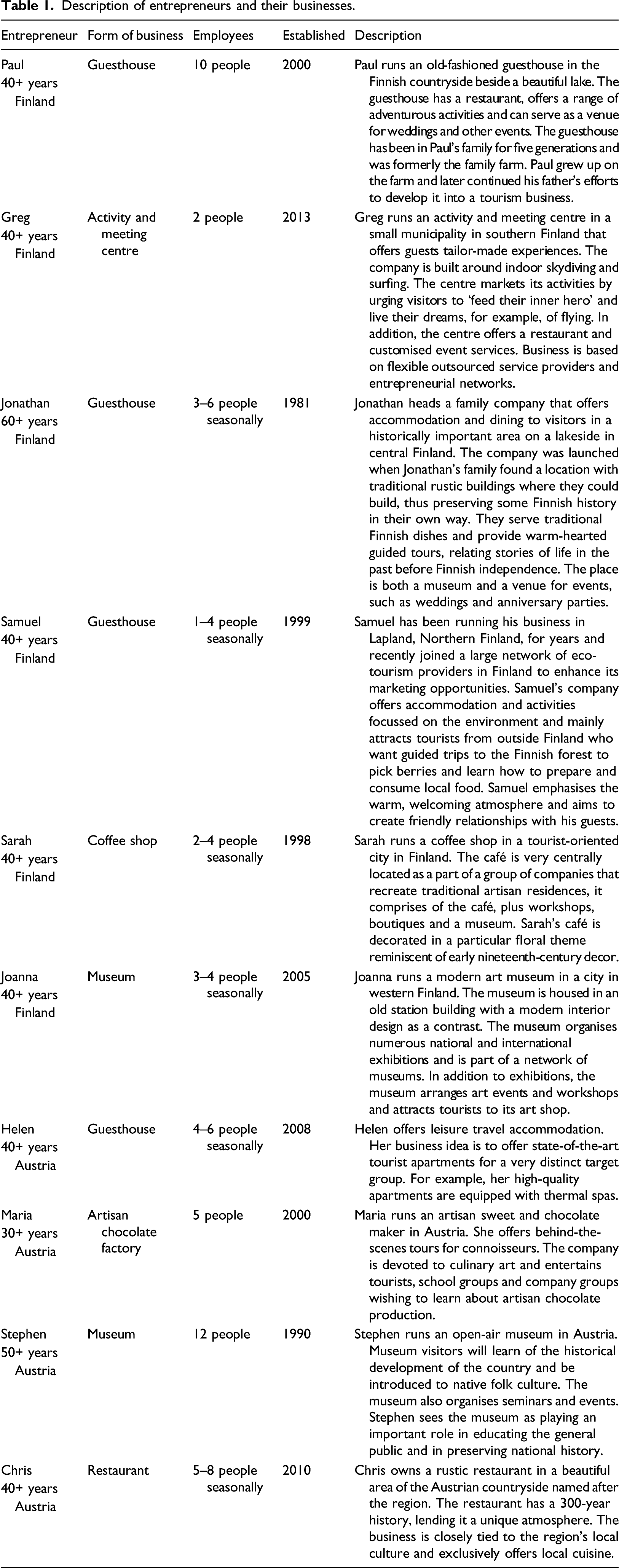
Two researchers collected data between August 2013 and May 2014 through individual interviews with respondents at their business premises. The semi-structured interviews began with broad questions, and subsequent questions arose through the dialogue between researchers and respondents (Cope, 2011). This method encouraged unconstrained storytelling (Czarniawska, 2004), thereby resulting in rich data. The researchers posed questions to extend and mediate discussions by eliciting information on specific topics, such as the business environment, consumer expectations and the features they valued, consumer evaluations of the business, how the business created value for consumers, and how the business stimulated consumption in general. Interviews typically lasted between 60 and 90 min, following which researchers held lengthy, informal discussions with the respondents that were audio-recorded and transcribed. In addition, the researchers toured the business premises and met employees informally while also observing the interaction between entrepreneurs and customers.
Data analysis
Overview of data structure.
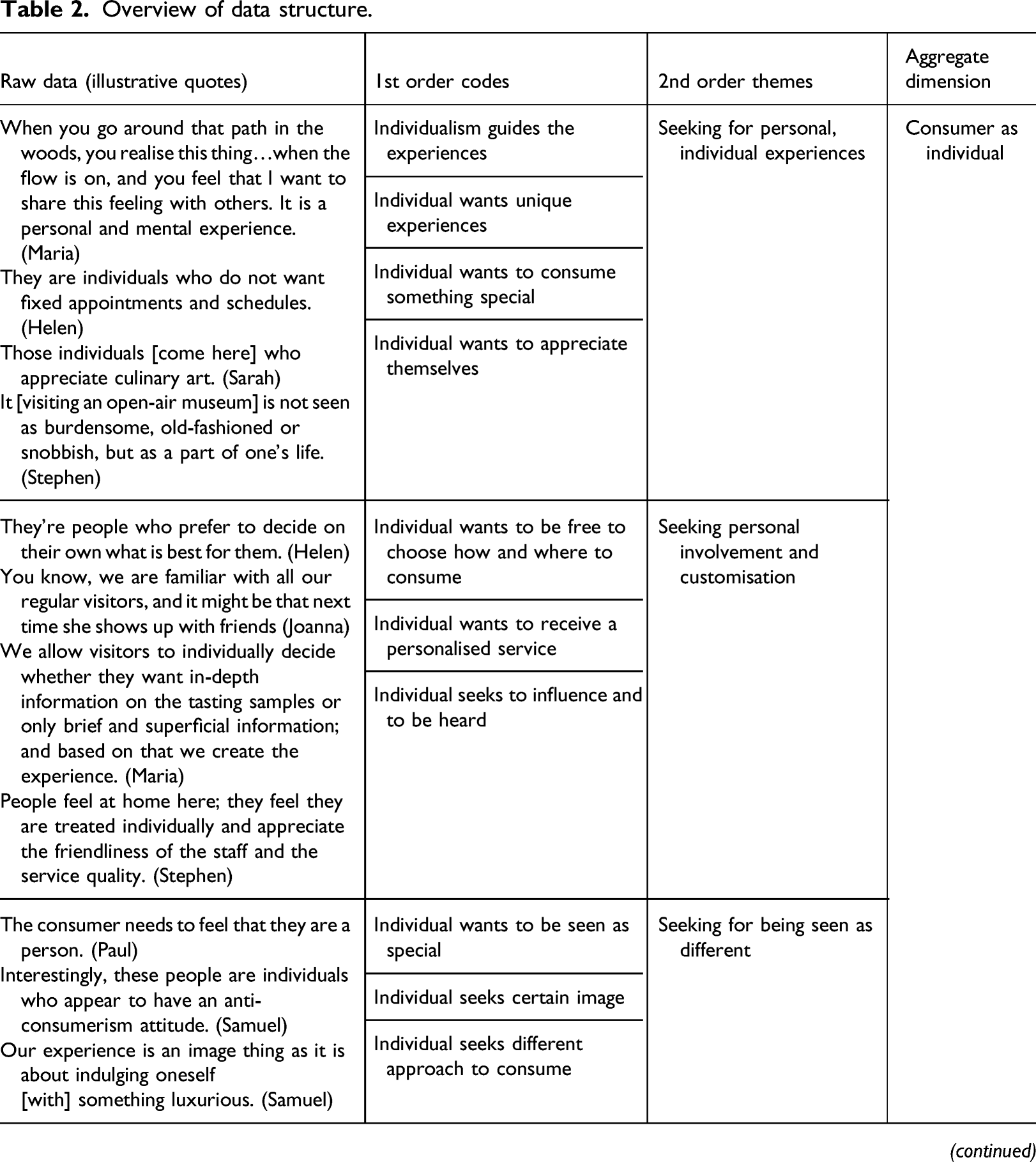
The analysis procedure was designed to depart from the process perspective that views entrepreneurship as a transformative process in which desires become goals, actions and systemic outcomes (McMullen and Dimov, 2013). Accordingly, we did not focus on longitudinal events or activities describing changes in understandings of the task environment over time, focussing instead on capturing situational and time-sensitive descriptors of ongoing immanent sensemaking.
Overview of themes and discourses.
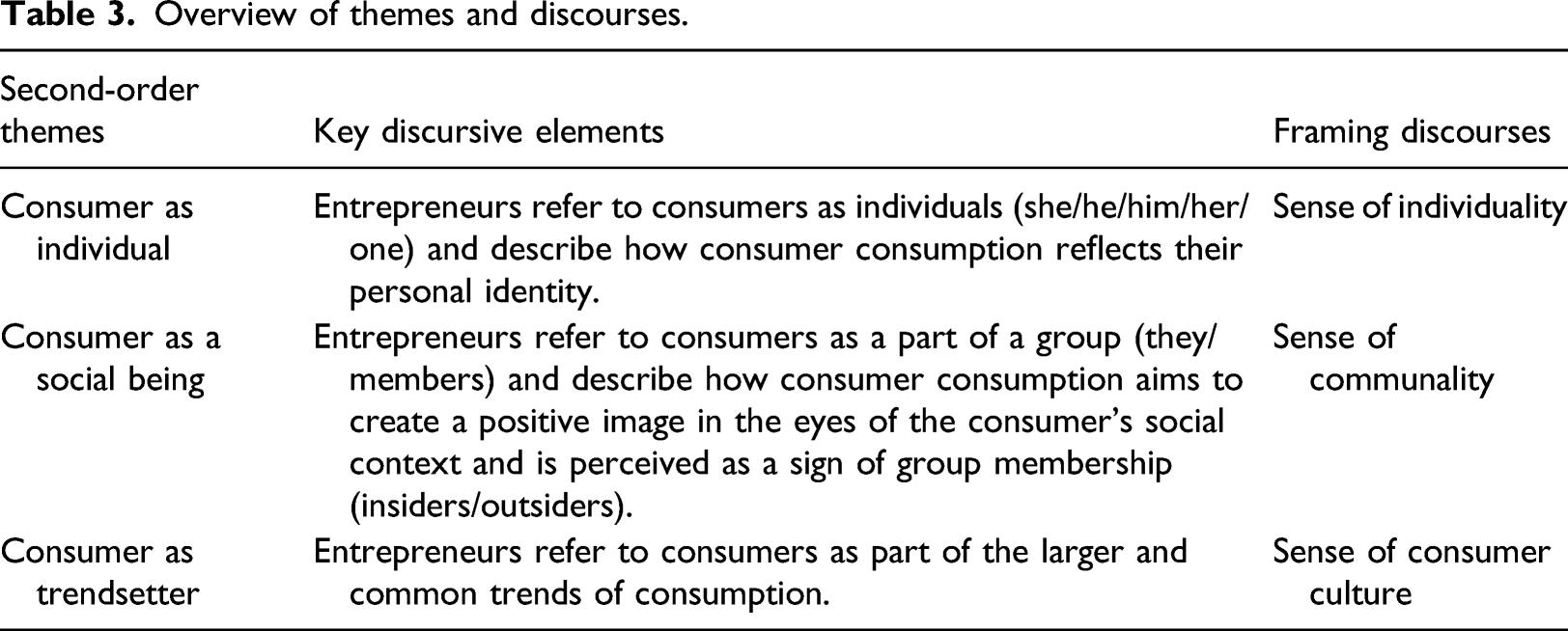
Our focus was on the language through which individuals engaged discursive resources to construct a sense of themselves, their activities and the context in which they were embedded. Entrepreneur narratives were treated as a single grand narrative representing their immanent sensemaking rather than separate units of cases.
Reflection on methodological choices
There is broad consensus on the essential nature of rich detail in qualitative research processes that address social phenomena (Bansal and Corley, 2012; Hoang and Antoncic, 2003; Jack et al., 2010; Lindgren and Packendorff, 2009). Previous studies address sensemaking as an analytical construct with the individual as the unit of analysis and where data are collected via narratives and discourse (Craig-Lees, 2001). Stories and storytelling are means of understanding entrepreneurial identities and how entrepreneurs legitimise their actions while simultaneously fulfilling the general function of imposing order upon uncertain situations (Lounsbury and Glynn, 2001; Maclean et al., 2012). We follow the underlying logic that stories provide the reason for an action and give it meaning (Steyaert and Bouwen, 1997). Our approach is also consistent with previous sensemaking studies in entrepreneurship (Cornelissen et al., 2012; Harries et al., 2018; Holt and Macpherson, 2010; Kimmit and Muñoz, 2018) that focus on situations and events that appear ambiguous. Similarly, sensemaking is captured here by looking at the patterns of narratives and discourses presented by individual entrepreneurs (Bettiol et al., 2012; Gioia and Chittipeddi, 1991) that relate to the mutable context in which they are embedded. As time is an endogenous aspect of narratives and discourses, our approach enabled entrepreneurial agency to be examined as temporal, distributed and emergent (Garud et al., 2014). This scope is crucial because sensemaking occurs ‘in the interaction between relational space and durational time’ (Garud and Giuliani, 2013: 158). Overall, our research design evolved iteratively; these iterations were developed into working papers shared with colleagues and presented at research seminars and conferences generating constructive and critical feedback to advance our inductive analysis.
Findings
Our analysis revealed common themes illustrating how entrepreneurs routinely engage with and perceive their task environment; they highlight how they frame and engage with the material world by making sense of their task environment (Reinecke and Ansari, 2021). In line with prior research, our results show that when our respondents interpreted markets, they attempted to understand the consumer environment in a broader sense than just that of either current or easily reachable customers (McKeever et al., 2015). Our analytical focus on language revealed that immanent sensemaking enables the respondents to construct frames which are utilised as a basis for their judgement and actions. In the following sections, we unpack the three interrelated framing discourses grounded in Fairclough’s (1992) three-dimensional model of discourse: a sense of individuality, a sense of communality and a sense of consumer culture.
Sense of individuality
Experiencing personally, being individual and making individual decisions were clearly core components of the discourses. The respondents characterised the consumers they encountered as individuals who wanted to make individual and independent decisions about consumption and the experiences. For example, Maria, who runs an artisan chocolate factory in Austria, stated that a key part of her service is offering consumers a chance to influence the content she produces:
Central to our business is the interaction and that we work together with every individual that we encounter to produce the final experience. We allow visitors to individually decide whether they want in-depth information on the tasting samples or only brief and superficial information, and based on that we create the experience.
Similarly, all the respondents described how considering individual consumer needs is an essential part of the business. They view today’s consumers as highly autonomous decision-makers who use products and services as building blocks to express their own identity. While consumers may have been a part of a group, the personal experiences encountered during their interaction with the entrepreneur/business made consumption essentially individualistic (Nairn et al., 2008). Additionally, the respondents knew that consumers were well aware of various consumption options encouraging them to offer customised products and services. The respondent entrepreneurs sensed that their direct engagement served to make the offering more personal so, adding value for consumers and conveying that they were a vital part of the business. Consequently, there was awareness that customers wanted them to go' the extra mile' and reflect how they valued them as individuals by offering services beyond monetary terms alone. For instance, Stephen, who runs an open-air museum, highlighted the importance of offering a personal service and creating a sense of appreciation. As he puts it: By dealing with each individual as a person, I have the opportunity to create a certain kind of experience. In this way, people feel at home here…they feel like they are treated individually and that they appreciate the friendliness of the staff and the service quality.
The respondents also felt that many consumers had become sceptical of mass consumption so tried to differentiate themselves from others by seeking personalised experiences or by rejecting recognised labels used to indicate high quality (such as Michelin Stars or global luxury brands). The respondents called upon encounters with their consumers to determine that they had adopted a certain critical attitude reflecting the desire to differentiate themselves from the traditional material way of thinking. The respondents articulated this in many ways, often indirectly, but some were very direct. Samuel runs a guesthouse in Finnish Lapland that offers distinct experiences such as guided trips into the forest to pick berries and a locally sourced menu and describes his customers as ‘individuals who appear to have an anti-consumerism attitude’.
Respondents also emphasised how in many cases, it was evident that consumers sought to act as individuals with an opportunity to make particular consumption choices and find specific qualities in the offering that others may not yet have discovered. The respondents were keen to fulfil the consumer’s dreams and provide individual opportunities to experience something unimagined. Delivering such experiences consistently and meeting demanding requirements was something that occupied their thoughts. Helen, an Austrian guesthouse owner, expressed her concerns as follows: Today, creating an experience is not simple. Consumers have far more demands than before. They’re people who prefer to decide on their own what is best for them. And we need to deal with these individuals and create experiences for them that they then appreciate.
Sense of communality
Somewhat paradoxically, while the respondents recognised that consumers sought individual experiences, they were also aware that those experiences were stronger and more meaningful when shared with others. They referred to consumers using products and services to achieve a sense of belonging in a certain community of consumers; this awareness was demonstrated when describing customers as like-minded individuals. Jonathan, a Finnish guesthouse owner, reported that his customers wanted to show they belonged to a community by relating their experiences on social media. Once they have visited here, in a way, they become a certain kind of member of the experience group…They are a part of an inner circle, and that is something that they want to bring out in their social media accounts.
It was evident that respondents regarded consumers as both eager to learn and seek their peer group’s appreciation by sharing experiences on social media. Hence, consumer decision-making and information seeking were guided by informal considerations, such as following the examples of friends or relying on the recommendations of others. In this context, respondents described an initial and constant act of evaluation where individual consumers judged whether certain consumption behaviour was appreciated by their social reference group (Deephouse and Suchman, 2008). Social media interactions, in particular, provide consumers with valuable information, helping them evaluate their options and share their experiences (Kozinets et al., 2008). Online brand communities also provide entrepreneurs with new platforms upon which to construct legitimacy (Hakala et al., 2017). Notably, most interviewees utilised social media to collect impressions and feedback from consumers and their communities. In addition, they clearly understood social media was not merely a marketing tool but also a way to construct their identity as a business and as an entrepreneur. Jonathan described his view on consumer identity building as follows: People come here because they want to experience something authentic. Those people want to share their experience, and that sharing involves personal storytelling. After all, that kind of sharing is done today largely on social media…We have our own Facebook page. People engage with the conversation but also place their critique there; others comment on that, and that [discussion] really has a large impact.
Sense of consumer culture
There were repeated references to how contemporary consumers use products and services as social and cultural signifiers that help them structure their everyday lives. Maria remarked We tell stories about nature and life here, and in this way they [the consumers] get real experiences and this is something that they desire. And these real experiences will ultimately matter in the longer term. They may even affect their [the consumer’s] everyday life.
The respondents also recognised that consumers are members of a broader consumer culture and follow contemporary trends. Sarah, who runs an artisan coffee shop was aware that her products represented a certain kind of contemporary consumer trend that valued hand-crafted, homemade products. She stated: In my understanding, hand-crafted coffee is a lifestyle thing, and we want to enhance this trend.
Moreover, respondents acknowledged that consumers buy or use goods or services to experience the activity of consumption itself and satisfy their lifestyle aspirations rather than for purely utilitarian or economic reasons. Stephen, from the open-air museum, had noticed that today’s consumer is more interested in having an experience than consuming material and that a person’s choices can strengthen their self-identity as a responsible consumer: Today people are really aware of consumption choices and deliberately seek a sustainable experience rather than the typical mass consumption.
Lawrence and Phillips (2002) describe the concept of symbolic consumption, sensing that consumers exist in a world of symbolism. The respondents felt an obligation to provide consumers with alternative experiences, which aligns with the idea that social activities are typically embedded in cultural groups that provide norms and values that direct and shape patterns of cultural choice (Sanders, 1985). Accordingly, respondents believed that creating experiences was a good way of creating ambassadors for their business as individuals want to share their positive experiences and recommend products or services. Chris, owner of a rustic restaurant in Austria, explained that individuals tend to share their experiences and enjoy doing so. That trait offers business owners a valuable way of marketing their business to a wider audience. According to Chris: People influence each other. One shares a joyful experience, and others want it too. Then little by little, it becomes more and more popular. And eventually maybe even some kind of phenomenon.
Multilevel consumer frames
All the respondents acknowledged that making sense of their task environment was challenging, but also that such sensemaking was an essential everyday activity. For them, framing is key to understanding the complex and dynamic consumer environment. Our analyses revealed three interrelated framing discourses, which we term individual, social and cultural consumer frames. We suggest that when interpreting their task environment, the respondents extract meaning from multilevel consumer frames shaped by these three framing discourses. This is evident through narratives emerging from the social interaction process and instances of immanent sensemaking. These frames allow entrepreneurs to routinely locate, perceive, identify and label the task environment when making sense of the consumer environment (Figure 1). Multilevel consumer frames employed in immanent sensemaking.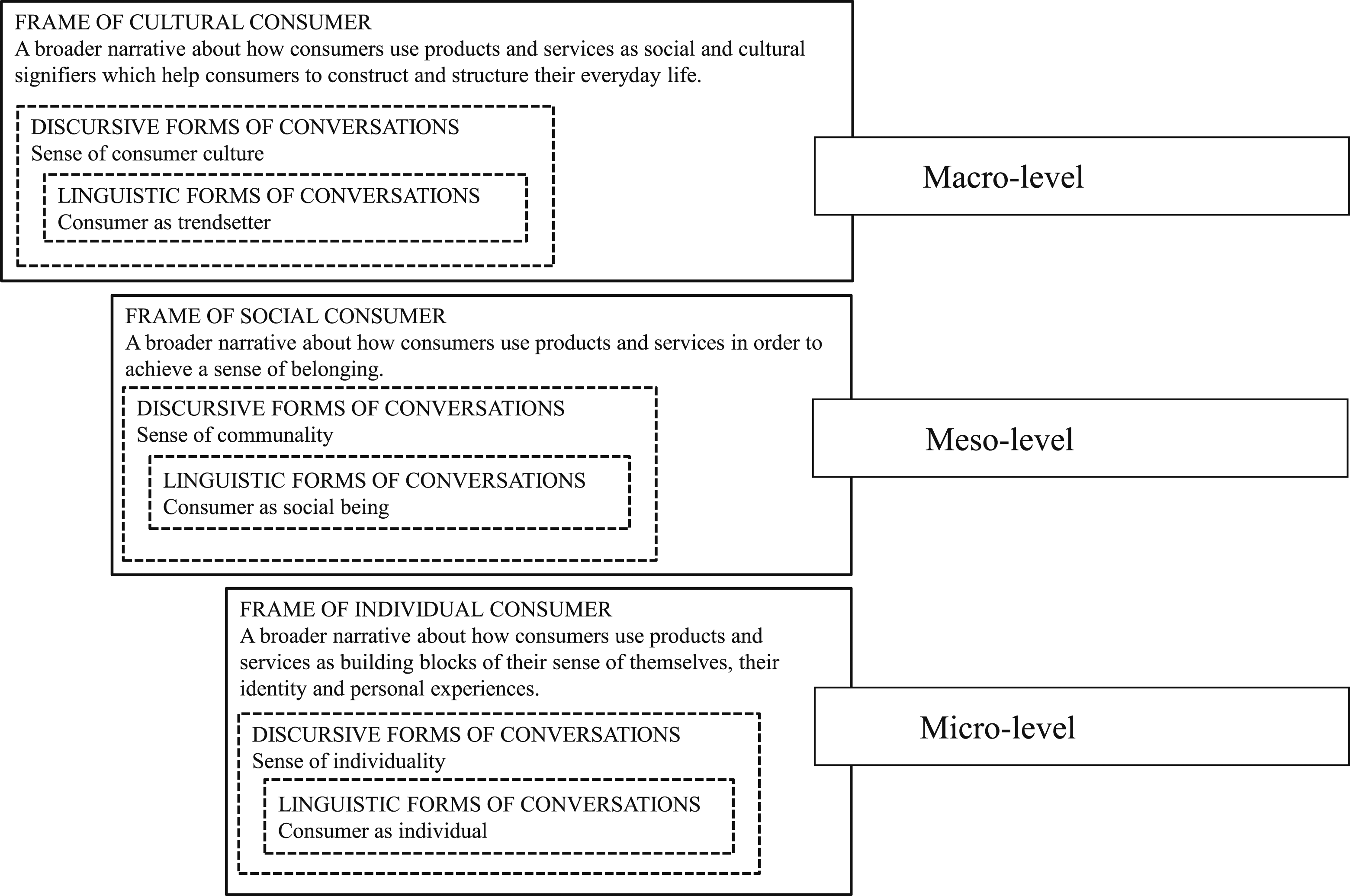
The frames guide the perception and representation of social reality and direct entrepreneur’s decision-making and actions.
For the respondents the marketplace becomes a multilevel marketspace – a term that connects not only physical and digital aspects, as Singh and Kumar (2021) suggest, but also the different layers of consumer experience. First, immanent sensemaking disclosed the personal dimension of consumption. The frame of the individual consumer reflects how entrepreneurs see individual consumers as demanding individualised products and services that suit their personal lifestyle and allow them to build their own identity. It was recognised that a consumer’s choices of whether to consume and belong are governed by individual desires and interests. Second, immanent sensemaking discloses the social dimension of consumption. The frame of the social consumer underlines how consumers use products and services to connect and share ideas and experiences with others in a meaningful way. There is a need to understand how consumers connect to various groups, such as their family, their interests or friends, depending on the specific situation of consumption. Each of these social circles plays its role in creating or sustaining the social identity of consumers and understanding this was part of routinised sensemaking. Third, immanent sensemaking revealed the cultural level of consumption. The frame of the cultural consumer illustrates how entrepreneurs continuously interpret the entire consumer culture in which consumers act, react and influence each other. Hence, the entrepreneurs appear to accept that they can no longer intervene directly in consumer lives but must blend in with consumer culture and participating in that culture. They are aware of the need to sense the past movements, trends and values that have influenced consumption preferences.
Our data show that our respondents utilised these frames to make sense of the environments influencing their consumers, which subsequently enabled them to routinely resolve uncertainty and make judgements. The emphasis on different frames varies; when particular frames become dominant, they help to advance certain interests and views while suppressing others (Baunsgaard and Clegg, 2013). As Reinecke and Ansari (2021) note, small contingencies during interaction can cause large shifts in subsequent events. We also find that frames can be contested, especially when uncertainty causes incongruence between actor frames (Kaplan, 2008). However, particular frames that resonate with one another and are seen as legitimate have a greater chance of prevailing and then, prompting action. Hence, these multilevel frames are closely intertwined and linked to an entrepreneur’s own sensemaking (Kaplan, 2008). In this sense, entrepreneur frames are driven by the need for them to be socially acceptable, comprehensive and credible and not necessarily a requirement to be entirely accurate.
Discussion
This article investigates the immanent sensemaking undertaken by entrepreneurs when navigating the inevitable uncertainty arising from new and unfamiliar information appearing in their task environment. Our evidence suggests that entrepreneurs make sense of the this environment by creating frames to aid in understanding the consumer at multiple levels. Attempts are made to understand a consumer environment more broadly than in terms of just the immediate customer encounter. This type of immanent sensemaking helps understanding of the complex and dynamic nature of markets, the social systems in which offerings are consumed, and where resources are integrated and value co-created.
We respond to the call for a more comprehensive understanding of the interactive aspects of the entrepreneurial process (Shepherd, 2015; Shepherd et al., 2021), and how immersive encounters, such as those with consumers, create frames (Reinecke and Ansari, 2021). The findings contribute to the literature in three ways. First, they indicate that the frames referencing individual consumers, social consumers and cultural consumers are products of ongoing immanent sensemaking on the part of entrepreneurs. This sensemaking is a routinised way to resolve and understand the task environment (Sandberg and Tsoukas, 2015, 2020). In particular, our multilevel consumer frames provide insights for research on entrepreneurial judgement, which is the necessary precursor to entrepreneurial action (Foss et al., 2019). It has been established that entrepreneurs act according to their judgement in order to generate desirable effects (Packard et al., 2017). By focussing on immanent sensemaking, our study furthers the understanding of judgement, which can be a ‘dance with uncertainty’ (Packard et al., 2017: 852). The results suggest that entrepreneurs use insights into consumers behaviour to constantly evolve their judgement of customer according to the prevailing context. However, the multilevel frames identified here are comparatively stable structures that enable entrepreneurs to understand the context in which they act (McKeever et al., 2015). Accordingly, the frames relating to individual, social and cultural consumers provide a particular insight into the task environment that extends beyond the traditional ideas of customer orientation or market research. Despite constantly evolving and changing, these sensemaking frames also help entrepreneurs to deal with the complexity involved in providing experiences that are simultaneously individual, social and culturally appropriate.
Second, while prior research has explained that entrepreneurs make decisions by imprinting (Mathias et al., 2015), chasing an invisible moving target (Huang and Pearce, 2015), connecting the dots (Baron, 2006) or thinking outside the box (Baron and Ward, 2004), the literature is yet to explicate the role of immanent sensemaking in arriving at those eureka moments that arise when entrepreneurs realise what it is that consumers value. The frames we propose reveal the mysterious moments of enlightenment as an outcome of a systematic attempt to understand a task environment through frames of reference. When customers act and react according to the construed frames, these frames are enhanced; however, when this does not occur, the frames change and result in entirely new ones that subsequently lead to such ‘moments of insight’ (Lumpkin and Lichtenstein, 2005). Hence, our findings propose that the eureka moments, while often experienced as sudden, are in fact a result of the immanent and rather mundane sensemaking employed to create order out of complexity (Sandberg and Tsoukas, 2020; Weick, 1995).
Third, it appears that the task environment is contextually necessary to orchestrate resources and formulate judgement and actions. Our study reveals how entrepreneurs construct multilevel consumer frames through immanent sensemaking upon which they base their judgement of, and actions in, the consumer environment. The frames explicated in the current research illustrate a consumer-centric perspective (Nambisan and Zarha, 2016; Prandelli et al., 2016) on entrepreneur’s immanent sensemaking. Accordingly, we suggest that interaction with the consumer environment reduces perceived uncertainty; this enables entrepreneurs to craft the absent structures of knowledge (Corbett, 2005) required to address pertinent consumer problems and, eventually, create a market for the offering. Beyond this, successful framing requires entrepreneurs to interact with their context repeatedly (Clark, 1997) and actively engage in immanent sensemaking, rather than serving as merely cognitive models that enable them to step back from, observe, assess and plan their actions (Wilson, 2002). An enhanced understanding of the task environment acquired as a result of immanent sensemaking enables the modification of market assessments and, thus, actions (Read et al., 2009; Welter et al., 2016). To synthesise our findings and discussion, we propose the following framework for an entrepreneur’s immanent sensemaking related to the task environment (Figure 2).
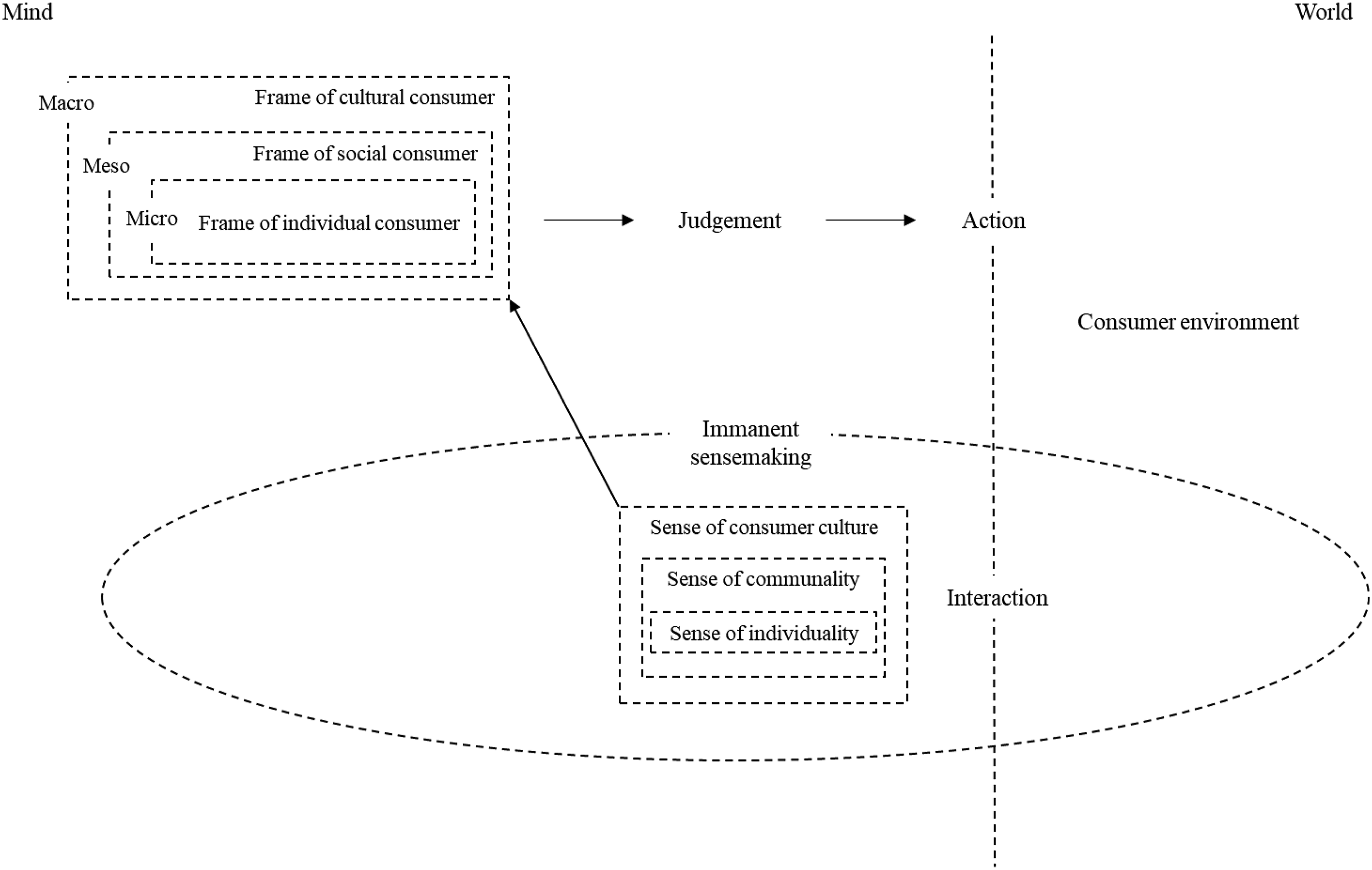
A framework of entrepreneur’s immanent sensemaking.
Immanent sensemaking links the an mind inseparably to the world in which the entrepreneur is embedded. We offer new insights into how entrepreneurs can absorb micro-re-position, meso- and macro-level signals (individual requirements, social needs and contemporary trends) to inform actions. By introducing immanent sensemaking as a premise for the process of judgement, the framework above contributes to an emerging literature that views entrepreneurial judgement as a continuous and dynamic process (Gilbert-Saad et al., 2018; McMullen, 2015; Packard et al., 2017). Understanding the multilevel spectrum of the task environments (from which we distilled the individual, social and cultural consumer frames) can assist practitioners in assessing which of their support mechanisms would be most effective. Rather than giving entrepreneurs information on individual consumers and their needs as traditional market research methods do, our recommended frames would offer entrepreneurs tools to grasp the social and cultural factors that influence consumers. Similarly, in the realm of entrepreneurship education, the scope of courses on uncertainty, entrepreneurial judgement and decision-making, for instance, could be extended beyond the horizon of individuals to address the task environment in which entrepreneurs operate. Such an extension could also lead to redesigning learning environments to follow a more experiential approach (Bell and Bell, 2020) to help students make sense of the task environment.
Despite its novel insights, our study is not without limitations. The first relates to the number of cases chosen and the partially retrospective data collected from entrepreneurs at a single point in time. To tease out the sensemaking frames, we also purposefully sampled entrepreneurs who offer novel services to the market, and it follows that our cases specifically focus on tourism-oriented organisations that interact directly with consumers. Consequently, the study sample may be biased towards respondents who already possess some skill in making sense of consumers. Scholars might compare and contrast our findings in the context of different countries, industries and against the immanent sensemaking undertaken by entrepreneurs who do not offer specifically novel services. Moreover, this study could not address how entrepreneurs and environments change over time as decisions are made and new information emerges. Longitudinal studies would be well suited to illuminating the interactive loop between entrepreneurs and consumers. In addition, using a sample of entrepreneurs who operate in tourism and within their niche markets prevents us from extending the results to include a more general population of service-based businesses or even those based in manufacturing. Accordingly, future research might address immanent sensemaking and use of frames in other contexts, and especially in those where anti-consumerism or resistance to a culture of consumption (Penaloza and Price, 2003) is strong. Furthermore, although our study explores the immanent sensemaking and how it results in multilevel consumer frames, we hesitate to conclude that these frames alone necessarily trigger action. Rather, as Hoyte et al. (2019) recently proposed, we encourage researchers to unpack the ways in which sensemaking is intertwined with entrepreneurial action or the series of activities involved in the entrepreneurial process. Specifically, future research could focus on new digital infrastructures used by consumers, such as social media and virtual platforms, to understand the actions, interactions and interpretations that entrepreneurs undertake with consumers in mind.
Conclusion
In conclusion, this article highlights the importance for entrepreneurs of making sense of the consumer environment. Specifically, we found that individual entrepreneurs routinely frame the consumer environment on multiple levels. When making sense of their customers, entrepreneurs strive to understand the consumer environment in broader terms than immediate customer encounters. Such immanent sensemaking thus, facilitates the understanding of complex and dynamic nature of markets and the social systems where offerings are consumed, where resources are integrated and where value is co-created. In order to successfully make sense of the consumer environment, entrepreneurs must embed themselves into the contextual communities in which consumers operate individually, collectively and socio-culturally.
Footnotes
Declaration of conflicting interests
The author(s) declared no potential conflicts of interest with respect to the research, authorship, and/or publication of this article.
Funding
The author(s) received no financial support for the research, authorship, and/or publication of this article.
Author biographies
 ) is a Professor of entrepreneurship at the School of Business and Management (LBM) at LUT University, Finland. His research interests are within entrepreneurship, small business management, strategy as well as sustainable entrepreneurship. His research has previously appeared in journals such as Journal of Management, Journal of Small Business Management, Small Business Economics, International Journal of Management Reviews and Long Range Planning.