



Abstract
Sustainable entrepreneurship, that is, venturing with the aim of contributing to a shift of practices towards environmental and social sustainability, is an increasingly prominent phenomenon. This article investigates how sustainability ventures orient between dual – commercial and environmental – logics when conducting the legitimation work necessary to secure their first major partnership with an incumbent firm. Specifically, we study multiple cases of partnerships on food waste reduction. This setting is characterised by limited tension between the two logics, which implies that ventures are not forced into hybridity. We find some indications that ventures are able to draw on both types of logic to legitimate their ventures. However, the dominant pattern is that sustainability ventures tend to orient their legitimation work around a salient founding logic. Our analysis suggests that this pattern can be attributed partly to organisational imprinting, but also to legitimation work in this context being inherently logic-specific to a significant degree. This seems to be particularly true for ventures with a salient environmental logic.
Introduction
The introduction of new solutions to issues of environmental degradation and social injustice constitutes an important driver for contemporary entrepreneurship (Patzelt and Shepherd, 2011; Munoz and Cohen, 2018; Johnson and Schaltegger, 2019). Through the creation of sustainability-driven ventures, entrepreneurs adopt the role of change agents who help to address such societal challenges (Isaak, 1998). In recent years, the number of newly created sustainability ventures has been growing (Stubbs, 2017; Munoz and Cohen, 2018) and emerging in various types of market such as ethical fashion (DiVito and Bohnsack, 2017), renewable energy (York et al., 2016), sustainable smartphones (Johnsen et al., 2018) and green buildings (York et al., 2018). As with any new venture, sustainability ventures face the challenge of building sufficient legitimacy in the eyes of stakeholders in order to establish themselves in a market while overcoming their liabilities of smallness and newness (Singh et al., 1986; Fisher, 2020). New ventures are required to employ a variety of strategic actions in legitimating themselves (Zott and Huy, 2007; Nagy et al., 2012; Engel et al., 2020), referred to as legitimation work (Rueede and Kreutzer, 2015).
Legitimation work is critical for any new venture’s performance (Wang et al., 2017) and survival during their early-stage development (Delmar and Shane, 2004). It also has potentially far-reaching implications for future strategic decision-making as it represents the first step in setting audiences expectations (Garud et al., 2014). For example, affiliation with a large incumbent firm in the form of a partnership may grant early-stage ventures an endorsement for their future relation to other major stakeholders (Stuart et al., 1999). Gaining such credibility is particularly important for ventures addressing new market opportunities and emerging niches (Abrahamson and Rosenkopf, 1993), such as is generally the case for sustainability ventures. In this article, we investigate the conditions for legitimation work in the particular context of sustainable entrepreneurship, which has not yet received sufficient scrutiny in the entrepreneurship literature.
In investigating how sustainability-driven entrepreneurs gain legitimacy for their ventures, entrepreneurship scholars have much to gain by taking inspiration from the literature on hybrid organising of social enterprises. Drawing on institutional theory, we refer to such settings as being characterised by more than one institutional logic, and to sustainability ventures as being subject to a certain degree of hybridity. Some sustainability ventures may, similar to the group of organisations known as ‘social enterprises’ (York et al., 2016), be truly hybrid organisations with environmental or social causes playing a central role in their entrepreneurial ambitions. Yet, others may be hybrid primarily in that their entrepreneurial ambitions are focused on a business opportunity where sustainability concerns are a key driver of demand. Extant literature on social enterprises has paid much attention to the struggle of such organisations in managing the different logics, and the potential tensions between these logics, when engaging with external audiences (Huybrechts and Nicholls, 2013; Nicholls and Huybrechts, 2016; Savarese et al., 2020). This literature also offers rich analyses of different strategies that organisations may employ to manage logic tensions. These include logic decoupling, meaning that organisations orient after one logic but perform ceremonial enactment of the other logic, and compromising (whereby organisations strike a balance between conflicting expectations) (Battilana and Dorado, 2010; Battilana and Lee, 2014). 1
When acting in a setting with logic tensions, the legitimation work of sustainability ventures will need to focus on managing logic tensions (O'Neil and Ucbasaran, 2016). However, not all dual logic settings are subject to direct tensions. Important examples are settings focused on increased resource-efficiency, shifts towards circular production systems, and waste reduction. In these types of settings, environmental, social and commercial concerns are all present – but better aligned in terms of strategic options. Reducing waste offers direct benefits from both an environmental, and, indirectly, social, and a commercial point of view, and any real logic tension therefore, only occurs if the marginal costs of further waste reduction exceed the economic gain in terms of resource cost reductions (Mourad, 2016), or if efforts to reduce waste are taken to include more radical reorganisation of existing supply chains and efforts to reduce overall levels of production. Actions which are desirable both from an environmental and a commercial point of view have also been documented to dominate – if not serve as the exclusive focus of – efforts undertaken by or supported by incumbent firms (Mourad, 2016; Redlingshöfer et al., 2020). We therefore, expect that for ventures addressing waste reduction, legitimation work directed towards incumbent firms is not as strongly framed by inherent tensions between multiple logics as is the case in the type of settings examined in previous literature on the legitimation work of sustainability ventures.
Reducing waste in existing production chains is a key concern in many settings, for example, as regards retrieval of precious metals from disposed electronic products or reducing material waste in manufacturing (Perey et al., 2018). Waste of food has been recognised as a major environmental problem globally, accounting for eight percent of global greenhouse gas emissions and a contribution to global warming almost equivalent to global road transports (FAO, 2019). This issue also has a strong social dimension. 2 One-third of food produced for human consumption globally is estimated as being lost or wasted per year (Gustavsson et al., 2011), while nearly 700 million people are hungry and three billion cannot afford a healthy diet (FAO, 2019). Growing attention and awareness regarding such issues is reflected in the Sustainable Development Goal (SDG) 12.3, which pledges to cut global food waste by 50 percent before 2030. For this important type of setting, social enterprise literature and related work on hybridity in entrepreneurial contexts does not provide particularly clear insights that we may apply to understand sustainability venture’s legitimation work. In view of this, we are investigating how sustainability ventures in a low-tension multi-logics setting, such as food waste reduction and gain sufficient legitimation.
Our empirical focus lies on the legitimation of new ventures that enable a first major partnership with a large incumbent firm. This is a key achievement in the context that we study. To achieve resource-efficiency and waste reduction, a sustainability venture seeking to address waste issues must establish a partnership with an incumbent firm that controls large-scale production activities. In the case of food waste, such incumbents include food producers, food retailers and restaurant chains. To initiate such major partnership, a new venture must leverage its legitimation work to gain inter-partner legitimacy (Kumar and Das, 2007), that is, legitimacy specific to the partnership dyad. Therefore, in this study, we pose the following specific research question: How do sustainability ventures engaged in food waste reduction navigate commercial and non-commercial logics in their legitimation work when establishing their first major partnership? Specifically, we investigate opportunities and barriers to leverage the commercial and environmental logics in the legitimation work of these sustainability ventures.
The article contributes to the literature on sustainable entrepreneurship (Outsios and Kittler, 2018; Johnson and Schaltegger, 2019; Patzelt and Shepherd, 2011) by elaborating on how sustainability-driven entrepreneurs build legitimacy for their new ventures, particularly in securing their first major partnership. We further contribute to the literature on new venture legitimation (O'Neil and Ucbasaran, 2016; Uberbacher, 2014; Truong and Nagy, 2020) by highlighting how such ventures utilise dual logics in their legitimation work. Most importantly, we explore opportunities and barriers for sustainability ventures to exploit logic duality, that is, to benefit from being able to draw on both commercially and environmentally, or socially, oriented arguments for their products and services. In so doing, our study also contributes to the broad literature on how organisations navigate institutional pluralism (Pache and Santos, 2013; Savarese et al., 2020; Wagenschwanz and Grimes, 2021).
The article proceeds as follows. We review prior studies on legitimation work where more than one institutional logic is present. Next, we outline the research methodology of our empirical work, which consists of a multiple case study of partnerships for food waste reduction projects. Based on the empirical findings, we identify two modes of legitimation work by sustainability ventures and explicate the link with the foundational backgrounds of the ventures. We then discuss how the orientation of legitimation work has implications for the nature and institutionalisation of the partnerships formed with incumbent firms. In the final section, we conclude by outlining our contributions to the literature, discussing limitations, and offering suggestions for future research.
Literature review
In reviewing extant scholarship on legitimation work, we specifically focus on work set in complex institutional settings where more than one institutional logic prevails. Our review also highlights insights from the literature of social enterprises and hybrid organisations, particularly in elaborating the opportunities and barriers of utilising both commercial and non-commercial logics in legitimation work.
Legitimation work in complex institutional environments
Studies of legitimation work have shown how skillful performance of a variety of symbolic actions allows entrepreneurial firms to obtain resources and to achieve early-stage success (Zimmerman and Zeitz, 2002; Zott and Huy, 2007). Legitimation work may involve organisational design aspects whereby a venture signals its commitment to certain objectives by setting internal milestones (Fisher et al., 2016). Other key activities include forging new inter-organisational ties and exploiting personal relationships (Higgins and Gulati, 2003, 2006). However, the most prominent feature in many types of legitimation work – including that conducted by ventures in order to establish a first major partnership – is the performance of activities that project the organisational identity of the venture (Martens et al., 2007). This entails, in the words of Navis and Glynn (2011), conveying a set of claims around the founder, new venture and market opportunity as to ‘who we are’ and ‘what we do’. Authors contributing to this line of work have studied how ventures can strategically craft the narrative they project about themselves (Martens et al., 2007; Moss et al., 2018; Navis and Glynn, 2011), but also how entrepreneurs may engage in impression management in the form of strategically considering, for example, how they dress and what their offices look like (Clarke, 2011) and how they name their ventures (Engel et al., 2020). As noted by Uberbacher (2014), much research on venture legitimation has tended to treat legitimacy as a monolithic concept. A strand of research has, however, acknowledged that legitimacy in principle may be viewed as being constructed in relation to multiple audiences (Ruef and Scott, 1998; Fisher, 2020). New ventures may face a multitude of audiences, each with specific interests and norms (Fisher et al., 2016). Legitimacy may therefore, be more or less audience-specific (Kumar and Das, 2007) – albeit with important interdependencies across audiences and over time (Weidner et al., 2019).
Legitimation work is purposeful action (Rueede and Kreutzer, 2015), but the direction and form of action is shaped by the aspirations and objectives of the entrepreneurs (Stringfellow et al., 2014) and by the institutional setting in which actions are evaluated (Davidsson et al., 2006). Scholarly literature on venture legitimation has paid particular attention to settings and situations spanning more than one institutional sphere or logic, or involving more than one type of entrepreneurial mindset. This is because more multifaceted environments create more complex (i.e. more interesting, from a scholarly perspective) sets of conditions for legitimation work (Wagenschwanz and Grimes, 2021). Complexity may entail challenges for entrepreneurs, requiring them to engage in translation between institutional settings (Tracey et al., 2018) or conducting identity work to overcome ‘otherness’ (Swail et al., 2018).
As highlighted in the literature on sustainable entrepreneurship, the growing phenomenon of new ventures whose core business concerns are environmental and/or social issues is a prominent example of a multifaceted (i.e. multi-logic) business setting (York et al., 2016; Munoz and Cohen, 2018; Outsios and Kittler, 2018). This literature has primarily focused on firms that have to navigate partly conflicting logics, for example, where start-ups’ environmental objectives are achieved by outcompeting incumbent firms by offering ‘greener’ product or service solutions (Schaltegger and Wagner, 2011; Hockerts and Wüstenhagen, 2010). In these types of settings, the presence of dual logics creates inherent tensions that require such ventures to make trade-offs and to search for compromises in their early stages of venturing (Munoz et al., 2018; DiVito and Bohnsack, 2017).
Studies investigating this type of hybridity have identified three ways in which an organisation may manage and reconcile the conflicting dual logics that they engage with in their legitimation work. First, organisations may decouple the two logics and separate elements that respond to the different logics (Battilana and Lee, 2014). Second, some elements of the two logics may be subjected to compromise and thus incorporated into a new blended logic (Battilana and Dorado, 2010; Savarese et al., 2020). Finally, organisations may pursue ‘selective coupling’ by selectively crafting elements drawn from both logics in an attempt to gain legitimacy in a particular field (Pache and Santos, 2013).
In this article, we focus on a type of setting where conflicts between logics are less accentuated rendering decoupling and compromising behaviour less relevant. We study ventures with a business model oriented towards increasing resource-efficiency of other firms’ operation in such a way as to allow a shift of practices towards greater environmental and social sustainability. This group of sustainability ventures can be referred to as waste-reduction partners. They contribute to sustainability transformations not by competing against incumbents, but by facilitating change in incumbents’ business models and processes (Riandita, 2020).
Opportunities and barriers to selective coupling in legitimation work
For waste-reduction partners seeking to establish partnerships with incumbents, presence of more than one logic does not represent a major challenge that must be effectively managed in order for legitimation work to be successful. With environmental and commercial logics being well-aligned in terms of which action is desirable, new ventures may choose to orient their legitimation work around one main logic. However, they may also use logic compatibility to their advantage. The presence of both commercial and non-commercial logics is in principle a Janus-faced property, which on the one hand may require careful management of stakeholder’s expectations, but on the other may enable flexibility in dealing with such expectations (Reay and Hinings, 2009; De Clercq and Voronov, 2011). Recent work on hybrid organising in social enterprises has recognised that multiple logic settings may present organisations with opportunities in their interactions with external audiences (Mongelli et al., 2019; Savarese et al., 2020). Such flexibility can allow organisations to selectively craft elements drawn from each logic in an attempt to gain legitimacy and support from various audiences. In parallel to Pache and Santos (2013), we refer to the combination of discursive elements emanating from either one of the two logics as selective coupling in legitimation work.
Waste-reduction partners may enjoy legitimation work benefits from such flexibility if the audience(s) that they address when seeking to establish a first major partnership value more than one logic. That may be the case if key audiences value both commercial and environmental logic aspects of food waste reduction efforts. It may also be the case if the ventures need to address partly separate audiences within a potential partner firm – for example, in the form of managers who are responsible for sustainability efforts and managers with line responsibility for the process in which waste takes place. If this is the case, a sustainability venture may leverage commercial logic in its legitimation work to convey their ability to help the incumbent solve a resource-efficiency problem (Navis and Glynn, 2011) and also leverage environmental logic in efforts that in turn provide a source of broader social legitimacy for the incumbent firm (Truong and Nagy, 2020) – thereby increasing the legitimacy of the partnership within the incumbent firm (Weidner et al., 2019).
The mobilisation of plural values, however, poses its own challenges because the messages that are projected may be confusing to the audiences (Wry et al., 2014). External audiences do not always respond positively to ventures that explicitly communicate their hybridity. For example, crowd-funders have been found to lend more quickly to hybrid microenterprises that position themselves within a single category in which the social element is emphasised over the commercial and entrepreneurial elements, when compared to those who leverage both elements (Moss et al., 2018). There may also be barriers to selective coupling emanating from the entrepreneurs’ willingness and ability to make credible claims in a logic in which they are not strongly rooted themselves. Entrepreneurs who had strong personal convictions regarding both commercial/entrepreneurial and environmental aspects of their venture’s activities were better positioned to reach out to a wide variety of stakeholders, as compared to entrepreneurs whose identity was rooted in environmental logic (York et al., 2016). Similarly, O'Neil and Ucbasaran (2016) suggest that sustainability entrepreneurs faced difficulties in that their focus on environmental values was found to constitute a ‘barrier to wider legitimacy’.
Methods
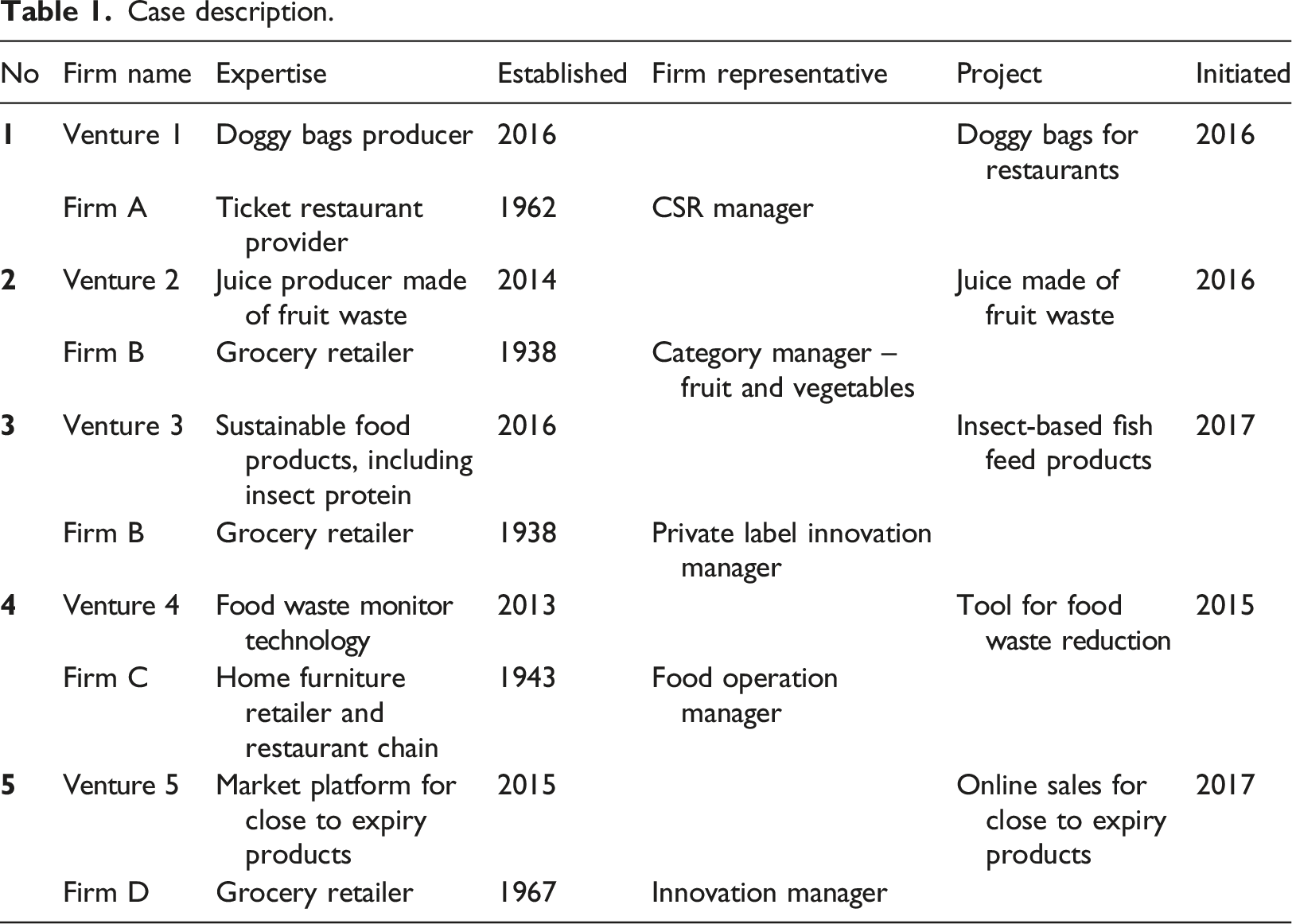
Case description.
Data collection
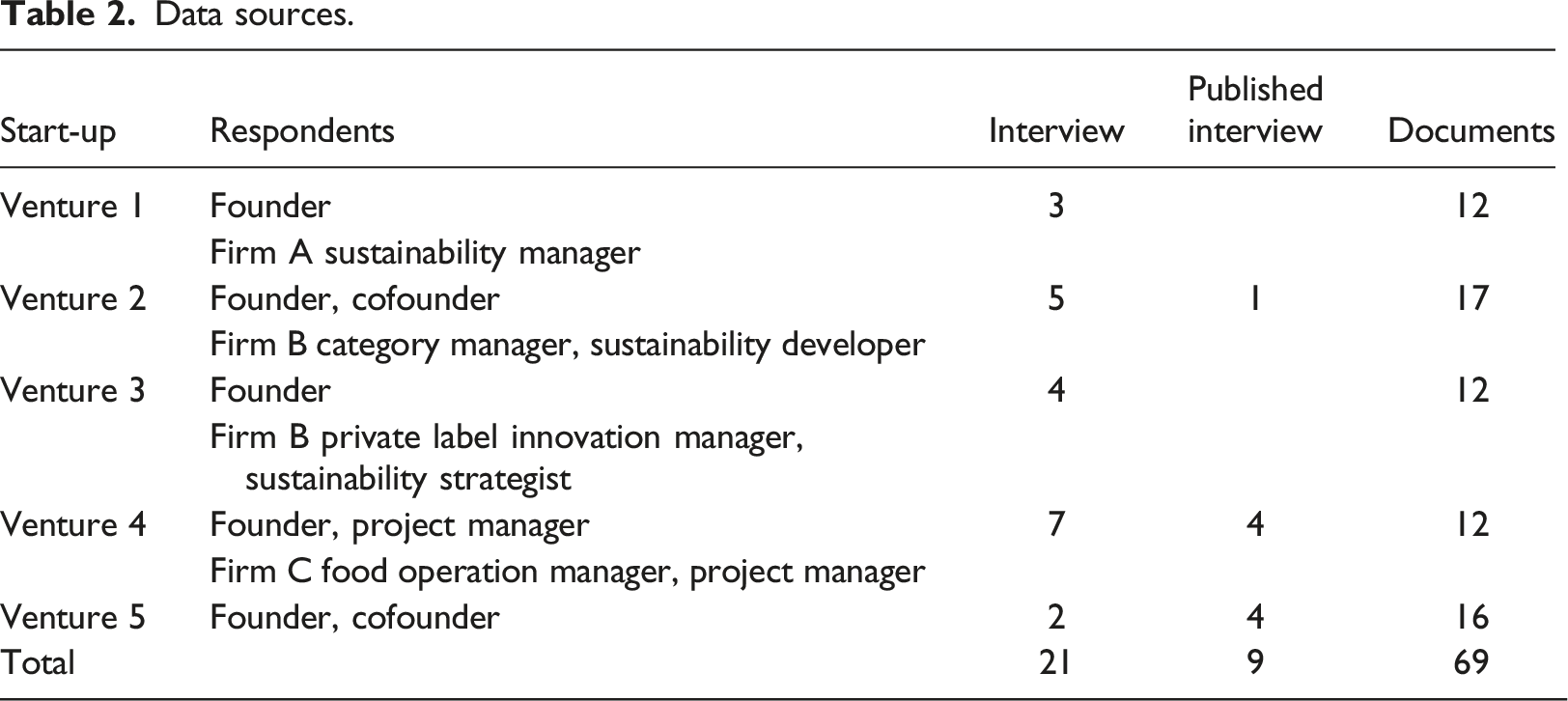
Our study relies on several data sources. Primary data was collected through 21 semi-structured interviews with key persons involved in the partnerships. Predominantly, these individuals are the new venture founders and the incumbent firm representatives, but we also include information from other relevant actors in the partnerships to clarify information and to minimise informant bias. Moreover, we gained access to secondary data in the form of interviews with the new venture founders and 69 public and private documents.
Data sources.
Data analysis
Our research process followed an inductive theory building principle (Gioia et al., 2013) which involves continuous iterations between data and theory. Our goal throughout was to determine how sustainability ventures build legitimacy in establishing their first major partnership. To this end, we began to form links between theories of legitimation work and hybrid organising.
We commenced our analysis by constructing a database to gather all collected data into individual case records. All interviews were recorded and transcribed. An open coding process was performed using the Atlas. ti software to improve transparency, traceability and replicability. We collected explicit information from the informant statements through in vivo empirical coding, resulting in a set of first-order codes. At this first stage, we differentiate accounts gathered from entrepreneurs as the legitimacy seeker and from the incumbents’ representatives as their audiences.
Building upon the first stage of analysis, we proceeded to a more theoretically driven stage. Through an in-depth exploration of literature on sustainable entrepreneurship (O'Neil and Ucbasaran, 2016; York et al., 2016), new venture legitimation (Navis and Glynn, 2011; Uberbacher, 2014; Truong and Nagy, 2020), and hybrid organising and social enterprises (Pache and Santos, 2013; Ciuchta et al., 2018; Wagenschwanz and Grimes, 2021), we analysed whether the emerging themes suggested concepts that might help us to describe and explain the phenomena we observed. Building on insights from the relevant literature, the first-order codes were grouped into second-order themes through axial coding (Corbin and Strauss, 1990; Gioia et al., 2013). During this stage, we also focused on differences, similarities and common patterns across cases (Eisenhardt, 1989). This second stage of analysis revealed two important insights. First, insight related to the emergence of themes characterising (1) each new venture’s account in communicating their ideas to a firm’s representative, (2) response of each incumbent firm and the characteristics of the formed partnership and (3) each sustainability venture’s foundational background. Second, insights based on the cross-case analysis where two broad patterns emerge, separating the cases into two groups with different behaviour.
Data structure.
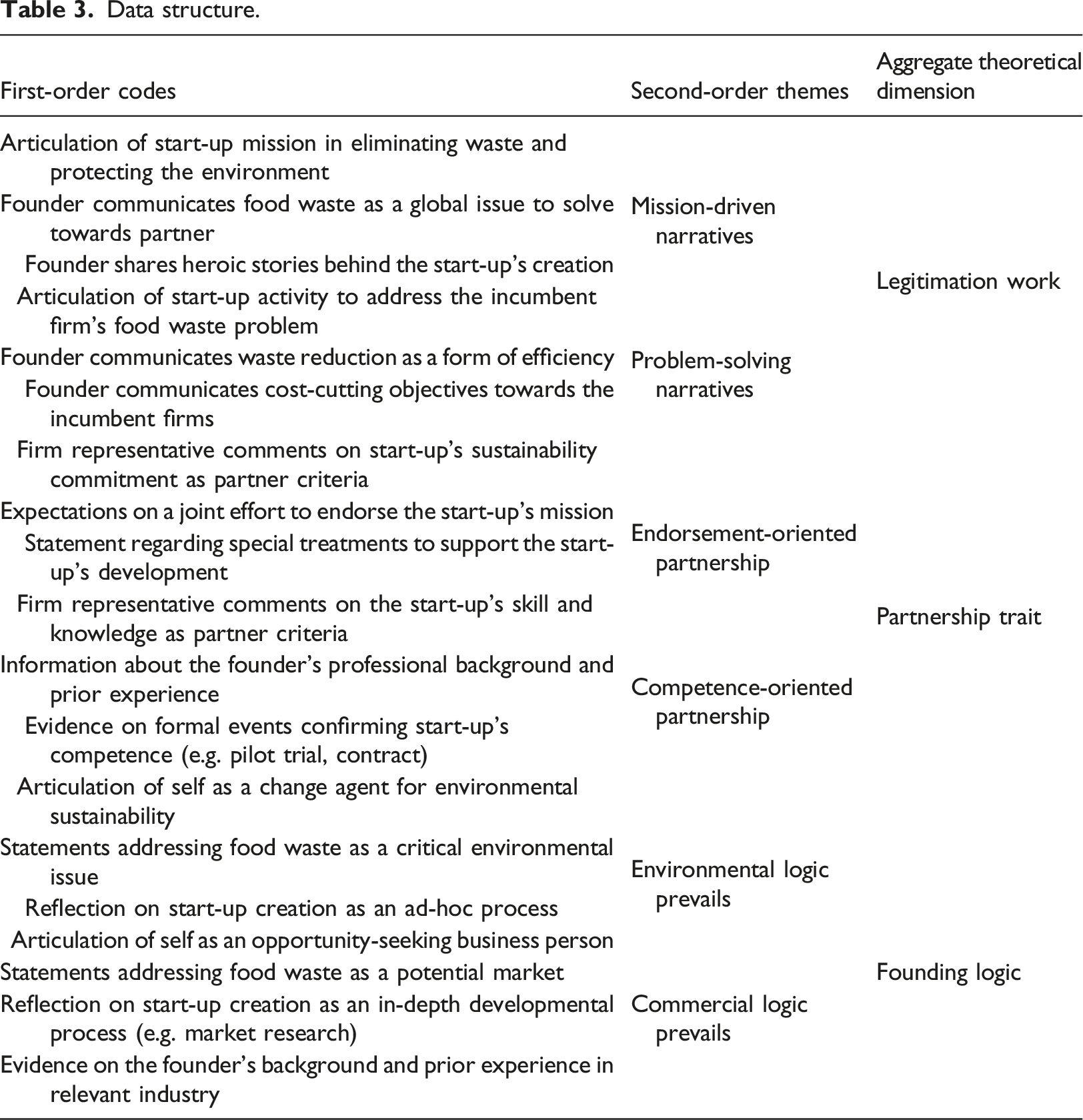
In the final and critical stage of our research, we formulated dynamic relationships among the second-order themes in data structure, while consulting with the literature and revisiting each case. This final stage allows us to build theory from our findings describing the journey of sustainability ventures forming their first major partnership.
Findings
We find that incumbent firms had no indirect or reputational knowledge about the new ventures before their first encounters. With the exception of Venture 2, the sustainability ventures that we study had their first encounters with the incumbent firms as a prospective partner through thematic events and exhibitions. Such meetings provided the entrepreneurs with an opportunity to convey legitimation work. Our inductive analysis soon signalled that across our interviews two distinct approaches to how the sustainability ventures frame their legitimation work could be identified. On the one hand, a group of founders frame their sustainability objectives in a mission-driven narrative. On the other hand, another group of founders frame their offerings in a narrative of problem-solving, highlighting their competence as skilful entrepreneurs. We also observe differences in how their audiences, that is, firms’ representatives, respond to the two modes of legitimation work portrayed by the sustainability ventures. As all sustainability ventures that we investigate eventually succeeded in forming their first major partnership, it may seem plausible that the employment of one or the other approach to legitimation work is driven by opportunistic strategic positioning on their behalf, that is, that the sustainability ventures are able to adopt either of the two approaches as they see fit. As we investigated further, however, we came to understand that the orientation towards either set of legitimation work seems to reflect a sustainability venture’s foundational identity, in that it permeates the values, goals and behaviour of the venture. As such, the varying ways to attract a partner can be understood as a reflection of differences in sustainability ventures’ founding logics (Ciuchta et al., 2018). As we discuss below, this insight drove our analysis of the two modes of legitimation work. Figure 1 illustrates our findings. Illustration of findings.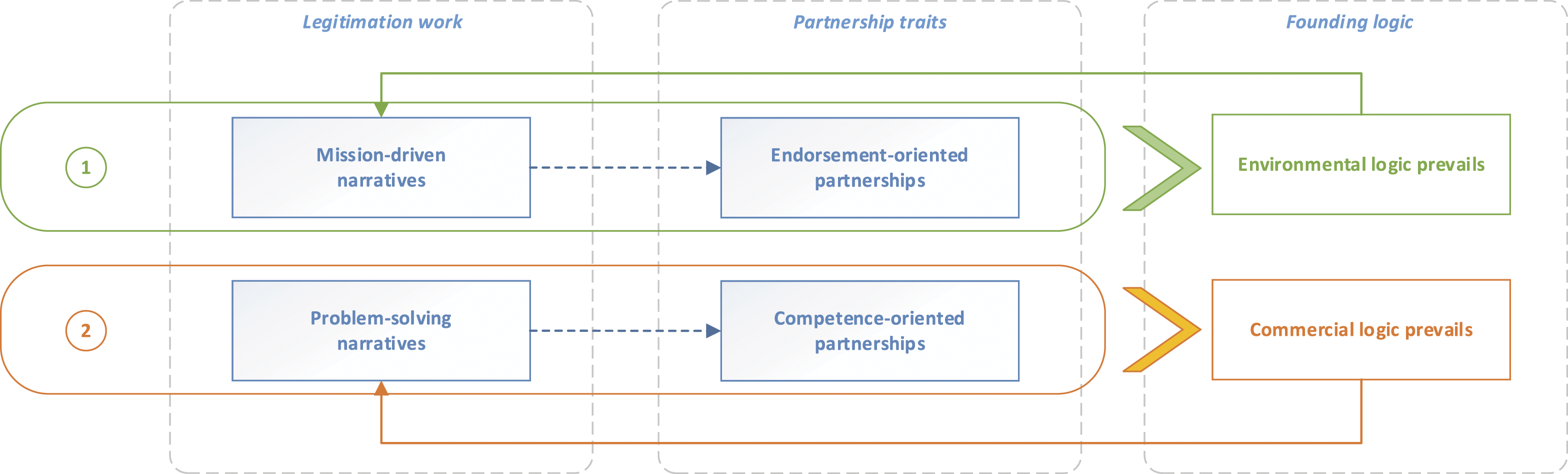
Legitimation work of sustainability ventures with salient environmental logic
We found that some founders (Venture 1, Venture 2 and Venture 3) perform legitimation work through accounts highlighting their passion for the venture’s social and environmental mission – framed as a mission-driven narrative (Martens et al., 2007; Phillips, 2013). For example, Venture 2’s founder left a strong impression on a representative of Firm B in their first meeting: I was just sitting there smiling on the opposite side of the table, because I saw what her business idea was like, it was brilliant. And not in commercial terms, but brilliant for the environment. She was describing how ‘so much resources have been spent during the time that the product has been growing up in Italy or Chile or Brazil or somewhere, and then they ship all the way to Sweden and then maybe it would be destroyed in our warehouse.’ (…) she really thought that was a terrible thing. (Category manager, Firm B)
Besides sharing their sustainability mission, the founders also employ storytelling by sharing the story of their venture’s creation (Garud et al., 2014; Moss et al., 2018). For Venture 3, this story involves the meeting between the cofounders, demonstrating the rich and diverse background of the new venture: … he also had a partner who he actually met during immigration. So he met up with this guy from Syria who (…) knew everything about insects and the two matched, and he got really involved in this, and when I met the guys I felt ‘Oh my god, there are so many good things about this company’. I mean, this is like a happy story; you two matched up, you went in a boat over the Mediterranean, you came here, and then you want to build something. (Innovation manager, Firm B)
Through their accounts, these founders demonstrate their firm commitment to advancing environmental sustainability despite their limitations as small and new players. Firm B’s representatives noted the passion and openness of Venture 2’s founder: At that time, she had a small kitchen in an industrial facility that she rented here in Helsingborg. So she was just taking boxes of that fruit in an elevator up to the kitchen making juice out of it. Then hopefully she could make a complete pallet in 2 days of work or something (Category manager, Firm B)
Another of Firm B’s representatives shared how she appreciated the venture’s determination in their mission, even though Venture three had not developed a clear commercial strategy in the early stage of their relationship.
... I think that from the beginning, he didn't really know exactly what product would be feasible. He had to try to figure that out on the way (...) We don't really know what’s going to happen, [just] that he is trying to find new ways, and that he wants to work for a sustainable future (Innovation manager, Firm B)
Our further analysis found that the narratives employed in their legitimation work were closely aligned with what the founders describe as the raison d’etre of the sustainability venture. Through their mission-driven narratives, they convey passion for and commitment (Davis et al., 2017) to ambitious environmental goals (Clark et al., 2018). We identify the founding of Venture 1, Venture 2 and Venture 3 as being framed in a dominant environmental logic. For these sustainability ventures, concerns about environmental degradation around food waste issues was an important motivation behind each venture’s creation. The founders of these sustainability ventures express their commitment to addressing the problem of food waste in the spirit of compassion and altruism, for example, as in the case of Venture 2: For me, it’s such a major problem, the volume of fruit waste. Many tons of fruits just go to waste every day. So it’s quite a big issue, and it’s really, really stupid. (…) We have so many environmental challenges today but I think wasting food… we should be able to stop wasting food. I can see the challenges in developing new types of fuels, building a different type of environmentally friendly houses, I can see the real challenges in those areas. But I think we should be really able to stop throwing food away. (Founder, Venture 2)
For these sustainability ventures, the primary goal of their business is centred on solving problems related to food waste. Although they strive for economic return, the environmental mission came before the financial goal, as stated by the founder of Venture 1: … we started from sustainability itself, not from the economic goal. I mean, we were interested in an economic return, but everything started from the idea to reduce waste. (Founder, Venture 1)
We further found that these ventures share similar behaviour as regards the alignment of their environmental and commercial goals. They refer to economic gain as a means to reinforce their environmental mission, as explained by Venture 2: The mission is much bigger than us, we need to do something. I mean, there is so much to do, and we actually do this for the planet. And I believe that we can do more for the planet if we earn some money so we can reinvest in the company and rescue more fruits. (Co-founder, Venture 2)
The process of sustainability ventures’ creation reflects how their approach in discovering and exploiting opportunities out of food waste tied strongly to their environmental mission. This process is rather spontaneous and ad-hoc. These sustainability ventures were created based on an idea of a product that can eliminate food waste in a direct and tangible way, without necessarily involving extensive market research. Venture 1’s founder elaborated on how he launched his new venture out of a simple idea; only afterwards did he start to investigate the market: Around 5 a.m. I got up, and, with the help of scissors and cardboard, I gave birth to the first prototype of[venture]. In this way, the project was launched, we started to check whether there was a real market, and whether it could be big enough. (Founder, Venture 1)
Endorsement-oriented partnerships
Our analysis shows how a venture’s founding conditions shape an entrepreneur’s capacity for, and interest in, mobilising each of the two logics. We take the analysis one step further by asking whether those who own ventures with a dominant environmental logic gain advantages from abstaining from mobilising the commercial logic in their legitimation work. Our findings suggest that the founders of Venture 1, Venture 2 and Venture 3 succeeded in conveying a view of their firms as legitimate collaboration partners by disclosing their initiatives and strong passion for environmental protection. Signalling that an initiative addresses an urgent environmental issue in the contemporary world improves audience judgements of the worthiness of a new venture (Truong and Nagy, 2020). A venture’s environmental commitment is classed by firms as being among their most attractive and distinctive features (Navis and Glynn, 2011), as Firm B’s representative for Venture 2 implies by stating that the founder’s sustainability passion was the deciding factor that triggered his decision. Similarly, Firm A’s representative stated that she intended to support Venture 1’s serious commitment to creating and disseminating a new habit to fight food waste in Italy: Venture 1 is a new venture with an ethical commitment, and they need the backing of a bigger corporate entity to support them going forward. (Sustainability manager, Firm A)
We learnt that this type of legitimation work leads to a partnership stance whereby this group of sustainability ventures form a unique tie that extends beyond a ‘typical’ business relationship (Yang et al., 2014). Such legitimation work leads to favourable legitimacy judgements by a firm’s representative, which may have a positive impact on their decision regarding the partnership formation (Truong and Nagy, 2020). In these partnerships, the incumbent firms offer endorsement to the new ventures with the purpose of helping the venture develop into a profitable busines (Zimmerman and Zeitz, 2002) beyond the scope of their initial agreement. As a result, Venture 1, Venture 2 and Venture 3 each developed a ‘special’ partnership with their first major partner. Firm A endorsed Venture 1 to its broad restaurant partner network across Italy. Similarly, Firm B’s representatives described how the firm provided far-reaching support for Venture 3 and Venture 2, respectively: ... we [Firm B] saw the production and we said, ‘Well, we must be able to do something. What do you need and what can we do?’ And then we figured out that we could help to put a lot of people in contact with them, we can help them with quality questions, we can help them with their dialogue with the government. (Innovation manager, Firm B) In the beginning, I think we paid more for every box of the fruit than what we actually sold the bottles for, because we wanted her to get on her feet and to be able to start recouping all the investment she had made in the factory. (Category manager, Firm B)
In such a relationship, the incumbent firms offer a favourable opinion that serves as a vote of confidence in the endorsed new ventures (Zimmerman and Zeitz, 2002). Receiving endorsements may play a pivotal role in the new ventures’ success and survivability (Ciuchta et al., 2018), particularly those at the nascent stage (Djupdal and Westhead, 2015). Endorsement from an incumbent firm may benefit the nascent venture when seeking to create future ties with other partners (Stuart et al., 1999; Dacin et al., 2007).
Interestingly, in all three cases, the process of partnership formation took place in a spirit of trust and benevolence. Partnerships were formed in a relatively short time and through a less formalised process compared to a general partnership formation process (Reuer et al., 2006). There was no use of a formal trial period or pilot project. The partnership agreements were relatively open and loose, that is, without strict terms and time limits. Venture 3’s founder stated that the partnership would run as long as both sides are happy. Even though these ventures benefit from the preferential treatments offered by the incumbent firms, they are not exclusively bound and are thus in principle free to collaborate with other companies including the competitors of the respective firms.
Legitimation work of sustainability ventures with a salient commercial logic
The founders of the two other sustainability ventures (Venture 4 and Venture 5) frame their offerings in a narrative of problem-solving, highlighting their skill and competence as entrepreneurs. Legitimation towards a potential partner is nurtured by communicating the idea of how their ventures can help the partner to solve a food waste issue and inefficiency problem. ... we just explained all the problems that existed and shared our concept about how they could use [our] technology to reduce food waste (..) so really what I did was kind of to convince [Firm C’s representative] that actually it was a solvable problem, and that the technological solution was feasible, for him to give us the opportunity to demonstrate it. (Founder, Venture 4)
In comparison to the other three sustainability ventures, the legitimation work that Venture 4 and Venture 5 conveyed was found to much more explicitly allude to the potential economic benefit for their counterpart. These sustainability ventures emphasised their capability in helping the partner firms to improve resource-efficiency by addressing cost-saving or revenue-creation opportunities that can be closely linked to the firm’s corporate social responsibility (CSR) activities. Our overarching goal is to help supermarkets to reduce food waste thanks to a better management system (…) in order to create special promotions on products that are about to expire. At the same time, our technology allows us to gather and manage information about what happens in every store in order to understand the causes of inefficiency and to create the right solution (...) that enables supermarkets to share their social responsibility with the final consumers and to create a better shopping experience. (Founder, Venture 5)
While communicating the importance of the cost benefit aspects to their prospective partners, these ventures may also highlight aspects of environmental benefit – particularly when addressing those who occupy roles such as sustainability manager. It depends on what people or department within the organisation that is championing it (…) which individual stakeholders that will help and drive [the project], whether it is more driven from the sustainability angle or from a cost-saving angle. (Head of operation, Venture 4)
The problem-solving narratives which we document are strongly integrated with arguments advancing a venture’s business competence in the field. These arguments are intimately tied to a founder’s background and identity (Wagenschwanz and Grimes, 2021). Both founders note that their motivation for starting their companies and the approaches they adopted are strongly influenced by their prior knowledge and professional experience. The founder backgrounds contribute to shaping business ideas for developing scalable products and addressing specific actors and operations along the food value chain (Outsios and Kittler, 2018). Venture 5’s founder has previously worked in a leading consulting firm and specialised in CSR projects. Similarly, Venture 4’s founder has extensive professional experience in the food industry, for example, from his prior role as a business consultant for various food firms. This background shaped his entrepreneurial mindset: I was in food pretty much during my entire life (…) while I was at [global consultancy firm] I was looking at the global opportunity in sustainability, like, where are the big numbers that if we really scale up the solution would allow us to do something very material? (Founder, Venture 4)
In this group of sustainability ventures, we found that the process of new venture creation was centred on entrepreneurial opportunities tied to environmental problems. The founders of these two sustainability ventures describe how they recognised food waste reduction as an area with commercial potential: ... I realised that the issue of food waste was one of the biggest opportunities that basically exists with very few people doing anything about it. It was one of those moments when you see an opportunity that no one is really addressing that excites you and drives you to quit and build a company yourself (…) food waste is a trillion-dollar problem globally, which is why it is very attractive to go after. We estimate that in the hospitality industry alone, there is a hundred billion dollars potential. (Founder, Venture 4)
For these sustainability ventures, it is important that their business activities achieve environmental and economic goals simultaneously. Venture 5’s founder explained that he initiated a business while aiming for multiple goals that work in tandem with one another: I was very interested in CSR topics and to understand how to create social, environmental, and economic value from problems and food waste is a huge problem. At the supermarket level I saw that it was not managed very well, so I decided to understand how to manage this problem in order to create this value. (Founder, Venture 5)
We found that both sustainability ventures perceive food waste as a promising, untapped market opportunity to be explored. In describing their activities, the founders emphasise the alignment between creating financial returns and solving food waste problems. As stated by Venture 4’s founder: If I continue to deliver shareholder returns, I am going to have significantly more capital available to help further solve the problems faster … I see it working as a virtuous circle. (Founder, Venture 4)
In view of this combination of values, goals and behaviours, we identify these sustainability ventures as having been founded with a predominant entrepreneurial and commercial logic. In comparison to the previous group of sustainability ventures, we also found a notable difference in the process of new venture creation that further demonstrates how their foundation is tied to the pursuit of entrepreneurial opportunity. Venture 4 and Venture 5 were founded following an in-depth process of market investigation. Venture 4’s founder shared his journey in the inception stage of Venture 4, where he spent nearly 1 year trying to understand the opportunities around food waste and spending a lot of time interviewing people, which eventually led him to focus on the issue of food waste in restaurants.
Competence-oriented partnerships
The three ventures with a dominant environmental logic were found to have been able to establish endorsement-oriented partnerships. For a comparison, we also investigate the partnerships established by Venture 4 and Venture 5 that employ problem-solving narratives in their legitimation work. We found a pattern of interaction more similar to a traditional partnership formation process. Our findings suggest that these sustainability ventures attract incumbent firms as partners by demonstrating founder skills and entrepreneurial competencies, as suggested by a Firm C representative in his account regarding Venture 4: … in general, you should talk about competence if you want competent people to help you, or if you want a competent partner. Competence for me is the combination of the knowledge that you have around the topic, the issue, and the capability as a company. (Food operation manager, Firm C)
In these two cases, both partnering firms develop relationships where future exchange is made contingent on the past and expected value of the partnership to the incumbent firm, as enabled by each venture’s level of competence (Reuer et al., 2006). The initial stage of their relationship involves ‘stage-gates’ of the type found in a typical arms-length partnership agreement between a large and a small firm (Yang et al., 2014), with initial commitment being limited to a trial period and a pilot project. We started with a pilot project, a test in one supermarket for six months. We established some KPIs with the company, in order to monitor the result and the impact of our solution on their business. At the end of the test we checked these KPIs and they were very happy, so they decided to go ahead with a broader collaboration with us in their stores. (Founder, Venture 5)
After satisfactory completion of the trial, formalised contracts were established with a defined timespan of three and two years, respectively, for Venture 4 and Venture 5. In summary, we find that the process of partnership formation is more formalised and structured compared to the other three partnership cases.
In these two cases, while the founder’s background substitutes for the lack of an organisational track record in providing the new ventures with sufficient credibility (Nagy et al., 2012), the incumbent firms require a formalised confirmation procedure through a sequence of pilot stages before entering the partnership arrangement. The pilot period provides firms the means of validation of the perceived credibility and serves as a partner legitimacy threshold for the sustainability ventures (Fisher et al., 2016). Such a formalised process constitutes the efforts of incumbent firms to eliminate uncertainties and minimise unnecessary risks that arise with new partners (Beckman et al., 2004). Without any prior ties, an incumbent firm cannot rely on a sustainability venture’s portfolio for relevant information in terms of activities, performance or previous partners (Li et al., 2008).
Legitimation work and founding logic
Our findings demonstrate how the sustainability ventures we studied tended to orient their legitimation work after one dominant founding logic. In what follows, we reflect on why our five sustainability ventures do not display greater tendencies to relate to both types of logic in their legitimation work, despite theoretical predictions that utilisation of more than one type of logic may entail advantages. We discuss opportunities and barriers to exploiting both commercial and environmental logics and propose a schematic representation of asymmetric logic compatibility in legitimation work.
A first explanation for why the sustainability ventures that we study seem inclined to primarily adhere to one of the logics relates to the ventures’ choices in recognising and exploiting opportunities. Such choices can be shaped by a venture’s foundational identity (Ciuchta et al., 2018; Kodeih and Greenwood, 2014) and, thereby, by the conditions and rationales behind a sustainability venture’s foundation as well as a founder’s background (Outsios and Kittler, 2018) and commitments associated with their identities as entrepreneurs (Wagenschwanz and Grimes, 2021; Ruvio and Shoham, 2011). The two commercially oriented ventures in our sample (Venture 4 and Venture 5) are pursuing commercially viable opportunities that may be presented as problem-solving activities to incumbent firms. The three environmentally oriented ventures (Venture 1, Venture 2 and Venture 3), in contrast, tend to identify such opportunities as secondary objectives. For these three sustainability ventures, neither their business model nor their offering towards the partner were fully identified at the initiation of the respective partnerships. In summary, it can be suggested that organisational imprinting may determine how sustainability ventures navigate the dual logics (Ciuchta et al., 2018; DiVito and Bohnsack, 2017).
A second-level interpretation and explanation of why such sustainability ventures do not fully utilise the potential flexibility advantages of dual logics is that legitimation work, to a non-trivial degree, is logic-specific. Successful mobilisation of environmental values requires a certain degree of credibility (Truong and Nagy, 2020), which may be provided by a compelling narrative about the foundational motivations of a new venture or a communicable personal passion for an issue (Davis et al., 2017; Martens et al., 2007). Such characteristics do not facilitate legitimation in terms of commercial logic. Rather, successful mobilisation of commercial values requires entrepreneurs to demonstrate a different set of characteristics. As found in the cases of Venture 4 and Venture 5, such characteristics include personal attributes (i.e. entrepreneurial drive) and reliability in delivering relatively well-specified services (Nagy et al., 2012; Zimmerman and Zeitz, 2002).
Both sets of reasoning outlined above provide explanations for why sustainability ventures may tend to orient strongly towards one of the two logics, despite the opportunities to leverage both (Mongelli et al., 2019). We have, however, found indications that the two commercially oriented ventures do to some extent find it useful to mobilise environmental values, whereas it would not seem that the environmentally oriented ventures relate to commercial values in their legitimation work. To interpret this pattern, we may first note that the two groups of sustainability ventures differ in their interfaces with their incumbent partners. The sustainability ventures oriented towards a commercial logic enter partnerships with a higher level of institutional formalisation, and seem to engage with a somewhat broader array of actors within the incumbent firm on their way to establishing these partnerships. This makes logic decoupling more relevant for them. We find indications that the sustainability ventures primarily orienting towards a commercial logic in their legitimation work opportunistically seek to mobilise environmental values in contacts with audiences for whom this logic is of primary importance. But with low tension between environmental and commercial logics, strong decoupling should not be the most beneficial path to exploit logic duality. We may instead have expected strategic coupling behaviour where sustainability ventures would freely combine elements of environmental and commercial logics in their legitimation work (Pache and Santos, 2013).
Dual logics in legitimation work.
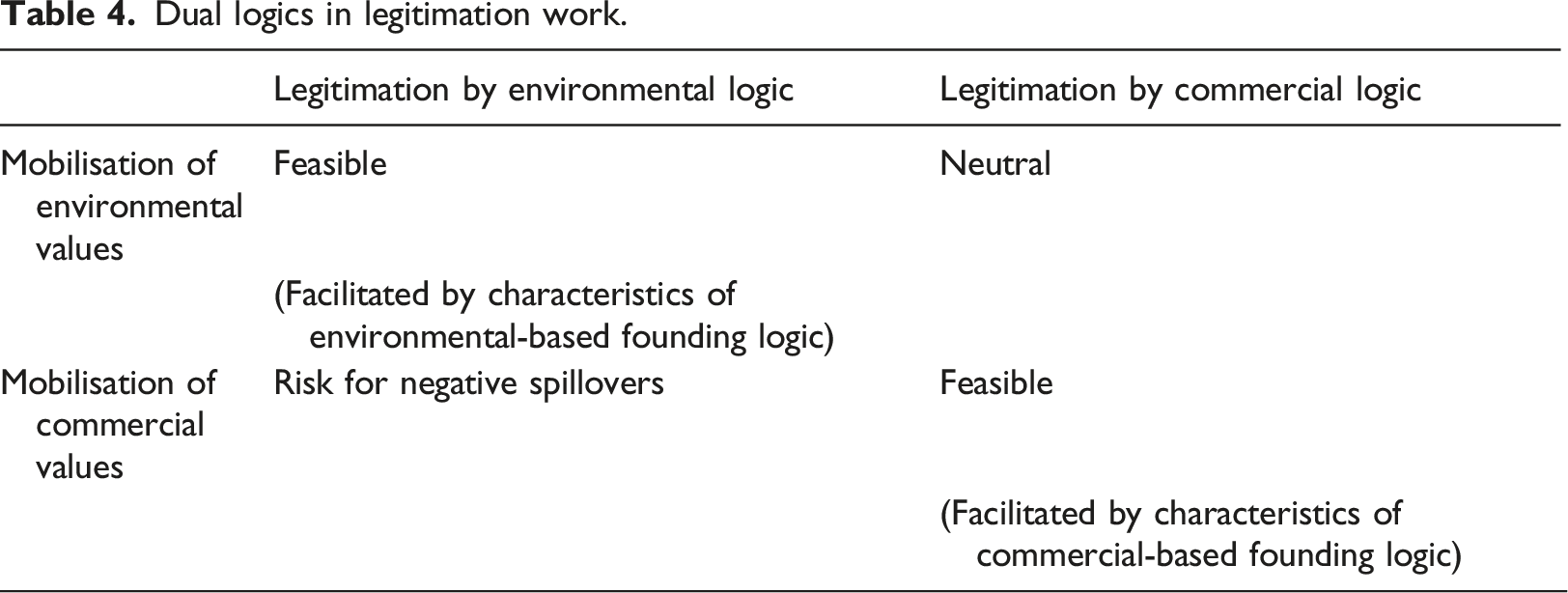
The schematic representation of key findings outlined above would apply to the legitimation work of sustainability ventures in general. However, in the most commonly studied settings, where the relationship between the dual logics is subject to direct trade-offs and tensions, sustainability ventures are forced to hybridise. The need to balance partly conflicting logics then counteracts the tendencies to orient towards a single logic, as described above. Our findings suggest that in the absence of direct conflict between environmental and commercial logics, the tendencies to single-logic orientation are stronger than tendencies to selective coupling or simultaneous exploitation of dual logics in the legitimation work of sustainability ventures
It is possible that in settings with a significant conflict between logics (Battilana et al., 2015; Nicholls and Huybrechts, 2016), the potential advantage of single-logic orientation in legitimation work is generally lower than it would seem to be in our setting. In particular, Firm A’s and Firm B’s representatives may find it more challenging to secure necessary support internally for a decision to partner with the sustainability ventures, had the partnership activities (i.e. waste reduction in different forms) not provided inherent economic benefits. That is, while the focus of this article is on the legitimation work of sustainability ventures, it is clearly possible (1) that processes of partnership legitimation inside the incumbent firms have had an impact on the outcome of the venture efforts, and (2) that these processes would be less likely to generate support for a partnership with an environmentally oriented venture if commercial and environmental logics were perceived as standing in conflict with each other.
Finally, it should be clarified that while we find that the division between environmentally and commercially oriented ventures is rooted in their respective founding origins and that these are important for early-stage behaviour, we do not perceive of this division as necessarily reflecting permanent differences. Sustainability ventures may adopt more elaborate practices of strategic logic coupling in view of changing priorities of their external audiences, or in view of other types of turbulence in their environment (Ramus et al., 2017). It is also possible that at a later stage, having gained experience from interacting with diverse audiences, these ventures may learn to craft and adapt their legitimation work in alignment to different audiences (O'Neil and Ucbasaran, 2016; Fisher, 2020).
Conclusions
New ventures in the realm of sustainable entrepreneurship operate in contexts where at least one ‘other’ type of logic (environmental, social) beyond the strictly commercial logic is present. This duality may pose significant challenges for sustainability ventures, insofar as the two logics stand in some conflict to each other in important decisions and in the expectations of different groups of stakeholders. Such ventures, however, may also be able to use a dual logics context to their advantage by coupling logics loosely or tightly together for different strategic purposes.
This article highlights how nascent ventures navigate between the two logics in pursuing legitimation work thus, enabling them to establish a major partnership with an incumbent firm. Specifically, we investigate opportunities and barriers regarding the mobilisation of dual logics in legitimation work undertaken to establish a first major partnership by sustainability ventures whose businesses focus on food waste reduction. Efforts to reduce food waste have the potential to simultaneously generate environmental and economic benefits. As long as the costs of initiatives to reduce waste are not greater than the sum of discounted future reductions of the cost associated with waste, the two types of benefit work in tandem. Hence, such ventures are not forced into hybridity by partial conflicts between values emanating from environmental and commercial logics to the same extent that the ‘typical’ setting of dual logics organisations suggests (Battilana et al., 2015; Nicholls and Huybrechts, 2016). With less restrictive boundaries in place, the setting of waste reduction is particularly interesting since entrepreneurs may choose to either orient their legitimation work towards a single logic, or to mobilise both types of logics in their efforts to legitimise their ventures.
Our analysis of five sustainability ventures shows that the legitimation work of three ventures is strongly oriented towards environmental logic, while the other two are dominated by commercial logic. Only in the latter group do we find indications that these ventures are also actively utilising the non-dominant logic in their legitimation work. Analysis of the backgrounds of the sustainability ventures suggests that this pattern may be driven by organisational imprinting, in that founding conditions emphasising either the environmental or commercial logic seem strongly related to the type of legitimacy work the different ventures engage in. Through further analysis of our findings, we also suggest that legitimation work may be seen as inherently logic-specific – particularly for new ventures rooted in an environmental logic.
Our specific findings on how sustainability ventures navigate between environmental and commercial logics primarily apply to settings where these logics are not in direct tension. However, we can expect that our analysis regarding the role of imprinting and logic incompatibility applies to the more general case of sustainable entrepreneurship. For example, our findings allow for reflections on how sustainability ventures in general may behave if changes in their environment reduce the level of an inherent conflict between the dual logics. Such changes could, for example, entail regulation transformation on what is hitherto a voluntary activity driven by incumbent firms’ CSR ambitions into a formal requirement that firms need to comply with. Our findings and interpretations suggest that new ventures addressing the commercial opportunities arising from such changes can be expected to employ a relatively low level of hybridisation, and orient more strongly towards a straightforward commercial approach when engaging with potential partners.
This article contributes to the literature on sustainable entrepreneurship (Outsios and Kittler, 2018; Johnson and Schaltegger, 2019; Patzelt and Shepherd, 2011) by elaborating on how sustainability-driven entrepreneurs build legitimacy for their new ventures. By focussing on how sustainability ventures use legitimation work to secure a first major partnership, our findings frame this critically important situation in relation to related work on new venture legitimation (O'Neil and Ucbasaran, 2016; Uberbacher, 2014; Truong and Nagy, 2020). Our study also contributes to the broader literature on how organisations navigate institutional pluralism (Pache and Santos, 2013; Savarese et al., 2020; Wagenschwanz and Grimes, 2021). We demonstrate shows how new ventures navigate dual logics settings to gain inter-partner legitimacy within limited logic tension. A low-tension setting, such as in contemporary waste-reduction activities, allows us to more effectively study barriers to combining environmental and commercial logic narratives in legitimation work. When logics point in different directions regarding strategic options – that is, when an environmentally or socially preferable action is at odds with what is preferable from a strictly commercial point of view – it is difficult to discern whether an audience reacts to inherent tensions between strategic options, or to tensions in legitimation work per se. Studying venture legitimation in a low-tension setting allows us to deduce that any prevailing barriers to freely combining elements from environmental and commercial logics emanate from tensions in audience perceptions of actor credibility. Thus, we are able to shed light on the extent to which barriers to selective coupling discussed in extant literature are to be understood as emanating from tensions between strategic options, rather than by tensions in legitimation work per se. Specifically, our findings support the view of legitimation work being subject to logic tensions also when these logics are well-aligned in terms of strategic options. In addition, our study responds to the call by Ciuchta et al. (2018) for research that examines the origins of founding logics and its implications for new venture endorsement. Our findings highlight how variations in entrepreneur backgrounds translate into differences in founding logics, but also how the mobilisation of logics in the legitimation work of sustainability ventures leads to differences in partnership outcome. In particular, we document how a non-commercial founding logic may enable a type of legitimation work that allows a venture to establish endorsement-based partnerships with an incumbent firm.
This study has limitations that we believe call for further research to develop and qualify the results that were obtained. Our findings relate to how sustainability ventures behave within the context of a single partnership with a common type of audience. Our analysis of the importance of founding logics and of the partial incompatibility of the two logics suggests that we should expect sustainability ventures – in particular those with a salient environmental logic – to leverage their founding logic in legitimation work across audiences; this should, however, be subjected to further scrutiny. A further limitation is that our empirical study examines only successful cases, that is, all the sustainability ventures have succeeded in forming a partnership with an incumbent firm. We believe a study that includes failed partnerships would be valuable while acknowledging that sampling would present a challenge. Finally, our study is focused on early-stage sustainability ventures. It would be of interest to investigate whether and how a greater maturity may allow sustainability ventures to exploit the potential advantages of employing the dual logics in their legitimation work towards new partners.
We offer several insights of value to managerial and policy decision making regarding business settings where environmental and/or social concerns constitute an essential driver for activity. Of particular interest to sustainability entrepreneurs, our study highlights how mobilisation of environmental values may help an early-stage new venture gain the active support of prominent industrial players. As regards implications for policy on entrepreneurship and sustainability, our findings call for a slight reconsideration of the requirements in publicly sponsored schemes for support of early-stage venturing (e.g. pre-incubators). Such schemes tend to have a strong focus on the demonstration of viable, marketable products and services. Our findings regarding the ability of sustainability ventures to form important partnerships and receive a form of sponsorship from established organisations suggest that it may make sense to support nascent ventures with a credible sustainability agenda, despite the absence of a well-defined revenue model. The same set of findings would also indicate that the CSR activities of incumbent are, in some instances, maturing to an extent where they actively contribute to fostering non-competitive sustainability champions; an observation which calls for further consideration of how public initiatives in the area of environmental entrepreneurship are to relate to activities within the private sector.
Footnotes
Acknowledgements
This article was produced as part of the Erasmus Mundus Joint Doctorate Programme on European Doctorate in Industrial Management (EDIM) funded by the European Commission, Erasmus Mundus Action 1. We would also thank the Observatory of Food Sustainability for the support on empirical study.
Declaration of conflicting interests
The author(s) declared no potential conflicts of interest with respect to the research, authorship, and/or publication of this article.
Funding
The author(s) received no financial support for the research, authorship, and/or publication of this article.
