



Abstract
Studies of internationalisation have largely overlooked developing countries with high levels of legitimate informal entrepreneurship. Consequently, this article analyses the internationalisation of Informal African Firms (IAFs) from a network perspective. We undertook in-depth case studies of 14 informal smaller firms in two major enterprise clusters in Ghana. Our findings show that half transacted business in five to seven foreign markets, and more than half sold abroad within three years of inception. The study illustrates the different network ties that influence passive and active internationalisation strategies with evidence that these IAFs developed buyer networks through customer referrals and foreign customer walk-ins to the firm. Overall, we provide a comprehensive understanding of the triggers that initiate international business activities by IAFs so contribute to current theorising noting implications for management practices and policymaking on this important but hitherto, under-explored issue.
Introduction
Analyses of entrepreneurial internationalisation are less common at the ‘base of the economic pyramid’ (Branzei and Abdelnour, 2010: 804) and particularly among enterprises in the informal sector, even though they provide 52% of the world’s employment (International Labour Organisation [ILO], 2018). In sub-Saharan Africa, over 79% of enterprises are informal; the sector contributes around 36.2% of gross domestic product (International Labour Organisation, 2018; Medina and Schneider, 2018). Prior research has shown that the foundations of informality are an essential part of the entrepreneurial and business ecosystem in sub-Saharan Africa (Barnard et al., 2017; Galdino et al., 2018). According to Kebede (2020), social and business networks enable business creation and positively affect the performance of informal enterprises (see also Berrou and Combarnous, 2012; Thai et al., 2020). Koto (2017) stressed that networks positively affect the linkages between firms in the informal and formal sectors. In recognition of this, Cuypers et al. (2020) and Coviello and Munro (1995) have demonstrated that access to network relationships is a significant factor in internationalisation. However, networks have been underexplored in the cross-border business activities of legitimate and opportunity-driven informal enterprises despite these being evident in ventures in developing economies (Abdallah, 2017; Grimm et al., 2012; Tang and Konde, 2021). In addressing this gap, this article explores two research questions: First, how and why do informal firms internationalise to foreign markets instead of remaining local? Second, how do the social and business networks of informal firms influence their modes of internationalisation?
Contemporary research on informal entrepreneurship has emphasised its importance as an integral part of global production (Chen, 2016; Meagher, 2013). There is also growing recognition that on a global basis, many entrepreneurs are neither wholly formal nor informal but display varying levels of (in)formalisation (Williams et al., 2016, 2020). The underlying causes and levels of informality in developing, emerging and developed economies differ (International Labour Organisation, 2018), due in part to the degree of institutional voids and weak formal institutions that undermine the efficiency of market transactions across these contexts (George et al., 2016). Following definitions outlined in extant studies (Siqueira et al., 2016; Tang and Konde, 2021; Webb et al., 2009), an informal firm refers to entrepreneurial activities that occur partially or entirely outside formal institutional boundaries. These firms, however, operate under informal institutional boundaries that reflect social acceptability based on norms, values and beliefs of large groups in society to produce legal goods and services. Globally, informality in business occurs at many levels, including business start-ups, management structures and processes, employment conditions and taxation. However, the nature and level differ between developing and developed countries (International Labour Organisation, 2018).
Following the definition of Ghana’s Business Establishment Survey (Krakah et al., 2015), the informal firms in our study do not keep formal accounts; they remain unregistered with the Registrar General’s Department, the national statutory body responsible for business registration. Most do not contribute social security payments. However, they have fixed and visible premises and rely on apprentices as their principal employees (Lamptey and Debrah, 2020). Thus, they are public businesses considered legitimate by other firms and most government institutions (Sowatey et al., 2018: 337). Most are registered with informal business associations or local councils who collect levies (International Labour Organisation, 2018). Premises are frequently provided in a geographic co-location 1 by the local council or local government institution (Gatune, 2016), for example, the Kumasi Metropolitan Assembly or the National Board of Small-Scale Industries in Ghana (Amoateng et al., 2014). According to Krakah et al. (2015), 90.5% of establishments are informal out of an overall 638,234 businesses operating in Ghana. Therefore, our study excludes ‘underground enterprises’ devoted to criminal activities.
Brenton and Soprano (2018) emphasise that informal firms who engage in cross-border trade move through official crossing points and even undertake formal clearance procedures. The African Trade Report (Afreximbank, 2020) underlined that informal cross-border trade (ICBT) had been a key contributor to the continent’s economic development, job creation, income growth, household consumption and expansion of intraregional trade. This sector is recognised as a significant contributor to developing competitive cross-border regional value chains in Africa. Nonetheless, in most African countries, attempts to monitor and understand these trade dynamics have been inhibited by a paucity of time series data and the absence of a consistent framework for collecting information on cross-border trade (Afreximbank, 2020). Thus, the internationalisation of informal African firms is not explicitly documented or researched. Consequently, we focus on the cross-border trade of legal goods produced by informal firms that have undergone formal clearance at the border points and are recorded by customs authorities.
The extent to which informality facilitates legitimate and attractive international opportunities for entrepreneurs differs depending on the degree of integration the informal firm has with the formal sector (Böhme and Thiele, 2014; Chen, 2016; Meagher, 2013), the state of the industry (Siqueira et al., 2016) and the informal entrepreneur’s effective use of social and business networks (Kebede, 2020; Koto, 2017). At the individual, organisational or inter-organisational level, a social network is defined as a set of nodes and the connections which form personal and social connections with others and a subsequent network of relationships (Cuypers et al., 2020). Business networks are relationships between actors in the business market for achieving business goals (Håkansson and Snehota, 1989). Researchers in entrepreneurship and marketing argue that business networks include a mix of formal and informal relationships (Donbesuur et al. 2020; Owusu et al., 2021). In this light, studies have recognised that the internationalisation process of small- and medium-sized enterprises (SMEs) also relies on social network relationships to enable their market selection and entry modes (Cuypers et al., 2020; Urban, 2019). As such, informal contacts have been found to play an essential role in building social networks, facilitating inter-firm cooperation and the internationalisation of small entrepreneurial firms (Dana and Ratten, 2017; Felzensztein et al., 2019). Many firms internationalise with the benefit of social and business relationships (Ellis, 2011; Johanson and Vahlne, 2011). In particular, Dana and Ratten’s (2017) study on African countries suggests that international entrepreneurs need to focus on informal networks and cultural attributes to differentiate themselves in foreign markets.
Those seeking to analyse the structure and operation of entrepreneur’s networks commonly use Granovetter’s (1973) notion of strong and weak ties (Jack, 2005; Jack et al., 2004). The principal argument being that strong ties generate closed networks, whereas weak ties allow access to other social circles beyond an actor’s direct network. However, Granovetter’s arguments remain underexplored in international entrepreneurship and business networks research despite them forming a basis for network characteristics and content in the fields of entrepreneurship and business networks (Håkansson and Snehota, 1989; Håkansson and Snehota, 1995). Cuypers et al. (2020) stressed that the incorporation into international business research of the social network perspective remains limited. In view of this underexplored research field, we undertook in-depth case studies of 14 informal SMEs in two major enterprise clusters in Ghana. Our findings contribute to international entrepreneurship and networking theories in several important ways: First, we illustrate the different network ties that influence the internationalisation of informal firms. Second, we analyse how and why informal firms do not remain local but expand abroad. Our findings, therefore, provide new knowledge on the entrepreneurial acumen and ambition of informal firms, the factors and processes that enable them to internationalise early to regional foreign markets and beyond.
In the following section, we review and link the literature on the concepts of the informal sector, entrepreneurship, social and business networks, and firm internationalisation. Then follows the methodology of the study, the findings and analysis, and the last section incorporates both the conclusion and the implications of our research.
Literature review
Characteristics of informal entrepreneurship
Contemporary literature emphasises that entrepreneurship should be viewed on a continuum ranging from wholly formal to wholly informal (Webb et al., 2009; Williams et al., 2016, 2020), whilst informality in business occurs globally, and differs between countries and firms in terms of degree (see discussion in International Labour Organisation, 2018: 1–2). In this regard, it has been found that higher levels of informality exist among entrepreneurs who are unaware of the need to possess a legal status as a company, who view informality as normal and do not trust public institutions (Obeng-Odoom and Ameyaw, 2014; Williams et al., 2016, 2020). Obeng-Odoom and Ameyaw (2014) studied informal entrepreneurs who failed to obtain formal employment even though they had appropriate qualifications, with many being highly educated and skilled. Thus, the critical determinants of the level of informality are a mix of the characteristics of the entrepreneur, the enterprise and the broader institutional environment.
Informal entrepreneurship in West Africa
In West Africa, the proportion of informal employment is about 92% (International Labour Organisation, 2018). Sector-wise, it is dominated by agriculture (98.3%), industry (91.5%) and services (85.4%) (International Labour Organisation, 2018). These figures confirm how deeply rooted informal employment is in the economic activities of West African countries. This sub-region hosts SMEs that meet all the criteria for formality but choose to remain informal (Benjamin and Mbaye, 2012; International Labour Organisation, 2018). Grimm et al. (2012) identified three groups of informal firms in West Africa: top performers, constrained gazelles and survival entrepreneurs, with the first two regarded as opportunity-driven informal entrepreneurs. Benjamin and Mbaye (2012) also reported that informal enterprises produce ordinary goods and services little different from those produced in the formal sector. Further, Böhme and Thiele (2014) demonstrate linkages between the formal and informal sectors concerning distribution channels and an overlapping customer base. However, the nature of informal enterprises makes their competition dynamics different from those of formal firms (Thai and Turkina, 2014).
There are, however, relatively few productivity and non-technological innovation gaps between informal and small formal firms in West Africa (Abdallah, 2017; Fu et al., 2018), with Amin and Islam (2015) finding that small informal firms have higher labour productivity than medium-sized informal firms. One significant factor here is the costs borne by medium-sized informal firms, for example, pre-formalisation fees. Nevertheless, Benjamin and Mbaye (2012) and Mckenzie and Sakho (2010) imply that economies of scale may give medium-sized informal firms a productivity advantage over their smaller counterparts. Acheampong and Dana (2015) found that informal enterprises can compete with foreign firms in Ghana given their liability of foreignness. In contrast, informal firms operate in local networks and leverage local knowledge (see George et al., 2016: 384). Finally, through the growth of global financial markets, rapid technological change in online banking services, waybill systems, transport and telecommunications has tended to stimulate rather than eliminate informal activity (Tang and Konde, 2021). This has enabled informal entrepreneurs to discover and take advantage of business opportunities and establish social and business networks.
This evidence highlights how formal institutions interact with cultural institutions in West Africa to create an environment conducive to non-formalised business (Barnard et al., 2017; Galdino et al., 2018). Regarding this, Webb et al. (2014) assert that informal entrepreneurs take advantage of, or fill the void, left by imperfections in the institutional environment. In situations where informal firms cannot rely on, and are generally denied support from, formal legal institutions their owner-managers draw support from social and business networks to maintain their businesses (Berrou and Combarnous, 2012; Koto, 2017).
Social networks, business networks and informal entrepreneurship
The term ‘business network’ is used to characterise connections between actors who can be individuals or organisations, for business purposes (Håkanson and Snehota, 1995, 1989; Owusu et al., 2021). The actors can be clients, suppliers, competitors and public supporting institutions. Firms and entrepreneurs share resources and thus, access resources they do not possess through business relationships. Some connections in the business network emanate from social contacts and personal relationships that developed before or after the firm was created, whereas others originate from purely business relationships post–start-up (Chetty and Holm, 2000). In this vein, Acquaah (2007: 1239) underlines that ‘managerial network ties developed in African economies are relational in nature because they are created due to the social relationships and interactions between managers of organisations and external entities’.
Social network research is the foundation for industrial or business networks research (Håkansson and Snehota, 1995) initially studied in depth by Granovetter (1973, 1983) with subsequent interest in differing disciplines (Cuypers et al., 2020). Social relationships create social networks for entrepreneurs, but Ellis (2011) notes that social exchanges at the level of the individual entrepreneur remain under-explored. In addition, it is essential to explore this personal level when investigating enterprise networks. Ahsan et al. (2021) noted that the relationship between perceived institutional support and entrepreneurial persistence is improved when entrepreneurs have strong social networks and leverage off their business networks. Entrepreneurs are embedded in context and involved in social interactions that influence how they identify opportunities, access resources and design an internationalisation path (Cuypers et al., 2020; Leppäaho et al. 2018). Herein, we apply this approach concerning legitimate informal firms.
Burt (1992) claims that social networks are the most significant factor contributing to the competitive success of all firms. In the arena of informal entrepreneurship, the value of social networks includes the circulation of information about technologies, prices and market conditions; ideas and knowledge about skills, activities and markets; the provision of trade credit and material support; the regularity of trade flows; the mitigation of risk; the prevention and handling of contractual difficulties; and access to market resources such as regular suppliers, loyal clientele and business partners (Berrou and Combarnous, 2012; Sowatey et al., 2018). Fafchamps and Minten (2000) note that successful African informal traders attribute their success to social and business relationships; in this context, better-connected informal firms had significantly more extensive sales and value addition in their productivity than less connected formal firms (Fafchamps and Minten, 2000). Hence, informal entrepreneurs who can create and nurture social and business relationships have better prospects to expand their business. Social networks also enable informal entrepreneurs to circumvent institutional constraints and structures of exclusion within broader society reducing transaction costs by filling gaps in formal institutional arrangements (Amoako and Lyon, 2014; Grant, 2013).
The role of strong and weak ties
The central hypothesis of the concept of strong and weak ties, as proposed by Granovetter (1973, 1983), is that the former generate closed networks; in contrast, the latter allow access to other social circles beyond an actor’s direct networks. Jack (2005: 1254) noted that ‘when building and forming a relationship, it is the function of a tie and how that tie can be utilized that is important rather than frequency of contact’. The effectiveness of a network depends on it being balanced since different forms of strong and weak ties provide distinct and diverse resources (Jack, 2005). Likewise, the nature and use of ties vary and may well change over time (Jack et al., 2004).
Weak ties play a role in effecting social cohesion by linking different small groups (Granovetter, 1973); they can also be used to provide access to information and resources (Granovetter, 1983) and generate business and enhance reputations (Jack, 2005). In their study of informal traders in Africa, Fafchamps and Minten (2000) noted that weak ties are vital for accessing and sharing market information. However, the use of weak ties offers some challenges; Assudani (2012) stated that high costs are incurred when searching through open networks whilst it demands more time and effort to monitor these relationships.
Strong ties, however, tend to be concentrated within community members and close friends; they are more reliable and may ensure higher quality in transmitting tangible and risky resources (Berrou and Combarnous, 2012). Such ties provide the mechanism to invoke weak ties and represent a source of knowledge and information. The cultures in sub-Saharan African economies are highly collectivistic, with the extended family and broader community performing a key role in the activities of individuals, employees, entrepreneurs and business organisations (Acquaah, 2007). Evidence from Fafchamps and Minten (2001) suggest that start-up conditions and previous business experience among micro and small-sized African informal traders have a paramount influence in building social and physical capital. In addition, African informal traders with higher networking activity are associated with higher productivity (Fafchamps and Minten, 2001).
From our literature review, there is evidence that both weak and strong ties can be valuable at different stages of business development.
Internationalisation theories, small and medium-sized enterprises, and informal firms
Internationalisation theories explain the triggers, stages, scope, scale and speed of firm internationalisation. Johanson and Vahlne (1990) classified them as ‘economic’ and ‘behavioural’ theories. On the one hand, economic theories (Dunning, 2000) emphasise rational analyses and formal planned strategies of firm internationalisation in relation to market conditions. These theories are more suitable for multi-national corporations. On the other hand, behavioural theories emphasise learning, knowledge acquisition, the use of relationships, networks and entrepreneurial capabilities to deal with risks and challenges of internationalisation (Johanson and Vahlne, 2009, 2011), in unexpected and unplanned ways (Alam and Dornberger, 2019; Kalinic et al., 2014). With the evolution of the global economy, new modes and opportunities have developed that challenge these established theories. This has informed contemporary analyses that build on entrepreneurs growing knowledge and behavioural factors (Reuber et al., 2017). Thus, behavioural theories are more suitable for the study of small firms, particularly informal entrepreneurial firms. Therefore, we concentrate on the use of behavioural theories. Barnard et al. (2017) and Dana and Ratten (2017) encourage researchers to focus more on international entrepreneurship and business in Africa, arguing that such studies could improve existing theories by acknowledging the impact of diverse contexts, fragile formal institutions and the dominance of informal firms.
The role of relationships and networks in the internationalisation of small- and medium-sized enterprises
The Uppsala internationalisation model (UIM) (Johanson and Vahlne, 1977, 2009; Vahlne and Johanson, 2017, 2019) provides a framework for studying many aspects of the internationalisation of a firm depending on its perception of psychic distance, level of knowledge, learning, relationships, networks and commitment. The main objective of this ‘progressive expansion’ is to minimise risks and reduce the uncertainty associated with foreign markets by developing ‘experiential knowledge’ defined as general knowledge (of the tools and routines for global expansion applicable to all foreign markets), and specific or local knowledge. In other words, the knowledge and expertise that is specific to a particular foreign market.
Oviatt and McDougall (1994) have challenged the Uppsala model, noting that what they describe as international new ventures (INVs) do not follow an incremental logic but internationalise quickly after creation. The founder’s previous experience, speed of learning and practical usage of network ties are central to early internationalisation (Ciszewska-Mlinarič et al., 2020). Given the above, Johanson and Vahlne (2009), and Vahlne and Johanson (2017, 2019) integrated their original findings with the network internationalisation model (NIM). This new model shows a shift from ‘the foreigner handicap’ (Johanson and Vahlne, 1977) to ‘the outsider handicap’ (Johanson and Vahlne, 2009), referring to the external networks of a firm. Appropriate networks allow entrepreneurs to quickly seize opportunities and enter foreign markets (Cuypers et al., 2020; Leppäaho et al., 2018). The critical concept is developing entrepreneurial networking skills, constructed differently on domestic and international markets because of the time involved and associated costs. Thus, according to the UIM and NIM, firms can deal with the challenges of a lack of knowledge, resources and risks in their internationalisation by using relationships and networks or suitable internationalisation modes. Similarly, international entrepreneurship research has found that smaller firms internationalise and compete with large firms through relationships and networks (Dana, 2017); this is clearly evident in African small firms (Boso et al., 2019; Dana and Ratten, 2017).
There is also evidence that knowledge of foreign market opportunities is commonly acquired through existing relationships rather than collected systematically via market research (Ellis, 2011; Urban, 2019). The integration of entrepreneurship models into international business theories (Oviatt and McDougal, 1994) emphasises entrepreneurial competencies in pursuing international business opportunities. This opened the way for integrating the internationalisation challenges and modes of entrepreneurial firms into international business research. With the changing global environment, improvement in communication, accumulation of knowledge and institutions that encourage international business, some entrepreneurial firms internationalise from the start, some very soon after establishment and some later, but rapidly.
Overall, the internationalisation theories of entrepreneurial firms focus on the triggers, entry modes, scope, scale and speed of internationalisation. The speed of internationalisation describes the number of years after business inception it took for a firm to sell abroad (Hilmersson, 2014). The total turnover or share of sales abroad is concerned with the internationalisation scale (Hilmersson, 2014). International scope refers to the process of seeking new market opportunities across multiple foreign markets (Boso et al., 2017) aiming to explain foreign market entry (Dai et al., 2014). Internationalisation modes have been explored based on various stage models, notably Bilkey and Tesar (1977) and Wiedersheim-Paul et al. (1978). The study by Wiedersheim-Paul et al. (1978) was anchored on gradual information collection and a three-stage model that proposed that firms begin as domestic-oriented, next as passive non-exporters (moderate willingness to start exporting) and finally active non-exporters (high willingness to start exporting). In contrast, Bilkey and Tesar’s (1977) conceptualisation, grounded on a six-stage model, was influenced by the gradual gain of experience. In synthesising the established stage models, Leonidou and Katsikeas (1996) divided them into three broad phases – pre-engagement, initial and advanced.
The pre-engagement phase includes firms involved in selling their goods exclusively in the domestic market. In the initial phase, firms are sporadic exporters and consider multiple options motivated by reactive triggers (Leonidou and Katsikeas, 1996) and internal and external factors (Leonidou, 1995). Triggering cues refer to the forces influencing a firm’s decision to initiate, develop or sustain export operations (Leonidou 1995). Reactive triggers refer to waiting for foreign orders or managing such orders on the same basis as domestic orders (Julien et al., 1997). This is also termed experimental export, indicating a passive engagement in international activities (Arranz and De Arroyabe, 2009; Leonidou, 1995). In the same sense, external factors reflect the domestic and foreign external environment (e.g. receipt of unsolicited orders from abroad), whilst internal factors are connected with internal influences (e.g. accumulation of overproduction).
In addition, the advanced phase covers regularly exporting firms due partly to proactive and internal and external factors (e.g. the existence of particular managerial interest and provision of government export-related activities). Proactiveness depicts the ability to search for opportunities in the marketplace. Within this context, the firm tries to improve its image or competitive position or to take on active international involvement in which the role of decision-maker is of great importance (Arranz and De Arroyabe, 2009). The proactive/active and reactive/passive strategies accord with the traditional stage model.
However, as noted, research on internationalising African small firms is scarce (Boso et al., 2019; Ibeh et al., 2011). The challenges and opportunities of internationalising by formal or registered firms, particularly regarding support from local and foreign institutions, have been the main areas of research (Misati et al., 2017). Considering the large number of informal firms on the continent (International Labour Organisation, 2018), and ICBT accounting for a significant proportion of intra-African trade (Afreximbank, 2020), these studies are not sufficient to understand the behaviour of those that informally conduct business across historically artificial borders – as they transcend ethnic and language groups. The African Trade Report details that ICBT differs significantly across the continent but is more prevalent in eastern and western Africa. It represents 80% and 42%, respectively, of total trade between some countries (Afreximbank, 2020).
Furthermore, re-exports – where imported goods are informally re-exported from countries with few trade barriers into highly protected markets – represent a significant share of intra-African traded goods (Afreximbank, 2020). Given the considerable level of informal exporting, Ibeh et al. (2011) have indicated that this implies a potential for further growth in firm-level internationalisation within Africa. A review of the research of small firm internationalisation on the continent has indicated that there is still considerable work to be done, particularly in internationalisation within Africa itself (Boso et al., 2019; Ibeh et al., 2011).
Conceptual summary
The literature review indicates that informal firms use informal marketing and management strategies. Being small firms, their resources are limited whilst their characteristics ensure an initial poor access to supportive formal institutions that aid internationalisation. Moreover, international business is unlikely to be their initial or main goal as this presumes upon greater formalisation. In practice, they face both self-imposed and systemic constraints. However, they possess entrepreneurial acumen and ambition as well as seek opportunities for profit survival and growth.
Informal business in the cultural and institutional environment of sub-Saharan Africa is built on culturally strong communal and social networks. In addition, traditional and labour-intensive informal firms are commonly found in geographic co-locations (Yoshino, 2010; Zeng, 2008). Geographic co-location promotes interactions and networks among informal firms, followed by joint production and marketing activities. Social networks emanate from the social relationships of an owner-manager who establishes and actively manages the entrepreneurial firm. The content of social networks comprises, on the one hand, the entrepreneur’s interpersonal relationships (Cuypers et al., 2020; Fafchamps and Minten, 2001), and on the other, of their involvement in a variety of community organisations and business groups (Amoako and Matlay, 2015). Personal networks are essential for studying the business networks of informal African entrepreneurs, which are often a blend of kinship, friendship and business ties (Berrou and Combarnous, 2012). Thus, they inevitably take an important part in structuring the economic activities of informal enterprises (Berrou and Combarnous, 2012). There is also evidence that informal entrepreneurs purposely develop business networks (Lyons and Snoxell, 2005), often critical to the development of their enterprises.
Koto (2017) found that a strengthening of an informal entrepreneur’s network has positive effects on the linkages between firms in the informal and formal sectors. In line with Vahlne and Johanson (2019), the result of all these relationships is a business network which provides room for the discovery and development of business opportunities. Strong and weak ties exist in these social and business relationships generating various useful links. The relationships are complex, as some existed prior to firm creation and thus, they are dynamic and change in content and effect with time and the nature of the business. Their characteristics give the informal firm a business network that provides contacts and resources to achieve business objectives. The internationalisation of a firm is achieved with passive or active strategies dependent on various internal and external triggers. Thus, while studies have shown the extent of informal cross-border trade in Africa, how and why individual informal African firms internationalise to foreign markets and the role of social and business networks in their internationalisation remains under-explored.
Methodology
Research design
The objectives of our empirical research were to understand how and why informal firms in Ghana internationalise to foreign markets, and how their social and business networks affect their modes of internationalisation. Our research questions were related to understanding, exploring and analysing rather than measuring. Hence, a qualitative research method was deemed appropriate for gathering comprehensive, systematic, and in-depth information (Doz, 2011; Eisenhardt and Graebner, 2007), particularly for a holistic understanding of contemporary events within their real-life contexts (Yin, 2013). More precisely, we used a multiple case study method, adopting the approaches proposed by Eisenhardt (1989) and Eisenhardt and Graebner (2007). In following this approach, we conducted and analysed in-depth interviews with owner-managers of informal firms. In addition, we used secondary data to achieve triangulation and raise the validity and reliability of our study.
In their review of the literature, Devine and Kiggundu (2016) suggested that the literature analysing African entrepreneurship would benefit from more case study-based research. Further, they argued that much of the information regarding what makes the entrepreneurial process in Africa context-specific might be missed in quantitative approaches (see also Barnard et al., 2017). Consequently, we employed a qualitative approach to gain a nuanced understanding of the internationalisation of enterprises in the informal sector; a sector that forms a substantial element of the economy of developing countries. Our use of qualitative methods extends existing knowledge in the field of firm internationalisation (Aguinis and Solarino, 2019; Cerar et al., 2021). In terms of the methodological considerations for network research, qualitative studies have been deemed to be valuable (Easton, 1995), as they provide an effective way to explore, compare and contrast the characteristics, content and nature of network ties (Halinen et al., 2013; Jack et al., 2004: 119). The multiple case study method is commonly used to gain an in-depth understanding of less-studied issues and is appropriate for network process studies (Birkinshaw et al., 2011; Welch et al., 2011). It is particularly apposite for international research involving entrepreneurial firms (Dana, 2017; Dana and Dumez, 2015).
Data sample and collection
Interviews and informants.
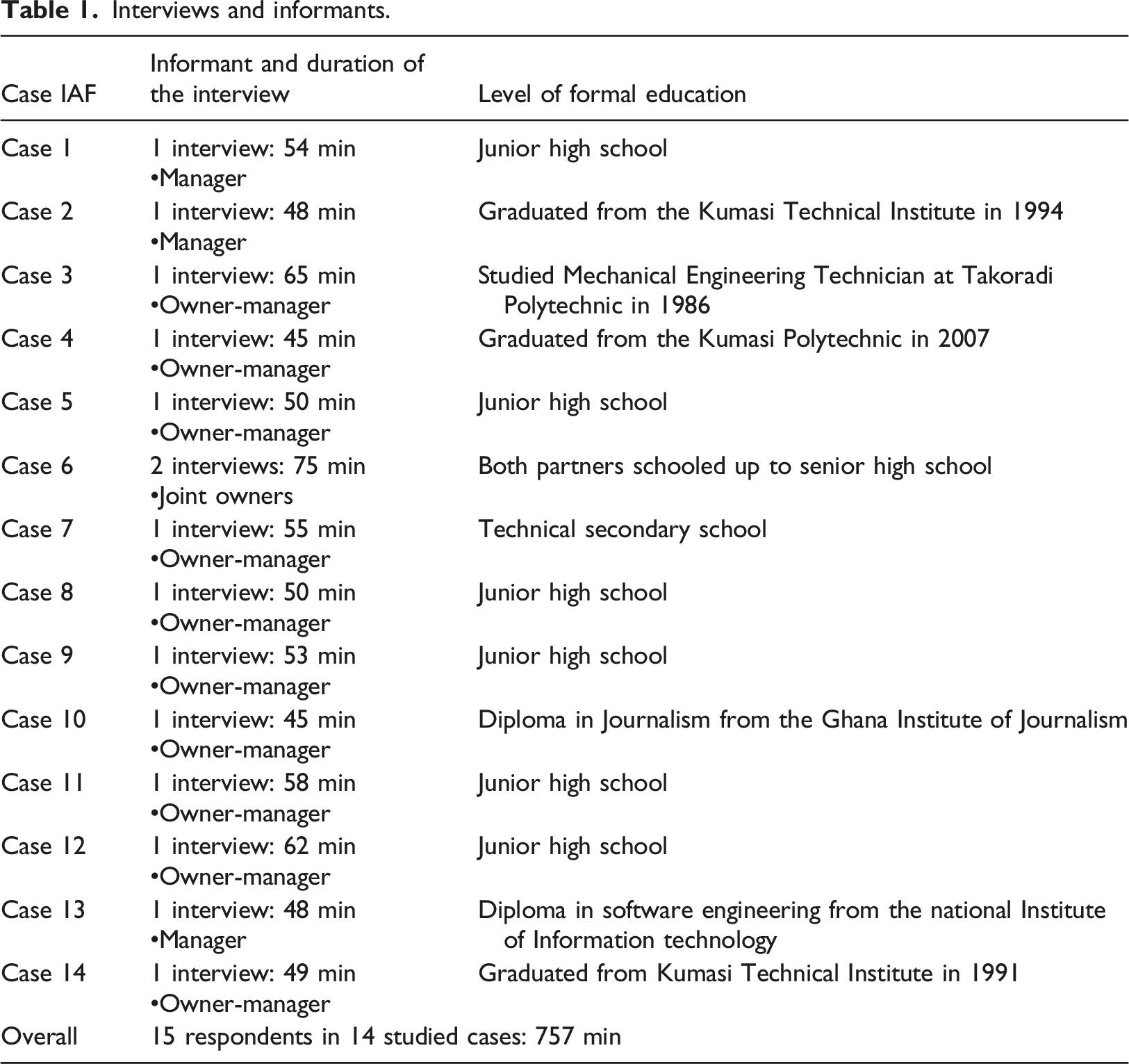
The methods employed to collect the data were semi-structured interviews, participant observation and informal discussions (Jack et al., 2004). The interviews were conducted in the local language (Twi), and English. The level of English-language ability varied among the informal entrepreneurs; hence, combining the local language and English helped us explore opinions and nuances. The interviews were based on four major themes related to our objectives and the literature review: the demographic and socio-economic profile of the entrepreneur and firm, entrepreneurial acumen and drive, the entrepreneurial network factors that influenced informal entrepreneurs to sell abroad and their internationalisation strategies. In terms of operationalising strong and weak ties, we used the themes: mutual respect, commitment, closeness, trust and duration (cf. Kontinen and Ojala, 2011) in the sales transactions between the informal firm and the buyer (customer or intermediary) (Appendix). For each theme, we allowed time to openly converse with each respondent and probe for more information about their relationships, experiences and stories; each interview was audio-taped and transcribed to ensure consistency during the data analysis process.
The fieldwork was conducted over 15 weeks in 2019. The studied clusters are recognised for craftsmanship, apprenticeship training and entrepreneurship development in Ghana. The Suame cluster (a spontaneous natural cluster) dates back to the 1920s, and the World Bank refers to it as possibly the largest informal manufacturing cluster in Africa (Yoshino, 2010). The main activities in the Suame cluster are composed of machinists, small-scale metal manufacturers, automobile spare sales and vehicle repair and maintenance. The government-generated woodwork cluster in Sokoban was completed in 2009; its primary activities were carpentry, lumber selling, plywood selling and sawmilling. SMEs dominated both agglomerations, with a majority operating in the informal sector (Amoateng et al., 2014; Gatune, 2016).
Data analysis
The data were read and analysed separately by all the authors to determine the themes and general patterns of activities. We followed the six stages approach by Braun and Clarke (2006), namely, data familiarisation, initial coding generation, searching for themes, review of the themes, theme definition and labelling and report writing. As stated earlier, the themes were based on the concepts and constructs from the literature review and conceptual summary. The respondents could describe their strategies, knowledge, experiences and perceptions related to the themes with the semi-structured interview. Therefore, in analysing the data we searched for thematic as well as particular information. Where clarifications were needed, discussions were held among the authors to reach a consensus (Ryan and Bernard, 2003). Finally, we discussed the categorised findings with the administrators of the trade associations in both enterprise clusters for further validation. Consistent with previous qualitative research (Ritvala et al., 2021), our tables summarise the transcribed interview data for conciseness.
Findings and analysis
We now explore how and why IAFs internationalise to foreign markets. Specifically, we present our findings regarding triggers, scope, speed and scale of internationalisation. Further, we analyse how strong and weak ties enable entry modes to foreign markets.
A regional scope and early internationalisation, but on a limited scale
Background of internationalised Informal African Firms.
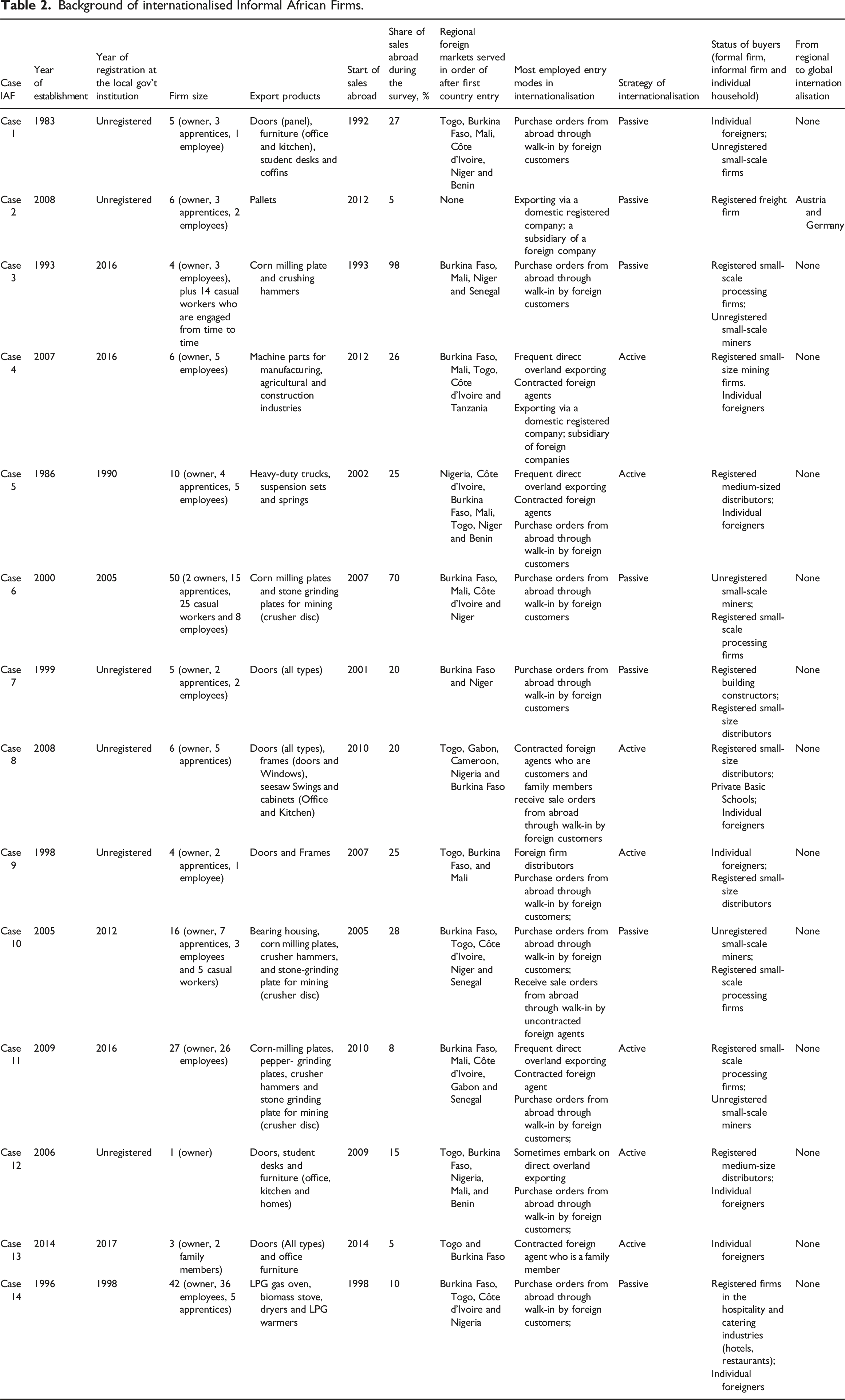
In addition, the internationalisation scale shows that nine of the respondent firms had 20% or more of their sales abroad (cases 1, 3, 4, 5, 6, 7, 8, 9 and 10). Similar to the internationalisation scope, it was also found that over half of the respondents with an internationalisation scale of above 20% sold to at least five foreign markets. This supports the claims that the more foreign markets served, the higher the percentage of sales abroad. Concerning internationalisation speed, we found that the majority (cases 3, 7, 8, 10, 11, 12, 13 and 14) began to sell abroad within three years after establishment. Excluding case 5, it took the respondents less than a decade to make their first sales to a foreign market (Baier-Fuentes et al., 2021). We again see intersections between the scope and speed of internationalisation. Notably, a significant portion of the respondent firms that serve the five foreign markets began expansion within three years of founding (cases 8, 10, 11 and 12).
The preferred foreign market entry modes were through indirect exports, direct exports and the use of foreign representatives or agents. The representatives consisted of customers, family members, friends, hired persons, engineers and firm distributors. We found two groups of foreign agents; those personally contracted by the informal firms and agents without any agreement. The latter always visited the clusters to scout informal firms with quality and innovative products to supply Table 1 customers in their home country. As case 10 remarked: ‘[…] some agents from neighbouring countries themselves visit firms in the cluster to search for good manufacturers […] according to the preference of their customers’. The respondents also exported through local agents. For instance, in cases 2 and 4, they relied on a formal domestic company, usually a subsidiary or agent of a foreign company, to facilitate exports beyond the ECOWAS region. That is, they supply goods through a third domestic firm that exported. Indirect export also covered sales through walk-ins by foreign buyers to the workstations of informal firms for direct purchase. Through visits from foreign customers and un-contracted agents, indirect exports also prompted internationalisation as they helped bridge foreign market barriers. Additionally, direct export is synonymous with overland exporting to countries in ECOWAS given the geographical proximity of Ghana to other West African countries.
We now illustrate how the respondents exploited opportunities through their social and business relationships, resulting in exchange agreements in foreign markets.
Network strength and the internationalisation of informal African firms
Network strengths of Informal African Firms.
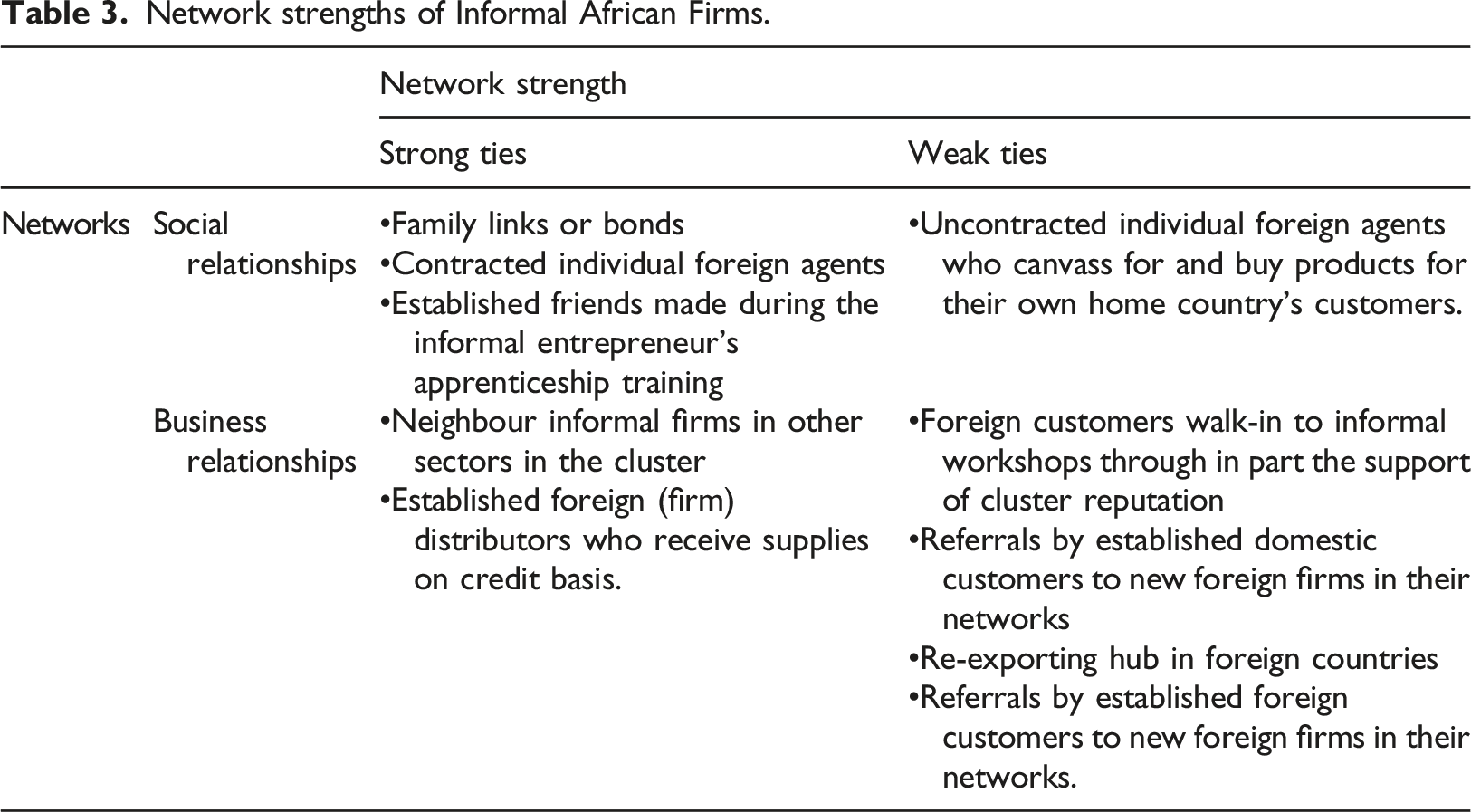
In contrast, the weak ties of social relationships include un-contracted foreign individual agents who frequently visited the cluster. As one respondent remarked: ‘[…] the agents from Burkina Faso normally interact with me, on behalf of their customers in their home country. They often visit Suame cluster […]’. In addition, the weak ties of business relationships comprise foreign customer walk-ins to informal workshops, customer referrals and re-exporting hubs in foreign countries. The informants used their main foreign markets as re-exporting hubs to advance their sales to geographically distant foreign markets. As the respondent in case 10 reported: ‘[…] customers from Burkina Faso buy in large quantities. Sales from the cluster to Burkina Faso are resold to Côte d'Ivoire, Senegal, Mali, Niger and Gabon. Selling to Burkina Faso means you are selling to the other Francophone African countries’. We find the informal firms in Ghana (an Anglophone country) relied on customers in their major foreign French-speaking market to expand to other French-speaking West African countries. The foreign trade networks of formal business customers also helped some informal firms embark on cross-border trade. As case 7 recounted: ‘The Burkina Faso market was found through a Ghanaian building contractor […] Both operate in the building construction sector’. The trust, faithfulness and loyalty of the informal entrepreneurs influenced foreign business customers to provide referrals. Through the interaction of network strength and firm internationalisation, the respondent firms were distinguished by their passive and active internationalisation strategies and positioned in a context where internal and external triggers influence the decision to initiate, develop, or sustain international operations. We now explore these findings.
Passive strategies of internationalising informal African firms
Analysis of network strength of Informal African Firm internationalisation.
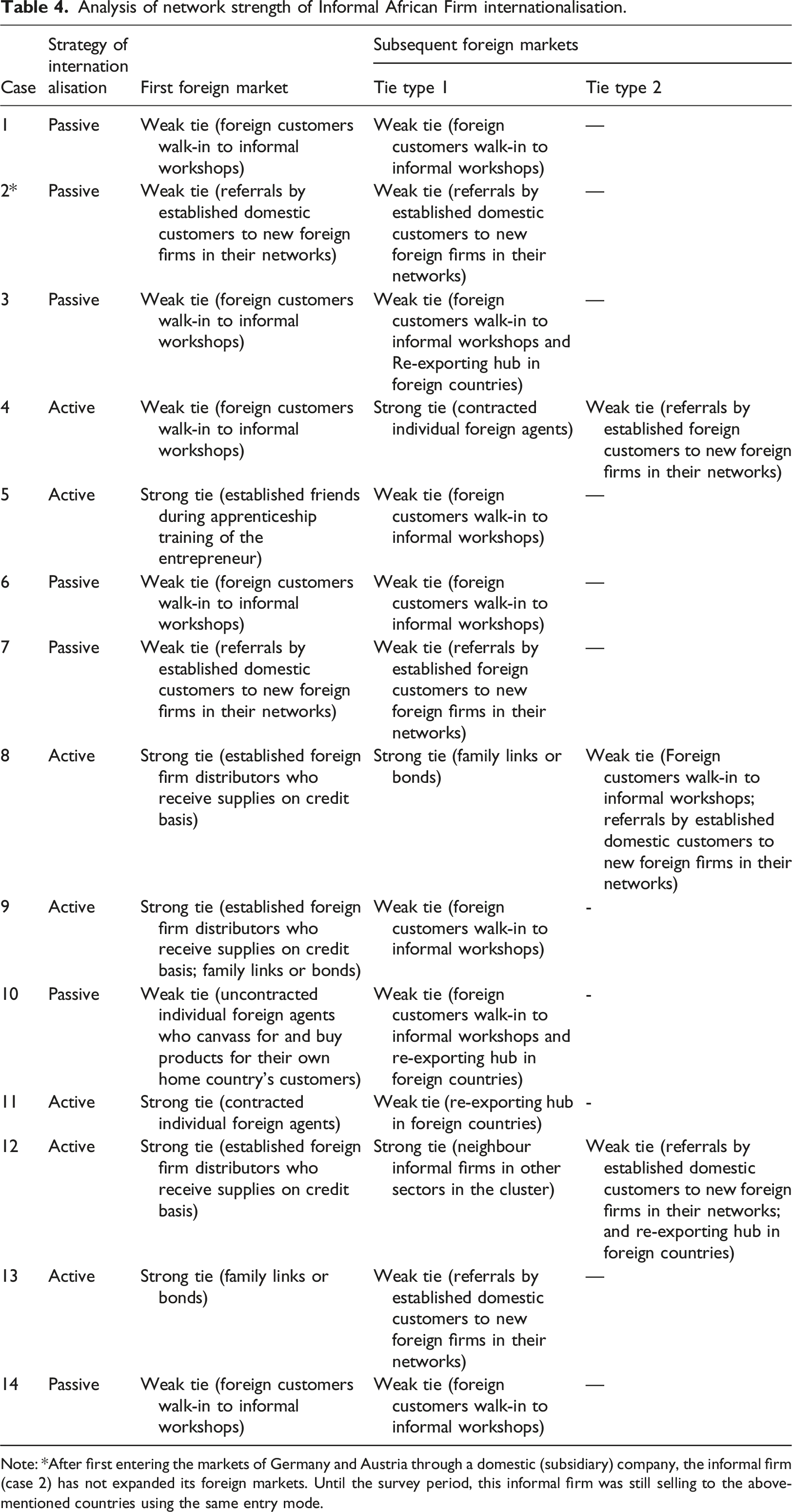
Note: *After first entering the markets of Germany and Austria through a domestic (subsidiary) company, the informal firm (case 2) has not expanded its foreign markets. Until the survey period, this informal firm was still selling to the abovementioned countries using the same entry mode.
External triggers for a passive strategy: The clusters hosted native and immigrant entrepreneurs; thus, they were from different ethnicities in both domestic and foreign countries. The existence of ethnic diversity has facilitated the establishment of relationships for entry to foreign markets. According to one respondent, ‘[…], most of the carpenters sell to Togo because many of them have family roots from Togo […]’. Case 10 remarked: ‘Some foreign agents from neighbouring countries often visit the cluster to search for good manufacturers for their business partners […], trust is the main factor in our work with agents […]’. The role of the clusters in attracting foreign buyers is one component of cluster marketing externalities. In effect, there is a benefit from the discovery of a firm. The receipt of unsolicited export orders benefited the informal firms without any conscious efforts by the owner-managers (Brown et al., 2010; Felzensztein et al., 2019). This meant that entrepreneurs have discovered their first international opportunity with little or no specific internationalisation efforts. One respondent recounted: ‘I decided to establish my firm in the cluster because it helps get foreign customers without me searching for them’. Overall, the weak tie of foreign customers and un-contracted agent walk-ins intersect with cluster marketing externalities and lead to unsolicited export orders.
Internal triggers for a passive strategy: This aspect covers the importance of firm specialisation and loyalty to customers, leading to further customer referrals. Loyalty to foreign customers is a crucial factor for an informal firm to engage in passive internationalisation. Our respondents interpreted loyalty as trust, good personal relationships, and the reputation of an entrepreneur. Accordingly: ‘our work is all about trust. If you can be trusted by foreign customers, you have higher chances of receiving more sales’. In defining trust, the case 1 respondent echoed that ‘[...] if you can deliver their goods on time, you win their trust’. The reputation of informal entrepreneurs relates to the number of years operating in foreign markets. For example, one respondent remarked: ‘I have been in the market for about 15 years. So, people always direct their business partners to my firm [...]’.
Our data illustrated that specialisation, quality products, and new products enhance the informal firm’s capacity to benefit from the weak tie of foreign buyer walk-ins and, consequently, unsolicited orders. This category of informal firms operates in production with high entry barriers. Echoing cases 1 and 11, respondent in case 14 remarked that: ‘[…] it is my products that attract people to my firm. People are attracted by the design and quality of my products’. ‘My specialisation in manufacturing machine parts attracts foreign customers to visit my workshop. There are only three workshops in the cluster that have specialised in this area’. Similarly, case 2 stated: ‘We are only two people who manufacture pallets in the cluster. So, it helps me receive orders from international firms’.
Overall, our findings demonstrated some elements of external and internal triggers that enhanced the passive internationalisation of informal firms. They show that when an informal firm has limited knowledge of, and commitment to internationalisation, unsolicited export orders, cluster marketing externalities, a loyal informal firm and firm specialisation were important triggers for passive international engagement. The influence of these triggers was strengthened by weak ties.
The active strategy of internationalising informal African firms
Activeness reflected the firm’s ability to search for opportunities in the marketplace in which the role of the decision-maker was important. The active internationalising informal firms (cases 4, 5, 8, 9, 11, 12 and 13) proactively searched for new network ties and diligently utilised established networks in seeking a presence and acquiring commitments in international markets. They often used, among other methods, direct overland exporting and contracted foreign intermediaries. These modes of internationalisation require commitment, knowledge and resources (time, finance, etc.) for the informal firms. Our interview data demonstrated the following to be triggers for an active strategy for internationalising informal firms: an ability to embark on commercial missions abroad, an ability to engage in commercial promotional activities abroad, possession of social media marketing skills, the capability to speak and understand diverse foreign languages and the ability to engage foreign buyers and external agents. Strong ties for efficient utilisation aided the triggers for an active strategy.
External triggers for an active strategy: This aspect includes the engagement in commercial missions and promotional activities abroad and the ability to engage foreign buyers and external agents. The former is reflected by owner–managers of informal firms travelling to foreign markets to meet potential buyers (agents or customers) and promoting products. These intermittent personal interactions with foreign buyers improve relationships and subsequently lead to building trust (Dabic et al., 2019). One informant stated that ‘visits to neighbouring countries have helped a lot in our business expansion. Our follow-up visits strengthened the relationships with customers. We get to know the challenges faced in the usage of our products. This helps us to improve our products’. In terms of promotional activities, case 5 respondent remarked: ‘[…] I have done a market survey in Burkina Faso […] I give out brochures for them to know what I can do, and what I have in stocks’. Normally the first established contacts (including customers) become agents, as case 11 remarked: ‘[…] after trying the sample products, the agents make orders and I supply […] Because of trust, they do not personally visit my workshop’.
Moreover, the external trigger of the ability to engage foreign buyers, also labelled as encouragement by external agents, refers to the willingness and networking capability of a customer in the role of a representative abroad. As we found, the first identified customer in a new geographic market typically becomes an agent to aid the international expansion of an informal firm in the foreign host market. According to the respondent in case 5, ‘[…] I establish relationships with some of the customers who also become agents based on mutual agreements in their countries’. We find this transition from customer to agent to be influenced by the human relationships of the informal entrepreneurs, as exemplified by one respondent: ‘[...] if you are faithful and loyal to foreigners who visit your firm, it can be your point of breakthrough to sell abroad. They return to their countries and later bring others they know and need my products’. Boso et al. (2017) noted that relationships with foreign buyers and agents provide first-hand experience and knowledge for navigating the African market alleviating operating costs and uncertainties.
Internal triggers for an active strategy: This aspect concerns the possession of social media marketing skills. As the respondent in case 8 remarked, similar to case 12: ‘My search for foreign customers is using social media (Facebook and WhatsApp through mobile phones) and visiting construction sites to give out complimentary cards which show my products’. Relatedly, ‘I share my complimentary cards with foreign customers, whom most times share my contacts on social media with their close ties’ (case 9). Over the last few decades, the advent of social media through information and communication technologies (ICTs) and globalisation have facilitated more accessible communication across borders. Additionally, rapid technological changes, associated with more efficient and less costly transportation means, have considerably affected how goods and services are produced and sold; thereby enabling small firms to access customers, suppliers, and collaborators worldwide (Dana, 2017). Social media resources directly influence the export performance of small firms in developing economies (Mahmoud et al., 2020; Odoom et al., 2017). While informal firms arguably may not officially have social media accounts in their business name, their owner-managers could have registered personal accounts used for product or service advertisements. In line with Omenma and Omeje (in press), the use of ICTs is seen to be a common practice among informal entrepreneurs. Similarly, Tang and Konde (2021) found that informal growth in business earnings is influenced by acquiring information and knowledge via online sources. The use of social media and relevant marketing skills allowed informal firms to reach customers at much lower costs and expand their visibility in the business landscape.
In addition, the internal triggers for an active strategy relate to the capability to communicate in several foreign languages. Unsurprisingly, respondents who spoke West African languages (French, native West African languages like Moshie, Hausa, Bambara and Mooré) had advantages in communicating with foreign buyers and were better able to undertake visits to other markets so, bridging psychic distance. As stated by one respondent: ‘I visit some foreign markets, especially travel to Burkina Faso and Mali with familiar foundrymen. […] my understanding of their local dialects (e.g. Mooré) has made it easier for social interactions […]’. The finding reinforces a growing recognition that language diversity influences management international decisions in contemporary business organisations (Tenzer et al., 2017).
Discussion
Our empirical study is based on 14 informal firms from two major enterprise clusters in Ghana. Foreign buyers operate in both the formal and informal sectors; this reflects an overlapping customer base between both sectors where there is a lack of developed market institutions and weak formal institutions (Böhme and Thiele, 2014; Webb et al., 2014). The respondents served 13 foreign markets, mainly in West Africa; seven transacted business in five to seven foreign countries. Nine registered at least 20% of annual sales abroad, and eight had commenced international sales within three years of creation. These characteristics complement the behavioural internationalisation theories in the Uppsala model (Johansson and Vahlne, 1977), the network model (Coviello and Munro, 1995; Håkanson and Snehota, 1989), the early internationalisation of born regional ventures or born internationals (Lopez et al., 2009; Oviatt and McDougall, 1994) and the effectual logic of entrepreneurs (Alam and Dornberger, 2019; Kalinic et al., 2014). We found that the firms internationalised using low resource-intensive strategies (indirect exports and direct overland exports), to geographically and psychically proximate countries with a similar level of informality offering greater societal legitimacy; that is the overall perception of acceptance of the activities of a social actor within a given social system of norms, beliefs and values (Suchman, 1995).
Legitimacy is found to contribute to firm internationalisation (Narteh and Acheampong, 2018). Similarly, these low resource-intensive strategies support Dana et al.’s (2008) findings that the internationalisation of microenterprises often begins with testing the market by adopting inexpensive methods, such as partnering with sales agents, to test the appeal of their products in foreign markets. We also corroborate evidence from Adeleye et al. (2016) that the low cost of identifying the situational conditions in regional African markets provides a significant driver for internationalisation. However, these informal firms were limited when expanding their international scope. Operating in more psychically distant markets demands additional resources other than the social and business networks of informal firms. To be more precise, activities such as business formalisation that reduce uncertainty and risks would be required. In this context, we find the distance to foreign markets limited the efficacy of networks for informal firms.
As noted, the use of social and business networks was central to the internationalisation of the IAFs in this study. Generally, access to formal and informal contact networks and collaborative partners are important factors in the internationalisation of African SMEs (Boso et al., 2019; Dana and Ratten, 2017). The effectiveness of a network depends on finding an appropriate balance as different forms of strong and weak ties provide distinct and additional resources for entrepreneurs (Jack, 2005). Moreover, the nature and use of ties varies and may well change over time (Jack et al., 2004). In this study, weak ties comprised mainly of business relationships while social relationships were primarily related to strong ties. Successful relationships eventually resulted in business networks; however, our findings show that excessive competition and instability in informal markets did not favour the development of such strong ties but rather, favoured weak ties (Amoako and Lyon, 2014; Berrou and Combarnous, 2012). Such weak ties related to referrals from established customers and foreign customer walk-ins and enabled internationalisation with limited effort from the business owner; hence, it was a passive strategy. To some extent, this occurred as the enterprise clusters represented a type of permanent exhibition; thus, the cluster’s reputation helped attract new foreign buyers. In addition, the clusters included tradespeople from different ethnic groups in domestic and foreign countries, with ties to foreign markets through kinship and language. We found that an informal firm with a trusted owner-manager with a specialised product and high entry barriers benefitted more from unsolicited export orders.
Our evidence also shows that most of our sample firms relied on customer referrals to enhance their operations in foreign markets. In particular, the trade networks of domestic and foreign customers assisted entry to cross-border trade. Those entrepreneurs who spoke a relevant foreign language found it more viable to embark on commercial missions and promotional activities in foreign markets. Their visits to foreign markets served as antecedents to customer referrals. Such interaction enhanced relationships and led to building trust – reflecting work by Berrou and Combarnous’s (2012) regarding trade ties and mutual aid between entrepreneurs. Similarly, Kebede (2020) reports that increased networking activity is associated with higher output among informal entrepreneurs with smaller enterprises and poor access to formal institutions, whilst Tang and Konde (2021) established that networking with formal businesses increased the earnings of informal firms. Meanwhile, we found that trust, faithfulness and loyalty influenced referral decisions from established customers to informal entrepreneurs, This confirms evidence by Amoako and Lyon (2014), Amoako and Matlay (2015) that trust amongst Ghanaian small exporters is tied to both parties having a link to a familiar person, established long-standing trading relationships, and being a member of the same network.
We found our respondents not only possessed skills and acumen regarding fabrication, production, workmanship, service, etc., but also, high entrepreneurial acumen and market orientation. All respondents spoke of a desire to compete, maintain customers and innovate to stay ahead of competitors whilst seeking new markets and growth evident through some actively searching for foreign markets. Those who did not actively search for foreign markets believed there was a substantial likelihood of exporting through indirect exports, as well as walk-in customers. Their foundational strategy to achieve this was to be trustworthy, competitive with their products and use their social and business networks within and outside the cluster. This study raises new and important knowledge about the high level of opportunity-search and exploitation conducted by informal African firms often considered by a dualist/modernisation school of thought as mainly uneducated people with low entrepreneurial acumen and limited ambition. This dualist school regards the informal sector as largely undertaking ‘survivalist’ activities (Hart, 1973).
Additionally, our evidence illustrated the different network ties that influenced passive and active internationalisation strategies. The triggers for an active strategy included engagement in commercial missions and promotional activities abroad, possession of social media marketing skills, the ability to communicate in a range of foreign languages, and the ability to engage foreign buyers with encouragement from external agents. These triggers were aided by strong ties for the efficient utilisation of active international involvement. For instance, the first established customer in a new geographic market through a strong relationship became, in many cases, an agent supporting further expansion in a foreign host market. In contrast, the use of weak ties triggered a passive strategy for internationalisation. Such strategies included cluster marketing externalities, unsolicited orders from foreign buyers, the importance of loyalty to customers encouraging further referrals and firm specialisation.
Much of this evidence corresponds to the extant small firm internationalisation literature. Most firms internationalise first, mainly to geographically and psychically close foreign markets, through relationships and networks (strong and weak ties); further expansion being largely on these ties. Consistent with extant work on the influence of social networks on internationalisation (Ellis, 2011; Urban, 2019), our findings support the view that informal entrepreneurs in an open economy, such as Ghana, are more likely to rely on social ties that have a significant influence on the initiation of exports, as well as increasing international experience. Several of our respondents internationalised very soon after inception, prompted by both active and passive triggers. By extension, their entrepreneurial and internationalisation process was mainly informal rather than a planned strategy. As a result, the general lack of support from formal institutions encouraged our respondents to adopt ‘actor-centric’ unplanned strategies. However, they possessed high levels of entrepreneurial acumen even though such strategies were not formally articulated. In summary, the empirical findings provide evidence that strong and weak ties (Granovetter, 1983) matter in the internationalisation of cluster-based informal firms forming the basis of social and business relationships.
An important theoretical extension to the analysis of informality and international entrepreneurship lies in the illustration that different network ties influence the internationalisation of informal firms. In this endeavour, the established network enhanced triggers for active and passive strategies for internationalisation. According to this stream of research, the initiation of small firm international expansion is triggered by several factors: limited domestic markets and new opportunities abroad, high levels of domestic competition prompting uncertainty, management interests, enquiries from buyers, entrepreneurial competence in identifying international business opportunities and managerial competence to put such opportunities into practice (Bužavaitė and Korsakienė, 2018; Martineau and Pastoriza, 2016). Such findings are based on studies of formal firms; this study, however, has illustrated how informal firms initiate international business activities. In addition, our findings confirm that both formal and informal firms undertake early internationalisation though their modes differ. This demonstrates that the institutional and business environment of foreign markets should be considered when studying the scope of early internationals. In the field of international entrepreneurship, scholars generally report on the number of foreign markets served (focused on continents, sub-regions and countries) without considering the nature of such markets (advanced, emerging and developing markets). More importantly, the entry barriers of developed markets are much higher for a firm originating from a developing country, especially for smaller firms (Misati et al., 2017). Though some informal firms are early internationals, expansion is concentrated in neighbouring countries and those with weak formal market institutions.
Managerial implications
From a practice perspective, our findings illustrate that both strong and weak ties are significant in the internationalisation of informal firms. Therefore, informal entrepreneurs should manage their previous social and business ties and develop new ones for business growth noting the role of these ties as promotional and resource exchange mechanisms. Both their own relationships, as well as those enabled by cluster neighbours and externalities, contribute to internationalisation. The basis of relationship-building in a particular context and culture is essential, as is the case with Africa (Acquaah, 2007). As some customers and agents are in formal firms, managers of enterprise clusters and business support institutions should focus on the linkages between firms in the formal and informal sectors to facilitate the latter’s transition to the formal economy. In doing so, we suggest using the term ‘responsible business’, which will demand the responsibility of formal firms in ensuring that their business suppliers are also formalised. We do not overlook the contention that some formal firms do business with informal firms to reduce input costs, thereby increasing competitiveness.
Policy implications
The implication for policy is that despite their informality, informal firms contribute significantly to national income. They can internationalise with the bit of institutional support that is intermittently offered to enterprise clusters. Therefore, official support agencies should implement policies to support informal exporters, which will advance them into mainstream exporting. One such action is to improve informal exporter’s knowledge base and capabilities (specifically network building) through training, workshops, and adult formal education. One example leading the way is the business advisory centres in developing countries. Entrepreneur training and education are essential in securing success in the internationalisation of firms as they can provide an internationally oriented mindset and vision for entrepreneurs. Human capital, which pertains to individual knowledge and capabilities, is acknowledged as paramount for effective entrepreneurial firm internationalisation (Dabić et al., 2019). Consequently, the education level of informal entrepreneurs is a critical predictor of enterprise performance that allows firms to take the risk of introducing new business practices and, in turn, makes it possible to sell their final products to higher-end users (Mano et al., 2012).
Limitations and suggestions for future research
There are limitations in this study that merit attention. First, we provide an understanding of the network strength of entries to foreign markets using the networks of informal owner-managers as a focal point. This is because it is difficult to isolate informal firms from the decisions and characteristics of the entrepreneurs who established and control the firm. This approach is similar to previous studies (Ellis, 2011; Urban, 2019) on how entrepreneurs use their social relationships with known others to identify opportunities for international exchange. Second, our case studies represent a larger population of informal firms in the studied clusters in Ghana. It should be noted, however, that the two studied enterprise clusters are among the largest of their kind in Ghana, with one of them considered to be the largest and most innovative in Africa with both having grown in size and reputation throughout West Africa since their creation (Yoshino, 2010; Zeng, 2008). Based on these facts, we advise that care should be taken in generalising our findings; we would, however, refer to Yin’s (2013) claim that such qualitative findings can be generalised for similar contexts.
Nonetheless, these limitations also provide potential agendas for future research. Our theoretical implications capture the nuanced empirical realities of what it means to be an internationalised informal business in a developing country. We suggest future studies test our theoretical implications by comparing informal firms operating from inside and outside enterprise clusters. In addition, we suggest that studies examine the role of enterprise clusters through the lens of agglomeration externalities and collaborative actions in the internationalisation of informal firms. Given the reliance of informal firms on networks of foreign buyers to enhance their internationalisation, we call for future studies to explore customer satisfaction by obtaining performance data from foreign buyers. In this sense, we suggest using Ubuntu, a social relationship theory of business conduct in Africa. The traditional Ubuntu argument is that ‘I only exist through my interaction with you’ (Barnard et al., 2017; Mangaliso, 2001). This implies respect and responsiveness that people show for one another, a spirit of caring, trust, harmony and hospitality.
Conclusion
In this article, we explored how and why informal African firms internationalise to foreign markets plus, the impact of social and business networks on their modes of internationalisation. Our findings emphasise that despite their informal status, informal firms may have high levels of entrepreneurial acumen and ambition. Furthermore, they imply that early internationalisation is not limited to formal firms but also includes informal firms. In addition to the contributions discussed above, our study opens the research arena for international entrepreneurship researchers, given the importance of legitimate informal entrepreneurship for economic development in developing countries.
Supplemental Material
sj-pdf-1-isb-10.1177_02662426211054099 – Supplemental Material for Understanding internationalisation of informal African firms through a network perspective
Supplemental Material, sj-pdf-1-isb-10.1177_02662426211054099 for Understanding internationalisation of informal African firms through a network perspective by Christopher Boafo, Richard Afriyie Owusu and Karine Guiderdoni-Jourdain in International Small Business Journal: Researching Entrepreneurship
Footnotes
Acknowledgements
This manuscript is a revised and expanded version of a paper entitled ‘Understanding Internationalisation of Informal African SMEs through a Network Perspective’ presented at EIBA-IBR Paper Development Workshop, 10th Atlas AFMI Annual Conference, University of Poitiers, France, 18 May 2020. The authors wish to thank Professors Utz Dornberger and Ulf Engel for their support of this work. In addition, we would like to acknowledge the editor (Prof. Susan Marlow) and the two anonymous reviewers for their extremely valuable comments during the preparation of this manuscript.
Declaration of conflicting interests
The author(s) declared no potential conflicts of interest with respect to the research, authorship, and/or publication of this article.
Funding
The author(s) received no financial support for the research, authorship, and/or publication of this article.

Supplemental material
Supplemental material for this article is available online.
Notes
Author biographies
Definition of strong ties Source: Adapted from Kontinen and Ojala (2011)
Description
Mutual respect
Commitment
Closeness
Trust
Duration
Family links or bonds
X
Contracted individual foreign agents
X
X
Established foreign firm distributors who receive supplies on credit basis
X
Established friends during apprenticeship training of the entrepreneur
X
Neighbour informal firms in other sectors in the cluster
X
X
References
Supplementary Material
Please find the following supplemental material available below.
For Open Access articles published under a Creative Commons License, all supplemental material carries the same license as the article it is associated with.
For non-Open Access articles published, all supplemental material carries a non-exclusive license, and permission requests for re-use of supplemental material or any part of supplemental material shall be sent directly to the copyright owner as specified in the copyright notice associated with the article.
