




Abstract
Mobilising postfeminism as an analytical device, this article re-examines how women business owners discursively engage with the identity of the mumpreneur. Drawing on interviews with women business owners, this article reconceptualises the compatibility between motherhood and entrepreneurship associated with the mumpreneur, in terms of a hybrid identity that interlinks feminine and masculine behaviours connected to home and work. Study data reveal the discursive practices present in interview accounts – choosing family and work, strategic mumpreneurship and enhancing the business without limits – which draw on postfeminist discourses to constitute hybrid entrepreneurial femininities associated with the mumpreneur category. The article contributes to the gender and entrepreneurship literature, in particular, the scholarship on mumpreneurship, by first, showing how engagement with the mumpreneur identity is implicated in the reproduction of masculine entrepreneurship; second, demonstrates how encounters with the mumpreneur contribute to the creation of a hierarchy of entrepreneurial identities which reinforces the masculine norm; and third considers how the mumpreneur as a hybrid identity mobilises entrepreneurship in children in gendered ways. While the emergence of the mumpreneur as a contemporary entrepreneurial identity has positively impacted how women’s entrepreneurship is viewed, the study demonstrates that it has not disrupted dominant discourses of masculine entrepreneurship or gendered power relations in the entrepreneurial field.
Keywords
Introduction
This article re-examines how women business owners discursively engage with the identity of the mumpreneur. Recent scholarship suggests that the mumpreneur is discernible from other women entrepreneurs by her simultaneous participation in active motherhood and committed business ownership (Duberley and Carrigan, 2013). This dual status is said to lie at the heart of mumpreneur entrepreneurial activity, with motherhood fuelling the motivation to engage in business ownership, providing the inspiration for a product or service and influencing the configuration of the business around childcare responsibilities (Ekinsmyth, 2011, 2013, 2014, 2015; Lewis, 2010; Richomme-Huet et al., 2013). Research shows that entrepreneurialism and motherhood are understood by mumpreneurs as compatible and valued equally, with women aiming to be ‘good’ mothers and successful business owners at one and the same time (Duberley and Carrigan, 2013; Ekinsmyth, 2014; Jean and Forbes, 2012; Khan and Rowlands, 2018). Taking this as our starting point and grounding our analysis within the contours of the critical concept of postfeminism, we make visible how this much vaunted compatibility upholds rather than challenges the promulgation of masculine entrepreneurship. In particular, we focus on how mumpreneur identities are implicated in the reproduction of masculine entrepreneurship, a gendered and privileged mode of entrepreneurial activity that devalues femininity and marginalises women entrepreneurs (Ahl, 2006; Ahl and Marlow, 2012; Lewis, 2006; Marlow, 2014; Marlow et al., 2009; Ogbor, 2000; Rouse et al., 2013).
Problematising the argument that the mumpreneur is ‘. . . a self-proclaimed, overtly female business identity . . . that represents a different way of doing business . . .’ (Ekinsmyth, 2014: 1244), this article draws on interview data with 21 women business owners in the United Kingdom. Analysis of these data shows how mumpreneurs reproduce modes of masculine entrepreneurship through the discursive constitution of the entrepreneurial identity of the mumpreneur. As the interview data demonstrate, mumpreneur identities can be conceptualised in terms of hybrid entrepreneurial femininities that have been discursively constituted by an entrepreneurial masculine norm, with serious implications for how forms of mumpreneurship are recognised and valued.
In this article, postfeminism is treated as an object of critique. Postfeminism is a polysemic concept, but it is easily recognisable through its selective take-up of liberal feminist values of choice, empowerment and agency alongside an emphasis on the neoliberal principles of individualism, self-governance and entrepreneurialism (Ahl and Marlow, 2021; Gill, 2017; Lewis et al., 2017; McRobbie, 2009). Within the gender and entrepreneurship field, recent research has galvanised postfeminism as a critical concept to investigate the kinds of entrepreneurial subjects women are called to become (Byrne et al., 2019; Lewis, 2014; Nadin et al., 2020; Pritchard et al., 2019; Sullivan and Delaney, 2017). However, none of these studies empirically engage directly with women business owners. Instead, they complete a set of postfeminist analyses that focus on narratives and representations produced within a range of different text-based sources. These include social media posts by entrepreneurial role models as part of a French government campaign to promote women’s entrepreneurship (Bryne et al., 2019), a review of the women’s entrepreneurship literature (Lewis, 2014), media representations of the entrepreneurial subject (Nadin et al., 2020), responses from business students to visual representations of entrepreneurial success encapsulated in the figure of Mattel’s Entrepreneur Barbie (Pritchard et al., 2019) and a review of the success stories of women consultants taken from the webpage of a network marketing organisation (Sullivan and Delaney, 2017). In contrast, through a set of face-to-face interviews, our study engages directly with women business owners who are discursively constituted as entrepreneurs through the identity category of the mumpreneur. In so doing, it contributes to the developing body of scholarship on postfeminism within the gender and entrepreneurship field, by demonstrating how the mumpreneur is a hybrid entrepreneurial identity constituted by discourses of masculine entrepreneurship that (re)produce a gendered hierarchy of entrepreneurial feminine identities. Crucially, postfeminist discourses circulate the seductive appeal of entrepreneurship and motherhood as compatible activities, interpellating women to pursue their entrepreneurial ambitions without limits, while also responding to the call to active motherhood (Manneuvo, 2016; Thornton, 2011).
Accordingly, from a postfeminist perspective, we conceptualise the mumpreneur as a hybrid entrepreneurial femininity, which brings discursively coded masculine (e.g. achievement in the public sphere of work) and feminine behaviours (e.g. retreat to home to care for children) into dialectic coexistence (Lewis, 2014). As such, the conceptualisation of the mumpreneur as a hybrid entrepreneurial identity is distinct from existing accounts of the mumpreneur that characterise it as a feminised worker identity (Ekinsmyth, 2011, 2014). In particular, we reveal the complications attached to the deployment of this identity and the implications for women’s entrepreneurship of engagement with the subject position of mumpreneur. Considering this, we ask the following: how are hybrid entrepreneurial identities discursively constituted by women who engage with the identity category of the mumpreneur, and what are the effects and implications of these identities for mumpreneurs? In addressing these questions, we revisit key issues in the existing literature around the mumpreneur, including the tensions that emerge in simultaneously running a business and family, and if these are managed through the curtailment of business (Duberley and Carrigan, 2013)? In addition, we consider whether mumpreneurship disrupts dominant discourses of masculine entrepreneurship by ‘delivering a subject identity that takes the masculine out of “entrepreneur”’ (Ekinsmyth, 2014: 1244).
The article’s contribution is threefold: first, we demonstrate that through strategic engagement with the hybrid entrepreneurial femininity of the mumpreneur, our respondents are paradoxically constituted in relation to the masculine norm of entrepreneurship. Thus, while normative constraints around entrepreneurship are changing, propelled by the emergence of hybrid entrepreneurial femininities such as the mumpreneur, these shifts can act to sustain rather than dismantle gendered inequalities (Bridges and Pascoe, 2014; Lewis, 2014). Second, we demonstrate how being discursively constituted in relation to the masculine norm can lead to the marginalisation of those mumpreneurs who are deemed to be excessively feminine. This applies to mumpreneurs who run businesses that are designated as too feminised and, thus, out of ‘balance’ with the dominant norms of masculine entrepreneurship (Lewis, 2014). Third, we make visible how women are interpellated by postfeminism to be successful business owners and parents. The effects of this include extending an entrepreneurial logic into the sphere of the family where working excessive business hours is normalised and children are discursively constituted as ‘developing’ entrepreneurial subjects.
The article begins by examining the nebulous concept of postfeminism. Next, we outline the study’s methodology before presenting the empirical sections. We conclude by discussing the study’s principal contributions and the implications of theorising mumpreneur identities as hybrid entrepreneurial femininities.
Postfeminism and entrepreneurship
Analyses of postfeminism usually begin by pointing out the existence of multiple interpretations of this phenomenon (see Gill et al., 2017; Lewis, 2014, 2018). These evaluations highlight the dominance of a constitutive approach that treats postfeminism as a discursive formation comprising a set of interrelated discourses around gender, feminism and femininity (Dean, 2010; Projansky, 2001). Understood as a cultural discourse, the scholarship of McRobbie (2009) and Gill (2007) is foundational to the development of this understanding, as it interrogates the persistence of traditional gender norms alongside the acceptance of liberal feminist principles of equality and women’s empowerment (Lewis et al., 2019). Accordingly, the general favouring of a moderated feminism within postfeminism facilitates the suturing of femininity to liberal feminism (Hemmings, 2018). This manifests in the bringing together of masculine (e.g. work in the public sphere) and feminine (e.g. care in the domestic realm) behaviours, such that normative femininities compulsorily interlock with norms as well as social realms marked by masculinity. The postfeminist demand to be more than ‘just’ a woman is thereby fulfilled (Carlson, 2011; Lewis, 2018; Lewis and Simpson, 2017).
Within postfeminist culture, this interdependence between the masculine and the feminine exhibits as a range of features including an emphasis on the optimisation of self that is located in the prominence given to individualism, choice and empowerment; a focus on self-perfecting in pursuit of transformation; the weight placed on ‘natural’ distinctions between femininity and masculinity; the importance assigned to femininity as a bodily and psychological property; and the stress on subjectification and retreat to home as a matter of choice not obligation (Gill, 2007; Lewis, 2014; Negra, 2009). Through the blending of a liberal feminism that interpellates women to engage in individualist masculine behaviours of ambition and self-actualisation, alongside a femininity that obliges them to participate in highly stylised feminine behaviours (McRobbie, 2009), postfeminism partly constitutes the contemporary individualised subjectivity women are called to take up. However, it is important to recognise that as a cultural phenomenon, postfeminism has as much to do with neoliberalism as with a moderate liberal feminism, given its emphasis on individualism and the belief that the individual is responsible for their own well-being (Gill, 2008; Peck and Tickell, 2002). Neoliberalism promotes an ethic that privileges a mode of living that is entrepreneurial, market-focused, competitive and self-interested. Consequently, Gill interviewed by Rottenberg (2019: 829) argues that postfeminism is one of the key discursive means through which neoliberalism has individualised women. Gender injustice is now ‘women’s own fault’, and the persistence of structural injustice is obscured. The suggestion is that the liberated, self-governing, self-reliant, autonomous neoliberal subject aligns with the agentic, choosing, empowered, self-transforming subject of postfeminism (Gill and Scharff, 2011).
Deployed as a critical concept, postfeminism has been mobilised in the gender and entrepreneurship field to expose the gendered assumptions that underpin women’s entrepreneurial experiences. Attention is directed at how such gendered assumptions are achieved and why they persist. A key concern is how should we interpret women’s contradictory position on the margins of entrepreneurship while being constituted as an untapped entrepreneurial resource, crucial for economic development (Jones and Clifton, 2018; Marlow, 2014; Nadin et al., 2020). Treated as an analytical device, postfeminism is able to interrogate issues of persistence and contradiction, shifting our analytic attention away from a sole focus on the exclusionary force of the masculine norm of entrepreneurship towards examining the ways in which women and a reconfigured femininity are now included in the call to entrepreneurship (Lewis, 2014). For example, adopting an interpretation of gender as mobile, indeterminate and detachable from an individual means, we do not have to construe women who are full of entrepreneurial promise as honorary ‘masculine’ entrepreneurs who have sublimated their femininity (Adkins, 2005). We can avoid also understanding the constitution of women’s entrepreneurial potential as a combination of dichotomous gender attributes and standards.
Instead, we can work with the notion of a postfeminist femininity in relation to women’s entrepreneurship that is a hybrid configuration discursively constituted around the dialectic coexistence of masculine and feminine norms. These gender norms are interdependent forces that interact to produce adjustments between them with change in one directly affecting the other, which often produces tension and conflict (Collinson, 2020). As interdependent mutually exclusive dialectic forces, business ownership (doing masculinity) and active mothering (doing femininity) are connected to each other through a constant push-pull between contradictory elements. Understanding the mumpreneur as a hybrid subjectivity means that business activity and motherhood are treated as a unity of opposites that mutually define each other rather than two activities which develop and evolve separately (Putnam et al., 2016).
Mumpreneurs and mumpreneurship
In making visible the feminine subjectivities available to women within the business sphere of entrepreneurship, postfeminist analyses of women’s entrepreneurship have also highlighted the emergence of the mumpreneur (Byrne et al., 2019; Lewis, 2010, 2014, 2017; Littler, 2018; Luckman, 2016; Orgad, 2019). However, as indicated above, the majority of these postfeminist studies tend not to draw on empirical data generated from direct engagement with women business owners connected to the identity of the mumpreneur. Extant studies largely analyse discursive representations of successful entrepreneurship (Byrne et al., 2019) or examine economic activity in the craft or gig sector (Luckman, 2016) or consider what stay-at-home mums might do in the future once their children are older (Orgad, 2019). Furthermore, most studies of the mumpreneur (Duberley and Carrigan, 2013; Ekinsmyth, 2011, 2013, 2014, 2015; Jean and Forbes, 2012; Khan and Rowlands, 2018; Nel et al., 2010; Richomme-Huet and Vial, 2014) do not analyse this entrepreneurial figure through a postfeminist lens. Nevertheless, they do highlight the way in which the mumpreneur blurs the boundaries between the positions of ‘mother’ and ‘businesswoman’.
In the non-postfeminist mumpreneur research, the combination of caring for family and running a business is reinterpreted as compatible and a source of entrepreneurial opportunity (Ekinsmyth, 2011, 2013; Jean and Forbes, 2012; Khan and Rowlands, 2018; Nel et al., 2010). Here, emphasis is placed on the idea of ‘family-to-business enrichment’ (Ekinsmyth, 2014) where home and business are approached as allies. This has led to calls to recognise that businesses established by mothers have different drivers, rationales and operational practices when compared to conventional businesses (Ekinsmyth, 2014; Richomme-Huet and Vial, 2014). Therefore, to secure optimal entrepreneurial benefit from mumpreneur businesses, it is argued that these differences should be acknowledged and addressed. For example, the (re)generation of neighbourhood capacities where mumpreneurial activity is located could act as a means of reducing gendered constraints on mumpreneurship (Ekinsmyth, 2015). Connected to this focus on ‘family-to-business enrichment’, mumpreneurs as a subset of women entrepreneurs in general (Duberley and Carrigan, 2013) are often presented as doing business ‘differently’. This occurs through the materialisation of a ‘. . . new feminised version of entrepreneurship practice’ (Ekinsmyth, 2014: 1239).
In putting the case forward for the compatibility of motherhood with entrepreneurship, the tensions between these two activities and the dynamic trade-off between being an entrepreneur and being a mother, which women face daily, are identified. For example, women may engage in blended entrepreneurial practices, which divide work over the course of a day and evening, to ensure a ‘fit’ with the needs of family (Ekinsmyth, 2014). Alternatively, they may, at times, curtail their business to facilitate engagement with children at home (Duberley and Carrigan, 2013). Indeed, a recent study of ‘mumtographers’, a variant of the mumpreneur, demonstrates how women within the Australian photography industry are denied entrepreneurial status by their male colleagues on the grounds that motherhood and entrepreneurship are constituted as incompatible, a denial that reinforces a dominant masculine norm of entrepreneurship (Mayes et al., 2020). Still, for most of the non-postfeminist mumpreneurship literature, the personal costs – long hours, excessive tiredness, irritability with children, being less available to their family and a constant sense of never quite getting on ‘top’ of things – that result from simultaneous devotion to family alongside a commitment to business do not signal an inherent incompatibility (Duberley and Carrigan, 2013; Ekinsmyth, 2011, 2014, 2015; Khan and Rowlands, 2018).
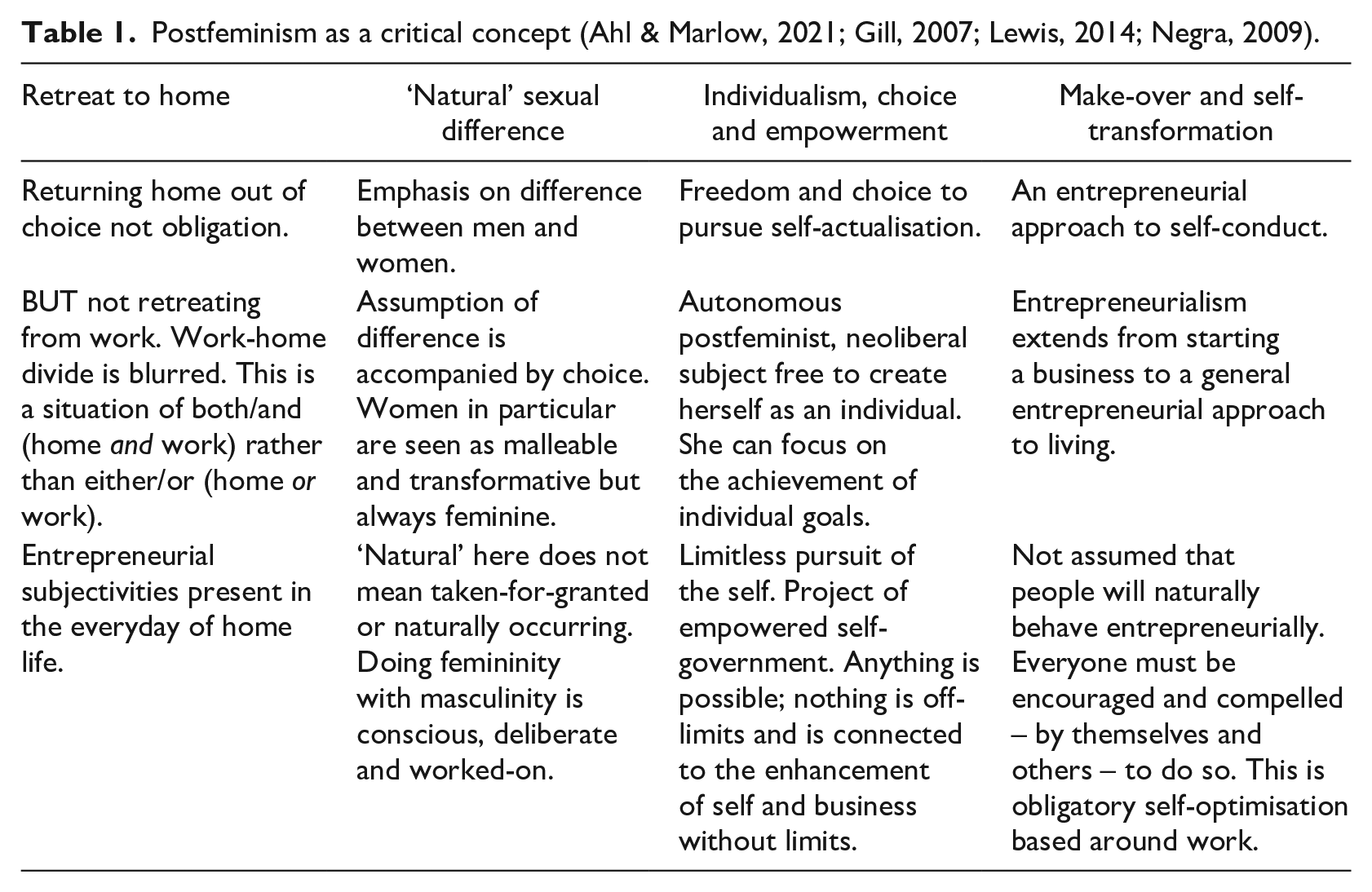
Considering the research cited above, it is both striking and problematic that few studies specify the masculinised orientation of what are deemed personal costs. Long hours and lack of availability to family are common characteristics of the masculine world of (public) work (Acker, 1990; Blagoev and Schreyogg, 2019; Ruiz Castro, 2012) and are a set of work practices in which the mumpreneurs in this study, and in existing research are willing to engage. Conventionally it is suggested that women’s entrepreneurship has little symbolic or monetary value, rendering it vulnerable to being (mis)understood as a marginal entrepreneurial identity (Meliou and Edwards, 2018). In contrast, we demonstrate how attachment to business as an aspect of normative femininity is deployed by mumpreneurs to demonstrate their entrepreneurial bona fides (Arvidsson et al., 2010). While the mythology of the ‘real’ entrepreneur has been questioned (Ahl, 2006; Ogbor, 2000), deep-rooted expectations exist about what comprises ‘proper’ entrepreneurship. Entrepreneurial discourses connected to postfeminism capture and constrain women in terms of what can be said about entrepreneurship (Elder-Vass, 2011). This obliges them to adopt the masculinised practice of prioritising business over family when required, a privileging that is legitimised and made sense of through a dominant masculine norm of entrepreneurship. We draw on the critical concept of postfeminism to explore women’s take-up and engagement with masculine entrepreneurship alongside motherhood when engaging with the identity of mumpreneur. To facilitate this examination of how women enact the hybrid femininity of the mumpreneur, we focus on the postfeminist elements of retreat to home, ‘natural’ sexual difference, individualism, choice and empowerment and make-over and self-transformation summarised in Table 1.
Postfeminism as a critical concept (Ahl & Marlow, 2021; Gill, 2007; Lewis, 2014; Negra, 2009).
Methodology
To recap, this study addressed the principal research question: how are hybrid entrepreneurial identities discursively constituted by women who engage with the identity category of the mumpreneur? As (dis)identification with the subjectivity of the mumpreneur was a central focus of the research, the study examined women’s encounters with and experience of this entrepreneurial identity. To this end, 21 in-depth qualitative interviews were completed by the first author involving women who run their own business and engage with the identity of the mumpreneur in the United Kingdom. Study participants were sourced using a purposeful sampling strategy that recruited women business owners from mumpreneur networks such as www.mumsclub.co.uk and www.mumpreneuruk.com. Eligible respondents had to have left employment after having children, had started a business alone or with a partner and were in business for at least one year. Appropriate sample size was judged through ongoing assessment of how the research question was being addressed, with the completion of interviews at the point of data saturation. By the time 21 interviews were conducted, similar issues, themes and patterns in relation to the issue of (dis)identification with the subjectivity of the mumpreneur were emerging in the data (O’Reilly and Parker, 2012). Finally, in assessing the sample size, the completion of 21 interviews aligns with other studies of entrepreneurship that explore identity, particularly in relation to issues of normativity and difference (Dean and Ford, 2017; Diaz-Garcia and Welter, 2011; Hytti et al., 2017; Kacar and Essers, 2019; Rumens and Ozturk, 2019).
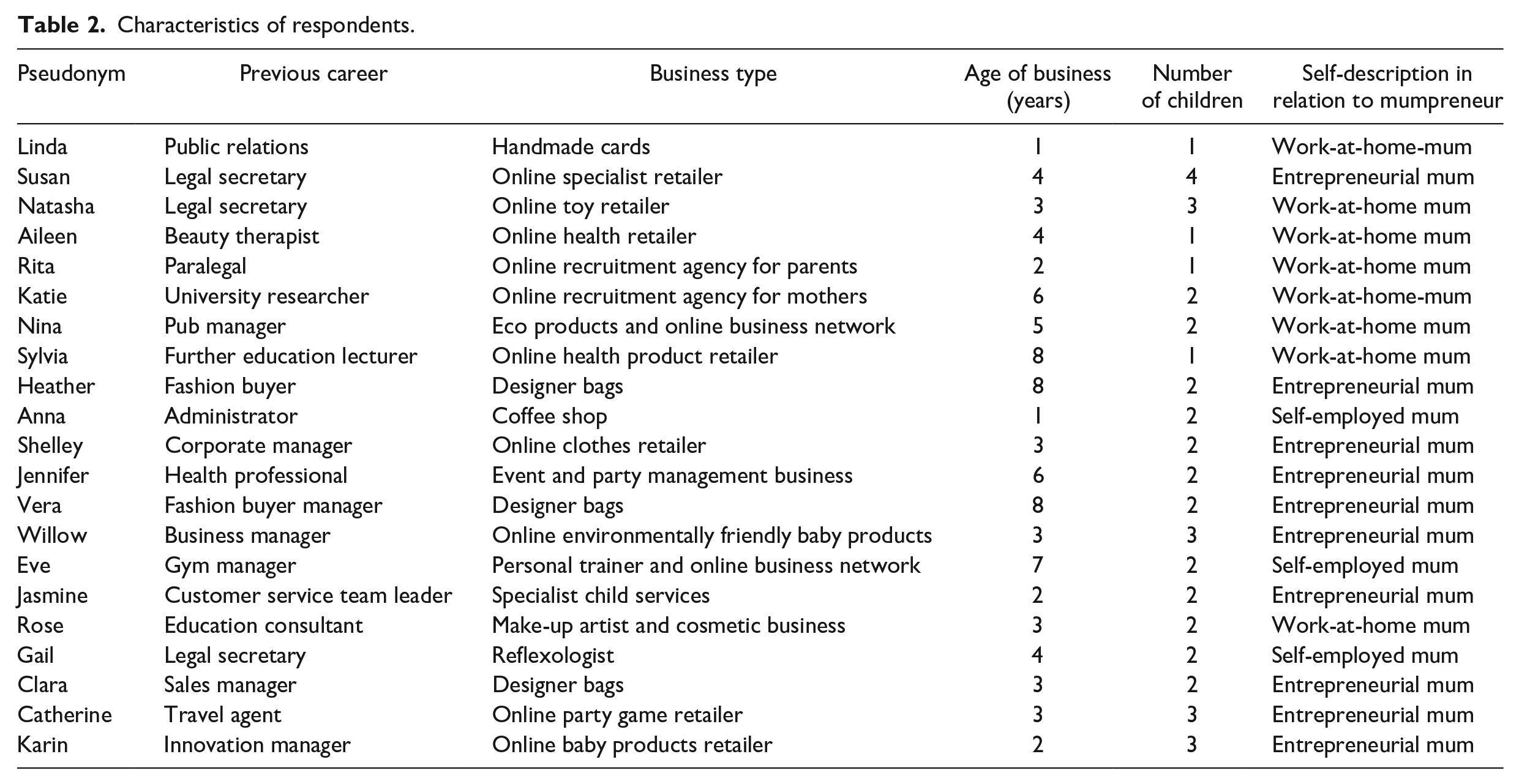
Details of the sample are presented in Table 2 below. Ten of the respondents identified themselves as an entrepreneurial mum who had significant plans for their business. Eight respondents described themselves in various ways as a work-at-home mum influenced by their wish to be the main carer for their children. Finally, three respondents called themselves self-employed because they ran their business in a public space such as a gym, health clinic and coffee shop and not just their home. We come back to this issue of self-description in relation to the identity of mumpreneur in the findings section. To protect the confidentiality of respondents, pseudonyms have been used throughout the data analysis.
Characteristics of respondents.
Interviews were undertaken in the homes of respondents (10 interviews), a coffee shop (six interviews) or in a work premises attached to their business (five interviews). This included locations such as a storage unit for stock and an event and party management shop. Interview questions focused on previous careers of interviewees before start-up, the reasons for setting up the business, their experience of entrepreneurship, their orientation to and use of the term ‘mumpreneur’, their engagement with mumpreneur networks and how they managed childcare and home. All the interviews were digitally recorded and transcribed by a professional transcription service.
As we intended to explore how hybrid entrepreneurial identities are discursively constituted by women who engage with the identity category of the mumpreneur, discourse analysis techniques were deployed. This approach aligns with recent calls within the gender and entrepreneurship literature (Ahl and Marlow, 2012; Henry et al., 2016) to adhere to a poststructuralist feminist epistemology to explore how gender and entrepreneurship are discursively constituted. As such, we subscribe to Weedon’s (1987) concept of discourse as systems of text, concepts, beliefs and signs that ‘exist both in written and oral forms and in the social practices of everyday life’ (p. 112). They are a mode of symbolic register in how they constitute individuals, but they are not wholly deterministic in that respect. Rather, specific discourses offer subject positions that individuals assume, the adoption of which is a discursive practice that is activated through individual agency but is ‘subjected to the power and regulation of the discourse’ (Weedon, 1987: 119). In this way, we understand gender and identity not as fixed properties of the individual but as discursive effects. Multiple discourses frequently overlap such that one discourse may contain traces of other discourses, which open and foreclose opportunities by which identities and the meanings attached to them are constituted.
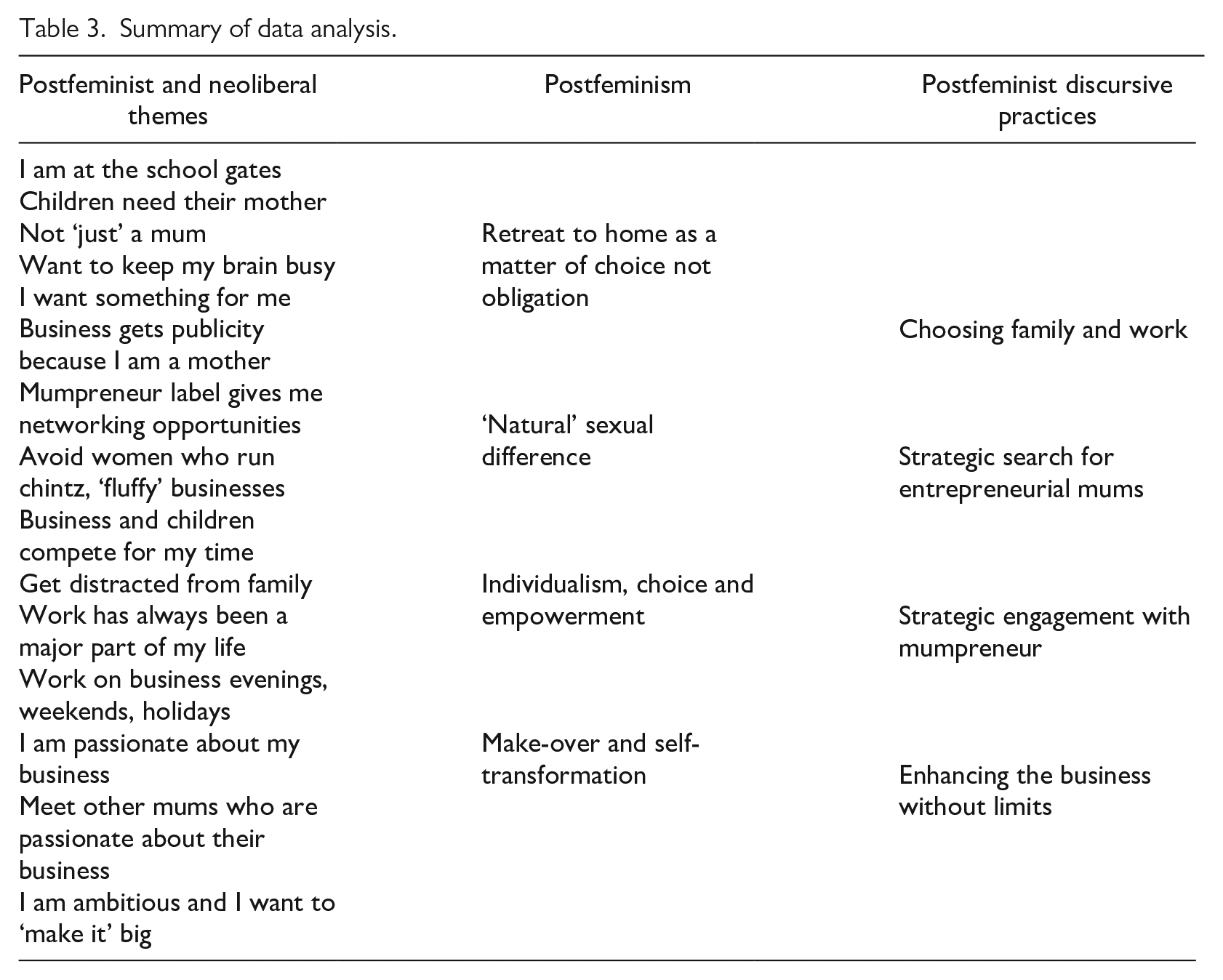
In completing our discursive analysis (summarised in Table 3), we drew on Arribas-Ayllon and Walkerdine (2017) to guide an iterative reading, note taking, coding and analysis of the data (Rumens and Ozturk, 2019). We began by identifying our object of study as (dis)identification with the postfeminist subjectivity of the mumpreneur. Our reading of the mumpreneurship literature indicated the need to problematise the contemporary common sense notion of ‘compatibility between motherhood and entrepreneurship’ associated with and manifest in the hybrid femininity of the mumpreneur. Our second step entailed combing the interviews for traces of postfeminist discourses, which involved moving between the empirical data and the literature. Analysis focused on discourses of retreating home, ‘natural’ sexual difference, individualism, choice and empowerment and self-transformation. Following Lewis (2014), we understand discourses of retreating home and ‘natural’ sexual difference as connected to the feminised tradition of a focus on children and home, while discourses of individualism, choice and empowerment and self-transformation are associated with masculinised attainment in the sphere of work. Together, these overlapping discourses call women into the hybrid subject position of the mumpreneur, inviting them to interlink feminised and masculinised behaviours associated with home and work. Third, following identification of these discourses within the interviews, we traced the discursive practices present in the accounts of respondents. We explored how they drew on postfeminist discourses to constitute hybrid entrepreneurial femininities associated with the mumpreneur identity category. The data analysis is organised around the identified discursive practices: choosing family and work; strategic mumpreneurship; and enhancing the business without limits.
Summary of data analysis.
Finally, it is important to point out that our analysis is subjective and partial in that it is not the only conceivable interpretation of the interviews (Pullen and Simpson, 2009; Rumens and Ozturk, 2019). We approached the interview data as a chance to explore the contours of postfeminist discourses in women’s discursive accounts and not as an exact overview of the reality of running a business while simultaneously caring for children. In other words, the discursive practices we identify highlight what can be said, but not exhaustively, about the coexistence of family and business at this postfeminist, neoliberal historical juncture.
Study findings
Choosing family and work
In common with other studies of the mumpreneur as an entrepreneurial figure (Ekinsmyth, 2014, 2015; Khan and Rowlands, 2018) and thinking about their own relationship to this identity, all the respondents emphasised how they had chosen to give up their job after having children. In a postfeminist feminine discourse of choosing family, respondents were constituted as having a strong commitment to home, often articulated in terms of women having a better ‘natural’ ability to care for children. According to Heather, who runs a designer handbag business, . . . being a mum . . . I don’t think it’s comparable in terms of gender with men anyway because women always, it’s very rare that women are not the main person that worries about the children. My husband would be of no use for half the things that the children do and not because he’s not a good parent but because he’s just oblivious, he doesn’t really see it the way I’ve had to . . . that’s just a thing that mums do, I think we’re very good at remembering the details.
In expressing this view, Heather draws on the postfeminist emphasis on ‘natural’ sexual difference that is underwritten by a feminised assumption that ‘my children need me’ – repeated throughout all interviews – based on the status of the mother as the parent who ‘naturally’ understands how to care for children. Her choice to retreat home is apparent in a postfeminist discourse that codes and naturalises feminine attributes as ‘natural’ rather than acquired skills. Similarly, in the same discourse, there are ‘natural’ differences between mothers and fathers as parents. Nevertheless, choosing to care for children does not mean the rejection of work per se. While motives such as having an independent income were given for the decision to engage in entrepreneurial activity, all respondents expressed a masculinised attachment to work and a need to continue to develop themselves in terms of their career as the following illustrates: So there is Mum as my children know me and I’m there for them 100% as Mum. They have never felt they’ve not had Mum but there is also Jasmine and ‘before children Jasmine’ was very much doing her career and laying foundations so that when she did have children she could provide for them. So that’s what Jasmine wants to carry through but the best thing is Jasmine can do the two and still be with her children (Jasmine – specialist child services)
Drawing on postfeminist discourses, Jasmine is constituted as both a (masculine) productive and a (feminine) reproductive subject, and this was often achieved through reference to a time before having children and since having children. She places a strong emphasis on her maternal capabilities while at the same time giving prominence to the time she has spent building her career in preparation for having children. In highlighting her productive and maternal capabilities and in referring to herself in the third person as a means of assessing who she is, Jasmine draws on the neoliberal theme of self-optimisation within postfeminist discourse through her calibration of masculine and feminine behaviours. Jasmine may be read as approximating the ‘ideal’ postfeminist neoliberal subject, in that she is attached to the world of business and wishes to maintain that attachment while also ‘willingly embracing culturally prescribed gender norms’ associated with motherhood (Thornton, 2014: 273). This positioning was common across the whole sample and is summed up by Catherine, an online party game retailer when she stated the following: ‘. . . I don’t know but I sort of want, I’m just greedy, I want both. I want to work a lot and have a lot of family’.
Much of the literature on the mumpreneur underscores women’s willing embrace of motherhood and their desire to prioritise their children (Duberley and Carrigan, 2013; Ekinsmyth, 2011, 2014, 2015; Littler, 2018), sentiments also expressed in our research. As Natasha stated, ‘I really don’t want my children going into an after school club after school . . . it’s just, its why have children? You know, it’s just wrong . . .’ Nevertheless, despite these strongly expressed views on family, it was also not unusual for our respondents to have a negative opinion and experience of the feminised work of childcare. Expressions of the ‘mind-numbingly boring’ nature of the work of caring for children were prevalent in the interviews, and these occurred alongside performances of a masculine commitment to business and work, as illustrated in the following extract: Yeah I like to keep busy. I’m always busy. I can’t sit at home. I can’t and I thought I could. I thought having two children this is what I’m meant to be doing. I’m meant to be sitting at home and you know, even playing I find frustrating. I play for a bit and then I, with them and I go ‘I can’t do this anymore, I have to go and do something for me’ and I’m off which is really, it sounds really immoral but, you know, I’ve got two independent children because of it. There’s only so much Cbeebies you can watch before your brain starts to melt slowly . . .’ (Rose – make-up artist and cosmetics business)
In Rose’s text, the postfeminist theme of masculine individualism emerges very strongly with the choice of motherhood not being enough for her. This is not a direct repudiation of motherhood per se but rather a sense that caring for children by itself will cause her to atrophy, as her ‘. . . brain starts to melt slowly . . .’ Instead, she is interpellated by the neoliberal aspects of postfeminist discourses to engage in the masculine behaviour of continually self-optimising. For most of the respondents, this means engaging in work beyond childcare by setting up a business, as they ceaselessly strive to reach their full potential. While recognising that motherhood is not fulfilling enough, expressed by some study participants in terms of guilt and anxiety, this was justified by constituting career as necessary for good motherhood, as exemplified by Jasmine (quote above). Similarly, Rose suggested that her way of mothering produces independent self-reliant children who as ‘good’ future entrepreneurial subjects will be able to realise their own potential as they grow, an issue we return to below.
Strategic mumpreneurship: searching for entrepreneurial mums, engaging with the mumpreneur
The power effects of postfeminist discourses in relation to motherhood and entrepreneurship also emerged in the way the respondents assessed their own and other women’s businesses on mumpreneur forums and at mumpreneur networking events. This was crucial to how respondents related to the mumpreneur identity category. A specific differentiation was made between ‘entrepreneurial mums’ who were running businesses and mums who were involved in ‘cottage industry’ making their own products and selling them at craft fairs. The latter group of mums were discursively constituted as not being ‘proper’ entrepreneurship and being deficient in business acumen. Jennifer and Shelley’s comments below are typical in respect to this group of mums: So when you’re speaking to them (entrepreneurial mums) it’s not cottage industry people as a rule, I mean there are still, you know, we still met a few at mumpreneur but most of them are running a business as opposed to ‘I’m running from home and I’ve got a candle making business or a soap maker, they’re all soap makers, soap making business, it’s all that kind of thing so you just think oh, or people that work with children which ah there’s loads of them as well “I work with kids” – oh dear not another one. And my life has never revolved around the children, I mean yeah I think a lot of them but they’re part of my life not all of my life and I don’t want to do something with kids’. (Jennifer – event and party management business) . . . lots of the mums who start, they do, there is a majority of mums who will do crafty things and they might not be ladies who had necessarily a lot of education or they’ve not done degrees of some sort or anything like that, they you know, don’t, and so they don’t, they’ve not necessarily got business acumen, you know, they will do, design a little cushion or this or that and do some sewing . . . selling baby shoes, baby bibs and baby tops and that type of stuff . . . put it on Facebook . . . but they don’t really know how to sell things. (Shelley – online clothes retailer)
In these extracts, we can see how Jennifer and Shelley ‘other’ those mumpreneurs who are not running ‘real’ businesses because of what is seen as the excessively feminine nature of their entrepreneurial activities. While Jennifer and Shelley refer to the type of products produced by ‘mum businesses’ as being ‘too feminine’, this means more than a feminised product. Rather, it relates to a lack of business acumen and not being growth focused with a determination to develop the business to its full potential. In disassociating themselves from mumpreneurs who are, for example, ‘soap makers’ or ‘cushion designers’, Jennifer and Shelley can be read as asserting a masculine postfeminist neoliberal commitment to entrepreneurship that underpins the discursive constitution of their ‘business-focused’ identities. In so doing, Jennifer and Shelley accentuate their entrepreneurial credentials, crucial to identifying as business women who just happens to be mothers. Drawing on a masculine discourse of entrepreneurship, they carry the conventional marginalisation of mothers into their entrepreneurial identities as individuals who know what is required in the world of business.
Notably, what is interesting about this discursive differentiation between masculine and feminine businesses is that all the respondents – those who understood themselves as an entrepreneurial mum or a work-at-home or self-employed mum – articulated this type of distinction and read the subjectivity of the ‘mumpreneur’ negatively or positively through it. Respondents who depicted themselves as self-employed or work-at-home mums, such as Sylvia, reversed the negative understanding articulated by Jennifer and Shelley. This was achieved by depicting the mumpreneur as ‘. . . a great empowering term for women who perhaps have had a corporate salary job in the past’, while Rose suggested that it made her think of ‘. . . somebody who is, you know, entrepreneurial . . . who is very successful making a lot of money . . .’ Natasha, an online toy retailer, went further and suggested that the mumpreneur is an entrepreneurial figure who is less involved with the active parenting of children: So I think mumpreneur, for me, I think it is this variation of entrepreneur and I do see (friend’s name) as a mumpreneur because I see her as successful. But I know lots of other mums who work at home, I would probably refer to them as work-at-home mums as opposed to mumpreneurs. I think that’s probably where there’s a distinction and I would see myself as a work-at home-mum . . . I think with mumpreneur there is this organised structure around it in my mind . . . And I envisage a mumpreneur maybe having older children who are a little bit more able to do their own thing. I don’t really envisage mumpreneurs having really young children, I envisage them having . . . a childminder or something so that they have got their time to focus on their business. Work-at-home mum I envisage as someone where the kids are running around in the background and you’re trying to keep them quiet when the phone rings because it could be a customer ‘shush this could be a customer, I think this could be a customer, please be quiet . . .’
In disidentifying with the entrepreneurial identity of the mumpreneur, Natasha draws on the postfeminist discourse of individualism, choice and empowerment. This overlaps with a discourse of entrepreneurship that conflates masculine characteristics and behaviours with entrepreneurial activity. In particular, Natasha establishes a discursive distance between herself and the subject position of mumpreneur, by citing the way mothers she sees as successful entrepreneurs manage the impact of domestic responsibilities on their business through the use of childcare facilities. Consideration is also directed at the difference between older and younger children, where the former allow a woman to give focused attention to the business (Duberley and Carrigan, 2013). In naming this ability to create clear boundaries between home and business as central to successful mumpreneurship, Natasha reads the mumpreneur through a normative masculine entrepreneurial discourse of dedicated commitment to business. This requires the imposition of a division between domestic and business responsibilities. As she does not create this divide, Natasha discursively distances herself from the mumpreneur by constituting herself as a work-at-home mum, not an entrepreneurial mum. By mobilising the combined postfeminist discourses of masculine individualism and feminine retreat to home, Natasha interprets her active parenting of young children as not conducive to successful business. In making this claim, she marginalises her own entrepreneurial activity and identity as not ‘proper’ entrepreneurship.
Nevertheless, Jennifer, quoted above, who sees herself as an entrepreneurial mum, does not completely reject femininity when she criticises ‘mumsy’ businesses. As Jennifer avers, she thinks a lot of her children ‘. . . but they’re part of my life not all of my life . . .’, while Vera, who also depicts herself as an entrepreneurial mum, claims that children ‘. . . make you start thinking out of the box a little more . . . I feel that if I didn’t have one (children) I certainly wouldn’t have the other (business) so they come together’. In doing this, both Jennifer and Vera are engaging in feminine behaviour in combination with masculine displays of entrepreneurship (Lewis, 2014). Accordingly, for both the entrepreneurial mums and the work-at-home and self-employed mums in our study, the mumpreneur is discursively constituted through an entrepreneurial masculine norm but is understood differently. The dual positions highlighted in these data illustrate the hybridity that characterises the entrepreneurial femininity of the mumpreneur identity. As a condition of the mumpreneur’s possibility, this hybridity entails the marginalisation of those who are perceived by themselves or others to fail in abiding by the masculine norm of entrepreneurship by being too feminised in their business and/or family behaviours.
Despite the differentiation made between masculine and feminine businesses and the constitution of the latter as not ‘proper’ entrepreneurial business activity, most of the respondents in our study identified the mumpreneur networks as arenas where they could ‘add value’ to their business. This had implications for how mumpreneurial identities were discursively constituted, drawing out the hybridity which is characteristic of this subjectivity. While none of the entrepreneurial mums directly claimed the mumpreneur as representing who they were due to the excessive femininity they believed attached to it, there was significant strategic engagement with the identity, as this account suggests: They (mumpreneur networks) are helpful and they’ll retweet your tweets and things like that . . . and obviously when you’re a new business with a limited marketing budget, anything that you can do for free is an advantage. So yes once I found that I thought well that’s obviously something I should look at . . . I don’t have a problem with the mumpreneur label. It’s created a lot of media opportunity for me which is free and I’m very grateful for it and I’ve been up to their awards ceremonies . . . it’s a networking opportunity . . . I (attended) because I was looking for new products . . . I try to find new products before they hit the Amazon stage. (Susan – online specialist retailer)
Susan’s strategic engagement with the mumpreneur networks and the subjectivity in general for business purposes demonstrates how she prioritises her entrepreneurial identity in this type of forum. There is an element of ambivalence in her text when she says, ‘she doesn’t have a problem with the mumpreneur label’, but there is a sense of dissociation from the identity of mother in this environment through the emphasis placed on doing business. Susan does not attend mumpreneur networking events to secure advice on issues such as accommodating family with business. Rather, she is explicitly engaging in the business activities of building relationships, marketing her business, and identifying new product opportunities. All these actions derive from a discourse of entrepreneurship that is central to neoliberalism and postfeminism and requires that the needs of the business be the central focus of an entrepreneur’s attention.
Similar to Jennifer and Shelley, the normative entrepreneurial ideal evoked discursively by Susan is coded as masculine. However, evoking this entrepreneurial ideal should not be interpreted as an exclusive doing of masculinity undertaken to secure power and prestige through a strategic appropriation of masculine norms (Ispa-Landa and Oliver, 2020). Rather, engaging with the femininity of the mumpreneur strategically or otherwise requires a capacity to dwell within and between masculine and feminine norms. As such Susan, Jennifer and Shelley’s doing of entrepreneurship within the sphere of mumpreneurship is a manifestation of the postfeminist demand that doing femininity must entail the doing of masculinity – it is unavoidable. Postfeminism has reconfigured femininity as hybridised and multiplicitous such that women are called to embrace both masculine and feminine norms as a unity of opposites within a subject position such as the mumpreneur (Carlson, 2011; Lewis, 2014). Accordingly, contradiction and tension is at the heart of the entrepreneurial femininity of the mumpreneur due to the necessity to incorporate performances and identity elements associated with entrepreneurial masculinity (Bridges and Pascoe, 2014). As a hybrid feminised identity it therefore, does not sit in opposition to masculine entrepreneurship; rather, a continuous (often tense) negotiation between masculine and feminine norms is constitutive of this entrepreneurial femininity.
Accordingly, an alternative understanding of the mumpreneur emerges when compared to the interpretations documented in the non-postfeminist mumpreneurship literature (Ekinsmyth, 2011, 2013, 2015; Khan and Rowlands, 2018) and media accounts. Constituted through postfeminism with its neoliberal themes, mumpreneurship is not an entrepreneurial activity built around the accoutrements of motherhood or the accommodation of childcare or general engagement in feminine behaviours per se. Rather, it is a hybrid entrepreneurial femininity that may bring entrepreneurship and motherhood together in the mumpreneur identity category, with the capacity to do masculinity and femininity simultaneously, being what is distinctly feminine about mumpreneurship. As such, the multiplicitous nature of the hybrid femininity of the mumpreneur unavoidably reproduces modes of masculine entrepreneurship that entrench systems of gender inequality in historically specific ways (Bridges and Pascoe, 2014). In other words, doing femininity through mumpreneurship cannot be done successfully without doing masculinity. Within a postfeminist gender regime, not embracing masculine and feminine norms concurrently is less desirable; indeed, it is increasingly impossible if a woman is to avoid sanction and criticism (Carlson, 2011; Lewis, 2014).
Enhancing the business without limits
Research on the emergence of mumpreneurship is characterised by the claim of congruence between motherhood and entrepreneurship. Nevertheless, despite claims that mumpreneurship is the recasting of ‘. . . the boundaries between productive and reproductive work . . .’ (Ekinsmyth, 2011: 104), a key issue explored in the literature is the tensions that arise from seeking to balance the two responsibilities (Duberley and Carrigan, 2013). Notably, while the tensions associated with the entwinement of motherhood and business identities have been documented along with practices such as blended working (Duberley and Carrigan, 2013; Ekinsmyth, 2011, 2013, 2014), less attention has been paid to the strategies employed by women who pursue growth of their businesses while being involved in the active parenting of their children. In our study, the disciplining of children around the business and in relation to entrepreneurship was a common theme in the interviews. Shelley spoke of the involvement of her family in her business and how she has sought to regulate her children’s behaviour when orders are taken over the phone: . . . I close the door straightaway, the sliding doors, they (children) can hear it and they know, they stop, they can’t shout, they can’t argue, this and that until I’ve reopened the door. So I’ve got a coding system working like that, well my son is very good, my daughter can be a bit naughty and I’m still working on her . . .’
However, this type of disciplining went beyond children’s behaviour in relation to the day-to-day running of the business. One underexplored means by which women address the tensions between their family and business ambitions was to call their children into entrepreneurship, as demonstrated by Clara, who manufactures designer bags: It impacts on your children, it does because you’re very passionate about your business you will be distracted from what they’re doing to answer an email, to see an email come in, to take a phone call and they get mightily pissed off, mightily, in fact they hate it. But we’re just going through a round of investment at the moment, trying to get investment and I’m obviously busy with it, and I tell them, I said ‘what do you want mummy to do, do you want (name of company) to grow or do you want it to stop?’ And they think about it and they’re like ‘no, no we want it to grow’ and they love it, they’re in the playground, cos everyone in their school has a (company name), even the kids have (company name) bags, they have like boys ask for the man bag for Christmas, so I think it gives them some kudos maybe, they, you know, ‘it is (company name), it’s my mummy, everyone loves it’. They have a love-hate with it.
Reading Clara’s text through the lens of postfeminism, we can trace how women are called to extend an entrepreneurial logic into the everyday world of the family as a means of pursuing enhancement of the business without limits. What is particularly striking about Clara’s extract is the way in which she invites her children into the world of entrepreneurship by seeking to build an attachment to her business. As a mother, she tries to address the impatience felt by her children towards the business. However, in doing this feminine work of motherhood, she draws on norms and social spheres marked by masculinity through reference to the growth of the business as something desirable.
Within a postfeminist context, what is distinctly feminine is Clara’s capacity to concurrently inhabit both the masculine-marked realm of entrepreneurship and the feminine-marked realm of motherhood. Negotiation between the masculine norm of entrepreneurship and the feminine norm of motherhood may be characterised by socially marked tension, but it is this ongoing dialectic which is constitutive of the hybrid femininity of mumpreneur or entrepreneurial mother. Entrepreneurship and motherhood are brought together in Clara’s mothering of her children by engaging the norms of entrepreneurial masculinity which discursively constitutes the bags as objects of desire and consumption for everyone at school. Thus, in the context of running her business, Clara’s doing of the femininity of motherhood includes the doing of masculinity. This coexistence discursively ‘disciplines’ her children, acquainting them with the entrepreneurial status quo in relation to the levels of work and commitment that entrepreneurship requires of individuals. As such, the children are discursively constituted as ‘developing’ entrepreneurial subjects who may acquire entrepreneurial identities. Sylvia’s commentary is a further illustration of this: I wanted to be a stay-at-home mum, purely cos I didn’t want anybody else to bring him up and I didn’t want anybody else at all and I wanted him to have a role model. I didn’t want to be . . . I think that if I was just a stay-at-home mum who didn’t have anything else to do then I wouldn’t be a role model for him . . . but I just wanted him to think that actually, you know, mummy and daddy go out and do things and make things happen to be able to lead the life that we lead. We try and teach him, you know, the value of being a business person and I really want him to be an entrepreneur . . . we keep trying to drop hints like, you know, ‘you have a lot more freedom if you’re your own boss’.
Sylvia, an online health product retailer who self-identifies as a work-at-home mum, assigns importance to active mothering. However, to successfully engage in the feminine-marked realm of motherhood, her doing of femininity must subsume the doing of masculinity in the form of entrepreneurship. Mumpreneurship, as a hybrid femininity, discursively constituted around the dialectic coexistence of masculine and feminine norms, provides Sylvia with the opportunity to role model ‘business’ to her son. The femininity Sylvia performs is multiplicitous and in tension but it is through the postfeminist call to embrace masculine and feminine norms that an entrepreneurial logic extends into her home to encompass Sylvia and her son. Consequently, the hybrid femininity of the mumpreneur also entails the entrepreneurialising of her son’s expectations of his future working life (Berglund et al., 2017). In personifying an entrepreneurial identity to her son, Sylvia presents life built around business as advantageous and attractive, characterised by action and freedom. Thus, the entrepreneurial identity she role models to her son is coded as masculine as doing femininity, for example, doing motherhood, entails the demand that she be more than ‘just’ a woman (Carlson, 2011). In enacting entrepreneurship as part of her mothering, Sylvia is not undermining traditional feminine behaviours per se. Rather, she illustrates how the feminine-marked practice of motherhood has higher value when it simultaneously incorporates the doing of masculinity through engagement in entrepreneurial activity.
Discussion
This article revisits the discursive engagement of women business owners with the identity of the mumpreneur. In so doing, it contributes to the small but growing body of research in the gender and entrepreneurship field that mobilises the concept of postfeminism as a critical analytical device. By this means, we reconceptualise the claimed compatibility between motherhood and entrepreneurship highlighted in the existing non-postfeminist research on the mumpreneur (Duberley and Carrigan, 2013; Ekinsmyth, 2011, 2013, 2014, 2015; Jean and Forbes, 2012; Khan and Rowlands, 2018; Nel et al., 2010; Richomme-Huet and Vial, 2014), in terms of a hybrid identity. This identity brings masculine and feminine behaviours into a dialectic collaboration. This attaches value to the feminine behaviour of care of home and children, as long as it occurs alongside the performance of masculinity through committed business ownership. Accordingly, we diverge from existing research (Ekinsmyth, 2011, 2013, 2014, 2015) that portrays the mumpreneur as a feminised worker identity based on feminine entrepreneurial activity which challenges conventional masculinised entrepreneurial behaviour. Instead, we suggest that doing mumpreneurship as feminised entrepreneurial activity necessarily and unavoidably entails the doing of masculinity. In other words, the feminised entrepreneurial subject of the mumpreneur cannot be understood in singular terms as the achievement of a feminine norm. Rather, it should be appreciated as women simultaneously engaging with the conflicting norms of masculinity and femininity in order that they be recognisable as feminine (Carlson, 2011). As such, the mumpreneur is better understood as a hybrid subjectivity which reinforces rather than challenges the masculine norm of entrepreneurship. In arguing for this reconceptualisation, the principal contributions of this article are as follows.
First, by demonstrating how the hybrid entrepreneurial identities of our interviewees are discursively constituted in relation to the masculine norm of entrepreneurship, we highlight the need to question if engagement with the entrepreneurial identity of mumpreneur signals a meaningful transformation in women’s unequal position within the realm of entrepreneurship. Our analysis shows how women who choose to care for children alongside business ownership may appear to transgress conventional entrepreneurial behaviour. However, as we demonstrate, this hybrid configuration of differently gendered practices reproduces, rather than diminishes, the normative status of masculine entrepreneurship. This is because doing femininity without doing masculinity is less liveable in a postfeminist gender regime. For example, engagement with mumpreneur websites and participation at mumpreneur networking events were treated as strategic opportunities to connect with women with significant entrepreneurial ambitions, understood in terms of progressive growth and development of their businesses. As such, the mumpreneur network was a business context wherein they could identify as ‘normal’ entrepreneurs concerned with business opportunities in the form of free marketing, the identification of new products or engagement with competitors and customers. The analysis above highlights the commitment of our respondents to a normative masculine mode of entrepreneurial activity that represents ‘normal’ or ‘proper’ entrepreneurship as a central element of the acceptable performance of contemporary femininity. The whole-hearted engagement of respondents with the discursive practices of the masculine entrepreneurial discourse at the heart of postfeminism, with its neoliberal themes (Ahl and Marlow, 2021; Gill, 2008), demonstrates how women’s understanding of entrepreneurship is circumscribed within the limits of this discursive formation. While postfeminism interpellates women with children to enter into the conventional arena of masculine entrepreneurship, one outcome of this is the hybridised entrepreneurial identities characterised by the calibration of (masculine) productive and (feminine) reproductive behaviours. Nevertheless, to be identified as a ‘normal’ entrepreneur, this calibration must be measured such that enactments of feminine behaviours, alongside masculine entrepreneurial performances, must not be perceived as disruptive of the latter. Mumpreneurial identities should be feminine enough to benefit the business but must avoid engaging in excessive feminine behaviours that may restrict development of or devalue their entrepreneurial activities (Lewis, 2014). Drawing on postfeminism as an analytic device in contrast to most of the mumpreneur literature, we demonstrate how it is impossible for women to avoid, or challenge, the masculine norm of entrepreneurial activity, when doing mumpreneurship. In effect, the simultaneous embrace of masculine and feminine behaviours is fundamental to it.
The second contribution emphasises how the discursive constitution of the mumpreneurial identity category is reinforced through the marginalisation of ‘other’ entrepreneurial women who are discursively constituted as too feminine in their business behaviours. This is a gap in extant scholarly knowledge, which, as the study data show, is an important focal point because the overtly feminised mumpreneur is disregarded for not calibrating masculine entrepreneurial behaviours, such as an unstinting commitment to business with feminine displays of motherhood. One problem with this form of othering and marginalisation is the creation of discursive distance between entrepreneurial mums and those women discursively constituted as more ‘mumsy’ cottage industry types. Through the enactment of hybrid entrepreneurial practices, symbolic distance is created between women who successfully calibrate masculine and feminine practices that facilitate alignment with normative masculine entrepreneurship and ‘others’ who are denigrated as excessively feminine (Bridges and Pascoe, 2014, 2018). Here, a parallel can be drawn with recent research that has also documented the generation of a problematic hierarchy of entrepreneurial identities. For example, in Rumens and Ozturk’s (2019) study of gay male entrepreneurial identities, entrepreneurs identified as exhibiting overtly feminised gay identities were denigrated and discredited by normatively masculine gay male entrepreneurs as ‘normal’ entrepreneurs. The latter group of gay men identified themselves as ‘proper’ entrepreneurial subjects because they were able to approximate the male norm of entrepreneurship and the specific set of masculine behaviours that sustain it. In Rumens and Ozturk (2019), and in this study, the repudiation of the feminine is problematic in how it constrains various ways of identifying as feminine and entrepreneurial.
For the entrepreneurial mums in this study, the hybridised nature of mumpreneurship allows them to identify with an entrepreneurial femininity which entails crossing gender boundaries for strategic advantage, while simultaneously discursively distancing themselves from excessive manifestations of feminine behaviours. Notable here is the way in which work-at-home mums discursively marginalised themselves by judging their business activities as deficient in relation to the masculine norm of entrepreneurship. Hybridised femininities such as that of the mumpreneur make visible the expansion of femininity to embrace masculine and feminine norms, facilitating the insertion of feminine behaviours into the realm of business. However, in highlighting the multiplicity of this hybrid femininity, our study demonstrates that the dominance of the masculine norm of entrepreneurship is not undermined by mumpreneurship. Doing the entrepreneurial femininity of the mumpreneur includes the enactment of masculinity and the power of the latter is secured through marginalisation of women identified as falling too far outside normative masculine entrepreneurial practices.
The third contribution of this article is to make visible how the discourses that constitute women’s mumpreneurial identities can also constitute the children of mumpreneurs as ‘developing’ entrepreneurial subjects. Extant mumpreneurship literature (Duberley and Carrigan, 2013; Ekinsmyth, 2011, 2013, 2014, 2015; Jean and Forbes, 2012; Khan and Rowlands, 2018; Nel et al., 2010; Richomme-Huet and Vial, 2014) documents how children act as a catalyst for entrepreneurial activities. These studies highlight the emphasis women place on how their business is dependent on the entrepreneurial innovation triggered by having children. More negatively, they identify the persistent tensions that emerge in simultaneously running a business while caring for children. Attention is directed at women’s concerns about their lack of availability to their children, the impact the business has on how they interact with their children and how the responsibilities which come with running a business can act to curtail their children’s social activities. Yet, to date, little research scrutiny has focused on the way in which the extension of an entrepreneurial logic into the home through take-up of the hybrid identity of the mumpreneur has a more profound, prescriptive influence on children.
Our study brings to the fore how mumpreneurs can resolve tensions connected to the calibration of business and motherhood, by calling their children into entrepreneurship. We suggest that an underresearched aspect of the mumpreneurship phenomenon is the manner in which entrepreneurial identities, and their accompanying subjectivities, are fostered among the children of mumpreneurs through the disciplining and prescriptive actions of their mothers. Research attention should be directed at the role mumpreneurship plays in mobilising entrepreneurship within the family with consideration given to the type of gendered entrepreneurial identities that mumpreneurs personify and role model to their children (Berglund et al., 2017). As the data reveal, the women in this study reveal the hybridity which characterises their lives and constitutes their entrepreneurial identities. The postfeminist demand that to enact contemporary femininity, a woman must necessarily enact masculinity, means that within the context of business ownership, women are interpellated to take up the masculine norm of entrepreneurship. Crucially, this means that in calling their children into entrepreneurial activity, the identities which they promote reinforce this masculine norm with the possibility of reproducing gendered inequalities across generations.
Conclusion
Mobilising the analytic device of postfeminism and conceptualising the mumpreneur as a hybrid entrepreneurial femininity, we revisited how women business owners discursively engage with the mumpreneur identity category. While compatibility between motherhood and entrepreneurship is central to mumpreneurship, signalling a change in how we understand the discursive constitution of entrepreneurial activity, our study indicates the need to acknowledge ‘. . . that meaningful changes in or successful challenges to systems of gendered power and inequality are more complex than they may at first appear’ (Bridges and Pascoe, 2018: 269). Such complexity is present in our study as it reveals the manner in which the mumpreneur as a contemporary entrepreneurial femininity is implicated in the reproduction of masculine entrepreneurship. While engagement with the identity of the mumpreneur can provide new means for (some) women to successfully participate in the business world and be recognised as ‘proper’ entrepreneurs, this success is dependent on alignment with the masculine norm of entrepreneurship. Women who fail to align with this entrepreneurial masculine norm are marginalised and individually ‘blamed’ either by themselves or others for their failure. The emergence of the mumpreneur as a contemporary entrepreneurial identity has had a positive impact upon the way women’s entrepreneurship is viewed. Nevertheless, our study demonstrates that it has not disrupted dominant discourses of masculine entrepreneurship or gendered power relations in the entrepreneurial field. Indeed, we hope other scholars will follow our steps to advance this area of research through empirical work that focuses on the complex interplay between feminine and masculine discourses of gender and entrepreneurship.
Footnotes
Funding
The authors disclosed receipt of the following financial support for the research, authorship, and/or publication of this article: The interview data in this article was collected as part of a project on mumpreneurship funded by the British Academy, grant reference no. SG112159.
