




Abstract
This article explores the characteristics of small and medium-sized enterprises (SMEs) that seek external human resource (HR) support and the circumstances in which they do so, drawing on the resource-based view (RBV) of the firm and recent growth theories. Original analysis of UK Longitudinal Small Business Survey data indicates that few SMEs seek HR support and that they are more likely to seek information than strategic advice. Resource deficiencies were not found to be a driver for seeking HR support, rather this was associated with business changes or challenges. Theoretically, we develop a model that identifies dynamic capabilities for HR support, integrated within an RBV framework. This is novel in integrating the concepts of ‘human process advantage’ and ‘human capital advantage’ from the strategic HR literature with dynamic capabilities theory. We draw out the implications of the findings and the model for future research and policy development.
Introduction
This article examines the extent to which, and circumstances in which, UK small and medium-sized enterprises (SMEs) seek formal external strategic advice and information about human resource management (HRM) issues, drawing on analysis of data from the UK Longitudinal Small Business Survey (LSBS). Evidence suggests that failure to adopt good management practices is associated with poor productivity, and that SMEs adopt fewer such practices than larger organisations and are over-represented in the long tail of less productive firms (Office for National Statistics, 2017). Research also suggests that HRM problems are among the most common causes of concern for SME owner-managers (Barrett and Meyer, 2010; Tocher and Rutherford, 2009). Moreover, research has shown that supporting SMEs with people management has a positive impact (Atkinson et al., 2017), and, given the size of the SME sector and its contribution to the economy, improvements arising from effective HRM support for SMEs may reap substantial benefits. However, while a growing body of research has explored which businesses access support services (Mole et al., 2017), why they access them (Edwards et al., 2010) and their impact (Chrisman and McMullan, 2000; Wren and Storey, 2002), little is known about the characteristics and behaviour of SMEs seeking support for HRM specifically, what support they seek and why.
We address this empirical gap developing a theoretical basis for understanding SME behaviour in relation to HRM support through introducing a model to explain the management decision-making capabilities that underpin accessing HRM support. Our starting point is the resource-based view (RBV) of the firm (Barney, 1991; Penrose, 1959). This has been a dominant influence in shaping thinking about both business support for SMEs (Brown and Mawson, 2016; Gregson et al., 2018) and HRM (Boxall, 1996; Boxall and Purcell, 2016; Kaufman, 2015), making it a useful point of departure. As Webber et al. (2010: 339) note, providing access to effective advice to SMEs is a cornerstone of government policy. In the United Kingdom, a mixed economy of support services exists, including consultancy and professional service firms, state or state-supported providers, and professional bodies and business associations (Johnson et al., 2007; Mole et al., 2017; Webber et al., 2010). Concerns over ‘market failures’ in private provision (Johnson et al., 2007) have led government to fund or provide support services. The UK Government’s Plan for Growth (HM Treasury/Department of Business Innovation and Skills, 2011), for example, included measures to support business by improving access to finance for start-ups and business growth, investment and support for SMEs in developing exports. This association in policy circles between business support and growth has resulted in a system largely underpinned by an RBV that positions formal business support as addressing a deficit in resources (Brown and Mawson, 2016). This in turn has promoted a transactional view of business support that prioritises access to finance as a means to overcome deficits in physical or human resources (HR; Brown and Mawson, 2016).
In contrast, the RBV of HRM is underpinned by a transformational approach to people management. RBV theories of strategic HRM consider people as a key resource, focusing on the potential competitive advantage arising from the pool of human talent within the business – human capital advantage – and from the processes and systems that are used to elicit cooperation and motivation – human process advantage (Boxall, 1996; Boxall and Purcell, 2016). The latter are seen as particularly significant as the routines and complexities involved are difficult to imitate or substitute for, thus potentially meeting the requirements in RBV theory of routes to sustained competitive advantage (Wright et al., 1994). This perspective encourages firms to develop a strategic understanding of how their employees drive competitive advantage, and develop dynamic systems to identify, secure and develop core capabilities, learning and knowledge (Boxall and Purcell, 2016). In short, HRM is envisaged as a strategic and transformational activity. Yet, HRM remains a low priority for SMEs, despite being recognised, by commentators and SMEs themselves, as one of the most problematic areas of management (Barrett and Meyer, 2010; Tocher and Rutherford, 2009), and how SMEs access support for HRM remains under-researched (with exceptions, see Harris, 2000; Jarvis and Rigby, 2012; Kitching, 2016).
Viewing access to business support for HRM through the lens of RBV presents a paradox. The RBV of strategic HRM suggests that SMEs should be seeking strategic advice about transformational aspects of people management if they are to achieve competitive advantage. The low priority given to HRM among SMEs, however, together with a business support system underpinned by a model of transactional information provision, often focused on access to finance, is likely to militate against this. Not only does the RBV, in its different applications, offer conflicting expectations as to HRM support-seeking behaviour, it also arguably offers an incomplete picture. It is possible, for example, that SMEs seek HRM support neither as a result of a resource deficit or a strategic epiphany, but from a recognition of specific HRM issues as a ‘problem’ (Tocher and Rutherford, 2009) or from pressures arising from growth or other trigger events (Brown and Mawson, 2016), for example, introducing new products or services.
The article has two aims. The first is to provide a novel and original empirical account of the characteristics of SMEs that access HRM support, and the circumstances in which they do so. Studies of SMEs access for ‘general’ business support, that is, those that do not focus specifically on HRM issues, and qualitative studies of HRM support (Kitching, 2016) provide valuable clues, but quantitative analysis of HRM support specifically using a large-scale national dataset are rare. The second aim is to interpret this empirical picture by testing hypotheses derived from business support and HRM theories. Thus, our study offers a contribution by providing a clearer, empirically grounded, picture as to which SMEs seek HRM support and why, which in turn informs policy provision. In addition, the article offers conceptual development through application of a dynamic capabilities approach (Teece, 2007) to the domain of HRM support; it proposes a new model of the HRM support domain, identifying relevant dynamic capabilities and integrating them within an RBV framework. This in turn provides the foundation to set out a detailed research agenda for both qualitative and quantitative researchers and to stimulate policy development.
To develop these arguments, first we examine the literature on HRM in SMEs and particularly, analyses of business support; then we explore relevant theories to develop and test hypotheses regarding the take-up of HRM support. We achieve this through the use of LSBS data and finally, conclude by examining the implications of our results.
HRM in SMEs
There is an extensive literature devoted to interpreting SME approaches to managing people (Atkinson, 2007; Lai et al., 2016; Nolan and Garavan, 2016). This body of work has helped to move beyond the characterisation of small-firm employment relationships and practices as either reflecting a benign informality or the ‘bleak house’ (Bacon et al., 1996) management practices of the ‘back street’ firm (Doherty and Norton, 2013). Research has revealed a diversity of practice in SMEs (Bacon and Hoque, 2005; Duberley and Walley, 1995; Ho et al., 2010) and generated a more nuanced understanding of what influences HRM practice in SMEs and of its impact (Atkinson et al., 2016; Cardon and Stevens, 2004; Georgiadis and Pitelis, 2012; Harney and Dundon, 2006; Marchington et al., 2003; Rauch and Hatak, 2016).
Research has also addressed the question as to whether size is the key factor in determining approaches to HRM. SMEs tend to have limited resources to invest in HRM practices and are less likely to have specialist expertise available in-house (Bacon and Hoque, 2005). However, this need not necessarily lead to approaches that are less sophisticated or effective (Marchington et al., 2003). Indeed, some research (Tsai et al., 2007) has found positive relationships between size and positive employee work experiences. There is acceptance that while smallness is influential – in ways which may be constraining or enabling (Wu et al., 2015) – it needs to be considered alongside other factors in making sense of SME approaches to HRM (Harney and Dundon, 2006). These include product market and sector, and employee skill levels (Bacon and Hoque, 2005; Tsai, 2010), internationalisation (Psychogios et al., 2016) and culture (Timming, 2011); in addition, SMEs vary in size, with firms at either end of the range having different HRM pressures and resources available to address such issues (Wu et al., 2015).
While there is a strong case to move beyond a size-deterministic account, the evidence clearly suggests that SMEs differ from larger organisations in terms of HRM; the first issue being that SMEs are less likely to adopt formal HRM practices (Bacon and Hoque, 2005; Cardon and Stevens, 2004), usually interpreted as written HRM policies (Psychogios et al., 2016) such as performance appraisal schemes or absence management procedures. Within the SME category, smaller firms tend to have fewer such practices (Garavan et al., 2016a; Innes and Retha, 2012; ONS, 2017). Increased formality in HRM has been shown to be associated with growth (Kotey and Slade, 2005; Steijvers et al., 2017) as the reliance on interpersonal contact and physical proximity (Atkinson et al., 2016) can come under strain. The presence/absence of a formal policy is not a secure indication as to how effectively people are managed (Marchington et al., 2003; Marlow, 2006; Taylor, 2005; Timming, 2011) or, indeed, of what happens in practice (Taylor, 2005; Woodhams and Lupton, 2006), and formality and informality coexist in the employment systems of SMEs (Atkinson et al., 2016; Verreynne et al., 2013). Nevertheless, the relative lack of formality of HRM in SMEs is likely to reflect the resource poverty of SMEs and their well-documented tendency to prefer informal work relations (Atkinson, 2007; Harney and Dundon, 2006).
The second notable difference is that small-firm HRM tends to be more reactive, and less strategic, than is often prescribed for larger organisations (Cassell et al., 2002). SMEs mostly do not have a strategic vision for the management and development of their people, but there is extensive evidence that they are prompted to adapt their approach by changes in their external environment – for example, competition driving innovation and changes in product markets (Cassell et al., 2002; Doherty and Norton, 2013; Patel and Cardon, 2010). The influence of other institutions, within supply chains or public-sector contracting, may also drive change to HRM policy and practice. There is evidence, therefore, that external triggers and drivers play a significant role in shaping SME approaches to HRM. Given the evidence for the relationship between the adoption of formal HRM practices and SME firm performance (Aït Razouk, 2011; Sheehan, 2014), and the lack of in-firm knowledge and expertise to develop and implement such practices, questions around the provision and take-up of HRM support by SMEs are significant.
Business support for SMEs
While relatively little is known about the provision, take-up and effectiveness of business support for HRM issues, rather more is known about these matters in relation to general business support. It has been found that firms struggle to navigate the landscape of provision, to identify their needs and to evaluate whether providers can meet them (Mallett and Wapshott, 2016; Mole et al., 2017). So, for example, Mole et al. (2017) report that less than 40% of UK SMEs had made use of formal assistance during a three-year period. Attention has turned to the demand side of business support – to identify the support needs of SMEs, the characteristics of SMEs that seek support and the circumstances in which they do so. These issues are important in informing the policy debate about how best to target SME business support (Chrisman and McMullan, 2000).
A number of studies have explored the relationship between organisation size and industrial sector and the propensity to seek business support. Mole et al. (2017) found that UK firms with more than 10 employees were more likely to access business support than micro businesses, though other research has not found size to be a factor (Audet and St-Jean, 2007, in Canada; Johnson et al., 2007). Similarly, while research has found sectoral differences in accessing business support (Edwards et al., 2010; Mole et al., 2017; Webber et al., 2010), a consistent picture has not emerged. Moreover, the relationship between sector and seeking support has been shown to be influenced by other factors, for example, business age, size and growth intention (Webber et al., 2010), and the position of firms in supply chains, networks, product markets and institutional frameworks (Edwards et al., 2010). Other relevant factors are an intention to grow (Johnson et al., 2007; Mole et al., 2017) – though this was not found to be significant in Edwards et al.’s (2010) study – having a training plan (Edwards et al., 2010) and engaging with Information Technology (IT) or Research and Development (R&D) activities (Johnson et al., 2007). The latter found no direct links between family ownership or age of the business and seeking support. Overall, research does not suggest deterministic relationships between firm characteristics and support-seeking behaviour, though as Edwards et al. (2010) note this should not be unexpected given the idiosyncratic nature of SMEs, and the complex interaction between their internal and external environments.
Researchers have explored whether specific events or issues – triggers – are related to seeking business support. Johnson et al. (2007), Mole et al. (2017) and Edwards et al. (2010) all found this to be the case and Mole et al. (2017) found that a firm’s negative perception of its ability to deal with the trigger issue was a key factor. Specific triggers identified are market pressures (Johnson et al., 2007; Mole et al., 2017), developing new products (Edwards et al., 2010) and recruitment problems or challenges (Edwards et al., 2010; Johnson et al., 2007). Nonetheless, Mole et al. (2017) found that of the 60% of firms that did not access external support, many experienced the same triggers as those who did. A range of reasons were given as to why support was not sought – including doubts about the benefit of external support, perceived difficulties in finding the right support, concerns over expense and worries about trust. The importance to SMEs of trust and confidence in business advisors, and the role of informal networks in fostering that, emerges strongly in the literature (Audet and St-Jean, 2007; Lambrecht and Pirnay, 2005; Mallett and Wapshott, 2016; Mole et al., 2014, 2017).
Much less is known about why and how SMEs access HRM support; the extant literature suggests that SME needs for trusted, bespoke support from an accessible source may override other considerations – for example, the specialised nature of support provided. Many SMEs seek HRM support from organisations that provide other professional services, such as their accountant or solicitor (Harris, 2000; Jarvis and Rigby, 2012). Research (Atkinson et al., 2017; Kitching, 2016) has reinforced the importance to SMEs of trust, confidence in the source of HRM support and the provision of a bespoke service. These studies also emphasise the role of trigger incidents in stimulating support-seeking behaviour. The former study drew attention to the lack of take-up of HRM support among SMEs – even when that was fully subsidised – and the overwhelming prevalence for seeking transactional support, rather than transformational or strategic advice. This underlines the point that HRM is not always a high priority for SMEs and reveals a lack of awareness of the benefits arising from expert HRM support.
To conclude, there is an incomplete picture as to which SMEs seek support in relation to HRM issues and why they do so. There is evidence that, as with business support generally, SMEs prefer to obtain support face to face from trusted sources, where they are confident that the support provided will be bespoke and relevant. Again, as with general business support, trigger incidents and issues are often the stimulus to seek HRM support. It remains unclear whether there are size-, ownership-, business- or age-related patterns in the propensity to seek HRM support. Significantly, little is known about the type of HRM support that SMEs seek. Research has tended to focus on regulatory or compliance issues, and less is known about whether and why SMEs might seek transformational HRM support, and the conditions and characteristics associated with doing so. A systematic analysis of the various factors and characteristics associated with seeking different types of HRM support, and of their relative explanatory importance, would enhance our understanding considerably. We provide that analysis but are also concerned with developing a theoretical understanding of the patterns of HRM support activity among SMEs. Accordingly, we now consider the different ways in which SME behaviour in seeking business support have been theorised, and from this analysis develop hypotheses as to which SMEs would be more likely to access HRM support and in what circumstances.
Theorising HRM support-seeking behaviour in SMEs – development of hypotheses
As discussed, the RBV of the firm has been a dominant influence in shaping thinking about both HRM and business support for SMEs. In terms of strategic management, the prominence of RBV (Barney, 1991; Penrose, 1959) represents a major shift in focus in the literature from factors affecting competitive advantage rooted in the external environment of the firm, towards the key role of internal resources (Kaufman, 2015). RBV has come under scrutiny both as means of understanding small-firm strategy and as an underpinning framework for providing business support. Gregson et al. (2018) note that a key, and questionable, assumption underpinning the RBV approach is that rational entrepreneurs will recognise both their knowledge deficiencies and the value of external support in addressing them. Furthermore, Marchington et al. (2003) question whether competitive advantage is always a core goal of SME owner-managers. They suggest that RBV over-emphasises the differentiation between firms to the exclusion of ‘. . . forces that promote similarity rather than difference among firms in an industry’ (Marchington et al., 2003: 20) and lead to replication across a sector of core routines essential for firm survival. For others, the RBV places undue emphasis on the internal resources of the firm and too little on its environment (Edwards et al., 2010). A further critique of RBV is that it might drive employers into adopting employment practices not conducive to good employment relations (Kaufman, 2015).
The RBV has also been a major influence in the literature on support for SMEs (Brown and Mawson, 2015; Chrisman and McMullan, 2000; Gregson et al., 2018). It has been used in a specific way in shaping thinking on the business support provision, in that it is framed as addressing a deficiency in firm resources (Brown and Mawson, 2015: 8). The RBV complements traditional life cycle models of small-firm growth, with steady incremental growth being underpinned by the development of resources (Brown and Mawson, 2016). This in turn emphasises the tendency for business support to be focused on the smallest firms and start-ups with the fewest resources. This has been challenged at both a theoretical and a policy level. As Brown and Mawson (2016: 819) note, ‘the life-cycle perspective of firm growth has come under sustained criticism for being too simplistic’, and research has shown growth typically to be volatile and discontinuous (Coad and Rao, 2008; Garnsey, 1998). Furthermore, it is not clear that growth and life cycle theories play out in practice. As Boter and Lundström (2005: 254) point out, ‘the arguments from theory that SMEs have a weak resource base and need external support does not translate into the smallest micro companies as the most intensive users of external support services’. Nonetheless, the RBV, in its interpretation in the business support literature, creates expectations about which businesses would seek HRM support, namely, the youngest and smallest firms with the fewest resources in terms of capacity and capability to develop their HRM strategies. Research has focused on the relative lack of internal specialist management expertise in family-owned firms and limited capability to introduce formal HRM practices (Reid et al., 2002) – though other studies have revealed a more nuanced picture (Kroon et al., 2013; Steijvers et al., 2017) – and under this resource-deficiency perspective, these SMEs may therefore, be expected to draw more on external HRM support.
Within the strategic HRM, the RBV approach has drawn more on the idea that it is the possession by firms of resources that are valuable and rare, and cannot be replicated or substituted that is a key driver of sustainable competitive advantage (Barney, 1991). This has been influential in the strategic HRM literature (Boxall and Purcell, 2016), shifting the emphasis from the alignment of a firm’s HRM practices with its business strategy, to a view that skills and capabilities of its workforce, and the way these are deployed, could themselves be sources of competitive advantage (Kaufman, 2015) – ‘human capital advantage’ and ‘human process advantage’, respectively (Boxall, 1996). Indeed, the argument has been extended to suggest that the HR can be the key source of advantage, as the firm-specific knowledge, skills and practices associated with it meets RBV key criteria of non-imitability (Boxall, 1996). While market position, products and technologies may be replicated, embedded knowledge and routines are harder to copy. The consequent expectation is that firms seeking HRM support are more likely to be those that have recognised a need to develop workforce capabilities. This would be true regardless of whether they are in the categories typically regarded as resource-poor such as smaller, younger, family-owned businesses which have traditionally been the focus of business support programmes (Brown and Mawson, 2016).
We now turn to literature examining how HRM is conceptualised as a problem for SMEs (Barrett and Meyer, 2010). The action of seeking HRM support depends on recognition within the firm that is has an HRM issue. Yet, research shows that this awareness is neither automatic nor straightforward (Tocher and Rutherford, 2009). SMEs may only recognise HRM issues as deserving of attention when they become acute – and more pressing than competing priorities – thus, many of those that could be addressed through HRM business support are left untouched (Tocher and Rutherford, 2009). It has been found that larger and growing SMEs are more likely to perceive HRM issues as problematic (Barrett and Meyer, 2010; Huang and Brown, 1999) – as increasing size brings greater complexity. Barrett and Meyer (2010) found that the stage rather than rate of growth was important in determining this issue; thus, firms in the early stage of start-up and expansion were more likely to view HRM as challenging. This often resulted from other issues, such as finance and profitability, becoming more pressing during later phases. However, Tocher and Rutherford (2009) found no relationship between growth and perception of acute HRM problems, and a non-linear relationship between size and such perceptions – midsized firms were the most likely to identify acute HRM issues. While the relationship between size, growth and recognition of HRM issues is nuanced and yet to be fully established, there remains a strong prima facie case that identifying HRM issues as problems will be associated with seeking external support to address them.
Finally, we draw on a new generation of SME growth theories arguing that it is not a firm’s position in its life cycle that determines growth opportunities, but various trigger factors which may be internal, such as decisions to move into a new market, or external, such as actions of a competitor (Brown and Mawson, 2013). As noted earlier, there is some support in the business support literature for specific triggers – intention to grow (Johnson et al., 2007; Mole et al., 2017) and development of new products and services (Edwards et al., 2010) as a stimulus for seeking general business support. Qualitative studies focusing on HRM in SMEs (e.g. Marlow et al.’s, 2010, study of medium-sized firms) have identified specific triggers towards formalisation of HRM practices, for example, Employment Tribunal cases. We propose here that growth triggers may also underlie propensity to seek HRM support. For example, plans to grow sales may stimulate the development of new recruitment strategies to increase staff. The introduction of new products and services may necessitate skills or management development, both of which may lead to seeking external support.
Data and method
We draw on data from the first wave of the LSBS 2015. This is a UK government commissioned survey 1 which collected data from a large sample of more than 15,000 SMEs. The size of the dataset makes it ideal for exploring small subsets of SMEs that have accessed support for HRM issues. The sample is drawn from the Inter-Departmental Business Register (IDBR) and Dun and Bradstreet’s database. The IDBR lists those businesses registered for either VAT (value-added tax) or PAYE (pay as you earn). Dun and Bradstreet’s database was used to identify SMEs that are not registered, typically businesses with small turnovers or no employees. Researchers were commissioned to conduct 30-minute telephone interviews with owners, managing directors or other senior directors, and these were completed by January 2016. Our analysis is based on a subset of 9123 employers, with at least one employee other than the owner or partners, from England and Wales. This is because LSBS did not ask separate questions about ‘strategic advice’ and ‘information’ in Scotland and Northern Ireland, and this is a key distinction in our analysis. We had usable data from 8588 cases.
As with all secondary datasets, our use of LSBS has limitations in that it was not designed specifically for the research project. While HRM matters are covered (see below), this is not the survey’s prime focus, and the coverage of HRM matters is less comprehensive than with a bespoke instrument. Furthermore, like all quantitative instruments, it does not offer detailed insights into the reasons behind actions and decisions, nor pick up informal activities, for example, information gathering from associates or other SMEs (Kitching, 2016). Despite these limitations, LSBS is the most robust large-scale UK dataset for exploring SME business practices, including HRM, and offers a valuable resource for testing our hypotheses.
The principal empirical question in this article is as follows: ‘what determines whether a business seeks support for HRM issues?’ We used hierarchical binary logistic regression (BLR) to explore the effect of business demographics, perceived problems with HRM, a strategic approach to HRM and trigger events on the likelihood of seeking HRM strategic advice and information. BLR differs from ordinary least squares regression (OLS) in that the dependent variable is dichotomous. In addition, BLR does not require many of the assumptions of OLS, in particular a linear relationship between dependent and independent variables and normally distributed error terms. However, the model is still required not to have high levels of multicollinearity. Tests indicated a low level of multicollinearity with all variance inflation factor (VIF) values less than 2.5, well below 10 which Myers (1990) suggests is a cause for concern.
Variables and frequencies
Dependent variables
The LSBS asked respondents to identify which, if any, of 17 issues about which they had sought ‘strategic advice to help introduce a stepped change to grow your business in terms of profitability or numbers employed, or to increase productivity’ in the previous 12 months, and about which they had sought ‘information relating to the day to day running of your business’. Six HRM issues were included: employment law or redundancies, health and safety, management and leadership development, training and skills needs, workplace pensions and tax, and national insurance law and payments. We developed two binary dependent variables to measure HRM strategic advice and information seeking. The first takes the value ‘1’ if the respondent had sought strategic advice on at least one of the six HRM issues and zero if the respondent had not sought any strategic advice. The second takes the value ‘1’ if information had been sought on at least one HRM issue and zero if the respondent had not sought any information.
Overall, 10% of employers in the survey had sought information about at least one HRM issue in the previous year, just under 5% had sought strategic advice and around 1% had sought both. In contrast, only 6% of businesses had accessed information about other business issues, 2 predominantly growth, finance and marketing, while 11% had sought strategic advice – suggesting that the support sought for HRM is of a more transactional and less strategic in nature than support sought for non-HRM issues.
Among those businesses that had taken strategic advice on at least one HRM issue, there is some evidence of a strategic HRM approach, with 18% having taken strategic advice about management and leadership development and 16% about using strategic advice about skills and training. However, the most commonly cited reason is strategic advice about redundancies and employment law (43% of those having taken strategic advice on at least one HRM issue), with 15% having sought strategic advice about health and safety issues, 17% workplace pensions and 17% 3 tax and national insurance payments. For those businesses that had sought HRM information (as opposed to strategic advice), redundancies and employment law remain the most popular reasons (46%) with 18% seeking information about health and safety issues, 30% tax and national insurance payments and 19% workplace pensions. For those businesses seeking information or strategic advice about at least one HRM issue, the most popular sources of support (of any kind) were accountants (38% for information, 29% for strategic advice), consultants or general business advisors (33%, 36%) and solicitors and lawyers (20%, 35%).
Explanatory variables
The RBV of business support
To test our hypotheses, three variables indicating size (number of employees), age and family ownership are of interest. Firm size is measured at ordinal level with three categories representing micro businesses (1–9 employees), small businesses (10–49 employees) and medium-sized businesses (50–249 employees). The reference category for firm size is micro businesses. Thirty percent of the sample were micro businesses, 39% were small businesses and 31% were medium-sized enterprises. Age is also measured at ordinal level with three categories representing start-ups and young firms less than five years old, established businesses between five and 20 years old and mature businesses over 20 years old. The reference category for age is firms established 21 or more years ago. Ten percent of the sample were either start-ups or young firms, 27% established businesses and 63% were mature businesses. A dummy variable is included, where 1 indicates that the business is family-owned.
Strategic HRM
The strategic aspect of HRM focuses on the internal capacity of the firm to adapt to changes in the external environment by aligning HRM policies and practices with an overall business strategy. The LSBS asked respondents questions about their plans for the business over the next three years. We use three of these as proxies for a strategic HRM approach, plans to increase the skills of the workforce, plans to increase leadership capability of managers and plans to introduce new working practices. Again, responses were coded as 1 = ‘yes’ and 0 = ‘no’. Just over 80% of businesses reported plans to increase the skills of their workforce, 62% planned to increase the capabilities of managers and 60% planned to introduce new working practices. Yet, only around 12% of each group had accessed any external HRM information and fewer than 7% any strategic HRM advice.
HRM as a problem
HRM problems can relate both to internal difficulties, for example, skills shortages among the existing workforce, and external challenges such as recruitment (Barrett and Meyer, 2010). The LSBS asked respondents whether any of a range of issues were obstacles to their business. Responses were coded as dichotomies, where 1 = ‘yes’ and 0 = ‘no’. The focus was on finance and competition; however, whether HRM issues were perceived as problematic was captured by a battery of questions relating to recruitment and skills. Just over a third (35%) of businesses believed recruiting staff was an obstacle to their business and 32% felt that a shortage of skills in the external labour market was having a detrimental effect. Fewer businesses perceived the skills of their existing workforce to be an obstacle (18%) and only 13% believed that a lack of managerial capability was problematic. Of those businesses that identified skills and recruitment as an obstacle, 60% were over 20 years old. Only 35% of those identifying HRM issues as an obstacle were medium businesses with 50 or more employees, while 40% were small businesses (10–49 employees) and 23% had fewer than 10 employees. Even among those who identified these HRM issues as a major concern, only 12% had sought HRM information, 6% strategic HRM advice and 2% both, around 1% more in each category than the full sample. Moreover, despite recruitment and skills being a fundamental component of a strategic approach to HRM, the majority of those who regarded it as a major obstacle to success sought information rather than strategic advice.
Growth and triggers
To test our hypotheses about growth and trigger events, we used three variables measuring whether a business planned to grow sales, develop new products or services or increase the number of employees over the next 12 months – endogenous growth triggers (Brown and Mawson, 2013). Sixty-nine percent of organisations planned to grow sales, 46% to develop new products and services and 30% to engage more employees. Approximately 10% of each group had sought HRM information and between 5% and 7% had sought strategic HRM advice.
Results of the regression analysis
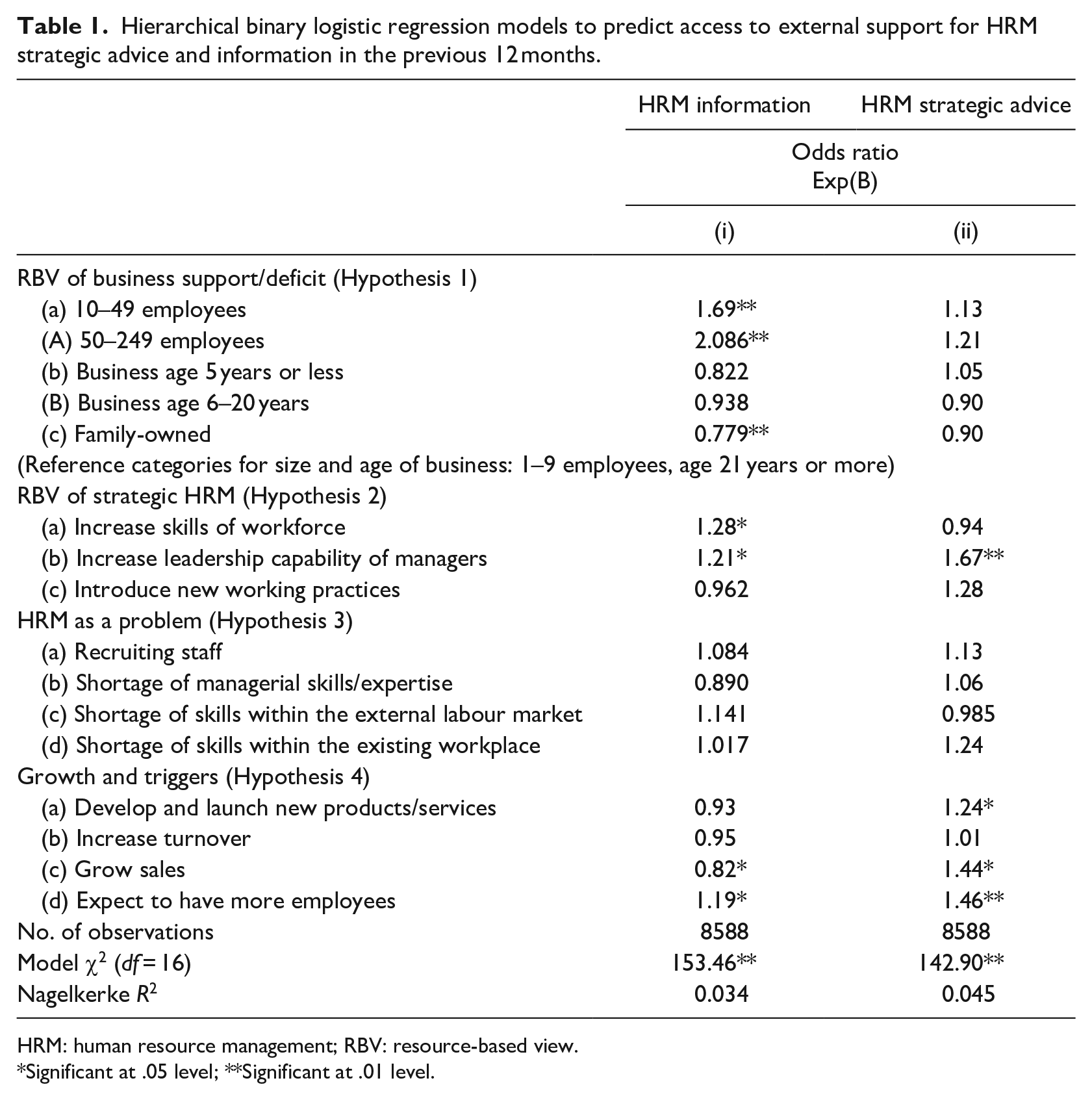
Here, we present the hierarchical BLR analysis results, which identified the factors associated with SMEs seeking information or strategic advice on HRM matters. We present the odds ratios for ease of interpretation. This is the probability of seeking, for example, strategic HRM advice if coded as 1 in the predictor variable, compared to the probability of seeking strategic HRM advice if coded as 0. For example, in the model below, businesses that plan to change working practices are 1.28 times more likely to have sought strategic HRM advice than businesses that do not, when all other variables in the model are held constant. The odds ratios for size are shown in comparison to the reference category of businesses with 1–9 employees, and those for age of business in relation to businesses operating for 21 or more years. As reference categories, these do not appear explicitly in the model but are fully present in the analysis – for example, it is clear that micro businesses are less likely to seek HRM information than are either small- or medium-sized businesses, as the latter are (respectively) 1.69 and 2.086 times more likely to do so (Table 1).
Hierarchical binary logistic regression models to predict access to external support for HRM strategic advice and information in the previous 12 months.
HRM: human resource management; RBV: resource-based view.
Significant at .05 level; **Significant at .01 level.
The model chi-square statistics indicate that both models fit the data well. While none of the R2 measures in BLR corresponds to the meaning of variance explained in OLS (Menard, 2000), they are useful for comparing different models fitted to the same data. Our Nagelkerke R2 values suggest that the model for accessing strategic HRM advice has slightly more predictive power. The results provide no evidence to support Hypotheses 1a, 1b or 1c, which relate to the RBV of business support. In relation to strategic HRM advice (hypotheses variant ‘ii’), none of our predictor variables was statistically significant. With regard to day-to-day information about HRM (hypotheses variant ‘i’), businesses with between 50 and 249 employees were more than twice as likely to have sought information than micro businesses, and medium-sized business 1.6 times more likely (Hypothesis 1ai) – contrary to what might be expected from RBV or life cycle perspectives. Turning to family-owned businesses, these were significantly less likely to have sought HRM information, again contrary to the Hypothesis (1ci). In summary, there was no support for the notion that a lack of resources was driving SMEs to seek HRM support.
Hypothesis 2, which relates to the RBV of strategic HRM, is largely supported. Businesses that planned to increase the leadership capabilities of their managers were 1.2 times more likely to have accessed information about HRM issues (Hypothesis 2bi) in the previous year and 1.7 times more likely to have accessed strategic HRM advice (Hypothesis 2bii). The direction of causality is not clear as the data record plans for the future and access to support in the past year. It is possible that plans to increase leadership capabilities were the result of, rather than the driver of, access to support. Nonetheless, there is some evidence to suggest a relationship between a strategic approach to HRM and access to business support.
‘HRM as a problem’ perspective, Hypothesis 3, was not supported. Recognising problems with skills within the firm and with recruiting externally were poor predictors of seeking HRM support. This may, in part, result from the dichotomous responses to questions about problems with skills and recruitment that do not differentiate between those who regard it as a minor or critical issue. With finer grained data, it may have been possible to shed light on Tocher and Rutherford’s (2009) thesis that HRM problems will only trigger action when they reach a ‘tipping point’. However, the results raise interesting questions as to why firms that recognised HRM problems did not seek external support to address them.
Finally, we turn to growth theories and trigger events (Hypothesis 4). Businesses planning to increase the number of employees were 1.2 times more likely to have sought HRM information (Hypothesis 4di) and 1.5 times more likely to have accessed strategic HRM advice (Hypothesis 4dii). Businesses that intended to grow sales were around 1.4 times more likely to have taken strategic HRM advice (Hypothesis 4cii), but less likely to have accessed HRM information (Hypothesis 4ci), while we found no statistically significant relationship between planning to increase turnover and accessing HRM support (Hypothesis 4bi and ii). Businesses planning to develop and launch new products and services were 1.2 times more likely to seek strategic HRM advice (Hypothesis 4aii). Hypothesis 4 is thus partially supported. There was fairly consistent support for the hypothesis that trigger events stimulated SMEs to seek strategic HRM advice, but only limited support for notion that such events prompted them to seek HRM information.
Discussion
Interpreting the empirical findings
We found that very few SMEs sought support for HRM issues. Where they did so, they were more likely to seek information than strategic advice; the focus was primarily on procedural and compliance matters confirming Edwards et al. (2010), Cassell et al. (2002) and Duberley and Walley (1995). However, the analysis also revealed a novel contrast between SME behaviour in seeking HRM support, and that in respect of other business issues such as finance and marketing. Firms accessing HRM support were more likely to be seeking information than strategic advice, but the pattern was reversed in respect of other business support, suggesting that SME HRM needs are distinctively transactional (Atkinson et al., 2017). The analysis also revealed novel findings around the factors associated with seeking HRM support. In terms of firm characteristics, we found that larger size was related to the propensity to seek HRM information, and family ownership negatively associated. Age of business had no relationship with seeking HRM support and neither business age, size nor ownership were related to seeking such strategic advice. These new findings on HRM support are largely in line with those of previous studies on generic business support (Johnson et al., 2007), reinforcing that organisation characteristics are not the main predictors of seeking support, and the need to look elsewhere for the drivers for seeking HRM support specifically.
In relation to factors associated with seeking support, our findings for HRM support replicated those for general business support in some aspects but differed in others. We found that firms that identified particular HRM issues as problems were no more likely to seek HRM support, and found little evidence to support an association identified in previous research between size and perceiving HRM issues to be problematic (Barrett and Meyer, 2010; Huang and Brown, 1999; Tocher and Rutherford, 2009). Even among those that regarded recruitment as a major concern, few sought information and fewer still, strategic advice echoing the findings of Edwards et al. (2010) and Johnson et al. (2007) who found little support for the proposition that a shortage of skills necessary to respond to changes in a product market drove access to business support. However, plans to develop skills and capabilities in the workforce were in most cases associated with an increased likelihood to seek HRM support in relation to strategic HRM advice – growth intentions and product/service development. These are again new findings that indicate that patterns of HRM support, in this respect, are broadly similar to those for business support generally (Edwards et al. 2010; Johnson et al., 2007).
It is interesting that identifying skills shortages or lack of leadership capability were not related to an increased likelihood of an SME seeking HRM support, but that plans to develop such capabilities were related. We cannot rule out the possibility that seeking strategic HRM advice stimulates the perceived need for workforce development programmes. However, this would still leave unanswered the question as to what triggered the desire to seek HRM support; our results suggest that growth intentions and environmental triggers are possible candidates, but we cannot establish that causal chain here.
That firms who identify HRM problems are no more likely to seek HRM support, and less likely to seek strategic advice than those that identify problems in other areas of their business, warrants further discussion. The literature suggests two plausible explanations. The first is a supply-side explanation that those who identify HRM problems want support but are unable or unwilling to access it (as with general business support, see Mole et al., 2017). The business support landscape is fragmented and difficult to navigate (Mallett and Wapshott, 2016), which is likely to inhibit support-seeking behaviour. Furthermore, the kind of HRM support that SMEs require may not be available. Indeed, this study provides support from a large-scale study for the findings of smaller scale ones (Harris, 2000; Jarvis and Rigby, 2012; Kitching, 2016) in showing that SMEs seeking support for HRM issues often turn to non-specialist sources. Empirical work has suggested that many of the above factors may be at play (Atkinson et al., 2017). That study identified a need for bespoke, affordable and easily accessible specialist HRM support that SMEs often felt was not available in current provision. In the absence of this, SMEs are likely to turn to trusted – but not necessarily specialist – sources of HRM advice (Jarvis and Rigby, 2012; Kitching, 2016).
An alternative demand-side explanation is that SMEs find it difficult to identify HRM issues as problems that need to be addressed. This may result from a failure to recognise HRM issues as strategically significant or from the way in which HRM problems are understood and surfaced in SMEs. Tocher and Rutherford (2009) argue that recognising HRM problems may not be sufficient to trigger action to resolve them unless they reach an acute level relative to other business challenges. This may help to explain our findings here – SMEs identified HRM issues, but these had not reached a critical level where they sought support to address them. Our data, and other evidence, tentatively suggest that other conditions may be required to nudge SMEs from a recognition of a problem towards addressing it. For example, a trigger such as business diversification or growth, or HRM support itself may be required – Atkinson et al. (2017) found that discussions with specialist HRM advisors over transactional employment matters often generated an awareness of more strategic HRM issues that required attention.
Implications for theory
In this section, we make two theoretical contributions. First, we reframe existing critiques of RBV as a theoretical basis for business support in the light of our empirical findings on HRM support. We argue that it is RBV’s deficit interpretation that is the legitimate focus of criticism, but that its transformational interpretation in the HRM literature has much to offer. Second, we offer a novel theoretical development, drawing on the notion of dynamic management capabilities (Teece et al., 1997) to interpret our findings, and integrating it with RBV to develop a conceptual model that advances understanding of HRM support in SMEs.
In relation to the first of these contributions, it should be noted that at the outset we drew attention to Brown and Mawson’s (2016) critique of RBV as the theoretical foundation for policy development around business support for SMEs. Business support needs and provision are conceived in terms of deficit amelioration, where deficits are seen as resulting from a lack of resources. Support is targeted at smaller and younger firms, who are assumed to be resource poor. For example, Brown and Mawson (2016: 820) note the tendency of policy makers, ‘to use firm age as a proxy for resource-scarcity and growth potential’. These authors argue that ‘RBV . . . may not be the best theoretical lens through which to assess how to equip firms for growth’ (Brown and Mawson, 2016: 820). Our results offer empirical support for that view, showing that there was greater support for the proposition that accessing HRM support was associated with strategic intentions in relation to the workforce, and anticipated changes in the business such as growth, than there was for the notion that it would be more likely to be sought by smaller, younger and family-owned firms. These findings are also congruent with the newer generation of growth theories (Brown and Mawson, 2013, 2016) that see growth as non-continuous, not necessarily size- and age-related, and dependent on developments in the internal and external environment.
Brown and Mawson (2016) suggest that a dynamic capabilities approach (Teece, 2007; Teece et al., 1997) provides a better conceptual underpinning for business support. Dynamic capabilities refer to the ability of firms to ‘integrate, build and reconfigure internal and external competencies to address rapidly changing environments’ (Teece et al., 1997: 516). The focus is on learning, responsiveness and agility, and the emphasis on the ability of firms to ‘. . . sense, seize and capitalise on new growth opportunities {rather than} the tangible resources they possess’ (Brown and Mawson, 2016: 820). We concur with Brown and Mawson that dynamic capability theory has value as a conceptual underpinning to an understanding of business support – indeed, we make an explicit application of it below – however, we argue that it is not the RBV per se that is the appropriate focus of the critique, rather the particular ‘deficit’ interpretation used in the business support literature. RBV tends to have a different interpretation in the strategic HRM literature. Rather than focusing on the stock of resources, conceptions of RBV in the HRM literature focus on the competitive potential embodied in people and their skills – human capital advantage – and, particularly, on the firm-specific processes through which capabilities are developed, and learning and knowledge are nurtured and deployed – a source of human process advantage (Boxall, 1996).
Indeed, influential interpretations of RBV in the HRM literature (Boxall and Purcell, 2016) and some strategic management literature (Lin and Wu, 2014) explicitly associate Teece’s (2007) capabilities approach with the RBV, rather than seeing them as contrasting perspectives. Dynamic capabilities are seen as an extension to the RBV and there is empirical evidence that ‘dynamic capabilities significantly mediate . . . resources to improve firm performance’ (Lin and Wu, 2014: 411). Learning, enabled by internal HR programmes or through fostering external relationships, emerge as the key dynamic capability (Lin and Wu, 2014). We argue that the RBV can still have much to offer here provided that resources are conceptualised more broadly in this way, and considered in conjunction with the dynamic capabilities that facilitate their effective deployment and development (Lin and Wu, 2014). The corollary is that the use of the notion of deficit could be broadened to include limits in firm capabilities to identify and capitalise on opportunities to grow.
This re-conceptualisation leads to a new theoretical development informing the second contribution of the article. A notable turn in the dynamic capabilities literature has been to focus on the micro-foundations of dynamic capabilities – management capabilities rather than organisational systems (Fallon-Byrne and Harney, 2017; Teece, 2007). To our knowledge, there has yet to be an explicit articulation in the literature of the dynamic management capabilities that lead to human capital and human process advantage (Garavan et al., 2016b, offer a discussion of dynamic management capabilities in relation to HR development specifically, but do not position it within an RBV framework). Here, we offer such an articulation within the domain of this study. We suggest that an awareness and capacity among managers (in this case, SME owner-managers) to recognise and address HRM challenges and opportunities in response to environmental changes, whether external or internal, and to seek appropriate support is in itself a form of dynamic capability. In Figure 1, we model this capability. We use Teece’s (2007: 1342) ‘sensing’, ‘seizing’ and ‘transforming’ dynamic capability framework as a structure to capture the process of enactment of the capability, and identify three sub-domains in which this capability may be manifested. These draw on the conceptual framework underpinning our analysis: the first relates to seeking HRM support for strategic workforce developments, the second to seeking HRM support to deal with perceived HRM problems and third to seeking HRM support to support business growth or diversification. The fourth element of our initial framework, seeking HRM support as a response to deficit (size, ownership, etc.), is not included in the model. This is because, in line with the arguments that we have made in the preceding section (and see also Brown and Mawson, 2016), the model is intended to reflect a conceptual shift from seeing HRM support seeking as a response to deficit, to regarding it as a dynamic capability. Furthermore, the deficit approach received no empirical support from our data.
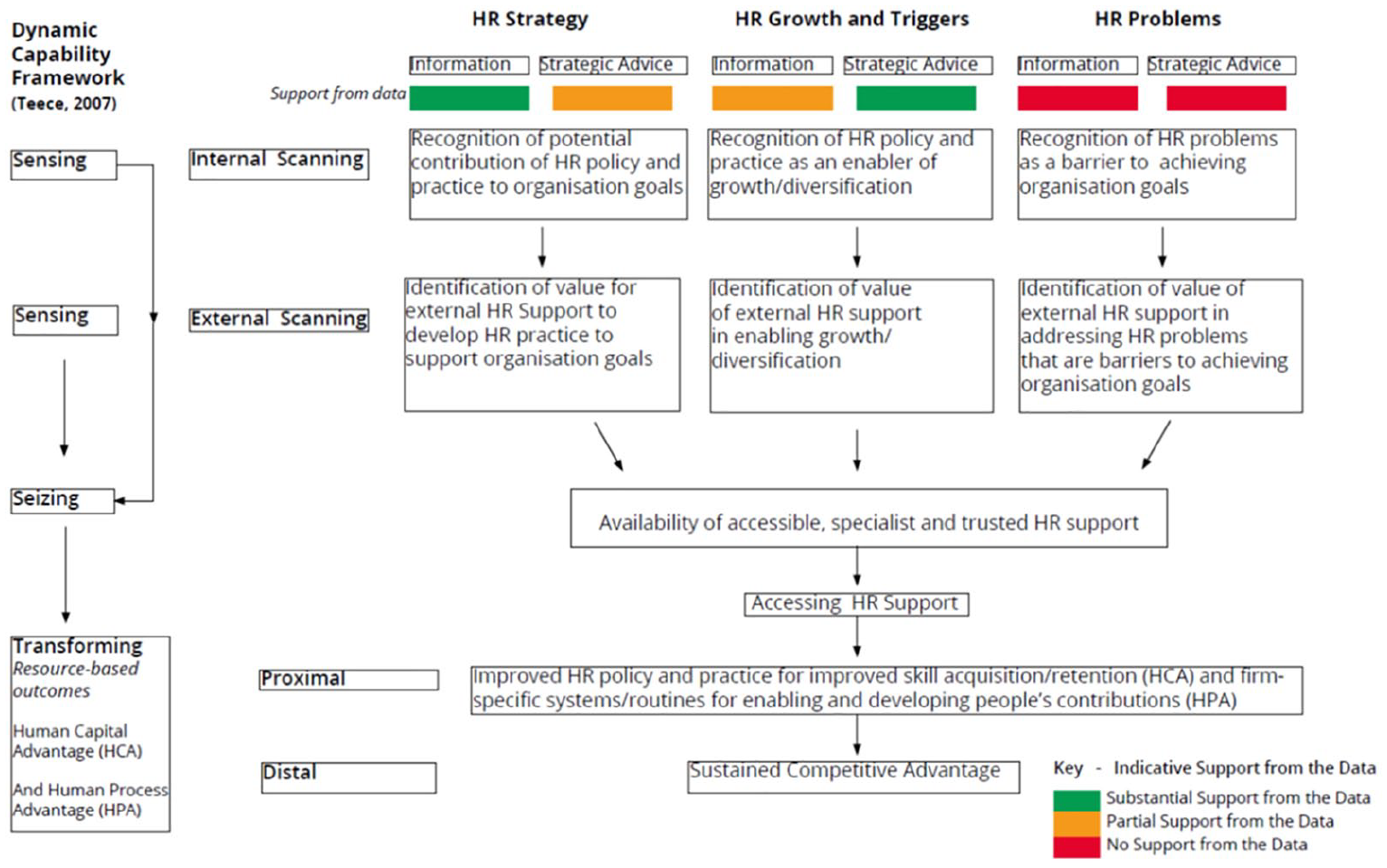
Seeking external HR support as a dynamic capability within a resource-based view (RBV) framework.
The model is an idealised representation of how the dynamic capability of seeking external HRM support might be enacted in each of the three sub-domains. We posit that, in each case, ‘sensing’ first requires a process of internal scanning – respectively, recognition of opportunities for strategic HRM development, for example, investment in line management skills; identification of HRM-related barriers to business development (Tocher and Rutherford, 2009), for example, workplace conflict; or an HRM response to intention to grow, for example, a recruitment need. ‘Sensing’ also requires recognition of the value of external HRM support in creating opportunities or responding to problems or triggers. ‘Seizing’ is reflected in the act of seeking that HRM support, and this will depend on the availability and accessibility of support, and also the suitability of it, for example, the extent to which it is seen as specialist or trusted (Atkinson et al., 2017; Jarvis and Rigby, 2012; Kitching, 2016). ‘Transforming’ refers to potential outcomes from improved HRM practice leading to competitive advantage arising from issues such as an improved skills base – a human capital advantage, better systems for leveraging the benefits of employees through, for example, better staff development or performance management programmes or, improved approaches for organisational learning and knowledge management – a human process advantage.
The model is useful in two ways. First, it suggests the ability to seek external HRM support, where appropriate, as a dynamic management capability with the potential to lead to human capital and process advantage. In so doing, it provides a specific example of how dynamic capabilities can be considered within a resource-based perspective within the HR field. The model articulates the potential route from micro-foundational management capabilities in relation to seeking external support through to sustained competitive advantage through people. As noted, the relationship between RBV and dynamic capabilities has been recognised in HR scholarship, but it has not yet, to our knowledge, been operationalised within particular domains of practice. Second, the model articulates the elements of that dynamic capability, and necessary steps for it to be realised. This will be useful for researchers in focusing their research on particular ‘links in the chain’ and for policy makers as a framework for understanding and investigating where barriers to the effectiveness of HRM business support may lie. The results of the current study shed some light on this, reflected in the representation of the model. They suggest that the routes to human capital and process advantage through HRM support are more well trodden in relation to strategic workforce development, response to growth intentions and other triggers, than they are in relation to identifying and responding to HRM problems. Acting in this way on latent HRM problems seems more challenging for SMEs than responding in to particular triggers or opportunities. The data cannot tell us whether support seeking is inhibited by a lack of in-firm capabilities or a lack of available and suitable external provision – the model draws attention to that as important research question.
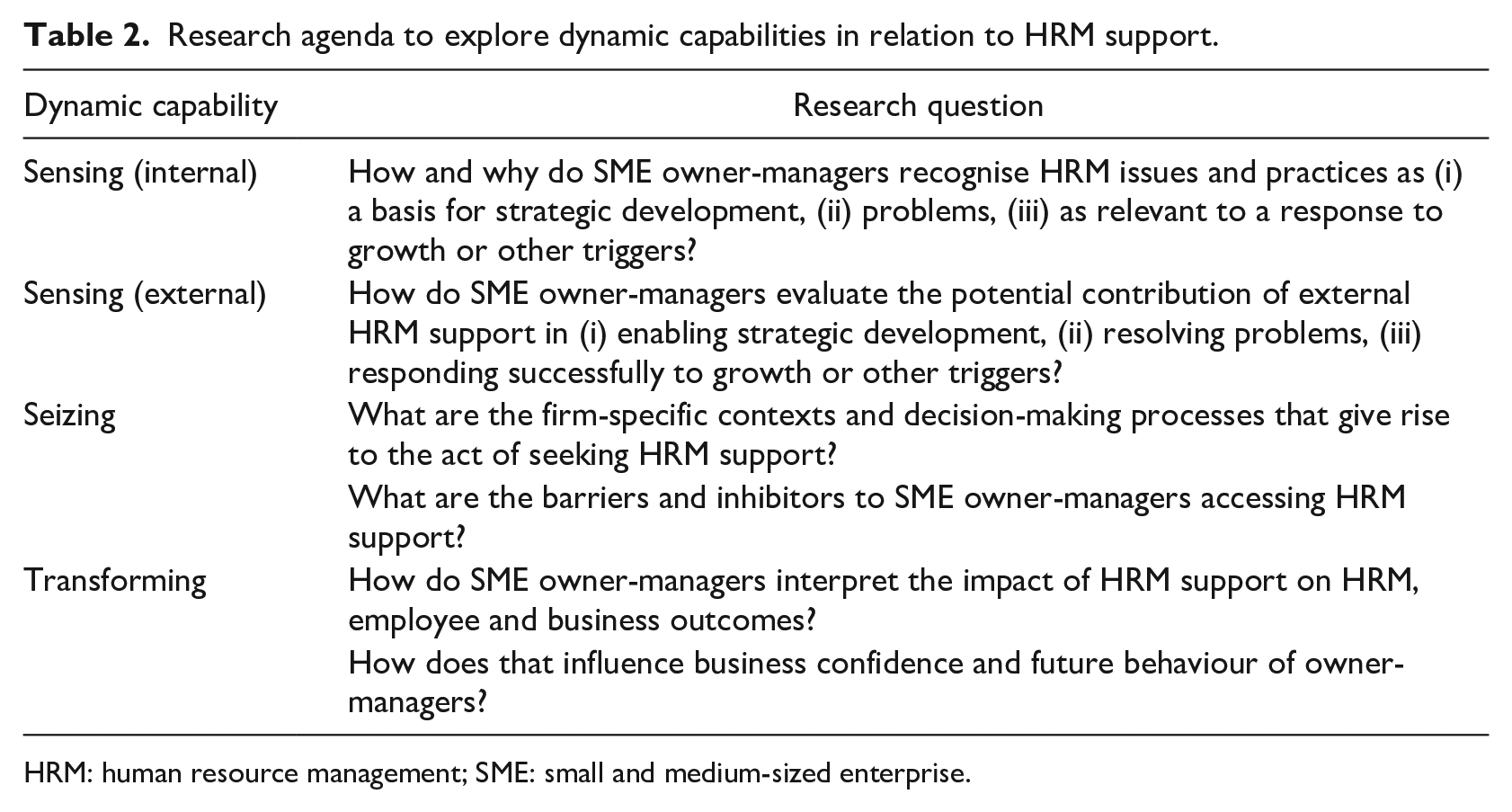
For this, and other reasons, the model will be useful in framing the agenda for future research in the field. As we have noted earlier, very little is known about the processes by which firms come to seek external HRM support, or not, and the influences upon those decisions. At each of its steps, the model stimulates questions around how the internal and external context frame decision making and impact on whether firms access HRM support. We set these out as research questions in Table 2 and suggest that they will be a valuable road map for qualitative researchers in uncovering the complexities of SME engagement with external HRM support. The model will also serve as a useful basis for empirical exploration by quantitative researchers, suggesting a range of connections and relationships to be tested.
Research agenda to explore dynamic capabilities in relation to HRM support.
HRM: human resource management; SME: small and medium-sized enterprise.
Conclusion
In the context of increasing recognition of the link between good management and productivity improvements (ONS, 2017), ensuring that SMEs receive the HRM support that they need will be an increasingly important policy agenda. This article has contributed to its foundations in two notable ways. The first is a novel empirical contribution, derived from identifying the factors associated with SMEs accessing support for HRM issues. While the existing literature provides valuable insights on this question from qualitative studies (Kitching, 2016), we contribute by analysing this issue using statistical analysis of a large national SME dataset (LSBS). Take-up of general business support has been extensively analysed in this way (Mole et al., 2017); an original empirical contribution here, however, is to extend the analysis to the take-up of support for HRM issues. We found that only a small proportion of SMEs access HRM support, and that those that do are more likely to seek basic information than strategic advice, in contrast to those seeking general business support. The findings show that intentions to grow and diversify, along with a desire to increase leadership capabilities and introduce new working practices, are better predictors of seeking strategic HRM advice than size, age of business or ownership.
The second contribution is theoretical. Our interpretation of the findings in relation to different theoretical perspectives on business support provision offers support for critiques of the use of deficit-based approaches drawing on the RBV (Brown and Mawson, 2016). We found no evidence that deficits in tangible resources were driving access to external HRM support. However, we argue that the appropriate focus of the critique is not RBV per se, but the narrow interpretation that is prominent in the business support literature. A broader interpretation of RBV that focuses on dynamic capabilities not only makes better sense of the empirical data but provides a platform for understanding the kinds of HRM capabilities that SMEs may need to develop. As part of this contribution, we have introduced the novel idea that recognition of HRM problems and opportunities, and responsiveness to them – including identifying and accessing external support – are in themselves dynamic capabilities, and we have developed a model that provides a framework for understanding the pathways to competitive advantage they offer. We hope that this encourages other scholars to provide a similar consideration of dynamic (HRM) management capabilities within an RBV perspective, and provides a stepping stone for a broader integration of these theoretical perspectives within the HR field.
Our final contribution is an agenda for policy and research. The empirical findings of the study, and theoretical insights developed from them, provide a foundation for rethinking policy provision in respect of HRM support. They suggest a need for specialist support that is tailored to the needs of SMEs at key points in their development, regardless of business age or size, in particular to ensure that they adequately meet the demand for strategic HRM support for those SMEs undergoing growth and strategic change. As research has shown (Atkinson et al., 2017), HRM needs of SMEs may often be basic, but their resolution can be transformational, and stimulate a more strategic orientation towards HRM issues. Design of provision should incorporate a recognition of these more foundational requirements. The model that we have developed points policy makers to key elements that need to be addressed if the development of HRM support provision is to be successful. The first is to support SME owner-managers to recognise HRM problems and possibilities, and to do so before they become critical; the second is to develop an awareness of the potential of external support to address these issues; and the third is to provide accessible and trusted support. The model is also useful in underpinning the agenda for quantitative and qualitative research which builds on the findings of the current study. We set out this agenda out in detail above, and trust that it will be a valuable resource for future researchers.
This study is limited by features of data capture in the LSBS in relation to employment issues, and its focus on England and Wales places limits on the generalisability of the findings. The data provide a snapshot and cannot offer an assessment of the impact of HRM support, and the purely quantitative nature of the data somewhat limits the depth of understanding of reasons for action. Future quantitative research could usefully explore the links in the model, in particular examining the impact of HRM support on future SME performance, both the immediate and proximal impact in terms of adoption of HRM systems and practices and their effects, but the distal impact on growth, diversification and sustainability (Harney and Alkhalaf, 2020). The content of the model also provides the basis for an agenda – which we have detailed in Table 2 – for in-depth qualitative research that explores the inter-relationships between growth intentions, workforce development intentions and the provision of strategic HRM support.
Footnotes
Acknowledgements
The authors would like to thank the anonymous reviewers and the editor for their helpful comments and constructive suggestions during the review process.
Funding
The author(s) received no financial support for the research, authorship, and/or publication of this article.
