




Abstract
Innovation ambidexterity is especially complex for young technology-based firms because they are resource-challenged and knowledge deficient in strategic terms; but they possess considerable scope for entrepreneurship. Strategic entrepreneurship may provide a solution. Incubators emerged as a policy solution precisely due to this dilemma. We conceptualise that strategic entrepreneurship, as a synthesis of opportunity-seeking and advantage-seeking behaviours of young technology-based firms, can affect both explorative and exploitative innovation activities in these firms and expect that subsequent innovation ambidexterity affects profitability. Our empirical analyses reveal complex and competing interrelationships that both ease and exacerbate the tensions associated with innovation ambidexterity. We contribute to theory by testing strategic entrepreneurship as it applies to innovation ambidexterity and evidence behaviours that contribute to its foundations. To entrepreneurs and managers, we offer a set of prescriptions for innovation ambidexterity in young firms that accounts for the complementarities between complex and theoretically opposing constructs.
Keywords
Introduction
Young technology-based firms face two fundamental challenges connected to their liabilities of newness. The first is to effectively and efficiently exploit in-house capabilities to create revenue streams and manage cost structures. The second is exploring new innovations to overcome the rapid development of new technology and the short life-cycle of many technology products and services caused by intense industry competition (Tukker and Tischner, 2017). For young technology-based firms, this situation calls for innovation ambidexterity (Hughes et al., 2021; Volery et al., 2015; Voss et al., 2008; Voss and Voss, 2013), defined as the high-quality, simultaneous balance (Simsek, 2009) of exploitation and exploration activities. Ambidexterity is necessary to increase the efficiency of processes, improve operations management and create value that may eventually help these firms to attain legitimacy, accountability, reliability and short-term sustainability (exploitation); while also pursuing new opportunities and building creative services and products for medium-to-long-term viability in the face of rapid technology development driven by intense competition in technology industries (exploration).
Yet, both of these activities are at odds with each other (March, 1991). Too much exploitation, and the young firm strengthens its burgeoning capabilities into a rigid state, losing its ability to innovate; too much exploration, and the young firm risks becoming unsustainable, trapped in never-ending technology development but little market development (Hughes, 2018; Levinthal and March, 1993). In fact, young technology-based firms have the capacity to regularly detect new opportunities for new technologies and innovations, but are far less effective at compiling the capabilities and resources needed to generate revenue streams to secure their future (Arzubiaga et al., 2018; Ireland and Webb, 2007, 2009; Kollmann and Stöckmann, 2014). A potential solution lies in strategic entrepreneurship: the extent to which a firm marries opportunity-seeking and advantage-building behaviours (Kuratko and Audretsch, 2013; Mazzei et al., 2017; Withers et al., 2018).
Critics point to potentially insurmountable challenges and substantial implementation problems (Nosella et al., 2012; Stettner and Lavie, 2014; Walrave et al., 2017) for those seeking innovation ambidexterity. While crucial to the performance and longevity of young technology-based firms, these firms are resource and knowledge deficient, often with underdeveloped capabilities, and current solutions to achieving ambidexterity are largely grounded in studies of far larger and established firms. At the heart of this problem has been a failure to conceptualise the antecedents and organising principles of ambidexterity (Durisin and Todorova, 2012; Koryak et al., 2018; Wilden et al., 2018) and an especial neglect for the context in which exploration and exploitation take place (Khan et al., 2018; O’Reilly and Tushman, 2013; Stettner and Lavie, 2014). As highlighted by Koryak et al. (2018), ‘while some common antecedents of ambidexterity as an overarching construct have been identified . . . its constituent components – exploration and exploitation − tend to be associated with diametrically opposing factors’ (p. 414). Which conditions shape this exploration–exploitation interplay is perhaps the most persistent criticism levelled against the ambidexterity thesis (Burgess et al., 2015; Koryak et al., 2018), and current treatments do not sufficiently examine how the momentum for explorative or exploitative innovations may derive from related firm activities (Mom et al., 2019).
We address this research opportunity in two ways. First, explorative and exploitative innovations are two competing, but essential, activities young technology-based firms must reconcile (Tushman and O’Reilly, 1996). Drawing on strategic entrepreneurship, we examine how strategic and entrepreneurial behaviours create tendencies that favour one innovation activity over the other, or, are common to both. Young technology-based firms with limited resources and liabilities of newness use different capabilities to implement explorative and exploitative innovations (Feng et al., 2019; Heavey et al., 2015). Firms pursuing strategic entrepreneurship seek new opportunities (opportunity-seeking behaviour) either to expand current product offerings by refining burgeoning competences (with exploitative innovation) or to adventure into new product domains (with explorative innovation) by remodelling its resource base (advantage-seeking behaviour) to compete on both market and technology frontiers (Kollmann and Stöckmann, 2014; Mazzei, 2018; Simsek et al., 2017; Withers et al., 2018). This application corrects for the disregard among studies of innovation ambidexterity for the organising principles underpinning both innovation forms (Birkinshaw and Gupta, 2013; Durisin and Todorova, 2012; O’Reilly and Tushman, 2013) and allows us to examine what activities augment exploration, exploitation or both. Second, to correct for the common disregard of context among studies of innovation ambidexterity of firms (Junni et al., 2020; Stettner and Lavie, 2014), we choose a context in which the complexity of managing scarce resources and firm entrepreneurship are exacerbated. We focus on young technology-based firms located in incubators where the challenges to achieving a sustainable future are particularly acute (Deligianni et al., 2019; Tukker and Tischner, 2017). In young technology-based firms, excellence at seeking opportunities is counterbalanced by inadequate resource ownership needed to generate and sustain longer term viability (Tornikoski et al., 2017). Incubators are a popular policy tool because they enable young technology-based firms to engage in entrepreneurial ecosystems (Bank et al., 2017; Lasrado et al., 2016; Spigel, 2017) to network with other technology firms and partners to close resource gaps and overcome knowledge deficits that underpin liabilities of newness. Most incubators have a specific focus on technology (Hughes et al., 2007; OECD, 1999). Because young technology-based firms often need significant upfront financial capital and periods of technological development to refine their initial technology in the market place while also creatively innovating to keep up with or surpass intense industry competition, incubators offer a valuable proposition to young technology-based firms by providing access to networks, services and capital (Chan and Lau, 2005). We predict that the firms that best channel strategic entrepreneurship will be those that gain the most from this context and achieve profitability. Our research question is: what strategic and entrepreneurial behaviours favour explorative innovation over exploitative innovation (and vice versa) or favour both?
We provide three contributions. First, we develop and provide a theoretical logic that reveals the strategic entrepreneurship conditions that precipitate explorative and exploitative innovation activities. In doing so, we provide a novel theoretical rationale and model of innovation ambidexterity in which seemingly opposing dimensions of strategic entrepreneurship – being opportunity-seeking and advantage-seeking – and innovation theory co-align in young technology-based firms. Second, we ground our theoretical narrative context sensitively to incubating technology-based firms, correcting for the tendency to relegate context to a mere control variable in entrepreneurship (Zahra et al., 2014), entrepreneurial orientation (EO) (Yin et al., 2020) and ambidexterity (Khan et al., 2018; O’Reilly and Tushman, 2013; Stettner and Lavie, 2014) studies. Collectively, these contributions provide novel theorising and empirical evidence of strategic entrepreneurship as it applies to innovation ambidexterity for incubating technology-based firms. These set essential new building blocks for further scholarly research into the antecedents of innovation ambidexterity as called for by Birkinshaw and Gupta (2013), Kassotaki et al. (2019) and O’Reilly and Tushman (2013). Third, we advance the conceptualisation of strategic entrepreneurship to resolve the ambiguity that surrounds exactly what represents opportunity- and advantage-seeking behaviour as lamented by Simsek et al. (2017). To entrepreneurs and managers, we offer a set of behavioural prescriptions for innovation ambidexterity in incubating technology-based firms.
Theoretical framework
Innovation ambidexterity and young technology-based firms in incubators
Ambidexterity rose to prominence from March’s (1991) seminal work on the fundamental adaptive challenge facing firms (Hughes, 2018). This challenge is conceptualised as the need to both exploitatively refine in-house competencies to grow current revenue streams and manage cost structures while providing for adequate exploration to prepare new technological changes and shape new innovations for future viability (O’Reilly and Tushman, 2013). Exploitative innovation is based on incremental additions, new refinements and cost improvements to existing products and technologies. Explorative innovation is based on new technological possibilities and creative ideas to shape new and truly distinct products. Firms that pursue both innovation activities successfully can align the needs of today’s customers while preparing for future markets (Gibson and Birkinshaw, 2004) and potentially obtaining superior business performance (He and Wong, 2004; Hughes, 2018). Those that do not, or do so badly, risk mediocrity or failure. This problem is especially acute for incubating technology-based firms because of rapid changes in technology, short product life-cycles and intense competition (Traynor and Traynor, 2004; Tukker and Tischner, 2017).
In theory, explorative innovation relies on variance-inducing activities at the firm level that fuel the play, discovery and experimentation of new product and technology possibilities, while exploitative innovation relies on choice-inducing activities to fuel the refinement, efficiency and execution of better ‘but not new’ product and technology possibilities (March, 1991). This dichotomy manifests a significant managerial problem for incubating technology-based firms because both activities compete for scarce resources (Voss et al., 2008) and typically rely on different resource-based and entrepreneurial activities (Ireland and Webb, 2007). This problem greatly affects young technology-based firms because of their relative constraints of newness (Hughes et al., 2014). The result is that one form of innovation tends to flourish, while the other flounders (Voss et al., 2008). Strategic entrepreneurship may resolve this problem (Hitt et al., 2011; Withers et al., 2018).
Strategic entrepreneurship and innovation in incubating technology-based firms
Two contrasting behaviours drive strategic entrepreneurship: opportunity-seeking behaviour and advantage-seeking behaviour. Conceptualisations of strategic entrepreneurship predict that integrating these two behaviours generates innovation as a precursor to profitability (Ireland et al., 2003). Strategic entrepreneurship involves behaviours in some way intended to fuel or create new or improved forms of revenue and competitive advantage (Mazzei, 2018; Simsek et al., 2017). Opportunity-seeking behaviour is a function of the entrepreneurial strategy of the firm. Through entrepreneurial behaviours, the firm is expected to develop competency at identifying a stream of rich opportunities to fuel innovation (Ireland et al., 2003; Ireland and Webb, 2007, 2009). However, opportunities alone cannot create innovation as this is also dependent on the resources attracted to the firm (Ketchen et al., 2007; Yin et al., 2020).
Following Ireland et al. (2003), we view opportunity-seeking behaviour as a product of an entrepreneurial mindset and entrepreneurial leadership within a firm. We conceptualise this as the EO of the incubating technology-based firm. 1 EO captures the mindset, behaviours and accompanying processes that managers use to seek out and pursue novel opportunities (Hughes and Morgan, 2007; Lumpkin and Dess, 1996). An EO embraces entrepreneurial behaviours related to product and market innovativeness, risk-taking and proactiveness (Covin and Slevin, 1989; Miller, 1983). Innovativeness characterises a willingness to depart from current practices and try out new or different ideas. Risk-taking represents the degree to which members of the firm are willing to make resource commitments towards projects that bear uncertainty and exhibit a reasonable danger of costly failure. Proactiveness is a firm-wide mentality to anticipate and act in advance of future problems and opportunities.
Despite these compelling entrepreneurial behaviours, EO remains a first-order effect in pursuing innovation (Arunachalam et al., 2018). Translating entrepreneurial opportunities into productive market offerings requires resources. Ireland et al. (2003) describe this as advantage-seeking behaviour in a construct conceptualised as ‘managing resources strategically’. Incubating technology-based firms possess little slack in their in-house competences and resources as these would ordinarily be directed primarily towards the exploitation of existing technology that forms the basis of its first products. This is consistent with the notion that young technology-based firms locate to incubators because of growth aspirations. However, it is also precisely because such young technology-based firms have significant upfront capital requirements and a need to continuously enhance and renew their technologies and products given rapid technology shifts and short product life-cycles, that incubators emerged as a support solution (Hughes et al., 2007; Lasrado et al., 2016; Spigel, 2017). Increasingly, the resources young technology-based firms need to attain profitability and sustain their viability lie outside of the firm’s boundaries (Cai et al., 2014). For incubating technology-based firms, this is necessarily so due to resource deficits. Although incubators vary (Theodoraki et al., 2018), they offer access to networks through which resources, services and capital to support the incubating firm can be found (Chan and Lau, 2005). Research suggests that those incubating firms that orient their behaviour to capitalise on such relational resources made accessible through incubators can experience a range of improvements in business performance (Hughes et al., 2007).
Young technology-based firms are typically skilled at identifying abundant and novel entrepreneurial opportunities but are less skilled at assembling and coordinating the resources needed to exploit those opportunities due to liabilities of age and firm size (Lubatkin et al., 2006; Voss et al., 2008; Voss and Voss, 2013). These firms start with low resource stocks that direct advantage-seeking behaviour towards resource attraction and acquisition activities, commonly through relationships (Feng et al., 2019; Heavey et al., 2015), to offset their newness and size disadvantages. The incubator provides the platform or ecosystem for this behaviour. Incubating technology-based firms can make extensive use of relational resources to fill gaps in their resource portfolio, changing their constraints (Pfeffer and Salancik, 1978). Thus, we conceptualise the first aspect of advantage-seeking behaviour as accessing and acquiring relational resources. The second aspect of this advantage-seeking behaviour is the firm’s relational embeddedness within its network of ties. Higher relational embeddedness is associated with a greater preponderance of strong ties. The quality of social relations, in general, improves with greater relational embeddedness and acts as a mechanism for knowledge transfer (Inkpen and Tsang, 2005) needed to offset the knowledge deficits of young technology-based firms. This knowledge can affect innovation activity (Dittrich and Duysters, 2007).
Squaring strategic entrepreneurship with innovation ambidexterity is difficult because simultaneous entrepreneurial and strategic behaviour can create bimodal effects on innovation activity. For example, Voss et al. (2008) found that resourcing difficulties and insufficient resource slack led young firms to prioritise exploitative innovation activity, but this switched to exploration when new resources entered the young firm. The behaviours associated with strategic entrepreneurship may then exert a mixture of competing and complementary effects on exploration and exploitation as the underlying components of innovation ambidexterity. Young technology-based firms adept at both can better service existing markets with refined product offerings while developing new technology spaces. Under these circumstances, the mediocrity proposed by March (1991) should not arise.
Incubating technology-based firms with EO and a collaborative orientation can, therefore, set the foundations for strategic entrepreneurship to pursue innovation activities. The strategic entrepreneurship paradigm proposes that EO and accessing relational resources strategically are antecedents to explorative and exploitative innovations, which jointly have the potential to increase profitability. Figure 1 illustrates our theoretical framework.
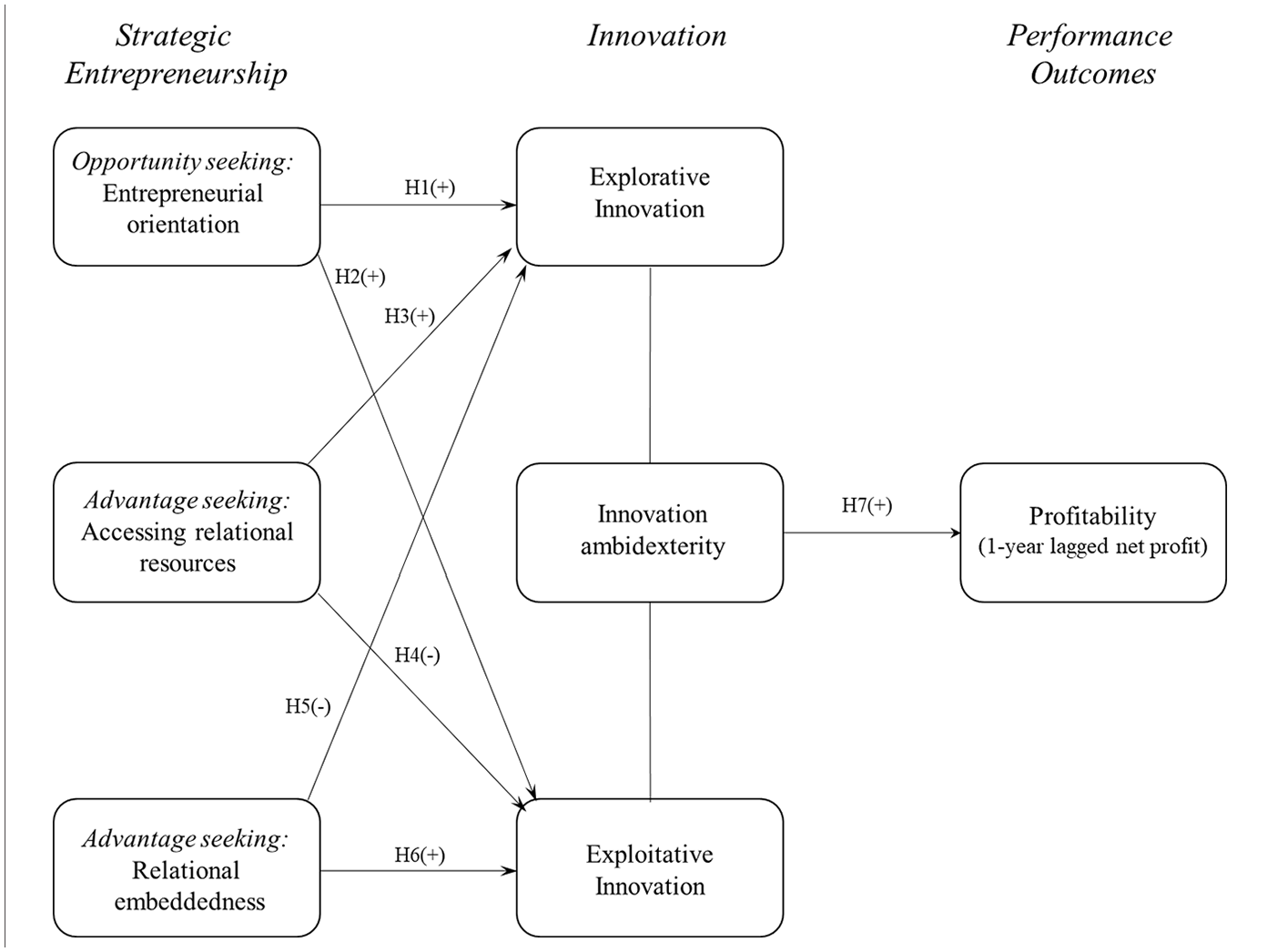
Theoretical framework and hypothesised relationships.
Hypotheses
For a firm to innovate in whatever guise, it needs the motivation and ability to do so (Chandy et al., 2003; Debruyne et al., 2010; Hughes et al., 2021). EO creates a bias for action that motivates firms to persistently seek out market-based entrepreneurial opportunities for change (Wales et al., 2015, 2020). Entrepreneurially oriented firms seek to be the first to introduce products, innovations and technologies by capitalising on opportunities ahead of competitors (Ireland et al., 2003; Miller, 1983), and seek to shape markets (DiVito and Bohnsack, 2017). Taken together, these qualities ought to fuel explorative and exploitative product innovation search to enact the opportunities found by the incubating technology-based firm through its EO. Ultimately, EO embodies a managerial desire to unsettle and change the nature of competition, which manifests itself in either disturbing existing product-market conditions or spearheading the development of new market space, or both exploit and explore (Ireland et al., 2003; Kollmann and Stöckmann, 2014; Ramachandran et al., 2019; Zhang et al., 2016).
EO can, therefore, stimulate an internal environment sympathetic to breakthrough explorative innovation and provides conditions to support exploitative product innovation initiatives. The coming together of risk-taking, innovativeness and proactiveness moulds a supportive infrastructure to underpin the ideation, experimentation and creativity that both innovations rely on (Ireland and Webb, 2007; Lumpkin and Dess, 1996). EO should then set in place an organisational environment and framework conducive for explorative and exploitative innovations and their commercialisation. For example, EO should increase the identification of a rich stream of opportunities capable of unsettling the short-to-medium term movements of competitors (Covin and Wales, 2019). The innovativeness and proactiveness dimensions of EO push firms to exploit opportunities to manipulate the current and anticipated weaknesses of competitors with incrementally revised products, while the risk-taking dimension also prompts the firm to set more ambitious goals to commit resources to define new segments and develop new product offerings in the face of possible costly failure (Covin and Slevin, 1989; Hughes et al., 2018; Lumpkin and Dess, 1996). The effect is near-constant outmanoeuvring of rivals. The aggressive nature of EO traps less-inclined competitors in a suboptimal competitive situation in which rival firms imitate to defend market share against the entrepreneurial firm’s innovating behaviour.
The effects of EO on product innovation can then be multiplicative as well. As a young entrepreneurially oriented firm innovates and proactively enters markets, the accompanying competitor reactions and reprisals prompt the firm to make further strategic adjustments to product-services and technologies (Anderson et al., 2009). Moreover, young and small firms with high risk-taking attitudes tend to engage in aggressive investment on current competitive advantages to refine competence of existing products (Covin and Wales, 2019; Lechner and Gudmundsson, 2014). Thus, the entrepreneurially oriented firm is sensitive not only to explorative innovations but also to the need to adapt new and existing products with further exploitative innovations. Therefore, we hypothesise the following:
Hypothesis 1. Entrepreneurial orientation is positively related to explorative innovation.
Hypothesis 2. Entrepreneurial orientation is positively related to exploitative innovation.
The availability and access to a stock of resources codetermine the incubating firm’s ability to innovate. However, resource deficiencies are inherent problems in any innovation initiative and exacerbated for young technology-based firms. In response, managers can make strategic choices concerning relationships to alter the system of constraints affecting the firm’s innovation activities (Pfeffer and Salancik, 1978). Ability of the managers to acquire and attract relational resources, thus, provides the ability to innovate by acquiring resources needed to fuel innovation activity (Ketchen et al., 2007).
Due to constraints of newness, intense competitive pressures mean that the time needed for incubating technology-based firms to develop resources internally to innovate new products and technologies is neither feasible nor appropriate. Using relational ties to locate and bring in external resources can expand the pool from which the incubating technology-based firm can perform innovation activity. A larger network can accelerate innovation (Ketchen et al., 2007). Resources brought into through external relationships with other firms made available through the incubator’s network enables the incubating technology-based firm to experiment with new resource combinations while learning to refine existing ones (Ireland et al., 2003; Sirmon et al., 2007). Explorative and exploitative innovations should then emerge as the firm’s motivation to challenge its market competitors is matched with the ability to build new and better products (Ireland and Webb, 2007). However, the simplicity of this argument masks a complex problem: explorative and exploitative innovation activities compete for scarce resources and the introduction of new (external) resources channels the attention of managers towards a different innovation activity. Voss et al. (2008) evidence this very concern. These authors found that absorbed, generic internal resources (consistent with the in-house competences of the incubating technology-based firm being tied to its first set of revenue-generating products) increased exploitative innovation and decreased explorative innovation because these resources are tied-up in present product-market offerings. The introduction of unabsorbed, new resources, however, changed firm behaviour towards higher levels of exploration and lower levels of exploitation for young and small firms.
In young technology-based firms then, a lack of internal resource slack means that most internal resources will be devoted to servicing current products. If external resources are brought in to encourage explorative activities, this will draw on scarce internal resources, which is inevitable given that (1) to access relational resources a firm must reciprocate in some form and (2) to explore new ways forward the firm must connect relational resources with its in-house resources, capabilities and expertise. Exploitative innovation activities will then be undermined as internal resources are drawn to fuel explorative endeavour, indicative of the exploitation/exploration trade-off. Voss et al. (2008) empirically demonstrate this trade-off in their study of small creative firms. Their discussion of the dilemma of [un]absorbed-[non-]generic resources for innovation activity of small firms reveals that unabsorbed non-generic resources lead to higher exploration and lower exploitation, whereas absorbed generic resources encourage more exploitative innovation activity. When internal resources are directed towards exploration, they are pulled from exploitation activities (March, 1991). External resources cannot plug this gap because such resources are new to the firm and direct attention towards exploration (Voss et al., 2008) without correcting for the loss of internal resources redirected from current product-market activities. This problem is consistent with theory on strategic entrepreneurship in which explorative innovation benefits from diversity but exploitative innovation benefits from focus (Ireland and Webb, 2007).
Reconfiguring the resources available to the young technology-based firm internally with those from its network provides the means to generate new, explorative product innovations to new and existing customers (Sirmon et al., 2007), but diverts resources away from the current, exploitative activities of the firm (Voss et al., 2008). We predict this will weaken exploitative innovation activity. To compound the problem, accessing relational resources requires a firm to reciprocate with its own. External resources are unlikely to plug the gaps that will emerge in the resourcing of the firm’s pre-existing activities because relational resources are typically novel to the firm. A firm with internal resource slack would not face this problem, but such a scenario is far removed from the context of incubating technology-based firms.
Accessing relational resources strategically should increase the resources available for exploration activities in these firms, where little internal slack is typically present, but we would expect to see a commensurate reduction in resources for exploitation activities particularly as existing resources and capabilities are redirected to shape new products and technologies forming explorative innovations. Thus, we hypothesise the following:
Hypothesis 3. Acquiring and accessing relational resources is positively related to explorative innovation.
Hypothesis 4. Acquiring and accessing relational resources is negatively related to exploitative innovation.
Relational ties can also help a young technology-based firm to plug knowledge gaps, and by crossing external boundaries, networking may enhance the young venture’s capacity to acquire, develop and leverage knowledge that are owned and controlled by outside actors (El-Awad et al., 2017). Superficially, this may increase the potential for novel (re)combinations of knowledge and resources. However, as relational embeddedness increases, knowledge transfer becomes more redundant as ties become stronger and the novelty of that knowledge is reduced (Burt, 1992; Granovetter, 1973). Under this condition, we expect that while increased knowledge enables the incubating technology-based firm to learn to do better with the resources it has, improving exploitative innovation, increases in knowledge redundancy and a lack of novelty detract from its ability to invest in explorative innovation. This position is supported by the work of Dittrich and Duysters (2007) on the role of networks in innovation management.
Dittrich and Duysters (2007) argue that exploitative innovation benefits from maximising the number of strong ties with similar firms to strengthen and broaden the basic knowledge available to it. Young firms tend to form networks based on cohesive, social contacts (Hite and Hesterly, 2001) and so we would expect that greater amounts of relational embeddedness with firms similar to the young firm itself will provide it with opportunities to maintain longer term relationships in which the intensity and reciprocity of those relationships are high (Granovetter, 1973). The depth of knowledge sharing that should then occur ought to improve exploitative innovation (Dittrich and Duysters, 2007).
Over time, however, knowledge redundancy will occur as the amount of novel information the firm is exposed to will decrease rapidly (Burt, 1992; Granovetter, 1973). New ideas and novel knowledge are more likely to be found in weak ties or in sparse networks in which relational embeddedness is low. Dittrich and Duysters (2007) posit that firms pursuing explorative innovation will, therefore, need a breadth of relationships with partners they infrequently encounter by way of weak ties (i.e. lower relational embeddedness). These ties allow firms to bridge to disparate and novel pockets of new knowledge over time, thereby benefitting from the breadth of resources in the network (consistent with Hypothesis 3) while not suffering the redundancy effects that occur with higher levels of relational embeddedness (Burt, 1992; Granovetter, 1973). Therefore, we hypothesise the following:
Hypothesis 5. Relational embeddedness is negatively related to explorative innovation.
Hypothesis 6. Relational embeddedness is positively related to exploitative innovation.
Those incubating technology-based firms successful at achieving both innovation activities to a high standard and at striking an appropriate balance between the two can potentially achieve a competitive advantage that augments profitability. Emerging empirical evidence generally supports this view but reports of its effects are mixed (O’Reilly and Tushman, 2013) and point to the significance of context in the relationship between innovation ambidexterity and business performance (Luger et al., 2018). Studies have drawn attention to its sensitivity to the type of firm (Cao et al., 2009; Junni et al., 2013, 2020) and particularly to firm age and size (Chang and Hughes, 2012; Lubatkin et al., 2006; Mathias et al., 2018; Voss et al., 2008; Voss and Voss, 2013). For example, studies of innovation ambidexterity among small and medium-sized enterprises (SMEs) have reported positive performance returns (Chang et al., 2011; Colclough et al., 2019; Lubatkin et al., 2006) and equivalent returns to both innovation strategies separately (Morgan and Berthon, 2008). Ambidexterity can set the conditions for firms to profit from new market opportunities and current market opportunities. However, innovation ambidexterity risks over-stretching the young firm (Cao et al., 2009) and their naivety at managing the tensions in ambidexterity may lead it to be unproductive (Schad et al., 2016; Voss et al., 2008; Voss and Voss, 2013). Innovation ambidexterity is resource-intensive and requires managers to make active investment decisions that maintain a delicate balance between explorative and exploitative innovation activities (Fourné et al., 2019). Nonetheless, the lure for young technology-based firms successful at achieving innovation ambidexterity is the ability to secure the benefits of exploration while suffering fewer of its costs, establishing a platform for longer term sustainability, which could not accrue with a focus on exploitation alone (March, 1991). Thus, we expect the following hypothesis:
Hypothesis 7. Innovation ambidexterity is positively related to profitability.
Methods
Sample
We generated data from incubating, young technology-based firms. Such firms have reasons to be engaged in innovation and strategic entrepreneurship, and the context is advantageous because incubators offer immediate opportunities for young firms to start networking, offering opportunities to access relational resources and develop relational embeddedness with like firms. This sample was built using the United Kingdom Business Incubation (UKBI) directory of incubator facilities and cross-referenced with Internet and archival searches. We also inspected the United Kingdom Science Park Association directory to identify further incubator facilities. We identified 196 incubator facilities in total. We then screened each incubator to ensure our sample captured only young and new technology-based firms. Of the 196 incubators, 53 ‘general’ incubators of no technological description were identified and were excluded from the sample to prevent sampling error. A list of the young technology-based firms within each of the 143 remaining incubators was then developed. We then randomly sampled until we had 1000 incubating young technology-based firms. These firms were double-checked for consistency with our requirements to prevent sampling error.
Data collection
Through preliminary interviews, we identified the lead entrepreneur in each firm as the most relevant informant (Hmieleski and Baron, 2008), defined as the founder or top management team leader (Chief Executive Officer or Managing Director; De Mol et al., 2018; Mueller et al., 2017). We then implemented a mail survey to generate data from these respondents. We pre-tested the survey instrument with academic researchers with expertise in strategic entrepreneurship and innovation to verify the content validity of the survey items. We then revisited our preliminary interview respondents (five lead entrepreneurs/managers and two incubator facility managers) to check the face validity of our items. Minor amendments were made to the survey. To increase the potential response rate, we reduced questionnaire length as far as possible, highlighted the relevance of the research in pre-notification and survey implementation phases, included a paid return postage envelope, included university sponsorship and UKBI endorsement, offered a report as an incentive and provided guarantees of anonymity and confidentiality. Pre-notification, a survey and information pack and two follow-up reminders were mailed to the firms in our sample.
We obtained 211 responses after removing a handful for being incomplete. We tested for non-response bias using the extrapolation method and found no statistically significant variable differences at conventional levels between early and late respondents. To assess informant validity, we asked respondents about their knowledge regarding the questions asked in the survey – anchored 1 = no knowledge to 7 = full knowledge (mean = 6.23, SD = 0.92) – and the perceived accuracy of their responses about the ‘realities’ of their business – anchored 1 = not at all accurate to 7 = very accurate (mean = 6.03; SD = 0.97). These scores support informant validity. Respondents had an average of 21 years (SD = 10.55) industry experience, further indicating informant validity.
Measures
Measures were sourced from previous studies with small modifications made to the phrasing of some items to account for context. We performed qualitative interviews with entrepreneurs and managers of incubating firms and managers of incubator facilities before developing the survey and list of measures to ensure we understood the context. This informed our item selection process. These same interviewees were later re-interviewed to pilot test the measures. Table 1 contains the scales used in this study. Items were anchored with a 7-point response scale ranging from 1 = strongly disagree to 7 = strongly agree.
Measurement item properties.
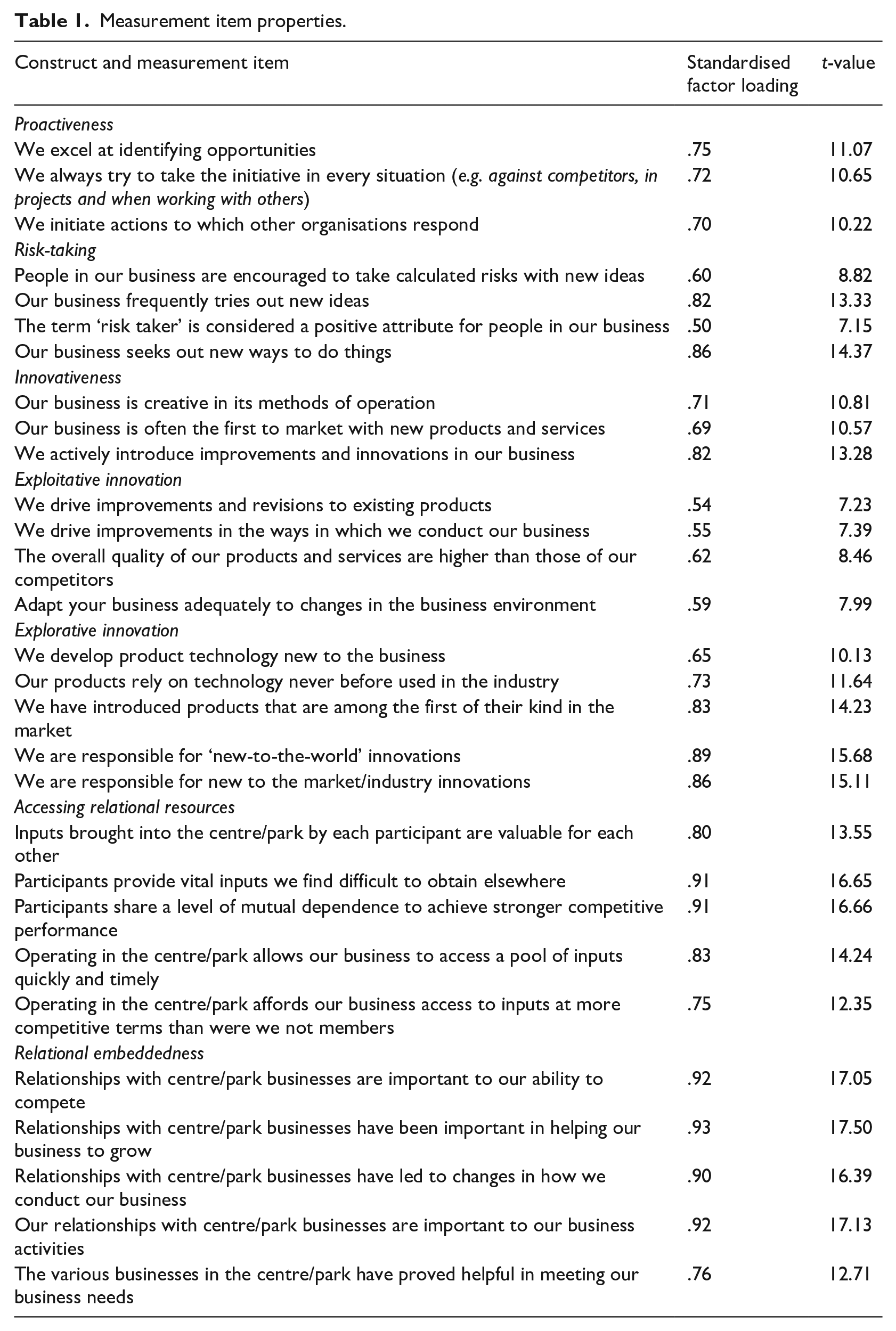
For entrepreneurial orientation representing opportunity-seeking behaviour, items for risk-taking, innovativeness and proactiveness were sourced from Covin and Slevin (1989).
For advantage-seeking behaviour, 2 first, to measure accessing and acquiring relational resources, items were used that captured the extent to which a firm had accessed the inputs of other firms in the incubator network to address their resource deficiencies. These items were sourced from Sarkar et al. (2001). Sarkar et al.’s items for resource complementarity among networked firms and reciprocal commitment scales to ensure partners were making valuable resources available to each other were used to form a battery of scales to measure incubating technology-based behaviour of firms towards accessing relational resources. Second, relational embeddedness was operationalised using the items of Andersson et al. (2002). Minor adaptations were made to pre-existing items to account for the context of incubating technology-based firms, which is recommended as good practice (Heggestad et al., 2019).
Measures for explorative innovation and exploitative innovation mirror Jansen et al.’s (2006) items and were sourced from Rindfleisch and Moorman (2001), Song and Parry (1997) and Song et al. (1998). 3
We operationalised profitability as the one-year lagged net profit of the firm, a measure relevant to the performance of both product innovation activities treated in this study (Griffin and Page, 1996). These data were sourced from the ‘Total Exemption Small’ abbreviated accounts of the firms in our sample. 4
Several control variables were specified. For explorative and exploitative innovations, we controlled for incubator size as larger incubators may facilitate (more) access to (more) resources, knowledge and opportunities. This control variable is reflected in the natural logarithm of the number of firms in each incubator. Following this logic further, we control for incubator facility type (ranked) as the type of incubator may present additional access to resources, knowledge and opportunities. Incubators are not homogeneous across the network opportunities they offer (changing the potential pool of resource and knowledge accessible to a young technology-based firm). Using our population data, we identified the type of centre/park/incubator respondent firms were located in. This variable is scaled with increased values reflecting increased complexity in the incubator. The scale was anchored as managed workspace (1; low); enterprise centre (2); innovation centre, technology centre and ‘other’ (3; midpoint types); business incubator (4); and science park (5; high). For profitability, firm age (natural logarithm) was used as a control variable as it is associated with greater time to accumulate resource stocks inside a firm and may then influence performance. We controlled for industry type onto profitability also. Respondents self-identified their industry. Following Paytas and Berglund (2004), we sorted respondent firms into standard industry classifications and then, following the guidance and categorisation of Paytas and Berglund (2004), proceeded to classify all respondents into two industry types: secondary technology generators (scored as 1) and primary technology generators (scored as 2). The former classification of technology-based firms reflects relatively less technological intensity, while the latter reflects relatively high technological intensity. Primary technology generators exhibit proportionally higher numbers of full-time-equivalent R&D staff and engineers and greater R&D spend than those firms located in secondary technology generator industries (Paytas and Berglund, 2004). Firm size was controlled for in the sampling process.
Common method variance
We followed protocols (Podsakoff et al., 2012) for limiting common method variance (CMV) by placing items in random order in the survey, not implying any ‘ideal’ responses, employing impartial and neutral wording throughout, limiting the length of the questionnaire, and providing detailed instructions for its completion.
We performed two tests for CMV. First, we carried out a Harman one-factor test using confirmatory factor analysis (CFA) (Podsakoff et al., 2003). We placed all variables into a single CFA and examined the fit indices to determine whether a single latent factor would fit the data well. The results reveal that a single factor does not fit the data: χ2 = 5725.48, df = 377, p < .01, root mean square error of approximation (RMSEA) = .26, non-normed fit index (NNFI) = .62, comparative fit index (CFI) = .65, incremental fit index (IFI) = .65, standardised root mean square residual (SRMR) = .23. The χ2/df ratio far exceeds the ⩽2.00 cut-off (Bollen, 1989) and the RMSEA is unacceptably high (Hu and Bentler, 1999). The model fit statistics of NNFI, CFI, IFI and SRMR also reject a single-factor solution (Hu and Bentler, 1999).
Second, we performed a marker variable test (Lindell and Whitney, 2001). We selected ‘respondent years of working experience’ as a marker variable that is not theoretically related to all other measures in the study. Non-significant correlations (p > .05) were found between the marker variable and all study variables. Next, we evaluated how much of the covariance between variables were affected by the common method, given that CMV affects the degree of variance between constructs. We assessed this by calculating a summation of the covariance difference between the marker variable and all study variables divided by the number of variables. Using this average marker variance (rm = .27), we specified a CMV-adjusted covariance matrix between all the measures in the study. This adjusted covariance matrix was then used to re-specify the original measurement model. Changes in the measurement model in using the CMV-adjusted covariance were non-significant. The substitution did not significantly deteriorate model fit (∆χ2 = 47.86; ∆df = 0; ∆CFI, ∆NNFI and ∆IFI = .03; ΔSRMR = .01). No material differences were found between any of the factor loadings in the modified CFA as compared to the original CFA. Consequently, these results imply that CMV does not threaten our data or results. We used the original measurement model for all subsequent analyses.
Reliability and validity
We examined all scales using exploratory factor analysis before CFA. Using LISREL 8.8, maximum likelihood estimation and the covariance matrix, we estimated our measurement model (Table 1). This measurement model (χ2 = 674.92, df = 356, p < .01) resulted in excellent fit to the data (CFI = .96; IFI = .96; NNFI = .95; RMSEA = .07; SRMR = .06). Each item loaded significantly (p < .01) onto the specified construct (ranging from .50 to .93). All construct reliabilities (CRs) exceed the recommended minimum threshold. Apart from one instance, average variance extracted (AVE) ranged from .51 to .79, satisfying the 50% cut-off for convergent validity (Fornell and Larker, 1981). The exception is ‘Exploitative Innovation’ whose AVE was below .5. However, its CR is sufficiently above recommended thresholds (.67) and its inclusion is consistent with prior works in strategic entrepreneurship and strategic management. Furthermore, the square root of the AVE for each construct is greater than the off-diagonal coefficients, indicating discriminant validity among our constructs. This result gives confidence in the robustness of the data and respective constructs. Table 2 presents the descriptive statistics, correlations and robustness of each construct.
Descriptive statistics, construct robustness and model fit.
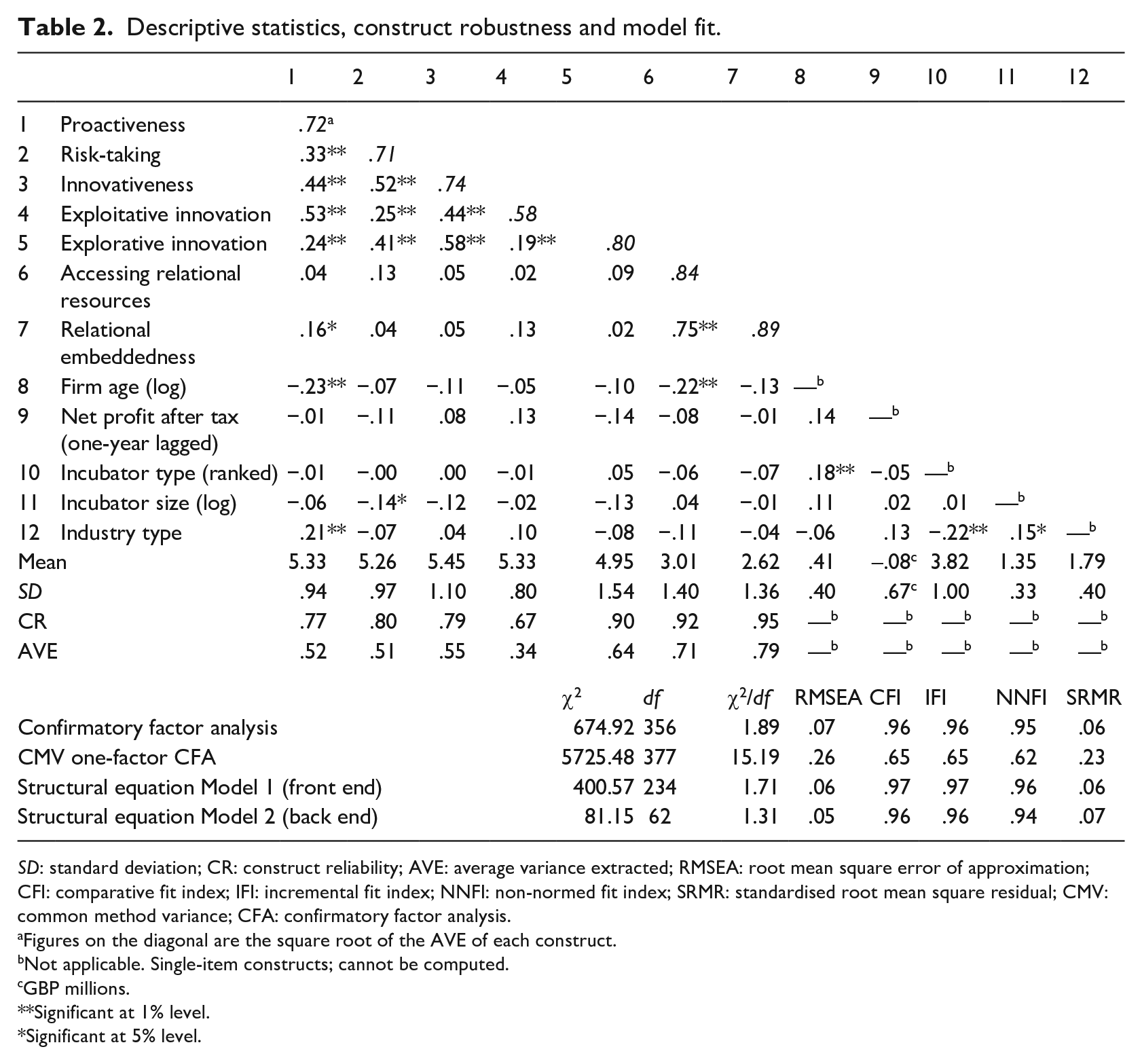
SD: standard deviation; CR: construct reliability; AVE: average variance extracted; RMSEA: root mean square error of approximation; CFI: comparative fit index; IFI: incremental fit index; NNFI: non-normed fit index; SRMR: standardised root mean square residual; CMV: common method variance; CFA: confirmatory factor analysis.
Figures on the diagonal are the square root of the AVE of each construct.
Not applicable. Single-item constructs; cannot be computed.
GBP millions.
Significant at 1% level.
Significant at 5% level.
Results
Two structural equation models (SEM) were specified to satisfy acceptable parameter-to-observation ratios. SEM Model 1 examines the hypotheses associated with explorative and exploitative innovations. SEM Model 2 examines the profitability effects of both innovation activities and innovation ambidexterity. Both models demonstrate excellent model fit statistics (Table 2). For SEM Model 1, we created a higher order latent variable of ‘Entrepreneurial Orientation’ by summing together and averaging its three specified components (risk-taking, innovativeness and proactiveness). For SEM Model 2, we calculated an index of Innovation Ambidexterity. Existing calculations of innovation ambidexterity speak separately to the relative magnitude of ambidexterity (Cao et al., 2009; Chen et al., 2021; Jansen et al., 2012; Koryak et al., 2018; Posch and Garaus, 2020) (a ‘combined dimension’, calculated through addition or multiplication) and the relative balance of exploration and exploitation (Cao et al., 2009; Chang et al., 2011; He and Wong, 2004) (a ‘balance dimension’, calculated through subtraction). We use both in our calculation, generating an index of the magnitude of innovation ambidexterity and the balance of ambidexterity exhibited by the firm.
Three salient matters drove our reasoning. First, Hughes (2018) notes that the subtractive approach captures the extent to which the exploration and exploitation are balanced, but the multiplicative approach captures the quality of both activities that make up that balance. But a firm may have perfect balance but be mediocre at both exploration and exploitation. As Simsek (2009) noted, ‘an organisation with low levels of exploitation and exploration is ‘balanced’, but not ambidextrous’ (p. 603). Second, subtraction creates a positive or negative score, yet, whether one arrives at a positive or a negative polarity is dictated by whether exploration or exploitation enters the equation first. The sign is then potentially erroneous, providing false values when what matters is determining deviance (imbalance) (Hughes, 2018). Third, the additive or multiplicative approach is also potentially flawed because it fails to account for balance. Simply adding or multiplying values of exploration and exploitation neglects that any difference between the two causes relevant implications that are missed in such a calculation. Information relevant to the actual ambidexterity of a firm is then lost (Hughes, 2018).
Following this discussion, we concluded that an accurate calculation of innovation ambidexterity must account for both balance and magnitude but must also correct the flaw in the balance calculation. Thus

First, we calculate imbalance by adjusting the formula to square and then square root the absolute difference between exploration and exploitation to obtain a pure difference score (negating the false polarity caused by entering either exploration or exploitation into the equation first)

Second, the magnitude, or quality, of ambidexterity is calculated by multiplying together the scores for exploration and exploitation activities (a multiplicative score is generally preferred to addition as it provides more information on the differences between exploration and exploitation)

The final mathematical calculation for Innovation Ambidexterity is

This formula provides a score of innovation ambidexterity quality that is adjusted by the degree of imbalance present in the firm. Where firms exhibit high exploitation and exploration, there is little or no imbalance and so the value of ambidexterity remains high. Where respondents favour one specific activity over another, the value of ambidexterity is adjusted to correct for this imbalance. This calculation addresses Simsek’s (2009) concern that scholars ‘consider very carefully their choice of measurement system when performing any empirical analysis of organisational ambidexterity, and particularly when examining its effects on firm performance’ (p. 603).
Hypothesis testing results are presented in Table 3. The independent variables explain 48% of the variance in explorative innovation. EO positively affects explorative innovation (H1) (t = 7.35; p ⩽ .01); accessing and acquiring relational resources (H3) also positively affects explorative innovation (t = 1.32; p ⩽ .10); and H5 is supported as relational embeddedness is negatively related to explorative innovation activity (t = −1.40; p ⩽ .10). Meanwhile, the structural model explains 41% of the variance in exploitative innovation. As hypothesised, EO (H2; t = 5.32; p ⩽ .01) and relational embeddedness (H6; t = 2.51; p ⩽ .01) positively affect exploitative innovation and accessing and acquiring relational resources (H4) negatively affects exploitative innovation activity (t = −2.22; p ⩽ .05). Innovation ambidexterity (H7) has a positive relationship with profitability (t = 1.76; p ⩽ .05) as predicted. For added nuance, we included in our statistical model paths for the effects of exploitative innovation (t = 2.11; p ⩽ .05) and explorative innovation (t = −2.56; p ⩽ .01) on one-year lagged net profit. Taken together, 20% of the variance in net profit is explained. Ambidexterity rewards the profitability of young technology-based firms by combining innovation strategies, which in this case may offset some of the costs associated with explorative innovation alone.
Results.
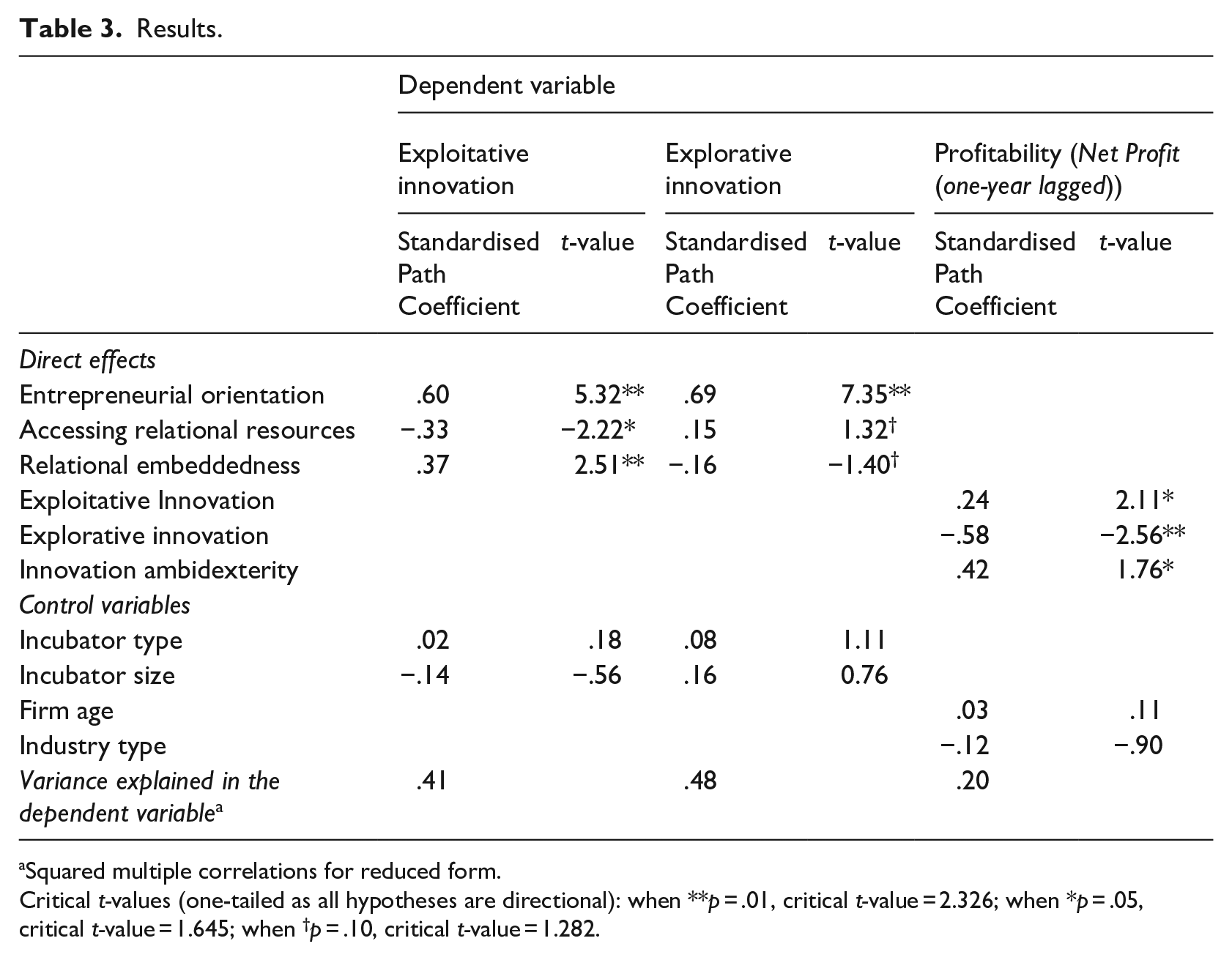
Squared multiple correlations for reduced form.
Critical t-values (one-tailed as all hypotheses are directional): when **p = .01, critical t-value = 2.326; when *p = .05, critical t-value = 1.645; when †p = .10, critical t-value = 1.282.
Discussion
Innovation ambidexterity is particularly important for young technology-based firms to overcome the liabilities of newness by implementing exploitative innovation which improve technology portfolio management, advance production procedure and attain know-how on specific technological area (Choi and Shepherd, 2005; Kollmann and Stöckmann, 2014). Simultaneously, these firms attain the ability to maintain the assets of newness such as organisational flexibility (Choi and Shepherd, 2005) and remain ahead of pressures from technology shifts and shortened product life-cycles by conducting explorative innovation. Therefore, young technology-based firms need to understand the value of both explorative and exploitative innovations to surmount obstacles and achieve high firm profitability. Our study provides novel theorising and empirical evidence of the principles of strategic entrepreneurship as it applies to explorative and exploitative innovation activity and innovation ambidexterity for young technology-based firms in incubators.
The results identify opportunity-seeking behaviour in the form of EO as a key factor in motivating exploitative innovation and explorative innovation. This suggests that EO as the opportunity-seeking component of strategic entrepreneurship is essential for incubating technology-based firms to obtain the profitability benefits that accrue from innovation ambidexterity. EO, therefore, provides the organising principle to ensure that firms focus their behaviours on repeating and improving the conditions responsible from present success (exploitative innovation) and to create the required variety for future viability (explorative innovation). Given the tensions inherent in the ambidexterity thesis (Junni et al., 2015; March, 1991; Tushman and O’Reilly, 1996; Zimmermann et al., 2018), EO is a means by which to manage the interfaces between exploration and exploitation.
The situation for advantage-seeking behaviours – relational embeddedness and relational resources – is far less clear-cut. We find that relational embeddedness is an essential contributor to successful instances of exploitative innovation. However, relying on locating and accessing relational resources affects negatively on instances of exploitative innovation, which may occur as a result of internal resources being re-bundled with externally sourced resources in pursuit of explorative innovation (Voss et al., 2008). Scholars recognise that the resources and capabilities for exploration (or exploitation) increasing lie beyond the boundaries of the firm and rely on networks of relationships (Stadler et al., 2014; Wilden et al., 2018). This is certainly the case for resource-deficient young technology-based firms.
These findings highlight a lapse in current treatments of relational resources and relational embeddedness in ambidexterity research (Feng et al., 2019; Heavey et al., 2015), which have failed to anticipate negative consequences for ambidexterity at the disaggregated level. This is in part driven by the failure of studies to account for context (Khan et al., 2018; Zahra et al., 2014). We concur with Dittrich and Duysters (2007) that the type of network ties formed by managers has a bearing on firm innovation outcomes but expand on their work by revealing that stronger ties exhibited by greater degrees of relational embeddedness benefit exploitative innovation, but at a cost to explorative innovation, and vice versa for the role of access to relational resources for innovation activities. These differing findings are symptomatic of the lack of treatment of the antecedents and consequences of explorative and exploitative innovation activities in young firms.
This discussion crystallises our first and second contributions to reshaping and re-interpreting the thinking of researchers around strategic entrepreneurship and innovation ambidexterity for young technology-based firms. First, we establish a theoretical argument that uncovers the strategic entrepreneurship conditions that promote explorative and exploitative innovation activities, as called for by Anderson et al. (2019) and Junni et al. (2015). In doing so, this article provides a first theoretical rationale that aligns the opposing dimensions of strategic entrepreneurship – being opportunity-seeking and advantage-seeking – and innovation theory to explain emergence of explorative and exploitative innovations in the context of young technology-based firms in incubators. This has important implications for investigations of the foundations of innovation ambidexterity by researchers. Specifically, it demonstrates how externally sourced resources and knowledge can supplement internal activities, but also actively change them as the young firm engages in resource reallocation and applies these external resources to different (competing) routines and activities. Whereas EO serves as a unifying mechanism for both types of innovation activities and underpins their ambidexterity. Second, in developing this theoretical logic, we also provide additional contextual nuance by positioning our theoretical narrative within incubating technology-based firms. Accordingly, we correct for the tendency to relegate context to a mere control variable in entrepreneurship (Zahra et al., 2014), EO (Yin et al., 2020) and ambidexterity studies (Khan et al., 2018; O’Reilly and Tushman, 2013; Stettner and Lavie, 2014). Collectively, these contributions provide novel theorising and empirical evidence of strategic entrepreneurship as it applies to innovation ambidexterity for incubating technology-based firms. Our theoretical logic and narrative set essential new building blocks for further scholarly research into the contextual antecedents of innovation ambidexterity, extending calls by Birkinshaw and Gupta (2013), Kassotaki et al. (2019) and O’Reilly and Tushman (2013), among others.
For our third contribution, we extend the literature on strategic entrepreneurship by advancing its conceptualisation. Specifically, we attempt to resolve the ambiguity that surrounds exactly what represents opportunity- and advantage-seeking behaviour as lamented by Simsek et al. (2017). For example, our theory and findings extend the understanding of scholars of the forms of advantage-seeking behaviour needed to secure innovation outcomes among resource-challenged and knowledge-deficient incubating technology-based firms and help scholars understand the competing effects these have on the innovation process for incubating technology-based firms. Relational embeddedness and accessing relational resources, representing their advantage-seeking behaviour, exacerbate the tensions of innovation ambidexterity. Thus, drawing on both strategic entrepreneurship and innovation literature, we advance knowledge on the foundations of ambidexterity by unravelling how external collaborative efforts orchestrated by managers might alter the firm’s landscape for innovation ambidexterity. Specifically, we reveal advantage-seeking behaviour to be a further important organising principle for innovation ambidexterity, one that bears a markedly different effect on explorative innovation versus exploitative innovation activity. However, this insight derives from conceptualising strategic entrepreneurship to the context of the subject of interest (in our case incubating technology-based firms). We expand the conceptual basis available for scholars to make predictions about the emergence of ambidexterity, especially in resource-constrained, young technology-based firms, long called for among scholars (Cao et al., 2009; Chang and Hughes, 2012; Hughes, 2018). Consequently, we enrich scholarly knowledge about the conceptual origins of ambidexterity (Heavey and Simsek, 2017; Mom et al., 2015; Volery et al., 2015) from the perspective of strategic entrepreneurship.
Managerial implications
The findings offer a prescription for product innovation ambidexterity management in young firms, driven by the need for managers to implement an EO. Specifically, the improvement in opportunity-seeking behaviour through an EO increases the firm’s capability at identifying opportunities to both exploit by improving present product-market offerings and to explore through generating truly new innovations. The added complexity for managers here is that the deployment of EO must occur in parallel with advantage-seeking behaviours to appreciate where problems in the management of innovation in a strategically entrepreneurial manner might originate from.
In the pursuit of innovation ambidexterity, managers must consider and manage the resource trade-offs and tensions that exist (Zimmermann et al., 2018). Locating relational resources fuels efforts towards explorative innovation but that exploratory process can then pull resources and managerial attention away from exploitative innovation activities. Managers must evaluate internal resource slack or resource constraints despite sourcing resources externally and consider the impact such efforts can have on its profit-driving exploitative innovations. Put differently, sourcing resources externally is not a panacea to resource inadequacies that typically prevent, constrain or undermine broader innovation efforts by young firms. However, deploying strong ties over and above a sparse network of weak ties by increasing relational embeddedness can have the converse effect of improving exploitative innovation by reducing the knowledge deficiencies of the firm, but can trap it in a suboptimal state of increased knowledge redundancy.
Careful consideration must be given to exploitation and exploration relative to performance goals. Exploitation brings more immediate profit returns that risk being seen too favourably compared with the short-term losses that exploitation can entail. The negative association between exploration and one-year lagged profits indicates a longer time horizon is likely for returns to accrue. Managers of incubating firms, then, must caution against overreacting to this and abandon exploration in favour of the immediacy that exploitation brings for meeting profit goals.
Limitations and future research
Some limitations bear relevance on the study findings. First, future research should instead unpack the relationships among strategic entrepreneurship and innovation and further contemplate the strategic entrepreneurship–innovation problem given the network of effects reported in this study. For instance, a focus on exploitative innovation implies strong focus on current customers which may limit future growth through an EO and its more exploratory outcomes (Eggers et al., 2013). Second, our empirical context means that our results can only be generalised to incubating technology-based firms. Young technology-based firms in incubators may have self-selected into these contexts for some reason and would be expected to be more growth-oriented compared with the larger population of young technology-based firms. In general, there may be potential differences that bear implications for the ability to generalise our findings beyond the incubator context. More research is needed, therefore.
In young firms, the distance between the behaviours of managers and firm-level outcomes is very small, relative to larger organisations (Cole and Mehran, 2016), which allows for a more precise examination of the underlying processes by which ambidexterity emerges and evolves; as we document in our study. However, there is a danger in assuming that creating high levels of both exploration and exploitation is always beneficial for firms (Cao et al., 2009; March, 1991; cf. Simsek, 2009; Simsek et al., 2009), neglecting the value and purpose of each activity and their conceptual origins and status in such firms. Future research should focus on the context-sensitivity of the ambidexterity–performance relationship and its antecedents in view of theory, our conceptualisation and results.
Conclusion
We provide new knowledge on the origins of innovation ambidexterity for young, incubating technology-based firms. Strategic entrepreneurship behaviours enable explorative and exploitative innovations. However, we find competing interrelationships that both ease and exacerbate the tensions associated with innovation ambidexterity. These conflicts can be reconciled by managing the patterns of conditions to do with EO, accessing relational resources and relational embeddedness. We offer scholars a context-sensitive assessment of EO and innovation ambidexterity for young technology-based firms in incubators. We encourage further work on context, EO and innovation ambidexterity with a specific view towards unravelling when and through what means strategic entrepreneurship benefits young technology-based firms.
Footnotes
Acknowledgements
Earlier drafts were presented at Durham University, Newcastle University and Warwick University and at the Strategic Management Society Annual Conference. We are grateful to the participants for their valuable feedback. We also offer our sincere thanks to our anonymous reviewers for their constructive comments in the development of this manuscript.
Funding
The author(s) received no financial support for the research, authorship and/or publication of this article.
