



Abstract
Despite its growing relevance, research on strategic entrepreneurship has been dispersed and fragmented. This study attempts to fill this gap and analyze the state-of-the-art of strategic entrepreneurship, identifying, and systematizing the main themes found in the literature and pointing to future research paths that researchers in the future can explore. To build a solid foundation and facilitate the development of this field, we reviewed and synthesized 85 key articles published to date with resources on bibliometric techniques. Our study provides a comprehensive field mapping and grouping of the literature into four main themes: entrepreneurship and strategic management, entrepreneurial orientation, corporate entrepreneurship, and exploitation and exploration. In addition, we identify key research gaps and promising areas for future research.
Keywords
Introduction
Entrepreneurship is a current theme that continues to prove pertinent to researchers, but it is still a theme with preliminary studies that allow for the total distancing of the identification of entrepreneurial activities from strategic management (Ireland, 2003; Shane & Venkataraman, 2000). Entrepreneurship is seen as a mindset; through activities, organizations can leverage their competitive advantages, performance levels, and wealth generation (Ireland and Webb, 2009).
At the beginning of entrepreneurship studies, this area was defined by answering two questions: who it is and what it does (Shane and Venkataraman, 2000). However, this concept still precedes even the most current articles in the study, and it has been added that entrepreneurship can be perceived as a procedure through which organizations create innovations (Ireland and Webb, 2007, 2009). These innovations can arise through processes, new products, new firms, or established firms in ways that rejuvenate “(1) the firm's existing competencies, or (2) the means through which these competencies are leveraged” (Ireland and Webb, 2009:471).
Entrepreneurship creates novelty with recourse to how organizations “create, define, discover, and exploit opportunities” (Zahra et al., 2006:917). However, the consensus view of the applicability of entrepreneurship and the development of entrepreneurial activities in organizations is that they contribute to greater competitive advantage and wealth creation (Hitt et al., 2011; Ireland, 2003). Strategic entrepreneurship is the process by which entrepreneurship manifests itself in organizations and translates into how “decision-makers manage both uncertainty and resources as the foundation for being able to position their firms to adapt to changes” (Ireland and Webb, 2009: 470). Entrepreneurship is often associated with advantage and opportunity-seeking behavior (Agarwal et al., 2010; Hitt et al., 2011; Ireland and Webb, 2007, 2009; Ketchen et al., 2007).
Analyzing advantage and opportunity-seeking behavior leads to “new entry into products, markets, processes, or technological innovations by incumbents and new ventures” (Agarwal et al., 2010:271). Implementing this requires not only a change in the mindset of the organizations but also adjustments in strategy, structure, culture, and operational activities (Ireland and Webb, 2007, 2009; Tushman and ÓReilly, 1996). In summary, strategic entrepreneurship contributes favorably to the growth of organizations, positioning, effective and efficient responses to changes in the external environment, developing sustainable competitive advantages, and increasing the wealth generated (Ireland and Webb, 2007).
At a time of extremely challenging competitive environments (Ireland and Webb, 2009), due to the fast pace (Ireland and Webb, 2007), dynamism (Cristo-Andrade and Ferreira, 2020), complexity (Ireland and Webb, 2007, 2009), globalization (Lopes et al., 2021), and the ambiguity and uncertainty (Hitt et al., 2011; Ireland and Webb, 2009), among other factors, has forced organizations to become more agile and adaptable to provide quick answers to changes. All these factors have led academics and entrepreneurs to question themselves and conduct studies to address these doubts and help organizations better understand and enhance their results.
The development of research on strategic entrepreneurship came about, especially when several questions began to emerge that needed to be answered as soon as possible. Questions such as: How do select the market in which companies will compete? Are the products customized to the market, or are they unchanged? What risks are undertaken? What competencies must there be to potentiate innovation? What resources are needed to maintain innovation as a constant? Will organizations be entrepreneurial, have a strategic management orientation, or is it a mix of the two? Which approach to organizational learning is most advisable for an organization? Is ambidexterity in organizational learning possible? Questions like these and many others contribute to this research topic's development.
Strategic entrepreneurship studies are diversified and fragmented, having been applied in various disciplines using several conceptual approaches. We have identified 15 review studies (RS) in the previous literature related to this field (Table 1).
Overview of the RS on strategic entrepreneurship.
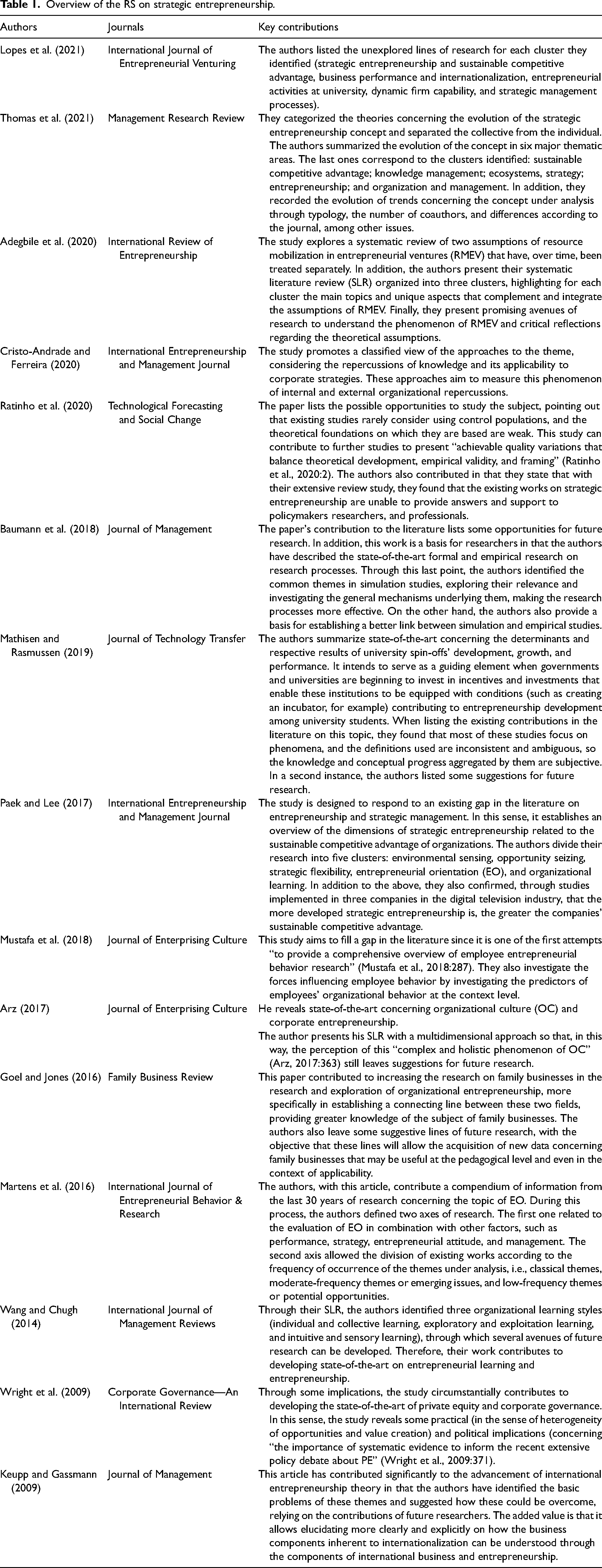
Given the topic's relevance, our study aims to develop a systematic review of strategic entrepreneurship, exploring the main thematic groups and proposing an integrative framework that elucidates the current state-of-the-art. Our study intends to aggregate knowledge on the topic under analysis in main themes (clusters), proposing a framework and future research agenda for the strategic entrepreneurship field. In this sense, we must clarify some main concepts to understand our study better. Strategic entrepreneurship has no consensual definition but can be understood as “the integration of entrepreneurial (i.e., opportunity-seeking behavior) and strategic (i.e., advantage-seeking) perspectives in developing and taking actions designed to create wealth.” (Hitt et al., 2001:481). This is one of the concepts under analysis in the first cluster together with entrepreneurship.
In this work, we present a first cluster that allows a comprehensive understanding of the topic under analysis, aggregating subclusters referring to theories related to the topic, a subcluster that allows establishing a distinction between entrepreneurial actions and strategic management, and another that addresses distinct models of how to obtain competitive advantage and generate wealth for organizations.
The second cluster brings a concept of entrepreneurial orientation that, for effect, is understood as all the entrepreneurial behaviors/attitudes that happen in organizations when we consider them holistically. The third cluster is about corporate entrepreneurship, a strategy that depends on the holistic view of how entrepreneurial practices are executed and how they learn and explore the entrepreneurial opportunities that arise. This cluster associated with the way organizations face entrepreneurship (orientation and corporate entrepreneurship) was also contextualized, and, finally, a cluster focused on demonstrating how organizations can enhance their results if they manage to become ambidextrous regarding learning forms (exploit and explore). The last cluster emerged two types of learning in the organizational context: exploitation and exploration. The first is about advantage-seeking behavior, and the second refers to opportunity-seeking behavior. These reviews allowed us to have a broader and deeper knowledge of the topic and to systematize the gaps researchers have identified in strategic entrepreneurship.
Therefore, this study aims to analyze the state-of-the-art of strategic entrepreneurship, identifying, and systematizing the main themes found in the literature and pointing to future research paths that researchers in the future can explore. The present SLR distinguishes itself from the others in the sense that of the 15 RS found, only ours and Martens et al. (2016) use the same software (VOSviewer) and methodology (co-citations). However, this RS resorts only to SCOPUS as a database, while ours uses WoS.
In this sense, it can be stated that the contribution of our SLR is very relevant because it presents itself as a comprehensive review with a differentiating methodology. Moreover, it presents a consistent framework that allows an understanding of the components that constitute strategic entrepreneurship and a rich diversity of future research lines for each of these components.
Method and data
This work is an SLR with a bibliometric analysis of strategic entrepreneurship focused on its constituent components.
Sample selection and evolution
The Web of Science (WoS) was the database selected to search for articles that serve as a starting point for this SLR. We used the WoS database for this study due to the high coverage of articles and citations on the topic analyzed in this paper and its relevance in research and academy (Cristo-Andrade & Ferreira, 2020). The search was restricted to the topic (title, abstract, and keywords), using the search term “strateg* entrepreneur*” and restricted to articles, article reviews, and early access in the categories business, management, and economics, and limited to articles written in English (see Figure 1 to check the entire research protocol). The search protocol was based on the paper of Cristo-Andrade & Ferreira (2020). After structuring the entire search panel, it was possible to obtain a database of 335 articles analyzing 30 years (from 1992 to 2022).
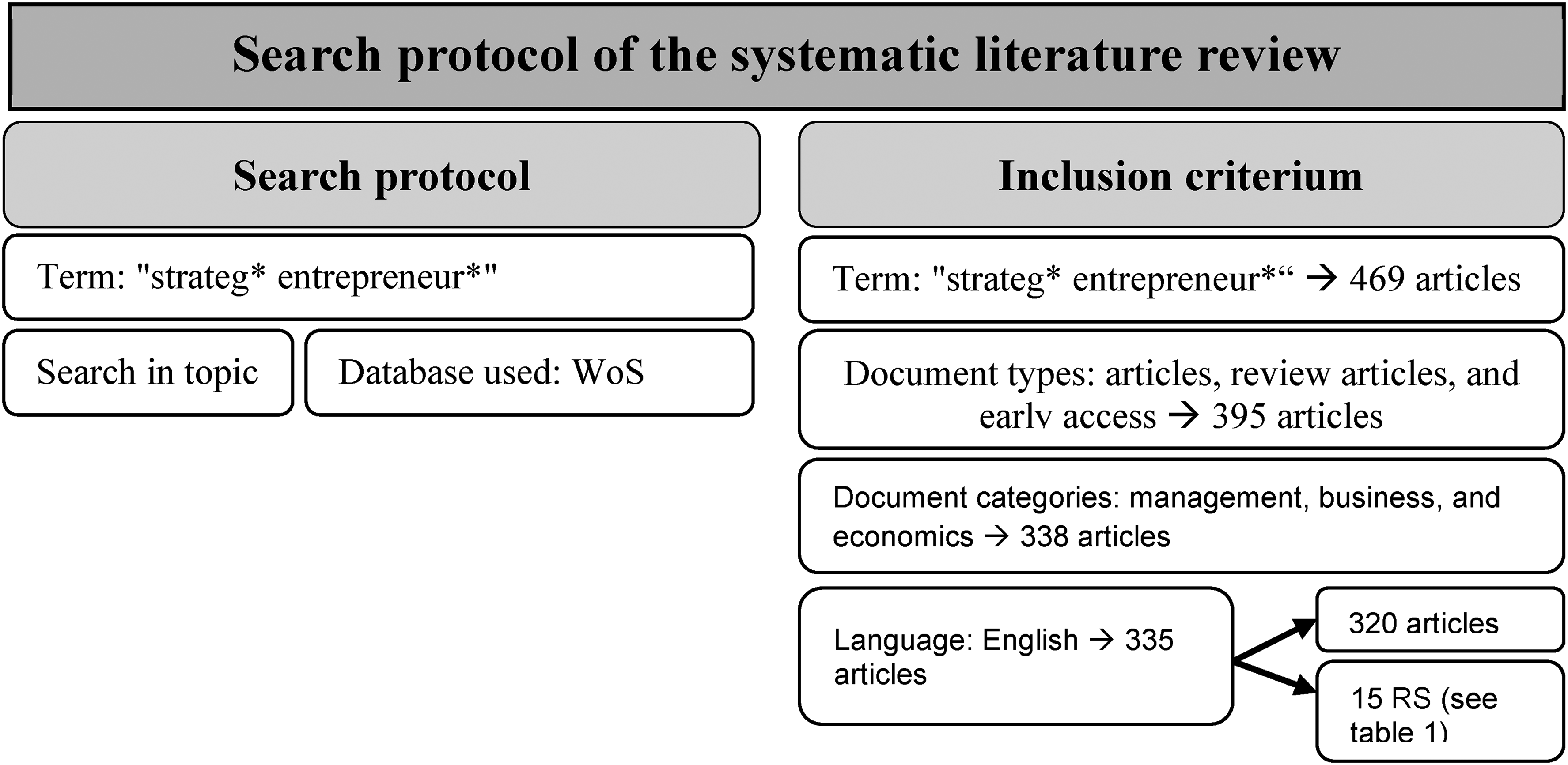
Methodological process—WoS database.
Bibliometric network analysis is next applied and it includes multiple sources and may be based on several criteria (Eck and Waltman, 2022). For this purpose, the criteria of co-citations were considered. For the determination of the thematic groups (clusters), the software VOSviewer (version 1.6.17) was used. The database collected through WoS was downloaded into VOSviewer, and a new base of articles was generated with 105 articles, considering the methodology adopted. After eliminating the books and book sections from this new base, and manual sorting, the database was left with 85 articles. Figure 2 shows the protocol followed for the bibliometric analysis and all the steps and choices selected in the respective VOSviewer criteria.
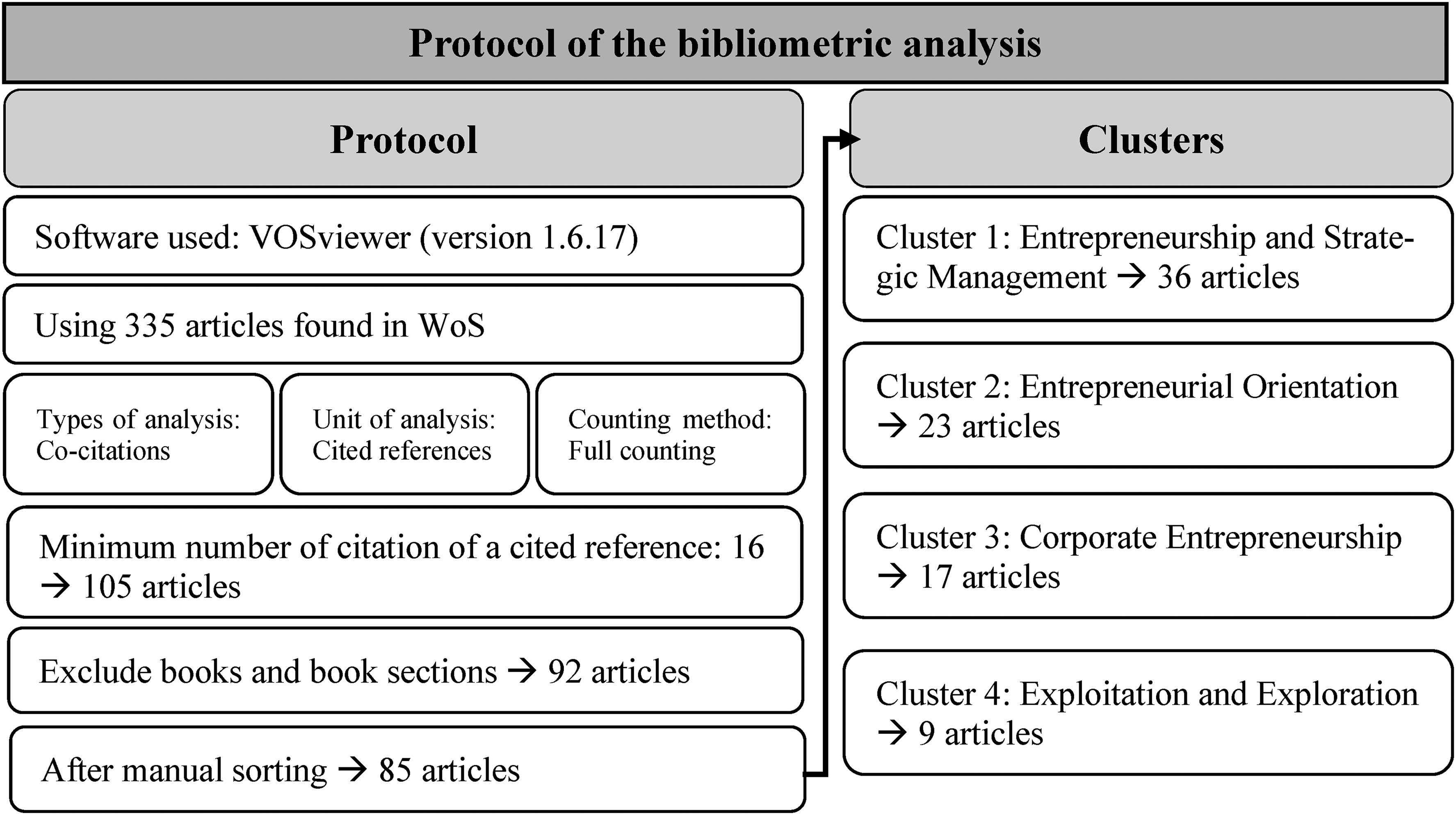
Methodological process—VOSviewer.
The last step of the methodological process of the bibliometric analysis, the manual sorting, is validating if the papers have more information besides the title and the author (information provided by the software). If it does not exist, the paper as no condition to integrate our study.
Results
Descriptive analysis
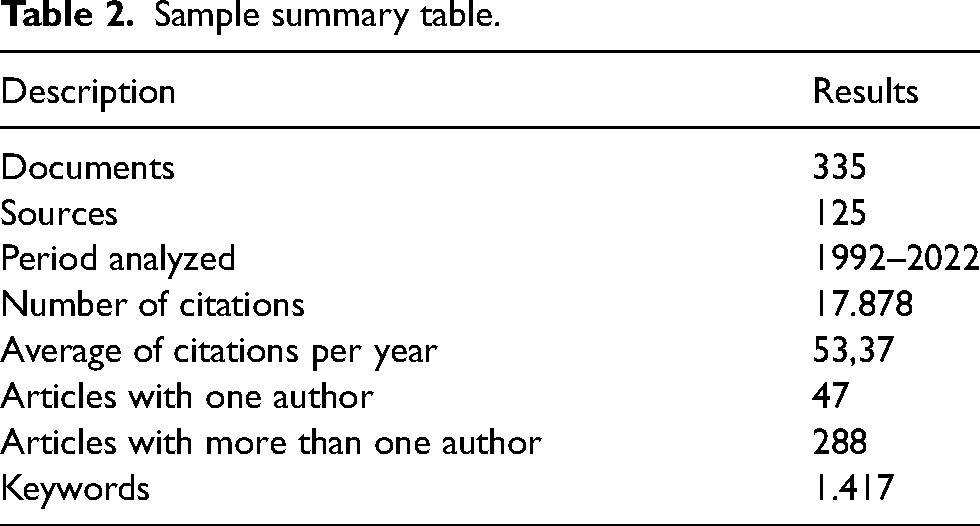
The search mentioned here was conducted on December 3, 2021. Table 2 shows an overview of the composition of the sample. According to the WoS database, strategic entrepreneurship is a theme, with its first publication dated 1992 (Figure 3). Even though its first publication in the database selected for the development of this study is already 30 years old, this theme still captures the researchers’ interest.
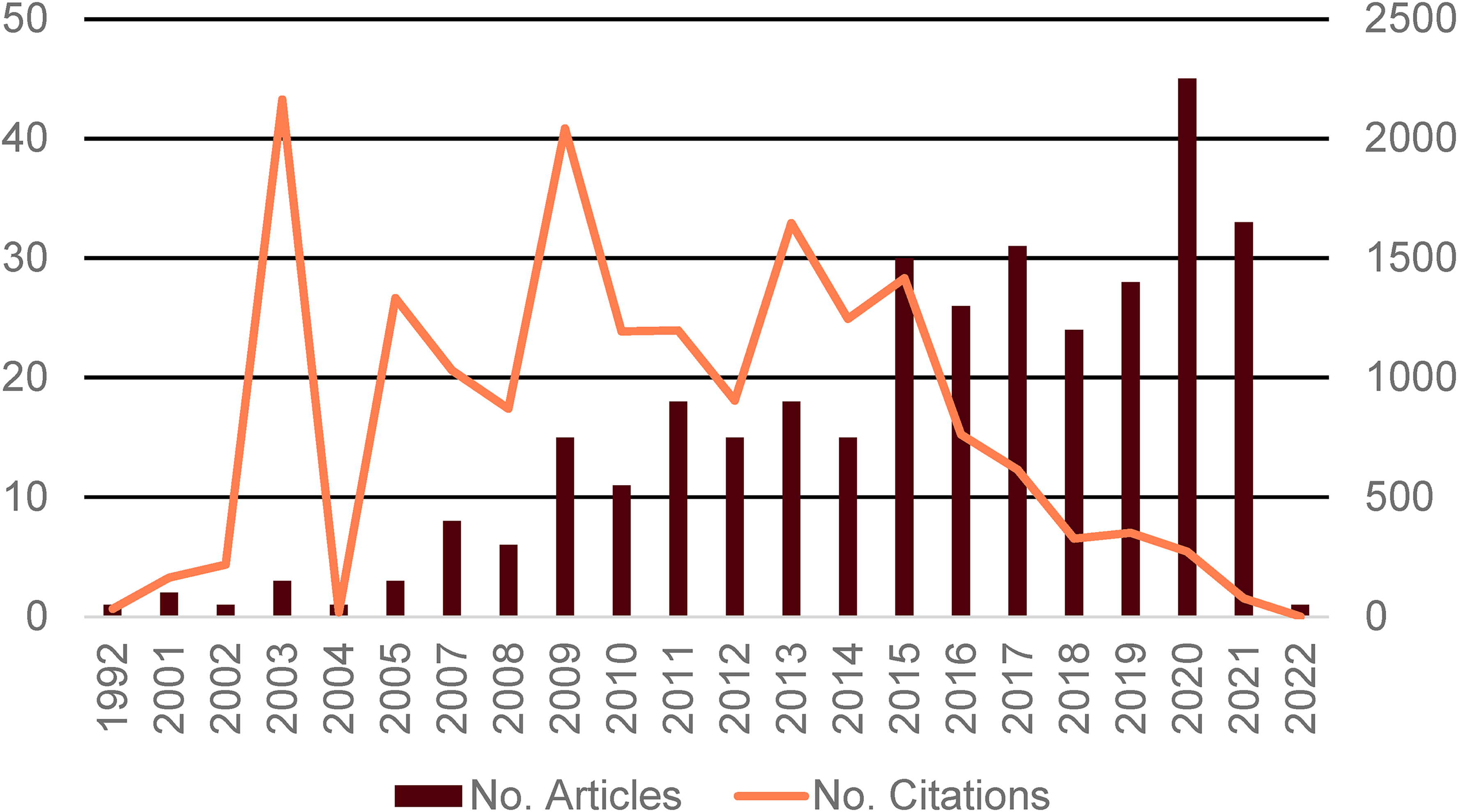
Number of articles and citations per year.
Sample summary table.
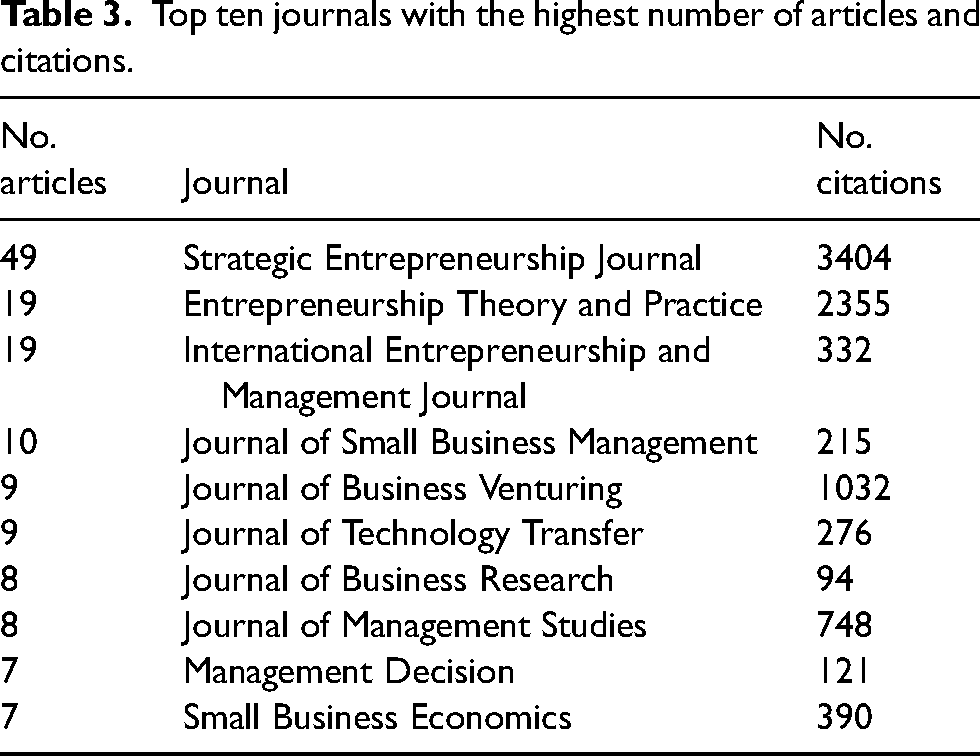
The publications on this subject have had some ups and downs, but there was a significant increase in the number of articles published on this theme in 2020, as shown in Figure 3. Regarding citations, the theme has suffered an exponential decrease since 2015. However, there was a small turnaround from 2018 to 2019 regarding the number of publications. Thus, there is an indication that the subject may recover its momentum in publications and citations in the coming years. Table 3 shows the ten journals with the highest number of articles and the respective numbers of citations.
Top ten journals with the highest number of articles and citations.
Co-citations
Figure 4 shows the network of authors by identifying four clusters. Cluster 1 (red) has 36 articles, cluster 2 (green) with 23, cluster 3 (blue) with 17, and cluster 4 (yellow) with 9 articles.
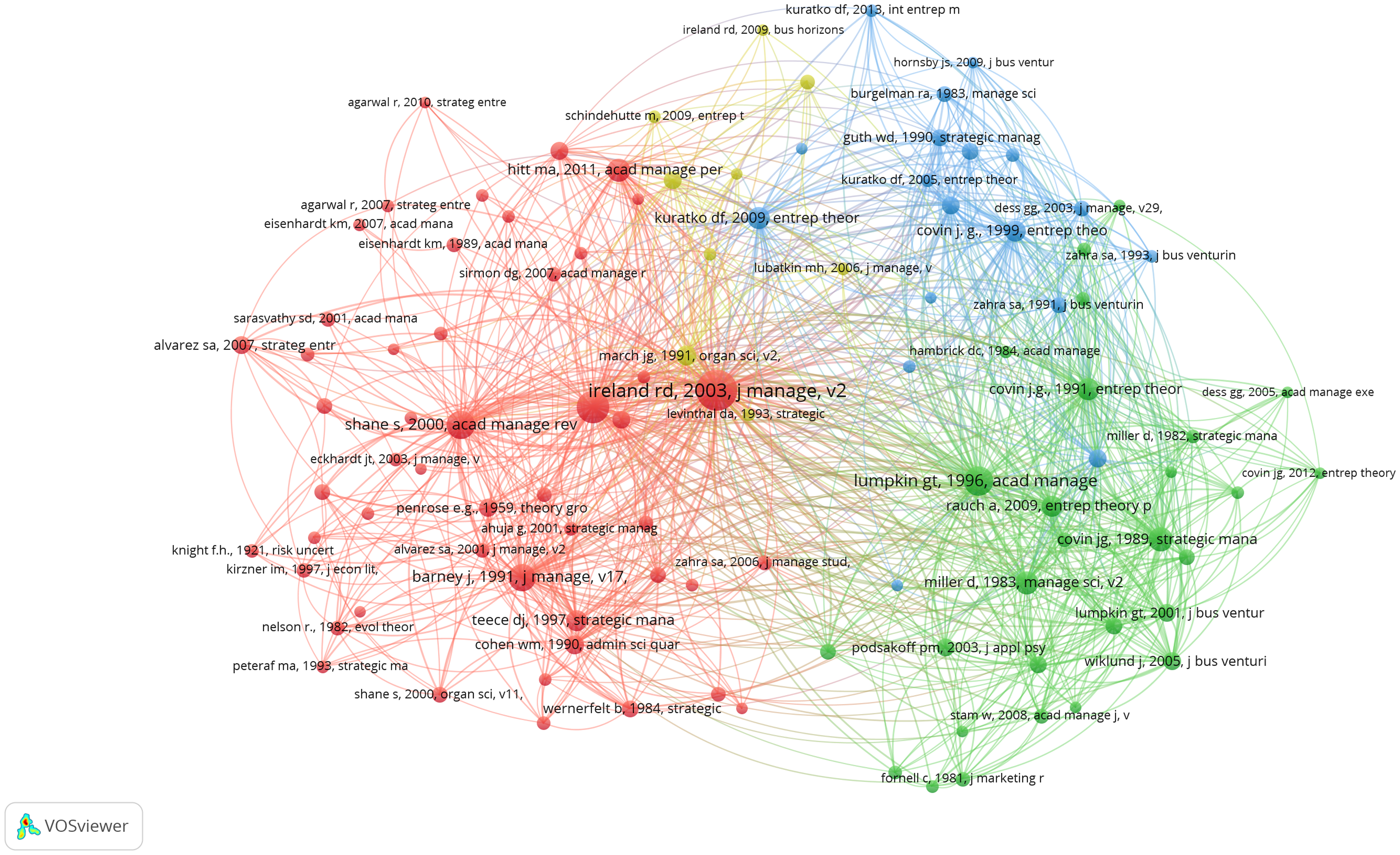
Bibliometric analysis of co-citations from VOSviewer.
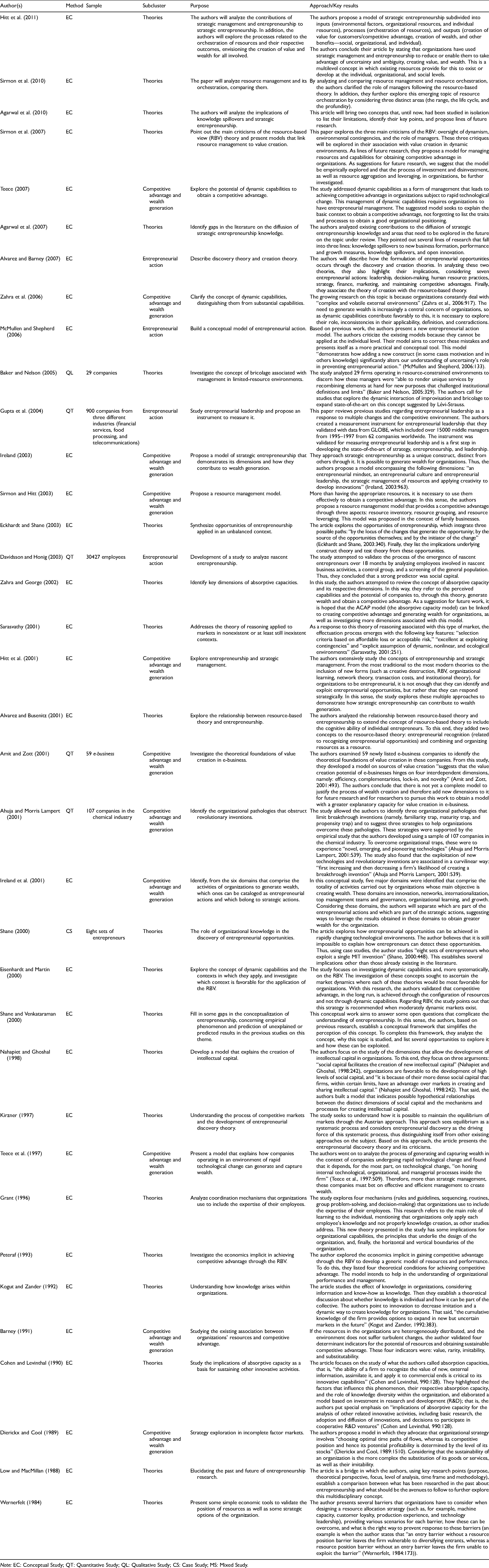
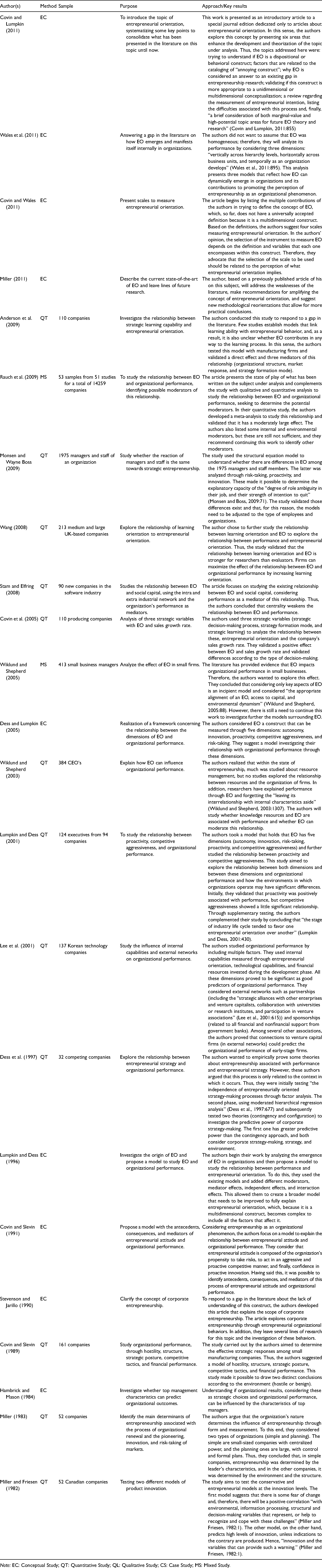
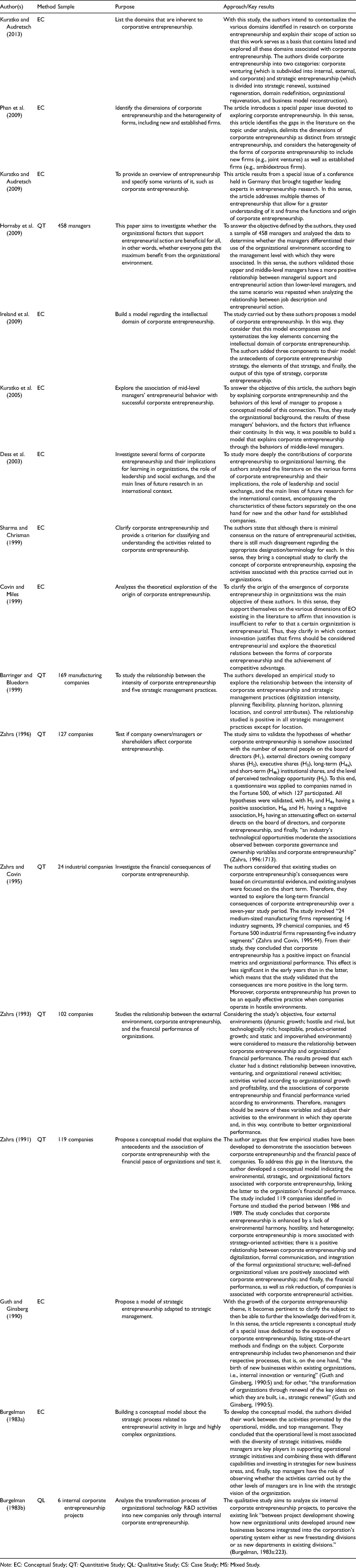
After this bibliometric analysis, in the next section, the authors analyzed the clusters indicated by VOSviewer software and, in the appendix are available a synthetic analysis of all papers presented by the defined clusters.
Strategic entrepreneurship: Thematic groups
Entrepreneurship and strategic management (cluster 1, n = 36)
Cluster 1, called “Entrepreneurship and Strategic Management,” comprises 36 articles, where 30 are conceptual, six are empirical, four are quantitative, one qualitative, and one is a case study. Originally, the cluster was composed of 38 articles, but two were eliminated (Eisenhardt, 1989; Eisenhardt and Graebner, 2007) since they did not address the subject but instead focused on the process and some issues authors should consider when creating any theory. The remaining articles were subdivided into three subclusters: theories, entrepreneurial action, competitive advantage, and wealth generation. All the articles comprising this present cluster studies are associated with entrepreneurship or strategic management. Thus, it was necessary to divide them so themes could group and facilitate their understanding (see Appendix 1).
Entrepreneurship has often been defined based on who the entrepreneur is and what they do (Shane and Venkataraman, 2000). However, the literature indicates that entrepreneurship is broader and more multidisciplinary, so reducing it only to the person who puts it into practice and how they do it is limiting and insufficient to define this topic. Other authors refer that entrepreneurship, in summary, represents the entire process through which it is possible to create new things (Ireland and Webb, 2007, 2009). Entrepreneurial management is different from what the definition initially made it seem “a bold, risky, and aggressive approach to decision making” (Covin and Wales, 2011:3). Broader contributions on the subject mention that “we define the field of entrepreneurship as the scholarly examination of how, by whom, and with what effects opportunities to create future goods and services are discovered, evaluated, and exploited” (Shane and Venkataraman, 2000:218), which involves “sources of opportunities; the processes of discovery, evaluation, and exploitation of opportunities; and the set of individuals who discover, evaluate, and exploit opportunities” (Hitt et al., 2011: 59). Ireland et al. (2001) also add wealth creation as one of the contributions of entrepreneurship. Wealth creation is the main attribute associated with entrepreneurship (Hitt et al., 2011; Ireland, 2003; Zahra et al., 2006), but here too, value creation, exploitation of opportunities, allocation, and management of resources in innovative ways, among others, are present (Hitt et al., 2011; Ireland, 2003; Ireland and Webb, 2009).
Regarding strategic management, the literature still presents difficulties distinguishing strategic actions from entrepreneurial ones. Therefore, it seems plausible that the cluster presents both designations to include the associated works since they address both concepts. In addition, the main purpose of either concept is to allow organizations to grow and increase their wealth (Amit and Zott, 2001; Hitt et al., 2001; Ireland, 2003).
From the cluster “Entrepreneurship and Strategic Management,” the first subcluster, composed of 21 articles, is dedicated to articles that present theories related in some way to entrepreneurship and the strategic management of organizations, such as resource-based management, resource orchestration, knowledge theory, bricolage theory, absorptive capacity, dynamic capabilities, and entrepreneurial opportunities. The second subcluster explores articles that address entrepreneurial actions and consists of four articles only, highlighting the need for the literature to begin to distinguish what are entrepreneurial activities/actions from strategic management activities/actions. Finally, the subcluster of competitive advantage and wealth generation has eleven articles that explore models through which the authors believe that organizations can obtain high competitive advantages over their competitors and generate wealth for their companies.
Entrepreneurial orientation (cluster 2, n = 23)
Cluster 2, entitled “Entrepreneurial Orientation,” is composed of a total of 23 articles. After reading all the studies in this cluster, four articles were eliminated because there are not related to the subject under analysis (Podsakoff et al., 2003; Floyd and Lane, 2000; Podsakoff and Organ, 1986; Fornell and Larcker, 1981). Of the 23 articles, 9 are conceptual, 14 are empirical, 12 are quantitative, and 2 are mixed. These articles explore the concept of entrepreneurial orientation, its association with entrepreneurship and corporate entrepreneurship, and the contribution of EO to organizations (see Appendix 2).
The concept of EO or orientation to entrepreneurial activity is not new, but its definition is not consensual. The term has been widely debated among academics and has undergone several changes. This concept has had multiple designations: “entrepreneurial orientation, intensity, style, posture, proclivity, propensity, and in some instances, corporate entrepreneurship” (Covin and Wales, 2011:2). This concept has been studied for more than 30 years (Covin and Wales, 2011). It is considered an organizational phenomenon as it is possible to put into entrepreneurial practice activities and, in this way, contribute to improving organizational performance (Covin and Lumpkin, 2011). The triggering of interest in this concept is often considered a continuous variable or multiple variables associated with a larger concept, corporate entrepreneurship (Covin and Lumpkin, 2011; Covin and Wales, 2011; Wales et al., 2011). Wales et al. (2011) argue that “entrepreneurial orientation (EO) is one of the most important and established concepts within the field of entrepreneurship” (Wales et al., 2011:895).
The concept of EO does not have a definition unanimously accepted by academics; therefore, there are distinct contributions to defining entrepreneurial orientation. Some authors consider that EO occurs within organizations and are expressed through entrepreneurial attitudes and behaviors, such as “proactiveness, competitive aggressiveness, risk-taking, and autonomy” (Covin and Lumpkin, 2011:857), and these attitudes and behaviors encompass the organization as a whole (Wales et al., 2011). This is because it is believed that EO can also be considered an additional tool in the decision-making process (Covin and Wales, 2011).
Corporate entrepreneurship (cluster 3, n = 17)
Cluster 3, titled “Corporate Entrepreneurship,” comprises 17 articles: 10 conceptual, 7 empirical, 6 quantitative, and 1 qualitative. These articles explore the concept of corporate entrepreneurship and its distinction from strategic entrepreneurship (see Appendix 3). However, to attain this total number, it was necessary to eliminate one article that was, after closer scrutiny, not related to the topic. This article discussed agency, property rights, and finance theories (Jensen and Meckling, 1976).
The external environment of organizations has been characterized by instability; therefore, they feel more and more pressured to invest in entrepreneurial strategies to try to ensure the success of their companies (Ireland et al., 2009). All this has led to an increase in corporate entrepreneurship. Corporate entrepreneurship can be perceived as a strategy in which, with the vision of the organization as a whole, there is an entrepreneurial behavior that contributes, intentionally and continuously, to rejuvenate the organization and adapt its operations to the recognition and exploitation of entrepreneurial opportunities (Ireland et al., 2009). On the other hand, some authors agree that it can also be a process if it contributes favorably to renewal or innovation (Ireland et al., 2009; Kuratko and Audretsch, 2013). Employees can practice this process individually or in groups, always associated with the organization (Ireland et al., 2009). The applicability of this concept can be based on activities that can range from formal to informal, aiming at creating new businesses in companies already established in the market. The activities mentioned here can assume a wide range “take place at the corporate, division (business), functional, or project levels, with the unifying objective of improving a company's competitive position and financial performance” (Kuratko and Audretsch, 2013:325).
Corporate entrepreneurship can be considered an entrepreneurial behavior, as mentioned before. In this sense, it can be clarified that entrepreneurial behavior is understood as all the “entrepreneurial actions by which individuals make judgmental decisions under uncertainty” (Kuratko and Audretsch, 2013:325) to find opportunities not yet perceived or exploited by competitors. Research in this area has led to the understanding that corporate entrepreneurship has advantages for organizations, such as improving the present and future competitive advantages (and, above all, sustainable ones so that they contribute to the profitable growth of organizations), contributing to high levels of performance, strategic renewal/innovation, organizational learning, international success, and improving the process of resource allocation so that it is possible to enhance competitive advantages (Hornsby et al., 2009; Ireland et al., 2009; Kuratko and Audretsch, 2013).
Exploitation and exploration (cluster 4, n = 9)
Cluster 4, entitled “Exploitation and Exploration,” comprises six conceptual articles and three empirical studies, two of which are quantitative, and one is a case study. These articles explain the relationship between these approaches to organizational learning and strategic entrepreneurship (see Appendix 4).
As a result of the change, a constant of organizational life, environmental agitation, diversity, and the persistent search for competitive advantage, effectively selecting among organizational forms, routines, and practices become vital (March, 1991). In this sense, strategic entrepreneurship assumes itself as an approach capable of enhancing organizational performance and improving competitive advantage to the extent that some authors believe that successful companies are those that can best respond to organizational tension and, at the same time, highlight what they do well-concerning competitors and identifying opportunities for improvement for the future (Ireland and Webb, 2007).
Along with these lines, exploitation and exploration arise since strategic entrepreneurship encompasses both seeking opportunities (explore) and advantages (exploit) that give organizations a competitive advantage. Strategic entrepreneurship seeks to balance these two approaches (Ireland and Webb, 2009; Schindehutte and Morris, 2009), but it is a complex, iterative, time-consuming, risk-taking, recursive, dynamic, and multiresource process (Ireland and Webb, 2007, 2009).
The concepts of exploitation and exploration are considered two distinct approaches to organizational learning (He and Wong, 2004). Exploitation grows as the organization accumulates knowledge (Ireland and Webb, 2007), so exploration is associated with discovery since it can “respond to, as well as drive, latent environmental trends by creating innovative technologies and new markets” (Lubatkin et al., 2006:648). This is a bottom-up learning process because managers must leave their routines behind and be persuaded to invest in new lines of action. Thus, exploitation proposes formal structures at the management level, where learning occurs from the top-down, that is, the top managers who implement the routines and behaviors within the organization (Lubatkin et al., 2006).
On the other hand, exploration seeks to discover what is still unknown to organizations and does so by “search, variation, experimentation, and discovery” (Schindehutte and Morris, 2009:244), as well as flexibility, risk, and innovation (He and Wong, 2004; March, 1991). The knowledge gained in exploitation learning does not create something new but focuses on improving processes for future implementations (Ireland and Webb, 2007). The exploitation happens through practices such as “refinement, efficiency, selection, and implementation” (Schindehutte and Morris, 2009:244) and choice, production, and execution (He and Wong, 2004; March, 1991). The organizational implementation of this learning approach is related to the organization's strategy (He and Wong, 2004).
However, research stresses that it is in ambidexterity that companies can leverage a greater competitive advantage. The term ambidexterity appears in the context of comparing the use of both hands with equal dexterity to organizations managing to maintain a balance between exploring new opportunities and using existing competencies (Lubatkin et al., 2006). The skill of balancing ambidexterity is the ability to effectively manage a limited set of resources during an environment of total uncertainty, and this is considered to be the crucial basis for leveraging (Ireland and Webb, 2009).
As these concepts are distinct, some studies present evidence that they need “structures, processes, strategies, capabilities, and cultures to pursue and may have different impacts on firm adaptation and performance” (He and Wong, 2004:481). Exploration is associated with skills and exploitation with capabilities. Organizations that focus only on exploitation only risk becoming obsolete and failing to succeed in the market. In contrast, organizations that rely on exploration risk never getting a return on their knowledge since they are always innovating and changing (Levinthal and March, 1993).
The goal of ambidexterity balance is closely associated with creating wealth by exploiting current competitive advantages and leveraging them by improving future performance (Ketchen et al., 2007). The hybrid use of these approaches allows the creation of multifunctional companies (Ireland and Webb, 2009). In addition, the returns from exploration activities are less certain than those from exploitation (March, 1991) since the first ones deal with innovation (Tushman and ÓReilly, 1996).
Integrative framework and research agenda
Based on the four thematic groups, we developed an integrative framework for the strategic entrepreneurship approach (Figure 5) that shows how each theme fits and interrelates.
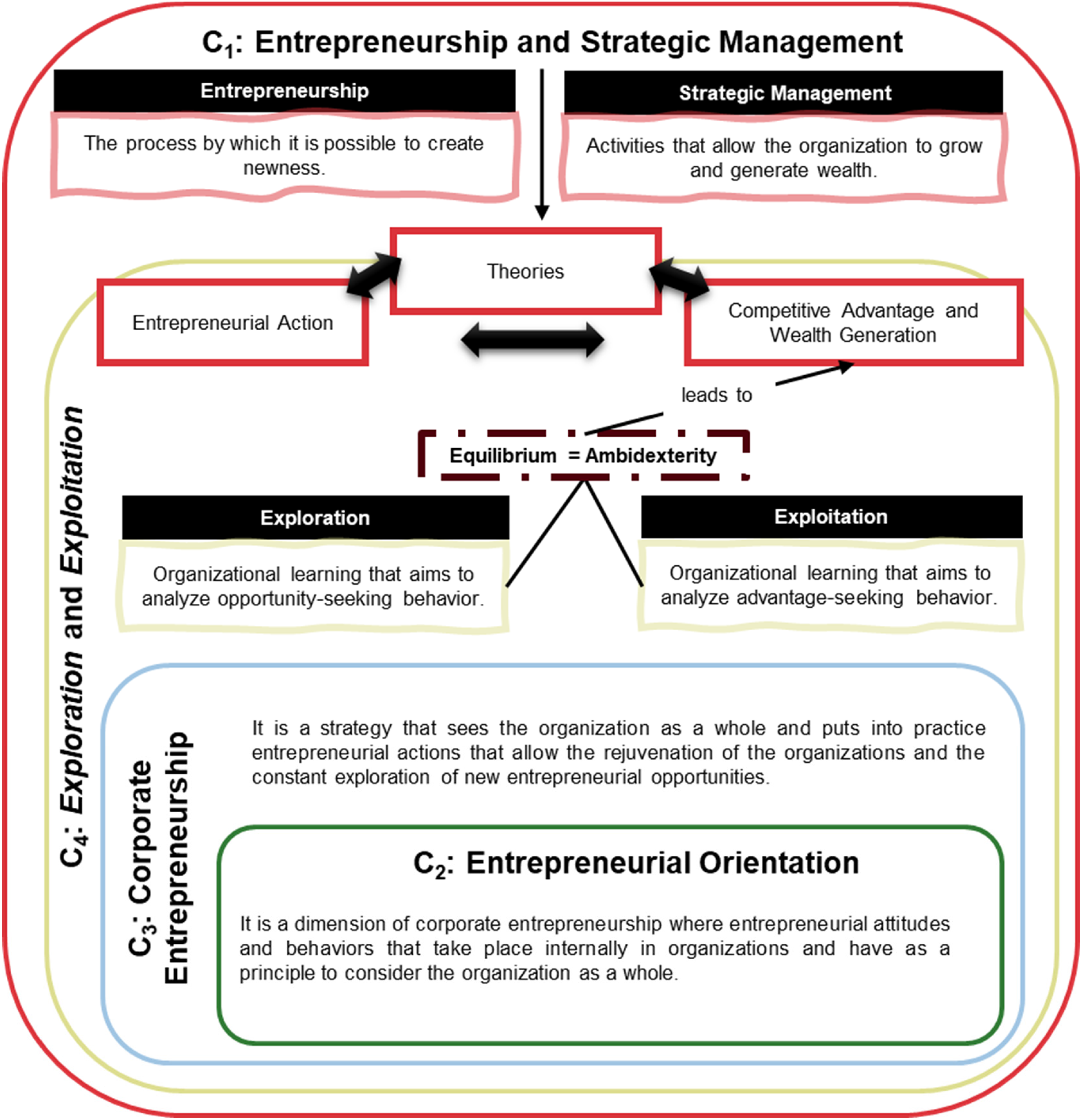
Strategic Entrepreneurship Framework.
Analyzing Figure 5, we can see that the theme of strategic entrepreneurship still has some very tenuous barriers to what entrepreneurship is and what strategic management is. Thus, the need arises to designate the first cluster with a more comprehensive denomination since the literature still does not clearly separate these terminologies. Due to the generality of the cluster designation, it was subdivided into theories, entrepreneurial action, competitive advantage, and wealth generation. Only the papers included under entrepreneurial action demonstrate the first attempts to define typical entrepreneurial activities. The theories address theoretical models of managing organizations strategically and aiming at the character of innovation, that is, the latter associated with entrepreneurship, as it is considered the process through which it is possible to create novelties for the organization.
A careful interpretation allows us to perceive that cluster 4 (exploitation and exploration) comprises all the clusters; that is, in all of them, multiple works argue that organizational success involves ambidexterity, as mentioned above. That is why the two organizational learnings (exploitation and exploration) are linked to equilibrium. This balance is about organizations being ambidextrous, that is, being able to use each approach with the same level of skill. Equilibrium/ambidexterity lead, according to several authors, equilibrium/ambidexterity leads to organizational success that translates into achieving competitive advantage and wealth generation for organizations (Ireland and Webb, 2007, 2009; Ketchen et al., 2007).
Therefore, this cluster is also somewhat related to the subclusters of cluster one. According to the literature, EO (cluster 2) represents one dimension of a larger construct, corporate entrepreneurship (third cluster). They differ because corporate entrepreneurship represents a strategy, and EO represents attitudes and behaviors. Most authors argue that EO and corporate entrepreneurship are associated with opportunity-seeking behavior analysis (exploitation) and advantage-seeking behavior (exploitation). Thus, it becomes visible that strategic entrepreneurship studies have focused primarily on opportunity and advantage-seeking management. On the one hand, they search for the new, the unknown, and, on the other hand, they intend to explore how to leverage the processes already carried out to get the best out of them and to obtain feedback on organizational learning.
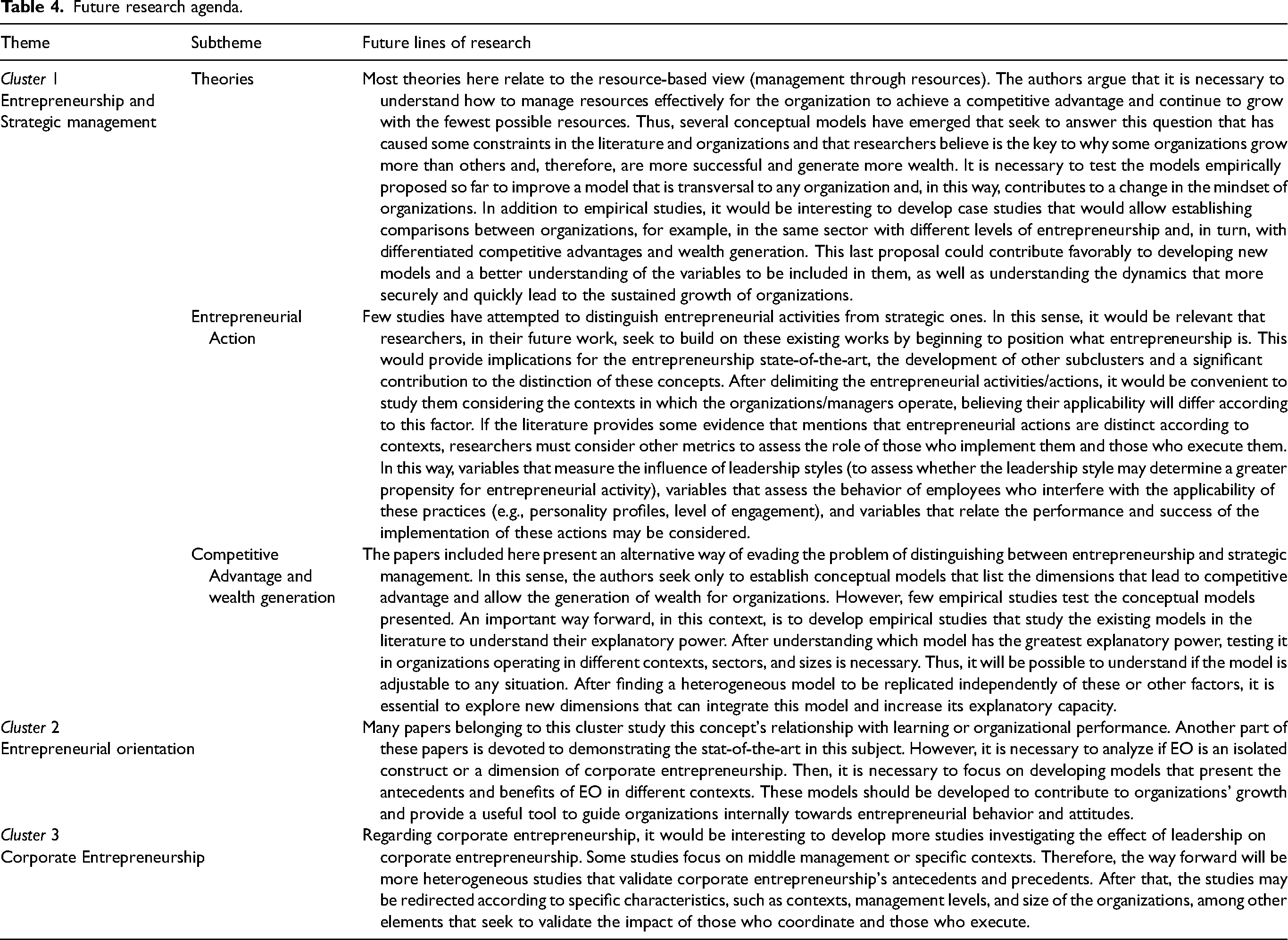
This topic briefly presents a future research agenda considering the subject under study and after analyzing and systematizing the literature and the thematic groups (clusters) found in this study (Table 4).
Future research agenda.
Conclusions, implications, and limitations
The emergence of entrepreneurship in organizations occurred in response to highly dynamic and competitive environments and the consequent need to respond quickly, effectively, and innovatively to achieve competitive advantage and generate internal wealth.
The study used the WoS database to identify the most relevant literature on strategic entrepreneurship, and the resource to bibliometric techniques allowed us to study the evolution of the literature on the subject under scrutiny. This analysis resulted in four clusters—entrepreneurship and strategic management (36 articles), EO (23 articles), corporate entrepreneurship (17 articles), and exploitation and exploration (9 articles).
The first cluster, which presents articles on entrepreneurship and strategic management, allowed us to conclude that there are still not enough data in the literature to separate entrepreneurial activities from activities related to strategic management (Ireland, 2003; Shane & Venkataraman, 2000). Irland (2003: 964) argues that this is because “entrepreneurship and strategic management disciplines are inseparable, making it difficult to understand one field's research findings without simultaneously studying the results reported in the other” (Ireland, 2003:964). Due to the size and heterogeneity of the topics addressed in this cluster, a tripartite division of the cluster was carried out, designated as (i) theories, (ii) entrepreneurial action, and (iii) competitive advantage and wealth generation.
The first subcluster, the theories (composed of 21 articles), shows the multiple theories that represent the manifestation of entrepreneurship and strategic management in organizations, and the most mentioned theory is resource-based management. The entrepreneurial action subcluster presents the few studies that seek to contribute to defining entrepreneurial actions/activities, demonstrating the separation of the concepts of entrepreneurship and strategic management. Finally, the competitive advantage and wealth generation subcluster represents the 11 articles that explore the contributions of entrepreneurship and strategic management to leverage competitive advantage and increase wealth generation for organizations.
The second cluster presents studies on entrepreneurial orientation, which has been a construct with little consensual designation but refers to entrepreneurial attitudes and behaviors that aim to encompass the organization. The third cluster presents studies on corporate entrepreneurship, a strategy that aims at the applicability of entrepreneurial actions, considering the organization, that allows rejuvenation and develops the ability to explore and recognize new entrepreneurial opportunities. Finally, the cluster is dedicated to exploitation and exploration, which suggest two distinct approaches to organizational learning. The first approach exploits advantages, and the second is for exploring opportunities.
This study has important implications for developing state-of-the-art of strategic entrepreneurship. First, the systematization carried out on the theme of strategic entrepreneurship intended to be useful for future researchers and contribute to developing new studies based on it, completing one of the main objectives. A second implication relates to the framework developed in this study, contributing to fully understanding the theme and existing studies around it. This implication allows us to comply with the other main objective, which is to study the components that characterize strategic entrepreneurship. Finally, but probably the most relevant implication, the proposed research agenda systematizes the possible lines of future research, facilitating future researchers in identifying gaps in the theme.
In terms of limitations, we identify two major limitations of this present study. Initially, the study presented here only used the WoS database, and other studies on the same theme were not included in the analysis. The last limitation is related to the methodology used in the VOSviewer. The co-citation technique and the definition of a minimum number of 16 citations may have caused the articles analyzed in the clusters to be not so recent, considering that in the analysis of the WoS database, about 48% of the articles were published five or fewer years ago. Potential lines of research are indicated in Table 3. However, in summary, we highlight the lack of empirical studies on the existing models in the literature that allow us to determine their validity or explanatory capacity concerning the construct under analysis. Consider the importance of the contexts and variables related to the behavior of those who put entrepreneurship into practice, among other specific characteristics (size, social capital, leadership, among others). Finally, the major gaps in the literature are related to the preliminary studies that establish a line between strategic management and entrepreneurial actions and that allow defining EO as a construct or a dimension of corporate entrepreneurship.
Footnotes
Authors’ note
All procedures performed in studies involving human participants were in accordance with the ethical standards of the institutional and/or national research committee and with the 1964 Helsinki declaration and its later amendments or comparable ethical standards. Informed consent was obtained from all individual participants included in the study.
Declaration of conflicting interests
The author(s) declared no potential conflicts of interest with respect to the research, authorship, and/or publication of this article.
Funding
The author(s) received no financial support for the research, authorship, and/or publication of this article.

Appendix 1—Entrepreneurship and Strategic Management (cluster1).
| Author(s) | Method | Sample | Subcluster | Purpose | Approach/Key results |
|---|---|---|---|---|---|
| Hitt et al. (2011) | EC | Theories | The authors will analyze the contributions of strategic management and entrepreneurship to strategic entrepreneurship. In addition, the authors will explore the processes related to the orchestration of resources and their respective outcomes, envisioning the creation of value and wealth for all involved. | The authors propose a model of strategic entrepreneurship subdivided into inputs (environmental factors, organizational resources, and individual resources), processes (orchestration of resources), and outputs (creation of value for customers/competitive advantage, creation of wealth, and other benefits—social, organizational, and individual). |
|
| Sirmon et al. (2010) | EC | Theories | The paper will analyze resource management and its orchestration, comparing them. | By analyzing and comparing resource management and resource orchestration, the authors clarified the role of managers following the resource-based theory. In addition, they further explore this emerging topic of resource orchestration by considering three distinct areas (the range, the life cycle, and the profundity). | |
| Agarwal et al. (2010) | EC | Theories | The authors will analyze the implications of knowledge spillovers and strategic entrepreneurship. | This article will bring two concepts that, until now, had been studied in isolation to list their limitations, identify their key points, and propose lines of future research. | |
| Sirmon et al. (2007) | EC | Theories | Point out the main criticisms of the resource-based view (RBV) theory and present models that link resource management to value creation. | This paper explores the three main criticisms of the RBV: oversight of dynamism, environmental contingencies, and the role of managers. These three critiques will be explored in their association with value creation in dynamic environments. As lines of future research, they propose a model for managing resources and capabilities for obtaining competitive advantage in organizations. As suggestions for future research, we suggest that the model be empirically explored and that the process of investment and disinvestment, as well as resource aggregation and leveraging, in organizations, be further investigated. | |
| Teece (2007) | EC | Competitive advantage and wealth generation | Explore the potential of dynamic capabilities to obtain a competitive advantage. | The study addressed dynamic capabilities as a form of management that leads to achieving competitive advantage in organizations subject to rapid technological change. This management of dynamic capabilities requires organizations to have entrepreneurial management. The suggested model seeks to explain the basic context to obtain a competitive advantage, not forgetting to list the traits and processes to obtain a good organizational positioning. | |
| Agarwal et al. (2007) | EC | Theories | Identify gaps in the literature on the diffusion of strategic entrepreneurship knowledge. | The authors analyzed existing contributions to the diffusion of strategic entrepreneurship knowledge and areas that need to be explored in the future on the topic under review. They pointed out several lines of research that fall into three lines: knowledge spillovers to new business formation, performance and growth measures, knowledge spillovers, and open innovation. | |
| Alvarez and Barney (2007) | EC | Entrepreneurial action | Describe discovery theory and creation theory. | The authors will describe how the formulation of entrepreneurial opportunities occurs through the discovery and creation theories. In analyzing these two theories, they also highlight their implications, considering seven entrepreneurial actions: leadership, decision-making, human resource practices, strategy, finance, marketing, and maintaining competitive advantages. Finally, they associate the theory of creation with the resource-based theory. | |
| Zahra et al. (2006) | EC | Competitive advantage and wealth generation | Clarify the concept of dynamic capabilities, distinguishing them from substantial capabilities. | The growing research on this topic is because organizations constantly deal with “complex and volatile external environments” (Zahra et al., 2006:917). The need to generate wealth is increasingly a central concern of organizations, so as dynamic capabilities contribute favorably to this, it is necessary to explore their role, inconsistencies in their applicability, definition, and contradictions. | |
| McMullen and Shepherd (2006) | EC | Entrepreneurial action | Build a conceptual model of entrepreneurial action. | Based on previous work, the authors present a new entrepreneurial action model. The authors criticize the existing models because they cannot be applied at the individual level. Their model aims to correct these mistakes and presents itself as a more practical and conceptual tool. This model “demonstrates how adding a new construct (in some cases motivation and in others knowledge) significantly alters our understanding of uncertainty's role in preventing entrepreneurial action.” (McMullen and Shepherd, 2006:133). | |
| Baker and Nelson (2005) | QL | 29 companies | Theories | Investigate the concept of bricolage associated with management in limited-resource environments. | The study analyzed 29 firms operating in resource-constrained environments to discern how these managers were “able to render unique services by recombining elements at hand for new purposes that challenged institutional definitions and limits” (Baker and Nelson, 2005:329). The authors call for studies that explore the dynamic interaction of improvisation and bricolage to expand state-of-the-art on this concept suggested by Lévi-Strauss. |
| Gupta et al. (2004) | QT | 900 companies from three different industries (financial services, food processing, and telecommunications) | Entrepreneurial action | Study entrepreneurial leadership and propose an instrument to measure it. | This paper reviews previous studies regarding entrepreneurial leadership as a response to multiple changes and the competitive environment. The authors created a measurement instrument for entrepreneurial leadership that they validated with data from GLOBE, which included over 15000 middle managers from 1995–1997 from 62 companies worldwide. The instrument was validated for measuring entrepreneurial leadership and is a first step in developing the state-of-the-art of strategy, entrepreneurship, and leadership. |
| Ireland (2003) | EC | Competitive advantage and wealth generation | Propose a model of strategic entrepreneurship that demonstrates its dimensions and how they contribute to wealth generation. | They approach strategic entrepreneurship as a unique construct, distinct from others through it. It is possible to generate wealth for organizations. Thus, the authors propose a model encompassing the following dimensions: “an entrepreneurial mindset, an entrepreneurial culture and entrepreneurial leadership, the strategic management of resources and applying creativity to develop innovations” (Ireland, 2003:963). | |
| Sirmon and Hitt (2003) | EC | Competitive advantage and wealth generation | Propose a resource management model. | More than having the appropriate resources, it is necessary to use them effectively to obtain a competitive advantage. In this sense, the authors propose a resource management model that provides a competitive advantage through three aspects: resource inventory, resource grouping, and resource leveraging. This model was proposed in the context of family businesses. | |
| Eckhardt and Shane (2003) | EC | Theories | Synthesize opportunities of entrepreneurship applied in an unbalanced context. | The article explores the opportunities of entrepreneurship, which integrate three possible paths: “by the locus of the changes that generate the opportunity; by the source of the opportunities themselves; and by the initiator of the change” (Eckhardt and Shane, 2003:340). Finally, they list the implications underlying construct theory and test theory from these opportunities. | |
| Davidsson and Honig (2003) | QT | 30427 employees | Entrepreneurial action | Development of a study to analyze nascent entrepreneurship. | The study attempted to validate the process of the emergence of nascent entrepreneurs over 18 months by analyzing employees involved in nascent business activities, a control group, and a screening of the general population. Thus, they concluded that a strong predictor was social capital. |
| Zahra and George (2002) | EC | Theories | Identify key dimensions of absorptive capacities. | In this study, the authors attempted to review the concept of absorptive capacity and its respective dimensions. In this way, they refer to the perceived capabilities and the potential of companies to, through this theory, generate wealth and obtain a competitive advantage. As a suggestion for future work, it is hoped that the ACAP model (the absorptive capacity model) can be linked to creating competitive advantage and generating wealth for organizations, as well as investigating more dimensions associated with this model. | |
| Sarasvathy (2001) | EC | Theories | Addresses the theory of reasoning applied to markets in nonexistent or at least still inexistent contexts. | As a response to this theory of reasoning associated with this type of market, the effectuation process emerges with the following key features: “selection criteria based on affordable loss or acceptable risk,” “excellent at exploiting contingencies” and “explicit assumption of dynamic, nonlinear, and ecological environments” (Sarasvathy, 2001:251). | |
| Hitt et al. (2001) | EC | Competitive advantage and wealth generation | Explore entrepreneurship and strategic management. | The authors extensively study the concepts of entrepreneurship and strategic management. From the most traditional to the most modern theories to the inclusion of new forms (such as creative destruction, RBV, organizational learning, network theory, transaction costs, and institutional theory), for organizations to be entrepreneurial, it is not enough that they can identify and exploit entrepreneurial opportunities, but rather that they can respond strategically. In this sense, the study explores these multiple approaches to demonstrate how strategic entrepreneurship can contribute to wealth generation. | |
| Alvarez and Busenitz (2001) | EC | Theories | Explore the relationship between resource-based theory and entrepreneurship. | The authors analyzed the relationship between resource-based theory and entrepreneurship to extend the concept of resource-based theory to include the cognitive ability of individual entrepreneurs. To this end, they added two concepts to the resource-based theory: entrepreneurial recognition (related to recognizing entrepreneurial opportunities) and combining and organizing resources as a resource. | |
| Amit and Zott (2001) | QT | 59 e-business | Competitive advantage and wealth generation | Investigate the theoretical foundations of value creation in e-business. | The authors examined 59 newly listed e-business companies to identify the theoretical foundations of value creation in these companies. From this study, they developed a model on sources of value creation “suggests that the value creation potential of e-businesses hinges on four interdependent dimensions, namely: efficiency, complementarities, lock-in, and novelty” (Amit and Zott, 2001:493). The authors conclude that there is not yet a complete model to justify the process of wealth creation and therefore add new dimensions to it for future research and for researchers to pursue this work to obtain a model with a greater explanatory capacity for value creation in e-business. |
| Ahuja and Morris Lampert (2001) | QT | 107 companies in the chemical industry | Competitive advantage and wealth generation | Identify the organizational pathologies that obstruct revolutionary inventions. | The study allowed the authors to identify three organizational pathologies that limit breakthrough inventions (namely, familiarity trap, maturity trap, and propensity trap) and to suggest three strategies to help organizations overcome these pathologies. These strategies were supported by the empirical study that the authors developed using a sample of 107 companies in the chemical industry. To overcome organizational traps, these were to experience “novel, emerging, and pioneering technologies” (Ahuja and Morris Lampert, 2001:539). The study also found that the exploitation of new technologies and revolutionary inventions are associated in a curvilinear way: “first increasing and then decreasing a firm's likelihood of creating a breakthrough invention” (Ahuja and Morris Lampert, 2001:539). |
| Ireland et al. (2001) | EC | Competitive advantage and wealth generation | Identify, from the six domains that comprise the activities of organizations to generate wealth, which ones can be cataloged as entrepreneurial actions and which belong to strategic actions. | In this conceptual study, five major domains were identified that comprise the totality of activities carried out by organizations whose main objective is creating wealth. These domains are innovation, networks, internationalization, top management teams and governance, organizational learning, and growth. Considering these domains, the authors will separate which are part of the entrepreneurial actions and which are part of the strategic actions, suggesting ways to leverage the results obtained in these domains to obtain greater wealth for the organization. | |
| Shane (2000) | CS | Eight sets of entrepreneurs | Theories | The role of organizational knowledge in the discovery of entrepreneurial opportunities. | The article explores how entrepreneurial opportunities can be achieved in rapidly changing technological environments. The author believes that it is still impossible to explain how entrepreneurs can detect these opportunities. Thus, using case studies, the author studies “eight sets of entrepreneurs who exploit a single MIT invention” (Shane, 2000:448). This establishes several implications other than those already existing in the literature. |
| Eisenhardt and Martin (2000) | EC | Theories | Explore the concept of dynamic capabilities and the contexts in which they apply, and investigate which context is favorable for the application of the RBV. | The study focuses on investigating dynamic capabilities and, more systematically, on the RBV. The investigation of these concepts sought to ascertain the market dynamics where each of these theories would be most favorable for organizations. With this research, the authors validated that competitive advantage, in the long run, is achieved through the configuration of resources and not through dynamic capabilities. Regarding RBV, the study points out that this strategy is recommended when moderately dynamic markets exist. | |
| Shane and Venkataraman (2000) | EC | Theories | Fill in some gaps in the conceptualization of entrepreneurship, concerning empirical phenomenon and prediction of unexplained or predicted results in the previous studies on this theme. | This conceptual work aims to answer some open questions that complicate the understanding of entrepreneurship. In this sense, the authors, based on previous research, establish a conceptual framework that simplifies the perception of this concept. To complete this framework, they analyze the concept, why this topic is studied, and list several opportunities to explore it and how these can be exploited. | |
| Nahapiet and Ghoshal (1998) | EC | Theories | Develop a model that explains the creation of intellectual capital. | The authors focus on the study of the dimensions that allow the development of intellectual capital in organizations. To this end, they focus on three arguments: “social capital facilitates the creation of new intellectual capital” (Nahapiet and Ghoshal, 1998:242), organizations are favorable to the development of high levels of social capital, and “it is because of their more dense social capital that firms, within certain limits, have an advantage over markets in creating and sharing intellectual capital.” (Nahapiet and Ghoshal, 1998:242). That said, the authors built a model that indicates possible hypothetical relationships between the distinct dimensions of social capital and the mechanisms and processes for creating intellectual capital. | |
| Kirzner (1997) | EC | Theories | Understanding the process of competitive markets and the development of entrepreneurial discovery theory. | The study seeks to understand how it is possible to maintain the equilibrium of markets through the Austrian approach. This approach sees equilibrium as a systematic process and considers entrepreneurial discovery as the driving force of this systematic process, thus distinguishing itself from other existing approaches on the subject. Based on this approach, the article presents the entrepreneurial discovery theory and its criticisms. | |
| Teece et al. (1997) | EC | Competitive advantage and wealth generation | Present a model that explains how companies operating in an environment of rapid technological change can generate and capture wealth. | The authors went on to analyze the process of generating and capturing wealth in the context of companies undergoing rapid technological change and found that it depends, for the most part, on technological change, “on honing internal technological, organizational, and managerial processes inside the firm” (Teece et al., 1997:509). Therefore, more than strategic management, these companies must bet on effective and efficient management to create wealth. | |
| Grant (1996) | EC | Theories | Analyze coordination mechanisms that organizations use to include the expertise of their employees. | The study explores four mechanisms (rules and guidelines, sequencing, routines, group problem-solving, and decision-making) that organizations use to include the expertise of their employees. This research refers to the main role of learning to the individual, mentioning that organizations only apply each employee's knowledge and not properly knowledge creation, as other studies address. This new theory presented in the study has some implications for organizational capabilities, the principles that underlie the design of the organization, and, finally, the horizontal and vertical boundaries of the organization. | |
| Peteraf (1993) | EC | Theories | Investigate the economics implicit in achieving competitive advantage through the RBV. | The author explored the economics implicit in gaining competitive advantage through the RBV to develop a generic model of resources and performance. To do this, they listed four theoretical conditions for achieving competitive advantage. The model intends to help in the understanding of organizational performance and management. | |
| Kogut and Zander (1992) | EC | Theories | Understanding how knowledge arises within organizations. | The article studies the effect of knowledge in organizations, considering information and know-how as knowledge. Then they establish a theoretical discussion about whether knowledge is individual and how it can be part of the collective. The authors point to innovation to decrease imitation and a dynamic way to create knowledge for organizations. That said, “the cumulative knowledge of the firm provides options to expand in new but uncertain markets in the future” (Kogut and Zander, 1992:383). | |
| Barney (1991) | EC | Competitive advantage and wealth generation | Studying the existing association between organizations’ resources and competitive advantage. | If the resources in the organizations are heterogeneously distributed, and the environment does not suffer turbulent changes, the author validated four determinant indicators for the potential of resources and obtaining sustainable competitive advantage. These four indicators were: value, rarity, imitability, and substitutability. | |
| Cohen and Levinthal (1990) | EC | Theories | Study the implications of absorptive capacity as a basis for sustaining other innovative activities. | The article focuses on the study of what the authors called absorption capacities, that is, “the ability of a firm to recognize the value of new, external information, assimilate it, and apply it to commercial ends is critical to its innovative capabilities” (Cohen and Levinthal, 990:128). They highlighted the factors that influence this phenomenon, their respective absorption capacity, and the role of knowledge diversity within the organization, and elaborated a model based on investment in research and development (R&D); that is, the authors put special emphasis on “implications of absorptive capacity for the analysis of other related innovative activities, including basic research, the adoption and diffusion of innovations, and decisions to participate in cooperative R&D ventures” (Cohen and Levinthal, 990:128). | |
| Dierickx and Cool (1989) | EC | Competitive advantage and wealth generation | Strategy exploration in incomplete factor markets. | The authors propose a model in which they advocate that organizational strategy involves “choosing optimal time paths of flows, whereas its competitive position and hence its potential profitability is determined by the level of its stocks” (Dierickx and Cool, 1989:1510). Considering that the sustainability of an organization is the more complex the substitution of its goods or services, as well as their imitability. | |
| Low and MacMillan (1988) | EC | Theories | Elucidating the past and future of entrepreneurship research. | The article is a bridge in which the authors, using key research points (purpose, theoretical perspective, focus, level of analysis, time frame and methodology), establish a comparison between what has been researched in the past about entrepreneurship and what should be the avenues to follow to further explore this multidisciplinary concept. | |
| Wernerfelt (1984) | EC | Theories | Present some simple economic tools to validate the position of resources as well as some strategic options of the organization. | The author presents several barriers that organizations have to consider when designing a resource allocation strategy (such as, for example, machine capacity, customer loyalty, production experience, and technology leadership), providing various scenarios for each barrier, how these can be overcome, and what is the right way to prevent response to these barriers (an example is when the author states that “an entry barrier without a resource position barrier leaves the firm vulnerable to diversifying entrants, whereas a resource position barrier without an entry barrier leaves the firm unable to exploit the barrier” (Wernerfelt, 1984:173)). |
Note: EC: Conceptual Study; QT: Quantitative Study; QL: Qualitative Study; CS: Case Study; MS: Mixed Study.
Appendix 2—Entrepreneurial orientation (cluster2).
| Author(s) | Method | Sample | Purpose | Approach/Key results |
|---|---|---|---|---|
| Covin and Lumpkin (2011) | EC | To introduce the topic of entrepreneurial orientation, systematizing some key points to consolidate what has been presented in the literature on this topic until now. | This work is presented as an introductory article to a special journal edition dedicated only to articles about entrepreneurial orientation. In this sense, the authors explore this concept by presenting six areas that enhance the development and theorization of the topic under analysis. Thus, the topics addressed here were: trying to understand if EO is a dispositional or behavioral construct; factors that are related to the cataloging of “annoying construct”; why EO is considered an answer to an existing gap in entrepreneurship research; validating if this construct is more appropriate to a unidimensional or multidimensional conceptualization; a review regarding the measurement of entrepreneurial intention, listing the difficulties associated with this process and, finally, “a brief consideration of both marginal-value and high-potential topic areas for future EO theory and research” (Covin and Lumpkin, 2011:855) | |
| Wales et al. (2011) | EC | Answering a gap in the literature on how EO emerges and manifests itself internally in organizations. | The authors did not want to assume that EO was homogeneous; therefore, they will analyze its performance by considering three dimensions: “vertically across hierarchy levels, horizontally across business units, and temporally as an organization develops” (Wales et al., 2011:895). This analysis presents three models that reflect how EO can dynamically emerge in organizations and its contributions to promoting the perception of entrepreneurship as an organizational phenomenon. | |
| Covin and Wales (2011) | EC | Present scales to measure entrepreneurial orientation. | The article begins by listing the multiple contributions of the authors in trying to define the concept of EO, which, so far, does not have a universally accepted definition because it is a multidimensional construct. Based on the definitions, the authors suggest four scales measuring entrepreneurial orientation. In the authors’ opinion, the selection of the instrument to measure EO depends on the definition and variables that each one encompasses within this construct. Therefore, they advocate that the selection of the scale to be used should be related to the perception of what entrepreneurial orientation implies. | |
| Miller (2011) | EC | Describe the current state-of-the-art of EO and leave lines of future research. | The author, based on a previously published article of his on this subject, will address the weaknesses of the literature, make recommendations for amplifying the concept of entrepreneurial orientation, and suggest new methodological reorientations that allow for more practical conclusions. | |
| Anderson et al. (2009) | QT | 110 companies | Investigate the relationship between strategic learning capability and entrepreneurial orientation. | The authors conducted this study to respond to a gap in the literature. Few studies establish models that link learning ability with entrepreneurial behavior, and, as a result, it is also unclear whether EO contributes in any way to the learning process. In this sense, the authors tested this model with manufacturing firms and validated a direct effect and three mediators of this relationship (organizational structure, market response, and strategy formation mode). |
| Rauch et al. (2009) | MS | 53 samples from 51 studies for a total of 14259 companies | To study the relationship between EO and organizational performance, identifying possible moderators of this relationship. | The article presents the state of play of what has been written on the subject under analysis and complements the study with qualitative and quantitative analysis to study the relationship between EO and organizational performance, seeking to determine the potential moderators. In their quantitative study, the authors developed a meta-analysis to study this relationship and validated that it has a moderately large effect. The authors also listed some internal and environmental moderators, but these are still not sufficient, and they recommend continuing this work to identify other moderators. |
| Monsen and Wayne Boss (2009) | QT | 1975 managers and staff of an organization | Study whether the reaction of managers and staff is the same towards strategic entrepreneurship. | The study used the structural equation model to understand whether there are differences in EO among the 1975 managers and staff members. The latter was analyzed through risk-taking, proactivity, and innovation. These made it possible to determine the explanatory capacity of the “degree of role ambiguity in their job, and their strength of intention to quit” (Monsen and Boss, 2009:71). The study validated those differences exist and that, for this reason, the models need to be adjusted to the type of employees and organizations. |
| Wang (2008) | QT | 213 medium and large UK-based companies | Explore the relationship of learning orientation to entrepreneurial orientation. | The author chose to further study the relationship between learning orientation and EO to explore the relationship between performance and entrepreneurial orientation. Thus, the study validated that the relationship between learning orientation and EO is stronger for researchers than evaluators. Firms can maximize the effect of the relationship between EO and organizational performance by increasing learning orientation. |
| Stam and Elfring (2008) | QT | 90 new companies in the software industry | Studies the relationship between EO and social capital, using the intra and extra industrial network and the organization's performance as mediators. | The article focuses on studying the existing relationship between EO and social capital, considering performance as a mediator of this relationship. Thus, the authors concluded that centrality weakens the relationship between EO and performance. |
| Covin et al. (2005) | QT | 110 producing companies | Analysis of three strategic variables with EO and sales growth rate. | The authors used three strategic variables (strategic decision-making process, strategy formation mode, and strategic learning) to analyze the relationship between these, entrepreneurial orientation and the company's sales growth rate. They validated a positive effect between EO and sales growth rate and validated differences according to the type of decision-making. |
| Wiklund and Shepherd (2005) | MS | 413 small business managers | Analyze the effect of EO in small firms. | The literature has provided evidence that EO impacts organizational performance in small businesses. Therefore, the authors wanted to explore this effect. They concluded that considering only key aspects of EO is an incipient model and considered “the appropriate alignment of an EO, access to capital, and environmental dynamism” (Wiklund and Shepherd, 2005:88). However, there is still a need to continue this work to investigate further the models surrounding EO. |
| Dess and Lumpkin (2005) | EC | Realization of a framework concerning the relationship between the dimensions of EO and organizational performance. | The authors considered EO a construct that can be measured through five dimensions: autonomy, innovation, proactivity, competitive aggressiveness, and risk-taking. They suggest a model investigating their relationship with organizational performance through these dimensions. | |
| Wiklund and Shepherd (2003) | QT | 384 CEO's | Explain how EO can influence organizational performance. | The authors realized that within the state of entrepreneurship, much was studied about resource management, but no studies explored the relationship between resources and the organization of firms. In addition, researchers have explained performance through EO and forgetting the “leaving its interrelationship with internal characteristics aside” (Wiklund and Shepherd, 2003:1307). The authors will study whether knowledge resources and EO are associated with performance and whether EO can moderate this relationship. |
| Lumpkin and Dess (2001) | QT | 124 executives from 94 companies | To study the relationship between proactivity, competitive aggressiveness, and organizational performance. | The authors took a model that holds that EO has five dimensions (autonomy, innovation, risk-taking, proactivity, and competitive aggressiveness) and further studied the relationship between proactivity and competitive aggressiveness. This study aimed to explore the relationship between both dimensions and between these dimensions and organizational performance and how the environments in which organizations operate may have significant differences. Initially, they validated that proactivity was positively associated with performance, but competitive aggressiveness showed a little significant relationship. Through supplementary testing, the authors complemented their study by concluding that “the stage of industry life cycle tended to favor one entrepreneurial orientation over another” (Lumpkin and Dess, 2001:430). |
| Lee et al. (2001) | QT | 137 Korean technology companies | Study the influence of internal capabilities and external networks on organizational performance. | The authors studied organizational performance by including multiple factors. They used internal capabilities measured through entrepreneurial orientation, technological capabilities, and financial resources invested during the development phase. All these dimensions proved to be significant as good predictors of organizational performance. They considered external networks such as partnerships (including the “strategic alliances with other enterprises and venture capitalists, collaboration with universities or research institutes, and participation in venture associations” (Lee et al., 2001:615)) and sponsorships (related to all financial and nonfinancial support from government banks). Among several other associations, the authors proved that connections to venture capital firms (in external networks) could predict the organizational performance of early-stage firms. |
| Dess et al. (1997) | QT | 32 competing companies | Explore the relationship between entrepreneurial strategy and organizational performance. | The authors wanted to empirically prove some theories about entrepreneurship associated with performance and entrepreneurial strategy. However, these authors argued that this process is only related to the context in which it occurs. Thus, they were initially testing “the independence of entrepreneurially oriented strategy-making processes through factor analysis. The second phase, using moderated hierarchical regression analysis” (Dess et al., 1997:677) and subsequently tested two theories (contingency and configuration) to investigate the predictive power of corporate strategy-making. The first one has greater predictive power than the contingency approach, and both consider corporate strategy-making, strategy, and environment. |
| Lumpkin and Dess (1996) | EC | Investigate the origin of EO and propose a model to study EO and organizational performance. | The authors begin their work by analyzing the emergence of EO in organizations and then propose a model to study the relationship between performance and entrepreneurial orientation. To do this, they used the existing models and added different moderators, mediator effects, independent effects, and interaction effects. This allowed them to create a broader model that needs to be improved to fully explain entrepreneurial orientation, which, because it is a multidimensional construct, becomes complex to include all the factors that affect it. | |
| Covin and Slevin (1991) | EC | Propose a model with the antecedents, consequences, and mediators of entrepreneurial attitude and organizational performance. | Considering entrepreneurship as an organizational phenomenon, the authors focus on a model to explain the relationship between entrepreneurial attitude and organizational performance. They consider that entrepreneurial attitude is composed of the organization's propensity to take risks, to act in an aggressive and proactive competitive manner, and finally, confidence in proactive innovation. Having said this, it was possible to identify antecedents, consequences, and mediators of this process of entrepreneurial attitude and organizational performance. | |
| Stevenson and Jarillo (1990) | EC | Clarify the concept of corporate entrepreneurship. | To respond to a gap in the literature about the lack of understanding of this construct, the authors developed this article that explains the scope of corporate entrepreneurship. The article explores corporate entrepreneurship through entrepreneurial organizational behaviors. In addition, they leave several lines of research for this topic and the investigation of these behaviors. | |
| Covin and Slevin (1989) | QT | 161 companies | Study organizational performance, through hostility, structure, strategic posture, competitive tactics, and financial performance. | The study carried out by the authors aimed to determine the effective strategic responses among small manufacturing companies. Thus, the authors suggested a model of hostility, structure, strategic posture, competitive tactics, and financial performance. This study made it possible to draw two distinct conclusions according to the environment (hostile or benign). |
| Hambrick and Mason (1984) | EC | Investigate whether top management characteristics can predict organizational outcomes. | Understanding if organizational results, considering these as strategic choices and organizational performance, can be influenced by the characteristics of top managers. | |
| Miller (1983) | QT | 52 companies | Identify the main determinants of entrepreneurship associated with the process of organizational renewal and the pioneering, innovation, and risk-taking of markets. | The authors argue that the organization's nature determines the influence of entrepreneurship through form and measurement. To this end, they considered two types of organizations (simple and planning). The simple are small-sized companies with centralized power, and the planning ones are large, with control and formal plans. Thus, they concluded that, in simple companies, entrepreneurship was determined by the leader's characteristics, and in the other companies, it was determined by the environment and the structure. |
| Miller and Friesen (1982) | QT | 52 Canadian companies | Testing two different models of product innovation. | The study aims to test the conservative and entrepreneurial models at the innovation levels. The first model suggests that there is some fear of change and, therefore, there will be a positive correlation “with environmental, information processing, structural and decision-making variables that represent, or help to recognize and cope with these challenges” (Miller and Friesen, 1982:1). The other model, on the other hand, predicts high levels of innovation, unless indications to the contrary are produced. Hence, “innovation and the variables that can provide such a warning.” (Miller and Friesen, 1982:1). |
Note: EC: Conceptual Study; QT: Quantitative Study; QL: Qualitative Study; CS: Case Study; MS: Mixed Study.
Appendix 3—Corporate Entrepreneurship (cluster3).
| Author(s) | Method | Sample | Purpose | Approach/Key results |
|---|---|---|---|---|
| Kuratko and Audretsch (2013) | EC | List the domains that are inherent to corporative entrepreneurship. | With this study, the authors intend to contextualize the various domains identified in research on corporate entrepreneurship and explain their scope of action so that this work serves as a basis that contains listed and explored all these domains associated with corporate entrepreneurship. The authors divide corporate entrepreneurship into two categories: corporate venturing (which is subdivided into internal, external, and corporate) and strategic entrepreneurship (which is divided into strategic renewal, sustained regeneration, domain redefinition, organizational rejuvenation, and business model reconstruction). | |
| Phan et al. (2009) | EC | Identify the dimensions of corporate entrepreneurship and the heterogeneity of forms, including new and established firms. | The article introduces a special paper issue devoted to exploring corporate entrepreneurship. In this sense, this article identifies the gaps in the literature on the topic under analysis, delimits the dimensions of corporate entrepreneurship as distinct from strategic entrepreneurship, and considers the heterogeneity of the forms of corporate entrepreneurship to include new firms (e.g., joint ventures) as well as established firms (e.g., ambidextrous firms). | |
| Kuratko and Audretsch (2009) | EC | To provide an overview of entrepreneurship and specify some variants of it, such as corporate entrepreneurship. | This article results from a special issue of a conference held in Germany that brought together leading experts in entrepreneurship research. In this sense, the article addresses multiple themes of entrepreneurship that allow for a greater understanding of it and frame the functions and origin of corporate entrepreneurship. | |
| Hornsby et al. (2009) | QT | 458 managers | This paper aims to investigate whether the organizational factors that support entrepreneurial action are beneficial for all, in other words, whether everyone gets the maximum benefit from the organizational environment. | To answer the objective defined by the authors, they used a sample of 458 managers and analyzed the data to determine whether the managers differentiated their use of the organizational environment according to the management level with which they were associated. In this sense, the authors validated those upper and middle-level managers have a more positive relationship between managerial support and entrepreneurial action than lower-level managers, and the same scenario was repeated when analyzing the relationship between job description and entrepreneurial action. |
| Ireland et al. (2009) | EC | Build a model regarding the intellectual domain of corporate entrepreneurship. | The study carried out by these authors proposes a model of corporate entrepreneurship. In this way, they consider that this model encompasses and systematizes the key elements concerning the intellectual domain of corporate entrepreneurship. The authors added three components to their model: the antecedents of corporate entrepreneurship strategy, the elements of that strategy, and finally, the output of this type of strategy, corporate entrepreneurship. | |
| Kuratko et al. (2005) | EC | Explore the association of mid-level managers’ entrepreneurial behavior with successful corporate entrepreneurship. | To answer the objective of this article, the authors begin by explaining corporate entrepreneurship and the behaviors of this level of manager to propose a conceptual model of this connection. Thus, they study the organizational background, the results of these managers’ behaviors, and the factors that influence their continuity. In this way, it was possible to build a model that explains corporate entrepreneurship through the behaviors of middle-level managers. | |
| Dess et al. (2003) | EC | Investigate several forms of corporate entrepreneurship and their implications for learning in organizations, the role of leadership and social exchange, and the main lines of future research in an international context. | To study more deeply the contributions of corporate entrepreneurship to organizational learning, the authors analyzed the literature on the various forms of corporate entrepreneurship and their implications, the role of leadership and social exchange, and the main lines of future research for the international context, encompassing the characteristics of these factors separately on the one hand for new and the other hand for established companies. | |
| Sharma and Chrisman (1999) | EC | Clarify corporate entrepreneurship and provide a criterion for classifying and understanding the activities related to corporate entrepreneurship. | The authors state that although there is minimal consensus on the nature of entrepreneurial activities, there is still much disagreement regarding the appropriate designation/terminology for each. In this sense, they bring a conceptual study to clarify the concept of corporate entrepreneurship, exposing the activities associated with this practice carried out in organizations. | |
| Covin and Miles (1999) | EC | Analyzes the theoretical exploration of the origin of corporate entrepreneurship. | To clarify the origin of the emergence of corporate entrepreneurship in organizations was the main objective of these authors. In this sense, they support themselves on the various dimensions of EO existing in the literature to affirm that innovation is insufficient to refer to that a certain organization is entrepreneurial. Thus, they clarify in which context innovation justifies that firms should be considered entrepreneurial and explore the theoretical relations between the forms of corporate entrepreneurship and the achievement of competitive advantage. | |
| Barringer and Bluedorn (1999) | QT | 169 manufacturing companies | To study the relationship between the intensity of corporate entrepreneurship and five strategic management practices. | The authors developed an empirical study to explore the relationship between the intensity of corporate entrepreneurship and strategic management practices (digitization intensity, planning flexibility, planning horizon, planning location, and control attributes). The relationship studied is positive in all strategic management practices except for location. |
| Zahra (1996) | QT | 127 companies | Test if company owners/managers or shareholders affect corporate entrepreneurship. | The study aims to validate the hypotheses of whether corporate entrepreneurship is somehow associated with the number of external people on the board of directors (H1), external directors owning company shares (H2), executive shares (H3), long-term (H4a), and short-term (H4b) institutional shares, and the level of perceived technology opportunity (H5). To this end, a questionnaire was applied to companies named in the Fortune 500, of which 127 participated. All hypotheses were validated, with H3 and H4a having a positive association, H4b and H1 having a negative association, H2 having an attenuating effect on external directs on the board of directors, and corporate entrepreneurship, and finally, “an industry's technological opportunities moderate the associations observed between corporate governance and ownership variables and corporate entrepreneurship” (Zahra, 1996:1713). |
| Zahra and Covin (1995) | QT | 24 industrial companies | Investigate the financial consequences of corporate entrepreneurship. | The authors considered that existing studies on corporate entrepreneurship's consequences were based on circumstantial evidence, and existing analyses were focused on the short term. Therefore, they wanted to explore the long-term financial consequences of corporate entrepreneurship over a seven-year study period. The study involved “24 medium-sized manufacturing firms representing 14 industry segments, 39 chemical companies, and 45 Fortune 500 industrial firms representing five industry segments” (Zahra and Covin, 1995:44). From their study, they concluded that corporate entrepreneurship has a positive impact on financial metrics and organizational performance. This effect is less significant in the early years than in the latter, which means that the study validated that the consequences are more positive in the long term. Moreover, corporate entrepreneurship has proven to be an equally effective practice when companies operate in hostile environments. |
| Zahra (1993) | QT | 102 companies | Studies the relationship between the external environment, corporate entrepreneurship, and the financial performance of organizations. | Considering the study's objective, four external environments (dynamic growth; hostile and rival, but technologically rich; hospitable, product-oriented growth; and static and impoverished environments) were considered to measure the relationship between corporate entrepreneurship and organizations’ financial performance. The results proved that each cluster had a distinct relationship between innovative, venturing, and organizational renewal activities; activities varied according to organizational growth and profitability, and the associations of corporate entrepreneurship and financial performance varied according to environments. Therefore, managers should be aware of these variables and adjust their activities to the environment in which they operate and, in this way, contribute to better organizational performance. |
| Zahra (1991) | QT | 119 companies | Propose a conceptual model that explains the antecedents and the association of corporate entrepreneurship with the financial peace of organizations and test it. | The author argues that few empirical studies have been developed to demonstrate the association between corporate entrepreneurship and the financial peace of companies. To address this gap in the literature, the author developed a conceptual model indicating the environmental, strategic, and organizational factors associated with corporate entrepreneurship, linking the latter to the organization's financial performance. The study included 119 companies identified in Fortune and studied the period between 1986 and 1989. The study concludes that corporate entrepreneurship is enhanced by a lack of environmental harmony, hostility, and heterogeneity; corporate entrepreneurship is more associated with strategy-oriented activities; there is a positive relationship between corporate entrepreneurship and digitalization, formal communication, and integration of the formal organizational structure; well-defined organizational values are positively associated with corporate entrepreneurship; and finally, the financial performance, as well as risk reduction, of companies is associated with corporate entrepreneurial activities. |
| Guth and Ginsberg (1990) | EC | Propose a model of strategic entrepreneurship adapted to strategic management. | With the growth of the corporate entrepreneurship theme, it becomes pertinent to clarify the subject to then be able to further the knowledge derived from it. In this sense, the article represents a conceptual study of a special issue dedicated to the exposure of corporate entrepreneurship, listing state-of-the-art methods and findings on the subject. Corporate entrepreneurship includes two phenomenon and their respective processes, that is, on the one hand, “the birth of new businesses within existing organizations, i.e., internal innovation or venturing” (Guth and Ginsberg, 1990:5) and; for other, “the transformation of organizations through renewal of the key ideas on which they are built, i.e., strategic renewal” (Guth and Ginsberg, 1990:5). | |
| Burgelman (1983a) | EC | Building a conceptual model about the strategic process related to entrepreneurial activity in large and highly complex organizations. | To develop the conceptual model, the authors divided their work between the activities promoted by the operational, middle, and top management. They concluded that the operational level is most associated with the diversity of strategic initiatives, middle managers are key players in supporting operational strategic initiatives and combining these with different capabilities and investing in strategies for new business areas, and, finally, top managers have the role of observing whether the activities carried out by the other levels of managers are in line with the strategic vision of the organization. | |
| Burgelman (1983b) | QL | 6 internal corporate entrepreneurship projects | Analyze the transformation process of organizational technology R&D activities into new companies only through internal corporate entrepreneurship. | The qualitative study aims to analyze six internal corporate entrepreneurship projects, to perceive the existing link “between project development showing how new organizational units developed around new businesses become integrated into the corporation's operating system either as new freestanding divisions or as new departments in existing divisions.” (Burgelman, 1983a:223). |
Note: EC: Conceptual Study; QT: Quantitative Study; QL: Qualitative Study; CS: Case Study; MS: Mixed Study.
Appendix 4—Exploitation and Exploration (cluster4).
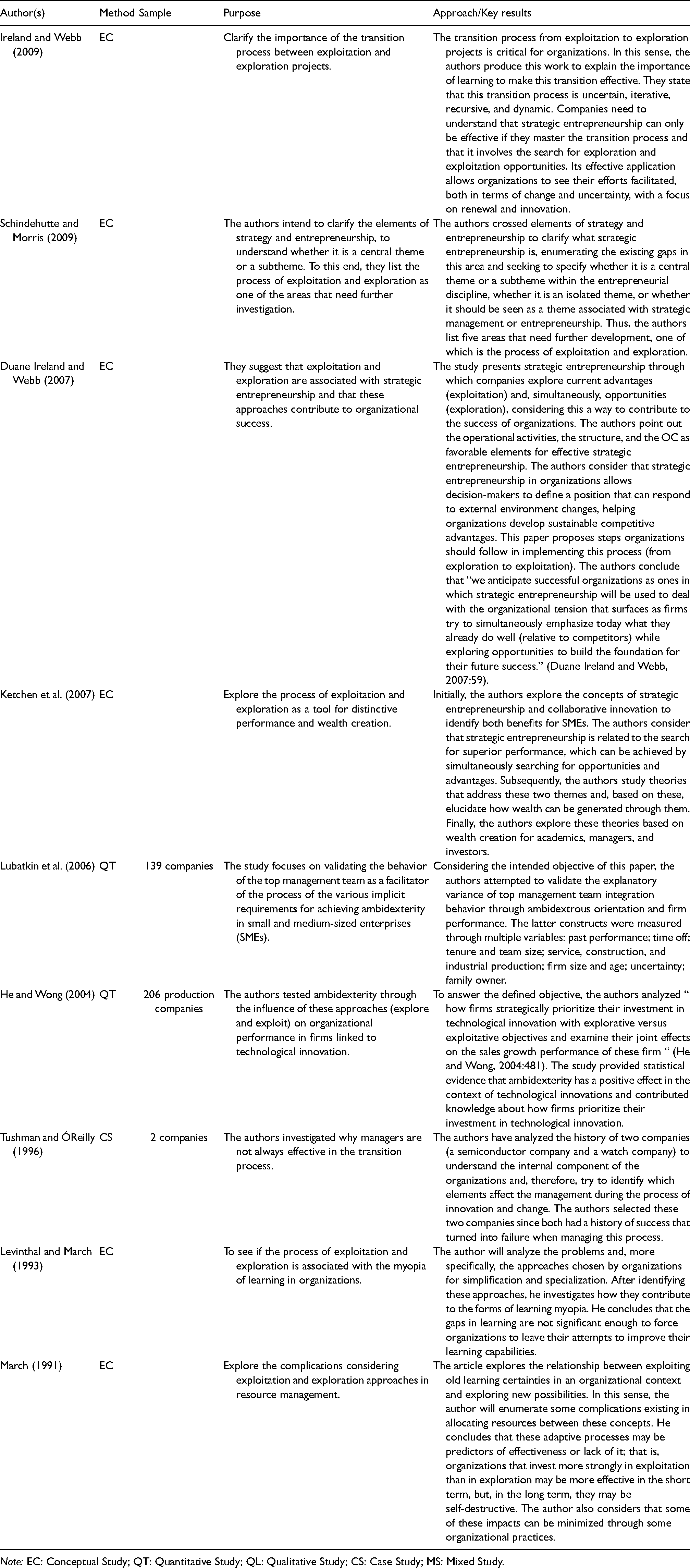
| Author(s) | Method | Sample | Purpose | Approach/Key results |
|---|---|---|---|---|
| Ireland and Webb (2009) | EC | Clarify the importance of the transition process between exploitation and exploration projects. | The transition process from exploitation to exploration projects is critical for organizations. In this sense, the authors produce this work to explain the importance of learning to make this transition effective. They state that this transition process is uncertain, iterative, recursive, and dynamic. Companies need to understand that strategic entrepreneurship can only be effective if they master the transition process and that it involves the search for exploration and exploitation opportunities. Its effective application allows organizations to see their efforts facilitated, both in terms of change and uncertainty, with a focus on renewal and innovation. | |
| Schindehutte and Morris (2009) | EC | The authors intend to clarify the elements of strategy and entrepreneurship, to understand whether it is a central theme or a subtheme. To this end, they list the process of exploitation and exploration as one of the areas that need further investigation. | The authors crossed elements of strategy and entrepreneurship to clarify what strategic entrepreneurship is, enumerating the existing gaps in this area and seeking to specify whether it is a central theme or a subtheme within the entrepreneurial discipline, whether it is an isolated theme, or whether it should be seen as a theme associated with strategic management or entrepreneurship. Thus, the authors list five areas that need further development, one of which is the process of exploitation and exploration. | |
| Duane Ireland and Webb (2007) | EC | They suggest that exploitation and exploration are associated with strategic entrepreneurship and that these approaches contribute to organizational success. | The study presents strategic entrepreneurship through which companies explore current advantages (exploitation) and, simultaneously, opportunities (exploration), considering this a way to contribute to the success of organizations. The authors point out the operational activities, the structure, and the OC as favorable elements for effective strategic entrepreneurship. The authors consider that strategic entrepreneurship in organizations allows decision-makers to define a position that can respond to external environment changes, helping organizations develop sustainable competitive advantages. This paper proposes steps organizations should follow in implementing this process (from exploration to exploitation). The authors conclude that “we anticipate successful organizations as ones in which strategic entrepreneurship will be used to deal with the organizational tension that surfaces as firms try to simultaneously emphasize today what they already do well (relative to competitors) while exploring opportunities to build the foundation for their future success.” (Duane Ireland and Webb, 2007:59). | |
| Ketchen et al. (2007) | EC | Explore the process of exploitation and exploration as a tool for distinctive performance and wealth creation. | Initially, the authors explore the concepts of strategic entrepreneurship and collaborative innovation to identify both benefits for SMEs. The authors consider that strategic entrepreneurship is related to the search for superior performance, which can be achieved by simultaneously searching for opportunities and advantages. Subsequently, the authors study theories that address these two themes and, based on these, elucidate how wealth can be generated through them. Finally, the authors explore these theories based on wealth creation for academics, managers, and investors. | |
| Lubatkin et al. (2006) | QT | 139 companies | The study focuses on validating the behavior of the top management team as a facilitator of the process of the various implicit requirements for achieving ambidexterity in small and medium-sized enterprises (SMEs). | Considering the intended objective of this paper, the authors attempted to validate the explanatory variance of top management team integration behavior through ambidextrous orientation and firm performance. The latter constructs were measured through multiple variables: past performance; time off; tenure and team size; service, construction, and industrial production; firm size and age; uncertainty; family owner. |
| He and Wong (2004) | QT | 206 production companies | The authors tested ambidexterity through the influence of these approaches (explore and exploit) on organizational performance in firms linked to technological innovation. | To answer the defined objective, the authors analyzed “ how firms strategically prioritize their investment in technological innovation with explorative versus exploitative objectives and examine their joint effects on the sales growth performance of these firm “ (He and Wong, 2004:481). The study provided statistical evidence that ambidexterity has a positive effect in the context of technological innovations and contributed knowledge about how firms prioritize their investment in technological innovation. |
| Tushman and ÓReilly (1996) | CS | 2 companies | The authors investigated why managers are not always effective in the transition process. | The authors have analyzed the history of two companies (a semiconductor company and a watch company) to understand the internal component of the organizations and, therefore, try to identify which elements affect the management during the process of innovation and change. The authors selected these two companies since both had a history of success that turned into failure when managing this process. |
| Levinthal and March (1993) | EC | To see if the process of exploitation and exploration is associated with the myopia of learning in organizations. | The author will analyze the problems and, more specifically, the approaches chosen by organizations for simplification and specialization. After identifying these approaches, he investigates how they contribute to the forms of learning myopia. He concludes that the gaps in learning are not significant enough to force organizations to leave their attempts to improve their learning capabilities. | |
| March (1991) | EC | Explore the complications considering exploitation and exploration approaches in resource management. | The article explores the relationship between exploiting old learning certainties in an organizational context and exploring new possibilities. In this sense, the author will enumerate some complications existing in allocating resources between these concepts. He concludes that these adaptive processes may be predictors of effectiveness or lack of it; that is, organizations that invest more strongly in exploitation than in exploration may be more effective in the short term, but, in the long term, they may be self-destructive. The author also considers that some of these impacts can be minimized through some organizational practices. |
Note: EC: Conceptual Study; QT: Quantitative Study; QL: Qualitative Study; CS: Case Study; MS: Mixed Study.