




Abstract
Decolonial philosopher Sylvia Wynter theorises the human animal as formed by both bios and mythoi, or matter and meaning. This article adopts this ontological perspective to explore the effects of the COVID-19 crisis on UK self-employed women and women-owned businesses through an intersectional lens accounting for race, class and gender. We argue that unequal health outcomes from COVID-19 are not solely biological; rather, they are also the outcome of social inequalities. Drawing upon the Wynterian elaboration of Fanon’s work on sociogeny – the shaping of the embodied human experience by the norms of given society – to explain this phenomenon, we contend that the same inequalities emerging in health outcomes will be reflected in entrepreneurship and self-employment. Drawing on Labour Force Survey data for the past decade, we peer through the Wynterian prism of bios and mythoi to argue that marginalised entrepreneurs are likely to experience extreme precarity due to COVID-19 and so require targeted support.
Keywords
Introduction
The COVID-19 pandemic has generated widespread socio-economic challenges worldwide with particularly negative impacts upon the most vulnerable members of society. Unsurprisingly, women, people of colour, poor and working class people, and especially those situated at the intersections of these categories, are particularly susceptible to its effects. Women, particularly poor women, have always suffered from macroeconomic transitions to, and within, capitalist modes of production (Federici, 2004, 2018). Similarly, the lives of Black, Indigenous and people of colour have been considered expendable in the search for new sources of capital accumulation (Federici, 2019; Mills, 1997). This is evident within the contemporary manifestation of neoliberal–libertarian free-marketism (Klein, 2007) and the ‘Uberization’ of work (Abílio, 2017), in which the effects of social class are indelibly inscribed (Acker, 2000). Thus, in the context of the United Kingdom, part of the Global North, from which we write, it is not surprising that the effects of the virus and its responses are intersectionally gendered, raced and classed. This commentary develops an intersectional critique on the impacts of the pandemic on self-employed UK women and women-owned businesses.
Bios: gendered, raced and classed occupational health inequalities in light of COVID-19
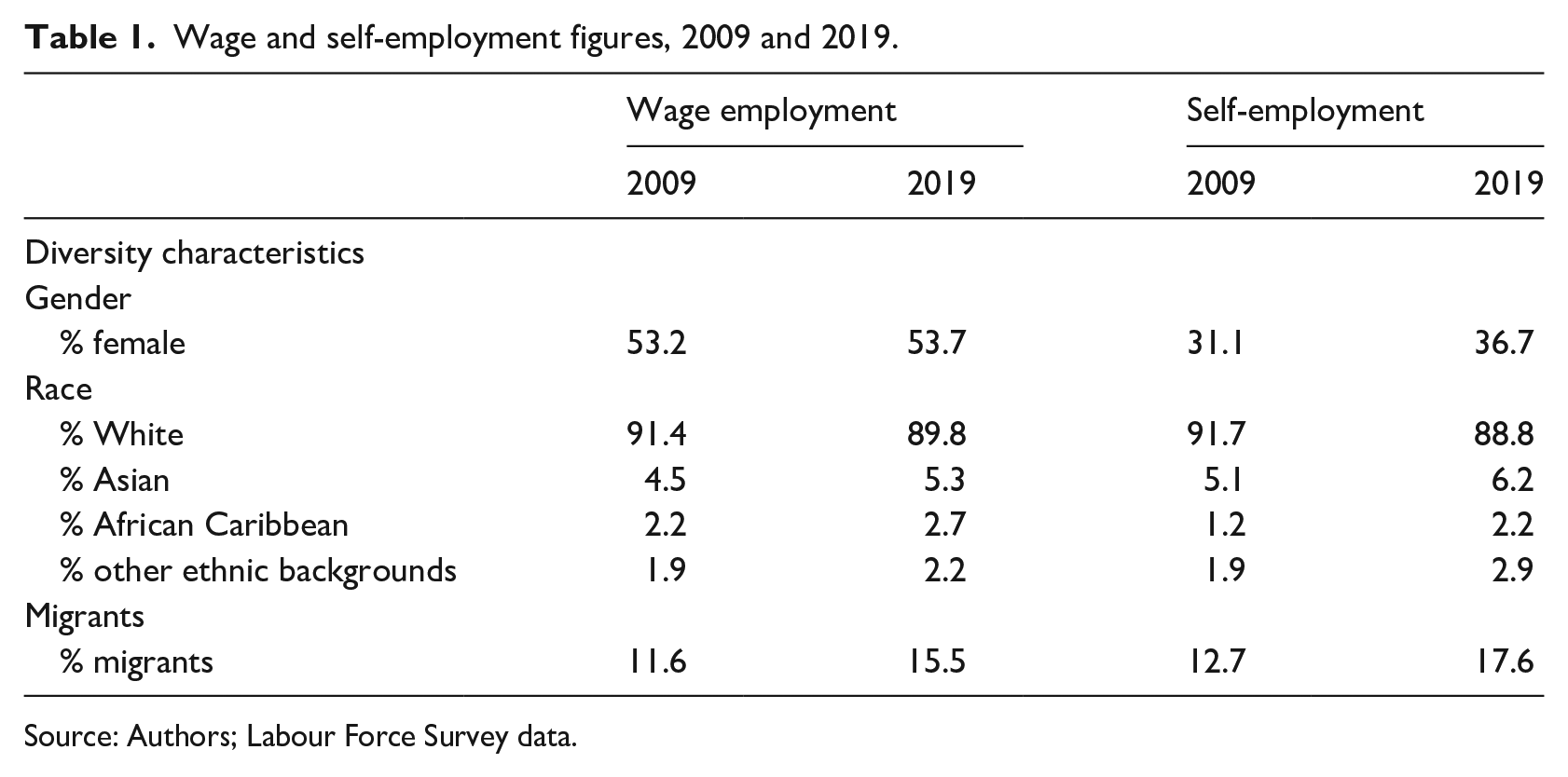
The differential effects of the virus on both the health outcomes and economic participation of various groups are stark. Although rates of infection are similar, men are dying at higher rates; however, women are adversely affected in other ways (Erickson, 2020). First, their overrepresentation in health, social care, education and service occupational sectors particularly in lower-paid, public-facing roles, where it is impossible to work from home, seem likely to precipitate exposure at greater rates to the virus itself (Wenham et al., 2020). Second, the blunt instruments of ‘stay home’ or ‘shelter in place’ orders and concomitant school closures have limited many women’s earning and productive capacity (Al-Dajani et al., 2020), due to their higher inputs into emotional and invisible reproductive and caring labour; additionally, home confinements have also precipitated a sharp rise in domestic violence (Chandan et al., 2020; Frederickson, 2020; Wenham et al., 2020). Women’s greater likelihood of exposure to the virus itself is a vulnerability shared with those from backgrounds of colour, typically referred to in the United Kingdom using the umbrella term of Black, Asian and Minority Ethnic (BAME). This highlights the importance of an intersectional perspective that accounts for the effects of multiple social categories simultaneously (Collins, 2019; Crenshaw, 1989). The disproportionately negative effects of COVID-19 on both women’s health and socio-economic participation, and that of women of colour in particular, are at this stage only beginning to be acknowledged (Erickson, 2020; Rodriguez, 2020). For example, women in the United States suffered 60% of job losses in March 2020 (Cahn, 2020). Intersectional inequality regimes (Acker, 2006; Healy et al., 2011) mean that many will be from BAME and working class backgrounds, given that these groups are overrepresented in the population of service workers in the lowest pay grades where jobs are most likely to be lost (Ewing-Nelson, 2020; Tinson and Aldridge, 2016). Applying this logic to the similarly stratified economic participation in entrepreneurial activity (Martinez Dy, 2020), this commentary suggests that for numerous reasons, women’s businesses, particularly those owned by women of colour and working class women, are most precariously positioned in the uncertain circumstances precipitated by the pandemic. Table 1 illustrates the growth in UK self-employment compared with wage employment (1) for all women, and (2) for Asian, African Caribbean, other minority ethnic groups and migrant groups, between 2009 and 2019.
Wage and self-employment figures, 2009 and 2019.
Source: Authors; Labour Force Survey data.
The work of decolonial philosopher Sylvia Wynter (1999) enables us to theorise multiple aspects of the COVID-19 phenomenon, as well as its specific relevance for the fields of small business and entrepreneurship. Building on the work of Franz Fanon, Wynter elaborates the idea of sociogeny, which suggests that there is no experience of human biology absent from sociology – in other words, that our ontological experience of humanness is inherently shaped by our subjective experience of social relations in the world. This is a fundamental principle underpinning the biopsychosocial approach to health (Clark et al., 1999; Epstein et al., 2004), and the field of epidemiology, which explores the impact of environmental factors on health and wellness. At the time of writing, the United States and United Kingdom are the nations with the highest number of deaths from COVID-19 (Financial Times, 2020). The groups most negatively affected are people of colour, with British BAME death rates more than twice as high (Siddique, 2020) and Black American death rates more than three times higher than that of White people (Pilkington, 2020). The racialised effects of the disease have been the subject of significant debate. In particular, there is disagreement on the extent to which the seemingly disparate causal mechanisms of genetic predisposition or social exposure seem to be more to blame for deaths caused by the virus (Cockburn, 2020; Devlin, 2020; Valdes, 2020). However, Fanon and Wynter’s work on sociogeny illuminates a fundamental interaction between the two, offering a theoretical basis for the ontology of structural racism as it manifests in the embodied health outcomes of marginalised populations, and explains the dramatic racial disparity in the negative effects of the COVID-19 virus.
Like experiences of health, experiences of work and entrepreneurship are not neutral but affected by social positionality (Alfrey and Twine, 2017; Berry and Bell, 2012; Villares-Varela, 2017). The self-employed comprise a smaller segment of the labour market than the employed (Moskalenko and Beresford, 2018; Wales and Agyiri, 2016), but one that is quickly growing. Regarding COVID-19 government support during the crisis, the self-employed were initially excluded from the measures announced by Chancellor of the Exchequer Rishi Sunak on 17 March 2020, with support eventually offered on 26 March 2020 (Holmes, 2020). A range of activities fall under the banner of ‘self-employed’, including sole proprietorship, running a business with employees (alone or with partners), agency, contract work and freelancing. Among these, financial returns are mixed, with many of the self-employed earning less than that of equivalent waged workers (Carter, 2011; Hamilton, 2000; Lambrecht and Beens, 2005); emerging evidence suggests that women and people of colour are overrepresented in categories where earnings tend to be lower (Martinez Dy et al., 2019). Non-pecuniary benefits are often cited as alternative compensation for poorer economic returns: for example, flexible working arrangements (Bender and Roche, 2016; Burke et al., 2002) which are deemed to be particularly attractive to women who continue to shoulder the greatest share of caring responsibilities (Watson and Pearson, 2016). Given that well-paid part-time employment is relatively rare, and the public sector which historically employs many women, especially women of colour, has been reduced in size and scope since 2008 (Emejulu and Bassel, 2015; McKay et al., 2013), self-employment presents a commonplace alternative to women’s part-time employment or labour market inactivity (Georgellis and Wall, 2005).
Consequently, UK women’s self-employment has grown substantially in the past decade due to a number of macrosocial, economic and technological factors, including the shrinking of the welfare state under austerity and the facilitation of entrepreneurial entry through digital technologies (Harding, 2007; Watson and Pearson, 2016). Women’s entrepreneurial entry is arguably responsible for self-employment comprising the only growth category in the UK labour market since 2010 (Moskalenko and Beresford, 2018). This reflects global trends in post-industrial nations transitioning to service sector economies and the emergence of feminised service businesses enabled through widespread use of mobile and other digital technologies. However, the persistence of gendered social norms and conditions mean that women’s entrepreneurial activity reflects their wider, disadvantageous participation in the labour market. As such, their entrepreneurial work is predominantly constrained to feminised sectors with low profit margins, such as childminding, teaching, cleaning, retail and hairdressing (Carter et al., 2015). Yet, while women’s self-employment historically tends to be in lower-value and more precarious service sectors (Joona, 2017), recent years have seen increased engagement by diverse women with higher levels of human capital entering high potential value digital entrepreneurial activity; nevertheless, they still face significant hurdles, such as access to social and external financial capital (British Business Bank (BBB), 2019b; Martinez Dy et al., 2018; Scott and Hussain, 2019).
The Black feminist concept of intersectionality (Cho et al., 2013; Collins, 2019; Crenshaw, 1989; Hancock, 2007) stresses that social categories do not operate in isolation, but simultaneously. As such, they shape experiences of entrepreneurship (Essers et al., 2010) in complex ways, affecting life course experiences and the pursuit and realisation of opportunities (see Jayawarna et al., 2014; Martinez Dy et al., 2017, 2018). Table 1 indicates that since the global financial crisis of 2008 and the subsequent imposition of austerity measures in the United Kingdom, there has been a rise in women’s self-employment overall, but notably, a marked rise in the self-employment rates of Black and Asian British women, and a proportional decrease in the self-employment rates of White British women (Table 1). This is consistent with findings from the United States that women of colour are driving self-employment (Ahmad, 2014). Our previous work has shown that the earnings constraints of social class add another dimension to this picture: analysing 2007 and 2017 Labour Force Survey data and using types of self-employment as proxies, we found an increase for BAME and decrease for White British self-employed in typically lower-potential value work, such as in agency work, sole directorship of limited companies, working for self and subcontracts (Martinez Dy et al., 2019). Conversely, categories that are typically higher value work, such as ‘partner in a business’, decreased for BAME but increased for White British self-employed; there was also an increase in Freelance work for Asian self-employed and other ethnic minorities, but a decrease for White British and African Caribbean (Martinez Dy et al., 2019). This pattern suggests that recovery from the financial crisis meant improved employment prospects for White British people, but not for many BAME individuals who entered precarious self-employment, a labour market position they are still likely to occupy as the COVID-19 crisis and forthcoming economic recession transpires.
Mythoi: the (extreme) marginality of women (of colour) in entrepreneurship and self-employment
Wynter’s work can also deepen our understanding of another aspect of the impact of COVID-19 on marginalised entrepreneurs: their omission from the process of consultation and the generation of support mechanisms by the British state. Wynter’s conception of human nature stresses the centrality of storytelling, or the creation of mythos (plural mythoi), to our species, enabling us to both interpret the world and organise ourselves as societies. She theorises that the notions of bios and mythoi, or the biological and the mythical, together constitute a ‘hybrid mode of being’ fundamental to the experience of humanity (Marine-Street, 2020: 17; Parker, 2018; Wynter and McKittrick, 2015). There is a well-established academic critique of such mythoi within the entrepreneurial domain, most visible in the hegemonic reification of the idealised entrepreneurial type as a White man, made wealthy due to business success, accompanied by the myth of meritocracy incumbent in the phenomenon (Ahl, 2006; Marlow and Martinez Dy, 2018; Ogbor, 2000). Yet, such rigorous academic critique has not destabilised the preponderance of these myths in everyday life. The combined effect of the mythic construction of the heroic White man entrepreneur, assumptions about his undue influence on the accumulation of capital, and the presumably meritocratic nature of the activity (Kirzner, 1973; Schumpeter, 2010), mean that the entrepreneurial activity of those who exist as ‘Other’ become invisible: women, people of colour, poor, working-class, disabled and lesbian, gay, bisexual, transgender, queer, intersex and asexual (LGBTQIA) self-employed and entrepreneurial individuals. The scale and variety of entrepreneurial activity in which they engage is generally marginalised and overlooked in the public – and academic – imaginations.
The result is that the entrepreneurial domain, overly influenced by the mythoi of ‘the entrepreneur’, has historically not attended to the impact of bios on entrepreneurial activity, uncritically adopting an abstract Western conceptualisation that ignored the impact of context, let alone historical inequality and disadvantage (Imas et al., 2012; Lippmann et al., 2005; Martinez Dy, 2020; Welter, 2011). Entrepreneurship is undertaken not by abstract or generic – that is to say, implicitly White and male (Mills, 1997; Wynter, 1999) – actors, but by differently embodied individuals and groups; such embodiment has impacts at all stages of their pursuit of opportunities. Considering bios and challenging hegemonic mythoi in this way opens up new avenues for exploration of the phenomenon as it currently exists. For example, evidence from the UK Labour Force Survey suggests that while White British entrepreneurial activity has proportionally decreased in the past decade, entrepreneurship by marginalised groups, including Asian, African Caribbean and immigrants, has increased (Table 1). Evidence from the British Business Bank (BBB) suggests at least some of the activities of diverse entrepreneurs are being externally funded, albeit with small loans: since 2012, the BBB start-up loans programme has issued loans averaging £7823 to more than 60,000 businesses, the recipients of which were 40% women and 22% BAME (BBB, 2019a).
Yet, for higher value entrepreneurship, much of which is located within the fields of digital start-up and technology, that diversity of entry is simply not present: in the United States, Black women founders receive only 0.02% of venture funding, while in the United Kingdom, all female investment teams receive 4% of all deals; a dearth of data still exists around racial diversity in UK start-ups (BBB, 2019b; YSYS, 2020). However, in a context that purports to be both post-feminist (Lewis, 2014; McRobbie, 2009) and post-race (Mirza, 2015) and, therefore, uniformly meritocratic, we see a continuation of gender- and race-blind policy that does not take such disparities into account – for example, the COVID-19 support mechanism targeted at technology start-ups, the Future Fund, will be available only to founders already in receipt of at least £250,000 external funding, which greatly restricts the diversity of those who will be able to access it (Warner, 2020a, 2020b; YSYS, 2020). It is a historical feature of the entrepreneurial landscape that groups who are socially marginalised and structurally disadvantaged turn to self-employment when the labour market contracts. Such groups include women, both White and non-White, BAME people, immigrants, poor and working class people, LGBTQIA+, disabled people, sex workers, those who have been institutionalised or imprisoned, and more. Moreover, intersectionality theory allows us to infer that people at categorical intersections, such as Black and women of colour from poor and working class backgrounds, are likely to be the most structurally disadvantaged. It is this same persistent system of disadvantage that has generated disparate health outcomes of COVID-19 along racial lines, and from which these marginalised groups will continue to suffer economically, likely for years to come.
Notable risk factors for self-employed people include whether their work is part-time or full-time, whether they claim benefits, whether they are self-employed or if they run a business with employees and whether they are based in the home. Any combination of the former of each of these pairs indicates that a business has an increased likelihood of being small and growth-constrained and so more at risk during a crisis such as COVID-19. Figure 1 illustrates an intersectional analysis of the differential effects of race, class and gender for self-employed people. It is evident that the presence of risk factors is greater among women in general, and most prevalent among working class BAME women.
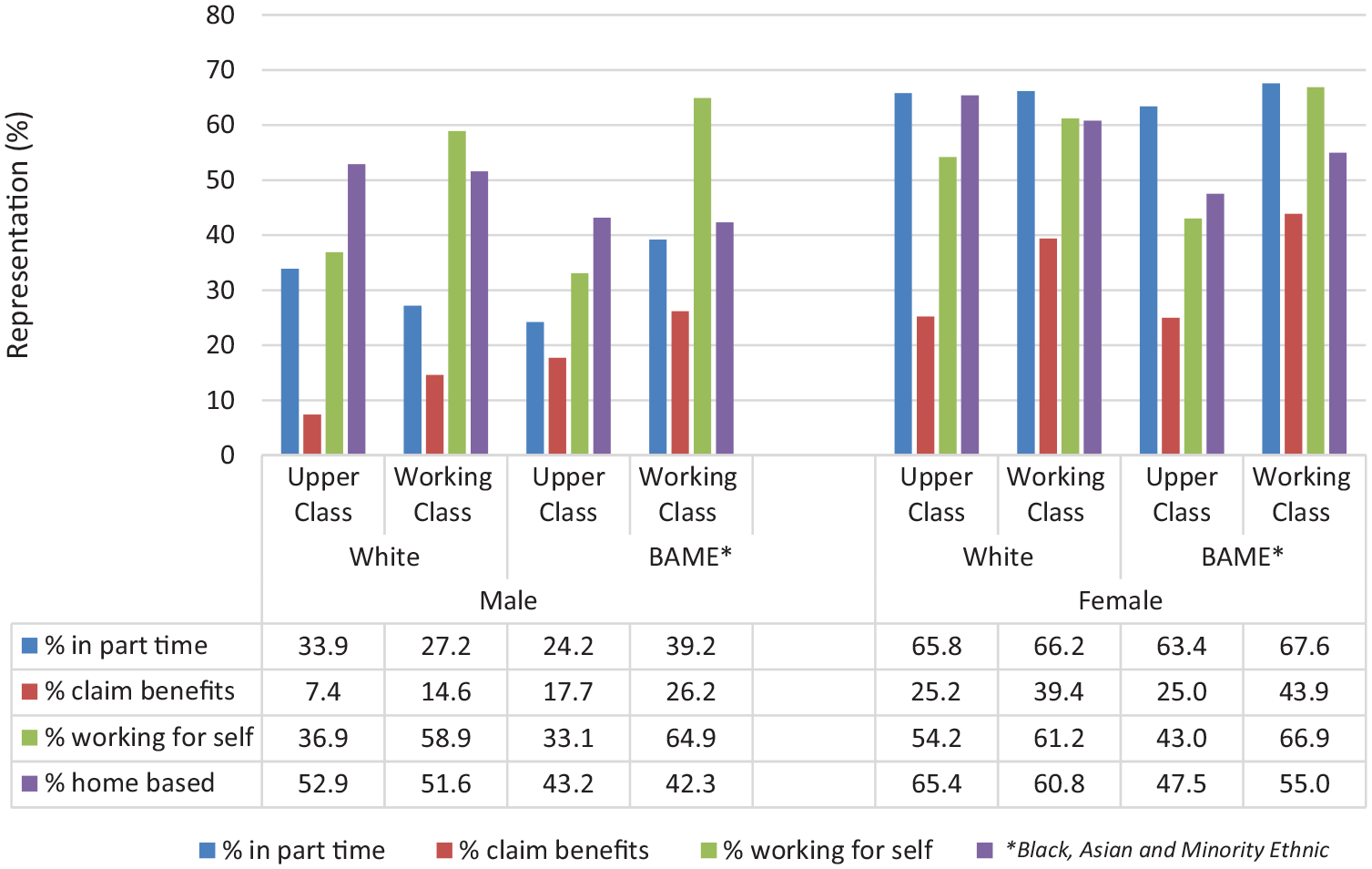
Intersectional representation of gender, race and class in UK self-employment (2019).
To understand the impact of COVID-19 on self-employed women and women-owned businesses, we must attend closely to bios. This means examining the impact of not only the embodiment of the entrepreneurs themselves but also the dimensions of embodiment, in contrast to the dimensions of digitisation or virtuality, inherent in the goods and services they provide. Those with businesses that have higher degrees of digitisation (McAdam et al., 2019; Martinez Dy, 2019; Von Briel et al., 2018), or are otherwise more able to be run remotely, will be at a clear advantage. While high-tech founders tend to have class privileges and also overwhelmingly tend to be men, lower barriers to entry via digital technologies and social media have opened new avenues for women’s entrepreneurial activity, particularly in the creative industries – nonetheless, such work has been found to reproduce traditional offline inequalities (Duffy and Pruchniewska, 2017; Gill, 2014). Beyond levels of digitisation, how women-owned digital businesses fare during the crisis could vary greatly, depending on the sector, how well established they are and if they are able to adapt. Nonetheless, their proprietors may still be encountering the increased social reproduction tasks, intensification of household labour imbalances and/or additional needs for income generation that the crisis has prompted for differently positioned women around the globe (Dattani, 2020).
Traditionally feminised service sectors, such as education, social care and cleaning, are not only impossible to digitise, but in recent decades have been converted from public sector employment to agency-based work, now falling under the banner of self-employment. As such, they command lower salaries with decreased access to employment benefits like sick and holiday pay (Cunningham, 2014), which will have negative implications at all times, but especially during a pandemic. Immigrant women of colour domestic workers who comprise a socially invisible, feminised chain of care are particularly vulnerable, losing work opportunities, income and possibly immigration permissions, while rates of violence and abuse increase (Al-Dajani et al., 2020; Dattani, 2020; Nighoskar, 2020). Activist women of colour are also likely to found and manage small organisations with social missions that respond to community needs (Emejulu and Bassel, 2015). Emerging research by The Ubele Initiative shows that many BAME organisations serve vulnerable groups such as children and young people, elderly, homeless and disabled populations, and that the majority do not have sufficient reserves to sustain them for even a month (Murray, 2020). This suggests that the COVID-19 pandemic puts them at the greatest risk of closing, with detrimental implications for the communities they serve.
A particularly stigmatised sector, traditionally presumed to be ‘women’s work’, that has received scant attention in the self-employment and entrepreneurship domain is sex work. In its contemporary form, it includes both offline and online elements (Jones, 2016) but has been much overlooked in the literature on digital entrepreneurship and the digital economy. Murphy and Hackett (2020) point out that the case of sex work in many ways reflects the precarious conditions of the gig and informal economy more widely, as it is shaped by the same conditions – austerity, benefit cuts, rising rents, job insecurity, zero hours contracts and exponentially increasing student debt – and the pandemic affects it in a similar way, decimating the availability and safety of in-person work, and excluding many workers from government support packages because of the fluctuating incomes of this type of self-employment. While, in response to the enforced home confinement, many people have turned to digital sex work – the paid adult platform OnlyFans saw a 40% increase in content creators during the March 2020 – this entrepreneurial entry is not simple, as it could require learning a completely new skill set; simultaneously, established content creators face increased competition from the sudden spike in new entrants (Stein, 2020). Only by altering our mythoi to include historically marginalised sectors and entrepreneurial workers can we ascertain a more accurate picture of the digital economy in this moment of extreme crisis, begin to understand how such individuals are experiencing, responding to and changing the self-employment landscape, and design effective policy interventions to support their recovery in the months and years to come.
Conclusion
In this highly uncertain historical moment, one that author Arundhati Roy frames as a portal, or a ‘transit lounge [in which] we don’t really have a present’ (Roy and Crenshaw, 2020), our dominant mythoi have the potential to be transformed by calling attention to our bios, and to the sociogeny that shapes our differential experiences of health, labour and technology. Emily Anne Parker (2018), in her exploration of Wynter’s work (p. 447), identifies that historically, the mythos of the human was contradictory: ‘he’ is ‘a natural organism that is also master of the natural. He is and he is not bodily’. She argues that the colonial, capitalist political systems that evolved according to this mythos sought to attain an ‘unfelt bodily status’, such that concerns of the body, or relatedly, of the embodiment of ecology, ‘are at best a liability’ (Parker, 2018: 447). Not only does this mythic rejection of embodiment resonate with the circumstances of the essential and frontline workers, whose bodies are not sufficiently protected from viral exposure, but also with the expectations for the middle classes to work from home, carrying on productive activities as normal through disembodied means. Legal scholar Ariadna Estévez (2020) posits that the pandemic is bringing about a new mode of production, following Fordism and Toyotism, a disciplining governmentality aimed at the achievement of productivity-in-place, which she terms Zoomism. In contrast to the violent ways in which the bodies of migrants are managed, she suggests the global middle classes are generating a microeconomy of self-enclosure, controlling our mobility while continuing patterns of economic production and consumption (Estévez, 2020). The picture of such a ‘touchless’ future is also painted by Naomi Klein (2020) in what she calls the ‘Screen New Deal’, or covert moves currently being made by the Silicon Valley tech giants, and the foundations they fund, to accelerate and profit from the normalisation and expansion of the COVID-19 ways of working, centred around home delivery, streaming technology, and data mining – disaster capitalism at its finest.
Yet, at the same time, ideas stemming from feminist economics and feminist ecologies (Federici, 2019; Pettifor, 2018; Shiva, 2020) are currently being mobilised and manifested through global activism in the form of, for example, the #FeministBailout campaign (AWID, 2020) that seeks to demand of the state and of industry the accurate valuing and compensation of women’s work and labour. As scholars of management, organisation and entrepreneurship studies, we have a key role to play in the recovery and repair efforts from the COVID-19 crisis. This begins with the recognition that to date, our uncritical reproduction of abstract disembodied, extractivist ideologies has underpinned the unabated racial capitalism (Leong, 2013; Robinson, 2000) that has led to such disastrous outcomes. Now is the time to challenge our historical amnesia (Dar et al., 2020) and to explore and adopt alternative economic systems based around such ancient principles as protection of the commons, an ethics of care, interspecies interdependency and the periodic redistribution of wealth (Federici, 2019: 80; Haraway, 2016; Mussell, 2016). By establishing ring-fenced funding for marginalised entrepreneurs and targeted crisis management support, we acknowledge their contributions and demonstrate their importance to society, making sure no one is left behind (Murray, 2020; Roy et al., 2020; Warner, 2020a). Such an approach requires an imaginative shift in which we adopt anti-racist, intersectional feminist responses to social problems, aiming to generate more equal sociogenetic outcomes. It is not only the welfare of the self-employed, but also the future of our species, that depend on it.
Footnotes
Acknowledgements
A.M.D. would like to deeply thank Professor Emerita Sylvia Wynter for her lifelong contributions to decolonial theory, as well as Alexis Pauline Gumbs, Anamika Misra and Kathryn Yusoff for their scholarly and poetic introductions to Wynter’s powerful work.
Funding
The authors received no financial support for the research, authorship and/or publication of this article.
