




Abstract
We evaluate whether the theory of effectuation provides – or could provide – a powerful causal explanation of the process of new venture creation. We do this by conducting an analysis of the principal concepts introduced by effectuation theory. Effectuation theory has become a highly influential cognitive science-based approach to understanding how nascent entrepreneurs start businesses under conditions of uncertainty. But by reducing the process of venture creation to a decision-making logic, effectuation theory pays insufficient regard to the substantial, pervasive and enduring influence of social-structural and cultural contexts on venture creation. Powerful explanations should conceive of venture creation as a sociohistorical process emergent from the interaction of structural, cultural and agential causal powers and must be able to theorise, fallibly, how nascent entrepreneurs form particular firms in particular times and places. We conclude that effectuation’s contribution to entrepreneurship scholarship is more limited than its advocates claim because it can offer only an under-socialised, ahistorical account of venture creation. Failure to theorise adequately the influence of structural and cultural contexts on venture creation implicitly grants nascent entrepreneurs excessive powers of agency.
Introduction
We evaluate whether the theory of effectuation provides – or could provide – a powerful causal explanation of the process of new venture creation. We do this by conducting an analysis of the principal concepts introduced by effectuation theory. Effectuation theory offers a cognitive science-based approach to understanding how entrepreneurs start businesses under conditions of uncertainty (Sarasvathy, 2001a, 2008). 1 In a series of publications, the founder of the approach, Sarasvathy, and her principal co-authors, Dew, Read and Wiltbank, argue that effectuation is a form of entrepreneurial expertise (Read et al., 2009a; Read and Sarasvathy, 2005), a decision-making logic that constitutes a clear basis for action in the world (e.g. Dew et al., 2008; Sarasvathy and Dew, 2005a). We choose to focus on the theory of effectuation for three reasons. First, effectuation theory has become a highly influential account of new venture creation in recent years as conceptual and applied studies have proliferated; Alsos et al. (2019) identify 618 works related to effectuation published between 1998 and 2016. Second, effectuation theory, in our view, suffers from a flawed assumption common to much entrepreneurship research: that of the under-socialised ‘heroic’ entrepreneur as the instigator of new business ventures (e.g. Armstrong, 2005; Drakopolou Dodd and Anderson, 2007; Johnsen and Sørensen, 2017). Our critical examination of effectuation theory therefore constitutes a critique of a wide range of work founded on the assumption that entrepreneurs possess excessive powers of agency. A third reason is that, despite the widespread diffusion of effectuation ideas (Grégoire and Cherchem, 2019), they have been subject to limited critical scrutiny.
Arend et al. (2015, 2016) have perhaps been the most vocal critics of effectuation, claiming that it is under-developed as a new theory of entrepreneurship. They maintain that effectuation emphasises description rather than explanation, fails to build on prior research and lacks a clear specification of context. We agree with this assessment but go further by arguing that effectuation theory does not, and cannot, explain venture creation fully because it under-theorises the influence of context. The importance of contextualisation for explaining entrepreneurial action is now well recognised (Baker and Welter, 2018; Welter, 2011; Welter and Gartner, 2016; Zahra et al., 2014). Venture creation is necessarily both an agent- and a context-dependent process (Davidsson, 2006; Gartner, 1985; Kessler and Frank, 2009). Entrepreneurs necessarily start businesses in particular sociohistorical contexts that make start-up possible. Powerful theory must explain the effects of social context on the perceptions and actions of entrepreneurs as the venture-creation process unfolds (Edelman and Yli-Renko, 2010). Effectuation theory, however, lacks a robust conception of social context. We seek to contribute to recent debates on contextualisation by foregrounding issues of social ontology and by distinguishing, and elaborating, two dimensions of social context – structure and culture – in critiquing effectuation theory. This requires reflection on issues of social ontology and conceptualisation of structural and cultural influences on processes of venture creation.
All research, including reviews of secondary sources, is informed by particular ontological commitments (Archer, 1995; Bhaskar, 1979); such assumptions are non-optional (Fleetwood, 2005). There is no way to think or talk about social reality without committing oneself, metaphysically (Groff, 2016). Whether researchers state their assumptions explicitly, or leave them implicit, they influence research practice profoundly, shaping conceptions of the social objects 2 studied – here, venture creation – the methods used to study them, and modes of data analysis. Failure to make ontological commitments explicit only leads to their reintroduction, without proper acknowledgement and justification, in analysis, interpretation and explanation.
Our evaluation of effectuation theory is informed by critical realist philosophy of science (Archer, 1995; Bhaskar, 1979; Collier, 1994; Elder-Vass, 2010a; Fleetwood, 2005; Groff, 2004; Lawson, 1997; Porpora, 2015; Sayer, 1992, 2000). Critical realism entails specific ontological assumptions about the nature of the social world, licencing social scientific theories that are consistent with them, while facilitating criticism of theories that are inconsistent (Bhaskar, 1978). Critical realism supports explanations of venture creation organised around a structure/agency framework (Bhaskar, 1979; Lawson, 1997; Sayer, 1992). We distinguish culture from social structure in order to propose a structure/culture/agency framework (Archer, 1995, 2013; Elder-Vass, 2012). To capture the interaction of structure, culture and agency through time, researchers must develop sociohistorical explanations of new venture creation that explain the formation of particular firms in relation to emergent social and temporal contexts.
Our examination of effectuation theory is explicitly conceptual. We interrogate the aims and core concepts of effectuation theory and identify both omissions and flaws. This enables us to point the way towards superior explanations of the venture-creation process. Concepts demarcate the parameters for empirical studies conducted under the effectuation banner by directing research attention towards particular issues while marginalising or omitting others. We question, as others have done (Grégoire and Cherchem, 2019), whether effectuation theory can explain fully why entrepreneurs act as they do. We do not offer a comprehensive review of applied effectuation research; nor do we seek to replace effectuation with a new theory of venture creation. Rather, we see our work as laying a platform for new theories that address the conceptual deficiencies of effectuation theory. Specifically, we argue that effectuation theory fails to theorise adequately the influence of social context on venture creation and, using the lens of critical realism, propose a framework of structural and cultural influences that, we believe, rigorous explanations of new venture creation require.
The article is organised as follows. The next two sections set out our critical realist standpoint in detail, committing us to a social world possessing particular properties and powers, and proposing particular conceptions of social structure and culture. We then present Archer’s (1995) morphogenetic framework connecting structure, culture and agency, demonstrating how this supports theorising of new venture creation as an emergent sociohistorical process. The next section sets out our methodological approach, justifying the focus on the core effectuation concepts. We then set out the theory of effectuation. The following two sections discuss the aims and pragmatist philosophical commitments claimed to underpin effectuation theory. Clarifying aims is necessary to rebut arguments that we misunderstand the purpose of the theory and consequently that our criticisms miss their target. We find effectuation theory’s aims ambiguous, a confusing combination of design, description, explanation and, implicitly, prescription. Next, we demonstrate that effectuation theory incorporates contradictory ontological assumptions. This is a consequence of the failure to be explicit about them. We then address the central question of whether effectuation theory is able to explain particular cases of venture creation and contrast the accounts provided by non-effectuation studies; we find that non-effectuation studies often provide deeper insights into structural and cultural influences on venture creation. We conclude that effectuation’s failure to theorise the influence of social context on venture creation adequately means that it can offer only an under-socialised, ahistorical account that implicitly grants nascent entrepreneurs excessive powers of agency.
Introducing critical realism: ontology, theory, causal explanation
Bhaskar’s (1979) conception of a stratified social ontology (‘depth realism’) has underpinned the theoretical and applied work informed by critical realism (e.g. Cruickshank, 2003; Edwards et al., 2014; López and Potter, 2001). This ontological standpoint proposes a structure/agency framework to support social science theorising, one that distinguishes the powers of human agents from the powers of the social contexts within which they act (Bhaskar, 1979). Bhaskar distinguishes three distinct strata in the social world. 3 One is the empirical level, referring to the experience of agents: beliefs, perceptions and intentions. The second is the actual level, referring to the social events, actions, practices and processes that actually occur. The third is the real (or deep) 4 level, referring to the emergent causal powers and generative mechanisms that produce events such as venture creation (actual level) and experience of entrepreneurs of those events (empirical level). Drawing on Bhaskar, we conceptualise the deep level in terms of social-structural and cultural powers that impact agents by shaping the situations they confront, facilitating or frustrating the formulation and pursuit of agential projects (Archer, 1995). Causal powers and mechanisms are not directly visible and are identifiable only by their effects on events (Danermark et al., 2001; Sayer, 1992). Structural and cultural powers only exert their effects through the actions of human agents; people are the efficient causes of social events, mediating the effects of structure and culture (Bhaskar, 1979).
Social structures are the durable patterns of social relations, the relationally emergent products of human interaction that generate the material circumstances, positions and relations within which agents must act, and which are reproduced and transformed historically over time (Bhaskar, 1979; Fleetwood, 2008; Lawson, 1997; Porpora, 1989; Smith, 2010). Structure refers to the necessary relations of causal interdependence connecting particular social positions (Sayer, 1992), for instance, market buyer and seller, creditor and debtor, landlord and tenant, employer and employee. Social structures possess causal powers autonomous from the agents who currently occupy particular positions within those structures. As a consequence of their structural positioning, agents become the bearers of specific causal powers to be able to do certain things, for instance, having access to particular resources, or of liabilities to suffer certain things. Social structures vary in terms of scale, the powers and liabilities to which they give rise, whether they are emergent from other structures and whether agents can opt in or out of them, or of their consequences.
Structures include those agents are born into, such as socio-economic class, gender and race/ethnicity, and those agents join in later life, such as organisations (Edwards et al., 2014), markets (Elder-Vass, 2009) and households (Carter et al., 2016; Meliou and Edwards, 2018); we stress these are only examples of social structures, many others may also be important. Social structural positions enable agents to pursue particular projects or constrain them from doing so (e.g. Vincent et al., 2014). Material relations of resource inequality, autonomy and dependence enable and constrain activities (Porpora, 1993). Positionality dynamically affects life chances, access to resources and the capacity to exercise agency (Martinez Dy and Agwunobi, 2018; Martinez Dy et al., 2014). Entrepreneurs, like all persons, are simultaneously positioned within multiple, intersecting social structures and move through them across the life course, accumulating or shedding material and cultural resources (Jayawarna et al., 2013, 2014; Martinez Dy et al., 2017).
Culture refers to the social norms that possess the power to influence how agents think, speak and act (Elder-Vass, 2012). Agents are positioned variably in relation to particular norms, for instance, those relating to gender. Cultural positioning furnishes agents with vocabularies to describe and legitimise particular projects and practices (Lee et al., 2019). Agents themselves may be unaware of the embeddedness of their personal beliefs and motivations in a deeper normative context that shapes cognition and action un-self-consciously or habitually (Fleetwood, 2008; Porpora, 2015). Entrepreneurs act on the basis of impulse-driven behavioural logics as well as deliberative reasoning (Lerner et al., 2018). Norms encourage nascent entrepreneurs to start new ventures, or particular kinds of venture – for example, particularly positioned women to start businesses in ‘feminised’ sectors (Carter et al., 2015) – and also influence their capacity to achieve legitimacy by shaping stakeholder perceptions and expectations (Fisher et al., 2017; Tornikowski and Newbert, 2007).
The social world is an open system, with multiple structural and cultural powers contributing to the production of social events. The connection between the causal powers of social objects, actual events and the experience of agents is therefore non-deterministic (Bhaskar, 1978, 1979). Structural and cultural powers are capacities, or potentials, for particular events such as venture creation to occur, but they require agents to activate them, whether intentionally or inadvertently (Archer, 1995; Collier, 1994; Lawson, 1997). Such powers may or may not be activated by agents or, if activated, interact with other activated powers to generate different events; and events may or may not be experienced/observed either by the agents studied or by researchers. For instance, when entrepreneurs activate property rights to engage in trade with the aim of generating a profit, this does not guarantee they will make a profit. Customers, suppliers and competitors also activate their powers to pursue their own projects which may facilitate or hamper the entrepreneur’s capacity to achieve a profit.
Adopting a stratified ontology of powers, events and experience enables researchers to avoid two problems. One is voluntarism, where events are explained solely in terms of the motivations of agents without reference to the social contexts that make those events possible. The second problem is determinism, where events are explained solely in terms of contextual forces, ignoring the capacities of agents to reflect on their circumstances and to act otherwise. Critical realist philosophy therefore supports process explanations of venture creation (Bhave, 1994; McMullen and Dimov, 2013) that place a reflexive, creative entrepreneurial agent in potent structural and cultural contexts that influence, but do not determine, what they do.
The purpose of social science theory, in our view, is to explain how social events such as new venture creation occur. Critical realist social science proposes theoretically informed and empirically substantiated, though fallible, explanations of social events (Brannan et al., 2017).
Causal explanation requires description of explanatory powers, narratives of the contingent conjunctures of powers and adjudication between rival explanations (Porpora, 2015). This explanatory task requires a three-stage process of conceptualising events; retroducing, or hypothesising, the causal powers (structural, cultural and agential) argued to have generated those events; and seeking relevant empirical data to corroborate the argument proposed (Bhaskar, 1979; Danermark et al., 2001; Hu, 2018; Sayer, 1992). Critical realist philosophy typically treats social events as multiply-determined, involving agential, structural and cultural powers, but it privileges no particular causal power a priori in the explanation of particular cases (Archer, 2013). These are social scientific, not philosophical, matters for researchers to investigate and debate.
Theorising new venture creation as a sociohistorical process
Taking a critical realist standpoint, we conceptualise venture creation as a sociohistorical process emergent from the interaction of agential, structural and cultural powers. Entrepreneurship and small business researchers must therefore theorise how particular powers interact to create particular new ventures. We draw on Archer’s (1995) morphogenetic approach to support theorising of the process of venture creation. Archer conceptualises the relationships between structure and agency and between culture and agency in terms of morphogenetic cycles that specify how structure, culture and agency emerge, intertwine and redefine one another through time. Morphogenetic cycles are composed of three analytical phases: structural (or cultural) conditioning of agency, interaction and structural (or cultural) elaboration consequent to interaction. 5 The endpoint of each cycle of conditioning, interaction and elaboration constitutes the starting point for the next cycle. In practice, conditioning, interaction and elaboration occur continuously in relation to each structural and cultural context that entrepreneurial agents inhabit. Researchers must populate the morphogenetic framework with specific structural, cultural and agential powers, specifying how they interact to explain particular instances of venture creation.
Structural and cultural contexts condition, but do not determine, new venture projects of entrepreneurs, for example, activities such as investing personal savings, securing finance from external investors, hiring employees or developing a product (e.g. Carter et al., 1996; Newbert, 2005). From birth, individuals are enmeshed in intersecting structural and cultural contexts that shape the life course, including the capacity to start a business (Galloway et al., 2019; Jayawarna et al., 2013, 2014; Jones et al., 2014; Kitching and Rouse, 2017; Martin and Wilson, 2014). Entrepreneurs conceive of, and attempt to actualise, new ventures in circumstances that predate their actions, are largely not of their own making and which often resist their efforts to transform them just as they wish. Nascent entrepreneurs always possess a degree of discretion to act otherwise because structural influences impart contradictory pressures (Luke and Bates, 2015) and because entrepreneurs are positioned variably in relation to structural and cultural contexts that impinge upon new venture projects in diverse ways (Forson, 2013; Knight, 2016; Martinez Dy et al., 2014, 2018). Social contexts are irreducible to interpersonal relations between nascent entrepreneurs and stakeholders. Starting a business presupposes a much wider structural and cultural context that makes the process possible, for example, a legal system supporting property and contract rights and a normative environment that legitimises commercial trading.
The structurally- and culturally-conditioned activities of nascent entrepreneurs contribute, by design or by accident, to the elaboration of structural and cultural contexts over time, reproducing or transforming social positions, relations and norms (Archer, 1995; Elder-Vass, 2012; Lawson, 2013). Markets, for instance, vary in terms of structural properties such as the level and type of competition; these are partly – but only partly – a consequence of the focal entrepreneur’s own investment, buying and selling activities. Dynamic market processes change what particular entrepreneurs find it possible to do. Market entrants can drive up the productivity of incumbent firms (Fritsch and Changoluisa, 2017), which is likely to influence how the entrepreneur’s new venture performs in future. These structural properties of markets exist only because of prior interactions between buyers and sellers, but they are not properties of entrepreneurs themselves (Elder-Vass, 2009).
Critical realism is a philosophy for, as well as of, social science because it directs attention to what should be included in a powerful explanation. Applying the morphogenetic framework permits critical scrutiny of accounts of new venture creation and, in particular, the conceptualisation of the contextual conditions that make venture creation possible. We might ask whether the theory of effectuation provides an adequate causal-explanatory framework: does effectuation theory incorporate structural and cultural influences on venture creation? Or, does it omit or marginalise them? We use critical realist ontological commitments to evaluate effectuation accounts of venture creation.
Methodological approach: analysing effectuation concepts
To evaluate effectuation theory as a causal-explanatory framework for new venture creation, we conduct an analysis of the theory’s aims and core concepts. Our primary sources are Sarasvathy (2001a), which introduced the term effectuation in a major academic journal, and Sarasvathy (2008), a book discussing the primary effectuation concepts, methods and data used to generate the concepts and the pragmatist philosophy argued to underpin effectuation. We also draw on conceptual works that discuss a range of overlapping issues, including the nature of entrepreneurial expertise (Dew et al., 2009a, 2018; Read and Sarasvathy, 2005; Sarasvathy, 2001b); alternative logics of decision-making (Sarasvathy and Dew, 2005a); the distinctive character of effectual reasoning (Dew et al., 2009b; Sarasvathy and Wiltbank, 2010); the creation of new firms and markets (Sarasvathy, 2001a, 2004a; Dew et al., 2011; Dew and Sarasvathy, 2016; Sarasvathy and Dew, 2005b); firm/organisation design (Sarasvathy, 2004b, 2012; Sarasvathy et al., 2008); a behavioural theory of the entrepreneurial firm (Dew et al., 2008), and the implications of effectuation concepts for strategic management (Venkataraman and Sarasvathy, 2001), innovation (Dew and Sarasvathy, 2007) and marketing (Read et al., 2009b). Two editions of a textbook illustrate the core concepts using real-life examples (Read et al., 2011, 2017). As Arend et al. (2015) note, there is considerable repetition of theoretical content across publications.
We focus on the core concepts of effectuation theory rather than applied effectuation research for two reasons. First, it is adherence to the conceptual core that distinguishes applied effectuation studies of venture creation from non-effectuation studies. Second, applied effectuation studies simply operationalise the core concepts (Brettel et al., 2012; Chandler et al., 2011); apply, or test, the core concepts (e.g. Bhowmick, 2011; Dew et al., 2015; Jiang and Rüling, 2019; Parida et al., 2016; Reymen et al., 2015; Sarasvathy and Kotha, 2001); or present secondary analyses (Fisher, 2012; McKelvie et al., 2019; Mansoori and Lackéus, 2019; Matalamäki, 2017; Mauer, 2014; Perry et al., 2012; Read et al., 2009a; Welter et al., 2016). 6 Some researchers have proposed minor modifications to effectuation concepts while retaining the basic framework (e.g. Bhowmick, 2011; Daniel et al., 2015; George et al., 2016; Martina, 2019; Nielsen and Lassen, 2012). As applied studies do not theorise structural and cultural influences on venture creation explicitly, discussing them would add no value to our conceptual analysis. We therefore focus our critique on effectuation concepts and ask whether they fully explain – or even could fully explain – venture creation.
Sarasvathy (2008: chapter 13; see also Alsos et al., 2019; Read et al., 2016) has invited researchers to ‘effectuate’ the effectuation approach by developing connections to other ideas, approaches and debates, including structure/agency accounts. A small number of empirical studies have combined effectuation concepts with other approaches. Examples include Actor-Network Theory (Murdock and Varnes, 2018); sensemaking and personal dispositions literatures (Jones and Li, 2017); role identity frameworks (Hannibal, 2017); regulatory focus theory (Palmié et al., 2018) and C-K design theory (Agogué et al., 2015). None of these studies explicitly adopted a structure/agency framework; they therefore do not theorise structural and cultural influences on the venture-creation process in the manner we proposed earlier.
The theory of effectuation
Sarasvathy (2008: chapter 3) presents effectuation theory as an approach to understanding the process of new venture creation under conditions of uncertainty using the concept of decision-making logic. Such logics are defined as internally consistent sets of ideas that form a clear basis for action. Two decision-making logics that entrepreneurs might use to create a business venture are distinguished – these are conceptualised as effectual and causal (Dew et al., 2011; Read et al., 2009b, 2011, 2017; Sarasvathy, 2001a, 2003, 2004a, 2004b, 2008; Sarasvathy and Dew, 2005a). Effectual and causal logics were identified by asking 27 ‘expert’ entrepreneurs (company founders with 10 years’ experience as full-time founders/entrepreneurs and of taking a company public) and 37 ‘novice’ entrepreneurs (MBA students) to use think-aloud protocols to make new venture decisions in an experimental situation (Sarasvathy, 2001b, 2008: chapter 3, Appendices 1–2; Dew et al., 2009a, 2011). Expert entrepreneurs are argued to take new venture decisions guided principally by effectual logic, while novice entrepreneurs rely mostly on causal logic (Sarasvathy, 2001a, 2008).
Sarasvathy (2001a) contrasts the two decision-making logics as follows: causal logic takes a particular effect as given and focuses on using selected means to create those effects; it presupposes given markets, with entrepreneurs searching the environment in order to select the most suitable course of action to achieve pre-selected goals. Effectual logic, in contrast, takes particular means as given and ponders what effects entrepreneurs might create. Effectual decision-making therefore involves design, the generation of alternative goals, rather than choice among already existing ends (Sarasvathy, 2003). Effectual reasoning is argued to enable entrepreneurs to transform their environments into new artefacts – products, opportunities, firms and markets – in a social world characterised by three features (Sarasvathy et al., 2008: chapter 4): Knightian uncertainty, where future states of the world cannot be predicted; goal ambiguity, where agent preferences are neither pre-given nor well-ordered; and environmental isotropy, where entrepreneurs do not know which aspects of the environment to attend to when making venture decisions. Sarasvathy (2001a: 245) illustrates the two logics with the example of preparing a meal. A causal chef chooses what meal to make, shops for the necessary ingredients and prepares it; effectual chefs see what ingredients are readily available, imagine possible meals to make and choose one to prepare.
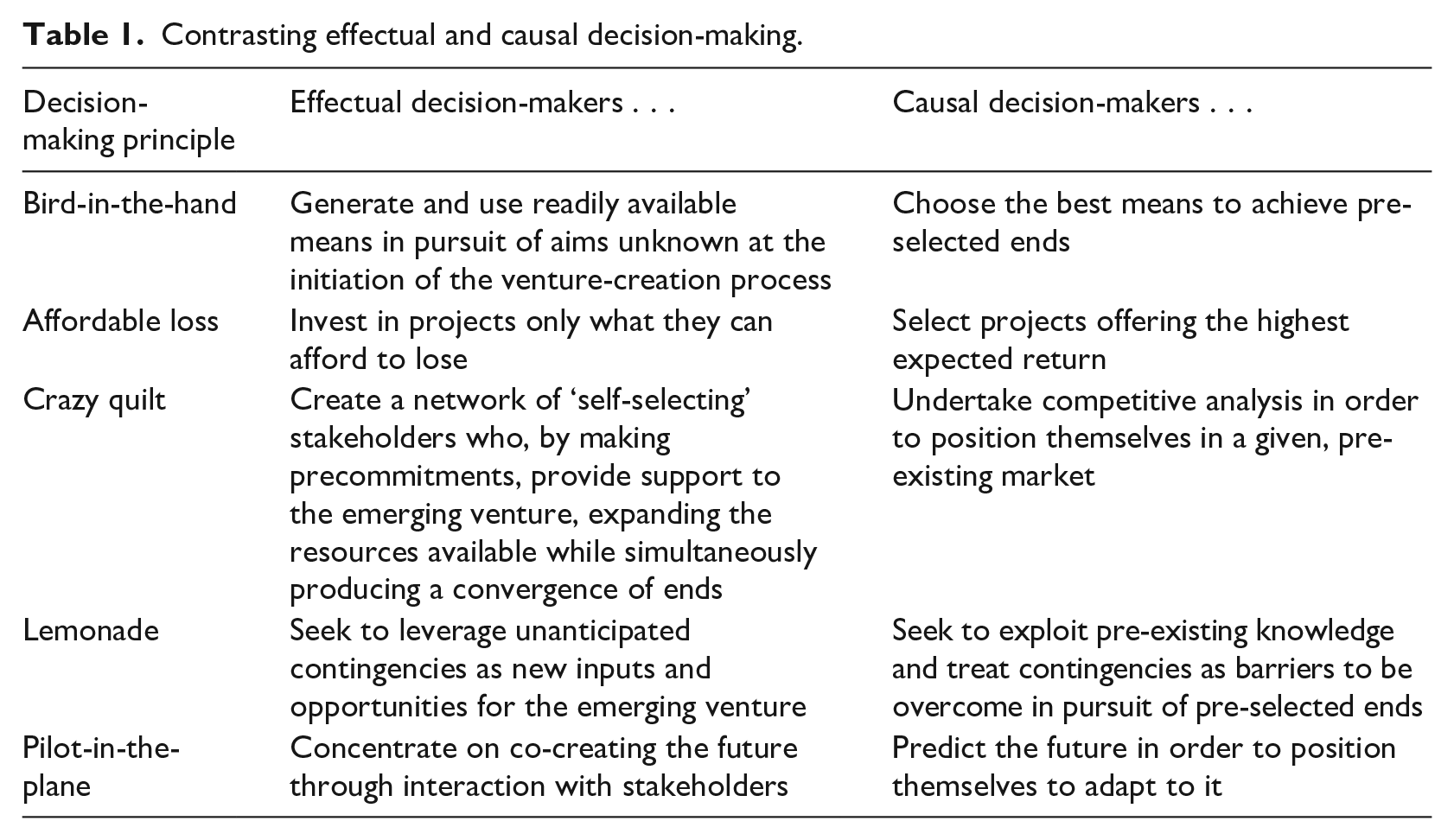
Sarasvathy (2001a) claims effectual entrepreneurs act according to five principles and contrasts these with causal logic (summarised in Table 1); later works reduce it to just four (e.g. Read et al., 2011, 2017). Starting with available means, rather than pre-selected goals, 7 defined in terms of ‘who I am’, ‘what I know’ and ‘whom I know’ (the bird-in-the-hand principle), effectual entrepreneurs are argued to: invest only what they can afford to lose in new venture projects, rather than seek to maximise returns (affordable loss principle); build a network of ‘self-selecting’ stakeholders, rather than undertake competitor analysis (crazy quilt principle); and leverage unanticipated contingencies, rather than exploit pre-existing knowledge (lemonade principle), in the process of co-creating a new venture by interacting with stakeholders (pilot-in-the-plane principle). Effectual entrepreneurs, it is claimed, seek to control the environment rather than predict its future states when taking new venture decisions (Wiltbank et al., 2006); if entrepreneurs are able to control the future, there is no need to predict it (Dew and Sarasvathy, 2007: 275; Read and Sarasvathy, 2005: 50; Sarasvathy, 2001a: 251, 2003: 208). Hence effectual and causal logics are often referred to as non-predictive control and predictive logics, respectively (Dew et al., 2009a; Sarasvathy, 2004b; Wiltbank et al., 2006). 8 Through repeated stakeholder interaction, entrepreneurs are argued to acquire expanding resources while the venture’s goals converge (Read and Sarasvathy, 2005; Sarasvathy and Dew, 2005b).
Contrasting effectual and causal decision-making.
Sarasvathy (2001a) suggests that business and management schools have traditionally taught causal, rather than effectual, approaches. It is not surprising therefore that, having been taught ‘causal thinking’ (Dew et al., 2009a: 295), MBA students report causal models when asked by a university professor how they would set up a hypothetical new venture. Expert entrepreneurs may receive a different kind of education to novices (Baron, 2009). Moreover, whether decision-makers would act similarly in real new venture situations is a moot point, one acknowledged by users of experimental methods (Kuechle et al., 2016: 44).
When we refer to the theory of effectuation, or to core concepts, we refer to the conceptualisation of the process of venture creation in terms of a decision-making logic and to the five specific principles of effectual and causal decision-making set out in Table 1 (bird-in-the-hand, affordable loss, patchwork quilt, lemonade, pilot-in-the-plane). We now turn to examining the objectives of effectuation theory to ascertain whether explaining new venture creation is its principal purpose.
The ambiguous aims of effectuation theory
We detect substantial ambivalence in Sarasvathy’s theoretical objectives. Effectuation theory vacillates between proposing design principles that guide how (expert) entrepreneurs might create new ventures, describing how entrepreneurs take actual venture decisions and explaining venture-creation processes. Design, description and explanation are different aims. In places, Sarasvathy (2004b: 524) claims effectuation ‘at heart is a theory of design’, emphasising the capacity of entrepreneurs to ‘worldmake’ (Sarasvathy, 2012). Sarasvathy provides real-life examples ‘as illustrations of what could be rather than as claims to truth about what actually is’ (Sarasvathy, 2008: xvii, italics in original). Sarasvathy (2008: 61–62) argues explicitly that effectuation is not ‘a theory of how entrepreneurs do (descriptive) or should (normative) act’. Others describe effectuation as a performative theory, as an active intervention capable of constituting the world (Garud and Gehman, 2016), while Read et al. (2016) ask what difference it makes if people act as though they believe in an effectual worldview.
Despite disclaimers that effectuation is not proposed as a superior logic of decision-making in terms of producing success (Sarasvathy, 2001a: 246), it is difficult to resist the strong hint of prescription in such arguments. We agree with McKelvie et al. (2013) that there is a ‘tacit undertone . . . that the use of effectuation is superior’. Sarasvathy (2001a) stipulates stringent criteria for inclusion in her sample of expert entrepreneurs that entail a substantial degree of success (see also Arend et al., 2016: 549, footnote 1). The alleged connection between expert entrepreneurs and effectual reasoning strongly implies that those seeking to be expert, rather than novice, entrepreneurs ought to take decisions informed by the five effectuation principles set out in Table 1.
While proposing effectuation as a design theory, Sarasvathy also uses the term effectuation to describe new venture decisions taken in accordance with the five principles set out in Table 1. Sarasvathy further claims that effectuation explains the creation of firms/organisations and markets (Sarasvathy, 2001a: 243), high growth firms (Sarasvathy, 2003: 205) and the rise of the ordinary entrepreneur (Sarasvathy et al., 2014: 235). Sarasvathy does not clarify what she means by ‘explain’ here, but we presume she would say that uncertainty influences entrepreneurs to take decisions according to the five principles. We might counter that it is insufficient for a causal-explanatory theory of venture creation simply to invoke heuristics, or ‘rules of thumb’, that guide an abstract entrepreneur, lacking specific properties or powers, to take new venture decisions in an uncertain but otherwise equally abstract and unspecified social context. But the important point here is that effectuation becomes more than a theory of design about the way the world might be; it is a hypothesised explanation about the way the world actually is.
In sum, the aims of effectuation theory are ambiguous. Effectuation is claimed to be a set of design principles, a description of a decision-making logic and an explanation of the venture-creation process. But even if we treat effectuation only as a theory of design, we believe this is a major weakness. The purpose of social science theory, in our view, should be to explain how venture creation occurs, as Sarasvathy and co-authors claim elsewhere. If, on the contrary, we treat effectuation as an explanatory theory, it is legitimate to ask how far it is able to explain particular cases of venture creation that occur under specific sociohistorical conditions. This is the purpose of the next two sections. We begin by exploring the conceptual and explanatory problems that arise from the failure to make effectuation theory’s ontological commitments explicit.
Ontological commitments matter: problems with pragmatism
Sarasvathy (2008: chapter 9) claims effectuation theory is philosophically underpinned by pragmatism. While pragmatists differ in their analytical concerns and methodological approaches (Talisse and Aikin, 2008), many avoid ontological questions as being impossible to settle, preferring instead to press on with the practical work of deciding whether ideas are useful guides to action (Baert, 2005; Kivinen and Piironen, 2004; Rorty, 1982). Sarasvathy (2008: 184, italics in original) suggests that pragmatists are ‘interested in how things work more than in how things really are, more focused on what is useful than in what is true’. In contrast to this view, we would argue that propositions about the way things work constitute ontological claims about the way things really are!
Effectuation scholars, like all researchers, inevitably make ontological assumptions. Their theoretical and empirical work presupposes them, whatever their explicitly declared standpoint (Bhaskar, 1978; Fleetwood, 2005; Groff, 2016; Sayer, 2000). As far as we are aware, neither Sarasvathy nor any other effectuation researcher has responded to Chiles et al.’s (2008) invitation to make effectuation’s ontological commitments explicit. Yet, effectuation theory’s conceptual vocabulary of entrepreneurs, new ventures, decision-making logic, means to hand, affordable loss, self-selecting stakeholders, precommitments, leveraging contingencies and venture co-creation necessarily commits researchers to particular ontological assumptions, even if these are left implicit or researchers themselves remain unaware of them.
Advocates of effectuation theory conceptualise the social world as uncertain (Sarasvathy, 2001a, 2008). This claim comprises the ontological assumption that the social world possesses certain properties and powers regardless of whether entrepreneurs happen to be aware of, or understand, them (Sayer, 1997). For critical realists, it is the dynamic openness of the social world and the presence of multiple social objects with diverse causal powers – agential, structural and cultural – capable of interacting in novel and unforeseen ways that is the source of the uncertainty entrepreneurs experience and have to manage. This dynamic openness enables entrepreneurs to act creatively in order to transform their structurally and culturally conditioned circumstances, but only in ways made possible by those circumstances. This has important implications for effectuation as a theory of design. Not just any design theories can be performative because the social world constrains what actions it is possible for particular entrepreneurial agents to perform (Felin and Foss, 2009).
When researchers fail to make their ontological commitments explicit, problems can arise using concepts that are not anchored in explicitly specified notions of the social world that constrain what is possible. Let us pause to reflect on the concepts of effectual and causal decision-making logics at the centre of effectuation theory. Despite claiming that effectuation inverts ‘every aspect of causal rationality’ (Read and Sarasvathy, 2005: 50) and ‘the fundamental principles, solution process, and overall logic of predictive rationality’ (Read et al., 2009a), Sarasvathy (2001a: 245, italics added) also theorises that entrepreneurial decision-makers can use the two logics simultaneously. Empirical studies make similar claims about simultaneity (e.g. Reymen et al., 2015; Villani et al., 2018). Yet simultaneous use of causal and effectual decision-making logics presupposes contradictory conceptions of the social world. It presupposes a world that possesses the property of being predictable, where decision-makers face a closed set of decision choices whose outcomes are knowable, probabilistically, in advance (causal logic) and also the property of being unpredictable, where decision outcomes and probabilities are unknowable in advance (effectual logic). The social world, considered as a unitary whole, cannot simultaneously be both predictable and unpredictable. Researchers cannot ignore the properties of the social objects they conceptualise and theorise just because they find it pragmatically convenient (Holland, 2014). Effectuation researchers must define their concepts clearly and apply them consistently, without contradiction, if effectuation theory is to contribute to knowledge. We now turn to the central question animating our analysis of effectuation concepts: whether the theory of effectuation is able to explain cases of new venture creation adequately.
Effectuation theory’s neglect of structural and cultural influences on venture creation
Effectuation theory focuses on what Bhaskar (1979) calls the empirical and actual strata of social reality, on how nascent entrepreneurs experience and manage uncertainty, rather than on the deep level of structural and cultural powers that generate the uncertainty entrepreneurs must manage in order to bring a new venture project to fruition. By conceptualising the process of venture creation in terms of the decision-making logics of entrepreneurs, effectuation theory does not – and cannot – explain fully how entrepreneurs create new ventures. Entrepreneurs act in particular ways in concrete sociohistorical settings that make possible, but do not determine, the process. Structural and cultural contexts enable, motivate and constrain entrepreneurs positioned variably in relation to structural relations and cultural norms (Martinez Dy et al., 2017, 2014; Wang and Warn, 2018). Failure to theorise structural and cultural influences means that effectuation can offer only an under-socialised and ahistorical conception of new venture creation that implicitly grants nascent entrepreneurs excessive powers of agency.
Effectuation theory largely ignores the structural and cultural positioning of entrepreneurs, although both affect the practices and interactions that interest effectuation researchers. Entrepreneurs are positioned variably in relation to social structures, including class, gender, race/ethnicity and markets, that enable and constrain new venture projects (Jayawarna et al., 2014; Loscocco and Bird, 2012; Rouse and Jayawarna, 2011; Tonoyan et al., 2019) and in relation to cultural norms that motivate individuals to embark on particular ‘entrepreneurial journeys’ (McMullen and Dimov, 2013). Structural and cultural positioning affects the resources entrepreneurs are able to accumulate over a life course that they bring to the task of creating a new venture (Jayawarna et al., 2014; Jones et al., 2014).
To our knowledge, no empirical studies of venture creation have explicitly adopted a critical realist-informed approach. So, to illustrate the kinds of structural and cultural influences we believe can help to explain specific cases of venture creation better, we draw selectively from the rich insights of non-effectuation studies. We demonstrate the connections between structural positioning and venture creation using the example of the socio-economic class of entrepreneurs; we stress we use class only as an example and do not attribute it greater causal significance than other structural influences such as gender or race/ethnicity. Class positioning, often referred to as, and partly concealed by, family background, confers unequal access to financial assets (Blackburn and Ram, 2006; Mulholland, 2003); skill development in childhood, adolescence and early adulthood (Jones et al., 2014; Obschonka et al., 2011); and formal education (Anderson and Miller, 2003; Kim et al., 2006) (all relevant to the bird-in-the-hand principle). Class positioning also influences the stakeholders entrepreneurs are likely to meet and may ‘self-select’ into supporting new ventures (Anderson and Miller, 2003) (crazy quilt principle); the investments entrepreneurs are willing to make in a new venture (Martina, 2019) (affordable loss principle); the capacity to leverage environmental contingencies (lemonade principle), and therefore the ability to co-create a new venture with stakeholders (pilot-in-the-plane principle) (Lee et al., 2019). By explicitly adopting a structure/agency framework, critical realist theorising can therefore incorporate structural influences such as class in explanations of venture creation.
Cultural norms possess the power to motivate, or discourage, venture-creating efforts of nascent entrepreneurs by shaping perceptions of the desirability and feasibility of start-up, but these too are absent from effectuation theory. Norms influence venture creation by moulding the beliefs and habits of entrepreneurs, and by shaping stakeholder perceptions of entrepreneur legitimacy (De Clercq and Voronov, 2009; Williams Middleton, 2013). Non-effectuation studies have, for example, argued that norms influence entrepreneurial intentions and attitudes to risk taking and innovation (Hayton and Cacciotti, 2013; Kibler et al., 2014; Spigel and Harrison, 2018; Valdez and Richardson, 2013; Williams and Vorley, 2015), perceptions of entrepreneurial self-efficacy (Hopp and Stephan, 2012), men and women’s varying propensity to start a business across the life course (Cheraghi et al., 2019), inter-generational transmission of role models and peer effects (Fritsch and Wyrwich, 2014; Mungai and Velamuri, 2011), the choice to become self-employed on a full- or part-time basis (Block et al., 2019), entry into self-employment through ‘contagion effects’ (Nikolaev and Wood, 2018) and the moral legitimacy of entrepreneurs (Kibler and Kautonen, 2016). By explicitly incorporating social norms within a structure/agency framework, critical realist theorising is able to integrate cultural influences in explanations of venture creation.
Sarasvathy (2004b: 525) notes that ‘effectuators do not ignore external constraints’ and Dew and Sarasvathy (2016: 169) refer to ‘reciprocal causation’ between organisations and their environments, but the influence of social context is mostly left implicit in references to entrepreneurs’ scope of action and use of resources (Tryba and Fletcher, 2019). Effectuation theory does not therefore ignore contextual influences entirely but tends to conceptualise them in very narrow terms, as relations between entrepreneurs and ‘relevant’ stakeholders (Dew and Sarasvathy, 2007: 279), where relevance is defined in terms of interpersonal interaction. This local, interpersonal focus omits reference to the wider distributions of material and cultural resources across major social groups – by class, gender and race/ethnicity, for example – that influence structural and cultural positioning, and the variable capacities to exercise agency they enable.
Effectuation researchers acknowledge entrepreneurs’ limited resources in terms of who and what they know (Sarasvathy, 2001a), but neglect the wider structural and cultural contexts that enable, motivate and constrain access to the skills, finance, social connections and other resources needed to create new ventures. This neglect is surprising given that Sarasvathy (2004b: 522) conceives of entrepreneurs as ‘evolved socio-biological beings whose psychology, history and culture matter’ and who come
onto the world stage in the middle of a drama already in progress. And like any other human being, the entrepreneur too is constrained and shaped by the socio-economic and psycho-historic forces that prevail at the moment of his or her advent upon the stage. (Sarasvathy, 2004a: 3)
We agree strongly with Sarasvathy on these points, but effectuation theory does not refer directly to history, culture or socio-economic forces. Nor can effectuation theory explain the variable structural and cultural positioning of entrepreneurs or their consequent variable capacities to formulate, and actualise, new venture projects.
Summing up, this section has sought to make two points that are at the heart of our contribution. First, the theory of effectuation fails to conceptualise the causal, conditioning influence of structural and cultural contexts on new venture projects. Effectuation cannot therefore provide an adequate causal-explanatory account of the venture-creation process. Second, non-effectuation studies offer more detailed insights into structural and cultural influences on venture creation than applied effectuation studies. Reconceptualised as emergent structural and cultural causal powers that entrepreneurs (and other agents) might activate, each of the influences discussed by non-effectuation studies potentially contributes to the explanation of actual cases of venture creation.
Conclusion and implications
Drawing on critical realist philosophy of science, we have interrogated the theory of effectuation to examine whether it provides – or even could provide – a powerful causal explanation of the process of new venture creation. We have focused on effectuation theory for three reasons: the theory’s growing popularity and visibility; the underpinning assumption of the under-socialised ‘heroic’ entrepreneur as the instigator of new business ventures, an assumption common in entrepreneurship research; and the limited critical scrutiny of the theory thus far. We have sought to remedy this research gap by evaluating the contribution of effectuation theory to explaining processes of venture creation. Our analysis has been explicitly conceptual. We have focused on the core concepts of effectuation theory, namely, what the concepts refer to, what they marginalise or omit, what they presuppose about the nature of social reality and, as a consequence, whether the theory is adequate to explaining the influence of social context on business formation. Concepts are important because they define the social objects effectuation researchers believe are important to the study of venture creation and the scope of the theories which empirical effectuation studies are able to support.
By reducing venture creation to a decision-making logic, we argue that effectuation theory pays insufficient regard to the influence of social context on the cognitions and actions of nascent entrepreneurs. By conceptualising the influence of social context in terms of an abstract, generic context of uncertainty or, slightly better, in terms of interpersonal relations between entrepreneurs and the stakeholders who ‘self-select’ into their emerging ventures, effectuation theorists neglect the substantial, pervasive and enduring structural and cultural influences on new venture creation. Effectuation theory cannot explain fully how structural and cultural conditions make particular new ventures possible in particular times and places. We therefore conclude that the contribution of effectuation theory to entrepreneurship scholarship is more limited than its advocates claim because it can offer only an under-socialised, ahistorical account of the venture-creation process. Failure to theorise the influence of structural and cultural contexts on venture creation implicitly grants nascent entrepreneurs excessive powers of agency.
Our critique of the theory of effectuation is also a contribution to contemporary debates on the influence of context on all forms of entrepreneurial action, including new venture creation. Our analysis suggests three wider implications for entrepreneurship and small business researchers. First, building on the insight that venture creation is necessarily both an agent- and a context-dependent sociohistorical process, we recommend that researchers explicitly adopt a stratified social ontology to inform their empirical work, one that distinguishes causal powers/mechanisms, social events and agents’ experience. Most researchers simply do not report their ontological commitments yet these inevitably underpin theorising of new venture creation processes. Conceptualising the influence of social context in terms of causal powers/mechanisms that may (or may not) be activated by entrepreneurs or other stakeholders permits theorising that is neither determinist nor voluntarist because it places the entrepreneurial agent in a potent social context that conditions, but does not determine, action.
Second, we distinguish structure and culture as two analytically distinct dimensions of social context and conceptualise these in terms of causal powers/mechanisms capable of conditioning entrepreneurial action. Powerful explanations of entrepreneurial action require attention to structural and cultural powers/mechanisms as well as to entrepreneurial agency. This deep social ontology of structural and cultural powers/mechanisms situates nascent entrepreneurs in a richer social context than allowed for by effectuation theory’s abstract, shapeless, condition of uncertainty. Entrepreneurs must activate the specific powers of their structural and cultural context, for example, by engaging with specific stakeholders, in order to create particular types of new business venture and to manage them successfully.
Third, we advise that researchers utilise Archer’s morphogenetic approach to theorise the connections between structure, culture and agency, in explaining entrepreneurial action, including venture creation. Specifically, researchers might use the framework to explain how particular entrepreneurs exercise their powers of agency in relation to the historically emergent structural and cultural conditions they inhabit. Using the morphogenetic approach takes seriously the variable positioning of entrepreneurs in relation to the intersecting structural and cultural powers that influence their actions, while recognising that entrepreneurs’ actions contribute to the reproduction or transformation of those structural and cultural powers. Theory must be able to explain cases of both entrepreneurial privilege, where agents possess substantial resources, and entrepreneurial disadvantage, where agents possess limited resources (Martinez Dy et al., 2014). Entrepreneurs occupy multiple structural and cultural positions that facilitate, or impede, the accumulation of resources (skills, money, social connections) across the life course that enable them to create and operate particular types of venture in particular times and places – or, possibly prevent them from creating a new venture at all.
Footnotes
Acknowledgements
We are grateful to the editor and reviewers for their constructive and supportive comments throughout the reviewing process.
Funding
The author(s) received no financial support for the research, authorship and/or publication of this article.
