




Abstract
Labour market institutions enable and constrain individual behaviour on the labour market and beyond. We investigate two main elements of national employment protection legislation and their effects upon entrepreneurial activity. We use multilevel analyses to estimate the separate impact of redundancy payments and the notice period for employers on independent entrepreneurship (self-employment) and entrepreneurial employee activity. Redundancy payments and notice period reflect labour market friction, opportunity cost, search time and liquidity constraint mechanisms contained in employment protection legislation. Country-level legislation on the notice period for employers is found to be positively related to an individual‘s involvement in entrepreneurial employee activity, yet negatively related to self-employment. We do not find consistent effects of redundancy pay legislation on entrepreneurial activity.
Keywords
Introduction
Institutions, the rules of the game in society (North, 1990), have wide-ranging intended and unintended effects on economic action, and ultimately economic performance (Acemoglu and Robinson, 2012; Chang, 2011; Nickell and Layard, 1999). Institutions enable and constrain economic action within the domain of entrepreneurship and small businesses (Kitching et al., 2015). Institutions define the relative rewards for different occupations, and hence, play a key role in the allocation of talent in society (Acemoglu, 1995; Baumol, 1990; Murphy et al., 1991). The impact of labour market institutions upon labour market outcomes has been the topic of recurrent policy discussions and research (Belot et al., 2007; Blanchard and Tirole, 2008; Holmlund, 2014). Labour market institutions are usually considered as policy interventions or collective provisions that interfere with employment and wage determination (Bertola, 1990; Skedinger, 2011) and perhaps unintentionally with occupational choice (Baumann and Brändle, 2012; Bertola and Rogerson, 1997; Martin and Scarpetta, 2012). One well-rehearsed mode of labour market institution is employment protection legislation (EPL) consisting of rules and procedures defining employer limits to hire and fire employees (see OECD, 2013; Skedinger, 2010).
During the second half of the 20th century, many nations – mostly European – enacted laws employment protection (Holmlund, 2014). The standard argument in favour of such laws is the protection of employees against unfair dismissal by employers (Bertola, 1992; Bertola et al., 2000). Opponents argue that employment levels decrease as employers are less likely to hire new employees (Kahn, 2007, 2010). Given the difficulty, and hence, costs of firing employees, attracting new workers is risky, and so, employers are reluctant to expand recruitment. This reflects labour market friction mechanisms (Campbell et al., 2017), constraining employee mobility, both in terms of entering new employment or exiting existing employment.
From an employee stance, EPL imposes opportunity costs upon self-employment (Amit et al., 1995; Baumann and Brändle, 2012). Opportunity costs are ‘the foregone benefit of the next available alternative as a consequence of making a choice’ (Cassar, 2006: 611). It is suggested that potential entrepreneurs evaluate the expected utility of their options in the labour market when choosing to become an independent entrepreneur (Campbell et al., 2017; Douglas and Shepherd, 2000, 2002). However, employees considering self-employment have to forego employment rights; this may act as a deterrent.
Entrepreneurship can be defined as the discovery, evaluation and exploitation of opportunities to create future goods and services by individuals (Shane and Venkataraman, 2000), and so, is not limited to those setting up an independent business or owning–managing a new business for their own risk and reward (Jensen and Meckling, 1976; Knight, 1921). In fact, workers with entrepreneurial abilities might also opt for engagement in entrepreneurship within established organisations (Antoncic and Hisrich, 2001, 2003; Carrier, 1994, 1996; Parker, 2011). Labour mobility across employment and self-employment (Sørensen and Sharkey, 2014), particularly by employees with entrepreneurial abilities, is likely to be affected by EPL. Put differently, EPL is expected to affect the allocation of entrepreneurial activity across new and established organisations within a country.
This article examines whether the nature of a country’s EPL has an effect on occupational status in terms of employment or self-employment. In turn, the category of employed individuals consists of both employees undertaking entrepreneurial activities for their employer, also referred to as entrepreneurial employee activity, and those who do not. We use multilevel analyses to disentangle the mechanisms of two main elements of EPL, that is, redundancy pay and the notice period for employers, and their effect on the allocation of entrepreneurial activity across employment and self-employment. The objective of this article is to provide greater understanding of how labour market regulations, in particular, two of EPL’s components, affect the allocation of entrepreneurial talent in society.
We offer a three-fold contribution to the extant literature. First and foremost, entrepreneurial employees are only recently acknowledged and internationally measured as a separate category of entrepreneurially active individuals (Bosma et al., 2013b; Stam, 2013). As such, we are able to take a closer look at the allocation of entrepreneurial activity across employed and self-employed individuals. Second, we investigate the effects of country-level EPL on individual-level occupational status given most studies focus upon macro effects, such as changes in unemployment, employment and/or self-employment levels (Holt and Hendrickson, 2017; Kahn, 2010; Torrini, 2005). Accordingly, we answer Shepherd’s (2011) call for more multilevel research on entrepreneurial decision-making. Third, we estimate the separate effects of the two main elements of EPL. Composite indicies have been used to measure a nation’s entire system of provisions regarding employment protection; given the complex multidimensional nature of EPL, we provide a more fine-grained analysis enabling the separation of four key mechanisms in the explanation of the effects of EPL on entrepreneurship: labour market frictions, opportunity costs, search time and liquidity constraints.
Our regression models are multilevel in nature due to the inclusion of explanatory variables at different levels of analysis (Shepherd, 2011). For our dependent variable, we make use of the 2011 Adult Population Survey (APS) of the Global Entrepreneurship Monitor (GEM). According to the GEM, employees are involved in entrepreneurial activity if they take the lead in the developmental process of new business activities for their employer (Bosma et al., 2013b). We use data from both the World Bank (WB) and the Organisation for Economic Co-operation and Development (OECD) on legislation regarding redundancy payments and advance notice of contract termination (Nicoletti et al., 1999).
The remainder of this article is organised as follows. In the next section, we discuss the extant literature on EPL and its effects on various labour market outcomes. We derive a pair of hypotheses reflecting the theoretical mechanisms between national-level legislation on redundancy pay and the notice period on the one hand and individuals’ occupational status on the other. The third section describes our data, and the fourth explains our methodological approach. In the fifth section, we present our main empirical results. Finally, the sixth section concludes and discusses the implications of our findings.
Theory and hypotheses
In his influential paper analysing productive, unproductive and destructive entrepreneurship, Baumol (1990) speculated that there might be a ‘true’ rate of entrepreneurship. This rate is said to be more or less equal across countries, but its appearance depends on the incentive structure created by institutional frameworks. Institutions define the relative pay-offs to different occupations and thereby determine the allocation of talent in society (Acemoglu, 1995; Baumol, 1990; Murphy et al., 1991). EPL is a specific type of labour market institution, part of a country’s formal institutional framework. Pissarides (2001) defines employment protection as follows: ‘Any set of regulations, either legislated or written in labour contracts, that limit the employer’s ability to dismiss the worker without delay or cost’ (p.136).
Extant research focuses largely upon the macro employment effects of employment protection (Holt and Hendrickson, 2017; Kahn, 2010). Böckerman et al. (2018) (micro level), Cingano et al. (2016) and Griffith and Macartney (2014) (meso level) are some notable exceptions. Empirical findings are inconclusive regarding the effects of composite EPL indicators on unemployment, employment and self-employment rates. Addison and Teixeira (2003) mapped part of the empirical literature on the labour market consequences of employment protection (see also Skedinger, 2011) and arrive at three main conclusions: stricter EPL (1) increases structural unemployment, (2) reduces employment on average and (3) is positively associated with self-employment. Cahuc and Postel-Vinay (2002) note that firing restrictions may, or may not, reduce unemployment, with the impact limited in either direction. Micco and Pagés (2006) find more stringent EPL to be the cause of a decrease in employment, driven by a decline in the net entry of firms. Van Landuyt et al. (2017) show that firms tend to hire employees on temporary labour contracts or on contracts that are subject to substantially reduced employment protection to circumvent high (future) firing costs (see also Hijzen et al., 2017). In a similar vein, Román et al. (2011) conclude that strict EPL promotes dependent self-employment as employers are encouraged to contract-out work previously undertaken in-house. Others, however, find no robust or even a negative relationship between EPL and self-employment (Robson, 2003; Torrini, 2005). Millán et al. (2013) show that the stringency of EPL is negatively related to labour mobility between small firms.
Most of the aforementioned studies faced difficulties in formulating a satisfactory one-dimensional measure of EPL; this suggests the need for more fine-grained analyses of the effects of its most important elements. But, most notably, they did not take into account entrepreneurial activity by employees within established firms commonly referred to as intrapreneurship (Antoncic and Hisrich, 2001, 2003; Carrier, 1994, 1996; Parker, 2011). Instead, self-employment is commonly seen as the only route for entrepreneurial individuals in society. Bosma et al. (2013a) find that the prevalence of intrapreneurship and independent entrepreneurship are negatively correlated at the macro level; more intrapreneurship means lower levels of independent entrepreneurship in society, and vice versa. This suggests that these two modes of entrepreneurial activity are substitutes rather than complements at the national level, confirming the allocation of entrepreneurship perspective by Baumol (1990). Bosma et al. (2013a) also conclude that both formal and informal institutions influence the allocation of talent across the two modes of entrepreneurial activity. More specifically, social security favouring employment over self-employment positively affects the share of entrepreneurial employees in a country (also see Wennekers et al., 2005). Social security systems vary substantially between countries, but typically involve more than just job security provisions, for instance, consider regulations on pensions, sick pay and unemployment benefits. In most cases, the self-employed are not automatically entitled to any of these (collective) benefits, but have to make personal arrangements. As such, comprehensive welfare systems that favour the employed dissuade self-employment.
The discussion on the effects of EPL on entrepreneurial activity is obscured by not disentangling the key mechanisms and by neglecting entrepreneurial activity by employees. In this article, we contribute to this discussion and the literature on labour markets, institutions and entrepreneurship, with adding entrepreneurial activity by employees to the equation and by disentangling four key mechanisms in the explanation of the effects of EPL on entrepreneurship.
Our empirical strategy is to use the two main elements of formal institutional employment protection, that is, redundancy pay and the notice period for employers. Within the category of employees, we distinguish further between entrepreneurial employees and those who do not qualify as such. Someone is identified as an entrepreneurial employee if continuously involved in the developmental processes of new business activities for the main employer and when they have (or have had) a leading role in the phase of idea development and/or the phase of preparation and implementation (Bosma et al., 2013b). Examples of new business activities include setting up a new business unit, establishment or subsidiary, but also the development of a new product, service or product–market combination.
We distinguish four key mechanisms in the explanation of the effects of EPL on entrepreneurship: labour market frictions, opportunity costs, search time and liquidity constraints. The labour market frictions mechanism emphasises the employer perspective, while opportunity costs, search time and liquidity constraints mechanisms primarily affect the employee perspective. We elaborate upon these key mechanisms.
First, the labour market friction mechanism (Campbell et al., 2017). Higher levels of employment protection lead to greater friction upon the labour market, lowering the probability that employers hire (and fire) employees and increasing the probability that employers contract self-employed labour. Second, the opportunity costs mechanism (Amit et al., 1995). Higher levels of employment protection increase the opportunity costs of leaving employment if self-employment is pursued. This lowers the probability that employees will opt for self-employment and increases the probability that workers will choose a position as employee. Third, the search time mechanism (Tirole and Blanchard, 2004). A notice period provides a delay between the layoff decision and its implementation, providing opportunities for on-the-job search by the employee (Addison and Blackburn, 1995). Longer notice periods will thus increase the amount of search time of employees, increasing the probability they will remain as an employee with another employer. We assume that employees will usually search for another job; however, we cannot rule out the probability that some will use this time to consider a switch into self-employment. Fourth, the liquidity constraints mechanism (Evans and Jovanovic, 1989; Holtz-Eakin et al., 1994). Redundancy creates a one-off payment to the employee; this lowers the liquidity constraints that normally hamper the transition into self-employment. This means that higher redundancy pay increases the probability of a shift from employment to self-employment. National-level legislation regarding redundancy settlements enables this payment (even though there is no one-to-one relationship of national legislation and the frequency of redundancy payments).
The net effect of the opposing labour market friction mechanism and opportunity cost mechanism is ambiguous as is evident in the mixed findings on the effect of EPL on self-employment. However, when the search time and liquidity constraints mechanisms are added, we expect a positive effect of notice period on the probability of being involved in entrepreneurial activity as an employee (Hypothesis 1) and a positive effect of redundancy payment on the probability of being involved in entrepreneurial activity as self-employed (Hypothesis 2):
H1. The longer the notice period for employers, the more likely an individual’s involvement in entrepreneurial activity as employee.
H2. The higher redundancy pay for employees, the more likely an individual’s involvement in entrepreneurial activity as self-employed.
Data
The data are derived from a variety of sources with the GEM foremost. GEM is an annual large-scale international study on the prevalence of entrepreneurship conducted since 1999. The 2011 edition of the GEM APS was the first to include entrepreneurial employee activity as a special topic. 1 More than 156,000 individuals from 52 countries completed the survey. The 52 participating countries include (1) Six factor-driven economies (i.e. Algeria, Bangladesh, Iran, Jamaica, Pakistan and Venezuela), (2) 24 efficiency-driven economies (i.e. Argentina, Barbados, Bosnia and Herzegovina, Brazil, Chile, China, Colombia, Malaysia, Mexico, Panama, Peru, South Africa, Thailand, Trinidad and Tobago, Uruguay and most of Eastern Europe) and (3) 22 innovation-driven economies (i.e. Australia, Japan, South Korea, Singapore, Taiwan, the United Arab Emirates, the United States and most of Western Europe). This follows a classification of countries into three stages of economic development by the World Economic Forum (WEF) and corresponds to a distinction between developing, transition and developed countries, respectively. As such, the data set covers a wide range of countries at different stages of economic development.
Dependent variable
Among other details, GEM 2011 APS asked for occupational status, in terms of being currently employed (either part-time or full-time), self-employed, unemployed, not working (i.e. retired or disabled), a student or a full-time homemaker. A specific set of questions was then targeted at all adult employees in the sample to determine who can be regarded as entrepreneurially active. This is the case when individuals have been involved in the development of new business activities for their main employer in the past three years and have had a leading role in at least one of the two phases of this developmental process, being the phase of idea development and the phase of preparation and implementation (Bosma et al., 2013b: 21). When someone is also currently involved in such a development, a narrower definition of ‘entrepreneurial employee’ is satisfied. Hence, these individuals are continuously active as entrepreneurial employees. On average, only 2.8% of the adult population in our sample satisfies this definition. Typically, innovation-driven economies demonstrate higher prevalence rates of entrepreneurial employee activity (Bosma et al., 2013b; Kelley et al., 2016). Other stylised facts show that, to a certain extent, entrepreneurial employee activity is a substitute of independent entrepreneurial activity, since in general, the share of entrepreneurial employee activity in overall entrepreneurial activity in society declines with the level of independent entrepreneurial activity (Bosma et al., 2013a). 2 The dependent variable is an unordered categorical variable indicating an individual’s occupational status. Those employed by others, either part-time or full-time, are treated as the base category. The second category consists of those involved in entrepreneurial employee activity according to the GEM’s narrow definition. Finally, self-employed people belong to the final category.
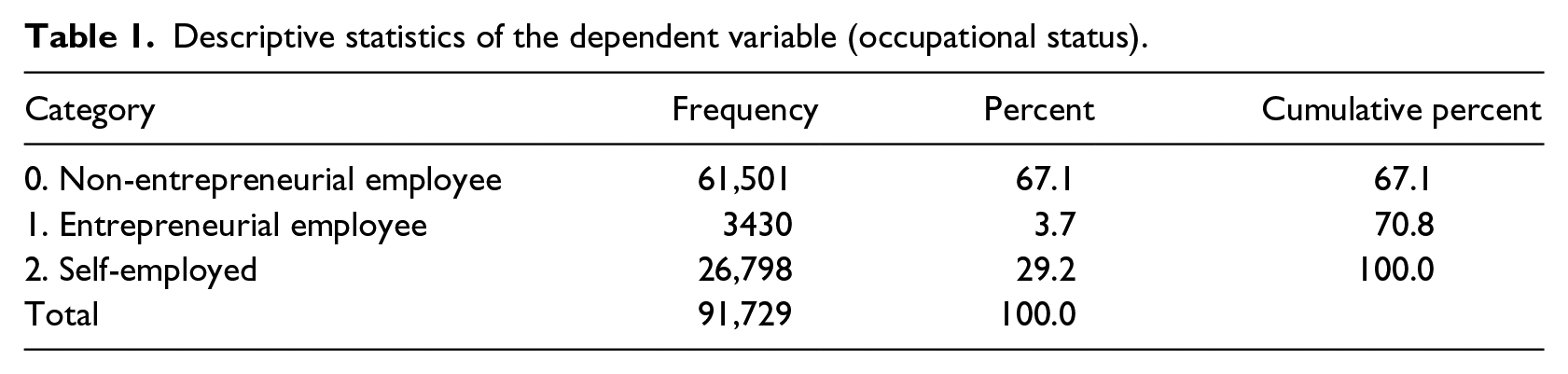
Table 1 presents the descriptive statistics of the dependent variable. Due to the focus on the economically active adult population, all other occupational statuses are omitted leaving a data set covering more than 91,000 individuals. It appears that a majority of the full sample is employed and not entrepreneurially active (67.1%), while only 3.7% are employed and involved in entrepreneurial activity. This distils to 5.3% of employees being entrepreneurially active. The narrow definition and the corresponding operationalisation of the concept of entrepreneurial employee activity could explain this relatively low share of entrepreneurial employees. Approximately 30% of the sample is currently self-employed; this includes imitative or routine entrepreneurs (also see Koellinger, 2008).
Descriptive statistics of the dependent variable (occupational status).
Independent variables
The WB and the OECD both gather EPL data and thus serve as a source for information on country levels of redundancy payments and length of the notice period for employers. The WB’s ‘Doing Business’ ranking incorporates a variety of measures of labour market policy of which the employing workers indicators refer to EPL. These indicators cover (1) the difficulty of hiring, (2) the difficulty of firing, (3) firing costs and (4) hours rigidity. Our focus is on the two main items of the firing costs for employers, namely redundancy pay and the notice period for redundancy dismissal, both measured in terms of salary weeks. Employees with more years of tenure are typically better protected against dismissal, and so, it might be useful to distinguish between employees with 1, 5 and 10 years of tenure, but the main conclusions are drawn based upon the averages of redundancy pay and the notice period for those with different lengths of service.
The OECD distinguishes between five categories of employment protection, namely (1) redundancy payment, (2) advance notice of termination, (3) administrative procedures, (4) difficulty of dismissal and (5) additional measures for collective dismissals (Nicoletti et al., 1999). Our main interest is in the first and second category; both can be viewed as a transfer from the employer to the employee – a direct money transfer in case of redundancy payment and an information transfer in case of advance notice of termination of the employment contract – whereas the other three categories are procedural ways to constrain employer rights to dismiss. Nonetheless, they might induce employers to delay a (collective) dismissal, or to buy off employees in order to avoid lengthy negotiations, and in that sense, they may act as a redundancy payment or notice period. The OECD measures EPL by examining the procedures and costs involved in dismissing individuals, or groups of employees, and the procedures involved in recruiting employees on fixed-term or temporary work agency contracts. This is reflected in three main indicators, namely (1) individual dismissal of employees with regular contracts, (2) additional costs for collective dismissals and (3) regulation of temporary contracts. Items indicating the amount of redundancy pay and the length of the notice period are part of the first indicator (both measured in months). Both items distinguish between employees at nine months, four years and 20 years tenure, but again, we mainly focus on averages for those at different years of tenure.
Both the WB and the OECD data set contain time series – in case of some of the OECD indicators ranging from 1985 to 2013 – but we only use 2011 data due to the restricted availability of the GEM data. However, it must be noted that institutional regimes are challenging to change, and indeed, it appears that EPL remains fairly stable over time in most countries. 3 The WB has EPL data on 214 countries, including 50 of the 52 GEM countries, whereas the OECD data set only covers 43 countries, of which 29 are also covered by GEM.
It should be emphasised that none of the elements of EPL we used, or a combination of such elements, fully covers a country’s EPL. Each item addresses part of the provisions regarding employment protection. There are also collective agreements, agreed upon at the regional or sectoral level, containing diverse provisions not covered by legislation and imposed at the national level. We argue, however, that redundancy pay and notice period are common and critical aspects of employment protection. Moreover, in most countries, redundancy payments and notice periods in collective agreements are usually similar to those in national-level legislation (Venn, 2009).
Control variables
The regression models take into account a number of controls at different levels. All stem from the GEM 2011 APS, except for the 2011 unemployment rate, collected by the WB. It is likely that the level of unemployment in a country affects the allocation of individuals over employment and self-employment. The gross domestic product (GDP) per capita is also considered to be an important country-level control variable when predicting an individual’s occupational choice. As noted, economic development typically leads to higher prevalence rates of entrepreneurial employee activity (Bosma et al., 2013b; Kelley et al., 2016). Demographic characteristics such as age and gender, characteristics capturing cognitive ability such as educational level and household income are included as control variables at the individual level.
Descriptive statistics of the independent variables
Table 2 shows the descriptive statistics of the independent variables, including the controls. Note that the WB indicators of EPL are given in weeks, whereas the OECD indicators are measured in months. Despite this, the mean values of the indicators differ substantially. For example, the average notice period according to the WB is slightly more than a month, while it is almost two months according to the OECD. This is likely to be the result of a different sample of countries; the WB sample includes more low-income countries than the OECD sample. Both job security provisions become more generous towards those with more years of tenure, as expected (not shown here). The largest part of the sample is middle aged (35–44 years, 27.3%), and the majority are men (55.4%). The 2011 unemployment rate ranges from 0.7% (in Thailand) up to 27.6% (in Bosnia and Herzegovina).
Descriptive statistics of the independent variables.
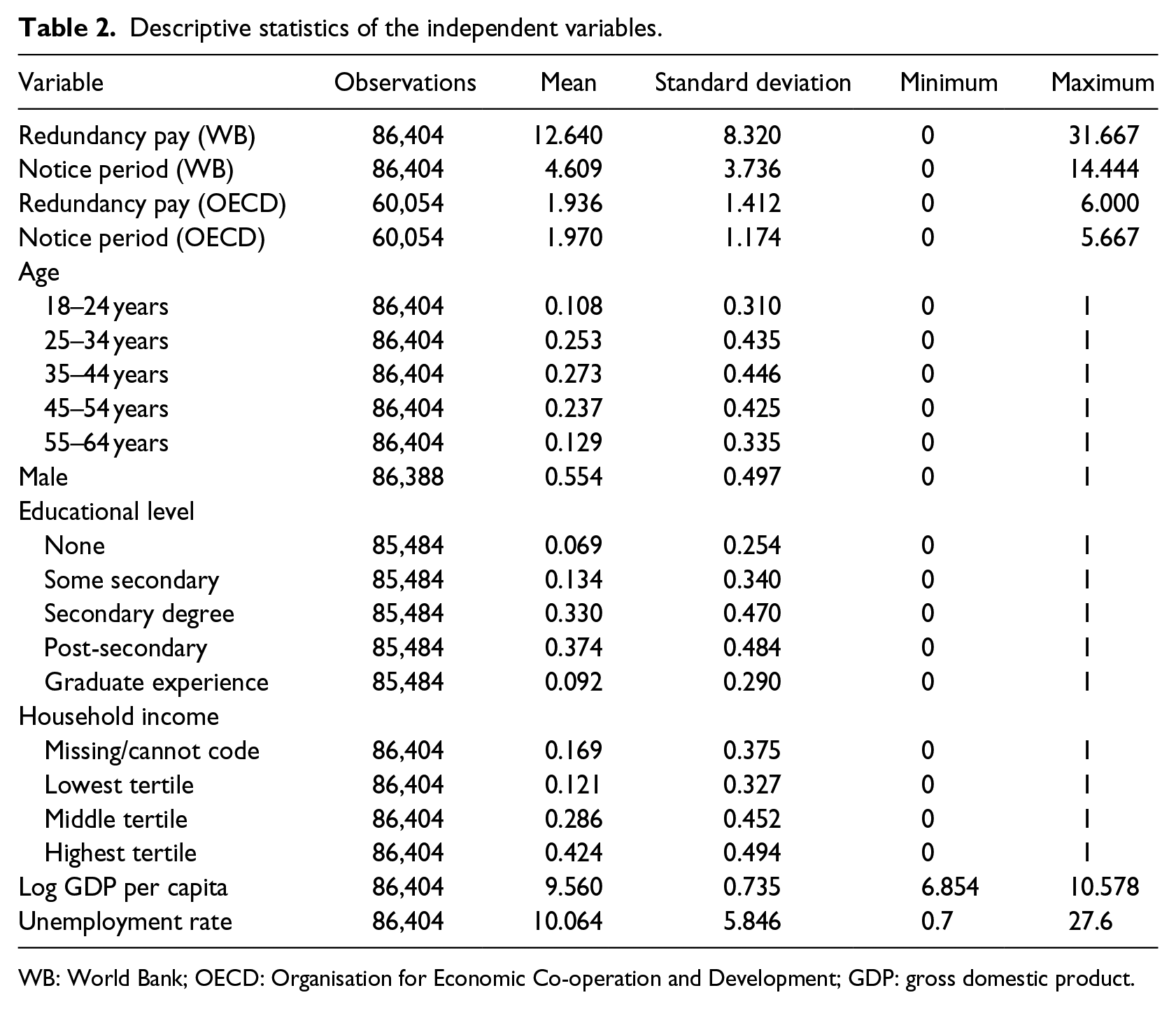
WB: World Bank; OECD: Organisation for Economic Co-operation and Development; GDP: gross domestic product.
Figures 1 and 2 represent scatter plots that have redundancy pay on the horizontal axis and notice period on the vertical axis – according to WB and OECD data, respectively – and reveal substantial dispersion. Hence, there is no clear relationship between the stringency of redundancy pay and the notice period within countries. At best, we can observe a weak negative relationship within the sample of OECD countries only.
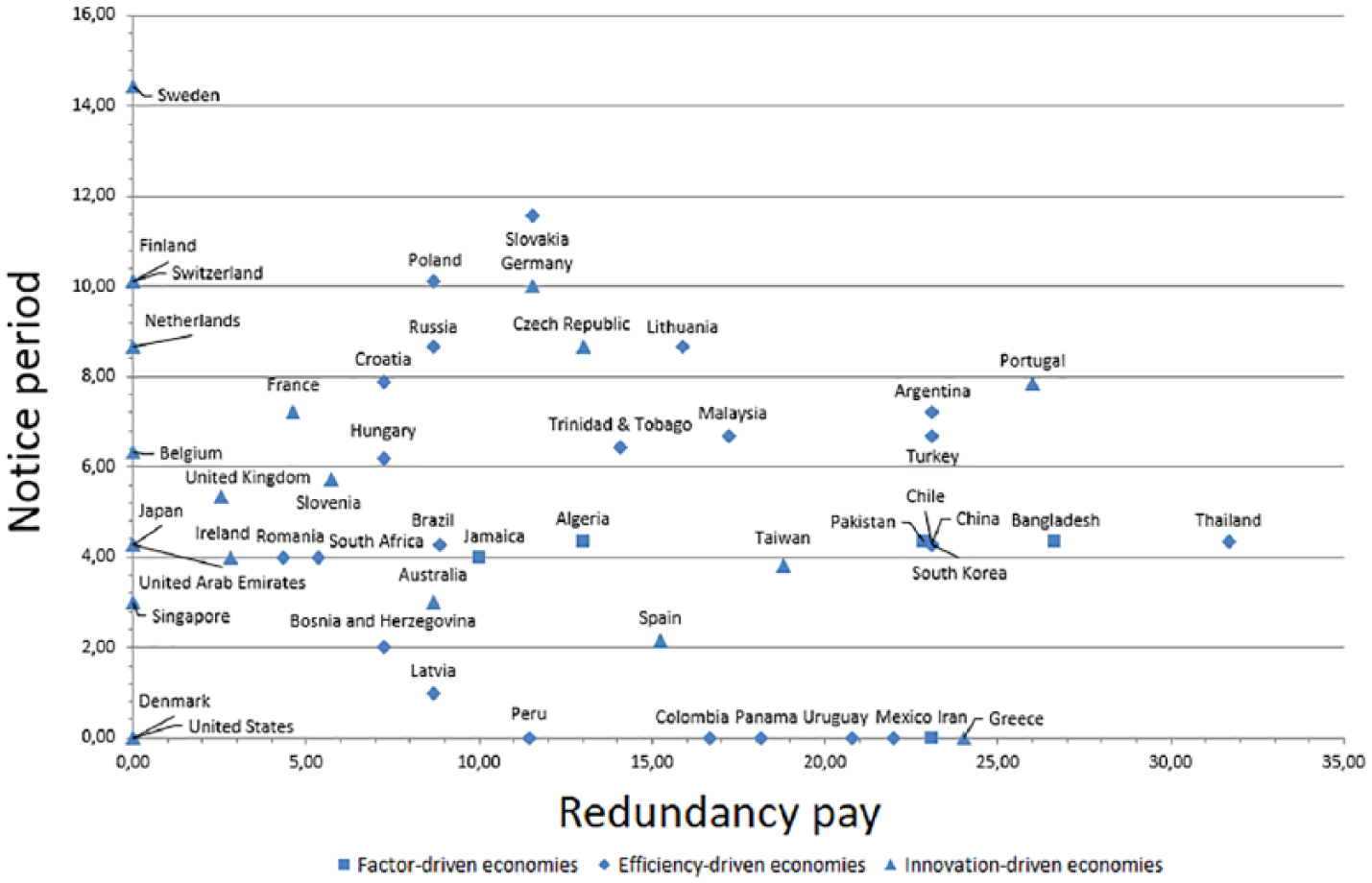
Country redundancy pay and notice period in weeks (World Bank, N = 50).
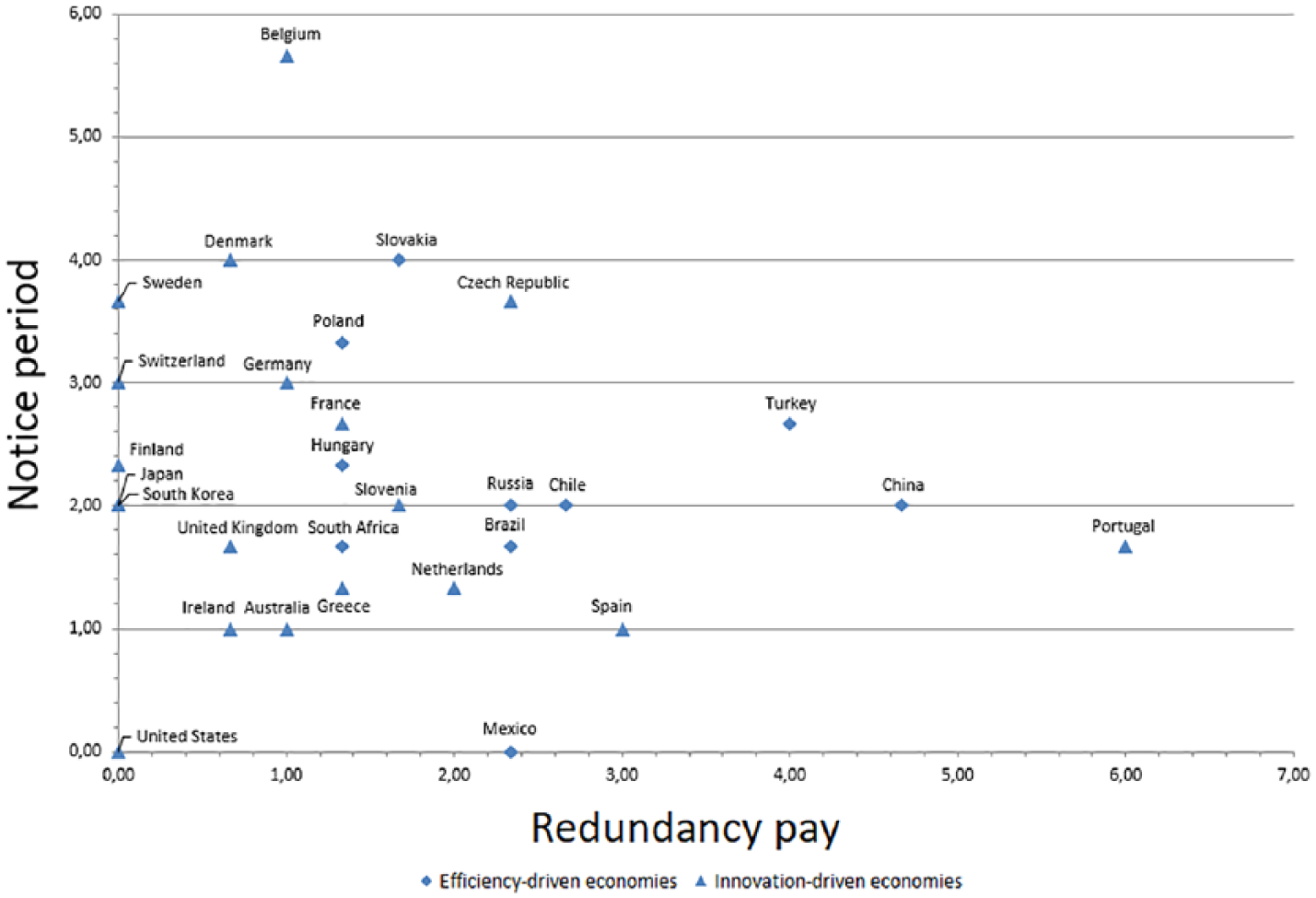
Country redundancy pay and notice period in months (OECD, N = 29).
Methodology
Both entrepreneurial employee activity and self-employment are not only affected by the national context but also by individual characteristics. This implies that disentangling the determinants of the allocation of entrepreneurial activity necessitates a multilevel analysis (Bjørnskov and Foss, 2016; Shepherd, 2011). In this way, we are able to unravel the direct effects of determinants at different levels as well as possible cross-level interactions. More specifically, we are able to investigate both the effects of a country’s redundancy pay and notice period on an individual’s occupational status and, for example, whether or not these effects depend on his or her age.
The composed data set has a hierarchical data structure; it includes variables on the individual level as well as on the national level. Traditional approaches to deal with hierarchical data are either disaggregating all variables to the lowest level, or aggregating all variables to the highest level, followed by standard analyses like multiple regression analyses. However, with hierarchical data, observations are not independent, errors are not independent and different observations may have errors with different variances (i.e. heteroscedastic errors), while multiple regression analysis assumes exactly the opposite. Observations of individuals within the same group (or, country in this case) tend to be more similar as compared to observations between different groups. This may be due to selection issues or a shared history of the individuals within a group. Multilevel techniques account for the fact that most variables have both within-group and between-group variation and that the effect of an individual-level explanatory variable may well be different across different groups (Rabe-Hesketh et al., 2004; Rabe-Hesketh and Skrondal, 2006).
In general, the lowest level of a basic multilevel regression model is represented by the following equation:

At the second level, we have

and

Substitution of equations (2) and (3) into equation (1) and rearrangement of terms leads to the following single-equation version of a two-level regression model, with only one explanatory variable per level

In equation (4),
Usually, as is the case in this study, one deals with more than one explanatory variable at both levels. Assume that there are

Our basic model consists of 12 individual-level explanatory variables (all binary), representing an individual’s age, gender, educational level and household income, and 2 country-level explanatory variables, namely a country’s log GDP per capita and unemployment rate. The full multilevel regression models also include the redundancy pay and notice period variables for workers with different years of tenure, and hence,
Results
Correlation coefficients
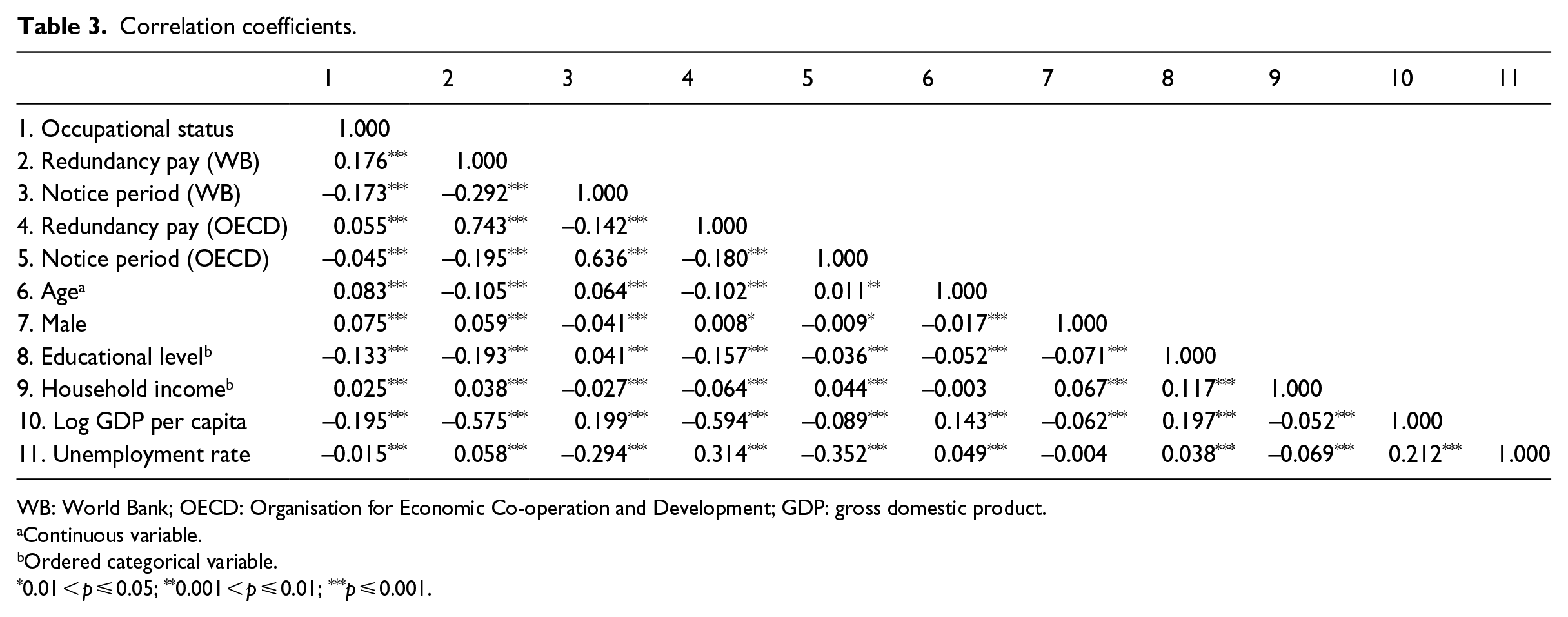
The correlation coefficients between the dependent variable, the independent variables of interest and the control variables, based on the full sample, are given in Table 3. They already provide us with some insights into their mutual relationships.
Correlation coefficients.
WB: World Bank; OECD: Organisation for Economic Co-operation and Development; GDP: gross domestic product.
Continuous variable.
Ordered categorical variable.
0.01 < p ⩽ 0.05; **0.001 < p ⩽ 0.01; ***p ⩽ 0.001.
Since our dependent variable is unordered categorical, we cannot draw any firm conclusions (yet) as to its correlation with any of the redundancy pay and notice period indicators. In the case of both WB and OECD data, redundancy pay and notice period are significantly and negatively correlated, so, on average, the higher the redundancy payments, the shorter the notice period, and vice versa. The highest correlations can be found among the redundancy pay and notice period variables from different sources. For example, the correlation between the WB and OECD indicator of redundancy pay is 0.743, and highly significant. We may conclude that both data sources seem to assess the strictness of EPL in a fairly similar way. Other correlation coefficients worth mentioning are those between the log GDP per capita and the redundancy pay variable, in case of both WB and OECD data. The highly significantly negative relationships (−0.575 and −0.594, respectively) point at high-income countries having less strict EPL in terms of redundancy pay. The coefficients are inconclusive regarding its relationship with nationally legislated notice periods.
Regression results
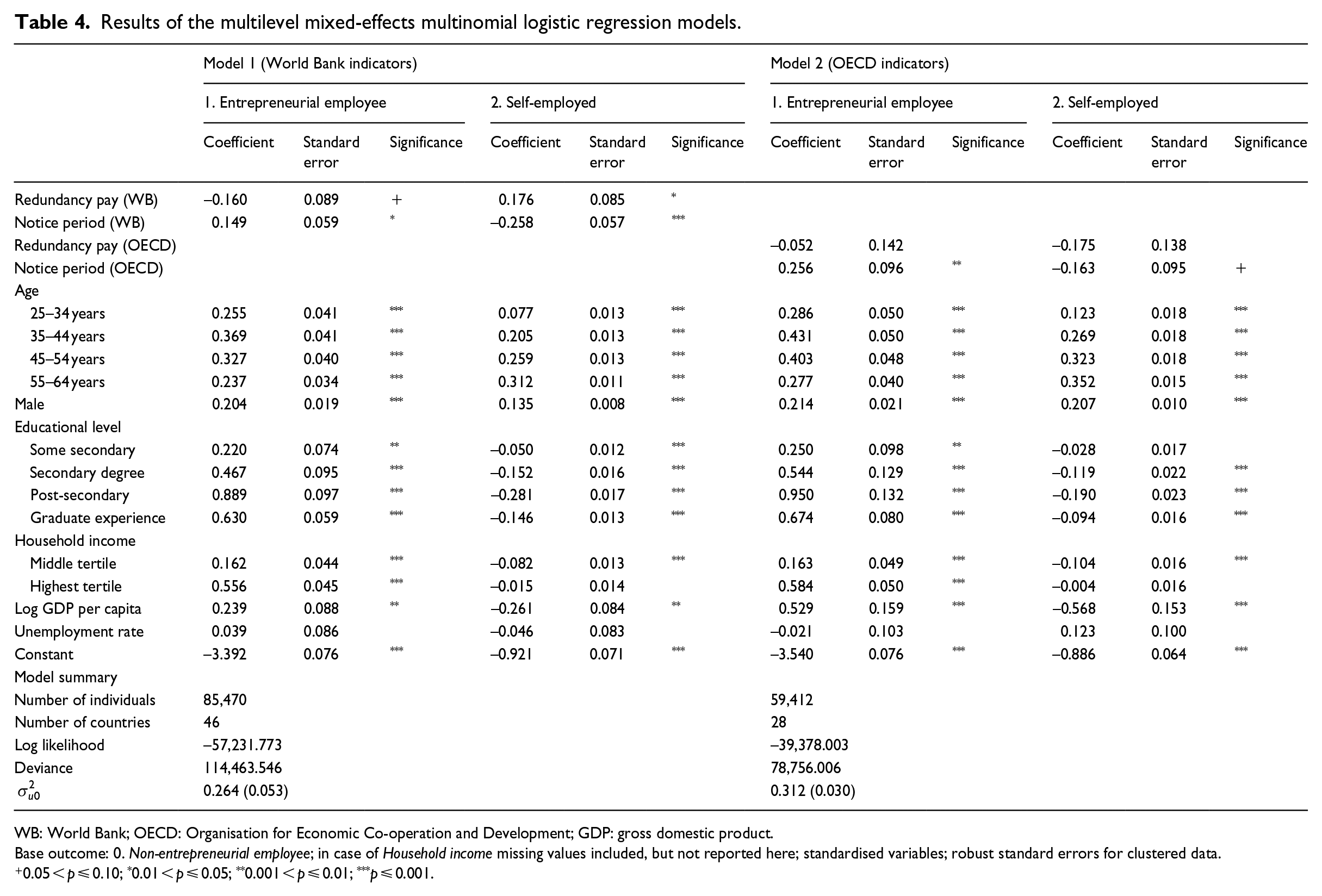
Table 4 shows the results of the main multilevel mixed-effects multinomial logistic regression models. Models 1 and 2 alternately include the WB and OECD variables regarding the average redundancy pay and notice period for employers. As WB data are available for a larger number of countries, their sample sizes differ. The results of Models 1 and 2 are based on data for 46 and 28 countries, respectively. 4 Both models contain all aforementioned control variables. We have also run models in which we test the effects of the redundancy pay and notice period variables separately; their results do not deviate from that discussed below, regarding the direction and significance of the effects. 5
Results of the multilevel mixed-effects multinomial logistic regression models.
WB: World Bank; OECD: Organisation for Economic Co-operation and Development; GDP: gross domestic product.
Base outcome: 0. Non-entrepreneurial employee; in case of Household income missing values included, but not reported here; standardised variables; robust standard errors for clustered data.
0.05 < p ⩽ 0.10; *0.01 < p ⩽ 0.05; **0.001 < p ⩽ 0.01; ***p ⩽ 0.001.
The base outcome category of the two models is Non-entrepreneurial employee, such that all coefficients should be interpreted relative to this occupational status. A non-entrepreneurial employee is someone who is employed, either part-time or full-time, but does not qualify as an entrepreneurial employee as they are not involved in developing new business activities for the employer. Coefficients are shown of the effects on the remaining two occupational statuses, that is, entrepreneurial employee and self-employed, two ways in which an individual can be entrepreneurially active.
We find clear support for Hypothesis 1, since the notice period has a significantly positive effect on individuals being entrepreneurially active as an employee. This effect is even stronger and highly significant in case of the sample with OECD countries only. A longer notice period is negatively associated with being self-employed. We do not find consistent evidence for Hypothesis 2; redundancy pay seems to be positively related to being self-employed in the WB sample, but there is no relation in the OECD sample. Redundancy pay is found to be negatively associated with the probability of being involved in entrepreneurial employee activity, although the effect is only weakly significant in case of WB data and insignificant in case of OECD data.
In any case, both elements of EPL have an opposite effect on the two different modes of entrepreneurial activity. The opposite effects of the redundancy pay and notice period suggest that a negative effect on one of the modes of entrepreneurial activity may not be as detrimental for overall entrepreneurial activity as initially appears. It may be compensated for by the positive effect on the other mode of entrepreneurial activity in society. Table 4 shows the coefficients of standardised variables which supports this interpretation when comparing the effects of different variables within one sample (Hox et al., 2018). However, for a meaningful interpretation of the effects on our outcome variable, we need to initially derive the unstandardised coefficients. For example, with each one week increase in the average notice period for employers, the average probability of being self-employed goes down by 0.063 (or 0.126 with each one month increase in case of OECD data). This corresponds to the −0.258 and −0.163 coefficients of the standardised variables Notice Period (WB) and Notice Period (OECD), respectively. Thus, the average probability for individuals to be self-employed is lower in countries that have set a longer average notice period for employers. At the same time, the average probability of being entrepreneurially active as an employee increases with 0.036 (or 0.198), corresponding to the 0.149 and 0.256 coefficients of the aforementioned standardised variables.
Hence, in case of Model 2 – that is, using the OECD indicators, and therefore, a sample with OECD countries only – we observe a sharper increase in the average probability to be an entrepreneurial employee than the decrease in the average probability to be self-employed (0.198 vs −0.126). This most likely yields an increase in the number of entrepreneurial employees, which more than offsets the decrease in self-employment numbers. In the case of Model 1 and WB data, the negative effect on self-employment is only partially offset by the positive effect on entrepreneurial employment (0.036 vs −0.063). Nevertheless, it appears not as harmful for entrepreneurial activity in society as it seems at first sight. At the same time, the positive effect of average redundancy pay on self-employment more than offsets its negative effect upon entrepreneurial employment (0.019 vs −0.018).
Almost all control variables are highly significant; only unemployment rates of countries remain insignificant throughout both models. The coefficients of the control variables mostly have the expected sign. Age is positively related with being involved in entrepreneurial activity in general either as an employee or as self-employed. The largest effect on being an entrepreneurial employee can be found for individuals between 35 and 44 (0.369 and 0.431 in Models 1 and 2, respectively). People above 55 are most likely to be self-employed. Moreover, men have a higher probability of being entrepreneurially active than women, relative to being employed and not involved in entrepreneurial activity. A higher educational level as well as a higher household income are strongly positive for being an entrepreneurial employee. Both controls are negatively related to self-employment, yet insignificant for individuals with a household income that belongs to the highest tertile of the population. The higher a country’s GDP per capita, the greater the probability that an individual is entrepreneurially active as an employee (0.239 and 0.529 in Models 1 and 2, respectively). The reverse holds for people being self-employed (−0.261 and −0.568).
Robustness checks
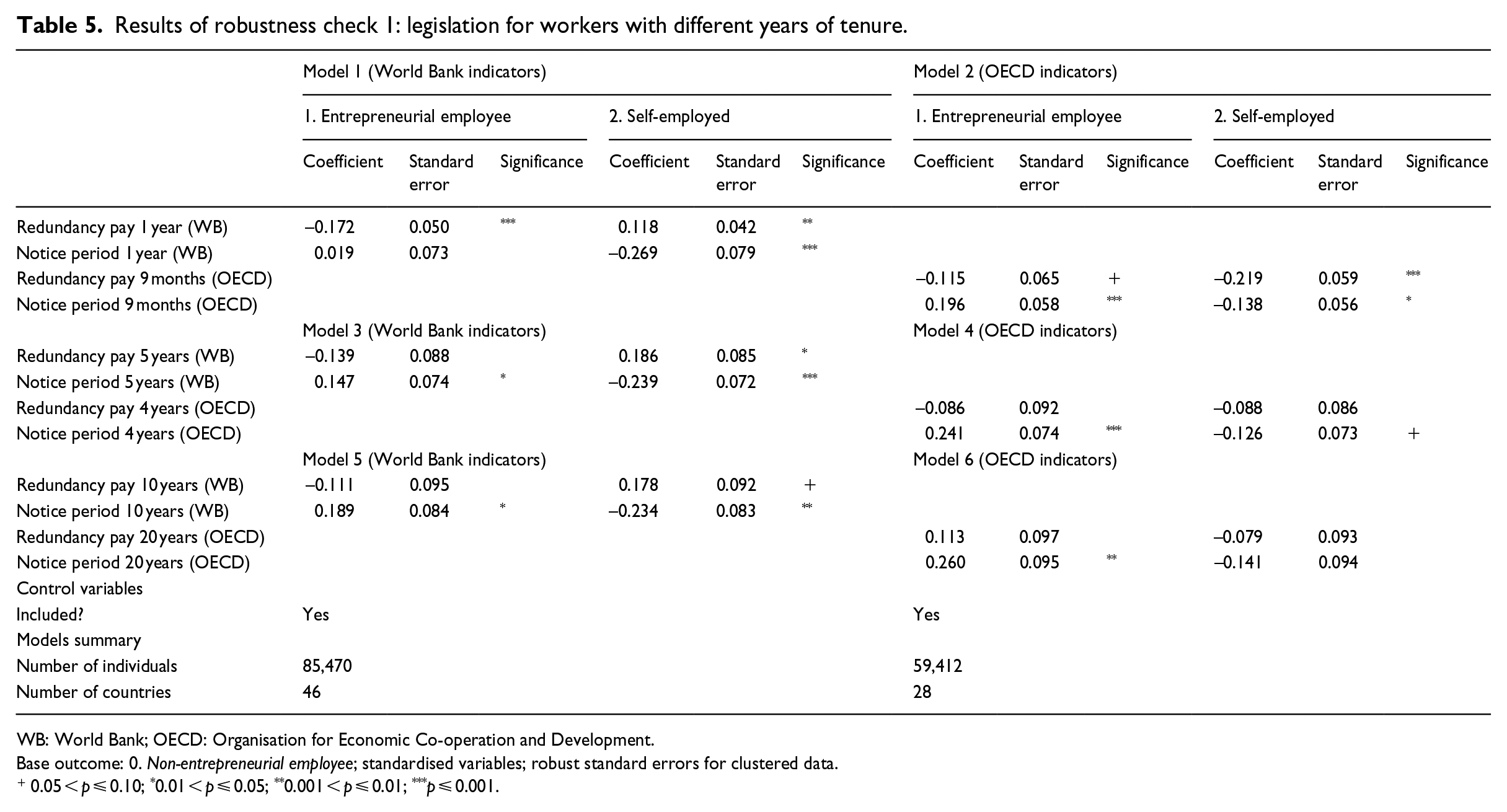
Our robustness checks include the estimation of similar models, but (1) now using the WB and OECD indicators of redundancy pay and the notice period for workers at different years of tenure and (2) preselecting 29 OECD countries. 6 The question regarding the latter robustness check is whether the conclusions previously drawn also hold for a more homogeneous set of countries in terms of levels of economic development. The subsample that results from this prior selection excludes all factor-driven economies and most countries that qualify as efficiency-driven economies. By focusing upon more developed countries only, our results are less influenced by necessity-based and/or informal forms of entrepreneurship; these are more prevalent in developing countries (Acs, 2006).
Usually, employment protection is less stringent for employees with fewer years of tenure, and so, any changes in the strictness of regulations will have a greater effect upon them. As such, it would be expected that redundancy pay and the notice period for employees with fewer years of tenure would be stronger determinants of the allocation over different occupations. Recall that the WB data allows for differentiation between workers with one, five and 10 years of tenure. The OECD in turn distinguishes between employment protection for employees working nine months and four years and 20 years for their current employer. On average, the length of the notice period decreases with years of tenure increasing in case of OECD data. Also, on average, redundancy pay is set highest for workers with four years tenure. For the sample of countries for which we have WB data, we see that both redundancy pay and notice period are greater for employees with the longest tenure.
Table 5 reveals that the direction of the effects does not depend on differences in legislation for employees with different tenure lengths. Only small differences appear in the magnitude and significance of the various effects. For example, only redundancy payments for workers with a relatively short tenure length (12 or nine months) have a significantly negative effect upon being an entrepreneurial employee. In contrast, the notice period for employees with longer tenure has stronger significant effects on the probability of being an entrepreneurial employee.
Results of robustness check 1: legislation for workers with different years of tenure.
WB: World Bank; OECD: Organisation for Economic Co-operation and Development.
Base outcome: 0. Non-entrepreneurial employee; standardised variables; robust standard errors for clustered data.
0.05 < p ⩽ 0.10; *0.01 < p ⩽ 0.05; **0.001 < p ⩽ 0.01; ***p ⩽ 0.001.
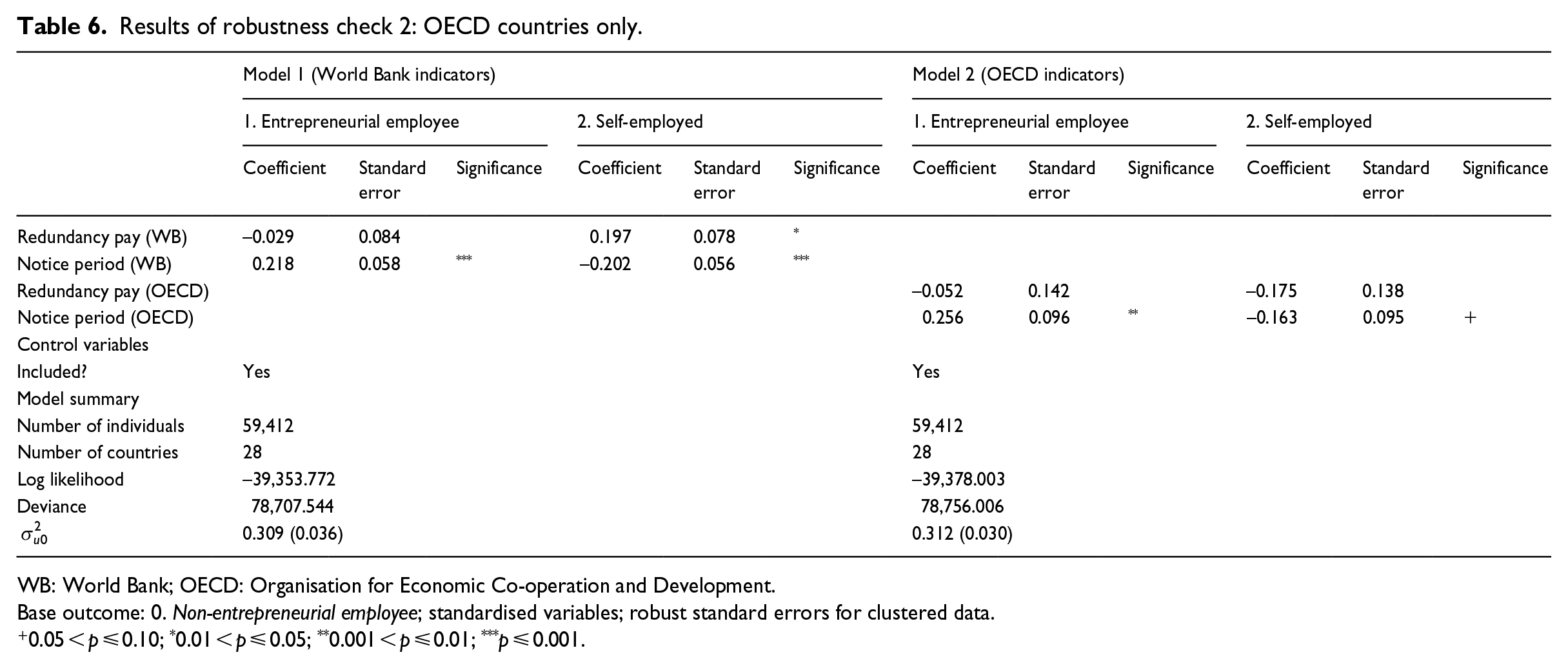
A prior selection of the 29 OECD countries confirms the previous findings as to the direction of effects (see Table 6). Our focus is upon the first model, in which we use the WB indicators. Model 2 replicates the second model in Table 4; the effect of average redundancy pay upon being an entrepreneurial employee loses its (weak) significance. The three other coefficients of interest remain significant. In particular, the notice period has a clear positive effect upon being an entrepreneurial employee and a clear negative effect on being self-employed. Therefore, in this instance also, we find evidence for our first hypothesis, but not for our second hypothesis.
Results of robustness check 2: OECD countries only.
WB: World Bank; OECD: Organisation for Economic Co-operation and Development.
Base outcome: 0. Non-entrepreneurial employee; standardised variables; robust standard errors for clustered data.
0.05 < p ⩽ 0.10; *0.01 < p ⩽ 0.05; **0.001 < p ⩽ 0.01; ***p ⩽ 0.001.
Consequently, we conclude that our main results are robust using slightly different specifications of the model and by preselecting a different group of countries. We find that two of EPL’s main elements, that is, redundancy pay and notice period, reflecting the two (contrasting) mechanisms of liquidity constraints and search time, have opposite effects on two types of entrepreneurial activity. Longer notice period increases the probability that an individual is active as an entrepreneurial employee, while higher redundancy pay increases the chances of being self-employed. This holds for both a heterogeneous set of countries and a more homogeneous sample regarding their level of economic development.
Conclusions and discussion
The manner in which the effects of EPL have been studied to date is lacking as the focus has been upon effects at the national level, such as changes in employment levels. Moreover, and despite EPL’s complex nature, a composite index has been favoured to determine its stringency. We, however, develop a discrete focus upon two main elements: redundancy pay and notice period. This reflects the four key mechanisms explaining the allocation of entrepreneurial activity in society – labour market frictions, opportunity costs, search time and liquidity constraints. Our analyses reveal opposing effects of these two elements on the allocation of entrepreneurial individuals across established and newly established organisations (i.e., entrepreneurial employee activity and self-employment, respectively).
The estimation results involving average notice period do show highly significant coefficients, in the hypothesised direction, for both WB and OECD data, that is, a longer notice period for employers is positively related to individuals being entrepreneurially active as an employee. The results are highly robust according to two checks. We also find that the higher the state-mandated redundancy payments from employer to employee after dismissal, the higher the chances of self-employment. These results are, however, not confirmed when using OECD data.
Any negative effect of national-level EPL on self-employment numbers may be offset – at least partially – by a positive effect on the number of entrepreneurial activities by employees, and vice versa. Similarly, evidence casts doubt on the well-established notion that large and mature organisations inhibit entrepreneurship; although employees in such organisations are found to be less likely to transition to independent entrepreneurship, they exhibit a higher probability to engage in entrepreneurship inside the established firm (Kacperczyk, 2012). Any observed negative effect on (independent) entrepreneurship may not be as detrimental as generally assumed.
The findings are notable in the sense that different elements of national EPL have opposite effects on the allocation of entrepreneurial activity. The results can therefore be seen as evidence against the use of composite indicators for EPL, which has been the standard in empirical research (Robson, 2003; Torrini, 2005). Different kinds of employment protection regulation might have contradictory effects, as is shown here (also see Addison & Grosso, 1996; Lazear, 1990).
This study is not without limitations. First, it might be the case that strict EPL is embedded in a culture of uncertainty avoidance, as formal institutions are often dependent on informal institutions (North, 1990; Williamson, 2000). In that sense, one may expect more people willing to become an employee, and some of them ultimately engaging in entrepreneurial employee activity, instead of becoming self-employed. Future studies need to analyse the interdependence between informal institutions and EPL. Second, we use a cross-sectional data set, which implies that it is hard to exclude reverse causality. Ideally, we would have had a longitudinal data set covering more than the year 2011 only, and preferably substantial variation over time in the independent variable (with some shocks in EPL). Nonetheless, it is unlikely that causality runs from an individual’s choice about where to be entrepreneurially active to country-level EPL, leaving our main conclusions unaltered. In addition, micro-level studies – both qualitative and quantitative – might be better able to reveal the causal effects of (changing) regulation on actions of employers as well as actions of workers (employees and self-employed). Third, redundancy pay and the notice period only capture part of a country’s EPL. Even though these two provisions are among the most important elements of EPL (Lazear, 1990; Pissarides, 2001), future research might consider the inclusion of various other regulations that are part of a country’s legislation on employment protection. One can think of the maximum length of fixed-term contracts, whether or not redundancy dismissal is allowed by law and whether or not third-party notification and/or approval are needed. Finally, there is a focus on of the difficulty involved in obtaining information on privately or collectively negotiated contracts. This might be misleading though, for example, in case of the Netherlands, where most employment protection regulations are laid down in collective agreements, on top of the prevailing national laws. Even though such regulations usually follow those set out in national-level legislation (Venn, 2009), future studies should take into account subnational heterogeneity in labour market regulations, such as sectoral- and regional-specific provisions (Autor et al., 2007). Scholars may be inspired by a recent study that measures a firm’s exposure to EPL instead of using country-specific proxies for EPL (Van Landuyt et al., 2017). Likewise, employee (potential) exposure to EPL is also likely to depend on regulations other than those of country-level legislation.
EPL, just like any institution, enables and constrains. It has been initiated to protect employees and also plays a role in economic policy debates on how to increase national-level productivity. Even though it may be designed with one purpose in mind (protection of employees), it may have unintended effects on other economic actions (the decision to become self-employed or entrepreneurially active as employee). EPL is largely a product of a society which is dominated by employers and employees, which runs the danger of neglecting the effects on the self-employed. EPL is also largely the product of the managerial economy (Audretsch and Thurik, 2001; Thurik et al., 2013), while its effects on the entrepreneurial economy need to be discovered. We have contributed to the latter and showed how labour market regulation and, in particular, two main elements of EPL affect different types of entrepreneurial activity and thus are important elements of entrepreneurial ecosystems (Stam, 2015). Future studies should take into account other types of entrepreneurship as well, for example, disentangling the effects of labour market regulation on dependent self-employed and more independent, innovative, growth-oriented types of independent entrepreneurs.
Footnotes
Acknowledgements
The authors would like to thank Niels Bosma, Steven Dhondt and the participants of the DRUID Academy Conference (Aalborg, January 2015); the ACED full paper presentations (Antwerp, June 2015); the IWH Workshop on Entrepreneurship and the Labour Market (Halle (Saale), April 2016); the Workshop on Institutions and Entrepreneurship (Reading, May 2016); the Università Cattolica - Department of Economic Policy Seminar (Milan, June 2016); and the Maastricht University SBE seminar (Maastricht, January 2019) for their helpful comments and constructive feedback on earlier versions of this paper.
Author’s note
Werner Liebregts is also affiliated to the Jheronimus Academy of Data Science (JADS), ‘s-Hertogenbosch, the Netherlands.
Funding
The authors disclosed receipt of the following financial support for the research, authorship, and/or publication of this article: An earlier version of this paper is part of author's doctoral thesis, for which they received funding from the Netherlands Organisation for Applied Scientific Research (TNO).
