




Abstract
Through an investigation of small and medium sized enterprises (SMEs) exporting in contexts which lack a formalised institutional environment in a less developed country, this article shows how entrepreneurs cope with institutional deficiency. By drawing on an analysis of 12 SMEs exporting from Ghana to other West African countries, the findings reveal how entrepreneurs and their organisations avoid recourse to the courts and instead, use culturally specific relationships to settle disputes when exporting. Institutional forms operating in parallel to the formal legal system are examined. These are shown to be hybrid forms drawing on traditional cultural institutions such as chieftaincy and religion, combined with forms of corporations and cooperatives. Assumptions around the different roles of family and kinship also are explored. The study contributes to the ongoing development of a theoretical understanding on trust and relationship building in international entrepreneurship, and the importance of understanding cultural context.
Keywords
Introduction
The growing interest in the internationalisation of small and medium enterprises (SMEs) in emerging economies suggests a need to understand how exporting processes vary according to cultural context, and how entrepreneurs where institutions such as legal systems and courts are perceived to be deficient. This article explores how entrepreneurs draw on alternative institutions and build trust-based relationships. Previous research has shown the importance of examining how organisations cope with uncertainty and competitiveness in the context of institutional deficiencies (Akimova and Schwodiauer, 2005; Smallbone and Welter, 2012; Welter and Smallbone, 2011). This study examines how context shapes the strategic relationships and institutions developed by exporting SMEs operating in an emerging country context. This allows a greater understanding of how networks and relationships in business operate in an African context, a part of the world that is rarely examined in management research (Jackson et al., 2008).
While previous research has examined the role of SMEs in cross-border trade in Africa (e.g. Fadahunsi and Rosa, 2002; Hashim and Meagher, 1999), and the importance of networks for firm survival in these contexts (Hart, 2000; Jenssen and Kristansen, 2004; Overa, 2006), this article focuses on the personalised relationships and institutions that support entrepreneurs in contexts of uncertain formal legal institutions. In such circumstances, an understanding of the processes of building networks and trust is needed. By examining SMEs, this article also addresses the imbalance in research which prioritises larger corporates, even though SMEs dominate the economies of less developed countries (OECD, 2006). Furthermore, until recently, research on internationalisation has focused on North–South trade relationships rather than South–South intra-regional trade (Demir and Dahi, 2011). However, to understand this part of the global economy there is a need for greater understanding of specific institutional and cultural environments (Bachmann, 2010; Dietz et al., 2010). Ghana was chosen for this study because, like most sub-Saharan African countries, SMEs dominate the economy (Abor and Quartey, 2010; World Bank, 2002). However, the formal institutional structures are weak, with limited use of legally binding commercial contracts and support from state-backed institutions for the sector (Fafchamps, 1996, 2004). Therefore, exporting businesses have to cope with institutional deficiencies within Ghana and the West African region.
This article has taken an exploratory approach to theory development that explores the role of culture in shaping trust and institutions, taking owner-managers of small firms as the unit of analysis. The original data draws on in-depth field work undertaken over a two-year period, focused upon 12 case studies. This approach recognises the role of entrepreneurial agency while providing an understanding of how the processes of trust building are embedded in social relations and existing norms and values (Drakopoulou-Dodd and Anderson, 2007; Granovetter, 1985; Hodgson, 2007; Jack and Anderson, 2002). In each of the case studies, the networks and relationships are explored, particularly the business–to–business links in supply chains, often crossing cultural boundaries. Through understanding the cultural context in Ghana and the export markets within West Africa, insights can be drawn as to how these relationships are developed in a multi-ethnic context, with a diversity of religions, institutional forms and professional cultures.
The article addresses the core research question of how entrepreneurs use networks and trust-based relationships in a context of institutional deficiency. The analysis of the findings is focused around three sub-questions:
RQ1: How do entrepreneurs perceive state-backed and legal institutions? RQ2: What are the personal relationships built in weak institutional contexts? RQ3: What are the parallel formal and semi-formal institutions that have evolved?
The analysis of context contributes to an understanding of how elements of family or kinship, religion and other specific cultural forms shape the process of building trust and form the basis of norms of networks and relationships that allow trade to occur in a context of limited recourse to legal contracts. This article also makes a contribution to research on institutions supporting entrepreneurship and internationalisation: these include less formalised institutional forms operating in parallel to legal systems, to help ensure that contracts are upheld and disputes settled. Finally, by examining these relationships and processes in an African context rather than in mature market economies, we enhance entrepreneurship research.
The article is divided into six parts. The next section investigates the literature on contexts and entrepreneurship. The methodology is then discussed and the findings presented. The discussion and conclusion then relate the findings to theoretical developments on the influence of context on entrepreneurship research.
Contexts of weak legal and state-backed institutions
Entrepreneurship is shaped by the formal and informal institutions that support market exchange (Aldrich, 1999; North, 1990; Smallbone and Welter, 2001, 2012; Thornton et al., 2011; Webb et al., 2009; Welter, 2005). Formal institutions such as courts ensure compliance with contractual relationships (Akimova and Schwodiauer, 2005; Fafchamps, 1996, 2004). However, where such state-supported institutions are not perceived to be effective, there is a need to examine other forms of institutions and trust-based relationships (Zucker, 1986). Therefore, all transactions in a market economy are shaped by a range of institutions defined as ‘the rules of the game in a society, or more formally … the humanly devised constraints that shape human interaction’ (North, 1990: 3). These range from social conventions, norms and codes of ethics, all of which generally evolve from the society’s culture, to explicit rules and regulations, such as constitutional, legal and property rights (North, 2005). Consequently, institutional factors such as the competence of court officials impact on strategy and the objectives of organisations (Berry, 1997). Conversely, it can be argued that uncertain institutional contexts, such as the existence of legal norms that encourage corruption and inefficiency, hinder the building of inter-firm relationships.
The adverse impact of institutions on economic exchanges becomes more obvious in emerging markets characterised by contexts where enforcement and sanctioning mechanisms by formal institutions may be generally weak. This requires the need to compensate for relationship development in other ways, such as the use of social, informal control mechanisms (Höhmann and Welter, 2005; Welter and Smallbone, 2006;). Nonetheless, in such contexts, entrepreneurship still may be particularly vibrant and so, for example SMEs dominate many sub-Saharan African economies (Jackson et al., 2008). However, the official statistics on cross-border trade in sub-Saharan Africa only reflect a partial picture of the volume of trade on the subcontinent, due to the existence of an almost equal amount of trade which crosses sub-Saharan African borders illegally – particularly by entrepreneurs in the informal sector (e.g. Brown, 1995). Fadahunsi and Rosa (2002) and Hashim and Meagher (1999) also show that entrepreneurs are involved in vibrant cross-border trade between Nigeria and its neighbouring West African countries, despite much activity being considered illegal. Cross-border trade in sub-Saharan Africa has evolved from the pre-colonial and post-colonial trans-Saharan and transatlantic trade and institutions (Bowdich, 1819; Kea, 1982). For example, during the colonial era, trade in Ghana was supported by a pre-colonial social structure due to the embeddedness of strong ties based on kinship, clan, community, the tribe or ethnic group, the chief and/or king (Barr, 1995; Perbi, 2004). Currently, traders in sub-Saharan African countries continue to rely on networks of intermediaries, suppliers and customers based on long-term relationships (Ghauri et al., 2003; Lyon, 2005; McDade and Spring, 2005; Overa, 2006).
Thornton et al. (2011) corroborate that different societies draw on diverse cultural values to enhance economic behaviour and entrepreneurship. Accordingly, there is a need to examine how cultural values influence the network relationships and institutions supporting exporting in an African context. While some see culture as an impediment to African SMEs (e.g. Dondo and Ngumo, 1998), others such as Tillmar (2006) show that SME owners draw on indigenous organisations such as tribal communities in solving business problems and sanctioning defaulters. There is a need to understand how culturally specific networking practices are emerging in an African context (Jenssen and Kristiansen, 2004; Thornton et al., 2011) This confirms that economic action is embedded in institutional contexts (Granovetter, 1985; Hodgson, 2007) and therefor, entrepreneurs use a variety of social and business ties that are built on trust and cooperation (Jack and Anderson, 2002). In addition, rather than assuming that institutional forms will evolve to a form found in Europe and North America, there is a need to explore the role of culture and hybridity from cross-fertilisation (Zein-Elabdin, 2009).
This article draws on the concept of embeddedness (Granovetter, 1985; Scott, 1995; Zucker, 1986) to argue that SME entrepreneurial networks and relationships are shaped by the nature of legal and less formal institutions in every country. In this way, the findings investigate the alternative cultural and other parallel institutions that entrepreneurs draw upon when building relationships in contexts of weak legal and state-backed institutions.
Cultural influences on the process of building export-related relationships
In order to understand the process of building relationships, it is necessary to focus on the ties that underpin such networks which are conceptualised as organised systems of relationships with an external environment (Donckels and Lambrecht, 1995; Drakopoulou-Dodd, 2011). Entrepreneurial networks may be developed based on membership in formal organisations, links with suppliers, customers, distributors and interpersonal linkages with acquaintances, friends, family and kin, which is aimed at organising resources to facilitate exploiting opportunities (Drakopoulou-Dodd, 2011). Strong ties linked to family and kinship deliver rich, timely, specific and important forms of resources to the entrepreneur, while weak ties gained from building friendships, socialising with people and earning their trust can be regarded as an investment in the business, allowing access to new ideas and information (Drakopoulou-Dodd, 2011; Granovetter, 1973; Uzzi, 1997). While there has been much work on social network analysis in order to understand patterns of networks (Scott and Carrington, 2011), there are also calls to examine the process of building relationships or ties (e.g. Georgiou et al., 2011; Klyver et al., 2008). While research in mature market economies has explored such issues, there has been minimal work on notions of trust and relationship-building in Africa (e.g. Jenssen and Kristiansen, 2004; Overa, 2006; Tillmar, 2006), with a particular gap in research on small business internationalisation.
However, in the context of internationalisation of SMEs, interpersonal and inter-firm relationships are important (e.g. Child et al., 2002; Hilmersson 2012; Johanson and Vahlne, 1990). Social and business networks enable firms to bridge ‘psychic distance’: the constraints associated with foreignness and to gain access to international markets (Berry, 1997; Child et al., 2002). Oviatt and McDougall (2005) suggest that weak ties abroad allow entrepreneurs to recognise international opportunities and thereby, facilitate internationalisation; also, it is less costly to maintain weak ties. The use of relationships highlights the key role of trust in SME internationalisation (Child and Rodrigues, 2007), particularly in contexts where there is less reliance on contracts (Hannah and Walsh, 2008). Gambetta posits that trust is
a particular level of the subjective probability with which an agent assesses that another agent or a group of agents will perform a particular action, both before he can monitor such action (or independently of his capacity ever to be able to monitor it) in a context in which it affects action. (1988: 217)
Such approaches to researching trust can be interpreted as being acultural, with a lack of attention to the norms that inform how different people perceive the same situation. In contrast, Zucker proposes that trust is ‘a set of expectations shared by all those involved in an exchange’ (1986: 54) maintaining that expectations can be preconscious in nature, in that they are taken for granted as part of the world known in common, until they are violated.
In general, the literature distinguishes between two types of trust: personal trust, which describes trust between people; and institutional trust, which refers to trust based on organisational, institutional and social systems (e.g. Lyon and Porter, 2009; Welter and Smallbone, 2006; Zucker, 1986). Personal trust results indirectly or by imputation from the outcomes of prior exchanges (Zucker, 1986). It is based on initial knowledge of the exchange partner and may depend on the characteristics of a group such as ethnic, kinship, or social bonds, as well as from emotional bonds between friends and family members and other social groups (Welter and Smallbone, 2006). Context, and particularly culture, shape interpersonal and institutional trust, which emanates from organisations, institutions and longstanding bilateral relationships involving partners or friends.
Curran et al. (1995) suggest that networks are primarily a cultural phenomena based on sets of meanings, norms and expectations. Sociological institutionalists such as Scott (1995) and Kostova (1997) argue that culture comprises normative aspects such as social norms, values, beliefs and assumptions, regulative aspects such as laws and rules, and cognitive components such as social knowledge. This may explain why Hofstede and Hofstede argue that: ‘Culture is the unwritten book with the rules of the social game that is passed on to newcomers by its members, nesting itself in their minds’ (2005: 36). Culture, and associated norms, may apply to a group of people, industry sectors, professions and firms, as well as individual business relationships and even separate transactions (Hofstede, 1991; Scherer 1980). Dietz et al. (2010) refer to the multiple interacting cultural spheres based on multiple cultural memberships that arise from different social identities. The complex mosaic of different cultural identities is divided by Chao and Moon (2005) into three categories:
the demographic – age, gender, ethnicity and nationality;
the geographical – emphasising the role of place and locale; and
the associational – related to a range of social groupings such as family, employment, industry, professional group, education or hobbies.
It is also necessary to understand the interaction of different a cultural characteristics. In particular, much work has been undertaken on ethnic and national cultures in Europe, North America and East Asia. On the aggregate level there has been a lack of empirical studies on the impact of culture on entrepreneurship, particularly in Africa. Currently, existing studies have adopted the cultural convergence perspective, and therefore, relied on western management principles (Jackson, 2004). Arguably, this approach constrains informed analysis of African management practices, which are shaped by the many (sub-)cultures on the continent, as well as historical contexts including colonialism (Georgiou et al., 2011)
SMEs sharing common culture and norms may forego contracts, avoiding enforcement and measurement costs by relying on cooperation based on cultural norms (Frederking, 2004). Therefore, culture shapes bilateral relationships involving partners or friends, since these relationships are governed by norms, values and codes of conduct (Lyon, 2005; Welter and Smallbone, 2006). In addition, shared characteristics such as ethnicity, kinship, social bonds and emotional bonds between friends and family members and other social groups may foster personal trust-based inter-organisational relationships (Welter and Smallbone, 2006). Interorganisational relations may rely on institutions that emerge based on formal organisations rather than personalised relationships. Business associations are one key source of external resources for SMEs, offering services ranging from advice, social opportunities, marketing, collective purchasing and self-regulation to lobbying and representing the interests of the businesses (Bennett and Ramsden, 2007; Masten and Brown, 1995). In contexts where legal systems are weak, they also have been found to offer roles in settling disputes (Lyon, 2003).
Accordingly, this article explores the process of building trust-based relationships in the context of weak formal institutions when expectations of institutional trust may be low. There has been only limited research on the role of trust in such cultural contexts (Hyden, 1980; Tillmar and Lindquist, 2007) so, there is a need for a greater understanding of the processes of building personal relationships and emerging institutions.
Method
Sample and data collection
The exploratory and theory-building approach in this article required an interpretivist approach (Eisenhardt, 1989) to ‘allow [for] capturing the richness and diversity of the context(s)’ (Welter, 2011: 177). The empirical element adopted a multiple case study approach (Perren and Ram, 2004; Yin, 1994), drawing on the experiences of 12 exporting SMEs in Ghana. Selecting the cases for the study was based on purposive and theoretical sampling in accordance with the research questions and theoretical framework (Marshall and Rossman, 1999). Table 1 presents the sample cases. The cases were all exporting to West African markets and covered the agriculture, services and manufacturing sectors in Ghana. This aimed to be representative of the SME exporters not involved in extractive industries (oil, gold and timber). The owner-managers of the cases were from a range of ethnic groups found within Ghana, with half coming from Akan-related ethnic groups, which make up just under half of the population. There was also a balance of male and female-led enterprises, and a range of organisations drawn from both the formal economy (with seven cases registered with the Registrar General’s Department), and five cases which are not registered and representative of the informal parts of the Ghanaian economy.
Details of sample organisations.
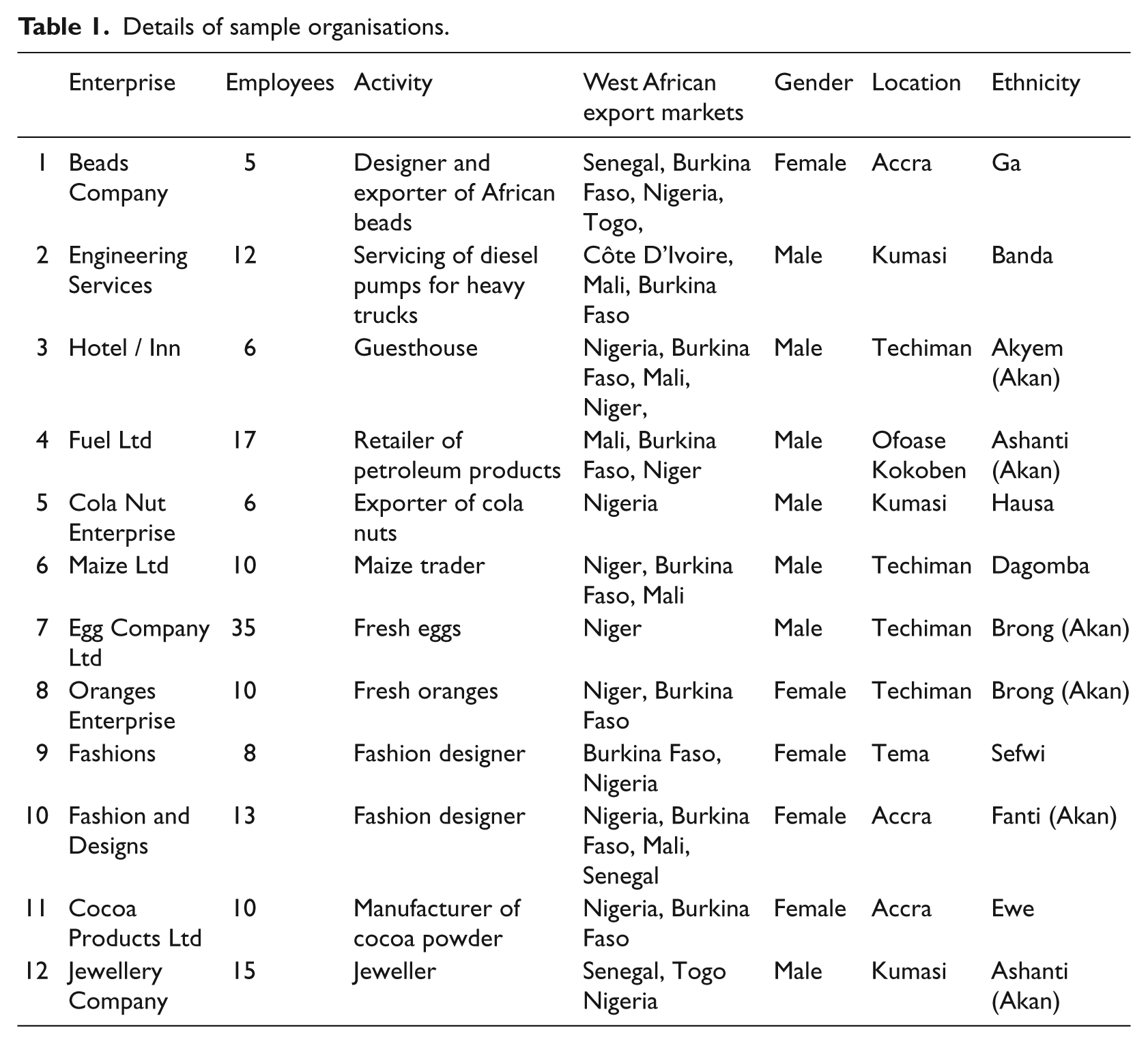
Based on the exploratory nature of this study, the selection of the cases aimed at comparing and contrasting entrepreneurs’ experiences and perceptions of the factors that shaped their decisions related to relationships. Ensuring continued access to cases was a critical issue, with the role of the researcher central in ensuring that trust-based relationships were established (Lyon, 2012). In addition, data collection was shaped by how the research participants perceived the researchers, both of whom had spent time working in this context.
The units of analysis for this study included the individual entrepreneur, their social and working ties and the multiple contexts including the business, social, spatial and institutional environments that particularly impacted on interorganisational relationship building (Drakopoulou-Dodd and Anderson, 2007; Welter, 2011). The research focused on the owner/manager as the key informant, since in small export organisations they were making the key decisions regarding inter-organisational trust building, collaborations and cooperation (Janowicz and Noorderhaven, 2006). In addition, four senior officials of state institutions were interviewed in an attempt to understand the various contexts that shaped internationalisation and relationship building.
Procedure and data analysis
The study used semi-structured interviews complemented by observations. The interviews were held at the respondents’ workplaces or homes. Direct and early questions about trust were not used, as this may have limited access to sensitive information. Questions seeking the disclosure of sensitive information were asked during the latter stages of the interviews (Dalton et al., 1997; Lyon, 2012). Observations of meetings and transactions at airports and ports, open food markets and industrial complexes provided data on actual practices and helped to explain events ‘within the context in which they occurred’ (Lupton, 1963: 29). These visits and meetings led to building rapport with prospective key respondents, and facilitated their cooperation during subsequent follow-up interviews (Tillmar, 2012).
A critical incident technique was used to explore specific experiences and to avoid generalisations (Flanagan, 1954). This technique allowed the researchers to probe into incidents that shaped owner-manager decisions and behaviours (Marshall and Rossman, 1999; Sullivan, 2001). The data analysis process also unearthed themes within the data that emerged to become the categories for the analysis. Thematic analysis allowed the research findings to be organised and described in detail (Boyatzis, 1998), with coding of particular responses allowing comparisons between types of exporters.
Study context
Ghana was chosen for this study for three main reasons. First, there is a rich history showing that for the past 1000 years, Ghana has been linked to the West African and intercontinental markets through the Savannah, Saharan and transatlantic trade routes. Transatlantic trade was facilitated through local Fanti captains who served as master merchant-brokers. The institution of captaincy was the basis of social networking, sharing information, sustaining shared norms and values, sanctioning defaulters, mobilising collective action and facilitating the generation of social capital among the trading parties (Kea, 1982). Second, like most sub-Saharan African countries, the state-backed institutional structures are relatively weak, with limited use of legally binding commercial contracts by SMEs (Acquaah, 2008; Fafchamps, 1996). Third, it has been argued that the formal institutional environment was limited further by a lack of encouragement of an entrepreneurial class in the years after independence (1957–1983), during which the political system constrained the growth of SMEs due to interference, bureaucracy and alleged corruption by government officials (Aryeetey et al., 1994; Kayanula and Quartey, 2000). Thus, it is unsurprising that SMEs’ contribution to Ghana’s export trade is not well documented (Aryeetey and Ahene, 2005). Business and product associations have emerged to strengthen the role of the private sector and smaller businesses (Masten and Brown, 1995). However, little attention has been paid to how trade associations and cultural forms (as parallel institutions to state-backed institutions) have been drawn on by SMEs in coping with numerous challenges. This study aims to fill this gap by examining how entrepreneurs’ experiences and perceptions of state-backed institutions shape their use of a range of networks and relationships in internationalisation.
Findings
Entrepreneurs’ perceptions of the legal system in Ghana and West Africa
Formal institutions that influence SME export relationships include the legal system, particularly the courts, and state-backed institutions such as the Ghana Export Promotion Authority. The findings revealed that entrepreneurs perceived the legal system related to commercial contracts to be weak, both in Ghana and in their export markets 1 (Table 2).
Entrepreneurs’ perceptions of the legal systems in Ghana and West African export markets.

All the entrepreneurs expressed negative perceptions regarding the Ghanaian court system’s capacity to in resolve disputes between themselves and suppliers. The multiple responses revealed that more than half of the cases (seven) cited waste of time, due partly to the long processes involved, while another half (six) perceived that the court system is corrupt, with two cases indicating that the court system is expensive. Similar perceptions were found concerning their West Africa export markets: six were of the view that going to court to seek redress to commercial disputes was a waste of time; five indicated that they perceived the legal system to be corrupt; three expressed security concerns; and two indicated that the court process would be too expensive.
In the context of using legal systems in export markets, a Hausa exporter of cola from Kumasi to Nigeria sums up the predicament of entrepreneurs in their market destinations:
No, we don’t deal with courts. We normally call the efiewura [agent’s] association. We call the fellow and tell them that this is the situation we have, and they will sit down and settle it – and you know, court cases sometimes it delays and as a foreigner, before you go there, you have to travel to Abuja to contact the Ghana ambassador, send your case to him. He drives you to find a lawyer for you, when? We don’t have time for that. So we just go to our association there (Interview number 5, Kumasi, 2010).
Personalised relationships used in contexts of weak institutions
In view of the respondents’ experiences and perceptions of the legal system or other state-backed support, SME exporters in Ghana are more likely to rely upon personalised relationships built on trust to address their problems and grievances. The relationships included close working relationships with partners based on credit provision, shared religion or intergenerational ties. Often, these relations were compared to strong ties based on family or kinship and friendships.
Working relationships. In the midst of a weak legal system and deficient state-backed support institutions, entrepreneurs have had to rely on a range of less formalised and culturally specific structures to allow networks and relationships to be built, as shown in Table 3. The working relationships in the case studies were found to rely on norms of family and kinship, religion, chieftaincy and industry-specific norms from trade associations, in order to build trust. These relationships were vital for gathering information and giving or receiving credit.
Norms of working relationships of cases by sector.
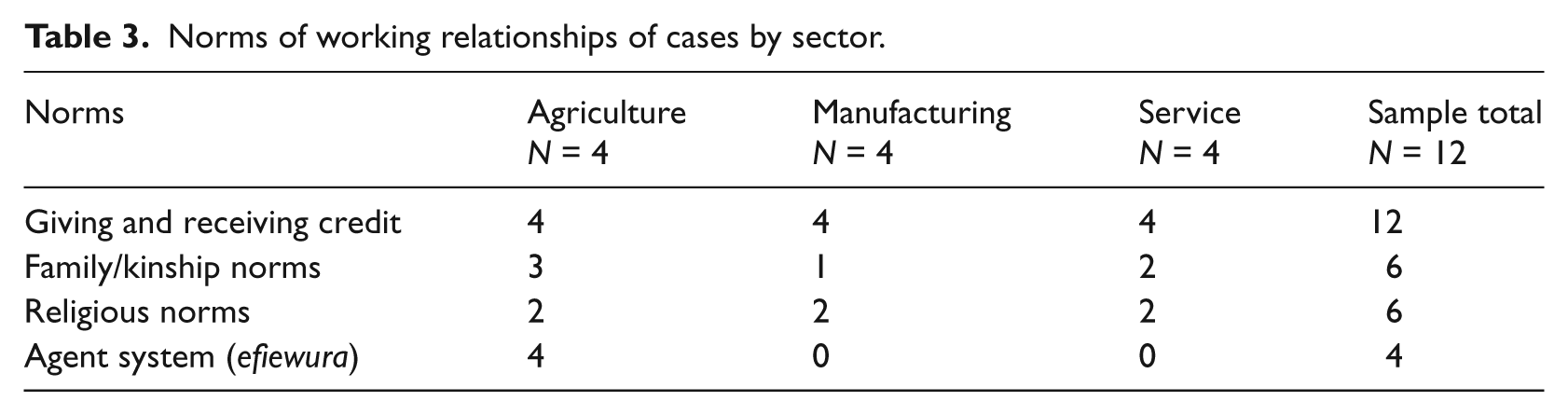
Table 3 shows that all 12 exporters stated that they offered credit to, and received credit from, some of their suppliers and customers in both domestic and West African markets after working with them for some time. The provision of such credit is essential to the export trade, as the smaller enterprises were found to have only limited access to banking facilities and finance. The length of time ranged from a few weeks to several months, depending mostly on the perceived trustworthiness of the exchange partners in the various relationships. Credit relations were shaped by specific norms regarding the provision of credit, such as repayment timing and offering better prices when credit has been given previously. More than half of the cases emphasised that lending and repayment of credit was seen as the most important indicator of trustworthiness. As a woman from Accra exporting African beads to Senegal, Burkina Faso, Nigeria and Togo puts it:
I give credit to those I trust, before I do that it means the person has bought from me before and they have been honest and honoured their credit promises and paid. (Interview 1, Accra, 2010)
As explained by case 1, providing larger amounts of credit takes place after experience in transactions involving cash payments followed by advancement of credit in smaller amounts. Nonetheless, credit relations take different forms in the various markets. Domestic exporter–supplier relations are characterised by credit advances for goods, cash loans or capital investment. In the context of exporters of agricultural produce, credit extension serves as a guarantee for supplies between the exporter and the partnering farmer, due to seasonal variations in the volume of agricultural produce.
Half of the entrepreneurs compared close working relations with business partners (who were not necessarily family members) as their mothers, brothers, sisters or family members, in an attempt to make sense of the reciprocity and obligations inherent in their working relationships in the domestic and West African markets (see Table 3). An exporter of maize from Techiman explained his metaphorical use of the concept of family when describing his relationship with his agent in Nigeria:
We talk to them, they visit us and occasionally we also visit them, and we have developed some kind of relationship, personal relationships and knowledge about the efiewura – and so now we are like a family. (Interview number 6, Techiman 2010)
Describing partners as family members is particularly important, since as ‘family members’ exporters are obliged to give and receive credit as well as other forms of reciprocity in bilateral exchange relationships.
In addition, religious norms are very influential in West African trade. Half of the exporters mentioned that shared norms of religion promoted relationships building due to shared beliefs, values and faith. Islamic, Christian and Animists belief systems shaped the expectations of their followers in various ways and therefore, their affection and loyalty to other followers of their religion. Evidence of the role of religious beliefs comes from references to the norms of fairness and reciprocity. Religious axioms were quoted by four of the respondents, with two Christians stating: ‘Do unto others what you want others to do unto you’, and two Muslims stating: ‘All men are brothers.’ An exporter of cola nut whose family had emigrated from Nigeria several generations before explained how Islamic values cemented relationships between himself and his agents in Nigeria:
We are Muslims, so our culture, you know, Muslims, if you are not a Ghanaian and then you go to meet another Muslim somewhere, he is our brother. After all, we all use Arabic and Hausa, and worship together. So we take him as our brother or our senior brother. (Interview Number 5, Kumasi, 2010)
A majority of the cases (nine) maintained that they did not consider religious affiliations in choosing whom to work and that their relationships spanned religions. While culture affects the nature and processes of building trust, the ties are found to cut across cultural and religious boundaries. When asked how religion influenced the type of partners used, an Ashanti retailer of petroleum products explained:
No, we work closely with anybody who comes and proves that he can honour his part of the agreement. Our foreign customers are mostly Muslims and we are Christians, but we have very cordial relationships. (Interview number 4, Ofoase Kokoben, September, 2010)
There was also no evidence of intra-religious animosity between exporters and their exchange partners of other religions.
A final type of less formal institutional structure is the collaborative relationship with agents in distant markets: the efiewura system. All four exporters of agricultural produce to West African markets had built personalised working relationships with commission agents in neighbouring regional markets such as Nigeria, Burkina Faso, Niger and Mali. A former winner of the Ghana National Best Poultry Farmer Award, who produces and exports fresh eggs to Niger, puts it aptly:
Yes I work with my efiewura in Niger – in fact, without him I cannot sell in that country, because with eggs we often sell on credit; but as a stranger I don’t understand their system of trading and I would need a lot of money and time to be able to start my own outlet in that country. (Interview number 7, Techiman, 2010).
These Efiewuranom (agents) serve as intermediaries who shrink the psychic distance between exporters and the markets of their choice. Sometimes these personalised relationships were reinforced through shared sociocultural norms of religion, ethnicity or kinship and languages, and in most cases, by sharing information and, at times, accommodation. These relationships also have particular norms for payment. Trade payments were received after the efiewura had finished selling and taken their commission: a process which could last for weeks. Unlike exporters in the agricultural sector, only one exporter in the manufacturing sector had an agent that distributed her products in Nigeria, while the remaining three exported directly to their customers operating retail outlets in neighbouring markets. All four cases in the service sector indicated that they did not have agents in West African markets. Upon probing further, it became clearer that they were more reactive and waited to be contacted by customers.
Family and kinship. While the previous section on working relationships showed how relationships drew on labels related to family ties, the research also explored the extent of strong ties to actual family members for supporting their enterprise. Traditionally, family members may dwell in one house and may contribute towards the upbringing of children through informal and formal education. Extended family members may contribute in cash and kind to the upbringing of children and might contribute to businesses in the start-up stage, particularly through inheritance, apprenticeships or start-up capital (Clark, 1994). Therefore, the extended family confers benefits as well as obligations on its members (Acquaah, 2008; Barr, 1995).
The interviews revealed that only three cases had received market information from relatives, and only two had received start-up capital from family members. However, kinship links were particularly central for the inheritance, succession and perpetuation of export relationships, especially with the efiewura system. These learning processes became institutionalised under the apprenticeship systems. Seven cases stated that they engaged their children or members of their family as apprentices in their trade, and as a result their export relationships could be perpetuated by these apprentices who may become their heirs or successors. It is important to emphasise that apprentices who eventually will become heirs were carefully selected, based on their perceived trustworthiness. Efiewuranom in the export markets also trained their children and extended family members as apprentices and heirs to their trade. For example, the cola nut enterprise utilised a network of trust built over several generations, originally between Hausa emigrants in Ghana and their kinsfolk in northern Nigeria.
In spite of the enabling influences of family or kinship, the cases reported that they had had negative experiences in working with family members: as a result, 10 entrepreneurs vouched that they actively avoided working with them. Half of the cases had experiences of family members defaulting on credit, and two reported examples of embezzlement. One respondent manufacturing clothes in Tema explained why they did not want to work closely with their family members in business:
I don’t mix business with family and friendships; they have given me a lot of problems previously. When I credited goods to a family member she did not pay back, and when I decided to take action, I was accused of putting money before family. (Interview number 9, Tema, 2010)
This excerpt typically explains that in Ghana, strong ties may constrain development of the enterprise and the SME sector. Interestingly, this finding cuts across ethnic divides, as the 12 cases in this study came from 10 ethnic backgrounds (see Table 1). The enabling and constraining roles of the family or kinship, or ‘the paradox of the family’, are discussed in later sections.
Additionally, one-quarter (three out of 12) of the respondents explained that when extended family members were employed or taken on as apprentices in their companies, productivity was curtailed. This was caused by a lack of discipline from extended family members who were not willing to take instructions from managers, and as a result adversely influenced the other employees.
Trade associations as parallel institutions
The study uncovered that respondents’ perceptions of the commercial court system, entrepreneurs relied particularly on a mix of institutions, including parallel cultural institutions of chieftaincy and industry-specific associations operating separately from the state, to provide foreign market services such as regulation and contract enforcement for exporting. Trade associations are found in all the export sectors in Ghana. The uniqueness of trade associations in Ghana and West Africa relates to their role in the mediation of disputes between their members and other exchange partners. In cross-cultural trade, trade associations also are found to be playing dispute resolution roles between the host efiewuranom and their trading partners from neighbouring countries. This is summed up by an exporter of fresh oranges from Techiman, whose efiewura in Mali belongs to a trade association:
Yes, those who have these market stalls are reliable because they have been registered – and I know that the association registers those people who are trustworthy. So in that case, should any of such agents who belong to the association cheat me, he could be fined. (Interview number 8, Techiman, September, 2010)
Case 8’s response focuses on the trade association’s ability to confer trust on its members in cross-border trade; they exercise their regulatory powers by sanctioning members found to have grossly abused the norms that govern their activities. In this way, the trade associations served as important parallel institutions to the courts. Furthermore, the trade associations promoted networking and relationship building through regulation, traceability, advocacy, skills development and welfare services, albeit to varying degrees. Hence, the associations and their leaderships functioned as bridges between the exporters and their foreign partners. However, in their attempt to build the capacities of some trade associations, state and international donor-funded organisations such as the Ghana Export Promotion Authority and Empretec Ghana were found to be encouraging trade associations to conform to their vision of how exporting should be done, rather than building on and strengthening the practices of these existing institutions.
The structures of some trade associations were found to be a hybridisation of western corporate or cooperative management styles and the traditional chieftaincy model. For example, among food trading enterprises that tend to be predominantly women-owned in Akan areas, the leader of a trade association in the open markets was usually referred to as ohemma, or the name of their particular commodity, such as ankaa hemma (literally ‘orange queen’). The ohemma exercised powers of leadership and administered the affairs of the association related to price negotiating, settling disputes and sanctioning members. The associations in the open markets also offered welfare payments to members who were ill or bereaved hence, offering a form of insurance to members. In this way they promoted shared values and enhanced trust and relationships building among members. Each ohemma was supported by a ‘secretary’ who played a role in deciding who had access to the ohemma and spoke on her behalf. This spokesperson role mirrors the role of okyeame, or linguists in traditional chieftaincy. Interestingly, the English word ‘secretary’ relating to corporate business structures or cooperatives, has been adopted as part of the Twi language. For other commodities which have a predominance of Hausa ethnic group men, the association leader is referred to as Sarkin (chief).
Table 4 summarises the trade associations to which three-quarters of the cases belonged, and the various services that were offered to the entrepreneurs. In some cases, the respondents were found to belong to more than one association; but for the purposes of this study, only those associations that were most important to the cases were explored.
Trade associations and the services they provide to exporters.

The data confirm that the trade associations also provided other services in Ghana (Table 4). including advocacy with both central and local government on issues ranging from policy to taxes, lobbying on behalf of members, providing business information, facilitating networking, providing training to members and organising trade fairs. However, there were limitations to trade associations. In spite of trade associations’ ability to foster networking and relationship building, some expressed concerns about transparency and use of resources by the leadership of some of the associations for example, one exporter shared her experience of attending an international fair, where ‘some fraudulent accounting was used in the course of the sharing of the money’.
Discussion
This article examines processes of relationship building when exporting between emerging market economies. It has specifically analysed how entrepreneurs use networks and relationships in order to build trust and access resources to enhance economic exchange in the context of deficiencies of the courts and legal institutions. It draws attention to the importance of understanding the role of culture in entrepreneurship research, particularly in international business. The study shows that SME owner experiences and perceptions of corruption with regards to commercial disputes in the legal system are widespread in both the domestic and West African regional markets (the first research question). Perceptions of delays due to long processes and perceptions corruption deterred entrepreneurs from using the legal system in both domestic and export markets. The plight of smaller businesses is exacerbated by a lack of support from state-backed support agencies.
Given the weak legal context, entrepreneurs were particularly keen on building personal and working relationships with their key partners (the issue addressed in the second research question). These networks and relationships were found to be culturally specific, drawing on historical precedent which can be traced back to the pre-colonial period and before trade with Europe started (Kea, 1982). While this is outside of the remit of this article, the current findings show the continued importance of understanding the mix of institutions that shape entrepreneurial strategy formulation, particularly when organisations cannot rely on legal institutions and state-backed support alone. There is a diversity of institutions, and the extent to which they are available and accessible to different types of enterprises requires further investigation. In this study, entrepreneurs’ strategic decision-making in the context of networking has been based on their perceptions and experiences with the legal system (Hilmersson, 2012). They also may appear different to forms of institutions found elsewhere in the world, with different cultural norms that influence small business internationalisation. There is a danger in making a eurocentric assumption that ‘less developed countries’ will be moving towards forms found in the more mature market economies of Europe, North America and Australasia. While entrepreneurs are shown to have agency and the chance to develop new relationships, their actions are embedded also in existing social relations (Granovetter, 1985). This article shows that this is particularly important in understanding South–South export trade in Africa: an area of study that has been neglected due to the overemphasis of research on exporting to and from developed countries.
While studying internationalisation, the process of bridging psychic distance, based on cultural difference was found to be a crucial factor for the case studies. SME exporters were found to rely more on different types of socially embedded networks and personalised relationships built on trust, in order to access resources for internationalisation (Child et al., 2002; Tang, 2011). This observation is not substantially different from SME internationalisation approaches in Europe, or other developed countries. However, since the agreements in these personalised relationships cannot be enforced by the legal system, personalised trust-based relationships assume more importance in the Ghanaian and West African context, since they are the only viable way to reduce opportunism and enhance economic exchange.
Moreover, relations are shown to be based on a range of ties, with important roles for intermediaries such as efiewuranom in bringing together enterprises and therefore, playing the role of broker, bridging some of the gaps in networks (Burt, 2005). The findings demonstrate the importance of understanding the role of context and embeddedness in entrepreneurship research, since in the context of developing economies, given the uncertainty over the formal legal system, there is a need for personalised networks and relationships underpinned by a range of less formal forms of trust-building (Child and Mollering, 2003).
A sophisticated conceptualisation of the role of culture is needed, as the institutional forms identified demonstrate the process of hybridisation, drawing on different cultural values and approaches. The case studies show how personalised relationships of trust develop across cultures and hybrid norms evolve, drawing on different cultural identities. The hybrid approaches to relationships show how exporters draw on different ethnic cultural norms held by the exporter and the importer. While there are ethnic differences between entrepreneurs coming from different parts of Ghana, the cases show that other ‘layers’ of cultures related to professions (e.g. traders in open market spaces) or sectors (e.g. specific issues to cola nut sales, fuel trading or tourism) are also important.
Within each of these conceptualisations of cultural layers, there is a need to understand the underpinning culture-specific norms shaping relationships. The relationships found in the case studies included working relationships shaped by norms related to credit relations, religious norms, the efiewura system and strong ties based on family, kinship and/or friendships. The norms of one context were found to be transposed onto other relationships: for example, exporters drew on norms of kinship and family by describing trading partners as their ‘mothers’, ‘brothers’ and ‘sisters’ in an attempt to draw on norms of reciprocity and obligation. As previously mentioned, this is particularly relevant, since as ‘family members’, exporters are obliged to offer and get access to credit as well as allegiance in bilateral exchanges. In addition, religious norms were identified as important factors, with the case study businesses referring to ‘brotherly’ relationships with fellow Muslims, or finding it easier to build trust with other Christians. However, much trade was found to be taking place across religious boundaries, with relationships built up on other norms.
The culturally aware analysis shows that the concept of the family business can be contested, and that there are dangers of making assumptions about the role of extended families and collaboration with families. While kinship links and the ‘economy of affection’ (Hyden, 1980) is important in many ways, the case study businesses reported that they often avoided working with close family members due to the accompanying obligations, as well as the difficulty in enforcing agreements. Similarly, Hart (2000) found that Frafra migrants in Accra who borrowed from fellow kinsfolk equated their interests with those of the lenders, and thus made poor borrowers. This evidence of the ‘burden of social relations’ encourages entrepreneurs to seek enterprise opportunities away from their extended family members, as well as from their home countries. Similar findings have been found elsewhere in Africa (Khavul et al., 2009; Whitehouse, 2011). The benefits and disadvantages attached to these strong ties are referred to here as the ‘paradox of family’, which was found across the different ethnic groups studied. However, there are culturally specific norms related to training certain close family members as apprentices, who will start to trade in their own right once they have built up relationships. These apprenticeship systems are found in both the exporters and the importing efiewuranom, showing how relationships and norms can be transferred between generations.
The third research question explored the parallel formal and semi-formal institutions that have evolved. This article shows that parallel institutions, particularly local trade associations, can reduce uncertainty and provide market information, advocacy, regulation, welfare services and networking. Similar forms of associations are found across West Africa, and to a lesser extent in southern Africa (D’haese et al., 2005; Porter et al., 2007). In these forms of cooperation, there is evidence of a hybridisation of norms, building on common leadership roles that originate in traditional cultural institutions such as chieftaincy systems and combining these with institutional forms found in European cooperatives and corporate business. Therefore, trade associations vary, drawing on place-based cultural norms, with some specific to a town or marketplace, particular industries, products or professions. In order to understand these institutions, it is important to understand the historical context in which they are embedded. This includes elements of pre-colonial regional trade, colonial period regulation and post-colonial economic opportunities and changing state controls. These are combined with other influences, such as the current models of enterprise found in globalised patterns of entrepreneurship. This hybridisation results in a combination of norms to make up the mix of culturally specific institutions within which entrepreneurial activity is embedded.
Conclusion
Despite the lack of institutional support, taken for granted in many mature economies, SME exporters in Ghana have found ways to develop ties and relationships that allow for internationalisation in the West African region. This article has examined the process of building trust-based relationships, both on an interpersonal level and with the emergence of a range of institutional forms that often are found operating in parallel to the state (Fadahunsi and Rosa, 2002; Hyden, 1980; Tillmar and Lindkvist, 2007). To understand these institutional forms, it is necessary to examine the context in which they operate and the process of finding common norms, even when developing cross-cultural relationships. The embeddedness approach to the study also shows how cultural differences, related to religion, particular locations and specific sectors shape the process of building trust.
In a context of globalisation and international trade, these norms and institutions may be a hybridisation of traditional systems and the norms of those businesses with which these exporters are collaborating. The case study approach taken demonstrates the importance of understanding how context and culture affects entrepreneurial activity, especially when SMEs are operating with legal institutions that are perceived to be deficient. The cultural norms and parallel institutions allow enterprise to flourish, but have been often overlooked by academic research that makes assumptions about how a supportive business environment should be based on a ‘western model’. While the institutional forms and processes of building trust can be specific to a particular context, there are wider implications for small business and entrepreneurship research with respect to explaining how SMEs operate in an environment where they believe they cannot rely on courts and other legal institutions. By taking an embedded approach that focuses on how economic action is shaped by social relations, this study challenges concepts such as family business, with entrepreneurs avoiding close relations due to the associated obligations (Khavul et al., 2009).
There are also considerable policy and practice implications in terms of identifying and supporting those institutions that encourage economic growth and access to livelihoods in Africa. Both intercontinental and intra-regional exporting can play a growing role in the economies of these less developed countries. Much research is focused on internationalisation related to the northern hemisphere economies, with only minimal consideration of exporting between less developed countries. Programmes wanting to grow such export trade need to explore both the facilitating factors and the barriers. Such barriers are frequently centred around perceptions of deficient institutional contexts. The lack of understanding of context has resulted in attempts to transplant inappropriate institutions from a European or North American context, rather than recognising that institutions can emerge that are a hybridisation of indigenous norms and other cultures. These institutions are shown to play a key role in current exporting strategies in West Africa, but are largely ignored by export promotion agencies in Ghana and elsewhere. Therefore, there is a need to explore these contexts, to understand what is meant by concepts such as family business, business association or the working relationship. Such an approach to understanding context can give an explanation of entrepreneurial strategies that do not appear to follow the assumed norms found in Europe and North America.
Footnotes
Acknowledgements
We are grateful to Sarah Drakopoulou-Dodd, David North, Leandro Sepulveda and three anonymous reviewers for their comments on the article. All views expressed are that of the authors.
Funding
The research on which this article draws was supported by the Centre for Enterprise and Economic Development Research, Middlesex University.