



Abstract
Institutional-based approaches to trust can explain how trust logics can exist in a societal context as compared to logics of distrust. Strong institutions in the form of regulative, normative and cognitive structures can enable and inspire trust-relations among people at the interpersonal and inter-organizational level. We suggest, however, that the actor-dimension of institutional-based trust is an underexplored issue in the literature. Quoting Fligstein, institutional theory needs to explain how ‘some social actors are better at producing desired social outcomes than are others’ (Fligstein, 1997: 398). While Fligstein refers to actors who engage in ‘robust or local action’ we argue that actors who engage in (robust, local) sensemaking activities are better at (re)producing institutional-based trust. Particularly in situations when institutions are relatively unstable, unfamiliar to the actors and ambiguous, sensemaking strategies directed towards exploring the institutional foundations of trust at a local level can be an important basis of interpersonal trust-relations. First, based on a summary of studies of institutional-based trust we argue that an unresolved issue is how institutions more precisely form the basis for trust-relations. Second, we explore how sensemaking may serve as a bridge between institutional contexts and interpersonal trust processes. Based on Weber and Glynn’s (2006) model of relations between institutions and sensemaking, we argue that institutions are ‘emerging’ rather than ‘impacting’. The relevance of this view of sensemaking for bridging institutional-based and interpersonal trust processes is illustrated by reviewing a case study on how trust is created in a politically turbulent and foreign environment.
This article investigates the relation between trust, institutions and sensemaking. Trust can be defined as ‘confident positive expectations regarding another’s conduct’ (Lewicki et al., 1998: 439). Institutions are ‘cognitive, normative and regulative structures and activities that provide stability and meaning to social behaviour’ (Scott, 1995: 33). Sensemaking can be understood as ‘ongoing retrospective development of plausible images that rationalize what people are doing’ (Weick et al., 2005: 409).
In the organizational trust-literature, research perspectives on the institutional bases of trust and interpersonal trust-relations tend to be separated (Bachmann, 2011; Lewis and Weigert, 1985). On the one hand, we find approaches with a bias towards overly individual accounts of trust focusing on individual traits, cognition and preferences while giving little explicit attention to the diverse cognitive, normative and regulative structures and activities which provide stability and meaning to trust behaviour (cf. Scott, 1995: 33). This is visible in rational choice theoretical approaches to trust (Coleman, 1990; Hardin, 1991). While not neglecting the relevance of institutions these are considered merely as parameters of individual actors’ decisions (Bachmann, 1998: 298). Also in psychological approaches to trust macro-level factors such as institutions are not recognized as important to the development of trust between two actors (see for example many of the contributions in Kramer and Tyler (1996) and especially Creed and Miles’ (1996) article on a conceptual framework for organizational trust where they focus on process-based and characteristic-based trust and explicitly neglect institutional-based trust).
On the other hand, we find approaches focusing on the institutional bases of trust (Bachmann, 2011; Bachmann and Inkpen, 2011; Kroeger, 2012). Most of the attempts to bridge institutional bases of trust and interpersonal trust see institutions as structures that embed and infuse trust-relations (Bachmann, 2011; Bachmann and Inkpen, 2011; Zucker, 1986). Bachman and Inkpen (2011) explore four mechanisms through which institutions can reduce risk and foster trust building processes in inter-organizational relationship: legal regulation, reputation, certification, and community norms, structures and procedures. The perspective of institutional-based trust seems especially relevant in regards to highly institutionalized environments in settled times where institutional structures are relatively stable, familiar to the actors and unambiguous. But when the institutional environment is more uncertain, confusing and turbulent, other perspectives are needed to supplement the institutional trust perspective. Bachmann has explored how actors operating in weak institutional environments may chose power as a mechanism of coordination, while actors operating under strong institutional environments may chose trust (Bachmann, 2001). In their important contribution Bachmann and Inkpen (2011) tend, however, to neglect how institutional bases of trust are formed and performed by actors. Their studies do not take explicit account of actors’ relationship to the institutional basis and whether and how it is strong and weak. There is a lack of theoretical perspectives that see the institutional bases of trust as emerging through microstrategies of social interaction (cf. Fligstein 1997) rather than as only embedding interpersonal trust-relations. Institutional elements are, arguably, not always available and accessible to actors in a ready-made way, but they are emerging through social processes, struggles and interactions.
In this article we focus on the relation between individuals in organizations and the institutional context. We stress that institutional-based trust is dependent on microstrategies of social interaction and sensemaking and give greater weight to the actor-dimension in trust showing that sensemaking may serve as an alternative way to conceptualize the bridge between institutional-based and interpersonal trust at the individual level. The sensemaking approach stresses how the meaning of institutional elements are gradually emerging to the actors. An example is when an organization enters a foreign country: then actors in the organization need to engage in sensemaking processes in order to understand the institutional bases of interpersonal trust in this unfamiliar institutional context (Child and Möllering, 2003; Möllering and Stache, 2010). Individuals in organizations must actively make sense of the institutional context and its impact on social behaviour.
Based on a review of recent analyses of the relation between institutions and sensemaking, especially Weber and Glynn’s (2006) modelling of the relation, we therefore argue that the institutional impact on trust is highly intertwined with sensemaking processes. While Weber and Glynn focus on the impact of institutions on sensemaking we focus on the role of sensemaking for clarifying relevant institutional elements for organizational actors. We argue that by focusing on sensemaking processes we may account for how particular elements of the institutional context are selected and made sense of in order for people to cope with interpersonal trust relations relevant for an organization.
The contribution of this study to organization theories of trust is two-fold. Firstly, the study points to the need for theoretical frameworks that show how social actors may produce and/or reproduce institutional features of trust by engaging in skillful sensemaking. The study then enhances our understanding of the way in which institutions ‘do their work’ by viewing institutions as emerging through sensemaking rather than seeing institutions as an objective basis for sensemaking and trust. Secondly, the study contributes by demonstrating that sensemaking can be seen as a bridging construct which could guide the analysis of how institutional trust enters into organizational processes. While some researchers have pointed towards the relevance of particular aspects of sensemaking for understanding trust (Adobor, 2005; Wright and Ehnert, 2006, 2010), this study shows that sensemaking generally could be seen as a bridging construct between institutional-based and interpersonal trust.
It should be noted that structuration theory has also been applied to explore the relation between actors and structures in trust relations. For example, Sydow uses Giddens’ structuration theory (Giddens, 1984; Sydow, 2004, 2006) to avoid both an undersocialized and an oversocialized conception of trust. This approach argues that agents act by referring to structural properties of their action context (such as trust) using interpretative schemes, norms and facilities. Thereby actors activate and reproduce structures/trust in a recursive way. Our approach differs from this approach because sensemaking is more loosely coupled to structural properties than understood in the structuration theory. For example, sensemaking may rely on improvisation and bricolage and can collapse (Weick, 1993). While sensemaking, therefore, is not directly a reproduction of structure it may be directed towards making sense of structural properties, such as institutional-based trust.
The remainder of the article is structured as follows. First, a summary of the discussion of institutions and trust show that a key issue is how institutions more precisely form the basis for trust-relations. Second, we show that sensemaking may serve as a bridge between institutional contexts and interpersonal trust processes. Based on Weber and Glynn’s (2006) model of institutions and sensemaking, we argue for an extended version of this model where institutions are ‘emerging’ through active sensemaking rather than ‘impacting’. The relevance of this view of sensemaking for bridging institutional-based and interpersonal trust processes is illustrated by reviewing an earlier reported case study on how trust is created in a politically turbulent and foreign environment.
Institutions and trust
In this section, we briefly review early work arguing for the relevance of institutions for inter-personal and inter-organizational trust.
The distinction between micro- and macro-sources of trust has, in fact, a long history in organizational trust research. For example, Niklas Luhmann (1979) distinguishes between personal trust based on familiarity, and system trust based on confidence in the reliable functioning of systems as abstract systems. Luhmann discusses systems as the object of trust, but his discussion also shows that he sees system trust as a source of personal trust. Without specifying the mechanisms involved, Luhmann argues that system trust may be seen as a basis for trust in specific persons, such as doctors, mechanics and other experts. Luhmann also explicitly refers to systems as a source of trust when he suggests that legal institutions play an important role in making it less likely that a trustee will behave in an untrustworthy manner and thereby may support interpersonal trust relations.
Lynne G. Zucker (1986) was probably the first to introduce the notion of institutional-based trust. Zucker distinguishes three different sources of trust: process-based trust, characteristic-based trust and institutional-based trust. Process-based trust is based on concrete experience from past exchange that may be either first-hand or third party experience passed on to the trustor by ‘trust intermediaries’. Process-based trust may cumulate into reputation that may enter into the trust decision process performed by the trustor. Characteristic-based trust is independent of a concrete exchange experience. The sources of this kind of trust are personal characteristics such as age, sex or belonging to a particular ethnic community. Institutional-based trust is considered as being generated more diffusely in a wider network of relationships. Sources of institutional-based trust may be traditions, professions, certifications, licences, brand names or membership in associations.
For Zucker institutional-based trust is a different mechanism of producing trust than interpersonal familiarity. Institutional-based trust is tied to formal societal structures which ‘generalize beyond a given transaction, and beyond specific sets of exchange partners’ (1986: 63) and becomes part of the external world known in common, i.e. becomes institutionalized. Unfortunately Zucker does not specify in detail how institutional-based trust conditions the actions of individual actors in order to ensure the efficient functioning of advanced economies.
According to Zucker, the significance of institutional-based trust is increasing because process-based and characteristic-based trust needs to be backed by stable institutions. Zucker describes how the ascendancy of institutional trust-producing structures was critical during the early period of industrial formation in the US: spread of rational bureaucratic organizations, professional credentialing, the service economy and regulation and legislation. Following Zucker, only a reliable production of institutional-based trust is sufficient to ensure the efficient functioning of advanced economies. Institutional-based trust describes sets of shared expectations derived from formal social structures represented by signals of membership of professions or associations or by intermediary mechanisms such as bureaucracy, banking and legal regulation.
The importance of institutional-based trust was further discussed by Christel Lane, Reinhard Bachmann and later by Bart Nooteboom (Bachmann, 1998, 2001, 2010; Lane, 1997, 1998; Lane and Bachmann, 1996, 1997, 1998; Nooteboom, 2002, 2007). In exploring the need for future research Bachmann stated that ‘[t]he foremost problems relating to the analysis of trust seem to be connected to the understanding of the role of the institutional environment in which the business relations are embedded’ (Bachmann, 1998: 198).
Among the more recent discussions of institutional-based trust Guido Möllering’s (2006a) review of the literature is particularly thorough. Möllering starts by stating that the question of how actors relate to institutions is still under-explored and raises three main questions which he attempts to answer from the perspective on sociological neo-institutionalism: What does it mean to say that institutions are a basis for trust? How can we deal with the issue that institutions are both sources and objects of trust? And what is the role and significance of agency in the constitution of trust?
Möllering argues that institutions are a basis for trust between actors because they ‘imply a high degree of taken-for-grantedness which enables shared expectations even between actors who have no mutual experience or history of interaction’ (Möllering, 2006a: 356). Actors are seen to have an active role in interpreting and questioning institutions. Second, institutions are both a source and an object of trust because institutional trust between actors requires that the institutions on which such trust is based are trusted themselves. Agency is once again important because actors are involved in processes of institutionalization and may influence institutions in an entrepreneurial way by seeking to institutionalize new ideas and theories. Third, the significance of institutionally embedded agency in the constitution of trust lies in the assumption that actors (re)produce collectively the institutional framework which serves as a source for trust in other actors (Möllering, 2006a).
Reinhard Bachmann (2011) argues that in substantial parts of the literature, trust has been seen as ‘essentially a micro-level phenomenon based on frequent contacts between individual actors’ (Bachmann, 2011: 204), where macro-level factors such as institutions do not appear as a constitutive part of a business relationship. In contrast to this ‘de-contextualized understanding of trust’ Bachmann argues that institutional-based trust: ‘i.e. trust that constitutively builds on institutional arrangements, deserves a lot more attention than is currently granted by large parts of the trust literature’ (Bachmann, 2011: 206). As we detail in the following section, Bachmann and Inkpen (2011) have recently contributed towards explaining how ‘do institutions do their job precisely’.
In summary, for both Luhmann and Zucker structural properties or institutions ‘form the basis or provide supports for trust production in more complex societies’ (Lane, 1998: 15). A question not explored by Luhmann and Zucker is how macro-phenomena, such as institutional elements, more precisely enter into interpersonal trust processes. According to Möllering (2006a), the key question of how actors more precisely relate to institutions is still under-explored. In the following section we approach this question reframing it as the micro-macro problem in institutional-based trust research.
The micro-macro problem in institutional-based trust research
In this section we explore how actors more precisely relate to institutions. We show that this question may be reframed as a specific example of the micro-macro problem in sociology.
Recently Bachmann and Inkpen (2011) argued that the link between institutional trust and interpersonal trust still remains unclear because: … there is no clear understanding of how institutional arrangements precisely find their way into the decisions and actions of (potential) trustors and trustees. In other words, it is unclear what it means when we say that institutional arrangements are a constitutive part of a relationship based on institutional trust and that trust is developed by references made to strong and reliable institutional arrangements in which a relationship is embedded. (Bachmann and Inkpen, 2011: 288)
This quotation points to the lack of knowledge of how institutions ‘precisely find their way into decisions and actions’ of trustors and trustees. Bachmann and Inkpen explore three different ways of linking institutions and interpersonal trust development. First, institutions may lend meaning to the circumstances in which the actors are embedded. In this situation institutions are working as behavioural bases to a trustor’s decision to either invest trust in a relationship or refrain from doing so. Second, institutions may influence the patterns of how trustors and trustees interact when they start to actively establish a business relationship. Third, a trustor may have trust in the institutional arrangements themselves, making them the object of trust. Trust in institutions are seen, by Bachmann and Inkpen (2011), as of little importance for interpersonal trust relations 1 and therefore they focus on the first two links between institutions and interpersonal trust development. In order to explore these two ways of linking institutions, trust and action, Bachman and Inkpen (2011) explore, as previously mentioned, four mechanisms through which institutions can reduce risk and foster trust building processes in inter-organizational relationship: legal regulation, reputation, certification, and community norms, structures and procedures.
The problem of linking institutional arrangements and trust as discussed above is a special case of the so-called macro-micro-macro problem in sociology (Coleman, 1986; Hedström and Swedberg, 1998). Part of this problem is also treated in the literature on institutionalization (Barley and Tolbert, 1997; Tolbert and Zucker, 1999; Zucker, 1977). In order to more fully understand how macro states at one point in time influence the behaviour of individual actors, the researcher should, according to Hedström and Swedberg (1998: 21–22): … establish how macro-level events or conditions affect the individual (Step 1), how the individual assimilates the impact of these macro-level events (Step 2), and how a number of individuals, through their actions and interactions, generate macro-level outcomes. (Step 3)
While Bachmann and Inkpen explore mechanisms relevant for Step 1 they have little to say about how the individual assimilates the impact of macro-level phenomena such as institutional-based trust (Step 2). In order to shed light on how institutions lend meaning to the circumstances that actors find themselves embedded in we need to change the traditional direction of inquiry in studies of trust, as argued by Mizrachi et al. (2007: 145) so ‘[i]nstead of viewing the truster’s behavior as a consequence of given factors, we treat the truster as an active, knowledgeable agent capable of applying forms of trust within changing social contexts’. Arguing along similar lines, John Child and Giudo Möllering (2003) apply the notion of ‘active trust’ development in order to conceptualize ‘trust development as an activity for the truster rather than just a consequence of given factors’ (Child and Mollering, 2003: 71).
Establishing an understanding of institutional trust may involve considering institutions in a more open way as context and not restricting the aspect of environment under consideration to highly institutionalized elements alone. This is not at all at odds with recent discussions. In a response to Bachmann, Graham Dietz (2011) also points towards the importance of a thick notion of contexts when he argues that … we may trust someone because of their character, conduct and performance (i.e. interactions) at the individual or dyadic level of analysis, and/or (mostly ‘and’) because of contextual factors that render them predictable which can operate at a workplace, organisational, sectoral or national level of analysis. On this Gary Johns’ (2001) paper ‘in praise of context’ is always worth revisiting. The sources are tricky to disentangle, but it is a neglected research agenda. (Dietz, 2011: 219–220)
Institutions are one, albeit an important, element among a broader set of contextual elements that may be important to interpersonal trust processes. Other elements include actions and tools that are not highly institutionalized, but stem from more local arrangements and events.
The question arising from this debate is how actors relate to institutional/contextual factors in their trusting actions. In the following section we explore the sensemaking perspective as a particularly fruitful approach for linking institutional context and interpersonal trust.
Emerging institutions, sensemaking and trust
The connections between institutions and sensemaking are explored in depth by Klaus Weber and Mary Ann Glynn (2006), who we draw on below. They tend to focus on Step 1, i.e. how institutions affect sensemaking. A narrow view of how institutions affect sensemaking emphasizes the role of institutions as internalized cognitive constraints on sensemaking as ‘taken-for-grantedness’. In contrast to this narrow view of the role of institutions in sensemaking Weber and Glynn propose that institutional context is interwoven with sensemaking processes in three ways: … first, institutions serve as the building blocks or substance for sensemaking; second, institutions dynamically guide and edit action formation; and third, institutions are continually enacted and accomplished in ongoing sensemaking processes. (Weber and Glynn, 2006: 1644)
These three different ways institutional context and sensemaking processes may be connected form the building blocks of an alternative view of institutions as intertwined with sensemaking elaborated thoroughly by Weber and Glynn who are proposing three contextual mechanisms by which institutions affect sensemaking.
Institutions prime sensemaking by providing social cues. Once noticed, cues are seen to set in motion sensemaking processes that cumulate in an overall situational framing which carry implications for action. Priming differs from internalized cognitive constraint in that the situational context that supplies the cues plays a greater role in action formation. In concrete situations several possible roles and action scripts may be plausible. Institutional enactment based on internalized taken-for-granted ideas is, on the contrary, quite insensitive to contextual factors.
Institutions edit sensemaking through social feedback processes. The editing mechanism allows deviance from institutionalized expectations to be enacted.
Institutions trigger sensemaking when they provide the occasion for sensemaking. Weber and Glynn propose that institutions may trigger sensemaking in two fundamental ways: by providing dynamic foci that demand continued attention and by creating puzzles that require sensemaking due to the contradictions, ambiguities and gaps that are inherent in institutions.
Following this perspective, institutions are intertwined with sensemaking in several different ways. Thus Weber and Glynn argue that ‘not only can sensemaking be the feedstock for institutionalizations as others have suggested, but that institutions may be the feedstock for sensemaking’ (Weber and Glynn, 2006: 1655).
As noted above, Weber and Glynn tend to focus on Step 1. The advantage of their model is, however, that they see institutions as intertwined with sensemaking, which implies that institutions are not seen as ready-made structures but as emerging through organizational sensemaking processes.
Earlier applications of the sensemaking concept in trust research have only limited relevance for exploring emerging links between institutional context and interpersonal trust processes.
Most of this research focuses on interpersonal trust and sensemaking. Adobor (2005) is an illustration of an early attempt to apply the sensemaking perspective linking trust and sensemaking through the concept of expectations. Trust is a process of sensemaking in which small cues are enlarged in support of expectations. Huy and Zott (2010) explore the link between trust and ‘affective sensegiving’ by start-up founders of six new ventures. Affective sensegiving is defined as ‘founders’ integrating affect into their actions to influence stakeholders’ understanding of their young firms (including themselves as leaders) (Huy and Zott, 2010: 2). Huy and Zott show that stakeholders interpret these founders’ sensegiving actions and that they are likely to mobilize resources when they feel emotionally assured because they perceive trustworthiness. Wright and Ehnert (2006) explore the affinity between trust and sensemaking. They suggest that trust can be seen as a product of sensemaking because the result of sensemaking can be a decision to trust.
We find these studies important for the understanding of the intertwining of trust and sensemaking but they do not contribute explicitly to understanding the relation between institutional context, sensemaking and trust. In Figure 1, we propose drawing explicitly on Weber and Glynn’s model of the intertwining of institutions and sensemaking, a model of how sensemaking processes link institutional context and micro-processes of trusting.
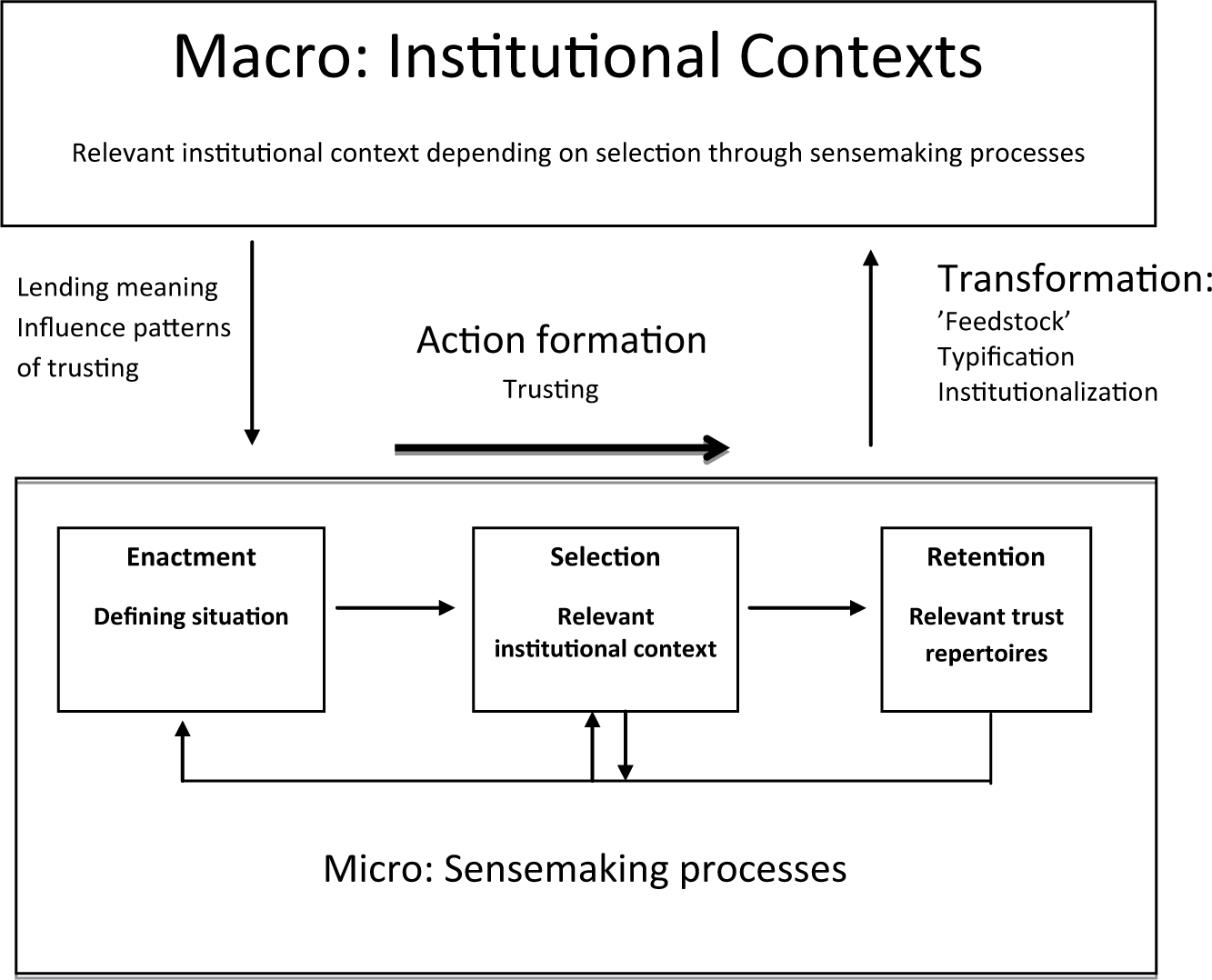
Institutional bases of trust as emerging through sensemaking. Adaptation of Weber and Glynn (2006) and Bachmann and Inkpen (2011).
In the model we apply Weick’s model of organizing through enactment, selection and retention. Enactment captures the more active role members play in ‘the activity of “making” that which is sensed’ (Weick, 1995: 30); i.e. in producing the occurrences that can be made sensible by the selection process. Enactment includes, according to Weick et al. (2005) the sensemaking activities of noticing and bracketing. Through noticing and bracketing, actors begin to transform the flux of circumstances into the orderliness of situations. The notion of enactment also implies that there is not a fixed environment existing detached from and external to actors. The environment is co-created by actors. The number of possible meanings gets reduced through selection involving a combination of ‘retrospective attention, mental models and articulation’. This process reduces the bracketed material by applying schemes of interpretation and locally plausible stories to it. The stories selected become stored in the memory of the organization through processes of retention relating the story to past experience, connecting it to significant identities and using the story as a source of guidance for further action and interpretation.
The three processes, enactment, selection and retention, stem from Weick’s The social psychology of organizing (1979). Here they are described as ‘organizing processes’ within a wider context of ‘ecological change’. This could also be seen as institutional change. ‘Ecological change’ is discontinuities, differences or variations in flows of experience that engage attention and ‘provide the enactable environment, the raw materials for sense-making’ (ibid. p. 130). In our model, ecological change is wider changes in the institutional and contextual environment which engages attention.
In a trusting relation, enactment is when two or more people, embedded in an institutional environment or ecology, enter into a relation with one another (for example a work relation) and must seek to notice and bracket the framework conditions of trust and trustworthiness in the context where they are situated, for example the rules and norms that are relevant to them.
Selection is when these actors start to establish the frames through which they can interpret their relationships. In doing so ‘they select schemes of interpretation’ (Weick 1979: 130) that may be built from past experiences. In a trusting relation this may, for example, be selection of the ‘contract’ as a relevant form of trust-scheme in a given situation, or, in another situation, a more intimate identity-based form of trusting scheme (cf. Lewicki and Bunker (1996) as a contextually relevant scheme). Hence, for example, in a business environment ‘contract’ may appear contextually relevant while in a family situation ‘identity-based trust’ may appear a more contextually relevant scheme.
Retention is ‘storage of the products of successful sense-making’ (Weick, 1979: 131). These products are already ‘enacted environments’. The enactment is ‘a sensible version of what the equivocality was about’ (ibid.). Did actors successfully use contract or identity schemes in a trusting relations and how? Retention is about building strategies and repertoires for action which were feasible in a given context of events. Paraphrasing Swidler’s (1986) culture in action theory this would be building an ideology that should be followed by the members of an organization, but such an ideology would have to be established incrementally by finding out what the powerful imageries in a given context are. In a trusting relation, this would be the specific scenarios of trust that seems to work and making them part of the history of trusting relations, and controlling the organization and people for following these schemes.
Making sense of trust in a turbulent environment: a case study
In the following, we revisit a case study (Mizrachi et al., 2007) that illustrates how the institutional context is enacted and emerges through sensemaking leading to the formation of specific types of trust-relations. Mizrachi et al. (2007) present a detailed ethnographic study of trust between Israeli and Jordanian managers in a Jordanian textile factory. The study demonstrates very eloquently that trust-relations are subject to change when actors try to make sense of changes in the social and political context and revise their trust strategies accordingly. While Mizrachi et al. apply their trust repertoires approach to this case study we find that the case also serves as a fine illustration of how a turbulent political or economic context triggers sensemaking. It follows that an important aspect of making sense of trust is to inquire into the relation between contextual factors, the meaning that actors attach to these contextual factors and the consequences for institutional-based trust in specific situations.
The case study focuses on a Jordanian textile factory, a subsidiary of a multinational Israeli textile corporation with 2,500 employees. The Jordanian subsidiary was a ‘hybrid’ structure: the Jordanians occupied all managerial posts in the subsidiary while Israelis were ‘in situ advisors serving as consultants in production, planning, and quality control’ (Mizrachi et al., 2007: 149). In their research, Mizrachi et al. (2007) investigated the changing trust relations between Israeli and Jordanian managers distinguishing between calculative trust, occurring in ‘impersonal and instrumental interactions’ and normative trust occurring in ‘informal, emotionally charged personal relationships, such as friendships, families, and communities’ (p. 145).
In the following we explore the processes of enactment, selection and retention before and after the Intifada in October 2000 for the two groups involved, Israeli and Jordanian managers.
The normalization phase
In the first period from 1998–2000 Israeli managers saw themselves as ‘missionaries disseminating professional knowledge, rationality, and progress’ (Mizrachi et al., 2007: 154) referring to the Jordanians as ‘youngest brothers’ who needed coaching by Israeli managers. We argue that the paternalistic calculative trust of Israeli managers towards Jordanian managers was emerging as an institutionally relevant scheme through processes of enactment, selection and retention.
Enactment for Israeli managers was directed towards noticing and bracketing contextually relevant data indicating whether and how Jordanian managers had internalized and applied the necessary professional knowledge to run production in the most efficient way. For Israeli managers this was indicated by the quality of the products and the extent to which Jordanian managers followed agreed upon measures and procedures. Israeli managers therefore attended to data indicating to what extent the factory was ‘meeting production schedules in the required quantity, mix, and quality’ (Mizrachi et al., 2007: 153).
The selection of a plausible interpretation based on ‘best-fit’ with past understandings led Israeli managers to stress the need to ‘draw a strict line between their personal relations with their Jordanian partners and their professional roles’ (Mizrachi et al., 2007: 155). This scheme of interpretation corresponding to calculative trust was applied because it seemed contextually and institutionally relevant given the circumstances of the subsidiary in Jordan.
Retention of a successful scheme of sensemaking led Israeli managers, during the normalization phase, to see the adopted calculative trust as successful. It stimulated the Jordanian managers to internalize and apply the ‘necessary professional knowledge and ethos required for effective operation’ (Mizrachi et al., 2007: 154).
In the same period, Jordanian managers made considerable efforts to expand the bandwidth of trust enabling them to negotiate and reduce the risks that ensued from not meeting the Israeli’s strict production standards. What mattered for Jordanian managers was being sure that they had good personal relations to Israeli managers in order to negotiate reasons for not living up to production standards.
The Jordanian managers enacted a bracketing of data indicating potential conflicts between production standards set by Israeli managers and the many practical limitations they face. Jordanian managers therefore attended to data indicating the motives and intensions of Israeli managers. These data were gathered through a vast variety of encounters, not least through informal social occasions such as dinners at local restaurants and shared celebrations of personal events such as birthdays, weddings and births.
They selected plausible interpretations based on ‘best-fit’ with past understandings leading them to stress the need to expand the boundaries of relationships in order to negotiate and reduce the risks that ensued from failing to meet the Israelis’ strict production standards. Jordanian managers ‘made considerable efforts to extend hospitality to their Israeli guests … [and] … made frequent references to “proper” normative behaviour that included respect, honor, and solidarity’ (Mizrachi et al., 2007: 153), hence a form of normative trust scheme.
The scheme of sensemaking that was subject to the Jordanian mangers’ retention was one of normative trust. During the normalization phase, Jordanian managers came to see normative trust as successfully creating a more favourable environment in order to reduce risks ensuing from failing to meet the strict standards set by Israeli managers.
The phase of political unrest
The outbreak of the Intifada in October 2000 affected the general political climate surrounding Globe Wear as, in Jordan, demands to dismantle economic ties with Israel became part of the political agenda. During this phase of political unrest, the forms of trust displayed by both sides changed radically. Due to political and security conditions, the Israelis were forced to transfer supervising, monitoring and quality control to the Jordanian managers. The Israelis then shifted their management style from monitoring and control to facilitation and support, and to normative trust. The Israeli managers saw themselves as moving from being the ‘ears and the eyes of the headquarters to the role of being the feet and the arms of the site’ (Mizrachi et al., 2007: 157). Israelis now served as intermediaries and facilitators between the headquarters and Jordanian managers as expressed by an Israeli manager: ‘Now we are working for the Jordanians. Things have reversed; we are their gofers’ (Mizrachi et al., 2007: 157).
Enactment was for Israeli managers now directed towards noticing and bracketing data indicating whether they could trust Jordanian managers running the plant since earlier control techniques as a reliable end-of-line quality inspection were not working. The Israeli managers had constantly to speak to local managers and ‘also with every junior manager I didn’t speak to before as a manager observed’ (Mizrachi et al., 2007: 158).
Israeli managers then selected a scheme of plausible explanation that fitted with past understandings that led them to stress the need to build strong personal commitment through personal contact and sometimes even personal friendship. Israeli managers were not only depending economically on the Jordanians to oversee the plant, but they also depended on Jordanian managers to protect their lives during their visits.
Through retention of a successful scheme of sensemaking the Israeli managers adopted a normative approach to trust since calculative trust was no longer a viable strategy. The Israeli managers became less concerned with the specifics of the Jordanians’ role performance. What mattered most to the Israelis was that the Jordanians would be sufficiently loyal to be entrusted with running the plant.The Israelis then attempted to instill loyalty in their Jordanian counterparts using different types of ‘pep talks’ as one Israeli manager described it (Mizrachi et al., 2007: 158).
The Intifada also forced the Jordanian managers to adapt to the changing political landscape. As Jordanian managers repositioned themselves as ‘autonomous actors working independently in a global international market, they adhered increasingly to formal professional procedures’ (Mizrachi et al., 2007: 159), thereby redefining the nature of their collaborative work with the Israelis. Due to their new autonomy from direct supervision, what now mattered for Jordanian managers was safeguarding their autonomy and the efficient shipment of material from headquarters in Israel. The Jordanian managers adopted a mode of trust that reflected these changed circumstances. Moving from normative trust to a calculative, contractual mode of trust ‘Jordanian managers now trusted their Israeli counterparts only to the extent that the latter demonstrated competence and efficiency and, in a word, fulfilled their professional obligations’ (Mizrachi et al., 2007: 158).
Enactment was, for Jordanian managers, re-oriented towards noticing and bracketing data concerning two kinds of risk. First, there was a risk that the Israelis would leave Jordan and close the production facilities. Therefore the smooth operation of the factory was a major concern to Jordanian managers. They focused on data informing on practical problems that could deteriorate production and quality levels due to lack of supplies. A second major concern for Jordanian managers was safety risks for both themselves and for visiting Israeli managers. Jordanian managers therefore also attended to data indicating the political and social tensions in the local community.
The selected plausible interpretation that now fitted with past understandings was one that stressed the need to ‘professionalize’ relations to Israeli managers in order to both put maximum pressure on Israeli managers to ‘adapt to the situation and to provide us all the material and the accessories we need and on time’ as Monir, a Jordanian manager, explained (Mizrachi et al., 2007: 158). After the outbreak of the Intifada, the Jordanian managers adopted a calculative mode of trust and they now trusted their Israeli counterparts only to the extent that they demonstrated competence and efficiency and thereby were fulfilling their professional obligations. The professionalization of relations towards Israeli managers was also the best strategy to minimize critique from the local community.
Retention of a successful scheme of sensemaking called for professional relations towards Israeli managers. In order to enact a more secure social environment, Jordanian managers moved from normative to a calculative, contractual mode of trust, changing their relations towards Israeli managers to a more apolitical professional relation.
Summary of case
This case study shows how actors in a mutually foreign and turbulent environment struggle to make sense of the institutional context relevant to trust-relations. The proper form of trust emerges from making sense of the otherwise turbulent institutional environment and the sense made of the actual context. The two radically different political environments, normalization and political unrest led the two groups of managers to revise the sense made of their relations towards the other party. The case study also shows that contextual factors are important both to frame the situation, here the relation between Israeli and Jordanian managers, and to condition the meaning and the consequences of different forms of trust. According to Mizrachi et al. ‘the complex relationships between trust and control can only be understood by actually examining how these strategies are used and practiced in concrete social and political contexts’ (Mizrachi et al., 2007: 162).
Discussion and conclusion
The point of departure for this article is the unresolved issue in institutional-based trust research of how institutions form the basis for trust-relations (Bachmann, 1998). Perspectives investigating interpersonal trust tend to focus primarily on individual traits, cognition and preferences while giving little explicit attention to cognitive, normative and regulative structures that provide stability and meaning to actors’ trust behaviour. On the other hand, perspectives focusing on the institutional bases of trust have not explicitly investigated the actor-dimension of institutional-based trust. It should be noted that Guido Möllering (Child and Mollering, 2003; Möllering, 2006a; Möllering and Stache, 2010) has nonetheless made attempts to explore the actor dimension.Thus, how social actors contribute to the (re)production of institutional-based trust is little understood. In this article we have attempted to bring in the actor-dimension in institutional-based trust research in order to be able to explore the social activities which are required to draw on and maintain institutional bases of trust.
The case could be made that some actors ‘are better at producing desired social outcomes than are others’ (Fligstein 1997: 398). More precisely, by applying certain social skills actors build and reproduce the desired social outcome of trust. These skills are about making sense of the institutional context. Following Fligstein, ‘[t]o find the rules social actors must have a larger conception of the world. These conceptions are worldviews or templates that define which actions are legitimate and which outcomes are most desired’ (Fligstein, 1997: 398). While Fligstein in his seminal article refers to socially skilled ‘actors who engage in what has been called robust or local action’ we argue in this article that the actor-dimension in institutional-based trust can be studied by drawing in the sensemaking construct. Actors who engage in collective processes of sensemaking are, in a sense, better equipped than others at producing or maintaining institutional-based trust. The contribution of the article thus is to see institutional-based trust as highly dependent on socially skilled actors’ collective sensemaking activities.
The macro-micro problem in trust research leads to two types of questions. The first is: How do institutions precisely find their way into decisions and actions of trustors and trustees? This question has been explored by Bachmann (2011) and Bachmann and Inkpen (2011). They have recently made a substantial contribution towards answering this question exploring four mechanisms through which institutions can reduce risk and foster trust building processes in inter-organizational relationship: legal regulation, reputation, certification, and community norms, structures and procedures.
The second is the one we have explored here: How do social actors find, build and maintain institutional-based trust? In this article, therefore, we suggest approaching the macro-micro problem from the perspective of actors by exploring how actors actually produce and reproduce institutional features and apply institutional-based trust in micro-processes of trust. We argue that sensemaking is a social skill of relating to peoples’ interest and identities even under seemingly chaotic circumstances and maintaining institutional-based trust. Sensemaking stresses how actors relate to the environment and reproduce institutional features of trust in an appropriate way. Individuals in organizations must actively make sense of the institutional environment and its impact on social behaviour by skilfully engaging into a collective process of sensemaking. Based on Weber and Glynn’s (2006) modelling of the relation between institutions and sensemaking, we show that the institutional impact on trust is highly intertwined with sensemaking.
This study then resonates with a growing body of studies that explore multilevel approaches to organizational trust (Curral and Inkpen, 2002; Curral and Inkpen, 2006; Fulmer and Gelfand, 2012; Wang and Gordon, 2011). But we argue that an important issue in studies of multilevel trust is to understand micro-level mechanisms which shape individual trust intentions. Here we would agree with Wang and Gordon (2011) that we need more knowledge of micro-level mechanisms shaping individual trust intentions though we would favour qualitative approaches to reveal these mechanisms in contrast to the quantitative approach taken by Wang and Gordon.
This article contributes to trust research in several ways, theoretically and empirically. Firstly, the article adds to theories on trust by pointing to the need for theoretical frameworks that focus on how social actors (re)produce institutional features of trust by engaging in skilful sensemaking. We should show empirically how actors cope with institutional context as stimuli in the environment as a basis for producing trust behaviour. While the existing literature tends to stress institutions as a basis of trust (trust as embedded in institutions and triggered down to the actors by various mechanisms), we argue that institutional bases of trust may be seen as having a more emergent character as schemes of interpretation that must be established incrementally by finding out what the powerful imageries are in a given situation. The approach presented here attempts to further develop the recently emerging analysis of how actors actively construct trust drawing on notions such as ‘trust repertoires’ (Mizrachi et al., 2007) and ‘reflexivity’ (Möllering and Stache, 2010).
The second contribution of the article is to specify a bridging construct (Floyd et al., 2011) which could guide the empirical analysis of institutional trust. A bridging construct can be used to investigate how different theoretical elements are connected, here institutions and actors. Actors make sense of institutions and context as a basis for decisions about whether and how to trust. In order to demonstrate how sensemaking processes help bridging social actors with institutional features of trust we have revisited a case study of trust between Israeli and Jordanian managers in a Jordanian textile factory (Mizrachi et al., 2007). This study shows how actors in a mutually foreign and turbulent environment struggle to make sense of the institutional context relevant to trust-relations. The proper form of trust emerges from making sense of the otherwise turbulent institutional environments and the sense made of the actual context. The two radically different political environments led the two groups of managers to revise the sense made of their relations towards the other party. The study shows that contextual factors are important both to frame the situation and to condition the meaning and the consequences of different forms of trust.
The sensemaking approach leads us to a contextual (cf. e.g. Johns, 2006) empirical and qualitative approach which tend to be under-represented in trust research. Contextualized research can help us avoid idealized modelling of practice and gaps between espoused and actual practices (cf. the distinction in Brown and Duguid, 1991). The better we can connect theoretical models and concepts with practice the better we can analyse and develop practice.
By applying the sensemaking perspective to empirical cases like the one presented here we may be able to specify in more detail what skills are required for social actors to make sense of the institutional context that is relevant for them. This is particularly interesting in order to explain how social actors may contribute to creating institutional trust. By, for example, exploring sensemaking during an organizational change process we may be able to explain why the activities of social actors may have very different outcomes in relation to trust.
Further research is needed in order to investigate in more detail how the sensemaking approach can be made operational to studies of social actors, institutions and trust. We see sensemaking as a generic term used to understand the basics of the process, but sensemaking may be further specified in different ways, for example in terms of social skills such as arguing, expecting, committing and manipulation (Weick, 1995). Other, more complex terms such as ‘justification’ (Boltanski and Thévenot, 2006; Mari, 2010) may also be investigated as a way to understand how actors through social processes of sensemaking relate to and make institutional and contextual elements available and accessible for trust-relations.