




Abstract
The article examines the strategies by which environmentally-motivated social enterprises seek to scale up their positive impacts, drawing on a theoretical understanding of the role of entrepreneurial agency in transitions to a more sustainable economy and society. Case study evidence is used to explore different forms of enterprise growth, contributions to economic, environmental and social value, and the capabilities involved in their realisation. A typology of three distinct approaches or modes is introduced to help explain orientations and strategies that reflect both conventional conceptions of growth and alternative ways of growing social and environmental value. The role of values, capabilities and relational learning in shaping strategies and addressing the tensions and challenges encountered within each category is highlighted.
Introduction
Heightening concerns around the challenges posed by climate change, unmet social needs and financial crisis have reinforced calls to realise the potential of alternative business forms and social innovation (Murray, 2009; Scott-Cato and Hillier, 2010). Social enterprises – or values-driven ‘hybrid’ businesses that operate in the ill-defined space between the for-profit and non-profit worlds – are seen by some to have particular strengths in simultaneously addressing economic, social and environmental needs (Amin, 2009; Boyd et al., 2009; Pearce, 2003). This article examines conceptions of growth found in environmentally-motivated social enterprises (ESEs) and the capabilities involved in their realisation in order to contribute a better understanding of their potential, which also can inform policy and support practice.
Given how little is known about the processes involved and the growth aspirations and capabilities of such enterprises, these issues are explored by addressing two research questions:
RQ1: What are the different approaches to growth adopted by ESEs and the missions and values that underpin them? RQ2: What are the resources and capabilities needed to implement such strategies effectively?
Building on a tradition of research on enterprise growth and the institutional contexts shaping these processes, we adopt an exploratory approach utilising qualitative case studies to draw out different ESE strategies for integrating economic, social and environmental objectives. Our analysis defines three distinct approaches with reference to the motivations and capabilities that underpin them. These approaches need to be understood in relation to wider contextual and institutional factors, which can be both enabling and constraining, including societal norms affecting the demand for the services or products involved, public policies intended to support a nascent low carbon economy (While et al., 2010), and moves to outsource and create quasi-markets for various public services (Walsh, 1995).
Although the term ‘social enterprise’ is contested and unclear, generally it is used to refer to a set of organisations with primarily social purposes, but which generate a significant amount of their income from trading in goods or services (Bridge et al., 2009; Chell, 2007). The category includes community enterprises, cooperatives, the trading arms of charities, employee-owned businesses, development trusts, credit unions, housing associations and social firms. There are significant tensions inherent in the concept of social enterprise within recent policy discourses, particularly given the diversity of organisational forms, motivations and expectations around their role and potential (Teasdale, 2011). The ‘social’ dimension of the term lends itself to the traditional concerns of not-for-profit civil society organisations to address social needs that the state and private sectors are unwilling or unable to meet, as well as notions of ‘alternative economic spaces’, egalitarianism, democratic governance and accountability. Conversely, the ‘enterprise’ dimension of the term lends itself to neoliberal perspectives, emphasising business opportunities, the efficiency of unfettered markets and a need to restrict the role of the state, including transferring responsibilities to the private sector and civil society (Sepulveda, 2009).
It is in this fluid and contested policy context that this article examines some recent experiences of contrasting types of social enterprises which claim to integrate economic, social and environmental objectives. The next section further examines relevant theoretical perspectives. Following this, evidence from a study of ESEs in the English East Midlands is used to explore the diverse approaches to growth and the rationales and strategies underpinning them, and the role of entrepreneurial resources and capabilities in addressing the challenges involved. The concluding discussion draws out the contribution to understanding by advancing a typology to help explain the varied approaches, as well as some implications for policy and further research.
Conceptions of growth and the sustainability agenda
Central to this article is how the study of social enterprises can add to our understanding of growth in light of the sustainability agenda. Conventional business enterprise growth tends to be conceived in terms of indicators such as turnover, profit, sales, employment, market share and physical output. However, even within this context there has been increasing recognition of the complex and heterogeneous nature of growth, the varied underlying causal mechanisms involved, and how such complexity compounds the difficulty of prediction and explanation (Leitch et al., 2010; McKelvie and Wiklund, 2010). Growth is understood to be an uneven and discontinuous process subject to uncertainties relating to the nature of the markets, the external circumstances faced and the characteristics and competencies of entrepreneurs and businesses. Uncertainty also arises from the fact that business owners and directors exhibit a range of motivations and aspirations, not all of which are monetary (Gimeno et al., 1997).
Considerations of sustainability bring further complexity, as can be seen from the disparate literature relating to the role of entrepreneurial agency in transitions to a more sustainable economy (Vickers, 2010). For example, Dean and McMullan (2007) view ‘market failures’ such as anthropogenic climate change as representing opportunities for the generation of profitability and economic value, insofar as market-based solutions can be extended by entrepreneurs with the support of governmental actors. Others emphasise the tensions involved: De Clercq and Voronov (2011) explore ‘sustainability’ and ‘profitability’ as two distinct logics that are constructed and played out as an outcome of the strategic actions of entrepreneurs and their legitimacy-seeking behaviour in relation to the institutional logics (or ‘field-imposed expectations’) involved. However, there is a need to go beyond such theoretical polarisations to develop a more evidence-based understanding of the range of contributions and motivations involved, and how these may offer varying combinations of economic, environmental and social value (Korsgaard and Anderson, 2011).
Actions on the part of environmentally-motivated entrepreneurs can encompass a diverse range of measures to conserve resources, ecosystems and biodiversity thus, also protecting the life support and other economic functions of the environment (Shepherd and Patzelt, 2011). Economic value in the form of monetary and employment outputs may be contributed by the provision of products or services in environment-related sectors (e.g. waste management and low-carbon technologies or services), and the growth of local or regional systems of production and consumption (e.g. Marsden, 2010). In addition, the actions of entrepreneurs can contribute to the social dimension of sustainability, including strengthening the web of relationships and cultures that bind groups of individuals, places and communities of interest (Maclean et al., 2012; Shepherd and Patzelt, 2011). Similarly, Korsgaard and Anderson (2011) emphasise the potential for multiple forms of social value creation, such as the growth of communities and individuals through self-actualisation and achievement, as well as more directly economic outcomes.
Much of the literature on sustainability draws attention to the key enabling role of governments in shaping the regulatory environment and the structure of incentives facing businesses and consumers (Vickers, 2010). Critical perspectives have drawn attention to the contested and paradoxical nature of policy responses that seek to accommodate the capitalistic impetus towards unrestricted growth with ecological considerations (e.g. Baker, 2007; Castree, 2008). Dominant responses to promote sustainable development have centred on the progressive ‘ecological modernisation’ of existing economic, political and social institutions (e.g. Hajer, 1995; Murphy, 2000). The ecological modernisation paradigm has tended to emphasise the use of market mechanisms to encourage the development of low-carbon technologies and some efforts to promote more enlightened consumer choice, or green consumerism. Policies and action that appear to create opportunities for sustainability-motivated entrepreneurs include financial incentives for renewable energy, the tightening of environmental regulations (e.g. in relation to waste management) and other policies to support low-carbon technologies, products and services (e.g. Department for Business, Enterprise and Regulatory Reform, 2009 within the UK context). Relatedly, some policy debate has focused on the potential for governments to implement ‘green stimulus’ packages for economic recovery, involving significant investment in a low-carbon economy and the creation of ‘green-collar’ jobs (e.g. Green New Deal Group, 2008; Ottmar and Stern, 2009).
Stronger ‘deep green’ versions of sustainability present an essentially post-capitalist vision involving a radical reconceptualisation of prosperity and wealth, and a more egalitarian, less materialistic society (Scott-Cato, 2009). Such a reconceptualisation underpinned the alternative technology movement of the 1970s and 1980s, with its advocacy of community-level initiatives in areas such as renewable energy, organic food and autonomous eco-housing (Smith, 2005), and as seminally influenced by Schumacher’s (1973) case for small-scale initiatives and ‘appropriate’ technology. More contemporaneously, the Transition Town movement (www.transitionnetwork.org) expresses impatience with the limited nature of government action to address climate change, emphasising a need for community-led innovation and eco-localisation. Scott-Cato and Hillier (2010) represent this as an important example of how climate-related social innovation can spread from community to community, originating as it did in Totnes in south-west England, to become a global movement. However, there is a need for greater understanding of inclusive innovation processes and their potential in developing and disseminating alternative approaches to meeting needs (see also Seyfang and Smith, 2007; von Hippel, 2005).
To summarise the discussion so far, although diverse in nature and originating motivations, the growth (albeit limited) of ESE activity can be understood as a product of the interplay between top-down ecologically modernising policy actions and institutional change opening up opportunities (Vickers, 2010), and bottom-up visions and energies informed by critical environmental politics and social movements (Pepper, 1996).
Strategies for growth and capabilities
There has been considerable interest in models and strategies to enable the scaling-up of social enterprises and their beneficial impacts. This can involve the originating entrepreneur or organisation working in or developing ‘green niche’ markets (Seyfang and Smith, 2007), geographically replicating a successful concept, such as through a franchising operation (Johnson et al., 2007; Litalien, 2006; Tracey and Jarvis, 2007), growth through alliances (Sharir and Lerner, 2006) and joining or forming consortia in order to tender for public sector contracts, such as in the case of waste recycling (Rowan et al., 2009). Replication also may occur less formally, whereby niche activities multiply in numbers, such as in the case of increasing public/consumer interest in ethical food and community-supported agriculture (Little et al., 2010), or through concepts being absorbed within established organisations and ‘mainstream’ practices (Seyfang and Smith, 2007).
Our focus on enterprises that are seeking to break out of niche markets suggests the relevance of insight from mainstream business studies on the role of resources and capabilities, including the ability to find new competences (Hamel and Prahalad, 1994). These include both tangible sources of competitive advantage (e.g. skills and functional knowledge, as reflected in formal measures of educational or training attainment) as well as more intangible resources (e.g. relations with customers, partners, brands or organisational culture) (Grant, 2002). Related research has shown how entrepreneurs can enhance their ability to grow and diversify businesses by building entrepreneurial teams with a greater diversity of human capital (i.e. knowledge, skills) (Ucbasaran et al., 2003). Work on dynamic capabilities (Foss, 1997; Teece et al., 1997) has focused on understanding how competences are created and updated through organisational learning. Barbero et al. (2011) found that rapid and intensive small and medium-sized enterprise (SME) growth requires high capabilities in specific functional areas, with marketing and financial capabilities being positively associated with market expansion and innovation.
Dynamic and adaptive capabilities and associated learning processes are likely to be of particular importance for ESEs seeking to implement innovative approaches to address emergent low-carbon markets, and social needs that may be subject to policy debate and contestation in terms of how they are best addressed. Perspectives on democratising innovation and social innovation suggest that ESEs embedded within specific communities may have particular capabilities related to open-source methods of deriving creative ideas, and developing co-production through relational learning with user communities and other actors (von Hippel, 2005; also Maclean et al., 2012).
Finally, our understanding of the role of capabilities in the growth of values-led enterprise is informed by research which contextualises entrepreneurial action in relation to institutions, broadly defined to include formal regulations, professional practices and social norms (Tracey, 2011). Important here is insight into the various ways in which entrepreneurial actors behave in the face of prevailing institutional conditions, which can involve both opportunism in response to new incentive structures, as well as less ‘economically rational’ behaviour, which may be underpinned by values and perspectives which are at variance to those of key actors or institutions and incumbent interests. Nevertheless, in order to maintain any challenge to mainstream ways of doing things, ESEs need sufficient capabilities and resilience at least to ensure the survival of their activities, including building legitimacy and trust. Initially, this is likely to take place within their immediate niches and supportive communities of interest: for example, including other civil society organisations. However, ‘beyond niche’ growth is likely to be particularly dependent on building competitive advantage by enrolling support from wider networks and key actors: that is, policy networks, and sources, quasi-markets for public services and other public and philanthropic support (Bloom and Smith, 2010).
Method
Sample
The exploratory approach of the study necessitated the use of qualitative case studies, focusing on eight ESEs that were purposively selected from an initial sampling frame of 87 environment-related organisations in the East Midlands, UK. The selection criteria were based on sectoral and size differences, with a view to providing rich detail on the factors and processes underpinning different growth paths (Yin, 2003). Table 1 shows the eight cases along with their profile characteristics. These ranged from relatively new organisations (three established since 2009) to others that had been trading for a number of years (the oldest founded in 1989).
Profile of selected enterprises.
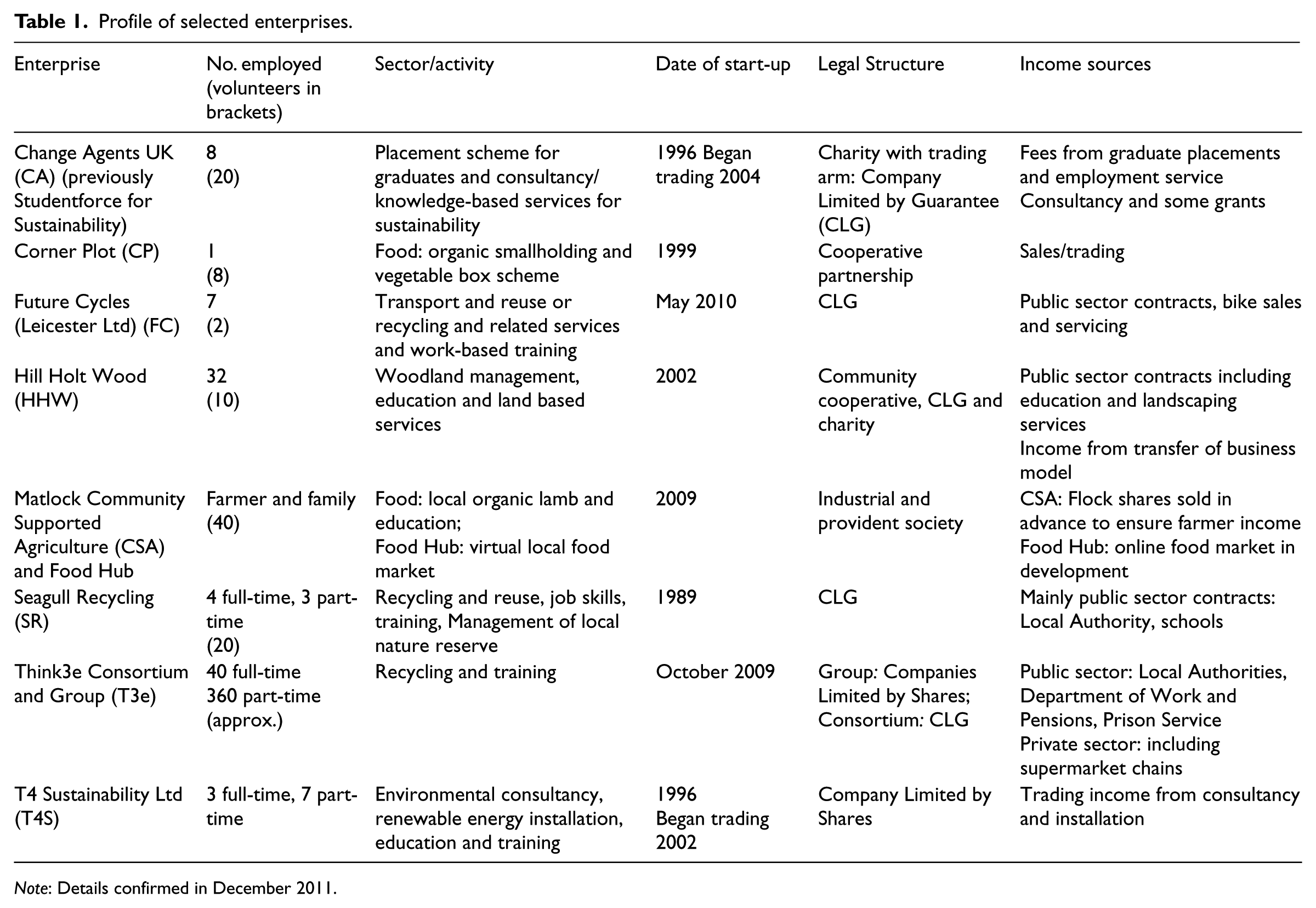
Note: Details confirmed in December 2011.
Given that our theoretical perspective problematises prevailing conceptions of business and economic growth, our analysis is sensitive to alternative approaches that prioritise growing social and environmental value. Therefore, the contrasting cases include ESEs that were experiencing a period of growth in employment and/or turnover, those that were aspiring to such growth without yet achieving it, and others that emphasised contributions to social and environmental value that were not captured by conventionally recognised measures of enterprise growth. We did not seek to include ventures that had failed to grow beyond initial start-up, as this is beyond the remit of the article. Similarly, while we recognise contraction and closure or failure following growth as a key issue, exploration of this is also beyond the scope of this article.
Data collection
In-depth interviews were conducted with the eight leaders or managing directors, who were also founders in six cases; in one case both the managing director and financial director were interviewed. The broad topics addressed related to: the organisations’ origins, their aims and objectives; activities and impacts; perceptions of opportunities and attitudes towards growth; relationships and partnerships; challenges faced and support needs. Most of the interviews were conducted between January and March 2011, recorded and transcribed, and with summaries (in the form of case study write-ups) sent back to be checked for accuracy. Supplementary information was drawn from websites and relevant documents or reports. Further data were collected after six months with follow-up email contacts, which also were used to seek permission to use the original material.
Data analysis
An iterative analytical process was used to draw out the key themes, commonalities and variations between the cases and the factors that appeared to explain them best. The interpretation is based on the identification of similar results from different cases (literal replication), and contrasting results and their explanation (theoretical replication) (Yin, 2003).
Findings
Growth forms and orientations
The cases all demonstrated elements of scaling-up and growth, although there were differences in how this was conceptualised. In terms of contributions to employment, Think3e provides the most striking instance of rapid growth, having 40 full-time and 360 associate and part-time employees by its second year of operation, followed by Hill Holt Wood (established 2002) with 32 employees (see Table 1). At the other end of the scale were the two food enterprises, with Corner Plot providing income for the individual founder and Matlock Community Supported Agriculture (CSA) supporting a tenant farmer and family.
Think3e was established in October 2009 as a consortium of third sector and private waste recycling enterprises, growing rapidly in terms of its core team and numbers of associates or part-time employees. This growth was achieved by focusing on corporate customers and public sector programmes to support employment and work integration:
So when we went into our very first customer, we weren’t going to the local corner shop; we were going to [supermarket chain]. Day 1: meet the big corporates and landing the business. There was an element of punching above our weight, in the fact that we had a target 7000 square foot, but it’s amazing what you could do with a good website … Within three months, we’d grown out of that into a 20,000 square foot unit, and then by March or April last year [2010] we moved into this site. (Group head of corporate social responsibility, Think3e)
By the end of the group’s second year, turnover had increased to £2.5m. While its scale allowed it to build legitimacy and win contracts with local authorities and government agencies, the approach proved to be problematical, with the organisation subsequently fragmenting and parts of the group spinning out in early 2012.
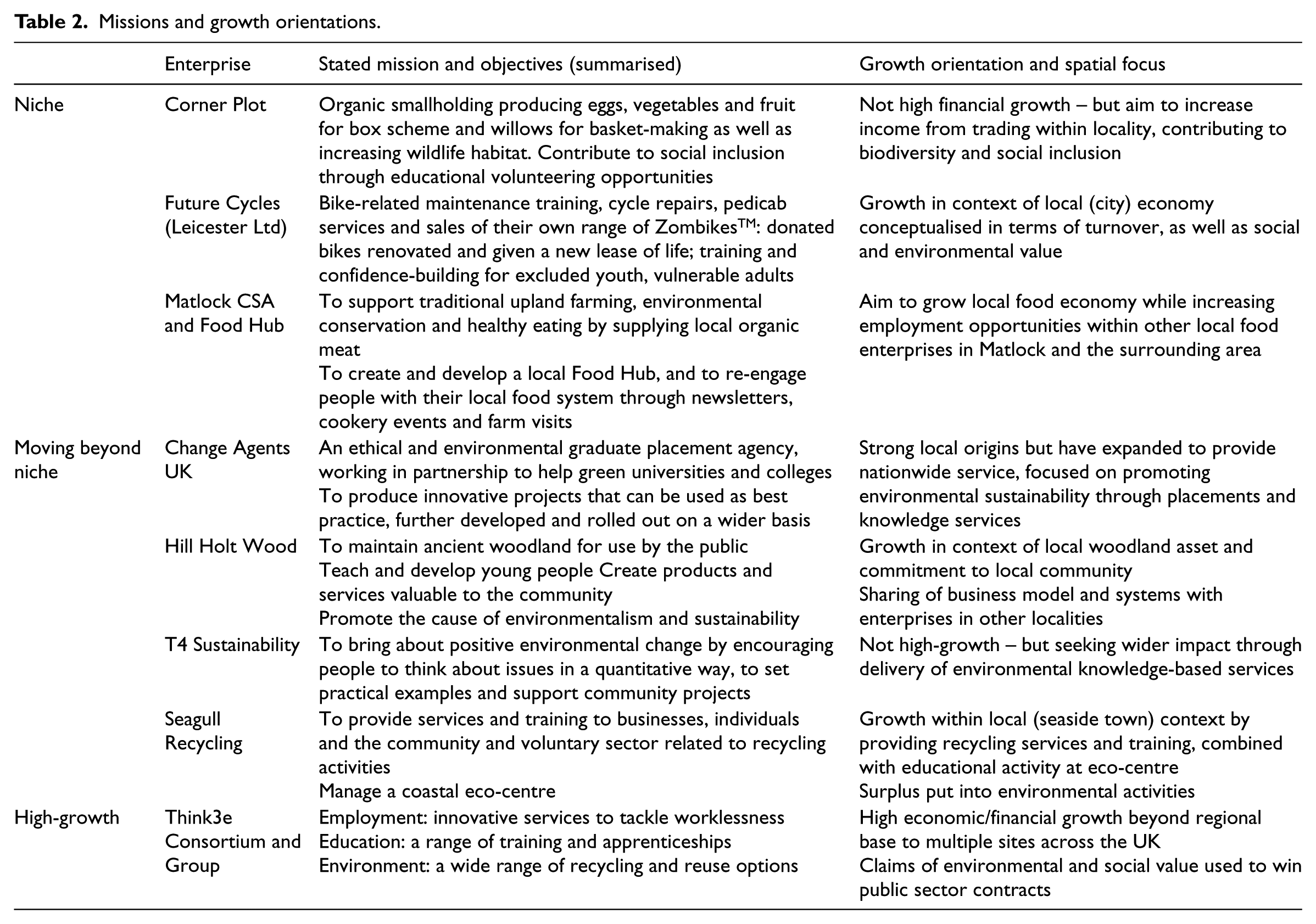
Although not exhibiting employment growth to such a significant degree, other ESEs had ambitions to grow employment while demonstrating other contributions to social and environmental value within their localities, as can be seen from Table 2. Cautious attitudes to enterprise growth were expressed in pragmatic terms, such as the need to be confident that the organisation was on a sure financial footing before taking on more employees, as well as alternative philosophies and aspirations: People often comment that the company is not growing fast enough, but we are growing in other ways that we feel are important: we are fans of prosperity without growth … A business can aspire to become the optimum size and remain so, which is a perfectly credible goal. (Managing director, T4 Sustainability)
Missions and growth orientations.
All the participants saw their commitment to sustainability as fundamental to their missions – with the motivating passions of founders or lead entrepreneurs often linked to their expertise and enthusiasm in areas such as organic horticulture, forestry, cycling, environmental science and green or low-carbon technologies – as well as dissatisfaction with current ways of doing things (e.g. as expressed by the co-founder of Hill Holt Wood, who was ‘absolutely pissed off at the way government is mismanaging woodlands’). Increasing environmental benefits were linked with aims to scale social impact in all cases, with five making a particular contribution to social inclusion by addressing the needs of disadvantaged groups. All were seeking to educate and influence individuals and communities in ways that promoted environmental sustainability: in some cases, (notably CA, HHW, T3e, T4S) including the policies and practices of corporate and public sector actors.
Most cases can be described as originating from small or green niche entrepreneurial activity, although with Think3e this involved a consortium of civil society organisations and a private sector entrepreneur. Most had sought to grow their impact through close ties to particular localities, often involving the ownership and/or management of specific biophysical assets (land, ecosystems, property, local infrastructure), as well as being embedded in a more cultural sense, through close engagement with local communities, staff or members’ involvement with activist groups (e.g. the local Transitions Network in several cases) and other communities of interest, including other supportive social economy organisations. Moreover, having influence beyond the niche or locality was evident to varying degrees, although with only two cases (CA, T3e) having significantly extended their trading activity to other parts of the country (Table 2).
Diversification to support growth, scaling of impact and increasing organisations’ resilience and financial sustainability was evident in all cases, usually entailing the introduction of new services that were related to core activities, or which took fuller advantage of resources and assets, such as their skills or competency sets, property or environmental assets. For Future Cycles, competitive advantage was achieved through being able to demonstrate multiple benefits to public sector funders:
It’s a case of hitting the right kind of things … you want to do something that’s a bit innovative and catches people’s eye … The good thing about cycling is that it ticks a lot of agendas … because it’s recycling and reuse, it’s health, it’s job creation and training and it’s sustainable transport. (Director, Future Cycles)
The case of Matlock CSA and Food Hub demonstrates how efforts to scale-up can take more strategic forms of diversification, with more recent efforts involving greater inclusivity and engagement with other small enterprises and local policy actors and agencies. The initial aim was to grow the local market for grass-reared lamb from an upland organic farm while promoting environmental conservation and healthy eating. However, the CSA had shown limited employment creation potential while remaining highly dependent on the voluntary efforts of a core group for its continuation. Debate among its members led to the creation of a Food Hub, with the more ambitious aims of linking with and supporting a greater number of food businesses, and job creation within an expanded local food economy. However, at the time of interview, this vision still appeared some way from being fully realised.
Finally, scaling impact was evident through the provision of consultancy services and knowledge-sharing (i.e. energy services, low-carbon business models, housing retrofit and waste minimisation strategies; CA, HHW, T4S). Change Agents UK in particular exemplified this approach to widening impact, having built and extended its services beyond a local and regional focus to providing a nationally renowned graduate placement programme and consultancy services to local government in different parts of the country.
Strategies and markets
Strategies for growth need to be understood in relation to the markets or customers targeted, and the shaping influence of formal institutions and regulations, such as those relating to waste management, nature conservation and organic standards for food production, as well as state welfare-to-work policies. Five organisations were delivering public services, in some cases with established or high-trust relationships with local authorities and other public sector agencies. Some emphasised their competitive advantage in these quasi-markets in terms of their ability to provide services more cheaply than other organisations, while addressing social needs for education and training in innovative ways. At the same time, some of the participants expressed critical attitudes towards and distance from government actions, including with respect to the conditions for funding on which they had been dependent, and changes (actual and impending) that were seen as undermining their ability to meet the needs of their client groups, including young people and the ‘hard-to-help’ long-term unemployed. Most autonomous of both the public and corporate sectors were the two food enterprises, being particularly rooted in local consumer markets and voluntary action support.
In terms of organisational or legal form, these ranged from those which are more commonly associated with the civil society sector (i.e. enabling social objectives and ownership) to some cases with private sector legal forms, but where commitments to social and environmental objectives were claimed as central to their missions (Tables 1 and 2). An alternative to growth within a single enterprise (i.e. organic growth in terms of increasing turnover year-on-year) involves the development of consortia and alliances. Think3e’s growth strategy was built on a hybrid organisational form incorporating private sector and social enterprise elements, although with the private sector form becoming predominant. The group consisted of a number of companies limited by shares that were separate to the consortium but which could be invested in to be replicated. The consortium and group were established as private limited companies but utilising forms recognised as ‘social enterprise compliant’ for smaller business units. The self-employment approach, with individuals being paid according to the work that they completed, was favoured for its perceived advantage in terms of minimising supervision and management costs and the risks involved in employing ‘socially excluded’ individuals – most notably ex-offenders. While being a target for assistance, ex-offenders in particular were found to value their independence above the attitudes and discipline expected in the modern workplace. Therefore, this hybrid organisational form was conceived as offering both the flexibility and control needed to take advantage of existing opportunity structures. Corporate (but regulation-driven) customers had responded positively to Think3e’s waste management offer, while public sector actors were attracted to the initiative’s early demonstration of work integration potential. As well as controlling the risks involved in engaging ‘excluded’ individuals, Think3e’s form and strategy was presented as conducive to the enrolment of actors with local expertise and knowledge while maintaining managerial control.
Other forms of scaling up involve the more informal replication of ideas, as represented by the numerical growth of small-scale local food and CSA initiatives in some UK localities in recent years (Little et al., 2010). Matlock Food Hub had evolved from its original CSA conception by seeking to extend its customer base to a wider local community of interest, with the managing director representing this as a necessary cultural shift away from a ‘deep green’ motivational philosophy towards a more commercial and inclusive orientation: We are working in town with other groups – the Matlock partnership, town centre partnerships, council, business, voluntary sector etc … It’s not just the Transition Group now, to increase the scope and mainstream element of it. Get some more traditional backing to encourage other people into the mix, so it’s not just a green thing, trying to get away from ‘hippyism’. (Director/coordinator, Matlock CSA and Food Hub)
Although the locally specific nature of Hill Holt Wood as a community cooperative was seen as limiting its transferability, this initiative has gained considerable attention and exerted some wider national influence as a model ‘environmental social enterprise’ (Frith et al., 2009). Building on this reputation had involved the transfer of certain aspects of its business model (operational policies and procedures) to two farm enterprises in other parts of the country that were seeking to diversify.
Growth strategies need to be understood in the context of institutional changes and the constraining and/or enabling nature of markets, publicly enabled quasi-markets and other related institutional/regulatory structures. For example, growth ambitions were found to be constrained by the restricted availability of external finance and support in a period of public sector austerity, with some of the study participants perceiving a systemic bias in public sector commissioning towards corporate prime contractors in the delivery of welfare-to-work services. Although Food ESEs were relatively autonomous from the public sector, they were constrained by difficulties related to building alternative systems of provision which can compete with the supply and distribution chains of large incumbent players. Consumer perceptions of the premium nature of organic food, in reflecting more fully the economic cost of production, also diminish the appeal of such products to lower income groups in particular.
Resources, capabilities and strategic relationships
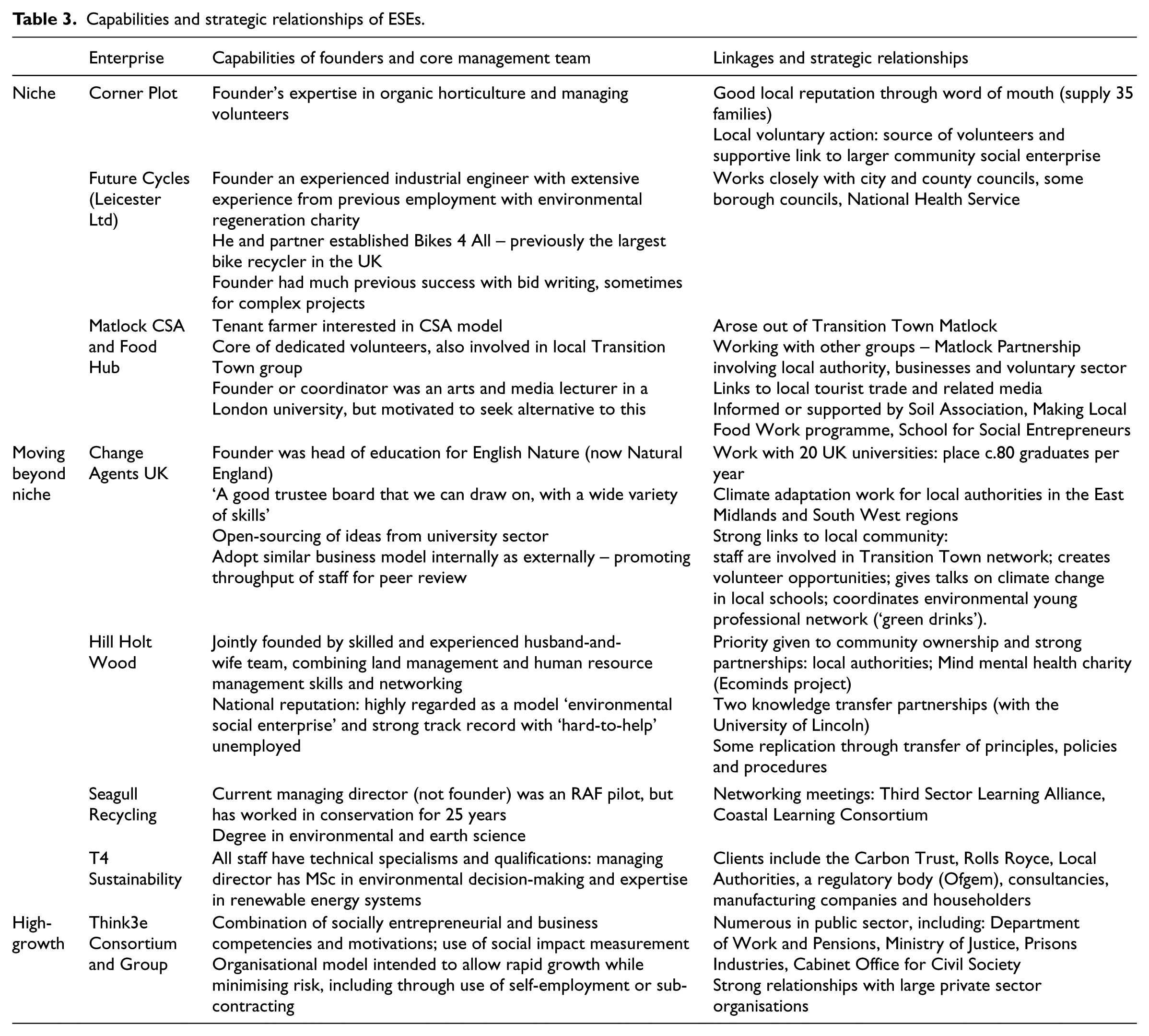
Table 3 shows the organisations’ capabilities in parallel with their markets and strategic relationships. In organisations where employment growth was more evident, the driving entrepreneur(s) had been able to draw on diverse competences, specialisms and general management skills (often acquired in previous employment), the latter including human resource management and logistics. The early success and rapid growth of Think3e was underpinned by entrepreneurial and business competencies resulting from the coming together of an individual with prior experience in a successful social enterprise start-up, and a ‘mainstream’ entrepreneur – a relationship brokered by a shared accountant. This organisation was able to draw on leadership experience and an ability to enrol other crucial specialists: an environmental consultant with expertise in waste streams, a logistics manager headhunted from a large retail chain and a head of administration. The leadership and team building role of the group managing director was referred to as the ‘glue’, in that he brought a specialist from all the fields. Other cases had been more dependent on accessing external support and advice to help address skills or competency deficits, although an issue for some was the declining availability of low-cost or no-cost support in a context of public sector cuts and the dismantling of the existing regional architecture for economic development and business support (HM Government, 2010). Strengths that were particularly specific to social enterprise included the management of volunteers, engaging with communities (of interest and place) and other stakeholders and policy actors, and the application of techniques for social or environmental impact reporting (notably HHW and T3e in relation to the latter).
Capabilities and strategic relationships of ESEs.
Whatever the form, growth entails an ability to learn and adapt in response to fluctuating market and institutional contexts, and perceptions of need and opportunity, as suggested by the management literature on dynamic capabilities. Similar learning and adaptive capabilities were demonstrated by the ESE cases in this study, notably with respect to ongoing efforts to diversify their income streams and balance multiple objectives, as previously described, but also including in some cases an ability to respond to emerging challenges and opportunities. Think3e’s strategic capability to scan, evaluate and respond to emerging opportunities was presented as a particular strength: We have a strategic team, which is tentatively me out on point, and I’ll try and plan stuff a year or 18 months ahead, and I’ll do some stuff that’ll be crazy, but [the group managing director] reels me in every now and then and lets me out every now and then depending on just how crazy I get … Then you’ve got the environmental consultant who strategically will look at different products and changes in the law. (Group head of corporate social responsibility, Think3e)
However, by early 2012 the group had run into difficulties, with questions being raised about its approach and core mission, leading to some of its sites and member companies breaking away from the parent group with the assistance of the co-founding social entrepreneur (who also had left the group) to operate as separate entities. Despite this fragmentation, the project continues to demonstrate spin-off activity based on the learning and best practice model developed under the Think3e group since 2009.
A crucial capability is that of developing strategic linkages and networks in order to help build support and legitimacy. This is particularly important for ESEs, where they have a range of stakeholders seeking to exert influence on how environmental and social value is realised. In all eight cases, achievements have been dependent on building legitimacy and partnerships within their immediate communities, including with customers or beneficiaries, volunteers, other social economy organisations, universities and, to a much lesser extent in most cases, the corporate sector. Other formal and informal networks are important mechanisms for brokering cooperative relationships to meet shared ideals.
The experience of Matlock CSA and Food Hub shows how the development of local food provisioning, with the need to plug gaps in the local supply chain by establishing new businesses and facilities (e.g. a mobile slaughterhouse was identified as a particular priority), has been dependent on broadening the appeal of the initiative and building relationships with a wider range of local stakeholders, including small businesses. In particular, this initiative appeared to exemplify a process of reflexive learning and change in response to debate among its members about some perceived limitations of its initial focus. Initially, health and environmental concerns arising from the emphasis on meat (primarily organic lamb) were voiced by vegetarian members of the local Transition Group. Subscribing CSA members also found that they were consuming more meat than intended initially; as well as raising diet-related health concerns, the need for members to drive to a remote farm to collect the meat was seen as undermining the initiative’s environmental aims. At the same time, the CSA had been poor at creating employment and highly dependent on the unpaid input of a small group of volunteers. Through collective debate a broader approach to local food emerged, embracing vegetarian concerns, local growers and other local food businesses, with the main energies of the initiative redirected to the creation of a Food Hub – a more centralised online shop offering a more accessible outlet for the local area, with the CSA tenant farm remaining as a component of this wider project.
In cases involving knowledge-based services and consultancy, links to universities have been important, with Hill Holt Wood in particular having benefited from two publicly supported knowledge transfer partnerships with the regional university. The graduate projects enabled and overseen by Change Agents UK were important in developing its climate change adaptation work, extending this beyond the East Midlands: By the end of it we had over 40 graduates doing these projects over the country, so if ever anyone wanted some adaptation work doing, we had a huge knowledge bank of case studies of what had worked – so we could simply plug it in and take the same project service to another locality. (Leader, Change Agents UK)
There were few instances of strong partnerships with the corporate sector, with Think3e being the notable exception, having sought engagement with corporate customers and partners from its inception. Matlock CSA was seeking to connect with local small businesses and other agencies but had experienced tensions in its early stages, with some of its members rejecting such engagement and the ‘language of business’. A woodland collective, originally part of this initiative, had ‘split because [they] didn’t like the business side, didn’t want to talk about business plans’ (Director/coordinator, Matlock CSA and Food Hub). Other study participants were overtly critical of certain ‘unethical’ practices which they perceived as being prevalent among their private sector competitors and intended to benefit ‘insiders’ and incumbent businesses. Such attitudes reflect the reluctance of some ESEs to engage with the private sector. Conversely, those most engaged with the corporate sector emphasised the importance of the different language and approaches needed when building relationships.
Discussion
This article has explored the conceptions of growth held by ESEs and the strategies and capabilities deployed to realise them. The cases show that growth can take multiple forms and is often contested, indicating the need to explore its meaning in specific contexts and in terms of various indicators, whether directly economic (e.g. turnover, profit or surplus, employment) or in relation to socio-environmental objectives underpinned by distinctive philosophical challenges to existing practices, behaviours and policies. Our analysis draws out the various strategies by which ESEs sought to increase their impacts, suggesting a typology of three broad but distinct approaches or modes, as summarised in Table 4.
Typology of environmentally-motivated social enterprises.
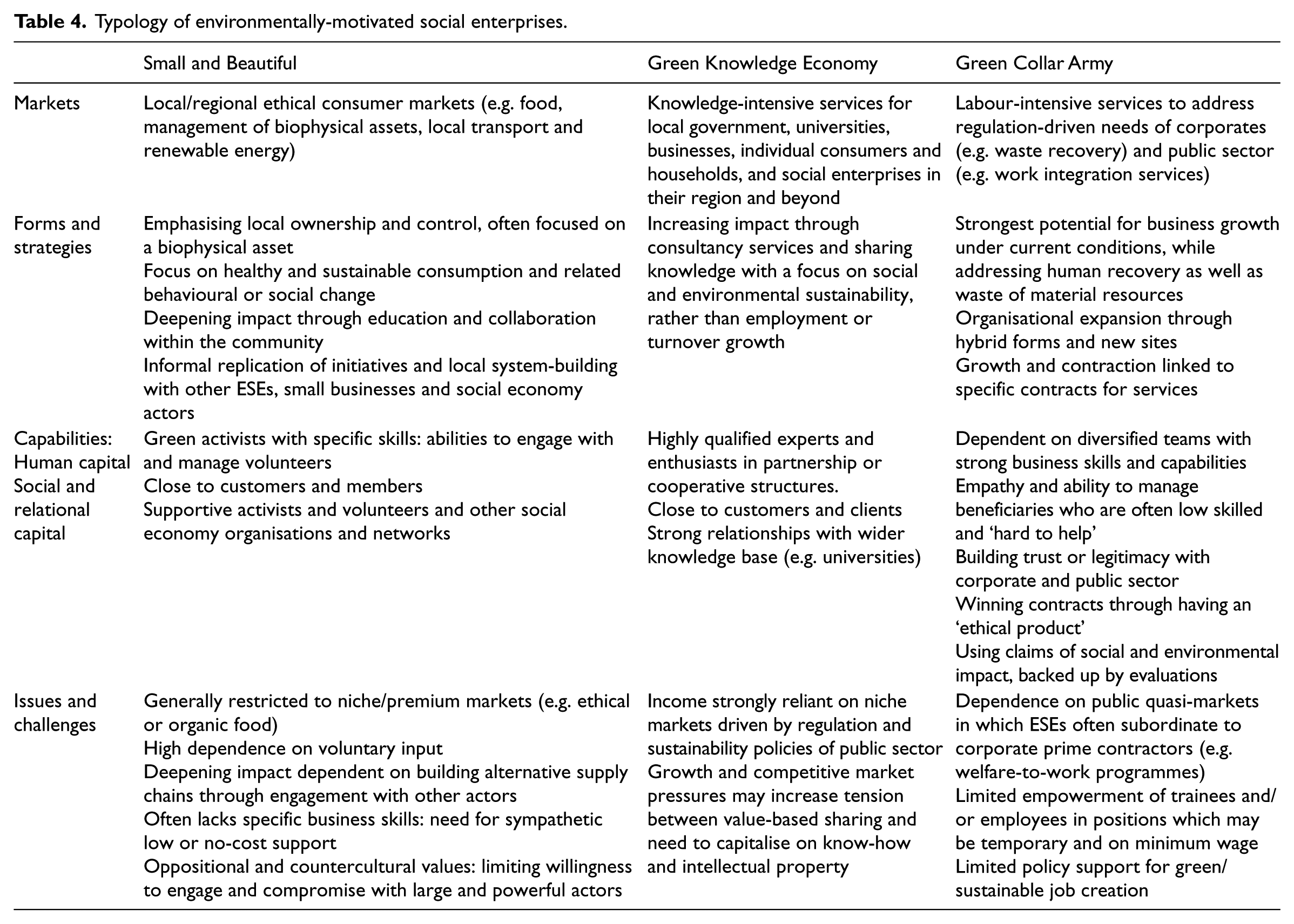
First, ‘Small and Beautiful’ niche ventures are characterised by their focus on addressing needs and deepening impact within the specific communities and locales within which they are embedded, often taking their inspiration from bottom-up alternative visions of community development and eco-localisation. Such initiatives exhibit some intrinsic advantages of ‘smallness’ (Schumacher, 1973), and their increase in number and geographical spread has potential in terms of developing local economies that are more sustainable and diversified. Examples include the local food initiatives and other ventures involving community ownership and management of specific biophysical assets. Some ESEs in this category may appear to have potential to grow their trading activity, but opt to remain small for reasons that include a preference to avoid the demands and compromises that they associate with business growth and, relatedly, a reluctance to engage with influential actors whose support would be needed for beyond niche development. In other cases, attempts to grow can take the form of joint action and building economic linkages with other, primarily local, actors (e.g. other food-related enterprises, as in the case of Matlock Food Hub). Challenges relating to sectoral characteristics and market contexts include the difficulty of building sufficiently integrated alternative systems which can compete with established supply and distribution chains, and ongoing high dependence on support and voluntary energies which may be variable over time, as well as being location-specific.
A second category, ‘Green Knowledge Economy’ ventures, seeks to achieve a wider impact through the provision of knowledge-intensive services and advice to others. They have particularly strong links to a wider knowledge base, such as universities and other sympathetic sources of expertise, and specific skills and innovative ideas which are applied to influence the practices and strategies of public and private sector organisations. ESEs in this category are keen to widen the impact of their know-how and services in ways that challenge mainstream approaches to intellectual property, insofar as they prioritise sustainability above private profit motivations. Therefore, the desire to share is underpinned by the social and environmental aims of the organisation. Some cases demonstrate the potential of open-sourcing ideas and expertise from within communities of interest (e.g. Change Agents UK). In addition, knowledge-sharing through replication of business models and processes is a way of growing and extending impact; thus one case was able to gain income from such a transfer to other small private farm enterprises that were seeking to diversify.
A final category, ‘Green Collar Army’, denotes enterprises that prioritise employment and/or training position creation in labour-intensive sectors and activities. In our main example of this type (Think3e), an entrepreneurial team that encompassed diverse capabilities gained from prior involvement in both social enterprise and private sector contexts was able to link opportunities for recovering economic value from industrial or consumer waste with opportunities created by public sector programmes for work integration, where ESEs have an established track record (e.g. Rowan et al., 2009). This category has particular resonance in the context of ‘Green New Deal’ type arguments for government-led stimulus packages to support significant employment creation while addressing sustainability challenges (e.g. Green New Deal Group, 2008).
Typologies inevitably involve simplifications of a complex reality; given ongoing diversification efforts, the activities of some ESEs span categories rather than fitting neatly into one. For example, two cases that in many respects exemplified the Small and Beautiful category were also developing Green Knowledge Economy activities, with potential to exert wider influence beyond their immediate locales. Other Small and Beautiful cases were aspiring to contribute to employment growth (‘Green Collar Army’) through accessing public sector contracts or service agreements and, in one case, by growing the local food economy.
Organisational and legal forms ranged from those commonly associated with civil society organisations to some with private sector forms being predominant, although representing themselves as social enterprises. It is notable that there were no cases (including within the study’s larger sample) utilising or considering franchising as an option, although much attention has been paid to the potential of social franchising within the academic and policy literatures (e.g. Litalien, 2006). Think3e, our main high-growth example, combined both private and social enterprise elements, but with the private sector legal form dominating. This hybrid organisational form was designed to combine control with flexibility, tapping into the knowledge and expertise of local actors and available pools of labour. However, growing tension and conflict within Think3e’s management team around aims and strategy appears to have been an important factor in the subsequent fragmentation of the consortium and group.
A further main objective of this article has been to explore the capabilities needed to realise the different conceptions of growth, as summarised in Table 4 in terms of human capital and social (or relational) capital. Most of the study cases demonstrate particular competencies and strengths in areas where they are strongly motivated by their core interests and value commitments, including an ability to enlist support from their immediate interest groups and communities, as well as social and environmental impact reporting. Also needed are business skills and capabilities similar to those required by more purely commercial activities (Barbero et al., 2011), with an ongoing need for support in many small ESEs to address specific gaps (e.g. access to finance, marketing, human resources). Building legitimacy with, and enlisting support from, public sector and corporate customers and sources of support was particularly important for Green Collar Army and, to a lesser extent, Green Knowledge Economy activities, with growth also underpinned by capabilities in key functional areas. Dynamic and adaptive capabilities, often built through relational learning processes, are of particular importance where the markets (or quasi-markets) are ill-defined and emergent in character.
Clearly, the state and its agencies were playing a key role in most of the study cases in terms of creating and shaping ESE institutional contexts and (quasi-)markets through regulation, commissioning and policy towards enterprise support. Contracting with the state was found to be important in six out of the eight cases, particularly in relation to services targeted at the disadvantaged and unemployed. While some cases emphasised the opportunities created by the increasing trend to outsource public services, most also expressed concerns about the nature of the commissioning processes involved, as well as public sector austerity measures more generally having an adverse affect on their sector, support infrastructure and client groups. Some of the problems reported in relation to government welfare-to-work programmes accord with an emerging body of evidence on their limitations as vehicles for addressing the needs of the unemployed (e.g. Newman, 2011).
While the ability to develop strategic linkages and legitimacy with key actors has been important in each of the present study’s ESE cases, who they choose to partner with is influenced also by their value commitments and preparedness to engage with the agendas and requirements of other influential actors. This accords with the insight from neo-institutional theory, that successful entrepreneurs have the ability to tailor their interactions (or develop different ‘narratives’) in order to achieve buy-in and commitment of resources (broadly defined) from different stakeholders: that is, employees, customers, suppliers and investors (Tracey, 2011). At the same time, growth can present new dilemmas, with scaling-up to encompass a wider geographic area and partnering with larger organisations potentially resulting in a loss of local focus and autonomy, giving rise to concerns around the extent to which ethical aims and alternative visions of sustainability are being compromised. The research reported here indicates a particular reluctance on the part of many ESEs to engage with the corporate private sector, with Small and Beautiful initiatives showing particular resistance to accommodating the ethos and language involved.
Conclusion
In this article we have sought to contribute to understanding of the nature and potential of ESEs, and the extent to which their activities offer alternative approaches for addressing social, economic and environmental needs. We argue that their contributions and the questions raised, challenging crudely defined notions of ‘success’ and ‘failure’, make ESEs of key theoretical and policy interest, not least in relation to ongoing debates around the ethical dimensions of capitalism and the nature of growth.
The analysis presented here identifies three main categories or modes of ESE growth, according to the nature of the markets and needs addressed, and sources of resilience and competitive advantage. Growth modes are shown to range from a highly localised niche focus (Small and Beautiful) involving deepening engagement with other local producers and communities; movement beyond niche through sharing and selling knowledge (Green Knowledge Economy); and employment creation through combining labour-intensive activities in environmental sectors with work integration services for the public sector (Green Collar Army). Within these modes, ESEs can be found with different legal and organisational forms, some of which are more associated with the private sector than the social economy.
Strategies for growth are shaped by complex relational processes involving the values of founders, the core team and key stakeholders, their skills and capabilities, the influence of the communities in which they are embedded and wider institutional influences. While some ESEs seek growth and competitive advantage in similar ways to mainstream businesses, others are informed more overtly by alternative visions of growth, demonstrating sustainable practices and deepening impacts within specific niches and communities. The approaches adopted are shaped by the interplay of different values and priorities within relational processes, with some ESEs heavily influenced by perspectives that can be described as ‘deep green’, remaining antipathetic towards the language of business, opportunity and economic growth, and with a related reluctance to risk co-option within the agendas of more powerful actors. Despite remaining small under current institutional and societal conditions, enterprise in this category can be viewed as experiments that retain the potential for growth under more conducive circumstances (Davies and Mullin, 2011; Seyfang and Smith, 2007).
ESEs that are seeking to grow in business and organisational terms, or that are dependent on support from larger actors for their survival, often experience contestation and adaptation of strategies as they confront various dilemmas of growth: for example, when seeking to expand beyond a local focus, and when there is a need to ensure ongoing financial viability in ways perceived by some stakeholders as being at the expense of their founding ethical aims. Growth-focused ESEs with more conventionally entrepreneurial characteristics and managerial capabilities are more pragmatic in seeking accommodation to isomorphic pressures, and the priorities and language of larger customers and partners.
Therefore, this article contributes to our understanding of the varied orientations and capabilities of ESEs and how these develop and are shaped by their contexts and institutions, just as institutions shape how opportunities are perceived and exploited. The hybrid nature of ESEs, marrying social, environmental and financial objectives, requires specific capabilities to balance these different objectives. This demonstrates the relevance of an institutionalist view that explores the different meanings and logics that shape growth-related behaviour. In addition, this discussion adds to previous analyses which highlight the contested and evolving nature of state interventions in the realms of sustainability, socio-economic regulation and enterprise support. Regarding the latter, we argue that there is a need for greater recognition of the contribution of ESEs, and of the limitations of conventional indicators of growth. Attitudes towards growth and scaling-up need to be understood in relation to organisational aims and ESE experiences of, and ability to engage with, institutional barriers and the key actors and agencies involved. Therefore, as with social enterprises in general (e.g. Hynes, 2009), support for ESEs needs to be tailored to their specific needs, helping them to articulate strategies for growth that are congruent with their missions and values.
Finally, the cases reflect a moment in time captured by the research. They indicate a need for further longitudinal work in order to investigate change over a longer period within specific contexts, notably with respect to the interplay of the perspectives of the various actors involved, both at the micro-level (within ESEs and their communities of interest), and in relation to the evolution of the wider policy and institutional context.
Footnotes
Acknowledgements
We would like to thank Social Enterprise East Midlands for their cooperation, Gordon Keay for his assistance with data collection, and the participating social enterprise managers who gave so generously of their time. Valuable comments on earlier drafts of the article were provided by the editor and anonymous referees. All views expressed are those of the authors unless otherwise stated.
Funding
The research on which this article draws was supported by the UK government’s knowledge transfer partnership scheme (programme no. 007508) and the Third Sector Research Centre, funded by the Economic and Social Research Council (ESRC), Office for Civil Society and Barrow Cadbury UK Trust (ESRC RES-595-24-0006).