




Abstract
High levels of out-of-centre foodstore developments in the 1980s and early 1990s significantly altered the commercial landscape of the UK, and were widely seen as threatening the vitality and viability of small and medium-sized centres. The progressive tightening of retail planning regulation in the decade that followed, and retailer adaptation to that tightening, resulted in the development of more flexible foodstore formats suited to in-centre or edge-of-centre sites, which worked ‘with the grain’ of the ‘town centre first’ approach to retail planning policy. Since then academic research has started to suggest a more positive role for such developments than hitherto, and to indicate that they can play an important role in anchoring small centres. The key mechanism underlining this potential positive role is that of linked trips, whereby the spatial externality generated by a foodstore development is transmitted to the existing retail structure of the centre in which development has occurred. Even though UK planning policy has consistently viewed the role of linked shopping trips as critical to town centre vitality, available evidence on this key issue remains remarkably scarce and dated in terms of the planning regulation context from which it was generated. This paper aims to fill that gap. We make use of a large and unique database on consumer shopping behaviour collected over the period August 2007–November 2009 in selected UK centres, and employ the difference-in-differences method to obtain insight into the hypothesised uplift in linked trip propensity which can be attributed to a foodstore development. Our results indicate that the development of new-generation foodstores in in-centre and edge-of-centre locations does indeed increase the propensity of shoppers to link their trips between foodstores and town centre shops/services. Controlling for shoppers’ individual characteristics, that increase is shown to be over seven percentage points. The exact numerical value is likely to be sample specific, and its typical range will only be established by replication. However, the importance of the finding is that using sophisticated but appropriate statistical methodology and a large sample of data from a transparently designed and rigorously conducted study, the development of ‘new-generation’ town-centre first foodstores is clearly associated with increased linked trip propensities. To our knowledge, this is the first time unambiguous evidence of the existence of this hypothesised ‘town centre first era’ linked-trip effect has been demonstrated.
Introduction
The impacts associated with the development of large corporate foodstores within, on the edge of, or outside UK town centres – market towns in particular – have long been contested issues. In the ‘store wars' era of the 1980s/early1990s (Wrigley, 1994), high levels of out-of-centre ‘one-stop' retail developments significantly altered the commercial landscape of the UK. Additionally, the cumulative impacts of those developments were seen as a serious problem for the future vitality and viability of existing centres. In particular, the influential DETR report The Impact of Large Foodstores on Market Towns and District Centres (DETR, 1998) presented a uniformly negative picture of those impacts.
It is important to note, however, that seven out of nine of the empirical case studies which underpinned the DETR report focused on impacts of the out-of-centre free-standing foodstores typical of the 1980s and early 1990s, and that all the case studies were conducted in the early to mid-1990s. That is to say, just before the landmark shift to tightening control of retail development proposals set out in Planning Policy Guidance Note 6 (PPG6) Town Centres and Retail Developments (DoE, 1996) – which in turn reflected and supported a growing cross-party political consensus in favour of a ‘town centre first’ approach to retail planning regulation.
As PPG6 and the ‘sequential test 1 ' which it incorporated were progressively tightened in the decade that followed, so the major retailers responded (albeit with different degrees of agility) by developing planning-regulation-compliant foodstore formats for in-centre or edge-of-centre sites. That is to say, they learned how to ‘flex' the rigid and much derided ‘superstore on the bypass' models of the 1980s, and how to work ‘with the grain’ of the ‘town centre first’ approach to retail planning policy. In turn, those new and typically smaller formats, together with the operating skills required to ensure their profitability, gave the major retailers the capabilities to reassess the potential of what, for most of the previous 20 years, had been regarded as marginal locations of food retail profit extraction (Wrigley, 1998, 2010).
As the new-generation of post-PPG6 foodstore developments started to roll out, it brought into question the extent to which the essentially pre-PPG6-era findings of the DETR (1998) report continued to have validity. Although that question remained surprisingly unanswered for most of the next decade, academic research gradually but progressively began to suggest a more positive role for foodstore development than hitherto. Studies of small and medium-sized towns in the UK (including Powe, 2012; Powe and Shaw, 2004; Wrigley et al., 2010b) began to indicate that supermarket developments might play a strategic role in anchoring small centres, clawing back expenditure which otherwise would have been lost to those centres, as consumers gravitated to centres higher in the retail hierarchy.
The mechanism which underlies the view that in-centre or edge-of-centre foodstore developments can play a potentially positive role to town centre vitality and viability is that of linked trips. Linked trips are effectively the means by which the potentially positive spatial externality generated by a foodstore development can be transmitted to the existing retail structure of the centre in which that development has occurred. That is to say, as the expenditure – which would otherwise have been lost to distant out-of-centre superstores and larger urban centres – is retained and additional footfall is generated, contributing to the centre’s ‘urban buzz’ (Storper and Venables, 2004).
It is clear that UK planning policy views the role of linked-trips as critical. For example, in the comprehensive practice guidance document (DCLG, 2009a) which complemented the important planning policy statement PPS4 Planning for Sustainable Economic Development issued in 2009 by the UK Department of Communities and Local Government (DCLG, 2009b) considerable stress was placed upon the need to seek to accommodate main town centre uses in locations where customers are able to undertake linked trips in order to provide for improved consumer choice and competition. In this way, the benefits of the new development will serve to reinforce the vitality and viability of the existing centre’ (DCLG, 2009a: 28, par. 6.2).
Nevertheless, given the magnitude of the shift of policy captured by PPG6, it is reasonable to expect that the linked-trip levels/benefits of ‘town centre first' compliant foodstore developments might be higher/stronger than found in previous studies of pre-PPG6 developments. Indeed, that is exactly what we found in our initial descriptive analysis of a major 3-year, before/after study of in-centre and edge-of-centre foodstore developments in six UK market towns and district centres (Wrigley et al., 2010b
2
) which we revisit in this paper. Our conclusion from that analysis was that there are indications that the linked-trip levels reported from our cluster of market towns might be higher than previously observed – possibly as a result of foodstore developments which reflect the decade-long trend towards more sensitive ‘with the grain’ integration into the structure of market towns’ (Wrigley et al., 2010b: 193). Because there are a wide range of possible measures of linked trips, ranging from stated intention (propensity) to link visits (‘always', ‘occasionally', etc.) through to various measures which attempt to capture the actual linkages/sequencing of visits on the day a respondent is interviewed (‘have you visited/intend to visit any other shops/service providers in the town centre before/after this supermarket'). As the measure used critically determines the range of values obtained – with some measures essentially being ‘lower bound' estimates and some ‘upper bound' estimates, drawing like for like comparisons in any exact sense is extremely difficult Because although it is interesting and relevant to attempt comparisons of typical linked trip levels over time – particularly if that coincides with a policy and regulation regime change – the comparison ideally sought is a more experimentally ‘controlled' one in which the levels of linked trips observed in retail centres in which a ‘town centre first'-policy-compliant foodstore development has occurred are compared to levels observed in centres not subject to such development. That is to say a comparison between linked-trip levels observed in centres subject to the ‘intervention' of a permitted in-centre or edge-of-centre development and those observed in ‘control' centres not subject to such development
In this paper, we explore for what we believe is the first time in the academic literature this more experimentally controlled approach to obtaining insight into the linked trip impacts of town-centre-first era foodstore development. We acknowledge immediately that we are dealing with a quasi-experimental situation – this is social science using social survey data not the experimental control of the laboratory. However, we attempt to compensate in part and also to increase analytical leverage by using a particularly appropriate modelling approach – the difference-in-differences (DD) method. Additionally, we use a high quality and unusually large data set which significantly increases the statistical power of our analysis.
The linked trip information we have employed for the purposes of this study is propensity data derived from high-quality, rigorously conducted, richly detailed surveys of over 4,500 consumers. That is to say, we use a sophisticated methodology to extract what we believe is significant added value from relatively low level linked trip information – albeit a large amount of such information. This then leaves open to us the possibility of employing this relatively advanced methodology to analyse more complex and sophisticated linked trip measurements in future work.
The remainder of this paper is organized as follows: The next section explains the insights that the use of the DD method can bring to the study of linked trips. The section that follows presents the database used in the study, followed by a section which outlines the two-step method and the DD empirical model employed in the paper. We then present the results and discuss their interpretation. Finally, we draw together the empirical contributions of the paper and assess their relevance for current policy debates.
What insights can the DD method bring to the study of linked trips?
Although it is still not a widely used method, the DD approach has been shown to have particular value in the evaluation of public policy programmes. Typically the approach involves the comparison of two sub-groups of a population, one affected by the policy or, more generally, by the ‘change’ under investigation (treated/intervention group), the other unaffected by it (control group). Comparing the two groups before and after the ‘intervention’ allows for a better understanding of the ‘real’ effect of the policy.
As Lee and Kang (2006) note the DD method can be applied to three different types of data: independent cross-sections, ‘mover’ panels, and ‘no-mover’ panels. In independent cross-sections, each individual is only observed once, while in ‘mover’ (and ‘no mover’) panels some (or all) individuals are observed twice (before and after the intervention). Although panels are more informative, the majority of DD studies rely on the use of repeated cross-sections where the individuals observed before and after the intervention are not necessarily the same (Athey and Imbens, 2002). Examples of this kind of studies can be found in an array of different disciplines such labour economics (Ashenfelter and Card, 1985; Blundell et al., 2001; Card and Krueger, 1993; Donohue et al., 2002), health economics (Gruber and Madrian, 1994), economic geography (Card, 1990) and public finance (Blundell et al., 1998; Dynarsky, 2003; Eissa and Liebman, 1996).
For the purposes of this paper, the DD method is used to help us understand the responses of two groups of consumers: (a) a group who shop in a set of market towns and district centres in the UK that have been subject to the development of a ‘town centre first' era in-centre or edge-of-centre foodstore during a specified period of time; (b) a group who shop in a set of market towns and district centres which have not been subject to foodstore development during the same time period. The first of these groups we call the treated group and the second the control group. Figure 1 illustrates some of the essential dimensions of the method.
Graphical representation of the DD methodology.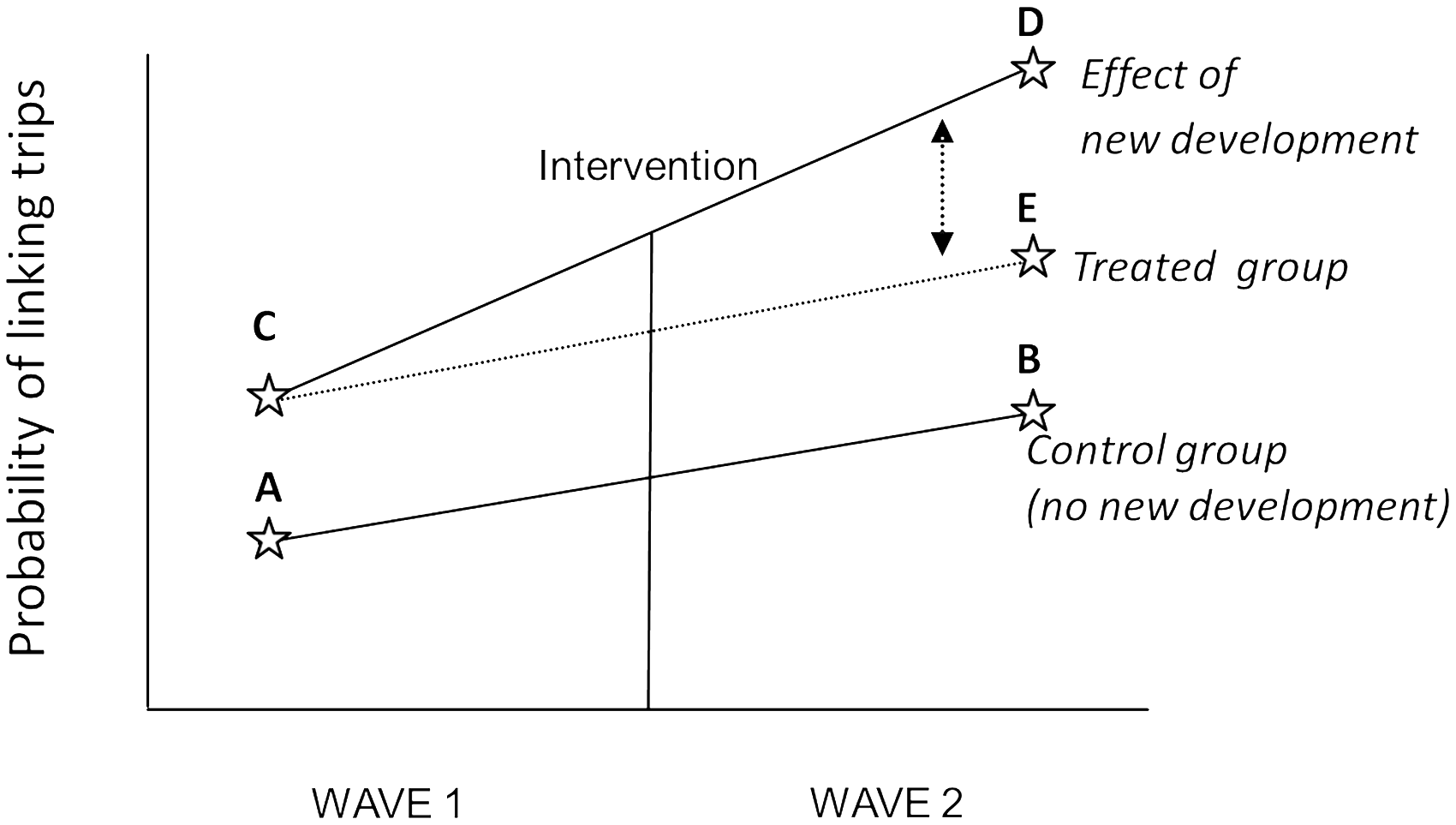
The method essentially involves comparing the responses of the treated and control groups before (Wave 1) and after (Wave 2) an ‘intervention’. In our specific case, the ‘intervention’ is the development of a foodstore and the responses are the linked trip propensities of the two groups. As Figure 1 illustrates – assuming that the probability of linking trips increases between study Waves 1 and 2 as a result of external factors (unrelated to the foodstore opening) from point A to B in the case of the control group and C to E in the case of the treated group – then the effect of the intervention (the opening of a new foodstore) is captured in the difference ED. In other words, the probability of linking trips would increase from C to D instead of C to E and the difference is attributable to the opening of the new foodstore.
In the empirical section of the paper, we in effect then consider in more formal terms two aspects of the difference ED. First, we ask whether the difference we observe in our particular sample is sufficiently large to be statistically significant – that is to say not merely an artifact of random variation. Second, we attempt to determine what are the external factors (unrelated to the foodstore opening) which account for the baseline change A to B and C to E. Then, holding all but one of those factors constant, we consider whether a small number of those factors (and, if so, in what order of importance) are responsible for the shift in likelihood (unrelated to the foodstore opening) of making linked trips. In turn, that enables us to determine, when all other factors are held constant, what the exact size of the uplift in linked trip propensity is, which can be attributed to the foodstore development.
Linked trips in the case study centres
The empirical analysis of this paper is based on data from a major 3-year, before/after study of new format foodstore developments in six UK market towns and district centres (treated/intervention centres), which were directly compared to two urban centres where no foodstore development took place in the period of the study (control centres). As the wider aims of the study were to move forward highly polarised policy debates on foodstore development impacts, the study design attempts to capture the store development consequences in the post-1996 era of refocused retail planning regulation which has stressed the importance of the functional integration of new developments with existing urban centres, in the context of a ‘town-centres-first’ approach to retail development.
Data
Data collection took place during the period August 2007 to December 2009 and focused on eight centres in two clusters – a cluster of four market towns in the South West of the UK and a cluster of four district centres in the North West (see Figures 2 and 3). In each cluster, three of the centres experienced the opening of a new large ‘in-centre’ or ‘edge-of-centre’ foodstore during the period September 2007 to November 2008. The remaining centre in each cluster was selected on the basis of having experienced no recent large foodstore opening, acting as a no-development ‘control’ study (see Tables 6–8 in the Appendix for detailed information on each centre).
Market Towns Cluster (South West). District Centres Cluster (North West).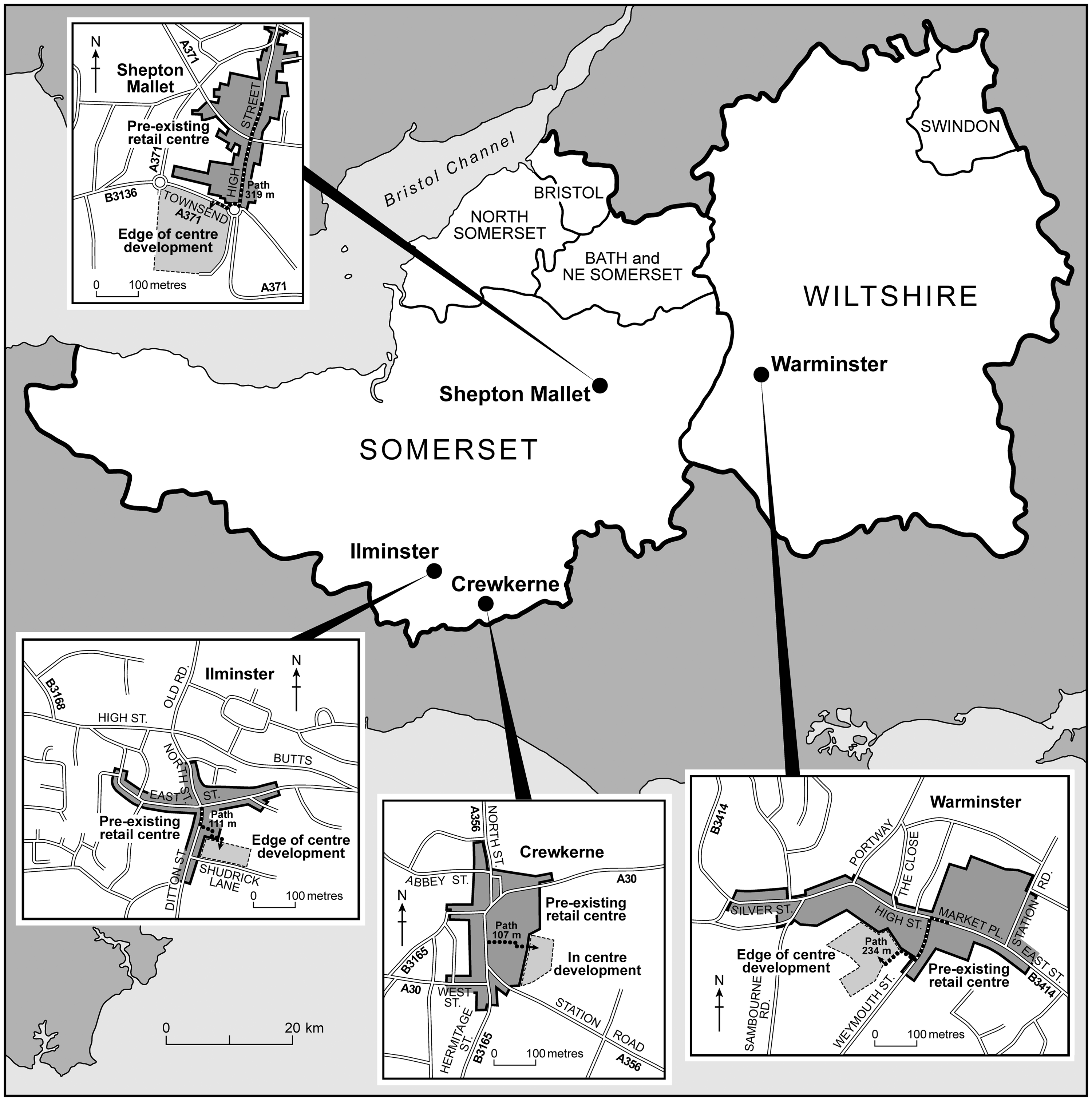
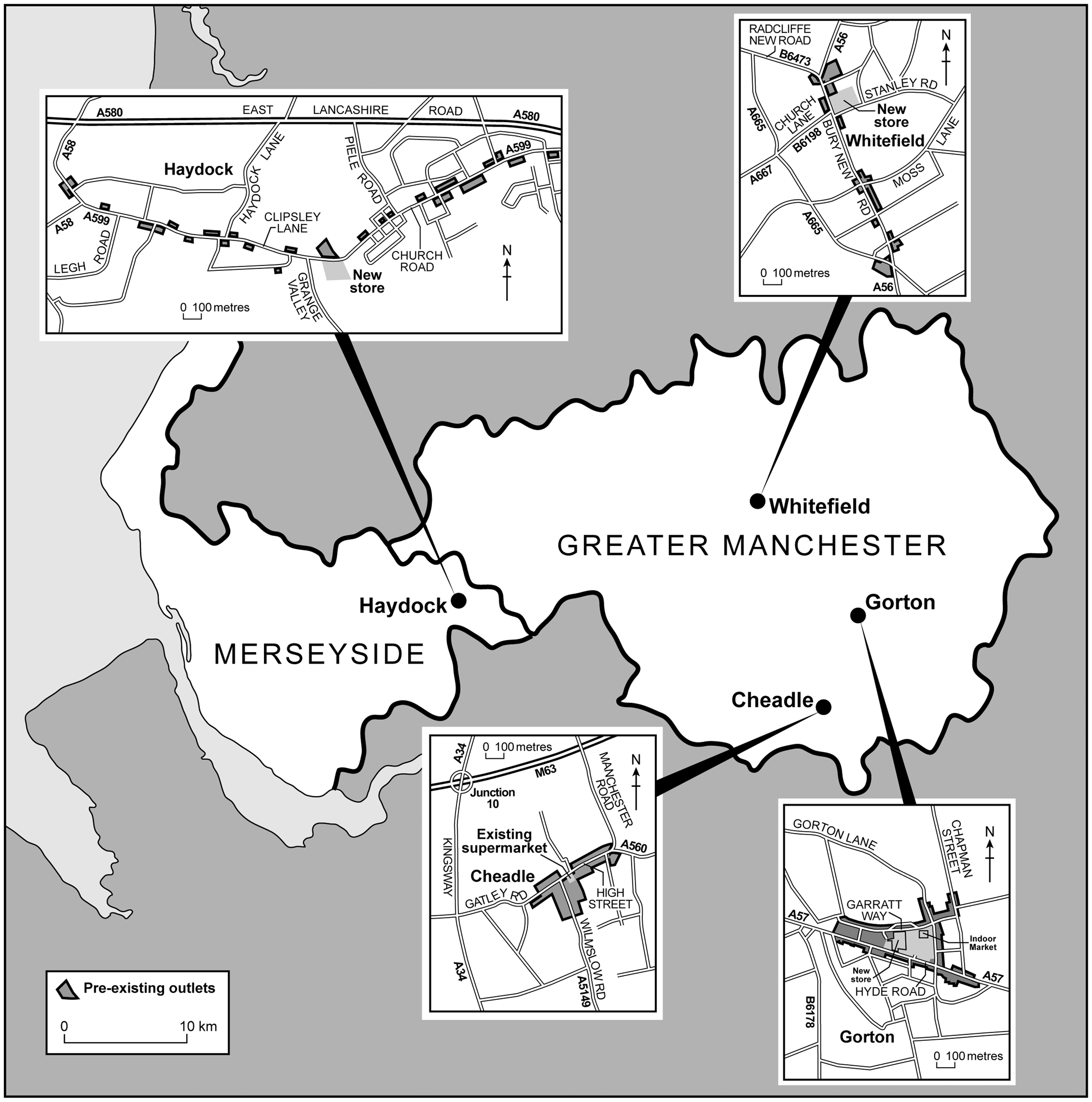
The foodstore development impacts on consumers’ linked trip behaviour in the six ‘intervention’ centres were evaluated using extensive before/after consumer questionnaires. The ‘before’ surveys were conducted approximately four months before the opening of each superstore, while the ‘after’ surveys were conducted a year after the store openings. Equivalent data was obtained for the two ‘control’ centres, with two survey waves timed parallel to the ‘intervention’ centres surveys. A stratified quota sample design was adopted for the surveys, with the sample being segmented across age groups and by catchment zone, with the 0 to 5 and 5 to 10 minutes’ drive-time zones being assigned higher weighting. The surveys were conducted on a face-to-face basis (as opposed to telephone interviews in other relevant studies like Bennison et al., 2000) with consumers across various locations in the primary shopping areas of the towns/centres, together (in the post-opening surveys) with locations in proximity to the new foodstores. Consumer surveys in the intervention cases captured town/district centre users, irrespective of whether they were users of the new stores of not.
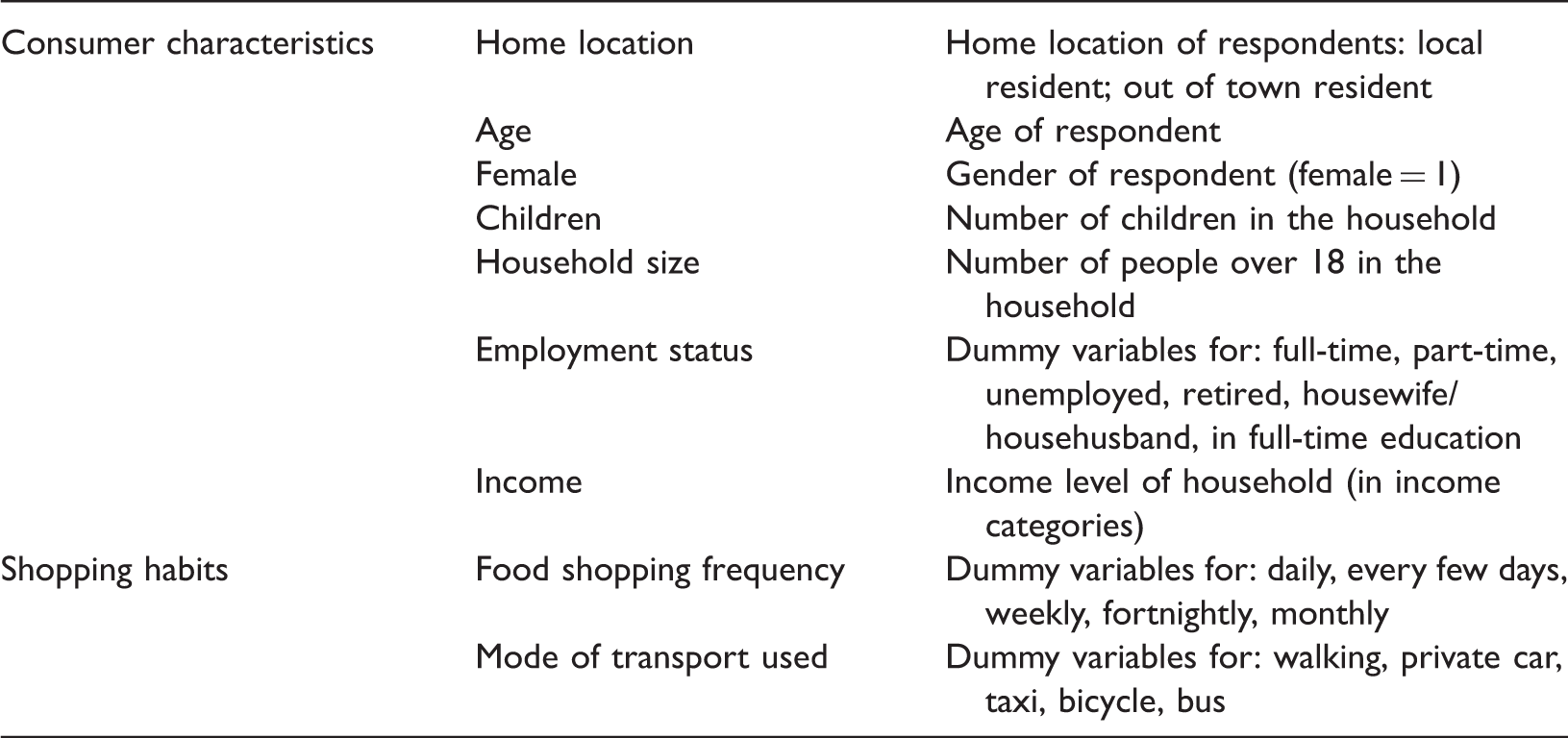
The survey provided a source of individual-level data describing consumers’ personal characteristics (gender, age, family status, household size), employment status and household income. Moreover, data on the shopping behaviour of consumers were also collected, relating to the frequency of their food shopping and the mode of transport used for shopping trips. Across the entire study (eight case study centres), a total of 8,702 individual consumer questionnaires were completed. For the purposes of the ‘before/after intervention’ structure of the DD methodology, we restricted our analysis to the pre and 12-month post-opening wave sub-sample (6,297 observations). Additionally, in the cases of the treated/foodstore development centres, this sub-sample was further restricted to consumers-users of the new foodstores in the post-opening waves. The final dataset employed for the purposes of the analysis presented in this paper contained 4,636 ‘valid’ (i.e. with no missing information on variables relevant to our analyses 3 ) observations.
Descriptive analysis of linked trips
Definitions of the nature of linked shopping trips vary widely within the existing academic literature. Descriptions and characteristics differ in terms of trip behaviour, trip ‘anchors’, starting locations and final destinations (NRPF, 2004). The particular type of linked trips we look at in this study involves visits to other shops or services (local businesses) within the existing retail centre of the market town or district centre, on the same trip for food shopping at the new store either on foot or by other modes of transport (car, bicycle, public transport).
For the purposes of the present study, the primary activity (trip generator) is the visit to the foodstore. The order of visits was not taken into account, meaning that the secondary activities could precede the primary. It was therefore assumed that once shoppers decide to visit the foodstore, a linked trip involves a visit by foot, by car, or by another means of transport to another local store or facility. In each wave of the consumer surveys, all respondents were also asked to specify which shops or services they used in combination with the foodstore.
Shopping propensities-all users.
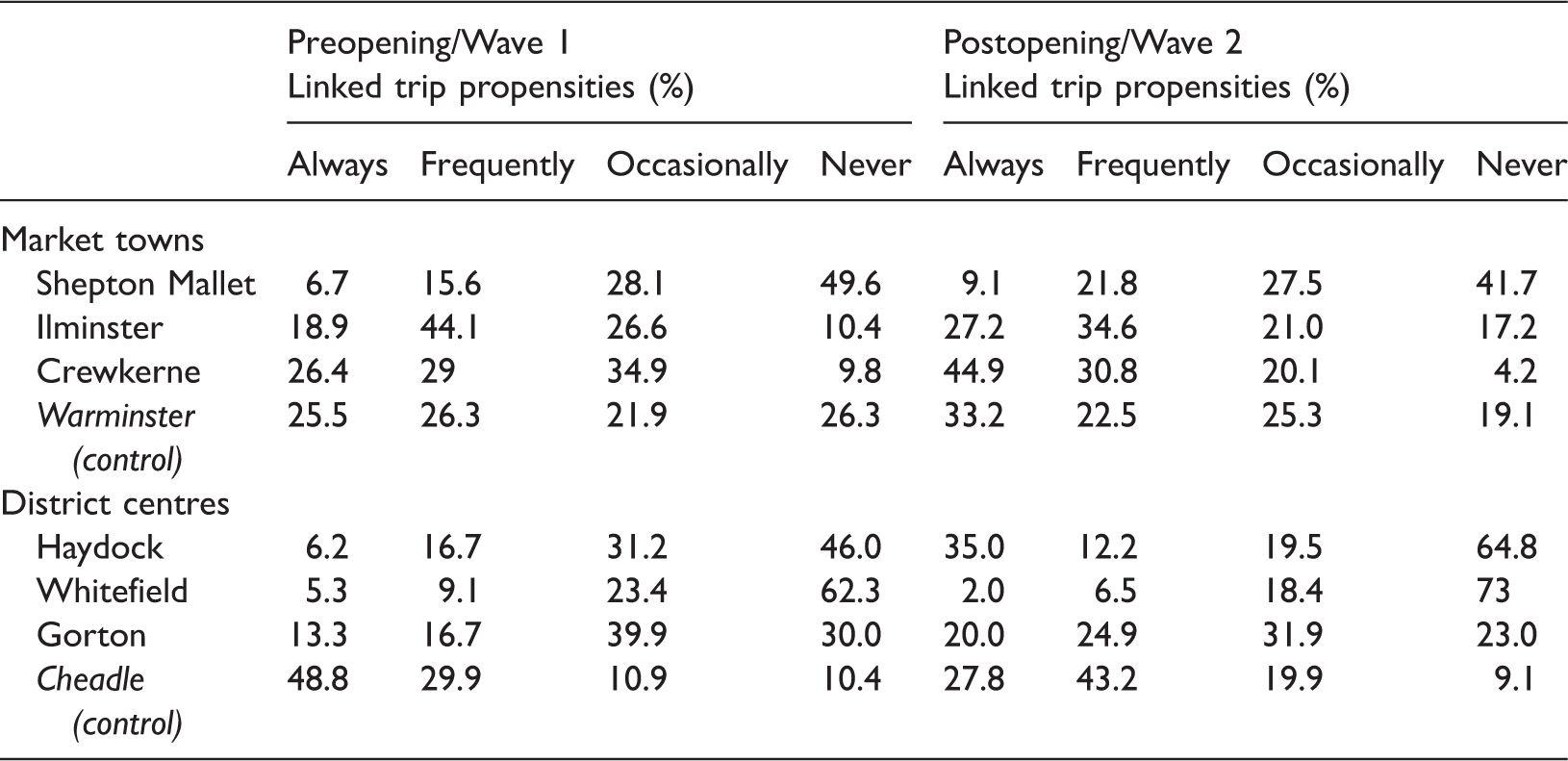
The observed linked trip behaviour presented in Table 1 suggests that (a) new foodstore developments are not just used for ‘one stop shopping’ and (b) despite considerable inter-case variation with significantly higher average levels reported in the market towns than in district centres, reflecting typical differences between the two types of centre in terms of their retail- versus service-unit balances, attractiveness and comprehensiveness of their existing retail offers, structure and compactness of their layouts, proximity to competing centres and so on (Wrigley et al., 2010a) – there are indications that the overall linked trip levels found are considerably higher than some of the extremely low levels reported by Guy (2007: 182–185) from UK studies relating to the 1990s.
Use of existing town centre retail and services on linked trips by those who use the new foodstore for their main food shopping.
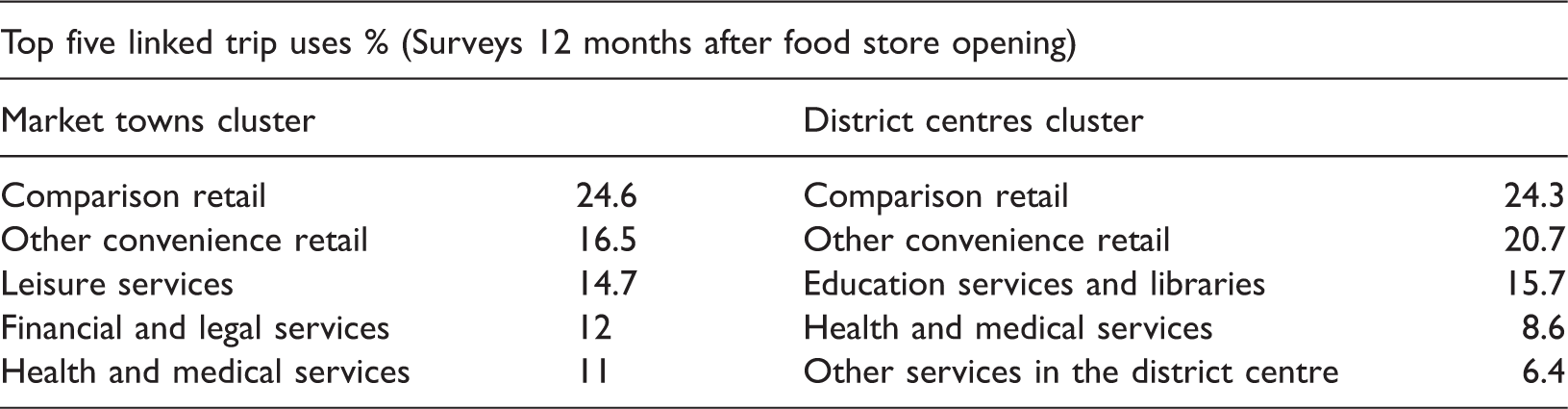
Differences between the two clusters partly reflect differences in the retail composition of markets towns and district centres. A key difference observed here is the leisure services category in the market towns cluster, where almost 15% of consumers report combining their shopping trips to the foodstore with a visit to a leisure service in the town (for instance cafes and restaurants) reflecting differences in the retail composition of those centres.
The method
As noted in the previous section, we now move to a two-stage analysis of differences amongst the control and intervention groups, between survey Waves 1 and 2. In other words, we now consider statistically the difference ED in Figure 1. We formally describe the two steps of the DD methodology we employ:
First, we use the DD methodology to compare the characteristics of different sub-groups of the market town/district centres population in the two time periods of the study. We use a two-sample z-test for differences between proportions, to assess whether there is a significant difference over study Waves 1 and 2 of the characteristics of each sub-group of the population – i.e. the treated and the control group.
So, if we call 

A t-test, as described in Ash (2008), is then used to test whether the difference between the two differences described above is significant. In this case our null hypothesis becomes:

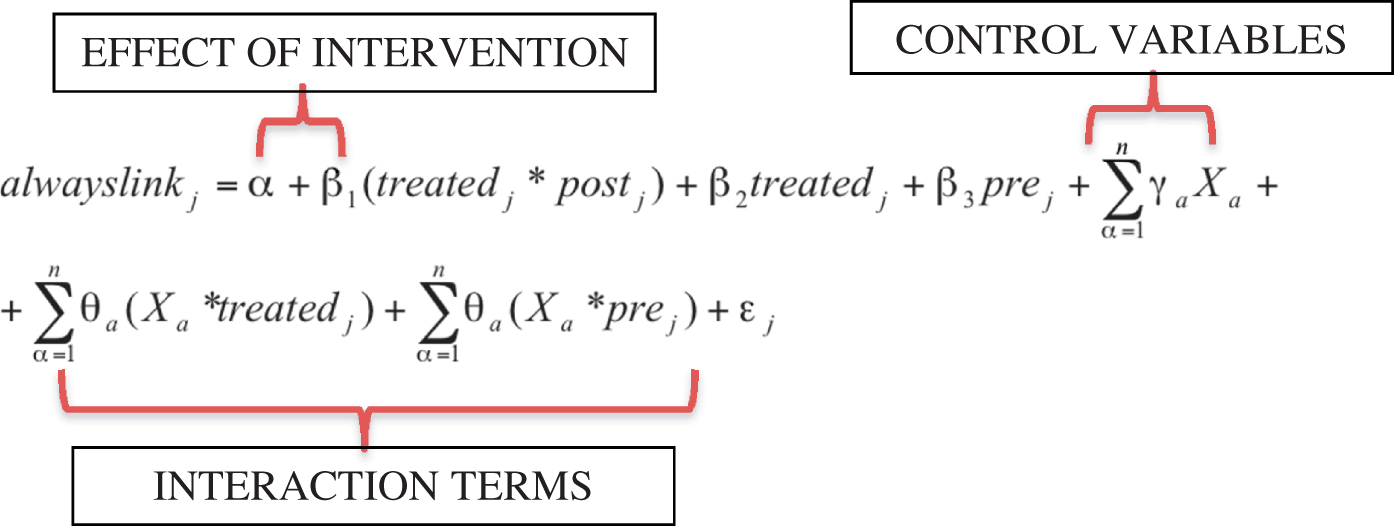
Calling Then, in the second step, we use a DD regression model to test how the development of new foodstores affects – on average – the propensity of always linking shopping trips to foodstores with trips to other shops/retail services, while controlling for other factors, such as consumer characteristics and shopping habits. Equation (5) presents our fully specified model, where subscript j refers to the jth consumer in our sample:


Explanatory variables.
In the next section, we start by presenting some descriptive statistics testing the significance of DD between treated and untreated cases, before and after the intervention (Step 1). Then, we move on to present a more sophisticated DD regression model to assess the effect of all our explanatory variables on the likelihood of linking trips (Step 2).
Results and discussion
Examining differences in linked trip behaviour in treated and control centres (step 1)
DD descriptives.
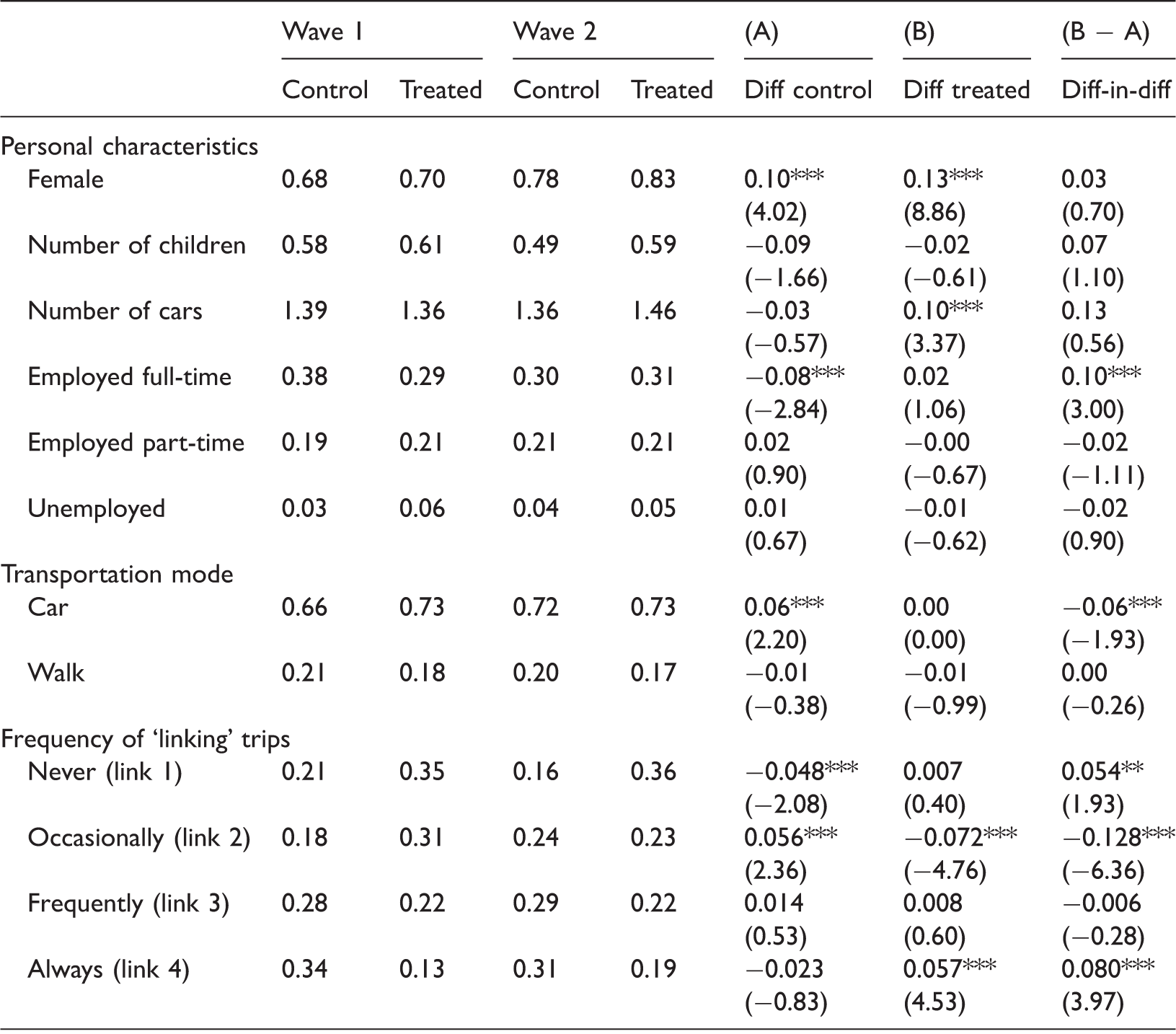
*significant at 10% level. **significant at 5% level. ***significant at 1% level.
With respect to personal characteristics, the only major difference between the control and treated groups is that the number of full-time employed individuals went down by about 8 percentage points in the control group, while it stayed almost constant in the treated group resulting in a significant DD of about 10 percentage points. In addition, the average number of cars per household increased by 0.6 in the control group but there was no significant difference vis à vis the treated group.
The crucial results, of course, relate to the frequency of linking trips. What we find is that the market towns/district centres group where new foodstore developments took place (i.e. our treated group) experienced a statistically significant increase in the number of shoppers ‘always’ linking their trips, as opposed to a decrease in the centres where there was no development. This resulted in a significant DD of 8 percentage points. By the same token, the ‘treated’ group also saw a sharp decrease (7.18 percentage points) in the number of shoppers only linking their trips ‘occasionally’. These by themselves are significant results, which have not previously been reported. Nevertheless, they need further investigation, to understand how the increase in the frequency of ‘linking’ in the ‘treated’ areas is related to variations in shoppers’ personal and shopping habit characteristics. In the section that follows, we focus on this descriptive result, and extend it by estimating a DD model to find out how much of this difference is due specifically to the intervention (i.e. the development of a new foodstore) while controlling for a series of factors.
DD regressions (step 2)
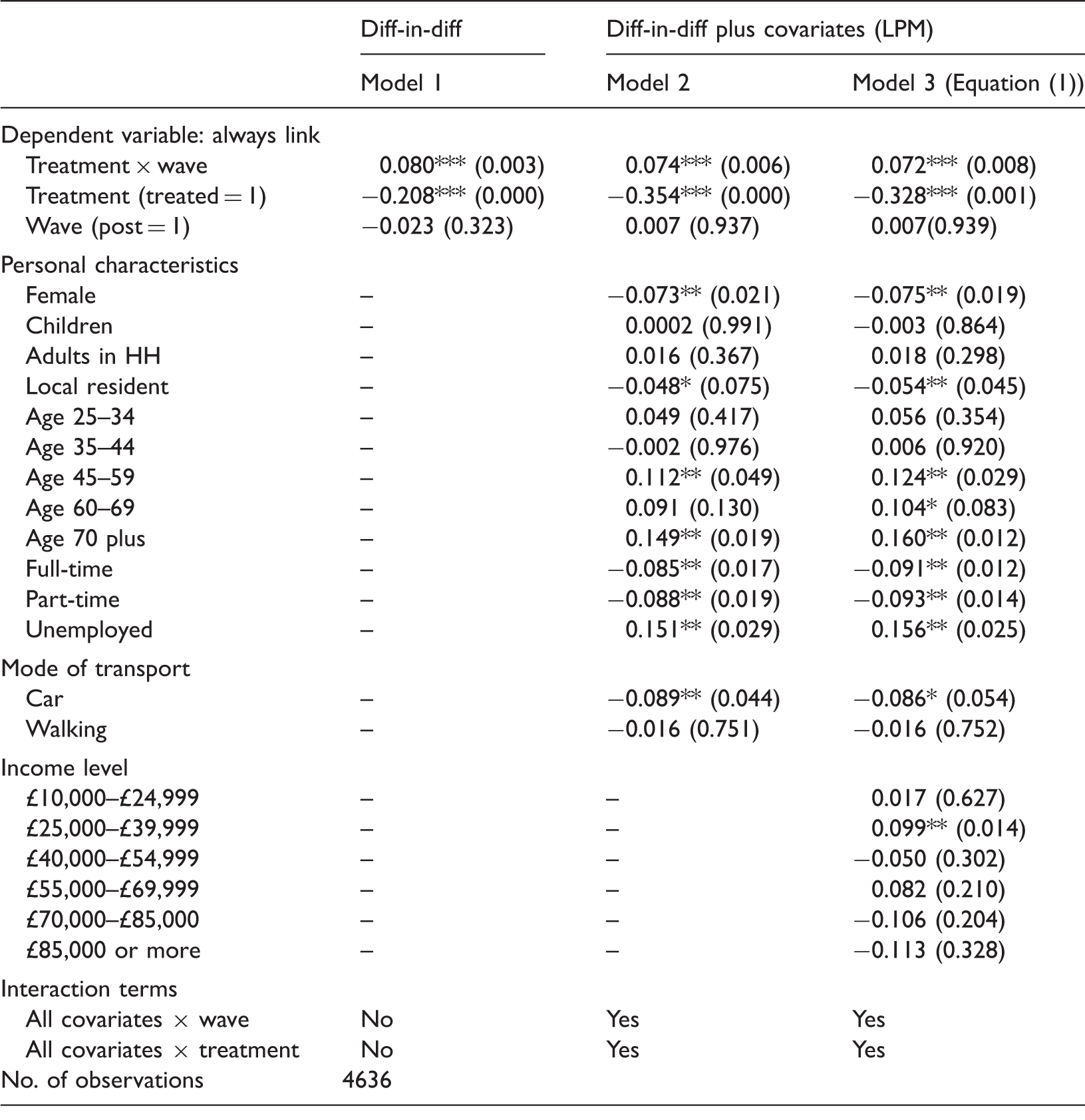
Results of DD regressions.
*significant at 10% level. **significant at 5% level. ***significant at 1% level.
Before running the fully specified model, as per Equation (5), we first run two ‘reduced-form’ models. Model 1 only includes three dummy variables: one for being in the ‘treated’ group, one for the ‘post-intervention’ period and an interaction between the two. The coefficient of this interaction term represents the DE segment in Figure 1, i.e. the differential effect of the intervention once the control group is taken as a base for comparison. Statistically, this coefficient of 0.080 is, as expected, identical to the coefficient in the last row-last column of Table 4.
In Model 2, a series of variables capturing personal and shopping habits characteristics have been included. The inclusion of the additional explanatory variables corroborates our main result that the ‘treated’ centres which experienced the development of a new foodstore, saw a noticeable increase in the number of shoppers always linking their trips, ceteris paribus. Even when we fully specify the model (Model 3, as in Equation (5)) with the inclusion of the individual income levels, this main result does not change. In this latter case, the ‘treated’ areas saw an increase of about 7.2 percentage points in the number of shoppers always linking their trips which appears to be attributable to the intervention.
Although it is the latter findings which are of crucial importance, results for the explanatory variables included as control variables for personal and travel characteristics offer some interesting additional insights. More specifically, the percentage of female shoppers in the sample that always link their trips to the foodstore with using other town centre shops/retail services is lower than that of male shoppers. Similarly, the percentage of local residents that always link their shopping trips, is lower than that of shoppers living in out-of-town locations, indicating that when out-of-town residents visit the centre, they are more likely to always combine their trip to the foodstores with trips to other town centre shops/retail services. This result is to be expected, as out-of-town shoppers most often drive to the town centre, park their car, and then combine their shopping visit to the new foodstore with visits to other shops/services, like coffee shops/restaurants and specialist independent shops.
The older age groups (over 45) of consumers show higher percentages of always linking trips – with those over 70 significantly higher by 16 percentage points. Similarly, unemployed shoppers show higher percentages of always linking trips; both these latter results might relate to the lower time constraints/more free time of these consumer groups (unemployed group and group of over 70). Finally, those consumers that use their car to go shopping show lower percentages of always linking shopping trips, a finding that is in line with previous research on the issue, which suggests that the use of private vehicles when shopping encourages one-stop shopping rather than linked shopping trips (Bennison et al., 2000).
Conclusions
The aim of the research reported in this paper was to evaluate and measure the effect of the introduction of in-town/edge-of-town new-generation foodstore developments on the propensity of shoppers to combine trips to the foodstores with trips to other shops and retail services. We used linked trip information from a major before/after study of eight market towns and district centres in the UK and employed – for the first time in these debates – the DD method to extract added value from the large dataset available in that study. Our results indicate that the development of new-generation foodstores in in-centre and edge-of-centre locations – stores that were developed ‘with the grain’ of the ‘town-centre-first’ approach to retail planning policy – increased the propensity of shoppers to always link their trips between the newly developed foodstores and other town centre shops/services. In this particular sample, we find that increase to be 8 percentage points and, when controlling for personal characteristics of shoppers, over 7 percentage points. Those numerical values are likely to be sample specific, and their typical ranges will only be established by replication. However, the importance of the finding is that using sophisticated but appropriate statistical methodology and a large sample of data from a transparently designed and rigorously conducted study, the development of ‘new-generation’ town-centre first foodstores is clearly associated with increased linked trip propensities. To our knowledge, this is the first time unambiguous evidence of the existence of this hypothesised ‘town centre first era’ linked-trip effect has been demonstrated.
The findings presented in this paper are timely for two major reasons. First, because research on linked trips since the publication of the DETR report has been limited in quantity, scope and depth – giving rise to a situation where policy debates have run dangerously ahead of an increasingly outdated evidence base. Second, because these results are of considerable relevance to planning policy guidance on retail development in the UK – guidance which continues to reiterate the importance of ‘impact’ assessment of ‘town centre first’ retail developments, and the need to assess town centre viability and vitality on the basis of ‘health check’ indicators which have been used over the past decade. In this context, the importance of facilitating developments which have the capacity to generate linked trips – developments which operate as an integral part of the town centres – has been continuously stressed in these policy documents.
Nevertheless, the nature and scale of linked trips remains a complex and significantly under-researched area of study. Existing research (Powe, 2012; Thomas and Bromley, 2003; Wrigley et al., 2010a) emphasises the importance of the individual characteristics of development schemes (in terms of store design and accessibility), as well as the role of the local (town centre) context, as key factors that can facilitate or prevent combined shopping trips. Close proximity of a retail development to a town centre, is seen as a necessary but not a sufficient condition to induce significant levels of linked trip behaviour. Where complementarity in retail offer exists, improved store design, clear signage, pedestrian-friendly centres, and, importantly, consumers’ own perceptions of the quality of a centre’s retail offer (Hart et al., 2014), can enhance shopping linkages. Yet, it is clear that there is an urgent need for greater insights regarding the conditions under which foodstore development schemes can enhance vitality via their combined use with smaller pre-existing units (both retail and service) in town centres (Wrigley and Lambiri, 2014). Hopefully, the novel findings of the present work provide the basis for further robust empirical work on the nature of the ‘functional linkages’ that new in-town developments can generate.
Footnotes
Declaration of conflicting interests
The author(s) declared no potential conflicts of interest with respect to the research, authorship, and/or publication of this article.
Funding
The author(s) disclosed receipt of the following financial support for the research, authorship, and/or publication of this article: This paper contributes to a set of interlinked investigations of Britain's town centres and high streets funded by the ESRC at the University of Southampton, 2010-15. It is based on secondary analysis of the original consumer survey data collected in the period 2007-09 for the large scale before/after research project ‘Revisiting the impacts of large foodstore development on market towns & district centres' conducted by the University of Southampton retail research group for Tesco Stores Ltd. Full details of that research are available in Wrigley N, Lambiri D and Cudworth K (2010) ‘Revisiting the Impact of Large Foodstores on Market Towns and District Centres' (Research Report, The University of Southampton, UK).