



Abstract
This article uses print and associated visual media to investigate the sensationalist reportage of, and the local responses to, a transnational journey undertaken over a century ago. Referred to at the time as the ‘German Gipsy Invasion’, this was a widely reported and highly debated journey of German Roma and Sinti across the UK. The exploration of the media coverage of this event provides a way to geographically and narratively track the activities and local interactions undertaken within a temporary and high-profile migration. It also enables the exploration of domestic, locale-specific discourses around migration, spectacle and the everyday. This paper seeks to explore how, and where, the event was documented in order to explore how it was remembered and later archived. It asks how a perceived spectacle, and the memory of that spectacle, is subsumed into the everydayness of place.
Introduction
This article uses print and visual media to investigate the place-based newspaper reportage and visual documentation of a transnational journey undertaken over a century ago. Referred to at the time as the ‘German Gipsy Invasion’, this was a widely reported and highly debated 1906 journey of German Roma and Sinti across the UK. 1 The exploration of the media coverage of this event provides a way through which to geographically and narratively track the activities and local interactions undertaken within a temporary and high-profile migration. It also enables the exploration of domestic, locale-specific discourses around migration, spectacle and the everyday. This article seeks to explore how, and where, the event was documented in order to explore how, and in relation to what, it was remembered, situated, and later archived. It asks how a perceived spectacle is subsumed into the everydayness of place – in activities, encounters and in memory – thereby acknowledging and questioning the extent to which rhetoric used to record an event continues to impact future recollections and (mis)understanding that both inform and transcend definitions of place and belonging.
Firstly, the article offers some background context to the 1906 event. Then an overview of the methodology and the overarching research project that informs this article is presented. It then proceeds to discuss contemporaneous and retrospective media coverage in order to explore how the event was documented and how aspects of this coverage partially entered and informed a place-based contextualization of it. This is followed by the exploration of a selection of associated visual images such as postcards and photographs documenting the event. The article concludes with a reflection on how these combined media affected the entry of the event into local archives and histories.
The ‘Invasion’
In the spring of 1906 over two hundred German Roma and Sinti arrived in the UK with the intention of temporarily travelling through the country to earn money by trading horses and associated activities. 2 Entering ports in Scotland and England as passengers in small groups on several different steamships, the arrivals caused a political and public stir, and the event was referred to in the press and in public debate as the ‘German Gipsy Invasion’. That it was of great concern at the time is evidenced by official sources such as UK Parliamentary debate, Home Office and Foreign Office reporting and correspondence, and local and national police documentation.
Earlier and similar transnational movements had been undertaken in the decades before. For example, a smaller movement had taken place in 1904–1905, when a party of 50 people entered the UK via Holland. Initially termed ‘Macedonian Gipsies’, the group were later found to be from Germany, and eventually negotiations were made to return them to Germany. The migration in 1906 undoubtedly built on this but was much larger and more coordinated in scale and in coverage. It began in April, when reports emerged of 80 people, in different groups, landing in the Port of Leith in Scotland. More were to follow, entering the country on commercial steamers in Scotland and to the south in England. Reports at the time suggest that the visitors had the intention of trading horses and earning money through entertainment activities, and that their aim was not to remain in the country.
The steady stream of arrivals was perceived as a problem by the UK Government, and indeed by the German authorities, as evidenced by diplomatic interchanges between the two countries. Measures were introduced to prevent British ships carrying new arrivals, but this was no solution to the perceived ‘invasion’ and, as such, dialogue and action shifted towards their removal. Local police forces harried them across regional borders forcing them into the jurisdiction and responsibility of other constabularies. Eventually, the different groups across the UK were rounded up with the help of a charitable organization named the Society of Friends of Foreigners in Distress. A special steamer, the Lincoln, was chartered to carry them back to Hamburg at the end of November. 3 Their 8 month presence had caused a media spectacle. With different groups staying in or travelling through new places, the result was that almost every day a new story or image was circulated to the public, who consumed it with both fear and fascination.
There is some existing literature exploring the 1906 event, though this concentrates primarily on official sources such as the British Home Office (HO) files and associated official reports. 4 Other studies briefly reference newspaper coverage of the 1906 event in order to draw a comparison with more recent coverage of Roma migration. 5 There are also several accounts of the event written around the time, or retrospectively. 6 A recent research project sought to redress in part our understanding of the context of the 1906 event by exploring it as one part of the wider life story of a German Sinti horse trading family. 7 The 1906 event has also been explored by other authors as a brief event in Romani and national histories. 8 However, until now there has been little exploration of this event which situate the traces of the visitors’ presence or their activities within local spaces or regional contexts (i.e., through diaries, local print, local police, church and magistrates’ records).
At the time of writing, a UK-Germany project is being undertaken to address this gap and research the 1906 episode more extensively. This article is part of that project and therefore framed by it. The approach is detailed in the Methods section below. This included working with a German Sinti community partner organization to explore the mapping of the archives relating to the event, and associated responses to the 1906 documentation. As such, this article does not have as its purpose the presentation or discussion of the mapping resource or the exploration of the histories and wider life stories of the people at its heart. These are of course central to any in-depth and representative exploration of the event, but they are not within the remit of this article. Rather, as set out above, it seeks only to explore the domestic documentation and retrospective recollection of the event, based on the media coverage of the stages of the visitor's trajectories through different UK towns and cities. The 1906 visitors were aggressively followed, documented and photographed. They constituted an anticipated spectacle, a source of entertainment, and a perceived threat. What was recorded was only a small part of the event, and of the connected lives, practices and interactions – and this has impacted on what remains now and any understanding of it.
Methods
The Wider Project
The UK-Germany RomMig project explores Romani migration between the UK and Germany at the turn of the twentieth century in order to interrogate the representation, the control, and the agency of the migrating groups through the exploration of regional, national and transnational perspectives. 9 The project also aims to contribute to contemporary understandings of, and debate around, Romani and other minority presences and the impacts of historical and archival (mis)representation. One of the key case studies for the project is the 1906 migration, and, more specifically, how it was documented formally and also remembered or understood within the context of the communities whose ancestors undertook or witnessed it. In order to do this, three key approaches were applied: (i) archival research in the UK and Germany; (ii) co-research with a German Sinti research partner; and (iii) the creation of static and interactive maps, utilizing GIS software, to visualize, interrogate and disseminate details about the 1906 migration. This third approach encompasses national and local newspaper and photographic data on the 1906 event with the aim of re-tracing, re-examining and re-presenting a multifaceted picture and understanding of the 1906 ‘invasion’. It is this defined and completed aspect of the work, the media collection and analysis, that this article draws upon. The movement of the 1906 group is a complex episode. Holding national passes, the migrants were nevertheless seen and treated as ‘outsiders’ to citizenship regimes and they are forcibly moved from place to place and returned to their country of origin. 10 By looking at the visual evidence and wider actions and interactions of the 1906 stay, a more multifaceted engagement with the everyday practices and performances of identities, belonging and resistance is afforded. Here a practical methodological understanding of migration(s) and identities as fluid and complex is adopted. 11
Newspaper Analysis
For this research, newspaper archives were primarily accessed via the British Newspaper Archive (BNA), initially via basic search terms relating to the phrases used in the contemporaneous reportage (‘German Gipsy’, etc.) and within a set time frame (1906–1907). This captured local and national press, albeit not exhaustively. These initial results – over 300 – were manually filtered according to content and to remove duplicate reportage across publications. A second search was performed, this time targeting specific dates and places and publications. This was informed by the complementary archival research undertaken. For example, if a police record mentioned activities at a certain place, then corresponding regional and local newspapers on or around that date were targeted. Similarly, if a postcard (see next section) was described as having been taken at a certain place, then newspapers from that area would be explored in more depth. Additionally, newspaper holdings at local archives were consulted for collections that were not encompassed within the digitized collections of the BNA. Again, all of these were reduced in terms of duplications or those containing only very short references (i.e., articles that mentioned specific places, activities or named people or sites were preferenced). As such, of the several hundred mentions, only approximately 100 were used in detail, and of these, 78 articles were selected for use in a mapping exercise (using ArcGIS) to understand and visualize patterns within the movement. Finally, other timelines were searched in order to assess mentions of the event in the proceeding decades, again, removing duplications or cursory mentions. This added another 20 articles to the analysis for this article. There are still additional articles, and there is also work being undertaken on German press articles. However, in terms of the UK media, the research needed to reach a point of completion, informed by the requirement to produce the initial map visualizations, and it is this data that the article draws upon.
3. Postcards and Photographs
A key aspect of any understanding and analysis of the 1906 event is the way in which photography was used to document, frame and ultimately archive traces of the visitors, the ‘spectacle’, and its impact on local histories. For this article, the focus is primarily on newspaper reportage. As such, photographic imagery is confined to illustrative examples of postcards and professional or semi-professional photography and how these images contributed to the sense of the spectacle of the event and the anchoring of it to locale. That is not to say that there is not much more to be explored within the images, both in terms of content and context. Here, the notion of power relationships within image production and consumption proceeds from long standing and ongoing debate around the wider visual language of photographs, and the power laden practice of photography and currency of the image. 12 The section on photography below picks this debate up further in relation to the documentation of the 1906 group and how this might be situated within the wider visual landscape of the period.
Understanding the Spectacle and the Everyday: Contemporaneous and Retrospective Newspaper Coverage
‘Have you seen the Shah?’ was a stock phrase some years ago, but now it was ‘Have you seen the ‘German Gipsies’, and business, sports, and the usual pacific plays were forsaken so that all might look upon the itinerant beggars.
13
Local presses often carried much lengthier stories and these were also inherently linked to place in a way the national presses were not. For example, they would reference specific streets, buildings, local individuals, organizations or everyday context. This is key for two reasons; the first being in terms of understanding the different paths taken by the visitors as they split into groups. The local presses provide much more information here, often including and then following different threads. Here there is detail of attendance at local horse fairs to trade, or evidence of which trains or ferries were caught to reach different towns to perform in theatres. For example, the movement of a small group dubbed ‘the Albert Hall troupe’ (having performed at Edinburgh's Albert Hall Theatre) can be traced across several newspapers. This gives an insight into one of the sub-journeys made by the different groups, understanding where they visited and, to an extent, why. In this case the ‘troupe’ had a Scottish-based agent and was travelling to different theatres and show grounds to perform at pre-arranged and marketed gigs. Secondly, more detailed exploration of the local presses enables the beginnings of an understanding of how the visitors interacted at a hyperlocal level – with shopkeepers, local (as opposed to national or regional) police constables, local translators and also with audiences (formally and informally, at theatres during organized events but also on the road in impromptu performances and economic transactions).
In almost all the newspaper descriptions, reference is made to the crowds of spectators. From the start, a proportion of the visitors were described as entertainers as much as they were branded invaders. In addition to the above-mentioned ‘Albert Hall troupe’, a group resident in Glasgow's Vinegar Hill, then a carnival ground, saw large numbers of visitors paying to see them and also staged weddings for public viewing. This is an activity which is replicated in other places several times and reported on in various newspapers. Even when groups travelled – and were hounded – across the country following the horse fair calendar in order to trade, there is a clear emphasis on their presence as an anticipated spectacle. For example, on the same page as the above-cited discriminatory report in the North Star and Farmers Chronicle, a separate advertisement draws attention to souvenirs and that ‘Picture post cards of the German gipsies’ procession through Dingwall were issued on Monday by Mr F. Urquhart, photographer, and are still in great demand’. 16
Retrospective Accounts and Recollections
These reports, their racism and overt othering of the visitors, invariably shaped the way in which the event was to be later remembered (and ultimately archived). Local newspapers ran stories about the invasion in the decades after. While many of these were ‘on this day’ type pieces which simply re-published excerpts of the 1906 stories, some included commentary or constituted later reflections on the event, often in light of contemporary issues. Generally, the event and the visitors were again presented as having been undesirable, echoing the earlier publications. Sometimes this is set against an explanation of how the town or city was not hostile to all visitors, differentiating between a perceived good and bad visitor. A piece in the Evening Telegraph of 1931 tells us how: I recall that nearly 20 years ago the district was invaded by a colony of what were called ‘The German Gipsies’, a most undesirable importation whom the police very rightly hustled along […] they made themselves a general nuisance to the residenters, but particularly to the shopkeepers of the town […] but the Market Muir has for generations served as a temporary home for the less fractious, or meddlesome tinkers […].
17
The tinkers on the Muir were peacably quiet mortals in contrast with the German gipsies who invaded this country and literally struck “The Luck of Roarin’ Camp” for a night or two on the same piece of ground, dancing while they sang Sousa's “El Capitan” throughout the night, and pestering our shopkeepers by day.
18
I wonder if Hitler includes the German Gipsies who visited Scotland away back about the year 1906, among the race of super men whom he is leading over the precipice. Our younger generation will not remember about that mysterious cavalcade of tatterdemalions, a large half-civilised gang of men and women, who, with their ponies, carts and tents landed at Leith […]. They thieved as they went, so much so that, when they entered a town shopkeepers shut their doors […] Probably many of their descendants are lying stiff in Russia's snows.
19
Beyond these types of article, there are several more that specifically tie the 1906 event to local people and their interactions with the visitors and, as such, embed the event within local memory. For example, in 1946 the Broughty Ferry Guide and Carnoustie Gazette ran a nostalgic piece entitled ‘Once Upon a Time. Haphazard Memories’ in which it distilled down into a long list several random reminiscences. Amongst these it tells: […] of how a golf club kitbag was stolen and later found impudently hidden in the water-butt at the back of a policeman's house; of the German gipsies [who] were encamped on the ground behind what is now D. T. Wilson's shop but was then a bill-board […].
21
Passports have wiped out visits from such romantic wanderers as the German Gypsies, who were so long encamped on the ground where D.T. Wilson's shops stand now. Street entertainment has dwindled to an occasional accordion player. When we were laddies we never knew what to expect on the streets […].
23
He recalled the ‘invasion’ by German gypsies, who put their caravans in the cattle market and made themselves ‘awful nuisances’ going into shops where nobody could understand them, picking up articles and walking off with them. When they were asked to leave the town, they were reluctant to do so, and he remembered going with the Magistrates’ Clerk and the Mayor, prepared to swear-in all the firemen as special constables in order to eject them.
24
United Free minister JW Slater occupies just a footnote in our archives but he was an unsung hero who prevented bloodshed or even the loss of life in Scone. He faced down a violent mob intent on ripping a band of 30 gypsies limb from limb in the summer of 1906.
25
A recent query in the ‘Herald’ as to when a band of German gypsies visited Brough Hill Fair has brought the above picture of a group from Miss Joyce Sarginson, Kendal. Her grandmother, Mrs Jackson, Warcup, sent her the photograph, and Mrs Jackson says it is over forty years since these gypsies attended the famous fair.
26
Across contemporaneous and retrospective newspaper accounts, several themes emerge. There was the ever-apparent sense of spectacle wherein the visitors were an event to be seen, followed, and consumed. Then, alongside the constant ‘othering’ and racialized language, there was a move towards building a narrative. For example, by following a specific group or ‘troupe’, or by including interview pieces and vignettes. Finally, there was the embedding and framing of the event(s) locally. Activities were linked to place via street or area names, and in several cases to local people. This became more pronounced in the retrospective accounts. Across all of these, the visitors were reported on using the language and framing of the national newspaper accounts but they and the event itself were seen and described through the lens of the local. In some ways this continued to be seen throughout the photographic materials. As the next section discusses, some images taken at the time potentially provide a more multifaceted account and foreground the visitors themselves.
Photography and the 1906 ‘Spectacle’
The 1906 event coincided with the beginnings of more widespread professional, personal and community memory making via photography. 27 Amateur photography societies had become established and, while camera ownership was still relatively uncommon, the ‘democratization of the image’ via the Kodak had begun. 28 The visual aspect of the coverage of the 1906 event is surprisingly rich, and as such warrants a more in-depth exploration. However, within the parameters of this article, the discussion of photography is limited to its relation to the sense of ‘spectacle’ and consumption propagated by the press – and with that, how it might have diverged from that coverage to present something more local or more visitor-centred.
Newspapers and magazines ran photographs and sketches of the visitors, and also ran adverts to publicize images of the visitors that were for sale locally as postcards. Articles describe how people had gathered to see the visitors and that they also brought their cameras with them to document the spectacle, and this reinforced the newspaper coverage and hype. For example, the Buckingham Advertiser and North Buck Free Press described that when the visitors reached Buckingham […] it was astonishing the large number of persons who were present to–not welcome–but to have a sight of the unusual spectacle. Few circus processions have been honoured in Buckingham by such a large gathering of sightseers. Kodaks were plentifully employed […].
29
There were also semi-amateur and professional photographers documenting the event for newspapers and magazines, and for sale as postcards usually labelled with ‘German Gipsies at …’ followed by whichever place name. These postcards turn up on eBay and other online selling sites. 30 They are also scattered in local archives across the country and in their online catalogues, as well as online local history sites. Often they link to questions or reminiscences of a locality or a local person. Sometimes the date is precise, sometimes it is out by a year or two; for example, a postcard image of visitors at Dingwall which had been wrongly dated on the front as ‘German Gypsies passing through Dingwall – June 1907’. A description on the local history website also links the event to a local person, expaining that: ‘One of the policeman has been identified as George Mackenzie’. 31 Sometimes the location is evident, other times it is not fully clear. Some images are well circulated online, across local history and selling sites; for example, the postcards of Walter McNab, a Scottish chemist and photographer. 32 The 1906 event also formed a chapter in a book written at the time, Andrew McCormick's The Tinkler-Gypsies of Galloway, which also includes photographs. 33
To an extent, these and similar images fitted a wider representation of the exoticized other. McCormick was an active member of the Gypsy Lore Society (GLS) and the photographs formed part of the wider context of the GLS documentation of Romani people and practices, and can be situated within the wider ethnographic images of Romani communities at the time. 34 The GLS believed they were capturing and documenting (selected) people and traditions that were endangered due to industrialization and modernity. In terms of the circulation of photographs of the 1906 group via postcards, this also fits within the context of the exoticized and the ‘vanishing’ other. 35 The morally coded cataloguing and studying of the domestic and the foreign ‘other’ were already established, as was the pseudo-scientific documentation of the poor or disenfranchised.
However, there are variations. The postcards and photographs differ in terms of content. Some are staged group photographs of a small group of the visitors, others are more ad hoc images, capturing a group as they made their way through town. Usually these are taken at a distance (see Figure 1) by the town's resident amateur photographer-chemist. In some cases, these images were an unexpected departure for them, with their usual work being the capturing of rural or local scenes. Early photography took place across different geographical levels and by different amateur practitioners. 36 The diversity of practitioners is arguably also key when exploring the images of the 1906 group. These pictures were taken by professional news and amateur photographers, by so-called ‘gypsylorists’ and by those who had no interest in anthropology, by those living in cities and those in rural villages, and by those expecting or following the visitors as much as by those whose lives they unexpectedly stumbled into. The visual and moral language will have informed the photographic practice, but it is not possible to say that it will have informed it uniformly.
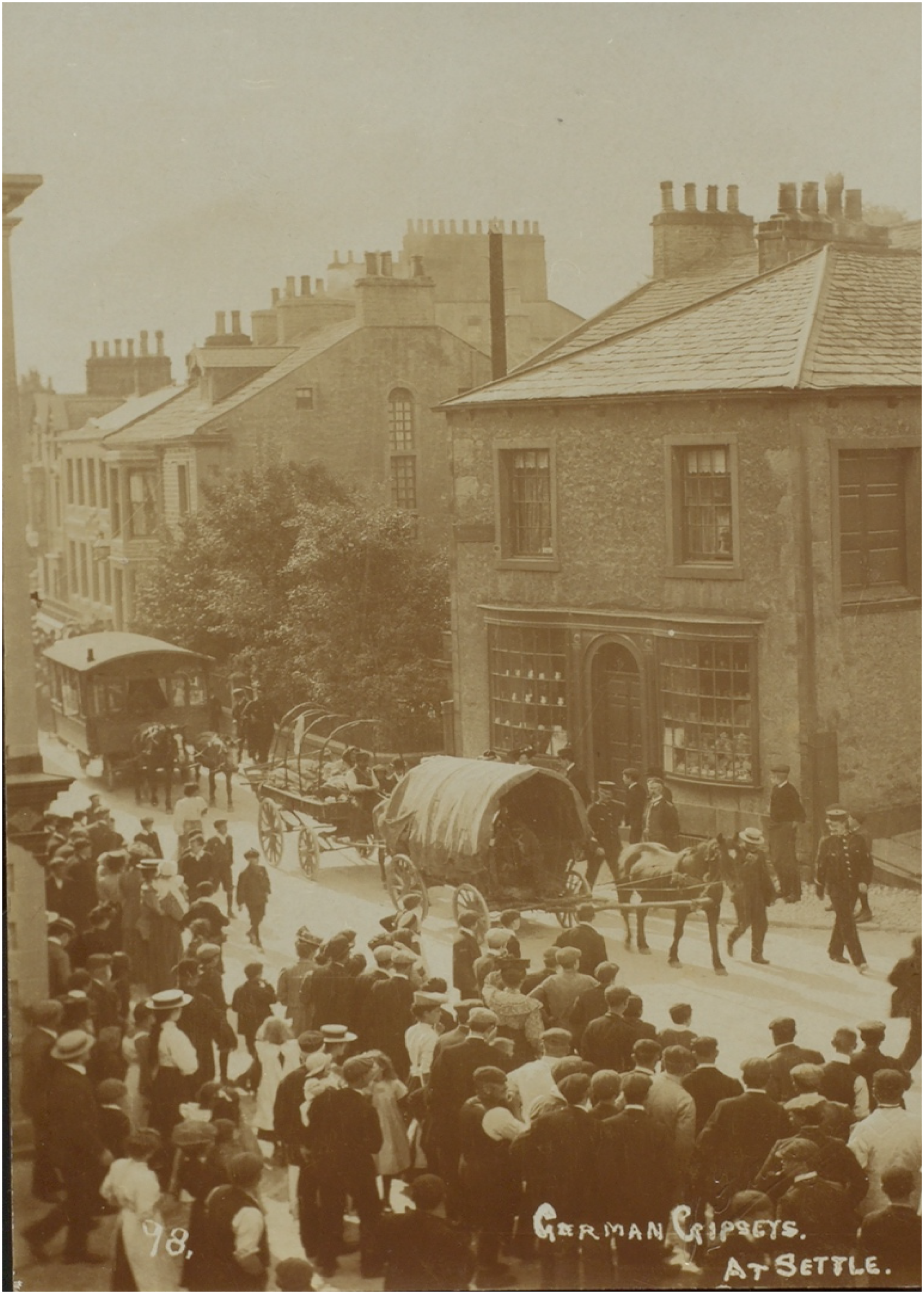
1906 Postcard depicting a group of the visitors travelling through Settle. Image courtesy of University of Liverpool Library SMGC 2.3.1/23.
A further layer in relation to photographs of the 1906 visitors is the existence of reportage of the sale of the postcards by the visitors themselves, as well as evidence of them posing for photographs as a means of making money. Numerous newspaper articles and reports at the time recount the visitors offering a price for their photographs to be taken.
Both the newspaper reportage and the photographs taken at the time determined how the event was captured and therefore how – and where – it was to be remembered. Initial reporting and recording of an event has an impact on how that event and the people involved in it are remembered. It therefore also impacts on the families of the people involved who might look for – or accidentally find – traces of their relatives. 37 It is not without contemporary relevance, of course, that the discriminatory narratives of invasion and panic in 1906 are strikingly similar to forced displacement and migration across the years to follow, and right up to today. 38 Arguably, the images have the capacity to both reflect and to present a counter narrative to the dominant press reports. Broken up into individual sources, each item remains a highly limited glimpse into lives, activities and perspectives; equally, each item retains the potential to become more. The 1906 visitors remain in flux, never fully accounted for. The memory and documentation of this temporary migration is now fragmented across locations, leaving the visitors both in place and peripheral to it, just as they were at the time of their visits.
Conclusion
This article has explored a selection of newspapers, postcards and photographs to explore how a temporary migration was captured, reported and consumed domestically. Investigating the locale-specific reportage of the 1906 event has uncovered evidence of mass spectacle and tension, but also the everydayness of social, cultural and economic interactions on a hyperlocal scale. By exploring in depth the smaller presses and local photographic archives, the 1906 event is no longer a single spectacle. It becomes the multifaceted, multistage and often fragmented journeys and activities of small groups across the villages, towns and cities of the UK. It tells as much, if not more, about those domestic places and people – their hopes, fears, economies, cultures and representatives – as it does about the visitors travelling through these locales. It has shown how perceived out-of-the-ordinary events are subsumed into everyday recollections and local histories, and consequently enter an archive – formal, informal, physical and digital – and, by their presence there, continue to pose questions.
Footnotes
Acknowledgements
The author wishes to thank the journal peer reviewers for their extensive comments, and the journal editors for their patience in accepting subsequent revisions. The author also wishes to thank the RomMig project team.
Funding
The author disclosed receipt of the following financial support for the research, authorship, and/or publication of this article: This work was part of the RomMig project (Romani Migration between Germany and Britain (1880s-1914): Spaces of Informal Business, Media Spectacle, and Racial Policing) supported by the Arts and Humanities Research Council [grant number AH/W010658/1].
