




Abstract
This article examines the political career of Angiola Moretti who was, from 1926 to 1930, the National Secretary of the Fasci Femminili – the women's section of the Italian Fascist Party. Despite her prominent role, this female hierarch has never, to date, been studied by historians. The article investigates how she came to be appointed to this high-ranking position and her subsequent role and career in the Fascist Party, including her eventual nomination in the late 1930s to the rank of Ispettrice Nazionale del PNF. The story of Angiola Moretti's somewhat improbable career is used as a lens to explore the murky world of the Fascist ‘court’ in Rome and its gender politics.
On the first of April 1925, a fashionably-dressed young woman, recently arrived in Rome from a small town in Lombardy, started work as a typist at Fascist Party Headquarters. Despite having little political experience and only modest educational qualifications, the following year she enjoyed a spectacular promotion to become the national secretary of the Fasci Femminili (FF), the party’s women’s section, the first of a series of high-ranking posts she held in the Fascist Party. By the end of the 1930s, she had risen to the very highest political rank open to women during the ventennio, that of Ispettrice Nazionale dei Fasci Femminili (FF National Inspectress).
The Fasci Femminili, the organization in which this young woman – Angiola Moretti – played such an important role, was to become a far from insignificant part of the Fascist endeavours to ‘mobilize the masses’. 1 By the fall of Fascism, millions had joined it and its ceaseless round of activities in cities, towns and villages around Italy, whether political or welfare-related, had become part of the everyday lives of huge numbers of Italian women. All this activity needed to be organized, and this led to the emergence of a new, unprecedented, female political elite. We still know very little, however, about many of the women who stepped into these new leadership positions, at either provincial or national level and, despite her prominent role, Angiola Moretti is one of those who have been largely ignored by historians. Helga Dittrich-Johansen's book on the Fasci Femminili, for example, includes only a brief mention of her (in a biographical appendix), just listing some of the posts Moretti held and who she married, as well as, perhaps in an attempt to add some detail, a description of her as a ‘shining example of Fascist womanhood’. 2
Moretti, however, is someone who merits a closer look, not least because she was a rare example of a woman who managed to forge a salaried career at the highest ranks of the party. Many prominent male fascist hierarchs were rewarded for their loyalty with jobs in both the party and the state apparatus, including well-paid appointments as federali (provincial party leaders), undersecretaries and government ministers, or even as prefects, diplomats or colonial administrators. 3 But none of these spoils of the regime were open to women. Indeed, Fascism offered very few career opportunities (beyond lowly clerical roles) to its female political supporters at all. Only towards the end of the 1930s did some new, fairly limited, positions begin to emerge.
Much of the existing historiography on the FF has failed to grasp this point by assuming that far more women received salaries for their work in party leadership roles than was actually the case. Dittrich-Johansen has, for example, misleadingly described these women as ‘the female professionals of the Fascist Party’.
4
But this idea is based on a vast overestimation of how many female hierarchs were on the party payroll. In reality, practically all the organizational and leadership roles in the FF were filled by unpaid volunteers
5
and very few women (apart from secretarial staff) earned salaries. This was true at all levels, including women high up in the party hierarchy: even provincial fiduciaries – the highest-ranking FF hierarch in each province – were not paid at all until October 1940. This makes Moretti, who held a series of paid, political appointments, unusual.
6
She was, moreover, rather different from most of the other women who rose to high rank in the Fascist Party, both in terms of her social origins and her specific route to high office. The image of her that emerges from police and Fascist Party archives offers some revealing insights into the murky world of the party and its gender politics. It also sheds light on the difficulties faced by political women in this period, in a regime created and controlled by men. So, who was Angiola Moretti? 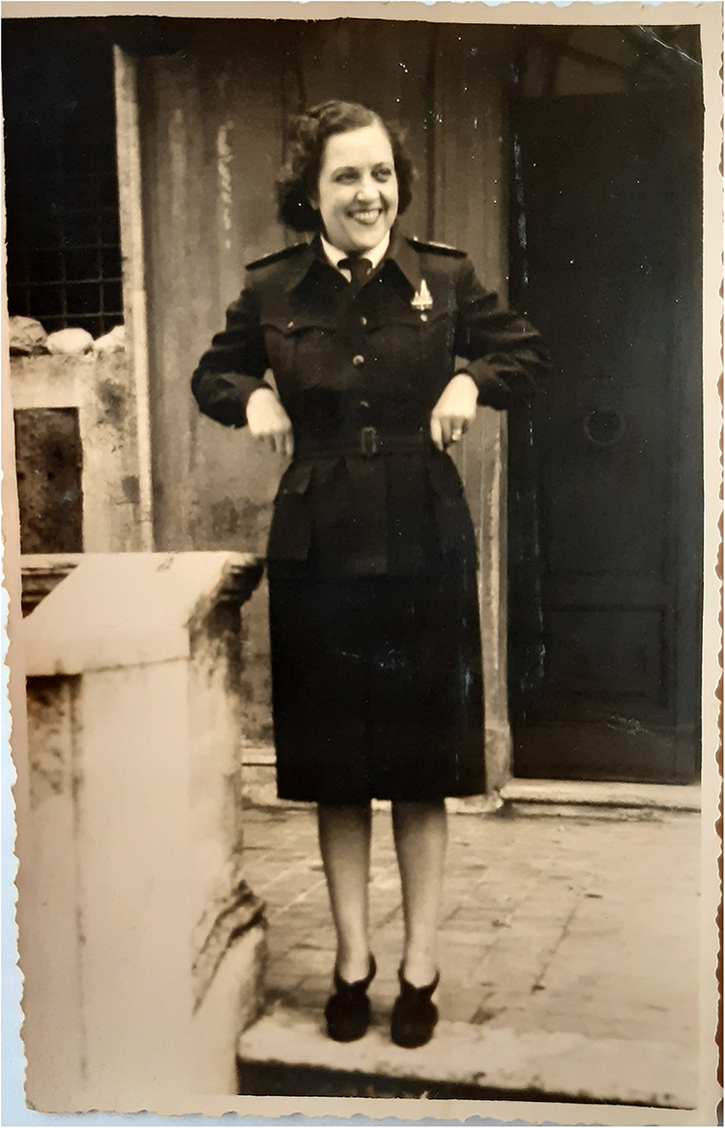
Angiola Moretti in Rome in 1941 (Private collection)
Origins
Angela Luigia Moretti (when she started calling herself Angiola is unclear) was born in the small town of Pontevico in the northern province of Brescia on 18 January 1899. Pontevico lies on the river Oglio and is roughly equidistant from the cities of Brescia and Cremona, in an area that was an absolute heartland of the rise of Fascism. Her background, both in terms of the social position of her family as well as her education, was remarkably similar to that of Benito Mussolini. She was the daughter of Luigi Moretti, a cobbler, and Maria Panzi, a primary teacher. 7 She had an older brother Fausto (born 1896) who, according to the Enciclopedia bresciana, set up a photography business aged only 14 and became a frontline war photographer during the Great War. 8 Eventually he went on to work on feature and documentary films. This encyclopaedia entry also records him as ‘frequenting’ the studio of the photographer Ghitta Carell, whose work included a series of well-known portraits of Mussolini. 9
Angiola Moretti followed the path of many ambitious girls from modest social origins by training as a primary teacher. In a letter she sent to the party's National Directorate in October 1925, she listed three teaching diplomas – for primary teaching, for kindergarten teaching, and to qualify her as a primary school headmistress. This letter also claims that she had joined the Fascist Party, and become founding Secretary of her local FF in Pontevico, in 1921. 10 A police report, however, puts the date of both of these as 1923 and suggests that she had retro-dated them deliberately. 11 Retro-dating a party membership was, of course, not uncommon during the ventennio, given the prestige of being seen as a ‘Fascist of the First Hour’. One police informant's report put the date even later, in 1925, but this seems unlikely given her prior active role in the party. 12
This was far from the only informant's report about Angiola Moretti. She is someone about whom a great deal was said and duly recorded by some of the numerous spies and paid informants active during the ventennio (Mauro Canali estimates that there may have been as many as 5,000 of them), 13 including in the corridors of Party Headquarters, reporting to the regime's Polizia Politica (Political Police – Polpol). In the Polpol archives there is a large folder of reports about Moretti. 14 Of course, such documents need to be approached with due caution as the information gathered could have a range of motivations behind it, including rivalries, personal animosities or simple revenge. 15 Slander, libel and blackmail were frequently deployed weapons in the incessant internal struggles among Fascists, struggles that under a dictatorship could not be expressed openly but did, nonetheless, simmer ceaselessly throughout the years of Fascist rule. In theory, such internal conflicts were anathema to Fascism, which preached the unity of the nation but, in practice, as Lorenzo Benadusi has written, they suited Mussolini well for: ‘His policy […] was divide et impera: a system of rivalry and distrust, conflicting ambitions, suspicion, and slander aimed at weakening the power of the most influential gerarchi and rising above them as the arbitrator of their fights’. 16 Holding information on his subordinates’ crimes and misdemeanours gave Mussolini power but such information was rarely aired in public, in order not to undermine the prestige of the regime and the idea that Fascist rulers lead morally upright lives. All this helps understand why, despite the large number of negative reports in Moretti's Polpol file, including some fairly lurid allegations, she survived politically. It is unlikely that all that informants said about her was actually true. However, it is worth noting that, although the archive does also have files on some of the other Ispettrici Nazionali, many have no file at all, and those that do mostly have very little recorded. Spies and informants were particularly interested in Angiola Moretti and hers is, by a long way, the fattest file.
The Move to Rome
After a spell in some capacity in the Fascist Federation in Cremona, 17 she moved to Rome in 1925 where, with the help of Roberto Farinacci, she obtained employment at Fascist Party National Headquarters. 18 Farinacci, the most powerful exponent of the violent, ‘intransigent’ wing of the Fascist movement, had just become (in February 1925) the Party Secretary General. Moretti doubtless already knew him in person since he was the ras (provincial party boss) of Cremona. In April 1925, she started work as the clerical assistant to Elisa Majer Rizzioli, the Ispettrice Generale dei Fasci Femminili (the national FF leader), with an initial salary of L.600 per month.
Majer Rizzioli had only been in post since December 1924, before which the FF, composed largely of spontaneously-founded local groups, had lacked a centralized leadership. The early FF had, nonetheless, not been inactive. They had organized their own conferences and some members even campaigned for suffrage. Their membership was diverse and included both young, hot-headed squadrists as well as more respectable types, like Majer Rizzioli herself.
Venetian by origin, Majer Rizzioli had been a Red Cross nurse in the Libyan War and the Great War. She was also a prolific author whose writings, mainly highly patriotic in tone, included journalism, a memoir and a co-authored novel. In the early post-war years, by then living in Milan, she became active in support and propaganda activities for D’Annunzio's occupation of Fiume and then joined the nascent Fascist movement. 19 As a moderate feminist, she believed that women should be politically active in the new regime and should have the vote. The founding of the Inspectorate had come at a time when Mussolini's rule was under threat in the fallout from the murder of Matteotti. Many were abandoning what seemed to be the sinking ship of Fascism and he needed to gather his most loyal supporters around him.
Moretti may have seemed an obvious choice for Majer Rizzioli to employ in her new office as they appeared to have much in common. Both had been involved in early Fascism and in supporting D’Annunzio's Fiume adventure. Both had attended teacher training college. Otherwise, there were many differences and they had contrasting backgrounds and personalities. Almost twenty years older, Elisa Majer Rizzioli belonged to a different generation and, as the daughter of a prosperous bakery-owner, a different class. She was also married (although childless). Both were ambitious but in different ways. Majer Rizzioli's ambitions did not, of course, exclude some personal desire to hold a prestigious position but she also wanted to bring her version of feminism (which tended to stress duties more than rights) to the new regime, making women an important part of its political project, with a voice and an active role. Moretti's ambitions, by contrast, seem to have mainly been concerned, as far as it is possible to tell, with carving a place out for herself in the capital and advancing her own career. What she actually thought about the FF, and its role in Fascism's project in a wider sense, is less clear. She was capable of writing in polished, albeit rather flowery, prose but what published words of hers we do have (admittedly not many for, unlike certain other prominent Fascist women, she rarely wrote for the press) offer no insight into this question as they tend to just dutifully churn out the well-known themes of Fascist ideology.
Majer Rizzioli did not last long in her job due to the hostility of many male hierarchs, particularly ex-Nationalists, to women having a political role in the party. They opposed women having their own national structure and instead wanted the FF to be kept strictly under the thumb of the male hierarchs. Majer Rizzioli managed to resist their pressures for a whole year, albeit with some compromise and by channelling the energies of the FF into the sorts of activities that met with male approval, particularly welfare, but eventually, at a meeting of the Gran Consiglio on 3 January 1926, Farinacci announced the abolition of the Ispettorato and she was invited to resign. 20 The subordination of the FF was reinforced by the fact that a man, initially Serafino Mazzolini, was put in charge of the FF office.
It is quite possible that Moretti played a part in Majer Rizzioli's downfall. Initially Majer Rizzioli seems to have been happy enough with her performance, to the extent that she soon requested (unsuccessfully) that her assistant be promoted to the grade of secretary with a higher rate of pay. 21 This may have been a misjudgement. Indeed, one of her detractors later claimed that, in welcoming Moretti to the party offices, Rizzioli had been ‘nursing a viper in her bosom’. 22
Soon after the fall of Majer Rizzioli, Moretti took her place. In an astonishing promotion, a lowly clerical assistant was transformed overnight into a high-ranking party official, stepping into the shoes of the competent and experienced Majer Rizzioli. She did not, however, become the next Ispettrice, for that office was abolished. Instead she was given the more modest title of Segretaria dei Fasci Femminili. Her role and authority reflected this: in effect she was to execute the dictates of the male party hierarchs. Indeed, that is undoubtedly why she was appointed, to do the bidding of her (male) superiors.
Who was behind this extraordinary promotion was, most likely, Augusto Turati (1888–1955), Vice-Secretary of the Fascist Party and, from 30 March 1926, Farinacci's successor as Party Secretary. He was first appointed by Farinacci to the party's National Directorate on 23 June 1925, soon after Moretti began work in Party HQ, and, although her appointment preceded his, he doubtless played a part in facilitating her move to Rome. 23 The reason for this, as various police documents attest, is that she was Turati's lover. 24
A journalist and war veteran of lower-middle-class extraction, Turati had begun his political career in Brescia and, like Farinacci, became the ras of the local Fascists in his own province. Tall, slim, respectably-dressed, and with a reserved manner, he was a far less flamboyant personality than most other ras and, according to Philip Morgan, ‘one of the most capable, intelligent and honest of the hierarchs’. 25 The replacement of the volatile, rabble-rousing Farinacci with the more level-headed Turati was part of Mussolini's attempt to get control of the unruly, ‘intransigent’ elements in the party. This was a rapid promotion, over the heads of others who considered themselves better candidates, but Turati's relative obscurity was perhaps why Mussolini chose him, believing him both more loyal and less threatening to his own power. 26
National Secretary of the Fasci Femminili
The promotion of a young woman who was dependent on the patronage of a powerful male hierarch, instead of someone like Elisa Majer Rizzioli, with her impressive record of patriotic activism and her political ambitions for Fascist women, made it far easier to control the FF. In his ironical and anecdotal book about the Fascist ventennio, the journalist and writer Gian Carlo Fusco commented: ‘Liaising between the Fasci Femminili and the Party Secretariat was Signorina Angela Moretti, from Brescia, a loyal admirer of Turati. She was someone lacking in great or specific merits, but dressed elegantly, spoke exquisitely and wore French perfumes’. 27 Fusco's tone is, of course, extremely patronising but it is hard to disagree with the view that she was ‘lacking in great or specific merits’. Moretti was not even remotely qualified for this job as she had had no prior leadership experience in the FF (setting up an FF section in a small town hardly counts as training for national leadership). This lack of experience, however, together with her intimate connection and loyalty to the party leader, was precisely what made her a safe, potentially malleable choice. Others with more relevant experience (those who had been involved in setting up the early FF, for example) were likely to be harder to control.
The subordination of the FF in these years proceeded in parallel to the subordination of the party as a whole. As Secretary, Turati enacted the ‘normalization’ – the mass purging of undisciplined elements, particularly the exponents of violent, provincial Fascism who posed a threat to Mussolini's power – as well as imposing a stricter discipline on the party ranks. Many ‘Fascists of the First Hour’ were expelled, whilst even larger numbers chose to resign. The party became a top-down, hierarchical organization, run from Rome. Local sections ceased to be the fiefdoms of charismatic leaders, answerable only to their followers. Leaders could now be appointed or removed from above and had to obediently follow the instructions spelled out in the newly-instituted ‘sheets of orders’ sent out, from July 1926 onwards, by Party Headquarters. The party was gradually transformed from a dynamic but chaotic movement into a far more orderly organization that was largely subordinated to the state.
This centralization and purging hit the FF too. The removal of Majer Rizzioli had marked the end of any active political role for Fascist women and, although they were to be allowed to do propaganda work (bringing the latest Fascist slogans to the masses), their main role was now welfare. Insubordinate elements, particularly feminists, who proved reluctant to obey the new rules, were removed. It is hard to know exactly how many female leaders left or were expelled from the party in these years, but, according to Dittrich-Johansen: ‘It must have been a pretty massive and wide-spread operation’. 28 The FF of Milan, for example, was summarily closed down in August 1926 when its leaders protested against the substitution of elected mayors by the new unelected podestà, thereby making a mockery of the fact that certain women had just gained suffrage rights in local elections. 29 Subsequently, as Il popolo d’Italia reported, due to ‘their persistently undisciplined and unworthy behaviour’ both the FF Secretary and her deputy were expelled from the party. 30 A less dramatic example was Pescara, where, in November 1927, the appointment of a new federale, as part of the ‘normalization’, meant also the changing of the guard in the FF. The new FF leader was a teacher whose main focus was welfare. 31 Smaller towns were affected too. In Reggiolo (RE), the FF was ‘shut down by the higher authorities because irregularly constituted’ and reopened with a new leader, selected by the ‘competent provincial hierarchs’ in early 1928. 32
The role of the FF thereafter was to obey orders and minister to the poor. In these years, they had to struggle along with very little funding, and, in 1929, they lost control of the girls’ organizations, apart from the groups for 18–21-year-olds. The pattern of subordination, established in these years, was to be their modus operandi throughout the 1930s.
None of the changes, of course, should be seen as Moretti's own policy for she had no remit to make policy. Majer Rizzioli's power may have been limited but she did at least have a seat on the Party's National Directorate. Moretti did not. Instead she had to carry out orders delivered from above, ultimately from Turati, and ensure that those below her, the provincial federations, obeyed these orders too. Whether a different, more assertive, FF leader could have resisted any of this is doubtful given the political climate of those years, but this gradual chipping away at the influence and autonomy of the FF did happen under Moretti's watch. What, if anything, her view was of this disempowerment is hard to discern, not least because she did not suddenly start airing her opinions in the press, although she probably was the author of the factual reports on the activities and achievements of the FF that appeared regularly in the FF newspaper.
Nonetheless, during Moretti's tenure of this post, the FF did expand. Initially membership fell from 40,000 in 1925 to 37,166 the following year, doubtless due to a mixture of expulsions and voluntary resignations, but thereafter it rose steadily, with 76,346 members in 1927, 88,006 in 1928, 100,000 by 1929 and 106,756 in 1930. 33 The FF presence, however, varied greatly from region to region and in some provinces it was practically non-existent. Given the hostility of many male hierarchs, the FF did best in provinces that had hardworking, determined, local leaders. 34 At this stage the situation was very different from the 1930s when, as part of Starace's policy of ‘going to the people’, the FF became part of the general mass mobilization of the Italian population. In that decade, the party was ordered to actively increase female recruitment and deluges of orders began to rain down on provincial FF sections, exhorting them to prodigious amounts of welfare activity.
Although such encouragement was lacking in the late 1920s, there was still plenty of work for the FF Central Office and Moretti's job was, despite her lack of real power, considerably more than just a clerical one. Indeed, she herself was given her own typist. 35 She was the central point of reference for the FF and their activities, which, in these years, were expanding. 36 They included a whole range of politicized welfare initiatives like visiting the poor to bring assistance and propaganda, organizing children's summer holiday camps, and giving talks on both cultural and political themes. They also (until 1929) ran the girls’ groups. A particular focus was the welfare of mothers and children, seen as part of the regime's newly launched demographic campaign. Some branches, particularly in certain northern provinces, were quite active.
Moretti's role also included representing the FF on official and ceremonial occasions, although sometimes that meant simply being dutifully present while male hierarchs orated pompously on topics like the ‘family virtues of Italian women’. 37 She also carried out inspection visits to FF Provincial Federations, like her visit to Pescara in September 1927. 38 Inspections were, of course, an important means of enforcing central control. On occasion she had to intervene more directly. In January 1930, for example, she was Acting Head of the FF in Rome (Reggente della delegazione FF di Roma). 39
Eventually, the many enemies he had made during his ‘pacification’ of the party caught up with Turati and he was replaced as National Secretary on 7 October 1930. Shortly after, Moretti also lost her job. After this, the FF was never to have a single national leader (even an essentially powerless one) again. A male hierarch – Gabriele Parolari – was put in charge. 40 In 1932, Rachele Ferrari del Latte, a Fascist stalwart from Milan, who, like Moretti, was later to become an Ispettrice Nazionale, began work in PNF headquarters. But Ferrari del Latte was only partly assigned to organizational duties for the FF and hers was an unpaid position. 41 The FF did not get any kind of properly professional female leadership at national level again until 1937, when the first Ispettrici Nazionali were appointed.
Inspectress of the Three Party Schools
Moretti, meanwhile, might have been side-lined but she was soon back on the party payroll: in December 1930 she secured a new position as Inspectress of the party's Scuole Superiori Femminili Fasciste. These three schools had, since 1928, been providing politicized vocational training for specific all-female professions, where women conveniently presented no competition to men in the overcrowded professional job market. As one commentator optimistically argued, they ‘could […] help resolve the problem of women's employment, especially with regard to those still far too numerous women who are trying to get into the liberal professions’. 42 A fourth party school, for female PE teachers, was added in 1932 but Moretti seems to have had nothing to do with this institution, located in Orvieto. 43 The schools for which she was responsible trained rural primary teachers, factory social workers and domestic science instructors, all as part of the regime's efforts to reach out to the masses. As the FF newspaper put this: ‘All three institutions, which are typically Fascist, seek the education and elevation of the popular classes’, their role being to ‘train teachers and personnel who are able to approach the people with a new mentality, following the guidelines and advice that the Duce has repeatedly expressed’. 44
The farming school – the Scuola di Sant’Alessio – situated just outside Rome, 45 opened initially in late 1927 to teach farming and domestic science to female war orphans, but the following year it began to focus on training specialized rural primary teachers. Its graduates' mission, essentially part of the regime's ruralization campaign, was to make peasants love the land and stay there. From 1937, however, the school began instead to turn out Technical Leaders for the Massaie Rurali – the FF section for peasant women. At this point it became increasingly involved with other party activities such as offering short training courses for female party cadres.
The two other schools were located more centrally in Rome, in a former convent at San Gregorio al Celio. One produced home economics teachers, destined for technical middle schools or to teach domestic science courses to Fascist women and girls, to prepare them for their domestic and maternal mission. Like the farming school, by the 1940s it was forging Technical Leaders for the party's youth organizations. 46 The third school trained factory social workers, as part of the regime's efforts to win the hearts of the industrial working class. 47 Its students studied ‘modern’, Fascist conceptions of social work: no mere philanthropy, as the FF newspaper explained, but ‘a state-controlled activity in defence of the race’. 48
The entrance requirement for all three institutions was a primary teaching diploma, but the social work school did hope to attract a different type of student, including university graduates or, more realistically, those with a secondary school diploma supplemented with a special examination. The students were all unmarried and mainly in their twenties (with an age limit of 25 for the farming school, 28 for the domestic science school and 30 for the social work school). The 10-month vocational courses each school offered combined theoretical and practical training, with an emphasis on modern, ‘rational’ methods. The students all lived in on school premises, where their lives were highly regimented in what was described as a ‘family discipline’: they wore uniforms, slept in dormitories and strict regulations governed their every waking hour. They were allowed out only on Sunday afternoons and only if accompanied by relatives or in a group with a teacher. In theory they were charged fees, although increasingly grants had to be offered to attract enough students. Teachers who took the courses as a form of in-service training paid nothing. 49
It is difficult to determine to what extent Moretti herself was really able to shape these institutions given that she had to get permission from Marinelli (PNF Administrative Secretary) even for petty matters like allowing a student to have time off sick. However, she did play a key role in the political aspects of the curriculum, for, in addition to her supervisory role, she was directly involved in teaching. It was she who took the classes on ‘Fascist culture’. These were, after all, not just ordinary schools: their graduates had a supremely political mission. As a party publication explained in 1936, they were ‘a political creation’ whose graduates ‘bring to the social, familial and educative sphere in which they are called to operate, not just the resources and virtues of their sex, but also the burning spirit of Fascism’. 50 The social workers, for example, were expected, as the FF newspaper put it, to ‘make known and explain to the workers the institutions of the regime, Fascist legislation that has been passed to help the people [… ] that is why the San Gregorio school can also be considered a school for propagandists’. 51 Insight into what was taught is afforded by a glimpse at the coursework of ‘T.S.’, a 21-year-old student from Campobasso enrolled at the domestic science school in 1942. Her curriculum included ‘Fascist culture’ classes, taught by Angiola Moretti, in which she studied topics like the history of Fascism from 1919 onwards, women's role in the regime, key speeches by Mussolini, the Fascist Empire, and the regime's achievements, institutions and organizations. 52
Moretti's role, therefore, amounted to much more than just the occasional cursory inspection, and she may possibly have had a guiding hand in much of what the schools did. Overall, however, this was not a particularly onerous job as these were tiny institutions. In October 1932, for example, the farming school had only 20 students and the social work school a mere eight. 53 Numbers were greater in some years but generally amounted to about 20–30 students in each institution.
This new job had much to commend it. It offered a good salary and an excuse to spend time in Party Headquarters (where she seems to have had an office) networking the powerful. It also meant opportunities to make official appearances on ceremonial occasions: the schools were often visited by important dignitaries, including even the Queen (Elena di Savoia) and Mussolini himself. It even afforded the excitement of foreign travel, when, in August 1934, Moretti went to Berlin to set up an exhibition about the work of the Domestic Science School at the Fifth International Domestic Science Congress. 54 Nonetheless, it was still a big step down from her previous, much more prestigious, post and one informant reported, in 1931, that: ‘She is doing everything she can to take back […] power […] she is a real fury, desperate to get ahead’. 55
Surviving a Disciplinary Investigation
She needed more than anger however as, soon after losing her job as National FF Secretary, she was facing a party disciplinary investigation for ‘immorality’, always a useful accusation to tarnish the reputation of a woman. According to one source, the accusation was that she had aborted Turati's child. Abortion was, of course, illegal and had recently been declared a crime against the state. It was typical of the party, however, to deal with a matter like this internally rather than in a court of law, as the desire to avoid scandal was great. Whether there was any truth in this allegation is impossible to know but she somehow managed to survive the crisis. After a few months the investigation was shelved, and she was back at work. She seems to have been saved by the intervention of Turati himself and of others, including Margherita Sarfatti. 56 Elisa Savoia, for example, who had been in charge of the FF in Milan during Moretti's tenure as National Secretary, penned a letter of support for her, in which she extolled Moretti's ‘prodigious activity’ in service to the party, and described her as leading a ‘simple, hardworking life of sacrifice’. 57
There are two possible explanations for her ability to bounce back despite the loss of her patron. One is that, after effectively acting as Turati's spy during his term of office, she knew a dangerous amount about other Fascist hierarchs. Just after the resignation of Turati, for example, one informant reported that Paola Benedettini, editor of the FF newspaper, was saying, along with others, that Signorina Angiola Moretti, after reigning for so long in the party, earning whatever she wanted, humiliating and crushing everyone, is getting her just desserts. According to Signora Benedettini, the Honourable Parolari has been given the task of side-lining her to ensure that she does the least possible harm, by avenging herself with later revelations.
58
Both the new post and the abortion accusation might have therefore had the same aim: to keep her quiet. One informant, indeed, reported in February 1931 that: ‘In party circles, people keep saying that Signora [sic] Moretti can never be definitively fired’. 59 However, her survival was also doubtless enhanced by the fact that she quickly acquired a new patron – the prominent educationalist Nazereno Padellaro. This connection possibly even predated the departure of Turati: according to a police report from November 1930, ‘everyone knows that professor [Padellaro] was at Moretti's beck and call (l’umile esecutore e strumento)’. 60 He was, moreover, one of those who intervened to save her from the disciplinary action.
Nazareno Padellaro (1892–1980) was certainly a useful patron for someone trying to make their way in the worlds of politics and education. He was, by the 1930s, an influential figure in Fascist education policy. He held various educational positions, including being one of the Superintendents of the local education authority in Rome. He was also a prolific author, publishing school textbooks as well as numerous scholarly articles and books on educational matters. During 1934–39, he edited a bi-monthly periodical Primato educativo, which was, according to Jürgen Charnitzsky, ‘totally drenched in the myth of the “Duce”’. 61 His political connections with Giuseppe Bottai, Minister of Education from 1936, led to various further appointments. He was one of the authors of the Carta della Scuola, and in December 1939 was put in charge of the new unified middle schools created by it. Juri Meda has described him as a: ‘A complex figure […] a conservative Catholic closely linked to the regime, deeply religious’. 62 According to one informant, Padellaro was in love with Moretti and wanted to marry her. 63
Padellaro may have been her most important patron at this time but informants also reported rumours that she was being protected at various times by all sorts of other people (some more plausible than others), ranging from the Party Secretary Achille Starace to the Queen. One report from 1936, moreover, links her to Marinelli, the Administrative Secretary of the PNF. 64 This claims that she was his unofficial secretary and ‘deals with all his post and extracts information that is useful to her and to her friends’. 65 Whether this report is true or not, she certainly seems to have excelled in navigating the murky backwaters of the corridors of power. Many informants’ reports portray her as someone who was constantly intervening to get jobs and favours like retro-dated party cards for her friends, or, alternatively, mobilizing favours of various kinds to further her own interests and career.
The disciplinary investigation against Moretti may have been part of attempts by Turati's enemies to build a case against him (Turati's intolerance of lax behaviour and corruption had earned him many enemies during his time in office). Indeed, soon after, he fell into disgrace when Farinacci took dramatic revenge on the man who had usurped him and then purged many of his supporters. Farinacci, in collaboration with the Turinese police, mounted a sex scandal against him. The crux of the allegations concerned, not his relationship with Moretti or any other extra-marital affair since, although Turati was indeed married, 66 adultery was considered fairly acceptable behaviour for men. 67 Instead, fabricated evidence was conjured up that he was homosexual and this proved his undoing. Accusations of homosexuality, often invented, were a far from uncommon method of discrediting political adversaries under Fascism. The supposed proof of Turati's proclivities was that he had asked a brothel madam for the favours of ‘il maschietto’ (the boy), but this was a deliberate misinterpretation as it was, in fact, the nickname of a boyish female prostitute. These allegations triggered a chain of events that led to him losing his job as a journalist, his expulsion from the party, a moral lynching in the press, and a nervous breakdown. After a brief spell in a mental hospital, he was exiled to Rhodes with his wife and child, only returning to Italy in 1937. 68
Meanwhile, Moretti continued to thrive, for she was a born survivor. Things turned out considerably better for her than for her former patron and, having got all the charges shelved, she remained on the party payroll. In October 1936, however, things started to go wrong again for her when Marinelli informed her that her services as Inspectress for the three schools were no longer required due to ‘the new way the three Party Schools are going to be managed’. 69 It is not totally clear why this happened. Mussolini did like a constant changing of the guard among Fascist hierarchs to show that the regime was dynamic and forward-looking but it is also possible that she had lost Padellaro's affection and, therefore, protection. A simpler explanation, however, would be to take Marinelli's words at face value, for at this point the FF was changing. Its rapidly expanding membership and greatly increased role was leading to a rethink about how it should be run centrally. The schools were about to start training Technical Leaders and, moreover, it was shortly after this that the first two Ispettrici Nazionali, Clara Franceschini and Giuditta Stelluti Scala Frascara, were appointed.
To soften the blow, the party paid her the very handsome sum of L.10,000 as a kind of golden handshake. 70 Moreover, Marinelli offered to intervene with the Education Ministry to help her get back another job she had previously had. 71 From July 1929 she had had a well-paid position as the Schools’ Inspector, in Roman primary and middle schools, for ‘Fascist culture’ 72 but she had lost this when, in October 1935, she had been given a promotion which involved a transfer to Viterbo, and, at this point, seemingly unable to combine jobs in two different places – or, perhaps, reluctant to find herself exiled from the centre of power – she took unpaid leave from it in order to stay in Rome.
During these years she had earned very well. In the early 1930s she was earning L.1,650 per month from the party and a further L.1,875 as a school inspector. 73 The combined figure represented a considerable sum for a woman at the time, although it was still far less than most comparable male hierarchs were earning. Various police documents, moreover, report rumours about her receiving extra payments on the side. For example, a report in 1936 by the informant ‘Torre’, based on the testimony of ‘a friend of Moretti's’, accused her of skimming money from accounts and obtaining money from dubious sources, but the details are vague and mainly based on the idea that she seemed to be living above her means. Even ‘Torre’ himself remarked that some of the information was probably exaggerated. 74 A telephone tap in 1935 also cast her in a dubious light. It recorded her saying to an unidentified woman that she was ‘tired of signing receipts for things I’ve seen neither arriving nor being used. I am sick of sorting out other people's messes’. 75
Losing her party job was certainly not to her liking and in July 1937 she wrote a pitiful, pleading letter (probably to Marinelli, although the addressee is unclear) in which she claimed that she had ‘devoted to them [the party schools], from their foundation, my youthful ardour, in the name of our Duce’. She went on to say that: ‘For a whole year I have silently endured being marginalized and feeling useless precisely at the time when our Leader was asking all Fascist women, even the most humble, to contribute their activities, faith and love’. 76 This initially seems to have fallen on deaf ears.
Marriage
The following year, however, her situation improved dramatically when she took a huge stride up the social scale by marrying into the nobility. Whether this was a love match, or more a pragmatic response to the fact that she seemed to have fallen from political favour, is unclear. It is, of course, possible that Padellaro abandoned her (thereby leading to the loss of her job) because her future husband was now on the scene. Whatever the reason, it was certainly an excellent match, both financially and in terms of social status.
Her wedding, on 20 October 1938, was a most Fascist affair. Instead of a traditional wedding dress, she wore a white safari suit (the FF summer uniform). The groom, Count Nestore Carosi Martinozzi, had impeccable political credentials. According to a curriculum vitae for him conserved in the archive of Mussolini's secretariat, he was born in Carbognano (Viterbo) on 21 July 1889. After serving as a captain in the Great War, this document records him as having joined the Fascist movement on 23 March 1919. He was a landowner and had a degree in Agricultural Science. He held a great number of different positions, at various times, in all sorts of organizations related to both farming and politics, including membership of the Fascist Militia and the Directorate of the Fascist Federation of Rome, in which capacity he was firstly Administrative Secretary and then an Administrative Inspector. He did some teaching in the University of Rome and also at the Sant’Alessio School and this may have been how they met. 77
This dazzling marriage opened a multitude of doors for the ambitious cobbler's daughter from small-town Lombardy. Far from turning into the devoted housewife and ‘exemplary wife and mother’ praised in Fascist ideology, she turned her attention again to the world of politics and the lure of its excitements and rewards. The fact that she did so clearly confirms that her career path to date had always been about far more than mere financial rewards. Now, as a wealthy countess with a well-connected spouse, she had no need of a pay packet, but she was in an excellent position to further her political career. Only a year later, on 24 December 1939, she landed a prestigious new post as one of the Ispettrici Nazionali dei Fasci Femminili. Aged only 40 at the time, she was one of the youngest to be appointed.
Ispettrice Nazionale
The role of the Ispettrici Nazionali was, essentially, to run the Fasci Femminili, by now a far larger task then when Moretti had done it alone, for the size of the FF membership and the scale of its operations had increased enormously. By 1940, over three million women were members of the FF or its subsections for peasants and workers. Its activities had risen exponentially during the 1930s and they proliferated further after Italy entered the war. All this necessitated a much-expanded administrative structure. This was not, however, a revival of Majer Rizzioli's Inspectorate from the 1920s for no single leader was appointed and this underscores the FF's continuing subordination to the male party hierarchs who dictated their activities. Only some ispettrici were based in Rome and this hindered the development of a group mentality which might have led to them trying to formulate policy and take initiatives together. These limitations notwithstanding, this was a most prestigious role. In many respects Moretti was something of an outsider in this group, as most of the others had earned the right to wear the prestigious ispettrice badge through long years of unpaid service as leaders of provincial FF federations or in leadership positions in organizations like the Red Cross. 78 The majority, moreover, came from a much higher social class than she did (most were aristocrats or at least from the upper middle class), although her recent marriage was doubtless helpful in that respect.
In her new role, Moretti was based in Party Headquarters. Once Italy entered the war in June 1940, she was given specialized tasks. Initially she was assigned to the coordination of women's mobilization for the war, liaising with the Centro Nazionale di Mobilitazione Civile, as well as training courses for women (apart from air-raid training), and assistance to soldiers and their families and to refugees. 79 Two months later her tasks were confirmed as roughly the same but with additional responsibilities for the three party schools and for running training for FF hierarchs. Now she also began to liaise with UNPA, the far from efficient air defence organization. 80
According to police reports, she had little sympathy with the idea that Italy should fight alongside Germany. One report said that she had referred to the Germans with the derogatory term ‘togniti’ when, in January 1940, a German dignitary visited the Schools. Later that year she told students at one of the Schools that Italians hated, and should hate, the Germans because of what had happened in the Great War. 81
Despite this insubordinate behaviour, true to form, Moretti outlasted some of the other ispettrici. In August 1940, probably in a bid to improve efficiency now that the work of the FF was becoming important on the home front, all 11 inspectresses in post were sacked. Shortly after, only five were reappointed, initially with the new designation of Dirigenti per le Organizzazioni Femminili del PNF. Moretti was one of the five. 82
This reappointment did not go unremarked by her many enemies. In that same month an informant reiterated many of the accusations made about her over the years such as her past immoral behaviour, her vulgarity and ignorance (whilst ‘now flaunting her aristocratic status’) and her anti-German ideas. This report, which is full of snobbish pretension, even claimed that she had gone around brandishing a certificate of virginity she had had made to seal her engagement to Count Carosi. 83
Spies, Lies and Gossip
The vitriolic tone of many of the accusations collected by the spies and informants secretly operating in Party Headquarters, as well as the sheer number of reports on her, suggests that she made plenty of enemies. This may have been the result of her particular personality and her unusually ambitious nature, but other factors were doubtless important too, like her connections with powerful men and class prejudice, given the elevated social origins of many other female leaders. Some of the accusations were doubtless misogynistic responses to a woman attempting to wield power, but there is no reason to assume that all her accusers were male. Some of them may have been women who wanted her job and were angry that it had gone to someone they saw as a presumptuous, unqualified parvenu. One anonymous informant commented: ‘And many knew her when she was just a typist – and a useless one at that’. 84
High-ranking Fascists accusing each other, often anonymously, of all sorts of crimes and misdemeanours was extremely common as rivals jostled for favour and tried to stab each other in the back in order to get ahead or to get revenge on others. 85 The accusations levelled in these internecine struggles were sometimes true, sometimes not. However, although it is quite possible that some of the accusations against her were in fact complete fiction, it is difficult to understand, without the information they provide, how such a modestly qualified person, with an unremarkable political background, managed to rise to such an important position.
Fascist Italy was, of course, by no means a meritocracy. Corruption was rife in the party and clientelism and patronage politics were essential to the course of many careers. As Paul Corner has written, the Fascist Party was ‘a network of clientelist and personal relations in which what mattered was not good behaviour but loyalty to – and support for – a particular leader’. 86 For women, the situation was slightly different as the opportunities for corruption and fraud were far more limited given the low level of funding for the FF and their lack of real political power. Corruption among female hierarchs was not unknown. Lola Carioli Condulmari – provincial fiduciary of Milan – for example, was removed in 1940 after an inspection found chaos in the Federation's accounts and various personal expenses, from cinema tickets to an expensive handbag, charged to the FF budget. 87 This sort of situation, however, was far less common than among men and, on the whole, women who managed to rise up in the Fascist Party were mainly obedient party loyalists with good track records as organizers or else women who moved into such positions due to their birth and social position. Many were both. Moretti fits neither of these categories.
It is true that some of the reports on Moretti include accusations (often presented as rumours rather than proven facts) that seem pretty far-fetched. Emboldened by the shield of anonymity, like modern-day internet trolls, her detractors made wild claims. Among these are improbable reports of her consorting with anti-fascists and even a spy for the ‘Intelligence Service of Downing Street’. Other reports spoke of her amassing immense sums of money. Some are embellished with exotic details such as a reference to a ‘mysterious brown car that brought her to Party Headquarters’.
88
One even said that her wealth was derived from international espionage.
89
Equally improbable was a story that her neighbours had complained about being disturbed by her ‘sexual excesses with other women’, overheard because she had not closed the windows of her apartment in Via Taro.
90
Sometimes the reports contradict one another. While some informants seem to think that she remained in contact with Turati after his downfall, looking after his interests, another claimed that it was she who had treacherously betrayed him to Farinacci by handing over the famous correspondence with the brothel madam.
91
It is very difficult for a historian to know which, if any, of these reports are true or, indeed, contain any truth at all. The reports of her arrogance, naked ambition and penchant for intrigue, however, seem too numerous, whatever the motivations of the writers, to be disregarded. This is clearly someone who liked to be important, to be seen to be important and to consort with the powerful. Particularly condemning, in this respect, was a report of a speech she gave to the students graduating from the party's Social Work School in 1941, in which she advised them to follow in her own footsteps, stating: I recommend you to treat others with haughtiness, because nowadays it's the only way to be respected and feared. I say this based on my own experience, because the Regime never recognizes nor rewards those who deserve it, only those who know how to take and who mock others.
92
Particularly poisonous was a seven-page anonymous letter, sent to Mussolini in September 1935, which portrays her as arrogant, ambitious and lazy and calls her the ‘evil woman who intrigues with the powerful’. She is depicted as extremely self-important and glorying in the power of her patrons. This letter is full of accusations of bad behaviour of various kinds, some more plausible than others. She is accused of sneering at the singing voice of an elderly primary teacher on a school visit; of swaggering arrogantly around the Rome Education Authority offices as if she was the most important person there; of elbowing others aside to take credit for work they had done; of doling out teaching jobs to her friends, and so on. Like many other such letters the accusations are framed in terms of her not being a good Fascist, stating that: ‘This dreadful woman cares nothing for Fascist devotion, Fascist work, Fascist sacrifice or the cordial collaboration the Duce teaches us. She is just arrogant and presumptuous’. The letter is similar to many others sent to Mussolini in that the writer presents him or herself as someone simply doing their duty in letting the pure and honourable Duce know about the dirty deeds and unfascist behaviour of his underlings. This particular letter ends with a marvellous flourish, invoking the idea that God, using his medium on earth – none other than Mussolini – will mete out due punishment. 93
This looks like the work of a jealous colleague (possibly a teacher given that it contrasts, at length, her laziness with the dedication of hardworking teachers) who, despite the venomous tone, in fact accuses her of much bad behaviour and rule-bending but nothing actually illegal. Some of the accusations, although doubtless exaggerated, do have a ring of truth about them. Although the image depicted is decidedly unpleasant, her behaviour was not particularly unusual in Fascist Rome. Many male hierarchs behaved very arrogantly and had improbable CVs, crammed with lists of important-sounding jobs and offices, which they cannot possibly have had time to all do properly and which served mainly as sources of prestige and income. Many, moreover, spent a lot of time in backroom deals and horse-trading. What was unusual was the fact that a mere woman, particularly a woman from a modest background, had the audacity to behave like this. Although the police files are full of reports on the bad behaviour of Fascist hierarchs, they do primarily concern the doings of men.
Conclusion
The career of Angiola Moretti demonstrates the poor regard the male Fascist hierarchs had for the women's organizations, a situation in which a party leader saw fit to appoint his unqualified mistress to the highest political rank open to women. In pursuit of her own career ambitions, she helped facilitate the demise of the FF as a real political force. Under her watch as national leader, the FF did admittedly grow but these were the years that saw its reinvention as an obedient welfare machine, focusing on the promotion of women's maternal destiny. Moretti was, therefore, both an emblem of the failure of the FF as well as a tool in its disempowerment.
Her career also demonstrates the many difficulties faced by a woman attempting to carve out a career under the Fascist regime. In order to get ahead, she needed to be tenacious and know how to turn situations to her advantage, essential skills for those navigating the treacherous waters of the political scene in Rome. Unlike in the provinces, where FF leaders toiled away at organizational tasks, with varying degrees of diligence and success, mainly on a voluntary, unpaid basis, and jostled primarily for prestige and influence rather than financial reward, Rome did have something to offer those with the political skills and the audacity to profit from them. In Rome there were a few real, well-paid, jobs available (albeit, of course, far, far fewer and more poorly paid than those available to men). Moretti obtained her first major position because she was Turati's mistress and then managed to build on this initial lucky break through other connections and, eventually, an extremely advantageous marriage. The fact, however, that she sought (or accepted) a national political role, even once she no longer needed paid employment, does suggest that she enjoyed the other, non-financial, rewards of treading the corridors of power.
It would be erroneous to simply see her as a kind of femme fatale, trading on her good looks to rise up in the world through the ‘casting couch’. Police reports show that she was far from just networking men: she also sought the patronage of powerful women and was constantly plotting with female friends to secure jobs and positions. Photographs of her show a trim, well-dressed woman who was indeed quite pretty but far from a classic beauty. 94 What she did seem to have was enormous self-confidence. Rather than simply someone who traded sexual favours for advancement in her career, it might be more accurate to describe her as someone who understood the power of networking and the mechanisms of patronage politics in the Fascist ‘court’ in Rome. She certainly behaved badly but her behaviour was symptomatic of the empty, corrupt core that lay at the heart of a dictatorship where talk of ‘remaking Italians’ masked a world of sordid intrigue and backstabbing. Without public accountability the Fascist regime was a squalid mess.
Her naked ambition and constant manoeuvring to get ahead, as well as her modest social origins, makes her, in many respects, more similar to many of the male hierarchs than the other women of similar rank. Moretti's chequered career was, in fact, not particularly unusual for a Fascist hierarch, but most unusual for a female hierarch. In terms of class, too, she was again more like many of the men, for, although there were indeed some male hierarchs from privileged backgrounds, their numbers included many from quite modest social origins. She also resembled the men in her sheer ambition, her determination to use the advent of the regime to rise far above what otherwise would have been her station in life.
Most women who came to prominence under the regime (including most of the other National Inspectresses) already had considerably more social capital to draw upon, due to their birth, wealth and education. In some respects, she was a fish out of water among these aristocratic and wealthy women who had the time and resources to devote themselves to unpaid party work. She did manage, however, to somewhat level the playing field by marrying into the aristocracy. As a countess, it was much easier to stand her ground. Interestingly, this was a path also followed by a number of male hierarchs from similar social origins who likewise tried to consolidate their newfound social status as members of the ruling class by marrying up. 95
It is, unfortunately, difficult to tell what she herself thought about anything. The discrepancy between the things she said and wrote officially (which are filled with propagandistic bombast of the worst sort) 96 and the dismissive, often outraged, tone of the informants’ reports, make this a challenging task. Both of her main political patrons were committed Fascists and she herself displayed no reticence in public pronouncements of utter faith in the regime. Informants wrote in disgust that she was not a Fascist but there is no reason to believe that this was true. For her, Fascism doubtless made sense. She was born and brought up in an area where, amidst civil unrest and considerable violence, Fascism had initially emerged. She was young when the regime was young and had seen Fascism rise at an age when it would have seemed exciting, creating a new, unprecedented world into which she could step. And step she did, for the regime brought her many opportunities, both personal and professional, far beyond what would otherwise have probably been her destiny – the underpaid, overworked life of a provincial primary school teacher.
She was absolutely nothing like the ideal Fascist woman who was meant to devote her life to self-sacrificing motherhood for the nation, nested in cosy domesticity with a large brood of children. Indeed, she was the complete opposite, an audacious adventuress with a flair for not just survival but personal advancement in a world dominated by men. She never became a mother. Hers was an up-and-down sort of career, with perilous troughs as well as moments of glory, but this was perhaps inevitable given that it was based on the favour of others, not, as for many other prominent Fascist women, the social status that came from being born into the aristocracy or at least the upper middle class or having an established track record of organizational achievements. The fact that she was able to rise so far was both evidence of the little regard that the Fascist hierarchs had for the women's organizations and her own willingness, fuelled by her thirst for personal advancement, to allow Turati to use her as a tool in their disempowerment. After the downfall of Elisa Majer Rizzioli, female Fascist activists were never allowed to choose their own leaders. It seems doubtful that, had they been able to do so, they would have chosen this particular person.
Footnotes
Declaration of Conflicting Interests
The author declared no potential conflicts of interest with respect to the research, authorship, and/or publication of this article.
Funding
The author received no financial support for the research, authorship, and/or publication of this article.
