



Abstract
Physical reminders of Fascist rule in Italy can be found in virtually every Italian town and city. To date, though, studies of how Italians have dealt with this ‘difficult heritage’ have focused overwhelmingly on Rome, where Fascism's copious remains are treated and admired as aesthetic objects, unmoored from their political–historical origins. Implied, assumed or articulated in these studies is the idea of Rome as an exemplar of the nation: that what is true of the capital is true of the country. In fact, the idea that Rome's approach to its Fascist heritage is representative of Italy's has yet to be properly tested. This article argues for the need to go ‘beyond Rome’ in order to gain a deeper, richer, and more nuanced understanding of the ways in which Italians have negotiated the difficult heritage of Fascism. Focusing on the provincial Lombard city of Brescia, the article reveals the complex interplay between time, place, use, memory, aesthetics, and politics in shaping how bresciani have negotiated three surviving ‘faces’ of Fascism: Marcello Piacentini's monumental piazza della Vittoria; Arturo Dazzi's colossal statue ‘L’Era Fascista’, popularly known as the ‘Bigio’; and Oscar Prati's monument-ossuary to the fallen of the Great War.
Historical studies of how post-authoritarian European societies have negotiated the uncomfortable physical legacies – the ‘difficult heritage’ – of dictatorship typically focus on capital cities. This is understandable. For regimes that used architecture, art, and urban planning to express ideological goals, colonize public space, connect to mythic pasts, or ‘speak as eternal witnesses’ to present glories, it was invariably the capital, the historical, political, and cultural heart of the nation, that bore the brunt of authoritarian ambition. 1 Consequently, it is in capitals that regime ‘relics’ – buildings, sites, mosaics, murals, monuments, memorials, inscriptions, etc. – are most pervasive and visible. Due to their location and former significance, these relics tend to be the focus of any public debate over what to do with the material remains of dictatorship.
Interest in post-authoritarian capitals, however, has been at the expense of interest in or awareness of the periphery. As Jaskot and Rosenfeld (2008) complained in relation to Germany: Scholars … have done significant work in examining [Berlin's] confrontation with the Nazi era … [but] what about … other German towns and cities? How have they struggled to deal with their own local experiences under National Socialism? Do they collectively amount to a consistent national response to the past, as the scholarship on Berlin implies? Or are they all unique in their own ways? … [In] the absence of a comprehensive analysis that addresses a variety of German localities … it remains unclear whether Berlin's fervent engagement with the Nazi experience represents the rule or the exception within Germany's overall memory landscape.
2
A similar picture emerges if we move beyond Germany, to Italy. Roman sites dominate the fledgling historiography on difficult Fascist heritage. 5 Rome's relationship with its Fascist heritage, however, is very different to Berlin's ‘fervent engagement’ with Nazism's legacies. ‘Today, history trails cover much of Berlin's city centre, and stand-alone boards elucidate the histories of more dispersed sites’. 6 In Rome, Fascism's copious remains are treated as ‘depoliticized aesthetic objects’. 7 The kind of ‘critical preservation’ seen in Berlin, whereby the original meaning and significance of Nazi relics are neutralized, transformed or contextualized, is absent.
Historians trace contemporary Rome's uninterest in the ‘fascistness’ of its Fascist heritage to national trends. First, beginning in the 1980s, the Italian academy's re-evaluation and reframing of Fascist-era art and architecture as an important and distinctive moment in twentieth-century Italian and international modernism. The soprintendenza, the state agency responsible for the protection of Italy's cultural, urban, and environmental heritage, is seen as an important ally in this regard. Second, following the collapse of the postwar ‘First Republic’ in the early 1990s, the normalization of ‘historical’ Fascism (and delegitimation of anti-Fascism) by the ‘new’ Italian right, notably Berlusconi's Forza Italia (FI) and the ‘post-Fascist’ (now defunct) Alleanza Nazionale (AN). In turn, the success of these (and other) right-wing parties has been seen as evidence of Italy's broader failure since 1945 to ‘face up’ to Fascism. 8 If national trends are thought to explain why, ‘When it comes to Mussolini's legacy, one of the world's greatest cities has simply looked the other way’, it is unsurprising that Rome and Italy are often conflated when discussing difficult Fascist heritage. 9 It is not just Romans who are said to have ‘looked the other way’; it is ‘Italians’ comfort with living amid Fascist symbols’ that is the issue. 10
In fact, the idea that Rome's approach to its Fascist heritage is representative of Italy's has yet to be properly tested. 11 The dictatorship's remains are everywhere. However, detailed studies of Fascist heritage beyond Rome are concentrated in two areas: the border regions of Trentino-Alto Adige (primarily Bolzano) and Friuli-Venezia Giulia (specifically Trieste); and the south-eastern corner of Emilia-Romagna (Predappio and Forlì). 12 Intriguingly, these paint a very different picture to Rome. Here, the story is one of critical engagement, from Bolzano's BZ ‘18–‘45 exhibition in the Fascist-era Monument to Victory, to Forlì's transformation into ‘an open-air museum of the architecture of Fascism’. 13 These regions and towns, though, have particular connections to and memories of the regime, the former because of Fascism's forcible Italianization of the local non-Italian populations, the latter because of their transformation under Fascism into pilgrimage sites (Mussolini was born in Predappio and lived in Forlì). We know relatively little about how communities beyond these (atypical) localities have negotiated Fascism's material legacies. 14
This article seeks to broaden, deepen, and complicate our knowledge and understanding of difficult Fascist heritage in Italy beyond Rome. Focusing on the provincial Lombard city of Brescia, it examines the complex interplay between time, place, use, memory, aesthetics, and politics in shaping how bresciani have negotiated three surviving ‘faces’ of Fascism: Marcello Piacentini's monumental piazza della Vittoria (Victory square), commonly referred to as Piazza Vittoria; Arturo Dazzi's colossal statue ‘L’Era Fascista’, known locally as the ‘Bigio’; and Oscar Prati's monument-ossuary to the fallen of the Great War. 15 Piazza Vittoria, inaugurated by Mussolini in November 1932, was imbued with Fascist meaning, expressed through its scale, buildings, nomenclature, iconography, and usage. ‘L’Era Fascista’ served as the square's focal point. Set above a large hexagonal fountain, the 7.5 metres tall marble statue of a muscular young male nude projected Fascism's self-identification with, and glorification of, youth, strength, and energy. The ossuary, built in Brescia's nineteenth-century monumental Vantiniano cemetery and inaugurated in September 1933 by Crown Prince Umberto, similarly concretized core Fascist values of war and sacrifice.
Despite their shared origins and proximity, the piazza, statue, and ossuary have been used and managed, experienced, debated, and understood very differently since Fascism. Today, Piazza Vittoria's Fascist origins are forgiven but not forgotten. After years of decline, the square has been restored physically and reputationally, while local cultural organizations have been active in telling its early history and highlighting the human impact of the sventramenti (demolitions) that preceded its construction. While ‘Piazza Vittoria has been pardoned, Dazzi's statue [has] no[t]’. 16 In October 1945, the Bigio was removed to a municipal warehouse where it remained for nearly 70 years. The statue was restored in 2013 in anticipation of its imminent return to the newly renovated Piazza Vittoria. Instead, it remains warehoused, the subject of ongoing and often intense local debate over its symbolism and significance. Contrastingly, the ossuary's Fascist roots have long been forgiven and forgotten, its ‘fascistness’ quickly disregarded after the war.
The article is in three sections. Section one examines the ideological aspects of the square, statue, and ossuary under Fascism. Section two explores and explains their contrasting post-Fascist ‘lives’. The conclusion assesses the significance of the Brescian case to our understanding of difficult Fascist heritage in Italy.
Fifty miles east of Milan, Fascism's birthplace and 20 miles south-west of Salò, the de facto capital of the Italian Social Republic, the German-controlled state fronted by Mussolini, September 1943–April 1945, Brescia itself does not loom large in the history of Fascism. Local Fascist leader Augusto Turati served as party secretary, 1926–1930, but his career collapsed in scandal shortly thereafter. Mussolini had briefly been based in the city as a soldier in the First World War, but this personal connection clearly meant little: the Duce did not visit Brescia until 1932, as part of the tenth-anniversary celebrations of the March on Rome. Arguably, Brescia's main claim to national significance under Fascism was as the start and finish of the Mille Miglia car race, which ran annually from 1927.
Brescia's ordinariness did not mean it escaped Fascism's drive to remake Italy's urban-symbolic landscape. In fact, the city was well suited to Fascist ‘urban editing’. 17 Aristotle Kallis, with reference to Rome, has written of Fascism's efforts to force the ancient capital ‘to conform to an overriding Fascist legibility’, through a frenetic program of ‘reconstruction, deconstruction and re-signification’. 18 D. Medina Lasansky has shown how, in the absence of ancient Roman remains, administrations in Tuscany sought to create the ‘perfect’ Fascist medieval/Renaissance town through the ‘careful reworking of historical spaces’ connected to the medioevo. 19 Claudio Fogu has demonstrated how the dictatorship attempted to develop ‘a properly fascist consciousness’ of nineteenth-century Italian unification (the ‘Risorgimento’) through the construction and carefully staged inauguration of monuments to heroes and martyrs of the nationalist struggle. 20 Brescia, a city with strong and visible historical connections to ancient Rome, the Middle Ages, the Renaissance, and the Risorgimento, was rich in opportunities for Fascism to assert itself materially and spatially as heir to, and emulator of, all these pasts. As an important behind-the-lines military base in the First World War, Brescia also lent itself to regime efforts to control the memory of the conflict for its own ends.
The fascistization of the Brescian cityscape duly took many forms and embraced multiple themes. The local Fascist administration invested heavily in major excavations of the city's ancient Roman archaeology zone in preparation for the (deeply ideological) Augustan bimillenary celebrations in 1937. 21 Dozens of monuments and plaques also appeared around the city celebrating local heroes of the Risorgimento, the First World War and the Fascist ‘revolution’, or memorializing key historical dates in the Fascist calendar. 22 By far the most symbolically significant of Fascism's urban interventions, however, were Piacentini's Piazza Vittoria and Prati's monument-ossuary.
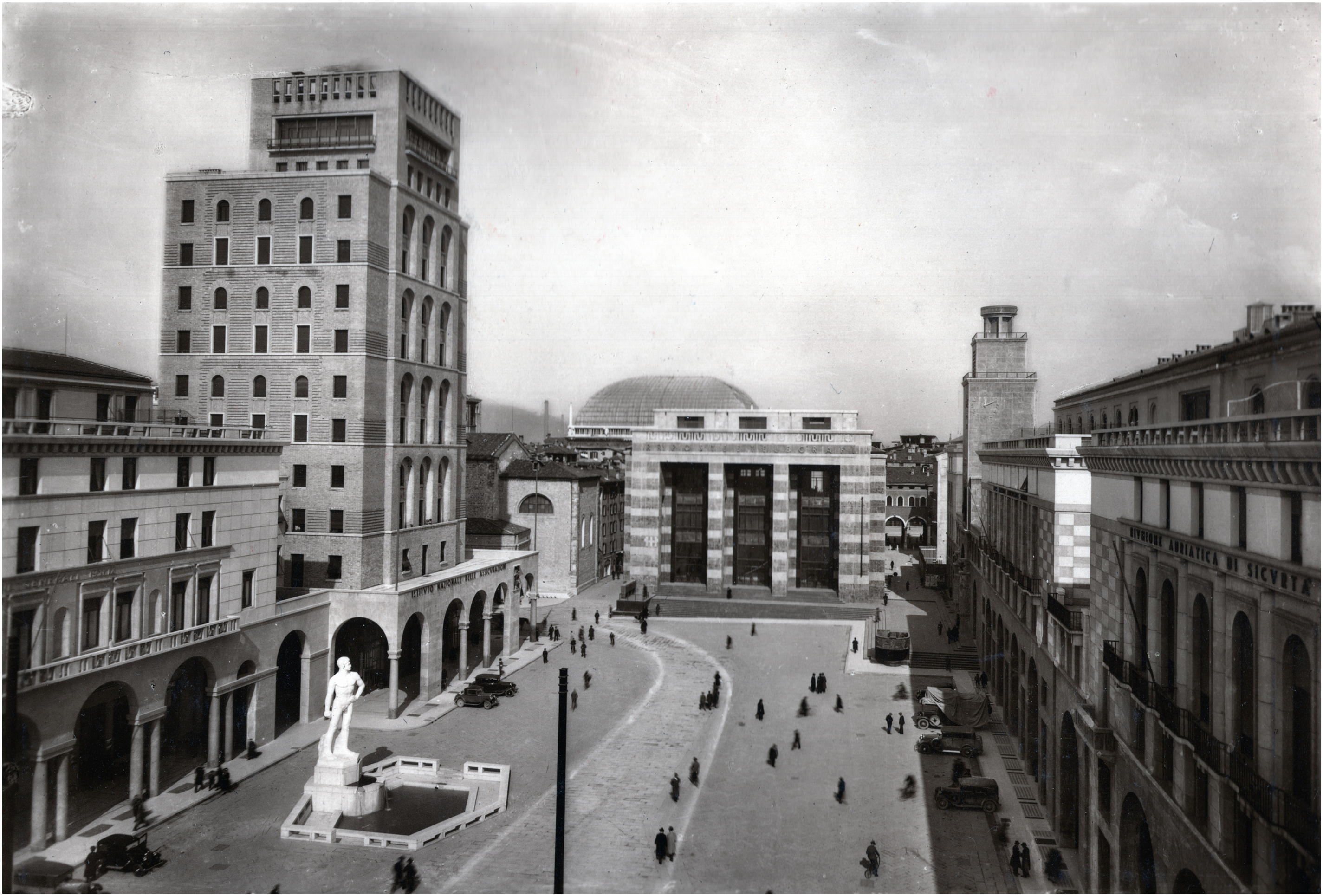
Piazza Vittoria, Brescia, 1935.
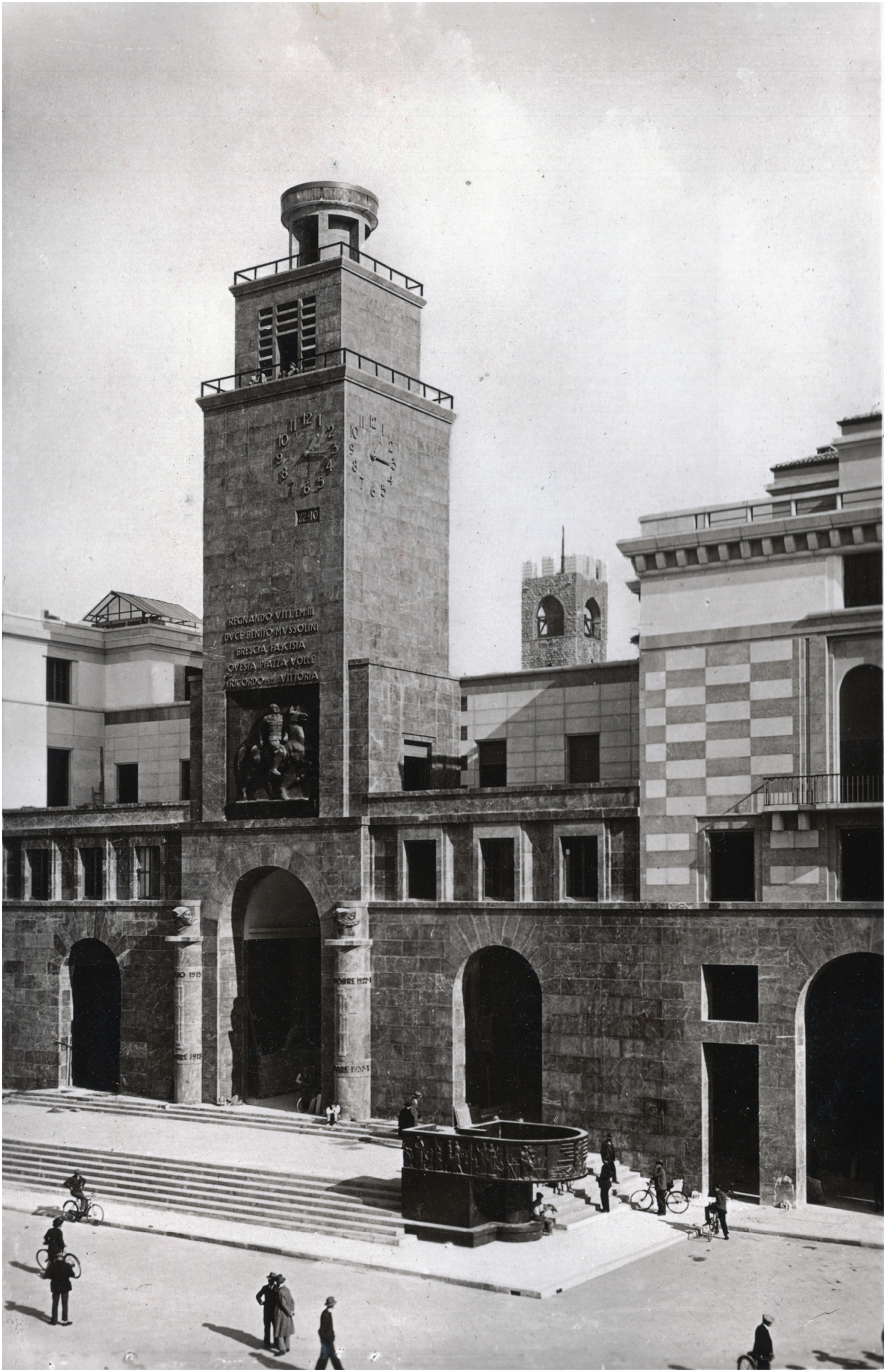
Torre della Rivoluzione and arengario, Piazza Vittoria, 1935.
From a practical urban planning perspective, Piazza Vittoria (Figure 1) was central to the city council's ambition to open up the centro storico to human and vehicular traffic. As designed by Piacentini, ‘the most prominent architect of Mussolini's regime’, the square would replace the tangle of streets and alleys of the medieval quartiere pescherie (fishmongers district). 23 This would improve pedestrian access to the other main central piazze (piazza della Loggia, piazza del Duomo, and piazza del Mercato) and, in conjunction with planned major road projects around the square, facilitate north–south and east–west traffic flows through the city. Rather than act as an intersection itself, however, the piazza would function as the ‘pivot’ for the new arterial roads, which would go around the square, touching but not crossing it. In this way Piazza Vittoria would have, in Piacentini's words, ‘the double character of a piazza of movement and of rest, next to and fueled by the traffic, but away from the tumultuous currents of vehicles and equipped with tranquil spaces where people can meet and take a break’. 24
Practical considerations aside, local Fascist hierarchs regarded Piazza Vittoria as an opportunity ‘to stamp a fascist mark on the city and construct in its centre a forum that represented the Mussolinian age’. 25 Kallis has described how Fascist demolitions in central Rome ‘targeted humble old constructions that were deemed “unworthy” of the city's past … [and] literally stood in the way of a closer (spatial and symbolic) rapport between the Fascist present/future and the city's cherished, idealized past’. 26 The same was true in Brescia. The fishmongers quarter was condemned as ‘squalid and unhealthy’, a ‘gangrenous boil’ in the middle of an otherwise flourishing city, whose inhabitants lived in ‘filthy houses’ in conditions of ‘hygienic and moral degradation, squalor and decadence’. Its demolition, involving the destruction of 167 residential buildings and 250 shops and stores over a two-hectare area, was a necessary ‘surgical action’; an act of ‘liberation’, not just of the centre's most important piazze but of the very earth itself. 27
With the demolition of the fishmongers district, it was possible to impose a ‘radically new [urban] chronotope’ on the historic centre. 28 Piacentini's Roman forum-style square sat at the heart of the re-systemized centro storico, bounded to the north by the Venetian-era piazza della Loggia, the heart of local government; to the east by piazza del Duomo, the city's religious core, built between the twelfth and early nineteenth century; and to the south by the Renaissance-Baroque piazza del Mercato, Brescia's central market. 29 Moreover, its main buildings, the Palazzo delle Poste (post office), the Torre della Rivoluzione (Tower of the Revolution), and the Torrione (large tower), echoed those of the surrounding area. The Palazzo delle Poste's imposing size, columns, and orientation (facing down the length of the square) suggested the nearby Palazzo della Loggia. The Torre della Rivoluzione's position replicated that of the Torre del Pegol in piazza del Duomo. The brick-finish and style of the Torrione simulated the thirteenth-century Torre di Porta Bruciata, which guarded the northeastern entry to piazza della Loggia.
While Piazza Vittoria represented a synthesis of familiar local architectural features and forms intended to harmonize and connect with its historical surroundings, it was also unmistakably modern. As Piacentini explained: ‘I have tried to recompose the city's features with clear characteristics that denote our age and our artistic aspirations’. 30 The Torrione was Europe's tallest residential high-rise and the first in Italy to be built from reinforced concrete. 31 The stripped classicism of the Tower of the Revolution was architecturally alla moda. The Palazzo delle Poste was a state-of-the-art communications hub. Beyond the post office, the other main occupants of the piazza – the Istituto Nazionale delle Assicurazioni, Banca Commerciale Italiana, Assicurazione Generale, and Riunione Adriatica di Sicurtà – emphasized the contemporary, national face of Fascist-era finance and commerce, a world away from the micro-local economy of the fishmongers district.
In its combination of modernity and tradition, Piazza Vittoria exemplified the kind of fascist architectural ‘rooted modernism’ described by Roger Griffin: [A] hybrid … that embodies the ethos of a regime that sees itself as pioneering a new society and opening up a new future for its people, while simultaneously maintaining its continuity with, and rootedness in, the unique, ‘eternal’ genius of the nation as manifested in its cultural past.
32
Second, the square reflected Fascism's totalitarian ambitions, imposing order, discipline and control on a once chaotic urban landscape. Beginning with its inauguration by Mussolini on 1 November 1932, when tens of thousands of bresciani packed the square to catch a glimpse of the Duce, Piazza Vittoria also provided Fascism with a bespoke stage on which to perform its rituals, parades, and public spectacles, simultaneously demonstrating its public power (monopolization of space) and its intent to remake ‘the patterns of civic life and community’ in the city (control of time). 35 Such occasions, which included regular calendar celebrations (Italy's entry into the First World War, the birth of Rome, etc.) and special events (e.g. the proclamation of Empire, May 1936; the return of Fascist volunteer fighters from East Africa, August 1936) were also opportunities for Fascist self-representation through accompanying press reports, films and photographs. 36
Third, the piazza's name – Victory – allowed the regime to celebrate Italy's triumph in the First World War and Fascism's own blackshirt ‘revolution’. The war was physically commemorated in the square by the inclusion of the ‘rock of Adamello’, a boulder from the alpine Adamello massif 150 kilometres north of Brescia, which had witnessed considerable fighting during the conflict. The rock, said to resemble Mount Adamello, had been relocated to the piazza on the initiative of the Brescian branch of the National Association of War Wounded, an organization closely linked to the dictatorship. Fascism's victory was celebrated in the Tower of the Revolution (Figure 2). The tower featured a 4 × 4 metre bronze relief of Mussolini on horseback by Romano Romanelli. Large fasci littori adorned columns on either side of the entrance to the quadriporticus below. The two victories – the War and the Revolution – were brought together with different sets of dates above and beneath each fascio: 24 May 1915 and 4 November 1918 (Italy's entry into the First World War; Austria–Hungary's surrender), and 23 March 1919 and 28 October 1922 (the foundation of the Fasci di Combattimento; the March on Rome).
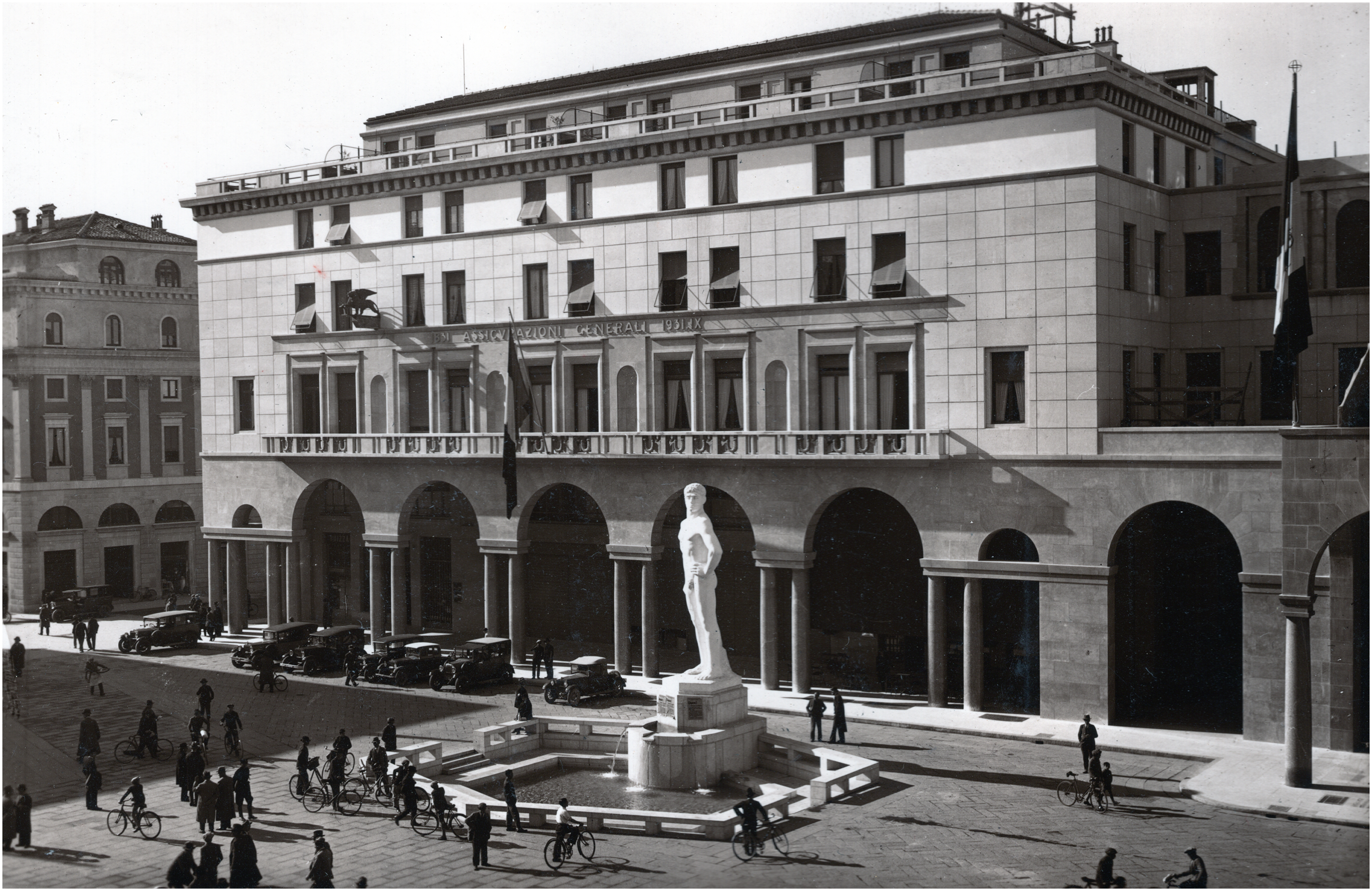
‘L’Era Fascista’, Piazza Vittoria, 1935.
Finally, there were the piazza's main decorative-representational elements. Besides Romanelli's relief, two examples stand out: Antonio Maraini's ‘History of Brescia’ on the arengario (pulpit) in the square's northeastern corner (Figure 2) and Dazzi's ‘L’Era Fascista’ diagonally opposite (Figure 3). Maraini's ‘History’ told the story of Brescia from Roman times to Fascism through nine stone panels. The final three, depicting the Risorgimento (Brescia's famous ‘Ten Days’ revolt against Austrian rule in 1849), the First World War (Adamello) and Fascism (youth saluting Fascist leaders), were conceived by Maraini as a triptych on the ‘modern history and life of the city’. Maraini also explicitly referenced Fascism's connection to ancient Rome: the Fascist capo in the last panel and the Roman legionary in the first (Brixia Colonia Augusta Civica) were shown each with a hand resting on a shared fascio. 37
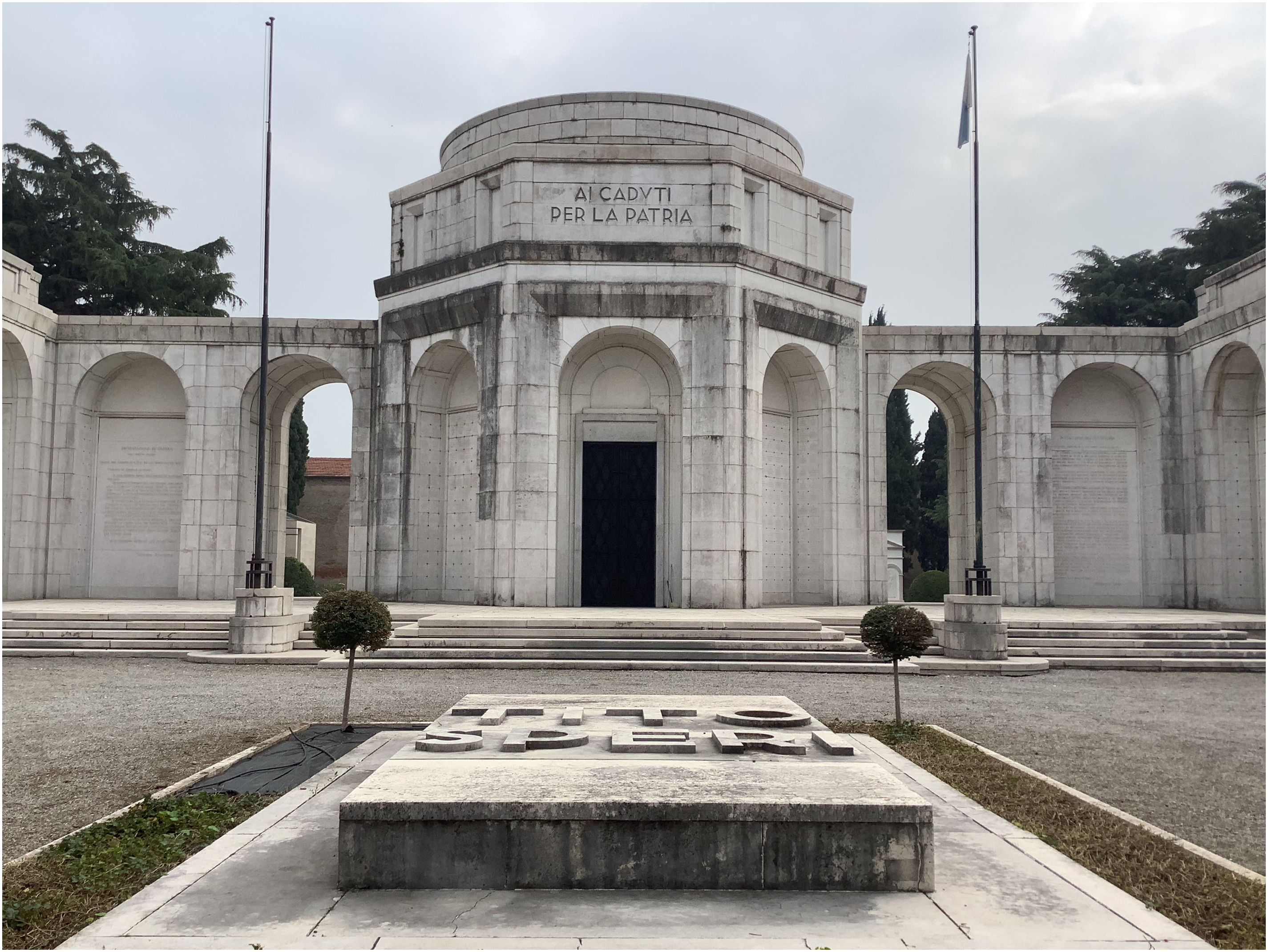
Ossuary, Vantiniano cemetery, Brescia.
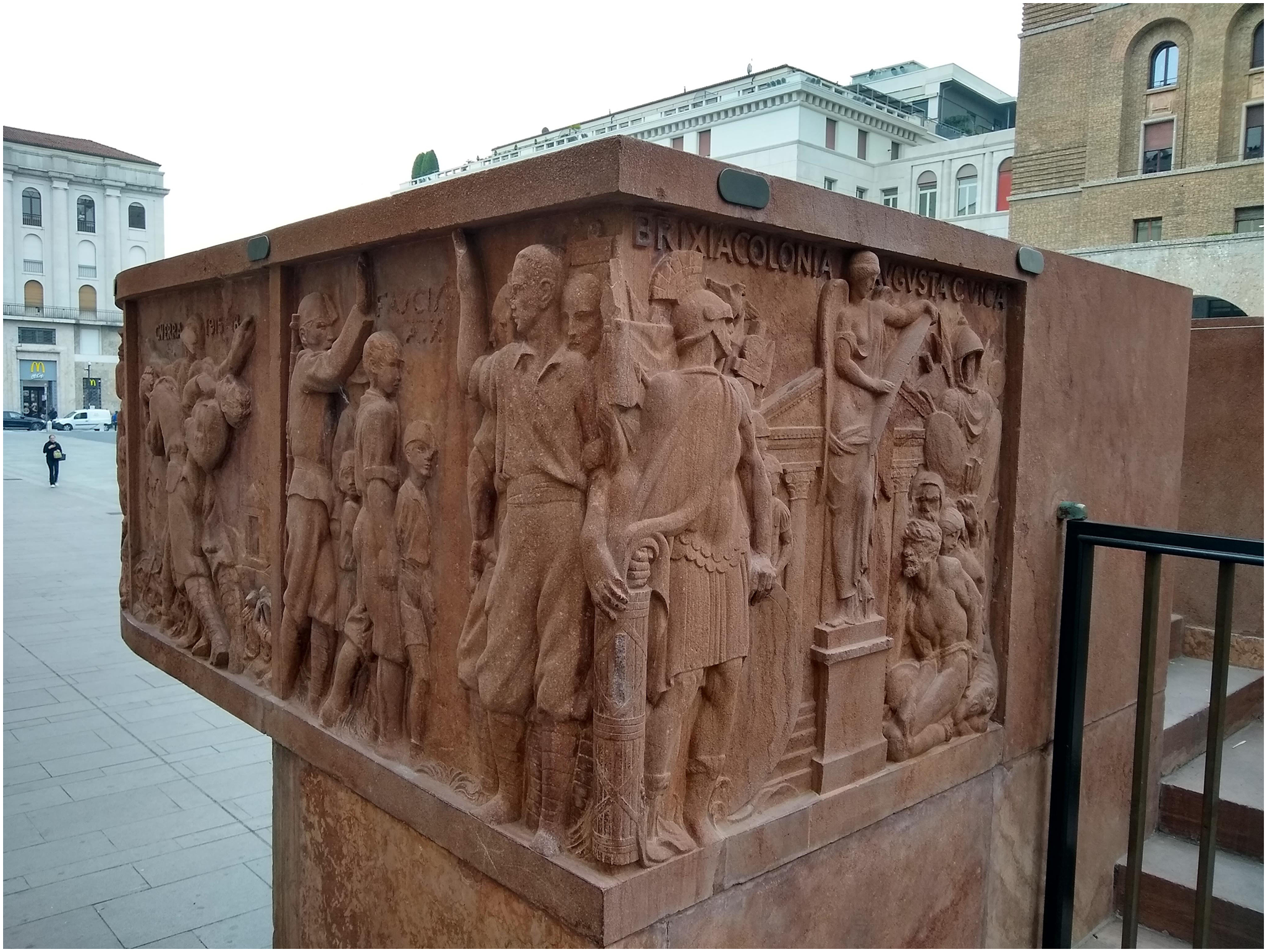
Arengario, Piazza Vittoria.
Dazzi's statue, while less obviously political than Maraini's (or Romanelli's) work, was still easily readable in Fascist terms. Its gigantic size, its dominant position in the piazza, and its representation of ‘a virile young man, fully developed, firmly planted on its feet, leaning in self-confident pride towards the future’, all alluded to the power and dynamism of Fascism a decade on from the March on Rome. 38 (That the statue looked across the square to the Tower of the Revolution was also surely deliberate.) Mussolini himself left no room for doubt as to the statue's meaning, christening it ‘L’Era Fascista’ in September 1932 before doubling down on the name in his address in Piazza Vittoria on 1 November (‘It is strong and truly represents the Fascist Era’). Even the statue's modern yet classical form carried symbolic weight, speaking to the supposed correlation between the Fascist present and ancient Roman past.
Turning to Prati's monument-ossuary to the fallen of the First World War (Figure 4), this formed part of an ambitious Fascist project from the late 1920s to exhume the remains of over 300,000 Italian soldiers from hundreds of small civilian cemeteries on or close to the former frontline and re-inter them in nearby, specially constructed, memorials. While practical and economic reasons (ease of access and cost of upkeep) were used to justify the extraordinary intervention, ‘the primary motivations were political’. 39 The 36 ossuaries eventually built under the programme varied enormously in their design and ranged from the relatively small (such as Prati's, which held the remains of 3200 war dead) to the enormous (the largest, Redipuglia, contained the remains of over 100,000 soldiers), but they served the same ends: to recast Italian memory of the First World War as a glorious and quintessentially Fascist war and to reframe the fallen as ‘“martyrs” of the fatherland’, to be venerated and emulated rather than mourned. 40 Through the ossuaries, the regime ‘monopolised the right to pay homage to the fallen and brought remembrance under the control of the state’. 41
Most ossuaries were built ex nihilo along the former front and were the sole responsibility of a military commission. However, the commission sometimes partnered with municipal governments to co-fund the construction of ossuaries in existing civilian cemeteries. This was the case with Prati's, designed and constructed by the municipality (Prati worked in the town council's technical office) at a shared cost of 1.1 m lire.
The need for the monument to blend with its surroundings in the Vantiniano and the commission's requirement that all identified remains be entombed individually and above ground constrained Prati's design choices. Unable to build above the height of existing structures, Prati opted for a central hexagonal chapel flanked by two L-shaped wings. The remains of the fallen, exhumed from 54 cemeteries, were either re-interred in niches located within the chapel or in one of 19 external alcoves. 42 Decorative and ornamental elements were minimized: for Prati, the monument's ‘robust, clear, sober architecture based on a feeling of solemnity’, was intended to speak for itself. Fasci littori were nonetheless ‘expressed architecturally’ on either side of the chapel entrance to remind visitors of the monument's provenance and ‘spirit of our times’. 43
The monument-ossuary also doubled as an important ritual-performative space under Fascism, primarily as the location of the annual November celebration of Victory in 1918, at which both the fallen in war and the martyrs of the Fascist revolution were honoured as the ‘finest sons’ of the Italian national family. 44 The monument also served to link Fascism to the Risorgimento. In April 1933, for example, anniversary celebrations of the Ten Days culminated with a procession to the Vantiniano, where votive wreaths were placed at the tomb of the dead of 1849, at the recently completed ossuary, and on the tombs of Fascist martyrs. 45 The Fascists’ insistence on the connection between the fallen of 1849, the First World War and the Fascist revolution was underscored in April 1939, on the 90th anniversary of the Ten Days. With great ceremony, the ashes of Tito Speri, the revolt's executed leader, were re-buried in a new, monumental, sarcophagus in front of the ossuary. A platoon of armed Fascist youth rendered honours. When the lid of the sarcophagus was closed, ‘those present stood to attention in the Roman salute’. 46
If our sites were understood and packaged by the regime as ‘Fascist’, what about after Fascism? Piazza Vittoria was quickly cleansed of most of its Fascist commemorative and decorative elements after liberation: Romanelli's ‘Mussolini a cavallo’ (and an accompanying inscription referencing the Duce and ‘Fascist Brescia’) was removed from the Tower of the Revolution; the fasci littori and commemorative dates were expunged from the entrance to the quadriporticus (as were fasci from the Palazzo delle Poste); and Dazzi's ‘L’Era Fascista’ was dismantled. While the final panel of Maraini's ‘History’ on the arengario remained, it did so in mutilated form: the inscription ‘Fascismo A[nno] X’ was chiselled off and the axe head cut from the fascio littorio (Figure 5). The panel was also concealed behind a ‘thin wall’ for many years, although whether this represented an act of damnatio memoriae or simply an attempt to protect the panel (and thus the larger artwork of which it was a part) from further degradation is unclear. 47 The rock of Adamello survived as a First World War memorial, an event that predated and could be separated from Fascism. Piazza Vittoria itself was renamed piazza Martiri della Libertà (martyrs of freedom) as the new local administration sought to unpick and remake Brescia's symbolic landscape. 48 The name, however, failed to take root and the piazza soon reverted to its original moniker. If ‘Victory’ retained a double meaning postwar, it connoted victory in the Great War and victory over Fascism.
Shorn of its Fascist markers, Piacentini's determination that Piazza Vittoria should appear ‘almost naturally inserted in the general picture’, meant there was little about the square, beyond its intimidating monumentalism, which could be read ideologically. 49 No building, bar the Tower of the Revolution, bore much resemblance to the aesthetics of the stile littorio that dominated late-era Fascist architecture and which became synonymous with the regime after 1945. Furthermore, much of Piazza Vittoria's political significance under Fascism had derived from its use as a ritual and performative space by the Fascists themselves. (And even then the square carried other associations for bresciani beyond Fascism, from the Mille Miglia to the familial passeggiata. The piazza reflected the regime's totalitarian ambitions, but it was also a place of leisure and repose.) Postwar, without Fascism to fill it, literally or figuratively, the square rapidly lost much of its original political charge.
Since 1945, it has not been Piazza Vittoria's connections to Fascism that have preoccupied bresciani so much as issues around its utilization, value and viability as a public space and commercial centre in a changing urban context. As with other large city centre piazze across Italy, the square's predominantly pedestrian character was quickly sacrificed to the needs of motorists and public transport. By the early 1950s, it was a chaotic mix of busy thoroughfare, car park and bus station; a ‘true Babel’ according to one critic. 50 Parking and traffic flow in the square were systematized and the bus station was removed in the 1960s: postcards show a large and overflowing central parking zone with smaller parking areas at either end of the piazza; two marked pedestrian crossings are also visible. 51 Growing concerns about chronic congestion, a shortage of parking and the poor pedestrian experience across the centro storico, prompted a further, fundamental, reshaping of the piazza in the early 1970s, with the construction of an underground carpark. However, despite city council assurances that this would end above-ground parking – part of its commitment to recreating ‘pedestrian islands [in the centre], unpolluted by exhaust fumes’ – this did not eventuate. 52 The square's architectonic integrity was also seriously compromised by the insertion of an enormous ventilation grille for the new carpark along its central axis (Figure 6).
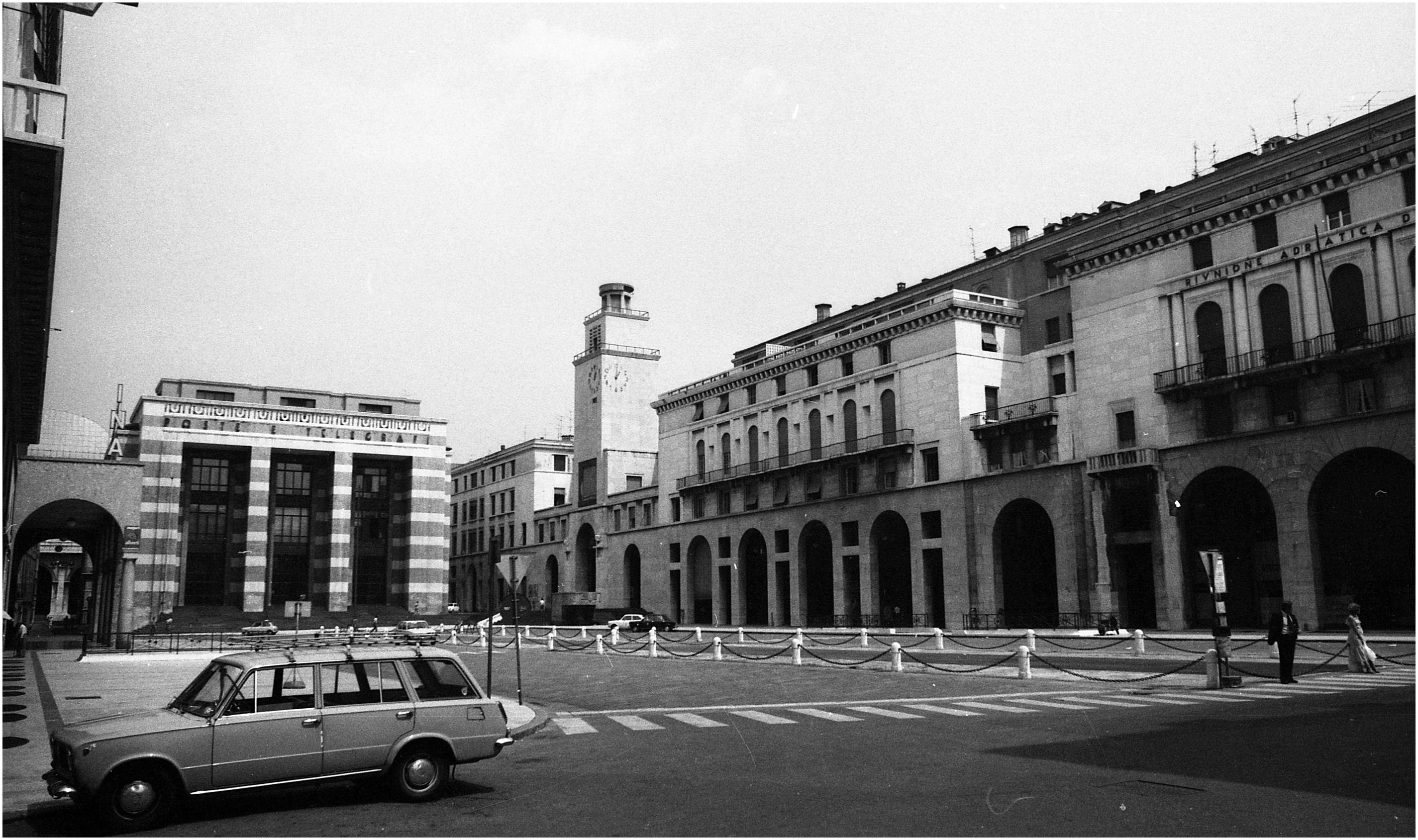
Piazza Vittoria in the late 1970s.
By the mid-1980s, Piazza Vittoria was said to be in a state of ‘progressive degradation’ due to ‘reduced pedestrian use … [and] a notable fall in the level of commercial activity’. 53 While its problems were to a degree a microcosm of problems affecting the entire historic centre – to those already listed we can add a precipitous fall in population as Brescians migrated to the suburbs – the square was considered the most vulnerable of the main piazze. 54 Piazza della Loggia, piazza del Duomo, and piazza del Mercato had defined identities and roles; Piazza Vittoria was an ‘unpopular and rarely visited … blank island’. 55 Nor was this considered a new problem: for one reason or another, and despite its continued use after 1945 as an events space, it had ‘never [become] the central fulcrum of the city or captured the collective imagination’. 56
Faced with these challenges, in 1986, the city council commissioned the architect Giorgio Lombardi to develop a plan for its revival as part of a general ‘recuperation’ of the historic centre. Lombardi's proposals, published in 1988, aimed to relaunch the square as a ‘forum of collective functions’ and a ‘place of the modern’. 57 Central to Lombardi's design was the replacement of the ventilation grille with an elongated water basin five metres below the surface of the square, flanked by two open galleries. Accessible from the piazza, the galleries would be bordered by glass ‘walls’ revealing a new public exhibition space – possibly a museum of the Mille Miglia – on the first level of the underground carpark. Lombardi also envisaged the construction of a modern glass and steel café-bar within the quadriporticus and the return of public sculpture. 58 The plan, however, was soon shelved. 59
The piazza's eventual restoration and resystemization in 2012–2013 coincided with the completion of the Vittoria underground station stop on the new Brescia metro, first mooted in the late 1980s as a solution to congestion and as a way to bring pedestrians back to the centre. By this point, the square was reportedly in a critical state, not helped by years of disruption caused by much-delayed, metro-related, construction works. In late 2011, on the eve of the council's confirmation of the redevelopment, the Corriere della Sera described the square's atmosphere as one of ‘fear and decay’. In addition to dozens of closed shops and empty offices, the ‘abandoned’ piazza had become a nighttime magnet for graffiti artists and vandals, petty criminals, drug addicts, alcoholics, and the homeless. 60 A March 2012 article compared the experience of walking through Piazza Vittoria on a Sunday to ‘like being in the depressed periphery of a Balkan city’. 61
Begun by a centre-right/right-wing coalition and completed under a centre-left administration, the redevelopment works proved transformational: the area was completely repaved and cleaned of graffiti, the unsightly grille was replaced and a new version of the original fountain, dismantled postwar, was added. Crucially, traffic was banned. ‘Citizens and families must be able to meet here’, Mayor Emilio del Bono announced at the square's reopening (December 2013), ‘We will organize initiatives to bring it to life’. 62
Despite Covid's catastrophic impact on Brescia, there has been a notable change in the narrative around Piazza Vittoria since its riqualificazione and the arrival of the light rail. ‘The heart of new Brescia’, it has become a cultural hub, hosting public artworks by leading Italian and local sculptors including Mimmo Paladino and Stefano Bombardieri. 63 It has also re-established itself as an events space, whether as the starting point of the Mille Miglia (now a time trial event for historic cars) and Brescia Pride's July parade, or as the site of book fairs, markets, concerts, festivals, fun runs, and demonstrations. Major retailers have moved into renovated and restyled premises around the square, while monuments such as the rock of Adamello and arengario have been restored. Restoration work on the Torrione began in 2021, the first since its construction.
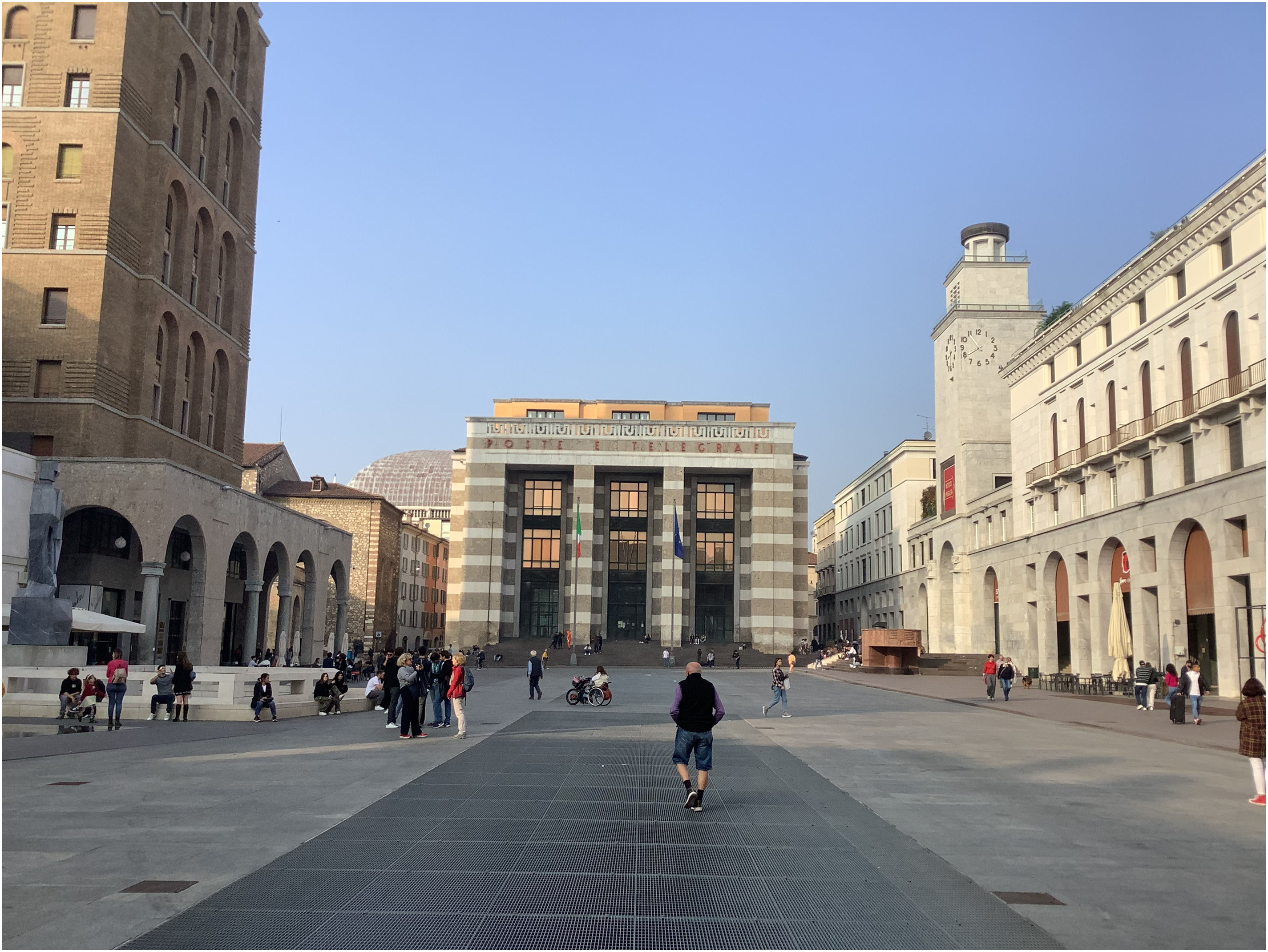
Piazza Vittoria, 2022.
Piazza Vittoria's postwar history, then, is less a story of negotiating ‘difficult heritage’ than one of poor urban planning and decline followed by belated renewal (Figure 7). However, this does not mean bresciani have ‘simply looked the other way’ when it comes to the piazza's origins. At its reopening in 2013, for example, Del Bono acknowledged it had been ‘born during the period of Fascism’. 64 Similarly, Bresciatourism's website informs visitors that the square ‘was inaugurated in 1932 according to the new Fascist urban plan’. 65 In comparison with descriptions and discussions of Roman Fascist architecture, such explicit reference to Fascism is striking: the ‘‘F’ word’ is rarely invoked in the Roman context, where sites and buildings once closely linked to Fascism are often simply said to have been constructed in a particular year or decade, or in the interwar period. 66 Furthermore, while Piazza Vittoria's architectural–historical stock has risen considerably in recent decades – once considered ‘an ugly and useless piazza [that] continues to corrupt [Brescia's] entire urban fabric’, it is now regarded as ‘one of the most coherent realizations of the ventennio and of classicist rationalism’ – revisionism has not been at the expense of critical or local historical memory. 67 In September–October 2017, for example, the Associazione Artisti Bresciani (AAB) organized a series of public talks on different aspects of the square's past. This included presentations on the former fishmongers district and, by local high school students, on the 2400 bresciani displaced by Piacentini's demolitions and forced into makeshift barracks on the city's periphery. Students from another high school subsequently curated two public exhibitions on the fishmongers quarter and Piazza Vittoria. 68
Place and recent history are key to explaining why bresciani have acknowledged the piazza's origins under Fascism. First, Brescia's wartime experience reinforced its strong civic self-identity as a resistance city: ‘the lioness of Italy’, a soubriquet dating to the Ten Days. Brescia was an important centre of the partisan struggle against Nazi-Fascism, 1943–1945, officially recognized in 1952 when the city was awarded the Silver Medal for Military Valour. Critically for postwar memory, the local resistance was not limited to or dominated by one political faction: catholic, socialist, and communist brigades were all active. It was also a popular movement replete with local heroes and martyrs: there were an estimated 5074 Brescian partisans; 629 died in action or Nazi–Fascist reprisals. 69 The historical reality of the Brescian resistance and the postwar preservation of its memory and values by active and influential local partisan associations from across the political spectrum has meant that the ‘Resistance myth’ still resonates, despite the efforts of the ‘new’ right since the early 1990s to delegitimize anti-Fascism. Second, there is the memory of the May 1974 neo-Fascist bombing of an anti-Fascist demonstration in piazza della Loggia, which killed eight and injured 102. The strage is marked annually with a well-attended official ceremony in the square but there is also an active association, the Casa della Memoria (House of Memory) established in 2000, ‘to keep alive the memory of the tragic events that occurred’. 70 In 2014, on the 40th anniversary of the massacre, the Casa inaugurated a ‘path of memory’ running from piazza della Loggia to Brescia castle: the percorso is marked by over 430 pavement plaques, each commemorating an Italian victim of terrorism; the first eight remember the dead of the 1974 attack. 71 The memory of May 1974 has also been reinforced through the repeated failure of judicial investigations stretching over 40 years to secure a conviction. Only in 2015 were two former members of the neo-Fascist Ordine Nuovo movement sentenced to life imprisonment for their part in the atrocity. This is the context in which Brescia has acknowledged Piazza Vittoria's debt to Fascism.
Resistance memory and memory of the 1974 bombing have also played important roles in the contemporary ‘Bigio sì o no?’ debate in Brescia: whether to return Dazzi's statue to Piazza Vittoria. The current controversy has its origins in Adriano Paroli's mayoral election victory in April 2008, the first time since the collapse of the ‘First Republic’ that a ‘new’ right candidate had been elected to Brescia's top office. Paroli's administration initially promised to bring back the Bigio, after ‘decades of oblivion, historical–political controversy, bureaucratic obstacles’, within a matter of months. 72 It was not until August 2012, though, that plans were finally approved. The decision was immediately denounced by the local Catholic partisan Associazione ‘Fiamme Verdi’ and the Brescian branch of the National Association of Italian Partisans (ANPI). In a joint press statement and petition, the associations attacked the Bigio as a ‘symbol of the strength and violence of the [Fascist] regime’, and as ‘an ugly statue, of no artistic value’. Its restoration and return, they warned, would be a ‘useless expense’ and lead to a ‘nostalgic and instrumental revival’ of Fascist ideology in a city whose recent civic identity and memory had been forged by the anti-Fascist struggle for liberation and the 1974 massacre. 73
In the months preceding the May–June 2013 mayoral election, the associations campaigned relentlessly against the Bigio's return, gathering nearly 3000 petition signatures, arranging public meetings, organizing a ‘flash mob’ in Piazza Vittoria, drumming up local, national, and foreign media interest and, in early April, forcing a ‘white-hot debate’ and vote in council. 74 ‘The ANPI doesn’t want to see [the Bigio] back where it stood’, the branch president told the Guardian newspaper at the time of the vote, ‘because it brings back all the memories of the Fascist regime and the oppression the country suffered’. 75 Broadening their original line of attack, the associations also argued that such a move would be provocative and offensive given the statue's proximity to piazza della Loggia and to recently installed pietre d’inciampo (stumbling stones) in front of the Torrione, commemorating Holocaust victims Guido and Alberto Dalla Volta. 76 Other local custodians of anti-Fascist memory, including the president of the Casa della Memoria (whose wife died in the 1974 bomb blast), concurred. 77
Although the partisan associations lost the April vote and the council initially declared that the now restored statue would return to Piazza Vittoria before Liberation Day (25 April), Paroli soon rowed back on the plan, announcing that the Bigio would remain in storage until after the election. 78 Paroli's defeat and the return to power of the centre-left, which had opposed the Bigio's return, ultimately ensured Piazza Vittoria would remain ‘Bigio-free’, at least for the time being.
If local conditions and context help explain why the Bigio didn’t return to Piazza Vittoria in 2013, national trends of the kind outlined in the introduction point to why the idea was first entertained. The Paroli administration's commitment to the project was of a piece with the ‘new’ right's efforts to overturn traditional anti-Fascist historical memory. Reclaiming public space was a small but important element of this. In some FI- and AN-controlled areas of Italy, streets, squares, and parks were renamed after Fascists (and neo-Fascists), new plaques commemorating Fascist-era events or individual Fascists were erected and old plaques and inscriptions restored. In one notable case, in 2012, the AN mayor of Affile in Lazio funded the construction of a mausoleum for the Fascist military leader and alleged war criminal Rodolfo Graziani. 79 The justificatory narratives used by local leaders typically stressed the same points: these were not ideological acts but rather a sign of a new calmness within Italy; Fascism was now history rather than politics, to be viewed without prejudice or fear.
The Paroli council used similar language in its defence of the Bigio. According to Andrea Arcai, AN councillor for culture, Dazzi's statue was an ‘expressive symbol of [Italy's] youthful and victorious tenacity and energy’ in the Great War, which had been allowed to fall into the ‘grinder of vendetta’ after 1945. For over half a century, Arcai argued, the ‘spiteful stubbornness of an unyielding political party’ had maintained ‘dangerous ideological barriers, recurrently expressed in new tragedies signed by Italian terrorism, instead of ending grudges, blame, credits and debits in a collective welding’. Bresciani, though, no longer wanted to ‘linger on worn out divisions’: the return of the Bigio's ‘youthful vigorous optimism’ to Piazza Vittoria would unite citizens, just ‘as the trenches of Adamello unite’. For Mario Labolani, AN councillor with responsibility for the development of the historic centre and the driving force behind the Bigio's return, bringing back the statue would be an indication of Brescia's new ‘historical and social maturity’, rather than ‘fertile terrain for a facile and simplistic political reading, far from artistic and contemporary cultural analyses’. 80
The claim that there was nothing ideological or political in the commitment of ‘new’ right politicians to the return of the Bigio was often difficult to sustain. Labolani, for example, was a former militant in the Movimento Sociale Italiano, the neo-Fascist predecessor of the AN. Proud of his political roots (‘For me, “neofascist” isn’t an insult’), it was Labolani who after the April 2013 council vote had provocatively announced that the statue would be reinstalled in Piazza Vittoria before Liberation Day. 81 Since Bigio's non-reappearance in 2013, all local political groupings of the right/far right have pressed for its return.
The Bigio controversy, though, is more than simply a reflection of Italy's memory wars over Fascism/anti-Fascism and the related ‘struggle over what histories and whose identities can be recognized or ignored in and through the official city-text’. 82 The proposal to return the Bigio to Piazza Vittoria is also indicative of the depoliticization and ‘heritagization’ of regime art (and architecture) in recent decades. We see this reflected in the Brescian soprintendenza's support since 2008 for the return of the Bigio, ‘as it was, where it was’. For the soprintendenza, the Bigio's release from its warehouse home was necessary because Dazzi was an important twentieth-century Italian artist: the Bigio might be ‘ugly’ and ‘clumsy’, but it had to be seen. The Bigio's return to Piazza Vittoria was essential because of its ‘dialectical relationship’ with the square and surrounding buildings: it belonged in and completed the space. An added advantage, from the soprintendenza's perspective, was that its height and bulk would draw attention away from the underground carpark's ‘disfiguring’ entrance at the square's southern end. As to the statue's ‘fascistness’, the soprintendenza was unconvinced: while a ‘celebrative monument’, stylistically there was nothing specifically or peculiarly ‘Fascist’ about it. In fact, in its representation of ‘beautiful youth’ – the Hellenic ideal of the young male – it followed in the footsteps of works by some of the greatest artists of the Renaissance. Given the controversy around the statue, the soprintendenza was prepared to make one concession: the addition of a plaque with the inscription ‘“L’Era Fascista” defeated by republican democracy’. Otherwise, people could ‘read’ the statue as they wished. 83
Monuments usually ‘evolve over time; they “become” rather than “exist”’. 84 The meanings and values attached to the Bigio, though, have remained remarkably constant. For example, the arguments used by the partisans’ associations and centre-left in recent years echo those of the Resistance at the end of the Second World War. In May 1945, the socialist partisan and Comitato di Liberazione Nazionale (CLN)-appointed mayor of Brescia, Guglielmo Ghislandi, had announced he would get rid of the ‘filthy creature’. 85 In July 1945, unknown assailants attempted to blow up the Bigio, succeeding only in breaking a leg and an arm and removing the metal vine leaf covering its genitals. The Giornale di Brescia, the local mouthpiece of the CLN, responded by urging patience: ‘We all agree that the colossus of piazza Martiri della libertà must disappear: first, because it is an ugly statue without remedy; second, because it is right that it should go if it is true that it represents, as was said, the Fascist era’. 86 In September 1945, a cross-party council of ex-partisans took the formal decision to remove the damaged ‘mediocre work of art’, despite the considerable cost involved and while the city was confronted with the enormous task of reconstruction. 87 After the Bigio's removal, the council resolved to replace the ‘symbol of the bygone Fascist era’ with an obelisk or stele in memory of the partisans who had ‘fallen for freedom’. 88 In early 1946, Ghislandi proposed selling the statue, on the condition that it never return to Brescia, describing it as a ‘representation of a person of massive and brutal strength … a symbol, that is, of the Fascist era’. 89 (Neither the memorial nor the sale happened.)
The ‘new’ right's and soprintendenza's arguments in favour of the Bigio's return also have earlier antecedents. For example, the 1945 council resolution to replace the Bigio with a memorial to the Resistance acknowledged that the ‘marble block’ had played a ‘not insignificant role in the architectural ensemble of the city centre’. In 1953, an article in the local magazine Terra Nostra challenged the ongoing exile of the ‘big white baby’ on the grounds that ‘this statue, not a contemptible work by Dazzi, paid for with city money, doesn’t represent anything political. It represented a young man, an athlete’. 90 In the early 1970s, the architect behind Piazza Vittoria's underground carpark recommended the Bigio's return as part of the square's redevelopment. Likewise, Lombardi's 1988 plans envisaged the Bigio back in the piazza, albeit in a different position. 91
How do we explain the Bigio's biographical stasis? The answer may lie in its lack of clear Fascist markers. On the one hand, this has always allowed the Bigio's supporters to claim it as ‘just’ art. On the other hand, and perhaps counter-intuitively, the absence of such signifiers has prevented its opponents from making peace with the statue. In 1945, the Bigio could not be de-fascistized in the same way as other more obviously Fascist monuments often were. In the Foce quarter of Genoa, for example, Antonio Maria Morera's 1938 statue, the ‘Navigatore’, a work analogous to Dazzi's in terms of its muscular, virile, representation of Fascist male youth, remained in situ following the removal of fasci and Fascist inscriptions from the surrounding arch and pedestal. Since then the Navigator has ‘become’ something very different to its original conception: a monument to the city's long association with the sea rather than a bellicose statement of Fascism's ambitions in the Mediterranean (the inscription on the pedestal had read ‘The youth of the Littorio make all seas our sea’). 92
Unable to defascistize the Bigio, but convinced of its ‘fascistness’, the victorious partisans removed it. 93 Once in storage, though, the statue could only ‘exist’. Consequently, for the partisan associations, the Bigio has remained inherently and irremediably Fascist. Moreover, the Bigio's removal was understood at the time and since as an important symbolic political act, as a very public statement of the Resistance's victory over Fascism. Any proposal for the statue's return was thus bound to offend partisan memory.
At the time of writing (October 2022), the Bigio's fate remains uncertain. Since becoming mayor in 2013, Del Bono has rejected calls for its return to Piazza Vittoria, arguing that this would be divisive locally and bring unwelcome international attention to the city (‘There are no other examples in the world of a statue removed after the end of a dictatorship later being relocated and we don’t want to be pioneers’). 94 While his administration has long favoured the statue's museumization, this has been stymied by the soprintendenza (committed, as we have seen, to the Bigio's return and suspicious of initiatives that might delay or prevent this). The centre-left will contest the 2023 mayoral election without Del Bono and will undoubtedly face stiff competition from the right/far right (FI, Lega, Fratelli d’Italia). A victory for the latter would once more open the path to the Bigio's reinstatement.
In contrast to Dazzi's statue, the meanings and values attached to Prati's ossuary have accumulated and transformed over time. The ossuary was easily de-fascistized postwar by the removal of the fasci from the chapel entrance and the erasure of the construction date (expressed according to the Christian and Fascist calendars) from above the chapel door. It was also quickly incorporated into the remembrance rituals of the new anti-Fascist republic, in which commemoration of the the First World War and ‘Victory’ in 1918 remained fundamental constituents of national memory and identity. 95 Whereas Fascist rituals at the ossuary had sought to present the ‘martyrs’ of the Fascist revolution as the brothers of the fallen of the Risorgimento and the First World War, bound together by their heroic self-sacrifice ‘for the Fatherland’, now it was the dead of the anti-Fascist resistance who were portrayed as the heirs of the Ten Days and Adamello. On the anniversary of Italy's 1918 victory (4 November) in 1949, for example, wreaths were laid at the ossuary, on Speri's tomb and at the new sacrario (shrine) to the ‘Fallen for Freedom’. Liberation Day ceremonies at the Vantiniano followed a similar pattern. 96
Over time, the ossuary has also become more than simply a monument to the fallen of the Great War. First, the postwar addition of new commemorative inscriptions to those who died on the Russian front, 1941–1945, and to Brescian soldiers who died in German prison camps, 1943–1945, broadened its scope. Second, the November commemoration of the fallen of the First World War in Brescia has for many years been absorbed into a service of remembrance to the ‘fallen of all wars’, with the ceremony held at the ossuary on All Souls’ Day (2 November) – the Catholic commemoration of all the ‘faithful departed’ – rather than 4 November. Italy's 1918 victory is still celebrated on 4 November in Brescia, as it is nationally, but at a ceremony in piazza della Loggia rather than the Vantiniano. Third, the area around the ossuary has steadily acquired the character of a remembrance park for the ‘fallen’ in the fight against Fascism. This encompasses both the dead of the Resistance and the May 1974 bombing, with the latter remembered as anti-Fascist activists rather than victims of Fascism. In 1979, on the fifth anniversary of the bombing, the municipal government announced that a new memorial to the ‘fallen of the partisan struggle and of piazza della Loggia’ would be built immediately to the north of the ossuary. The triangular monument, which points directly at the ossuary, was inaugurated in 1984, on the tenth anniversary of the massacre. Further memorials to the wartime resistance and the 1974 strage have since been added. 97
Brescia demonstrates the importance of local studies if we are properly to understand the range of responses to, and experiences of, difficult Fascist heritage in Italy. Brescia's engagement with the dictatorship's remains has been profoundly shaped by local factors, notably the legacies and memories of the Resistance and the 1974 bombing. In a country such as Italy, where memory, history, and identity are deeply rooted in the local context, this is to be expected. At the same time, though, Brescian memory culture does not exist in a vacuum: national trends (‘new’ right revisionism, the ‘heritagization’ of Fascist art and architecture) have also played their part in shaping how bresciani have negotiated Fascism's remains. As Jaskot and Rosenfeld propose, it is the ‘dynamic interaction’ between the local and national that matters. 98 This being the case, we might reasonably expect future local studies of difficult Fascist heritage to reveal a wider range of experiences than has hitherto been assumed.
The Brescian case also suggests the need for historians working at the local level to consider a plurality of objects and sites. Our three ‘faces’ of Fascism in Brescia were constructed within months of each other and reflected a particular moment in the dictatorship's development. Nevertheless, bresciani have negotiated each ‘face’ very differently, for reasons already explained. Only by employing a comparative microhistorical framework at the local level has it been possible to reveal the complexity of the Brescian experience of difficult Fascist heritage.
In its approach(es) to its difficult Fascist heritage, Brescia has followed neither Rome nor Bolzano/Forlì. This does not mean, however, that bresciani are oblivious to these examples. Those who argue for the return of the Bigio, for example, often point to the uncontroversial presence of similar statues at Rome's Foro Italico. Contrastingly, the AAB's public lecture series in 2017 on Piazza Vittoria included a presentation on Forlì's efforts to ‘come to terms’ with its Fascist heritage and its leadership of the ‘ATRIUM cultural route’ (Architecture of Totalitarian Regimes of the 20th Century in Europe's Urban Memory), an initiative involving 17 towns and cities in Italy, Bulgaria, Romania, and Croatia, designed to encourage critical cultural engagement with the architecture and built heritage of European dictatorships. The Bolzano case has also been discussed locally. 99 In this sense, Brescia conforms to patterns of behaviour which extend beyond Italy: as Macdonald discovered in Nuremberg, ‘local actions are frequently negotiated through comparisons with other places, through concepts and ideas produced elsewhere … and through the sense of being judged by others’. Macdonald identified a particular ‘awareness of a potential international – and judgemental – gaze’. 100 We see this too in Brescia, notably in Del Bono's refusal to return the Bigio to Piazza Vittoria. It remains to be seen if those who follow him will be so mindful.
Footnotes
Acknowledgements
I would like to thank the anonymous reviewers of the article for their thoughtful and considerate feedback. Thanks also to Dr Claudia Baldoli and Dr Maria Paola Pasini for their help and advice during the research of the article, and to my fellow historians at Australian Catholic University for reading and commenting on early drafts.
