



Abstract
At the periphery of Portuguese right-wing authoritarian rule, in the Atlantic archipelago of the Azores and its Central Group, political repression remained part of local life in the period after the Second World War. However, in spite of the Portuguese political police being installed in Terceira (in the Central Group) in 1954, this repression remained porous, and many Azoreans used the loopholes for their own advantage. The everyday life history approach allows us to understand these strategies and challenges: it shows how individuals used the internal conflicts amongst the agents of the Portuguese state or the presence of one of the principal US American military bases of the Cold War in Terceira Island. Medical doctors played out their social prestige to defend themselves of accusations, and elites of small towns used the political police to further their own goals. In some extreme cases, profiting from the internal contradictions of the regime even meant committing some small acts of democratic choice on the local level, or mobilizing against an unpopular bishop.
Keywords
The Azores are a remarkable place to study the social history of local populations under Portuguese right-wing authoritarianism in the decades between 1926 and 1974. The islands were a hotspot of socioeconomic problems for a considerable number of their inhabitants and a place of outmigration still in the post-Second World war period; they were indeed identified as a principal area of poverty by an enquiry mission organized by the Salazar regime in 1938. 1 From 1943 onwards, the British and US American military used the islands as an important strategic place in the Atlantic. 2 The Lajes Airfield on Terceira Island became one of the principal airbases of the Cold War, but apart from its political and strategic importance, it also offered new opportunities of employment to many thousands of the islanders. 3 Especially for the Central Group of the Azores, this was a welcome addition to the most important economic sectors of dairy agriculture and, partly, fishery and the (declining) whaling industry. 4
In terms of social life, the archipelago saw the evolution of a certain type of urban society both in the nineteenth and the twentieth centuries: together with the main urban centre of Ponta Delgada, Angra do Heroísmo, the principal urban space of the central group, was equally important. Azorean elites were partly connected to the mainland: the sons of elite families studied in Coimbra, Lisbon or Porto, and some Azoreans became important Portuguese politicians.
5
In 1931, the city of Angra was also a key place of revolt against the authoritarian regime.
6
Beyond a social elite background, a two-sided connection of the archipelago with North America involved many families and both urban and rural groups of islanders. It included, first, massive Azorean migration into the United States and Canada, and subsequent contacts of that diaspora with their remaining family in the islands.
7
Second, for the Central Group in particular, the economic and cultural effects of the airbase on the local society were strong. Terceira Island in particular is therefore also an essential place to study processes of Americanization (see below Map).
8
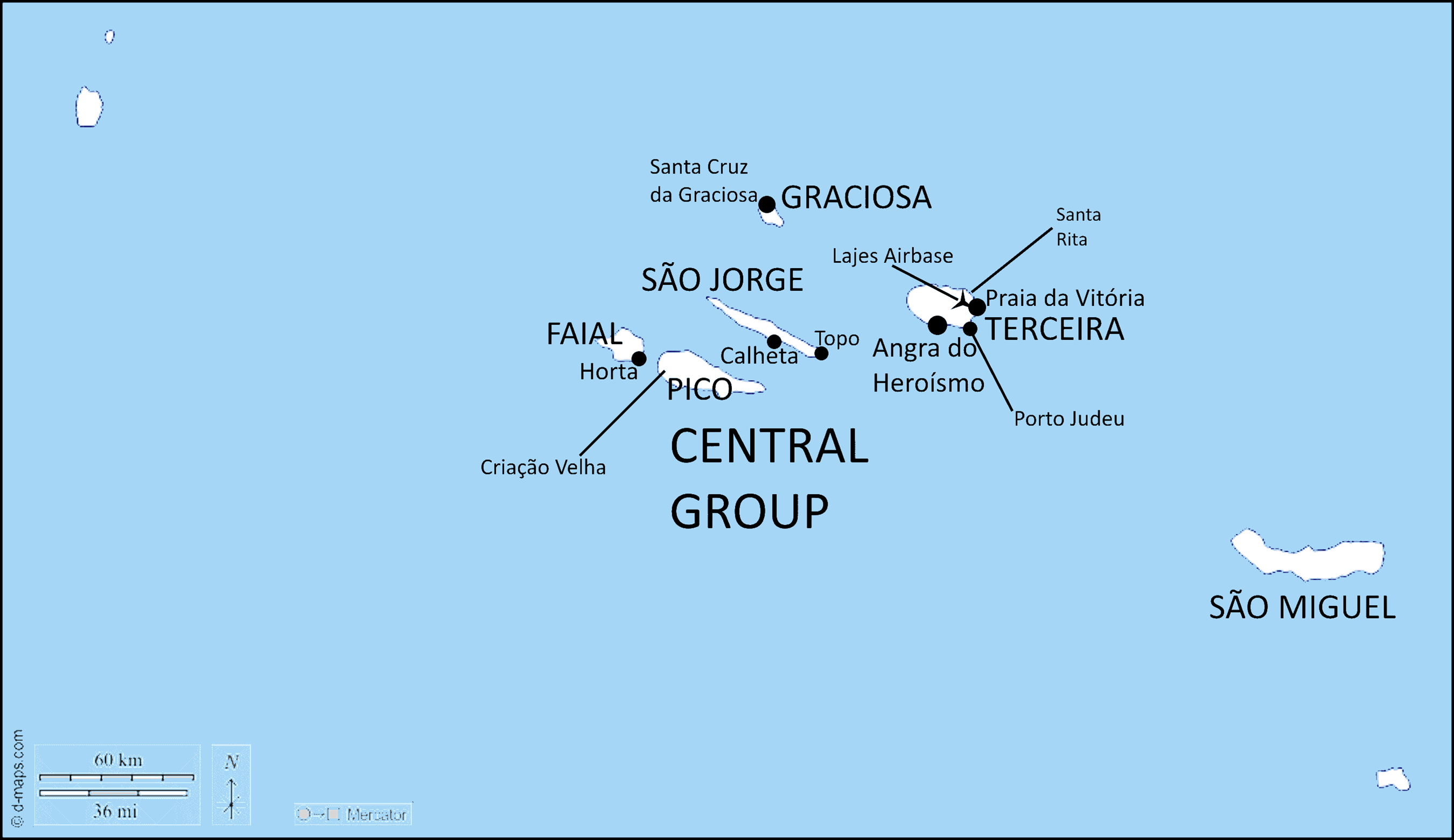
However, historians have engaged very little to understand local life in the Azores between the Second World War and the Carnation Revolution in 1974. 9 This might partly have to do with the nature, and dearth, of available sources (limited so far to the practically unknown/unused political police archives that we analyse here), which brings the approach of everyday life history (or Alltagsgeschichte, as its mostly German-speaking founders called it) back into focus. Slightly modified assumptions for societies under authoritarian rule after the Second World War make this approach useful as an innovative attempt at putting the emphasis on local everyday life; as we will point out below, it is especially promising for the Azores and its Central Group and gets into the study of lived experiences that is still missing for the archipelago's history after 1945. A principal constraint for researchers wishing to study the social history of Azorean populations, but also, indeed, the forms of repression exerted over ordinary Azoreans by the Estado Novo and its political police, is the ongoing lack of access to most files produced by the civil governments in place. This serious problem is equally relevant for the period between 1930 and 1945 (and was discussed by Carlos Cordeiro in his several works on the archipelago's earlier history), and it has not yet changed, although there seem to be possible improvements of access to some archival sources on the horizon. 10 Diplomatic exchanges concerning the archipelago in a historical perspective certainly allow for better research: these advantages might partly explain the relative abundance of studies on the Azores regarding their strategic importance as a Cold War outpost and the negotiations between the Salazar and Caetano regimes and the US American government to secure the use of the islands as a military asset. 11 Unsurprisingly, such studies, while offering interesting insight in certain, diplomatic, political, military and elite networks, are relatively superficial regarding conditions of social life in the islands.
The archives of the Polícia Internacional e da Defesa do Estado (the political police: PIDE) post in Angra do Heroísmo, created in 1954, are still insufficiently used, and yet they currently constitute the principal possible source for social historical studies. 12 The depth of the information they provide in spite of the many biases, depends on the degree of engagement of the commanders of the post – only the first two PIDE commanders in Terceira, João Lourenço and Virgílio Cunha, gave suitably ample accounts on individuals and community life. For historians interested in the everyday life history of the Central Group's population, this limits the period of interpretation to the years between 1954 and 1960, but for the six years in question, and especially for the phase until 1957, the evidence is extremely rich and full of important observations, frequently given in passing, on social life in the island communities.
We have used this evidence in a different context to discuss the constant conflicts between the civil government and the PIDE in the Central Group. 13 Those show the restraints regarding repression the political police could exert over the Azoreans in the 1950s. Still in 1956, the commander of the Angra post impatiently awaited the replacement of the civil governor, Manuel de Sousa Meneses, because he held that no real cooperation could be established with the island's authorities. 14 However, the activity of PIDE agents was not limited to such conflicts, or to their repressive tasks; these agents also took part in local life. Some of them married local women, such as in the case of Merícia Maria Pires Belém, who became the wife of PIDE police officer, Anibal Libánio de Sousa Brites. The information this agent gave thereby became directly linked to the affairs of his wife's family, which was rather well-off, with property in Brazil and ownership of a pastry and coffee shop in Angra. 15 But even without such direct links, the political police often left the agency processes to local individuals and their interests. An important practical observation has recently been made in that regard by Duncan Simpson, who, for the Portuguese mainland, pointed to the need to interpret the relationship between the PIDE and its informants and anonymous letter writers: he rightly characterized that as a two-way process, in which many individuals addressed the political police to report on political or moral deviance, without hoping for any acknowledgement or compensation. 16 Such denunciations were often motivated by individual goals and rivalries or antipathy felt by their authors. This observation had also been confirmed for political police activities within other right-wing authoritarian regimes, especially for the Nazi German Gestapo, and is certainly one of the many doors that bring us from sources of political repression to the interests of local individuals. 17
We will nevertheless need to discuss the specific conditions of late right-wing authoritarianism and of the periphery situation of the Azores, and the effects of the US American airbase, with regard to the importance of an everyday life history approach for that particular case. Our analysis of everyday experiences, as mitigated by political police reports, focuses principally on Terceira as the Central Group island that was shaped by the presence of the airbase, and a socially mixed structure. This analysis will be supplemented by observations on the neighbouring, but more remote Central Group islands of Graciosa and São Jorge, where the PIDE had less control.
The Peripheral Condition and ‘Room for Manoeuvre’: Were the Azores Different Within Portuguese Authoritarian Repression?
Although the approach was subsequently mobilized in other authoritarian contexts, much of the debate on everyday life history (or Alltagsgeschichte) remained almost exclusively a phenomenon of German historiography, and its vision was much shaped by the study of National Socialist authoritarian rule in Germany. The elaboration of the approach, including an attempt to bring this discussion into an international perspective, was the special merit of Alf Lüdtke. 18 While principal trends in the study of the Nazi regime continued to focus on structural issues and on a ‘model of perpetrators and victims’, Lüdtke insisted from the 1980s onwards on the, often complex, experiences of individuals, who partly made concessions with the authoritarian regime, while opposing its ideology at other moments or seeking a normal life outside the experience of repression. 19 Lüdtke and some other colleagues mobilized a wide array of sources to identify the everyday experiences and individual attitudes of persons living under and with the regime, but who also had complex and conflicting views, motivations and priorities.
An older debate, which might explain the initial lack of popularity of the approach and its rapid decline, even in German historiography – beyond a limited group of specialists around Lüdtke who clearly continued to defend its position – was about its potential to ‘trivialize’ the crimes that were related to repression. 20 As Claudio Hernández Burgos points out in a recent revision of the everyday life history approach, such relativization is no longer a relevant object of debate (which, as we will comment below, would need to be qualified for the Portuguese case), while the need to discuss complexities of individual experiences of living both under right-wing authoritarian regimes (in Nazi Germany, but also in Italy, Spain or Portugal) and under so-called Communist regimes as in the Soviet Union or the German Democratic Republic still remains valid. 21 In that view, the already classical approach of everyday history might still have thought-provoking material to offer.
To some degree, the Salazar regime after 1945 was different from the authoritarian regimes that both the original followers of the everyday life history approach and their detractors had in mind. Already from the outset, the degree of totalitarian goals of the Portuguese regime was less pronounced than what were the ideological claims within National Socialism and Italian Fascism. After the Second World War, the Salazar regime retained a wide range of repressive mechanisms, the political police continued with its exertions, alleged Communists and anti-regime activists were still threatened with persecution and death, but the regime made concessions to the Allied victors of the war. 22 The scope for oppositional positions and attitudes widened somewhat, and the regime's capacity to interfere in the life of its citizens diminished at least slightly. Election campaigns, while manipulated and suffering from spates of repression, gave occasional chances for freer expression. 23 One would expect this to open spaces for debates for individuals in the sense of an everyday life history approach, but that has remained practically absent for the Portuguese case, with the exception of what Duncan Simpson called, in an important new article on the late years of the PIDE/DGS, his own analysis on ‘[t]he PIDE as Platform for Collaborative Interaction with the Regime’. 24 The recent debate among historians in the newspaper Público about victims and collaborators of the PIDE, with its impressively aggressive overtones from those rejecting the notion of ‘collaboration’, or arrangements, for the wider population, shows the difficulties of analysing on those lines. Both the tone and the arguments recall the attacks against the older generation of historians advocating the everyday life history approach for other regimes, and against Lüdtke himself. 25
Processes of relative relaxation of repressive control after 1945 were multiplied in the Azores, where they combined with hostilities between local authorities (with positions often being dominated by local families) and the organs of state repression, on the one hand, and the regular army and the political police, on the other hand. The US American presence complicated matters: the political police agents could likely convince the American military command that certain individuals employed by the base were dangerous Communists, but the American officials sometimes doubted the arguments given by the PIDE or were slow to react. As we will show, this created more space and, in Lüdtke's words, ‘room for manoeuvre’ that were difficult to control.
The attitudes of the Portuguese army personnel stationed in the Azores did not make things easier. Officers like Colonel Fernando Duarte Silva, commanding the Portuguese base, refused to help the PIDE controlling the allegedly suspicious employees of the US airbase and refused the police easy access to the Portuguese installations; an impressive degree of conflict flared up on several occasions. 26 But relations between the civil governors in Angra do Heroísmo and the political police were also very problematic, and remained so. The first commander of the PIDE post in Terceira, João Lourenço, repeatedly called for intervention from Lisbon to remedy the situation, and he obtained some support. However, Lourenço and his successors as PIDE commanders continued to complain that the civil governor did his best to poison the understanding between the police and the various civil authorities. 27 Similar tensions existed in places on the mainland, but in the Azores, these were especially strong after 1945.
While the situation therefore seemed to be ‘bad’ from the point of view of the principal force of political repression even in an island as relatively big and accessible as Terceira, the other islands of the Central Group without a permanent political police presence had the reputation of being constantly problematic for the adherents of the regime. The political police described some of the authorities in the Azores as ‘democratic’, with a special focus on municipalities in islands without any PIDE post and which were thus more difficult to control, like Calheta in São Jorge. 28 Over various years, the agents of the police did not receive any support from the local elites in their attempts to intervene in those places.
The peripheral position of the Azores, the small steps towards liberalization of the Salazar regime after 1945, and the presence of the US military guaranteeing that such liberalization did not remain a dead letter locally, plus the rifts between local administration, the Portuguese military and the political police, led to conditions that differed strongly from other twentieth-century conditions of authoritarian rule. Even so, the everyday life history approach remains an important option. Its perspective allows us to draw attention to local interests and social experiences from police sources whose authors had other activities in mind, as they sought ‘Communists’ and ‘conspirers’. Using an everyday life history perspective, we will discuss five trends in relation to islanders living under the radar of the political police and pursuing their own interests, sometimes even attempting to manipulate the PIDE in their own interests, or by creating ‘democratic spaces’ that the regime normally wished to curtail.
We will first discuss changing living conditions as result of the existence of the US airbase. A second analysis will be of exemplary careers of immigrants into the archipelago from the Portuguese mainland or other regions, and the challenges of their local installation. A third theme will be the attempts by local individuals to manipulate the PIDE through denunciations to pursue their own agendas. Medical doctors as a group that was especially targeted as potential conspirers are the subjects of the fourth section, as they were the objects of substantial political criticism. Finally, in more remote places, whole mechanisms intended to repressively control the political process failed, and plebiscitarian processes (or sometimes even ‘basic democratic’ experiences) became an everyday phenomenon through the back door.
Living for the Airbase: Job-Creation Machine, Refuge, Motor of Social Change
The US airbase was a principal concern of the Portuguese political police. Its agents described the American installations as a potential haven for subversives, but also as a critical object of ‘denationalization’ of the archipelago in itself. ‘Communists’ and other dangerous elements were likely to seek access to military secrets and sensitive material. 29 PIDE post commanders constantly called for vigilance, and started enquiries that often failed because of lack of cooperation from the American side. 30 What the agents had in mind were ‘Communist cells’ – one early example of such suspicions was surveillance of employees working in the base's offices, such as Frederico Manuel da Ponte Pacheco and Luís Dinis Drumonde, who were accused by an informant of being in contact with an Eastern Bloc spy. PIDE agents massively complained about the lack of access to these persons; their attempts at cooperating with the US Federal Bureau of Investigation utterly failed because of a lack of interest on the part of the FBI representation. 31
On some occasions, reports seem to deliver evidence that these alleged suspicions might just have been a pretext: for the police agents, the employment of Azoreans in the Lajes Airbase represented a massive nuisance in more basic terms. In the 1950s, the base always had various hundreds – and sometimes thousands – of Portuguese employees working on the premises; the PIDE saw the special rights of the concession as an obstacle to their own strategies of control and vigilance. The police agents could not enter the premises of the base except as visitors with special authorization – and these agents often felt ridiculed by the US staff, their frequent lack of linguistic capacities not being helpful in that regard. 32 In the mid-1950s, not only did dozens of local employees live in regular houses on the concession; others installed themselves with their families in barracks, at the margins of the airbase but just out of reach of the PIDE. 33 In 1955, in Santa Rita in the north-eastern corner of the concession there existed ‘an enormous agglomeration of barracks of all types where some thousands of persons lived coming from the most distinct parts of the country and who employ themselves for the public works of the Airbase carried out by the Americans’. 34 Over months, the agents of the political police attempted to understand the origins of the different Azoreans residing in that shanty town (called bairro de lata by its residents), but the lack of control over the employees of the base remained a problem. 35
Some cases show the degree of protection that individuals could obtain from their engagement on the base. Almost from the establishment of the PIDE post in Terceira, one principal target of police repression was António Gomes de Rego, who worked as metalworker for an American firm active in construction work for the base. In November 1954, the commander of the PIDE in the island wrote to the US commandant of the airbase about Rego's ‘Communist and subversive ideas’ and his dishonest character, and asked for his removal and investigations of potential American and Portuguese contact persons. 36 Given the lack of American enthusiasm, PIDE commander, João Lourenço, tried to mobilize the Portuguese military, branding Rego as a potential Soviet spy and bemoaning the absence of information on his activity on staff lists. 37 It took the political police another six months to convince the American authorities in the base that their employee was indeed dangerous. 38 Only after an incident between Rego and his superiors in the contracting firm, did the latter use these suspicions against the employee to get him expelled from the American concession; he was handed over to the PIDE and interrogated under torture. However, the affair ended in great disappointment for the political police agents. Rego did not confess to anything more spectacular, and apparently was entirely ignorant about any Communist activities; even under violent interrogation, he admitted sympathizing with Socialist ideas, but denied having anything to do with the PCP. After some pressure from the regular police, and dismayed by the lack of results, the PIDE agents finally set Rego free. 39 They wanted to keep him under controlled conditions, but as there was no evidence of any Communist activities, the PIDE did not manage to prevent his travelling to Lisbon, and Rego then attempted to go as a settler to Angola. 40 Other individuals who were equally considered suspect by the PIDE could profit from the smaller, Portuguese military base to remake their life: this was the case for Rui Nunes de Azevedo, who as an alleged Communist had been imprisoned in the principal concentration camp in Tarrafal, Cabo Verde, in 1947, or the interpreter José Coelho Fraga, described by the political police as a Communist fellow traveller. 41 In the case of Nunes de Azevedo, the US company Oman, Farnsworth & Wright interceded with the American military to keep this employee in their service against the pressures of the political police. 42
The reports of the agents, while targeting allegedly subversive individuals, nevertheless also shed light on their living conditions, their room for manoeuvre under the authoritarian conditions of rule, and their everyday life history. The impact of the airbase on local life has already been the subject of an overview and, more recently, of a descriptive summary of the literature 43 – but analysis of the PIDE reports helps to reveal much clearer contours. The airbase had a strong impact on local life. It also reinforced the links between the archipelago and its diaspora in perhaps unexpected ways, as employment offers there gave former rural labourers the chance to earn wages that were beyond any of their possibilities in agriculture. José Linhares Coelho, José Martins Toledo and Floriberto Machado Cota all managed to form families thanks to their income from the Lajes base, marrying women of Azorean origin who came back from the United States. 44
As long as the boom phase of construction and extension of the base continued, there was practically no unemployment on Terceira. Moreover, the American companies that organized the extension process hired a considerable number of construction workers from São Miguel Island. However, the PIDE reports point to hardships in several phases: during a period of considerably lowered activity in construction work, between September 1956 and January 1957, these companies laid off more than 1100 Azorean workers, some of whom were sent back to their islands of origins. Others attempted to hold out in their barracks, leading to panic within the political police about a possible rise of thefts and burglaries in the nearby town of Praia da Vitória. 45 While the experience of work in the base was essential for local life, it also led to the creation of purchasing power via payment in dollars. As PIDE agents perceived it, not only were the drivers of a private bus company that connected the air base to the city of Praia da Vitória paid in US currency, but also greengrocers and sellers of eggs and garden products had access to dollars, as an increasing number of American staff of the base installed their families in the neighbouring city. 46 Most of these individuals routinely retained a respectful attitude when faced with the PIDE agents and, if confronted, insisted on their loyalty to the Salazar regime – as a routine of interaction in Lüdtke's logic 47 – but in their daily activities were much more focused on their American connections than on the representatives of the repressive regime.
In a number of cases, the available opportunities in the airbase represented an important chance for the very poor: some of these processes of social mobility are documented thanks to the distrust of the PIDE against workers of the airbase as potential spies and saboteurs. Manuel Garcia da Costa, an impoverished sawyer and woodworker from Pico Island, moved from Pico's Criação Velha District, where he could no longer sustain his family, to Horta on nearby Faial Island, and then travelled to Terceira in 1951 where he immediately found work in the airbase, his eldest son joining him as an employee of the canteen. His second son, Manuel Garcia da Costa Júnior obtained at 15 years of age a small office position in an American firm working for the airbase and managed to get a secondary school diploma at the same time. Such careers would have been practically impossible without the resources brought in by the base. 48
Certain individuals in Angra do Heroísmo tried to use their contact with the US base to build up their own social prestige and attempted to function as brokers of access to jobs. This is exemplified by the career of, as PIDE Commander Cunha described it, ‘good Portuguese and good nationalist’, Manuel Pereira Terra, who worked as an English teacher at the airbase. Pereira Terra apparently liked to spread the rumour that he had been interviewed by US American media during a stay in the United States and had praised the Portuguese nation. In reality, Terra only appeared as defender of the Estado Novo during a didactic course with American colleagues in the base, but he also helped Portuguese workers applying for certain positions in the base to pass language exams; for this apparent fraud, he lost the confidence of his employers and finally part of his functions, and was left harbouring bitter feelings. His colleague, Valdemar Furiado de Simas Belém, was a more successful example of such middleman roles. 49
While the PIDE agents thus saw the base as a problem in many regards, as employers the US military and concession companies made social ascension possible. At the same time, the base gave individuals a certain level of protection if they used it skilfully. Not only did it help to create careers, but it also placed obstacles in the way of political repression. It is even appropriate to claim that the base, for a considerable percentage of the islanders, became an alternative context of authority and allowed them, albeit within certain limits, to evade the sphere of influence of the authoritarian regime. 50 In spite of PIDE agents’ outbursts of anger about these conditions, they were nevertheless mainly tolerated.
Newcomers and Island Society
The PIDE regarded all outsiders with distrust, whether they came from the mainland – and were thus exiles or potential subversives – or from other, more unusual contexts. The political police attempted to get detailed dossiers on these persons, in an attempt to identify suspicious behaviour. The information assembled was frequently full of conjectures and hearsay, but these observations nevertheless give a good impression of situations that could be found in the society of Terceira and the Central Group with regard to immigrants.
Individuals living outside Portugal, but with family connections to the archipelago and who came to visit increased as a phenomenon in the years after the Second World War; shortly after the Carnation Revolution, around 30,000 such visitors were seemingly present at the Santo Cristo celebrations in 1978, and this followed a longer trend. 51 However, there was a distinction made between Azorean Americans and emigrant tourists visiting the archipelago from Brazil and other places. 52 The PIDE had difficulties in enacting repressive control against those visitors holding US citizenship, and very little is currently known about their influence (and their number) in the 1950s. The situation was different for Brazilians of Azorean origin, especially because the Azorean family-in-law of Angra-based PIDE agent, Anibal Libánio de Sousa Brites, had contacts with Brazilians. Normally, the PIDE did not understand much of their perspectives and interests, generally calling them ‘law-abiding’. Most rented rooms and visited family, participating in some celebrations; although the 1950s were a period in which ‘populist’ politics reigned in Brazil, these emigrant tourists mostly behaved in ‘apolitical’ ways, and they seem to have had little connection even to the urban society of Angra do Heroísmo. 53
Other foreigners were exiles, who managed to obtain considerable social status locally; the political police was particularly suspicious of the case of Chu Shin Yuan. This Chinese national born in Zhejiang province, having come to the Azores as mobile street vendor, was stranded in the archipelago during the years of the Second World War. He managed to finance and open a shop in Angra do Heroísmo, which was later joined by a second establishment in Praia da Vitória. Yuan also succeeded in bringing his wife and son from China to Terceira, using the intermediary of the Patriarch of India, José da Costa Nunes, and his network, with the promise of a Catholic baptism of the whole family (that would not occur). According to the PIDE, this merchant was suspected as a possible Communist, as the political police intercepted ‘subversive messages’ in English and Chinese language. 54 It took some time for the PIDE to understand that the material Yuan received was from the National Chinese Embassy in Lisbon and from Hong Kong, and anti-Communist in character. Although being a particular case of an immigrant into the Azores, and probably an extreme case from the perspective of both the urban population of Angra and the political police, Yuan quickly understood the key to local prestige. While he did not enter much into local networks of sociability, he hired a retired sub-director of the regular police, the Polícia de Segurança Pública, as manager of his principal shop, the Casa Chinesa. This former police agent was well respected locally, and also taken seriously by the PIDE – this was a major stratagem to thrive locally. 55
Immigrants from the Portuguese mainland often had their difficulties integrating into the islands’ society, with the fact that some were political exiles complicating matters. From the police files, it is possible to gain insights into their attempts at adaptation. If individuals were former opposition members, they profited yet more from a strategy of integration in Angra do Heroísmo's urban society, and, if the PIDE reports are taken as indicators, such individuals were able to mobilize local support to survive economically and to escape political repression. This is certainly exemplified by the experience of Antero Consigliere Sá Pereira, a commercial agent and former employee of the postal services who had come from Lisbon. Sá Pereira had already lost his job after the 1931 revolt, with only his wife remaining in the service; after the Second World War, he reappeared in the opposition, as district delegate for the 1949 presidential candidacy of Norton de Matos. 56 He benefited as much from his manifold contacts in Angra's urban society as did the carpenter, Carlos Guerreiro Raposo. The latter arrived in Terceira in his late 30s to take part in the construction of Angra's new hospital, and quickly managed to become locally integrated, according to the frustrated PIDE agents. They lacked information to identify him as dangerous, but they suspected he could be Carlos ‘O Alentejano’, an alleged Communist activist; however, the police did not obtain the necessary evidence in the city. 57 A successful integration in the local community was essential for ultimately holding out in spite of political police pressures.
On the other hand, distrust in the local society could make individuals’ lives more difficult, even if they belonged to the social elite and should have been able to mobilize community support (but did not). The PIDE referred to the case of Francisco Xavier da Cunha Aragão, a former colonial war hero, former participant of the 1931 rebellion against the Estado Novo as air force commandant in Amadora in the mainland, and subsequently a Parisian exile; he had been imprisoned after his forced return to Portugal in 1940, and finally been relegated to the Azores. Da Cunha Aragão married the daughter of the proprietor of the principal firm for alcoholic beverages in Terceira and took on the management of the firm. However, other than his father-in-law, Frederico Vasconcelos, who had been a notable in the island, the new manager was disrespected by the workers (and also quickly known to be less generous with payments for invalidity) and many described him as a ‘class enemy’. 58 PIDE agents were more interested in da Cunha Aragão's possible oppositional convictions and remarked that he had refused to lead the opposition in Terceira between 1945 and 1949, but it was his lack of social integration that made him extremely vulnerable to workers’ resistance – and not his rupture with the opponents of the Estado Novo regime. 59
The situation was different for José de Carvalho, who had also participated in the 1931 revolt in the mainland and was subsequently imprisoned in the fortress of São João Baptista in Angra do Heroísmo. Carvalho was a particular target of PIDE commander, João Lourenço, after he was installed in post in 1954. As he was an employee of the US airbase, the PIDE invested much energy in spoiling the former flight lieutenant's career. 60 The latter had built up a certain prestige in Angra already during the later years of his imprisonment turned into exile, working as a messenger for other prisoners when profiting from furloughs in the city. This prestige was fundamental for Carvalho to enlist support within the island's society when confronted with the pressures of the political police. 61
The motives and strategies for individuals who sought to find reliable connections in Terceira's island society (or failed to do so) varied. However, these were essential. They helped such individuals to remain unmolested by the PIDE – but also to enjoy at least modest social success in the Central Group.
Bringing the PIDE into Denunciation Games
The PIDE post in Angra do Heroísmo does not have denunciation letters in its archives; therefore, it is unlikely that historians will get a clearer picture of the number of such denunciations received. However, three processes show how everyday rivalries intersected with police interests. These also illustrate in exemplary ways the tensions existing within the Central Group's societies on various levels, and the rationales of enlisting the PIDE's support.
In Santa Cruz da Graciosa, on the smaller Azores island neighbouring Terceira, the mayor accused Alberto Esteves Martinho, registrar general and advocate, of being an opponent of the regime. The PIDE official took the time to get an opinion via a regular police officer of the Polícia de Segurança Pública (PSP), who gave a positive account of the accused individual. 62 Virgílio Cunha, then commander of the PIDE post, had already himself come to a more differentiated view of the accusations against Esteves Martinho: he held that in small places such as the island capital of Santa Cruz, the local elite was using the political police to get rid of newcomers who were rivals for important official positions and for the income generated in lawyer work. Cunha regarded that as manipulation, as má vontade; Esteves Martinho's predecessor had already been the victim of a local intrigue and been subsequently transferred. Cunha held that the assistant of the notary, someone from the Portuguese mainland but better integrated into Graciosa's society and husband of the owner of Santa Cruz's pharmacy, hoped to obtain the post of registrar. 63
A second theatre of rivalries and jealousy potentially leading to denunciations of individuals regarded those who had built up a successful career within the Lajes Airbase. The experience of the photographer Eduardo Correia de Melo, who lived in Santa Rita and worked for the US military, is a case in point. The PIDE agents in Lajes became acquainted with the rumour – without identifying the source – that Correia de Melo had expressed himself against the Salazar regime and said he was ashamed of his Portuguese nationality. 64 After enquiries, the PIDE held that this person was rather someone with an obvious pro-regime position, and who had himself accused opponents of the regime, participated in propaganda, and was very much appreciated by the authorities of the Portuguese and the US American airbase alike. Would that indicate that earlier victims of Correia de Melo's interventions wanted to pay him back in the same currency? Or would one rather be inclined to think of simple jealousy? In any case, it was possible to bring the repressive machine in motion even against persons who clearly were amongst the regime's adherents in the Azores. 65
A third context was that of the church operating against vocal and socially well-established critics of religious practice. In Terceira, the investigation by the PIDE gave voice to the parish priests; the role of the church in providing information on the moral character of certain individuals was essential in that regard. That involved a kind of mutual dependence: political police agents believed in the moral authority of the ecclesiastic staff in the islands, while the latter were sometimes eager to provide evidence to be used against their enemies. Thus, the parish priest of Porto Judeu in Terceira was important for corroborating the suspicions against merchant, Eduardo Azevedo Rafael, and was often invited to give his opinions on the behaviour of other individuals. 66 It is likely, although difficult to prove, that the PIDE especially trusted in conservative priests, who were vocal against moral deviance and appeared to see in the regime a guardian of moral issues.
The three cases mentioned demonstrate that PIDE agents gave varying degrees of attention to what local denouncers in the Azores told them. For these denouncers, their interventions gave them leeway to change distributions of social prestige and privilege. This was true for attractive social positions in smaller towns, or in the American airbase – or indeed for members of the church to sustain the prestige of the institution against local challenges.
Devilish Doctors
Medical doctors enjoyed considerable social prestige in the Azores, as is corroborated by the correspondence of the PIDE post. Whether they were of Azorean origin or not, all doctors brought in experience from mainland universities, and many had been active in the opposition to the Salazar regime. They had subsequently taken positions in public health posts and hospitals in the Central Group, for which they were taken in view of the dearth of candidates and, frequently, their local family connections; some would also choose to work in the private sector related to company personnel and thus were accessible only for regular employees or especially well-off insurance holders. 67
PIDE files on these individuals are remarkable, because they show the relative range of freedom that these medical doctors had in terms of expressing their political opinions. The agents of the political police seldom dared intervene against such individuals; they contented themselves with looking for conspiracies and Communist connections (which they could practically never prove). Part of the team of the health post of the security company ‘Mundial’ in Angra do Heroísmo was under close vigilance by the political police. With respect to Narciso da Silva Veiga, a nurse in the US airbase, who had joined the urban health post as interpreter, and Borba, who had equally started as a nurse in American service but later worked for the ‘Mundial’ post, the police agents claimed that information about both men was contradictory, but they obviously profited from their good contacts with American staff. 68 A more influential individual – and certainly more closely observed by the PIDE – was Oldemiro Cardoso Figueredo, the doctor of the post, who later became famous when installed as district governor in Angra do Heroísmo for one year after the Carnation Revolution. 69 Thanks to police surveillance, it becomes obvious that Cardoso Figueredo not only supported the opposition in the various campaigns of the 1940s and 1950s, but also publicly maintained his critical views of the regime. PIDE agents referred to him as ‘Communist’ (an accusation that was all too common for most suspects of political dissent, without having any proof of clandestine party membership), but while that was not obvious, he clearly remained very outspoken in his criticism. 70
A school doctor in Angra do Heroísmo, Campos Coroa, was equally seen as dangerous. After a period of work in the hospitals of Coimbra, the PIDE tried to block him for a position in the archipelago, given rumours about his ‘Communist ideas’ and his participation in ‘various anti-nationalist campaigns’. The agents of the political police feared that his potential leanings could lead to future oppositional activity. Their endeavours to stop this doctor's career impressively failed, because, again, no hard evidence could be mobilized. 71 A final case is that of José Alberto Carvalho Malheiro, who was continuously described by the political police as principal opponent and ‘villain’ in the island of São Jorge. The PIDE had already formulated those suspicions in the summer of 1955, raging against the lack of discipline in that island. However, they underestimated the enormous prestige that Malheiro had obtained through his taking a position of medical responsibility in a more remote and underequipped part of São Jorge: Malheiro, born in the northeast of Portugal, had first worked in the small hospital of Calheta, the second city of the island, but in 1951 he applied for the unpopular job as doctor in the town of Topo, in São Jorge's southeast. Malheiro also earned himself local respect by taking a committee position in the local milk-producing industry, investing a part of his salary in agriculture. The PIDE was mostly concentrated on his alleged schemes and dealings, but indeed the doctor of Topo held a position of strong social prestige – and his voice became important during the political tensions in the area of Calheta at the end of the 1950s. 72 Later on, Malheiro would have a position as doctor in the city of Calheta – the political police never managed to silence him, despite their several attempts to do so. 73
Medical doctors in the Central Group of the Azores thus profited from a remarkable freedom of expression. This was particular to the members of the profession, who – given their prestige in terms of medical learning combined with their standing in the community due to the general lack of medical services and the contact of many health posts with poverty and its related illnesses – had an especially distinguished role in the island society of the 1950s. They enjoyed massive social prestige and were thus rarely the target of denunciation campaigns. The political police, while constantly complaining that these individuals were subversive and either challenged the PIDE openly (as in São Jorge) or invested themselves in anti-regime positions clandestinely (as in Terceira), did not manage to attack them.
A Flavour of ‘Democracy’
The specific conditions of island society, the need for the integration of newcomers, and the additional shield of protection given to certain groups with social prestige, such as medical doctors in particular, explain why residents of the Azores, in the late 1950s, could engage in small challenges to the authoritarian regime. These never took the dimension of the larger (and much more strongly inhibited) opposition campaigns in the mainland, and during the 1958 Humberto Delgado campaign, which created so many headaches for politicians and administrators of the Salazar regime, the Azores did not figure prominently. 74 However, whenever campaigns became linked to everyday life and to local tensions, their results and outcomes in certain places turned out to be a slap in the face for the regime. Local communities tried to impose their own plebiscites on issues that were normally under regime control. For some ‘normal islanders’, but particularly for local elites, a recreation of the democratic rights and practices that had been more usual under the Republic was an issue. To the wider context of such plebiscites belong mobilizations of the islands’ elites against civil governors installed from Lisbon (although, in the case we refer to, the candidate chosen by the regime was a local notable believed to express the opinion of the island community, without actually consulting opinions in the Central Group on the matter) or against bishops who were said to behave improperly.
Yet, PIDE agents often communicated the impression that no one in the Azores still supported opposition forces in the 1950s. Special attention was given to the 5 October 1957 legislative elections, the first after the installation of the political police in the archipelago. The PIDE congratulated itself for the high rate of voters’ participation in the Central Group, and the lack of any visible opposition at all. 75 In fact, during the 1957 elections, neither the União Nacional (the regime party) nor the opposition campaigned. 76 Individuals identified as key persons of the opposition during José Norton de Matos's abortive presidential campaign in 1949, now seemed to be silent. That was the case for José Correia da Silva, who worked as a driver in Santa Cruz da Graciosa; in 1949 he had done a considerable amount of campaigning for the opposition, but nothing of that was visible seven years later. 77 Local Terceira merchants, such as João Gouveia and Tomás de Mesquita Borba, who in 1949 were still supporters of Norton de Matos, also abandoned political activism. 78 Moreover, José Leal Armas, a young veterinarian, who had a past as an opposition follower within the Movimento de Unidade Democrática (MUD) in 1945, became ‘reformed’, pledging loyalty to the Estado Novo regime and becoming the president of the District Commission of Angra do Heroísmo. Partly because of his good understanding with the PIDE commander in Terceira, João Lourenço, Leal Armas was accepted as a ‘disciplined’ administrator and regime follower by the political police. 79
On the more local level, PIDE agents trusted in the regime's installation of mayors within a corporatist logic. 80 However, local interests and the imperatives of everyday history played themselves out during elections for the town commissions. Normally, these were not free elections, as the towns’ inhabitants voted for a list established by the mayor as representative of the regime and by the committees of the União Nacional, the regime party. 81 On 18 October 1959, the local elections showed that the opposite could happen.
In Graciosa, the mayor of Santa Cruz, Vinício de Brito – a medical doctor who in the end had lost the prestige that many of his colleagues still enjoyed – attempted to push through an ‘official’ list, with the support of the Secretary of the Town Hall and President of the District Section of the União Nacional, Manuel de Vasconcelos. 82 However, the social elite of Santa Cruz mobilized against this list, out of anger about a water scandal, in an island where water reserves were particularly scarce. 83 The mayor had imposed high taxes for the use of the principal source, without any alternative for consumers. Vasconcelos had profited as co-proprietor of the industrial firm that had obtained the licence to do the construction work of canalization; these decisions had not been submitted to the local authorities in the island. The victory of an unexpected rival list, organized by the director of the local customs post, Dr Almeida Castelão, was a clear signal that local tensions could indeed lead to a certain, if localized, political opposition. 84
In Topo in São Jorge, a rival list also won the elections. PIDE agents held that this was the result of Malheiro's influence in the town, in which oppositional votes had already appeared during the presidential elections in 1951 (for Norton de Matos, although he was not a candidate) and 1958 (for Humberto Delgado). 85 In 1959, José Costa Reis, in Topo, took the presidency of the newly elected town commission of Topo. He had had a remarkable past as a former supporter of Norton de Matos and a former employee of the anti-regime lawyer in Velas (the main city of São Jorge), Rui Mendonça; a police enquiry had helped to ensure that Costa Reis lost his position as town warden, and the PIDE tried to enlist the evidence provided by the church, as local priests were all too happy to attack the anticlerical Costa Reis, because the latter had rented out a hermitage in Topo as a kind of hostel. But he withstood these attacks and, despite being branded by the PIDE as an ally of Malheiro, he effectively took the position as president of the commission. 86 This electoral success was applauded and endorsed by the mayor of Calheta, Manuel Faustino Nunes, one of the other individuals in São Jorge who were frequent targets of the PIDE. 87 Described in manifold occasions as ‘an old democrat’, Faustino Nunes was a survivor of all the regime's periods of greater repression; imprisoned in 1931, in 1949 he reappeared as a representative of the opposition, but used his good contacts in the district government of Angra do Heroísmo to be installed as mayor. 88
Some of these forms of behaviour also began to be found in the regional institutions that represented the central government, and with regard to the highest political and ecclesiastical authorities of the Central Group. In Terceira, local politicians challenged the change of district governor decided in Lisbon. While the president of the União Nacional's district committee in Angra do Heroísmo, Manuel Flores Brasil, had a reputation with the PIDE as a ‘crypto-Communist’ 89 , in March 1959 he defied the new district governor, Teotónio Pires, by writing to Salazar. He branded the new governor as ‘defeatist’ and ‘politically unsound’ and used the journal A União as a platform. Colonel António Silveira de Bettencourt, the brother-in-law of Pires, sought the intervention of the PIDE but this came too late. The political police suspected Francisco Valadão, former secretary-general of government, as being behind that ‘intrigue’, but the situation rather showed the strong position of certain dignitaries in Terceira, which Flores Brasil was able to express as that of the local authorities, against the resistance of União Nacional district committee members who were closer to the regime, like Leal Armas and the young doctor, Joaquim da Rocha Alves. In the end, this protest did not prevent Teótonio Pires becoming district governor, but it showed that public uproar could be generated against a nominee of the regime. 90
Another outbreak of plebiscitarian anger, on a more popular level, was directed against the hierarchy of the Catholic Church. In 1960, the Central Group was shaken by resistance against the Bishop of the Azores, Manuel Afonso de Carvalho, in what implicitly constituted a challenge against the Estado Novo's religious policy. 91 The bishop had tried to intervene in the local practice of brotherhoods that were popular all around Terceira and an essential part of the Senhor Espírito Santo celebrations. The brotherhoods also gave substantial help to the poor. 92 For the coronation celebration, and the upkeep of the impérios, the seats of the brotherhoods, these associations asked for payments from the local population and attempted to independently administer these budgets. De Carvalho insisted he had to control these funds, and also prohibited the priests from taking part in the coronations. 93
Popular opinion expressed fury. According to the PIDE, Francisco Lourenço Valadão Júnior took the role of advocate for the masses, while capitular, Cunha de Oliveira, as director of the journal A União, tried to calm the popular mood but failed completely. Over months, jokes circulated about the bishop, who was nicknamed ‘Manuel Quinteiro’, because he allegedly lived in a villa outside of Angra do Heroísmo, wearing trousers instead of tunicles. Pamphlets and rumours weakened the prestige of the high church – although the bishop remained on the island for nearly two decades more, he had to turn back from his religious policy. 94
All these examples show the room for plebiscitarian mobilization in the outlying archipelago. Especially on the secondary islands of the Central Group, individuals could engage in democratic competition, short-circuiting regime controls, and the political police had few means to respond. But even in Terceira, both at moments of political succession imposed by the authoritarian state, or on occasions in which the church tried to change the rules of the game of local religiosity, local political mobilization was possible, and remained outside the control of the Estado Novo.
Conclusion
PIDE agents active in the Azores’ Central Group lived in a world of alleged Communists seeking refuge in the Lajes Airbase, ‘subversive doctors’, and local ‘political schemers’. But while their reports point historians to a number of societal tensions, they particularly allow us to understand the problems that newcomers from the mainland (and even refugees from China) had in installing themselves in island society, and the chances of inhabitants of Terceira and of Azoreans from other islands taking advantage of social mobility. These experiences can be gleaned by examining political police reports from an everyday life history perspective; the convictions of police agents seeking an imagined enemy practically everywhere can be deconstructed to give important glimpses of individuals and their lives. The concepts of the everyday life history approach, especially Lüdtke's terms of evasion, room for manoeuvre and pragmatism, help us to better understand their experiences.
Many Azoreans evaded the repressive means of the authoritarian regime, profiting from the protection of the Central Group islands’ communities. With a sufficient degree of acceptance by these communities, newcomers profited from protection, and the agents of the political police frequently abandoned their persecution of alleged anti-regime activists when confronted with a local lack of cooperation. In Terceira, this field of evasion was spectacularly widened by the existence of the Lajes Airbase, which offered islanders and immigrants from other Azorean islands alike an alternative context of power. This could be used literally, as by immigrants from other islands who preferred life in the Santa Rita shanty town on the airbase concession to PIDE control; it could also offer evasion in economic and social practices, as it did for individuals who took part in the parallel local dollar economy as workers and employees on the base and merchants and retailers serving the Americans.
A combination of local factors allowed both Azoreans and newcomers to enjoy such considerable room for manoeuvre. Urban communities – such as those of Angra do Heroísmo in Terceira or of Calheta in São Jorge – were willing to give individuals targeted by the regime's political police a certain amount of protection. Parts of the local elite, which also tended to staff the local positions of authority, preferred to endorse this relative protection over close cooperation with the agents of the regime. These mechanisms are probably much stronger for the archipelago than for any region in the Portuguese mainland, and they were multiplied by the effects of the American airbase: US company management had no impetus to denounce their Azorean workers, the US military was reluctant to believe in spy stories and rumours of Communist infiltration, and the Portuguese army officials who had their own, smaller airbase close by, emulated the American hesitations with regard to police repression.
This room for manoeuvre even provided spaces for plebiscitarian moments, which were not possible in the contexts that Lüdtke and other specialists of the everyday life history approach have studied for authoritarian regimes. The political concessions ostensibly given by the Salazar regime after 1945 might have been more limited in the mainland; in the Azores, manipulation of the principal political processes continued to rule, but in more local contexts, protégés of the regime could lose elections, and a bishop who had the support of the regime could be attacked by a local popular campaign. For some individuals in the Azores’ Central Group, this even brought a notion of the democratic processes in place before the authoritarian regime back into their everyday life; this became just another expression of their self-reliance (Eigensinn).
Footnotes
Notes
Funding
The author(s) disclosed receipt of the following financial support for the research, authorship, and/or publication of this article: This work was funded by FEDER – COMPETE 2020 – POCI and the Fundação para a Ciência e a Tecnologia (FCT) as part of the research project “World of (Under)development: Processes and Legacies of the Portuguese Colonial Empire in a Comparative Perspective (1945–1975)” (POCI-01-0145-FEDER-031906).