




Abstract
A group of Polish displaced persons (DPs) was stranded in the British zone of occupation in 1945, a smaller part of a much broader population upheaval in Europe in the 1940s that included Nazi forced labour and resettlement plans, as well as the expulsion of Germans from Eastern Europe. The relationship between British military officials, welfare workers and the Polish DPs within the British zone deteriorated quickly after German surrender. Using the issue of repatriation as a focal point, this article will explore the growing tensions between the British and Polish who had fought alongside one another and place these within the wider context of increasing East-West tensions in the immediate post-war world. As the British tendency to look upon the Polish DPs as a troublesome ‘nuisance’ can be viewed as a by-product of pressure on an economically weakened Britain straining to live up to its pre-war stature, in this context the need to help the very people who embodied the provocation for going to war became irrelevant.
‘Finally, it was the Poles who would later present the most tragic paradox of all’,Quaker welfare worker Margaret McNeil recalled, ‘the paradox of a people who could never be happy in any country but their own, yet who stayed away’.
1
Repatriation – the return to one’s country of origin – was simultaneously regarded as both one of the Western Allies’ biggest successes and one of their biggest failures in the post-war era.
2
A success due to the sheer number of quickly and efficiently repatriated displaced persons (DPs), and a failure due to the lasting legacy of Polish DP repatriation evidenced since in testimonies of welfare workers’ and military testimonies as well as in the historiography. In addition to successfully providing relief to the millions of displaced across Europe, priority was given to creating a quick and efficient repatriation system soon after the war ended.
3
However, for Polish DPs resident in Germany in 1945 the idea of repatriation was inextricably linked with fear of what awaited them in Poland. As one former concentration camp prisoner wrote: We felt drunk with this freedom – almost dazed […] These were the first days of happiness. Slowly we got accustomed to the new situation. Life does not allow to wonder too long. It brought us new troubles, new problems and it didn’t let us be idle.
4
Personal testimonies regarding Polish repatriation from the British zone are sparse. Yet narratives of the repatriation process and the level of involvement of the UNRRA welfare workers, and sometimes military officials, can be found in personal memoirs, autobiographies and, more general opinions, in archival records. When used in conjunction with correspondence between military officials, regional and home offices, welfare workers and indeed several other organizations taking part in the colossal challenge that repatriation posed in the immediate post-war period, a fuller picture of the inherent pitfalls in the British zone’s repatriation of Polish DPs can be understood. 6
The identity of who exactly was considered Polish in 1945 is also a topic fraught with problems as the welfare workers and military officials sorting ‘groups’ into camps and later conducting vast screening procedures were poorly equipped to understand geographical, racial, religious and even linguistic differences. As the occupation was further developed, many Polish citizens with German backgrounds who had been ranked ‘favourably’ on the Nazi Volksliste also proved problematic to the post-war authorities. 7 However, this article determines the Polish DPs in the British zone of occupation in Germany to be a group bound by cultural and linguistic ties, placed by its leaders and the Allies in camps organized along national lines, and as a community fighting to self-define according to ethnic and religious (predominantly Roman Catholic) borders, often drawing on concepts of nationhood and race. 8 The blurred lines of who was considered Polish with a Ukrainian accent, Lithuanian with a Polish accent, Ukrainian with a Polish accent and those nationally indifferent were distinctions many were unable to make. The disastrous lack of official documentation accompanying DPs caused significant problems for the Allies, especially by 1945 as ‘the production of false identity papers in Europe had become almost a major industry’, even though identity was not always determined by a document. 9 According to Laura J. Hilton, Polish DPs in the US Zone had the weakest basis for claiming ‘non-repatriable status’, but in the British zone the situation was different. 10 Therefore, this article analyses the circumstances under which Polish DPs found themselves in Germany’s British zone of occupation in 1945, asserting that – contrary to previous claims – Poles did not have the weakest basis for refusing to repatriate, but had multiple reasons to choose DP camps over a return to Poland. Their experiences differed from those in the US zone of Germany, as well as Poles resettled in Britain under the Polish Resettlement Act (1947). Therefore, this article will use the British authorities’ delegitimization of the refusal to repatriate to emphasize the disparity of planned action and reality, highlighting the overlooked fate of Polish DPs abroad under British care compared to those in Britain.
Although there was an initial burst of research on DPs, displacement and European movements in the immediate aftermath of the Second World War, interest had waned by the mid-1950s. 11 Consequently, little else was done until the development of Alltagsgeschichte, or everyday history, in the 1980s. 12 Beginning with broader surveys of the DP situation in Germany under Allied occupational control, the literature has since shifted to local and regional studies, 13 and to the individual DP groups themselves. 14 This article will look at the issues and interplay of a specific DP group, the Allied military authorities in the British zone, and the contributions or hindrances of welfare workers belonging to international humanitarian organizations, and in particular UNRRA. 15 In doing so, it contextualizes the complex problems of Polish DPs as they were seemingly rejected by a country that had long invoked a ‘brothers in arms’ attitude throughout the war. Although Poland was the primary reason for Britain to declare war on Germany, this article will explore how Poles were not received as equals in 1945, and how this created a sizeable group who were made to feel repeatedly rejected through increasingly harsh repatriation measures. The Polish inability to comprehend Britain’s foundational reasons for declaring war led to increased feelings of neglect and betrayal. The large movements of people across Europe in the middle of the twentieth century has been viewed as catastrophic, yet today forced population movements continue to occur with worrying pace and repetition. The Polish DPs stranded in the British zone in 1945 serve as an important example of mismatching international aims at a local level, and the repercussions this has had on minority groups.
Underestimating the Problem
In 1944, as the Allies made their way through Germany and towards Berlin, the Supreme Headquarters Allied Expeditionary Forces (SHAEF) encountered a seemingly limitless number of DPs on the roads throughout Germany. To alleviate the problem they created The Refugees, Displaced Persons and Welfare Branch, which grouped ethnicities and nationalities together in holding camps until the cessation of hostilities. This was the beginning of enforced ethnic homogeneity that would dominate geostrategic concerns in the post-war period. 16 When the war came to an end on 8 May 1945, the Foreign Office requested an urgent but accurate estimation of the number of DPs in Germany; many were categorized as they had been grouped, according to nationality or ethnicity. The SHAEF officials estimated there were 800,000 Poles in the three Western zones of occupation under their jurisdiction as of 9 June 1945. They estimated numbers would decrease by 50,000 per month until October 1945. SHAEF expected repatriation to slow down throughout the winter months due to inclement weather and damaged transport networks in Europe, predicting 600,000 Poles remaining by 1 January 1946. In a footnote attached to the estimates on repatriated Polish nationals the document stated: ‘It is assumed that 25 per cent of the displaced Poles in areas of SHAEF and AFHQ [Allied Forces Headquarters] responsibility will elect to return to Poland. Likewise, a substantial proportion of the residual 600,000 Poles probably will find new homes’. 17 Unfortunately for SHAEF they could not have accounted for the social and political changes in Poland, resulting in grief and a reluctance to return. Indeed, by September 1945 Malcolm J. Proudfoot, a former member of the DP administrative branch of SHAEF, estimated that within the three Western zones alone (discounting the other areas of SHAEF’s jurisdiction initially incorporated into the above figures) just over 816,000 Poles remained. 18
SHAEF’s initial reports in June 1945 for quick repatriation of all Polish DPs were positive. Yet between June and September 1945 a series of events occurred which established and later strengthened the conviction of Polish DPs to remain in one of the three Western zones. Two main causes were the Western Allies’ recognition of the Soviet-backed Tymczasowy Rząd Jedności Narodowej, or Polish Provisional Government of National Unity (Warsaw), in early June along with the agreement between Soviet Russia and the Allies to give priority to repatriating Soviet nationals first, thereby halting the repatriation of Poles. Secondly, Poland’s borders had also been moved 150 miles westwards to fit in with the Communist government’s notion of Poland’s true ‘ethnographic territory’, thereby placing many previously Polish towns east of the River Bug firmly within Soviet territory. 19
Polish DPs quickly became more than merely an annoyance for Britain and her Allies, as their steadfast refusal to repatriate seemed trivial to many of the British military officers and UNRRA welfare workers. There was an overbearing urgency to rush the DPs out of the zone, so the military could get on with the real task at hand – the Germans. This need to rid the Western zones of DPs and ‘get cracking’ was something that belittled the efforts of welfare workers from all organizations from the outset. 20 The situation was far more complicated than those helping the DPs realized, and their true dilemma was not readily understood by officials until mid-1947, towards the end of UNRRA’s existence in Europe. The empathy displayed for the Polish DPs remaining in camps by 1946–47 can be attributed to the type of personnel left caring for them. 21 Previously UNRRA and the military had filled positions with anyone available, consequently many were not sympathetic to the plight of the DPs and were the first to abandon UNRRA or take leave when it was offered to them. Marvin Klemmé, an American who reluctantly chose to work for UNRRA in the British zone after hearing rumours it was a ‘screwball outfit’, confidently stated that one of UNRRA’s main problems at the start was that ‘the whole structure was honeycombed with incompetent, dishonest or disloyal people [and] some of them were awfully close to the top’. 22
The remaining UNRRA employees saw their work in a practical sense, they were there to get the job done and to do it efficiently. The idealists were championing UNRRA as the vanguard of a future world government, yet as Klemmé stated, the ‘zeal of fine idealism possessed by these people turned to disappointment later on when they faced Europe’s almost unsolvable problems. Quite a few of them were so disillusioned that they quit and went home long before the job was finished’. 23 Consequently, the champions of this newfound international humanitarianism were some of the first to retreat, and those who showed little interest in the DPs often stayed the longest, eventually creating mutually empathetic relationships with the DPs who remained.
In contrast, British military officials still working in DP camps by 1946–47 were unconcerned with the DPs, often explained away by UNRRA workers as a symptom of being detached from interacting with DPs on a daily basis. However, it was also part of the British military’s propensity to regard Poles as inferior, which is frequently displayed in inter-office correspondence and within personal memoirs, most notably those of Lt. Gen. Sir Frederick Morgan. 24 The tendency to think of one as inferior, and alternately another as superior, has deep roots in the way ordinary white British soldiers treated their colonial counterparts throughout the war. Gradually it became an unforgiving reminder to the Poles that Slavic groups were considered inferior to their Western counterparts. 25 The Poles were on the side of the victors and equal to the Western Allies by all accounts, yet in the archival material a tendency to speak of the Poles as a troublesome ‘nuisance’ is readily apparent. 26 There was, of course, a clear distinction between the Poles the British military and elites were used to dealing with, and the Poles who greeted them in the DP camps of Germany. The Poles involved in the London circles were cosmopolitan, urbane and often polyglots. Conversely, the Poles in the DP camps were mostly poorly educated agricultural and industrial workers. 27 Not only were the British unused to working with Poles who spoke no English, but they were also unfamiliar with many habitual norms of the lower classes, causing further friction. For many, the Poles had misconstrued British reasoning in declaring war on Germany as an act of loyalty, solidarity and empathy, in reality Britain was thinking practically about the territorial integrity of Poland and the wider repercussions of another partitioning. Alongside these issues, there was also a consistent subordination of UNRRA to the military government authorities due to lack of personnel, which impacted on how the DPs were handled in the camps.
By the end of September 1945, the majority of Western European and Soviet DPs had been repatriated, leaving the other mostly Eastern European nationalities within the British zone. Indeed, according to Proudfoot, Polish DPs accounted for the majority of DPs in each of the Western zones of Germany after 30 September 1945 (see Table 1). 28 However, although Poles represent the highest percentage in all three zones, the British zone accommodated the largest quantity, accounting for 63 per cent of the total number of Polish DPs in the three Western zones of Germany. 29 Consequently, when problems with repatriating Polish DPs emerged the British zone was the most effected. 30 Morgan, who was the Chief of Operations for the UNRRA mission in Germany, stated that ‘almost everything depends on the solution of the Polish problem. If the Poles agree to go home, and there is every likelihood that the vast majority of them will, the whole thing is comparatively simple’. 31 Unfortunately for Morgan, the combination of Poland’s borders shifting westwards, the installation of the new Polish Provisional Government in Warsaw and the initial halt on Polish repatriation caused what one welfare worker called a ‘mental paralysis’, and consequently an odd form of stalemate ensued. 32
Poles in three Western zones of occupation, Germany, 30 September 1945
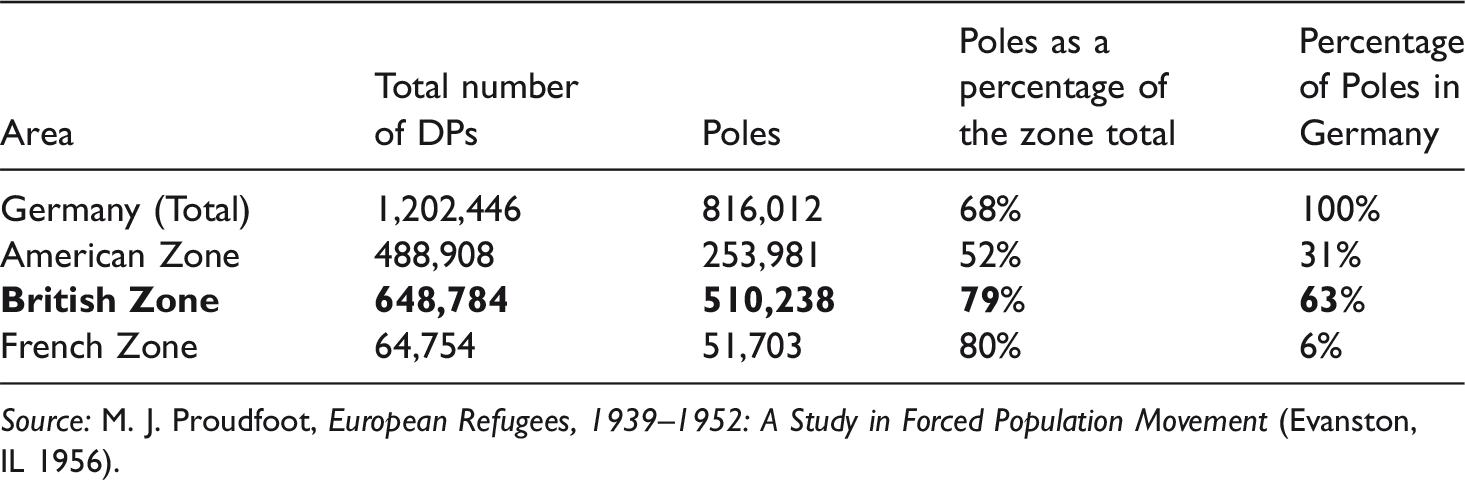
Source: M. J. Proudfoot, European Refugees, 1939–1952: A Study in Forced Population Movement (Evanston, IL 1956).
From September 1945 to March 1946, the repatriation of Polish DPs was continued, although with limited success. On 13 March 1946, MP John Hynd, Minister for Germany and Austria, presented on the situation of DPs to the House of Commons, estimating that 326,000 remained in the British zone. Vice Admiral Taylor asked Hynd ‘what progress is being made to restore those displaced persons to their homeland’? to which Hynd and his committee had no answer; neither did they know how many Poles had been repatriated to what was now Poland. 33 According to George Woodbridge, UNRRA’s official historian, in total 74,005 Poles had been repatriated from the British zone between September and November 1945 and, although at a time when repatriation was meant to be increasing, only a further 79,932 had been repatriated between December 1945 and March 1946. 34 Even if these numbers are slightly skewed due to lack of understanding at the time of who was Polish, the estimated figures show that the repatriation of Polish DPs had slowed significantly. By March 1946 British military officials and UNRRA workers were becoming frustrated by the slow pace of repatriation. UNRRA’s initial mandate was to finish European operations in 1946, but its Director General, among others, realized that there was still much be done. UNRRA’s Fourth Council session in March 1946 passed Resolution 92 allowing continuing care of DPs in Germany for a limited time and discouraging the provision of recreational activities in camps with the intention of isolating the DPs. This reinforced the Western Allies’ conviction that all Polish DPs must return home and resulted in a meagre increase in the repatriation numbers and a visible slump in the Polish DPs’ morale. 35
Operation Carrot
By the summer of 1946 Polish repatriation had virtually stagnated. To stimulate it, Operation Carrot was created as a joint venture between the Allied military and UNRRA to ensure that the maximum possible number of Poles would be repatriated before the end of the year. 36 Any Pole who voluntarily repatriated would be given 60 days’ food rations. The sheer amount of food was staggering: over 90 lbs for one individual, and over 376 lbs for a family of four. The lavish parcels were displayed in the camps, and the Poles were ordered to walk past them one by one. 37 The parcels were undoubtedly enticing to many, as living on scarce rations had become the norm since 1939 and very few had had the luxury of eating 2000 calories a day, which was precisely what the parcels promised. Naturally this caused a swell in the numbers willing to repatriate almost immediately. There had been a strong campaign to distribute information about the packages throughout the summer but many UNRRA staff perceived this as nothing short of a bribe, although some thought it was a ‘bright idea’. 38
While Operation Carrot was being advertised during the summer the Director General of UNRRA, Fiorello LaGuardia, ordered the Soviet-commissioned newsreel Return to Homeland to be shown repeatedly throughout the camps in the three Western zones of occupation. 39 In case the newsreel was not enough to satisfy the Polish DPs and address their concerns, LaGuardia also ordered UNRRA representatives to go to Poland to survey the conditions and report back. 40 Large amounts of informational material were dispersed around the camps to convince the Poles that repatriation was the best and only option. The UNRRA Mission to Poland Welfare and Repatriation Division issued its staff with texts (in both Polish and English) to enable them to answer the DPs’ questions. Eventually compiled into a large booklet entitled ‘What Every Citizen Should Know’, it addressed 36 questions about life in Poland, for example ‘is there work for me?’, ‘I have no tools; can I get them?’, ‘Are Poles allowed to return east of the [River] Bug?’ However, the DPs snubbed the booklets as mere propaganda, as UNRRA had compiled the answers in conjunction with the Polish Central Repatriation Mission for Germany after discussions in Warsaw. 41 Although LaGuardia had attempted to ensure that this pressure from the authorities would have a strong effect on the Poles remaining in the DP camps, the results were disappointing. The British authorities and UNRRA welfare workers had mixed emotions towards the remaining Polish DPs; many were confused as to why such a patriotic people were unwilling to return home and help rebuild their country, although others were entirely indifferent and just wanted to go home themselves. Rhoda Dawson, a British UNRRA welfare worker, fell into both categories: she was perplexed at the Polish situation, but her empathy was running out. 42
Three Additional Pressures
Restriction of Newspapers
The British zone’s repatriation figures continued to be poor regardless of the additional pressure of Operation Carrot. The culmination of problems specific to the British zone contributed significantly to the Polish DPs’ lacklustre attitude towards repatriation; when these issues are viewed simultaneously it is hardly surprising many Polish DPs wished to remain in the camps. Firstly, Resolution 92 ordered the removal of any ‘handicaps in assembly centres to the prompt repatriation of displaced persons wishing to be repatriated’, including English- or Polish-language newspapers that spoke ill of the new Polish government in Warsaw. 43 Poles in the British zone were discouraged from taking part in recreational activities: instead their entertainment was to come from newspapers known for their tendency to be biased. One of the most widely-circulated Polish-language newspapers was Repatriant (Repatriate), a semi-official weekly newspaper which focused chiefly on promoting repatriation, answering questions about repatriation and tracing missing persons. Repatriant, alongside Robotnik (The Worker) and Głos Ludu (Voice of the People), also semi-official weeklies, painted a very positive picture of an economically thriving Poland that would benefit greatly from the return of its former citizens. However, even though they circulated widely, official reports have been unable to distinguish between their popularity and reading through boredom: one might read anything if there was nothing else to do. 44
While Poles were not allowed to read particular publications because the Warsaw government objected to the content, Warsaw frequently complained to the Foreign Office about its restrictions on newspapers emanating from Poland, claiming that it was solely disseminating anti-Communist Polish news produced in England. 45 Foreign Office memoranda focused on the use of any means necessary to urge the Poles to return home. 46 The distribution of newspapers, largely commissioned in Poland, which were favourable to repatriation, backed by increasingly assertive rhetoric from the British military in the camps about the need for the DPs to return ‘home’ increased, yet the numbers leaving remained low. A survey found that only newspapers written by DPs for DPs were genuinely welcomed, as they used satire and cartoons to comment on and criticize the new social order in Poland and its reverberations. 47
Polish Liaison Officers
The second element was the presence of Polish liaison officers in the British zone. Liaison officers were required in each DP camp to serve as emissaries to the DPs’ former country of residence, and to present the DPs with information on the situation in their home countries and encourage repatriation. However, many of the Polish liaison officers had been appointed to DP camps across Germany before the new Provisional Government in Warsaw was officially recognized by the Western Allies on 5 June 1945, and most of those in the British zone were loyal to the London government-in-exile and were perceived as hindering the repatriation operation. Officially, liaison officers who opposed the new government in Poland were not meant to be in the DP camps; however, in reality the majority were anti-Communists, anti-Warsaw, anti-USSR, and thus also anti-repatriation.
To resolve this problem the British Army of the Rhine separated the work of the London and Warsaw liaison officers, tasking the former with registration and welfare in the camps and the latter with transport. Neither side was given overall responsibility for encouraging repatriation, although a letter differentiating their tasks indicated that the London liaison officers were to have the most contact with Polish DPs, stating: the British Authorities have no present intention of making changes in any of the Polish personnel or in any way of disturbing the liaison machinery which has hitherto functioned so well. There will, therefore, be no change in the main function of the existing Polish Liaison Organisation.
48
The result was a constant state of anxiety for many Polish DPs in the British zone as the liaison officers continued to exert their influence; if they were indeed encouraging repatriation in March 1946, they had very limited success. Although many of these officers may not have actively sabotaged the repatriation mission, they willingly endorsed speculation and undoubtedly influenced DPs’ decisions. By April 1946 the British were accused of hindering repatriation by allowing the London liaison officers to remain in the camps. Memoranda between the Control Commission for Germany (British Element) and the Warsaw government concerning the origins of the liaison officers suggest a large-scale exercise of childish finger-pointing in a vain attempt to lay the blame for the low repatriation numbers on one another. Yet the last element contributing to the Polish DPs’ unwillingness to repatriate from the British zone was often the most damaging, and certainly influenced how liaison officers reacted to news from Warsaw, whether they had pledged allegiance or not.
Polish DP Returnees to the British Zone
Polish repatriation began in earnest in the autumn of 1945; however by the winter of 1945/1946 officials in the British zone realized that some Poles who had been repatriated had returned to Germany and the British zone of occupation, and were attempting to re-enter the British camps as DPs, and seriously affecting the remaining Polish population’s decisions about returning to Poland. The UNRRA worker Marvin Klemmé asserted that this was the most damaging set-back for the Polish repatriation mission, as Poles ‘who had been repatriated and then, not liking the conditions, came all the way back … What these people said was generally believed [as] it was always the dissatisfied who returned’. 53 The British military and UNRRA staff were largely ignorant of the fighting that continued along the border regions to the east and west in Poland, readily believing that Poles were returning to seek economic advantages, not to flee continuing persecution as areas descended into chaos and civil war. 54 To prevent the spread of rumours from the returning Polish DPs, division leaders in the British zone attempted to put new measures in place to stop Polish repatriation numbers decreasing. While these amounted to little more than threats to withhold the Red Cross food parcels, uncertain food and clothing rations, and low prioritization for housing and resettlement opportunities, they caused considerable outrage among the Polish DPs as well as the liaison officers and top British Military officials. 55 The Polish DPs’ morale was already extremely low and this only increased their ill-feeling towards the military authorities and cemented the view they were not to be treated as equals. Although the Control Commission for Germany (British Element) drafted a response disputing these ‘orders’ and claiming that no coercion would be used, the psychological damage had already been done. 56
The return of previously repatriated Polish DPs significantly influenced the views of the London liaison officers, further damaging repatriation prospects as camp officials were left blindsided and had to exclude them from the DP camps. According to the official definition of a DP, those returnees were now ineligible for UNRRA care as they had not been displaced by war, but had willingly chosen to return to Germany, causing their own displacement. 57 To the Poles remaining in the camps this meant two things: first, that the Polish Repatriation Organisation was lying about conditions in Poland if so many were returning; and second, that the Allies certainly did not see them as equals. Those excluded from the camps were turned over to the local German authorities. To be left at the mercy of the Germans was an abhorrent thought for most of the remaining Polish DPs. Those who did return often painted an unwelcoming picture of life back in Poland and, as Klemmé stated, ‘with such conditions staring him in the face there is little wonder that many a Polish peasant decided that a D.P. camp in Germany was not such a bad place to be in after all’. 58
Asked why they had made the perilous and lengthy journey from Bydgoszcz, two young Polish boys who had returned to an assembly centre in Osnabrück two months after being repatriated to Poland stated that ‘all the Poles who have been repatriated are now attempting to make their way back to the British Zone’, and that ‘everybody is trying to get out of Poland’. 59 The official response from the British military government was that they were to be discharged to the German population or must go back to Poland. 60 This problem grew throughout the winter of 1945/46, and a declaration to the effect that returning Poles and new Poles coming across from Poland were not to be admitted to DP camps was sent out to British-zone camps. 61
This combination of restricted newspaper access, Polish liaison officers loyal to the London government-in-exile and the high-rate of returnees was unique to the British zone, and together with the Poles’ increasing insecurity about socio-political developments in Poland, caused a ‘mental paralysis’ amongst them. Operation Carrot was announced to reinvigorate repatriation, and caused an initial surge, but then the repatriation numbers fell once more. Therefore an even harsher line was adopted: ‘Effective October 1st 1946, all educational, recreational and other cultural activities are to be discontinued in all camps caring for one hundred or more Polish Displaced People’. 62 This order crushed any rehabilitative measures in place in Polish DP camps and made it unavoidably clear that the Poles were no longer welcome.
The numbers willing to repatriate did increase: after the announcement of Operation Carrot in September 1946 and the banning of recreational activities in October 17,282 Poles left for Poland from the British zone alone. However, not even the lavish food parcels on display and the threat of boredom, held the remaining Polish DPs’ interest for long, and, according to Dawson, ‘after a month the figures sank again … the people had got used to the idea’. 63 Moreover, news was filtering back to the camps that some of the DPs who had chosen repatriation had not received their Operation Carrot parcels on reaching Poland, with a backlog of rations still to be distributed. Some DPs had taken their rations and not returned to Poland: as Klemmé states, ‘a good many of them had jumped off the train long before they had reached the zone frontier and, like stray house cats, eventually turned up back at their old camp’. 64 Consequently by the end of 1946 the repatriation numbers had plummeted once more, with a mere 375 Poles leaving the British zone in January 1947. 65
Part of the Polish discourse surrounding the Yalta agreement and the Atlantic Charter with regard to Polish DPs and exiles’ post-war relationship with Britain is a legacy of betrayal. Erroneously, the Poles had conflated British appreciation of their active and eager military participation with the reward of diplomatic influence; the government-in-exile had believed that fighting courageously and fearlessly alongside the British would afford them a say in the post-war world amongst the Western Allies, and this proved to be their greatest error. As Anita Prażmowska asserts, ‘they hoped by being brave and selfless they would gain British respect, support or at least gratitude. They achieved none of this. The only lingering positive impression created by the Poles was of reckless heroism’. 66 They owed them nothing, and as many Poles loyal to their government-in-exile prolonged their stay in the camps, animosity grew between the British and the Polish.
The three additional pressures coupled with the banning of recreational activities in the British zone and the Anglo-American implementation of Operation Carrot caused discernible contempt for the Allies. Some saw the British military authorities as akin to the Soviet propaganda machine running in Warsaw. Poles were increasingly being made to feel inferior, which had a decidedly negative effect on them and their attitude towards the British. Although numerous quotes illustrate their resentment, the following, from a 17-year-old Polish boy, embodies the collective contempt: Is there really much difference between ‘now’ and ‘before’? I was a number. I am a number. I was called Polish Dog [now] I am called ‘Wretched Pole’. Food – the same. Despised by the Master Race Germans – rejected by the Master Race English. I hated the Germans before – I hate the English now.
67
As many of the British troops began to show their contempt for the Poles and the attitude that they were a troublesome ‘nuisance’ became the accepted standard, the Poles were aggrieved to discover that the once strictly imposed non-fraternization (with the Germans) order was being rescinded by the Commander-in-Chief of the British Army of the Rhine, Field-Marshal Montgomery. The order was gradually eroded until only intermarriage between British soldiers and German women was prohibited. 69 Again, the sliding scale of racial hierarchy was once more brandished in front of them; Germans were becoming acceptable to the British, even when Poles were not. At the same time Baltic DPs who were considered stubborn by many British military and welfare workers were largely granted non-repatriable status and readily accepted on European Volunteer Worker (EVW) schemes in Britain, while Poles were rejected. 70 Balts were perceived to be of ‘good human stock’ and easily assimilable into British society. 71 Poles were not: they did not fit well into the hierarchy of desirable migrants in which, according to J-D. Steinert, ‘at the top were White Anglo-Saxon Protestants, followed by North Europeans and, at quite a distance, South and finally East Europeans’. 72 It was becoming very clear that Poles, unlike their fairer-skinned and blonder neighbours, were not seen as equals.
When disseminating literature about Poland’s prosperity failed, the British changed their aim to convincing the Poles that their country could be great if only they would return to help rebuild it. Finally, they resorted to bribery. When the Poles rejected the generous food parcels offered the British authorities and UNRRA, with an even deeper sense of resentment, recognized that the hard core of remaining Polish DPs was a lot more permanent than they had anticipated.
The Influence of British Perceptions on Polish DPs
As early as August 1945, top-ranking British military officials had deemed it necessary to inform the average British soldier that Poles were their equals, and to help them understand why many were not readily prepared to return to Poland. However, problems between the British soldiers stationed in Germany and the Polish DPs became apparent early in the occupation. In an Allied Liaison Branch memorandum on Poles of September 1945, the friction between the two is chalked up to a ‘lack of understanding’ on both sides: Though certain Polish elements are frequently at fault it would appear that all Poles are regarded by many of the British troops as a nuisance. Few attempts have been made to put the psychological aspect of the Polish case to the British soldier, nor is the attitude of the British press helpful. Tactless handling of the situation leads to resentment among the Poles themselves. When this resentment assumes active proportions the British authorities naturally take measures, whether forcible or otherwise, to maintain or restore order. This leads to further discontent and so the vicious circle grows.
73
The Poles’ resistance to leaving the camps was interpreted by some British military officials as an embarrassment. In 1945 the initial message to Poles in the British zone was welcoming, although it often contained strong overtones encouraging repatriation by trying to foster a sense of their duty to help rebuild Poland, as was later reflected in Warsaw’s propaganda after the repatriation numbers stagnated. The British Foreign Office declared that it would help to make Poland ‘healthy’ again, adding however that there could not be a ‘healthy and restored Poland without the Poles themselves to do the job’. 77 However, the Poland presented to them was not the country most Poles had hoped for, and the British recognized the need for free, untainted and fair elections in Poland at the earliest opportunity. Many British officials at home and abroad realized that the elections would be tainted by the Communist party in Poland, and that even if opposing parties were to run in the elections this would mean very little in reality. On 21 February 1946, MP Tufton Beamish a Conservative politician, reiterated passages from the Yalta agreement, declaring a common desire ‘to see established a strong, free, independent and democratic Poland’. 78 This had become practically impossible, as the new Polish Provisional Government had choked freedom of speech both in private and in public and further put off the promised free and unfettered elections until October 1946, when the communist factions believed they had sufficiently paralysed any opposition to their party, giving them the confidence to hold the vote. How can this Poland be the Poland the British had so often promised to the Poles? In 1946, after numerous attempts to boost repatriation, only a few stalwarts championing the Polish cause could be found in British circles.
Communication between British officials had become very different indeed by the summer of 1946. Some called for outright force towards the Poles, employing the principles agreed at Yalta for the treatment of Soviet DPs. As mentioned, some tried to encourage repatriation by claiming that DP privileges, such as Red Cross food parcels would be revoked, although this was immediately quashed by the British Army of the Rhine HQ. However, scrawled in the margins of the reports a different attitude can be discerned. Instead of lambasting the unauthorized measures, the authors appear to only regret the improper wording. 79 As time passed, the need to bring more pressure to bear upon the Poles to repatriate intensified, as evidenced by the bombardment of camps with leaflets advertising the forthcoming Operation Carrot.
Conclusion
The situation in the DP camps in Germany’s British zone was fraught, with the memory of Britain failing to come to Poland’s aid during the Polish-Soviet war burning in the minds of many who wished and longed for a special Anglo-Polish relationship. 80 In 1939, when Britain declared war on Germany in defence of Poland, it was thought that this relationship had finally come to fruition. However, in the aftermath of the war Britain was suffering under financial burdens at home and abroad, and although it took Westminster and Whitehall a long time to fully absorb the reality of the country’s economic instability, this underwrote its retreat from globalism. 81 Its lofty position as one of the ‘Big Three’ gradually became merely symbolic as the United States wielded its remarkable power in the post-war landscape, leaving Britain to take a junior role. Amid Britain’s almost pyrrhic victory, the unique plight of Poles in the British zone was practically irrelevant. While looking to alleviate any strains the British had on their resources, the Polish DPs immediately amassed negative attention due to the belief that they had the weakest basis for claiming non-repatriable status. 82
At this time UNRRA, led by LaGuardia, put Operation Carrot into full effect with the aid of pro-Warsaw literature. Although Operation Carrot was also rolled out in the other Western occupation zones with great enthusiasm, the additional pressures in the British zone, detailed above, made the Polish DPs’ predicament unique. The lack of unbiased material and unbiased liaison officers, and the lack of confidence in Poland due to recent returnees’ stories had a cumulative effect. Together with the increasing antagonism, the tautology of ‘there is no such thing as an unrepatriable Pole’ became ubiquitous in the British zone.
Any loyalty that Britain had felt towards Poland in 1939 was waning. Although it had helped to create the very conditions that led to the Polish DPs’ steadfast refusal to repatriate, Britain had effectively disowned its ally. The relationship had been misconstrued on multiple levels; the British had wanted to protect Poland’s territorial integrity in 1939 rather than the Poles themselves. By mid to late 1946 resentment of the hard core of DPs remaining in the camps was growing, with the British government and military facing sharp criticism from the British public due to the introduction of bread rationing at home and ongoing problems with food supplies throughout the British occupation zones. The winter of 1946 suspended most repatriation transport to Poland, and at this point the British military knew that UNRRA’s operations would be discontinued by the summer of 1947. Although UNRRA was eager to continue with Operation Carrot, the Control Office for Germany and Austria (British Zone) prevented the scheme from being restarted in the spring of 1947, fearing that ‘the Polish authorities may not be as favourably disposed towards the measure as we have hitherto imagined’. 83 Regardless, a final push for repatriation would have to be made. However, as the US and Britain lost their faith in UNRRA’s ability to carry out its task, the fate of the Polish DPs was handed over to UNRRA’s successor, the International Refugee Organization (IRO); equally unable to stimulate repatriation, the IRO shifted to a policy of resettlement over repatriation.
In the German culture of remembrance, although DPs have recently enjoyed more visibility in the historiography, the overarching perception of their enduring legacy is predominantly negative. 84 Conversely, little is known in Britain about the Polish DPs in Germany under British occupational control. Although many know about the congenial relationships that blossomed in Britain due to the Polish Resettlement Act (1947), which resulted in almost 150,000 Polish ex-army members and their dependents starting a new life in Britain, little is known about the relationship with those in Germany. 85 The situation in the German camps could not have been further divorced from the camaraderie shown to ex-army Poles in Britain’s resettlement camps. As the Foreign Office stated, their interpretation of the situation was that Britain was not wholly responsible for the Poles as they had not brought them to Germany in the first place, and therefore Britain was ‘under no special obligation’ to care for them. 86 Consequently they became a burden that Britain could do without, and any hopes of friendship dissipated as the Cold War intensified and their presence was considered an embarrassment.
Footnotes

1
Margaret McNeill, By the Rivers of Babylon (London 1950), 37.
2
Laura J. Hilton, ‘Prisoners of Peace: Rebuilding Community, Identity and Nationality in Displaced Persons Camps in Germany, 1945–1952’ (PhD diss., The Ohio State University, 2001), 108.
3
Malcolm J. Proudfoot estimated that around 8 million were repatriated from Allied controlled Germany and Austria before September 1945, M. J. Proudfoot, European Refugees, 1939–1952: A Study in Forced Population Movement (Evanston, IL 1956), 189, 238–9.
4
Imperial War Museum (IWM) London, UK, 95/26/1, Rhoda Dawson, Additional Materials boxed with typescript ‘The Stagnant Pool: Work Among Displaced Persons in Germany, 1945–1947’ [c. 1992]. Letter to Rhoda Dawson in Polish with the title ‘Victory Day’ (no date given). Author’s translation.
5
Archives Nationals (AN), Paris, AJ-43-60, ‘Germany. British Zone. Agreements IGC∼UNRRA∼Military Nationales Authorities. Aug. 1945 – Feb., 1947’. The London Memorandum to H. Emerson from ‘Help Poles in Germany’ Polish Social Committee, London, February 1947, Appendix 14.
6
UNRRA’s main archive is located in New York, however this work uses the duplicated documents of UNRRA that are housed in the Archives Nationales, Pierrefitte-sur-Seine, Paris, France, as well as duplicates housed in The National Archives, Kew, London, UK.
7
Czesław Łuczak, ed., Documenta Occupationis Teutonicae IX – Położenie Polskich Robotników Przymusowych w Rzeszy, 1939–1945 (Poznań 1975).
8
See: Norman Davies, ‘Polish National Mythologies’, in Geoffrey Hosking and George Schöpflin, eds, Myths and Nationhood (New York 1997), 141–57; Brian Porter, When Nationalism Began to Hate: Imagining Modern Politics in Nineteenth-Century Poland (Oxford 2000); Timothy Snyder, The Reconstruction of Nations: Poland, Ukraine, Lithuania, Belarus, 1569–1999 (New Haven, CT 2003), 52–73; Laura J. Hilton, ‘Cultural Nationalism in Exile: The Case of Polish and Latvian Displaced Persons’, The Historian, Vol. 71, No. 2 (2009), 280–317.
9
Lt. Gen. Sir F. Morgan, Peace and War: A Soldier’s Life (London 1961), 234.
10
Laura J. Hilton, ‘Pawns on a Chessboard? Polish DPs and Repatriation from the US Zone of Occupation of Germany, 1945–1949’, in Johannes-Dieter Steinert and Inge Weber-Newth, eds, Beyond Camps and Forced Labour: Current International Research on Survivors of Nazi Persecution: Proceedings of the First International Multidisciplinary Conference at the Imperial War Museum, London, 29–31 January 2003 (Osnabrück 2005), 90.
11
See for example: Jacques Vernant, The Refugee in the Post-War World (London 1953); Proudfoot, European Refugees; Eugene Kulischer, Europe on the Move: War and Population Changes, 1917–1947 (New York 1948); Joseph B. Schechtman, European Population Transfers 1939–1945 (New York 1946).
12
For broader surveys, see: Wolfgang Jacobmeyer, Vom Zwangsarbeiter zum Heimatlosen Ausländer. Die Displaced Persons in Westdeutschland, 1945–1951 (Göttingen 1985); Michael Marrus, The Unwanted: European Refugees in the Twentieth Century (Oxford 1985); Mark Wyman, DPs: Europe’s Displaced Persons, 1945–1951 (New York 1989). On Poles in the British zone, see: Czesław Łuczak, Polacy w Okupowanych Niemczech 1945–1949 (Poznań 1993); Jan Rydel, ‘Polska okupacja’ w północno-zachodnich Niemczech 1945–1948 (Kraków 2000).
13
For works on local/regional history, see: Andreas Lembeck and Klaus Wessels, Befreit aber nicht in Freiheit: Displaced Persons im Emsland, 1945–1951 (Bremen 1997); Mechtild Brand, Verschelppt und Entwurzelt: Zwangsarbeit zwischen Soest, Werl, Wickede und Möhental (Essen 2010); Stefan Schröder, Displaced Persons im Landkreis und in der Stadt Münster, 1945–1951 (Münster 2005); Anna Holian, Between National Socialism and Soviet Communism: Displaced Persons in Postwar Germany (Ann Arbor, MI 2011).
14
For works on specific groups of DPs, see: Anna D. Jaroszyńska-Kirchmann, The Exile Mission: The Polish Political Diaspora and Polish Americans, 1939–1956 (Athens, OH 2004); Angelika Königseder and Juliane Wetzel, eds, Lebensmut im Wartesaal: die jüdischen DPs (Displaced Persons) im Nachkriegsdeutschland (Frankfurt 1994); Zeev W. Mankowitz, Life Between Memory and Hope: The Survivors of the Holocaust in Occupied Germany (Cambridge 2002); Lubomyr Y. Luciuk, Searching for Place: Ukrainian Displaced Persons, Canada and the Migration of Memory (Toronto 2000); Andrew Ezergailis, The Latvian Legion: Heroes, Nazis or Victims (Riga 1997).
15
For recent studies concerning the organizations dealing with the DPs, see: Tommie Sjöberg, The Powers and the Persecuted: The Refugee Problem and the Intergovernmental Committee on Refugees (Lund 1993); Jessica Reinisch and Matthew Frank, eds, Refugees in Europe, 1919–1959: A Forty Year Crisis? (London 2017); Jessica Reinisch and Elizabeth White, eds, The Disentanglement of Populations: Migration, Expulsion and Displacement in Postwar Europe, 1944–1949 (London 2011); Silvia Salvatici, ‘“Fighters Without Guns”: Humanitarianism and Military Action in the Aftermath of the Second World War’, European Review of History: Revue européenne d’histoire, Vol. 25, No. 6 (2017); Peter Gatrell, The Making of a Modern Refugee (Oxford 2013).
16
See: Matthew Frank, ‘Reconstructing the Nation-State: Population Transfer in Central and Eastern Europe, 1944–8’, in The Disentanglement of Populations, 27.
17
AN, AJ-43-76, ‘SHAEF Displaced Persons Branch: Documents and Correspondence’ – Revised Estimates of the Number of Displaced Persons by Nationality and by Area of Responsibility, for the Period 9 June 1945 to 1 Jan. 1946, Table II.
18
Proudfoot, European Refugees, 238–9.
19
Davies, ‘Mythologies’, 153.
20
See Jessica Reinisch, The Perils of Peace: The Public Health Crisis in Occupied Germany (Oxford 2013), 8–9.
21
Proudfoot, European Refugees, 105.
22
Marvin Klemmé, The Inside Story of UNRRA: An Experience in Internationalism; A First-Hand Report on the Displaced People of Europe (New York 1949), ix, 4.
23
Klemmé, Inside Story, 34.
24
See: Morgan, Peace and War; IWM 02/49/01, Lt. Gen. Sir F. Morgan, ‘Diary as Director of Operations for UNRRA mission in Germany 01.09.1945 – 27.08.1946’.
25
Polish soldiers serving alongside the British army were afforded the same rights as soldiers serving from Commonwealth countries, see Historical Institute of General Sikorski, Polskie Siły Zbrojne w drugiej wojnie światowej (London 1950), 226–30; Keith Sword, Norman Davies and Jan Ciechanowski, The Formation of the Polish Community in Great Britain, 1939–1950 (London 1989), 55–7.
26
The National Archives (TNA), London, Foreign Office (FO) 1052/273 ‘Polish Displaced Persons (DPs): policy (1945)’ – Memorandum on Poles, Allied Liaison Branch, British Army of the Rhine (BAOR) HQ 17/09/45.
27
See Sword, Davies and Ciechanowski, Formation of the Polish Community.
28
Proudfoot, European Refugees, 238–9.
29
Polish DPs were largely brought to Germany as labourers, some voluntarily until penal measures were implemented to prolong seasonal contracts which created a large forced labour population (Zwangsarbeiter). Others were former concentration camp prisoners, or captured members of the Polish Home Army (Armia Krajowa). See, Ulrich Herbert, A History of Foreign Labour in Germany, 1880–1980: Seasonal Workers/Forced Laborers/Guest Workers (Ann Arbor, MI 1990), 156; Sophie Hodorowicz Knab, Wearing the Letter P: Polish Women as Forced Laborers in Nazi Germany, 1939–1945 (New York 2016); Norman Davies, Rising ’44: The Battle for Warsaw (London 2004); Halik Kochanski, The Eagle Unbowed: Poland and the Poles in the Second World War (Cambridge, MA 2012).
30
The Soviet zone undoubtedly held some Polish DPs; however, UNRRA was prevented from operating in the Soviet zone (apart from one team in Berlin) – terming all DPs as ‘repatriates’ they reiterated that everyone in their zone was a Soviet citizen and that they had no DPs. Soviet citizens in Western zones were to be moved to the Eastern zones at the earliest opportunity. See Proudfoot, European Refugees, 230; George Woodbridge, ed., UNRRA: The History of the United Nations Relief and Rehabilitation Administration, Vol. II (New York 1950), 257–320; William Arnold-Forster, ‘U.N.R.R.A.’s Work for Displaced Persons in Germany’, International Affairs (Royal Institute of International Affairs 1944–), Vol. 22, No. 1 (1946), 1–13.
31
IWM, Morgan, ‘Diary as Director’, Wed. 10th Sept. 1945 (7).
32
McNeill, Babylon, 161.
33
United Kingdom (UK), Hansard Parliamentary Debate, 13 March 1946, vol. 420, cc1085-6 – ‘Non-German Displaced Persons’ – Flight-Lieutenant Haire to Mr. J. Hynd (Duchy of Lancaster); UK, Hansard, 13 March 1946, vol. 420, cc1085-6 – Vice Admiral Taylor to minister for Germany and Austria, labour politician John Hynd (Duchy of Lancaster).
34
Woodbridge, ed., U.N.R.R.A.: The History of the United Nations Relief and Rehabilitation Administration, Vol. II (New York 1950), 4a Table 13, 426.
35
Woodbridge, ed., U.N.R.R.A., Vol. III, 155–6.
36
Klemmé, Inside Story, 143; IWM, Dawson, ‘The Stagnant Pool’, 182; Proudfoot, European Refugees, 284.
37
For the amounts and types of food on offer in the bulk parcels, see: AN, AJ-43-47, ‘Polish Nationals: Repatriation’, from US Forces HQ to ALL, re: Polish Repatriation Programme, pt. 9, 11 Oct. 1946.
38
Klemmé, Inside Story, 143.
39
Proudfoot, European Refugees, 284.
40
Eileen Blackey, Child Welfare Consultant, ‘Report of Official Visit to Poland’, dated 2 Sept. 1946. Folder: Report on 60-Day Rations – Public Information, Box 11, PAG-004, 3.0.11.0.0, United Nations Archives (New York, USA), quoted in Hilton, ‘Pawns on a Chessboard’, 95–6.
41
TNA, FO 945/689, ‘Polish Displaced Persons in Germany, 1945–1947’ – What Every Citizen Should Know, Q’s 2, 4 & 25.
42
IWM, Dawson, ‘The Stagnant Pool’, 63 & 146A.
43
Resolution 92 in Woodbridge, ed., U.N.R.R.A., Vol. III, 155–6; Piłsudski Institute of America (PIA) Documents of Shame – relacja z tragicznych wydarzeń w obozie w Murnau (folder 387/024).
44
A list of all Polish newspapers and the times/areas of their circulation can be found here: AN, AJ-43-608, ‘Polish Repatriation, 1947–1948’, Informational Material Bulletin, No. 4 – Polish News Publications.
45
TNA, FO 1049/622, ‘Repatriation of Poles, 1946–1947’ – Control Commission for Germany (CCG) British Element, from Concomb to Troopers, 25 Mar. 1946; TNA, FO 945/588, ‘Polish Displaced Persons: North West Europe, 1946 – From British Delegation to UNRRA Conference, Atlantic City to Foreign Office, 24 Mar. 1946’; TNA, FO 371/71618, ‘Newspapers for Poles in Germany, 1948’.
46
TNA, FO 821/1032, ‘Polish Displaced Persons: Vol II’, Nov. 1945–Mar. 1946.
47
Jaroszyńska-Kirchmann, The Exile Mission, 58–103; Tadeusz Nowakowski, Camp of All Saints, Norbert Guterman, trans. (New York 1962).
48
TNA, FO 1049/199 TNA, ‘Poles in the British Zone: returns (1945)’ – Functions of Polish Liaison Officers in Connection with Care and Repatriation of Poles, BAOR HQ Nov. 1945.
49
UK, House of Commons Sitting, 19 Feb. 1946, vol. 419, c940 – ‘Polish Liaison Officers, Germany’, Mr Zilliacus to Mr Lawson.
50
TNA, FO 1049/622 ‘Repatriation of Poles, 1946–1947’ – Summation of Conference held 25–26 Feb. 1946 about Warsaw takeover of Polish Liaison Organisation at BAOR HQ from Col. Ross to PW&DP division, CCG. 5 Mar. 1946.
51
TNA, FO 1049/622 ‘Repatriation of Poles, 1946–1947’ – Polish Liaison Organisation Letter Reply from Col. Ross to PW&DP division CCG. 9 Mar. 1946.
52
TNA, FO 1049/622 ‘Repatriation of Poles, 1946–1947’ – Original letter from Troopers to Bercomb regarding Polish LOs in BZ, 11 Mar. 1946 – reply from Bercomb to Troopers, point 2.C., 20 Mar. 1946.
53
Klemmé, Inside Story, 139.
54
Anita Prażmowska, Civil War in Poland, 1942–1948 (Basingstoke 2004).
55
TNA, FO 945/689, ‘Polish Displaced Persons in Germany, 1945–1947’ – Extract from note handed to the Chancellor by Ms Rathbone, M.P.: – Repatriation of Poles: The New Measures, Dec. 1945.
56
TNA, FO 945/689, ‘Polish Displaced Persons in Germany, 1945–1947’ – Point 4. to all immediate in BZ, Dec. 1946.
57
Of course, the officials disregarded displacement due to civil war along the borders and particularly the Kresy region. See Proudfoot, European Refugees, 115.
58
Klemmé, Inside Story, 142.
59
TNA, 1049/622, ‘Repatriation of Poles, 1946–1947’ – To Mil. Gov. Det. From UNRRA Team 128, Information DP Travel, 18 Dec. 1945.
60
Bydgoszcz, formerly Bromberg with a history of mixed citizens, was one of ‘The Recovered Territories’ on the western border in 1945 – TNA, 1049/622, ‘Repatriation of Poles, 1946–1947’, To Political Division from Major Clitheroe, Chief of PW&DP Division, additional handwritten notations included.
61
TNA, 1013/2102, ‘Repatriation of Poles: 1945–1947’, To all from Hilden, Lt. Gen. DS Division, Discipline Poles, 15 Jan. 1946.
62
AN, AJ-43-60, ‘Germany. British Zone. Agreements IGC∼UNRRA∼Military Authorities. Aug. 1945–Feb. 1947 – The London Memorandum from the ‘Help Poles in Germany’ Polish Social Committee to H. Emerson, Feb. 1947, Appendix 49.
63
IWM, Dawson, ‘The Stagnant Pool’, 182.
64
Klemmé, Inside Story, 143.
65
AN, AJ-43-60, ‘British Zone in Germany: Agreements between the UNRRA Intergovernmental Committee and the Military Authorities, Correspondence, Aug. 1945 – Feb’. – DP/PWX State Reports, 28 Aug. 1946 – 29.
66
Anita Prażmowska, Britain and Poland, 1939–1943: The Betrayed Ally (Cambridge 1995), 195.
67
Adolescent in Nazi Hand’, Arnold-Forster papers quoted in Ben Shephard, The Long Road Home: The Aftermath of the Second World War (London 2010), 269.
68
‘A Soldier of the Home Army’, Arnold-Forster papers quoted in Shephard, Long Road, 269.
69
IWM, Doc. 1851, Field-Marshal Montgomery Commander-in-Chief 21 Army Group BOAR, ‘Montgomery’s 4 Letters on Non-Fraternisation and Personal Message to the German Populace, 1945, and 1950s Ration Books’, March–Sept. 1945.
70
Silvia Salvatici, ‘From Displaced Persons to Labourers: Allied Employment Policies in Post-War West Germany’, in Reinisch and White, Disentanglement of Populations, 221.
71
Royal Commission on Population, Report, London (His Majesty’s Stationary Office, 1949), 124.
72
Johannes-Dieter Steinert, ‘British Post-War Migration Policy and Displaced Persons in Europe’, in Reinisch and White, Disentanglement of Populations, 232.
73
TNA, FO 1052/273, ‘Polish Displaced Persons (DPs): policy (1945)’ – Memorandum on Poles, Allied Liaison Branch, British Army of the Rhine (BAOR) HQ 17/09/45.
74
TNA, FO 1052/273, ‘Polish’ – Appendix A, Memorandum on Poles, Allied Liaison Branch, British Army of the Rhine (BAOR) HQ 17/09/45.
75
TNA, FO 1049/106, ‘Poles in the British Zone: Vol. III, 01 Aug. 1945–31 Oct. 1945’ – Appendix A to BOAR HQ, 25 Sept. 1945.
76
TNA, FO 1049/106, ‘Poles in the British Zone’ – PolPress, London, 17 Jul. 1945.
77
TNA, FO 1049/106, ‘Poles in the British Zone’ – From Foreign Office to Warsaw, 26 Aug. 1945.
78
UK, House of Commons Debate, 21 Feb. 1946, vol. 419, cc1313-66 – ‘Foreign Affairs’ – Major Tufton Beamish (Lewes) to the House.
79
TNA, FO 1049/622, ‘Repatriation of Poles, 1946–1947’, From Troopers to Bercomb, subj. Poles: Repatriation – additional handwritten notations. 2 Jan. 1946; The original sent out: TNA, FO 945/689, ‘Polish Displaced Persons in Germany, 1945–1947’ – Extract from note handed to the Chancellor by Ms Rathbone, M.P.: – Repatriation of Poles: The New Measures, Dec. 1945.
80
See, Norman Davies, ‘Lloyd George and Poland, 1919–20’, Journal of Contemporary History, Vol. 6, No. 3 (1971), 132–54.
81
John Danylyszyn, ‘Prisoners of Peace: British Policy towards Displaced Persons and Political Refugees within Occupied Germany, 1945–1951’ (PhD diss., London School of Economics, 2001), 123.
82
See: Laura J. Hilton, ‘Who Was “Worthy”? How Empathy Drove Policy Decisions about the Uprooted in Occupied Germany, 1945–1948’, Holocaust and Genocide Studies, Vol. 32, No. 1 (2018), 8–28, 13.
83
TNA, FO 371-66701, ‘Repatriation of Polish Displaced Persons: Sixty-Day Ration Scheme’ – Refugee Department at the UK Foreign Office to Chancery, 22 March 1947.
84
See, Anna Holian, ‘A Missing Narrative: Displaced Persons in the History of Postwar West Germany’ in Cornelia Wilhelm, ed., Migration, Memory, and Diversity: Germany from 1945 to Present (Oxford 2017).
85
Keith Sword, ‘“Their Prospects will not be Bright”: British Responses to the Problem of the Polish “Recalcitrants” 1946–49’, Journal of Contemporary History, Vol. 21, No. 3 (1986), 367–90, 367.
86
TNA, FO 1049/622, ‘Repatriation of Poles, 1946–1947’ – Foreign Office to Berlin, Telegram No. 1009 of 4 July 1946.