



Abstract
Among the thousands of camps Britain operated in the twentieth century were some that gained a notorious reputation for how they treated prisoners. Such places were often seen as aberrations within their individual contexts. Their recurrence across different places and times – including in Aden, Cyprus, and Northern Ireland – nonetheless renders it difficult to dismiss them as mere anomalies. This article examines one of the first post-war camps to have attracted such attention in Allied-occupied Germany, which was closed down following an investigation into its appalling conditions. Seeking to understand how an establishment ended up departing so drastically from accepted interrogation norms, which saw torture as unproductive and un-British, it finds that prisoners were subject to a combination of neglect due to difficult circumstances and malevolence. Tracing the camp's successors, the article also finds that political considerations ensured future camps in Germany did not step out of line; nevertheless, there was a failure to ensure the same for other cases more generally and to turn this into a one-off affair for Britain. Overall, while the camp existed within a unique post-war context, its history points to conditions and structures that may serve as units of analysis for investigating similar establishments.
In the Führerbunker on the afternoon of 29 April 1945, Bernd Freytag von Loringhoven stood waiting outside Adolf Hitler's office. As adjutant to the Chief of the Army General Staff, he had been ordered to remain in the bunker until the end. But as the end was beginning to take shape, he wanted to ask for permission to leave; several others had done that before him. He entered his Führer's office, discussed his escape plan with him, shook his hand, and left. Despite initially evading capture, he was soon arrested by US troops near his home in Leipzig. 1 By Christmas, he was moved to a British camp in the town of Bad Nenndorf, near Hanover where he shared a cell with his former boss, Kurt Zeitzler. While there, Loringhoven was also interrogated by future historian Hugh Trevor-Roper, who was trying to piece together Hitler's final days. Some of Loringhoven's interactions were, however, more sinister. They included being put in an isolation cell, being forced to ‘scratch the paint on the tiles with [his] nails, and to rub and wash down the cell’, after which he was made to sleep on the wet floor. 2 Unlikely to attract any sympathy when experienced by Hitler's entourage, such ordeals were not unique to Loringhoven. The camp, which was opened in September 1945, was closed down in 1947 following revelations about its abusive practices. In the interim, 416 detainees (forty-four of whom women) passed through it.
The camp's story was never a secret: the UK press reported on it at the time, local Germans were aware, while developments were dealt with by the highest echelons of government, including Ernest Bevin, the Foreign Secretary. The affair resurfaced in 2005, after the Guardian's Ian Cobain revealed, through declassified photographs, the state of emaciation of some of the prisoners; his subsequent book included even more detail on how abominably some of them were treated. 3 This widely known case has nevertheless not been integrated into existing narratives of British internment and interrogation. 4 One implication is that the camp may be seen as exceptional. After all, cases of torture – used here in a colloquial rather than a contemporary legalistic sense – sit awkwardly within the history of Britain's Second World War, particularly its good treatment of German prisoners. 5 Ill-treatment during interrogation was also something the intelligence services were averse to during that period, both because they saw it as resulting in unreliable information and as being un-British. In fact, in 1939, when Britain turned to France for advice on interrogation, the conclusion was that there was ‘little to learn from the French, whose harsher methods would not suit the British mentality’. 6 Harsher methods were out of the question and prisoners had to be treated well, so that the Axis would reciprocate – a policy that dated back to the First World War. 7 Even in the latter conflict, when British interrogations were performed with little skill, they remained humane and even underwent a limited ‘process of modernization’, becoming more professionalised by 1918. 8 This process of modernization continued into the Second World War, which saw interrogation become a highly specialized and streamlined process. 9 Even after 1945, and despite the fear of reprisals disappearing with Nazi Germany's defeat, the thousands of Germans held by Britain for the remainder of the 1940s continued to be treated on the whole well.
Consequently, in the absence of alternative narratives, the camp in Bad Nenndorf appears to be an outlier, perhaps even explained by its proximity to revelations about the extent of the Holocaust and the role of some of its prisoners in it. Key among them was Oswald Pohl, responsible for the economic administration of concentration camps, subsequently hanged for his crimes. The camp's Commandant found him ‘the most unrepentant of them all…What manner of man was this who could perpetrate such crimes without question?’. 10 Another was Gustav Adolf Nosske, previously in command of Einsatzkommando 12, a subgroup of SS Einsatzgruppen, notorious for their role in the Holocaust. His interrogations lasted almost seven months, during which he gave ‘the impression of a man capable of anything’. 11 He was sentenced to life, later commuted to ten years.
Recent works on encampment nevertheless demonstrate that camps do not exist in a vacuum. 12 They instead reflect broader processes and attitudes towards concerned populations. Importantly, such works highlight the value of comparison: the story of a single camp may be more insightful when analysed against that of others. Applying this logic, the camp in Germany becomes less of an outlier when compared with other places where war criminals were held. Possibly the most comparable case is the London District Cage in Kensington, which was interrogating war criminals present among prisoners of war in the UK, and against which some allegations of mistreatment were made. The Cage's Commandant, although denied the use of violence, admitted that he sought to create ‘a certain atmosphere round the place’, revolving around threats and intimidation; that atmosphere ‘proved most effective’ in getting prisoners to talk. 13 The contemporaneous Anglo-American interrogations of major war criminals in Germany similarly saw denigration and intimidation being used in some cases. These methods took different forms, including solitary confinement and chores which, given their rank, such prisoners found humiliating. 14 In this context, the camp in Bad Nenndorf appears to be the most extreme example of treatment afforded to war criminals, which was different from that afforded to the general prisoner population in which they belonged.
The camp becomes even less exceptional, however, when the lens is widened to capture a longer period, particularly the post-war phase of decolonization, which saw a systematisation of controversial interrogation methods. 15 Shortly after the Bad Nenndorf affair, for example, torture had become a structural part of detention in Kenya, consistent with the brutality with which the entire conflict was pursued. The 1955–9 Cyprus Emergency, too, had its share of torture claims and, while most were dismissed by the colonial administration as propaganda, they were not without substance. Proof of this was the court-martialling of two interrogators who were found guilty of chaining up to two detainees and punching them, while proceedings were initiated for forty-nine more cases at the European Commission of Human Rights (they were eventually dropped following political compromise). 16 Some allegations in Cyprus concerned what later came to be known as the ‘five techniques’ – hooding, white noise, stress positions, sleep, and food deprivation. Important work by Samantha Newbery has looked at their employment comparatively in Aden (1963–7), Northern Ireland (1969–71), and Iraq (2003) and has shown how factors such as perceived effectiveness, lack of training, and lack of legal clarity explained their use. 17 Among the majority of ordinary camps operated by Britain, therefore, there existed those that, like the one in Bad Nenndorf, gained a more notorious reputation – including the Omorphita Interrogation Centre in Cyprus, Fort Morbut in Aden, and the Shackleton Barracks in Northern Ireland. Often, such camps were presented as aberrations within their individual contexts. Nonetheless, their recurrence renders it difficult to simply dismiss them as anomalies. Under which conditions do camps adopt abusive practices? What facilitates their continuous existence for months, sometimes years? What is their legacy?
Utilising the fact that, unlike many subsequent cases, the camp in Bad Nenndorf does not suffer from the vagaries of the colonial archive, 18 this article aims to offer a more thorough historical account of this place than currently exists, both by drawing on a richer collection of archival material and literature than earlier work, and by situating the camp's history within a longer timeline. By doing so, it explains how an establishment that was not set up to mistreat prisoners ended up departing so drastically and for so long from established norms around prisoner treatment. Using the UK Government's own archive, it first examines the running of this place and highlights the systemic defects that allowed neglect to occur and go on for months before someone blew the whistle. The second part demonstrates how camp staff exploited these defects to obtain intelligence. Prisoners were therefore subject to a combination of neglect due to difficult circumstances and malevolence. The final part traces the camp's direct successors in order to grasp the legacy of this affair. It finds that interventions by the Home and Foreign Offices ensured that future camps in Germany did not step out of line.
Britain had excelled in intelligence during the war. In the Government's Code and Cypher School at Bletchley Park, tens of thousands of Axis radio messages were broken; in the Security Service's Camp 020, almost all known agents sent to the UK were ‘turned’; Europe, West Africa, and Southeast Asia saw clandestine warfare by the Special Operations Executive. With the end of the war, this intelligence machine risked becoming obsolete. Some of the most important wartime methods, such as signals, could not be as fruitful in peace, when the enemy would no longer be a state at war. Others, such as espionage, could not be as useful immediately, as new agent networks had to be established. The one exception was interrogation, which during the war had emerged as an effective intelligence-gathering method. What was particularly successful was the work of the Combined Services Detailed Interrogation Centre (CSDIC, pronounced sizdik), whose camps employed a range of methods, including concealed microphones, to gather intelligence from enemy prisoners of war. 19 By 1945, those camps were recognised by the Joint Intelligence Sub-Committee as having provided ‘much valuable operational, technical, economic and political intelligence’. 20
The need for such intelligence would outlive the war. Despite Nazi defeat, there were fears that German military intelligence (Abwehr) would go underground; that other parts of the Nazi machine, such as the SS and Hitler Youth, would reorganise; and that there was even prospect of a Nazi-Soviet collaboration against the West. 21 Together with Nazi activities, there was also the threat of Soviet espionage and concern about the scientific capabilities of the USSR. 22 A peacetime CSDIC thus had to be preserved and be moved from the UK to Germany, where millions of prisoners of war, refugees, and internees were under British control. An establishment to this effect was agreed in May 1945 and a camp, fitted with concealed microphones, was formally opened in Bad Nenndorf in September, called CSDIC(WEA: Western European Area). 23 Its initial investigations accordingly focused on interrogating former Abwehr personnel to ensure that the organisation was defunct; on interrogating senior Nazi officers and officials on how the Third Reich functioned, in an attempt to identify potential sources of political and financial support for neo-Nazi activities; while there were also investigations into more informal underground movements, often revolving around individuals with Nazi pasts. By early 1946, all these threats were realised not to be substantial, and so the focus turned more firmly towards Soviet activities, including civilians who had merely crossed over from the Soviet Zone. The latter category made up a substantial proportion of detainees: in January 1946, it was estimated that every month from then on, around thirty-five individuals would be taken there to give intelligence on Soviet-occupied Germany. 24
The fact that detainees were a mix of prisoners of war, war criminals awaiting trial, and civilians was problematic, in that each group was entitled to different treatment under detention. But it also meant that the camp could no longer be a militarised institution. Unlike its wartime predecessor, which was interrogating only prisoners of war and was for that reason under War Office control, the post-war CSDIC ended up being under the Foreign Office. With the 21st Army Group having been redesigned as British Army of the Rhine and as British Control Commission, the camp was the responsibility of the latter's Intelligence Division, which at that point was part of the Foreign Office. Despite this structure, and given the camp's intelligence focus, its staff would be a mix of Security Service (MI5) and War Office personnel. The Commandant, Colonel Robin Stephens, for example, had previously been the MI5 officer in charge of MI5's Camp 020 for Nazi spies.
25
But whereas MI5 and War Office staff from Camp 020 and the UK CSDIC were sent to Germany with him in 1945, such experienced personnel were soon demobilised. The resulting shortage necessitated several ad hoc measures, such as German prisoners of war being used as labour, including a doctor who assisted the camp's Medical Officer. With the camp seeking intelligence on Soviet activities, it also employed some Red Army deserters, despite the UK having agreed to turn all Soviet prisoners over to the USSR; consequently, much secrecy surrounds CSDIC(WEA)'s staff, and many used pseudonyms. Moreover, some of the British personnel sent to replace those demobilised were inexperienced and many proved unsuitable, not least because their salaries were very low, which affected the type of candidate suitable and willing to work there. The original proposals that were drawn in 1945 by MI5 and the War Office were thought by the 21st Army Group to be on ‘too luxurious a scale’;
26
they scaled down the number of higher ranks, ‘to bring them into line’ with their own standards.
27
The quality of new staff was a source of frustration for Stephens who, two months in, wrote that: We are having considerable difficulty in obtaining reinforcements of good character, and up to the present have had no less than 15 suspended sentence personnel sent to us … Quite clearly a large number of such personnel create a dangerous element.
28
The unsuitability of many of the staff was only exacerbated by the serious material shortages the camp faced. Germany more generally was facing severe shortages in the aftermath of the Allied bombings, affecting transport, medical services, as well as the water, electricity, and gas supplies; 30 yet there were problems unique to this camp, which was set up in a converted bathhouse rather than built for purpose, with concrete floors and no heating. For example, due to the destruction of the water system in the winter of 1946–7, everyone in the camp had to use make-shift bucket latrines instead of proper lavatories, rendering the place not only ‘in an extremely dirty and neglected state’ but full of disease. 31 Further problems stemmed from inadequate medical care. Although a Medical Officer lived in the camp, there was no laboratory aid through which to investigate symptoms – such as through taking blood samples – and so diagnoses regularly relied on guesswork. Even worse, as a security measure, there was no ambulance at the camp's disposal. The few detainees who were sent to hospital, many of them almost dead by that stage, had to be transported in trucks without stretchers. 32
What was allotted to the camp nevertheless betrays a broader issue: that of lack of external support. An example of this was the ‘disposal’ of detainees whose interrogation had been completed, and it was often the case that people were left in the camp simply because nobody knew what to do with them. Even in straightforward cases when the action to be taken was clear, such as with war criminals who had to stand trial, they too ended up staying in the camp longer than necessary because the relevant authorities were unresponsive. The camp was thus both unsuitable and overcrowded. The Chief of Intelligence Division, Major-General John Sydney Lethbridge, put the blame on other departments; he complained that he had received ‘no assistance whatever in disposing cases particularly of more Eastern nationality’.
33
Yet the problem was not merely one of coordination but also one of disregard for the detainees, including by the Intelligence Division: even when removed from the camp, some continued to be detained elsewhere to prevent them from discussing their CSDIC experience publicly, in line with a broader policy of using internment as a ‘political, preventative, and extrajudicial’ measure.
34
In 1946, for example, over thirty individuals were interrogated in connection with a Hitler Youth underground group, though no formal charges resulted against them; instead of being released from CSDIC, they were transferred to an internment camp for civilians, the plan having been to keep them there indefinitely without trial.
35
Although resorts like this suited the Intelligence Division, a change of policy in December 1946 rendered them illegal: This [Intelligence] Division is holding in Civilian Internment Camps, ex inmates of [CSDIC(WEA)] who, by virtue of their knowledge of the methods of interrogation and the type of questions being asked, are in possession of knowledge which would be harmful to the Allies and who constitute a dangerous security threat to the Occupying Forces. It has now been ruled that the holding of such cases … without a charge being preferred against them is illegal.
36
It would seem contrary to the accepted principles of British justice that sentences of any kind should be imposed on people whose only crime is that they have had the misfortune to acquire a too detailed knowledge of our methods of interrogation.
37
Exchanges such as these suggest at least some knowledge that the camp's conditions and practices were controversial. How much was actually known – and so whether high command was directly or indirectly enabling the camp – is nevertheless difficult to ascertain because it is unclear how regularly the premises were being inspected. After the camp was closed down in mid-1947, Lethbridge claimed to have visited it at least four times and to have found no problems with it. 38 But, after a Labour MP, Richard Stokes visited in early 1947, he returned to tell Parliament that he was certain Lethbridge had ‘not been near the camp since August [1946]’, and ‘he ought to be sacked’ for it. 39 Problems with Lethbridge's approach to governance may have expanded beyond this particular place: when his successor, Major-General Haydon assumed duties, he confessed that he ‘never had such a shock’ as when he ‘got to know the principles – or rather the complete lack of principles’ under which the Intelligence Division operated under Lethbridge, 40 with officers given ‘unlimited’ power over how to carry out their duties. 41 Thus, while the camp was never set up with the intention to mistreat prisoners, its running ended up being subject to a combination of neglect, some of which was contingent on the post-war context in which it existed, and negligent administration which enabled poor conditions to exist and to escalate.
Still, material shortages and poor administration alone do not equate to torture. Instead, such deficiencies were compounded by the actions of staff. For example, while neither the freezing temperatures nor the lack of heating was caused by staff, some of the detainees were forced to sleep with open windows in said weather. Prisoner treatment was thus subject not only to material shortages and bad governance but to deliberate action which exploited existing conditions to force prisoners to give intelligence. One such problem caused by staff was malnourishment. Formally, detainees were on the scale set for non-working prisoners of war (2200 calories), yet many lost weight incredibly rapidly. Of course, the civilian population was suffering from famine, with rations much lower than 2200 calories. 42 Nevertheless, while the Medical and Prison Officers were required to weigh detainees once a month, the records kept could not have been genuine and appear to have concealed how dangerously thin detainees were becoming. This evidence, presented in Table 1, shows the weight of four men as recorded in CSDIC(WEA) between June 1946 and February 1947, and then their weight as recorded upon being taken to an internment camp in March. 43
Weight of four Bad Nenndorf detainees, compared to their weight as subsequently recorded in No.7 civil internment camp.

To try and explain the discrepancies between the last record kept in CSDIC(WEA) compared to the first in the internment camp – ranging between −6 kg and −10 kg in a matter of days – the thought was entertained at the time that in CSDIC they were being measured with their clothes on whereas in the internment camp they were naked. Even if such a far-fetched explanation was accepted, it does not make the fact that four men weighed between 49 kg and 56 kg any less striking. Table 2 shows the weight of more individuals and confirms that detainees weighed an objectively low range for their particulars. 44
Weight and weight changes of twenty-two CSDIC(WEA) detainees.
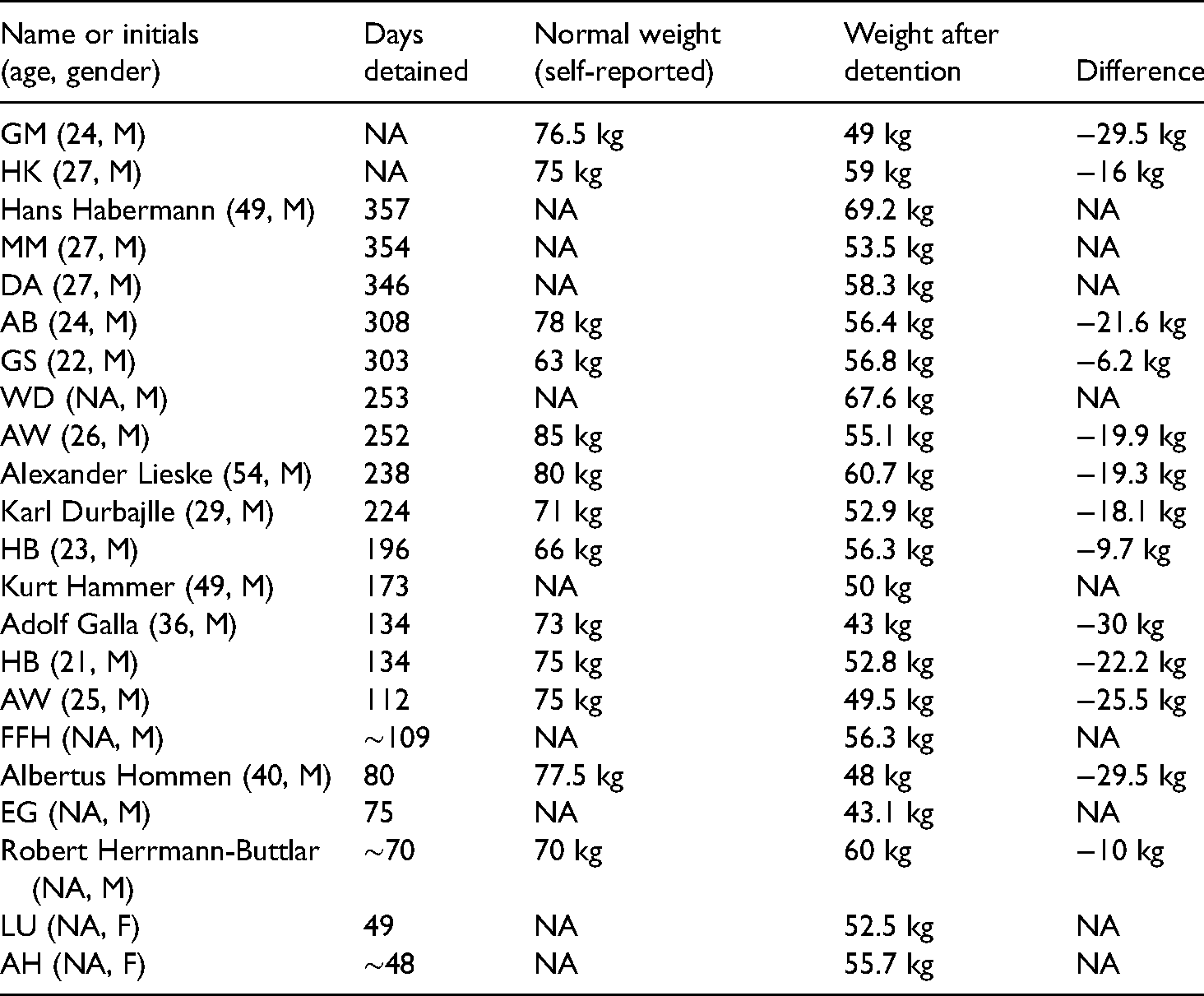
It was of course not the fact that they were being measured with their clothes on that could account for the difference, but the fact that many were kept in solitary confinement – in cells with no furniture, no beds, and no heating, with food taken away as a form of punishment.
45
Solitary confinement was allowed by UK camp rules but CSDIC(WEA) pushed the limits of what was acceptable, with Stephens recognised subsequently as ‘a firm believer in the use of psychological pressure’ as a means of getting intelligence.
46
The extensive use of solitary confinement shocked Stokes, the Labour MP when he visited in 1947. Referring to an 18-year-old woman he met during his visit, he told the House of Commons: That child had been held incommunicado for the best part of three and a half months… I was so ashamed of it that when the door of the cell was shut, I turned to the commandant and said, ‘Goodness gracious, the British Empire will not fall if you allow a child like this out to mix among her fellow human beings.’ The commandant said, ‘Wait until you see her case’ … She was picked up at Koenigsberg by a Russian officer and raped. She lived with him for some weeks, and then she was told that if she took a message over to a certain Herr Schmidt in Schleswig-Holstein, she would on her return be repatriated to her parents. She was picked up by the security police … and sent to a place of civilian detention for inquiry. That is the dreadful woman on whom the whole fate of the British Empire hangs, and in order to make sure that nothing dreadful happens, this wretched child is kept in solitary confinement for three and half months.
47
He went on to say that the temperature inside the cells was ten degrees below zero, and that it was ‘outrageous that human beings, whatever their faults, should be so treated’.
48
Still, Stokes failed to see that such conditions were tantamount to physical mistreatment. He instead found that ‘verbal persecution’ was the only questionable method employed, but that its use was necessary. Stokes's perspective may be seen as highlighting the gap between 1940s and contemporary standards towards acceptable detention conditions. Yet the gap was not as wide for everyone. A Court of Inquiry visiting the camp at around the same time as Stokes did make the connection between conditions that fell short of deliberate physical abuse and such abuse: … it is surely physical pressure to lock a man for, say, 7 days in a completely stone cell, with no underclothing or overcoat in a severe winter, with a window pane missing and not even a chair or a bed at night. There is ample evidence that this has been happening.
49
Yet there is evidence that outright violence was contemplated, and likely used, too. Although detainees’ accusations to that effect were denied by staff, an investigation into the camp in 1947 found ‘documentary evidence of an agreed plan’ between three interrogators to ‘go beyond mental pressure’ when dealing with two detainees, suspected of planning a rising in Hanover on the anniversary of Hitler's birthday:
52
… the guards had apparently been instructed to carry out physical assaults on certain prisoners with the object of reducing them to a state of physical collapse and making them more amenable to interrogation.
53
It is nevertheless the winter conditions that led to a Court of Inquiry being called in the spring of 1947. At that point, some of the detainees’ health problems, exacerbated by the extreme weather, necessitated their transport to a neighbouring British camp's hospital. The Governor of the camp, Major Morgan-Jones, was made aware of some of the cases in February by his medical staff, and he visited them to see their state for himself. The sight of Adolf Galla, a German in his 30 s, suspected of underground Nazi activities, ‘was one of the most disgusting sights’ of Morgan-Jones's life; he had been so malnourished that even though it had been five weeks since he had been hospitalised: … he was still a figure which may well have been one of the Belsen inmates. The man literally had no flesh on him, his state of emaciation was incredible…At the base of [his] spine above the buttocks was a huge festering sore, the size of a man's hand. This I understand was a result of lying on bare boards at [CSDIC(WEA)].
54
Habenicht's case is not where the story of detainee deaths ends. A day before Morgan-Jones was informed about Galla and Buttlar, Franz Österreicher, who had been detained for about three months after crossing over from the Soviet Zone with fake identity documents, 59 died in the hospital after arriving from CSDIC: ‘his organs and the muscles were atrophic’ and his body had no ‘resistance against infection’. 60 The cause of Österreicher's death was ‘starvation and peritonitis’, yet the medical report accompanying him to hospital claimed that he was simply suffering from indigestion. 61 Another detainee who died in hospital soon after was Walter Bergmann, who arrived in such a state that it was impossible to hold him up to measure his weight. 62 He died of ‘severe malnutrition and severe tuberculosis of the lungs’; his medical report from CSDIC reported him as suffering from ‘debility’. 63 Although Bergmann was held in relation to Hitler Youth activities, 64 it was later concluded that he had ‘no Nazi record’, he had entered the camp ‘quite voluntarily in order to give us valuable information’ and yet he ‘was so abominably treated that he died’. 65 His mother was given an unofficial ex gratia payment for her loss.
Shocked by what he saw, Morgan-Jones asked the hospital's doctor to write a report detailing all cases brought to him in the three months to February 1947. As a result, and in addition to the cases mentioned, details were provided for three more men and two women, all of whom had suffered from bronchitis, vitamin deficiency, and malnourishment; other illnesses included ‘rheumatism, heart disease, sickness of the bladder and the intestines’. 66 Soon after, during a meeting of civil internment camp governors, Morgan-Jones was joined by the governor of a neighbouring camp who said that several individuals who were sent to him from CSDIC were also ‘in a deplorable condition which indicated serious ill-treatment’. No detailed minutes of that meeting were kept, ‘for obvious reasons’, though the two governors were instructed to submit reports about what they knew. 67 Shortly after, a medical inspector from the Public Health Office was sent to this second camp to examine the patients. In his report, he described having seen up to eight malnourished individuals, one of whom was close to dying; this inspector too joined the governors in calling for an investigation into the camp. 68
It is at that point in spring 1947 that the Military Governor, Air Marshall Sir William Sholto Douglas, was informed and ordered a Court of Inquiry into the camp within a week. Its terms of reference were to investigate the treatment of detainees and any individual responsibility that would arise if mistreatment was proven. At the same time, Douglas also ordered for the removal of the camp's administration: Colonel Stephens, Captain Smith (the Medical Officer), and Lieutenant-Colonel Short (the Senior Interrogating Officer). No other member of staff was allowed to leave Germany, and administration was passed from the Intelligence to the Legal Division of the British Control Commission. 69
The inquiry went on to find enough evidence of a conspiracy ‘to extract information from internees at all costs’, even though, far from being war criminals, a number of them ‘had committed no offence, the purpose of their detention being that they were believed to hold information of security interest’. 70 As a result, Stephens and Smith, along with an interrogator who had received intelligence training for only two weeks before being sent to CSDIC, where he was ordered to ‘use mental pressure, but no bodily violence’, were court-martialled for breaching various clauses of the Army Act. 71 The decision to court-martial them was taken at a high level, by Ernest Bevin and Lord Pakenham, not least in order to show the local population that such behaviour was unacceptable, even when perpetrated by Britons. After all, developments were taking place against the backdrop of efforts to ‘re-educate’ and democratise Germany. The irony was not lost on the Court of Inquiry, which thought that ‘our efforts to teach democracy in the British Zone tally with an organisation in many respects resembling the Gestapo’. Nevertheless, Stephens was acquitted, his defence having been that he had explicitly prohibited the use of violence, and there was no proof that he had authorised the actions in question. Not leading to his complete fall from grace, the acquittal did lead to his appointment as MI5 Security Liaison Officer in the Gold Coast, which was very likely a form of demotion. The interrogator was also acquitted because the defence failed to present enough evidence against him. 72 It was Captain Smith who was found guilty of neglect – his own responsibility was easier to establish given the misleading medical reports he was issuing – and was dismissed.
Especially considering that Stephens himself was conducting some of the interrogations, he must have been aware of the state many individuals were in, if not the reasons why they were like that. But he also knew better than to leave a paper trail behind. As was common in many other cases where British mistreatment was involved, here too practices often fell short of direct physical violence; they instead took the form of sleep and food deprivation, as well as of humiliating and exhausting tasks aimed at making detainees more malleable to interrogation, rendering any meaningful distinction between prisoner handling and questioning techniques redundant: the treatment of prisoners outside the interrogation room was designed to influence their behaviour in it. 73 It is for these reasons that, while staff could do little to help ease some of the external factors affecting them, what they – from guards to interrogators to the senior administration – instead did was exploit them in order to assert superiority over the detainees and obtain intelligence.
Although only the Medical Officer was held responsible in the eyes of the law, there was no doubt at the time that prisoners had been mistreated: the question was not whether allegations were true, but against whom there was enough evidence for a guilty verdict. Whatever the outcome of the court martials, therefore, the question of what to do with the camp remained; indeed, that question had to be resolved without needing to wait for the court's verdict, which was expected to take months. One of the first tasks of CSDIC(WEA)'s new Commandant, Lieutenant-Colonel Waight was accordingly to write a report on the state of the camp, in which he confirmed much of what Stephens had been reporting since 1945 about problems with the building, its supplies, and ‘the wrong type of man’, including those under suspended sentence, being attached to it. 74 The course of action was becoming all the more clear: CSDIC(WEA) could not go on; if it did, the Public Safety Branch – which also produced a report on the camp – had no fewer than seventeen recommendations to be urgently implemented, ranging from the installation of a heating system to providing detainees with the right size shoe. 75
Intelligence was nevertheless still needed, particularly around Soviet activities. A successor camp was thus considered necessary but had to ‘lose its identification’ to CSDIC, something that was to be achieved through moving it to a new location, with a new name, and mostly new staff. 76 The result was a new establishment in Harsewinkel, operating under the name No.10 Disposals Centre (10 DC) from November 1947 and until March 1951. Underpinning it was a conviction that, unlike its predecessor, it could never be left to its own devices. Consequently, the Intelligence Division had to now share responsibility for the camp with the Legal Division. The former was responsible for all intelligence matters, including whom to detain, the conduct of interrogation, the release of detainees, and the recruitment of intelligence staff. The Legal Division – specifically its Penal Branch – was in charge of all other matters, including the conditions of custody. 77 Moreover, and in order to prevent another Commandant from being able to claim ignorance about their camp's conditions, the 10 DC Commandant was assigned a personal duty to ensure that neither the physical nor the mental health of detainees was impaired by interrogation. 78 The duration of interrogation was also regulated. Whereas in CSDIC(WEA) detention was indefinite, in the new camp the intention was for it to be up to fourteen days. It took the Intelligence Division two months before they complained of difficulties in ‘obtaining any real value’ from 10 DC, ‘owing to the severe restrictions which have been imposed’. 79 After a number of revisions, the rules eventually allowed for individuals to be detained indefinitely, so long as they were not interrogated for more than a total of sixty-one days. 80 This would allow people to be kept in the camp if their release was for whatever reason undesirable but would prevent the motive of such detention from being interrogation. Attempts by the Chief of Intelligence Division himself to increase the 61-day limit in exceptional cases were generally refused by the Deputy Military Governor, which goes to show the level of seniority that the camp continued to attract. 81 Crucially, all rules regulating life in the camp were put in writing and handed out as standing orders to all staff, leaving little to the imagination about who was responsible for what. Responsibility for 10 DC was thus never merely notional. Indeed, up until that point (as well as subsequently elsewhere), intelligence interrogations were generally not regulated by written policy, and so 10 DC marked a significant departure from this norm.
Similarly, illustrative of the level of seniority involved was the fact that Lord Pakenham visited 10 DC in early 1948 and, while he was pleased with what he saw, suggested that the camp be regularly inspected by ‘responsible officials’ from the two divisions it fell under. 82 He also wanted the Home Office – which was responsible for prisons back in Britain – to be involved in such inspections. 83 The suggestion was even relayed to Prime Minister Clement Attlee, who thought it was ‘an excellent one as the Home Office had experience of running this type of institution during the war’, possibly referring to London's Royal Patriotic School. 84 The latter was a wartime interrogation camp for refugees, run by the Home Office in conjunction with MI5, and its living conditions were generally very good. 85 An inspection committee was accordingly constituted, with its chairmanship assigned on behalf of the Home Office to the Deputy Chairman of the Prison Commissioners, Dr Methven. Its other members included the Chief of Intelligence Division and the Legal Adviser, once again indicating the level of importance assigned to matters relating to CSDIC(WEA)'s successors. Moreover, while the committee was reporting to the Military Governor, the Foreign Secretary was receiving copies for information. 86 Put simply, not only regulation but also regular oversight would ensure that 10 DC was never actually left to its own devices.
The committee's first visit accordingly took place in October 1948 and no major concerns were raised, nor were any such concerns raised during the four other inspections up to December 1950. 87 One of the few issues that existed in Bad Nenndorf and which remained in 10 DC was that blankets were being used as mattresses by the detainees. 88 It was not until 1949 – four years into the occupation – that enough mattresses had been bought and the problem was addressed. Yet this simple fact encapsulates an argument made earlier, that while these interrogation centres did indeed exist in a Zone facing a number of problems, difficult circumstances alone did not equate to mistreatment; it was instead the actions of staff that determined that. Accordingly, contrary to CSDIC(WEA), the overall atmosphere of 10 DC came to be praised by the inspection committee. The Commandant, still CSDIC(WEA)'s Waight, who was responsible for the overall running of the place, and the Senior Intelligence Officer, who was responsible for the camp's intelligence work, were also praised for their ‘excellent co-operation’. 89 The success of the running of 10 DC was actually put down to this factor: the two aspects – living conditions and intelligence work – were ‘under separate management but working in the closest co-operation with each other’. 90
The existence of 10 DC nevertheless came into question in 1950, because it was unclear whether its intelligence value justified its cost. Its work appears to have been entirely geared towards those suspected of Soviet sympathies and espionage, with the War Office having particularly benefitted from it: less than a year of 10 DC's opening, it was thought that ‘a large proportion of such information as [the War Office] obtain about Soviet military dispositions’ was coming from it, 91 and so was information on a number of other matters pertaining to the USSR, including the work of the Soviet Ministries of State Security and of Internal Affairs, Order of Battle plans of the Red Army, and Russian scientific and technical intelligence. 92 But while the consensus was that useful intelligence was gotten in the past, there was ‘no individual case of great importance’ to offer as an example. 93 Moreover, despite its forty months of existence, 10 DC interrogated only a hundred people. 94 A Working Party was set up to consider the options. The most viable one was to establish a similar interrogation centre within the premises of an existing prison, specifically Werl. The prospect alarmed Dr Methven. He remarked that 10 DC had ‘become a model Detention Centre and that, if such places are to continue to exist, no better arrangements than those to be found at No.10 DC could be devised’. 95 But his opposition could not counterbalance the cost factor, and 10 DC gave way to an interrogation section in Werl from spring 1951, called No.1 Special Disposals Unit (SDU). The standing orders regulating SDU were those that had regulated 10 DC, with some modifications. Importantly, SDU's prisoners were to be given better treatment than the rest of Werl's population – the result of addressing Methven's concerns about the move – including providing them with ‘food of a standard above that of the normal convicted prisoner’ and ensuring that they would have no contact with such prisoners. 96 The entire establishment was actually very small, especially compared to its predecessors: whereas CSDIC(WEA) employed upwards 300 staff, and 10 DC was employing between thirty and forty, SDU had only six permanent staff. 97 Similarly, whereas CSDIC(WEA) detained 416 people, and 10 DC closer to 100, forty-four individuals passed through SDU in the first two years of its existence.
Problems, however, occurred within Werl more generally, which was under joint Anglo-German control and was detaining many war criminals. So caught up was the administration with the prison's overall problems that Methven's role of inspecting SDU was forgotten, and he had to write to the Foreign Office to ask if he had been discontinued. He resumed duties in May 1952, and on his first inspection came to the conclusion that Werl was ‘one of the most difficult prisons to administer’, with regular uprisings among convicted prisoners, and a lack of cooperation between the German and British staff. 98 A second inspection in January 1953 identified no issues as to SDU. 99 But 1953 saw mounting German opposition towards the continued detention of war criminals, much of which was focused around Werl (not SDU). Like its predecessors, therefore, SDU was not to last for more than three years and seems to have been abandoned by 1954, this time without a direct successor. At around the same time, Britain was preparing to reduce its troops in Germany, the Control Commission was being downsized, and so was the Intelligence Division. Thus, while CSDIC(WEA)'s successors did not step out of line, their fate fits into the broader tendency towards withdrawal.
This article set out to understand the conditions under which the Combined Services Detailed Interrogation Centre in Bad Nenndorf came to adopt abusive practices, despite its wartime predecessors and the intelligence community more broadly having considered mistreatment unproductive and un-British, as well as the reasons it was able to use such practices for so long. It also sought to understand what legacy it left behind, given that establishments resembling it to varying degrees persisted in other places, despite the decisive and effective action that was taken in response to this affair. It found that life in the camp was influenced by a unique set of circumstances, including the memory of Nazi atrocities, the logistical problems of occupation, and the material shortages of early post-war Germany.
Together with this environment, however, were factors less particular to 1940s Germany. One such was the administrative set-up in which the camp operated. The lack of oversight and support afforded to it by the Intelligence Division allowed poor conditions to exist and continue, particularly by recruiting unsuitable staff, by failing to provide supplies or make repairs, by not assisting with the removal of captives and causing overcrowding, and by apparently not properly inspecting the premises. It was the administrative framework that was targeted in the wake of revelations, and it was similarly the revised arrangements that were praised for why subsequent units prevented mistreatment. Although only three individuals were singled out for court-martialling, and while a common explanation in subsequent instances of abuse – which often concerned makeshift and badly organised Special Branches – was the existence of a few ‘bad apples’, a broader significance of this case study is that it demonstrates how abuses on the ground were enabled by higher command.
Nonetheless, the camp's execrable conditions were not only the result of difficult circumstances and poor administration but of spite as well. However, brutalised and guilty some of the detainees already were, and whatever their intelligence value (a question that remains to be examined), the government's own archive leaves little doubt that abuse became an intelligence-gathering method, with the treatment of many of the prisoners inside and outside the interrogation room having served to influence their interrogation. The shift from war to peace may have further justified this kind of treatment of those under interrogation. Whereas wartime CSDICs sought intelligence from prisoners of war, in this case, some detainees had already violated the laws of war, others held allegiances that could threaten the peace, even though in reality there was also a substantial proportion who were neither war criminals nor Soviet spies. 100 Elsewhere, too, the treatment of those not seen as legitimate combatants was at points extreme, including in the British counterinsurgencies that followed the war, where attitudes towards insurgents, detainees, and local populations more generally were underpinned both by the righteousness of the imperial mission and the perceived criminality of anyone who opposed it. 101
The decisive action that was nevertheless taken in 1947 was largely the product of political considerations. Following the Court of Inquiry's report, the camp was closed down, the process of interrogation was reconsidered, and the lessons drawn dictated the running of similar units until withdrawal in the mid-1950s, with direct Home Office and Foreign Office involvement. In contrast, officers and officials went to great lengths to dismiss similar allegations elsewhere, be it by outright rejecting them as anticolonial propaganda, as was usually the case in Cyprus, by concealing evidence of brutality, as was often the case in Kenya, or by ordering inquiries with deliberately limited scope, as was the case in Aden. 102 Whereas the legitimacy of broader policies pertaining to Germany's reconstruction and Westernisation could not be compromised by the stain of torture, in the colonial context transparent responses to enemy claims were seen as damaging to British reputation and, by implication, to the conflict at hand. Consequently, while Britain was successful in turning this early post-war episode into an aberration in Germany, it failed to turn it into a singular, un-British affair altogether.
Footnotes
Acknowledgements
I am grateful to Professor Heather Jones and Professor Neville Wylie for comments on earlier stages of this research.
