




Abstract
Keywords
Introduction
Well-developed oral language provides a foundation for academic achievement (Beitchman et al., 1996), predicts reading and writing success (Pace et al., 2019; Roulstone et al., 2011) and supports learning across the curriculum (Oracy APPG, 2021). Oral language competence is also associated with healthy social and emotional outcomes both at school (Cohen and Mendez, 2009) and in adulthood (Law et al., 2013). Despite its importance, many children entering school have delayed language, with those in economically disadvantaged areas experiencing disproportionate delays compared with their peers in more affluent areas (Law et al., 2011). This uneven distribution may have been exacerbated by the Covid-19 pandemic (Oracy APPG, 2021), making effective oral language support a pressing priority.
Children's language development is influenced by their home and school language learning environments (Hoff, 2006) and language trajectories are particularly malleable in early childhood (Bornstein et al., 2016). Thus, alongside family interventions, a graduated approach offering high-quality language learning environments to all children in early years educational settings as the first tier in addressing language learning needs is widely supported (Bercow, 2008; Ebbels et al., 2019). Such provision should enhance all children's language development (Schmerse et al., 2018) and facilitate the equitable and accurate identification of those requiring additional language support (Dockrell et al., 2012). As educational settings in disadvantaged areas are likely to serve a higher proportion of children with language difficulties, high-quality provision in these settings should be prioritised.
Understanding the quality of language provision in early years education settings is essential to the effective operation of the graduated approach. Through this understanding, strengths of practice can be identified, and the professional development (PD) needs of educators (e.g. teachers, teaching assistants and early years practitioners) ascertained, so that they can be appropriately supported to optimise language supporting provision in their settings. However, little is known about the quality of universal language provision for English pre-schoolers in socially disadvantaged areas as, while studies have documented the general quality of educational provision (Mathers and Smees, 2014; Melhuish and Gardiner, 2019), few have adopted a specific language focus. Furthermore, few studies have examined variation in quality during sessions, something which can have implications for how provision is structured and observed. This study aims to address these gaps by documenting the nature of language provision in nursery classrooms in disadvantaged areas of England across the course of a three-hour session.
Early childhood education in England
In England, primary education typically commences in the September following a child's fourth birthday. Prior to this, parents in England can select from a range of non-compulsory, early childhood education settings. Maintained settings are funded and controlled by local education authorities and include stand-alone nursery schools and nursery classes attached to maintained primary schools. Nursery classes can also be attached to academised schools which receive funding from central government and are run by academy trusts. Other settings, including day nurseries and playgroups, operate within the private/voluntary/independent (PVI) sector. Educator qualifications in England have nine levels and maintained and academised settings must be led by a teacher qualified at level 6 (the equivalent of degree level), whereas PVI settings require managers to hold level 3 qualifications (equivalent to advanced level qualifications typically required for entry to university). Starting ages vary, but 94% of three- and four-year-old children are registered for the annual entitlement to government funded early education (National Statistics, 2023), a rate which reflects the potential for universal provision to influence child outcomes across the population. Children from disadvantaged areas are more likely to attend maintained settings than their more affluent peers (Gambaro et al., 2015) and academisation was intended to support the attainment of pupils from socially disadvantaged backgrounds (Hutchings and Francis, 2018), thus an understanding of practices to support language development in these settings is particularly desirable.
High-quality language supporting provision
To develop language competence, children need repeated exposure to high-quality, conceptually challenging language input in the context of responsive interactions with more knowledgeable conversational partners (Chapman, 2000; Justice, 2004). Thus, language supporting provision encourages children's language development across three interconnected dimensions – the interactive, the linguistic and the conceptual (Rowe and Snow, 2020).
Children's language growth is supported by rich language models. Specifically, educator language use has been associated with children's complex language use (Justice et al., 2013), and lexical (McLeod et al., 2019) and syntactic (Huttenlocher et al., 2002) development. Educators can model language by providing children with labels, making comments, expanding children's utterances (Justice et al., 2018) and using varied and sophisticated vocabulary (McLeod et al., 2019).
As well as supporting the breadth of children's vocabulary through language modelling, educators can support the depth of children's word knowledge with vocabulary supporting strategies such as using gesture and objects (Justice, 2004), using synonyms, explaining word meanings and making links to children's experiences (McLeod et al., 2019). Word learning is likely to increase when support is offered repeatedly across contexts (Justice, 2004). Word learning is an important element of broader conceptual development, which can be supported through opportunities to problem solve, the encouragement of higher order thinking and the use of complex language (Bulotsky Shearer et al., 2020; Hamre, 2014). Such cognitive facilitation has been associated with language gains (Barnes et al., 2017; Hamre, 2014) and the use of abstract and decontextualised language by teachers supports these features in child language (Lohse et al., 2022; Tompkins et al., 2013).
Linguistic and conceptual information is likely to be more impactful on children's language when it is offered responsively (Girolametto and Weitzman, 2002; Hindman et al., 2022), particularly for less verbal children (Gosse et al., 2014) and those from disadvantaged backgrounds (Feldman, 2019). Extended back-and-forth interactions support this contingency (Cabell et al., 2015; Hamre, 2014), allowing educators to tailor their feedback to offer appropriate linguistic and conceptual support in response to children's contributions (Justice et al., 2018). Such interactions have been associated with improved language outcomes (Duncan et al., 2022; Romeo et al., 2018), thus educators in high-quality classrooms will seek to initiate and sustain frequent rich and supportive adult-child conversations in order to maximise opportunities to scaffold children's language development.
Educators can seek to establish these rich interactions by utilising ‘child-oriented strategies’ (e.g. making eye contact) to gain children's interest and attention (Girolametto and Weitzman, 2002), ‘interaction promoting’ strategies (e.g. open questions) to elicit child speech (Girolametto and Weitzman, 2002) and ‘language developing’ strategies (e.g. expanding and extending children's contributions to provide more advanced language models and conceptual information and to encourage further interaction) (Justice et al., 2018). These approaches have been associated with increased language productivity (Girolametto and Weitzman, 2002; Massey et al., 2008) and improved vocabulary development (Cabell et al., 2015; Hindman et al., 2022).
Specific contexts provide rich opportunities for language learning because they elicit the types of adult-child interactions shown to promote language growth (Dockrell et al., 2012; Justice, 2004). Interactive book reading, which engages children in extended dialogue around a text, has been associated with improved vocabulary outcomes (Cabell et al., 2019; Mol et al., 2009), narrative comprehension (Grolig et al., 2020) and narrative production (Pesco and Gagné, 2017). Adult-child interactions in small groups increases the likelihood of establishing ‘joint attention’ (Hassinger-Das et al., 2017), supports individualised attention (Wasik, 2008) and provides opportunities for educators to match content to children's developmental levels (Camilli et al., 2010). These features support children's verbal contributions (Girolametto and Weitzman, 2002). Furthermore, peer interactions can support children's language development (Mashburn et al., 2009). Thus, the provision of such opportunities is a marker of high-quality practice.
While the physical environment is unlikely to impact directly on children's language (Cutler et al., 2022) some suggest it mediates teacher and child language (Justice, 2004) and thus provides a foundation for language learning (Connor, 2013; Turnbull et al., 2009). This could be particularly important for those from economically disadvantaged backgrounds who may have access to fewer language supporting materials than children from more affluent backgrounds (Neuman and Celano, 2001). The physical environment should therefore be conducive to language learning and provide appropriate stimulation in the form of books and resources (Dockrell et al., 2015).
Measuring language supporting provision
Evidence-based observational tools can provide insight into the quality of language provision, supporting understanding of where improvement efforts might most usefully be focussed. Current tools document environmental features, learning opportunities and interactions at various levels of classroom practice and at varying degrees of specificity. At their broadest, tools evaluate practice at a ‘systems-level’, that is across educators and multiple domains (Justice et al., 2018). Although systems-level scores have been associated with children's language outcomes (Howes et al., 2008; Pinto et al., 2013), associations are inconsistent and modest (Justice et al., 2018; Soliday Hong et al., 2019). In contrast, domain-specific measures focus explicitly on language support and include language specific items from systems-level tools (Brunsek et al., 2017; Schmerse et al., 2018), tools specifically designed to capture classroom language support (Dockrell et al., 2015; Phillips et al., 2018) and fine-grained analysis of specific elements of practice (e.g. book reading) (Cabell et al., 2015; Weadman et al., 2022). Domain-specific measures have been more closely associated with children's language outcomes (Connor, 2013) and can support educators to identify areas for the development of language supporting practices (Dunst, 2015). One such measure is the Communication Supporting Classroom Observation Tool (the ‘CSCOT’) (Dockrell et al., 2012) an evidence-based, language-specific observational tool which profiles language support in typical classroom practice over a one-hour observation period. The CSCOT was primarily designed to capture practice in the linguistic and interactive domains, although includes some strategies which relate to conceptual support. Educators reportedly find the CSCOT useful in evaluating and adapting their practice (Law et al., 2019). To date it has been utilised in English classrooms serving school-aged children (Dockrell et al., 2015; Law et al., 2019) and in other countries (e.g. Badar et al., 2022) but not in English settings serving pre-school children. Applying the CSCOT in nursery classrooms provides an opportunity to develop quality oral language pedagogy in these contexts.
Existing evidence
Studies considering the systems-level quality of nursery provision in England have indicated that language support is good (as defined by the tools employed) (Lera et al., 1996; Melhuish and Gardiner, 2019) but, to our knowledge, no studies have utilised a language-specific tool in English nurseries meaning that detailed information about language support in these contexts is limited. Studies in other countries do however suggest that provision could be less than optimal, particularly in economically disadvantaged areas (Neuman et al., 2018). Educators are reported to offer limited language models (Sawyer et al., 2018) and few expansions of children's language (Girolametto and Weitzman, 2002). Interactions are reportedly infrequent and brief (Cabell et al., 2015) with a focus on adult speech (Sawyer et al., 2018). This may arise from the reported infrequency of interaction promoting strategies (Girolametto and Weitzman, 2002; Hindman et al., 2019). Support for conceptual development appears limited with educator talk reported to be basic (Franco et al., 2019), predominantly literal (Chen and Liang, 2017) and contextualised (Franco et al., 2019). Educators are also reported to use few prompts for higher level thinking (Girolametto and Weitzman, 2002) and explicit vocabulary instruction is reportedly rare (Phillips et al., 2018).
Many studies report variation in quality between classrooms and educators (Hindman et al., 2022; Phillips et al., 2018; Turnbull et al., 2009), suggesting that some educators are better equipped to offer language support than others. Variations have also emerged within classrooms, with a reported decline in the number of adult words, conversational turns and instructional, organisational and emotional support across the day (Duncan et al., 2020; Thorpe et al., 2020). These fluctuations are important to understand as the consistency of quality language provision has implications for the amount of high-quality language exposure that children receive, and for when and how quality should be measured. Capturing classroom quality at different times during teaching sessions can support this understanding.
Variation was also observed in studies collecting language-specific data in classrooms serving older children in England. Employing the CSCOT in classrooms serving children four to seven years of age, Dockrell et al. (2015) and Law et al. (2019) reported well-equipped physical environments but few structured opportunities for language learning. Furthermore, while there were strengths in terms of acknowledging learners’ needs, there was less evidence of language developing and interaction promoting strategies (e.g. advanced language models; open questions). However, provision varied across age groups, suggesting that contextual factors such as curricula demands, staffing requirements and children's learning needs, impact on provision (Law et al., 2019). Thus, it is essential that investigations are undertaken in specific contexts of interest, particularly given the importance of PD being tailored to meet need (Cordingley et al., 2015).
The current study
The current study aimed to document the quality of universal language provision in English nursery classes and schools in economically disadvantaged areas, with a view to supporting preschool educators, and those involved in educator PD, to enhance language provision in preschool classrooms serving children most likely to need language support. An accessible, evidence-based, language specific tool (the CSCOT) was employed to observe typical classroom practice across three consecutive one-hour observation periods to address the following research questions (RQ):
RQ1. What are the strengths and areas for development of language supporting provision in the sample preschool classrooms? RQ2. Does the quality of language supporting provision vary across the three consecutive one-hour observation periods?
In accordance with the CSCOT guidance, RQ1 was addressed with reference to the first hour of observation. It was hypothesised that, in line with previous research, the physical environment would be well-equipped but that there would be few structured opportunities for language learning. Furthermore, it was predicted that, while educators would frequently employ child-oriented strategies, language models would be limited, opportunities for back-and-forth interactions would be few and support for children's conceptual development would be minimal. RQ2 was addressed by comparing scores across the three consecutive one-hour observations. It was expected that the frequency of language supporting strategies would reduce across this three hour period (Duncan et al., 2020; Thorpe et al., 2020).
Method
Context for study
Observations were undertaken as part of the baseline measures of a randomised controlled trial (RCT) conducted to evaluate the impact of Talking Time©, a universal intervention and professional development programme designed to support children's language development in areas of significant economic disadvantage in two regions of England, London and the north-east (see Dockrell et al., 2023).
Sample
Thirty-nine classrooms participated (n = 20 in London; n = 19 in north east England). The majority were nursery classes attached to maintained (n = 35) and academy run (n = 2) primary schools. Two were maintained nursery schools. Classrooms were recruited from areas in the lowest quintile of deprivation based on their Income Deprivation Affecting Children (IDACI, Ministry of Housing, Communities & Local Government, 2015) rank (mean IDACI z-score −1.66, SD = 0.56). Children were 3–4 years of age in their final year of nursery. The mean age of children whose parents/carers consented to the RCT child-level assessments (n = 876) was 44 months (SD = 4) and 54% were monolingual. Data collected through standardised tests at the RCT level indicated differences between participating children and normative samples in verbal and non-verbal domains, with participants performing on average a year below the average level expected for their age (Dockrell et al., 2020). Classroom sizes ranged from 7 to 56 (M = 27.64, SD = 11.2) and were typically led by one class teacher supported by an average of 2.44 support staff (SD = 0.51). Lead teachers were invited to provide demographic information by way of confidential questionnaire. Thirty-one responded, all of whom were educated to degree level and whose years of experience ranged from 0 to 30 + years (see Supplemental materials for details). Demographic information was not collected from support staff.
Measurement tool
The CSCOT was employed to profile the quality of the oral language environment across three domains:
Language Learning Environments (‘LL-Environments’) concerning the physical environment. Language Learning Opportunities (‘LL-Opportunities’) concerning structured opportunities for language learning, for example, interactive book reading. Language Learning Interactions (‘LL-Interactions’) concerning language supporting strategies, for example, open questions.
The CSCOT is designed to be used over a one-hour observation period aligned with the first hour of the teaching day. Items in the LL-Environments sub-scale are recorded as ‘present’ or ‘not present’ and occurrences of items in the other sub-scales are recorded up to a maximum of five on the basis that opportunities and strategies observed at this rate during a single hour can be considered securely embedded in practice within observed classrooms. The CSCOT can be applied consistently between expert observers (inter-rater reliability LL-Environment ≥ 83%; LL-Opportunities ≥ 71%; and LL-interactions > 84%) (Dockrell et al., 2015). Its validity is demonstrated by its capacity to capture distinct profiles of provision between year groups and schools (Dockrell et al., 2015) and across studies (Law et al., 2019).
Procedures
Observations were undertaken by the first author prior to randomisation of classrooms in the RCT. Prior to the observations, the first author undertook rigorous training (see Supplemental materials) and participated in three joint reliability observations. The reliability observations were conducted in three separate nursery classrooms, none of which were involved in the RCT. The first author and an expert early years observer independently completed the LL-Environment sub-scale on arrival in the classrooms, insofar as the items allowed. On commencement of the reliability observation period, observers moved around the classrooms together to ensure that the same practice was observed, completing the remaining CSCOT items and scales independently. 100% exact agreement (Cohen's ĸ = 1) was achieved in respect of both the LL-Environment and the LL-Opportunities sub-scales of the CSCOT across all three one-hour observations. For the LL-Interaction sub-scale exact agreement ranged from 75% to 85% (Cohen's ĸ = 0.59–0.69).
Observations took place in October/November 2019 and were conducted during morning sessions in 37 classrooms and, due to timetabling constraints, afternoon sessions in two classrooms. These sessions did not include lunchtime but snack times occurring during ongoing provision were observed. Three consecutive one-hour observations were undertaken during the same nursery session in each classroom. Notes were taken, and scoring was recorded before the conclusion of each visit.
Analysis
RQ1 was addressed with reference to hour 1 of the observation period. In line with prior studies, LL-Environments sub-scale proportion scores were calculated based on the number of items scored present relative to the total number of items and LL-Opportunities and LL-Interactions sub-scale proportion scores based on the number of observed occurrences relative to the maximum number of occurrences (N = 5). Paired sample t-tests and Wilcoxon signed-rank tests were run to compare scores across sub-scales. To account for potential scoring differences across sub-scales and in alignment with the design of the CSCOT as a profiling tool, specificities of practice within each sub-scale were also considered. LL-environments items were considered in terms of the percentage of classrooms in which they were observed, and proportion scores for individual LL-Opportunities and LL-Interactions items were calculated. T-tests were run to compare the relative frequency of occurrence of individual LL-Opportunities. To support interpretation, LL-interactions were mapped to the linguistic, conceptual and interactive language input dimensions on the basis of best fit. To address RQ2, t-tests were used to compare the frequency of LL-Opportunities and LL-Interactions across the three separate hours.
Results
Research question 1: Strengths and areas for development
LL-Environment sub-scale scores (M = 0.67, SD = 0.13) were significantly higher than for LL-Opportunities (M = 0.22, SD = 0.12, t38 = 16.97, p < 0.001, d = 2.72) and LL-Interactions sub-scales (M = 0.54, SD = 0.12, t38 = 5.55, p < 0.001, d = 0.89). LL-Opportunities sub-scale scores were significantly lower than the LL-Interactions (t38 = −20.781, p < 0.001, d = −3.33) and LL-Environments sub-scales.
Findings in respect of individual LL-Environments items are provided in the Supplemental materials. Frequencies of each LL-Opportunity are detailed in Table 1. Structured adult-child conversations were observed significantly more frequently (LLO1 t38 = 4.55, p < 0.001, d = 0.73; LLO2 t38 = 4.35, p < 0.001, d = 0.696; LLO4 t38 = 7.94, p < 0.001, d = 1.271; LLO5 t38 = 3.25, p = 0.002, d = 0.52) and conversations between children were observed significantly less frequently than all other LL-Opportunities (LLO1 t38 = −5.64, p < 0.001, d = −0.902; LLO2 t38 = −4.68, p < 0.001, d = −0.75; LLO3 t38 = −7.94, p < 0.001, d = −1.27; LLO5 t38 = −5.88, p < 0.001, d = −0.94). Individual LL-Interactions are presented in Table 2. There was a strong and significant correlation between the occurrence of LL-Opportunities and LL-Interactions (r = 0.68, p < 0.001).
LL-Opportunities
a
in descending order of average frequency.
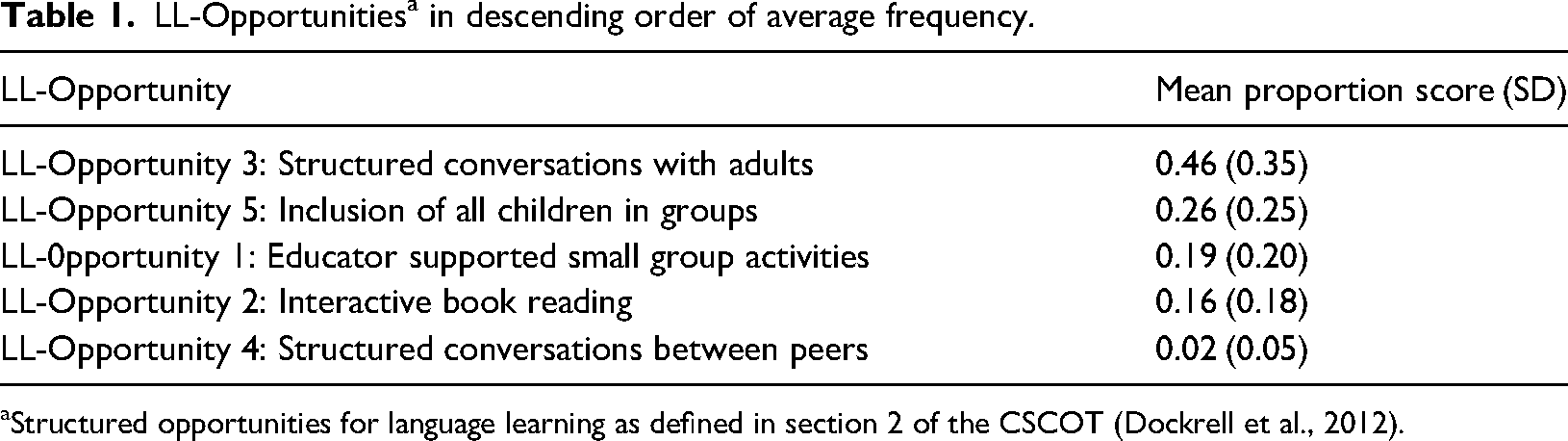
LL-Opportunities a in descending order of average frequency.
Structured opportunities for language learning as defined in section 2 of the CSCOT (Dockrell et al., 2012).
LL-Interactions a by domain in descending order of average frequency.
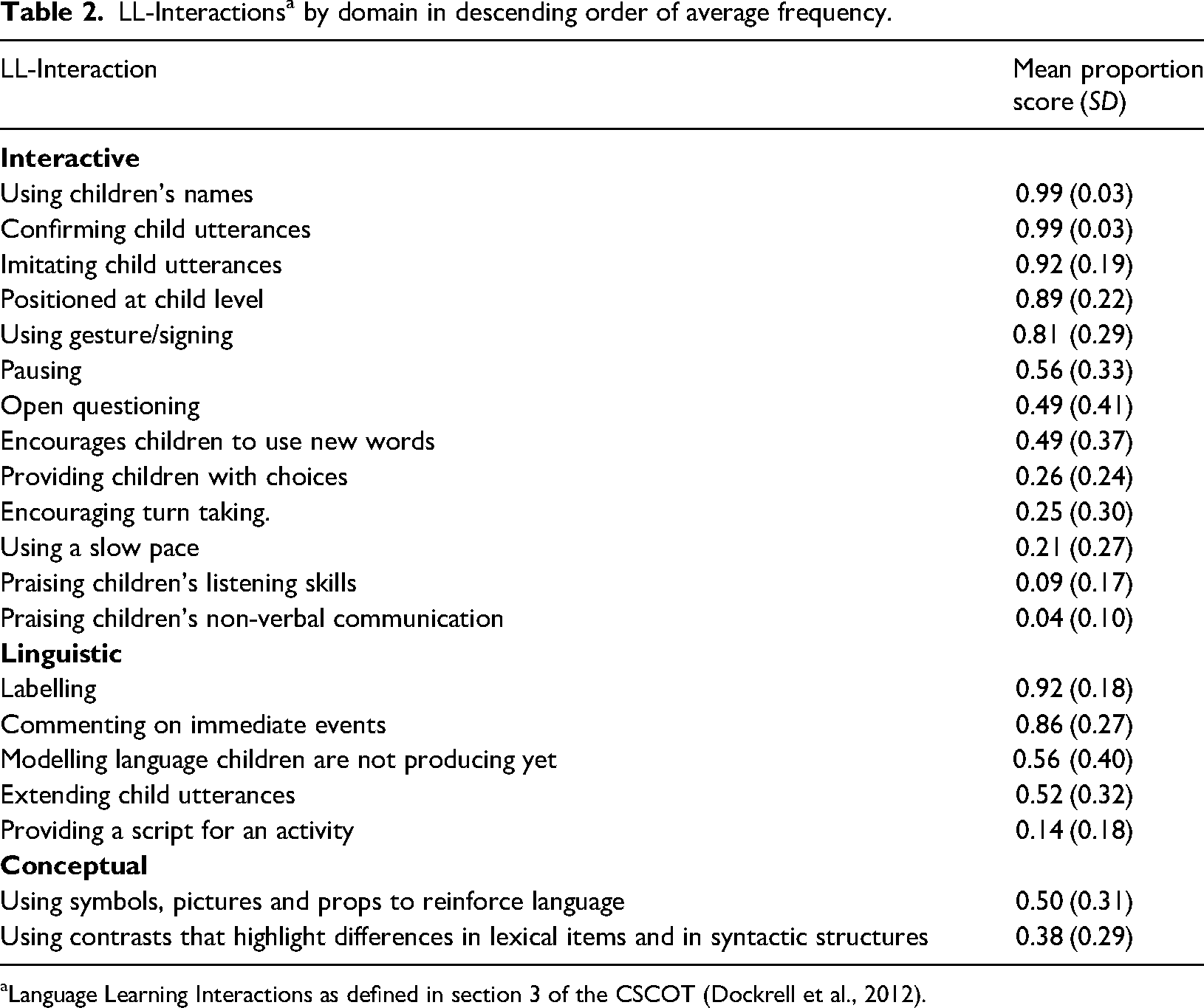
Language Learning Interactions as defined in section 3 of the CSCOT (Dockrell et al., 2012).
Mean proportion scores (MPS) for the LL-Opportunities and LL-Interactions sub-scales for each hour are set out in Table 3. Item level proportion scores across the three hours and for the total observation period can be found in the Supplemental materials. Significantly more LL-Opportunities were observed in hour one than in hours two (Z = −2.551, p = 0.011) and three (t = 3.601, p < 0.001, d = .58). Although fewer opportunities occurred in hour 3 than hour 2, these differences were not statistically significant (Z = −1.458, p = 0.145).
LL-Opportunity and LL-Interaction proportion scores by hour of observation period.
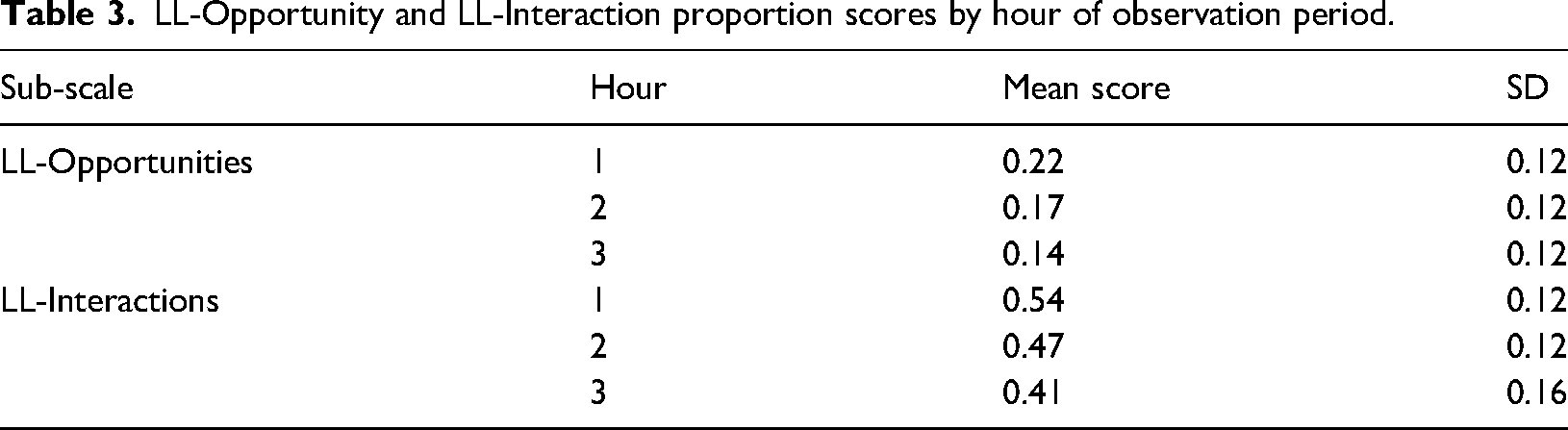
LL-Opportunity and LL-Interaction proportion scores by hour of observation period.
Similarly, significantly more LL-Interactions were observed during hour 1 (M = 0.54, SD = 0.12) compared with hours 2 (M = 0.47, SD = 0.12) (t(38) = 4.582, p < 0.001, d = 0.73) and 3 (M = 0.41, SD = 0.16) (t(38) = 7.262, p < 0.001, d = 1.16). LL-Interactions were also significantly more frequent in in hour 2 than hour 3 (t(38) = 3.069, p = 0.004, d = 0.49), indicating that the quality of language learning provision reduced over the course of the observation.
Children require access to high-quality language provision across the linguistic, interactive and conceptual domains to support their language competence (Rowe and Snow, 2020) and environments and opportunities should be designed to maximise the quality of this provision. This is especially important for children at greater risk of language delays associated with social disadvantage. This study employed the CSCOT to document the nature of language support offered across 39 nursery classrooms in economically disadvantaged areas of England and is the first to adopt a specific focus on the quality of classroom level language provision in English nurseries and to consider whether this practice varied across observed sessions. It was predicted that the physical environment would be well equipped, that there would be few structured opportunities for language learning and that, while educators would respond sensitively to children, they would utilise fewer strategies to extend children's language.
In line with predictions and previous research using the CSCOT in classrooms serving older children (Dockrell et al., 2015; Law et al., 2019), LL-Environment proportion scores were highest, highlighting provision in the physical environment as a relative strength of practice. This may be particularly important for children from disadvantaged backgrounds who may be less likely to have access to language learning resources in their homes and communities (Neuman and Celano, 2001). Low scoring items (e.g. displays featuring children's work) could be explained by the conduct of the observations early in the new school year when there was likely insufficient time to create children's work for display. Two areas of provision which might easily be addressed were the absence of bilingual/multilingual texts and non-fiction texts outside of the designated book area. The presence of such texts could increase the cultural and practical relevance of texts to children, which in turn could encourage access to literacy (Axelrod and Gillanders, 2015; Dowhower and Beagle, 1998). Bilingual/multilingual texts could be particularly relevant in these classrooms where significant numbers of children spoke other languages.
Proportion scores for LL-Interactions were higher than proportion scores for LL-opportunities. This was expected and is arguably desirable given that structured opportunities for language learning provide the supportive context within which a variety of language learning interactions can occur. In terms of the nature of LL-interactions, support in the linguistic domain was offered in the form of regular comments and the frequent provision of labels for actions, objects and abstractions (MPS = 0.86 and 0.92 respectively). Contingent linguistic models, for example, modelling language children were not yet producing and extending children's utterances, were less frequent (MPS = 0.56 and 0.52 respectively), and more extended linguistic models (e.g. scripting) were rare (MPS = 0.14). The use of these strategies might be considered limited in relation to the number of children in observed classrooms and, given that contingency is an important element of language support (Girolametto and Weitzman, 2002; Rowe and Snow, 2020), increased use of child-dependent language models is desirable.
In the interactive domain, educators consistently employed child-oriented approaches (e.g. using children's names, confirming and repeating utterances) (MPS = 0.92–0.99). The consistent use of such strategies is important, particularly for children with low language levels (Gosse et al., 2014) and from economically disadvantaged backgrounds (Feldman, 2019). Gesture, symbols, pictures and props can also be utilised to foster joint attention. Gesture was frequently observed (MPS = 0.81), whereas symbols, pictures and props (which can support the development of children's lexical awareness (Justice, 2004)) were observed less often (MPS = 0.50), perhaps reflecting the need for increased planning for the use of props. Timing of adult speech is also important for engaging children, yet use of a slow pace was infrequently observed (MPS = 0.21) and support for non-verbal communication and praise for listening skills represent a further form of responsiveness which was almost never observed (MPS = 0.04 and 0.09 respectively), and which might be encouraged in future PD.
Strategies explicitly encouraging children to make verbal contributions are also key in the interactive domain. Asking open questions, encouraging children to use new words and pausing were less commonly observed than child-oriented approaches (MPS 0.49–0.56). More supportive interaction promoting strategies, such as providing children with language choices (e.g. ‘Would you like the red boat or the blue boat?’) and encouragement of turn taking, which can offer increased scaffolding for child speech and interaction, were even less frequent (MPS 0.26 and 0.25 respectively). This aligns with findings that high-support strategies are rarely utilised by educators (Pentimonti et al., 2017) and could indicate that educators struggle to adapt their support for children with lower language levels. Overall, interaction promoting strategies were observed less frequently than language modelling strategies. This aligns with findings that educator talk dominates in classrooms (Sawyer et al., 2018) although could reflect educators providing children with language models before encouraging them to produce language. While this may be beneficial for children with lower language levels (Ard and Beverly, 2004; Grolig et al., 2019), multiple studies have emphasised the importance of supporting all children to use language (Cabell et al., 2015; Girolametto and Weitzman, 2002; Justice et al., 2018) regardless of age or existing language level.
Findings in the conceptual domain were limited in the current study. Although some strategies specified in the CSCOT can be employed to support conceptual development (e.g. comments, open questions), no record was made of the purpose for which these strategies were employed thus the degree of conceptual challenge offered cannot be reported. Two strategies which clearly relate to conceptual support, highlighting difference in lexical items and using props, were utilised by educators (MPS = 0.38 and 0.50 respectively) indicating that some support for conceptual development was offered. However, a more detailed understanding is desirable given the importance of such support for children's language development (Gosse et al., 2014; Hamre, 2014; Rowe and Snow, 2020).
Thus, while many LL-Interactions occurred, and educators were adept at responding sensitively to children and modelling simple language, there were notable gaps in contingent and sophisticated language models and more supportive interaction promoting strategies. Furthermore, the lack of data on the contexts in which interactions occurred means that children may well be differentially exposed to LL-interactions unless they are embedded across activities in which all children engage at some point over the session.
Indeed, regular structured opportunities for language learning, such as learning in educator-supported small groups and interactive book reading, are key to ensuring sufficient exposure (Justice, 2004). However, educator-supported small groups were inconsistently utilised (MPS = 0.19), suggesting that not all children will receive the necessary exposure to support their oral language skills. Given their importance as a context for language development (Wasik, 2008), understanding barriers to their use, and specifically considering how educators might run these groups with limited staffing, is important. Interactive book reading was also infrequent (MPS = 0.16) mirroring studies in other countries (Phillips et al., 2018). Evidence suggesting that interactive book reading supports children's vocabulary (Mol et al., 2009) and comprehension (Grolig et al., 2019) makes this an important area for development. Although the CSCOT does not distinguish between small group and whole group book reading, field notes indicated that most reading was whole class, offering limited opportunities for staff to personalise sessions to meet the needs of diverse language learners. Small group reading may be more supportive of children's verbal participation, understanding and recall (Morrow and Smith, 1990), thus, increasing the incidence of this practice is important in addressing children's language learning needs, especially in areas of social disadvantage. A higher dosage of interactive book reading may be needed if positive effects on children's language are to be realised and sustained over time (Noble et al., 2019).
Structured conversations between adults and children occurred more frequently, although the MPS of 0.46 equates to a capped average of just 2.3 conversations per hour. Given the influence of extended back-and-forth interactions on children's language (Duncan et al., 2022; Romeo et al., 2018) increasing their frequency is key. The impact of children's language levels on the occurrence of these back-and-forth interactions should be considered as educators may need specific support to initiate and sustain interactions with children with poorer oracy skills. Indeed, interactions between young children with limited language were very rarely observed.
In line with previous findings (Phillips et al., 2018), large standard deviations reflected variation across classrooms. Understanding the reasons for these differences is important. Some educators may be more skilled at supporting language than others, indicating the need for adaptive PD and the potential for PD based on communities of practice or peer mentoring (Tschantz and Vail, 2000). Measures evaluating quality at the level of the individual educator could be utilised to consider this further. Variation in structural features is also important to consider. Observed classrooms had different adult-child ratios and the experience, training and qualification levels of staff varied (although these data were only collected for lead teachers). Furthermore, the influence of more distal factors such as school leadership was not investigated. Understanding how such features impact on the quality of language support is important to informing recommendations for action.
Variation may also have arisen from differences in routines across classrooms as the quality of language support is impacted by group size and activity type (Thorpe et al., 2020; Turnbull et al., 2009). Thus, evaluating the quality of ‘barometer events’ (Thorpe et al., 2020), that is specific activities which have the potential to be language supporting and which can be easily compared across classrooms, could be a useful alternative or supplemental means of assessing relative quality and identifying areas for development. Tools such as the Emergent Literacy and Language Early Childhood Checklist (Weadman et al., 2022), which assesses the quality of interactive book reading, could support this.
Finally, variation could have resulted from educators adapting language support to meet the differing needs of children in their classrooms (Connor, 2013; Thorpe et al., 2020). The bi-directional nature of language (Justice et al., 2013) and the need for language support to be well adapted to individual children (Neugebauer et al., 2021), makes the relationship between the language used by children and teachers an important aspect to consider when evaluating quality, particularly in light of the findings of Deshmukh et al. (2022) which suggest that educators select strategies to provide differential scaffolding to different child responses.
As predicted, variation also occurred across the nursery session, with the frequency of LL-Opportunities and LL-Interactions reducing as sessions progressed. These findings reflect those of Thorpe et al. (2020) and Duncan et al. (2020) which indicate a reduction in language support across the school day. Potential explanations for these findings are increasing tiredness of staff and children, and the more frequent occurrence of small group sessions earlier in the session. The latter proposition is supported by the strong and significant correlation between LL-Interactions and LL-Opportunities sub-scale scores, but further investigation is necessary. Meanwhile, educators might consider how they could increase LL-Opportunities and LL-interactions across the whole teaching session. Tier 2 targeted interventions might also be timetabled towards the end of sessions, when children potentially stand to benefit less from universal provision.
Limitations
Despite the uniqueness of the data presented the study is subject to various limitations. The findings relate to a single observation at the beginning of the school year, so time of year differences are not captured. Multiple observations could increase the representativeness of these data. Observations at different times of day would be advantageous given evidence of fluctuation revealed by this study. Although rigorous training was undertaken and high interrater reliability was established, observations were conducted by a single observer. While this provides consistency in scoring, findings could be subject to observer bias. The sample was representative of areas of social disadvantage in London and the northeast, but findings may not generalise to other contexts. Furthermore, more detailed demographic information for support staff and children would support a deeper understanding of variation across classrooms and inform recommendations for development. Limitations of the tool employed should also be noted. The CSCOT was designed as a profiling tool for use by educators and could be more suited to profiling individual classrooms than generalising across them (Dockrell et al., 2015). While the CSCOT captures the frequency of language learning opportunities it does not document their duration limiting its capacity to establish what proportion of classroom time is allocated to language support and how this relates to wider quality. Further, to date CSCOT scores have not been associated with improved child language outcomes which is arguably the ‘gold standard’ for quality measures. Finally, despite the large number of classrooms there was insufficient data to perform a factor analysis, and the underlying factor structure of the CSCOT could not be investigated or confirmed. This means that analysis and conclusions are based on a theoretical framework, albeit one supported by an extensive literature review. Potential limitations also apply to the use of the IDACI rating to identify disadvantaged areas as it captures income deprivation with limited accuracy, missing around 27% of children from low-income backgrounds and inaccurately classifying 32% of children as coming from a ‘low-income’ background (Jerrim, 2021). IDACI rankings taken from the school postcode rather than individual home addresses mean that the level of economic deprivation experienced by the children in the classrooms may have been over or underestimated. Finally, this study was undertaken in the English cultural context and the impact of culture on practice and expectations for high-quality have not been interrogated.
Conclusion
The CSCOT has provided rich information about language supporting provision across 39 nursery classrooms in disadvantaged areas of England. Strengths of practice have been identified. Physical environments were well equipped, and educators were adept at responding sensitively to children, frequently employing strategies to engage children's attention. Educators supported language learning through the consistent use of simple language modelling approaches such as labelling and commenting. However, the relative lack of more structured LL-opportunities, such as small group interactive book reading, indicates that these exposures may not be consistent for all children. A further challenge for practice is reflected by the limited occurrence and length of conversations between adults and children, and between peers. PD should build on the existing strengths of individual educator's practice to support the enhanced use of interaction promoting strategies, such as using a range of prompts and a slower pace, as well as the provision of more complex and contingent language models, which may in turn support an increase in extended interactions.
The CSCOT has an important role as an accessible tool for educators, however it might usefully be supplemented by fine-grained investigations of specific aspects of practice. This would allow for reliable comparisons across classrooms, support our understanding of how language support varies by activity type and duration, and advance our understanding of key aspects of high-quality language provision including the content of the linguistic model, support for conceptual development and educator adaptation to individual learner need. Nonetheless the CSCOT was designed with a view to empowering educators, and PD based on this premise seems more likely to result in the high-quality language supporting provision so many children need.
Supplemental Material
sj-docx-1-clt-10.1177_02656590241252044 - Supplemental material for The quality of universal language supporting provision in maintained nursery classrooms in economically disadvantaged areas of England: Identifying strengths and areas for development
Supplemental material, sj-docx-1-clt-10.1177_02656590241252044 for The quality of universal language supporting provision in maintained nursery classrooms in economically disadvantaged areas of England: Identifying strengths and areas for development by Keeley Dobinson, Sandra Mathers, Claire Forrest, Jenna Charlton and Julie Dockrell in Child Language Teaching and Therapy
Footnotes
Acknowledgements
We would like to acknowledge Professor James Law who was instrumental in conception and conduct of the randomised controlled trial with which this work is associated and whose commitment to supporting children with speech, language and communication needs was unwavering. We would also like to thank the settings, practitioners, children and families whose involvement made this work possible and Catherine Phillips for her knowledge, guidance and support with the observation process.
Declaration of conflicting interests
The authors declared no potential conflicts of interest with respect to the research, authorship, and/or publication of this article.
Funding
The authors disclosed receipt of the following financial support for the research, authorship, and/or publication of this article: This work was supported by the Nuffield Foundation (grant number EDO/43391).

Supplemental material
Supplemental material for this article is available online.
References
Supplementary Material
Please find the following supplemental material available below.
For Open Access articles published under a Creative Commons License, all supplemental material carries the same license as the article it is associated with.
For non-Open Access articles published, all supplemental material carries a non-exclusive license, and permission requests for re-use of supplemental material or any part of supplemental material shall be sent directly to the copyright owner as specified in the copyright notice associated with the article.
