



Abstract
Total Communication is a collaborative intervention approach delivered by teachers and speech and language therapists (SLTs) to support children with complex speech language and communication needs (SLCN). Total Communication combines the intervention approaches of active learning and support for speech using augmentative and alternative communication (AAC). The AAC consists of signing, and the use of voice output communication aids / speech generating devices (VOCAs / SGDs) and communication boards. This study reports on the evaluation of the effectiveness of this approach to support primary age children with complex SLCN. The study aims to determine if the collaborative Total Communication approach facilitates communication ability. The following questions are asked: does the Total Communication approach increase the communication ability (mean length of utterance, and number of propositions, using any communication mode) of pupils with severe and complex SLCN? Is conducting an evaluation study of a holistic Total Communication approach using single case experimental design (SCED) in a special school context effective? A multiple probe design across participants was used to evaluate Total Communication with three children between 8 and 10 years. Following baseline, the children took part in the Total Communication intervention in a story telling context, via class-based active learning with speech, signing and VOCAs plus communication boards. Probes measured the children's subsequent story re-telling with these communication modes. All participants showed increases in their production of propositions and the mean length of their longest utterances, using a variety of modes of communication. Gains were sustained and generalised. The study shows Total Communication is effective in increasing the communicative ability of children with complex SLCN.
Keywords
Introduction
In the UK, children with speech, language and communication needs (SLCN) are educated in mainstream and special school provision, the majority in mainstream provision with varying levels of speech and language therapy support (Department for Education (DfE), 2022), via a range of service delivery models. Speech and language therapists (SLTs) often work with schools through a consultative model to enable school staff to deliver interventions individually or at the level of the classroom or whole school. This inter-professional collaboration offers much opportunity to meet the educational needs of children with SLCN. There is a desire from teachers and SLTs to increase their collaborative practice (Glover et al., 2015; Langner et al., 2021). Quigley and Smith (2022) describe four core attributes of inter-professional practice and suggest that when supporting children with SLCN, teachers can share experience and knowledge of curriculum, literacy and pedagogy while SLTs can share experience and knowledge of language disorders, language development and enrichment practices.
A survey and focus-group methodology of teachers and SLTs working in primary schools in Australia identified barriers to effective collaboration in increasing positive outcomes for children with SLCN. Systemic strategies to overcome these barriers included increasing knowledge and skills at an individual level, interprofessional collaboration and organisational support (Glover et al., 2015). Although focused on teacher and SLT collaboration to use augmentative and alternative communication (AAC) in inclusive education settings, Pampoulou (2016) also confirmed a shared understanding of professionals’ roles, resources and organisation support are instrumental to effective collaboration. Badar et al. (2022) used the Communication Supporting Classroom Observation Tool (CSCOT) to increase the knowledge and skills of teachers in Brunei. This collaborative training was effective in enabling teachers to use more targeted communication-supporting strategies. However, although there is support for inter-professional practice, there is still a paucity of detail for strategies and activities that can be used to put collaborative working into practice (Quigley and Smith, 2022). Where teachers and SLTs work together in specialist educational provision within the same organisation, it is argued effective collaboration is more achievable than when teachers and SLTs are employed by different organisations and separated by physical space.
Background to the Study
This study is an evaluation of a Total Communication intervention approach carried out at a non-maintained special primary school for children with severe and complex SLCN. As a non-maintained school, the school is charitably run, not maintained by a local government authority and not profit-making. All children attending the school have an Education, Health and Care Plan (EHCP), which is a legal document mandating the specialist support the child needs to access their learning. In the school, inter-professional collaboration between teaching staff and SLTs is integral to the educational provision. Each school class has a dedicated class team consisting of a teacher, an SLT and a learning support assistant (LSA). These class teams use a range of integrated and collaborative approaches, speech and language learning is integrated into lessons and some joint sessions are run by teachers and SLTs together in areas such as storytelling, news and social skills development.
Teachers, SLTs and LSAs all use a Total Communication approach to support the pupils’ speech, language and communication abilities and to enable access to learning. This study reports on an evaluation of the Total Communication approach delivered by teachers, SLTs and LSAs in its effectiveness in facilitating the communication of pupils. The study employs a single case experimental design (SCED), and specifically, a multiple probe design across participants.
Background to the Total Communication approach
Human communication is multimodal, using the two main modalities of visual and auditory in two or more forms in parallel; however, typically one form, usually speech, tends to dominate (Loncke et al., 2006). These authors summarise the two core assumptions of AAC: that alternatives for standard communication forms such as signs, symbols and electronically generated speech can supplement or replace speech; and that ‘adding modes of communication to speech has the potential to strengthen the message’ (Loncke et al., 170). Historically, there has been a controversy around incompatibility or compatibility of combining modes, where the incompatibility hypothesis holds that the use of one mode will inhibit expression and development in another mode. This controversy has been most evident in the field of deaf education with many educators believing that using signing will be detrimental to speech development. However, the educational philosophy of Total Communication, the simultaneous use of speech and sign, was also first introduced in deaf education, in the 1960s (Rendel et al., 2018). David Denton, described as the creator of Total Communication, explained in an interview with Beck (2005): ‘Total Communication has as its foundation, that…. we had to facilitate lip reading, sign language and maximal communication via the transfer of information, using all channels together’. The term ‘Total Communication’ was first used by Roy Holcomb, working in California (Beck, 2005). The concepts of ‘using all channels together’ and ‘adding modes of communication to speech has the potential to strengthen the message’ are central to the Total Communication described in this study.
The Total Communication approach described in this study, is a holistic approach specific to the school, which combines spoken communication, signing, low tech communication boards, voice output communication aids (VOCAs) and active learning. Total communication is implemented in all school settings, by all staff, with all pupils as part of their learning and everyday lives.
The signing system implemented is Sign Supported English (SSE). SSE is a method of speaking and signing at the same time, in English grammatical word order. SSE's core vocabulary is the same as Makaton, whose signs are based on British Sign Language (Marshall and Hobsbaum, 2015; Sheehy et al., 2009). SSE has additional signs to mark grammar. SSE is often used within educational settings to support spoken English (National Deaf Children's Society, 2022). At the school, SSE is used in three stages: in stage 1 a single sign is used to communicate the main functional idea for children who are starting to learn signing in lower language level classes (e.g. ‘more’, ‘home’); at stage 2 all of the key information carrying words are signed, to support key messages and encourage independence (e.g. ‘The
Signing is evidence based in supporting word learning in children with and without SLCN. Signed gestures, particularly iconic gestures, are used to scaffold novel word learning in pre-schoolers with specific language impairment (SLI) (Lüke and Ritterfield, 2014; Van Berkel-van Hoof et al., 2016). Typically developing hearing children in prekindergarten who received sign instruction scored significantly higher on a standardised vocabulary assessment than children who received no signing instruction (Daniels, 1994). Daniels (1994) concluded ‘simultaneously presenting words visually, kinesically, and orally enhances a child's vocabulary development’ (p. 291). The use of signs is supported by SLTs. Morgan et al. (2019) surveyed 245 SLTs working with preschool children with SLCN in England, in order to construct a therapy framework of SLT practices. Of these SLTs, 86% reported that work to support children's functional communication was essential, with signing and symbols being key approaches for use to support comprehension.
Low tech communication boards at the school are bespoke paper-based resources to support pupils’ communication in particular lessons and in specific settings such as snack-time or a play activity. The boards display the key vocabulary in written and symbol or pictorial form that pupils are likely to need in that setting or for that activity. The symbols used are Widgit Symbols (Widgit, 2024) which is the symbol system used across the school. Vocabulary is chosen according to the need of the child or children in the particular setting where the communication board is required, and boards are made by either SLTs or LSAs. For the study the communication boards were the same grids that were used on the VOCAs, printed by the LSA. Communication boards enable pupils to communicate by pointing to the symbols and words they want to use. Scott (writing in Wilson et al., 1998) describes the range of low-tech AAC systems, including communication books, communication boards and topic boards and how these can give a flexible, powerful and quick means of communication both in their own right and as a back-up to high-tech AAC.
VOCAs, which are also known as speech generating devices (SGDs), range from those that speak a single recorded message, through VOCAs that allow the user to select or use a sequence of messages, to dynamic-screen VOCAs that display symbols or graphics on a screen using a specialist app or computer software that also ‘speaks’ aloud the words chosen by the pupil (Call Scotland, 2022; Communication Matters, 2024). The children who use VOCAs at the school each have their own allocated or outside-agency provided mobile dynamic-screen VOCA, which is available to them at all times. The apps or software used are supplier provided vocabularies featuring grids of cells that display words and symbols together. The vocabulary predominantly used is the symbol-based core vocabulary ‘Super Core’ within ‘Grid’ (Smartbox Assistive Technology, 2024) which uses ‘Widgit’ symbols (Widgit, 2024). The Super Core vocabulary on the VOCAs is modified for use at the school by the school's Aided AAC Coordinator, an SLT. Modification is by using both colour coding for word types, and grids specifically made to support approaches used at the school, such as Zones of Regulation (Kuypers, 2011), storytelling, and other lessons as required. Modified grids for particular lessons, such as class stories, follow the principal of left to right presentation of vocabulary with a basic grammatical subject–verb–object word order, alongside linking cells to other grids within the core preprogrammed vocabulary, e.g. for verbs, prepositions etc. Children create sentences, e.g. within story grids, by manually tapping cells on the screen for the key story words they want to use and can also use the linking grids for other vocabulary and grammatical features. Voice output is by individual word and/or by completed sentence, depending on child preference; child voices are in UK English by gender, which can be altered in pitch and speed. Children's individual VOCAs are personalised with the names of people important to them and may have particular grids for personal activities and settings. VOCA editing can be performed directly on the VOCA or remotely, with most editing and personalisation being performed remotely.
Recent systematic reviews and meta-analyses have explored the use of VOCAs (SGDs) with children with complex communication needs. Gevarter and Zamora (2018) conducted a systematic review of 32 single-subject studies teaching children with complex communication need to use SGDs expressively. Nineteen of the studies were found to have consistent positive results. Ciarmoli and Stasolla (2023) conducted a systematic review of ‘existing scientific literature’ for using AAC with adolescents and children with neurodevelopmental disorders; their results showed ‘clear levels of effectiveness’ for the use of high-tech and medium-tech SGDs in developing language and communication skills. A meta-analysis by Pak et al. (2023) looked at 19 single case studies with a total of 66 participants, which compared young children's development of communication skills for requesting, using SGDs and other AAC. Children in these studies learned to request better, and preferred, using SGDs when compared to manual sign.
Active learning is an integral component of the Total Communication approach. Bonwell and Eison (1991) defined active learning as ‘involving students in doing things and thinking about what they are doing’ (p. iii) and recommended active learning strategies such as drama, role playing, visual-based instruction, demonstrations and discussion. These active learning strategies are used across the school as part of Total Communication. In a meta-analysis of 15 studies between 1980 and 2013, Pesco and Gagné (2017) explored the use of props and role play in storytelling approaches for supporting narrative language skills in pre-school children. They found that the most positive effects for narrative expression were when such nonverbal strategies were combined with verbal strategies.
The Total Communication approach is specific to the school and combines this range of intervention approaches. As we have seen, there is evidence to support the use of signing, VOCAs, active learning and low-tech communication aids when evaluated independently. There is limited evidence for supporting the use of such interventions when combined together. King (2010) evaluated an approach combining use of ‘speech-generating AAC systems’ (i.e. VOCAs), with ‘traditional intervention techniques’ (p. 91) for improving production of target speech sounds, for three boys between 4 and 9 years with childhood apraxia of speech (CAS). King reported positive improvements in these participants’ speech and some improvements in communication. Light et al. (2021) reported on a single case study using natural speech, signs and gestures, an AAC app on mobile technology and various low-tech materials for a child with complex communication needs and developmental delay. This 3-year-old girl showed ‘substantial gains in language, speech and literacy skills’ over an 18 month period. Iacono and Duncum (1995) compared using sign on its own and sign combined with an electronic device for early language intervention with a preschool girl with Downs syndrome. For eliciting single word productions their results showed that combined use of the electronic device and signs was more effective than sign alone. Iacono et al. (1993) compared the effectiveness of using speech and signs, with speech, signs and an electronic communication aid, for two intellectually disabled children. The results included increases in the use of two-word combinations, but differences for the comparative effectiveness of sign and the electronic device. Further research is needed into the combined use of intervention approaches.
Teachers and SLTs both work in special school provisions, but research evaluating the effectiveness of teacher and SLT collaborative practices is limited. Ebbels and colleagues have very successfully shown the effectiveness of specific language intervention approaches for pupils with developmental language disorder (DLD) in the special school context where they work, using randomised controlled trials and controlled cohort studies (Ebbels et al., 2022, 2017, 2014). However, although the intervention described in these studies is delivered in a school, there is little collaborative practice in the studies in delivering and evaluating the intervention as this is usually delivered individually to the pupils by the SLTs employed in the school. Ebbels et al. (2019) have pointed out that good evidence exists for individualised and direct delivery of interventions by SLTs, and strongly recommend investigating the effectiveness of approaches for children with language difficulties which are provided using service models that have less evidence. The intervention used in the current study is delivered via a collaborative model and the researchers (the first two authors) evaluating the intervention are an SLT and a teacher.
More research is needed to understand the potential effectiveness of collaborative and holistic communication intervention approaches such as the Total Communication approach to facilitate the communication abilities of children with severe and complex SLCN in a school setting. This study employs a single case experimental design (SCED), specifically a multiple probe design across participants, in which performance by participants during an intervention is compared to the same participants’ performance during baseline conditions (Gast et al., 2014); experimental control being achieved by a time lag in introducing the intervention to each participant (Hammond and Gast, 2010). Intervention with the use of Total Communication follows baseline sessions without the use of Total Communication. The use of multiple probes (or data collection points) through the phases of the study, i.e. at baseline, and during intervention and generalisation, gives continuous measurement of the participants’ performance.
The aim of this study is to determine if the Total Communication approach, when delivered collaboratively between teachers, speech and language therapists and learning support assistants, facilitates the communication ability of children with severe and complex SLCN. Communication skills are defined as ‘the ability to convey information and ideas effectively’ (www.collinsdictionary.com). Norbury and Bishop (2003) have described how narrative assessment is sensitive to children's communication impairments. Two commonly assessed aspects of children's narrative are production of propositions (Assessment of comprehension and expression 6–11, Adams et al., 2001) and length of utterance (The Bus Story, Renfrew, 2010b). These narrative characteristics were therefore used as indicators of communicative ability for this study.
The study asks the questions:
Does the Total Communication approach increase the communication ability (mean length of utterance and number of propositions using any communication mode, as well as type of communication mode used) of pupils with severe and complex SLCN in a special school context? Is conducting an evaluation study of a holistic Total Communication approach using a multiple probe across participants experimental design in a special school context effective?
The study received full ethical approval from the Ethics Committee, Faculty of Health, University of Sheffield.
Method
Participants
This study aimed to investigate the effect of the Total Communication approach for children with severe speech and language difficulties as their primary need. The school's pupil records were used to identify all such children within the school. The school sent a letter to parents informing them that a research project into the Total Communication approach was to be taking place. Three participant children were selected at random, using a random name generator, from all children in each Key Stage 2 class who met the inclusion criteria of: (a) a severe expressive language disorder and severe or moderate–severe receptive language disorder; and (b) a severe speech articulation disorder or phonological speech errors. The school sent the parents of these children a letter informing them that their child was invited to take part in the study, and an information sheet giving detailed information including: the study's aims, that it was the decision of the parents and their child whether they took part and that their child could withdraw at any time, what their child would do if they did take part, the video method of recording data and who would see the videos, what would happen to the data that was collected, that their child would not be identifiable in any dissemination from the study, that the project had been ethically approved by the University of Sheffield and who to contact with any concerns or complaints. Parents completed a detailed consent form if they chose to give consent for their child to participate. If parents gave their consent, the child was then given information at school about the project and what they would do if they took part, at a level appropriate to their understanding, in a 1:1 session with an SLT who did not otherwise take part in the research. At the end of this session the child completed an accessible Assent form to give or refuse their assent to participate. After following this process three pupils who attend the school were recruited to the study. The participants were in Key Stage 2 (7–11 years of age) and recruited from different Key Stage 2 classes to reflect the implementation of Total Communication across the school. The participants were: (i) aged between 8;05 and 9;06 years; (ii) used a VOCA for the previous one or more years, which they accessed directly using touchscreen; (iii) had hearing within normal limits, (iv) had English as their primary language. All participants used speech as their primary means of communication and used SSE signs and gestures and the VOCA in addition.
The participants’ speech and language therapy records at the school were used to profile their speech, language and communication. The Total Communication approach was investigated in the context of class story lessons. Additional assessment of the children's narrative abilities was therefore also undertaken, by each child's class SLT, prior to commencement of the study. The children's profiles are detailed in Table 1. An accompanying description of each of the participants is given below.
Participant characteristics.
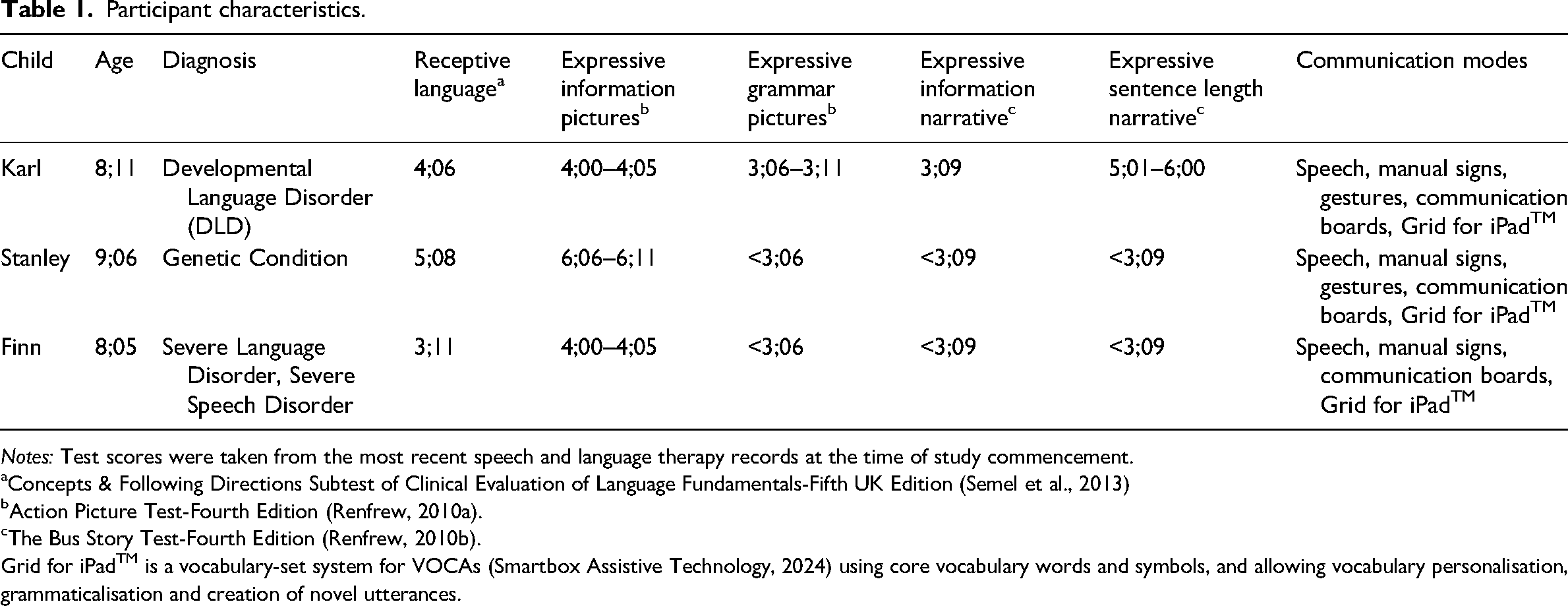
Participant characteristics.
Notes: Test scores were taken from the most recent speech and language therapy records at the time of study commencement.
aConcepts & Following Directions Subtest of Clinical Evaluation of Language Fundamentals-Fifth UK Edition (Semel et al., 2013)
bAction Picture Test-Fourth Edition (Renfrew, 2010a).
cThe Bus Story Test-Fourth Edition (Renfrew, 2010b).
Grid for iPadTM is a vocabulary-set system for VOCAs (Smartbox Assistive Technology, 2024) using core vocabulary words and symbols, and allowing vocabulary personalisation, grammaticalisation and creation of novel utterances.
The class teams consisting of a teacher, an SLT and an LSA collaboratively deliver the whole class story lessons each week and the Total Communication approach in these whole class lessons. The teachers in the class teams therefore delivered the usual Total Communication approach to the participating pupils during the intervention and generalisation phases as part of the usual lessons. The teachers’ interactions with the children were not recorded or analysed, so they were not research participants. Teachers were provided with an information sheet detailing this, along with the information about the research. Throughout the data collection phases, the teachers were part of all discussions relevant to their role in delivering the whole class story lessons.
The sequence of the class story sessions at the school are described below in the section on ‘Design’. The materials for the intervention and generalisation stages of the study were prepared collaboratively following the usual school processes. For the class story lessons, the teacher determined the story and prepared the story powerpoint visual presentation; the SLT and teacher together determined the vocabulary in the story needed for signing all key words and creating the VOCA grids; the teacher, SLT and LSA all learned the signs; SLTs created the VOCA grids for the stories using the determined vocabulary; the LSAs prepared the communication boards; all three staff together sourced the props and costumes needed for the role play. The story books used naturally varied in style but were appropriate for the maturity level of each child's class. Stories might be short, completed in a single week, or longer, taking four to six weeks to complete in chapters/sections. The main stories used were: ‘Oi! Get off our Train’ – John Burningham, ‘The Last Tree in the City’ – Peter Carnavas, ‘Mr Wolf's Pancakes’ – Jan Fearnley, ‘One Plastic Bag’ Isatou Ceesay and the Recycling Women of the Gambia – Miranda Paul, ‘The Last Polar Bears’ – Harry Horse, ‘The Wind in the Willows’ – Lesley Sims and ‘Handa's Surprise’ – Eileen Brown. Further information about the number of stories used in each class and the number of weeks individual stories were used, is detailed in Supplemental Table S1.
Design
The study employed a single case experimental design, specifically a multiple probe design across participants. Measurements for analysis were taken at baseline, intervention and generalisation each week in the story retelling measurement probes with the individual child participants. The criteria for establishing a stable baseline in the study are given at the end of this section.
At the school, the usual practice is to conduct two story sessions in every class at the school each week. The first story delivery lesson each week involves all the children in the class. The class team, i.e. the teacher, SLT and LSA, collaboratively tell a new story or new story chapter to the children. The story is told with story pictures and accompanied by Total Communication used by all staff, involving signing of all key vocabulary and active learning, i.e. role playing of characters using props and costumes, and VOCAs and communication boards available for modelling. Role play is by the whole class team and the children together.
The second story session each week at the school, involves further exploration of that week's story or story chapter, such as identifying key story components, predicting an ending or re-telling the story; this second session may be delivered with the whole class, in small groups or one-to-one. This second weekly session is accompanied by Total Communication support involving the use of signing, VOCAs and communication boards.
For the study, the first story session each week for each child participant was the whole class story delivery lesson. The second session each week for the child participants was the measurement probe, which involved the child participant re-telling the story in one-to-one with the class SLT or class LSA. These story re-telling probes were video-recorded for later transcription and analysis of the child participants’ story re-telling, by the first two authors.
Baseline conditions
The baseline conditions for each child participant consisted of three weeks of class story sessions. Two story sessions were conducted in each of these weeks as usual. However, for the study, the baseline first session each week consisted of the teacher alone preparing and delivering the new story or story chapter to the whole class with picture support only. There were no features of Total Communication (no collaboration in preparation, no signing, no active learning and no VOCAs or communication boards available). The second session each week at baseline for the child participants was the story re-tell measurement probe, delivered in 1:1 with the SLT. The SLT briefly re-read the story/story chapter using story pictures to remind the child of the first lesson and therefore minimise memory requirements for the child. Throughout the phases of the study this brief story reminder at the beginning of the story re-tell measurement probes lasted an average of 2 minutes, varying between 1 minute and 4.5 minutes, dependent on the story. The child participant was then asked to re-tell that week's story. At baseline, the children had the story pictures to look at but did not have any elements of Total Communication available (no signing, VOCAs or communication boards). When the child appeared to have completed their re-telling the SLT checked that the child had finished, then ended the session.
Intervention conditions
The intervention, i.e. the independent variable (IV), was the Total Communication approach delivered in the class story lessons. Following the three weeks of baseline lessons and measurement probes for the participant, the intervention Total Communication conditions started. The intervention for each child participant consisted of six weeks of class story sessions. Two story sessions were conducted in each of these six weeks as usual. During this intervention period the first session each week was collaborative delivery of the new story or story chapter using Total Communication (the independent variable, IV). These lessons consisted of delivery of the story with picture support and Total Communication support using signing and active learning, alongside VOCAs and communication boards. Signing was signing of all key words by all staff, contemporaneous with the speaking of the words, throughout the lesson. Active learning was role play of characters using props and costumes by the teacher, SLT, LSA and children together. The children were shown the story grids on the VOCAs and the story communication boards; these were available for modelling by the staff and use by the children. This first class story delivery lesson was 50 minutes in length each week.
The second session each week during the intervention period for the child participants was the story re-tell measurement probe, delivered in 1:1 with the SLT. At the start of each of these probes the SLT briefly re-read the story/story chapter using story pictures plus some key signs, to remind the child of the first lesson and therefore minimise memory requirements for the child (as noted, throughout the phases of the study this brief story reminder at the beginning of the measurement probes lasted an average of 2 minutes, and varied between 1 minute and 4.5 minutes, dependent on the story). The SLT then asked the child participant to re-tell that week's story. The child participant had the story pictures to look at and the Total Communication materials provided. The SLT pointed out the VOCA story grid and communication board to the child participant and also explained that the child could use signing. When the child appeared to have completed their re-telling the SLT checked that the child had finished.
If the child participant omitted major parts of the story in their re-tell in the intervention measurement probe the SLT returned to these parts of the story once the child had completed their re-tell and asked questions or used modelling or prompting to support the child. Prompting, questioning and modelling are important teaching strategies, however any additional utterances produced as a result of these strategies were not used in data for the study, since doing so would have made experimental conditions different at baseline and intervention. The additional utterances produced by the children following the use of these strategies are shown in Figure 1 (in Results, below) as examples of the benefit of their use, but these additional utterances are not used anywhere else in the data.
Generalisation conditions
The generalisation conditions for each child participant consisted of three weeks of class story sessions. Two story sessions were conducted in each of these three weeks as usual. The first week of generalisation sessions was conducted before the final week of intervention sessions; then two further weeks of generalisation sessions took place after the intervention sessions for that child had been completed. Procedures for the generalisation class story delivery lessons and generalisation story re-tell measurement probes were the same as for intervention sessions but the story re-tell probes were conducted by a different adult, the class LSA.
The multiple probe experimental design across participants requires that a stable baseline is achieved for all participants. A rate of variation of no more than five propositions between the three baseline story re-tell probes for the individual child, was the threshold for establishing that child's stable baseline. This stable baseline was achieved by each of the participants. Following his baseline lessons and probes, the first child started the intervention lessons, whilst the other child participants continued with baseline sessions (i.e. in order to create the time lag or stagger necessary for achieving experimental control). When the first child participant reached the pre-set criterion-level performance in the story re-telling probes (i.e. a 10% increase in mean length of utterance (MLU) and 10% increase in propositions using any communication mode, over their first three intervention weeks) the intervention sessions were introduced to the second child participant. When the second child participant achieved criterion-level performance, the intervention sessions were introduced to the third child participant.
The baseline, intervention and generalisation story re-telling probes for the three child participants were video-recorded; then transcribed and inspected for three measures.
Measures
The dependent variables (DVs) that were examined in the videos of the story re-tell probes, and used to evaluate the effectiveness of the Total Communication approach, were the following measures:
Fidelity
Compliance with the school's story delivery procedures for the whole class story telling lessons, as detailed above, is by regular school in-service trainings for all staff: teachers, SLTs and LSAs together. Termly class observations by the school senior leadership group (either the senior teachers, the senior SLTs or both jointly) monitor and ensure compliance with school procedures for use of Total Communication and story delivery.
For the research story re-tell measurement probes the SLTs and LSAs read a procedural checklist before conducting the probes. The first two researchers reviewed the probe video recordings every week to check for and ensure correct procedural compliance and implementation according to this checklist. The procedures were followed by SLTs and LSAs throughout.
Analysis
Transcription of video data
The video recordings of the story re-telling measurement probes for baseline, intervention and generalisation were independently transcribed by each of the first two researchers (an SLT and a teacher) by repeated viewings. Videos were viewed from the point at which the participant started their re-telling to avoid bias to expected narrative. Transcription involved orthographic recording of the participants’ words, including noting of unintelligible words as word attempts and coding for the communication mode(s) used. The gist of the adult utterances was also recorded. The two researchers then met to compare their transcriptions; where there were differences the video-recordings were repeatedly viewed again jointly until agreement was reached and final transcriptions determined.
Analysis of transcriptions
The agreed transcriptions were then independently interrogated by the first two researchers who marked the valid propositions, the number of words in each of these propositions and the communication mode(s) used to produce them. These two authors then met to compare their analyses; where there were differences the videos were repeatedly re-viewed together until final analyses were agreed.
To add a further check to the analyses, the third author (researcher and qualified SLT) completed a reliability check of 10% of the analyses from all participants and all stages of the study. This third author did not know the participants, did not take part in any data collection and was blind to the study stages of the analyses. To complete the check, the third author viewed the written transcription (s) with the video recording(s) of the participant(s) re-telling the story along with the completed analyses for propositions, communication mode and number of words. Cohen's kappa was used to determine if there was agreement. There was strong agreement for propositions (k = 0.94, p < 0.0001), communication mode (k = 0.75, p < 0.01) and number of words (k = 0.93, p < 0.001).
The three measures used for evaluation: number of propositions, mean length of the five longest utterances and percentage use of modes of communication were calculated by the first two researchers for each of the child participants’ story re-tells. These measures were displayed in graph form.
Statistical analysis
Visual and statistical analysis was completed for all the intervention, baseline and generalisation probe data. Six features for employment in visual analysis of graph data: trend, variability, immediacy of effect, overlap, consistency of data patterns and level of performance (Kratochvill et al., 2010) are described by What Works Clearinghouse for the US Department of State, as Single Case Design standards. The visual graph data in this study was examined for these six features.
For the dependent measures non overlap statistical procedures were calculated for each of the participants. Improvement Rate Difference (IRD) and Tau-U were used in combination and were calculated using an online calculator (www.singlecaseresearch.org). IRD is the improvement rate in intervention minus the improvement rate in baseline (Parker et al., 2011). Tau-U is an index designed for single-case research, which uses a combination of trend measures for the intervention, and nonoverlap measures between study phases.
Results
Figures 1 and 2 show the results for the number of propositions produced and the mean length of the five longest utterances (each using any communication mode) in the story re-telling probes. These figures give representation visually of variability, consistency, immediacy of effect, trend, overlap and level of performance. Visual inspection of these figures shows maintenance of experimental control for all participants across all dependent variables. The number of propositions produced and the mean length of the five longest utterances increased during intervention for all three participants. Following intervention, increases were also generalised above pre-intervention baseline levels for all participants.
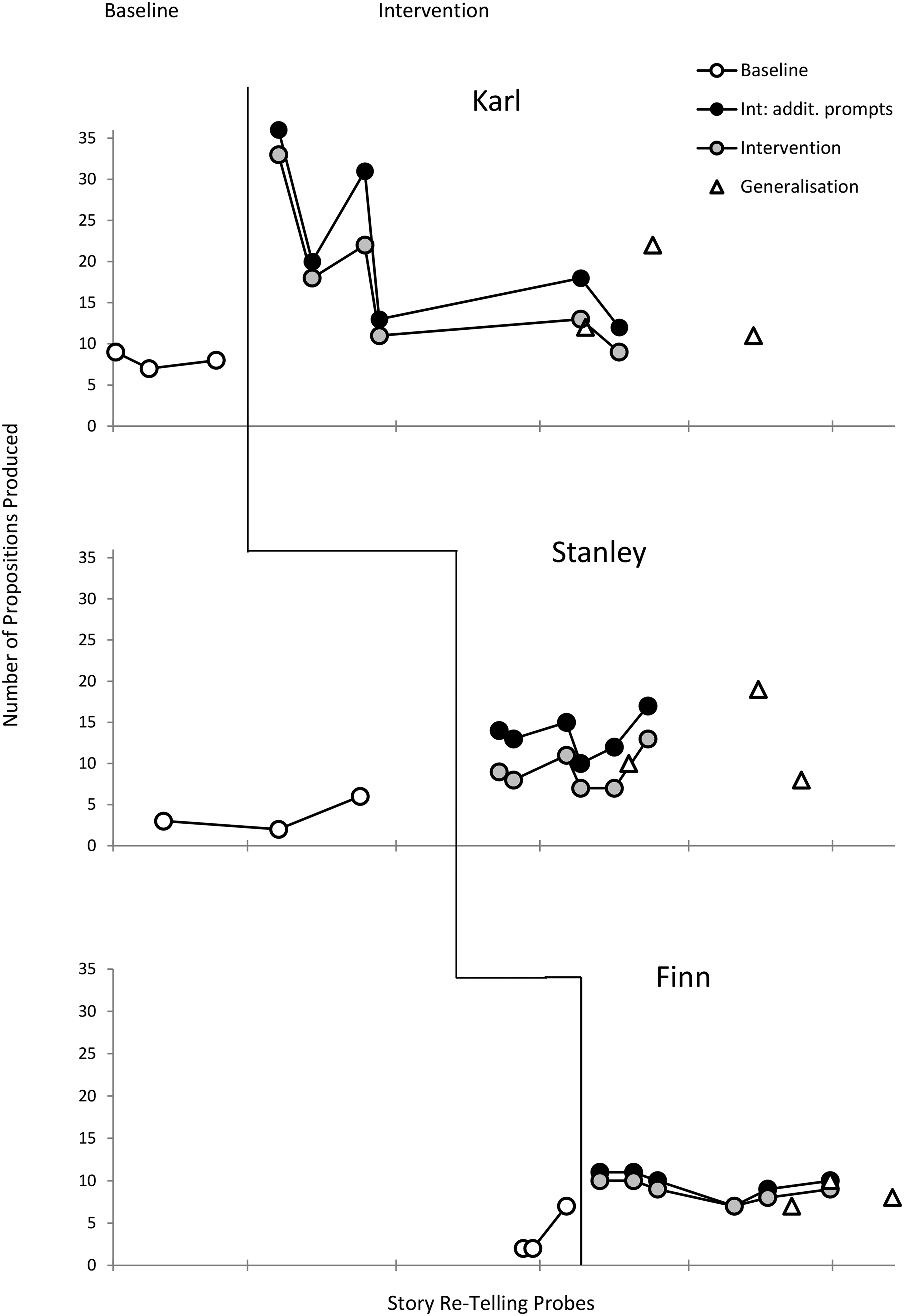
Number of propositions produced.
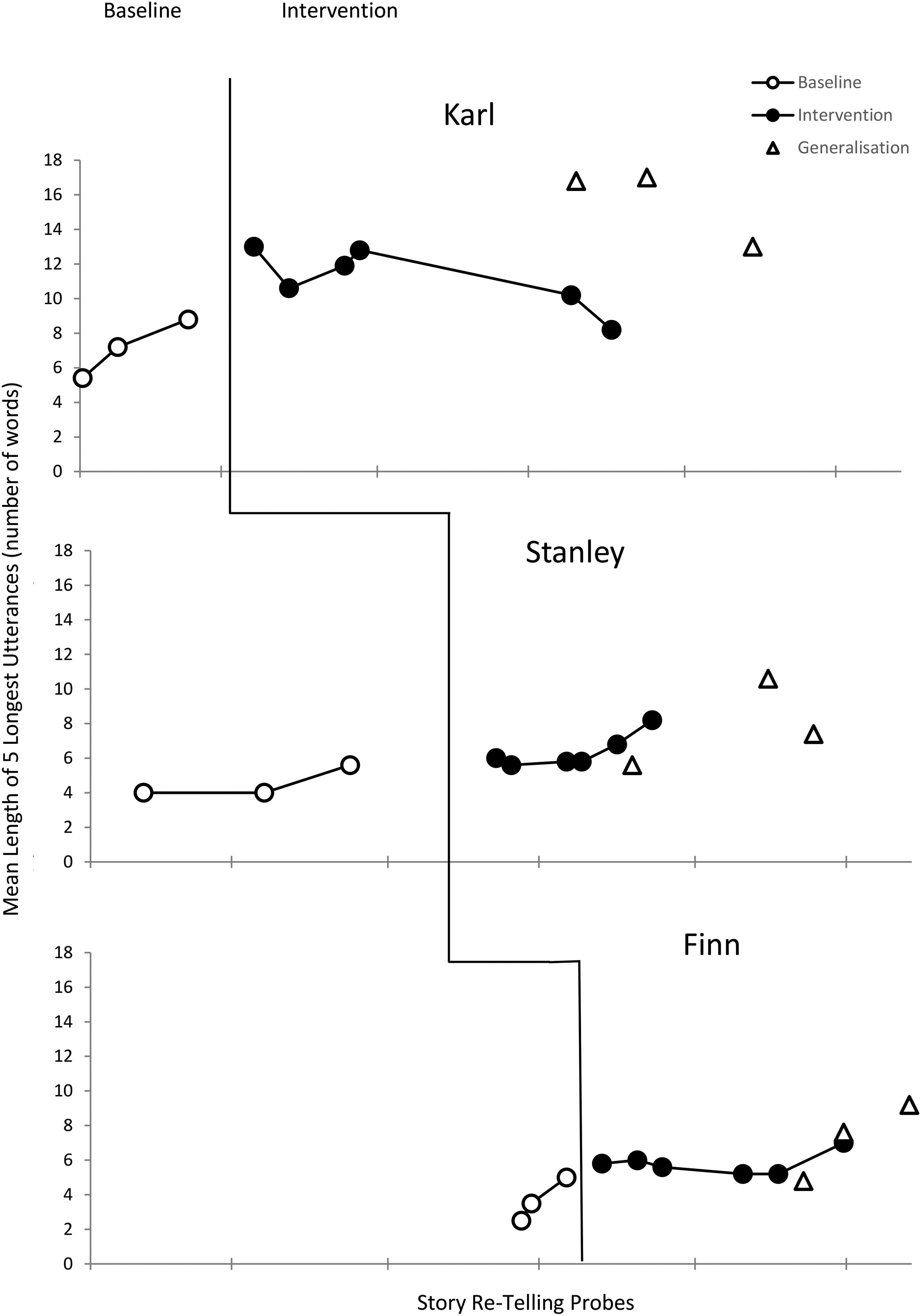
Mean length of 5 longest utterances*.
The individual Tau analysis for each of the three participants along with a summary of their descriptive results is reported below (figures in parentheses are for range of results).
During baseline Karl's utterances were 100% verbal. During intervention 88% of his utterances were verbal while 9% of his utterances were a combination of verbal and VOCA expression, 2% used VOCA and 1% were a combination of verbal and VOCA expression. During generalisation 92% of Karl's utterances were verbal and 8% were a combination of verbal and VOCA expression.
During baseline 89% of Stanley's utterances were verbal while 11% were a combination of verbal and signed expression. During intervention 14% of his utterances were verbal, 25% were a combination of verbal and signed expression, 40% of his utterances were made using the VOCA, 11% were a combination of verbal and VOCA expression, 6% were a combination of verbal plus VOCA expression, 6% were a combination of verbal, signed and VOCA expression and 4% were made using a combination of signed and VOCA expression. During generalisation 58% of Stanley's utterances were verbal, while 29% were a combination of verbal and signed expression, 8% of his utterances were a combination of verbal and VOCA expression and 5% of his utterances were made using the VOCA.
During baseline 90% of Finn's utterances were verbal while 10% were a combination of verbal and signed expression. During intervention 50% of his utterances were verbal, with 43% a combination of verbal and VOCA expression, 3% were a combination of verbal, sign and VOCA, 2% used verbal and signing expression and 2% of his utterances were made using the VOCA alone. During generalisation 54% of Finn's utterances were verbal, 40% of his utterances used a combination of verbal and VOCA expression, 3% used verbal plus signing expression and 3% used a combination of verbal, sign and VOCA expression.
Summative results
The mean values for the number of propositions produced and the number of words in the five longest utterances (each using any communication mode) are shown in Table S2 (Supplemental materials). All participants increased the mean number of propositions they produced and the mean number of words in their five longest utterances in intervention and generalisation probes compared to their baseline levels. All children also increased the mean number of words in their five longest utterances in generalisation probes when compared to intervention probes.
The modes of communication used by the participants at each stage of the study are shown in Figure 3. All participants increased the number of utterances they produced using a range and variety of communication modes during intervention and generalisation probes, when compared to baseline levels. The participants also all increased the number of utterances produced using mixed modes of communication in intervention and generalisation probes. The participants did not choose to use the communication boards in the intervention and generalisation probes.
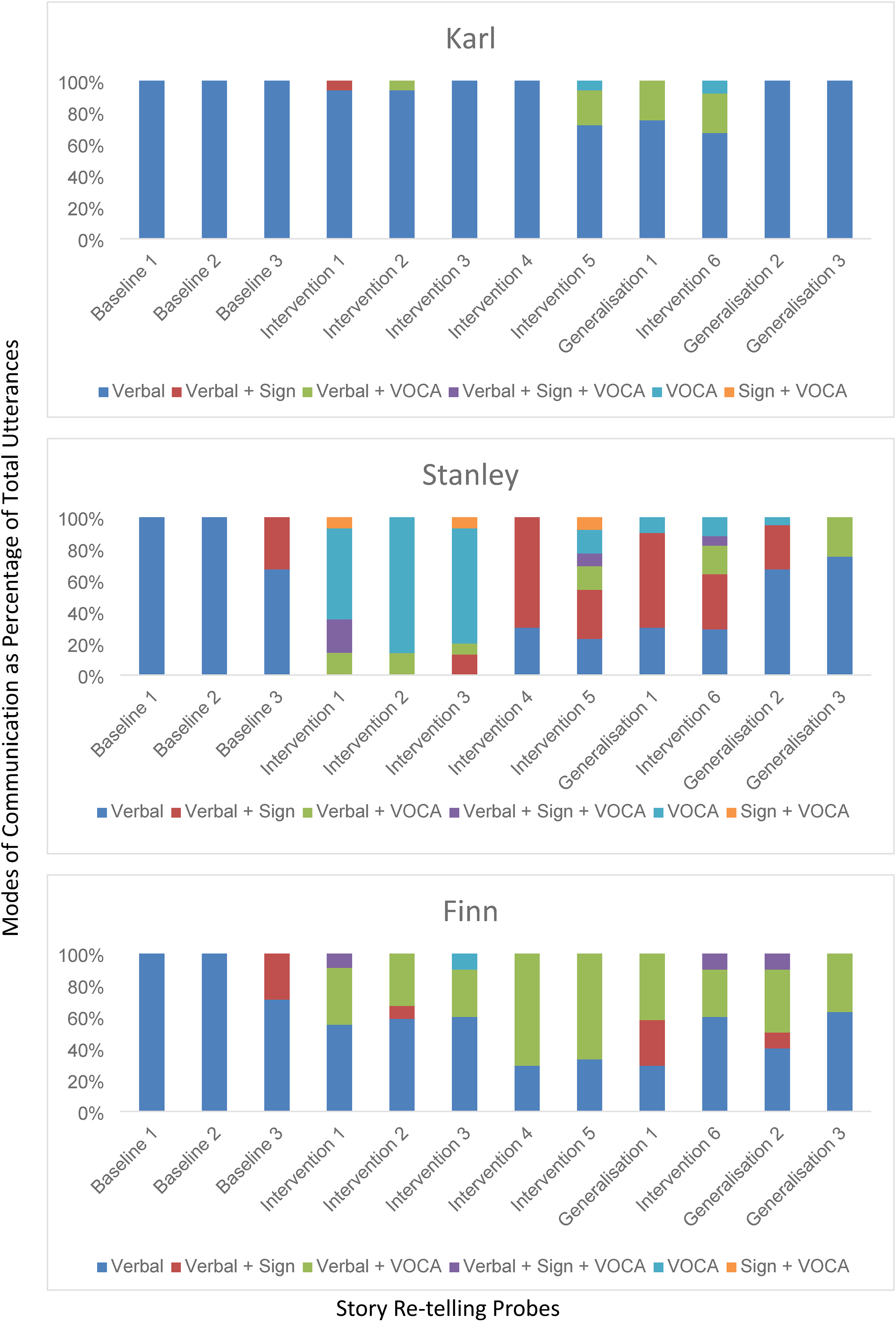
Modes of communication.
Improvement rate difference (IRD) was calculated for Karl, Finn and Stanley for the propositions score and the MLU score (five longest utterances) to compare the baseline and intervention phases. IRD scores indicate that the intervention was very effective (IRD = 0.83–1.0) for all measures for all children.
Tau-U was used to compare the baseline and intervention phases across all three participants as a group. For the propositions, Tau-U (0.964) was significant (p < 0.0001) as it was for the MLU score, (Tau-U 0.944) (p < 0.0001) (see Supplemental Table S3 IRD and Tau-U).
The aim of this study was to explore the effects of a collaboratively delivered Total Communication approach using speech, signing, VOCAs, communication boards and active learning on the communication ability of children with severe and complex SLCN.
The Total Communication approach was effective for the three participants. All three children increased the number of propositions they produced and their MLU in these propositions. Each child employed a range of communication modes in the production of their utterances. The participants effectively generalised these outcomes to the LSA, another adult member of the inter-professional team, with MLU increasing further during the generalisation phase. Quigley and Smith (2022) found that strategies and activities for collaborative practice were needed. This research contributes a holistic strategy, the Total Communication approach, for collaborative practice by teachers and SLTs working with children with severe and complex SLCN. The approach adds to the work of Luckins and Clarke (2021) who found that using speech, signing, gesture and VOCAs in combination had ‘clear potential’ (p. 143) to increase communicative intelligibility and language development for children with receptive and expressive language delay/disorder and partially intelligible speech.
Using single case experimental design provides the evidence that the approach studied in this research was effective for each individual participant. SCEDs should not be confused with observational case studies; SCEDs exercise experimental control demonstrating that change occurs as a direct result of intervention (Thompson, 2006). Demonstrating that an approach is effective for each individual is of key importance in heterogenous groups such as SLCN. As Best et al. (2019, 2022) have pointed out, findings from randomised controlled trials (RCTs) apply to the group studied as a whole, and indeed may not apply to every individual within the group. The restrictive criteria required for RCT research, in addition to heterogeneity, ‘all limit the likelihood of the results of RCTs being truly generalisable’ (Best et al., 2019) Alongside addressing ‘what works for whom’ the data from SCED research can be used to consider how the intervention might have had its effect (e.g. Best et al., 2002). This is explored below in a discussion of possible key benefits of the Total Communication approach for the participants.
Total Communication is effective in providing other modes of communication to support low verbal intelligibility. Stanley and Finn produced few propositions in short utterances at baseline, but in the intervention and generalisation re-telling probes they were both able to say more, using a range of communication modes, in longer utterances, that were understood by both the adult who was with them and the researchers and the reliability transcriber watching the videos. This adds to the work of King (2010), Light et al. (2021), Iacono and Duncum (1995) and Iacono (1993) who found some positive effects on participants’ speech, language and communication when using more than one support modality with children with developmental communication needs. In the current study Stanley and Finn used differing combinations of communication modes to improve their intelligibility. Finn used a VOCA plus verbal speech communication mode for many of his utterances, whilst Stanley's skill in using the Total Communication approach to support his low verbal intelligibility was evident in the range of modes he used, across the intervention and generalisation probes. Stanley also showed that he was able to choose to use different communication modes flexibly to improve his intelligibility. Van der Meer (2012) looked at preference for the AAC communication modes of SGD, picture exchange and signing, by children with developmental disabilities during the acquisition of requesting skills. The 12 children, across three studies, all acquired at least one of the communication modes, with seven learning to use all three AAC modes. Van der Meer found that the children's preferences for mode varied, and that the children's acquisition and maintenance of skills was better with their preferred mode; she suggests that opportunities for self-determination in AAC is beneficial. The current study, and Finn and Stanley's preferences, support this view. Further research into communication mode preferences and communication modes used in combination are indicated.
It appears that the Total Communication elements of signing and active learning may be effective in supporting the increased number of propositions in Karl's story re-tells. He used exclusively verbal speech expression in the baseline story re-telling probes, and once the other communication modes were available he continued to use predominantly verbal speech expression in the early intervention probes, but produced more than three times the number of propositions in these probes compared to baseline. This observed increase in verbal speech expression could potentially be a result of the signing used in the approach, or alternatively as a result of having an increased understanding of the story. Five of the six studies meeting criteria in the research review by Millar et al. (2006) investigated the effects of instruction in manual signs on the speech production of individuals with developmental delay; 24 out of 27 individuals in these studies showed increases in speech production, predominantly measured in terms of spoken words or word approximations, following instruction in manual signs. Vogt and Kauschke (2017) investigated word learning in two gesture conditions for children with and without language impairment. They found that all groups benefitted from observing iconic gestures for word learning which they postulate prompts richer encoding. Alternatively, Karl's improvements in spoken production of propositions could be a result of having an increased understanding of the story. As we have seen, Daniels (1994) found that kinesically, visually and orally presenting words improved vocabulary development, whilst a large proportion (86%) of SLTs working with preschool children with SLCN in the study by Morgan et al. (2019) reported that using approaches such as signing and symbols was essential to support comprehension. Similarly, the meta-analysis of approaches by Pesco and Gagné (2017) found that enacting stories and using props, alongside verbal strategies, was the most effective means for improving pre-school children's story telling. The reasons and mechanisms for increased subsequent verbal narrative retelling, such as Karl's, following story presentation with signing, props and acting, require further investigation.
Total Communication seemed to have an effect in supporting word finding for the two children with word finding difficulties, Karl and Finn. For example, in his fifth and sixth story re-telling intervention probes, Karl used the VOCA to give the story character names and also try out and then choose several action words. For Finn, close inspection of his intervention probe transcripts showed that he often used the VOCA to give the specific story character names or labels (e.g. mole, toad, chief weasel) which in turn then appeared to give him the confidence to complete his utterance either verbally or with further VOCA words. The use of VOCAs to support word finding is little explored in research literature, however Checkley et al. (2012) did find that use of a VOCA helped an 11-year-old boy with ASD and severe word-finding difficulties to ‘recall words he would normally struggle with verbalising’ (p. 251).
The benefits of Total Communication in turn appear to develop the children's confidence, leading to further improvements. All the children's increases in number of propositions and MLU suggest this benefit, however this was particularly evidenced for Finn. As Finn's use of communication modes other than verbal speech increased, so did his apparent confidence, observed in the videos in his greater enthusiasm for the task and louder verbalisations; his improved confidence then appeared to lead to an increase in the number of his propositions and the length of his utterances. On a much wider scale Hunt-Berg (2005) noted the changes over time in goals for students attending an AAC educational programme: goals were initially around communicative competence but later goals were around self-determination and academics as students competence and confidence in their AAC skills developed. The effect of using Total Communication on children's expressive confidence is another area requiring further investigation.
None of the participants in this study chose to use the communication boards. The communication boards for the stories were in the same layout as the VOCA story grid, but in paper form. The participants preferred to use the VOCAs perhaps because the voice output provided an auditory message; thus showing that using additional paper-based communication boards may not be necessary in situations where a VOCA containing the same information is also available. Wider use of paper-based communication boards at the special school, however, suggests that they are an essential part of the Total Communication approach, for instance where VOCAs are inadvisable, inaccessible or not available. Bornman (2011) cites a number of authors who suggest, respectively, that low-tech ought to be a critical part of most, or all, AAC communication systems; that low-tech serves as a back-up when high-tech devices break down; and that having a non-speech-output means of AAC is important for AAC users’ privacy in certain situations. For children at the school, low-tech communication boards are used, for instance, in play or game scenarios where use of a VOCA would distract from the activity or would be contra-indicated due to the outdoor/physical nature of the play; for children who do not yet have the skills to access VOCAs; for children who need additional support in only limited scenarios so would not be provided with a VOCA; or for occasions when bespoke editing of the VOCA is not possible.
The Total Communication approach described in this study is a multicomponent intervention. Overall, it is not possible to say what the ‘active ingredient’ of the approach is and, as has been discussed, different elements of the approach, and combined elements, may be of benefit to different children and at different times, depending on their specific profile and needs. Gevarter et al. (2013) conducted a review of 28 studies that compared different AAC communication systems for individuals with developmental difficulties. The studies that were reviewed compared either: aided AAC (VOCAs and picture exchange systems) to signing, non-electronic picture systems to VOCAs, or AAC to speech and language interventions for vocal speech. Comparisons of these studies were made in the areas of effectiveness, efficiency, user preference, occurrence of vocalisations and generalisation of use. Results found that consistent and clear differences between the benefits of communication systems were rare and therefore a universal optimum approach for individuals with developmental disabilities was not possible. The authors concluded that ‘the results of this review highlight the importance of comparing different communication systems at the individual level’. The Total Communication approach used at the special school in this study allows for these individual benefits and preferences. By collaboratively utilising and supporting a range of communication systems simultaneously, i.e. at the school: signing, VOCAs, and non-electronic systems (communication boards) alongside verbal speech, individual pupils are able to develop their use of the communication system(s) that best support their individual difficulties and suits their individual preferences. A prime purpose for the Gevarter et al. review was a need to provide information that would be useful for clinical decision making in determining AAC systems. Likewise, Nam et al. (2018) conducted an overview of five review studies, including Gevarter et al., which together analysed 92 studies exploring the effectiveness of major AAC systems. They concluded that: ‘Searching for the best AAC system for all children is like an effort to find the end of a rainbow.’ (p. 11). By utilising an on-going simultaneous range of communication systems, and in a variety of contexts, professionals using Total Communication at the special school in this study are not only able to support children's needs in a range of ways, but are also able to make better decisions when selecting the best long-term communication system or combination of systems for individual children, as a result of the extensive AAC use and opportunity for development of skills. This approach to clinical AAC decision making requires further investigation and research.
This study compared and measured the use of Total Communication with not using Total Communication. It did not measure the children's output with additional active support to use Total Communication at the point of re-telling, via strategies such as prompts, questions and modelling. Sennott et al. (2016) systematically reviewed AAC modelling research conducted between 1989 and 2013 and concluded that using AAC modelling alongside recasting improved children's expressive language. Prompting for VOCA use, alongside recasting, in child-directed conversations has been shown to enhance children's language (Soto and Clarke, 2017). Luckins and Clarke (2021) successfully used modelling, prompting, repair and recasting to increase clause production and grammaticality in children with partially intelligible speech. Using such strategies to actively encourage children to use Total Communication in all contexts should potentially, therefore, increase children's use of propositions and sentence length further. More research is needed to look at the impact of not only using Total Communication but also actively using proven strategies in specific contexts to encourage and support its use.
This study was conducted as part of the everyday education of children with severe and complex SLCN in a special school. The study shows a collaborative multimodal approach between teachers and SLTs is effective in facilitating the communication abilities of children with severe and complex SLCN. Key aspects of the approach include: (1) the teachers, SLTs and LSAs learning and using the signs for the story vocabulary; (2) all staff taking part in, modelling and supporting the children with active learning; (3) the SLTs creating the bespoke VOCA grids and LSAs making the communication boards; and (4) the teachers, SLTs and LSAs supporting use of signing, VOCA and communication boards by the children.
Facilitating the participants’ communication, should also have an impact on their learning and ultimately their educational attainment. Further research is needed to understand if collaborative approaches such as Total Communication do have a longer-term impact for these children's learning and educational progress.
Limitations
Several limitations are highlighted. Firstly, this is a small study of three participants with profiles of severe and complex SLCN who attend a special school. These participants will not be representative of the population of children with SLCN. The study needs to be replicated across larger populations of children with SLCN including those not educated in a special school context. The intervention evaluated (the Total Communication approach) is a bespoke intervention to the special school and therefore designed to meet the needs of children in this context. The approach is delivered at high intensity by specialist teachers and SLTs. Further research should determine if such an approach is effective for other populations of children with SLCN educated in other settings. The study was designed and implemented by the first two authors (employed by the school). Neither these researchers nor the staff delivering the intervention was blinded to the participants. This may have led to some bias in the study design. The inter-rater reliability was completed by the third researcher who was not blind to the study; this researcher took no part in the data collection and analysis and did not know the participants. Ideally, inter-rater reliability of a larger sample by a researcher completely blinded to the study is preferable. The study used only three baseline sessions. Three sessions meet the established requirements for demonstrating an effect (Kratochwill et al., 2010) but a greater number of baseline sessions would have improved the evidential standard. A more extended generalisation period and inclusion of more participants would also have added to the evidence base.
Conclusions
This study provides evidence that a Total Communication approach delivered by collaborative inter-professional practice in a special school is effective in increasing the number of propositions and mean length of utterance of primary age children with severe and complex SLCN. The Total Communication approach, using speech, signing, VOCAs, communication boards and active learning, appeared to support the participants in a variety of ways. Use of signs and a VOCA by the children with low speech intelligibility allowed them to convey their message by other communication modes. Active lesson involvement, use of signing by all class staff and modelling of the communication modes facilitated the children's use of these communication modes. Simultaneously presenting words verbally, visually and kinesically appeared to support vocabulary learning. Signing of all the key story vocabulary and active learning using role play with props and costumes appeared to support comprehension of the story. The use of signs and VOCAs by the children may have supported word finding. Having a variety of communication modes available allowed the children to choose to use different modes flexibly. Being able to express themselves in different ways appeared to build the children's confidence so in turn supporting them to use more propositions and longer utterances.
This study investigated a collaborative multimodal approach for supporting children with severe and complex SLCN in a real-world context. An SCED methodology was used, which shows the benefits of the Total Communication approach and provides the opportunity to explore how the approach may have its effects and which aspects may be of greater or lesser value for which SLCN child profiles. This provides many potential avenues for future research. It is suggested that in real-world contexts where children have varying SLCN profiles and are educated in heterogenous groups, the combined elements of Total Communication offer a variety of benefits for a range of individuals with SLCN.
Supplemental Material
sj-docx-1-clt-10.1177_02656590251315598 - Supplemental material for Is the Total Communication approach effective for children with complex speech, language and communication needs?
Supplemental material, sj-docx-1-clt-10.1177_02656590251315598 for Is the Total Communication approach effective for children with complex speech, language and communication needs? by Jessie Luckins, Georgina Tongue and Judy Clegg in Child Language Teaching and Therapy
Supplemental Material
sj-docx-2-clt-10.1177_02656590251315598 - Supplemental material for Is the Total Communication approach effective for children with complex speech, language and communication needs?
Supplemental material, sj-docx-2-clt-10.1177_02656590251315598 for Is the Total Communication approach effective for children with complex speech, language and communication needs? by Jessie Luckins, Georgina Tongue and Judy Clegg in Child Language Teaching and Therapy
Supplemental Material
sj-docx-3-clt-10.1177_02656590251315598 - Supplemental material for Is the Total Communication approach effective for children with complex speech, language and communication needs?
Supplemental material, sj-docx-3-clt-10.1177_02656590251315598 for Is the Total Communication approach effective for children with complex speech, language and communication needs? by Jessie Luckins, Georgina Tongue and Judy Clegg in Child Language Teaching and Therapy
Footnotes
Acknowledgements
The authors acknowledge and hugely thank the staff at Meath School, part of Speech and Language UK (formerly named ICAN), who carried out the intervention: teachers Anne Hill, Clare Hickford and Virginia Deane; SLTs Rebecca Mottram, Caroline Burns and Caylin Hall, plus Lily Scanlon and Kelly Moran; and LSAs Jayne Jones, Alice Hoyle and Kirsten Patient. The authors are very grateful to the child participants who took part in the project and their parents for their interest and support.
Declaration of conflicting interest
The authors declared the following potential conflicts of interest with respect to the research, authorship, and/or publication of this article: This study was funded by the Rayners Foundation through Speech and Language UK's Rayners Research Centre. The first two authors and all adult participants were employed at Speech and Language UK's Meath School at the time of the intervention.
Funding
The authors disclosed receipt of the following financial support for the research, authorship, and/or publication of this article: This work was supported by the Rayners Foundation.

Supplemental material
Supplemental material for this article is available online.
References
Supplementary Material
Please find the following supplemental material available below.
For Open Access articles published under a Creative Commons License, all supplemental material carries the same license as the article it is associated with.
For non-Open Access articles published, all supplemental material carries a non-exclusive license, and permission requests for re-use of supplemental material or any part of supplemental material shall be sent directly to the copyright owner as specified in the copyright notice associated with the article.
