




Abstract
Multilingual children living in areas with low socioeconomic status (SES) are at an increased risk of having speech, language and communication needs (SLCN). Many multilingual children with SLCN in Sweden have insufficient basic vocabulary knowledge in the majority language, preventing them from achieving the school's learning goals. However, there is a lack of studies of interventions that could improve vocabulary development in this group, and that can be delivered in an everyday educational setting. This pilot study evaluates the effect of a school-based vocabulary group intervention, which combines elements from shared book reading and the Lexicon Pirate method, on vocabulary skills. A non-randomised pretest–posttest control group design was used. Eighteen six- to seven-year-old multilingual children attending preschool class in low SES areas either received intervention (n = 9) or were included in a control group (n = 9). The intervention group participated in 12 intervention sessions over six weeks. Word knowledge, semantic fluency, and comprehension of semantic relations were assessed pre- and post-intervention. Results revealed that children in the intervention group demonstrated significant gains in knowledge of both trained and untrained words, compared to the control group. No effects were found on semantic fluency or comprehension of semantic relations.
Keywords
Introduction
The socioeconomic housing segregation in Sweden has increased over the last 30 years, and is still increasing. This means that people in different income groups, e.g., with low and high incomes, to a progressively greater extent live in separate areas of the same city or municipality. The proportion of foreign-born residents is considerably higher in the most socioeconomically challenged areas (53.3% national average), compared to the most advantaged ones (10.9%) (DELMO, 2022).
In the present paper, Speech, Language and Communication Needs (SLCN) is used as an umbrella term for all children with needs related to communication, including e.g., speech, language, and fluency (Bercow, 2008; Bishop et al., 2017). SLCN are often multifactorial, and may depend on both genetic factors, such as a predisposition for language disorder, or environmental factors, for example, lack of second language (L2) exposure (Bishop et al., 2017). In the case of multilingual children, it can be difficult to determine whether SLCN pertaining to the L2 stem from a child having e.g., developmental language disorder (DLD) or from not having been exposed to the language enough. Delays in the L2 usually do not last for longer than two years, provided that the child has received sufficient L2 exposure. Persistent difficulties after this period may indicate DLD, and an assessment of the child's language ability should be carried out in both the L1 and L2, including known markers of DLD in each language (Garraffa et al., 2019).
Children from a non-majority language background, who live in socially disadvantaged areas, have been shown to be at an increased risk of having SLCN, which in turn leads to an increased risk of lower school achievement, compared to e.g., monolingual peers from a middle-class background (Hoff, 2013). In favourable conditions, the language development in all languages of multilingual children more or less follows the same developmental trajectory as for monolingual children (Kohnert et al., 2020). But while multilingualism in itself is not a cause of SLCN, there are several external factors that increase the risk of language difficulties in multilingual children who live in segregated areas (Halle et al., 2012; O’Connor et al., 2018).
For example, O’Connor et al. (2018) found that multilingual children from socioeconomically disadvantaged communities in Australia were more likely to have insufficient vocabulary skills at the age of school entry. Furthermore, those who could not close this gap relative to monolingual age peers during the first years of school were at an increased risk of later problems with literacy (O’Connor et al., 2018).
In a study of 224 Swedish seven- to eight-year-olds, Andersson et al. (2019) investigated how core language skills – as measured by CELF-4 (Semel et al., 2013) – were related to multilingualism, parental level of education, school characteristics (measured as the proportion of students with Swedish as L2 and the proportion of parents with post-secondary education), and students’ enrolment in school-based recreational activities. The results showed that multilingualism in isolation could predict 38% of the variance in core language skills. However, with all predictors taken into account, the unique variance explained by multilingualism was only 9%, suggesting instead that a combination of risk factors is associated with language disorder or SLCN. However, as the authors point out, many multilingual children in Sweden live and attend school in socioeconomically disadvantaged areas, which itself carries an increased risk for SLCN (Andersson et al., 2019).
The ability to learn new words in any language varies considerably between children, and relies on both child intrinsic factors, such as size and organisation of the mental lexicon or phonological working memory, and on external factors, such as access to proficient conversational partners (Sheng et al., 2013). Vocabulary knowledge and use in multilingual children is context dependent, which means that the level of proficiency and distribution of word knowledge varies between situations and languages (De Houwer, 2009). In ethnically diverse areas in Sweden, children are exposed to Swedish less through persons who use Swedish as their first language (L1), and more through Swedish L2 learners who have not fully acquired the new language. In addition, L1 acquisition for children in these areas may be hampered if there are few competent speakers of their L1 outside their immediate family (Salameh, 2012).
Many multilingual children with SLCN have vocabulary knowledge in Swedish that is insufficient to achieve the school's learning goals (Salameh, 2018; Swedish National Agency for Education, 2009, 2019). If a child has vocabulary problems also in their L1, for example, due to having developmental language disorder, this warrants speech and language therapy and special education support targeting the L1. However, lack of resources and access to language competency in the child's L1 often make it challenging for schools to provide such interventions (Salameh, 2018). Regardless, effective interventions targeting vocabulary acquisition in the majority language – i.e., the language used for communication and learning in school – are needed to minimise the short- and long-term consequences of low vocabulary knowledge (Marulis and Neuman, 2013), since simply attending school is not enough to stimulate vocabulary growth in children with SLCN (Biemiller, 2006).
Available vocabulary interventions use a range of different strategies, including the provision of a language-rich environment, use of contextual cues, explicit teaching of word meaning, and repeated exposure to words in different contexts (Steele, 2020). There are indications that theme-based multimethod interventions – combining e.g., direct teaching of word meaning with activities that promote the active use of words within the context of a theme – are advantageous for children with below average vocabulary in general (Christ and Wang, 2011). A combination of different approaches has also been suggested to enhance the effect of vocabulary intervention for multilingual children, for example the use of explicit teaching of semantic meaning together with interactive discussion where the child is encouraged to participate actively (Kong and Hurless, 2021). The intervention delivered in this study is theme-based in the sense that target words are selected based on themes, and includes systematic use of different strategies and activities.
The word learning strategies used in the intervention of this study are based on the Lexicon Pirate intervention (Motsch, 2008), which is a short-term vocabulary intervention that promotes children's active learning and use of strategies to learn new words. Children are encouraged to discover gaps in their vocabulary, and seek knowledge about new words from others, for example through asking questions. They are also encouraged to use semantic categorisation and rehearsal strategies. Throughout the intervention, the children collect words (‘treasures’) that are put into a relevant context to further deeper learning of the words’ meaning and their connections to other words. The Lexicon Pirate intervention has been evaluated in two randomised controlled trials with preschool (4 years) and school-age (9 years) children who had developmental language disorder with lexical deficits (Motsch and Ulrich, 2012; Motsch and Marks, 2015). Motsch and Ulrich (2012) showed that the four-year-old children in the intervention group achieved higher expressive vocabulary growth one year after the intervention, compared to children who received regular language support in kindergarten. In their study of nine-year-old children, Motsch and Marks (2015) found significantly higher gains in both receptive and expressive vocabulary skills for the intervention group, compared to controls, four months post-intervention. An effect of the intervention was found for both words included in the sessions, and for untrained words, suggesting a long-term generalisation effect. Furthermore, no difference in results was found between individual and small group settings in the intervention group, indicating that group activities could be used for this type of intervention (Motsch and Marks, 2015). In both studies, the intervention effect was independent of whether the lexical deficits could be classified as mainly quantitative, meaning there were large vocabulary gaps, or qualitative, defined as underspecified semantic and phonological representations (Motsch and Marks, 2015; Motsch and Ulrich, 2012).
Shared book reading is a collective term denoting practices that can be used to promote language and literacy skills when adults read books aloud in interaction with children individually or in groups. Typically, the text is not simply read from beginning to the end. Instead, the adult utilises techniques to engage the child in the text, drawing attention to important elements. This includes e.g., stopping to explain the meaning or pronunciation of new words, asking open questions about the story, and reflecting upon how events in the book are related to the child's own experiences (Noble et al., 2019).
The effects of shared book reading interventions have been extensively studied in the last decades, mainly in children with typical development (Dowdall et al., 2020). Recent systematic reviews suggest that shared book reading has some effect on language development in both typically developing children (Dowdall et al., 2020; Noble et al., 2019), and in children with developmental disabilities and delays (Towson et al., 2021). However, meta-analyses indicate that the effect is small concerning both receptive and expressive language skills, but this may reflect insufficient intensity in many of the studies analysed, rather than a problem with the shared book reading methodology as such (Dowdall et al., 2020; Noble et al., 2019). Indeed, Flack et al. (2018), identified multiple exposures to target words as one of the factors that positively affected word learning, based on a meta-analysis of 38 studies. Further, Storkel et al. (2017) investigated the effect of shared book reading intervention on word learning in 5–6-year-old children with developmental language disorder and found that 36 exposures was an adequate intensity to achieve group-level improvement. This finding was confirmed by Storkel et al. (2019), who also concluded that different combinations of dose (exposures per session) and dose frequency (number of repeated sessions) yielded similar positive results, as long as the total number of exposures reached 36 (Storkel et al., 2019). Intervention features that have been found to enhance word learning include the use of dialogic reading techniques, such as pointing or providing definitions, and multiple exposures to target words, while it appears to be of less importance who does the reading (e.g., teacher, parent or researcher) (Flack et al., 2018).
Successful education requires children to have basic vocabulary knowledge of the language used in school. Children who grow up in ethnically segregated areas with low levels of education and income are at increased risk of having SLCN (Andersson et al., 2019), including insufficient vocabulary, and may experience subsequent problems using word knowledge for learning (O’Connor et al., 2018; Pace et al., 2019). Thus, there is a need for interventions that enhance the vocabulary development in this population, and that can be delivered in an everyday educational setting. The aim of the present study was to evaluate the effect of a school-based vocabulary group intervention, which combines word learning strategies (Lexicon Pirate methodology) and shared book reading, on vocabulary skills in multilingual children with SLCN attending preschool class. This intervention is currently in use for children with SLCN attending preschool class, but its effect has not been systematically studied. In light of this, the present study addressed the following research questions:
What effect does the intervention have on the children's word learning in Swedish (L2). In line with the findings of previous studies, it can be hypothesised that there will be a positive effect on the learning of words that have been trained directly (Motsch & Ulrich, 2012; Wasik et al., 2016), as well as on the learning of words that are similar in form and function, but that has not been trained in the intervention (Motsch & Marks, 2015). What effect does the intervention have on the children's semantic fluency and comprehension of semantic relations? The authors have no a priori hypothesis about this potential effect. What effect does the intervention have on the children's acquisition of word learning strategies? According to Motsch and Marks (2015), children who had received Lexicon Pirate intervention could actively use word learning strategies that had been taught in the intervention, when confronted with new words. Based on this, it can be hypothesised that the children who receive intervention in the present study will acquire new word learning strategies.
Method
Design
The present study was carried out in the everyday school environment of the participating children, with as little interference with the regular teaching as possible. The intervention procedures were already in practice at these schools, and the intervention provided in the study was aimed to resemble what would normally be offered to the children. A non-randomised pretest–posttest control group design was used, which allowed for more flexibility in composing the intervention groups in each school, compared to using randomisation. The children were assigned either to an intervention group (IG) receiving vocabulary group intervention, or to a control group (CG). The IG was further divided into smaller groups, each of which included children who attended the same ordinary class. Children in the CG attended regular school activities and did not receive any additional support or teaching aimed at improving their vocabulary, during the intervention phase. However, the children in the CG would receive the intervention after completion of the present study. Children were assessed pre-intervention and immediately post-intervention.
Participants
The present study included 26 multilingual children (11 girls and 15 boys) attending preschool class. In the Swedish school system, preschool class is a stage between preschool and first grade. All children living in Sweden enter preschool class in the autumn of the year they turn six, and attendance is compulsory.
To be eligible for inclusion in this study, the children should: (1) be six to seven years of age, (2) attend preschool class, (3) have attended Swedish preschool for at least two years prior to enrolment in preschool class, (4) have a home language other than Swedish, and (5) have been identified with the school-based screening material Hitta språket (Skolverket, 2019) as having low Swedish language proficiency and/or have a language disorder, including vocabulary problems, as confirmed by a speech therapist. Children were not eligible for participation if they had known conditions that included major difficulties with attention, concentration, or interaction, which could make participation in group intervention problematic.
Children were recruited from schools situated in three ethnically diverse districts of a major municipality in Sweden, all of which are classified as geographical areas with socioeconomic challenges (Statistics Sweden, 2022). In these districts, 50–70% of children live in relative poverty, meaning that their household income is below 60% of the national median disposable income (Holmström, 2019). To give an indication of language background in the participating schools, the proportion of children in preschool class who had another first language than Swedish was around 90%.
Class teachers distributed written information about the study along with an invitation to participate to the caregivers of 30 children. One child did not meet the criteria for inclusion, and the caregivers of three children did not return the consent forms. Informed written consent was obtained from the caregivers of 26 children. Eleven of the children had a DLD diagnosis, and 15 had been identified as having low language proficiency in Swedish. However, it is important to note that the latter 15 children had not been sufficiently evaluated for a diagnosis of DLD, primarily due to difficulties assessing them in their home languages. There were no children who had a confirmed or suspected language disorder associated with a biomedical condition.
Sixteen children were assigned to the IG, and 10 to the CG. The unequal group sizes were chosen to get as many groups of four children as possible in the IG, while still having a control group of at least 10 children. For practical reasons, the children in each of the four intervention groups were required to go to the same school and attend the same class, making individual unequal allocation randomisation from the whole sample to the IG or the CG impossible. Instead, each school was assigned one or two intervention groups (one per class), based on discussions with the schools about scheduling preferences and room availability. The eligible students in these classes were then randomly assigned to be part of the group of four, or to be included in the control group.
All 26 children completed the pre-intervention assessment. Eight children could either not complete the intervention or were unable to take part in the post-intervention assessment, mainly due to sickness or reasons associated with the COVID-19 pandemic. The children who dropped out and those who completed the study were compared based on baseline characteristics and performance at the pre-intervention assessment. Two of the eight children who dropped out had a DLD diagnosis, compared to nine out of eighteen children who completed the study (6 in the intervention group and 3 in the control group), indicating that children with DLD were not more prone to dropping out. Further, Mann–Whitney U tests did not show that the children who dropped out differed from the rest of the sample concerning age (p = 0.286), or performance on word knowledge (p = 0.460), semantic fluency (p = 0.604), or comprehension of semantic relations (p = 0.571) at baseline.
Eighteen children completed assessments both pre- and post-intervention: nine in the IG (5 girls) and nine in the CG (3 girls). The mean age was 6.5 years in the IG, and 6.6 years in the CG, with no age difference between the groups (z = 0.486, p = 0.666).
Procedure
Pre- and post-intervention measures
Assessment of word knowledge, semantic fluency, comprehension of semantic relations, and word learning strategies were administered to participants in the IG and CG pre-intervention and post-intervention. All assessments were administered by authors MH, RS and HW. For practical reasons, blinding to group allocation was not possible. Children were assessed individually by one of the aforementioned authors in a separate room at the child's school, with each session lasting about 30 min. The assessments used are described below.
Word knowledge test
To enable assessment of word learning and the children's use of word learning strategies, a researcher-designed test was used. The test comprises pictures illustrating 20 words (see Table 1), whereof 10 are words included in the intervention (henceforth trained words), and 10 are control words (hereafter untrained words) matched pairwise for grammatical function and/or semantic hierarchical level. Selection criteria were that the words should be suitable for children and belong to tier 1 (basic vocabulary), i.e., be relatively common in oral language used with children (see e.g., Beck et al., 2013). Out of the 20 words, four represent concepts that could be considered abstract, while the remaining 16 represent concepts, actions or objects that are more concrete. The proportion of abstract to concrete words are balanced between the trained words and the untrained words. Since the last theme of the intervention could not be completed (see 4 Intervention below), two trained words (kofta and kläder) included in that theme were excluded from analysis along with their respective untrained words.
Words included in the Word knowledge test.
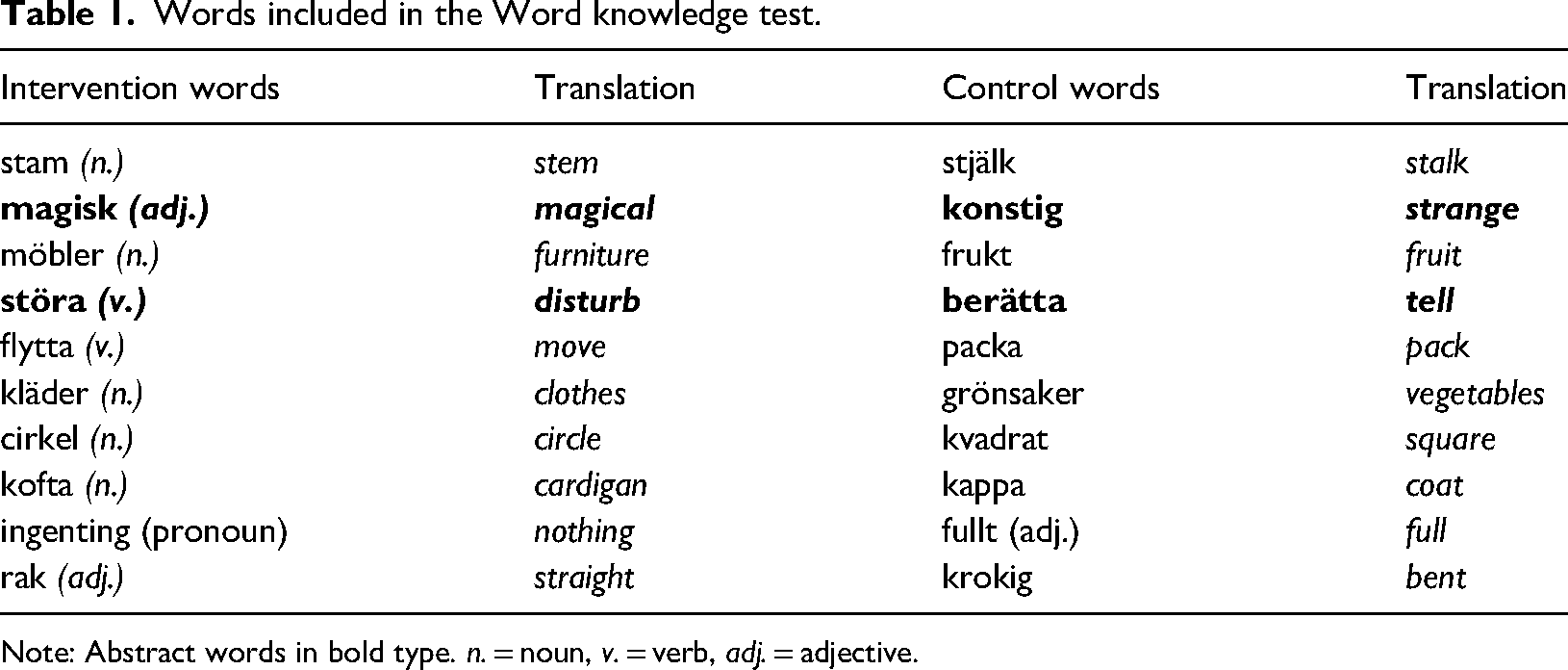
Words included in the Word knowledge test.
Note: Abstract words in bold type. n. = noun, v. = verb, adj. = adjective.
The test leader and the child go through the pictures together. The child's knowledge of each word is rated using colour codes. Green words are words that the child can name and/or explain; concrete words, which are easy to illustrate with a picture, are rated as green if the child can name them. The child's response can be spontaneous, or elicited through phonological and semantic cueing, or sentence completion. Abstract words are rated as green if the child can explain the word after having heard it spoken by the test leader. Words that the child recognises or has heard before, but cannot name or explain, are rated as yellow. Words that the child does not know are rated as red. For scoring purposes, green words are given 2 points, yellow words 1 point, and red words 0 points. The maximum score is 20 for trained words and untrained words respectively. However, since the fifth and last theme could not be completed in the present study, the maximum score was 16.
Word learning strategies
When all words of the Word knowledge test have been rated, the test leader picks a word that has been rated yellow or red and asks the following questions: (1) What do you do if you don’t know what this word means? and (2) What do you do to learn a new word that you haven’t heard before? The answers given indicate what strategies the child can employ to acquire new words.
Semantic fluency
In order to assess the children's ability to quickly produce words within a given semantic category, the task Semantic fluency – Animals was used. First, the child is asked to name as many items of clothing as possible within one minute, as a warm-up task. The procedure is then repeated with the category animals, which was scored following the instructions in Carlsson (2009).
Semantic relations
The receptive part of the task Likheter 1 (Word classes 1) from the Swedish version of the Clinical Evaluation of Language Fundamentals, Fourth edition (CELF–4; Semel et al., 2013) was used to assess the children's ability to comprehend semantic relations between words. In this task, the child is tasked with identifying which two pictures, out of three or four, that have the strongest semantic relation. For example, the child is shown pictures of a butterfly, a caterpillar, and a kitten. The test leader names the pictures and asks the child to point out which two pictures belong best together. The total maximum score for this task is 18. The expressive part of the Likheter 1 task was not administered since it includes providing the child with the correct answers, thus creating potential learning effects on the post-intervention assessment.
The intervention used in the present study includes elements from the Lexicon Pirate intervention and shared book reading (see 1 Introduction). The purpose is to improve vocabulary development by raising awareness of, and demonstrating, word learning strategies, as well as providing children with opportunities to practice such strategies in playful activities. Different themes and associated words are introduced in the context of books that are read in interaction with the children following principles of shared book reading. The manual for the intervention has been developed by Walsö (2019).
The intervention comprises five themes: (1) home and furniture, (2) school, (3) farm animals, (4) forest and nature, and (5) clothing and colours. The work with each theme is divided into three sessions, yielding a total of 15 sessions which are carried out over a period of eight weeks. It should be noted that while this is the intended intensity and procedure, only the first four themes of the intervention could be completed because of low school attendance at the start of theme five, owing to the COVID-19 pandemic.
The children in the IG received the intervention in groups of four over a period of approximately six weeks, with two sessions per week. In each session, one of the interventionists (authors MH and RS) met the children in a separate group room at the children's school. The sessions lasted between 20 and 30 min.
Session 1
In the first session, the children are introduced to a book revolving around the current theme. At the start of the session, the book's title and front cover are presented, and the children are encouraged to guess what the book is about. After that, three or four words are selected according to the manual and explained along with picture illustrations. The book is then read in interaction and dialogue with the children, inspired by principles for shared book reading. The interventionist stops at the selected words and gives a short explanation with help from contextual information available in the book. When the book is finished, the selected words are repeated once more. As an example from theme 1 (home and furniture), the book is called Olle flyttar ‘Olle moves [house]’ (Åberg and Lepp, 2014), and the selected words are flytta ‘to move’, hylla ‘shelf’ and möbler ‘furniture’.
Session 2
In the second session, a Lexicon Pirate (Motsch and Marks, 2015; Motsch, 2008) inspired approach is used. At the beginning of the session, all words from the current theme are put into a treasure chest. The interventionist goes through the words, one at a time, together with the children, and sorts the words according to whether the children know them (green), recognise them (yellow), or do not know or recognise them (red). This sorting is done at group level, and as such does not necessarily reflect the children's individual knowledge. Thereafter the interventionist normally selects three to five yellow words to be collected. This is to ensure that the words are within the children's zone of proximal development. Occasionally, red words may be selected instead, for example if they are central to the current theme (e.g., one of the words selected in session 1). The interventionist demonstrates and promotes awareness about various word learning strategies that can be employed to acquire new words (see Table 2).
Word learning strategies.
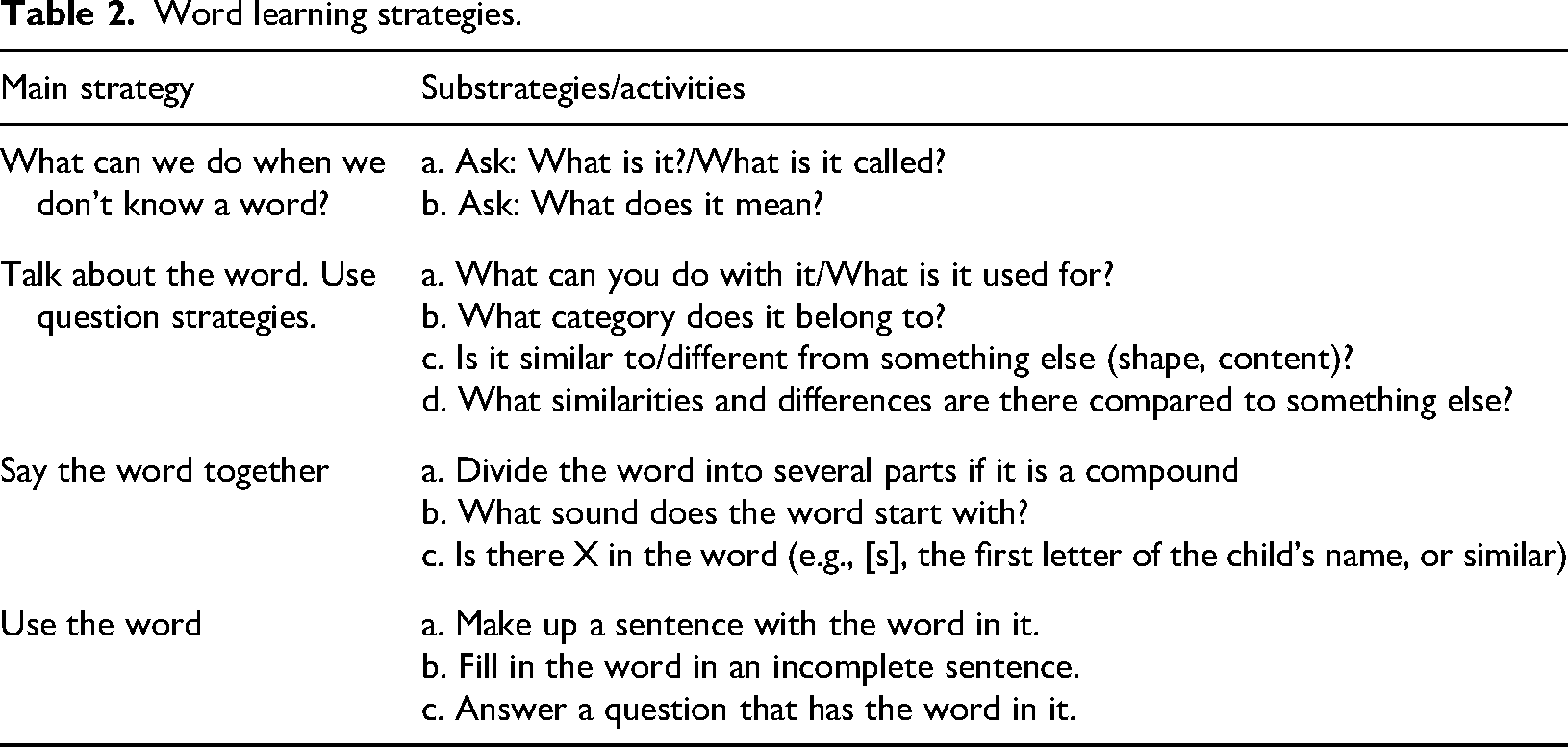
Word learning strategies.
Session 3
The third and final session of each theme starts with a repetition of the words collected in session 2. Following the repetition, a training activity is carried out with all words that belong to the theme. Examples of activities include memory, go fish, and word categorisation. After the activity, the children put pictures representing all the words from the theme, with collected words highlighted, into their own word treasure books, followed by naming or discussion of the words. The session is then concluded with another repetition of the collected words with the help of word learning strategies.
The IG and CG raw score results on the pre- and post-interventions assessments were analysed with nonparametric statistical methods in IBM SPSS Statistics 28. Wilcoxon's signed rank test was used for within-group comparisons of performance pre- and post-intervention. Mann–Whitney U test was used for between-group comparisons of performance on the pre-intervention assessment. As a measure of effect size, r was used: r < 0.3 = small effect, 0.3–0.5 = medium effect, > 0.5 = large effect.
A qualitative analysis of word learning strategies pre- and post-intervention was undertaken based on answers provided by children when asked about such strategies. The answers were rated as adequate or inadequate for the purpose of learning new words.
Results
Performance pre- and post-intervention on measures of word knowledge, semantic fluency and comprehension of semantic relations
Mann–Whitney U tests revealed no statistically significant differences between the groups pre-intervention. Table 3 presents the mean results and within-group comparisons of pre- and post-intervention performance for the IG and the CG on all measures. Within-group analyses using Wilcoxon's signed rank test showed that the IG made significant gains on both the trained and the untrained words of the Word knowledge test. No significant within-group difference was found in either group on the standardised measures of semantic fluency and comprehension of semantic relations.
Group performance and within-group pre–post-intervention comparisons.
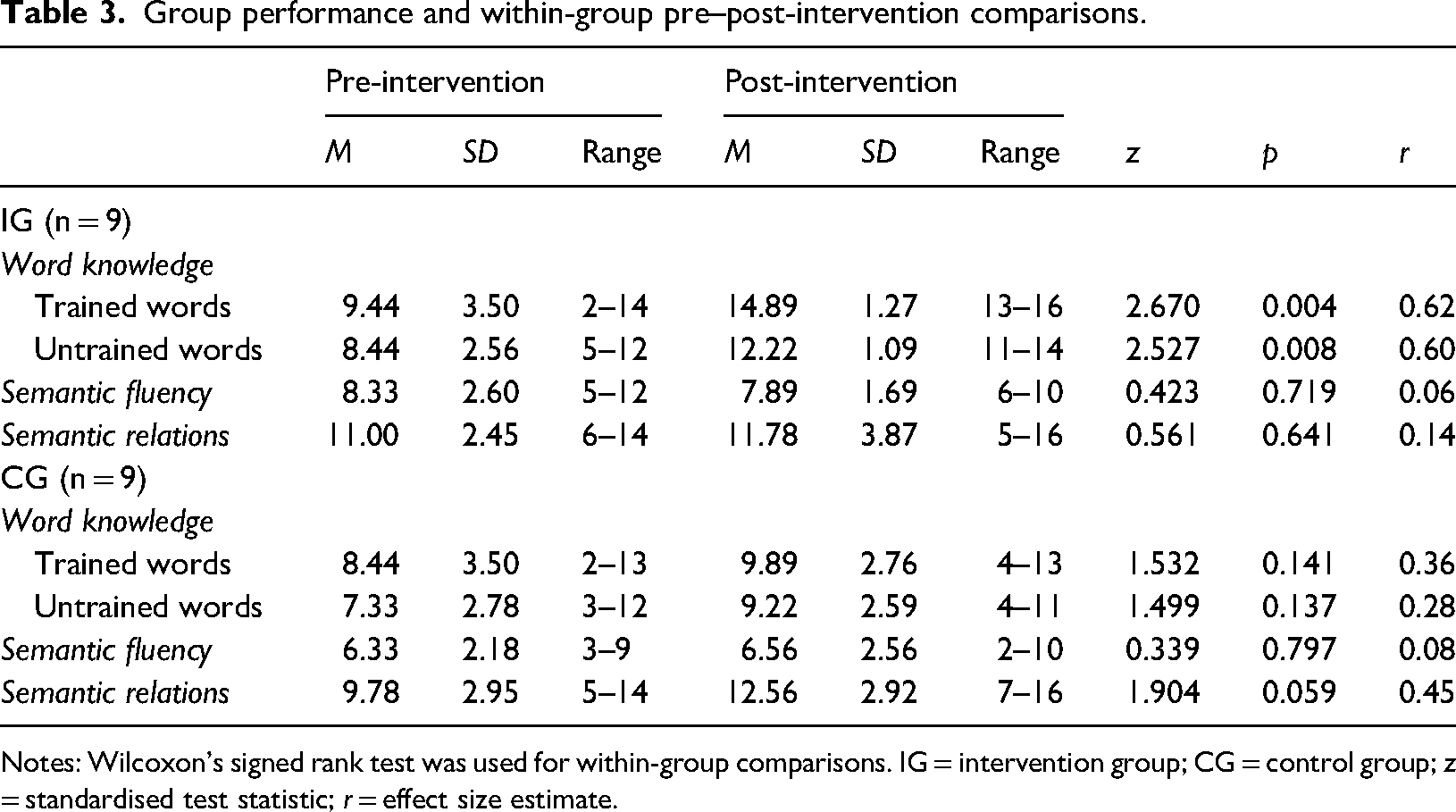
Group performance and within-group pre–post-intervention comparisons.
Notes: Wilcoxon's signed rank test was used for within-group comparisons. IG = intervention group; CG = control group; z = standardised test statistic; r = effect size estimate.
The average gain in the IG was 5.45 points for trained words, and 3.78 for untrained words, with a total average gain of 9.23 points (trained and untrained words combined). No significant gains could be found in the CG. They did, however, exhibit an average gain of 3.34 points. It should be noted that one point does not represent one learned word, as two points were awarded if the child could name and/or explain the word, and one point if they recognised the word.
Answers to the questions (1) What can you do if you don’t know what a word means? and (2) What do you do to learn a word that you haven’t heard before? were judged as adequate or inadequate for the purpose of learning new words. At pre-intervention, no adequate answers were provided by the IG children, while the children in the CG provided two answers rated as adequate (one for each question).
Table 4 shows the answers judged as adequate from both groups post-intervention. Six out of nine children in the IG gave adequate answers to question 1. In the CG, only one child answered the same question adequately. In general, the children found it harder to answer the second question. Three children in the IG and one child in the CG provided adequate answers. In summary, these findings could indicate that the IG acquired word learning strategies to a greater extent than the CG.
Word learning strategies post-intervention.
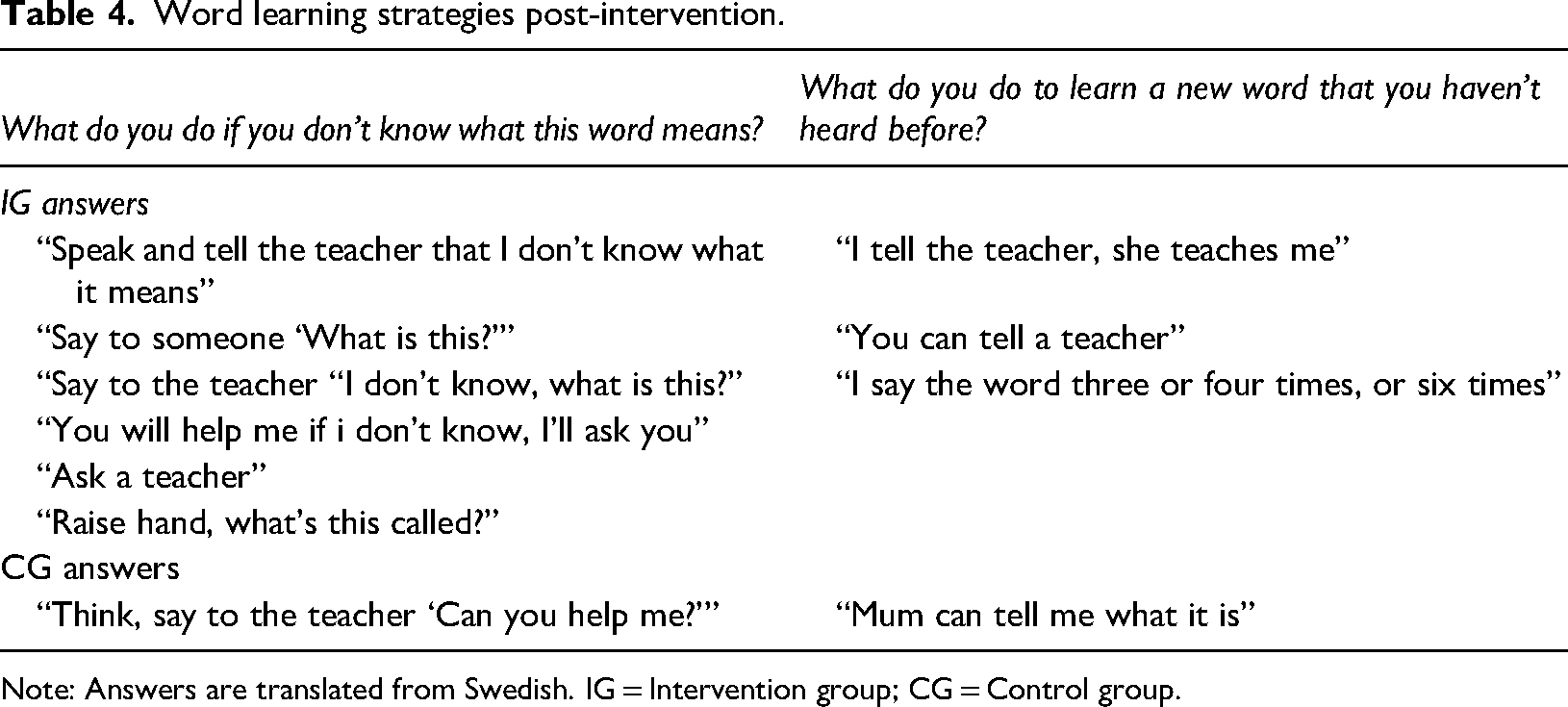
Word learning strategies post-intervention.
Note: Answers are translated from Swedish. IG = Intervention group; CG = Control group.
Previous studies of shared book reading and Lexicon Pirate interventions have shown effects on word knowledge and use of word learning strategies (Motsch and Marks, 2015; Steele and Mills, 2011). In the present study, the effectiveness of a school-based vocabulary intervention that utilises shared book reading and word learning strategies was investigated in six-seven-year-old children with SLCN who use Swedish as their L2, and who live in socioeconomically disadvantaged urban areas. Outcomes included word knowledge, the ability to use word learning strategies, as well as standardised measures of semantic fluency and comprehension of semantic relations.
As indicated by performance on the Word knowledge test, the IG showed significant improvement between pre- and post-test. The finding that they learned words that had been used actively in the intervention is promising, and also expected in light of previous studies of shared book reading (Wasik et al., 2016) and the Lexicon Pirate method (Motsch and Ulrich, 2012). The intervention method included several factors that have proved beneficial for word learning in previous studies, e.g., multiple exposures over time (Goldin-Meadow et al., 2014; Steele, 2020), word meanings put into a relevant context with clear explanations (Kong and Hurless, 2021), and explicit use of word learning strategies (Motsch and Marks, 2015). The group intervention format may also have influenced word learning positively, as this gave the children opportunities to discuss with peers as well as with adults (Steele and Mills, 2011).
The performance on the Word knowledge test indicates that the children in the IG gained knowledge equivalent to, on average, three to five out of the ten trained words included in the test, which is arguably a modest gain from 12 group sessions over six weeks of intervention. This result would appear to be similar to findings from previous studies of kindergarten and younger school age children with low vocabulary (Dyson et al., 2018; Christ and Wang, 2011), and rightly begs the question about the balance between cost and benefit. However, bearing in mind that the children included in the present study started from a low baseline, this improvement is potentially meaningful and important for the individual child. It is also important to add that the number of new words learned during the course of the intervention was likely larger, since the test only probed a subset of the words included in the intervention.
In line with the findings of Motsch and Marks (2015), the children in the IG also made significant gains in their knowledge of words that were not targeted in the intervention, which could be interpreted as a generalisation effect. While it is not possible to draw certain conclusions about what contributed to this supposed effect, it is possible that the word learning strategies taught facilitated word learning outside of the intervention context. Future studies should include long-term follow-up assessments to confirm whether such an effect is lasting or not.
While the intensity of the intervention appears to have been high enough to achieve group-level improvement of word knowledge, the total number times each child was exposed to each word was not controlled. It is therefore possible that some of the variation in the knowledge of trained words could be explained by insufficient dosage for the children who showed little improvement (Storkel et al., 2019). Future studies should carefully control the dose and dose frequency for each individual child, potentially through video recordings of the sessions.
The scores on the Semantic fluency and Semantic relations tasks showed no significant improvement from pre- to post-intervention testing. As such, there was no indication of transfer effects of the intervention to the ability to quickly find words within a given semantic category, or to the ability to comprehend semantic relations between words, immediately after the intervention. Even though one of the activities used in the intervention was categorisation of words based on meaning, this appears to have yielded no short-term gains on the ability to understand semantic relations, as measured by the Word Classes subtest of the CELF–4. The lack of improvement on the Semantic fluency task is similar to the results of Ebbels et al. (2012), who found no effect of semantic therapy on semantic fluency in a group of 9–15-year-old children. In relation to the absence of transfer effects, it is also worth noting that although the IG made significant gains concerning the number of words learned, the absolute numbers may have been too low to drive an improvement of more general vocabulary skills (Bialystok et al., 2008).
After the intervention, more children in the IG than in the CG could give examples of relevant word learning strategies they would use when encountering new words, which indicates a positive effect of the intervention on the acquisition of such strategies. However, this type of task is presumably a rather coarse measure of the children's actual knowledge and use of strategies. Observation of children in interaction with teachers and peers, both during intervention and regular teaching activities, would allow for analyses of what strategies they use, how frequently they use them, and how successful they are.
Clinical implications
All children in the IG, regardless of their specific SLCN or language background, had improved their vocabulary knowledge post-intervention. This suggests that the method can be used to teach relevant vocabulary to somewhat heterogeneous groups of children, whose common characteristics are that they are L2 users of Swedish with SLCN, who are in need of explicit vocabulary instruction. This is particularly useful in schools situated in segregated areas, such as those of the present study, where children with Swedish as L2 are in majority and diverse in terms of language background. There is often a lack of teachers and other educators who are proficient in the children's home languages, thus making interventions directed at the children's L1 impracticable. In addition, resources are often insufficient to provide individual intervention with enough intensity, which makes group intervention an attractive alternative.
The intervention evaluated in the present study contained specific themes selected for children with very limited Swedish vocabulary. However, since the method is flexible in the sense that books and words can be adapted to the needs of the children, it could potentially be used to teach not only basic vocabulary, but also vocabulary specific to e.g., certain school subjects, to multilingual children whose L1 is different from the majority language used in school.
Limitations
There are some limitations regarding the methodology of the present study, as well as the implementation of the intervention-as-intended, that ought to be addressed.
Firstly, this study was conducted during the COVID-19 pandemic. While Swedish elementary schools in general were being held open, a surge in COVID cases towards the end of the intervention prompted many parents to keep their children at home. As a result, a majority of the participants were not attending school when theme 5 was scheduled, forcing cancellation of the last three sessions. Despite this deviation from the planned course and intensity of the intervention, positive results were documented with only four themes (twelve 20–30 min sessions twice weekly for six weeks) completed. If anything, completion of the last theme may have yielded even more favourable outcomes, but this will need to be determined in future studies.
Further, as Andersson et al. (2019) conclude based on their Swedish study, living in areas with low socio-economic status increases the risk of SLCN in multilingual children. No information about the caregivers’ income, level of education or employment was collected in the present study, preventing group comparisons based on socio-economic status, or analyses of socio-economic status as a moderator of success. Nevertheless, the schools in this study were all situated in areas with low median incomes and low rates of employment, and the participants were residents of these areas.
Participants in the present study were multilingual children with SLCN characterised by low proficiency in their L2 (Swedish). Some had a confirmed diagnosis of DLD, while others did not. However, it is possible that some of the participants had undiagnosed DLD, but had not been adequately assessed in all their languages. Assessments of the children's home languages, as well as knowledge about specific markers of DLD in these languages, would be required to establish whether their SLCN were more likely due to DLD, or due to insufficient exposure to Swedish (Garraffa et al., 2019). In summary, all children in this study can be described as having SLCN (Bishop et al., 2017), but it has not been possible to determine exactly what underlay the needs of each child.
It is also important to note that the purpose of the intervention used in the present study was to improve vocabulary in Swedish, and that some of the participating children would also benefit from intervention targeting their L1 language skills. Unfortunately, information about the children's L1 language proficiency could not be obtained, since there were no previous records available, and no staff proficient in the children's L1 who could conduct assessments.
Finally, this study was quite small in scope, with a total of 18 children from three schools, and outcome measurements only at the start of intervention and immediately after. The efficacy of the intervention should be evaluated in studies using designs that are more rigorous, e.g., randomised control trials, and larger samples, with follow-up assessment of potential long-term effects. Future studies should also include additional background measures of e.g., L1 and L2 language ability, and socio-economic status, in order to enable analyses of factors moderating the effect of the intervention.
Conclusion
The results from the present study indicate that vocabulary intervention combining elements from shared book reading and Lexicon Pirate methodology can be used to promote children's word learning strategies and acquisition of new words in Swedish. However, no evidence of a transfer effect of the intervention to semantic fluency or the ability to comprehend semantic relations between words, as measured with standardised tests, could be found. Considering that this was a non-randomised pilot study, the findings should be interpreted with care.
Footnotes
Acknowledgements
We would like to give our many thanks to the participating children and their caregivers, as well as to the teachers, special educators, and speech and language therapists who helped with recruitment and the practicalities surrounding the intervention.
Declaration of conflicting interests
The authors declared no potential conflicts of interest with respect to the research, authorship, and/or publication of this article. The authors alone are responsible for the writing and content of this paper.
Funding
The authors received no financial support for the research, authorship, and/or publication of this article.
