




Abstract
Children diagnosed with autism spectrum disorder (ASD) are at increased risk of persistent language and literacy difficulties. This study investigated the effectiveness of an 8-week parent-implemented shared book reading intervention designed to change parent and child book reading behaviours. Sixteen parents and their preschoolers on the autism spectrum participated. Nine parents were randomly allocated to receive the shared book reading intervention first. The intervention used a coaching model and comprised a training session, four home visits, and four follow-up phone calls. Parents completed a shared book reading video with their child prior to the intervention, immediately post-intervention and eight weeks after the intervention was completed. Following intervention, there was a significant increase in the intervention group parents’ use of book-related vocabulary and their explicit teaching of story structure, compared to the waitlist control group. Compared to the control group, there was a significant increase in children’s verbal participation (number of utterances and number of different words). However, these effects disappeared when the significant increase in reading duration following the intervention was taken into account. All improvements were maintained over time. Our results highlight the feasibility of a parent-implemented shared book reading intervention for encouraging early language skills in children on the spectrum in a naturalistic setting that is part of many family routines.
Keywords
I Introduction
Autism spectrum disorder (ASD) is characterized by impairments in social-communication skills combined with repetitive and restricted behaviours and interests (American Psychiatric Association, 2013). Common comorbidities include language impairment and intellectual disability. Considering literacy is a language-based skill (Catts, 1993), with many precursor skills learned through social interactions with parents, caregivers, and early childhood professionals, it is not surprising that children on the autism spectrum are at risk of persistent literacy difficulties. Research investigating the emergent literacy skills of children on the spectrum during the preschool period has shown particular challenges in meaning-related skills (e.g. vocabulary and story retelling and comprehension) and relative strengths in print-related skills, including alphabet knowledge (Davidson and Ellis Weismer, 2014; Fleury and Hugh, 2018; Lanter et al., 2012; Westerveld and Roberts, 2017; Westerveld et al., 2017). While these uneven emergent literacy profiles may be related to children’s language abilities and/or cognitive skills (Westerveld et al., 2020b), emerging longitudinal research has confirmed the importance of these precursor literacy skills to future reading performance (Davidson and Ellis Weismer, 2014; Dynia et al., 2017; Westerveld et al., 2018), reinforcing the importance of early intervention. In the current study we investigate the effectiveness of a shared book reading (SBR) intervention for preschoolers on the spectrum.
Shared book reading interventions for preschoolers generally comprise three strategies aimed at engaging the child in shared book reading: (1) encouraging the child to talk about pictures by using open-ended questions, (2) using indirect language stimulation techniques (i.e. modelling of vocabulary and expansions beyond the ‘here and now’), and (3) being responsive to the child’s cues as appropriate to the child’s developing abilities (Whitehurst et al., 1988). There is strong support for shared book reading interventions that promote active child involvement in story book reading, with improvements in both expressive vocabulary (moderate effect size) and receptive vocabulary indicated (small effect size) (Mol et al., 2008). A recent systematic review and meta-analysis of shared picture book reading intervention studies involving parents (randomized control trials only) was conducted by Dowdall et al. (2019) to better understand sources of variation in outcomes, including child age, dosage, modality, SES, and parental education. A total of 20 studies met the final inclusion criteria, but only two studies included participants with mild to moderate language delays (Dale et al., 1996) and special education needs (Towson and Gallagher, 2014). Although the results from this meta-analysis generally mirrored those from an earlier review by Mol et al. (2008), with significant improvements observed in the children’s expressive language skills following intervention, an additional finding was that the interventions resulted in a significant improvement in caregiver book-sharing competence, with a large effect size.
Studies investigating parental shared book reading interventions for children with language difficulties have reported positive effects for children with mild communication difficulties, including children with low expressive vocabulary skills (Hargrave and Sénéchal, 2000) and children with language delays (Dale et al., 1996; Towson and Gallagher, 2014). More recently, researchers have investigated shared book reading interventions for preschoolers on the spectrum (e.g. Coogle et al., 2018; Fleury and Schwartz, 2017; Whalon et al., 2015), however only one published study involved a parent as the agent of intervention (Whalon et al., 2016). This is surprising considering shared book reading is an activity many families engage in daily, including parents of preschoolers on the spectrum (Simpson et al., 2020). Whalon et al. (2016) used a single case study design to examine whether a parent could reliably implement the shared book reading procedures and if the child (a 4-year-old boy on the spectrum) improved in his ability to spontaneously respond to caregiver questions. Results indicated shared book reading intervention would potentially be suitable for implementation by parents of preschoolers on the spectrum.
Shared book reading places high social interaction and communication demands on both the parent and the child. This may explain why parents report preschoolers on the spectrum show less enjoyment during, and lower interest in, shared book reading than typically developing children (Lanter et al., 2013; Simpson et al., 2020) or children with Down syndrome (Westerveld and van Bysterveldt, 2017), despite no group differences observed in the number of children’s books in the home (Lanter et al., 2013; Westerveld and van Bysterveldt, 2017). Tipton et al. (2017) investigated the impact of such high social and communication demands on parents and children on the spectrum (n = 111, ages 4–7 years). Parents were asked to share four wordless picture books with their child. Links between the parents’ book reading strategies and their children’s communication, behaviour problems, and social skills were investigated. Significant positive correlations were found between parents’ use of clarification strategies (open-ended function/attribute questions and praise/confirmation) and children’s social interaction skills, while negative correlations were shown between parents’ use of evocative techniques (open-ended questions, yes/no questions, and imitative directions) and their child’s behaviour problems. Taken together, these studies suggest that making this activity more interesting or ‘fun’ may reduce children’s behaviour problems and support engagement during shared book reading activities aimed at fostering social interaction, language development, and emergent literacy skills in preschoolers on the spectrum. Further, the need to consider engagement in shared book-reading interventions for children on the spectrum is also highlighted.
We used a block randomized control study design to investigate the effectiveness of a shared book reading intervention implemented by parents with preschoolers on the spectrum over an eight-week period. We incorporated a dialogic reading approach (Sim et al., 2014; Whitehurst, 1994; Whitehurst et al., 1988), in which parents were encouraged to introduce their child to new vocabulary depicted in the books. We also encouraged parents to explicitly teach their child story structure elements, based on previous research showing limited use of this strategy with children on the spectrum (Westerveld et al., 2020a), combined with the generally poor oral narrative comprehension skills of this population (Westerveld and Roberts, 2017). The following research questions were posed:
Do parents who participate in an eight-week shared book reading intervention program show an increase in their use of book-related vocabulary and explicit teaching of story structure compared to a waitlist control group?
Do children whose parents participate in an eight week shared book reading intervention program show an increase in the number of utterances and the number of different words they use during a shared book reading session, compared to their peers in the control group?
We also investigated if the results were maintained at follow-up, eight weeks after the intervention ceased and asked the intervention group parents to complete an anonymous online feedback survey.
II Method
1 Participants
The study was approved by the university’s Human Ethics Committee (AHS/13/14/HREC). Participants were recruited through ASD early childhood services, private speech pathology clinics, and Applied Behaviour Analysis Services. The following inclusion criteria for children were listed on the recruitment flyers: (1) confirmed community diagnosis of ASD, (2) younger than six years of age, (3) no formal schooling, (4) ability to attend to a book for approximately five minutes, (5) regular engagement in shared book reading with parents, and (6) no current attendance in other book reading programs.
Twenty-four parents expressed interest and commenced the assessment process. For the Consolidated Standards of Reporting Trials [CONSORT] diagram, see Figure 1. As shown in Figure 1, 25% of the intervention group withdrew due to other commitments / parental workload. In the waitlist control group 4 parents withdrew and reported timing issues or workload by the time the intervention was offered. The Social Communication Questionnaire (Rutter et al., 2003) was used to verify ASD diagnosis, using 11 as a cut-off (see (Lee et al., 2007) and the Autism Diagnostic Observation Schedule (ADOS; Lord et al., 2012) was administered to verify diagnosis for the three children who scored ⩽ 11. Maternal level of education was used as a proxy for socioeconomic status (SES), with 17% of mothers having completed year 12 and 83% of mothers having completed tertiary studies. English was the primary language of 82% of participants; other primary languages included Arabic, Tagalog, and Japanese.
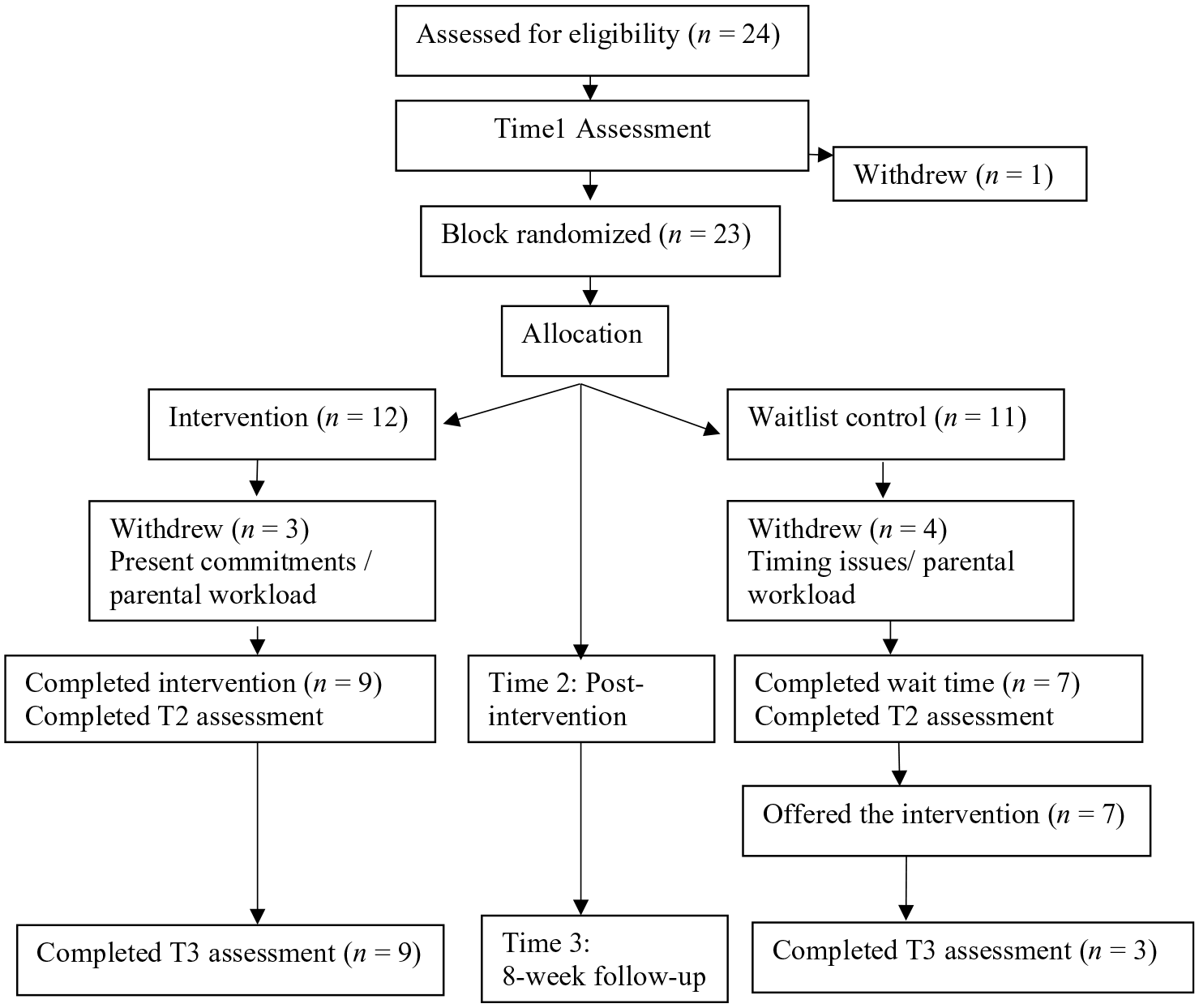
Consolidated Standards of Reporting Trials (CONSORT).
2 Procedure
Participants completed assessments at three time points: pre-intervention (T1), immediately post-intervention (T2), and eight weeks after the intervention finished (T3).
3 Measures
Parents completed a home literacy questionnaire at T1. Parent responses to five questions were analysed, from a 1 (never) to 5 (very often) scale:
Does your child ask you to read to him/her?
How often do you read to your child?
Does your child ask questions about characters or events during story reading?
Do you attempt to teach the names of letters in the alphabet and/or letter sounds when reading?
At what age did you begin reading to your child?: scale of 1 (birth – 3 months) to 5 (over 24 months).
Two subscales of the Mullen Scales of Early Learning (MSEL; Mullen, 1995) were administered to measure nonverbal ability: Visual Reception and Fine Motor. A developmental quotient (ratio IQ) was calculated by dividing the child’s age equivalent average across the two subscales by their chronological age, then multiplying by 100. Children’s previous assessment results were used if these were gathered in the previous 12 months.
Children’s receptive vocabulary skills were assessed at T1 using the Peabody Picture Vocabulary Test – Fourth Edition (PPVT-4; Dunn and Dunn, 2007). Age equivalent scores were calculated and used when adapting the intervention strategy sheets to the child’s level of development (see intervention materials).
During the shared book reading observation, parents videotaped themselves at each time point sharing Pip and Posy, the Big Balloon by Alex Scheffler, (2012) with their child ‘as they normally would’ in their home setting. This book was not used during the intervention. Video recordings were transcribed verbatim and entered into Systematic Analysis of Language Transcripts (SALT; Miller et al., 2017). Total reading time for each video recording was calculated. Transcripts were coded using a clinical observation scale (Westerveld et al., 2020a) for two types of parent behaviours that aligned with the research questions: (1) exposure to book vocabulary / language [Words], and (2) explicit teaching of story structure [ESS]. The following child behaviours were calculated automatically using SALT: (1) Total number of child utterances (communication units); and (2) Number of different words. For an overview of the coding scheme, see Appendix 1.
4 Randomization
As shown in Figure 1, children were randomly allocated, using SPSS, to the intervention or waitlist control group. There were no significant group differences in responses to the five home literacy questionnaire questions (all ps > .074). Groups did not significantly differ at T1 on any of the other descriptive measures (all ps > .05), see Table 1.
Participant characteristics for intervention and control groups.
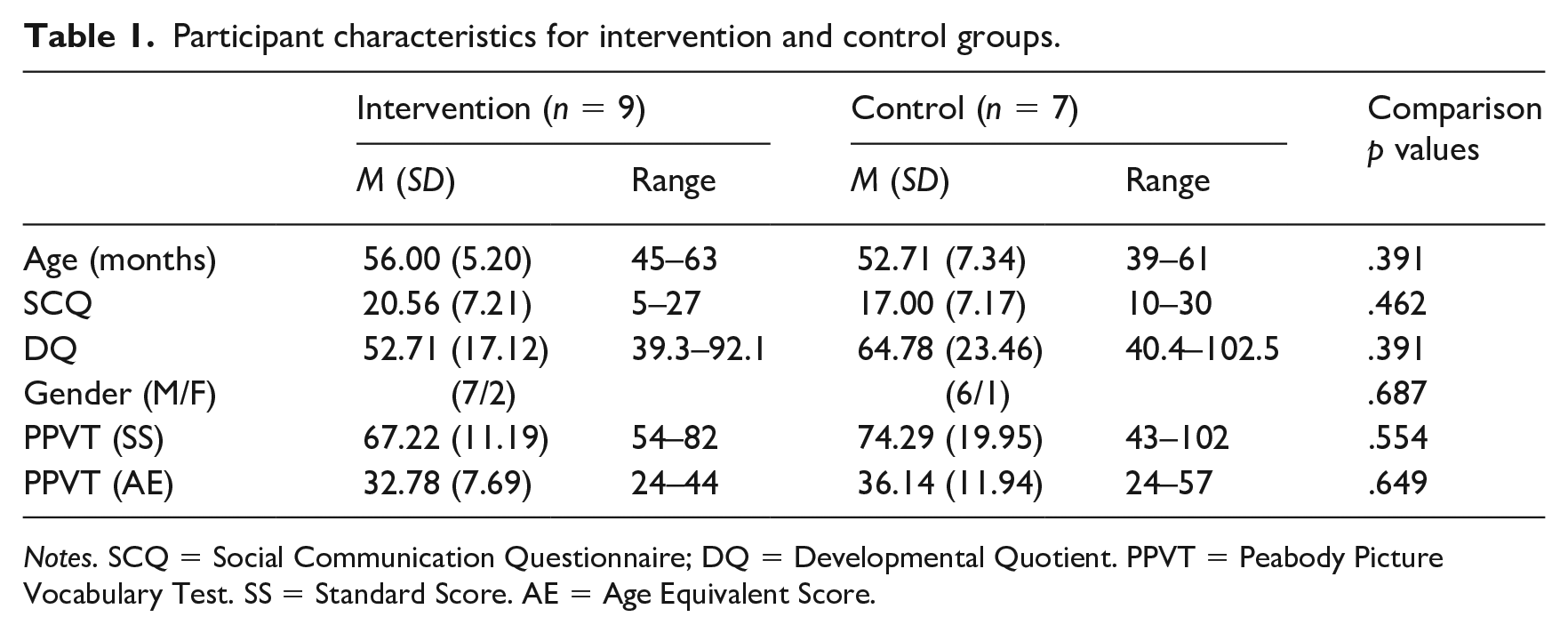
Notes. SCQ = Social Communication Questionnaire; DQ = Developmental Quotient. PPVT = Peabody Picture Vocabulary Test. SS = Standard Score. AE = Age Equivalent Score.
5 Reliability
Transcripts were checked by a second researcher for transcription errors and disagreements were resolved prior to analyses. Five transcripts were randomly selected for recoding for Words and ESS, using the clinical observation scale (Westerveld et al., 2020a), by an independent research assistant (a speech-language pathologist who was blind to the intervention status of the children) and showed good reliability (intra-class correlations .874–.986).
6 Shared book reading (SBR) intervention
a Control group
Parents were instructed to continue reading to their child as they typically would over an eight-week period; parents were provided with a log book and asked to note instances of shared book reading. No formal training was provided and parents were not given a copy of the books that were used in the intervention.
b Intervention group
The intervention was delivered over an eight-week period by a certified practising speech pathologist, adopting a coaching model, in which the speech pathologist provided individualized support to each parent through video observation (of the parent-recorded shared reading sessions), reflection and feedback, with joint planning for the week ahead (Rush and Shelden, 2011). The speech pathologist first conducted a training session introducing the parents to the book reading strategies, followed by four fortnightly follow-up visits of approximately 45-minutes’ duration, with phone calls completed on alternative weeks. For an overview of the schedule, please see Appendix 2.
c Intervention materials
All sessions were manualized to ensure consistency of delivery across participants. Eight commercially available books were selected if they were deemed suitable by the first author for preschool-aged children across a range of developmental levels and contained a clear narrative structure, attractive pictures, medium- to large-sized print, and the potential for teaching new vocabulary. Parents were given a new book each week and asked to share this book with their child on at least four occasions that same week. Three sets of strategy sheets were created to adapt to each child’s language level (based on T1 PPVT-4 and their expressive language use during the T1 shared book reading session), level 1: children with no, or very little verbal language; level 2: children with emerging oral language and PPVT-4 age equivalent [AE] < 36 months; level 3: children who communicated in short phrases or sentences, with PPVT-4 AE > 36 months. We also created bookmarks for each book (at each level), with specific examples on how to 1) target words, 2) target story structure, and 3) encourage fun (see intervention overview next). The complete intervention program is available for download from the first author’s website (www.marleenwesterveld.com). For examples of strategies at each level, see Appendix 3.
7 Intervention overview (vocabulary, story structure, and fun)
a Vocabulary
Parents were introduced key strategies to promote child vocabulary: pointing out and labelling new pictures; providing word definitions; using facial expressions and gestures to demonstrate word meanings; and relating words, pictures, and events to the child’s own life experiences.
b Story structure
Parents were encouraged to introduce their child to story components through modelling of language and use of questions related to the characters, setting, problem, actions, and resolution. A narrative visual aid was provided for use when needed. Discussing the story prior to reading and summarizing the story once completed were promoted in order to provide continual modelling of the narrative structure, sequence of events, and key details. Where possible, parents encouraged their child to attempt to retell the story themselves, with scaffolding provided to ensure essential features were included.
c Fun
Given lower levels of interest in shared book reading in children on the spectrum (Westerveld and van Bysterveldt, 2017) and the importance of social interaction for shared book reading success, strategies to promote having fun during the book reading sessions were included. These were: acting out the story or actions in the book, using exaggerated gestures and expressions, making fun noises, and using silly voices.
III Results
1 Data screening
Missing values analysis including all variables showed < 5% missing with analysis, suggesting data were missing completely at random, Little’s MCAR test χ2 (29) 25.81, p = .636. Data were checked for assumptions of repeated measures t test, ANOVA and ANCOVA analyses. Significant Shapiro-Wilk statistics indicated normality was violated across groups for several variables. Means and medians were compared, and Pearson’s skewness coefficients calculated (cut-off: 1.96; α = .05), for each variable. This process revealed no significant departure from normality for any variable inspected. Inspection of Levene’s test per model revealed homogeneity of variance was violated for reading duration time (T2: p < .001), parent teaching of story structure (T1: p = .049; T2: p < .001), and child number of different words (T2: p = .014. Homogeneity of covariances, as assessed by Box’s test of equality of covariance matrices, was violated for reading duration time (p = .028), story structure teaching (p < .001), and child number of different words (p = .013). However, as group sizes were similar in size, and distributions showed no severe deviations from normality, these violations can be tolerated due to the robust nature of the analyses (Allen and Bennett, 2007). Thus, no corrective action was taken. Means, standard deviations and range scores for reading duration, parent behaviours and child verbal participation are shown in Table 2.
Means, standard deviations and ranges for reading time duration (in seconds), parent behaviours and child verbal participation at T1 and T2 by group.
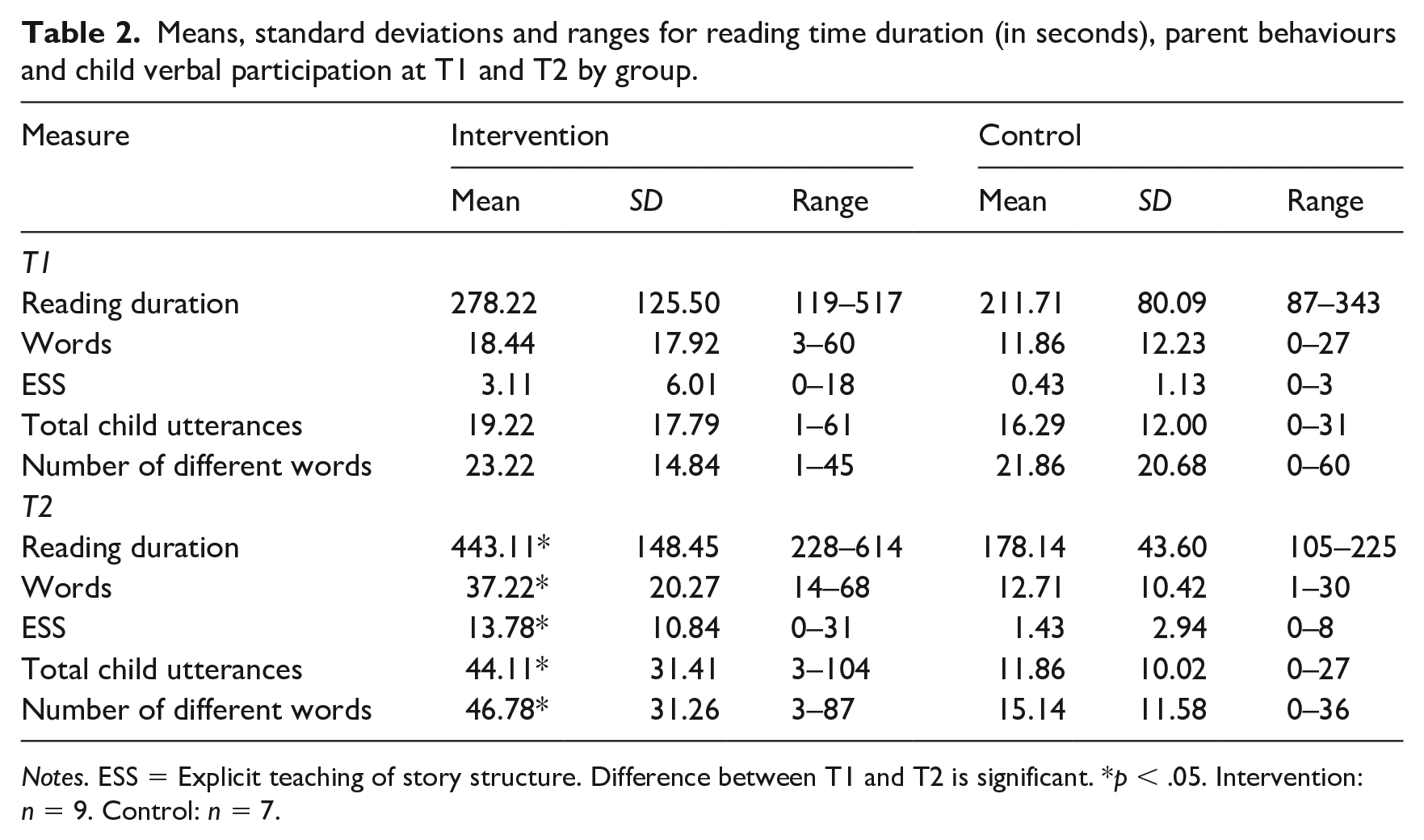
Notes. ESS = Explicit teaching of story structure. Difference between T1 and T2 is significant. *p < .05. Intervention: n = 9. Control: n = 7.
2 Reading duration
To compare groups on reading duration at pre- and post-intervention, mixed ANOVAs were conducted. Groups did not differ in reading time duration at T1, F(1, 14) = 1.48, p = .244, ηp2 = .096. A significant interaction between group and time was shown, F(1, 14) = 7.65, p = .015, ηp2 = .353. There was a statistically significant difference between groups in time spent sharing the book from T1 to T2, as shown by a main effect for group, F(1, 14) = 14.40, p = .002, ηp2 = .507, with the intervention group spending an increased amount of time sharing the book at Time 2 compared to the control group, F(1, 14) = 12.07, p = .004, ηp2 = .463 (see Table 2). Mean reading time for the intervention group significantly increased at T2 (Mdiff = 164.89 seconds, SE = 47.46, p = .004, d = 1.20). Therefore, the following analyses were conducted before and after controlling for reading time duration at T2, by adding reading duration as a covariate in a mixed ANCOVA.
3 Parent behaviours during SBR
a Exposure to book language (words)
A significant interaction between group and time was found, F(1, 14) = 5.60, p = .033, ηp2 = .286. Groups did not differ in parent use of book language at T1, F(1, 14) = .69, p = .420, ηp2 = .047. At T2, the intervention group used significantly more book language compared to the control group parents, F(1, 14) = 8.41, p = .012, ηp2 = .375, with a large effect. Parent book language use increased significantly for the intervention group (Mdiff = 18.78, SE = 5.01, p = 002, d = .98); no significant increase was found for the control group (Mdiff = .86, SE = 5.68, p = .882, d = .08). After controlling for increases in T2 reading time, no significant interaction between group and time was found, F(1, 13) = 0.85, p = .374, ηp2 = .061. Closer inspection of the results showed that 6 of the 9 parents in the intervention group showed an increase in exposure to book language (Words) after controlling for time.
b Parent explicit teaching of story structure (ESS)
There was a significant interaction between group and time, F(1, 14) = 5.24, p = .038, ηp2 = .272. Groups did not differ at T1, F(1, 14) = 1.34, p = .267, ηp2 = .087. At T2, parents in the intervention group used significantly more ESS techniques than the control-group, F(1, 14) = 8.48, p = .011, ηp2 = .377. Mean ESS significantly increased at T2 for the intervention group (Mdiff = 10.67, SE = 2.80, p = .002, d = 1.22), but not the control group (Mdiff = 1.00, SE = 3.17, p = .757, d = .45). After controlling for T2 reading duration, no significant interaction between group and time was found, F(1, 13) = 0.01, p = .926, ηp2 = .001. Closer inspection of the results showed that 7 of the 9 parents in the intervention group demonstrated an increase in ESS after controlling for time.
4 Child behaviours during SBR
a Child utterances
There was a significant interaction between group and time, F(1, 14) = 10.99, p = .005, ηp2 = .440. Groups did not differ in the number of child utterances at T1, F(1, 14) = .14, p = .714, ηp2 = .010. At T2, children in the intervention group used more utterances than children in the control group, F(1, 14) = 6.75, p = .021, ηp2 = .325. Mean child utterances score significantly increased at T2 for the intervention group (Mdiff = 24.89, SE = 5.85, p = .001, d = .98); no significant increase was found for the control group (Mdiff = −4.23, SE = 6.63, p = .515, d = .40). After controlling for T2 reading duration, no significant interaction between group and time was found, F(1, 13) = 0.01, p = .929, ηp2 = .001.
b Number of different words
There was a significant interaction between group and time, F(1, 14) = 11.24, p = .005, ηp2 = .445. Groups did not differ significantly in the number of different words at T1, F(1, 14) = .02, p = .880, ηp2 = .002. At T2, children in the intervention group produced a significantly higher number of different words compared to children in the control group, F(1, 14) = 6.40, p = .024, ηp2 = .314. Mean number of different words score significantly increased at T2 for the intervention group (Mdiff = 23.56, SE = 5.97, p = .001, d = .96); no significant increase was found for the control group (Mdiff = −6.71, SE = 6.77, p = .338, d = .40). After controlling for T2 reading duration, no significant interaction between group and time was found, F(1, 13) = 0.04, p = .840, ηp2 = .003.
5 Performance at T3
Paired sample t-tests were conducted to assess whether gains observed in the intervention group were maintained at T3. No significant differences were found in reading duration from T2 to T3, t(8) = .29, p = .778, d = .05. Significant increases were found in the total number of utterances children made during shared book reading with parents from T2 (M = 44.11, SD: 31.41, Range: 3–104) to T3 (M = 53.78, SD = 37.39, Range: 11–126), t(8) = −2.57, p = .033, d = .28. There was no significant change in the number of different words the children used, (T2, M = 46.78, SD = 31.26, Range = 3–87; T3, M = 49.56, SD: 28.36, Range = 11–96; t(8) = .77, p = .462, d = .09). No differences in parent use of book language, (T2, M = 37.22, SD = 20.27, Range = 14–68; T3, M = 45.67, SD = 28.84, Range = 14–107; t(8) = −1.90, p = .094, d = .34), or explicit teaching of story structure (T2 = M = 13.78, SD = 10.84, Range = 0–31; T3, M = 11.00, SD = 9.10, Range = 0–27; t(9) = .65, p = .535, d = .28), were found from T2 to T3.
6 Social validity
All parents reported feeling satisfied or extremely satisfied with the book reading strategies and overall experience of the intervention. All parents also reported that the intervention changed the way they shared books with their child, consistent with observational data.
IV Discussion
We investigated changes in parent and child behaviours during shared book reading immediately following intervention, and eight weeks after the intervention was completed. We found an increase in parents’ use of shared book reading behaviours that were targeted in the intervention, as well as an increase in children’s verbal participation; however, these improvements became non-significant when differences in reading duration were controlled in analyses. Parents significantly increased both their introduction of new words and their focus on story structure by using a variety of strategies while sharing a book with their child. This finding adds to the limited literature demonstrating an improvement in caregiver book-sharing competence following intervention (see Dowdall et al., 2019; Noble et al., 2020), and extends these findings to parents of children on the spectrum. Although this increase in behaviours was linked to an increase in overall reading duration, it gave children significantly more exposure to these parent behaviours that are known to promote oral language skills in typically developing children (Dowdall et al., 2019).
We investigated if the intervention resulted in a change in children’s verbal behaviours during the shared book reading. Children who participated in the intervention showed a significant increase in the number of utterances during shared book reading, but this effect was not sustained after controlling for reading duration. A similar trend was observed in the number of different words children used, which increased significantly following intervention, indicating children used a wider variety of words during the shared book reading than initially observed. Our finding that children used a wider variety of words following intervention is consistent with previous shared book reading intervention studies involving parents of preschoolers not on the spectrum (Dowdall et al., 2019; Mol et al., 2008) and confirm Whalon et al.’s (2016) results that this type of intervention can be reliably implemented by parents. Considering the crucial importance of vocabulary knowledge for later language and literacy development (National Early Literacy Panel, 2008; Westerveld et al., 2018), this is a promising finding.
We reassessed the shared book reading behaviours of the intervention participants eight weeks after the intervention finished. Reading duration remained at post-intervention levels, with similar use of shared book reading strategies (Words and ESS) by the parents. The children maintained their post-intervention levels of number of different words, but showed a significant increase in the number of utterances produced during the shared book reading. These results indicate that the intervention was successful in changing parent shared book reading behaviours, resulting in increased verbal participation of their children on the spectrum which was sustained over time. Moreover, parents expressed their satisfaction with the intervention and had observed a change in the way they shared books with their children. Our results thus showed the success of using a coaching model with parents, extending findings from studies examining the effects of coaching on preschool educators’ interactive shared book reading (Rezzonico et al., 2015). Taken together and considering this group of children often show low interest in shared book reading activities (e.g. Simpson et al., 2020), these maintenance results are particularly promising.
Albeit small-scale, this is one of the first studies to use a randomized control group design to investigate the effectiveness of a parent-implemented shared book reading intervention with their preschoolers on the spectrum. Although our results were generally positive, further research with larger sample sizes is needed to fully understand the impact of the intervention on parent and child behaviours. Further research is also needed to help determine the active ingredients of the intervention program. We cannot be certain if simply asking parents to increase the time spent reading with their child would have resulted in similar gains in children’s verbal behaviours during shared book reading. Our finding of non-significant effects following controlling for reading duration may be due to limited power due to our small sample size, particularly given large effects sizes were found in our initial analyses. Time alone, however, is unlikely to increase engagement, based on previous research linking parents’ shared book reading behaviours to their children’s social interaction skills (autism symptomology) (Tipton et al., 2017). Instead, it may be that increased engagement led to increased reading time in the intervention group. Taken together, there is a need for future research that includes a larger sample and comparison of specific techniques in order to focus on engagement (e.g. component analysis; compare to just ‘make it fun’ alone) which would enable more fine-grained analysis of mechanisms and outcomes to be conducted. Further, this research may be extended by investigating the ‘dose’ required for changes, as well as what components may foster broader generalization. Finally, it should be noted that seven (29%) families withdrew from the study during the intervention phase (three from the intervention group and four in the waitlist control group). When asked, parents cited a high parental workload and many found it difficult to fit the research-related requirements (e.g. home visits and providing the team with SBR videos), into their already busy schedules. These findings highlight the importance of attempting to incorporate these SBR intervention strategies into existing services for preschoolers on the spectrum.
In conclusion, we add to the scant evidence base on the effectiveness of parent-implemented shared book reading intervention for preschoolers on the spectrum. Our findings indicated that parents were receptive to coaching and that changes in child verbal behaviours during shared book reading were made without direct input from the clinician. Parent-mediated interventions help build family capacity in a naturalistic setting that is part of many family routines and is potentially a cost effective and socially valid way of encouraging early language skills needed for future reading success for preschoolers on the spectrum.
Footnotes
Appendix
Examples of strategies provided at each level.
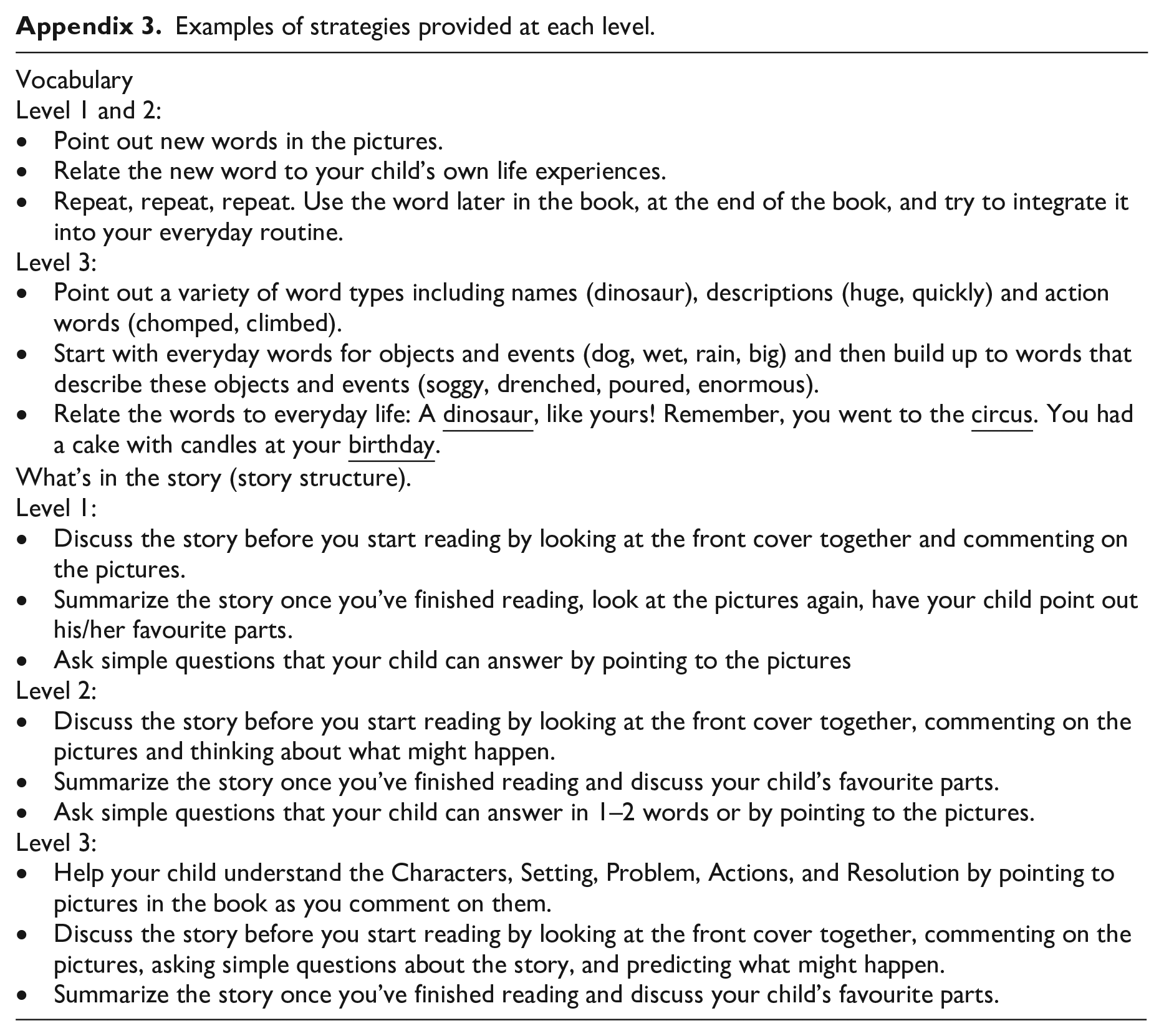
| Vocabulary Level 1 and 2: • Point out new words in the pictures. • Relate the new word to your child’s own life experiences. • Repeat, repeat, repeat. Use the word later in the book, at the end of the book, and try to integrate it into your everyday routine. Level 3: • Point out a variety of word types including names (dinosaur), descriptions (huge, quickly) and action words (chomped, climbed). • Start with everyday words for objects and events (dog, wet, rain, big) and then build up to words that describe these objects and events (soggy, drenched, poured, enormous). • Relate the words to everyday life: A |
| What’s in the story (story structure). Level 1: • Discuss the story before you start reading by looking at the front cover together and commenting on the pictures. • Summarize the story once you’ve finished reading, look at the pictures again, have your child point out his/her favourite parts. • Ask simple questions that your child can answer by pointing to the pictures Level 2: • Discuss the story before you start reading by looking at the front cover together, commenting on the pictures and thinking about what might happen. • Summarize the story once you’ve finished reading and discuss your child’s favourite parts. • Ask simple questions that your child can answer in 1–2 words or by pointing to the pictures. Level 3: • Help your child understand the Characters, Setting, Problem, Actions, and Resolution by pointing to pictures in the book as you comment on them. • Discuss the story before you start reading by looking at the front cover together, commenting on the pictures, asking simple questions about the story, and predicting what might happen. • Summarize the story once you’ve finished reading and discuss your child’s favourite parts. |
Acknowledgements
The authors would like to acknowledge the assistance from Kate O’Leary and Rhylee Sulek. Our heartfelt thanks to the parents and children for their participation in this project.
Funding
The author(s) disclosed receipt of the following financial support for the research, authorship, and/or publication of this article: The authors acknowledge the financial support of the Cooperative Research Centre for Living with Autism (Autism CRC), established and supported under the Australian Government’s Cooperative Research Centres Program.
