




Abstract
Flexible learning programmes (FLPs) and similar alternative education initiatives are designed to meet the diversity of needs of young people who have become disengaged from mainstream education. There is emerging evidence of the high prevalence of speech, language and communication needs (SLCN) and language disorders amongst students attending FLPs. This highlights the importance of understanding the views of these young people growing up in challenging psychosocial contexts about their experiences of schooling. We report on the perspectives of 45 students (aged 12–18 years) who had identified SLCN and who attended an FLP. We wanted to understand what they found valuable (and not) in their current FLP and how this compared to their previous schooling experience. The majority of students responded positively when asked about their current high school. Key factors identified via qualitative content analysis included how the FLP class content and environment were suited to them, the responsiveness of staff to their learning and personal needs, how their autonomy was respected, and the positive peer relationships they had developed in the FLP. Understanding these factors will support the design and implementation of educational programmes that foster improved engagement with, and achievement within, both FLPs and mainstream schools.
Keywords
Introduction
In developed countries around the world, completion of upper secondary level education has become the expectation. In Australia, it is compulsory for young people to complete Year 10 (to age 15 or 16) and to take part in full-time education, training or paid employment until they are aged 17 (Wilson et al., 2011). School attendance contributes to academic achievement and future employment opportunities. Not unexpectedly, the converse applies, with non-attendance associated with negative academic and social outcomes (Australian Institute of Health and Welfare, 2021). The term ‘flexible learning programme’ (FLP) (or flexible learning option/alternative education) is used internationally to describe services provided by government, non-government and not-for-profit organisations that aim to extend and re-connect young peoples’ engagement with mainstream education. In Western Australia (WA), the Association for Independent Schools (AISWA) runs 28 FLPs, termed Curriculum and Reengagement in Education (CARE) Schools, across the state. These high schools cater for up to 575
1
students in years 7–12 (aged 12–18 years) who have been unable to access or have significant difficulty accessing mainstream education. These young people fall into the category of ‘young people at risk’ (AISWA, 2022): The majority of students in a CARE School will study a modified curriculum that is designed to address their identified needs. Low or non-existent literacy and numeracy are an issue for a significant number of students and programs designed specifically to address this are provided. Most of the students have significant social issues that need to be addressed before they are able to engage with the curriculum.
Students who attend FLPs typically come from families with a pattern of non-completion of school (Wilson et al., 2011). The students themselves are more likely to look upon the school system unfavourably, have a history of suspension and/or exclusion (often based on poor behaviour) as well as a background of disrupted family structures and often experience domestic violence (Wilson et al., 2011). These factors increase the risk of disengagement from school and poor academic achievement. These factors also increase the risk of speech, language and communication needs (SLCN) although there has been little exploration of this within FLP settings. Spencer et al. (2012) compared the language scores of adolescents from socio-economic advantaged and disadvantaged areas, with those from areas of disadvantage performing more poorly on language tests, in particular on measures of vocabulary. A preliminary report of a small group of high school children at risk of permanent school exclusion identified 10 of the 15 students to have language difficulties and 5 of these 10 to have scores consistent with a language disorder (Clegg et al., 2009). For a high proportion of this sample (Clegg et al., 2009), oral language difficulties were a factor in their behaviour problems and risk of school exclusion.
Oral language competencies (both expressive language and understanding), as well as literacy skills (i.e., reading, spelling and writing), are fundamental to academic success. Students who have difficulties developing skills at the broadest level might be identified as having SLCN (Bishop et al., 2016). The prevalence of SLCN is approximately 12–13% of school-age children (McLeod and McKinnon, 2007). This may include difficulties in the areas of speech (articulation and phonology), fluency (stuttering) and voice, as well as language. For those children who have specific difficulties in language (i.e., within the domains of syntax, vocabulary and/or morphology across the word, sentence and discourse levels), some will present with language profiles that are significant and persistent, with functional impact affecting their ability to participate in social and academic contexts. These children may be identified with language disorder (Bishop et al., 2016). A language disorder can be associated with a biomedical condition such as autism, intellectual disability or foetal alcohol spectrum disorder or can be ‘developmental’. Developmental language disorder (DLD) refers to cases where there is no differentiating condition, though DLD may co-occur with other developmental conditions, such as attention deficit-hyperactivity disorder (ADHD) or specific learning disorders (e.g., dyslexia). The prevalence of DLD is estimated to be 7.6% (Norbury et al., 2016). Preliminary data from our broader programme of research at AISWA care schools have identified that more than half of our sample to date meet the criteria for language disorder, substantially higher than the established prevalence within the wider community (Leitão et al., 2022). We are continuing to collect information on associated/co-occurring conditions.
While it is known that young people attending FLPs have histories of low academic achievement (Te Riele, 2014), we know of only one other programme of research (also in Australia) in which the researchers investigated the oral language skills of adolescents in FLPs. Snow et al. (2020) recruited a convenience sample of 50 young people (mean age 16 years), attending FLPs across three sites in the state of Victoria. Core oral language scores on the Clinical Evaluation of Language Fundamentals, 4th edition (CELF-4) for just over half of the participants were below average, with 18% falling in the very low range: a similar profile to our preliminary findings. The functional impact of these scores was reflected in the participants’ self-assessment of perceived difficulties in their everyday communication skills. These findings highlight the need for educators and clinicians to have access to oral language data, including functional impact, so that they may build knowledge of each student's strengths and difficulties, as well as the potential implications for academic, social and vocational development. Having access to this information will also likely aid the provision of classroom accommodations and modified classroom programmes to support student learning.
However, what is missing from the literature is the views of the young people attending FLPs themselves – what they say about their educational experiences and what they value. In the only study that we identified, McGinty et al. (2018) interviewed 61 young people across eight sites in Australia, exploring their worldviews concerning the value of education and their experiences of attending an FLP. Students were asked about their previous experience of schooling and their current experiences in an FLP, to explore the differences between the two. They were asked their opinions about the value of attending an FLP and what might contribute to that value. A thematic analysis uncovered a range of themes relating to the life trajectories of young people and their experiences and thoughts about FLPs.
The students described in McGinty et al.'s (2018) study did not describe a positive life trajectory prior to attending an FLP. These young people spoke of being homeless and reported a range of behavioural issues including truancy from school, drinking, fighting, stealing, violence and incarceration. The students identified these as overwhelming factors in their lives. Mental health issues and associated behaviours of drug use, self-harm and suicide were also raised, and bullying was considered a major factor in previous disengagement from school. Many spoke about educational failure in their previous school experiences. Attending an FLP was associated with student statements about growing up, learning about how to make good choices, believing in themselves and developing confidence (McGinty et al., 2018). These were reported in conjunction with mention of their experience of teachers (in FLPs) caring about students. The most common agent of change identified by the students was teachers and other educational staff at the FLPs. These staff were described as different to teachers in previous schools, and the students talked about the personal nature of relationships with staff. The students also focused on the relevance and flexibility of the curriculum in FLPs, the sense of choice and the focus on future needs.
These are all important factors in understanding the key features of FLPs and how best to support these young people. The participants in McGinty et al. (2018) were aged between 12 and 20, and the sample included students who identified as male and female, as well as Indigenous and non-Indigenous young people. What is not known, however, is the speech, language and communication profiles or needs of the participants and how this might influence the findings. These data were not collected or reported. To date, no study has explored the perspectives of young people who have SLCN on their experiences of FLPs.
The current study
Educational engagement is a significant protective factor in the lives of young people (Snow et al., 2016), and as such, it is important to understand the views of young people attending FLPs such as CARE Schools about their educational experience. There is emerging evidence of the high prevalence of SLCN and language disorder in FLPs (Leitão et al., 2022), highlighting the numbers of young people growing up in challenging contexts and becoming less engaged with mainstream schools. We wanted to understand what they find valuable (and not) in their current FLP. Gaining a more detailed understanding will support the design and implementation of educational programmes that foster improved engagement with, and achievement within, FLPs as well as mainstream schools.
In this study, we will:
Explore the perspectives of students who attend a high school FLP and who have SLCN about their past and present schooling experiences and Consider the implications of these perspectives on the identification and ongoing support of young people with SLCN in both alternative and mainstream schools.
Method
Ethical approval
Ethical approval was obtained from Curtin University Human Research Ethics Committee (number HRE2020-0397).
Participants
The current study forms part of a broader programme of research exploring the oral language and mental health profiles of high school students attending FLPs in WA. At the time of the current study, we had completed the assessments of oral language and mental health with a group of 51 students at one CARE school. Students who attend this school have experienced adversity in education and family contexts and have complex psychosocial needs. For the current article, we report only on those students who met the criteria for SLCN: SLCN covers a range of difficulties with speech, language and communication, regardless of aetiology (see Figure 1).
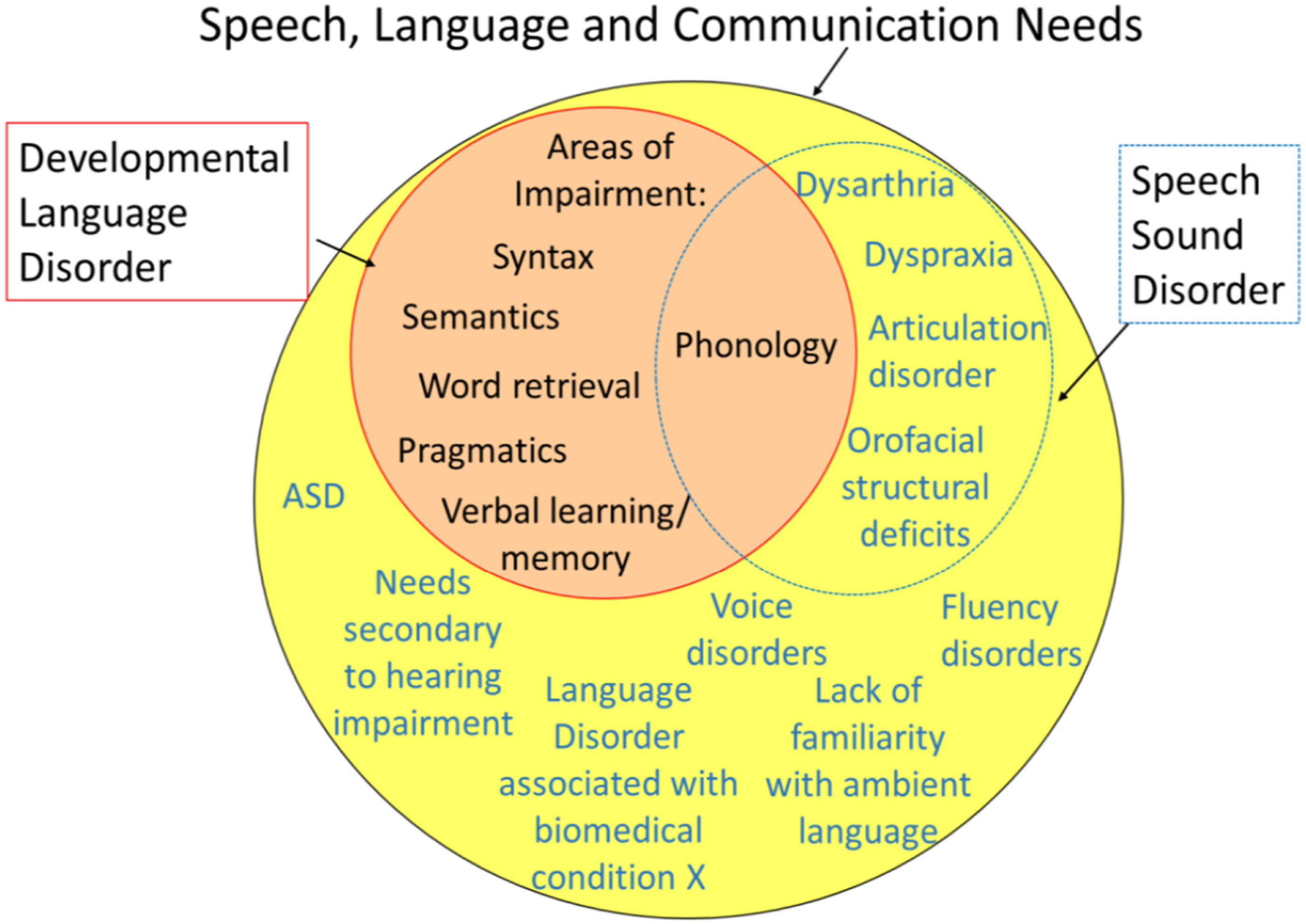
A schema for developmental disorders impacting speech, language, and communication, as outlined by Bishop et al. (2017). No permissions required.
Participant selection criteria were based on the following:
Administration of the Core Language subtests of the Clinical Evaluation of Language Fundamentals, 5th edition, Australian and New Zealand Standardisation (CELF-5A&NZ) (Wiig et al., 2017), Administration of the Pragmatics Profile subtest of the CELF-5A&NZ, Collection of background information from school records including documentation of speech, language or communication needs (e.g., individual education plans and previous speech-language therapy, psychology and health reports), and A semi-structured, researcher-designed interview with the speech-language therapist (SLT), during which observations of speech, language and communication skills were documented. A standard score of 85 or less (1 or more SD below the mean) on the Core Language composite of the CELF-5A&NZ, A scaled score of 7 or less (1 or more SD below the mean) on the Pragmatics Profile subtest of the CELF-5A&NZ, and/or Identification of SLCN concerns (as per Figure 1) within the school records or SLT observation notes.
A student was deemed to have SLCN if they met any of the following criteria:
Of the total sample of 51, 45 students were identified as having SLCN. Thirty-three were identified on the basis of their Core Language score (27 of these students also had scores of 7 or less on the Pragmatics Profile). An additional 10 students were identified based on their low Pragmatics Profile scores but had average-range Core Language scores. An additional two students were identified for inclusion based on their interview with the SLT: The SLT identified that one student had a significant speech sound impairment, and one had a stutter. All available data from the school records were examined, but there were no additional students identified as having a history of SLCN.
A total of 45 students were included (28 males and 17 females). The average age of participants was 14.12 years (SD = 1.73, range 12–18 years, 11 months). Further demographic details are reported in Table 1. All participants reported English as being their only language. All identified as ‘Australian’ when asked about their culture or ethnic group, except for one student who identified their primary ethnicity as ‘Australian Aboriginal’. Fourteen participants identified additional cultural and ethnic groups for themselves and their family, including Australian Aboriginal (n = 3), New Zealander (n = 4), English/British (n = 2), Malay (n = 2), Scottish (n = 1), Italian (n = 1) and Burmese and Maltese (n = 1). Participants had a range of residence types at the time of the study, including with immediate family (n = 39), informal family care (n = 2), formal out of home care (n = 1), with friends (n = 2) and homeless (n = 1). Some students (n = 8) had only attended one high school (their current FLP), whereas others attended two (n = 23), three (n = 11) or five (n = 2). For one student, the total number of high schools was unknown. Many participants also had a transient primary school experience. Ten students attended one primary school, but others attended two (n = 14), three (n = 11), four (n = 5) or five (n = 2), and for one student, the total was unknown.
Demographic details of the students with SLCN/participants.
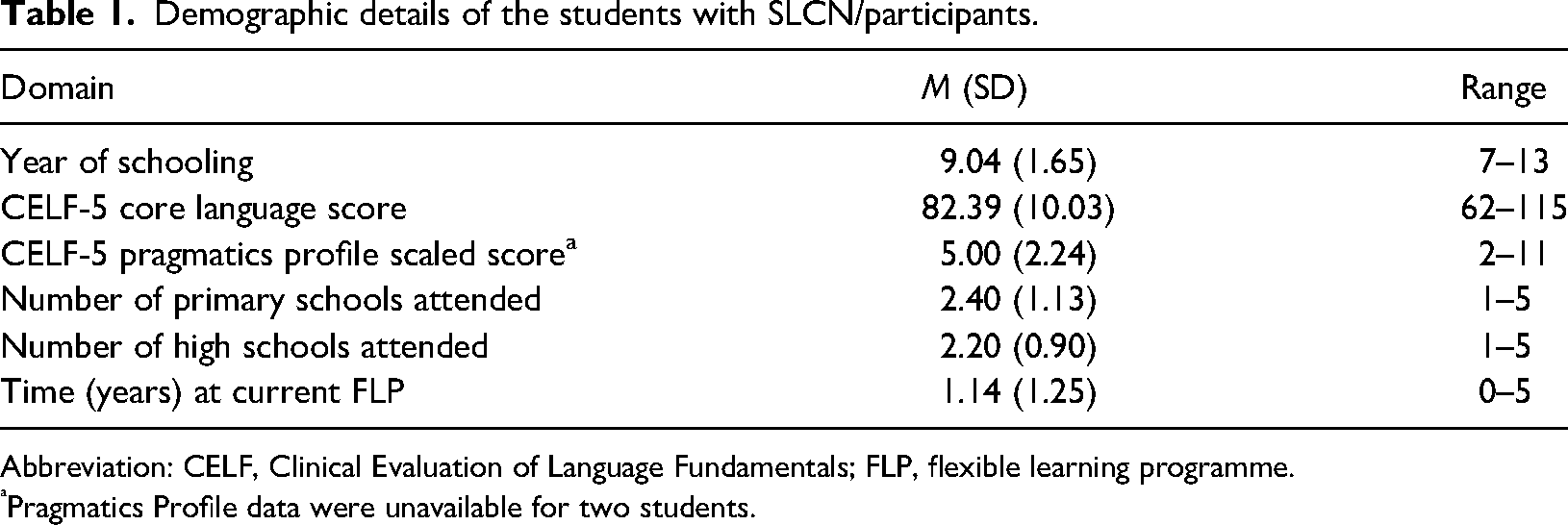
Abbreviation: CELF, Clinical Evaluation of Language Fundamentals; FLP, flexible learning programme.
Pragmatics Profile data were unavailable for two students.
Procedure
Participation in this study was voluntary. Following consent from the school principal for the FLP to participate, a research information sheet and consent/assent forms were provided to all students and their parents/caregivers via school administration staff, class teachers and school psychologists. Teachers were also provided with a consent form to participate in the study to provide information about students’ functioning in the classroom. The school administration officer and school psychologists collected the completed consent and assent forms and then liaised with the assessing SLT to organise student assessments.
Participants completed a semi-structured interview with the SLT followed by the standardised assessments. The SLT was blind to background information and any pre-existing diagnoses of the students at the time of the assessments. With parent/caregiver consent, a summary of the language assessment results was provided to the school, and school psychologists facilitated feedback of results to the students and the parents/caregivers.
Data collection
The subtests that formed the Core Language composite score of the CELF-5A&NZ (Wiig et al., 2017) were administered. These included formulated sentences, recalling sentences, semantic relations, understanding spoken paragraphs (for students aged 13+ years) and word classes (for those aged 12 years). These subtest scores have reliability coefficients ranging from 0.70 to 0.94, and the Core Language Score has a reliability coefficient ranging from 0.92 to 0.95 for individuals aged 12 years and above (Wiig et al., 2017). The Pragmatics Profile of the CELF-5A&NZ evaluates use of verbal and non-verbal pragmatic abilities that influence social and academic communication. It has a reliability coefficient ranging from 0.94 to 0.99 for 12 years and above (Wiig et al., 2017).
With parent/caregiver consent, the school provided school and medical records, including individual education plans and previous speech-language therapy, psychology and other health reports, from which we extracted data. To gather information on the students’ current and past experiences of school, interviews with the SLT, lasting approximately 20 min, were conducted. A semi-structured interview guide was used to ask questions related to demographic information, educational history, oral and written communication skills, behaviour, any current employment and aspirations for future careers. The interview situation and style of questioning were tailored to the individual needs of each student who each had differing communication abilities (Lloyd et al., 2006). For the current study, we focus on the questions relating to the students’ high school experiences. Specifically, we asked them to recall the high schools they had attended and approximately how long/for which school years they attended each school.
For the 37 students who had attended a high school before attending the current FLP, the SLT asked the yes/no question, ‘Did you like that school/those schools?’, followed by the open-ended question, ‘Tell me why you did/did not like that school/those schools’. They were also asked a yes/no question related to the current high school, ‘Do you like this school’, followed by the open-ended question, ‘Tell me why you do/do not like this school’. Students who gave limited (e.g., single word) responses were prompted to provide more detail. However, as recommended for an inductive qualitative content analysis approach (as described in the section below), the SLT interviewing the student provided only non-specific prompts, such as ‘Can you tell me more?’ (Elo and Kyngäs, 2008). Students’ verbal responses to the questions were transcribed verbatim and stored electronically in a de-identified manner for analysis.
Data analysis
Qualitative content analysis was used to explore students’ open-ended responses to the question about why they do or do not like the FLP they were currently attending. An inductive approach was chosen, which is recommended when there is little existing knowledge on the phenomenon (Elo and Kyngäs, 2008). The inductive approach allows the derivation of ideas from the data rather than based on previously determined theories or models as in a deductive approach.
First, one author immersed themselves in the data by reading all written responses several times. Next, they re-read the data and made notes throughout the transcribed responses to describe all components of the content. These notes were then condensed into 20 codes, which were collated onto coding sheets. Two authors independently grouped the codes, and both identified six categories. There was a high level of agreement (16/20, 80%) in the grouping of codes. Disagreement on four codes was discussed until a consensus was reached. The wording of categories was discussed in depth to check the adequacy of analysis and to ensure clarity of reporting (Kyngäs et al., 2011). The third and fourth authors, who were the SLTs conducting the assessments but not directly involved in the analysis, were consulted to establish agreement (i.e., they were presented with the identified categories and asked to evaluate whether this matched reality; Cavanagh, 1997). This resulted in one code being moved to a different category. To prepare for reporting, the six categories were grouped under four higher-order headings to facilitate clear and concise reporting of the concepts identified from the data. Figure 2 shows the structure of the codes, categories and higher-order groupings.
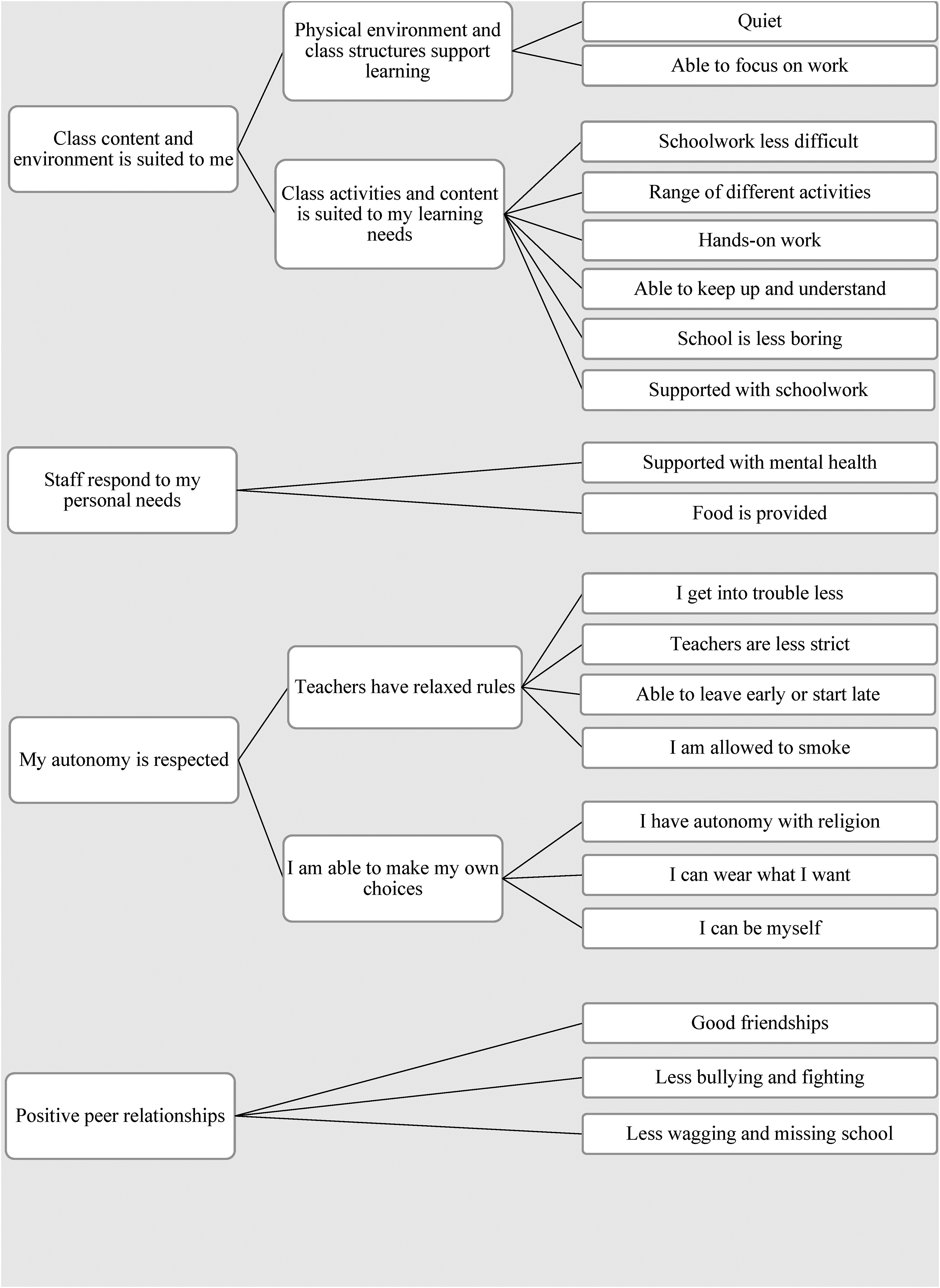
Reasons for liking their current high school, arranged (left to right) into higher-order grouping of categories, categories and codes.
Results
In response to the question, ‘Do you like your current high school?’, 42 out of 45 students said ‘yes’ (93%). Three students said ‘no’ and then responded to the SLT's question asking them to explain why. Two of these students commented on preferring their previous high schools because they had few friendships at the FLP (e.g., ‘I don’t know many people’, and ‘Everyone is rude here’). The third student also mentioned friendship difficulties now that they were in high school (‘In primary school, you get to be friends with everyone’), as well as difficulties with their confidence in comparison to when they were in primary school. This student also described significant difficulties at home that were impacting their ability to enjoy school. We reflect further on these students in the discussion below.
The 42 students who responded ‘yes’ were asked to describe their reasons for liking their current high school. The results of qualitative content analysis on the students’ open-ended responses are presented descriptively according to the four higher-order category groupings. The concepts, their hierarchy and possible connections are also presented in Figure 2.
The environment and design of learning activities are suited to me
The students compared the environment of their current FLP to previous high schools. They described that they ‘couldn’t cope in mainstream classes … too big’ and that ‘It was always noisy’. Students indicated that they preferred not having to change classrooms throughout the day for different subjects, as is the case at the FLP. For example, ‘[at previous high school] had to move classrooms. Organisation and change is hard’.
The students also positively reflected on the tailoring of the learning activities to suit their needs. A key idea that was identified related to finding it easier to do schoolwork at the FLP, which was contrasted to previous high schools. Students spoke about the work at previous high schools as being ‘hard’, and there was the sense that schoolwork was difficult for them to ‘keep up with’. The following quote exemplifies this concept: ‘Couldn’t keep up with the homework … the amount of it was too much’. Students also reflected that at the FLP, it is ‘easier to comprehend’ and ‘They go at your pace, and not ahead’.
Relatedly, the responsiveness and care of the school staff were described as key reasons for liking school. Students commented on the individual support they receive with schoolwork, and that this helps them feel engaged and that they can succeed. For example, ‘Teachers are interactive with students. Teachers take time to help students’, and ‘They know I need help, so they help me do it’. Individualised support was also acknowledged: ‘Started getting help with paperwork. Got one-on-one help from teachers’. Students also commented on the wide range of learning activities that the school offers and how they appreciate that there is more emphasis on ‘hands on’ activities and less so on formal written schoolwork that involves sitting in a classroom. Students highlighted the range of vocational activities and appreciated the opportunity to prepare for entering the workforce. For example, ‘Work experience … [like] hospitality and construction’, ‘Getting to cook for everyone on Fridays … part of the hospitality course, learn[ing] how to cook’ and ‘Need school to get somewhere in life – hands on stuff’. They also described frequent excursions and outings.
School staff respond to my learning and personal needs
Responses in this category included mention of the support that staff provide students for their basic needs and mental health. Several students noted that they are provided with food when they need it. The individualised support for mental health was also described by many students, and that this support comes from both teachers and the on-site psychologists. For example, ‘They have resources that can help. They know how to help me calm down, they help out’. Similarly, ‘If I’m having a bad day, they have plans sorted to help me through the day’. Students contrasted this to their experiences at previous schools (e.g., ‘At [school name], don’t care about mental health’).
My autonomy is respected
Student autonomy was identified throughout responses and was grouped under two main categories: the first related to getting into trouble less due to relaxed rules at the FLP, and students being given choice over their beliefs, what they wear and how they act. Students compared the frequency with which they would get into trouble at their previous high school and linked this with teacher ‘strictness’ (e.g., ‘I like the teachers here. They’re not so strict or uptight’). Students also commented on the flexible rules around starting school late and leaving early.
Several factors contributed to the concept of student autonomy that was present amongst responses. This included the ability for students to wear whatever they want at school (‘Don’t have to wear uniforms’, and ‘[previous school] uniforms very uncomfortable’), as well as not being required to ascribe to certain religious beliefs, as was the case at previous schools (e.g., ‘Was a Christian school … not for me’). Additionally, student responses reflected the sense that individuality was respected; that is, ‘I can be myself’.
I have positive peer relationships
Students described high rates of bullying at their previous high schools, which contrasted to their experiences at the FLP, for example, ‘got bullied by a girl and group’. Students also commented on the frequency with which they were in trouble at their previous school, as linked to peer difficulties (e.g., ‘Got bullied a lot and got into fights. Got in trouble’). Students highlighted the teacher responsiveness to bullying at the FLP compared to previous high schools. For example, ‘Way better … if you get bullied, they deal with it straight away’). In some cases, students linked less-positive peer relationships at other schools with school disengagement. For example, when describing a previous friendship group, one student said, ‘[I would] wag 2 with them. Mainly running around. Didn’t do any schoolwork’, and another stated, ‘spent most of the time talking to my friends’.
Discussion
This study aimed to explore the perspectives of 45 students who have identified SLCN and are attending a high school FLP. Of our sample of 51 students, 45 met the criteria for SLCN, confirming the high prevalence in the FLP setting. The majority of students responded positively when asked whether they enjoy attending their current high school (FLP), and they provided us with a rich source of data as they discussed their reasons for liking this school. Interestingly, the three students who responded ‘No’ when asked if they liked their current high school were in the youngest age group (Year 7, aged 12–13 years) and had all only recently commenced at the FLP.
Many of the students (n = 37) had attended a previous high school and provided comparisons between the alternative learning environment compared to mainstream schooling. Key factors identified via qualitative content analysis included how the FLP class content and environment were suited to them, the responsiveness of staff to their learning and personal needs, how their autonomy was respected, and the positive peer relationships they had developed in the FLP. We reflect on these categories in turn, considering the implications on the identification and ongoing support of young people with SLCN growing up in adverse psychosocial contexts in both alternative (FLPs) and mainstream schools.
Participants in our study focused on the practical (e.g., class size, not needing to move class) and educational (e.g., tailoring of learning activities and the vocational focus) aspects of FLPs. The latter finding is in keeping with McGinty et al. (2018) whose participants were focused on the future and preparing for life after school, also preferring a curriculum that was relevant and practical. Of particular importance, our finding is that these young people valued small class size, staying in the same classroom, and reduced noise levels in the classroom compared to previous schools. The SLCN profiles of our participants highlight the need for flexible learning areas and smaller learning spaces. Students with language difficulties are often disengaged in classrooms where there are simultaneous demands on their auditory processing abilities or when they are surrounded by distracting levels of noise (Starling, 2012). Classrooms that are organised to provide regular routines and structured opportunities to interact with peers and adults support communication and learning (Dockrell et al., 2015; Starling, 2012). Our students valued these structures within their current FLP. These findings are in keeping with those of Simkin and Conti-Ramsden (2009), who interviewed adolescents about their views on attending a language unit when younger. The young people reported a broadly positive experience and commented on the pace and level of work.
In this study, we found that students valued the vocational opportunities provided by the school to prepare for the workforce. In a systematic review, Dubois et al. (2020) found that young adults with DLD participate less in conventional ways of seeking employment (e.g., providing a résumé and having a phone interview), but that once they have employment, the experience of working is just as positive as that of young adults without DLD. This highlights the potential for programmes that address the job search process as well as vocational opportunities to be offered within FLPs and mainstream schools for students with SLCN.
Our participants identified the qualities of the teachers and other FLP staff as key. This included support with mental health and was often contrasted with negative experiences from previous schools. Myconos (2018) identified the centrality of well-being in FLPs as a key feature of their success. Our participants were clear about how importantly they valued the emphasis on well-being and building relationships in the FLP and how the responsivity of staff facilitated their participation. This mirrors the emerging focus on promoting well-being as part of everyday business within mental health services (Slade, 2010). ‘My autonomy is respected’ came through clearly in the data set, with a range of examples, from choice over respecting individual beliefs through to what students wear. For many participants, there was a focus on the opportunity to be their individual selves. For others, there may have been a financial component of poverty which impacted on their previous experiences of school, as identified by Te Riele (2014). A focus on ‘correct’ wearing of school uniform in many mainstream schools can lead to a disproportional impact for students who cannot afford to buy or replace uniforms, as well as those who value the expression of individuality.
The participants in McGinty et al. (2018) also focused on the personal nature of relationships with teachers as key. McGinty et al. (2018) highlighted how many times the students mentioned the word ‘respect’ in their interviews. Principles of tolerance are fundamental to FLPs. Empowerment through the provision of autonomy and choice will help equip the students with the skills to draw on in the future, for example, to develop relationships and diffuse potential conflict. While students in our study did not explicitly use the term ‘respect’ in their interviews, as was the case with McGinty et al. (2018), we identified similar concepts relating to positive student–staff relationships (as captured in the categories of ‘staff respond to my learning and personal needs’ and ‘My autonomy is respected’).
The principles of fairness and tolerance are also highlighted in the students’ focus on positive peer relationships in the FLP – the fourth broad category in our data. The notion of the relationship dynamic within the school setting has been related to the strength of student relationships with their peers (Wilson et al., 2011). Our participants described high rates of bullying at their previous high schools and contrasted this with their current experiences. They also focused on the responsiveness of the FLP to instances of bullying, again reflecting the central focus on promoting mental health and well-being. Peer relationships for children and adolescents with language difficulties have been acknowledged as ‘particularly problematic’ (St Clair et al., 2011). By aged 16, almost 40% of a group of adolescents with DLD were impaired in their interactions with peers (St Clair et al., 2011). The positive peer relationships identified by our participants supports the notion that the FLP context may offset some of these.
In summary, our study has identified the importance of classroom content and environment, support and well-being promotion by education staff (teachers, psychologists and others), respect for autonomy and the promotion of positive peer relationships. These are important features of FLPs and in keeping with the findings of McGinty et al. (2018) in their programme of work exploring the value of FLPs for disenfranchised youth. Given that our participants had identified SLCN in addition to growing up in adverse psychosocial contexts, our findings have important implications for both FLPs and mainstream classrooms. Many of the identified factors are modifiable, such as the adaptation of the curriculum to take account of individual learning needs with an increased focus on preparing for the workforce. Indeed, some of these modifications could support disenfranchised youth to maintain their attendance in mainstream schools. Others are more resource-dependent, such as class size and staffing levels, which highlights the value of FLPs. FLPs should continue to provide programmes that are indeed flexible, focusing on individual needs and future employment opportunities, underpinned by acceptance and a commitment to respect and autonomy. These are amongst the key characteristics valued by our participants. The foundational role of well-being and relationships was central to their reflections. The implications for adopting such principles within mainstream education are clear, in particular, to address the needs of young people who have grown up in adverse psychosocial environments and who additionally present with a range of SLCN.
A limitation of this study is that we only included students from one FLP high school, and as such the findings must be interpreted with caution and may not be transferable to other FLPs in Australia or other countries. Additionally, all students in the sample spoke English as a first language, highlighting the need for future research to explore the perspectives of students who are culturally and linguistically diverse, particularly as these students may have a different experience of high school than their monolingual peers (Kim and García, 2014). The high rates of SLCN and language disorders identified in our sample may have influenced their responses to the open-ended questions. The researcher who conducted the interviews is an experienced SLT who was able to tailor the style of questioning to each participant to support their responses.
To our knowledge, this is the first study to explore the perspectives on schooling of high school students who have identified SLCN and who attend an FLP. Factors identified centred around learning environments and activities that were suited to their learning needs, staff responsivity to personal (and mental health) needs, respect for individuality and autonomy and positive peer relationships. These findings highlight the benefits of alternative learning environments for high school students, especially those who have SLCN, and may help advocacy efforts to maintain and extend resources for FLPs in WA and beyond.
Footnotes
Acknowledgements
We would like to thank the students who so willingly took part in our research and shared their views with us.
Declaration of Conflicting Interests
The authors declared no potential conflicts of interest with respect to the research, authorship, and/or publication of this article.
Funding
The authors disclosed receipt of the following financial support for the research, authorship, and/or publication of this article: This research was funded by the Association of Independent Schools of Western Australia and a Healthway Exploratory Research Grant (32037). Mark Boyes is supported by the National Health and Medical Research Council, Australia (Investigator Grant 1173043).
