




Abstract
Learning academic vocabulary is a crucial task for all students, but especially challenging for students with speech, language, and communication needs (SLCN) and those who are multilingual. Following a participatory research strategy, we analyze whether iconic gestures can be integrated in teaching routines in an inclusive elementary school and whether the presentation of iconic gestures supports novel word learning over the period of four math lessons. One hundred and sixteen students (44% boys), the majority (91%) with SLCN, participated in the study. We conducted a control group design in eight classes with pre- and post-testing of a target academic vocabulary on the topic “Geometric surfaces and solids.” Results show a significant increase in the acquisition of the receptive and expressive target academic vocabulary for all students, but a predominance of expressive learning performance in favor of students who observed iconic gestures during lessons. Iconic gestures can be easily implemented into teaching, improve novel word learning in students with SLCN and serve as a cuing strategy for naming words in students with severe SLCN.
SLCN in school
Receptive, expressive, and writing-based language skills represent essential key competencies for school learning (Organisation for Economic Co-operation and Development, 2016). The acquisition of subject-specific academic vocabulary concerns all students and is related to academic achievement (Schuth et al., 2017; Snowling et al., 2021; Townsend et al., 2012). However, acquiring novel academic vocabulary is particularly challenging for students with speech, language, and communication needs (SLCN). The term SLCN as defined by the CATALISE consortium (Bishop et al., 2017) is an umbrella term for students with different difficulties in the areas of speech, language, and communication. This category includes among others, children with developmental language disorders (DLD), speech sound, fluency, and voice disorders. It also includes children without a language or communication disorder, but with a lack of familiarity with the ambient language requiring additional support or modifications in their classrooms (Bishop et al., 2017). Being multilingual is not equivalent to having SLCN and does not pose any additional risk factor for having a DLD (e.g., Paradis, 2010). Still, little exposure to the surrounding language is a risk factor in multilingual children to access the language of the classroom (Bishop et al., 2017; Schmidtke, 2017).
The percentage of students with a migration background correlating with multilingualism, has increased from 18% (2009) to 22% (2018) in German school classes with a percentage of almost 50% that are socioeconomically disadvantaged (Organisation for Economic Co-operation and Development, 2019).
Considering the fact, that a low socioeconomic status (SES) is another risk factor for language acquisition (Desmarais et al., 2008; Hoff, 2006; Romeo et al., 2018; Sirin, 2005), multilingual children with little exposure to the surrounding language coming from families with a low SES are particularly vulnerable to language and communication difficulties needing support to follow and understand the content of lessons which is relevant for school learning.
In general, low receptive and expressive lexical abilities negatively affect the overall course of language acquisition and impair emotional functioning and the establishment and maintenance of relationships with peers in both childhood and adulthood (Conti-Ramsden and Botting, 2004; Fujiki et al., 2004; St Clair et al., 2011). SLCN can even merge into difficulties in academic achievement and may lead to dropping out of school (Aguilar-Mediavilla et al., 2019; Conti-Ramsden and Durkin, 2008; Cronin et al., 2020; Dockrell et al., 2011; Eadie et al., 2021; Markham et al., 2009; Valera-Pozo et al., 2020; Whitehouse et al., 2009). Therefore, students with SLCN require effective support in school and precisely in novel word learning. The implementation of the study addresses the pedagogical action of teachers, but also represents an opportunity to act for speech-language therapists.
Iconic gestures as support of novel word learning
Gestures are an integral and spontaneous part of natural, interpersonal communication (Goldin-Meadow, 1999; Hostetter, 2011). Depending on their function in conversation, gestures are divided into beats (rhythmic hand movements while pulsating the speech), deictic (indicative, reference to person, object, or action), iconic (pictorial reference of a feature of an object or action), arbitrary (abstract reference to something), or conventional (meaning is lexicalized in culture) subtypes that co-occur with speech (Goldin-Meadow, 1999; Hostetter, 2011).
In contrast to spontaneous, speech accompanying gestures, signs are a central component of sign languages, defined in their form and execution. Sign languages use the manual and visual modalities to convey language and for most deaf people a sign language, for example, American Sign Language (ASL) or German Sign Language (DGS), is their first language (Pfau et al., 2012). In the context of augmentative and alternative communication (AAC), signs are used as a method to support hearing people with language and communication disorders in developing oral language skills and to express themselves (Beukelman and Mirenda, 2013). They have also been found to foster communication options and novel word learning, for example, in children with Down Syndrome (Wright et al., 2013). Like iconic gestures, sign languages have a high potential for iconicity, which is especially visible in the lexicon (Perniss and Vigliocco, 2014), exemplified by the sign for “drinking” in ASL as well as DGS, in which one hand moves in a c-shape from the center of the body to the mouth.
Accompanied iconic gestures have an important role in verbal communication: they complement the speaker's spoken words with references to the size or shape of an object or a particular pattern of activity (McNeill, 1985). Speakers are not necessarily aware that the use of complementary information via iconic gestures effects their communication and characterizes it as bimodal. Capone Singleton (2012) refers to iconic gestures as a type of “semantically enriched cue” where the visual representation of the spoken, maybe novel, word accounts for a richer semantic representation in the mental lexicon (Levelt, 1989).
Because of this semantically enriched function of iconic gestures, their use facilitates novel word learning in typically developing children (e.g., Capone and McGregor, 2005; Capone Singleton, 2012; McGregor et al., 2009), children with DLD (e.g., van Berkel-van Hoof et al., 2019, Vogt and Kauschke, 2017a, 2017b, Weismer and Hesketh, 1993), and children growing up multilingual (Lüke and Ritterfeld, 2014). Thus, iconic gestures provide special support for children with difficulties in language acquisition such as DLD, regardless of multilingualism. Van Berkel-van Hoof et al. (2019) investigated the use of iconic gestures in the process of acquiring novel words in children with DLD and whether the effect of the gestures is associated with linguistic and cognitive abilities. Therefore, the authors randomly recruited 40 children with DLD and 26 age-matched children without DLD between the age of nine and eleven years. The target vocabulary consisted of twenty pseudowords and ten matching iconic gestures. In a one-on-one setting with the examiner, the pseudowords (introduced as brightly colored aliens) were shown to the children via prerecorded video clips. The results show that children with and without DLD learned more pseudowords regardless of condition (with or without gesture presentation) and were able to name them quicker over the period of testing. In children with DLD, a supportive effect of iconic gestures on pseudoword acquisition emerged.
These findings are in line with the research of Vogt and Kauschke (2017a, 2017b) as well as Lüke and Ritterfeld (2014), which also demonstrate a supportive effect of iconic gestures on the acquisition of novel words in children with DLD.
However, the illustrated research shows the beneficial effect of iconic gestures and signs solely in one-on-one interactions between child and adult. Little is known about the purposeful use of iconic gestures/signs as a didactic method and their impact on the acquisition of academic vocabulary in (inclusive) elementary classrooms.
Use of gestures in classrooms
Teachers use different types of gestures in addition to facial expressions, prosody, or visuals in form of graphs or presentations in classroom to highlight the specific content they want to convey (Alibali & Nathan, 2012; Roth & Bowen, 1998). Gestures are used regardless the type of school or grade (Chikiwa, 2021; Goldin-Meadow and Alibali, 2013; Valenzeno et al., 2003; Yohannan et al., 2021), but most teachers are not aware of the supportive effect their spontaneously produced gestures can have on student learning in the classroom (Alibali et al., 2013; Goldin-Meadow et al., 1999).
Cook et al. (2017) investigated the effect of so-called content gestures, that consolidate the contextual teaching content and beat gestures, when students solved mathematical equivalence tasks. According to a randomized group assignment, equivalence tasks, either with gestures or without, were shown to the students individually, using a computer-generated avatar. The avatar's lip movement, head position, and eye gaze were identical across the groups. Children who observed the avatar gesturing had a higher increase in learning, were more likely to transfer their knowledge to other domains and were able to solve equivalence tasks faster than children who saw the avatar without gesture production. The results indicate the importance of purposeful gesture use in school learning situations, even with an avatar.
The use and influence of gestures on learning are most commonly studied in mathematics classes (Cook et al., 2017; Goldin-Meadow et al., 1999, 2001, 2012) and foreign language vocabulary acquisition (Church et al., 2004; Huang et al., 2019; Macedonia et al., 2010; Sweller et al., 2020; Tellier, 2008) in one-on-one situations. In some studies, a group setting was used. Church et al. (2004), examined gesture use with a recorded video in a classroom setting, Huang et al. (2019), investigated word acquisition in a group setting of at least two individuals, Chikiwa (2021), observed gesture use of two teachers in a multilingual 11th-grade mathematics class, and Yohannan et al. (2021) aimed to facilitate spatial understanding of complex anatomical relationships in medical college students while lecturing. Yohannan et al. (2021) used a combination of iconic and deictic gestures in addition to traditional methods, that is, PowerPoint presentations or textbooks while teaching the intervention group and compared it to teaching the control with only traditional methods. The posttest showed significantly higher word recalls and improved factual and applied knowledge of the lesson content for students, who followed the lectures with gestures compared to those in the control group. Gestures seem to particularly support students who have a low to moderate spatial awareness in learning curriculum contents. Furthermore, the authors received positive feedback on the use of specific gestures from the students in the intervention group for their novel and supportive didactic method.
Given the evidence that teachers’ gestures matter for student learning, they should be aware of the facilitative effects of their gestures and moreover use them intentionally and also planned (Goldin-Meadow and Alibali, 2013). However, not much is known regarding the use of iconic gestures as a purposeful didactic method and its impact on the acquisition of academic vocabulary in inclusive elementary classrooms with students with SLCN. In a participatory study, we, therefore, provided the training for and analysis of teachers’ use of iconic gestures in the school entry phase of an inclusive elementary school and investigated the impact of gesture presentation on the students’ academic word learning. Based on previous research. We formulated and tested three hypotheses.
Consistent with the finding that teachers use many gestures in their daily teaching lessons (e.g., Alibali and Nathan, 2012, Chikiwa, 2021, Roth and Bowen, 1998), we hypothesize that teachers who receive training in the use of iconic gestures in the classroom will perform corresponding gestures quite frequently, at least every second oral mention.
Since results indicate a facilitative effect on learning novel words in one-on-one situations (e.g., van Berkel-van Hoof et al., 2019; Vogt and Kauschke, 2017a, 2017b), we expect that students who experience the use of iconic gestures in class will learn more target academic words receptively and expressively compared to students who have not seen iconic gestures in class.
Given the high iconicity of gestures (Capone and McGregor, 2005; Capone Singleton, 2012; Perniss and Vigliocco, 2014), and the observations in our prestudy (described below), we assume that students who scored the lowest in the pretest language test will resort to iconic gestures as a cueing strategy in the posttest.
Methods
Participants
A total of 190 students (51% girls, 84% multilingual with German as one of the acquired languages) in 1st and 2nd grade (school entry phase) from eight school classes with a class size of 23 (2) or 24 (6) students participated in our study. The global SARS Cov-19 pandemic and associated school closures in Germany affected our study leading to 66 incomplete data sets (29% intervention group, 41% control group). In addition to these sets, the data of eight students with less than one year of contact to the German language were excluded from the analysis.
Complete data sets are available for 116 students (44% boys, 56% girls), 84.5% of whom grow up multilingual being exposed to the German language since birth (38%), more than three years (34%) or over a year (28%).
In an effort to target more students with SLCN, an inclusive elementary school located in a major German city, specifically in an area with a high proportion of citizens with a rather low SES and citizens with migration background was selected. At the time of data collection, 19% of the citizens in this area were unemployed, 39% received state transfer payments and 73% had a migration background. The school entry phase can be completed by the students in two to three years, depending on their individual academic progress. In the participating elementary school, more students remain in the school entry phase for three years compared to overall German students.
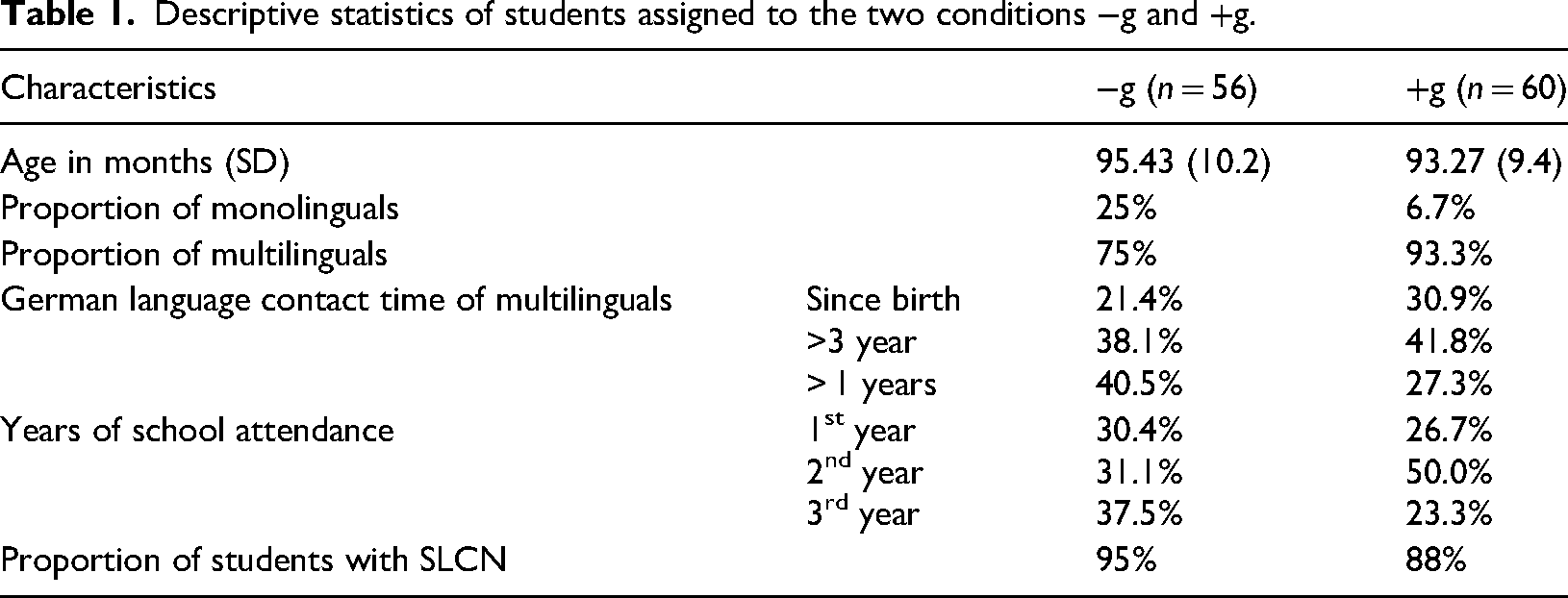
The classes were randomly assigned to one of two groups, distinguished by the factor iconic gesture presentation in class (+g) or no gestures (−g). The groups did not differ in mean age, gender ratio, proportion of multilingual children, German language contact time, or in the distribution of years of school attendance (Table 1).
Descriptive statistics of students assigned to the two conditions −g and +g.
Descriptive statistics of students assigned to the two conditions −g and +g.
The teachers participating in the study (7 female, 1 male) were regular elementary school teachers and had a mean age of 43.75 years (SD = 12.85), ranging from 30 to 62 years. Their professional experience in years was in mean 16.31 years (SD = 13.52) with a range from 2 to 40 years. None of the teachers had experience in DGS or similar teaching strategies including gesture use.
To allow for a high degree of external validity, a participatory research design was chosen that actively involved teachers in the planning and implementation process. In the pre-study phase, the PI of the study conducted an exemplary lesson on the topic “spatial prepositions” in five classes of the participating inclusive elementary school. For this exemplary lesson, like in the main study, the classes were randomly assigned into one of two conditions either with the presentation of iconic gestures during class (+g) or without gesture presentations (−g). The target vocabulary consisted of six spatial prepositions (on, behind, in, beside, under, in front of). To ensure consistency of frequency of naming, each target vocabulary item was mentioned 10 times regardless of the condition. The spatial prepositions were presented in an interactive story in which a stuffed animal was placed in various locations, such as on or under the chair. Also, worksheets were used asking the children to color a bird indicated by the preposition, such as “Color the bird behind the balloon.” These lessons were videotaped to capture the didactic procedure of iconic gesture use to facilitate word learning and student's response to the gesture presentations. The videos were then shown to all teachers at the elementary school to discuss and decide whether to investigate the effectiveness of using iconic gestures on word learning in their classrooms. Especially the observation that students with the lowest language skills (in German) used the gestures to communicate, was the main reason for the teachers to take part in the study and to conduct the course.
Procedure
The use of iconic gestures was investigated for a series of lessons in mathematics. The teacher chose “Geometric surfaces and solids” as the subject area with the following 13 words as target vocabulary: circle, triangle, square, rectangle, corner, side, sphere, pyramid, cube, cuboid, cylinder, edge, and face. The teachers and the PI of the study planned in detail a series of lessons with six school hours defining the duration of the instruction phases, the social forms (e.g., individual work, sitting circle), and the materials (e.g., worksheets, picture cards, …) to ensure that the lessons were conducted as identically as possible in all eight classes. Again, the global pandemic with the school closures had an influence on the study, since only four of the six lessons could be conducted.
In accordance with the prestudy the two conditions, +g or −g, were randomly assigned to the classes. Only teachers in the +g condition were trained in the use of iconic gestures. The PI showed the teachers the gestures and guided them in gesture use on word and sentence level. During the 60-min training, each target vocabulary was gestured by the teachers at least five times. To ensure consistency of iconic gestures across teachers, the 13 iconic gestures were taken from DGS (Kestner, 2019). The teachers were instructed to produce the corresponding gesture as often as possible, preferably every time they named a target word during the lesson, see Figure 1. Furthermore, they were advised to ask the students to participate in the use of gesture.
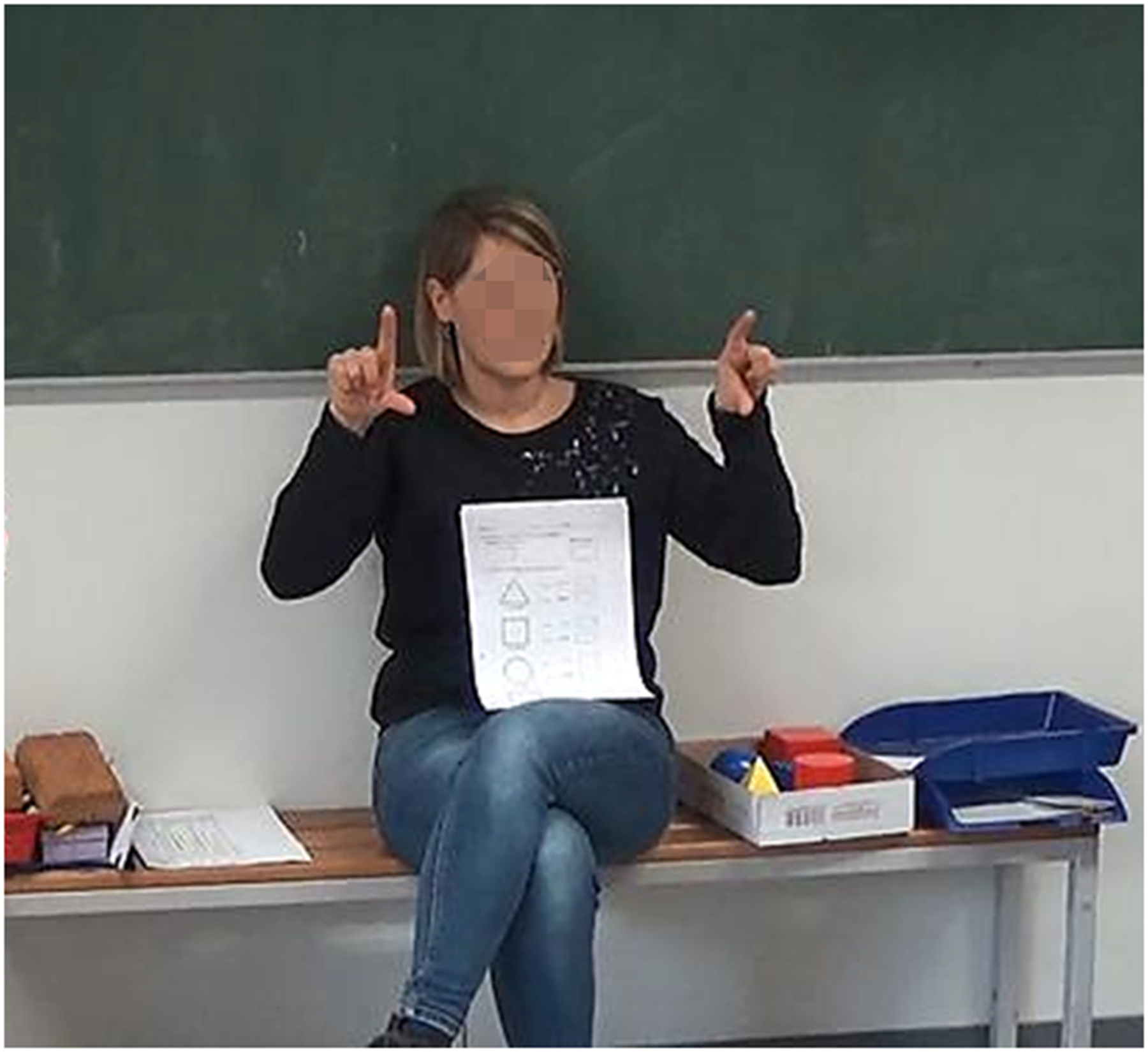
+g teacher presenting the iconic gesture for “cuboid.”
The teachers in the −g condition did not produce any specific gestures. The naming and gesture production of the target words were counted for each teacher by the PI of the study and research assistants sitting in the classrooms. In addition, three lessons were videotaped to verify the live count.
Students’ receptive and expressive knowledge of the target vocabulary was tested individually before (pretest) and after the four conducted lessons (posttest) by research assistants in a separate room at the elementary school. In the pretest, students’ expressive lexical skills in German and their working memory skills were tested also. The pretest assessment ranged a duration from 15 to 20 min whereas the posttest only took up approximately 5 min.
Target vocabulary
A specially designed screening was used to test the receptive and expressive target academic vocabulary used in our study. Expressive testing of the target vocabulary corresponded to a naming test in which the examiner presents each item as a black, white, and red illustration in a paper booklet asking the child to name it. A picture selection procedure was chosen to test the receptive target vocabulary. The investigator named each target word, which was presented as a black, white, and red illustration accompanied by three distractor illustrations (Figure 2) asking the child to point to the corresponding picture. The testing was videotaped to capture the gestural answers as well as the verbal ones.
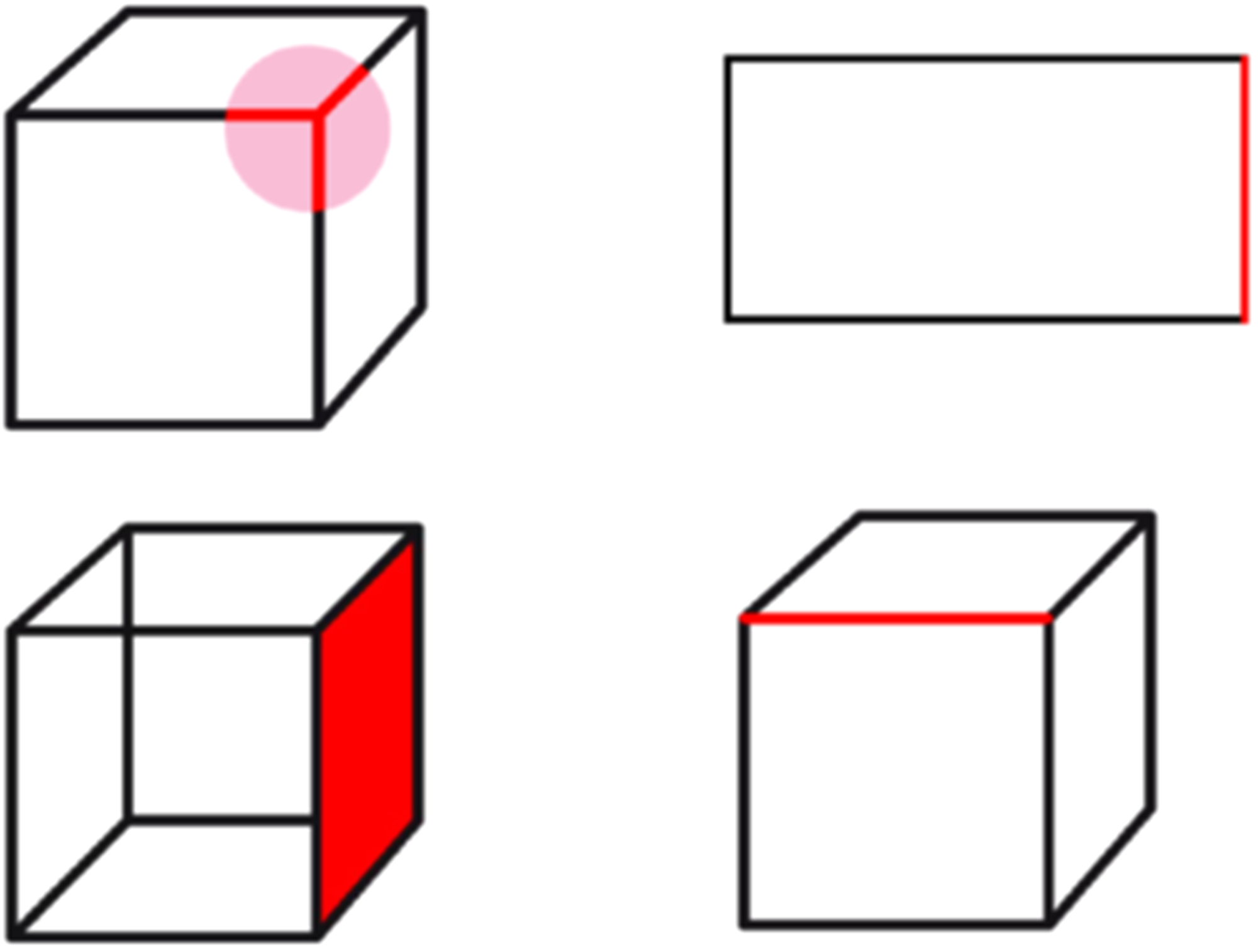
Examples from the test of the receptive target academic vocabulary.
Expressive vocabulary was measured using the vocabulary task of the “Potsdam-Illinois Test für Psycholinguistische Fähigkeiten (P-ITPA)” (Esser and Wyschkon, 2010), the German version of the “Illinois Test of Psycholinguistic Abilities” (ITPA, Hammil et al., 2001), a standardized test that measures language and literacy skills in children from age four to the end of the fifth grade. The items, exclusively nouns, were presented to the students by means of an “association task,” for example, “Ich denke an etwas und du sollst es erraten. Hör zu! Ich denke an etwas, das hat Beine. Was könnte das sein?” [“I’m thinking of something, and I want you to guess it. Listen! I’m thinking of something that has legs. What could that be?”]. Although a few multilingual children were in the norming study of the P-ITPA, the standard norms of the P-ITPA are aimed primarily for children growing up monolingual.
Phonological working memory skills
Phonological working memory skills were measured via the “Mottier-Test” (Mottier, 1951), a non-word repetition task, which is commonly used in German-speaking countries to examine the auditory processing span and perception. It consists of 30 simple non-words (no consonant clusters), which differ in length (2–6 syllables) and adhere to German phonotactics. The items were presented as prerecorded audio files. Students’ repetitions were also audio recorded and rated as correct or incorrect. For the interpretation, standard values for 5- to 17-year-old children with German as their first or second language were used (Wild and Fleck, 2013).
Student profile
Language proficiency scores of the P-ITPA (Esser and Wyschkon, 2010) and Mottier-Test (Wild and Fleck, 2013) were used to assign SLCN status to the students. As the non-word repetition task is suitable for mono- and multilingual children (Wild and Fleck, 2013), we defined a T-score 1.5 standard deviation (SD) below average as indicator for a SLCN in mono- and multilinguals. Since the standard norms of the vocabulary test (P-ITPA; Esser and Wyschkon, 2010) are aimed primarily for children growing up as monolingual German speakers we used the diagnostic guidelines proposed by Thordardottir (2015) to identify language disorders in young simultaneously multilingual (English & French) children as orientation for a SLCN. Although our sample comprised languages other than English and French, as well as minority languages, we considered T-scores below 2.25 SD below average in multilinguals and T-scores below 1.5 SD below average in monolinguals as indicator for a SLCN. According to these criteria, 91% of the sample had a noticeably low score in the standardized German vocabulary test and 8.8% of the 91% had additional difficulties in the phonological working memory. In line with the definition of SLCN (Bishop et al., 2017) our sample consists of 91% of students with SLCN, though in the majority of children this is not due to a language disorder. However, the low language performance clearly shows the need for additional support at school.
Results
Teacher ratio of naming and gesture productions
The frequency of target word production by teachers is distinguished into their oral naming and iconic gesture presentations. Comparing oral naming frequency of teachers in the −g condition (Md = 102.17, IQR = 161.15) with teachers of + g condition (Md = 127.25, IQR = 59.38) revealed no differences, U = 6.0, p = 0.564. Over the course of the entire four lessons, students in the −g condition heard the target academic vocabulary from their teachers a similar number of times (M = 414.44 times, SD =331.3) as students in the + g condition (M = 428.46 times, SD = 150.86, t(114) = 0.29, p = 0.767).
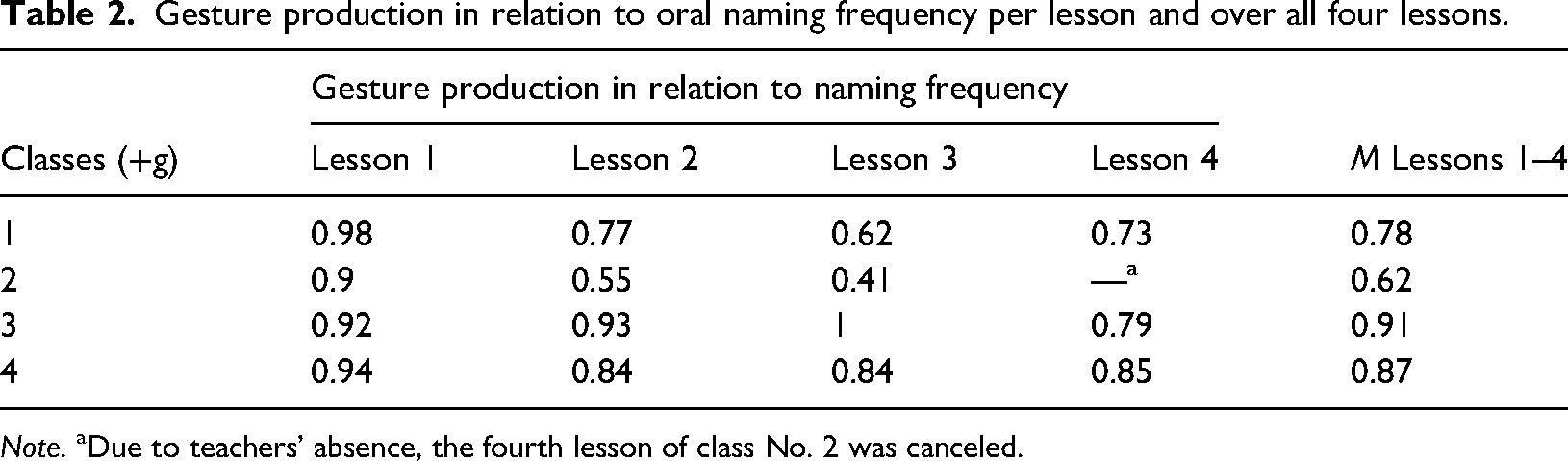
All teachers in the + g condition used iconic gestures during each of the four lessons (Md = 106.13, IQR = 81.5, range = 46–202). In total + g students saw the iconic gestures an average of 341.87 times (SD = 146.66), ranging from 92 to 600 presentations. In proportion to their naming, teachers accompanied in mean between 62% and 91% of verbal target word productions with the according to iconic gesture (Table 2).
Gesture production in relation to oral naming frequency per lesson and over all four lessons.
Gesture production in relation to oral naming frequency per lesson and over all four lessons.
Note. aDue to teachers’ absence, the fourth lesson of class No. 2 was canceled.
Receptive and expressive target vocabulary, each as the dependent variable, were analyzed using mixed ANOVAs with condition (−g/+g) as the between-subjects factor and time (pretest/posttest) as repeated measure. Because of individual sick days, students attended an average of three lessons (M = 3.22, SD = 0.84).
All students benefited from the series of lessons on the topic of geometric surfaces and solids as there were main effects between time and receptive target vocabulary, F(1, 114) = 319.76, p < 0.001, and expressive target vocabulary, F(1, 114) = 319.76, p < 0.001. For the expressive target vocabulary a significant interaction effect was found, F(1, 114) = 7.29, p ≤ 0.008, indicating that students in the +g condition learned more target words expressively compared to students in the −g condition (Figure 3). Descriptive statistics are presented in Table 3.
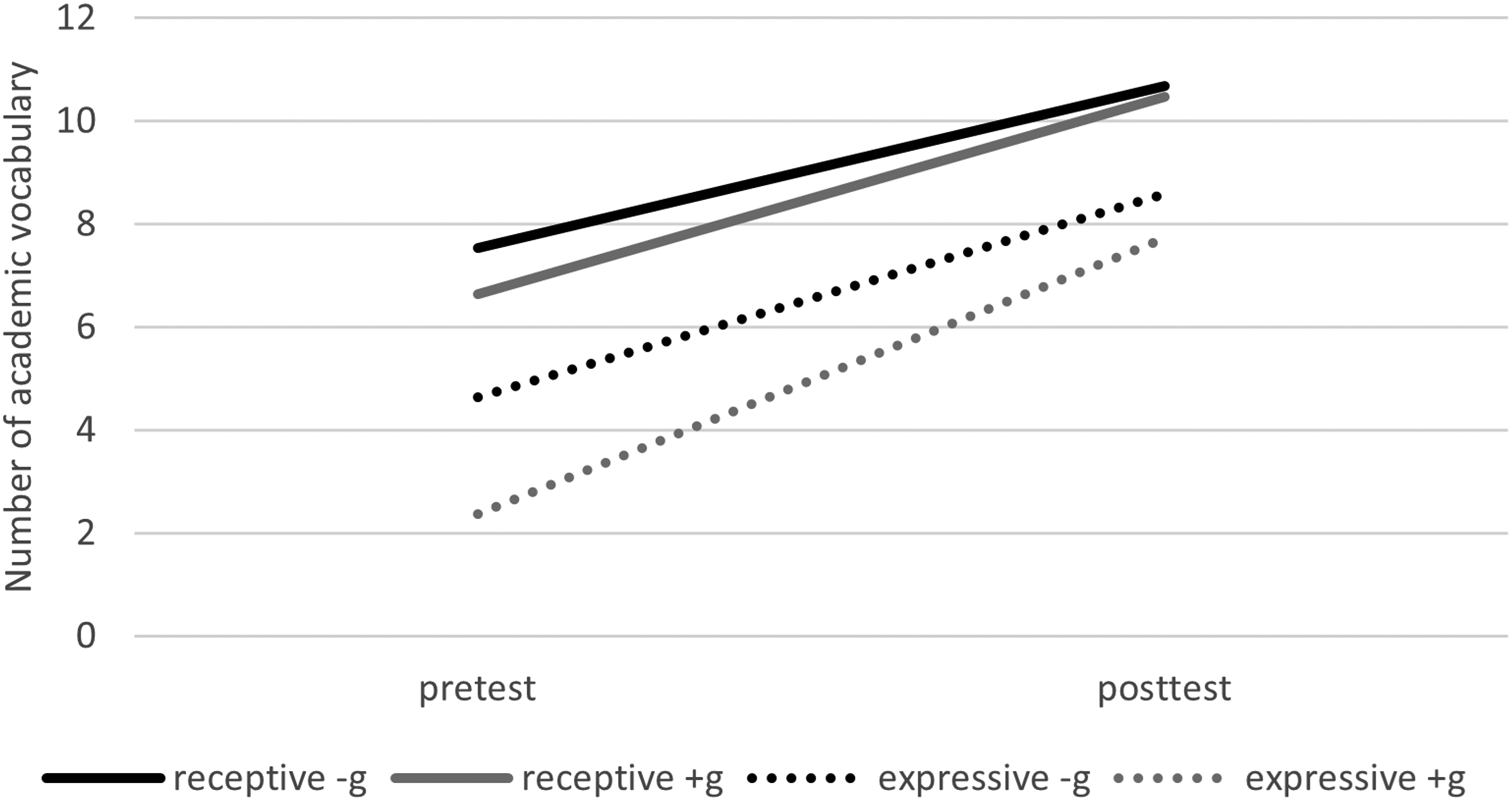
Acquisition of the target academic vocabulary.
Descriptive statistic of linguistic skills in the condition of −g and +g.
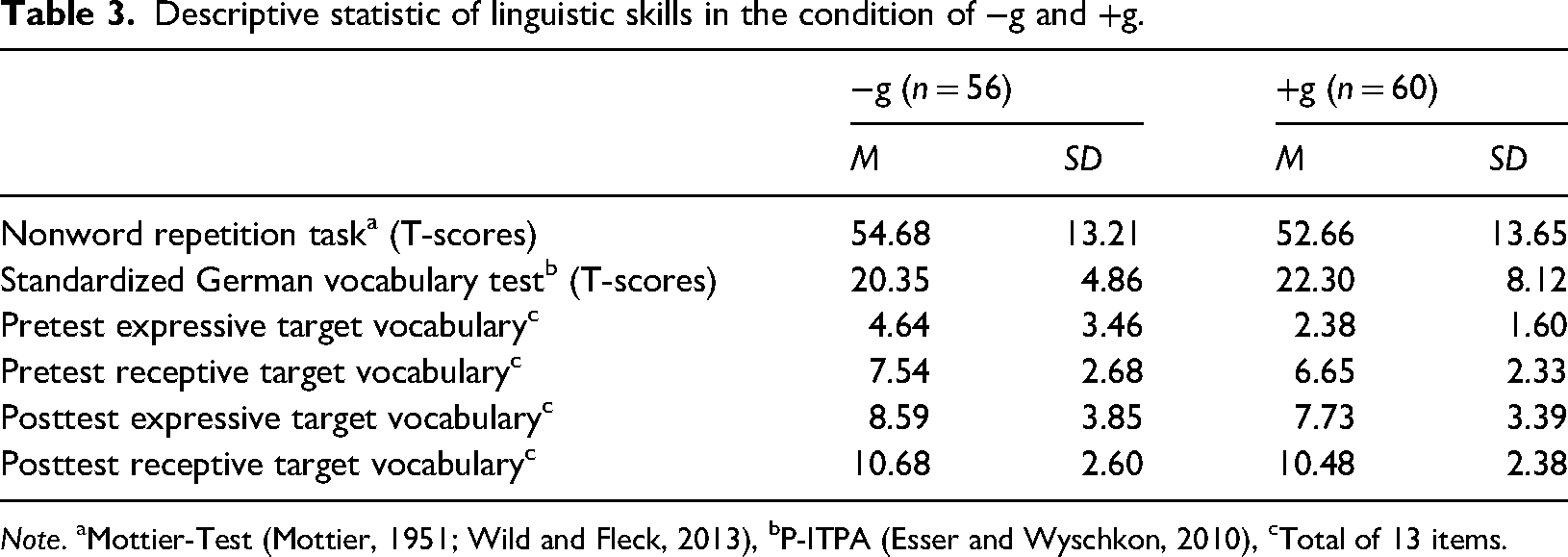
Note. aMottier-Test (Mottier, 1951; Wild and Fleck, 2013), bP-ITPA (Esser and Wyschkon, 2010), cTotal of 13 items.
In the expressive pretest, 27% of the +g students (n = 16) showed very little knowledge of the target vocabulary and named none or only one of the 13 words correctly. In the posttest, significantly more of these students with very little expressive knowledge produced gestures (37.5%) than students with a slightly better expressive vocabulary in the pretest (11%), χ2 = 5.35, df = 1, p = 0.021. Therefore, the students with the lowest knowledge of the target academic vocabulary in the pretest produced more gestures to label the target items in the posttest (Md = 0, IQR = 1.75), compared to students with slightly more knowledge of the target vocabulary (Md = 0, IQR = 0, U = 255, Z = −2.405, p = 0.016, d = 0.428).
None of the children of the −g condition produced gestures in the posttest.
Discussion
In our study we investigated the effect of iconic gestures, derived from DGS, in classroom didactics of an inclusive elementary school, to facilitate novel academic word learning in students with SLCN in the series of mathematics. We observed teachers using the predefined gestures accompanying verbal naming in a very high frequency. This is in line with the findings by Alibali and Nathan (2012), Chikiwa (2021) as well as Valenzeno et al. (2003), who were able to show that teachers spontaneously produce a lot of gestures during class. But, unlike in these studies where teachers were not aware of the supportive effect of gesture use (e.g., Alibali et al., 2013; Church et al., 2004; Yeo et al., 2017), teachers in the present study purposefully used gestures to enhance academic vocabulary learning. In accordance with Yohannan et al. (2021) our findings demonstrate that teachers can be easily and effectively trained to use iconic gestures purposefully during lessons. The high degree of iconicity of these gestures may have helped the teachers to quickly memorize and transfer the gestures into their pedagogical actions.
With regard to the students, our data confirm the beneficial impact of iconic gestures on the acquisition of novel words in children with SLCN (Lüke and Ritterfeld, 2014, van Berkel-van Hoof et al., 2019, Vogt and Kauschke, 2017a, 2017b), which had also been found for typically developing children (Capone and McGregor, 2005; Capone Singleton, 2012; McGregor et al., 2009). Students who have seen iconic gesture presentations during the math lessons outperformed students who have not seen them, but only regarding expressive language skills. The lack of an effect in receptive word knowledge might have been influenced by the chosen bimodal teaching strategy, social forms, and materials, which is mainly reflected in expressive (e.g., naming the geometric surfaces and solids) rather than receptive tasks (e.g., understanding differences between the geometric surfaces and solids).
Another reason for this outcome could be the different requirements in receptive and expressive testing of the target vocabulary. In the receptive target word test, children were requested to recognize the target word from four pictures, whereas in the expressive test, they were asked to name the picture presented separately. Possibly they performed less well in receptive testing because three distractors were presented next to the target item, all of which were other geometric surfaces and solids from the chosen target academic vocabulary. In expressive testing, students in the +g condition were stimulated to perceive visual cues on paper and to use them as a cueing strategy or bootstrapping mechanism in naming the (target) words (Capone Singleton, 2012; Pouw et al., 2014). Within the context of the predominantly expressively focused teaching strategy, it may be that children are not yet ready to transfer these cueing stimuli to receptive language performance. It is also possible that students in the +g condition would have outperformed −g students if the duration of the intervention had included the full six hours of instruction rather than just four, which might have been necessary to enable long-term memorization and learning.
The aforementioned cueing effect of the iconic gestures also became evident in students who had difficulty naming the target word in the posttest. Instead of verbal naming, they resorted to the iconic gesture for the corresponding word. The use of gestures reflects the student's cognitive processing of novel word acquisition on the transition from anchoring the word concept, meaning the semantics to oral language (Goldin-Meadow et al., 2009; Paivio, 2010). By adopting gestures, students with SLCN also receive opportunities to facilitate lexical retrieval (Pine et al., 2007) and to express themselves, even if expressive language is still lacking.
Therefore, the results of our teaching strategy are particularly supportive for multilingual students with migrant or refugee background who have difficulties following the content of the lesson because they have less or no exposure to the language spoken in the classroom. The results of the 2000 PISA (Organisation for Economic Co-operation and Development, 2001) and the 2016 IGLU study (Hußmann et al., 2017) indicate that the achievement gaps, concerning multilingualism and low SES, associated with an migration background are higher in Germany than in other member states of the OECD or the EU. Furthermore, an increase in the number of students with an immigrant background is also assumed. This poses a challenge in particular to the German education system, as 22% of primary school students had an immigrant background and 50% of those had a comparable low SES in 2018 (Organisation for Economic Co-operation and Development, 2019). Considering the high percentage of children with less or no contact to the surrounding language as well as children coming from families with lower SES needing support in language acquisition (Desmarais et al., 2008), effective didactic approaches are needed to achieve the goal of equal learning opportunities supporting all students at possible risk of SLCN.
Not only students, but also teachers and the interactions between teachers and students benefit from these cues, as the visualization via iconic gestures offers teachers an opportunity to observe and perceive the student's learning process through an additional modality than the spoken language. Thereby it enables teachers to praise students for their communicative contributions even if they are not able to produce the appropriate word verbally.
Iconic gestures are usually produced spontaneously and can differ in the realization between speakers (Goldin-Meadow, 1999; Hostetter, 2011). To provide a consistent presentation of the chosen iconic gestures, we have deliberately chosen signs from DGS. Since visual representation or motor execution of some selected signs might differ from teachers’ initial, spontaneous, and individual conceptions of the gesture of a target word (Ortega et al., 2020), the effectiveness of the intervention might have been limited. Yet, the consistent presentation of gestures and signs is important, because even small variations can change the semantic, the speaker wanted to convey or to highlight. In addition, gestures or signs from a sign language serving as beneficial method for academic word learning in schools, should be constant across teachers and not exclusionary for deaf students or students, who use signs as a communication mean in general. Nevertheless, the high degree of iconicity of the chosen gestures from DGS seem to support teachers not only in learning the iconic gestures per se, but also in adopting and frequently presenting them to students.
There are many studies being conducted in the mathematics series investigating the interface between language skills and mathematical competencies (Chow et al., 2021; Cross et al., 2019; Kleemans et al., 2018; Peng et al., 2020). Students need to acquire mathematical vocabulary to understand and solve relevant tasks (Kleemans et al., 2018; Riccomini et al., 2015). Referring to the linguistic skills of the students in the participating elementary school, it is not surprising that the teachers selected the presentation of iconic gestures in mathematic lessons. The presentation of iconic gestures as a strategy to support students in the acquisition of novel (academic) words in (inclusive) elementary schools would also be interesting regarding general knowledge, such as tree species (spruce, beech, alder, linden) or living beings (amphibians, reptiles, insects). The implementation of iconic gestures as a didactic method also goes beyond their presentation in (inclusive) elementary schools. It is conceivable that students in secondary schools could also benefit from their presentation. This would be imaginable for subjects such as geography (latitudinal circle, infrastructure, monoculture, troposphere) or natural science (protons, refraction, gravitation), to enable the understanding of the partly abstract course contents and the execution of tasks supporting the learning process.
Limitations
Our study has some limitations in terms of data collection, which must be considered when interpreting the results. The planned study design, which included six lessons, a pretest, a posttest, and a follow-up, could not be conducted due to the public health situation caused by the Corona pandemic and the resulting school closures in Germany. Instead, the study ended prematurely after four lessons of instruction followed by the posttest. The results might have been more noticeably after the planned six lessons. Originally eight weeks after the last mathematics lesson a follow-up measurement was supposed to take place. Due to its cancellation, no conclusions can be drawn regarding the maintenance of the positive effect. In addition, we collected data at only one inclusive elementary school and could not analyze our nested data structure with specific statistical approaches. Further research is necessary to calculate more complex statistical analyses from a larger sample distributed across several inclusive elementary schools. Our participatory approach, where we actively involved teachers in the design and implementation of lessons from the beginning of the project, can also be critizied. The aspect worth mentioning is the possible enthusiasm the teachers in the +g group might have shown due to the promising effects on novel word learning of the prestudy. This could have led to the positive effect on word learning in students. To counteract this, we counted teachers’ oral naming of the target vocabulary in all lessons and found no differences between groups. Therefore, the participatory approach can be considered as a strength of the study. Teachers at the participating school not only supported empirical research, but also experienced an effective teaching method that they can implement into their everyday teaching in all classes and subjects.
Conclusion
Iconic gestures can be used as a multimodal teaching strategy in inclusive elementary schools. For teachers, this means that they acquire an efficient teaching strategy in a relatively short time and merely have to be more aware of the content they convey through gestures. Thus, students with (severe) SLCN can also be actively involved in the classroom and express themselves by gestures. Due to the predefined execution of the gestures, gestures from the surrounding environmental sign language are particularly suitable as a teaching strategy compared to individually created, spontaneously introduced gestures. For this reason, we refer to the use of signs from the surrounding sign language when teaching novel words.
Our results provide the preliminary evidence for the efficacy of the presentation and implementation of iconic gesture in inclusive classrooms resulting in an effective teaching method facilitating novel word acquisition in mono- and multilingual children with SLCN.
Footnotes
Acknowledgments
Thanks are extended to the students, teachers, the school management of the participating elementary school, the research assistants, and furthermore, to Kathrin Heeg, for proofreading.
Declaration of conflicting interests
The author(s) declared no potential conflicts of interest with respect to the research, authorship, and/or publication of this article.
Funding
The author(s) disclosed receipt of the following financial support for the research, authorship, and/or publication of this article: The study is funded by the (German) Federal Ministry of Education and Research (01UL1811X), awarded to Carina Lüke.
