




Abstract
Children with language disorder frequently experience difficulties with vocabulary acquisition, and these difficulties often persist into adolescence. The literature indicates that clinical studies tend to investigate phonological-semantic approaches, whereas educational studies focus on the derivation of meaning within a literacy context. Little is known about whether the practices of speech and language therapists and teachers reflect these findings from the literature. The current paper reports on a survey which gathered information from speech and language therapists and mainstream secondary school teachers, about their current practice concerning vocabulary support for adolescents, aged 11–16, who have language disorder. An online questionnaire was distributed through teaching and speech and language therapy professional networks. The aim of the study was to establish which specific strategies were used in practice by speech and language therapists and mainstream secondary school teachers to teach vocabulary to adolescents with language disorder, and which strategies were the most effective. Responses were obtained from 127 speech and language therapists and 47 mainstream secondary school teachers in the UK. Speech and language therapists were more likely than mainstream secondary school teachers to teach phonological awareness and semantic feature analysis as strategies for developing vocabulary skills. Both professions used literacy-related strategies as well as strategies for independent word learning such as the derivation of meaning from morphology and context. Increased joint working and training opportunities would further develop the knowledge and skills of both mainstream secondary school teachers and speech and language therapists, enabling theoretically-grounded and relevant vocabulary support for this group of adolescents.
Introduction
The importance of vocabulary
It is well established that vocabulary knowledge plays a critical role in academic progress. Vocabulary knowledge both in early childhood (Croll, 1995) and in the adolescent years (Spencer, Clegg, Stackhouse, and Rush, 2017) is positively correlated with examination success. There is an increasing awareness of the ‘word gap’, referring to lower vocabulary levels in children from areas of social disadvantage (Oxford University Press, 2018: 3), with the active teaching of vocabulary across subjects being explicit within national school curricula in the UK and internationally (e.g. Department for Education [DfE], 2014; Common Core State Standards Initiative, 2020).
Up to 10% of children have disordered language development (Norbury et al., 2016), frequently presenting with deficits in vocabulary acquisition, which continue throughout adolescence (McGregor et al., 2013). Disordered language development results in difficulties with first language acquisition, which are likely to cause ‘a significant impact on social interactions or education progress’ (Bishop et al., 2017: 5). The term language disorder encompasses both children for whom language is their primary difficulty (developmental language disorder) and those whose difficulties occur in association with another condition (language disorder associated with X). Children with language disorder are known to be at risk of poor long-term outcomes in a range of academic, social, emotional, health and employment domains, well into adulthood (Johnson et al., 2010).
It is, therefore, essential that effective vocabulary teaching strategies are implemented in clinical and educational practice, to meet the needs of not only typically-developing children and adolescents, but also those with language disorder. The goal of the current paper is to investigate the current practice of speech and language therapists (SLTs) and mainstream secondary school teachers (MSSTs) concerning vocabulary support for adolescents aged 11–16 who have language disorder.
Vocabulary deficits
Evidence suggests that vocabulary deficits are related to weak phonological and semantic skills. Phonological information about a word includes the word's initial sound, how it rhymes with other words, and its syllable structure (see e.g. Stackhouse and Wells 1997). Semantics refers to the meaning of words, with semantic information being organised according to features such as function, location, association, part of speech and category (see e.g. Murphy 2010). Children with language disorder are more likely than typically-developing peers to have sparse semantic representations (McGregor et al., 2002) and inaccurate phonological representations (Stackhouse et al., 2006).
Lahey and Edwards (1999) provided evidence that children with language disorder aged four to nine years made both phonological and semantic errors in word production, with children who had expressive-only difficulties making more phonological errors, and children with expressive-receptive difficulties making more semantic errors. This suggests that for some children with language disorder, relatively weaker phonological skills underlie their word-learning difficulties, particularly affecting naming, whereas for others, relatively weaker semantic representations have greater influence, particularly affecting comprehension. However, as Stackhouse et al. (2006) describe, a strong phonological representation is also necessary for word comprehension; therefore, it is difficult to entirely dissociate the phonological and semantic aspects of word learning. Phonological information needs to be integrated with semantic information: an inaccurate or unstable phonological representation could result in a tenuous link between a word's phonological form and its semantic representation, impeding efficient receptive word learning as well as word retrieval (Kail and Leonard, 1986; Nash and Donaldson, 2005). A poorly developed semantic system further compounds the difficulty.
As children get older, these aspects of word learning remain relevant, but in addition, literacy plays a greater part. With proficient reading skills, language and literacy ‘enjoy a symbiotic relationship’ (Nippold, 1988: 29). Typically-developing older children and adolescents independently absorb the meanings of new words through reading, through the use of word-learning strategies. Two key independent word-learning strategies involve using morphological clues from within the word, and context clues in the text surrounding the word. However, as reading difficulties are a common feature of language disorder (e.g. Bishop and Snowling, 2004), children and adolescents with language disorder are less able to do this, placing them at an educational disadvantage. Furthermore, these children and adolescents need direct instruction in how to derive meaning from context. Nash and Snowling (2006), working with seven-to-eight year-olds with low vocabulary levels, found that when this direct instruction happened, it was more effective than being taught definitions. Such in-depth vocabulary teaching, which involves active processing of word meaning, ‘get[s] at the heart of vocabulary knowledge, that is, its rich network of semantic and associative connections’ (Ford-Connors and Paratore, 2015: 54).
Strategies for in-depth vocabulary teaching
Clinical research has evidenced the effectiveness of vocabulary intervention with children and adolescents who have language disorder, through the teaching of phonological and semantic features (see Lowe et al., 2018, for a review). Structured semantic feature analysis strengthens semantic representations, while direct phonological instruction may confer added benefit by increasing the accuracy of the stored phonological form, thus supporting expression as well as comprehension (Kail and Leonard, 1986; Nash and Donaldson, 2005).
In contrast, research from an educational perspective has tended to investigate vocabulary intervention focusing on derivation of meaning within a literacy context (see Wright and Cervetti, 2017, for a review). One such approach is the Robust Vocabulary Instruction method of Beck, McKeown and Kucan (2013). This approach fosters an interest in words through discussing word meanings from literary texts, emphasising the derivation of meaning from contextual and morphological cues, and relating word meanings to personal experience. Educational vocabulary research has typically included children and adolescents who have low language levels in connection with second language learning and/or social disadvantage (e.g. Snow et al., 2009).
These differing perspectives of clinical and educational research suggest that practising teachers and SLTs may take different approaches to vocabulary support. This assertion receives some support from Roulstone et al., (2012), who surveyed speech and language therapy managers, educational psychologists, and managers of specialist advisory teachers. This survey found that practitioners often used eclectic intervention approaches, covering a variety of age groups, client groups, and models of delivery. Little overlap was found between the approaches used by the educationalists and SLTs, although the survey was not specifically about vocabulary, nor secondary schools, and so it did not elucidate what vocabulary strategies were used with adolescents; neither did it canvas the views of mainstream classroom teachers.
A review by Ford-Connors and Paratore (2015), specifically investigating classroom vocabulary teaching in the adolescent age group, suggests that in-depth vocabulary teaching is not commonplace in the secondary school classroom, and that vocabulary teaching tends to take the form of direct instruction of targeted words. Although most of the included studies were based in the USA, this view echoes earlier observations of others in both the USA and UK (Dockrell and Messer, 2004; Graves, 1987; Nagy and Herman, 1987), seeming to indicate that there has been little change over a number of years. Ford-Connors and Paratore, coming from an educational perspective, did note that phonological decoding of the written word is sometimes used as an in-depth strategy, but there was no mention of teaching the phonological structure of the spoken word.
Models of intervention delivery
There has been a trend in the UK for speech and language therapy to deliver school-based rather than clinic-based services (Dockrell et al., 2019; Pring et al., 2012), creating opportunities for teachers and SLTs to collaborate on support for children and young people with speech, language and communication needs. Collaborative support has long been regarded as important while at the same time challenging (Ehren, 2002; McKean et al., 2017; Merritt and Culatta, 1998). One such challenge in the adolescent age-group is that speech and language therapy provision typically decreases as children move from primary to secondary education, in both the UK and other countries (Bercow, 2008; Dockrell et al., 2019; Ehren, 2002; Hollands et al., 2005; Royal College of Speech and Language Therapists [RCSLT]/ICAN, 2018), which places extra emphasis on the role of teachers in supporting speech and language needs in the classroom. An increased awareness of theoretically-grounded vocabulary support relevant to the secondary school classroom is therefore critical to effective intervention.
The current study
The evidence summarised above suggests that adolescents with language disorder require in-depth vocabulary teaching, explicitly emphasising phonological form and semantic features, as well as utilising literacy support and explicit instruction in independent word-learning skills. As a large part of vocabulary support for this population takes place in the classroom, it is essential that whole-class vocabulary teaching incorporates these four elements as part of an in-depth vocabulary teaching approach. However, to date, no study has specifically explored the extent to which the differences outlined above between clinical and educational research are reflected in the practice of SLTs and MSSTs, in the field of vocabulary teaching and intervention for adolescents with language disorder.
The current paper aims to answer the following research question: for adolescents with language disorder, do the vocabulary teaching practices of MSSTs and SLTs differ? Evidence from the literature leads to the following hypotheses: (H1) SLTs are more likely than MSSTs to teach phonological awareness; (H2) SLTs are more likely than MSSTs to teach semantic feature analysis; (H3) MSSTs are more likely than SLTs to use literacy-related strategies; and (H4) MSSTs are more likely than SLTs to teach the use of morphological and contextual clues for independent word learning.
Methods
Study design
Data for the current paper is taken from a survey which gathered information from SLTs and MSSTs about their current practice concerning vocabulary support for adolescents who have language disorder aged 11–16 years. The survey sought practitioners’ views on their use of vocabulary teaching strategies and models of intervention delivery, as well as the importance of vocabulary, confidence in teaching vocabulary, factors influencing intervention and teaching approaches, and the need for continuing professional development on this topic. A questionnaire was created using an online survey tool, Qualtrics (Qualtrics LLC, 2017). As the survey took place prior to the adoption of the terms language disorder and developmental language disorder (Bishop et al., 2017), the term language impairment was used. The introduction to the questionnaire defined the relevant adolescents as ‘11–16-year-olds with language impairment, in mainstream secondary schools. Many of these adolescents have a vocabulary deficit. This could mean they have a limited vocabulary; difficulty learning to understand the meaning of new words; and difficulty remembering the words in order to be able to use them in their speech and writing’.
An initial version of the questionnaire was piloted with a small sample of teachers and SLTs. Positive feedback was received, and minor amendments were made to increase the clarity of the questions. The questionnaire was preceded by a paragraph explaining the background to the research, followed by the statement: Yes, I give my consent to take part in this survey, and for my responses to be used anonymously in the dissemination of the research. If the tick box adjacent to this statement was not ticked, no further questions were visible to the respondent.
The current paper reports on the section of the questionnaire pertaining to vocabulary teaching strategies. A list of evidence-based strategies was generated from the literature and from clinical practice observations These were broadly categorised into different types of approach, which led to the four hypotheses of this paper. Two categories were identified for which the literature did not suggest specific hypotheses; therefore, analysis was exploratory. The strategies (see Table 1) were listed in random order in the questionnaire, and respondents were asked to rate their usage of each strategy on a scale of never, seldom, sometimes, often, or always. There was a free text field for respondents to list what they felt were the most effective strategies.
Vocabulary teaching strategies listed in the questionnaire.
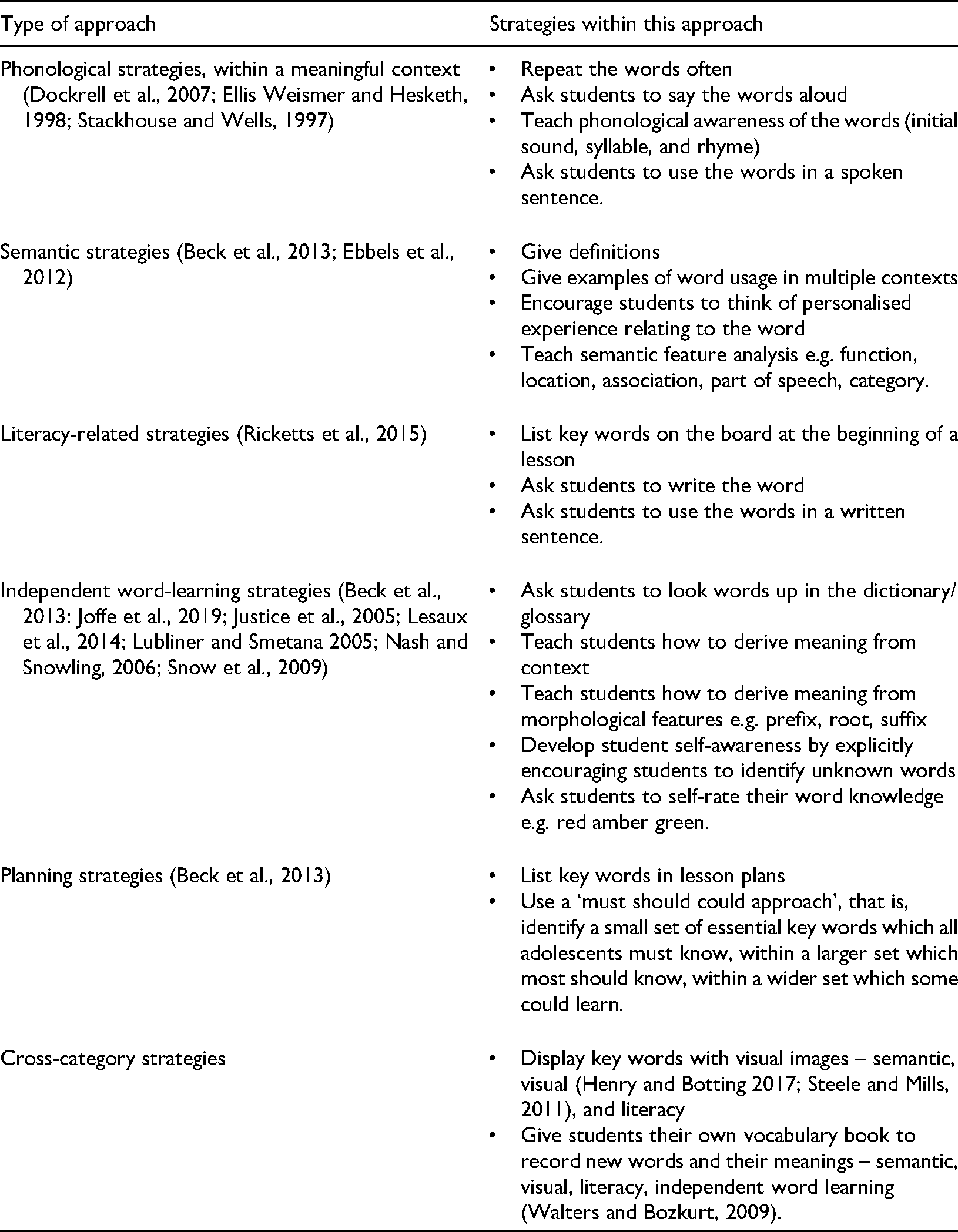
Vocabulary teaching strategies listed in the questionnaire.
Ethical Approval for the study was received from the relevant City, University of London ethics committee. The survey was distributed through teaching and speech and language therapy professional networks, publications, websites, and social media. It was also directly distributed via email to schools in two London borough councils, two county councils, and two metropolitan councils in the UK chosen at random. The survey was open for an eight-month period from February to October 2015. Responses were anonymous.
Data Analysis
Quantitative responses were collated and inputted to SPSS 22 (IBM Corp., 2013). Descriptive data for each separate category is in the Appendix. When the categories never, seldom, sometimes, often and always were considered separately, fewer than 80% of the expected cell counts were greater than or equal to 5, thereby violating the assumptions of a chi-square test Therefore, the never and seldom categories were collapsed, and the sometimes, often, and always categories were collapsed to produce 2 × 2 tables (in which more than 80% of the expected cell counts were ≥5) from which a Fisher's exact statistic was calculated. This enabled differences between profession and strategy use to be examined. Bonferroni corrections were applied such that the significance level was set at p = 0.0025. Free-text responses were collated and inputted into NVivo 11 software (QSR International, 2017) for content analysis (Ritchie and Lewis, 2003).
Results
Participants’ characteristics
Two hundred and fifty-nine questionnaires were started, of which 38 included no information beyond stating their profession. There was a low response rate from outside the UK (N = 7); therefore, these responses were excluded from analysis. Twenty-three responses from specialist teachers, nine from special educational needs coordinators, and seven from teachers in special schools were also excluded, due to the small numbers of responses in these categories, and to enable the experiences of SLTs and MSSTs to be directly compared. Of the remaining 174 questionnaires, 126 respondents were SLTs and 47 were MSSTs. One respondent was a dually qualified teacher and SLT, who was included as an SLT. Fully-completed questionnaires were returned from 97 SLTs, and 36 MSSTs (an overall completion rate of 62%).
Eleven MSSTs taught English (21%), seven taught Science (13%), six taught History (11%), six taught Religious Studies/Citizenship (11%), and five were Modern Foreign Language teachers (9%). There was a small sample from all other subjects.
Fifty-one respondents (29%) worked in London, and 26 in the South East of England (15%), with respondents from all other areas in the UK except Northern Ireland.
Comparison of strategies used by SLTs (N = 106) and MSSTs (N = 39)
Table 2 displays percentages of MSSTs and SLTs using each strategy sometimes, often or always, and lists the significance of the difference between the professions in their use of each strategy.
Frequency of strategy use by mainstream secondary school teachers and speech and language therapists.
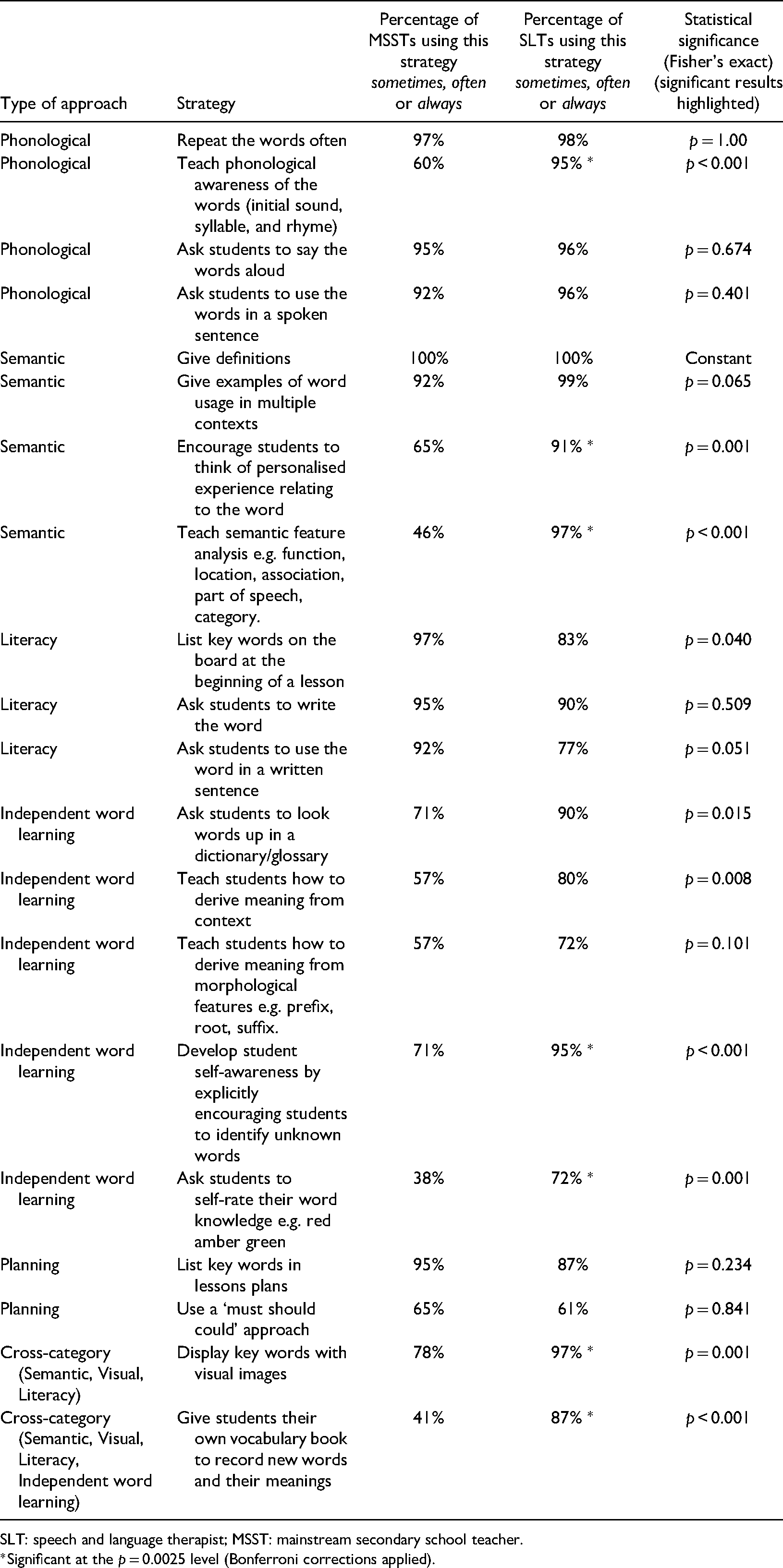
Frequency of strategy use by mainstream secondary school teachers and speech and language therapists.
SLT: speech and language therapist; MSST: mainstream secondary school teacher.
*Significant at the p = 0.0025 level (Bonferroni corrections applied).
The following sections will compare the two groups in their use of the different strategy types, taking each category in turn.
Phonological strategies (H1)
There was no significant difference between the professions in their use of ‘Repeat the words often’, ‘Ask students to say the words aloud’, or ‘Ask students to use the words in a spoken sentence’. However, 95% of SLTs indicated that they used ‘Teach phonological awareness of the words (initial sound, syllable, and rhyme)’ sometimes, often, or always, compared with 60% of MSSTs, a statistically significant difference (p < 0.001), thus providing support for H1, that SLTs are more likely than MSSTs to teach phonological awareness (Figure 1).
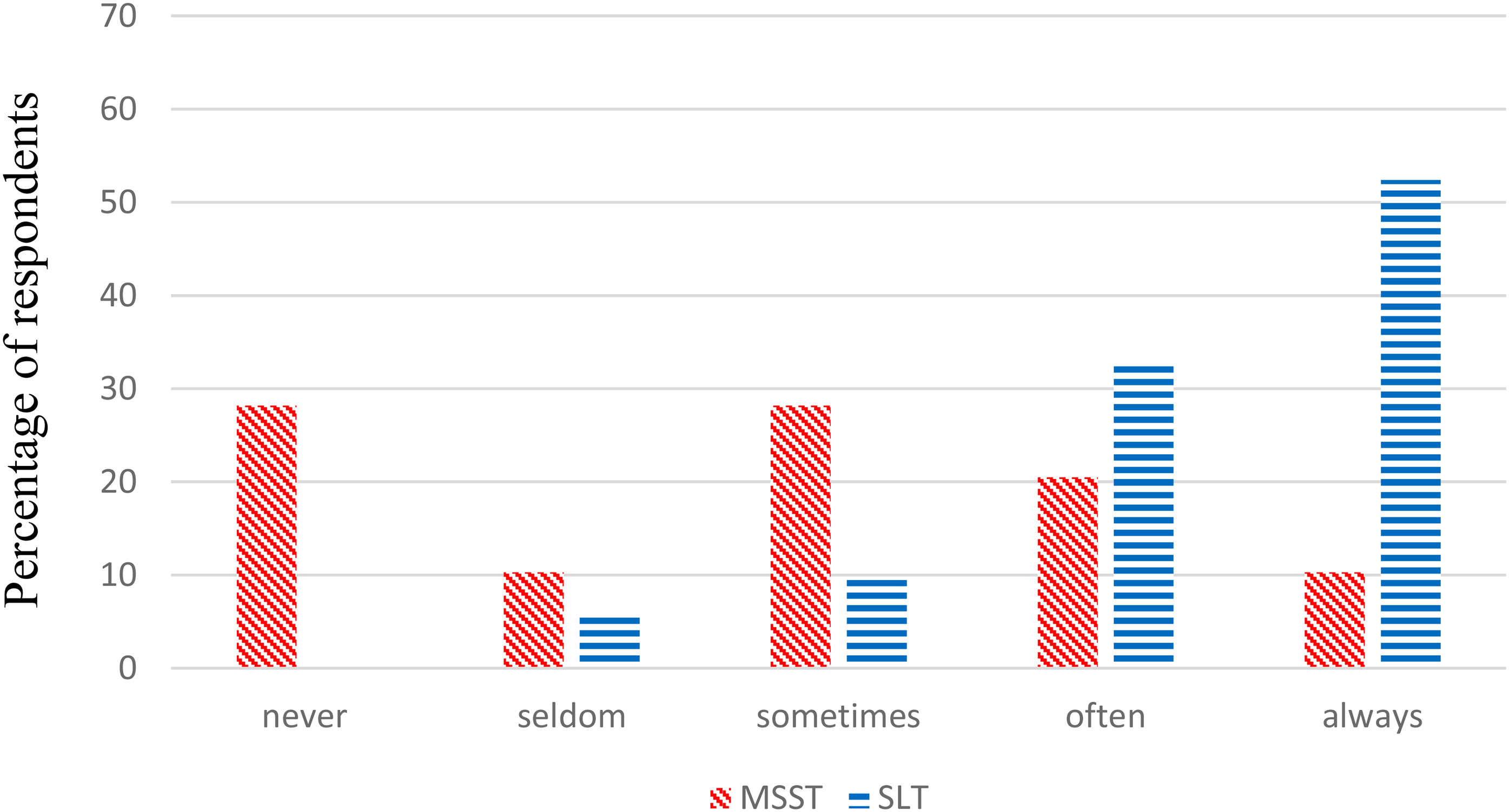
Percentage of MSSTs and SLTs teaching phonological awareness.
Semantic strategies (H2)
There was no significant difference between the professions in their use of ‘Give definitions’, or ‘Give examples of word usage in multiple contexts’. However, 91% of SLTs indicated that they sometimes, often, or always encouraged students to think of personalised experience relating to the word, compared with 65% of MSSTs, a statistically significant difference (p = 0.001). In addition, 97% of SLTs indicated that they taught semantic feature analysis sometimes, often, or always compared with 46% of MSSTs, also statistically significant (p < 0.001), thus providing support for H2, that SLTs are more likely than MSSTs to teach semantic feature analysis (Figure 2).
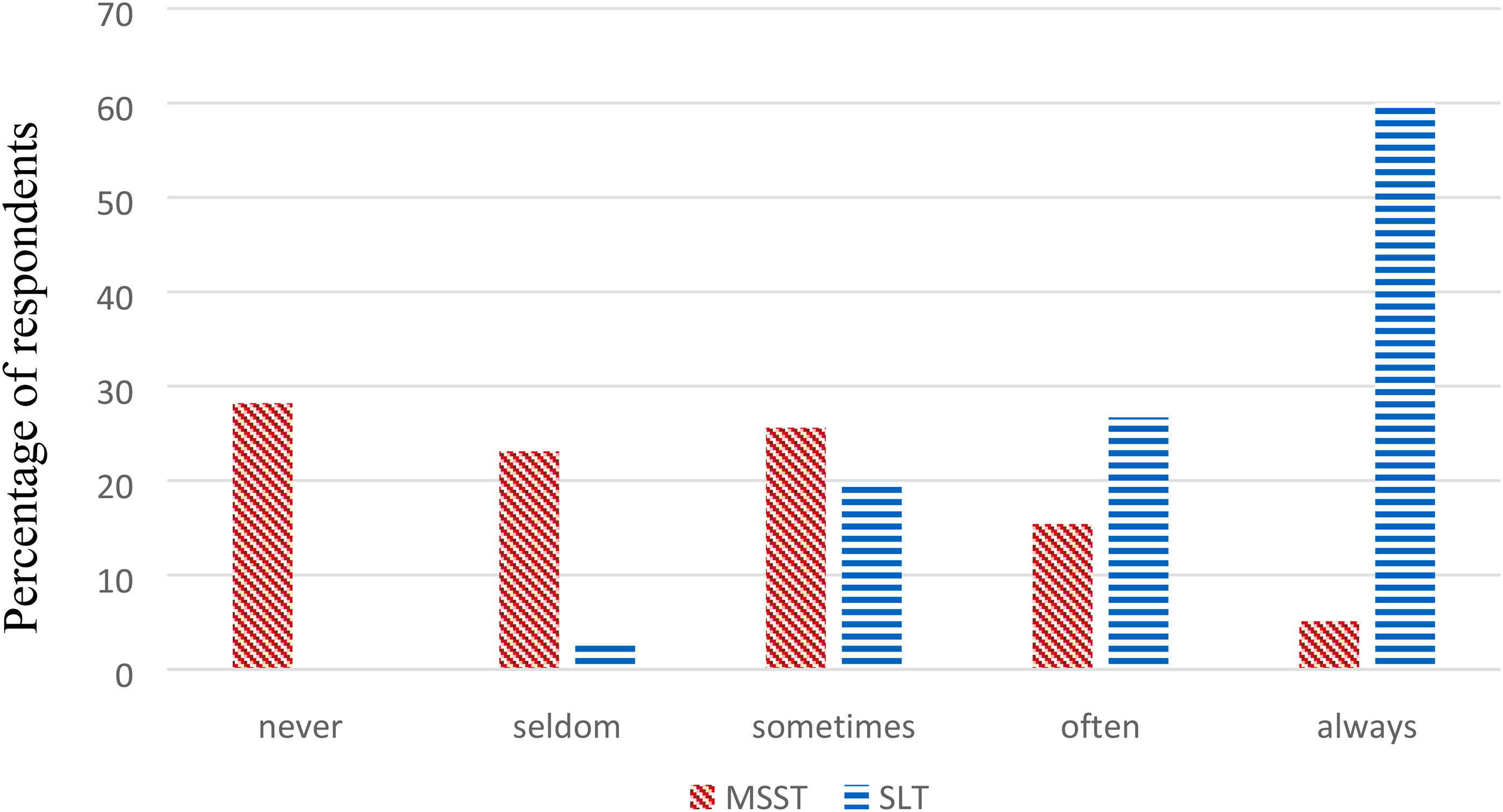
Percentage of MSSTs and SLTs teaching semantic feature analysis.
Literacy-related strategies (H3)
Although MSSTs used ‘List key words on the board at the beginning of a lesson’, ‘Ask students to write the word’, and ‘Ask students to use the words in a written sentence’ numerically more often than SLTs, these differences were not significant; therefore, H3, that MSSTs are more likely than SLTs to use literacy-related strategies, was not supported.
Independent word-learning strategies (H4)
There was no significant difference between the professions in their use of ‘Ask students to look words up in a dictionary/glossary’, (90% of SLTs used this strategy versus 71% of MSSTs); ‘Teach students how to derive meaning from context’, (80% of SLTs, 57% of MSSTs); and ‘Teach students how to derive meaning from morphological features e.g. prefix, root, suffix’ (72% of SLTs, 57% of MSSTs). Indeed, there was a trend against predictions, with SLTs using these strategies numerically more often than MSSTs. Therefore, H4, that MSSTs are more likely than SLTs to teach the use of morphological and contextual clues for independent word learning, was not supported. In addition, SLTs used two independent word-learning strategies significantly more often than MSSTs. These were: ‘Develop student self-awareness by explicitly encouraging students to identify unknown words’ (p < 0.001), and ‘Ask students to self-rate their word knowledge e.g. red amber green’ (p = 0.001).
Planning strategies and cross-category strategies
There was no significant difference between the professions in their use of ‘List key words in lesson plans (87% of SLTs, 95% of MSSTs)’ or ‘Use a must-should-could approach’ (61% of SLTs, 65% of MSSTs).
SLTs used ‘Display key words with visual images’ (97%) significantly more often than MSSTs (78%) (p = 0.001); and likewise ‘Give students their vocabulary books to record new words and their meanings’ (87% of SLTs, 41% of MSSTs) (p < 0.001).
Thus, these planning and cross-category strategies represent areas of overlap between teaching and speech and language therapy practice.
A free text field was provided for participants to indicate which they felt was the most effective strategy for teaching vocabulary. The strategy listed most commonly by MSSTs was asking students to say the word in a spoken sentence (38% of MSSTs), followed by repeating the word often (29%), and writing the word in a sentence (22%). In contrast, 27% of SLTs felt that teaching semantic feature analysis was the most effective, followed by repeating the words often (22%), saying the word in a spoken sentence (20%), using visual support (20%), and teaching phonological awareness (20%). Most respondents listed more than one strategy, with 13 (10%) stating that for maximum effectiveness, a combination was important.
Discussion
The Current study used an online questionnaire to survey the practices of SLTs and MSSTs in the UK about the vocabulary support given to adolescents with language disorder in mainstream secondary schools. It was hypothesised that (H1) SLTs would be more likely than MSSTs to teach phonological awareness, and that (H2) SLTs would be more likely than MSSTs to teach semantic feature analysis. These two hypotheses were supported: SLTs taught phonological awareness significantly more often than MSSTs; and, further, while many of the strategies used by teachers were semantic in nature, significantly fewer teachers than SLTs explicitly incorporated semantic feature analysis into their teaching.
Results did not support hypotheses 3 and 4, that MSSTs would use literacy-related and independent word-learning strategies more than SLTs: SLTs were just as likely as teachers to use literacy-related strategies and to teach derivation of meaning from context or morphology. In fact, contrary to H4, SLTs used some independent word-learning strategies significantly more often than teachers, particularly strategies to raise students’ awareness, that is, encouraging them to identify unknown words and to self-rate their own word knowledge.
These results confirm the differences in intervention approaches between teachers and SLTs found by Roulstone et al. (2012), and that in-depth vocabulary teaching, such the integration of semantic, phonological, and independent word-learning strategies, is limited in the classroom (Ford-Connors and Paratore, 2015). Specific differences highlighted by this survey include teachers’ and SLTs’ utilisation of phonological awareness, semantic feature analysis, and student self-awareness. However, the survey also indicates areas of agreement – for example, teaching how to derive meaning from morphology and context in order to develop independent word-learning skills. It is also noteworthy that both professions felt that a combination of strategies is necessary for maximum effectiveness.
Differences between the teaching and speech and language therapy professions are to be expected, given the different knowledge bases and training of each profession. Initial teacher training has historically included little in the way of training in language disorder. In the UK, the ‘Carter Review of Initial Teacher Training’ (DfE, 2015) recommended that training in special educational needs (including speech, language, and communication needs) should be part of core content on all initial teacher training courses. This recommendation was accepted by the government in office at that time (DfE, 2016), and efforts are still being made to implement this recommendation (e.g. Gascoigne and Gross, 2017), in order to foster shared understanding and to lay the foundations for collaborative working from the outset of professional training. In fact, the literature already reports examples of inter-professional training opportunities in some countries; for example, joint practice placements during training in New Zealand (Wilson et al., 2017).
The current findings reinforce previous research exploring the benefits and challenges of a collaborative approach to speech and language therapy input in schools (Ehren, 2002; McKean et al., 2017; Merritt and Culatta, 1998). Ehren promoted the concept of ‘curriculum-relevant therapy’ (p. 60) as a way of addressing this challenge. The current authors argue that this is particularly important in the field of vocabulary, central as it is to curriculum access. Inter-professional collaboration, to which teachers bring knowledge of the curriculum and the classroom setting, and SLTs bring knowledge of word-learning difficulties, unites the professions’ two spheres of knowledge to create curriculum-relevant vocabulary intervention.
As Merritt and Culatta (1998: 49) noted, ‘Collaboration is neither automatic nor easy to execute as it encompasses significant professional challenges’, a statement which still holds true today. Since the National Health Service (NHS) Reorganisation Act in 1974, public sector SLTs in the UK have traditionally been employed within the NHS, whereas teachers are employed within education authorities, creating a strategic divide due to differing priorities. Where SLTs are employed by education authorities or individual schools, as is happening increasingly (RCSLT/Association of Speech and Language Therapists in Independent Practice, 2011; RCSLT/ICAN, 2018), it may be easier to share priorities and achieve effective collaboration. McKean et al. (2017), in a study of four SLTs and 29 educational professionals in one education authority and its NHS partner in the UK, identified factors which enabled barriers to be overcome and successful collaborative practice to be achieved. These included: positive attitudes; adequate resources; open and honest communication; and a shared understanding of each other's roles both at operational and strategic level.
Limitations
There was a small return rate from MSSTs in the current study (0.02%, given an estimated 204,700 secondary school teachers in England alone (DfE, 2017). In addition, there could have been a volunteer bias within the teacher cohort such that those with experience of, or interest in, vocabulary or language disorder were more likely to take part. Twenty-one percent of teachers were English teachers, which is unsurprising giving the centrality of vocabulary to the subject of English. Nonetheless, there was sufficient representation of other subject teachers, notably Science, History, and Religious Studies/Citizenship to widen the applicability of the findings. The return rate from SLTs was higher (26%, calculated from figures in Pring et al. (2012) and Roulstone et al. (2012) that 7.1% of 6860 paediatric SLTs work predominantly in secondary schools). Although this provides greater external validity for the SLTs’ responses, a further limitation of the study is that information was not sought about the specific setting in which SLTs worked. The low return rate from MSSTs necessitated caution in choosing an appropriate statistical test and interpreting the results. To overcome low cell counts, the strategy use categories were combined. As this may have masked subtle differences between the professions, the raw data is included in the Appendix for visual inspection. Therefore, any inferences or generalisations from the survey should still be made with caution.
The current paper aimed to focus on the practices of teachers and SLTs. However, the inclusion of data from specialist teachers, special educational needs coordinators, and teachers in special schools could have yielded valuable information, given their pivotal role in multi-disciplinary working in schools; therefore, this should be the subject of future research.
Conclusion and implications
Reviews of vocabulary interventions for adolescents in the literature show that most clinical studies have investigated phonological-semantic approaches, whereas educational studies have tended to focus on the derivation of meaning within a literacy context. The current study provides some evidence that this parallels current practice, showing that SLT practitioners taught phonological awareness and semantic feature analysis more often than MSSTs. SLTs were also more likely than MSSTs to make use of visual images and personalisation, and to raise students’ awareness. However, both professions used literacy-related strategies, and both taught the derivation of meaning from morphology and context.
MSSTs and SLTs both contribute valuable insights and knowledge to support the vocabulary needs of adolescents with language disorder. This knowledge needs to be shared between the professions through joint working and training opportunities, to enable evidence-based vocabulary practices to be embedded into classroom teaching, and to enable targeted and specialist vocabulary intervention to be relevant to the curriculum. To achieve this, shared understanding and commissioning at a strategic level is of critical importance.
Footnotes
Acknowledgements
The research for this paper was part of the first author's PhD, supported by a studentship from City, University of London.
Declaration of Conflicting Interests
The authors declared no potential conflicts of interest with respect to the research, authorship, and/or publication of this article.
Funding
The research for this paper was funded by the PhD studentship from City, University of London.
