




Abstract
Many candidates undertaking high-stakes English language proficiency tests for academic enrolment do not achieve the results they need for reasons including linguistic unreadiness, test unpreparedness, illness, an unfavourable configuration of tasks, or administrative and marking errors. Owing to the importance of meeting goals or out of a belief that original test performance was satisfactory, some individuals query their results, while others go on to retake the test, perhaps on multiple occasions. This article critically reviews the policies of eight well-known, on-demand gatekeeping English language tests, describing the systems adopted by language assessment organisations to regulate results enquiries, candidates resitting (components of) a test where performance fell short of requirements, and repeat test-taking. It was found that all providers institute clear mechanisms through which candidates can query their results, with notable variations exhibited in procedures, costs, restrictions, outcomes, and how policies are communicated to test-takers. Test resit options are scarce, while organisations enact few restrictions on test retakes in the form of mandatory waiting times and cautionary advice. The implications for language assessment organisations are discussed.
Keywords
Introduction
Meeting the English language proficiency requirements of a higher education institution through a high-stakes, on-demand gatekeeping test is a rite of passage for many second language users seeking to undertake English-medium tertiary education. For some candidates, overall test outcomes fall short of institutions’ requirements (Barkaoui, 2016, 2017; Hu & Trenkic, 2019; Pearson, 2019b; Wilson, 1987; Zhang, 2008) or they may fail to achieve the correct balance of scores across various test components (Alsagoafi, 2018; Hamid, 2016; Pearson, 2019b). Unsatisfactory outcomes could result from insufficient language proficiency (Gobert, 2019; Saif et al., 2021), unfamiliarity with the testing system, lack of academic ability (Gamaroff, 2000), illness and anxiety (Elkhafaifi, 2005), inaccurate rating (Johnson & Lim, 2009), or rarely, the failure of test administrators to correctly follow procedures (Murray, 2015). Consequently, many candidates end up retaking on-demand English language tests in the hope or expectation of improved performance (Alsagoafi, 2018; Barkaoui, 2016; Cho & Blood, 2020; Gobert, 2019; Zhang, 2008), although research shows test repeaters’ scores can stagnate (Barkaoui, 2016; Hamid, 2016) or even go down (Elder & O’Loughlin, 2003; Zhang, 2008), likely to test-takers’ confusion or consternation.
In response, language assessment organisations institute policies outlining the options available to unsuccessful candidates in three discrete but related areas: test enquiries, resits, and retakes. Enquiries range from the mere procedural rechecking of score calculations to remarking one or more areas of a candidate’s work, often their productive output, the marking of which is generally considered more subjective (Gamaroff, 2000). Resits provide a second chance for candidates whose scores in (usually) one component fall below requirements but are satisfactory in others. In contrast, retake policies govern the conditions under which the whole test can be taken anew (usually how soon after an unsuccessful attempt and how often). Enquiries, resit, and retake policies are explicitly outlined on language assessment organisations’ websites as well as constituting part of the terms and conditions which candidates sign when registering for the test.
To some test-takers and language assessment specialists, enquiry, resit, and retake policies may be perceived as a purely procedural dimension of language testing. However, as in other policymaking domains, they embody the collective values and ideological beliefs considered important by members of the language assessment organisation. Such policies constitute the practice of power by large institutions (Levinson et al., 2009), protecting their rights and privileges and incurring responsibilities on test-takers to act within established constraints. Yet, they also require organisations to act consistently according to a set of norms, whilst establishing an individual candidate’s right to question an institution’s power and authority. As such, enquiry, resit, and retake policies suggest the degree of fallibility the organisation perceives towards its testing system, the commitment of the organisation towards fairness and justice, and the relationship between further English language study and test score improvement. Drafting and amending such policies requires careful consideration. An ill-thought-out policy could encourage unnecessary appeals, consume valuable resources, or reduce confidence in the accuracy of marking. Conversely, they represent a domain in which testing organisations, in competition with one another for a finite cohort of international students, can innovate, for example, through a pre-paid resit option.
This study critically reviews the international enquiry, resit, and retake policies of eight tests commonly used for determining the sufficiency of L2 users’ English proficiency for tertiary academic study in UK higher education contexts. The coverage of assessments is not exhaustive. Five tests currently designated SELTs (Secure English Language Tests) by the UK Home Office—International English Language Testing System (IELTS), LanguageCert, Pearson Test of English (PTE)—Academic, PSI Services Skills for English, and Trinity Integrated Skills in English (ISE)—were included. This is due to their role in the admission of prospective students at the pre-tertiary level via a pre-sessional or foundation programme, which serve as an entry alternative to achieving the scores required for direct entry, even for candidates who fall noticeably short of test-users’ requirements. As UK institutions can determine which tests are appropriate to assess candidates’ English language proficiency for direct entry onto degree programmes, requiring test-takers to demonstrate proficiency at CEFR B2 or above (Home Office, 2011), three other well-known tests were also included; Cambridge English Qualifications (CEQ, B2-C2), the Duolingo English Test (commonly referred to as Duolingo), and the Test of English as a Foreign Language (TOEFL) Internet Based Test (iBT). Some of the reviewed tests (e.g., IELTS) are used for other purposes, such as immigration, professional registration, and workplace assessments, and are accepted in other Anglophone countries (e.g., Australia, Canada, New Zealand). As such, the policies have applicability beyond tertiary academic enrolment. The tests are reviewed in alphabetical order.
Review of test enquiry, resit, and retake policies
Cambridge English Qualifications
Enquiry procedure
Cambridge English Qualifications encompass a suite of pass/fail exams pegged to the CEFR, targeting both young learners (e.g., A2 Flyers) and adults (e.g., B2 First). Cambridge English (2021) states that the basis for a test enquiry is if a candidate, “believes that their exam result is not fair,” language that could resonate with some test-takers’ perceptions of their scores. The dissatisfied candidate is first required to speak to a representative of Cambridge English at their local test centre to clarify the enquiry procedures (and probably to ward off unfounded or unrealistic inquiries). If the individual’s concern(s) cannot be resolved, two levels of redress can be triggered. In Stage 1 (full clerical recheck), a candidate’s marks and grades are checked to see if they have been accurately counted and calculated, with a waiting time of 5 days. If the test-taker remains unsatisfied, they may request to progress to Stage 2 (full remark), involving a separate examiner remarking the written components (including listening), a process that may take up to 3 weeks. For reasons that are not clear, candidates have no recourse to having their speaking test remarked.
Restrictions
Cambridge English places only temporal restrictions on results enquiries. They should be submitted within 14 days of the initial test. If the candidate chooses to appeal (see below), this must be submitted within 21 days of the outcome of a Stage 2 enquiry.
Cost
There are separate fees for enquiry Stages 1 and 2. The cost of an enquiry is determined by the individual test centre (and not always publicly advertised). In Spain for instance, the fees for a full clerical check are EUR 40 (GBP 34), rising sharply to EUR 143 (GBP 124) for a full remark. Since candidates must have completed Stage 1 to request a Stage 2 enquiry, the actual fees for a full remark amount to EUR 183 (GBP 158) in Spain, making the cost of a CEQ remark the highest among the eight providers. Indeed, this is only EUR 23 (GBP 20) less than booking a new test, perhaps causing dissatisfied candidates to think twice before launching an enquiry. Fees are refunded in the event of a score change in either direction.
Outcomes
Under both a full clerical recheck and full remark, an individual’s scores could go up, down, or remain the same. The potential for scores to go down could act as a deterrent, although fees are reimbursed in the event of a change of result. If an individual still perceives an error or malfeasance has occurred, there is the possibility of launching an appeal. An appeal is not concerned with making further judgements about a candidate’s work since potential rating inaccuracies are addressed at the enquiry stage. Instead, it encompasses independent arbitration to discern whether, in the course of reaching a decision, Cambridge English adhered to regulatory codes of practice and applied procedures properly and fairly. As such, a successful appeal could result in potentially far-reaching changes to the organisation’s policies or working practices.
Resits and retakes
CEQ institutes no global policy on resits or retakes. As with fees, local test centres are permitted to formulate discrete policies. In Switzerland, for example, some authorised Cambridge English test centres offer an Exam retake option (ERO), which generously allows candidates to resit the whole test within 1 year should they fall short of the pass mark by up to three points, albeit only in cases of provable illness, accidents, or public transport delays and failure. The ERO requires candidates to commit to the option of resiting the test by paying a registration fee of CHF 20 (GBP 18) in advance of their test, appealing to test-takers lacking in confidence that they will comfortably exceed the given pass mark.
Duolingo English Test
Procedure
The Duolingo English Test (DET) is an at-home, computer-adaptive language test that automatically scores candidates’ responses, including their spoken and written output using a “black box” algorithm (Wagner, 2019). Candidates may appeal a DET result only if their session is flagged as invalid (i.e., not certified) on their account by Duolingo. Test results may be invalidated for a host of reasons, including technical errors in uploading or certifying responses, problems with a candidate’s submitted identification, and rules and/or requirements that have been broken by the candidate (see Duolingo, n.d.). A notice of test invalidity will remain visible for up to 72 hours after the test on the test-taker’s online account, after which no appeal can be made. An appeal will be looked at by a (human) proctoring supervisor. The supervisor’s role is not to re-rate candidate material. Instead they re-examine the test session and determine whether to uphold or overturn the original result (necessitating a retake).
Results cannot be appealed if a candidate’s account has been blocked. Duolingo may block the accounts of candidates who they suspect of violating test rules (e.g., by another individual being present in the testing room, obscuring one’s face, leaving the test window) or engaging in activity that damages the security of the test. However, test-takers can complete an online form to appeal a blocking, which will be reviewed by an appeals specialist.
Restrictions
An invalid result may only be reviewed once.
Cost
The cost of a review is not publicly disclosed but is available to registered candidates on their online Duolingo account profile.
Outcomes
As a result may only be upheld or overturned, Duolingo is the only provider not to alter a candidate’s score as an outcome of an appeal. Decisions are issued within four business days. All review decisions are final. Certified results cannot be appealed.
Resits and retakes
For results that were not certified due to technical issues, candidates can retake the test within 21 days of the original purchase at no extra charge. Test-takers need to wait for their results (issued within 48 hours) before booking a new test. Duolingo mandates that candidates may only receive certified results for three tests in a 30-day period.
International English Language Testing System
Enquiry procedure
The co-owners of IELTS adopt a simplified enquiry policy, albeit how it is phrased by the British Council and IDP (International Development Programme) Australia differs slightly. The British Council employs more open-ended language, stating that an application for an enquiry on result (EoR) can be made via the IELTS online portal or at the candidate’s test centre if an individual, “would like to make an enquiry about [her/his] test results” (British Council, 2022). IDP embraces more candid wording, positioning realistic EoR applications as those submitted by candidates who, “feel confident that [they] have done better than [their] score shows” (IDP, 2022). They also state that, “applying for an EOR is one option for you,” although, aside from retaking the test or exploring other test providers, it is unclear what other options are available to test-takers. Test-takers choose which of the four components they wish to have remarked (or the whole test). It is explicitly stated that a senior examiner remarks an EoR, due to the imperative for accuracy and to help persuade dissatisfied candidates of the rigour of the remarking process (as no appeals policy is present).
Restrictions
EoRs must be submitted within a generous 6 weeks of taking the test, the second longest timeframe of any provider, allowing plenty of time for candidates to reflect on their scores and contemplate the appropriate course of action in the event of test underperformance.
Cost
A flat fee of GBP 60 for standard IELTS and GBP 100 for UK Visa and Immigration IELTS is charged, constituting approximately 30% and 50% of the cost of retaking the test respectively, regardless of the number of components requested to be remarked.
Outcomes
Among providers, the IELTS EoR represents a lower risk option to test-takers since the scores of remarked sections cannot go down, albeit fees are refunded only if a score increases in any section. Outcomes are transmitted to candidates in 2 to 21 days, varying according to test centre location and how many sections need to be remarked.
Resits and retakes
Candidates who did not obtain the score they wished can apply to retake the IELTS test as soon as they, “feel ready” (IELTS, 2022), which may mean test-takers need to wait up to 13 days, the maximum time for the original test results to be delivered. Up until 2006, the mandatory waiting time was 90 days, reflective of the “200 hours of language learning = one band gain” formula (British Council et al., 1989). Unusual among the surveyed policies, test-takers considering retaking IELTS are alerted that, “score increases are unlikely, unless you make a significant effort to improve your English before re-taking the test” (IELTS, 2022). However, the phenomenon of test repetition, widely reported in the literature (Barkaoui, 2016; Elder & O’Loughlin, 2003; Hamid, 2016; Zhang, 2008), shows that not all candidates heed this warning. IELTS is currently rolling out a “One Skill Retake” option for test takers interested in retaking only one section of the test, and some test users accept satisfactory scores in two separate test sittings, provided minimum performance requirements are met.
LanguageCert
Enquiry procedure
LanguageCert’s appeals policy (LanguageCert, 2019) details the procedure for candidate enquiries and retakes. To initiate an enquiry, a completed exam results enquiry and appeals form needs to be emailed to LanguageCert, requiring basic information identifying the candidate and their session as well as which of the four skills they wish to query. There is no requirement to provide an explanation for the grounds of the enquiry. Thereafter, a clerical and systems check of the marking process and confirmation of results for each selected section of the test are undertaken, although it is not specified by whom. LanguageCert aims to respond to enquiries within 10 days.
Restrictions
The only expressly stated limitation is that candidates have 4 weeks from the receipt of results to submit an enquiry.
Cost
It costs GBP 50 to submit an enquiry (roughly 25% of test fees), GBP 100 for a Stage 1 appeal (see below), and GBP 130 for Stage 2.
Outcomes
As a consequence of an enquiry, an individual’s results could go up, down, or remain the same. As with IELTS, fees are refunded if LanguageCert rules in the candidate’s favour. If a candidate is unhappy with the outcome of an enquiry, they may initiate an appeal, the process of which mirrors CEQ and Trinity. First, an individual needs to register a Stage 1 initial review. Upon application, LanguageCert undertakes an assessment to ascertain whether the issue can be resolved without the need to escalate to a formal appeal. If the appellant chooses to proceed, LanguageCert arranges for an independent review. Like CEQ, the purpose of a review is not the further checking of the accuracy of a candidate’s results but examining whether policies and procedures have been applied fairly, appropriately, and consistently, with potentially serious ramifications should the appeal be upheld.
Resits and retakes
Uniquely among the cohort of providers, LanguageCert offers an innovative second chance resit option known as Take2, positioned as one of the test’s unique selling points: “A second chance to pass your exam!” (LanguageCert, 2021). Pre-purchasing Take2 at, “a fraction of the exam price” (LanguageCert, 2021), allows an unsuccessful test-taker to resit either the Spoken or Written paper (the latter comprising listening, reading, and writing), although they must have achieved a minimum score of 20 out of 50 in the former and 75 out of 150 in the latter. Eligible test-takers are notified automatically, encouraging uptake, although the paper must be retaken within 14 days of the original test. Beyond Take2, LanguageCert offers the least regulated retake policy, permitting test-takers to retake the whole test without, “pre-requisites or restrictions” (LanguageCert, 2021). However, should a candidate fail to achieve a pass on three occasions, they need to wait 90 days (from their most recent attempt) before retaking the test. LanguageCert does not expressly say that a candidate cannot rebook a test until they have received their original scores, which are delivered within 5 working days.
Pearson Test of English—Academic
Enquiry procedure
PTE Academic is a computer-based test that uses a large corpus of spoken and written data against which a candidate’s recorded output is compared and automatically rated. After a face-to-face or telephone interaction with a Pearson customer service team member, unhappy test-takers can request for their spoken and open-ended written responses to be rescored, involving the test’s algorithm being re-applied to the response. As such, Pearson adopts a highly discouraging tone in its retaking and rescoring policy, emphasising that, “PTE Academic is a computer-scored test; therefore, it is unlikely that your overall scores will change” (Pearson PTE, 2021). This is reiterated later in the policy where a score change is again described as an “unlikely event” (Pearson PTE, 2021). As a computer-based and computer-scored test, there is also potential for faults with the testing equipment or scoring technology that could introduce measurement error. In such instances (particularly the former), test-takers can request to have their test reviewed, wherein one or more (human) investigators will scrutinise captured test material and testing systems and processes. In the event a candidate becomes aware of a technical issue during the test, they must raise their hand immediately to attract the attention of the test administrator, who will advise.
Restrictions
Pearson’s rescoring policy is also notable for explicating a number of restrictions on results enquiries, perhaps to discourage baseless appeals. It states that rescoring may only be requested within 14 days of the receipt of results, once per test registration, for a candidate’s most recent test, and only if they have not scheduled another test.
Cost
Fee information is available only to registered PTE—Academic test-takers from Pearson Customer Service and, thus, could not be retrieved for this review.
Outcomes
Parallel with CEQ, LanguageCert, PSI, TOEFL, and Trinity ISE, outcomes may go up, down, or remain the same. In the event of a score change, the rescore fee is fully refunded. The outcome of rescoring cannot be appealed.
Resits and retakes
No option is available for resitting a component of the PTE Academic. However, a new provision, a score review, allows a candidate to receive written feedback on their test performance, which Pearson purport will, “help you better understand your test score” and, “inform your preparations for any future test attempts” (Pearson PTE, 2022). This contingency requires a candidate to sign up in advance of their test, including payment of a USD 50 fee (GBP 40). A test-taker’s scores will not change as a result of a score review. Test-takers must wait until they have received their scores from a prior test (which Pearson aims to provide within five business days) before booking a new one. An additional, potentially overlapping requirement states that a new test can only be booked if at least 5 days have passed after the previous attempt.
PSI Skills for English
Enquiry procedure
A candidate may appeal a result in the event they fail the PSI Skills for English test at the level they chose. Unusual for a high-stakes language test, the process requires individuals to provide a written case outlining the reason(s) for why they are appealing, including the provision of supporting information. This forms the basis of, “an independent investigation by senior members of the Assessment Team” (PSI Services, 2020), undertaken to decide whether the enquiry has merit, and if the response should be rescored.
Restrictions
PSI states that not all test components are eligible for an appeal, although they do not specify in their general information to candidates which are and are not. Appeals must be launched within 21 days of the original test.
Cost
At USD 130 (GBP 106), PSI Skills for English is the second costliest appeal for a test.
Outcomes
Appeal results (an upwards or downwards change or no change at all) are delivered within a maximum of 28 days, although the company strives to provide them within 14 days. Fees are returned to candidates in the event a result changes from a fail to a pass, while there is no option to query the outcome of an appeal.
Resits and retakes
No provision for resits is granted by PSI. The only stipulation in the company’s retake policy is that candidates may book another Skills for English test once in possession of their original test results (which are relayed within 14 days). PSI recommends failed test-takers wait, “a minimum of twenty-eight (28) days” in order to provide, “time to prepare for the new Test” (PSI Services, 2020) but stops short of enforcing this as a rule, unlike Trinity.
Test of English as a Foreign Language Internet-Based Test
Enquiry procedure
An application for a score review can be made through a test-taker’s online account with Educational Testing Service (ETS), the TOEFL app, or by completing and returning the score review request form. As a computer-based test, only TOEFL iBT Speaking and/or Writing responses can be reviewed, a process which is undertaken by “scoring specialists” (ETS, 2022).
Restrictions
As with Pearson, TOEFL adopts a more restrictive enquiries policy. Applications must be submitted within 30 days of the original test date. Scores can be reviewed once per test registration. In other words, a review of Speaking cannot be requested at a later time than a review of Writing, and vice versa. Scores cannot be reviewed if a candidate has requested them to be sent to their institution, considered formal acceptance of the legitimacy of the scores.
Cost
It costs USD 80 (GBP 65) to review either the Speaking or Writing section (USD 160 [GBP 130] for both). This constitutes roughly 40% (or 80%) of the test fees for TOEFL iBT.
Outcomes
Reviewed scores are transmitted within 3 weeks after receipt of the request and payment, and may go up, down, or remain the same. The policy does not expressly state that fees are refunded in the event of scoring or marking errors. There is no appeals process—the outcome of a review is final.
Resits and retakes
ETS (2022) stresses, “there is no limit to the number of times you can take the test,” suggesting a preference for repeat test taking over the more logistically complex and less immediately lucrative option of section resits (which are not offered). The retest policy states that candidates cannot take TOEFL iBT more than once within a 3-day period, down from the 12-day mandatory waiting period, removed in 2019. This is now shorter than the 6 to 10-day timeframe in which results are delivered, meaning it is theoretically possible to arrange a retake without knowing the outcome of the original test.
Trinity Integrated Skills in English
Enquiry procedure
Test-takers of Trinity ISE can submit an enquiry about results if they, “have already received [their] exam result and are dissatisfied with the outcome” (Trinity College London, 2021). Like CEQ, Trinity appears keen to resolve queries and grievances before they escalate to the formal processes of enquiry and appeal: “In the first instance please contact your Registered Exam Centre or Trinity representative for all enquiries about exam results. Most issues can be resolved in this way” (Trinity College London, 2021). Trinity offers three types of enquiries: (1) a clerical check to see if scores have been calculated and input correctly, (2) a results review, wherein a reviewing examiner investigates the assessment of the candidate’s performance in the speaking component by the original examiner, and (3) a re-mark, which involves written work being remarked by a reviewing examiner and the results confirmed. For both a results review and remark, a clerical check is also conducted.
Restrictions
Trinity’s enquiry policy offers the most flexibility and cost-effectiveness to candidates. Enquiries must be submitted within 12 weeks of the test date, by far the longest contemplation period offered to unsuccessful test-takers among the cohort of assessments.
Cost
A clerical check is only GBP 12 (6% of test fees), while a results review and re-mark are GBP 27 (15%)/43 (24%), depending on the test component.
Outcomes
Trinity aims to transmit the outcomes of a clerical check, results review, and remark within 45 days of payment. Marks may go up, down, or remain the same (fees are reimbursed if marks go up only). Candidates can appeal the outcomes of an enquiry through a formal policy process that is similar to Cambridge English.
Resits and retakes
The organisation institutes the most restrictive conditions for a test retake, which could impact on its ability to generate revenue from repeat testing. A minimum of 1 month must elapse before a candidate may retake the test. Failure to observe this rule may result in both exams being voided with no refund payable. No test resit contingency is offered by Trinity.
Conclusion
This study has critically reviewed the enquiry, resit, and retake policies of eight high-stakes English language proficiency tests used for making decisions about the suitability of candidates for tertiary study, with the policy features summarised in Table 1. Common to all tests, enquiries comprise a one-shot opportunity for candidates to request a review of one or multiple test components, invariably their speaking and writing. Where test providers do not set “pass” or “fail” outcomes (e.g., IELTS, TOEFL iBT)—since score acceptability is judged by higher education institutions—any result across the given range of scores can be queried. In the case of “pass/fail” tests, it was not always clearly stated that only scores that fell below the pass mark could be investigated.
Summary of language assessment organisations’ test enquiry, resit, and retake policies.
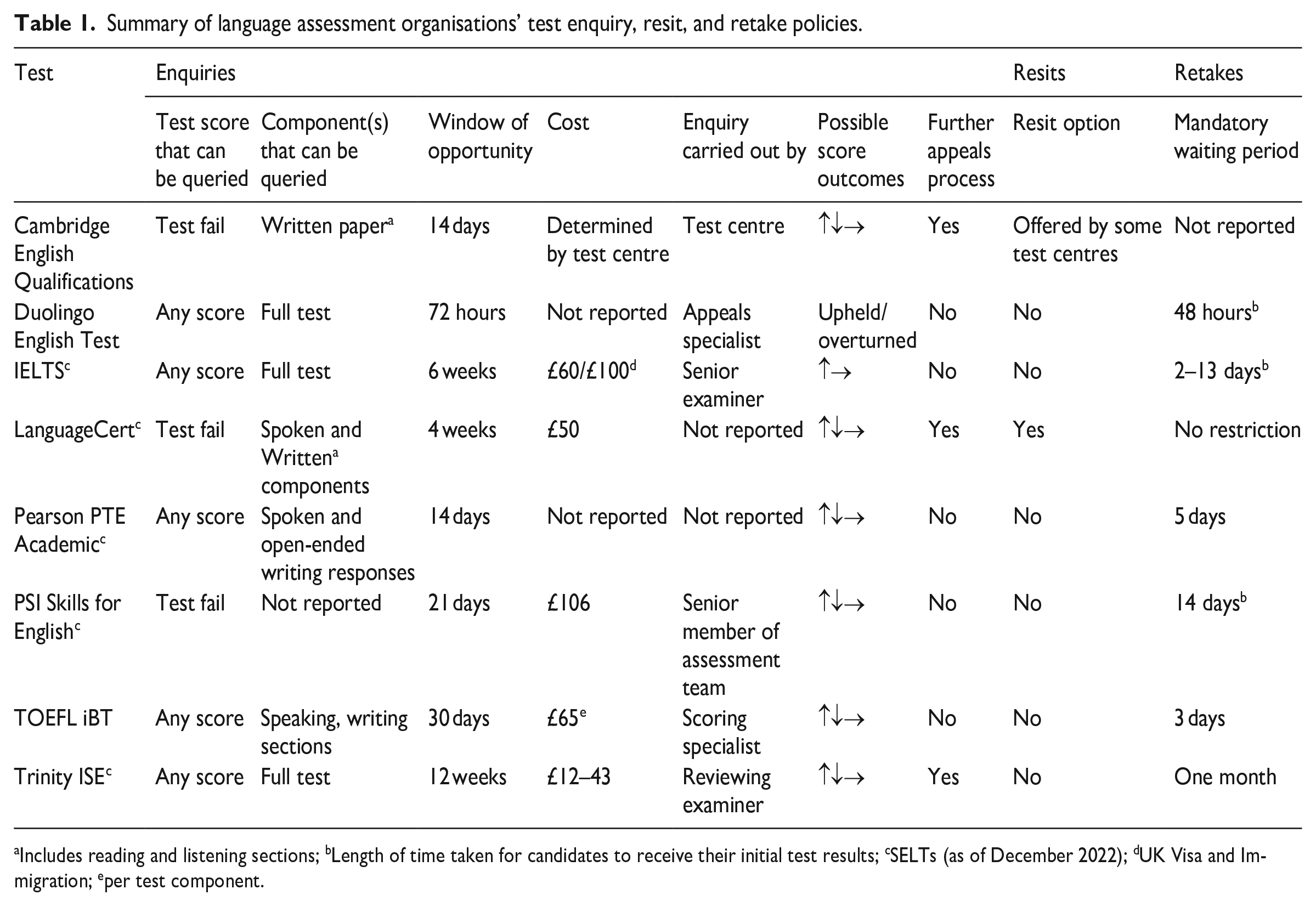
Includes reading and listening sections; bLength of time taken for candidates to receive their initial test results; cSELTs (as of December 2022); dUK Visa and Immigration; eper test component.
The ubiquity of enquiry policies reflects the reality that marking errors by human raters can and do occur (Johnson & Lim, 2009) and that powerful language assessment organisations need to be held accountable to test-takers (Hamid, 2016; Pearson, 2019a). To manage the operational costs involved and prevent excessive uptake, enquiries are subject to the payment of fees borne by the test-taker, albeit always reimbursed in the event of undermarking. Rarely are excessive procedural demands (e.g., the need for explanations, evidence) or severe time pressures placed upon test-takers, though high fees mean unsuccessful candidates need to carefully consider the merits of an enquiry before proceeding. Few provisions for test resits (e.g., LanguageCert’s Take2) and written feedback (e.g., Pearson’s score review) were apparent, indicating scope for greater competition and innovation in this area.
Reviews of spoken and/or written material originally rated by a human language assessment specialist were usually highlighted as being conducted manually by a senior examiner or reviewing specialist, likely for face validity purposes. Given the need for testing systems to be perceived as accurate and trustworthy, the uptake of reviews and their outcomes among respective candidatures is poorly addressed in the (publicly available) literature (e.g., Hamid, 2016). Review policies of the two companies offering computer-scored testing (DET and PTE Academic) differed slightly, although in neither instance is disputed test material re-rated by a human specialist. A (human) proctoring supervisor will review a DET appeal, but only to determine its validity and only if Duolingo itself does not certify a test result. In the case of Pearson, the assessment algorithm is reapplied to disputed material, reflecting claims of the accuracy and reliability (vis-à-vis human raters) of the algorithm stressed in publicity material (Pearson, 2022). With the increasing adoption and development of computer-scored testing, it seems likely that organisations will further lean on their theoretical and technical expertise in principles of language testing and assessment, marginalising test enquiries to mere procedural issues.
Language assessment organisations appear keen to promote repeat test taking, indicated by short mandatory waiting times (which had reduced substantially in two of the most popular tests, IELTS and TOEFL) and limited cautionary advice against test repetition. Embracing greater flexibility may reflect a desire to accommodate candidates who encounter extenuating circumstances on the day of the test. Another more nefarious explanation is that it is in the financial interests of testing organisations, which typically operate as for-profit entities, to increase their market share relative to the competition through tacitly encouraging repeat test taking. As the reviewed tests are international, one policy option—imposing minimum waiting times for test repetition (except in instances of provable extenuating circumstances) through government regulation—seems unfeasible and may run counter to the wishes of many test-takers. As an alternative, expanding the provision of formative test feedback and face-to-face counselling could support candidates’ post-test decision-making. Further research investigating test-takers’ perspectives towards resit and retake policies (Hamid, 2016) could provide information that would help testing companies address perceived concerns about fairness, validity, and justice, as well as clarifying organisations’ broader goals.
Footnotes
Author contributions
Declaration of conflicting interests
The author declared no potential conflicts of interest with respect to the research, authorship, and/or publication of this article.
Funding
The author received no financial support for the research, authorship, and/or publication of this article.
