



Abstract
Gender equality in the division of parental work is related to women’s relationship quality and well-being. This pre-registered dyadic study examined the association between couples’ political ideology, perceptions of the division of parental work, and relationship quality, parental satisfaction, and parental self-efficacy. In addition, the study examined the moderating role of social support. Two hundred and thirteen dyads completed measures of political ideology, division of parental work (CRS), relationship quality (PRQC), parental satisfaction and efficacy (PSOC), and perceived social support (MSPSS). Results showed that a more conservative political ideology, primarily among fathers, was associated with mothers’ perceptions that fathers did not carry their fair share of the parenting workload, which in turn was associated with mothers’ lower relationship quality and parental satisfaction. Examination of the mediated paths showed that conservative political ideology was indirectly associated with women’s lower relationship quality, parental satisfaction, and parental self-efficacy through perceptions of inequitable division of parental work. Moreover, women’s perceived social support moderated the association between the perceived equity of parental work and women’s relationship quality. Surprisingly, women’s perceived social support amplified, rather than buffered, this association. When perceived social support from family (but not friends) was high, the negative association between perceived inequitable parental work and women’s relationship quality was stronger. These findings highlight the role of political ideology within the family and its associations with relationship dynamics and parental behaviors.
Rep. Charlie Shepherd: “I don't think anybody does a better job than mothers in the home, and any bill that makes it easier or more convenient for mothers to come out of the home and let others raise their child, I don't think that's a good direction for us to be going.” (KTVB, 2021).
Introduction
Despite shifts in social norms over the past few decades, particularly in Western societies (Pailhé et al., 2021), and growing expectations for fathers to take a more active role in childrearing (Scheibling, 2020), mothers continue to shoulder most childcare responsibilities (Pailhé et al., 2021). Lower childcare participation by fathers has been associated with decreased relationship satisfaction and reduced psychological well-being in mothers (Thielemans et al., 2021; Waddell et al., 2021). Hence, examining predictors of low paternal participation in childcare and possible protective mechanisms is highly important.
Gender equality is a central issue in the political discourse in the United States, dividing liberals and conservatives (Sevincer et al., 2023). Consequently, political ideology may be a critical predictor of gendered coparenting patterns, including the division of parental responsibilities between mothers and fathers. Through this association, political ideology may indirectly relate to mothers’ interpersonal and parental well-being. However, these effects may be buffered when mothers feel supported by their family and friends. The current study used a dyadic design to examine the relationship between political ideology and paternal participation in childcare and its downstream associations with mothers’ relationship quality, parental satisfaction, and parental self-efficacy, as well as the moderating role of mothers’ perceived social support.
Political Ideology, Gender Equality, and the Division of Household Labor
In the United States, political ideology tends to align along a spectrum from liberal to conservative orientations (Hibbing et al., 2013). Liberals generally embrace social change and challenge existing inequalities, whereas conservatives often prefer stability and accept existing social hierarchies (Jost et al., 2009). In line with these differences, political ideology influences people’s opinions about gender issues. Studies indicate that political ideology is linked to gender-role attitudes, with conservatives more likely to endorse traditional gender roles and oppose gender equality (Bryant, 2003; Prusaczyk & Hodson, 2020). Indeed, a recent study found that political ideology was the strongest predictor of support for gender equality, outweighing both personal experiences of inequality and perceived social inequality (Sevincer et al., 2023).
The association between political ideology and gender-role attitudes may be explained through the uncertainty-threat model of political conservatism. This model suggests that political conservatism stems from a need to reduce uncertainty and perceived threats, which drives resistance to change in general and opposition to equality specifically (Jost et al., 2007). The model implies that people with conservative political ideologies are more likely to endorse a traditional view of men’s and women’s parental roles that sees childcare as inherently suited to women, thus justifying its primary allocation to mothers. Building on this model, we propose that the political ideologies of parents partially underlie the division of parental work between them. We conceptualize political ideology as a stable background factor that shapes parents’ gender-role attitudes and, consequently, the division of parental work. This directionality is theoretically grounded in research showing that political ideology tends to be relatively stable over time and influences individuals’ values and behaviors (Malka & Lelkes, 2010; Sevincer et al., 2023).
Given conservatives’ tendency to accept existing social hierarchies, favor stability (Jost et al., 2009), and believe that men and women should perform different roles (Gaunt & Deutsch, 2024), they should be more likely to adhere to a traditional, gender-based division of labor when they become parents, wherein mothers function as primary caregivers. Conversely, given liberals’ inclination to challenge existing inequalities and embrace social change (Carney et al., 2008), they should be more likely to divide their parental responsibilities equally.
Importantly, the degree of equality in the division of parental work does not perfectly align with its perceived equity. Personal and cultural expectations about gender roles and whether one’s contribution aligns with what one “should” do affect the perceived fairness of the division of labor (Hiekel & Ivanova, 2023; Zuo & Bian, 2001). Consequently, mothers and fathers may differ in their views of what constitutes a fair share of parental duties. Women tend to perceive unequal divisions of labor as less fair than men do (Koster et al., 2021), though this varies with contextual and ideological factors. Women who spend less time in paid employment, are more economically dependent on their partners, and hold more traditional gender-role attitudes are less likely to perceive inequality as unfair (Braun et al., 2008). Perceptions of equity and fairness in the division of parental work, therefore, are a mix of what is and what one thinks ought to be.
Perceived equity in the division of household and parental labor has been linked to relationship quality and conflict. Mothers who perceived the division of childcare and housework as fair reported higher relationship satisfaction nine months postpartum (Chong & Mickelson, 2016), and lower levels of relationship conflict one year after birth (Newkirk et al., 2017). Moreover, stable perceptions of fairness in the division of unpaid labor were associated with smaller declines in relationship satisfaction across the transition to parenthood, whereas persistent perceptions of unfairness predicted sharper declines (Hiekel & Ivanova, 2023).
Division of Parental Work and Relationship Quality
Research has found that couples with an unequal division of domestic labor experience higher levels of relationship distress and an increased risk of relationship dissolution (Barstad, 2014; Gordon et al., 2022; Offer & Schneider, 2011; Thielemans et al., 2021). Cross-national evidence shows that disagreements about household responsibilities are among the main sources of relationship stress. For instance, in a U.S. study of low-income newlyweds, unequal division of domestic work predicted relationship distress regardless of race or income (Jackson et al., 2016). Similar findings were reported in Norway (Træen, 2010) and in a Danish longitudinal study, which showed that couples with the most unequal division faced the highest risk of dissolution (Thielemans et al., 2021). During the COVID-19 pandemic, Italian couples reported increased satisfaction when the division of labor became more egalitarian and decreased satisfaction when it became less equal (Vignoli et al., 2024).
As couples transition into parenthood, childcare responsibilities add to the overall workload, which is still not shared equally. Studies indicate that despite women’s increased labor force participation, they continue to perform a disproportionate share of parental work across most countries (Chung & Booker, 2023; Metzger & Gracia, 2025; Pailhé et al., 2021). This inequality is linked to lower relationship quality. In the United States, when women carry the main responsibility for childcare, couples report lower satisfaction and sexual intimacy than when childcare is shared or father-led (Carlson et al., 2016). Moreover, greater paternal involvement is associated with higher relationship quality in Britain (Schober, 2012) and lower separation rates among U.S. cohabiting couples (McClain, 2011).
Unequal division of parental work may also weaken the coparenting relationship—the degree to which parents coordinate and support each other in childrearing (Feinberg, 2003; McHale & Fivaz-Depeursinge, 1999). Studies show a strong correlation between coparenting and the quality of romantic relationships (Campbell, 2022; Fillo et al., 2015). For example, a meta-analysis of 108 studies found a moderate positive association between coparenting quality and marital satisfaction, particularly among women (Ronaghan et al., 2024).
Division of Parental Work and Parental Experiences
Unequal division of parental work may also predict poor parental functioning through its effect on coparenting relationship quality (Feinberg, 2002; Schoppe-Sullivan et al., 2009). The parent who performs the lion’s share of the parenting may feel overburdened and unsupported by the other parent, resulting in a negative parenting experience marked by dissatisfaction and a lower sense of competence and self-efficacy. Indeed, a study found that when mothers perceived themselves as doing more than they desired, their coparenting relationship quality declined, suggesting increased strain and frustration. These feelings of being overburdened and unsupported may reinforce a cycle of dissatisfaction and reduced parental well-being (Martin et al., 2023).
Moreover, conflict between parents surrounding the unequal division of parental work may induce negative affect that could spill over to the parenting domain (Kouros et al., 2014; Yoo, 2020). For example, a study investigating the association between marital conflict and parenting experience in two-parent families found that marital conflict negatively affects the quality of coparenting relationships, leading to higher parental stress and lower parental efficacy (Margolin et al., 2001). Another study found that marital conflict spills over into coparenting, particularly by reducing cooperative coparenting and increasing competitive interactions (Christopher et al., 2015). Other studies have found that low relationship quality is associated with parental dissatisfaction and low self-efficacy (Chen et al., 2022; Pedro et al., 2012; Ronaghan et al., 2024; Schoppe-Sullivan et al., 2016).
The Moderating Role of Social Support
Social support often acts as a buffer against stress and adverse circumstances, mitigating negative outcomes and preserving well-being (Ozer et al., 2003; Thoits, 1995). The social buffering model (Cohen & Wills, 1985) suggests that support from various sources, such as family, friends, and romantic partners, can mitigate the negative effects of stress by either reducing perceived stress levels or providing resources to cope with challenges more effectively. This model suggests that social support not only directly enhances well-being but also acts as a protective factor, reducing the negative impact of stressors on adverse outcomes. The model has been supported in various studies on relationships and parenting. For example, it was found that social support from partners buffers the negative effects of general stress among mixed-gender couples (Graham & Barnow, 2013). Similarly, social support buffers the negative effects of parental stress on foster parents’ well-being (Sharda, 2022). When looking specifically at mothers, studies found that social support moderates the impact of parental stress on depression in mothers of children with disabilities (Park & Lee, 2022), reduces perceived stress, and indirectly lessens work-family conflict among low-income mothers (Carlson & Perrewé, 1999). These findings suggest that high levels of social support from family and friends may help reduce the negative effects of an inequitable division of parental work on mothers
The Current Study
The current pre-registered study employed a dyadic sample of mothers and fathers of 3-5-year-old firstborn children to examine how political ideology is linked to perceived inequity in the division of parental work and its downstream associations with relationship quality, parental satisfaction, and parental self-efficacy. Additionally, the study explored whether social support can mitigate the associations between parental work perceived inequity and low relationship quality, parental satisfaction, and parental self-efficacy. The study fills an important gap in the literature by examining a potential process through which political ideology may impact relational and parental well-being, as well as possible protective factors.
We hypothesized that (H1) more conservative political views held by fathers and mothers will be associated with a less equitable division of parental work, as perceived by mothers; (H2) mothers who perceive the division of parental work as less equitable (i.e., insufficient paternal participation) will report (a) lower relationship satisfaction, (b) lower parental satisfaction, and (c) lower parental self-efficacy; and (H3) mothers’ perceived social support from family and friends will moderate the associations of perceived equity in the division of parental work with relationship satisfaction, parental satisfaction, and parental self-efficacy, such that perceived support will serve as a protective factor.
Method
Participants
Two hundred and thirteen mixed-gender parenting couples were recruited to participate in a study on coparenting relationships conducted in a large Midwestern American university. Data collection took place from July 2018 to April 2022, with a 20-month break during the COVID-19 pandemic. Each couple was raising a child between the ages of 3 and 5 (number of children: M = 2.15, SD = 0.89). The participants were 22-60 years old (M = 35.24, SD = 4.87). Most couples were married (N = 200, 93.9%), and the rest were engaged or in a long-term relationship. Relationship length ranged between 4.75 and 30.17 years (M = 11.78, SD = 4.34). The participants self-described as White or European American (N = 358, 84.0%), Asian American (N = 19, 4.5%), Black or African American (N = 14, 3.3%) Hispanic, Latino, or Latina (N = 14, 3.3%), Middle Eastern (N = 2, 0.5%), Native Hawaiian or Pacific Islander (N = 1, 0.2%), or having multiple races/ethnicities (N = 18, 4.2%). In terms of educational attainment, the participants reported having a college degree (N = 209, 49.1%), an advanced degree (N = 144, 33.8%), some college education (N = 55, 12.9%), a high school diploma (N = 15, 3.5%), or not graduating high school (N = 1, 0.2%), with two participants not reporting. The participants received monetary compensation for their participation. The study was approved by IRB of the University of Minnesota (approval number: 00000595).
Procedure and Measures
The data for the current study were collected as part of a larger lab study that included parents and their children. The measures used in the current study come from a preliminary online questionnaire completed independently by each parent before their lab visit. The measures and analysis were pre-registered (https://doi.org/10.17605/OSF.IO/ZX3F9). Informed consent was collected at the beginning of the online questionnaire.
Political Ideology
The participants indicated their political ideology on a 7-point scale from 1 (extremely liberal) to 7 (extremely conservative). Due to a technical problem with the preliminary questionnaire, the first 67 couples were not given this item. Hence, data on political ideology exists for 146 mothers and 145 fathers.
Perceived Inequity of the Parental Work Division
The perceived inequity of the parental work division between parents was measured using the division of labor subscale of the Coparenting Relationship Scale (Feinberg et al., 2012). This subscale includes two items: “My partner does not carry his or her fair share of the parenting work” and “My partner likes to play with our child and then leave dirty work to me.” Mothers and fathers rated each item on a scale of 1 (Not true of us) to 7 (Very true of us). The Spearman-Brown reliability coefficient was acceptable for mothers (ρ = .60) but not for fathers (ρ = .31). Hence, only maternal reports of the father’s participation in the parental work were used (descriptive statistics of the father’s division of labor items and correlations with other study variables are provided in Supplemental Table S1). The two items were averaged, with higher scores reflecting a perception of more inequitable division of parental work (fathers doing less).
Relationship Quality
Romantic Relationship quality was measured using the Perceived Relationship Quality Components (PRQC) questionnaire (Fletcher et al., 2000). This 18-item questionnaire assesses six components of relationship quality: satisfaction, commitment, intimacy, trust, passion, and love (e.g., “How satisfied are you with your relationship?”, “How much do you love your partner?”). Participants rated each item on a scale ranging from 1 (Not at all) to 7 (Extremely). Total scores were computed for mothers (α = .93) and fathers (α = .94) by averaging all items.
Parental Satisfaction and Self-Efficacy
Parental satisfaction and self-efficacy were measured using the Parenting Sense of Competence Scale (PSOC; Johnston & Mash, 1989), which includes nine items that assess parental dissatisfaction (e.g., “My talents and interests are in other areas, not being a parent”) and seven items that assess parental self-efficacy (“I meet my own personal expectations for expertise in caring for my child”). Participants rated their level of agreement with each item on a 1 (strongly disagree) to 6 (strongly agree) scale. Parental dissatisfaction scores were computed by averaging the satisfaction items (αs = .76 and .79 for mothers and fathers, respectively). Parental self-efficacy scores were computed by averaging the self-efficacy items (αs = .78 and .76 for mothers and fathers, respectively).
Perceived Social Support
Perceived social support from family and friends was assessed using the Multidimensional Scale of Perceived Social Support (Zimet et al., 1988), which is a 12-item questionnaire assessing perceived support from family, friends, and a romantic partner (e.g., “My family (e.g., parents, siblings) really tries to help me”, “I have friends with whom I can share my joys and sorrows”). Participants rated their level of agreement with each item on a 1 (Very strongly disagree) to 7 (Very strongly agree) scale. Scores of perceived social support from family (αs = .93 and .91 for mothers and fathers, respectively) and friends (αs = .93 and .91 for mothers and fathers, respectively) were computed by averaging the four items in each scale.
Analytic Strategy
We tested the study hypotheses in two stages. First, to examine hypotheses H1 and H2, we ran a multivariate mediation model, with political ideology as the independent variable, perceived inequity in parental work division reported by mothers as the mediator, and mothers’ relationship quality, parental dissatisfaction, and parental self-efficacy as the dependent variables. Because the political ideologies of mothers and fathers were strongly correlated (r = .64, p < .001), we began by using a dyadic composite of political ideology (Spearman-Brown ρ = .78), with higher scores reflecting greater dyadic political conservatism. Then, we probed the results by repeating the analysis using fathers’ and mothers’ political ideologies separately. We also repeated the mediation analyses to explore possible effects on fathers’ relationship quality, parental dissatisfaction, and parental self-efficacy. Second, to examine hypothesis H3, we ran a multivariate moderated mediation model that included mothers’ perceived social support from family and friends (mean-centered) as parallel moderators of the associations between the perceived inequity in parental work division and the dependent variables (for the conceptual model, see Figure 1). Conceptual multivariate moderated mediation model. Dashed paths represent possible moderator effects
The mediation and moderated mediation analyses were conducted using Mplus version 8.8 (Muthén & Muthén, 1998-2019). Full Information Maximum Likelihood (FIML) estimation was used to account for missing data. FIML produces unbiased estimates when data are Missing at Random (MAR) (Enders, 2010). The political ideology score was approximately normally distributed, so its variance was included as a parameter in the model. In this way, the model could use the available data from all 213 couples despite the missing values in the independent variable (i.e., the paths from political ideology were estimated based on fewer data points). Indirect and conditional indirect effects were tested using bias-corrected (BC) 95% bootstrap confidence intervals (k = 5000). BC bootstrap confidence intervals were also used as additional, nonparametric significance tests for model coefficients. The analysis plan was pre-registered.
Results
Preliminary Analysis
Descriptive Statistics and Zero-Order Correlations of Study Variables
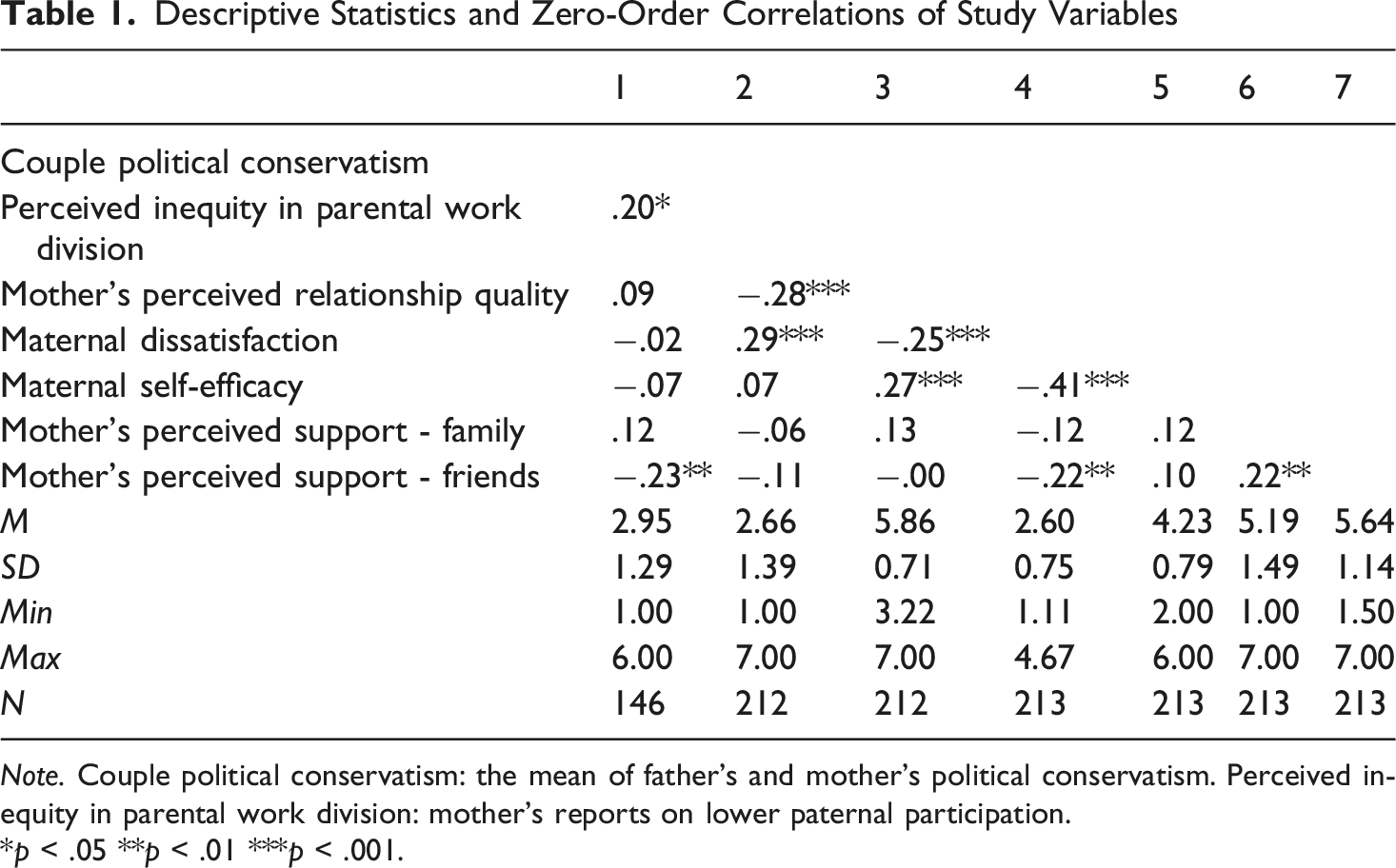
Note. Couple political conservatism: the mean of father’s and mother’s political conservatism. Perceived inequity in parental work division: mother’s reports on lower paternal participation.
*p < .05 **p < .01 ***p < .001.
Multivariate Mediation Model
Standardized Maximum Likelihood Estimates and 95% Bias-Corrected Bootstrap Confidence Intervals (k = 5000) for Multivariate Mediation Model

Note. Couple political conservatism: the mean of father’s and mother’s political conservatism. Perceived inequity in parental work division: the mother’s report on lower participation by the father. Mother’s perceived relationship quality R2 = .10. Maternal dissatisfaction R2 = .09. Maternal self-efficacy R2 = .02. Perceived inequity in parental work division R2 = .04.
The bootstrap confidence interval for the indirect effect of couple conservatism on the mother’s perceived relationship quality through perceived inequity in parental work division did not include 0 (β = −.06, CI[−.12, −.02]), indicating significance at the α = .05 level and supporting mediation. Similarly, the bootstrap confidence interval for the indirect effect of couple conservatism on maternal dissatisfaction was significant (β = .06, CI[.01, .12]), supporting mediation. Interestingly, the bootstrap confidence interval for the indirect effect of couple conservatism on maternal self-efficacy also reached significance (β = −.02, CI[−.06, −.001]), supporting the existence of a mediated path in congruence with H2c. None of the direct effects in the model were significant, suggesting that couple conservatism was only indirectly associated with mothers’ relationship and parental experience. The model explained 10.1% of the variance in mothers’ perceived relationship quality, 9.1% of the variance in maternal dissatisfaction, and 1.6% of the variance in maternal self-efficacy.
Alternative Mediation Models
To examine whether these effects are driven primarily by the fathers’ or the mothers’ political ideology, we reran the model while substituting the couple’s conservatism with the father’s or the mother’s conservatism. The full results are provided in Supplemental Tables S2 and S3. The model that included the father’s conservatism replicated the results of the main mediation model. When fathers were more conservative, mothers reported greater perceived inequity in parental work division (β = .20, SE = 08, p = .013; R2 = .04). The downstream paths from the mediator to the dependent variables were also similar and had the same significance status as in the primary model (see Table S1). Moreover, the indirect paths from father’s conservatism to mothers’ perceived relationship quality (β = −.06, CI[−.12, −.02]), maternal dissatisfaction (β = .06, CI[.01, .13]), and maternal self-efficacy (β = −.03, CI[−.07, −.002]) were all significant and similar in size to the primary model.
The results were somewhat different for the model that included the mother’s political ideology (see Table S2). Despite replicating the paths from the mediator to the dependent variables, more conservative mothers did not report significantly perceived inequity in parental work division (β = .14, SE = 08, p = .076; R2 = .02). Moreover, whereas the indirect path from mother’s conservatism to maternal dissatisfaction narrowly reached significance (β = .04, CI[.002, .10]), the indirect paths to mothers’ perceived relationship quality (β = −.04, CI[−.10, .00]) and self-efficacy (β = −.02, CI[−.06, .00]) narrowly missed significance. Furthermore, given the substantial overlap between fathers’ and mothers’ political ideologies (r = .64, p < .001), when these two variables were entered simultaneously, the unique association between mothers’ conservatism and their perceptions of inequity in the division of parental work was almost completely nullified (β = .02, SE = .11, p = .831). However, the unique association of the father’s conservatism with the mother’s perceived inequity in parental work division remained almost as large as when the mother’s conservatism was not controlled for (β = .19, SE = .11, p = .080), despite failing to reach significance due to a substantially larger standard error. Together, these results suggest that the father’s political ideology is the main driver of the association between the couple’s political ideology and the mother’s perceptions regarding the division of parental work between them.
Finally, to explore whether fathers’ relationship and parenting experiences are predicted by the same process as mothers’, we reran the mediation model while replacing mothers’ perceived relationship quality, parental dissatisfaction, and parental self-efficacy with those of fathers. Unlike with mothers, fathers’ perceived relationship quality (β = −.12, SE = 07, p = .086), paternal dissatisfaction (β = .08, SE = 07, p = .229), and paternal self-efficacy (β = −.01, SE = 07, p = .898) were not associated with mothers’ perceived inequity in parental work division. Nor were there any direct effects of couple political conservatism on these outcome variables. However, the indirect path from couple political conservatism to fathers’ perceived relationship quality through less equitable division of parental work perceived by the mothers reached significance (β = −.02, CI[−.07, −.001]), suggesting that in more conservative couples, wherein mothers feel the fathers do not participate enough in the parental work, the fathers might also experience some relationship effects. This result might not be surprising, given that fathers’ and mothers’ perceptions of relationship quality were strongly correlated (r = .47, p < .001). The full results are provided in Supplemental Table S4.
Multivariate Moderated Mediation Model
Standardized Maximum Likelihood Estimates and 95% Bias-Corrected Bootstrap Confidence Intervals (k = 5000) for Multivariate Moderated Mediation Model
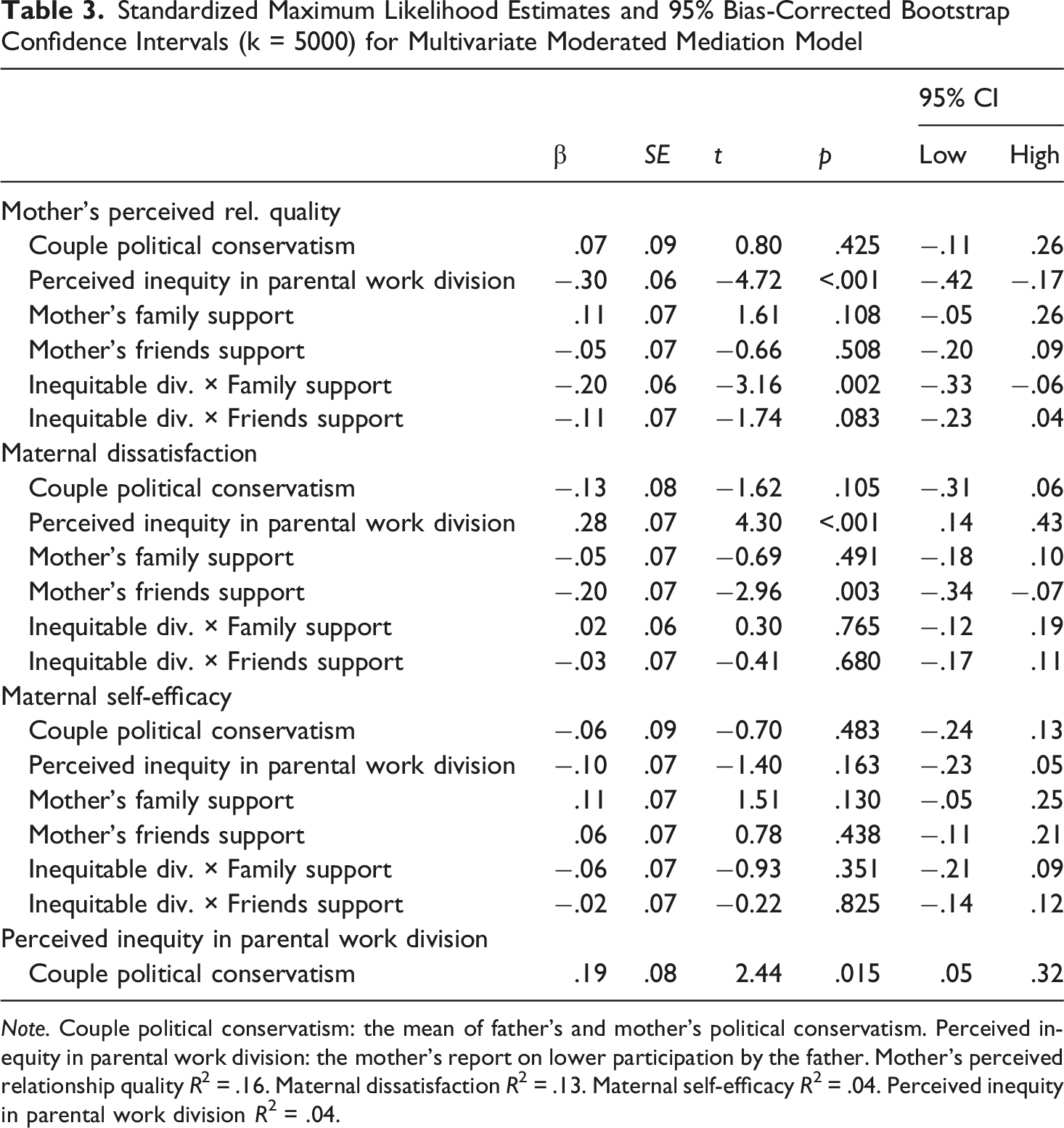
Note. Couple political conservatism: the mean of father’s and mother’s political conservatism. Perceived inequity in parental work division: the mother’s report on lower participation by the father. Mother’s perceived relationship quality R2 = .16. Maternal dissatisfaction R2 = .13. Maternal self-efficacy R2 = .04. Perceived inequity in parental work division R2 = .04.
Only one moderation effect was found, with the mother’s perceived inequity in parental work division significantly interacting with her perceived support from family to predict her perceived relationship quality (β = −.20, SE = 06, p = .002). Conditional slopes were calculated to probe this interaction (see Figure 2). The analysis revealed that when the mothers’ perceived social support from their family was low (−1 SD), their perceived inequity in parental work division was not significantly associated with their perceived relationship quality (β = −.12, SE = 09, p = .189). In contrast, when the mothers’ perceived social support from their family was high (+1 SD), greater perceived inequity in parental work division was negatively associated with their perceived relationship quality (β = −.48, SE = 08, p < .001). Thus, contrary to H3, rather than buffering the association between perceptions of inequity in the division of parental work and mothers’ relationship quality, greater family support amplified it. Conditional slopes of the association between mother’s perceived inequity in parental work division and the mother’s perceived relationship quality for mothers with high (+1 SD) and low (−1 SD) perceived family support. Perceived inequity was mean-centered. Hence, low inequity in the figure corresponds to the scale mean – 1.66 (the minimal score of 1 on the original scale), whereas high inequity corresponds to the scale mean + 1.66. ***p < .001
Bootstrap confidence intervals were used to probe the conditional indirect paths from the couple’s political conservatism to the mother’s perceived relationship quality. When the mother’s perceived family support was low, this indirect path was not significant (β = −.02, CI[−.09, .01]). However, this path was significant when the mother’s perceived family support was average (β = −.06, CI[−.12, −.02]) or high (β = −.09, CI[−.18, −.03]). These findings indicate that the indirect association between higher couple political conservatism and mothers’ lower perceived relationship quality through greater perceived inequity in parental work division exists only in mothers with at least average family support.
Discussion
In recent years, political discourse in the U.S. has increasingly addressed issues related to gender, particularly the roles and status of women and men. This gendered political discourse may influence the behavior and experiences of couples within their homes. The current study examined the association between couples’ political ideologies and the perceived equity of their parental work division, and the downstream associations with mothers’ perceptions of the relationship and their parenting experiences. Our findings show that, as hypothesized, the more politically conservative couples’ ideologies are, the less mothers perceive the division of parental work as equitable, such that fathers are seen as not contributing their fair share. This perceived inequity is associated with lower perceived relationship quality and increased parental dissatisfaction among mothers. Indirect negative associations were found between political conservatism and all three maternal outcome variables—perceived relationship quality, parental satisfaction, and parental self-efficacy—through mothers’ perceived inequity in parental work division.
These results point to perceived inequity in parental work division as a pathway through which political ideology may relate to mothers’ relationship perceptions and parenting experiences. Interestingly, when examining the contribution of each partner’s political ideology separately, the father’s, rather than the mother’s, political ideology was the main driver of these associations. These links did not extend to fathers’ parenting experiences, although an indirect association was also found for the father’s perceived relationship quality, perhaps due to crossover from the mother’s relationship dissatisfaction. Moreover, contrary to expectations, these associations were stronger in mothers who reported higher family support.
Political Ideologies Play out in Domestic Settings
Our results are consistent with the uncertainty-threat model of political conservatism (Jost et al., 2007), which posits that politically conservative ideologies are associated with greater adherence to traditional values and beliefs. In the U.S., like in most human societies, household labor and childrearing are traditionally the responsibility of women (Haas, 2006; Russo & Smith, 2006). This is reflected in women’s lower labor force participation compared to men (U.S. Department of Labor, 2025, April). Conservatives often accept social hierarchies and prefer to preserve existing social structures, whereas liberals are more open to social change and more inclined to challenge the status quo (Napier & Jost, 2008). Accordingly, our findings suggest that conservative couples adhere more strongly to traditional family values in which mothers and fathers have distinct roles, with child-rearing being primarily the mother’s responsibility.
Our findings also point to the dominant role of fathers in determining their participation in parental work. Despite the significant correlation between partners’ political views, it was fathers’ political ideologies, more than mothers’, which predicted how equitably mothers thought the parental work was divided. Conservative fathers in mixed-gender relationships might be more likely to view parenting as primarily their partner’s responsibility and participate less in parental work. However, it was mainly mothers who experienced the adverse effects of the inequitable division of parental work on their relationship and parenting quality. This finding may reflect broader gendered dynamics in intimate relationships, where men often play a central role in setting relational norms and expectations. For instance, men’s gender attitudes and relationship norms have been linked to sexual decision-making and condom use, illustrating their influence in setting behavioral norms between partners (Harrison et al., 2006). In dual-earner families, men tend to preserve symbolic authority over definitions of fairness and family roles even when women contribute equally or more to household income (Tichenor, 2005). Cross-national analyses further show that in societies where male-breadwinner norms are stronger, men’s unemployment is more likely to lead to relationship dissolution, suggesting that cultural expectations around masculinity shape not only economic behaviors but also relational stability (Gonalons-Pons & Gangl, 2021).
The Division of Parental Work and Relational Well-Being
The current study provides evidence that perceived inequity in the division of parental work is negatively associated with women’s relational and parental well-being. Raising children provides meaning and joy but can be very burdensome (Ren et al., 2024). Having a partner who does not share enough of the load can lead to greater interparental conflict and frustration when engaging in parental tasks (e.g., Barstad, 2014; Gordon et al., 2022). Because equity in parental work division was measured through mothers’ self-reports, these findings reflect their perceptions of how responsibilities are shared and how fair that division feels, rather than an objective record of time or task allocation. Nevertheless, such perceptions are central to understanding family dynamics, as the subjective sense of fairness within a couple is closely tied to partners’ relational well-being (Newkirk et al., 2017).
Interestingly, the indirect negative association between political conservatism and fathers’ perceived relationship quality through mothers’ perceived inequity in parental work division, also found in the current research, suggests that men may also experience adverse relationship effects if they do not participate equally in childrearing. This could reflect women’s relationship discontentment crossing over to affect men’s relationship experience, the existence of conflict between the parents, or other factors that underlie the dependency between couples’ relationship perceptions. Another intriguing possibility is that some men experience tension between their values and the realities of inequitable parental work and its consequences, which can affect their psychological well-being. This possibility could be investigated in future studies. It may also be valuable to explore the cognitive or practical strategies couples use to navigate or reduce this tension.
Women’s values and ideologies may similarly impact their psychological reactions to inequity in parental work. Specifically, women’s acceptance of traditional gender roles and values might mitigate some of the adverse effects of this inequity. Indeed, cross-cultural studies comparing more and less traditional societies have found that women’s traditional gender attitudes can buffer the association between inequality in the division of parental work and their dissatisfaction (Fisher et al., 2024). Interestingly, there is a growing movement in the U.S. wherein women advocate for a return to traditional gender roles, arguing that such roles are more natural and suitable for women. This movement, commonly referred to as Tradwife—a shorthand for traditional wife—has gained attention primarily through social media platforms (Bower, 2024). Future research should examine whether aligning with certain online communities, such as the Manosphere and Tradwife, acts as a coping mechanism against undesired realities of family life or, in fact, reinforces these realities.
The Paradoxical Role of Social Support
Contrary to our expectations, the negative association between perceived inequity in parental work division and perceived relationship quality was stronger in women who received greater family support. Thus, rather than buffering the adverse effects of perceived inequity, family support exacerbated them. One possible explanation is that certain components of support may have triggered negative emotional responses. Social support often includes instrumental, social, informational, and emotional elements (Cohen & Wills, 1985; Nick et al., 2018). Being emotionally supportive and responsive often involves expressing validation (Reis & Gable, 2015). Perhaps the dissatisfaction mothers expressed regarding the inequitable division of parental work and its consequences was validated by family members, reinforcing their perception that the labor division was indeed unfair and their feelings justified. As a result, mothers’ negative relationship perceptions were amplified.
It is also possible that during support interactions, family members explicitly or implicitly reflected normative values and social expectations around parental work division, which are generally more egalitarian in liberal Western societies. In doing so, they may have highlighted the gap between these norms and the mothers’ personal experiences, leading to social comparisons. These comparisons, combined with perceived failure to meet prevailing expectations, may have further intensified distress and dissatisfaction within their romantic relationships. Indeed, research shows that falling short of social expectations, particularly in comparison to others, often leads to lower self-evaluation and increased psychological distress (McCarthy & Morina, 2020). Greater insight into the effects of social support in the context of parental work inequity may be gained by examining the specific content of supportive interactions, their direct psychological effects on well-being, and their indirect effects on perceptions of relationship quality and parenting.
Echoes of the Present
The study’s findings can be viewed within a broader sociocultural discourse linking politics and gender. Views about gender, particularly beliefs that assign different qualities and roles to women and men, are becoming increasingly central in political discourse, as illustrated by the quote presented at the beginning of this paper. Some scholars view this conservative gender-political discourse as a backlash against the achievements of gender equality movements (Kováts et al., 2018). Within this phenomenon, a link can be observed between the rise of conservative politics and narratives of traditional masculinity. Male-oriented spaces such as the “manosphere” have emerged, promoting discourse on a return to traditional gender roles (Barnes & Karim, 2025; Ging, 2019). While our data do not address this phenomenon directly, it is plausible that such gender-traditional narratives both influence and reflect how couples negotiate the division of labor at home. These narratives may gain greater visibility and acceptance in the public sphere, contributing to the persistence or even expansion of gender inequality within romantic and family relationships. It is noteworthy that these movements are often situated within White people. Given that our sample is primarily white (84%), our findings may reflect how these broader cultural shifts specifically shape the negotiation of perceived inequity within this demographic.
Limitations
The findings of the current study should be interpreted in light of several limitations. First, the correlational, cross-sectional design limits the ability to infer causality. For example, relationship problems may hinder mutual support and co-parental coordination (Le et al., 2016), resulting in a less equitable division of parental work (Riedijk et al., 2024). Nevertheless, the theoretical rationale of the current model assumes that political ideology is a relatively stable factor that precedes relational patterns (Sevincer et al., 2023). Future longitudinal research should examine the potential bidirectionality of the processes examined in this paper. Second, the sample included primarily White American mixed-gender couples, which may reduce generalizability to other couple types or cultural contexts. This is particularly important as research suggests that race, ethnicity, and social class affect relational dynamics regarding paid and unpaid labor (Perry‐Jenkins & Gerstel, 2020). In more traditional cultures, political ideology may play a smaller role in shaping the division of parental work, as cultural expectations may more strictly determine such arrangements. Third, the study relied on self-reports. This is especially relevant for the measure of equity in the division of parental work, which included two items reflecting mothers’ subjective perceptions. Future studies might use subjective measures with more objective questions about specific tasks directed to both parents. That said, perceptions may influence psychological well-being more than objective realities (Tan et al., 2020). Fourth, the modest observed effect sizes suggest that additional individual, relational, and contextual factors also play a role in shaping relationship and parenting outcomes. However, this level of explanatory power is consistent with prior research on the effect of division of labor on relationship satisfaction (Gordon et al., 2022; Shockley & Allen, 2018). While relatively low compared to other correlates of relationship quality (e.g., Righetti et al., 2022), our effect sizes are within the typical range reported in social psychology when examining complex behaviors (Funder & Ozer, 2019). Finally, political ideology was measured as a unidimensional construct, from extremely liberal to extremely conservative. Although consistent with some prior studies (e.g., Rosenfeld & Tomiyama, 2021), multi-dimensional models may be more appropriate and offer greater explanatory power. The use of a single-item measure may mask differences between social, economic, and cultural dimensions that could be relevant (Feldman & Johnston, 2014). Future studies should examine whether different ideological dimensions show distinct associations with parental division of work.
Summary and Conclusions
In a world where political discourse is increasingly polarized and more people shape their attitudes, decisions, and behaviors based on political affiliations, it is important to investigate how political ideologies play out within family life. The current study identified a link between conservative political ideology—especially among fathers—and mothers’ perceived inequity in parental work division, which, in turn, was associated with lower perceived relationship quality and a more negative parental experience in mothers. The association between the inequitable division of parental work and mothers’ low relationship quality was stronger among those reporting greater family support. These findings highlight one pathway through which political ideologies might shape relationship and parental experiences. The findings also contribute to a deeper theoretical understanding of the link between political attitudes and gender equality.
Supplemental material
Supplemental material - Beyond the Ballot: The Associations Between Political Ideology, Division of Parental Work, Social Support, and the Relational and Parental Experiences of Mothers
Supplemental material for Beyond the Ballot: The Associations Between Political Ideology, Division of Parental Work, Social Support, and the Relational and Parental Experiences of Mothers by Tair Tager-Shafrir, Ohad Szepsenwol, Vladas Griskevicius, Jeffry A. Simpson in Journal of Social and Personal Relationships
Footnotes

Ethical Considerations
This study received ethical approval from the University of Minnesota IRB (approval number: 00000595) on July 17, 2017.
Consent to Participate
All participants provided written informed consent prior to participating.
Funding
The authors disclosed receipt of the following financial support for the research, authorship, and/or publication of this article: This research was funded by the National Science Foundation (JS, VG, & OS, Grant no. 1728168).
Declaration of Conflicting Interests
The authors declared no potential conflicts of interest with respect to the research, authorship, and/or publication of this article.
Open Science Statement
As part of IARR's encouragement of open research practices, the authors have provided the following information: The research was pre-registered. The aspects of the research that were pre-registered were the study’s background, hypotheses, and statistical analysis plan. The pre-registration was submitted to the Center for Open Science website (OSF). The materials can be obtained by emailing Ohad Szepsenwol,
Supplemental material
Supplemental material for this article is available online.
References
Supplementary Material
Please find the following supplemental material available below.
For Open Access articles published under a Creative Commons License, all supplemental material carries the same license as the article it is associated with.
For non-Open Access articles published, all supplemental material carries a non-exclusive license, and permission requests for re-use of supplemental material or any part of supplemental material shall be sent directly to the copyright owner as specified in the copyright notice associated with the article.
