



Abstract
Individuals who perceive greater support or approval for their relationships from friends and family also report greater relationship stability and commitment and better mental and physical health (known as the “social network effect”). These associations have been explained, in part, through three cognitive-affective processes: uncertainty reduction, cognitive balance, and dyadic identity formation. However, we know less about cognitive-behavioral mechanisms that might help explain the social network effect. In this study, we propose and test a model in which physical affection-sharing acts as one such behavioral mechanism. In a sample of 1848 individuals in same-sex (n = 696), mixed-sex (n = 1045), and gender-diverse (n = 107) relationships, we found support for our overall model. Our findings suggest that perceived support for one’s relationships is a significant predictor of perceived support for physical affection-sharing, which in turn predicts the frequency of affection-sharing in private and public contexts and, ultimately, relationship well-being. However, we also found that relationship type moderates these associations, highlighting how the experience of sharing affection with one’s partner changes for many in marginalized relationships, especially in public. We conclude by discussing how our findings contribute to theories of social support for relationships, underscoring the importance of considering affective, cognitive, and behavioral factors relevant to the process. We also emphasize the understudied role of context in shaping affection-sharing experiences across all relationship types.
Keywords
Introduction
Chris and Robin are a romantic couple whose relationship receives little support or approval from others (e.g., family, friends, and society). Extensive past research (Agnew, 2014) shows that such disapproval is likely associated with Chris and Robin experiencing worse relational, mental, and physical well-being (Blair & Holmberg, 2008). Why, though? How precisely does experiencing disapproval of a relationship ‘get under the skin’ and feed through to well-being? Existing theories have focused on cognitive-affective explanations (Sprecher et al., 2019). While agreeing that such theories provide part of the story, we propose an additional cognitive-behavioral mechanism: perceptions of support for, and engagement in, physical affection-sharing with one’s partner. Those who perceive a lack of support for their relationship might also perceive a lack of support for sharing physical affection with their partners. They may then actually engage in less affection-sharing, potentially affecting their well-being. In this paper, we test the plausibility of this model and assess variations depending on whether Chris and Robin are in a same-sex, mixed-sex, or gender-diverse relationship.
The Social Network Effect
Extensive past research has shown that perceived approval/disapproval of a romantic relationship is associated with couple members’ well-being, an association termed the ‘social network effect’ (Felmlee, 2001). Perceiving support for one’s relationship is associated with more love and commitment (Sinclair et al., 2014), relationship stability (Le et al., 2010), mental well-being, and physical well-being (Blair & Holmberg, 2008). Although the association is bidirectional, the path from perceived support to well-being is stronger than the reverse (Sprecher & Felmlee, 1992). Individuals value network support and even engage in ‘support marshaling’ behaviors to garner approval for their relationship (Crowley & Faw, 2014).
The social network effect generally works similarly for same-sex and mixed-sex relationships (e.g., Blair et al., 2018). However, those in same-sex relationships perceive less support for their romantic relationships than those in mixed-sex relationships (e.g., Blair & Pukall, 2015). Compared to mixed-sex couples, same-sex couples exhibit a stronger association between perceived network support for the relationship and other forms of support, such as support for sexual orientation (Holmberg & Blair, 2016) and general social support (Blair et al., 2018). Finally, individuals in same-sex relationships display resilience, showing weaker associations between low perceived support and poor relationship outcomes than those in mixed-sex relationships (e.g., Holmberg & Blair, 2016).
Existing Theoretical Explanations of the Social Network Effect
To return to our opening question, why exactly does the social network effect occur? Past scholars have drawn on three theories. First, symbolic interactionist theory (Lewis, 1973) posits that individuals develop their identities, in part, through internalizing the views of important others. Similarly, perceiving others’ support for their relationships helps couples shape a dyadic identity (Agnew et al., 1998), moving from “me” to “we,” a transition associated with increased commitment (Sprecher et al., 2019). Second, uncertainty reduction theory (Berger, 1979) suggests that when a couple perceives approval for their relationship, it confirms their choice of a mate is a good one (Sprecher & Felmlee, 2000), reducing relational uncertainty and facilitating commitment. Third, balance theory (Heider, 1946) suggests that triads are more balanced when all parties view each other positively. If a person feels positively toward both their relationship partner and a social network member, an imbalance will occur if the social network member views the relationship partner negatively (Parks, 2011). Individuals are then motivated to restore balance (see Gillian et al., 2022). When balance is achieved, it becomes mutually reinforcing; for example, the more network members approve of a romantic partner, the more the individual increases their liking for that partner (Sprecher, 2011).
These three theories focus on cognitive-affective explanations of the social network effect: perceiving support for the relationship changes the partners’ perceptions of, and/or feelings toward, the relationship and each other. While undoubtedly relevant, these theories do not specify concrete behavioral changes that might accompany cognitive-affective changes. What, if anything, do couples who perceive support for their relationship actually do that translates into better outcomes?
Three potential behavioral mechanisms have been identified (see Sprecher et al., 2019, for an overview). First, perceiving network support for a relationship is associated with spending more time together as a couple with network members, a practice that is associated with increased relational well-being. Second, tangible support from network members, such as providing childcare, can facilitate relationship maintenance behaviors by making it easier for couples to carve out time together. Third, when relationships are supported, network members are more likely to advocate for forgiveness when the partner has transgressed, and forgiveness is associated with increased commitment.
These behavioral mechanisms undoubtedly play a role in the social network effect. Still, they focus primarily on interactions between couple members and the social network – the network members spend time with the couple, provide childcare, or advocate for forgiveness. Are there no behavioral changes within the relationship dyad itself that follow from perceived support for a romantic relationship? In this study, we propose one such behavioral mechanism, namely physical affection-sharing.
Affection-Sharing as a Cognitive-Behavioral Mechanism
Our proposed model is outlined in Figure 1, with paths labeled with letters for ease of reference. We acknowledge from the outset that previous theoretical explanations also play a role, each contributing to understanding the social network effect. This paper does not compare and contrast the different theories; instead, we propose physical affection-sharing as an additional cognitive-behavioral route that might help explain the social network effect.
1
As shown in Figure 1, we suggest that perceiving more support for a relationship is associated with perceiving support for sharing physical affection between partners (the cognitive component); that approval is then associated with more frequent dyadic affection-sharing (the behavioral component), whether in public or in private contexts, which in turn is associated with better relationship well-being.
2
Conceptual Model. Note. Analyses also assessed whether any paths or indirect effects were moderated by relationship type.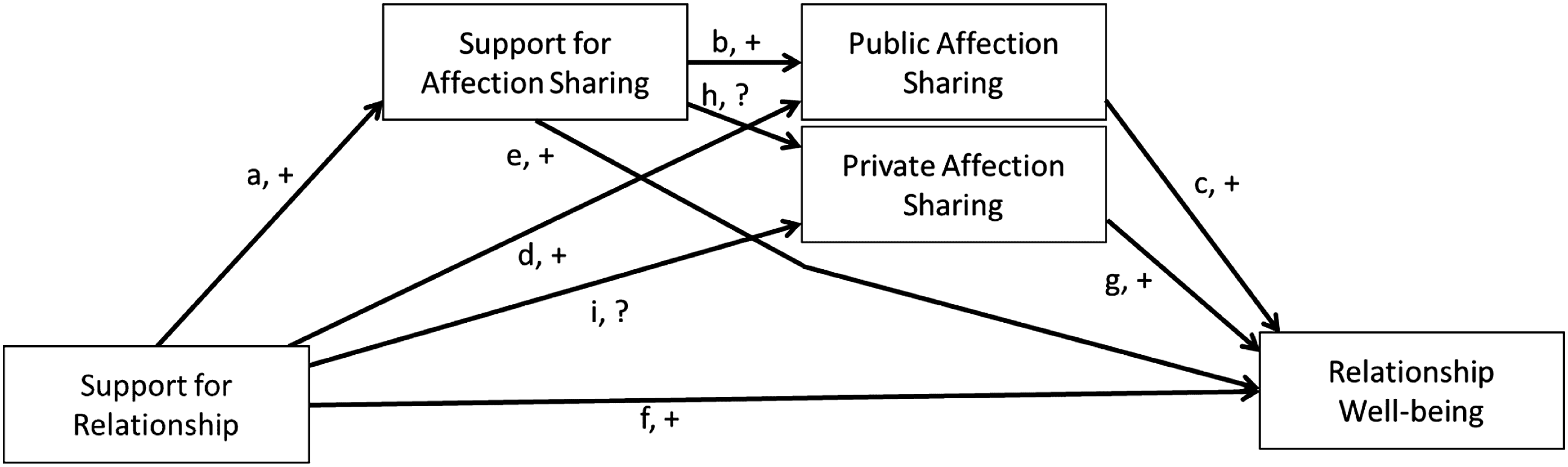
To our knowledge, no previous research has explicitly tested the first few steps of the proposed model: is perceived support for the relationship associated with perceived support for affection-sharing, and is this, in turn, associated with frequency of affection-sharing? However, previous research on affection-sharing in same-sex relationships suggests these links are plausible. As already noted, those in same-sex relationships generally perceive less support for their relationship than those in mixed-sex relationships (Holmberg & Blair, 2016). They also tend to avoid public displays of affection (PDAs) and to be hyper-aware and vigilant when engaging in such displays (Blair et al., 2022; Rohleder et al., 2023). Although the construct of support for same-sex affection-sharing has not been explicitly measured in previous research, our previous work using the same dataset shows that individuals in same-sex relationships report being less comfortable sharing affection in front of others, particularly strangers and family members, than those in mixed-sex relationships (Blair et al., 2022; https://osf.io/679ge/); some also report refraining from affection-sharing because they anticipate others will disapprove or even react with violence (Stammwitz & Wessler, 2021). This anticipation of negative responses is not unfounded. Many heterosexuals still respond negatively to witnessing same-sex displays of affection (O’Handley et al., 2017), and affection shared between two men, even when presumed to be friends, is not well received (Bank & Hansford, 2000). Thus, for those in same-sex relationships, it seems plausible that perceived disapproval of their relationship might be associated with perceived disapproval for romantic affection-sharing and with less actual affection-sharing, particularly in public.
Although these processes are foregrounded in same-sex relationships, similar issues might apply to mixed-sex relationships. For example, some mixed-sex relationships (e.g., mixed-race, age-discrepant) also experience marginalization (e.g., Lehmiller, 2012). Individuals in such relationships perceive less general support for their relationship (Lehmiller & Agnew, 2006) and engage in less public affection-sharing (Vaquera & Kao, 2005) than individuals in non-marginalized relationships. Even non-marginalized relationships may experience similar dynamics: if others around you do not approve of your relationship for a specific, personal reason, they may still convey, explicitly or implicitly, that they do not approve of you “flaunting” your disapproved-of relationship by sharing affection in front of them.
If couples refrain from affection-sharing in the face of disapproval, it is likely to be associated with adverse outcomes. Experiencing adequate physical affection is associated with many beneficial outcomes (see Floyd, 2018, for a review). Most directly related to our model, affectionate touch is consistently associated with increased relationship satisfaction (Jakubiak & Feeney, 2017) and dyadic intimacy (Debrot et al., 2013). Thus, the final step of our proposed model is well-established in the research literature: more affection-sharing is associated with better relationship well-being.
Note that our proposed model separates public and private affection-sharing, which is rarely done in other studies. Focusing on perceived support for affection-sharing makes this distinction important: intuitively, others’ opinions seem most likely to shape public affection-sharing; these paths (b and d) are hypothesized to be positive. Associations between perceived support and private affection-sharing (paths h and i) are less clear-cut. On the one hand, others’ support may not matter in private contexts when the couple is safely hidden away from disapproving eyes. Supporting this supposition, our previous research using the same dataset (Blair et al., 2022) found public affection-sharing to be less frequent in same-sex relationships than in mixed-sex relationships, but no differences in the frequency of private affection-sharing. However, perceived disapproval could disrupt even private affection-sharing if couple members internalize the disapproving messages or become accustomed to interacting in less-physically affectionate ways. Associations between support and private affection-sharing could even be negative if couple members compensate for perceived disapproval by strengthening their connections in private. Thus, the direction of paths h and i remains an open research question, as indicated by question marks in Figure 1.
Current Study
To summarize, we will test the model in Figure 1. Overall, we hypothesize that most paths in the model will be positive and significant, except the directions of paths h and i remain open research questions. We further hypothesize that the association between perceived support for the relationship and relationship well-being will be partially mediated (statistically) by support for affection-sharing and/or frequency of affection-sharing. We will also assess whether the strength or nature of (a) associations between variables in the model and/or (b) mediating effects vary by relationship type. 3 There is little past research here; therefore, we approach potential group differences as open research questions.
Method
Recruitment and Procedure
After approval from the research ethics board at Acadia and St. Francis Xavier Universities, data were collected between February and December 2019. Participants were recruited via social media advertisements, an undergraduate research pool, and invitations to an existing database of >6000 individuals from previous studies with ample LGBTQ + representation. Participants were eligible if they could read English, were 18 or older (or at least 16 for research pool participants) and were currently in a romantic relationship. Interested participants completed an informed consent form online and a roughly 1-hour survey. Participants were debriefed and compensated with entry into a monthly $50 prize draw or course credit.
Participants
Sample demographics, overall and by relationship type.
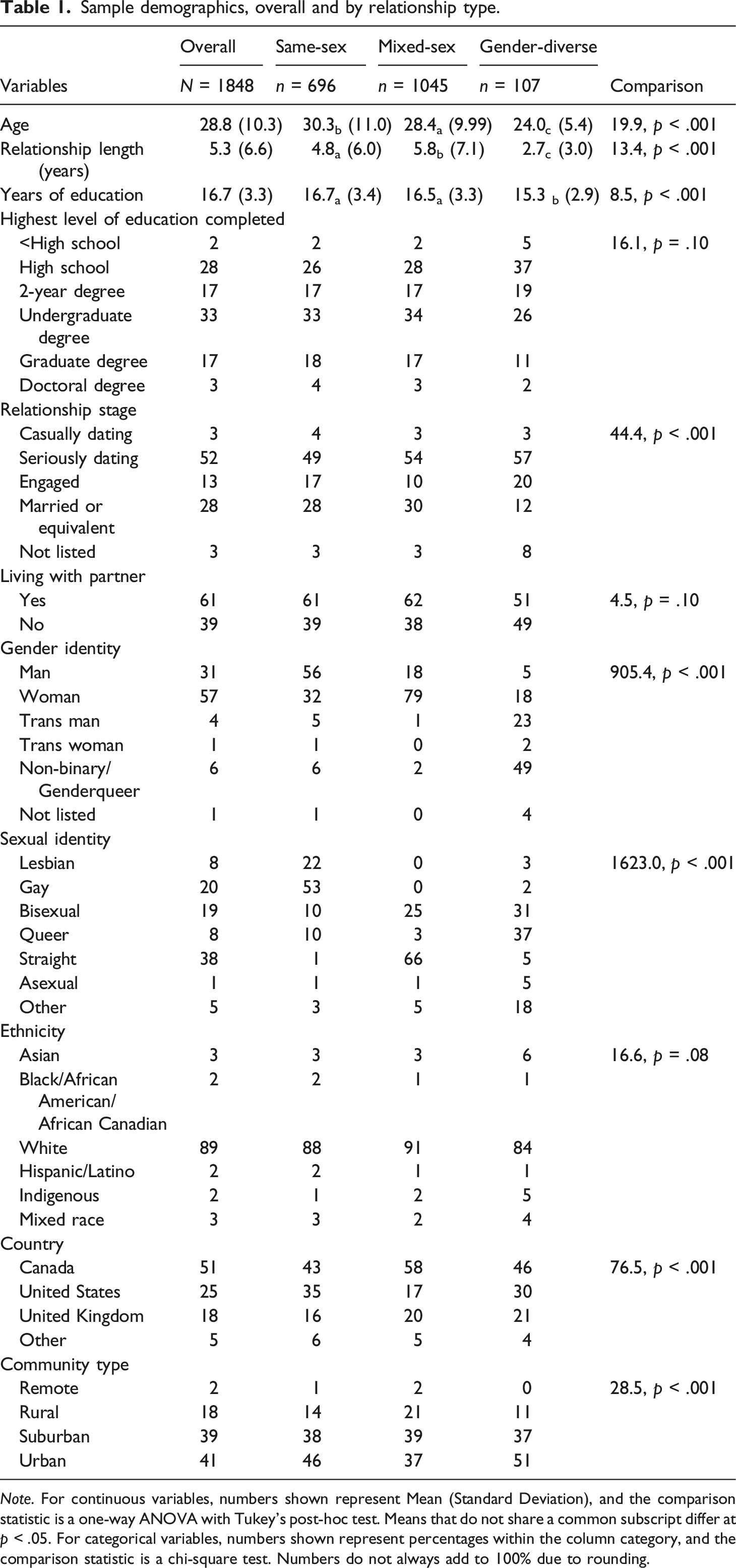
Note. For continuous variables, numbers shown represent Mean (Standard Deviation), and the comparison statistic is a one-way ANOVA with Tukey’s post-hoc test. Means that do not share a common subscript differ at p < .05. For categorical variables, numbers shown represent percentages within the column category, and the comparison statistic is a chi-square test. Numbers do not always add to 100% due to rounding.
On an a priori basis, participants were categorized as being in a mixed-sex or same-sex relationship if they chose the relevant category in response to each of two questions, one asking how they described their relationship and one asking how others (e.g., strangers on the street) would perceive their relationship. If responses to the two questions did not align, either question was left blank, or the participant selected “not listed” for either question, we examined their data more closely. Some participants could be categorized into the same-sex and mixed-sex groups, but others did not readily fit (e.g., “I’m trans nonbinary, and they are genderqueer”). We, therefore, created a third group, on a post hoc exploratory basis, labeled “gender diverse.” See Supplementary Materials for more details.
Table 1 shows there were significant group differences for most demographic variables. Consequently, we controlled for age, relationship length, years of education, country, and community type in all analyses. Unsurprisingly, there were also group differences in the sexual and gender identity variables. However, these could not be meaningfully entered as covariates, as they are inherent to the nature of the groups. Note, however, that there were relatively more women than men in mixed-sex versus same-sex relationships. That gender difference serves as a potential alternative explanation for differences between those two groups.
Measures
Descriptive statistics and Cronbach’s alphas for all study variables.
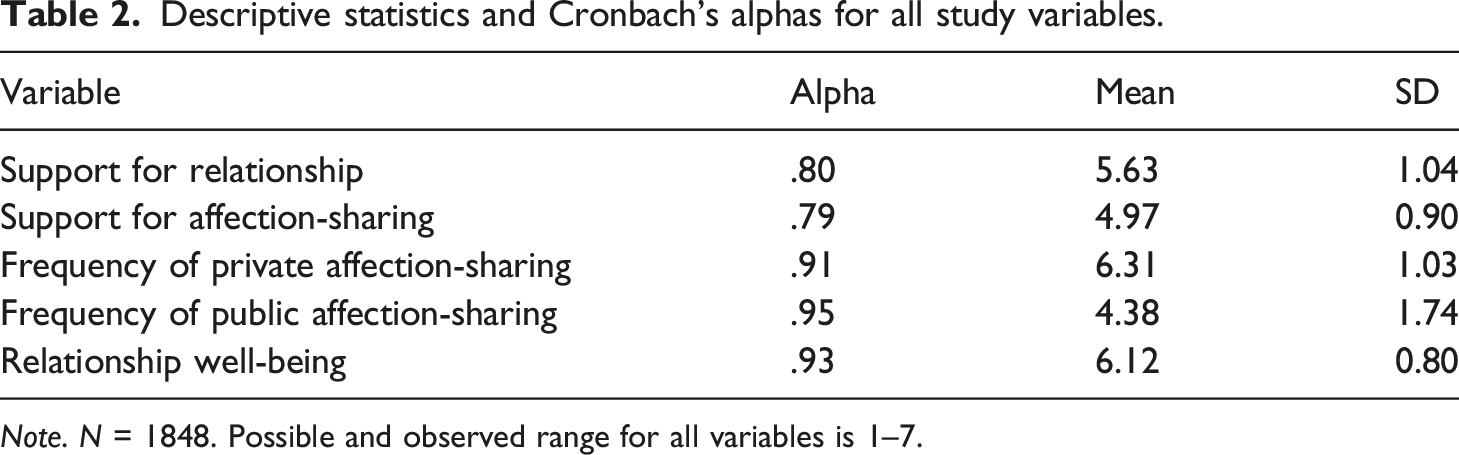
Note. N = 1848. Possible and observed range for all variables is 1–7.
Note that exploratory measurement invariance testing (Vandenberg & Lance, 2000) showed that all measures passed the tests of configural and metric invariance (i.e., using a basic single-factor model for each measure, the models applied equally well to all groups, and the factor loadings were the same across groups); however, they did not pass the test of scalar invariance (i.e., item-level intercepts differed across groups). Details available upon request from the authors.
Analytic Strategy
All hypotheses and research questions were addressed using PROCESS version 4.0 (Hayes, 2018) within SPSS to test a moderated mediational model. We created a custom model, most closely resembling Model 92, but allowing for public and private affection-sharing to be considered as parallel mediators in the place of M2. As some variables were skewed, we used bootstrapping with 95% confidence intervals, which does not assume multivariate normal distributions. Confidence intervals that do not cross zero (indicated in
Results
Descriptive Statistics, Including Group Comparisons
One-way ANCOVAs with bootstrapped pairwise comparisons, all study variables by relationship type.
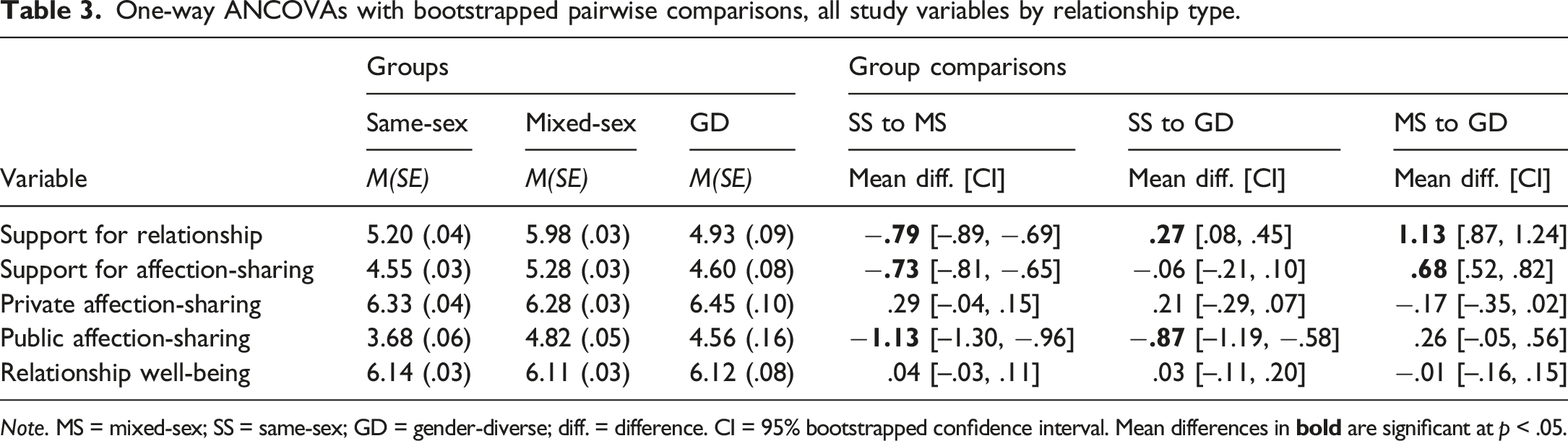
Note. MS = mixed-sex; SS = same-sex; GD = gender-diverse; diff. = difference. CI = 95% bootstrapped confidence interval. Mean differences in
Primary Analysis
Testing Overall Model
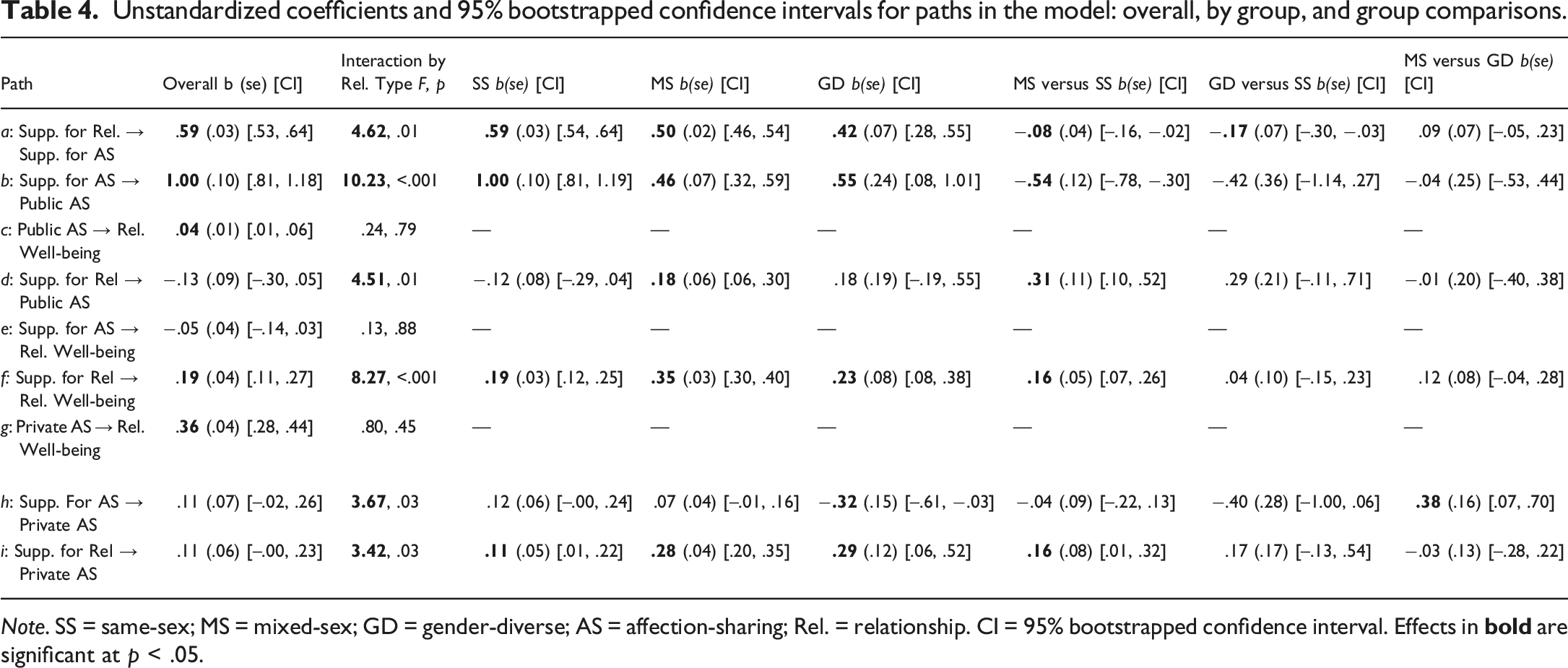
Unstandardized coefficients and 95% bootstrapped confidence intervals for paths in the model: overall, by group, and group comparisons.
Note. SS = same-sex; MS = mixed-sex; GD = gender-diverse; AS = affection-sharing; Rel. = relationship. CI = 95% bootstrapped confidence interval. Effects in
We hypothesized that seven paths would be positive and significant (i.e., those above the bove the lin in Table 4), and our hypotheses were supported for five paths. More perceived support for the relationship was indeed associated with more perceived support for affection-sharing (Path a; all italicized letters denote model paths), which in turn was related to more public affection-sharing (b), which was associated with better relationship well-being (c). General support for the relationship was also directly associated with relational well-being (f), as were both public (c) and private (g) affection-sharing. However, two hypotheses were not supported: there was no overall association between general support for the relationship and public affection-sharing (when support for affection-sharing was controlled; d), and there was no association between support for affection-sharing and relationship well-being (when the frequency of public and private affection-sharing was controlled; e). Concerning our two research questions (below the blank row in Table 4), neither general support for the relationship (i) nor support for affection-sharing (h) was significantly associated with the frequency of private affection-sharing.
Testing Moderation of Model Paths
Table 4, column 3, shows the F and p statistics of the interactions testing moderation by relationship type. Six of the nine effects showed significant interactions. Columns 4–6 show the b, SE, and 95% bootstrapped confidence intervals for each group when interactions were significant. Columns 7–9 show tests of whether coefficients differed significantly across relationship types. 5
Three paths (c, e, g) show no significant relationship type interactions; in four others (a, b, f, i), the effect is positive and significant for all three groups, highlighting basic group similarities; however, significant differences in the strength of the association still appear, highlighting group nuances. Compared to individuals in mixed-sex relationships, those in same-sex relationships show stronger associations between support for the relationship and support for affection-sharing (a), as well as between support for affection-sharing and frequency of public affection-sharing (b). However, they show weaker associations between support for their relationship and relationship well-being (f), and support for their relationship and private affection-sharing (h).
For the last two interactions, we see different patterns across groups. In path d, support for the relationship to public affection-sharing, the association is positive and significant only for mixed-sex relationships; it is not different from zero for the other two groups. In path h, support for affection-sharing to frequency of private affection-sharing, the association is significant and negative only for gender-diverse relationships: the less support they perceive for their affection-sharing, the more affectionate they are in private, possibly in a compensatory effort.
In general, individuals in gender diverse-relationships do not show a consistent pattern: sometimes, their effects are intermediate between the other two groups; sometimes, they more closely resemble those in mixed-sex relationships. The large standard errors also result in most comparisons involving this group being non-significant.
Mediation and Moderated Mediation
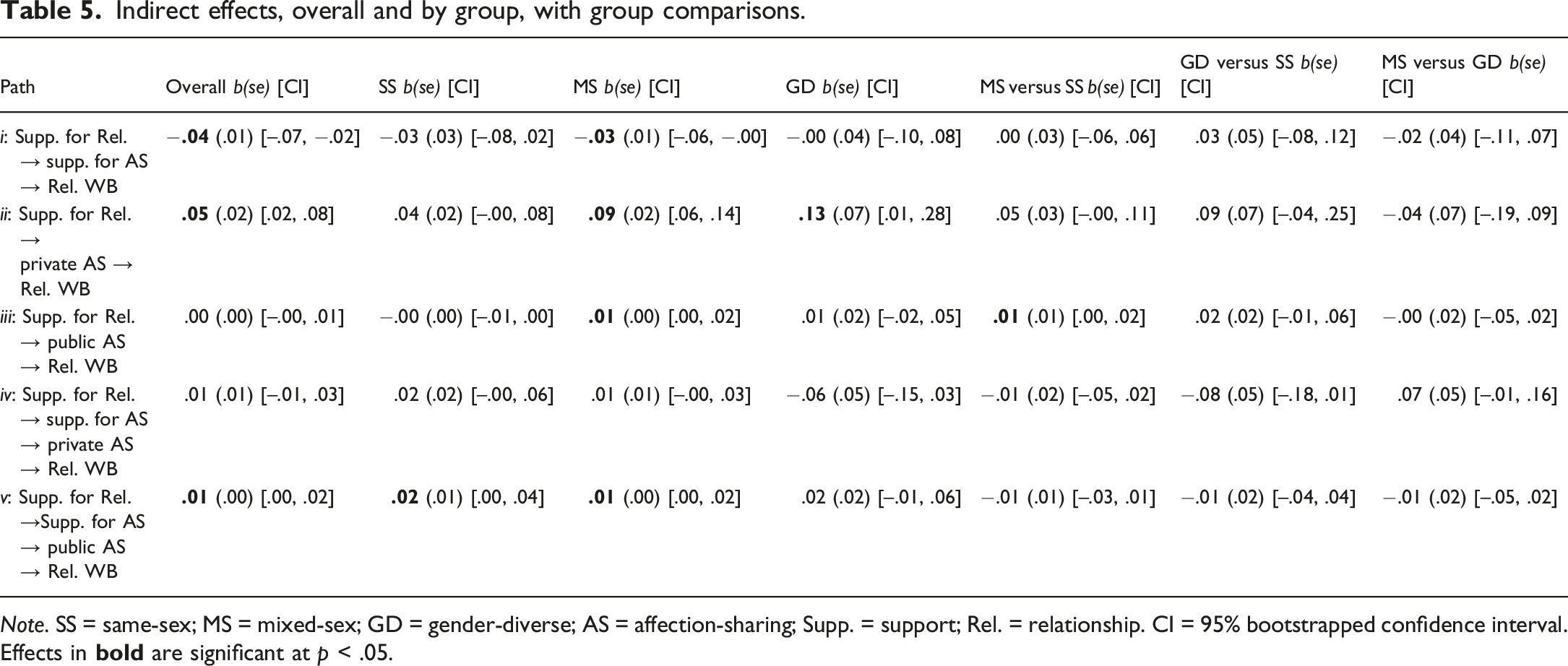
Indirect effects, overall and by group, with group comparisons.
Note. SS = same-sex; MS = mixed-sex; GD = gender-diverse; AS = affection-sharing; Supp. = support; Rel. = relationship. CI = 95% bootstrapped confidence interval. Effects in
Substantial mediation was present, with four of the five indirect effects being significant for at least one group. The exception was the four-variable path going through private affection-sharing (iv), which was not significant for any group. The full four-variable path going through public affection-sharing (v) was significant overall, and for both same-sex and mixed-sex relationships. In addition, those in mixed-sex relationships showed significant three-variable mediational paths from support for relationships through both private (ii) and public affection-sharing (iii) to relational well-being, bypassing support for affection-sharing (those in gender-diverse relationships showed the same pattern, but through private affection-sharing only, ii; this path was also significant in the overall model). Finally, in both the overall model and for those in mixed-sex relationships, there was a significant indirect effect from support for the relationship to support for affection-sharing to relationship well-being; unexpectedly, this effect was negative, not positive.
There was little indication of significant moderated mediation, as the indexes of moderated mediation (final three columns in Table 5) were mostly non-significant. Variations in the indirect effects should therefore be interpreted as minor nuances on a theme rather than radically different patterns across groups. Still, the substantial moderation of the basic model paths shown in Table 4 highlights that different relationship types reported somewhat different experiences.
Discussion
While cognitive-affective explanations for the social network effect have been proposed (Sprecher et al., 2019), few have explored potential cognitive-behavioral mechanisms. In this paper, we break new ground by investigating perceptions of support for, and engagement in, physical affection-sharing as a potential mechanism of the social network effect. By focusing on what couples may actually do differently when facing various degrees of support for their relationship, rather than just how they think or feel differently, we contribute a novel perspective to the literature. Overall, our proposed model was supported well: if couples like Chris and Robin perceived support for their relationship, they were also likely to perceive support for affection-sharing, engage in more affection-sharing, and have better relational well-being. 6 Importantly, our findings extend to same-sex, mixed-sex, and gender-diverse couples, highlighting the relevance of this mechanism across diverse relationship contexts. We first discuss the overall model before delving into nuances that shed light on the role of relationship type in shaping the experience of physical affection-sharing.
Affection-Sharing as a Cognitive-Behavioral Mechanism
Our findings add perceptions of support for, and engagement in, affection-sharing as potential cognitive-behavioral mechanisms partially explaining the social network effect. Affection-sharing may work alongside existing cognitive-affective explanations (i.e., increased certainty, couple identity, and network balance), whereby changes in any of these constructs likely affect the others. For example, the more support Chris and Robin perceive for their relationship, the more they may feel like a couple. Consequently, they may feel comfortable acting like a couple by sharing small acts of physical affection comfortably in front of others. These behaviors, in turn, may reinforce others’ positive views of the relationship, further increasing support. Future research could explore the causal pathways underlying these effects and confirm them through experimental studies. Longitudinal research could assess whether some of these causal paths are stronger than others (Sprecher & Felmlee, 1992); experimental vignette studies could confirm whether changes in one of these variables directly cause changes (albeit only perceived, hypothetical changes) in another.
Most importantly, adding affection-sharing to our understanding of the social network effect begins to suggest actions couples may be able to take when they experience disapproval of their relationship. Crowley and Faw (2014) outline support marshaling strategies, primarily verbal, that people use to persuade social network members to support a relationship. Affection-sharing could potentially serve as another point of intervention. If Chris and Robin seek support for their relationship, they could (provided no barriers exist) freely engage in affectionate behaviors around others (sharing subtle touches, holding hands). Most network members likely want their loved ones to be happy. If they see Chris and Robin as an affectionate and thriving couple, they may begin to approve, even if they initially had reservations about the relationship.
Of course, potential advice to increase PDAs would only work in some circumstances. Chris or Robin might come from a culture, faith, or family that frowns on PDAs, regarding them as inappropriate or immature. In such circumstances, increasing PDAs would only increase disapproval. Even then, Chris and Robin could increase their private affection-sharing, which is strongly associated with relational well-being, in this study and others (e.g., Jakubiak, 2022). In part, increased private affection-sharing might compensate for the negative effects of network disapproval. This scenario demonstrates that factors other than relationship quality might shape network members’ views of affection-sharing, an observation that becomes especially relevant when comparing relationship types.
Same-Sex versus Mixed-Sex Affection-Sharing
If Chris and Robin are a same-sex couple, they likely perceive less support for their affection-sharing and engage in less affection-sharing in public than a mixed-sex couple (see Table 3). Here is one very concrete way societal disapproval can “get under the skin” and affect relationship behavior. Our prior work shows that same-sex couples experience more vigilance and are likelier to refrain from public affection-sharing, despite reporting a greater desire for such affection (Blair et al., 2022). At the extreme, such vigilance might be due to well-justified fears for physical safety (e.g., Padgett, 2022; Rohleder et al., 2023). However, as Diamond and Alley (2022) argue, a lack of social safety can still be consequential, even when physical safety is not an issue.
Same-sex couples often lack social safety, described as feeling entirely accepted and protected within a social group (Diamond & Alley, 2022). Engaging in any visible act of physical affection can reveal that they are a couple, leaving them vulnerable to various unwelcome experiences. Innocent displays of affection can elicit responses ranging from overly positive (“Aww, you’re so cute together!”) to curious glances and even negative reactions such as staring, verbal harassment, or physical assault. The consequences of innocent affection can snowball into severe and even catastrophic situations, placing same-sex couples in danger of severe injury or worse (Padgett, 2022). Even if negative responses occur rarely, the awareness that they could happen is enough that same-sex couples cannot “simply be” together without at least a flicker of thought devoted to scanning their social environment (Blair et al., 2022; Rohleder et al., 2023). Thus, this vigilance may explain that while the full four-step model holds for both same-sex and mixed-sex couples (Table 5, line v), the three-step model only holds for mixed-sex relationships (lines ii and iii), as same-sex couples do not have the privilege of bypassing a “check-in” to determine whether support specifically for affection-sharing is present in their environment.
Perceptions of support for affection-sharing are more closely connected to perceptions of support for the relationship for same-sex couples than for mixed-sex couples (Table 4, line a), perhaps because it is more salient to those in same-sex relationships. Similar patterns have been seen in our previous research: connections of general relational support with general social support (Blair et al., 2018), and with support for sexual orientation (Holmberg & Blair, 2016) are also stronger for those in same-sex versus mixed-sex relationships. Same-sex couples seem to say: “support for me entails support for my identity, relationship, and affection-sharing -- it’s a package deal.” Once same-sex couples have ticked all those boxes and perceive that their affection-sharing is supported, the association with their actual behavior is particularly strong (line b).
Social support for the relationship and affection-sharing are still positively and significantly associated with each other for those in mixed-sex relationships, but they form less of a tight package. When mixed-sex couples feel that their affection-sharing is not approved of, they may be less likely to assume that their relationship is also met with disapproval or to change their affection-sharing behaviors. In a heteronormative society, simple moments of affection between mixed-sex partners are unlikely to draw disapproval. When they do, the couple can often safely ignore the disapproval and continue to behave as they please. However, the same is not true for same-sex or gender-diverse relationships (Blair et al., 2022; Rohleder et al., 2023). Disapproval of a same-sex or gender-diverse relationship is often accompanied by the disapproval of their affection-sharing, and societal policing is used to enforce these norms, making these constructs more tightly interwoven.
While social support for the relationship and affection-sharing are strongly associated constructs for those in same-sex relationships, other associations within the model appear weaker for same-sex compared to mixed-sex couples. For instance, perceived support for the relationship is less predictive of relationship well-being in same-sex relationships than in mixed-sex relationships (Table 4, path f), consistent with our previous research findings (Holmberg & Blair, 2016). Similarly, support for one’s relationship is less strongly associated with private affection-sharing in same-sex relationships (path h). Disapproval of a same-sex relationship by others is not as tightly connected to lower relational well-being or less frequent private affection-sharing, compared to those in mixed-sex relationships. For example, if Chris and Robin are in a same-sex relationship disapproved of by others, this disapproval may not be as strongly tied to their relationship satisfaction or private affection-sharing as it would be if they were in a mixed-sex relationship.
On the one hand, this process can be viewed as a sign of resilience within same-sex relationships. Despite experiencing less social support for their relationships, they are still able to maintain levels of relationship well-being and private affection sharing comparable to those of their mixed-sex peers (Table 3). The ability to draw on the knowledge that some people disapprove of same-sex relationships on principle alone, irrespective of the relationship’s quality, may produce a state of attributional ambiguity (Mendes et al., 2008). In other words, when disapproval comes from a biased source, it is possible to interpret it as a reflection of the perceiver’s problem rather than the relationship’s quality, making it easier to dismiss the criticism. Thus, attributional ambiguity may help protect same-sex couples from the negative correlates of disapproval.
On the other hand, it is not all good news. First, these associations are smaller for same-sex relationships but are not zero. Those in same-sex relationships still perceive lower levels of support, and lower levels of support, on average, still predict lower levels of relational well-being and private affection-sharing. Resilience may help same-sex couples fend off the worst effects, but challenges remain. Attempts to disentangle the causal flow here would be interesting. Does disapproval from others actually “poison the well,” making it more challenging to maintain good relational well-being and private affection-sharing? Or is the causal flow more in the opposite direction, such that unhappy or less affectionate relationships garner more disapproval?
This question is an important reminder that not all relationships are worth supporting. Future research should investigate why social network members disapprove of others’ relationships, and whether some reasons for disapproval are more reliably linked to eventual negative outcomes than others. It is intriguing to reflect on what social network disapproval is for, i.e., what function does, or should, relationship disapproval serve? Network members frequently have insight into relationships exceeding that of couple members themselves (Felmlee et al., 1990). Network approval/disapproval, when working optimally, may serve as a guide towards positive, fulfilling romantic relationships and away from problematic ones. If so, the lowered associations between disapproval and well-being for same-sex couples may not be a positive sign of resilience but instead a warning signal that the system is not working optimally. If homonegativity is present, others’ disapproval of a same-sex relationship will have reduced diagnostic value. Chris and Robin may not know whether their social network’s disapproval of their relationship stems from prejudice or from an honest assessment of their relational compatibility. Such ambiguity may help them ignore invalid feedback but also encourage them to ignore valid feedback, opening them up to future heartbreak if the relationship is unhealthy. Overall, the fundamental model dynamics work similarly for all couple types. However, these nuances remind us that couples exist in an interconnected social world, with different implications for same-sex versus mixed-sex relationships.
Gender Diverse Relationships
Issues become even more complex for gender-diverse relationships that do not fit neatly into the mixed-sex or same-sex category. No consistent pattern emerges here. The values for gender-diverse relationships sometimes resemble same-sex relationships, sometimes mixed-sex relationships, but most often are intermediate between the other two groups (see Tables 3 and 4). In two instances, values for those in gender-diverse relationships diverge from the other groups. Those in gender-diverse relationships perceived the lowest levels of relationship support. They are the only group to show possible compensatory behavior: lower perceived relationship support is associated with more private affection-sharing. Receiving little acceptance from others, those in gender-diverse relationships may turn to their partner privately for affection.
Overall, though, the findings for this group should not be over-interpreted. The only consistent finding is that their responses are highly variable, with standard errors 2-3 times larger than the other groups. The large standard errors reflect the smaller sample size but also true heightened variability. By definition, this group is diverse. Many members of this group identified as non-binary or genderqueer and/or reported that their gender expression was fluid, varying daily. Many onlookers, particularly strangers, may respond to PDAs based on the perceived gender composition of the dyad. Participants whose gender expression is non-binary or variable may sometimes be perceived to be in same-sex relationships, sometimes mixed-sex, and sometimes ambiguous. Indeed, when gender presentations are ambiguous, affection-sharing may tag the dyad as a romantic couple. Base rates may encourage onlookers to disambiguate by classifying them in the ‘statistically normative’ mixed-sex category.
Gender presentation may be the critical variable determining how others respond to individuals in gender-diverse relationships. Straying from expected gender norms, particularly by displaying “misplaced” femininity, is heavily sanctioned in society, including through physical attacks (e.g., Hoskin, 2020). Those who challenge gender norms may experience a chronic lack of social safety and heightened vigilance, whether with their partner or alone. Being with their partner may be associated with increased perceived safety for some in terms of strength in numbers, “confirmation” of affirmed gender, or a sense of “us against the world.” In contrast, for others whose own gender presentation adheres to societal norms, being associated with a gender-diverse partner may increase perceived or actual risks. In line with these suppositions, Matheson et al. (2021) found that those in same-sex relationships with more feminine-presenting partners reported higher levels of general and PDA-related vigilance. Though particularly salient for gender-diverse couples, issues of gender expression may also be important for those in same-sex and mixed-sex relationships. Thus, although preliminary and showing inconclusive findings, including this group was fruitful for inclusivity and because it suggests promising future directions to improve understanding of affection-sharing in all types of relationships.
Strengths and Limitations
Our study had a large sample size and a good representation of diverse relationship types. It relied on self-report, but past literature shows that perceived support is more important in predicting well-being than “actual” support (Etcheverry et al., 2008). As acknowledged in the introduction, the primary limitation of our study is that it is cross-sectional and therefore does not disentangle causal flow. Longitudinal or vignette studies could help address this weakness, but we strongly suspect the answer will be that all constructs are interconnected and mutually reinforcing. Another limitation is that we had a higher proportion of women in mixed-sex relationships than in same-sex relationships. Therefore, differences between those two groups could result from gender, not the relationship type. However, patterns echoed those seen in other research on same-sex relationships, making this alternative explanation relatively unlikely. Additional information, such as the disability status of the participants, was not collected and may be relevant for future research. The measures’ failure to pass the scalar invariance test suggests complexities in how the measures work for each group, which merits further investigation in future studies.
Conclusion
We opened our paper seeking to understand why Chris and Robin, who experienced low relationship support, might have lower relational well-being. We have shown that perceptions of support for, and actual engagement in, physical affection-sharing may provide part of the explanation. Although the basic processes are similar for all relationship types, important nuances depend on whether Chris and Robin’s relationship is same-sex, mixed-sex, or gender diverse. We call for further research to help understand how Chris and Robin can act to increase support for their relationship, should support be warranted. However, we also note the caveat that not all relationships warrant support; if the general purpose of expressing disapproval of others’ relationships is to help them seek out healthier, happier relationships, more research is also needed to assess how individuals in socially marginalized relationships can tap into this resource, despite the potential for prejudice to lead such judgments astray. Therefore, future research should also attempt to understand how Chris and Robin’s friends and family can successfully intervene and discourage the pairing should it be genuinely unhealthy, ideally without disrupting their relationships with Chris and Robin (Gillian et al., 2022). Relationships are always complex, as one must go beyond the individual and understand processes at the dyadic level. When factoring in interactions between the dyad, their broader social network, and even society, the issues become ever more complex – but also more interesting and worthwhile.
Supplemental Material
Supplemental Material - Walking hand in hand: The role of affection-sharing in understanding the social network effect in same-sex, mixed-sex, and gender-diverse relationships
Supplemental Material for Walking hand in hand: The role of affection-sharing in understanding the social network effect in same-sex, mixed-sex, and gender-diverse relationshipsby Karen L. Blair, Chelsea Hudson, and Diane Holmberg in Journal of Social and Personal Relationships
Footnotes
Acknowledgements
We thank Odessa McKenna for her contributions to data collection.
Author notes
This article is partly based on the master’s thesis of the second author, who was supported by graduate student fellowships from Research Nova Scotia and the Province of Nova Scotia.
Declaration of conflicting interests
The author(s) declared no potential conflicts of interest with respect to the research, authorship, and/or publication of this article.
Funding
The author(s) disclosed receipt of the following financial support for the research, authorship, and/or publication of this article: This research was supported in part by the St. Francis Xavier University, Experiment.com (10.18258/1003) and the Social Sciences and Humanities Research Council of Canada (430-2017-00944 and 435-2020-0772) supported the larger research project.
Open research statement
As part of IARR’s encouragement of open research practices, the authors have provided the following information: This research was pre-registered. The analyses for the second author’s master’s thesis were pre-registered, and the analyses presented within the current manuscript present an extension of the theoretical model. The registration was submitted to: OSF: https://osf.io/qkfr6. The data used in the research are not available. The materials used in the research are available. The materials can be obtained within the Supplementary Materials file, on OSF:  or by emailing:
Supplemental Material
Supplemental material for this article is available online
Notes
References
Supplementary Material
Please find the following supplemental material available below.
For Open Access articles published under a Creative Commons License, all supplemental material carries the same license as the article it is associated with.
For non-Open Access articles published, all supplemental material carries a non-exclusive license, and permission requests for re-use of supplemental material or any part of supplemental material shall be sent directly to the copyright owner as specified in the copyright notice associated with the article.
