




Abstract
People’s attachment orientations change over time and are linked with their relationship experiences. However, it is unclear whether perceptions of a partner’s attachment orientation—which likely reflect (and affect) aspects of a relationship—track with how the partner changes over time. Do people become more accurate judges over time? Further, are changes in judgments of partners’ dispositions affected by how happy people are in their relationships? By examining accuracy and bias in perceptions, and how they are shaped by relationship quality, the present study sheds light on the interpersonal perceptions that may sustain—or hinder—relationships. We employed longitudinal Truth and Bias Models in a sample of 226 newlywed couples followed over a 3-year period. People were generally accurate in perceiving their partners’ attachment, but overestimated their partners’ attachment anxiety and avoidance and often projected their own attachment orientation. These perceptions persisted over time and depended on how the relationship was going.
People’s general perceptions that their partners will be available and responsive to their needs (i.e., their attachment orientation) change over time and are linked to their relationship experiences and quality (Davila et al., 1999). However, do perceptions of a partner’s attachment orientation—which likely also reflect aspects of people, their partner, and the relationship—track with how partners change over time? People view their relationships and their partners with some degree of accuracy and some degree of bias. Although accuracy and bias in perceptions of partners serve distinct functions in relationships (Luo & Snider, 2009), accuracy and bias in perceptions of a partner’s attachment orientation—a characteristic so closely implicated in the health of a relationship—has been under-examined compared to those of other personality characteristics (e.g., Big 5; Lenhausen et al., 2021). How do people view their partners’ attachment orientations and do these perceptions depend on how well the relationship is going?
Based on self-reports, people tend to become more secure over time, as maturational processes are enacted in such a way that they approach relationships more compassionately over time (Chopik et al., 2013; Luong et al., 2011; Mikulincer & Shaver, 2010). Particularly in the early years of marriage, people tend to become more secure as they settle into relationships, even in the context of declines in relationship satisfaction (Davila et al., 1999). Although people’s self-reports shift toward maturity and security, how well relationships fare depends on how people perceive their partners, over and above what people and partners say about themselves. For example, perceiving a partner as responsive, sometimes regardless of the accuracy of those judgments, is one of the most robust predictors of a happy and sustained relationship (Neff & Karney, 2005; Reis et al., 2004; Reis & Shaver, 1988; Srivastava et al., 2006).
Perceptions of romantic partners are often positively biased (Solomon & Vazire, 2014). For example, 95% of participants think their partners are better than average (Gagné & Lydon, 2004), and people may choose to ignore relationship-threatening information altogether (Simpson et al., 1995). Both overestimating the positivity (i.e., positive illusions) and underestimating the negativity of partners’ characteristics and behaviors (i.e., selective attention) can be beneficial because they make relationships satisfying and feel as though they are continuously improving or help maintain relationships by ignoring relationship-threatening information, respectively (Segrin et al., 2009; Simpson et al., 1995). However, there is evidence for the independence and distinct functions of accuracy and bias in how people see their partners (Fletcher, 2015; Fletcher & Kerr, 2010; LaBuda & Gere, 2023; Neff & Karney, 2005). In addition to generally overestimating or underestimating qualities of the partner, people tend to assume others are similar to them and project their own qualities on others, especially on people they like (Eldesouky et al., 2022; Morry, 2005; Purol & Chopik, 2023; Tidwell et al., 2013). In other words, people are not wholly accurate about how they see their romantic partners, and they often show different types of biases (i.e., assuming partners are like themselves or over/underestimating the mean levels). Nevertheless, being accurate about partners is beneficial. For instance, according to the Self-verification Theory, it can be validating to have others see us as we see ourselves (Swann Jr, 2012). Whether self- and partner-reports of psychological characteristics align has been a hot topic, continuing to yield meta-analyses (Fletcher & Kerr, 2010; LaBuda & Gere, 2023), but few studies examine partner perceptions over time.
Evaluating what partners are like is particularly important during the early stages of a relationship. A longitudinal study comparing newlyweds’ self- and partner-reports on personality traits (e.g., conscientiousness, agreeableness, and neuroticism) found evidence for a “honeymoon effect”—partner evaluations were more positive earlier in a relationship but later became more negative with self- and partner-ratings showing little agreement over time (Watson & Humrichouse, 2006). Although these studies seem to suggest a gap between individual and partner perceptions over time, other research suggests that couple members might be relatively accurate in how they see each other (Aviles et al., 2021; Rohrer et al., 2018). One study found strong self-other agreement (half of the “others” were romantic partners) on Big Five personality changes over 6.5 years (Oltmanns et al., 2020). Another study found some level of self-partner agreement across all traits and that partners largely agreed on how they and their partners changed over a year and a half (Lenhausen et al., 2021). How perceptions of partner attachment orientations—a more relationally oriented and relationally-determined construct than Big Five personality traits—change might be more closely tied to the health and longevity of relationships.
Do individuals’ perceptions of their partners’ attachment change over time as partners themselves change? On the one hand, perceptions of partners might change because people can observe genuine changes in their partners. People’s attachment orientations change over time (Chopik et al., 2013), and partners spend a considerable amount of time together, likely accumulating evidence for how each other thinks, feels, and behaves in a variety of situations. People generally tend to be more accurate the longer they know someone (Schneider et al., 2010), so they may accurately track how their partners see themselves over time. On the other hand, perceptions are not exclusively based on actual behavior. They also reflect pre-existing positive or negative views of the person and relationships in general (Collins, 1996; Leising et al., 2014). For instance, people reporting their relationships were of higher quality saw their partners more positively than those partners saw themselves (Fletcher & Kerr, 2010; Murray et al., 2000). When people expected their partners to behave positively, they also reported perceiving their partners to behave positively a week later independent of their partners’ self-reported behaviors (Joel et al., 2023). In other words, people’s expectations about their relationship shape their perceptions of their partners’ behaviors.
As such, people in unhappy relationships might be more attuned to the negative features of their partners. A greater sensitivity to the ways a partner is falling short of their ideals might lead people to conclude that their negative characteristics are increasing. Alternatively, people in happy relationships might live in blissful ignorance—they might endorse healthier attributions and assume the best about their partners. This idea is consistent with how negative directional bias—viewing partners more negatively than partners see themselves—can sometimes be a predictor of relationship dissolution (Le et al., 2010). Similarly, the less people interpret their partners’ behaviors as destructive during a conflict, the more they value their relationship (Venaglia & Lemay, 2019). Ultimately, how people feel about the relationship can influence their judgments of their partners’ attachment. Therefore, we investigated the extent to which people’s accuracy or bias in perceiving their partners’ attachment orientation changed over time, and whether it varied as a function of their relationship quality.
The Present Study
We examined the extent to which people show accuracy and bias in perceiving their partners’ attachment orientations, and the extent to which accuracy and bias change over time and vary as a function of the quality of their relationship. Understanding such shifts in perceptions and whether these shifts can be predicted by relationship characteristics speaks to questions of how relationships develop and are shaped by contexts.
Based on work on accuracy and bias in perceptions of diverse partner characteristics (Fletcher & Kerr, 2010; LaBuda & Gere, 2023; Luo & Snider, 2009), we hypothesized that individuals would show both accuracy and bias in perceiving their partner’s attachment anxiety and avoidance. We hypothesized that people who reported lower relationship quality would perceive greater attachment insecurity in their partners (i.e., higher anxiety and avoidance or mean-level directional bias) over time, and we also explored whether relationship quality is associated with changes in accuracy and similarity bias. A meta-analysis (k = 69–157 studies) suggested that relationship quality is not associated with tracking accuracy but is positively associated with assumed similarity bias and mean-level directional bias (LaBuda & Gere, 2023). However, results differed across the constructs examined (e.g., positive, negative or non-interaction traits), and only two samples examined attachment orientations. Thus, this study focused on accuracy and bias in perceptions of attachment orientations. We applied longitudinal Truth and Bias models (T&B; Stern & West, 2018; West & Kenny, 2011) to track accuracy and bias of newly married individuals’ perceptions of their partners’ attachment over time. The T&B approach allows for the detection of a truth force or tracking accuracy (i.e., the extent to which individuals’ perceptions of their partner’s attachment agree with those of their partner); a similarity bias force (i.e., the extent to which individuals’ own attachment levels bias their perceptions of their partner’s attachment orientation), and directional bias (i.e., the extent to which individuals over- or under-estimate their partner’s attachment). We also tested whether accuracy and bias depended on relationship quality and changed over time.
Method
Participants
Data came from the Growth in Early Marriage Project (GEM; Pietromonaco & Powers, 2019), a three-wave study of newly married mixed-sex couples that collected data across 3–4 years. Couples were recruited mainly from marriage license records in Western Massachusetts, United States (e.g., Amherst, Hadley, Northampton, Belchertown, South Hadley, Springfield, Pittsfield). We used all available data (226 couples, N = 452) 1 from the original project. On average, husbands were 29.05 years old (Mdn = 28.00, SD = 5.23, range = 31.00), and wives were 27.65 years old (Mdn = 27.00, SD = 4.47, range = 27). The study did not ask about sexual orientation, gender identity, or disability status. On average, couples had been in a relationship for 4.97 years (SD = 2.92; minimum 6 months, maximum 16 years and 7 months) and had cohabited for 2.28 years (SD = 2.25). Among husbands, 92.9% were White, 1.3% were Black, 1.3% were Hispanic, and 3.6% were multiracial. Among wives, 91.6% were White, 0.9% were Black, 1.3% Asian, 4.0% Hispanic, and 1.3% were multiracial. All participants had completed at least a high school education (or GED) and 24.0% of husbands and 27.1% of wives were enrolled as part-time or full-time students at the time of the study. The majority were employed: 89.3% of husbands and 90.7% of wives had a paid job. Regarding income, most participants reported annual earnings between $20,000 and $59,999 (husbands: 64.4% wives: 6.41%), with 20.3% of husbands and 26.8% of wives earning less than $20,000 and 15.3% of husbands and 9.1% of wives earning $60,000 or more.
Openness and Transparency
This study was not pre-registered and its results (and conclusions) rest on the assumption that the hypothesized model is correct. The data and syntax to reproduce the main and supplementary results are available at https://osf.io/ne6vc/overview.
Measures
Attachment
Self- and partner-reports of attachment were measured using the 36-item Experiences in Close Relationships (ECR; Brennan et al., 1998) questionnaire, a measure that is found to be invariant across different samples (Alessandri et al., 2014; Brauer & Proyer, 2025; Gray & Dunlop, 2019). Participants answered questions about their own attachment anxiety (18-items; e.g., “I worry about being abandoned.”; husbands: αs > .85, wives: αs > .89) and avoidance (18-items; e.g., “I prefer not to show a partner how I feel deep down.”; husbands: αs > .86, wives: αs > .82). They answered the same questions about their partner’s anxiety (husbands’ reports of their wives: αs > .92, wives’ reports: αs > .88) and avoidance (husbands’ reports: αs > .89, wives’ reports: αs > .92). All items were measured on a scale of 1 (strongly disagree) to 5 (strongly agree) and averaged together. 2
Relationship Quality
Marital relationship quality was measured using the Dyadic Adjustment Scale (DAS; Spanier, 1976). 32 items across four subscales (satisfaction, cohesion, consensus, and affective expression) assess how well a relationship is going (e.g., “In general, how often do you think that things between you and your mate are going well?”). Previous research supports a hierarchical structure where a second-order factor (overall relationship quality) accounts for the covariance among four lower-order factors that represent the subscales (Montesino et al., 2013) and demonstrates test-retest reliability for the total and subscales scores (Carey et al., 1993). We also conducted confirmatory factor analyses to evaluate the underlying structure in our sample. Both higher-order factor models (e.g., CFIs >.83, RMSEAs <.06) and the four-factor models showed similarly acceptable fit (e.g., CFIs >.83, RMSEAs <.06). For parsimony, items were summed together to yield a composite score of relationship quality ranging from 1 to 179 (husbands: αs > .89, wives: αs > .88), but we explore subscales in supplementary analyses. 3
Analysis Plan
The present study employed the Truth and Bias Model (T&B; West & Kenny, 2011) in a multilevel modeling framework to account for the non-independence of partners and multiple assessments of attachment orientations. We ran separate models for attachment anxiety and avoidance. 4
We modeled perceived partner attachment as a function of directional bias, the “truth” (i.e., accuracy), assumed similarity bias, relationship quality, time, and interactions between these variables on SPSS. Figure 1 depicts this conceptual model. A brief description of T&B models is provided here, but an expanded description (including model equations) is provided in the supplement. Applying West and Kenny’s (2011) Truth and Bias Model to partner judgments of attachment: Modeling relationship quality as a moderator of the truth force, assumed bias force, and directional bias.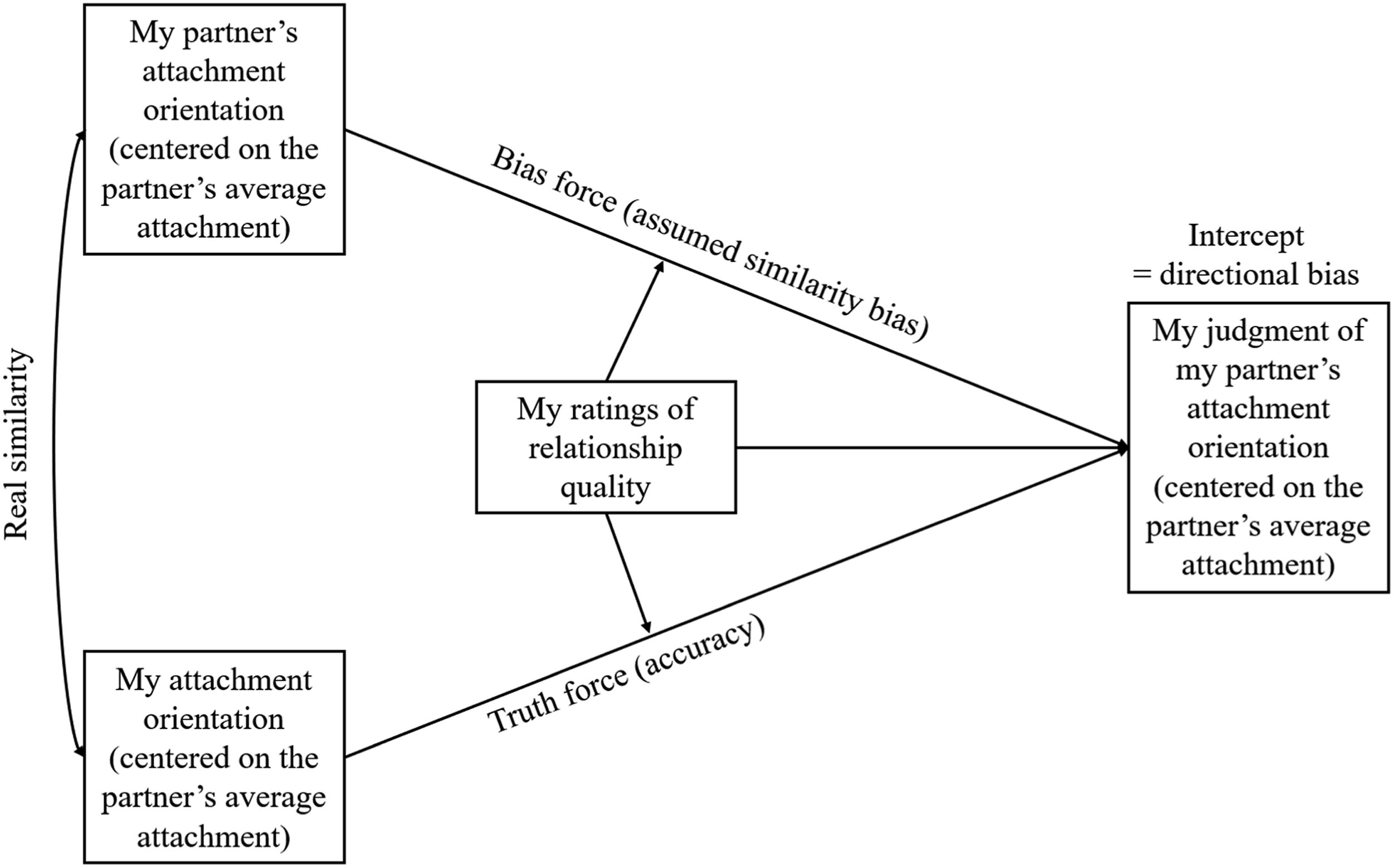
The dependent variable is a person’s rating of their partner’s attachment orientation. Three terms in the model characterize accuracy and bias. After centering attachment variables based on that target/partner’s attachment orientation (i.e., the truth), the intercept of the model represents the average directional bias—the degree to which people over/underestimate their partners’ attachment insecurity. Partners’ self-reports are entered as a predictor that represents the truth force (i.e., do people’s ratings of their partner’s attachment track the partners’ self-reported attachment?). People’s self-reported attachment is entered as a predictor that represents assumed similarity bias because it suggests that a person’s self-reported attachment is guiding how they see their partner (i.e., a larger coefficient means suggests a larger correspondence between a person’s attachment orientation and their report about their partner’s attachment orientation).
The effect of time tests the moderation of directional bias. If positive, this means that the directional bias (i.e., overestimation if the intercept is positive) is increasing over time. Likewise, the effect of relationship quality tests the moderation of directional bias. If this effect is negative, it means that overestimation is lower among happy participants. Two-way interactions between the accuracy/assumed similarity bias (the truth force or that self-reports of attachment guide reports about partners) and time/relationship quality assess if those truth and bias forces vary over time or as a function of relationship quality, respectively.
Finally, we tested additional two- and three-way interactions to see whether relationship quality and accuracy/bias × relationship quality interactions were further moderated by time. In other words, these higher-order interactions test whether relationship quality increases/reduces accuracy and bias over time. We initially tested these interactions in successive blocks but present results from the full model given how similar the blocks were (OSF page includes syntax for this iterative testing).
Perceiver’s gender (−1 = women, 1 = men) was included as a covariate (i.e., the effect of gender tests the moderation of directional bias) based on the meta-analytic findings that gender moderated mean-level bias across various characteristics (LaBuda & Gere, 2023). Although relationship length was generally unassociated with mean-level bias (LaBuda & Gere, 2023), studies specific to attachment are rare and newlywed couples have previously shown unique changes in attachment (Davila et al., 1999). Thus, to better estimate mean-level biases in this relationship period (i.e., in a sample of newlyweds), we also controlled for relationship length (in months, grand-mean centered; the effect of length tests the moderation of directional bias). 5
We also conducted follow-up exploratory analyses with subscales of relationship quality—satisfaction, cohesion, consensus, and affective expression.
Results
Means, SDs, and Correlations Among the Study Variables
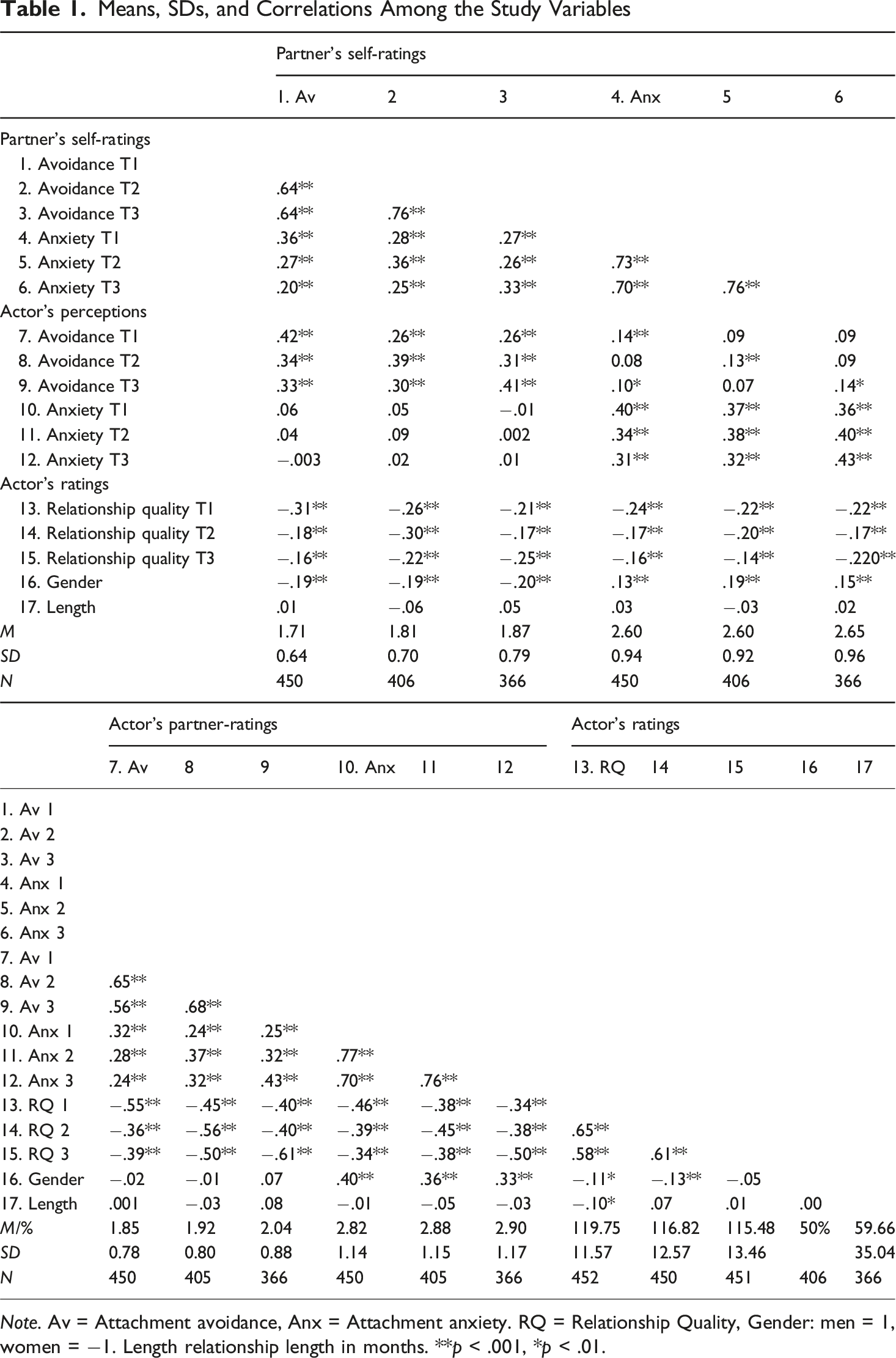
Note. Av = Attachment avoidance, Anx = Attachment anxiety. RQ = Relationship Quality, Gender: men = 1, women = −1. Length relationship length in months. **p < .001, *p < .01.
Attachment Anxiety
Directional Bias
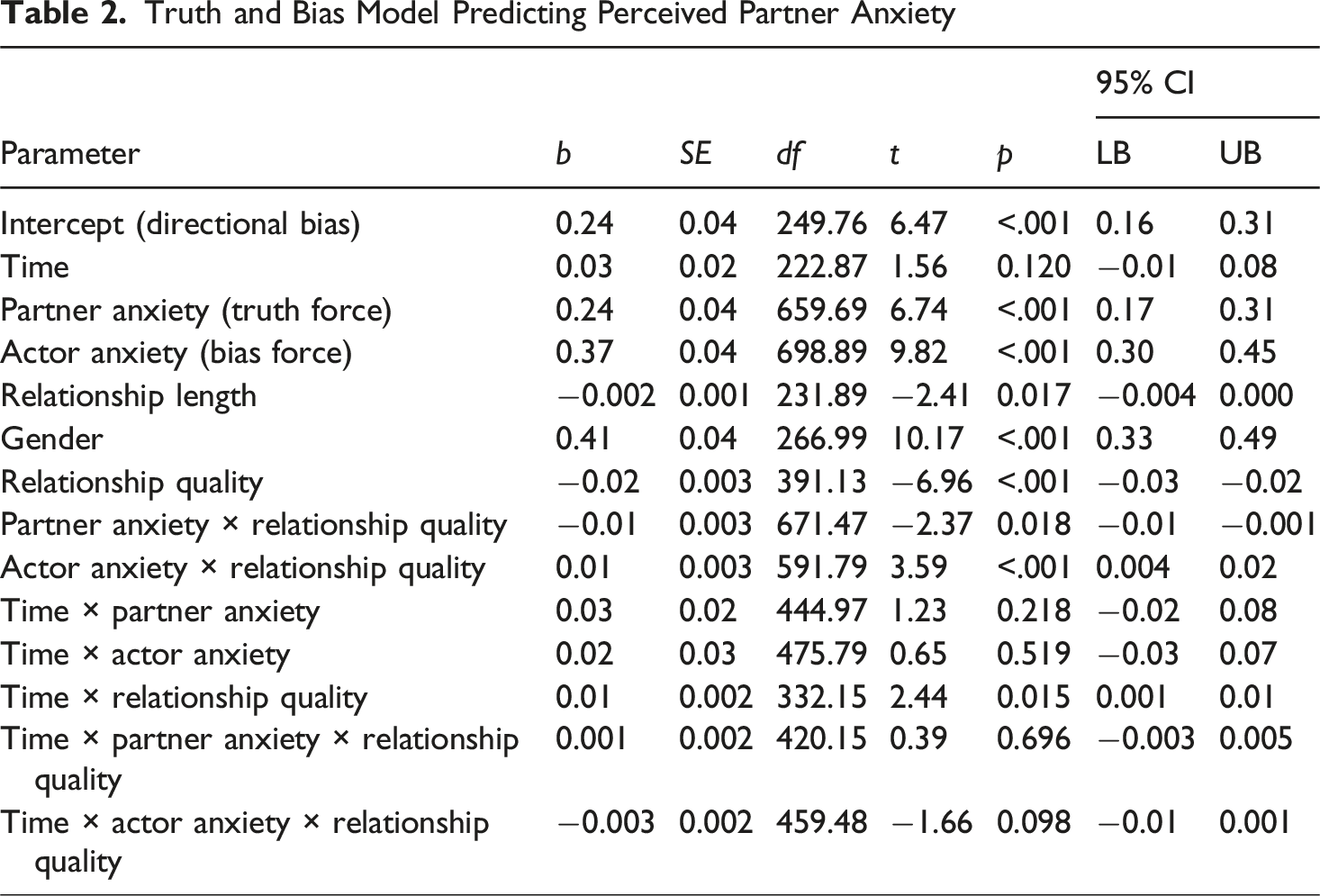
Truth and Bias Model Predicting Perceived Partner Anxiety
Truth Force
The partner’s self-reported attachment anxiety (i.e., the truth force) was statistically significant and positive, which suggests tracking accuracy. That is, when people rated themselves as higher in anxious attachment, their partners also rated them as higher in anxious attachment.
Similarity Bias
The rater’s own attachment anxiety was also statistically significant and positive, indicating assumed similarity bias plays a role in the judgment of the partner. That is, when people rated themselves as higher in attachment anxiety, they also assumed that their partners were higher in attachment anxiety (i.e., assumed similarity).
Moderation by Relationship Quality and Time
First, people reporting higher relationship quality show less overestimation of their partners’ attachment anxiety, whereas those with lower relationship quality showed more overestimation of partners’ attachment anxiety. Simply put, directional bias was less pronounced in better relationships.
Second, we decomposed the significant interactions between relationship quality and the truth force (Figure 2(a)), and relationship quality and similarity bias force on judgments of anxiety (Figure 2(b)). The truth and similarity bias forces were both significant and positive at higher (+1 SD) and lower (−1 SD) levels of relationship quality. The truth force was stronger among people lower in relationship quality (b = .32, p < .001 vs. higher relationship quality: b = .16, p = .002). That is, people who reported lower relationship quality showed greater agreement with their partner’s ratings of attachment anxiety (i.e., were more accurate). However, the assumed similarity bias was stronger among people higher in relationship quality (b = .49, p < .001 vs. lower relationship quality: b = .26, p < .001). That is, among people with higher relationship quality, the similarity bias was more pronounced: people’s own attachment anxiety more strongly contributed to their ratings of their partners’ attachment anxiety for individuals reporting higher relationship quality. Simple slopes analysis of the moderating effect of relationship quality on tracking accuracy (2a), assumed similarity bias (2b) and time (2c) for perceived partner attachment anxiety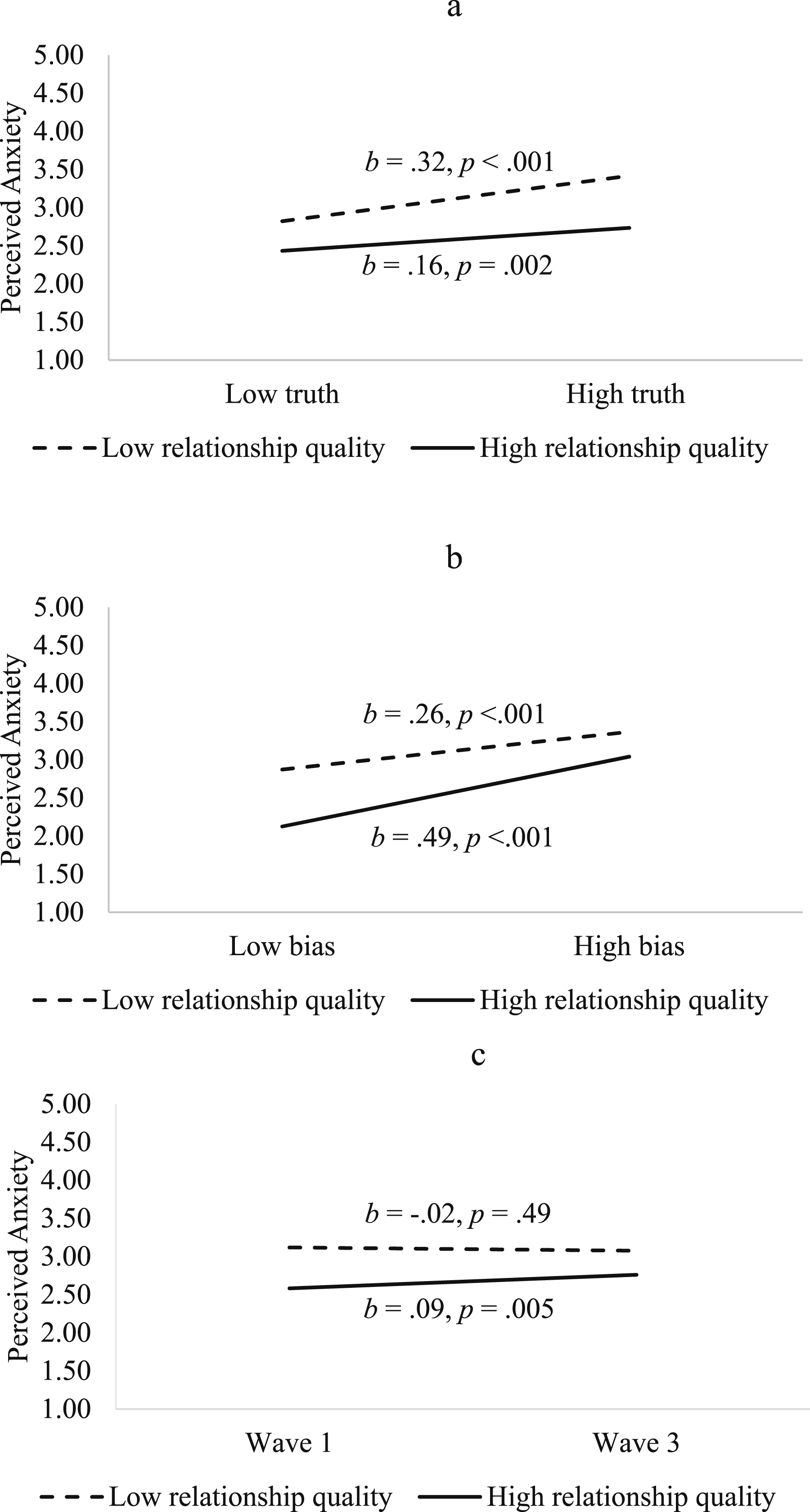
Third, there was a significant interaction between time and relationship quality (Figure 2(c)). Contrary to our prediction, people with higher relationship quality viewed their partners as more anxious over time. This was surprising, but the magnitude of the association was small (b = .09, p = .010). Also given the “main effect” of relationship quality (that happy people rate their partners as less anxious), it was still the case that people in higher quality relationships rate their partners as less anxiously attached than those in lower quality relationships throughout the entire study period (i.e., ratings of attachment anxiety became higher over time but did not reach the ratings of those lower in relationship quality). People who reported lower relationship quality did not change their perceptions of their partners’ attachment anxiety over time (b = −.02, p = .49). There were no significant three-way interactions among time, relationship quality and the truth/bias forces.
Using subscales of relationship quality (full results in the supplement), we found that people who reported higher levels across all components showed less directional bias of their partners’ attachment anxiety (i.e., lower overestimation; ps <.001). Time only interacted with relationship satisfaction, mirroring the general pattern (i.e., more satisfied people viewed their partners as increasingly anxious over time but overall viewed them less anxious than less satisfied people). Only affective expression moderated the truth force—people who reported lower levels of affective expression were more accurate (b = .33, p < .001 vs. higher levels of affective expression: b = .19, p < .001). All but consensus moderated similarity bias—people who reported higher levels of relationship satisfaction, cohesion, and affective expression viewed their partners as more similar to them (ps < .017).
Attachment Avoidance
Directional Bias
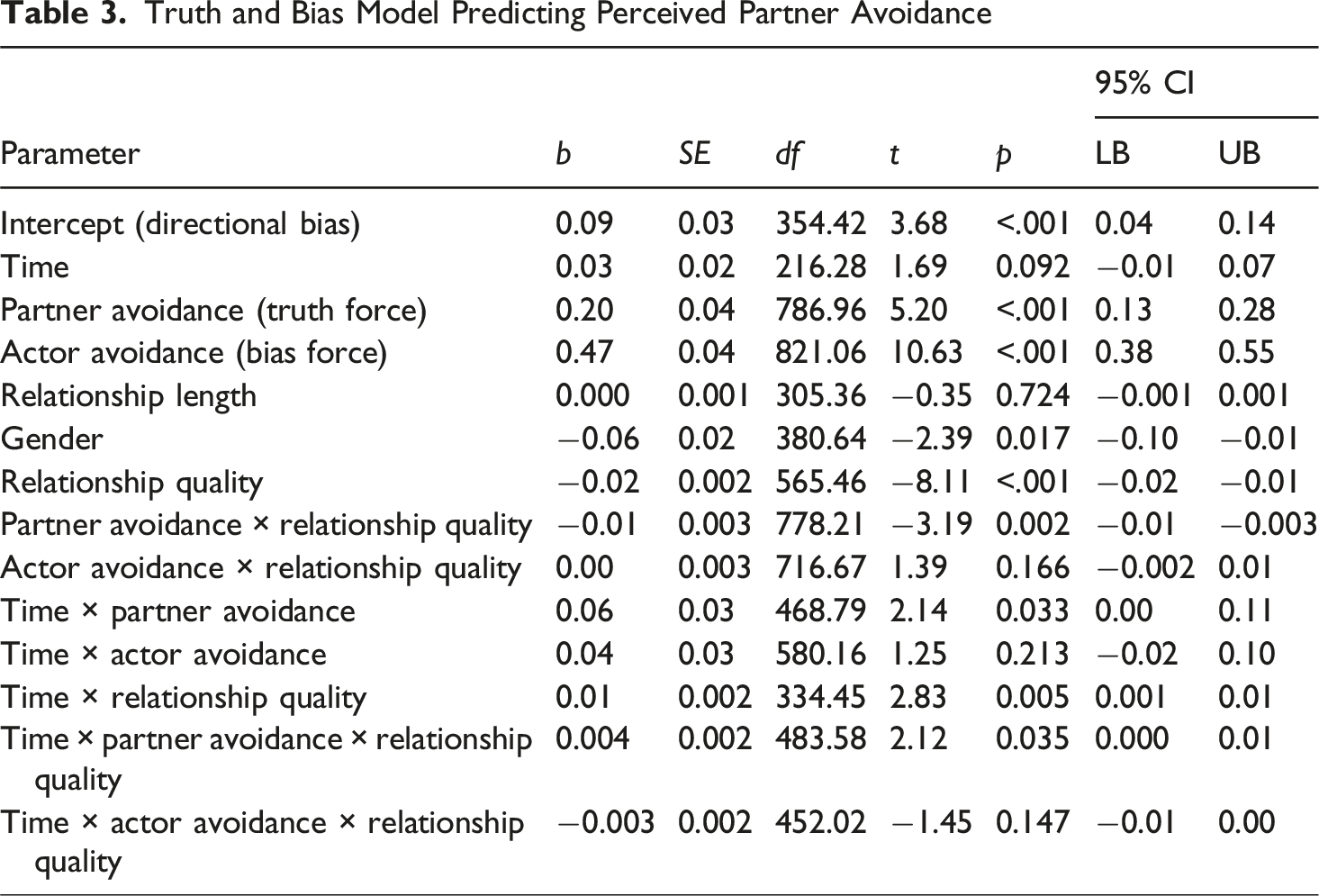
Truth and Bias Model Predicting Perceived Partner Avoidance
Truth Force
The partner’s self-reported attachment avoidance (i.e., the truth force) was statistically significant and positive, which suggests tracking accuracy; partners showed some agreement in their ratings of attachment avoidance.
Similarity Bias
The rater’s own avoidance was also statistically significant and positive, indicating assumed similarity bias playing a role in people’s judgments of their partners. That is, when people rated themselves as higher in attachment avoidance, they also assumed that their partners were higher in attachment avoidance.
Moderation by Relationship Quality and Time
First, people reporting higher relationship quality showed less overestimation (i.e., less directional bias) of their partners’ attachment avoidance, but this effect was only present in the first two years of marriage (i.e., the relationship quality × time interaction; the effect of relationship quality was no longer significant at wave 3, b = .02, p = .645).
Second, the strength of the truth force (agreement between people’s own reports and their partner’s judgments, i.e., tracking accuracy) changed over time (i.e., the partner avoidance × time interaction) and depended on relationship quality (i.e., the partner avoidance × time × relationship quality interaction). Relationship quality moderated the truth force at waves 1 and 3, but not at wave 2. Specifically, at wave 1, tracking accuracy was present only among individuals reporting lower levels of relationship quality (b = .37, p < .001 vs. b = .08, p = .253 for high relationship quality; Figure 3(a)). At wave 2, tracking accuracy was present in general (i.e., main effect of partner avoidance, b = .14, p = .005) but did not depend on relationship quality (i.e., no partner avoidance × relationship quality interaction, b = −.01, p = .083). At wave 3, tracking accuracy was present in general, but stronger among people reporting lower relationship quality (b = .40, p < .001; Figure 3(b)) than people reporting higher relationship quality (b = .16, p = .018). In other words, satisfied individuals’ judgments were uninfluenced by how their partners see themselves in earlier years of marriage but started to use this information to shape their judgments with time (i.e., more accurate judgments over time). Similarity bias did not vary by relationship quality or time. Simple slopes analysis of a three-way interaction among time, relationship quality, and tracking accuracy on perceived partner avoidance: The moderating effect of relationship quality on tracking accuracy decomposed at wave 1 (3a) and wave 3 (3b).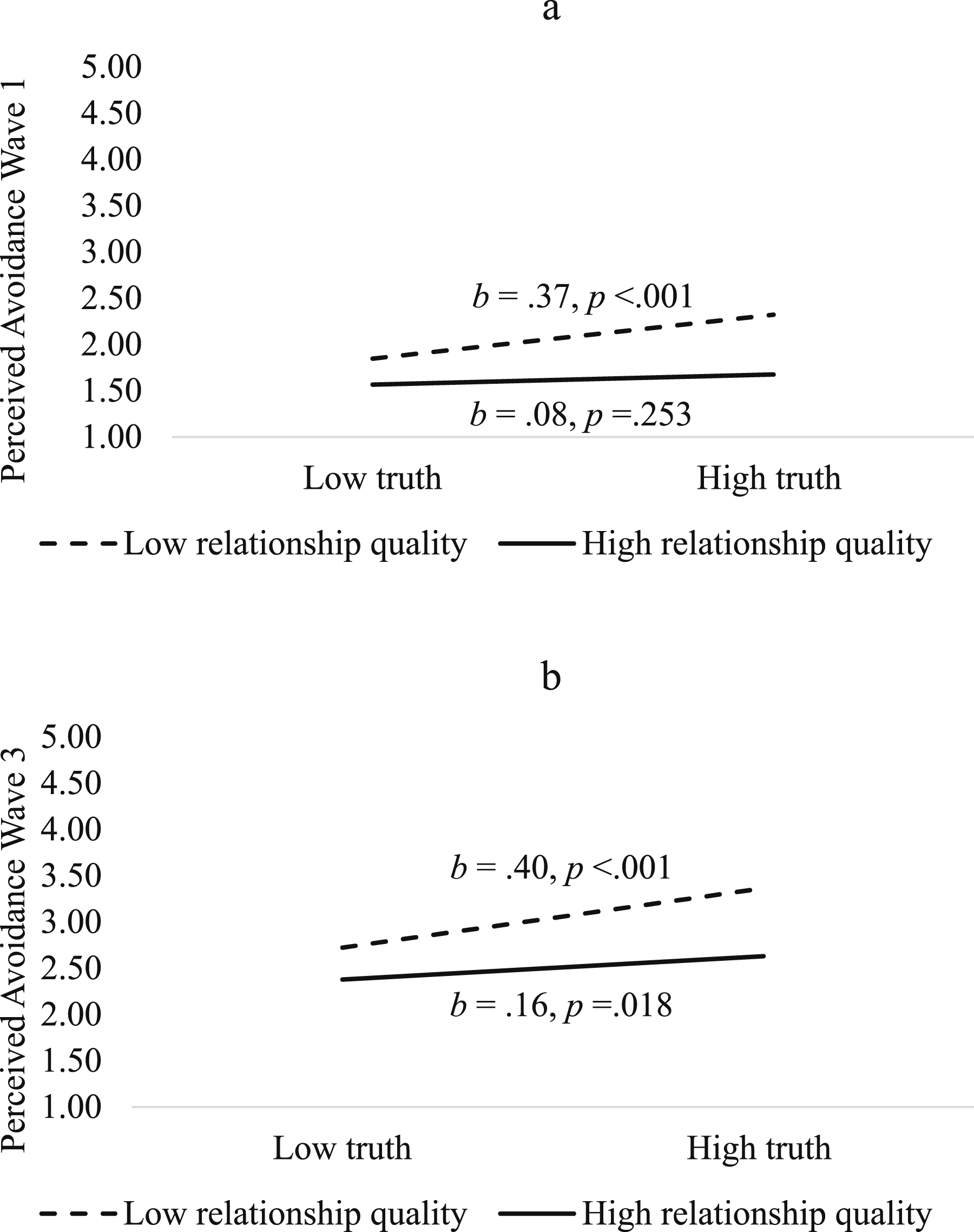
Using subscales of relationship quality (full results in the supplement), we found that people who reported higher levels across all components showed less directional bias of their partners’ attachment avoidance (ps <.001). Affective expression and consensus moderated the truth force (ps <.006)—people who reported lower levels of affective expression consensus were more accurate. Only affective expression moderated similarity bias—people who reported higher levels of affective expression viewed their partners as more similar to them (b = .64, p < .001 vs. low affective expression: b = .47, p < .001).
Discussion
Perceptions have implications for the course and quality of a relationship (Fletcher, 2015; Le et al., 2010). For example, people often project whether they think they should end a relationship onto their partner (e.g., thinking, “I think this relationship has run its course; my partner probably feels the same way”; Tan et al., 2023). Accuracy and bias in perceptions make unique contributions to both the actor’s and partner’s relationship satisfaction (Luo & Snider, 2009), which suggests the importance of understanding their roles in perceptions of attachment orientation over time. By examining accuracy and bias in perceptions longitudinally, and how they are shaped by relationship quality, the present study sheds light on the interpersonal processes that may sustain—or erode—relationships.
Partner judgments of attachment were accurate—their judgments agreed with their partners’ judgments—and biased—people used their own attachment orientation to guide judgment of their partners. These patterns were consistent with research suggesting self-other agreement and people’s tendency to assume partners are similar to them. Surprisingly, partners overestimated each other’s insecurity instead of viewing them more positively (Gagné & Lydon, 2004; Watson & Humrichouse, 2006). Even though people may view their partners more positively on a number of different characteristics (Solomon & Vazire, 2014), ostensibly negative relationship-oriented traits such as attachment orientation may be something that people overestimate (Spielmann et al., 2020). Accuracy and biases in perceptions were mostly consistent over time but depended on relationship quality—individuals in higher quality relationships tended to assume more similarity while individual is lower quality relationships were both more accurate and more strongly overestimating insecurity.
Additional exploratory analyses examining subscales of relationship quality (i.e., satisfaction, consensus, cohesion, and affective expression) reveal some patterns that reflect possibly meaningful nuances. Lower levels on all subscales were associated with greater overestimation of partner attachment insecurity, supporting our general hypothesis that people in lower quality relationships would overperceive quality insecurity. However, only affective expression consistently moderated the accuracy and similarity bias, and consensus deviated the most from the general patterns. These differences highlight the complexity of how different aspects of relational functioning shape perceptions of a partner’s attachment. While informative, these findings are exploratory and warrant replication before drawing firm conclusions about the distinct roles of each component. Thus, we largely focus on discussing the main patterns.
Taken together, our study suggests that people are generally accurate and biased when judging their partners’ attachment over time, but how they feel about the relationship influences their perceptions. These results have implications for how people starting their marriages view their partners over time and how relationship dynamics shape (or do not) their perceptions.
Accuracy and Bias in Perceptions of Partner’s Attachment Orientation
People are motivated to know their partner and be accurate, which has been reflected in accurate perceptions of other partner characteristics and interaction patterns (Fletcher & Kerr, 2010; LaBuda & Gere, 2023; Luo & Snider, 2009). Consistent with past research, though mostly on characteristics other than attachment (Aviles et al., 2021; Rohrer et al., 2018), we found that people’s perceptions of attachment styles agreed with their partners’ self-perceptions.
Nevertheless, people’s perceptions were also biased in how they viewed their partners. First, newlywed couples saw their partners as more anxiously and avoidantly attached than their partners saw themselves. Second, we also found that people project their own attachment orientation onto their partners (i.e., assumed similarity bias), similar to other characteristics people judge their partners on (LaBuda & Gere, 2023). The overestimation was surprising as it is inconsistent with a series of early findings that suggest people tend to evaluate their partners more positively (Fletcher & Kerr, 2010; Gagné & Lydon, 2004; Segrin et al., 2009; Solomon & Vazire, 2014), even ignoring relationship-threatening information (Simpson et al., 1995). However, a more recent meta-analysis (LaBuda & Gere, 2023) suggested that as researchers considered a wider range of constructs, no consistent positivity bias emerged among constructs, but rather the pattern differed by construct. In fact, the overestimation we see with attachment does appear in studies on constructs conceptually related to attachment orientations. For example, people overestimate their partners’ fear of being single (Spielmann et al., 2020). People can be worried about being without a romantic partner and being single, and this fear is related to attachment anxiety (George et al., 2020; Sakman et al., 2021; Spielmann et al., 2013). Signs of attachment insecurity might be more visible than signs of attachment security. Newlywed couples navigate changes in interdependence/identity, routines, relationships with others, and responsibilities (Hall & Adams, 2011). Discussions about these changes, which involve disclosures and being responsive to disclosures, may occasionally be awkward or even adversarial. As a result, newlyweds might perceive greater insecurity even though they view each other more positively in many other ways. Additionally, overestimating attachment insecurity in their partner may be adaptive for the relationship as this perception can motivate people to put in more effort, providing greater support for their partner according to (according to error management theory; Haselton & Buss, 2000).
Do Relationship Quality and Time Moderate Accuracy and Bias in Attachment?
Given that people’s self-reported attachment orientation changes over time generally in the direction of security (Chopik et al., 2019; Davila et al., 1999), we were interested in examining whether people perceive change in their partners’ attachment orientation as well. Furthermore, we expected people who reported lower relationship quality would perceive greater attachment insecurity over time, and explored the effect of relationship quality on their accuracy, and assumed similarity bias as well. Despite past research on change towards (self-reported) attachment security and a honeymoon effect, where perceptions of the partner’s personality traits start quite positive but become more negative over time (Watson & Humrichouse, 2006), our results mostly suggested consistency in truth and bias forces over time. There was occasional moderation by relationship quality, and we discuss how these patterns were specific to anxiety and avoidance separately.
For attachment anxiety, relationship quality moderated each type of accuracy and bias. People who were unhappy with their relationship thought their partners were more anxious but did so consistently over time. In contrast, people who were happier with their relationships saw their partners as becoming more anxiously attached over time, but they still saw their partners as less insecure overall. In other words, we see a version of the honeymoon pattern (Watson & Humrichouse, 2006) among happily married couples: their perceptions are more positive at first, showing less overestimation of anxious attachment—but contrary to patterns of self-reported change, their perceptions change towards insecurity. Otherwise, the newlywed couples in our study were consistently accurate and consistently projected over time. On the one hand, people, on average, showed a degree of projection. But those who were more satisfied particularly thought their partner was similar to them, similar to past research that suggests greater projection among satisfied couples (LaBuda & Gere, 2023). On the other hand, people on average showed a degree of accuracy but those who were less satisfied were more accurate in perceiving their partner’s attachment anxiety. Across diverse constructs, relationship quality is not always associated with tracking accuracy, though higher relationship quality can be associated with intimacy and deeper knowledge of one’s partner, or greater accuracy (Fletcher & Kerr, 2010; LaBuda & Gere, 2023). Nevertheless, people who have lower trust and more suspicion can be hypervigilant to relationship-threatening information (Ickes et al., 2003). These people are likely less satisfied with their relationships, and to protect themselves and/or their relationships, they may be motivated to be more accurate. In sum, we found support that people who are unhappy with their relationship see their partner as more anxiously attached, but their perceptions did not become more negative over time. They also saw their partners as less similar to themselves, although they were more accurate.
For attachment avoidance, time and relationship quality moderated the mean-level directional bias and accuracy, but neither time nor relationship quality moderated assumed similarity bias. The pattern for mean-level bias was similar with attachment anxiety: people who were unhappy with their relationship consistently perceived greater attachment avoidance over time. People who were happier with their relationships saw their partners as becoming more avoidantly attached over time but still saw their partners as less insecure overall. Regarding accuracy, people who were less satisfied were consistently more accurate in perceiving their partners’ attachment avoidance; people who were more satisfied were not accurate at the start of marriage but became accurate over time. Attachment avoidance, which involves keeping emotional experiences to oneself rather than expressing them and relying on the partner, might be less visible than attachment anxiety (e.g., Peters et al., 2019; Tu et al., 2022). As a result, those who are particularly trying to protect themselves and/or their relationships (i.e., less trusting and less satisfied with their relationships) may consistently be accurate (Ickes et al., 2003). Those who are not looking for negative cues (i.e., the satisfied participants) may need more time to recognize such information to form an accurate judgment.
Limitations and Future Directions
The present sample of newlywed couples allowed us to focus on perceptions in the early years of marriage, but the timeframe and sample limited the generalizability of the findings and the ability to establish directionality in these effects. A previous meta-analysis found that relationship length generally does not influence accuracy and bias in partner perceptions (LaBuda & Gere, 2023). However, newlyweds might be highly motivated to be accurate about their partners as people contemplating important relationship milestones, like getting married, tend to be accurate (Fletcher & Thomas, 2014; Gagne & Lydon, 2001). Thus, further work should follow couples diverse in marital statuses and length of relationships over time. Additionally, the study used existing data that did not collect information on participants’ gender identity, sexual orientation, or disability status. Future research is needed to examine whether the present findings generalize across diverse identities and lived experiences.
A related direction for future research is to examine both the mechanisms that give rise to these perceptions and their consequences by isolating factors that lead partners to see each other in more or less accurate, positive, and similar (to oneself) ways. For example, are there some interactions during daily life that might be associated with increases in truth and bias over time (LaBuda et al., 2020; Visserman et al., 2021)? Further, people’s feelings about relationships also change across time (Lavner & Bradbury, 2010), which could affect accuracy and bias. Likewise, perceptions can also guide feelings about relationships that change over time (Tan et al., 2023). Future research that examines the mechanisms behind accuracy and bias can help better understand their implications to relationships and the individuals within them.
The present findings should also be interpreted in light of measurement limitations. In our sample, the two-factor model of attachment did not fit as well as expected given its wide usage and existing theory. Recently, Brauer and Poyer (2025) suggested measurement invariance at the dyadic level while noting lower model fit indices using CFI, consistent with our sample. Though there may be alternate measurement structures (e.g., bifactor models, where there is a general attachment factor and two grouping factors), these models only showed modest improvements (Machan et al., 2025). Potential misspecification of attachment using this measure could influence the truth and bias effects we observed. Future research employing other samples, alternative measurement models, and alternative measures can help establish the robustness of patterns in the present study.
Conclusion
Perceptions about one’s partner are linked with relationship outcomes and experiences (e.g., Finkenauer & Righetti, 2011; Lemay Jr & Dudley, 2011; Murray et al., 2000). Past research found evidence that perceptions are both accurate and biased over time, and that relationship quality is linked with self-perceptions. We also found that among newlywed couples, people showed a degree of accuracy about their partners’ attachment orientations over time. Interestingly, it was particularly those in less satisfying relationships who were more consistently accurate over time. Despite being generally accurate, people saw their partners to be more insecure than their partners saw themselves, especially if they were less happy with their relationship. When people were happy with their relationship, they saw more of themselves in their partners. But they do not necessarily live a life of blissful ignorance—they still see their partners as a bit more insecure than their partners see themselves (albeit not as much as people in unhappy relationships). Given the importance of perceptions for future relationship quality and stability, further investigations are needed to understand factors that shape attachment perceptions over a longer course of the relationship.
Supplemental material
Supplemental Material - Truth and Bias in Partner Perceptions of Attachment Orientation Over Time: The Moderating Role of Relationship Quality
Supplemental Material for Truth and Bias in Partner Perceptions of Attachment Orientation Over Time: The Moderating Role of Relationship Quality by Jeewon Oh, Mariah F. Purol, William J. Chopik, Fiona Ge, Sally I. Powers, Paula R. Pietromonaco in Journal of Social and Personal Relationships
Footnotes
Funding
The authors received no financial support for the research, authorship, and/or publication of this article.
Declaration of Conflicting Interests
The authors declared no potential conflicts of interest with respect to the research, authorship, and/or publication of this article.
Open research statement
As part of IARR’s encouragement of open research practices, the authors have provided the following information: This research was not pre-registered. The data and analysis code used in the research are publicly posted. The materials can be obtained at: https://osf.io/ne6vc/overview or by emailing:  or can be obtained by emailing:
Supplemental material
Supplemental material for this article is available online.
Notes
References
Supplementary Material
Please find the following supplemental material available below.
For Open Access articles published under a Creative Commons License, all supplemental material carries the same license as the article it is associated with.
For non-Open Access articles published, all supplemental material carries a non-exclusive license, and permission requests for re-use of supplemental material or any part of supplemental material shall be sent directly to the copyright owner as specified in the copyright notice associated with the article.
