




Abstract
Marital relationship quality is a strong predictor of overall health, making it a critical target for prevention and intervention efforts. In Iran, rapid cultural shifts have reshaped marital dynamics, highlighting the need for accessible psychological support. Relational Savoring (RS), a brief attachment-based program, aims to strengthen relationship quality by guiding individuals to re-experience moments of positive connectedness. The present study is the first to evaluate a 4-week, group-based RS program in Iran among 96 female spouses, testing its effects on affective (positive emotion, relationship closeness) and cognitive (relationship satisfaction) domains at post-treatment and three-month follow-up, compared to a no-treatment control. The study also tested an exploratory research question regarding whether sharing savored memories with one’s partner between sessions had a differential impact relative to the traditional relational savoring protocol, which does not prescribe sharing. Results showed that the RS-Combined condition (pooling both savoring conditions) produced greater improvements across all outcomes at post-treatment with small effect sizes (marginal R2 = 0.02–0.05), although these effects were not sustained at the three-month follow-up. Comparisons between the two savoring conditions (RS-No Share versus RS-Share) revealed mixed patterns: sharing was linked with stronger gains in positive emotion at post-treatment, whereas not sharing was associated with greater improvements in relationship closeness and satisfaction at post-treatment. We interpret these findings to suggest preliminary promise for RS, particularly RS-No Share, in improving short-term outcomes for Iranian wives. Future work should examine ways of prolonging the effects observed in this study.
Marital relationship quality encompasses both affective (e.g., conflict, support) and cognitive components (e.g., satisfaction, commitment, closeness; Fincham & Bradbury, 1987; Karney & Bradbury, 1995). As a multidimensional construct, marital quality is often assessed through domains such as satisfaction, intimacy, and emotional closeness, and is linked with both psychological and physical health including lower risk of mortality and reduced cardiovascular reactivity during marital conflict (Pietromonaco & Collins, 2017; Robles et al., 2014). Being married itself can serve as a protective factor against mental and physical health problems (Aizer et al., 2013; Kiecolt-Glaser & Newton, 2001).
However, maintaining high marital relationship quality can be challenging. Stressors of married life, such as financial strain or parenting challenges, can erode relationship satisfaction, a widely used index of marital quality, particularly as the newness of a relationship wears off. Indeed, relationship satisfaction shows reliable declines over time. A recent meta-analysis found that relationship satisfaction decreases between ages 20 and 40, reaching its lowest point around age 40, before increasing again into older adulthood (around age 65; Bühler et al., 2021). The central role of marital quality in predicting health, coupled with the challenges of sustaining it, point to the need for programs designed to provide support.
Marital Relationships in Iran
In Iran, marital relationships have traditionally been shaped by Islamic cultural norms that emphasize the permanence of marriage. Historically, relationships between Iranian men and women have been embedded within patriarchal legal and social structures, with men positioned as heads of households and women occupying more subordinate roles, consistent with broader patterns in Muslim legal traditions (Mir-Hosseini, 2000, 2015). However, the marital landscape in Iran has undergone substantial change in recent decades. Individuals are marrying later and at lower rates (Koosheshi & Khalili, 2021), women’s ability to initiate divorce has expanded (Amanat, 1993), and divorce rates--which were once relatively low--have risen sharply (Akhavan, 2014; Iranian Civil Registration, 2016). These demographic and social shifts underscore the growing importance of understanding and supporting marital relationship quality in the contemporary Iranian context.
Despite these changes, empirical research on marital relationships in Iran remains limited and has often focused primarily on women (e.g., Babaee & Ghahari, 2016). Nevertheless, emerging work offers valuable insights into processes that may promote marital intimacy, defined as the reciprocal sharing of internal experiences (Ferreira et al., 2013). For example, using a culturally adapted marital interaction assessment, Sadeghi et al. (2012) found that non-distressed couples, compared to distressed couples, used higher levels of first-person plural pronouns (e.g., “we”) during problem-solving conversations. This linguistic pattern is thought to reflect a joint, team-oriented approach to problem solving and an interdependent self-construal, which has been linked to greater relationship satisfaction in prior longitudinal research (Ouellet-Courtois et al., 2023).
Complementing these findings, qualitative research has identified several factors that appear to enhance marital intimacy among Iranian couples, including strong family ties, longer marital duration, mutual self-sacrifice, expressions of gratitude, shared activities, parenthood, overlapping social networks, and religious engagement (Kamali et al., 2020). Collectively, these factors highlight promising targets for marital interventions, as they emphasize closeness through self-other overlap, emotional and social connectedness, and positive emotions such as gratitude. However, relatively few interventions have been developed to strengthen marital relationship quality and emotional intimacy among Iranian couples, and even fewer have assessed outcomes at follow-up (Behrang et al., 2021; Karden-Souraki et al., 2015; Khazaeian et al., 2021). Moreover, although existing interventions have primarily focused on enhancing intimacy by addressing attachment-related needs (e.g., Behrang et al., 2021), no programs to date have explicitly targeted the positive relational processes identified in Kamali et al.’s (2020) qualitative analysis, such as mutual self-sacrifice, gratitude, and shared activities. In light of rising divorce rates in Iran, the development of interventions aimed at supporting marital quality is both timely and warranted.
More broadly, Iran is often described as occupying a position along the continuum between collectivist and individualist societies, with individuals tending to hold a relational view of the self (Cross et al., 2000), in which identity is defined in relation to close others. Consistent with this perspective, family plays a central role in self-concept in Iran (Zabihzadeh et al., 2019), encompassing not only one’s spouse but also one’s family of origin (Sadeghi et al., 2012). This relational orientation further underscores the cultural relevance of interventions that strengthen marital bonds and promote emotional intimacy within couples.
Relational Savoring
Relational savoring (RS; Borelli, 2024; Borelli et al., 2020) is a prevention and intervention technique designed to enhance both intrapersonal and interpersonal well-being through guided reflection on moments of close interpersonal connection. RS is informed by broaden-and-build theory (Fredrickson, 2001) and attachment theory (Bowlby, 1973). Broadly, the broaden-and-build theory posits that positive emotional states promote openness and cognitive flexibility, creating an optimal context for change, while attachment theory emphasizes felt security--experiences of safety, trust, and reliability within close relationships--as a central component of well-being (Mikulincer & Shaver, 2016).
During RS, participants are guided to recall a specific moment of felt security with their partner, such as providing encouragement before a job interview (caregiving) or seeking comfort after receiving distressing medical information (care-receiving). Participants attend to the feelings of safety, trust, confidence, and emotional connection present during and activated by this interaction. By evoking thoughts and emotions tied to a concrete experience of felt security (Mikulincer & Shaver, 2016), RS aims to strengthen broader mental representations of the self as both a capable caregiver and a worthy care recipient--someone who can provide love, is deserving of love, and experiences security within close relationships. Through this process, RS seeks to enhance intrapersonal well-being (e.g., reductions in mental health symptoms) and interpersonal well-being (e.g., increased interpersonal sensitivity; see Borelli, 2024; Borelli et al., 2020).
RS teaches the emotion regulation strategy of savoring, the process of attending to, appreciating, and prolonging positive emotional experiences, which has been linked to greater life satisfaction and fewer depressive symptoms (Cheung & Lau, 2021). Participation in savoring-based interventions is associated with increases in positive emotionality (Bryant & Veroff, 2007) and reductions in depressive symptoms (Villani et al., 2023). RS is distinct from general savoring in its focus on relationships -- by intentionally revisiting emotionally rich moments of connection, RS integrates the benefits of savoring with the relational depth emphasized by attachment theory.
RS is a manualized approach that consists of three phases. First, the intervener facilitates a brief mindfulness exercise (e.g., 1 min of deep breathing) to promote relaxation and focus. Next is the memory selection phase, in which the intervener helps the participant identify two to three positive memories involving their spouse. Ideally, these include attachment themes, either Secure Base (e.g., calling a partner for encouragement before a job interview, providing a partner with encouragement before a job interview) or Safe Haven (e.g., seeking comfort after bad news, providing comfort after bad news). In the absence of attachment themes, memories with clear themes of positive connectedness (e.g., enjoying one another's presence, cuddling) are prioritized. After the participant has discussed two to three memories with the intervener, the intervener selects the memory with the strongest content (the most positivity and connectedness, and the least negative emotional drift; Borelli, 2024). Finally, the participant moves on to the memory reflection phase, in which the intervener guides the participant through a five-step structured reflection process to deepen the emotions and significance associated with the memory.
RS has been evaluated across a variety of populations, including romantic partners (Borelli, Burkhart et al., 2014; Borelli, Sbarra et al.; 2014; Wang et al., 2023), parents of young children (Ansarifar et al., 2025; Borelli et al., 2022; Burkhart et al., 2015; Sharifi et al., 2025), older adults (Borelli et al., 2019), college students (Nguyen et al., 2025), Latine-serving community health workers (Rowley et al., 2026), and teens in residential treatment (Wang et al., 2020). Across these trials, compared to Control Groups (no-treatment, control awareness tasks, or savoring a personal experience, depending on the study), RS has been linked to increased feelings of closeness (Ansarifar et al., 2025; Borelli et al., 2022), greater relationship satisfaction (Borelli, Burkhart et al., 2014), greater positive emotion (Borelli et al., 2022; Burkhart et al., 2015), and greater sensitivity/availability (Ansarifar et al., 2025; Borelli et al., 2022; Sharifi et al., 2025; Smiley et al., 2024). Further, RS has been culturally adaptive to subcultures within the United States that share an emphasis on the importance of family relationships (Latine: Borelli et al., 2014; Asian American: Li et al., 2025).
The mode of administration of RS has varied across trials: in-person (Borelli et al., 2022; Sharifi et al., 2025; Wang et al., 2020), online (Borelli, Burkhart et al., 2014; Burkhart et al., 2015; Lord et al., 2026), phone-based (Borelli, Sbarra et al., 2014), and mobile app–based (Nguyen et al., 2025). Most in-person administrations have used individual sessions, though emerging studies have examined group-based approaches--for example, with parents in Iran (Ansarifar et al., 2025; Sharifi et al., 2025) and within a broader group attachment-based intervention that prominently incorporates RS (Borelli et al., 2021).
To date, no studies have tested a group-based administration RS for married individuals, the focus of the current study. Further, almost all research on RS has been conducted in the United States, with only two recent studies in Iran, both focused on parents of young children (aged 5 and under; Ansarifar et al., 2025; Sharifi et al., 2025). Moreover, most marital intervention studies conducted in Iran have been quasi-experimental (Kardan-Souraki et al., 2015) or lacked a comparison group (Babaee & Ghahari, 2016). Given that the marital context in Iran differs substantially from that in the United States, it is essential to test relationship-based interventions for efficacy within Iran rather than assume they will be effective across contexts. Based on the broader trend within Iran to focus exclusively on women in marital research, this study only enrolls female-identifying participants with acknowledgement that future work should strive toward the incorporation of male-identifying participants when possible.
Although not all RS trials have assessed interpersonal outcomes, existing evidence suggests that even when delivered individually, RS can enhance interpersonal sensitivity (Ansarifar et al., 2025; Borelli et al., 2022; Sharifi et al., 2025; Smiley et al., 2024). These benefits may be amplified when participants share the savored memory with the person involved, as doing so allows participants not only to re-experience the positive moment but also to communicate feelings of closeness and appreciation (Borelli, 2024). For the listener, hearing the shared memory may reactivate a meaningful relational experience, thereby strengthening their own sense of connection. This reciprocal exchange may “supercharge” the intervention by extending its effects across the dyad. Although a clinical case study has described the use of RS sharing within a couple (Borelli, 2024), this approach has not yet been systematically tested in RS trials.
This proposed benefit of sharing positive relational memories aligns with research on capitalization--the process of sharing positive experiences with close others--which has been shown to produce greater gains in affect and relationship quality than experiencing positive events alone (Gable & Reis, 2010; Otto et al., 2015; Peters et al., 2018). While the concepts of RS and capitalization have in common the disclosure of positive experiences to a close other, they differ in important ways. In capitalization, the positive event is external to the relationship (e.g., a job promotion), whereas in RS, the positive experience is inherently interpersonal (e.g., recalling a moment of spousal support during a challenging time).
Research also suggests cultural variation in capitalization processes (Choi et al., 2019). Although studies in the Middle East are limited, one investigation in Turkey found that capitalization occurs less frequently than in the United States, yet remains positively associated with relationship quality (Demir et al., 2013). Building on this literature, the present study examined whether sharing a savored memory with one’s partner enhances the effects of RS. Although prior capitalization research and a clinical case study of RS sharing in a U.S. couple suggest potential added benefits, cultural norms in Iran--characterized by strong family bonds alongside greater privacy with the broader social world (Zabihzadeh et al., 2019) -- make it unclear whether sharing would similarly enhance intervention effects in this context.
Current Investigation
We conducted the first study to examine RS as a strategy to enhance emotions and romantic relationship quality among Iranian wives. In addition, we tested whether sharing the savored memory with one’s partner spouse added benefits beyond savoring within the group session. To address these aims, we delivered a four-session group intervention to Iranian wives using a randomized design. Participants were assigned to one of three conditions: (1) RS administered individually (RS–No Share), (2) RS administered individually with the added component of sharing the memory with their husbands between sessions (RS–Share), or (3) a no-treatment Control Group. Our hypotheses were tested in two steps. First, we combined the two RS conditions into one superordinate RS condition (RS–Combined) and compared outcomes against the Control Group, enabling us to examine the broader impact of RS against a control. Second, we compared outcomes separately across all three groups, testing an exploratory hypothesis regarding the sharing of RS memories with one’s spouse. First, we predicted that (a) RS-Combined would result in greater increases in positive emotion compared to the Control Group (Hypothesis 1a), and (b) tested whether RS–Share participants reported different impacts in positive emotion than both RS–No Share and Control participants (Hypothesis 1b). For Hypothesis Two, using two indicators of closeness, overlap in sense of self (inclusion of other in the self (IOS); Aron et al., 1992) and perceived closeness (Dibble et al., 2012), we predicted that (a) RS–Combined would result in greater increases in closeness than the Control group participants (Hypothesis 2a), and (b) tested whether RS–Share participants would show different impacts in these two closeness indicators than both RS–No Share and controls (Hypothesis 2b). For Hypothesis Three, we predicted that (a) RS–Combined participants would report greater increases in relationship satisfaction than controls (Hypothesis 3a), and (b) tested whether RS–Share participants showed different impacts in satisfaction than both RS–No Share and controls (Hypothesis 3b).
Method
Participants and Procedures
This experimental study was conducted using a pretest, a posttest and a 3-month follow-up assessment. All married women in the Isfahan province in Iran in 2023 were eligible to participate. Participants were informed that they were being invited to participate in a study about marital relationships. The inclusion criteria included (a) women who have been living with their husbands for at least one year, (b) having attained at a high school diploma or more education, (c) not receiving other individual or group therapy concurrently, and (d) being without a history of chronic mental disorders (per self-report), defined as schizophrenia, bipolar disorder, chronic depression, and other psychiatric disorders that significantly impair an individual’s functioning and require ongoing medical care. The exclusion criteria included (a) absence from a session, and (b) failure to complete questionnaires (pre-test, post-test, and 3-month follow-up). To select the sample, a public call was made to participate via social media and also in-person at public meeting places. Subsequently, 105 people were selected through volunteer-purposive sampling to participate in the study.
Using a random number generator, the participants were then divided randomly into three groups, each containing 35 participants. The following groups were created: RS–no spousal sharing (RS-No Share), RS- spousal sharing condition (RS-Share), and Control Group. Members of the Control Group did not receive any intervention. Three RS-Share participants failed to attend any sessions; thus, these participants were excluded from the study. Additionally, during data analysis, three participants from RS-No Share were removed because they had not attended any intervention sessions. In order to preserve balanced numbers across the groups, three participants from the Control Group were randomly chosen to be excluded from analyses, consistent with a per protocol approach to analysis.
The final sample size consisted of 96 participants (M age = 33.75 years, SD age = 10.30, age range: 19–60, median age: 32), all of whom identified as Persian heterosexual women. Among them, 32 participants (33.3%) had no children, while 64 (66.7%) had at least one child. Regarding the number of children, 25 (26.0%) had one child, 24 mothers (25.0%) had two children, 12 mothers (12.5%) had three children, and 3 mothers (3.1%) had four children. The average age of their spouses was 38.24 years (SD = 10.37). Among the respondents, 81.3% were homemakers, 12.5% employees, 6.2% self-employed, and 16.66% were students. In terms of economic class, 41.7% of participants characterized their economic class as intermediate, 55.2% as good, and 3.1% as excellent. None of the participants reported having a disability. Regarding their spouses, 2.1% were unemployed, while 35.4%, 54.2%, and 8.3% of the spouses were self-employed, employees, and retirees, respectively. 33.3% held a high school diploma, 47.9% had a bachelor’s degree, and 18.8% had a master’s degree. The average number of children among respondents was 1.26 (range = 0–4). The average duration of marriage was 12.68 years (SD = 11.07); all participants reported being in their first marriage.
Before and after the intervention phase as well as during the follow-up period 3 months later, the members of all the three groups completed an assessment battery. Consistent with principles of research ethics, after the completion of the research, a one-day workshop on RS was held for the Control Group.
RS Intervention Protocol
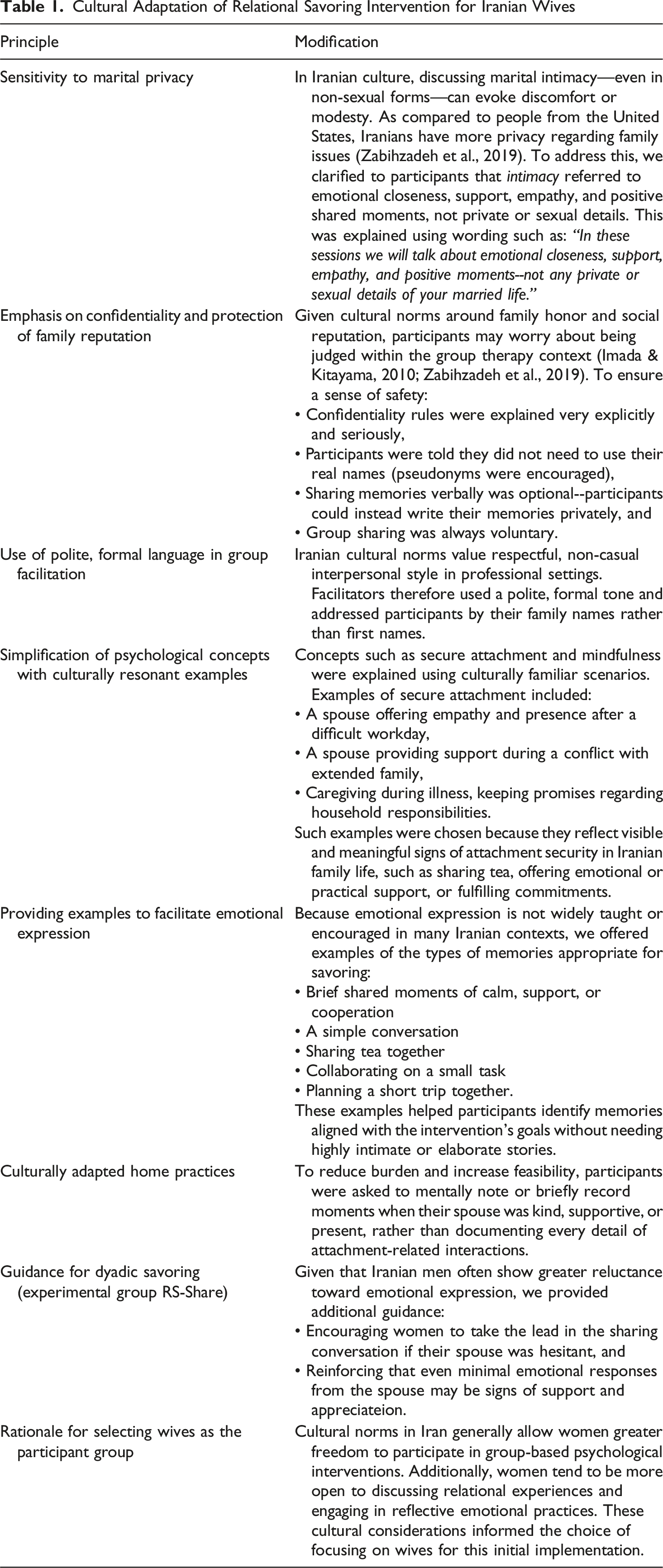
Cultural Adaptation of RS Protocol
Cultural Adaptation of Relational Savoring Intervention for Iranian Wives
Delivery of Adapted RS Protocol
Participants in both the RS-No Share and RS-Share conditions were organized into small groups of 5 to 7 individuals, within which the intervention was delivered. The intervention consisted of four structured sessions, each lasting 70 min, held weekly. All intervention sessions were led conjointly by a female counselor with a master’s degree in family counseling under the supervision of a male counselor holding a doctorate in the same field. While the overall protocol remained consistent, minor adaptations were made to accommodate the specific requirements of each group (RS-No Share and RS-Share), which are detailed below.
The first session was exclusively dedicated to psychoeducation and training in the RS technique. Specifically, psychoeducation focused on sharing the theoretical foundations underlying the intervention approach with the group members, including attachment, attachment needs within romantic partnerships, and mindfulness. In addition, interveners discussed the benefits of reflecting on positive moments of connection within attachment relationships (Borelli et al., 2024). These concepts were introduced using accessible language to ensure that participants clearly understood the theoretical framework, objectives, and procedures of the intervention. Interveners presented several sample memories of positive connection in marital relationships to participants, describing the characteristics of these memories that render them more and less suitable for savoring. Interveners then described and illustrated the five-step reflection process of RS, in which one takes a positive relationship memory, deeply re-experiences the memory, and derives significance from the memory. The goal of this psychoeducational session was to ensure that all participants had a clear understanding of RS and its rationale.
The RS intervention process, which was explained to participants in this initial session, involves an invariant series of steps. Each session began with a minute-long mindfulness breathing exercise designed to enhance sensory awareness and increase openness to the intervention. Next, participants begin the memory selection process, where the individual engages in the process of recalling meaningful attachment-related memories. Participants then choose a memory they would like to spend time reflecting on, entering the memory reflection phase. Priority is given to memories that reflect attachment security or moments of positive connection or togetherness (e.g., holding hands, hugging, being together in a positive way). Once a memory is selected, participants engaged in a structured five-step reflection process: (1) Sensory reflection: Recalling and vividly re-experiencing sensory details, such as sounds, sights, physical sensations, tastes, and the spouse’s facial expressions; (2) Emotion focus: Identifying, labeling, and re-experiencing and expressing the bodily sensations and emotions associated with the recalled memory; (3) Meaning making: Reflecting on the significance of the memory for oneself, the spouse, and the relationship (e.g., “What does this memory reveal about me (or my spouse) as a partner?”); (4) Future focus: Considering how the savored experience might shape future interactions with the spouse or what it signifies about the connection the couple has; (5) Mind wandering: Allowing spontaneous thoughts related to the memory, self, or spouse to emerge for deeper emotional processing.
In sessions 2 through 4, participants began each session by engaging in the RS process (mindfulness, memory selection, five step memory reflection) with the aid of a worksheet, which was then submitted to the facilitator. Next, a volunteer participant shared their memory with the group, describing the memory itself and going through the five-step reflection process aloud in the group setting. This group memory sharing was followed by group discussion and reflection, which over time encouraged other members to share their own memories as well. The facilitator’s role focused on guiding the discussion and occasionally summarizing or highlighting key points. At the end of each session, the facilitators reviewed all written memories submitted by the group members and provided feedback both verbally and in writing.
Efforts were made to encourage all members to share their memories with the rest of the group. This was one of the most challenging aspects of the study, as discussing family matters outside the family is often considered taboo in Iranian culture. To pre-emptively address this issue, during the first session, the facilitators emphasized confidentiality, created a supportive environment for sharing memories, and implemented other necessary measures. As previously mentioned, some group members voluntarily shared their memories with the group, which gradually encouraged others to do the same.
At the conclusion of each session, participants were given homework assignments. Members of both RS groups were given the assignment to observe and document moments of closeness and connection with their spouse, which would then be discussed and reflected upon in the following session. Each new session began with participants providing feedback, offering an opportunity to reflect on the effects of the savoring exercises.
Members of the RS-Share group were given an additional homework assignment in which they were instructed to complete the RS exercise at least once with their spouses before the next session. Specifically, they were told to share a positive memory of a time when they felt close and connected to their spouse with their spouse, following the five-step reflection process, at least once before the following group.
At the end of the first session, members of the RS-No Share group were told that the group procedures involved them not sharing the content of the exercises with their spouses during the study period. At the beginning of sessions 2–4, they were reminded not to share with their spouse and asked if they had shared anything.
Supervision and Fidelity of RS Delivery
The facilitator (a master’s student in family counseling) received structured training under the direct supervision of the senior author (PhD in family counseling), including at least 20 hr of instruction and practice on two pilot cases. During training, errors and challenges were discussed and addressed before the facilitator conducted the intervention with the main participant group. Throughout the intervention, the senior Iranian author provided weekly one-hour supervision sessions, reviewing session implementation, challenges, and fidelity notes. Fidelity to the RS protocol was maintained throughout, with no deviations observed.
Measures
Positive Emotion
Participants completed the positive emotion subscale of the Positive and Negative Affect Scale (Watson et al., 1988), a commonly used scale to measure affective states. This scale consists of 10 items that measure positive emotions (e.g., proud, inspired), each of which is rated on a 5-point Likert scale, ranging from 1 = very little or not at all to 5 = very much. The validity and reliability of this scale have been demonstrated in U.S. samples (Watson et al., 1988) as well as in the Iranian context (Rafienia et al., 2007). We focused specifically on positive affect due to its relevance to the RS intervention. Internal consistency was acceptable: pre-test α = 0.93, post-test α = 0.95, and follow-up α = 0.94.
Closeness
Participants completed two self-report measures of closeness, the Inclusion-of-other-in-Self Scale (IOS; Aron et al., 1992) and the Unidimensional Relationship Closeness Scale (UCRS; Dibble et al., 2012). These two different measures assess different aspects of closeness – the IOS assesses overlap in sense of self with one’s partner – in other words, closeness is the degree to which one includes the other in their sense of self (Aron et al., 1992) while the URCS considers closeness to be the degree of interdependence between two people, which can be assessed cognitively, behaviorally, and emotionally (Dibble et al., 2012).
The IOS is a single-item scale that assesses the degree of overlap in sense of self one has with another person. In this scale, participants are asked to select the image that best describes their relationship from among 7 images consisting of 2 circles called “self” and “other.” In this case, participants are told that “other” refers to their spouse (i.e., Please circle the picture below that best describes your relationship with your partner). The first image, which shows no overlap between the two circles, is given a score of 1, and the last image, which shows almost all the circles overlapping, is given a score of 7. Validity for the measure is found in the form of its high positive correlations with six scales of relationship closeness (Gächter et al., 2015). This measure has previously been used in Iran in the context of romantic partnerships (Garhamani Nik et al., 2016).
The Unidimensional Relationship Closeness Scale (URCS) is a relatively new self-report scale for assessing the closeness (interdependence) of relationships between two individuals, designed by Dibble et al. (2012) and consisting of 12 items (e.g., My relationship with my partner is close). Each item is rated by a 7-point Likert-type response (high scores indicate high closeness), with the average of the 12 items used to signify overall closeness. The reliability and validity of this measure have been demonstrated in the United States (Dibble et al., 2012), Brazil (Vilar et al., 2017), as well as in Iran (Samadieh et al., 2019) In this study, In the present study, pre-test α = 0.93, post-test α = 0.94, follow-up α = 0.93.
Relationship Satisfaction
Participants completed the Kansas Marital Satisfaction Scale (KMS; Schumm et al., 1980), a three-item tool designed to quickly assess marital satisfaction. Respondents respond to each item (e.g., How satisfied are you with your spouse as a partner?) on a 7-point Likert scale ranging from 1 (very dissatisfied) to 7 (very satisfied). The reliability of the measure has been demonstrated across cultural contexts (Schumm et al., 1980), including in Iran (Maroufizadeh et al., 2019). In the present study, internal consistency was acceptable (pre-test α = 0.86, post-test α = 0.88, follow-up α = 0.87).
Data Analytic Plan
To provide readers with information about the achieved power of our design for the observed effects, we conducted a post-hoc simulation-based power analysis using the SIMR package in R (Green & MacLeod, 2016). Specifically, power Sim was applied directly to the final fitted linear mixed-effects models for each outcome variable. All model parameters—including fixed effects, residual variance, random intercept variance (by intervention group of 5–7 participants), random slope variance (for time), and the correlation between random intercept and random slope—were taken from the observed data rather than assumed a priori. Simulations (1,000 iterations) mirrored the final model structure (Group × Time fixed effects, random intercept and slope). Power for the strongest observed effect (IOS Combined vs. Control: partial ηp2 = .105, Cohen’s f ≈ 0.33) was 83%–87% for detecting the Group × Time interaction on the IOS scale (α = .05). For the smallest observed significant effect (relationship satisfaction: partial ηp2 = .045, Cohen’s f ≈ 0.22), power was 58%–71% across outcomes. The observed intraclass correlations (ICCs) for intervention-group clustering were low and ranged from 0.06 to 0.09 (see Results section). The estimated correlations between random intercepts and random slopes in the fitted models ranged from −0.18 to 0.24 across the four outcomes. We note that post-hoc power estimates based on observed effect sizes should be interpreted cautiously (Hoenig & Heisey, 2001) and are most useful for descriptive purposes in pilot work. For planning future, fully powered trials, we recommend a priori power analyses based on the smallest effect sizes observed here (marginal R2 ≈ 0.02–0.05). With N = 96 (∼32 per group), the study was therefore adequately powered to detect the medium-sized post-treatment effects that were in fact observed, lending confidence to the significant findings reported below.
To account for the repeated-measures nature of the data and the nesting of participants within small intervention groups (5–7 women per group), we used linear mixed-effects models fitted with the lmer4 package in R (Bates et al., 2015). Because the primary interest was in short-term (pre-to-post) and longer-term (pre-to-follow-up) effects separately, we constructed two long-format datasets per outcome: one containing only pre-test and post-test observations, and one containing only pre-test and follow-up observations.
Fixed effects therefore included group, time, and the Group × Time interaction. The Group × Time interaction directly tests whether the pre-to-post (or pre-to-follow-up) change differs across conditions. Models were estimated with maximum likelihood. Significance of the Group × Time interaction was evaluated with Type-III F-tests and Satterthwaite approximation for degrees of freedom using the lmerTest package (Kuznetsova et al., 2017). Effect sizes are reported as partial eta-squared (ηp2) for the Group × Time interaction (calculated via the effectsize package) and Cohen’s d for the pre-to-post changes within each condition.
This approach is equivalent to testing differential change while fully accounting for clustering at both the participant and group levels. No additional baseline covariate was included, as the pre-test score constitutes the reference level of the time factor.
To test Hypotheses 1–3, analyses proceeded in two steps. First, the two RS intervention conditions were combined (RS-Combined) to provide a powered test of the overall efficacy of RS compared to Control (Hypotheses 1a–3a), evaluating the core intervention grounded in attachment theory and the broaden-and-build framework (Bowlby, 1973; Fredrickson, 2001). Second, all three conditions were compared to assess the unique effects of the sharing component (Hypotheses 1b–3b), examining potential augmentation via capitalization processes (Gable & Reis, 2010). This stepwise approach, commonly used in intervention research to evaluate core therapies before examining additive components (e.g., Otto et al., 2015), helps prioritize primary hypotheses while minimizing inflation of Type I error. Effect sizes are reported as partial eta-squared (ηp2) for the Group × Time interactions and as Cohen’s d for the pre- to post-treatment changes.
As a follow-up to our original analyses, we reran the linear mixed models including all participants who enrolled in the baseline assessment. We also conducted intent-to-treat analyses, which account for participant attrition. Finally, we imposed a Bonferroni correction on our findings.
Results
Prior to hypothesis testing, the data were screened for conformity with the assumptions of linear mixed-effects modeling. Residuals for all outcome variables (Positive Emotion, Inclusion of Other in the Self [IOS], Unidimensional Relationship Closeness Scale [URCS], and Kansas Marital Satisfaction Scale) were normally distributed according to Kolmogorov–Smirnov tests (all ps > .10). Homogeneity of variance across the three groups was confirmed using Levene’s test (all ps > .15). Multicollinearity among predictors and covariates (age, marriage duration, number of children) was not evident, with variance inflation factors (VIF) ranging from 1.12 to 1.68 (all <2). Intraclass correlation coefficients (ICCs) indicated modest clustering within intervention groups (Positive Emotion ICC = .08; IOS ICC = .07; URCS ICC = .09; Relationship Satisfaction ICC = .06); therefore, a multilevel modeling approach was retained to appropriately account for the nested structure, despite the low clustering.
Descriptive Statistics of Outcome Variables
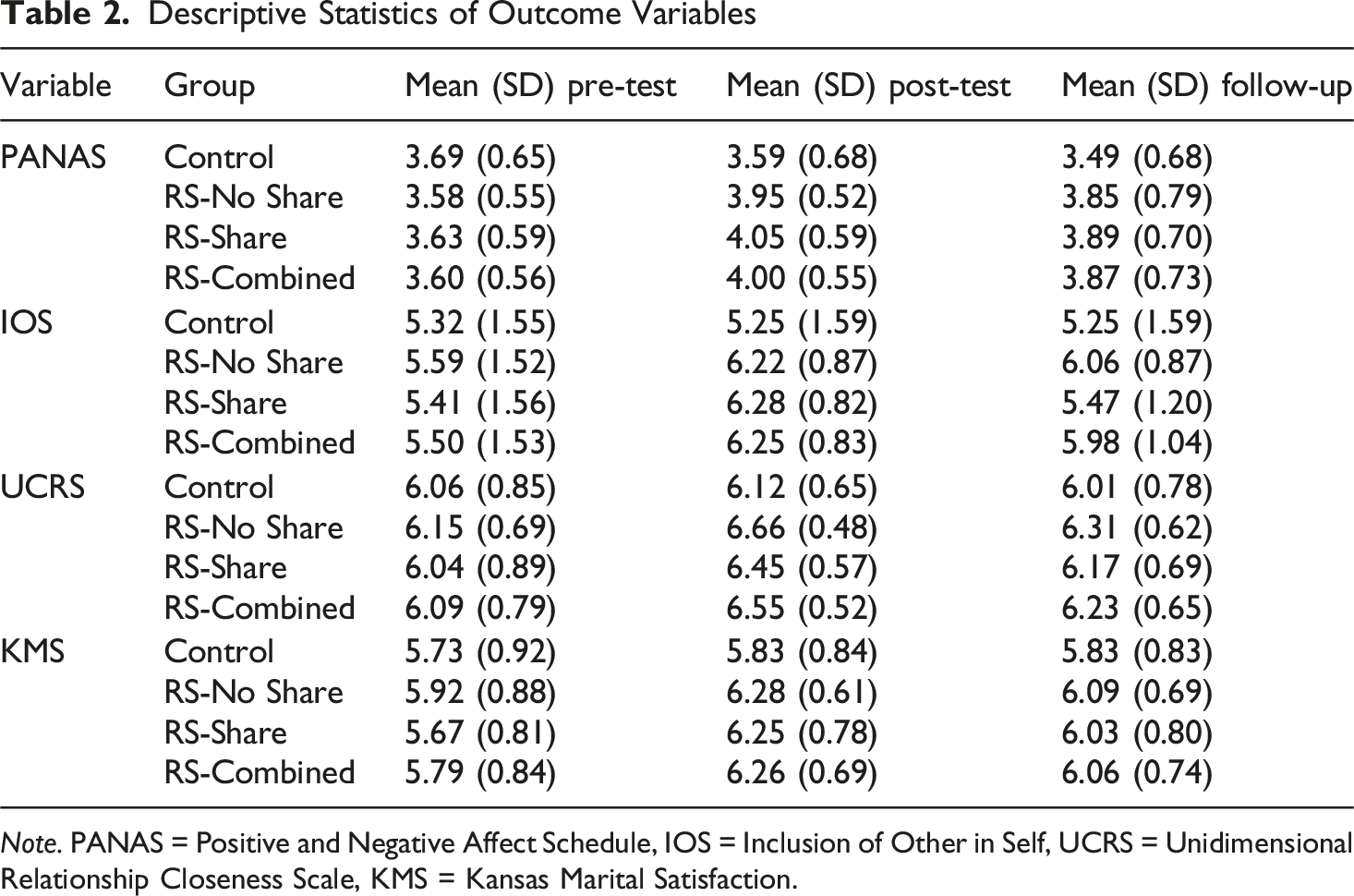
Note. PANAS = Positive and Negative Affect Schedule, IOS = Inclusion of Other in Self, UCRS = Unidimensional Relationship Closeness Scale, KMS = Kansas Marital Satisfaction.
Hypothesis One: Predicting Increases in Positive Emotions
Comparing RS-Combined and Control
Mixed-Effects Model Results: RS-Combined vs. No-Treatment Control
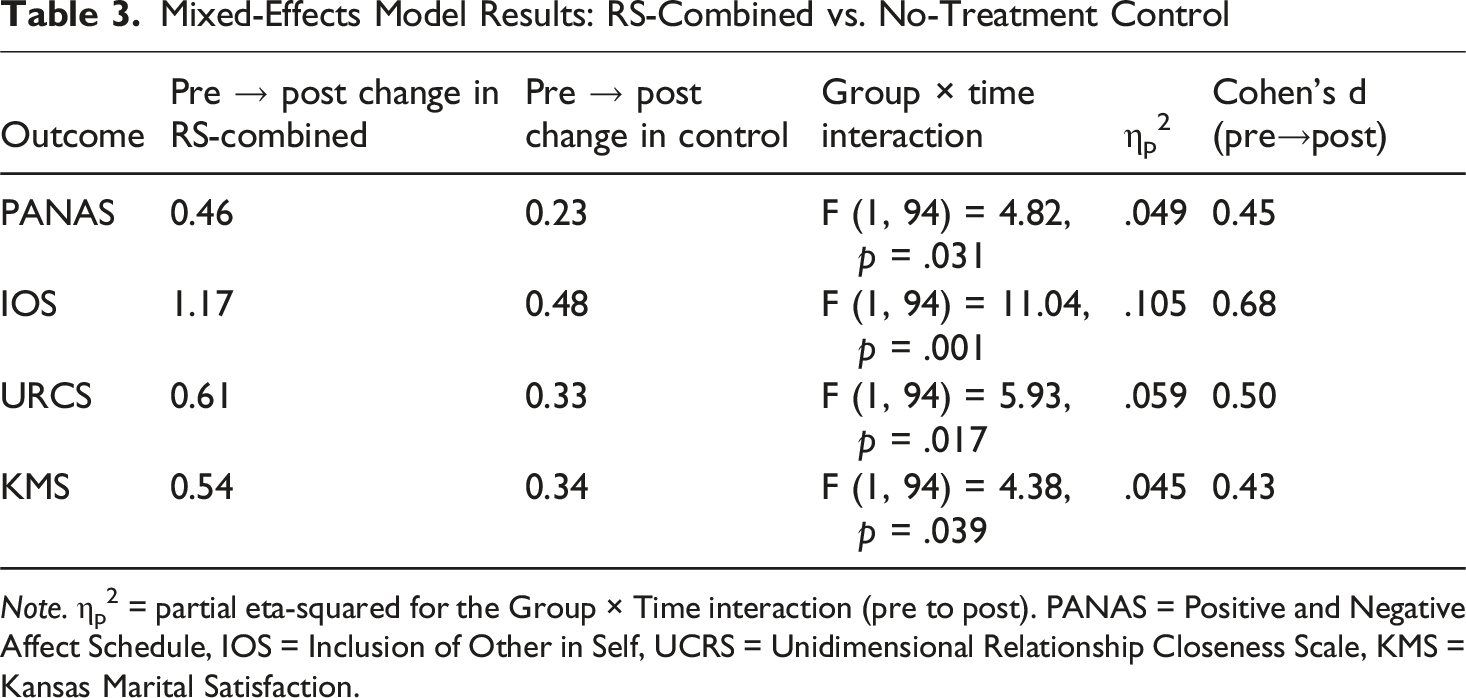
Note. ηp2 = partial eta-squared for the Group × Time interaction (pre to post). PANAS = Positive and Negative Affect Schedule, IOS = Inclusion of Other in Self, UCRS = Unidimensional Relationship Closeness Scale, KMS = Kansas Marital Satisfaction.
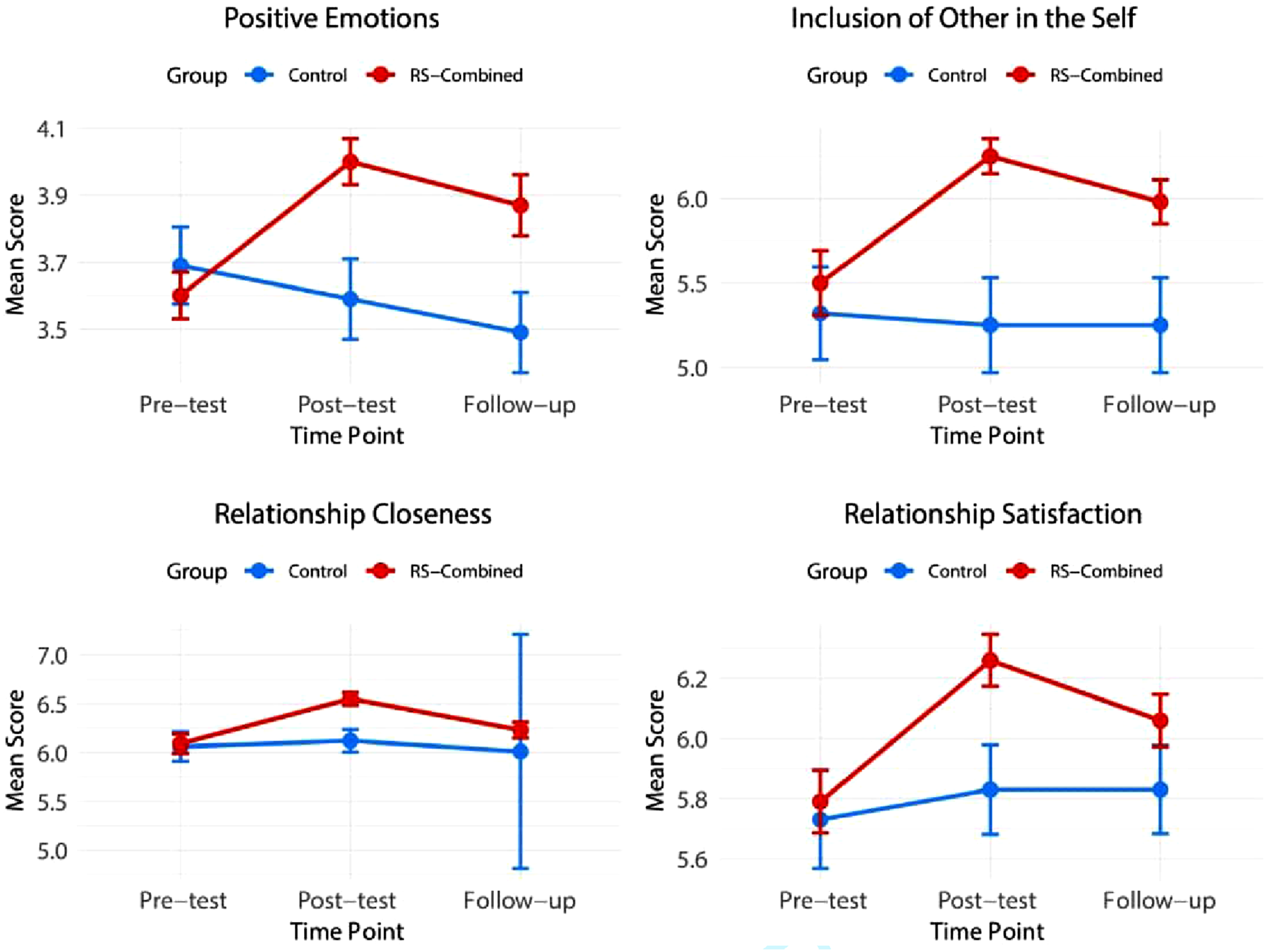
Control compared to RS-Combined on key study outcomes
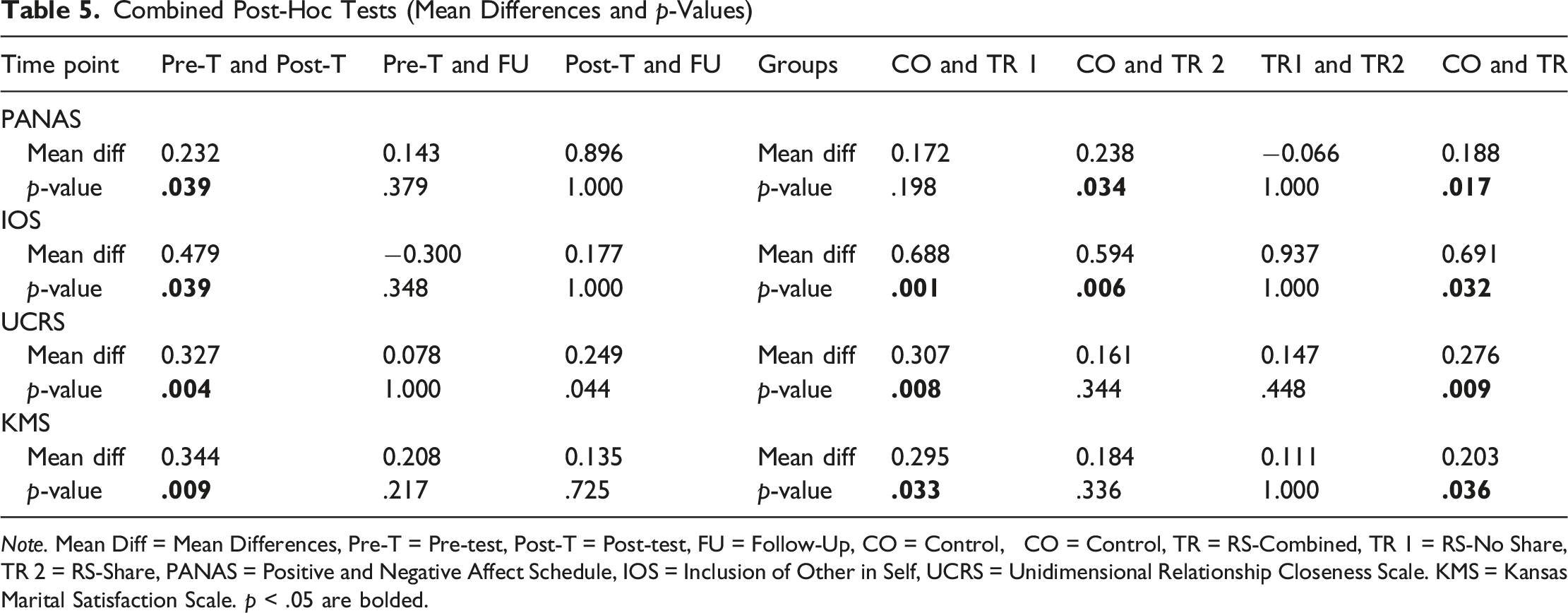
Post-hoc tests using Bonferroni correction showed a significant difference between pre-test and post-test (mean difference = 0.232, p = .039), but no significant differences between pre-test and follow-up (mean difference = 0.143, p = .379) or post-test and follow-up (mean difference = 0.896, p = 1.000). Group comparisons indicated a significant difference between Control and RS-Combined from pre-test to post-test (mean difference = 0.188, p = .017), with the RS-Combined group showing greater increases in positive emotion from pre-test to post-test compared to control participants. The RS-Combined condition significantly enhanced positive emotion, but these effects were not significant at the three-month follow-up.
Comparing RS-Share, RS-No Share, and Control
Mixed-Effects Model Results: Three-Group Comparison
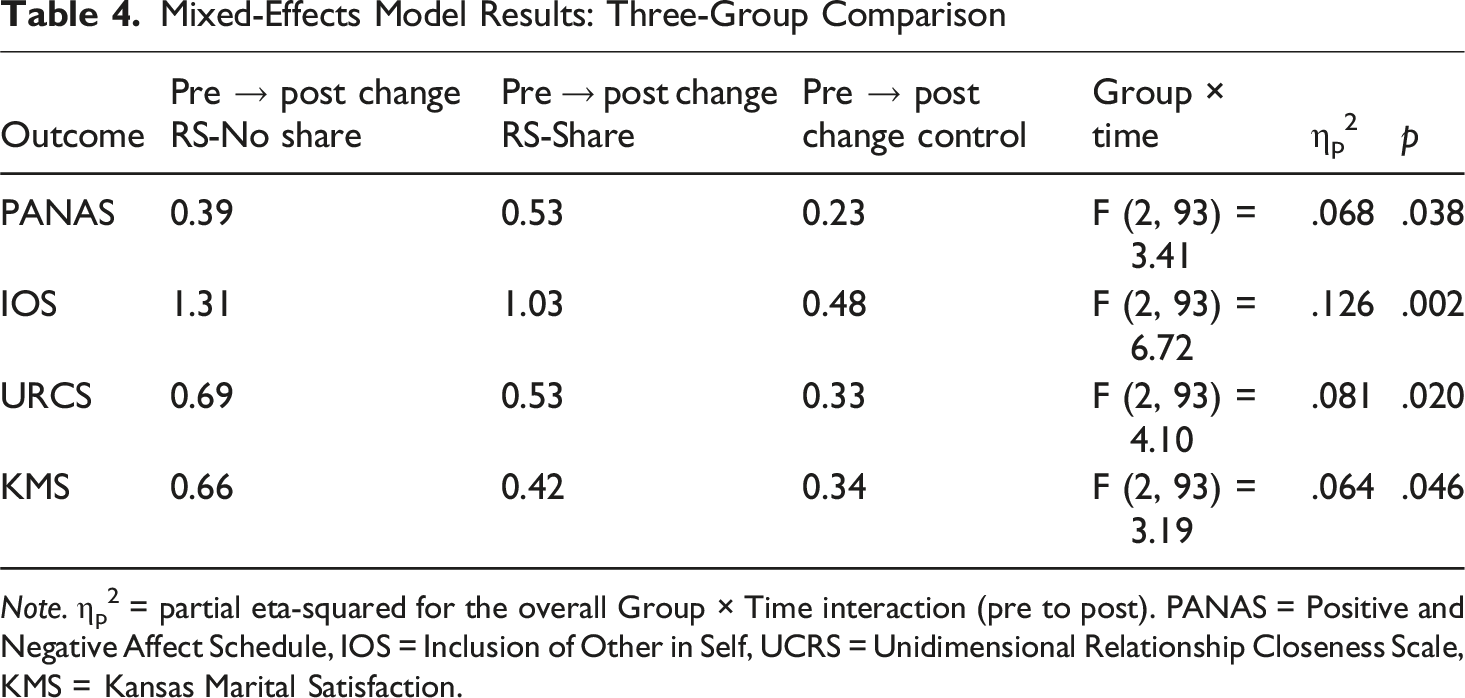
Note. ηp2 = partial eta-squared for the overall Group × Time interaction (pre to post). PANAS = Positive and Negative Affect Schedule, IOS = Inclusion of Other in Self, UCRS = Unidimensional Relationship Closeness Scale, KMS = Kansas Marital Satisfaction.
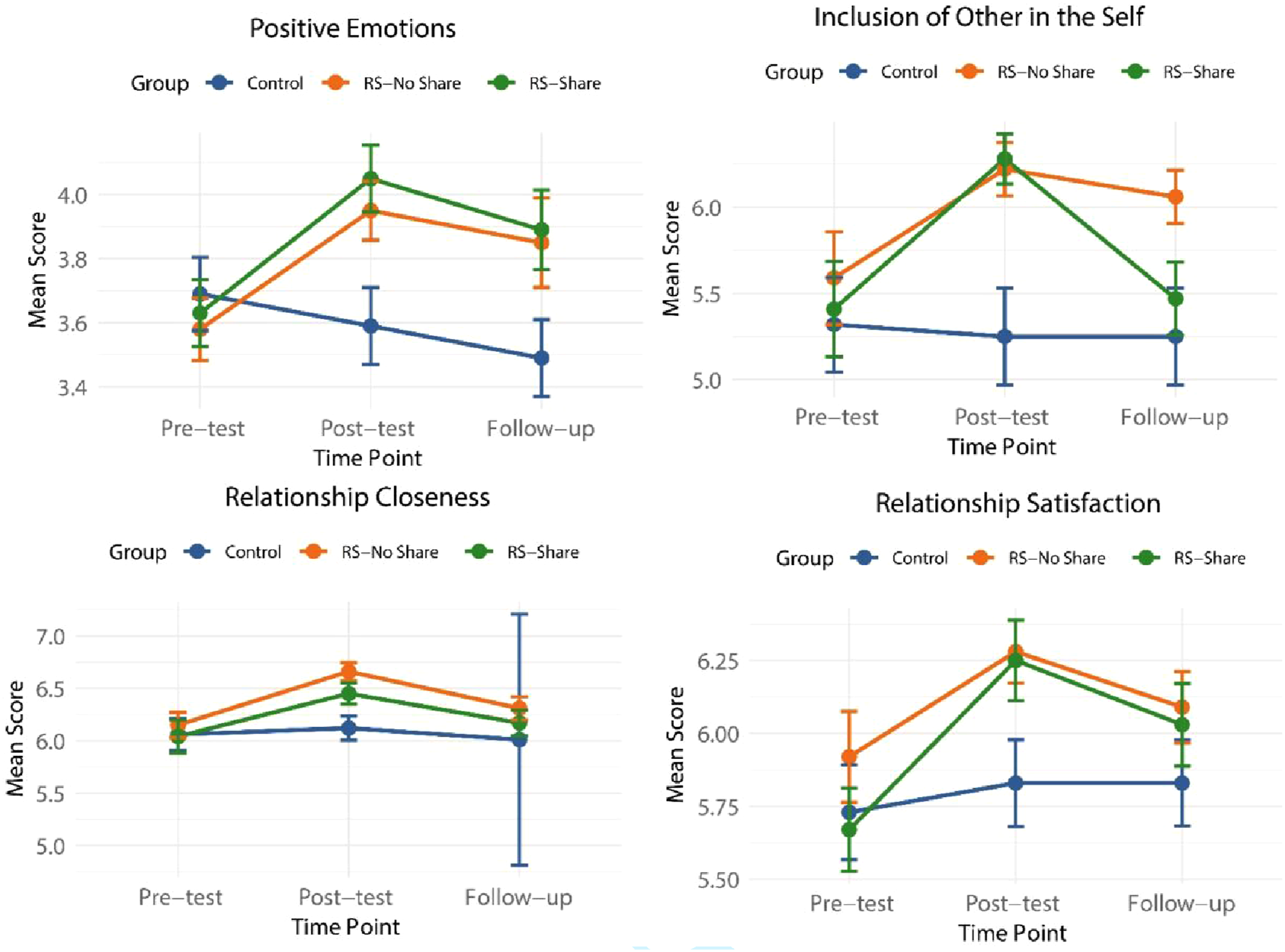
Control compared to RS-Share and RS-No share on key study outcomes
Combined Post-Hoc Tests (Mean Differences and p-Values)
Note. Mean Diff = Mean Differences, Pre-T = Pre-test, Post-T = Post-test, FU = Follow-Up, CO = Control, CO = Control, TR = RS-Combined, TR 1 = RS-No Share, TR 2 = RS-Share, PANAS = Positive and Negative Affect Schedule, IOS = Inclusion of Other in Self, UCRS = Unidimensional Relationship Closeness Scale. KMS = Kansas Marital Satisfaction Scale. p < .05 are bolded.
Hypothesis Two: Predicting Increases in Indices of Relationship Closeness
Inclusion of Other in Self
Comparing RS-Combined and Control
The mixed-effects model results showed a significant Group × Time interaction on IOS, F (1, 94) = 11.04, p = .001, ηp2 = .105, Cohen’s d = 0.68. The RS-Combined group showed an increase of 1.17 from pre-test to post-test, compared to 0.48 in the Control group. The fixed effects explained 7.1% of the variance (marginal R2 = 0.071). The group factor had a significant effect (β = 0.69, p = .001), and the experimental time point was also significant (β = 0.48, p = .039 for post-test vs. pre-test).
Post-hoc tests using Bonferroni correction indicated a significant difference in IOS between pre-test and post-test (mean difference = 0.479, p = .039), but no significant differences between pre-test and follow-up (mean difference = −.300, p = .348) or post-test and follow-up (mean difference = 0.177, p = 1.000). Group comparisons revealed a significant difference between the Control and RS-Combined groups from pre-test to post-test (mean difference = 0.691, p = .032), with the RS-Combined group showing greater increases in IOS compared to control participants. These findings indicate that the RS intervention significantly enhanced IOS from pre-test to post-test, though the effects did not remain statistically significant at follow-up.
Comparing RS-Share, RS-No Share, and Control
The mixed-effects model results revealed a significant Group × Time interaction, F (2, 93) = 6.72, p = .002, ηp2 = .126. The RS-No Share group showed an increase of 1.31 from pre-test to post-test, the RS-Share group 1.03, and the Control group 0.48. At post-treatment, group comparisons using Bonferroni correction showed significant differences between Control and RS-No Share (mean difference = 0.688, p = .001) and Control and RS-Share (mean difference = 0.594, p = .006), but not between RS-No Share and RS-Share (mean difference = 0.937, p = 1.000). In other words, both RS-No Share and RS-Share groups reported significantly higher IOS scores than the Control group at post-treatment, but RS-No Share and RS-Share did not differ significantly from each other. At follow-up, group comparisons did not reveal significant differences among the three groups (e.g., Control vs. RS-No Share, p > .05; Control vs. RS-Share, p > .05; RS-No Share vs. RS-Share, p > .05), consistent with the non-significant findings for the RS-Combined vs. Control comparison at follow-up.
Unidimensional Relationship Closeness Scale
Comparing RS-Combined and Control
The mixed-effects model results indicated a significant Group × Time interaction on URCS, F (1, 94) = 5.93, p = .017, ηp2 = .059, Cohen’s d = 0.50. The RS-Combined group showed an increase of 0.61 from pre-test to post-test, compared to 0.33 in the Control group. The fixed effects explained 6.8% of the variance (marginal R2 = 0.068). The group factor had a significant effect (β = 0.28, p = .011), and the experimental time point was also significant (β = 0.33, p = .004 for post-test vs. pre-test).
Post-hoc tests using Bonferroni correction revealed significant differences in URCS scores between pre-test and post-test (mean difference = 0.327, p = .004) and between post-test and follow-up (mean difference = 0.249, p = .044), but not between pre-test and follow-up (mean difference = 0.078, p = 1.000). Group comparisons showed a significant difference between Control and RS-Combined from pre-test to post-test (mean difference = 0.276, p = .009), with the RS-Combined group showing greater increases in relationship closeness compared to control participants. At follow-up, the group comparison between Control and RS-Combined was not significant (p > .05), consistent with the non-significant pre-test to follow-up difference. These findings indicate that the RS intervention significantly enhanced relationship closeness from pre-test to post-test, with some evidence of sustained effects to follow-up, though not significant compared to baseline or between groups at follow-up.
Comparing RS-Share, RS-No Share, and Control
The mixed-effects model results (see Table 3) revealed a significant Group × Time interaction, F (2, 93) = 4.10, p = .020, ηp2 = .081. The RS-No Share group showed an increase of 0.69 from pre-test to post-test, the RS-Share group 0.53, and the Control group 0.33. At post-treatment, group comparisons using Bonferroni correction showed a significant difference between Control and RS-No Share (mean difference = 0.307, p = 0.008), but not between Control and RS-Share (mean difference = 0.161, p = .344) or between RS-No Share and RS-Share (mean difference = 0.147, p = .448). In other words, RS-No Share participants reported significantly higher relationship closeness scores than Control participants at post-treatment, but RS-Share participants did not differ significantly from Control, and RS-No Share and RS-Share were not significantly different from each other. At follow-up, group comparisons did not reveal significant differences among the three groups (e.g., Control vs. RS-No Share, p > .05; Control vs. RS-Share, p > .05; RS-No Share vs. RS-Share, p > .05), consistent with the non-significant RS-Combined vs. Control comparison at follow-up.
Hypothesis Three: Predicting Increases in Relationship Satisfaction
Comparing RS-Combined and Control
The mixed-effects model results revealed a significant Group × Time interaction on relationship satisfaction, F (1, 94) = 4.38, p = .039, ηp2 = .045, Cohen’s d = 0.43. The RS-Combined group showed an increase of 0.54 from pre-test to post-test, compared to 0.34 in the Control group. The fixed effects explained 5.2% of the variance (marginal R2 = 0.052). The group factor had a significant effect (β = 0.20, p = .037), and the experimental time point was also significant (β = 0.34, p = .009 for post-test vs. pre-test).
Post-hoc tests using Bonferroni correction showed a significant difference in relationship satisfaction between pre-test and post-test (mean difference = 0.344, p = .009), but not between pre-test and follow-up (mean difference = 0.208, p = .217) or post-test and follow-up (mean difference = 0.135, p = 0.725). Group comparisons revealed a significant difference between Control and RS-Combined from pre-test to post-test (mean difference = 0.203, p = .036), with the RS-Combined group showing greater increases in relationship satisfaction compared to control participants. At follow-up, the group comparison between Control and RS-Combined was not significant (p => .05), consistent with the non-significant pre-test to follow-up difference. These findings indicate that the RS intervention significantly enhanced relationship satisfaction from pre-test to post-test, though the effects were not statistically significant at the three-month follow-up.
Comparing RS-Share, RS-No Share, and Control
The mixed-effects model results revealed a significant Group × Time interaction, F (2, 93) = 3.19, p = .046, ηp2 = .064. The RS-No Share group showed an increase of 0.66 from pre-test to post-test, the RS-Share group 0.42, and the Control group 0.34. At post-treatment, group comparisons using Bonferroni correction showed a significant difference between Control and RS-No Share (mean difference = 0.295, p = .033), but not between Control and RS-Share (mean difference = 0.184, p = .336) or between RS-No Share and RS-Share (mean difference = 0.111, p = 1.000). In other words, RS-No Share participants reported significantly higher relationship satisfaction scores than Control participants at post-treatment, but RS-Share participants did not differ significantly from Control, and RS-No Share and RS-Share were not significantly different from each other. At follow-up, group comparisons did not reveal significant differences among the three groups (e.g., Control vs. RS-No Share, p > .05; Control vs. RS-Share, p => .05; RS-No Share vs. RS-Share, p => .05), consistent with the non-significant RS-Combined vs. Control comparison at follow-up.
Follow-Up Analyses
Complete Sample
We reran the mixed linear models including the participants who did not attend all of the sessions (and who were excluded from our main analyses reported here. MLM is robust to missing data and unbalanced group sizes under the missing at random (MAR) assumption. Through the use of maximum likelihood estimation, we were able to include all initially randomized participants (N = 105) in the main analyses without the need for exclusion based on attendance. The findings from the analyses did not change.
Intent-to-Treat Analyses
To ensure the robustness of our findings given participant attrition (9 participants excluded: 3 from RS-No Share, 3 from RS-Share, and 3 from Control, resulting in a final sample of N = 96 from an initial N = 105), we conducted an intent-to-treat (ITT) analysis using multiple imputation (See Supplement A for more information). The findings were consistent with our original findings.
Multiple Testing Correction
To account for multiple testing across the nine hypotheses, we applied a Bonferroni correction (adjusted α ≈ 0.0056), which preserved the overall pattern of results and key post-treatment significance (e.g., IOS group effect p <.009; URCS time effect p = .036), though some comparisons became marginal. Full details of original and adjusted p-values are provided in Supplement B for transparency, confirming no substantive changes to our interpretations.
Discussion
The current study constitutes the first investigation of a culturally-adapted version of RS for marital relationships in the Middle East and contributes to the limited body of research on attachment-based interventions for marital relationships in this cultural context. Given the differences in marital relationships between Iran and Western countries (e.g., Sadeghi et al., 2012), developing and testing marital interventions within these contexts is critical. This study is also the first to directly compare the sharing of RS memories with spouses to the original RS design, which does not involve sharing. The findings provide preliminary support for the short-term effects of this brief intervention in Iran, generally suggesting that the non-sharing version of the intervention is superior to the sharing version, and are reviewed in turn below.
Effects at Posttreatment
Our first aim involved examining the impact of this culturally-adapted group-based version of RS (combined across the two conditions), administered to Iranian wives, as compared to the control condition. This enabled us to examine the overall impact of RS against the control condition. Here we found that with respect to all the outcomes – positive emotion, closeness (IOS, UCRS), and relationship satisfaction, the RS-Combined group had greater increases from pre- to post-treatment as compared to the Control condition. These effects were small and are consistent with prior studies that have documented that RS improves positive emotion (Borelli et al., 2022), closeness to the savored person (Burkhart et al., 2015), and relationship satisfaction (Borelli, Rasmussen et al., 2014). These findings suggest that as in the U.S., the effects of the RS intervention are similar in size and type. This is noteworthy given the vast cultural differences between Iran and the U.S. generally (Markus & Kitayama, 1991) and in terms of marital relationships (Sadeghi et al., 2012). The findings are also consistent with previous trials of RS in Iran, which involved parents of young children and found impacts on closeness to children, availability, sensitivity, and satisfaction (Ansarifar et al., 2025; Sharifi et al., 2025). Given that this is first trial of its kind, these findings are encouraging and suggest its preliminary promise. Future studies utilizing a community-based participatory research lens that seek to better understand what features of the program and program delivery model were most and least helpful to participants would help to further refine adaptations of the intervention that are specific to this population and cultural context.
Our second, exploratory aim examined whether sharing a savored memory with one’s spouse enhanced RS outcomes, compared to RS without sharing and a no-treatment control. The findings were nuanced. For IOS, there were no differences between the two RS conditions: both RS-Share and RS-No Share showed greater increases than the Control group. Thus, while engaging in RS generally enhanced IOS, sharing the memory did not confer additional benefits for this outcome.
Results for the remaining outcomes revealed a more complex pattern. With respect to positive emotion, participants in the RS-Share condition reported greater post-treatment gains than those in RS-No Share. Sharing may amplify positive emotion by extending the savoring process; recounting a positive experience offers an additional opportunity to re-experience and reinforce positive affect. In contrast, participants in the RS-No Share condition reported greater gains in UCRS and marital satisfaction. This pattern suggests that, although sharing enhanced positive emotion, it may have attenuated some relational benefits of savoring.
Several explanations may account for these findings. It is possible that participants experienced fewer feeligns of connectedness when sharing memories with their spouses than when savoring privately or within the group context, resulting in fewer relational benefits. Some participants may also have preferred not to share their memories; being asked to disclose a meaningful experience when one prefers not to may reduce feelings of closeness or satisfaction. Additionally, partners’ responses to the shared memories may have influenced outcomes. If partners did not respond with warmth, gratitude, or reciprocal engagement, the relational benefits of sharing may have been diminished. Notably, the present study did not assess spouses’ reactions or participants’ perceptions of partner responsiveness. Prior research indicates that partner responsiveness is central to the benefits of sharing positive experiences in European and Asian contexts (Gable et al., 2004, 2006; Pagani et al., 2015; Reis et al., 2022; Sim et al., 2024), although cultural norms may shape how such responsiveness is expressed and interpreted (Reis et al., 2022). Partner responsiveness may have been particularly salient for Iranian wives in this study.
One way to reconcile the divergent findings across outcomes is to consider that positive emotion may be less dependent on the listener’s response than relational constructs such as closeness and marital satisfaction, which are inherently interpersonal. Whereas recounting a memory may reliably elicit positive affect for the speaker, feelings of closeness and satisfaction likely depend on how the partner responds. In retrospect, this tension was foreshadowed during the adaptation process: one guiding principle was to anticipate minimal emotional responsiveness from husbands and to support wives through the sharing process. While this approach acknowledged potential non-participation by spouses, it may not have fully considered how such responses would feel for participants.
These findings raise important questions for future research. It will be critical to assess how Iranian wives experience sharing RS memories with their husbands--whether it enhances or detracts from the savoring experience, and under what conditions it might strengthen connection. In addition, although spouses did not receive the intervention themselves, preparatory coaching in savoring or responsiveness may enhance the benefits of shared disclosures. While recruiting male partners into marital interventions presents challenges, their participation may be essential for optimizing relational outcomes (Sardehaei et al., 2024).
More broadly, these results prompt fundamental questions about the nature of RS itself. Is relational savoring primarily an intrapersonal process, capable of enhancing closeness and satisfaction through individual reflection alone, or is interpersonal sharing necessary for relational change? Given that RS sharing has not been systematically tested in other cultural contexts (aside from a single clinical case study; see Borelli), it remains unclear whether the present findings reflect cultural specificity or a more general phenomenon.
Effects at Follow-Up
Notably, the effects of RS (RS-Combined, RS-Share, RS-No-Share) did not persist at the three-month follow-up. We wonder whether a stronger dose of the treatment, the inclusion of booster sessions, or structured home practice following the in-person sessions could help maintain effects that were observed at post-treatment. Some of the findings suggest that the No-Share version of the RS intervention was most impactful. Regrettably, the current trial was underpowered to detect findings specific to the RS-No Share group. However, given that their findings were strongest within this trial, it is possible that a trial with a larger sample of RS-No Share would result in findings that persist to the follow-up period. Alternatively, it may be that the RS intervention’s impacts do not persist beyond the short term. Such findings would suggest that either ongoing practice is necessary to maintain positive impacts or that the intervention needs to be enriched with additional treatment components to sustain its impact – in other words, that the impacts of RS may not be long-lasting enough and alternative strategies (cognitive behavioral, emotion focused) may need to be implemented in order to enact longer-lasting change.
Strengths and Limitations
As the first study to test RS within a romantic relationship context outside of the United States and within an understudied context (Iran), this study provides an important contribution to the literature. The study employed multiple outcome measures across three timepoints. Importantly, it was the first to experimentally test the impact of sharing the savoring memory, thereby advancing knowledge on interpersonal capitalization and providing the first known empirical data on capitalization processes in Iran. Additional strengths include the use of random assignment and the inclusion of a control group.
Several limitations should be noted. First, the study was not preregistered. The hypotheses and aims of the study were filed with university’s master’s review committee prior to conducting the study, but not with an official preregistration site. Second, the study relied exclusively on self-report outcomes; expanding to observed outcomes (e.g., couple interactions) would strengthen the conclusions of the study. Third, acceptability was not measured, and though the interveners’ impressions from conducting the groups were that the program was congruent with cultural values and participant needs, future work should explicitly assess this. Fourth, the relatively small sample size, particularly given the division into three conditions, limited statistical power, reducing our ability to detect smaller effects. Fifth, the control condition was a no-treatment group rather than an active control, constraining the conclusions that can be drawn. Related to this, participants were aware they were participating in a study about marital relationships, so without an active control group, demand characteristics were high. Prior studies of relational savoring have utilized an active control group (e.g., personal savoring; Borelli et al., 2022), which could alleviate concerns about demand characteristics and should be explored as a potential direction for future research. Further, a purported mechanism by which RS impacts participants is through the activation of memories of positive connectedness – however, in the current study, no formal assessment of the quality of participant savoring or intervener adherence to the RS protocol was conducted, leaving the mechanisms of impact unknown. Finally, several aspects of the RS-Share condition were allowed to vary and left unmeasured that could have affected the outcome of the study, including compliance with sharing and non-sharing (in both RS-Share and RS-No Share groups), participants’ perceptions of spouses’ responsiveness, and the broader impact of sharing. Future research should incorporate these assessments to clarify the mechanisms through which sharing influences outcomes.
Conclusion
This pilot study, the first of its kind in Iran, provides preliminary evidence that RS impacts short-term outcomes in married women in Iran while revealing that the outcomes do not persist until the three-month follow-up. Future work is needed to identify whether sharing is a beneficial or detrimental component of this program, as well as to identify whether a stronger dose sustains longer-term effects.
Supplemental material
Supplemental Material - Relational Savoring as an Approach to Improve Marital Relationship Outcomes: A Pilot Study Among Iranian Women
Supplemental Material for Relational Savoring as an Approach to Improve Marital Relationship Outcomes: A Pilot Study Among Iranian Women by Zahra Sadeghi Dehnavi, Zabihollah Kaveh Farsani and Jessica L. Borelli in Journal of Social and Personal Relationships
Consent to participate
This study received IRB approval and the participants provided informed consent.
Footnotes
Acknowledgements
The authors wish to acknowledge the women who participated in this study and the research assistants who reviewed and edited a preliminary draft of this manuscript, Merhnoosh Bavarsad and Mohammad Mazaheri.
Declaration of conflicting interests
The authors declared no potential conflicts of interest with respect to the research, authorship, and/or publication of this article.
Funding
The authors received no financial support for the research, authorship, and/or publication of this article.
Open science statement
This research was not pre-registered in an official repository. However, the design and hypotheses were registered with the university in the form of a master’s thesis prior to beginning data collection. The data used in the research can be obtained by contacting Dr. Zabihollah Kaveh Farsani. The materials can be obtained at:
Ethical considerations
This study was conducted in accordance with ethical principles of the Declaration of Helsinki.

Data Availability Statement
Supplemental material
Supplemental material for this article is available online.
References
Supplementary Material
Please find the following supplemental material available below.
For Open Access articles published under a Creative Commons License, all supplemental material carries the same license as the article it is associated with.
For non-Open Access articles published, all supplemental material carries a non-exclusive license, and permission requests for re-use of supplemental material or any part of supplemental material shall be sent directly to the copyright owner as specified in the copyright notice associated with the article.
