




Abstract
In daily social interactions, joint decision making is not just about the outcomes we reach but also about how partners experience reaching those decisions together. Across three studies, we examine how perceived co-creation - the subjective sense of building understanding together, rather than simply agreeing - shapes interpersonal relationships. Compared to low co-creation and pre-existing agreement, high co-creation consistently enhanced trust, rapport, and willingness to collaborate, whether participants envisioned, remembered, or directly engaged in a joint decision. In Study 3, high co-creation dyads were nearly twice as likely to leave the laboratory together, suggesting effects that extend beyond self-report to observable behavior. Mediation analyses revealed that generalized shared reality - the sense that partners see the world similarly across domains - partially explained these relational benefits. These findings highlight the relational importance of how agreement is formed: the process of building shared understanding together may be as valuable as the agreement itself.
Joint decision making shapes interpersonal relationships across personal, professional, and social contexts. Yet research on decision making has largely emphasized outcomes’ quality and group performance (Brodbeck et al., 2007; Laughlin, 1980, 2011). For example, in organizational psychology and group decision making, research has focused on decision effectiveness and results (e.g., negotiation: Hart & Schweitzer, 2022; advice seeking: Blunden et al., 2019). However, how the process of reaching decisions may affect the relationship between decision-makers has been relatively overlooked (Tindale & Winget, 2019).
More recently, psychological research has begun to conceptualize the co-construction process leading to a joint outcome as a subjective experience of mutual authorship - the felt sense of building understanding through reciprocal influence (Pinelli & Higgins, 2025; Rouse, 2020). Pinelli and Higgins (2025) show that the degree of co-creation predicts self-efficacy and personal meaning above and beyond agreement, underscoring its role as a subjective process rather than an outcome. Similarly, Rouse (2020) theorizes co-creation as a dyadic process of mutual authorship, emphasizing how joint construction over time shapes relational dynamics rather than merely producing shared outputs. Yet this emerging work has only tangentially examined how co-creation operates within interpersonal relationships themselves, or how the subjective experience of building agreement together shapes trust, rapport, and future collaboration. Thus, the present research examines whether partners’ experience of reaching shared understanding has distinct consequences for relationship outcomes beyond merely achieving a common ground.
Building on this recent research and aligning it within shared reality theory (Echterhoff & Higgins, 2021; Higgins, 2019), we conceptualize co-creation as the subjective experience of mutual authorship, with each partner experiencing reciprocal influence in constructing a shared understanding, regardless of whether the interaction begins in disagreement or in alignment. This felt experience is distinct from both the observable collaborative behaviors that may accompany joint decision making (Mesmer-Magnus & DeChurch, 2009; Stasser & Titus, 1985) and the mutual agreement or shared reality that may emerge as its outcome (Echterhoff et al., 2009). Notably, shared reality refers to the subjective experience that one’s inner states (e.g., thoughts, feelings, beliefs) about a target are aligned with another person’s. Critically, shared reality is itself an interpretation of interaction - an experienced sense that one’s understanding has been validated by another - serving both relational motives for connection and epistemic motives for truth and certainty. While immediate consensus provides validation and signals compatibility (Byrne, 1971), we argue that perceiving co-creation, even when requiring effort and compromise, generates superior relational outcomes such as enhanced trust, closeness, and future collaboration intentions.
Importantly, we distinguish co-creation from communication per se. Although co-creation involves discussion, communication alone does not reliably produce positive relational outcomes; it can be neutral or detrimental when experienced as unresponsive or one-sided (Emmers-Sommer, 2004; Schrodt et al., 2014). Co-creation, by contrast, refers to the subjective experience of mutual authorship: the sense of building understanding together. Further, what distinguishes co-creation from mere agreement or acquiescence is not whose view prevails, but whether convergence is experienced as jointly constructed.
We posit that co-creation enhances relationship quality through its effect on generalized shared reality (SR-G) 1 –a broad experience with the decision partner of commonality of inner states (feelings, beliefs, concerns) about the world (Rossignac-Milon et al., 2021). We suggest that fostering a sense of ‘sharing a common perspective' beyond the focal decision, contributing to a more generalized shared reality with the partner, can matter more for relationship development than the agreement itself (Higgins et al., 2021; Lutterbach & Beelmann, 2020; Mahaphanit et al., 2024).
By examining how co-creation fosters SR-G during decision making, we reveal a mechanism through which everyday collaborative interactions strengthen interpersonal bonds.
The co-creation process in interpersonal contexts
The term co-creation has its origins in business and marketing literature, where it describes how stakeholders jointly create value (Frow et al., 2015; Prahalad & Ramaswamy, 2004). By harnessing collective knowledge, co-creation fosters ownership and engagement, enhancing value for both contributors and organizations (Ranjan & Read, 2016; Saarijärvi et al., 2013). We extend this perspective to interpersonal contexts across various domains, including workplace projects, planning activities, romantic discussions, and household management. In the decision-making context examined here, the outcome is a shared agreement, and the process – distinct from the outcome – involves sharing opinions, exploring ideas, and merging insights.
Research on self-disclosure, active listening, and responsiveness demonstrates that exchanging personal information and attending to a partner’s perspective reliably promote liking, closeness, and psychological safety (Collins & Miller, 1994; Reis & Patrick, 1996). However, these literatures primarily focus on interaction behaviors rather than on how partners subjectively experience the construction of shared understanding. They explain why being listened to or disclosed to feels good, but they do not address whether partners experience themselves as jointly authoring an understanding or merely responding to one another. Co-creation, as we define it, differs conceptually by capturing the subjective experience of mutual influence, namely, how partners interpret the interaction as one in which understanding is built together rather than simply exchanged.
Co-creation and relational outcomes
Common ground feels good, but it is not enough. We propose that perceiving high co-creation in decision making improves relational outcomes beyond immediate agreement. Social validation reliably produces positive outcomes (Hardin & Conley, 2001; McPherson et al., 2001; Reis et al., 2018; Sherif, 1935). But we argue that co-creation offers additional relational benefits, even when arriving at shared understanding requires greater cognitive and interpersonal effort.
Research demonstrates a strong link between attitude similarity and positive affect, especially attraction (Byrne et al., 1966; Finkel & Eastwick, 2015; Miller, 2012). This literature suggests attitude alignment draws individuals together, while dissimilarity drives adverse reactions and distance (Byrne et al., 1966, 1971; Montoya et al., 2008; Rimé, 2009). Consequently, immediate agreement not only enhances perceived similarity but also boosts positive feelings and improves relational outcomes.
However, beyond these immediate benefits, extensive research underscores how engaging in self-disclosure promotes connection and enhances relationship quality (Aron et al., 1997; Bareket-Bojmel & Shahar, 2011; Chaudoir & Fisher, 2010; Chiu & Staples, 2013). Disclosure increases liking and attraction (Collins & Miller, 1994), and reciprocal listening in dyads enhances psychological safety, closeness, and a sense of togetherness (Kluger et al., 2021; Ledermann & Kenny, 2012). The importance of interactive dialogue is further supported by the link between communication and collaboration (Orbell et al., 1988) and the role of information sharing in enhancing mutual perceptions of expertise during joint decisions (Wittenbaum et al., 1999).
Moreover, information sharing benefits relationships beyond personal interactions. In the workplace, it strengthens peer relationships (Allen & Meyer, 1996; Sherony & Green, 2002), while in marketing and business, the co-creation process fosters trust among buyers, sellers, and stakeholders (Alves & Wagner Mainardes, 2017; Shulga et al., 2021). Taken together, these findings suggest that the experience of co-creation, created through exchange and even compromise, should strengthen relational outcomes in interpersonal contexts (Franklin & Marshall, 2019; Luccini et al., 2018).
Related evidence comes from gain-loss theory (Aronson & Linder, 1965; Fishbein & Ajzen, 1972), which suggests that positive shifts in evaluation - moving from initial negativity or ambivalence toward positivity - produce stronger favorable responses than consistently positive evaluations. Applied here, moving from initial misalignment to shared understanding may foster deeper relational bonds than immediate consensus, because the positive shift itself signals investment and compatibility. Although co-creation often becomes especially salient when partners begin misaligned and actively integrate perspectives, initial disagreement is not a definitional requirement. Co-creation can also occur when partners start aligned but jointly elaborate, refine, and co-own the emerging understanding. What distinguishes co-creation is the subjective experience of joint construction, not the starting point.
Co-creation and SR-G
What explains co-creation’s relational effect? We posit that co-creation builds SR-G (Rossignac-Milon et al., 2021), extending beyond the immediate topic to foster a broader sense of mutual understanding.
Recent research supports the relational significance of SR-G. Enestrom et al. (2024) found that generalized shared reality with romantic partners and caregivers enhances meaning in life by reducing uncertainty about one’s place in relationships. Rossignac-Milon et al. (2024) demonstrated that perceived authenticity promotes wider shared reality and fosters relationship initiation during live dyadic interactions. Elnakouri et al. (2023) showed that a more expansive shared reality with instrumental others increases goal success and achievement. Collectively, these studies suggest that SR-G, especially when actively constructed, plays a central role in relationship development.
Our research extends this work by focusing specifically on the process through which shared reality develops in collaborative contexts and how it affects relationship development. We suggest that when partners work together to build mutual understanding, rather than simply learning they already agree, they develop a stronger sense that they genuinely “see eye to eye” across many domains. This enhanced SR-G, in turn, promotes greater trust, closeness, and willingness to engage in future collaborative endeavors. We propose that this effect emerges because co-creation requires partners to share genuine perspectives and respond supportively to differences (Rouse, 2020). This process builds confidence not only in the specific shared perspective but also in partners’ broader compatibility and capacity to understand one another across domains (Mahaphanit et al., 2024).
In sum, we hypothesize that higher perceived co-creation will: (1) lead to greater trust, closeness, and willingness to collaborate; (2) foster greater SR-G; and (3) influence relational outcomes via a mediated pathway through SR-G.
The present research
We conducted three studies to examine how perceived decision-making co-creation influences interpersonal relationships. In each study, the degree of co-creation was manipulated through scenario instructions or interactive tasks, and Studies 2 and 3 additionally included self-report measures to measure participants’ subjective co-creation experience. We included both workplace and personal contexts to test co-creation’s generalizability.
Study 1 provided an exploratory foundation, testing our basic premise in a hypothetical workplace scenario. Participants imagined collaborating with a coworker under high or low co-creation (immediate agreement). We examined whether higher co-creation increased trust, closeness, and collaboration. We also measured perceived similarity and workplace homophily to test whether co-creation effects held beyond baseline similarity or affinity (Byrne, 1971; Collins & Miller, 1994; Finkel & Eastwick, 2015).
Study 2 offered a more rigorous test using real relationship memories. Participants recalled actual interactions with close others, describing instances of high co-creation, low co-creation, or scenarios where they had a longstanding shared view on a topic. We specifically measured SR-G - the sense of “being on the same page” with one’s partner across various domains (Rossignac-Milon et al., 2021) - to assess whether active co-creation strengthens this feeling of shared understanding. We hypothesized that actively co-creating decisions would foster stronger SR-G, trust, and closeness compared to both low co-creation and mere pre-existing agreement. Exploratory analyses beyond the preregistered plan are noted in the Results.
Study 3 examined co-creation in real-time dyadic interactions. In a controlled laboratory setting, pairs of participants engaged in a decision-making task with experimentally varied levels of information sharing and joint problem-solving. Study 3 tested how live co-creation influences trust, closeness, rapport, and willingness to work together. We also tested whether working together toward mutual understanding strengthens relationships through the mediating role of shared reality (Higgins et al., 2021; Rossignac-Milon et al., 2021).
Challenging the assumption that immediate agreement is most beneficial, we test whether the process of building mutual understanding, especially when partners start misaligned, more effectively strengthens relational bonds.
Study 1 was exploratory; Study 2 was preregistered, and Study 3 was not. For each study, we report sample size decisions, exclusions, manipulations, and measures. All data, analysis code, preregistration details, and study materials are available on the Open Science Framework (OSF) repository: https://osf.io/xmhrb/.
Study 1
Study 1 provided an initial test of our main hypothesis: that perceived co-creation strengthens relationships beyond mere agreement. Using a visualization-based manipulation (Dadds et al., 1997; Kosslyn et al., 2001), participants imagined collaborating with a coworker under either high co-creation (mutual influence, joint solution-building) or low co-creation (immediate agreement with little discussion). We assessed trust, interpersonal closeness, and willingness to collaborate, as well as exploratory outcomes, liking and psychological safety, to capture broader relational dynamics (Aron et al., 1997; Collins & Miller, 1994). To rule out affinity-based explanations, we also measured perceived similarity and workplace homophily (Byrne, 1971; McPherson et al., 2001).
Method
Participants
We recruited 262 U.S. adults via Prolific Academic. After excluding 19 participants who failed manipulation checks, the final sample comprised 243 participants. Participants ranged in age from 21 to 69 years (M = 37.0, SD = 10.3), and 49% were assigned female at birth. 2 Participants self-identified as White (88%), Asian (7%), Mixed race (3%), or another race/ethnicity (1%). Sexual orientation, disability status, and gender identities beyond sex assigned at birth were not assessed.
Participants reported having completed a high school diploma or equivalent (14%), some college or a technical/community college degree (32%), an undergraduate degree (36%), or a graduate degree (18%); most were employed full-time (71%) or part-time (18%). The final sample size provided 80% power to detect effects of approximately f ≈ 0.20 at α = .05.
Procedure
Participants were randomly assigned to high or low co-creation conditions. They first read explanations and vignettes illustrating their assigned level: high co-creation scenarios showed partners merging different ideas into joint solutions (e.g., friends planning a trip by integrating suggestions), while low co-creation scenarios depicted immediate consensus (e.g., teammates quickly agreeing without debate). After verifying participants understood the different constructs, they visualized working with a colleague in one of three co-creation scenarios: - Low co-creation – Partner validates you (LC-PVY): The participant shares their proposed solution for the task, and the colleague immediately agrees, responding, “I was thinking along the same lines, and I agree with your idea.” - Low co-creation – You validate partner (LC-YVP): The roles are reversed: the colleague proposes a solution first, and the participant immediately agrees with it, saying, “I was thinking along the same lines, and I agree with your ideas.” - High co-creation (HC): The participant and the colleague exchange ideas and discuss them, influencing each other nearly equally, and ultimately co-construct a unified solution through that dialogue.
The LC conditions were counterbalanced to control for order effects. Participants wrote a few keywords to describe how the interaction unfolded, reinforcing their visualization. Finally, participants rated their feelings toward this imagined colleague. Full instructions and experimental materials are available in the Supplement and on the project’s OSF page.
Measures
Manipulation check
At the end of the survey, participants indicated which scenario they had been asked to visualize. The item stem read, “In the interaction with your colleague, we asked you to picture…,” and the multiple-choice options were: (a) “My colleague validated me – he/she was in perfect agreement with my idea”; (b) “I validated my colleague – I was in perfect agreement with his/her idea”; or (c) “My colleague and I co-created – we debated the topic and influenced each other equally.” Participants whose selection did not match their assigned condition were excluded from analysis.
Closeness
We measured interpersonal closeness using four items from the relatedness subscale of the Intrinsic Motivation Inventory (McAuley et al., 1989; Ryan, 1982). Participants rated items such as “I feel like this colleague and I could become friends” on a 7-point scale (1 = Strongly Disagree, 7 = Strongly Agree). Responses were averaged (α = .89).
Trust
Trust was assessed with three items adapted from Echterhoff et al. (2008) (e.g., “I feel I can rely on this colleague’s judgment about work issues”) rated on a 7-point scale (1 = Strongly Disagree, 7 = Strongly Agree). Items were averaged (α = .95).
Desire to work together
Participants rated one item: “I would like to work with this colleague on a regular basis,” using a slider from 1 (Definitely not) to 100 (Definitely yes).
Perceived similarity
Perceived similarity to the colleague was measured using four items adapted from Rossignac-Milon et al. (2021) (e.g., “I have a lot in common with this colleague”), rated on a 7-point scale (1 = Strongly Disagree, 7 = Strongly Agree). Items were averaged (α = .93)
Workplace homophily
We assessed perceived similarity in work-relevant domains using five semantic-differential items adapted from the Perceived Homophily Scale (Light & Goldberg, 2020; McCroskey et al., 1975), such as “Believe similar things” vs. “Believe different things.” Items were rated on a 7-point scale, reverse-coded as needed, and averaged (α = .75).
Liking
Four items from Jacoby-Senghor et al. (2019) assessed liking (e.g., “I like this colleague,” “I feel warmly toward this colleague”), rated on a 7-point scale (1 = Strongly Disagree, 7 = Strongly Agree). Items were averaged (α = .96).
Psychological safety
Three items from Edmondson (1999) measured psychological safety (e.g., “It would be easy for me to take a risk when working with this colleague”), rated on a 7-point scale (1 = Strongly Disagree, 7 = Strongly Agree). Items were averaged (α = .86).
For all measures, higher scores indicate more of each construct. All scale anchors and item wordings are available on the project’s OSF page.
Results
We tested whether focusing on a high co-creation interaction, marked by mutual engagement, would yield stronger relational outcomes than imagining low co-creation (immediate agreement). One-way between-subjects ANOVAs were conducted with condition (HC, LC-PVY, LC-YVP) as the independent variable for each outcome measure. All outcomes were analyzed both without and with covariates (perceived similarity and workplace homophily), given their established links to relationship quality.
Closeness did not differ significantly across conditions, F(2, 240) = 1.91, p = .150, η2 = .016, 95% CI [.00, .06]. Mean closeness ratings were highest in the high co-creation (HC) condition (n = 86, M = 4.65, SD = 1.25), followed by the low co-creation conditions (n = 88, M = 4.36, SD = 1.40; LC-YVP: n = 69, M = 4.24, SD = 1.42). Planned contrasts comparing HC to the combined low co-creation conditions revealed a modest difference in closeness that did not reach significance, t(240) = 1.91, p = .057, d = 0.25, 95% CI [-0.01, 0.52]. However, when controlling for similarity and homophily, this effect became significant, F(2, 238) = 3.81, p = .023, partial η2 = .031, with perceived similarity emerging as a strong covariate, F(1, 238) = 73.38, p < .001.
Trust differed significantly by condition, F(2, 240) = 4.88, p = .008, η2 = .039, 95% CI [.011, .100]. Participants in the high co-creation condition (M = 5.55, SD = 1.15) reported greater trust than those in low co-creation conditions (LC-PVY: M = 4.96, SD = 1.57; LC-YVP: M = 4.94, SD = 1.54). Planned contrasts confirmed higher trust in HC versus combined LC conditions, t(240) = 3.12, p = .002, d = 0.42, 95% CI [0.15, 0.69]. This effect strengthened when controlling for covariates, F(2, 238) = 7.18, p = .001, partial η2 = .057. The two LC conditions did not differ, t(240) = 0.09, p = .930.
Desire to work together also showed a significant condition effect, F(2, 240) = 3.87, p = .022, η2 = .031, 95% CI [.01, .09]. High co-creation participants expressed stronger willingness to collaborate again (M = 71.8, SD = 19.4) than those in low co-creation conditions (LC-PVY: M = 65.1, SD = 21.4; LC-YVP: M = 62.7, SD = 24.1), t(240) = 2.74, p = .007, d = 0.36, 95% CI [0.10, 0.63]. This effect was stronger when covariates were included, F(2, 238) = 6.98, p = .001, partial η2 = .055.
Co-creation had reliable effects on psychological safety and liking, outcomes most directly tied to the subjective experience of joint engagement. Psychological safety was significantly higher in the HC condition (M = 5.40, SD = 0.93) than in either LC condition (LC-PVY: M = 4.79, SD = 1.43; LC-YVP: M = 4.83, SD = 1.38), F(2, 240) = 6.24, p = .002, η2 = .049, 95% CI [.02, .11], d = 0.47, 95% CI [0.21, 0.74]. Similarly, liking was greater following high co-creation (M = 5.60, SD = 0.94) versus low co-creation (LC-PVY: M = 5.09, SD = 1.52; LC-YVP: M = 5.05, SD = 1.48), F(2, 240) = 4.35, p = .014, η2 = .035, 95% CI [.01, .08], d = 0.40, 95% CI [0.13, 0.66].
To control the family-wise error rate across outcome variables, Holm’s correction was applied. After correction, psychological safety (p = .011), trust (p = .033), liking (p = .042), and desire to work together (p = .044) remained statistically significant, while closeness did not (p = .150). Notably, all significant effects became stronger when controlling for perceived similarity and workplace homophily, suggesting co-creation’s relational benefits operate through mechanisms distinct from baseline affinity, as detailed in the Supplement (Table S2 for comparisons with covariates, Table S3 for pairwise effect sizes). Robustness checks, including outlier sensitivity analyses and non-parametric tests, also appear in the Supplement.
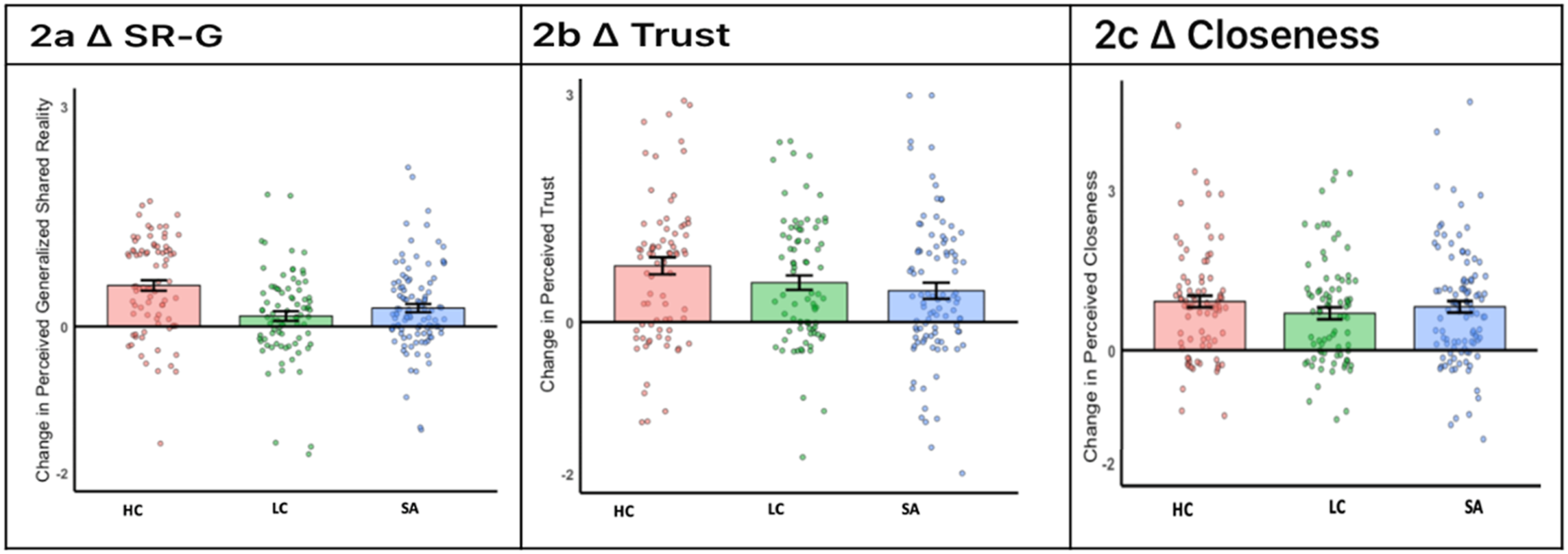
Baseline equivalence checks confirmed successful randomization: perceived similarity did not differ across conditions Figure 1, F(2, 240) = 2.21, p = .112, nor did workplace homophily, F(2, 240) = 0.55, p = .577 (see Supplement for additional demographic comparisons). Effects of Co-creation on Relational Outcomes. Note. Scatter plots show individual participant responses, with group means and 95% confidence intervals plotted by condition. Results reflect differences across high co-creation (HC), low co-creation where the participant validated the partner (LC-YVP), and low co-creation where the partner validated the participant (LC-PVY). See Supplement for full statistical outputs and distributional data. Change in SR-G, Trust, and Closeness Across Conditions (HC, LC, and SA). Note. We used jittered points for individual response clarity and mean value bars for direct comparison. Error bars, calculated from the standard error, indicate the 95% confidence interval around the mean.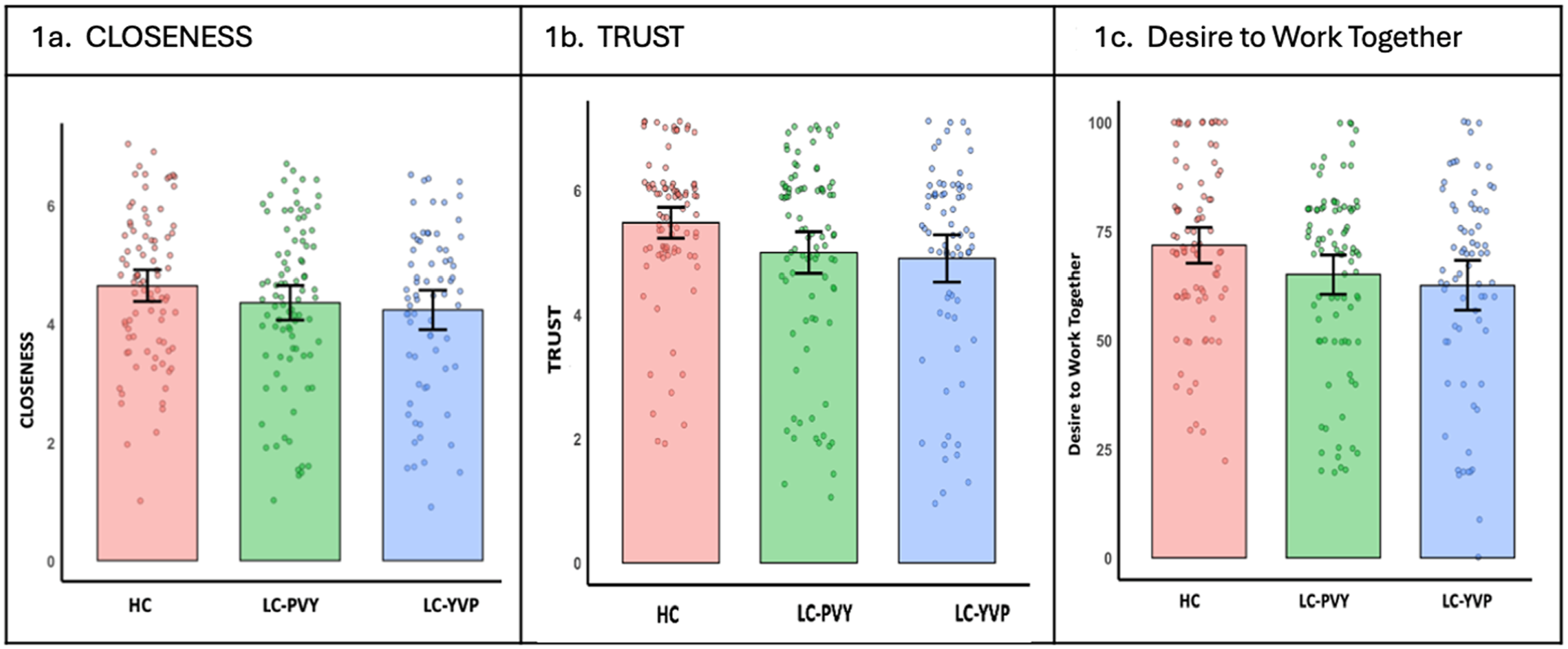
Discussion
This exploratory study provided initial evidence that co-creation enhances multiple dimensions of workplace relationships. Imagining a high co-creation interaction led to greater trust (d = 0.42), psychological safety (d = 0.47), desire for future collaboration (d = 0.36), and liking (d = 0.40) compared to scenarios of swift agreement. The pattern of effect sizes, strongest for process-focused outcomes like psychological safety and trust, moderate for behavioral intentions (d = 0.36), and weakest for relational closeness (d = 0.25), aligns with a conceptualization of co-creation as primarily shaping collaborative dynamics rather than interpersonal intimacy. These effects persisted and, in some cases, strengthened when controlling for perceived similarity and homophily, supporting the unique relational value of the co-creation process itself.
While exploratory, these findings suggest that imagining co-creation enhances key aspects of relational potential in workplace contexts, especially trust, psychological safety, and willingness to collaborate. To build on this foundation, Study 2 examined recalled real-world experiences and included a theoretically important comparison: interactions involving pre-existing shared agreement. This allowed us to test whether co-creation contributes to relationship quality in part by fostering SR-G.
Study 2
Consider two individuals planning a weekend activity. Does brainstorming together to make a joint decision affect their relationship differently than choosing an already-established option they both know they like? Study 2 tested whether co-creating a shared outcome enhances relationship quality more than relying on pre-existing agreement.
Participants recalled either an episode where they shared a longstanding agreement with someone or co-created an agreement together. Within the co-creation condition, we further distinguished high co-creation (intensive collaboration) from low co-creation (minimal discussion due to pre-aligned views). We then assessed how these recalled interactions affected trust, closeness, and SR-G: the sense of sharing inner thoughts, feelings, and beliefs about the world (Rossignac-Milon et al., 2021).
We hypothesized that recalling a high co-creation experience would lead to stronger trust, closeness, and SR-G than recalling either a low co-creation experience or a shared prior agreement. Mood and perceived homophily served as control variables to account for general affect and similarity in participants’ social networks.
Method
Participants
We recruited 331 U.S. adults via Prolific Academic. The preregistration target sample (N = 330) provided 80% power to detect a small effect (f = 0.175) at α = .05 (Faul et al., 2009). Participants ranged from 19 to 70 years (M = 41.4, SD = 12.4), 49% were assigned female at birth. 3 Participants self-identified as White (71.7%), Asian (12.5%), Black (10.2%), Mixed race (4.5%), or another race/ethnicity (1.1%). Education level, employment characteristics beyond current employment status, sexual orientation, disability status, and gender identity beyond sex assigned at birth were not assessed.
After excluding participants who failed attention or manipulation checks, the final sample consisted of 265 participants. Sensitivity analysis showed this sample could detect effects of f = 0.192 with 80% power at α = .05.
Procedure
Participants identified someone in their social circle they interacted with fairly regularly but were not close to. They described the relationship’s nature and duration and provided baseline ratings of SR-G, closeness, and trust. Next, to reduce carryover effects, they completed a short filler task (five anagrams, 3.5 minutes).
Participants were then randomly assigned to one of three conditions: high co-creation, low co-creation, or shared prior agreement. Each condition was introduced with a definition and examples. The high and low co-creation (HC, LC) conditions used the same scenarios as Study 1; the shared prior agreement (SA) condition used new examples (e.g., long-standing shared values or common beliefs). Participants completed a brief comprehension quiz and re-reviewed materials if they answered incorrectly.
Once understanding was confirmed, participants recalled a personal experience that matched their condition. HC participants recalled a time they actively worked with the person to build a shared understanding or make a joint decision. LC participants recalled reaching an agreement quickly with minimal discussion due to similar initial views. SA participants recalled a long-standing agreement with the person, one that didn’t require any new discussion. Participants summarized their memory with keywords, then wrote a detailed description. HC and LC participants also rated the degree of co-creation they felt in the interaction. Participants were told that some questions might feel repetitive and were asked to respond based on their current feelings.
All participants then re-rated SR-G, closeness, and trust, reflecting on how they felt after recalling the experience. A manipulation check confirmed participants had recalled a scenario consistent with their assigned condition. Full instructions and experimental materials are available in the Supplement and on the project’s OSF page.
Measures
Manipulation check
At the conclusion of the study, participants were asked to indicate which scenario they had focused on, choosing from three options: “co-creating an agreement,” “validating someone’s opinion or having my opinion validated,” or “reflecting on an existing agreement.” Participants whose choice did not match their assigned condition were excluded.
Perceived co-creation
In the HC and LC conditions, participants rated three items on a 7-point scale (1 = Strongly Disagree, 7 = Strongly Agree): “We actively shared knowledge,” “We worked together,” and “We made sense of it together.” Although these items use action-oriented language (e.g., ‘worked together’), participants rated their agreement with these statements after recalling a specific interaction. The agreement response format (Strongly Disagree to Strongly Agree) captures participants’ subjective interpretation of the experience as jointly constructed, rather than measuring behavioral frequency or communication quantity.
Items were averaged to index perceived co-creation (α = .95).
Closeness
Participants rated closeness using a single item: “How close do you feel to [that person]?” on a 10-point scale (1 = Not at all, 10 = Extremely), both before and after the recall task.
Trust
Trust was assessed with one item, “How much do you trust [that person]?” rated on the same 10-point scale before and after the recall task.
Because Study 2 assessed closeness and trust at two timepoints within a single session, we used single-item measures for these constructs to reduce respondent burden and minimize reactivity from repeated administration.
Generalized shared reality (SR-G)
The SR-G Scale (Rossignac-Milon et al., 2021) was used to assess psychological alignment (e.g., “We see the world in the same way” and “We often feel like we have created our own reality”). Items were rated on a 7-point scale (1 = Strongly Disagree, 7 = Strongly Agree) and averaged at both Time 1 (α = .89) and Time 2 (α = .92).
Mood
Participants rated four bipolar adjective pairs (Nervous–Relaxed, Unhappy–Happy, Bad mood–Good mood, Anxious–Content) on a 7-point scale. Items were averaged to form a mood index (α = .94).
Social circle homophily
As in Study 1, participants completed an adapted Attitude Homophily subscale (Light & Goldberg, 2020; McCroskey et al., 1975), α = .83.
For all measures, higher scores indicate more of each construct. All scale anchors and item wordings are available on the project’s OSF page.
Results
Manipulation checks confirmed that participants experienced qualitatively different interactions across conditions. Those recalling high co-creation reported substantially higher perceived co-creation (M = 6.35, SD = 0.66) than those recalling low co-creation (M = 4.11, SD = 1.94), t(99.68) = 9.90, p < .001, d = 1.54, mean difference = 2.25, 95% CI [1.80, 2.70]. We did not measure perceived co-creation in the shared agreement condition because, by definition, pre-existing beliefs do not involve any active construction process. Additional validation analyses appear in the Supplement.
We tested our primary hypotheses using linear mixed-effects models with time (pre/post-recall) as a within-subjects factor and condition as a between-subjects factor, controlling for mood and social circle homophily. All continuous variables were standardized.
Consistent with our prediction for SR-G, all participants reported greater alignment after recalling positive interactions, F(1, 265) = 73.30, p < .001. This increase varied significantly by condition, Time × Condition: F(2, 265) = 10.63, p < .001 (Figure 2), partial η2 = .074. High co-creation produced substantially larger SR-G gains (mean change = 0.56) than either low co-creation (mean change = 0.14) or shared agreement (mean change = 0.25).
Planned comparisons showed that high co-creation increased SR-G more than low co-creation (β = −0.42, 95% CI [−0.60, −0.23], t(265) = −4.42, p < .001) and more than shared agreement (β = −0.31, 95% CI [−0.48, −0.13], t(265) = −3.46, p < .001). Cohen’s d for change scores confirmed substantial effects: HC vs. LC, d = 0.67, 95% CI [0.35, 0.98]; HC vs. SA, d = 0.51, 95% CI [0.21, 0.80]. Recalling pre-existing agreement produced gains, but actively building new agreement produced additional increases.
Consistent with our prediction for trust, this outcome showed similar patterns, though effects were less pronounced. All conditions increased in trust from baseline to post-recall, F(1, 265) = 84.52, p < .001. The Time × Condition interaction was not statistically significant, F(2, 265) = 2.55, p = .079, partial η2 = .019, but our theory-driven planned contrast comparing high co-creation against combined controls was significant, t(268) = 2.06, p = .040. High co-creation showed greater trust gains than shared agreement (β = −0.33, 95% CI [−0.62, −0.04], p = .025, d = 0.31), with a similar but non-significant pattern versus low co-creation (d = 0.23, p = .162).
Closeness increased equivalently across all conditions, F(1, 265) = 131.14, p < .001, with no Time × Condition interaction, F(2, 265) = 1.62, p = .199. Effect sizes confirmed negligible differences between conditions (all ds < 0.30). This null result replicates Study 1 and suggests that closeness may require longer or more emotionally rich interactions to shift meaningfully. As a robustness check, we also conducted ANCOVA analyses with baseline scores as covariates (see Supplement). The condition effect on generalized shared reality remained significant, F(2, 259) = 9.76, p < .001, partial η2 = .070, indicating that the SR-G condition effect is robust to this alternative analytic specification.
Mean and standard deviations at times 1 and 2 and significance of pre–post differences.
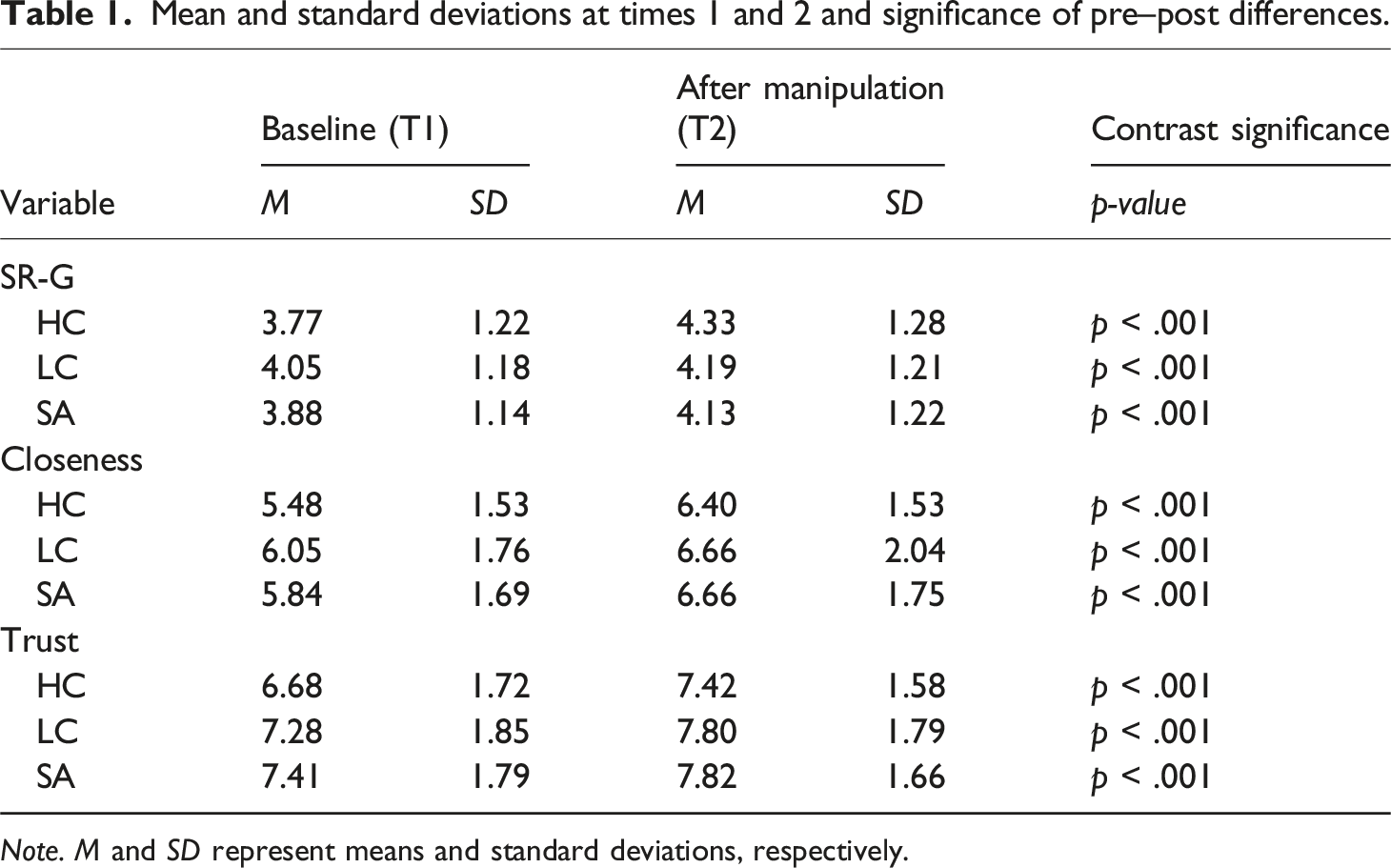
Note. M and SD represent means and standard deviations, respectively.
Exploratory analyses of additional relational outcomes (liking, epistemic trust, psychological safety, desire for future interaction)and robustness checks controlling for individual differences in shared reality motivation are presented in the Supplement.
Discussion
Study 2 provided further evidence that co-creation shapes relationships through mechanisms distinct from simple agreement. The manipulation elicited markedly different interaction experiences (d = 1.54), and even low co-creation involved moderate mutual influence, underscoring that co-creation operates along a continuum rather than as a dichotomous construct.
High co-creation enhanced both SR-G and trust relative to control conditions. For SR-G, effects were substantial when compared to both low co-creation (d = 0.67) and pre-existing agreement (d = 0.51). The weaker distinction between high and low co-creation conditions for trust may reflect that even minimal-discussion agreement contains some mutual influence, as evidenced by the moderate perceived co-creation scores in the low co-creation condition (M = 4.11 on a 7-point scale). The inclusion of the shared agreement condition was particularly informative: it demonstrated that these relational benefits arise not merely from agreement itself, but from the collaborative process of actively constructing shared understanding.
All conditions showed increased closeness from baseline to post-recall, but these increases did not differ by condition. This pattern – significant effects on SR-G (d = 0.67 for HC vs. LC; d = 0.51 for HC vs. SA), and non-significant differences for closeness - suggests that co-creation may differentially influence distinct relational dimensions, though confidence intervals for these effect sizes overlapped. Whereas shared understanding and trust may be sensitive to single collaborative episodes, closeness may unfold more slowly or require deeper emotional contexts to fully register the impact of co-creation.
Study 2 provided evidence that co-creation holds unique relational value beyond agreement, but it relied on retrospective self-reports. Exploratory mediation analyses revealed significant indirect effects through generalized shared reality for both trust, b = 0.103, 95% CI [0.045, 0.174], and closeness, b = 0.088, 95% CI [0.034, 0.154] (see Supplement). However, because the mediator and outcomes were measured concurrently and the design captures reconstructed memories rather than real-time processes, Study 2 is better suited for testing condition differences than for drawing process inferences from mediation. Do these effects emerge during real-time interaction? Can they be observed behaviorally? And does SR-G help explain how co-creation translates into relationship outcomes? Study 3 addresses these questions through live dyadic collaboration.
Study 3
Building on prior findings from imagined (Study 1) and autobiographical (Study 2) interactions, Study 3 tested whether co-creation yields similar relational benefits in live, real-time dyadic collaboration. To extend this work, we designed Study 3 to achieve three goals: testing co-creation’s effects on moment-to-moment interpersonal dynamics, capturing behavioral outcomes beyond self-report, and examining whether SR-G mediates these effects.
Participants worked face-to-face in dyads on a joint problem-solving task. We manipulated co-creation by varying beliefs about information distribution. High co-creation (HC) dyads were told one partner might lack critical information, creating an expectation of collaborative interdependence, while low co-creation (LC) dyads believed both had complete information. This approach, adapted from team decision-making research, creates different levels of perceived interdependence without changing actual task materials (Hinsz et al., 1997; Jehn & Shah, 1997; Mesmer-Magnus & DeChurch, 2009; Mitchell et al., 2009).
We assessed multiple relational outcomes: trust, closeness, and positive/negative rapport. To capture behavioral expressions of affiliation, we recorded whether participants chose to leave the laboratory together - an unobtrusive index of affiliative intent. Dyads also completed a second joint task (selecting actors for a play based on the mystery) without further manipulation, to examine whether co-creation’s effects extend beyond the initial interaction.
Drawing on prior work on team information exchange (Mesmer-Magnus & DeChurch, 2009), we predicted that high co-creation would: (a) enhance trust, rapport, and closeness (b) increase willingness to collaborate again; (c) promote spontaneous affiliative behavior (leaving together); and (d) foster SR-G (Rossignac-Milon et al., 2021).
Method
Participants
We recruited 218 participants (71 men, 147 women) from a Northeastern U.S. university and the surrounding community for an in-person dyadic “Solve a Mystery” study. Participants ranged in age from 18 to 43 (M = 20.03, SD = 3.32) and received either course credit or $18. Participants self-identified as White (36.7%), Asian (26.6%), Mixed race (13.8%), Hispanic/Latino (11.9%), Black or African American (9.2%), Native (1.4%), or another race/ethnicity (0.5%). After excluding 12 participants for failing attention checks and 10 who were already acquainted with their assigned partner, the final sample comprised 196 participants (98 dyads). Dyads were same-gender (62.4%) or mixed-gender (37.6%) and racially mixed in 71.6% of cases. Students’ status, sexual orientation, disability status, and gender identities beyond sex at birth were not recorded. Individual-level recruitment source data were not collected, precluding exact proportions of students versus community participants. Data collection lasted eight months and concluded at the end of the academic year. 4 The final sample exceeded our target of 160 participants (80 per condition), providing 80% power to detect effects of d = 0.30 (minimum detectable d = 0.20).
Procedure
Before arrival, participants were randomly assigned to a high co-creation (HC) or low co-creation (LC) condition. Upon arrival, they received task materials (The Bank Robbery Mystery, Stanford & Stanford, 1969) and condition-specific instructions. The mystery task required participants to analyze a set of clues to identify the perpetrator(s) of a fictional robbery. All participants received the full set of clues and initially reviewed them independently, and formed opinions without communication.
LC dyads were told that both partners had full access to all clues. HC dyads were told that one partner might lack some information, but that together they would have had everything needed to solve the case. This manipulation, pretested to elicit perceived interdependence, was designed to promote co-creation. Dyads completed a hidden-profile–type decision-making task (see Stasser & Abele, 2020, for a review), in which correct solutions typically require integrating information across partners. Participants were seated in two separate rooms and were not permitted to communicate while forming their initial opinions.
They had 15 minutes to review clues and formulate individual conclusions. Initial thoughts were recorded via questionnaire (Survey at Time 0; St0; see Figure 3). Dyads then discussed the case for up to 10 minutes, submitted a joint solution, and completed a post-discussion questionnaire (St1). Study 3 design Flow.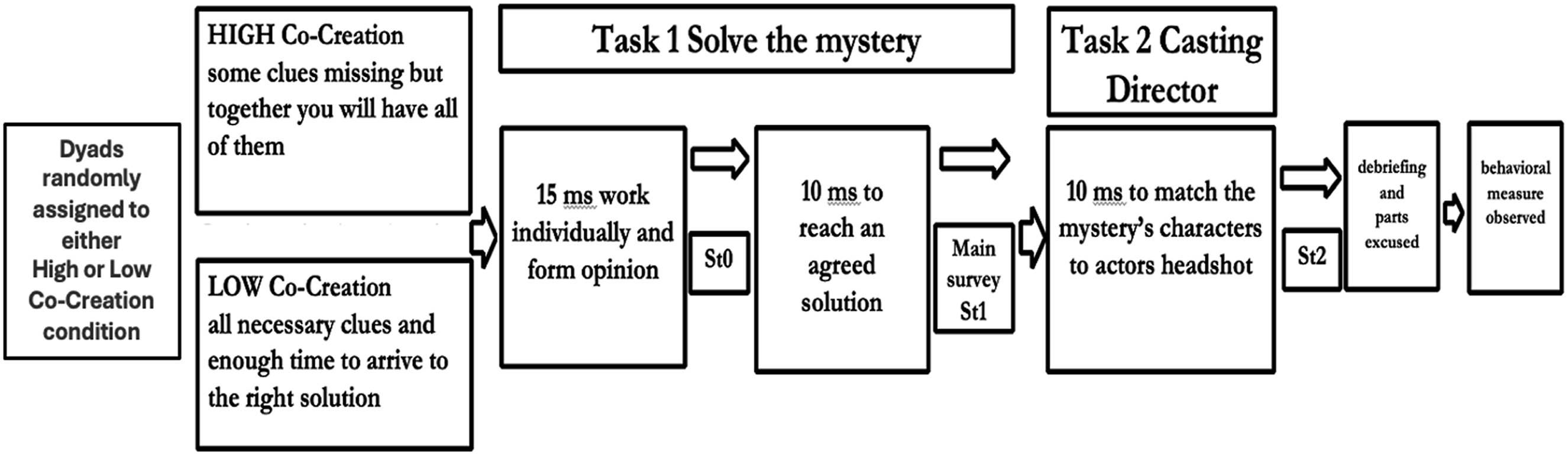
Next, dyads completed a second joint task: matching seven play characters to actors from 13 headshots, based on the mystery content. This task was identical across conditions and served to assess carryover effects without additional manipulation. Participants whose joint responses matched a predetermined answer key on the tasks were entered into a lottery for a $50 prize. The answer key for the character-matching task was created by a research team member with formal theater training. Afterward, participants completed a final questionnaire (St2), were debriefed, and dismissed. When feasible, we recorded whether participants exited the lab together or separately as a behavioral measure of affiliative intent. The exact wording of all condition-specific instructions and materials is available in the Supplement and on the project’s OSF page.
Measures
Manipulation Check
Participants rated solution similarity before discussion (‘In general, how similar were your initial conclusions?’) and after discussion (‘…after you had talked about them?’), each on a 7-point scale (1 = Very different, 7 = Very similar). Pre-to-post convergence was operationalized as post-discussion similarity controlling for pre-discussion similarity 5 , so that the condition effect reflects convergence net of initial similarity.
Closeness
As in Study 1, participants expressed their sense of closeness using the 4-item relatedness subscale of the Intrinsic Motivation Inventory (McAuley et al., 1989; Ryan, 1982), α = .83.
Trust
As in Study 1, trust was measured using three items adapted from Echterhoff et al. (2008), α = .94.
Rapport
Participants rated ten adjectives based on prior rapport literature (Bernieri, 2005; Tickle-Degnen & Rosenthal, 1990). Five positive items (e.g., “Friendly,” “Comfortable”) formed a positive rapport index (α = .87); five negative items (e.g., “Awkward,” “Cold”) formed a negative rapport index (α = .85).
Perceived co-creation
Participants rated seven items capturing perceived co-creation. Three items were carried over from Study 2, and four new items were added (e.g., “We interpreted the mystery robbery together,” “We influenced each other’s perceptions”). Items were rated on a 7-point scale. We report both the 3-item version (α = .82) and the 7-item version (α = .87).
Willingness to work together again
Participants answered: “Would you like to work with your study partner again?” (1 = Definitely Yes, 5 = Definitely No). Responses were reverse-scored.
Generalized shared reality (SR-G)
As in Study 2, participants completed the SR-G Scale (Rossignac-Milon et al., 2021), α = .85.
Mood
To control for affective state, participants completed a 13-item abbreviated version of the Profile of Mood States (Grove & Prapavessis, 1992), rated on a 5-point scale (1 = Not at All, 5 = Very Much). Items were averaged to form a composite mood index.
Observational coding of waiting for each other after the study (behavioral affiliation)
At the end of the study, researcher assistants recorded whether participants waited for each other and exited the lab together (coded as 1) or left separately without interaction (coded as 0) 6 . This binary outcome served as a behavioral proxy for affiliation intent.
For all measures, higher scores indicate more of each construct. All item wordings, scale anchors, and reliability statistics for primary and exploratory measures are available in the Supplement and on OSF. Additional exploratory measures, including perceived similarity, epistemic certainty, partner responsiveness, disagreement resolution, and joint decision comprehensiveness, are fully reported in the Supplement, along with their statistical results, reliability estimates, and effect sizes.
Data analysis
All analyses used multilevel modeling with participants nested within dyads. Models were estimated in R using the lme4 (Bates et al., 2014), nlme (Kuznetsova et al., 2017), and bruceR (Bao, 2022) packages. Following Bolger and Laurenceau (2013), we isolated dyad-level variance and standardized individual-level predictors using residual standard deviation. This approach allowed us to compute standardized beta coefficients, which serve as interpretable effect-size estimates in our models.
Results
Our manipulation successfully created different levels of co-creation. Controlling for initial similarity, participants in the high co-creation condition showed significantly greater pre-to-post discussion convergence in their solutions than those in the low co-creation condition, β = 0.32, 95% CI [0.02, 0.82], t(99.60) = 2.05, p = .043, d = 0.42. Participants in the high co-creation condition perceived greater co-creation during the task (M = 5.77, SD = 0.98) than those in the low co-creation condition (M = 5.43, SD = 1.21), t(100) = 2.16, p = .033, d = 0.33. This pattern held when restricting analysis to the three items used in Study 1 (p = .050), confirming that our manipulation shaped participants’ subjective experience of co-creation. 7
Means and standard deviations by condition for relational outcomes.
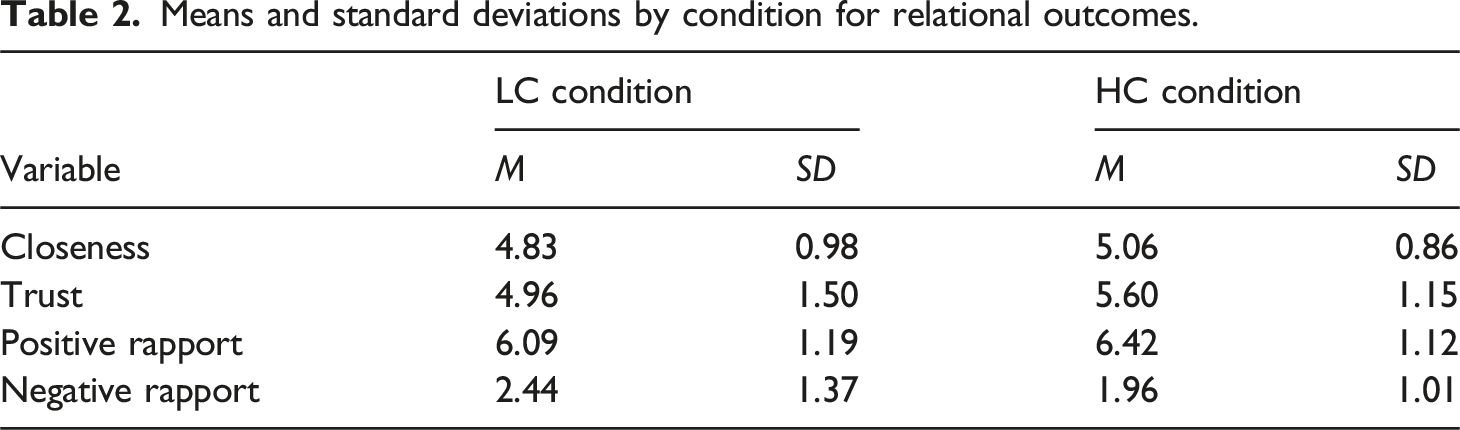
Note that confidence intervals for effect sizes overlapped across outcomes (see Supplement), so differences in magnitude should be interpreted descriptively. Consistent with our prediction for SR-G, participants in the high co-creation condition reported stronger SR-G than those in the low co-creation condition (β = 0.54, 95% CI [0.29, 0.80], t(96.15) = 3.55, p < .001, d = 0.65 [0.29, 1.01]). They also expressed greater willingness to work with their partner again (β = 0.40, 95% CI [0.11, 0.68], t(98.39) = 2.75, p = .007, d = 0.41 [0.12, 0.70]).
Finally, our behavioral measure was available for 159 of 196 participants (81.1%). Behavioral observation was not available for 37 participants because staggered payment times precluded clean observation of joint departure. Among observed participants, 71.4% of those in the high co-creation condition (50 of 70) left the laboratory together compared to 37.1% of those in the low co-creation condition (33 of 89), χ2(1) = 18.53, p < .001; log-odds = 1.44, 95% CI [0.78, 2.13], z = 4.20, p < .001.
Analysis II: mediation analysis
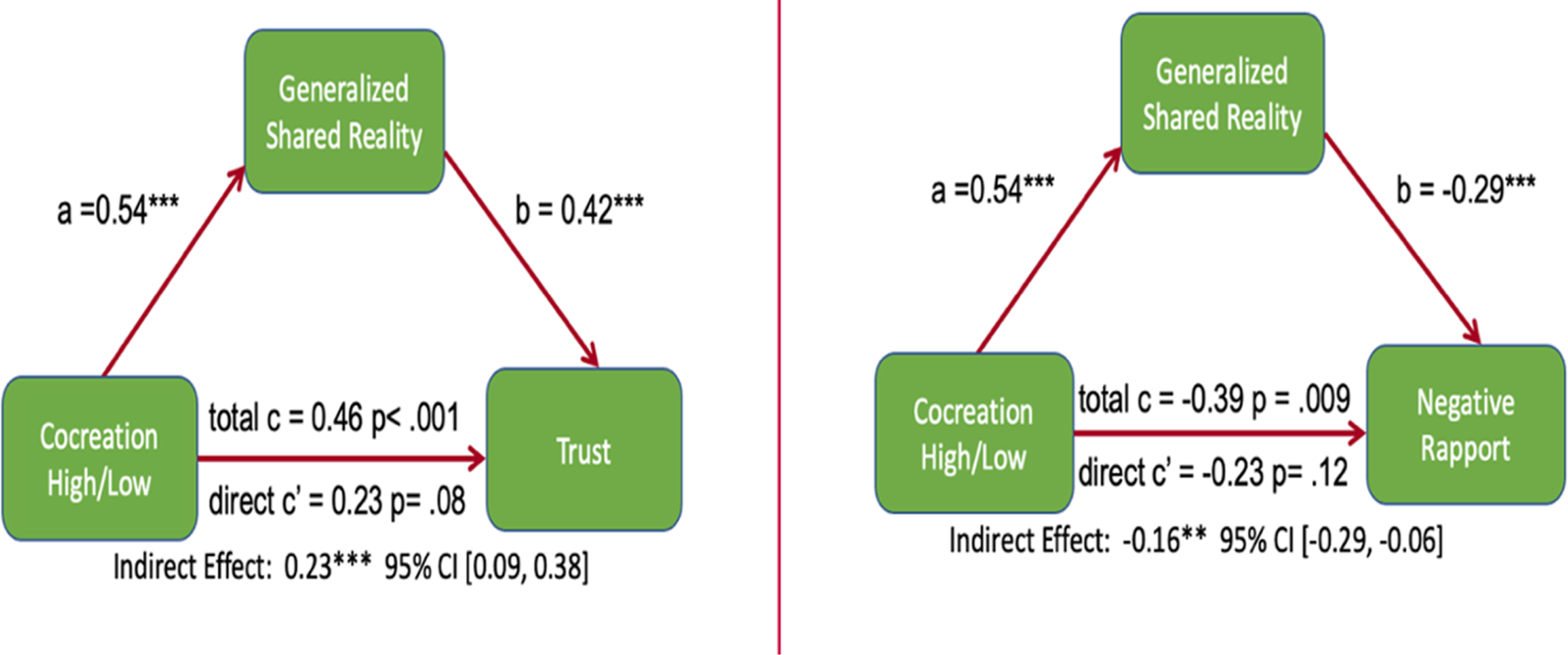
To test whether SR-G statistically accounted for the relationship between co-creation and relational outcomes, we conducted mediation analyses using Monte Carlo confidence intervals with 10,000 simulations. As hypothesized, SR-G significantly accounted for the relationship between co-creation and trust. The indirect effect was 0.23, 95% CI [0.09, 0.38], p = .002, representing 50% of the total effect. Consistent with this pattern, SR-G partially accounted for the relationship between co-creation and negative rapport (indirect effect = −0.16, 95% CI [-0.29, −0.06], p = .008), accounting for 41% of the total effect.
These findings support our prediction that co-creation shapes relational outcomes in part through SR-G Figures 4 and 5. However, because SR-G and relational outcomes were measured concurrently, these analyses establish statistical mediation but do not permit causal inference regarding the path from SR-G to relational outcome (Chan et al., 2022). Full model outputs, indirect effects for alternative mediators, and robustness checks are reported in the Supplement. Relational Outcomes by Condition: Means, 95% Confidence Intervals, and Individual Scores for High Co-Creation (HC) and Low Co-Creation (LC) Dyads Note: We used jittered points for individual response clarity and mean value bars for direct comparison. Error bars represent 95% confidence intervals. Mediation Models: SR-G as a Mediator of the Effect of Co-Creation on Trust (Left) and Negative Rapport (Right). Note: p < .10 “.”, p < .05 “*”, p < .01 “**”, p < .001 “***”.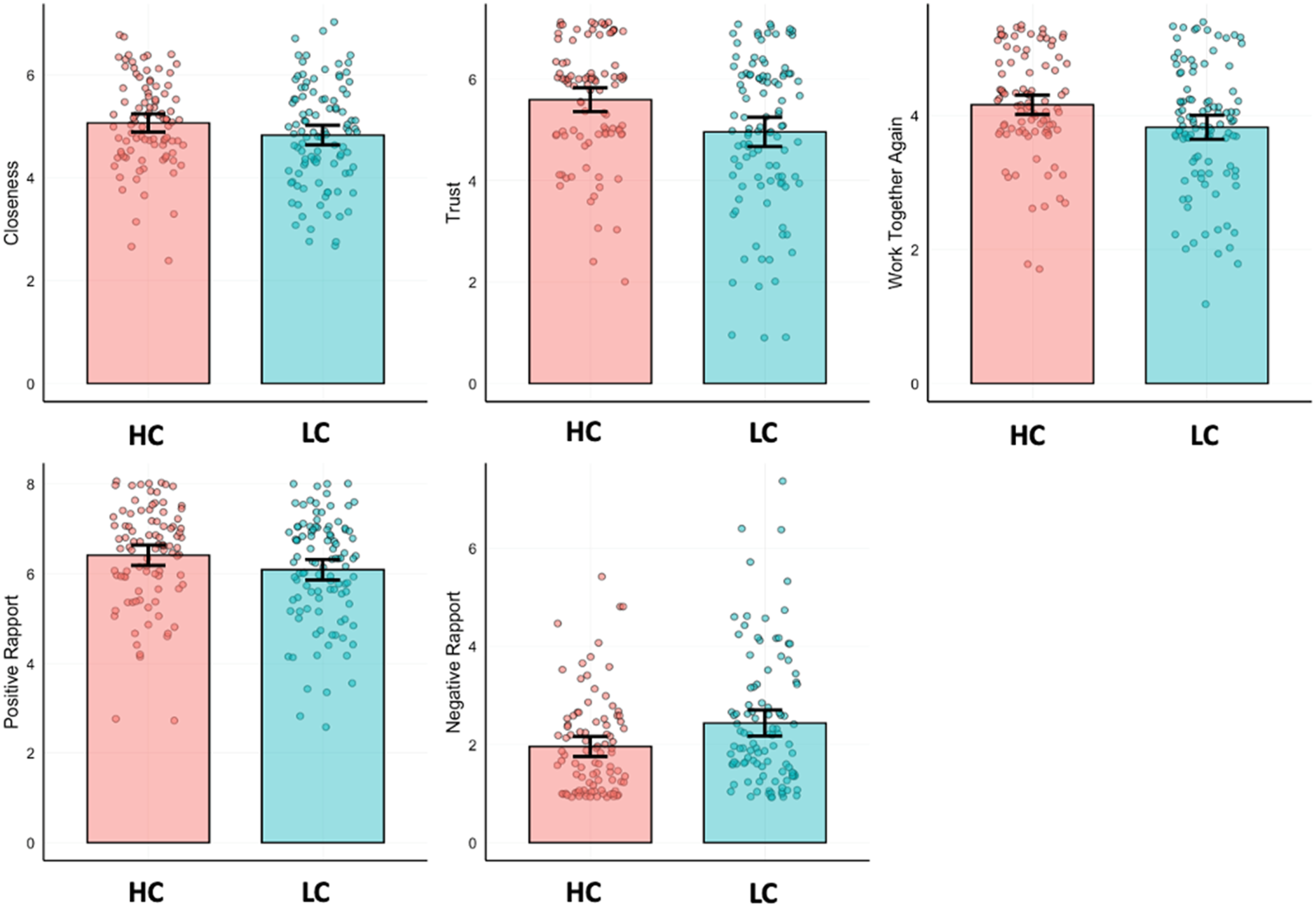
Discussion
Study 3 provided behavioral evidence that co-creation shapes relationships during face-to-face interaction. High co-creation dyads reported greater trust (d = 0.49) and lower negative rapport (d = 0.42). Positive rapport was not statistically significant but showed an effect in the predicted direction (d = 0.29). Notably, participants in the high co-creation condition were nearly twice as likely to wait for their partner and exit together (71.4% vs. 37.1%), suggesting that co-creation’s effects extend to observable social coordination. This exploratory behavioral indicator provides converging evidence beyond self-report. 8
As hypothesized, SR-G mediated the effects of co-creation on relational outcomes. Participants in the high co-creation condition reported stronger SR-G, which accounted for 50% of the effect on trust and 41% of the effect on negative rapport. This indicates that shared reality is a primary, but not sole, pathway through which co-creation influences relational outcomes. Importantly, alternative mediators, including mood, epistemic certainty, and perceived similarity, did not yield reliable indirect effects, supporting the specificity of SR-G as a psychological mechanism. In interpersonal terms, people seem to feel more connected when they believe they are ‘seeing things the same way' as their partner, though additional mechanisms likely contribute to the remaining variance. The absence of effects on closeness, also found in Studies 1 and 2, suggests that relational intimacy may require more time, repetition, or personal content to shift. Since task performance did not differ by condition (45% vs. 44%), the relational benefits of co-creation appear to reflect how people engage, not how well they solve problems. Frequencies of correct and incorrect solutions are reported in the Supplement (Table S8).
Exploratory findings suggest that co-creation encourages more thoughtful and reflective discussion. High co-creation dyads scored higher on Joint Decision Comprehensiveness (d = 0.57), a measure assessing whether partners examined multiple perspectives and critically re-evaluated their assumptions during discussion (see Supplement for measure details). While disagreement frequency was similar across conditions, those in the high co-creation group showed greater willingness to work through disagreements constructively, though this did not reach statistical significance (p = .063).
Study 3 contributes to our understanding in three important ways. First, it demonstrates co-creation’s effects in live, face-to-face interaction, extending the retrospective findings of Studies 1 and 2. Second, the behavioral measure, whether dyads left the lab together, offers ecological validity beyond self-report. Third, by testing and ruling out alternative mediators, it supports shared reality as a specific pathway rather than one of many possible correlates. Together, these findings suggest that actively working to build mutual understanding, not just discovering agreement, can foster trust and connection in everyday relationships.
General discussion
Across three studies, we demonstrate that the subjective experience of co-creation - the felt sense of building understanding together - plays a meaningful role in shaping interpersonal relationships. Whether imagining, recalling, or engaging in joint decisions, participants who experienced high co-creation consistently reported greater trust, stronger rapport, and increased willingness to collaborate again. These effects held even after accounting for baseline similarity and mood, underscoring that how partners experience building agreement may matter as much as reaching it.
This research advances relationship science by identifying co-creation as a distinct process in relationship development. Our findings show that it is not merely communication quality or shared outcomes, but the subjective experience of mutual authorship during decision making that is statistically associated with stronger relational outcomes, with generalized shared reality accounting for a substantial portion of this association. Although co-creation entails communication, communication alone does not guarantee positive outcomes; even agreement can impose relational costs when experienced as contentious or one-sided (Hart & Schweitzer, 2020; Schrodt et al., 2014). Study 2’s manipulation check (d = 1.54) confirms that co-creation represents a qualitatively distinct experience from simple agreement, while Study 3’s mediation analyses show that SR-G specifically mediates co-creation’s effects on trust and negative rapport (indirect effect = 50% and 41% of total effects, respectively). This process-focused lens complements existing work by highlighting subjective collaboration as a durable source of interpersonal benefit. These findings can be understood through shared reality theory’s account of the dual functions (epistemic and relational) served by experiencing one’s inner states as shared with another (Echterhoff et al., 2009; Higgins et al., 2021). Co-creation may be particularly effective at activating both functions simultaneously: by jointly constructing understanding, partners gain confidence that their perspective is valid (epistemic) while also experiencing their partner as invested in mutual comprehension (relational). This dual activation may help explain why co-creation produced significant effects for some relational outcomes (e.g., trust and negative rapport) but not others (e.g., closeness), without implying that the magnitude of effects differed across outcomes.
In our studies, co-creation exerted its strongest effects on process-oriented outcomes: trust, rapport, and willingness to collaborate, while its effects on closeness were weaker and less consistent. This pattern suggests that co-creation may operate through distinct relational pathways: it builds collaborative confidence, reflected in trust and rapport, through successful joint problem-solving, while emotional intimacy, reflected in closeness, may require self-disclosure of personal content or repeated interactions over time (Reis & Shaver, 1988). The subjective experience of mutual authorship appears to signal “we can work well together” more readily than “we are emotionally close,” a distinction consistent with research showing that task-based and socioemotional bonds develop through different mechanisms (Jehn & Shah, 1997). Indeed, while trust can emerge from a single interaction that demonstrates competence or alignment (Baumeister & Leary, 1995; McAllister, 1995), closeness tends to follow a cumulative trajectory requiring repeated reciprocal disclosures and responsive exchanges (Collins & Miller, 1994; Ledermann & Kenny, 2012; Reis et al., 2018). Relatedly, experimental evidence shows that shared reality generalizes more broadly when it is built through sustained, interactive dialogue rather than isolated moments of agreement, suggesting that mutual understanding develops depth and breadth through repetition (Echterhoff & Schmalbach, 2018). Our Study 2 results align with this framework: recalling long-standing agreement, a proxy for accumulated interaction history, produced comparable closeness increases to co-creation, suggesting that closeness may depend more on relational continuity than a single instance of mutual authorship.
Notably, high co-creation dyads were nearly twice as likely to wait for the lab partner (Study 3), a subtle behavioral indicator of affiliative intent that offers ecological validity beyond self-report. This effect emerged despite the low co-creation condition spending more time on Task 2 (p = .017), suggesting that time investment alone does not account for co-creation’s relational benefits. This outcome also aligns with prior work on nonverbal synchrony and rapport, which shows that coordinated behaviors, such as shared movement or timing, signal deeper interpersonal alignment (Bernieri, 2005; Bernieri et al., 1994). Although our measure was binary, the decision to leave together may reflect these emergent synchronies, suggesting that co-creation can produce not just shared understanding, but shared action.
Our manipulation checks revealed an instructive pattern across methodologies: very strong effect sizes in Study 2’s recall paradigm (d = 1.54) but more modest in Study 3’s live interaction (d = 0.33). This variation likely reflects methodological rather than conceptual differences. When recalling past experiences, participants can select prototypical examples that maximize contrast between high and low co-creation. In live interactions, however, even our low co-creation condition involved face-to-face discussion, creating some baseline level of mutual influence. This suggests that co-creation operates on a continuum, with even minimal discussion involving more mutual influence than pure individual decision making, a nuance that may be obscured in recall but apparent in real-time interaction.
SR-G emerged as the key mechanism linking co-creation to these relational benefits. When partners feel they have genuinely co-created an outcome, they appear to infer broader compatibility, an inference that may generalize beyond the specific task. This interpretation aligns with recent research showing that SR-G enhances perceived authenticity during relationship formation (Rossignac-Milon et al., 2024), supports life meaning in close relationships (Enestrom et al., 2024), and facilitates goal pursuit with instrumental others (Elnakouri et al., 2023). Longitudinal evidence further links shared reality to relationship satisfaction (Lutterbach & Beelmann, 2020), while recent work shows its role in adaptive interpersonal dynamics (Mahaphanit et al., 2024). Together, these findings underscore that shared reality plays a central role in how relationships are formed, maintained, and experienced.
Our results add to this literature by identifying co-creation as a specific process through which shared reality can be built, namely, through the subjective sense of mutual authorship in joint decision making. This view is consistent with work by Kashima and colleagues, who describe shared reality as arising not only from converging beliefs but from interaction processes that validate and transmit shared meanings (Kashima et al., 2018; Kashima et al., 2007). It also aligns with findings that actively constructed agreement (vs. fortuitous consensus) produces greater shared reality and trust (Krueger, 2017), and that shared reality, shaped by audience trust, can even bias autobiographical memory (Boytos & Costabile, 2022). These converging lines of evidence help explain why co-creation outperformed even pleasant pre-existing agreement in Study 2.
These findings challenge the assumption that swift consensus is always preferable. Instead, our data suggest that navigating divergent views through active engagement may produce stronger relational bonds. This insight carries practical implications across multiple contexts. In workplace settings, structuring tasks to require genuine integration of perspectives, rather than simply pooling information or ratifying the best pre-existing views, may foster stronger working relationships and team cohesion. The hidden-profile paradigm used in Study 3 offers a template: when team members believe they possess complementary knowledge that must be synthesized, they engage in co-creation rather than mere information exchange. In close relationships, disagreements may strengthen the relationship when partners treat them as puzzles to solve together rather than as arguments to win. For educators, designing collaborative learning activities that require students to build shared understanding, rather than simply reach consensus, may strengthen peer relationships alongside learning outcomes. The key insight is that agreement alone does not guarantee relational benefits; rather, the process through which agreement is reached, whether it feels mutually constructed or unilaterally imposed, shapes relational outcomes.
Nevertheless, this research has limitations. First, there are methodological limitations, especially with respect to causal inference in mediation. Although our experimental manipulation establishes that co-creation causally affects both generalized shared reality and relational outcomes, the association between shared reality and outcomes is correlational because both were measured at the same time point. Our mediation analyses therefore demonstrate that shared reality statistically accounts for co-creation’s effects, but cannot definitively establish that shared reality causes the relational improvements (Chan et al., 2022). Future research using longitudinal designs or experimental manipulation of shared reality itself would strengthen causal claims about the mediational pathway. In Studies 1 and 2, co-creation was operationalized in ways that entailed greater discussion, so communication quantity and co-creation covaried. However, Study 3 helps clarify this concern by holding task structure and time constant while still observing condition differences, suggesting that communication is necessary but insufficient for co-creation’s relational effects. Second, our tasks involved low-stakes, neutral decision contexts. Future research should examine whether co-creation functions similarly in emotionally charged, high-stakes, or morally contentious settings. Third, our samples were drawn primarily from short-term or task-based relationships and did not fully capture demographic diversity; several variables (e.g., sexual orientation, disability status, gender identity) were not assessed, limiting our ability to examine potential moderating effects and reducing generalizability to underrepresented populations. It remains unclear whether co-creation strengthens long-term bonds or becomes redundant in relationships grounded in extensive shared history. Fourth, effects on closeness were inconsistent across studies, suggesting that perceived intimacy may require different conditions, such as repeated co-creative interactions or more personal content, to reliably shift. Future work should explore whether co-creation accumulates over time, examine which behaviors reliably foster the subjective experience of co-creation, and test its impact in naturalistic settings. Exploratory analyses indicated that dyad gender composition did not significantly predict closeness, trust, or rapport, and did not interact with experimental condition. This raises questions about co-creation’s intergroup potential; future research should examine whether co-creative collaboration attenuates outgroup attitudes across racial or political boundaries.
In relationship development, how agreement is reached may be just as important as whether agreement is reached. When people feel they have jointly constructed understanding, rather than simply arrived at the same conclusion, they may see the relationship itself as more trustworthy, collaborative, and resilient. Co-creation fosters mutual authorship and shared reality, which in turn strengthens interpersonal bonds. For relationship science, this highlights the importance of investigating not only the outcomes of interaction but also the subjective experience of building shared meaning. In many contexts, how people create understanding may be how they create relationships.
Supplemental material
Supplemental Material - The role of co-creation in shaping positive relationship outcomes
Supplemental Material for The role of co-creation in shaping positive relationship outcomes by Federica Pinelli and E. Tory Higgins in Journal of Social and Personal Relationships
Footnotes
Declaration of conflicting interests
The authors declared no potential conflicts of interest with respect to the research, authorship, and/or publication of this article.
Funding
The authors received no financial support for the research, authorship, and/or publication of this article.
Open research statement
This manuscript reports three studies. Study 1 was exploratory and not preregistered. Study 2 was preregistered. Study 3 was not preregistered.  ; Data Availability: All data for Studies 1, 2, and 3 are publicly available at https://osf.io/xmhrb/;
Ethical considerations
The Columbia University Institutional Review Board approved all studies. Studies 1 and 2 were approved under Protocol #AAAT2702 and IRB-AAAS2545, respectively. Study 3 was approved under Protocol #IRB-AAAS2667. All studies were conducted in accordance with the Declaration of Helsinki and the ethical standards of the American Psychological Association.
Consent to participate
For Studies 1 and 2, participants provided informed consent electronically by clicking to proceed after reading the consent information page. For Study 3, participants provided written informed consent on paper forms at the beginning of the laboratory session.
Supplemental material
Supplemental material for this article is available online.
Notes
References
Supplementary Material
Please find the following supplemental material available below.
For Open Access articles published under a Creative Commons License, all supplemental material carries the same license as the article it is associated with.
For non-Open Access articles published, all supplemental material carries a non-exclusive license, and permission requests for re-use of supplemental material or any part of supplemental material shall be sent directly to the copyright owner as specified in the copyright notice associated with the article.
