




Abstract
Emotional intelligence (EI) has been positively associated with relationship quality in romantic couples, but few studies have examined the mechanisms underlying this association. The current study examines the mediating role of extrinsic emotion regulation (regulating your partner’s emotions) on the associations between EI and relationship quality. Specifically, we studied the mediating effects of three extrinsic regulation strategies involving high engagement with the partner’s emotions (cognitive reframing, receptive listening, and valuing). Heterosexual couples (N = 175) completed three waves of surveys across 14 weeks from August to October 2021. EI, extrinsic emotion regulation strategies, and relationship quality were measured at three time points. Actor-Partner Interdependence Mediation Models (APIMeMs) were applied to the dyadic data to predict relationship quality and changes in relationship quality (with baseline relationship quality controlled). Results showed that valuing one’s partner was the only significant mediator linking EI to relationship quality. For both men and women, individuals’ EI is associated with better relationship quality for themselves and their partners, through their use of valuing to regulate their partners. However, the mediation effect did not extend to residualized changes in relationship quality over time, indicating that EI and mutual valuing may not drive long-term growth. These findings underscore the importance of fostering EI and mutual valuing within couples, which related to healthier present relational functioning. Future research is needed to clarify their roles in sustaining long-term relationship trajectories.
Keywords
Emotional intelligence (EI) includes the capacities to perceive, understand, use, and manage one’s own and others’ emotions (Mayer et al., 2016; Mayer & Salovey, 1997). EI relates to positive experiences in many interpersonal contexts, including higher-quality romantic relationships (e.g., Lovis-Schmidt et al., 2024; Malouff et al., 2014; Schutte et al., 2001). However, the mechanism by which high EI leads to high relationship quality is unclear. One possibility is emotion regulation processes. Emotion regulation encompasses the processes people use to influence the type, duration, and expression of emotions (Gross, 1998). As emotional interdependence is a core feature of intimate relationships (e.g., Butler, 2011; Finkel & Simpson, 2015; Schoebi & Randall, 2015), emotion regulation in couples is considered a dyadic interdependent process, where both partners are involved in influencing each other’s emotion regulation. Therefore, how individuals regulate their partners’ emotions (extrinsic emotion regulation) is likely to be linked to relationship quality in couples (MacCann et al., 2025). While there has been limited empirical evidence about the mechanism through which EI relates to relationship quality, the current study aims to address this gap by investigating extrinsic emotion regulation as the mediator, by employing a dyadic interdependent perspective (Kenny, 1996; Kenny & Ledermann, 2010).
EI and relationship quality: The underlying mechanism
EI has been conceptualized in various ways depending on theoretical models and assessment methods (Ashkanasy & Daus, 2005), yet it has consistently been linked to more positive experiences in various interpersonal contexts, including romantic relationships (e.g., Lovis-Schmidt et al., 2024). Meta-analytic evidence supports a reliable, moderate positive association between EI and satisfaction with one’s romantic partner, with effect sizes ranging from r = .32 to .37 (Jardine et al., 2022; Lovis-Schmidt et al., 2024; Malouff et al., 2014). Beyond these cross-sectional findings, a longitudinal study spanning 15 years demonstrated that college students with higher EI were more satisfied with their relationships in mid-adulthood, even after controlling for EI levels during mid-adulthood (Parker et al., 2021). This highlights the critical role of EI in the transition to adult relationships.
However, there has been limited research examining the mechanism through which EI positively contributes to relationship quality. One possible pathway is people’s positive emotional experience in the relationship (Levenson et al., 1994). Emotionally intelligent people demonstrated greater empathic perspective taking in social situations and were more likely to offer cooperative responses towards their partners (Schutte et al., 2001). These cooperative responses may enhance not only their own emotional experiences in the relationship but also those of their partners, thereby fostering improved relationship quality for both parties involved.
Existing empirical findings reinforced the view that emotions and emotion regulation play a crucial role in romantic relationships, serving as a key pathway through which EI positively influences couples’ relationship quality. For example, taking the partner’s perspective in conflict discussion (an ability associated with the cognitive component of empathy) mediated the positive link between EI and relationship satisfaction among couples (Schröder–Abé & Schütz, 2011). Conflict resolution styles are also important. In a study focusing on women in romantic relationships, higher EI was linked to a greater tendency to adopt positive conflict resolution strategies with their male partners (Berenguer-Soler et al., 2023). These strategies involved effectively regulating the male partner’s negative emotions, such as anger, which related to lower conflict levels and women’s increased relationship satisfaction.
Skills such as perspective taking and conflict resolution are essential elements of interpersonal emotion regulation, which also contribute to the quality of romantic relationships. Past research suggested that dyadic coping (involving active participation in coping behaviours aimed at managing stress experienced by both partners within a dyadic relationship) mediated the effects from EI to the couples’ experiences in romantic relationships (Wollny et al., 2020; Zeidner et al., 2013). Dyadic coping is closely related to relationship satisfaction among couples. As Falconier et al. (2015) summarized, it would be beneficial for couples to develop their skills in expressing stress, offering dyadic coping strategies in response to their partner’s stress, and improving their ability to provide support that aligns with their partner’s feedback and needs. Therefore, regulating the partner’s emotions, which involves alleviating their negative feelings, would contribute substantially to the overall quality of the relationship.
Extrinsic emotion regulation as the mediator of the EI-relationship quality association
Compared to the broader scope of coping mechanisms entailed in dyadic coping, extrinsic emotion regulation, defined as regulation of others’ emotions, offers a more nuanced perspective on emotion regulation in dyadic relationships: it distinguishes the target (whose emotions are regulated) from the regulator (who regulates the other person’s emotions) within the dyad; and it examines specific strategies employed to improve the emotional experience of others (Gross, 2015; Nozaki & Mikolajczak, 2020). Drawing upon prior research, the current study investigates extrinsic emotion regulation strategies as the mediator through which EI links to relationship quality in romantic couples, where both actor effects (effects of what I do to myself) and partner effects (effects of what my partner does to me) are expected.
Extrinsic emotion regulation and relationship quality
While there has been in-depth exploration of a wide range of strategies of intrinsic emotion regulation (regulating one’s own emotions; e.g., Aldao et al., 2010; Naragon-Gainey et al., 2017; Webb et al., 2012), less is known about strategies of extrinsic emotion regulation. MacCann et al. (2025) identified eight strategies in the domain of extrinsic emotion regulation: expressive suppression, downward social comparison, humor, distraction, direct action, cognitive reframing, valuing, and receptive listening. These strategies vary in their levels of engagement with the target’s emotions, conceptualized as the regulator’s attentional focus and effortful processing of the target’s affective experience. Research indicates that mutual engagement and responsiveness to each other’s internal states enhance positive relational experiences, thereby contributing to higher relationship quality (Clark & Reis, 1988; Reis, 2014). Therefore, extrinsic emotion regulation strategies that require high engagement, where the regulator deeply attends to and processes the target’s cognitive and affective experiences, may uniquely fulfill core relational needs such as empathy and validation. Consistent with this view, MacCann et al. (2025) found that three high-engagement strategies (cognitive reframing, valuing, and receptive listening) were most strongly linked to both regulators’ and targets’ well-being and relationship quality. These findings were also corroborated by Walker et al. (2024), who identified valuing as the strongest predictor of regulators’ relationship satisfaction.
Accordingly, the present study focuses on these three high-engagement strategies. Cognitive reframing entails a high degree of cognitive involvement by addressing the target’s thoughts and cognitions to promote perspective-taking and co-regulation. In contrast, both receptive listening and valuing demand substantial affective engagement through attentive processing of the target’s feelings and emotional expressions, thereby facilitating trust and intimacy via nonjudgmental acceptance or explicit validation.
By employing cognitive reframing to regulate their partner’s emotions, the regulator encourages them to reinterpret the situation in a positive way that alters its emotional impact. Studies have shown that training married couples to positively reappraise marital conflicts can effectively prevent declines in marital satisfaction (Finkel et al., 2013). In addition, when one partner requests a change from the other, the act of positively reappraising that request can promote long-term behaviour change and improve both partners’ perception of the change outcomes (Sisson et al., 2022). Thus, helping the partner to positively reframe a situation is likely to enhance the experience within relationships, and cognitive reframing is expected to be positively associated with couples’ relationship quality.
By employing receptive listening to regulate their partner’s emotions, the regulator will actively listen to their partner and encourage them to express their emotions. When individuals are satisfied with their partner’s listening behaviours, they are more effective at resolving conflicts in the relationship (Gottman & Levenson, 1988). Listening to one’s partner demonstrates support and a shared understanding of their feelings and experiences, fostering meaningful conversations and contributing to a happy marriage (Levenson et al., 1994). Furthermore, attentive listening during the partner’s stress disclosure is associated with better dyadic coping behaviours and greater relationship satisfaction for both men and women (Kuhn et al., 2018). This may be because receptive listening encourages the partner to express their negative emotions, whereas difficulties with emotional expressiveness impairs relationship satisfaction for both partners (Yelsma & Marrow, 2003), and suppressing the partner’s emotional expression harms the overall quality of the marriage (Velotti et al., 2016). Therefore, using receptive listening to regulate the partner’s emotions is expected to facilitate couples’ positive experience in the relationship and contribute to higher relationship quality.
By employing valuing to regulate the partner’s emotions, the regulator will give their partner attention and make them feel valued or special. In romantic relationships, feeling valued by the partner and the desire to be valued both significantly contribute to positive outcomes like increased care, commitment, and responsiveness (Lemay & Spongberg, 2015). Perceived value by the partner also acts as a buffer after conflicts, encouraging individuals to stay close to their partner even when hurt (Murray et al., 2003). For those with low self-esteem, feeling positively regarded fosters greater emotional expressiveness, as it is linked to perceptions of unconditional acceptance and non-judgemental attitudes (Gaucher et al., 2012). Therefore, fostering mutual feelings of being valued is essential for long-term relationship satisfaction. Using valuing to regulate the partner’s emotions is expected to contribute to higher relationship quality.
Extrinsic emotion regulation and EI
As the construct of EI comprises emotional skills related to regulating others’ emotions, extrinsic emotion regulation is conceptually linked with EI. Limited empirical research has supported the positive associations between EI and high-engagement extrinsic emotion regulation. Cognitive reframing, receptive listening, and valuing were the only three out of eight extrinsic regulation strategies showing significant and positive correlations with EI (MacCann et al., 2025; Xiao et al., 2022). As emotionally intelligent people tend to hold a more empathic view toward partners’ stress (Schröder–Abé & Schütz, 2011; Schutte et al., 2001) and experience fewer relationship conflicts (Berenguer-Soler et al., 2023), it is reasonable to expect that they invest more emotional and cognitive resources in managing others’ emotions. However, given the lack of evidence supporting partner effects between EI and the use of high-engagement extrinsic emotion regulation strategies, this relationship will be explored in an exploratory manner.
As noted, EI can be conceptualized in multiple ways (Ashkanasy & Daus, 2005). Meta-analytic evidence on EI and intrinsic emotion regulation suggests that self-rated EI (assessing individuals’ perceived abilities to perceive, understand, use, and regulate emotions) shows the strongest associations with regulation strategies compared to other EI conceptualizations (Xiao, 2022). This is likely because self-rated EI captures individuals’ self-efficacy in regulating their own and others’ emotions. Consistent with this evidence, we focus on self-rated EI when examining its relationship with extrinsic emotion regulation and relationship quality.
The following hypotheses were proposed regarding the associations between EI, high-engagement extrinsic emotion regulation strategies, and relationship quality in romantic couples:
In addition to examining whether EI and high-engagement extrinsic emotion regulation predict future relationship quality, we sought to explore their contribution to changes in relationship quality, by controlling for the baseline levels. This approach allows us to go beyond the influence of existing relationship dynamics to investigate the potential for EI and extrinsic emotion regulation behaviours in predicting long-term improvements in relationship quality.
Method
Participants and procedure
Participants were 175 heterosexual couples (N = 350), each consisting of one self-identified man and one self-identified woman, who reported being in a heterosexual relationship. Couples were recruited from the online crowd-sourcing platform Prolific (https://www.prolific.co/). The mean relationship length was about 12 years (M = 11.85 years, SD = 8.91), with all participants in their current relationship for at least 6 months. The mean age was 40.44 years (SD = 11.96; Mdn = 38; range = 21–83) for men and 38.06 years (SD = 10.65; Mdn = 36; range = 20–66) for women. Of the sample, the majority identified as White (n = 290, 82.9%). Additional participants identified as Asian (n = 39, 11.1%), Black/African (n = 12, 3.4%), Hispanic/Latino (n = 4, 1.1%), Caribbean (n = 2, 0.6%), or mixed ethnicity (n = 8, 2.3%). Fifty-five participants (15.7%) reported other backgrounds. Because participants could endorse more than one category, totals exceed 100%. Regarding residency, most participants reported living in English-speaking countries (n = 317, 90.5%), such as the United Kingdom, Ireland, and the United States. Regarding education level, 71.8% held undergraduate or graduate degrees. Regarding employment status, most participants reported working full-time (n = 237, 67.7%) or part-time work (n = 72, 20.6%). Additional participants were recruited for the study but were excluded for the following reasons: (a) both members of the dyad did not complete all three waves (n = 319 dyads); (b) there was missing data (n = 3 dyads); or (c) at least one member of the couple completed a survey in less than a third of the median time duration (n = 6 dyads).
Participants were recruited via Prolific in three stages. Initially, 1,166 individuals consented and provided their partner IDs on Prolific. Partners were then invited to complete Wave 1 surveys (two 35-min sessions) within a 3-week period. There were 403 couples where both members completing both sessions. Four weeks after Wave 1 surveys closed, 218 couples completed Wave 2 (10-min survey) within two weeks. Another four weeks after Wave 2 surveys closed, 270 couples completed Wave 3 (15-min survey) within two weeks. Participants received £3 (Wave 1), £0.85 (Wave 2), and £1.25 (Wave 3) per time.
The present data was collected as part of a broader 7-wave 24-month (from August 2021 to August 2023) study investigating emotion regulation, emotional intelligence, relationship quality, personal well-being, personality traits, and affective forecasting in romantic couples. The present data was collected in the first three months from August to October 2021. The procedure was approved by the first author’s institution (protocol number 2021/411).
Measures
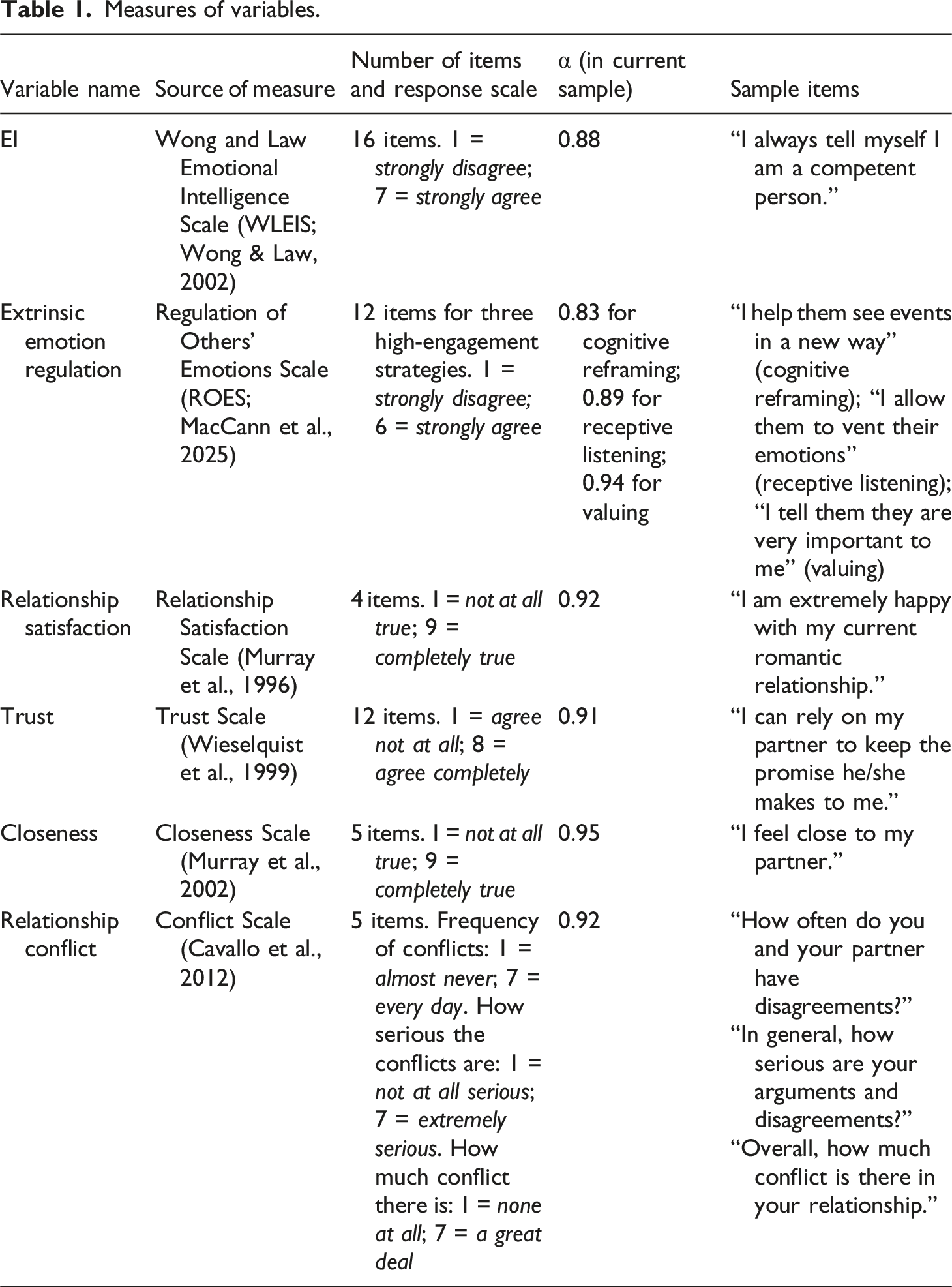
Full materials for the 7-wave study are provided in online supplemental materials. The variables used in the current study were: EI (collected at Wave 1), extrinsic emotion regulation strategies (collected at Wave 2), and relationship quality (collected at Wave 1 and 3). Participants were instructed to rate their use of extrinsic emotion regulation strategies with the aim of making their partner feel better (i.e., “Recently, I have done the following things TO MAKE MY PARTNER FEEL BETTER”). Relationship quality was operationalized as the mean of standardized scores of relationship satisfaction, trust, closeness, and (reverse-coded) relationship conflict. This composite for relationship quality at Wave 1 and Wave 3 showed excellent reliability (α = .96 for both waves). Confirmatory factor analyses (CFAs) were conducted to test whether relationship satisfaction, trust, closeness, and conflict loaded onto a single latent construct of relationship quality. At Wave 1, the one-factor model showed acceptable fit, χ 2 (2) = 15.53, p < .001, CFI = .99, TLI = .96, SRMR = .03, RMSEA = .14, 90% CI [.08, .21]. At Wave 3, the model demonstrated a similar pattern, χ 2 (2) = 37.99, p < .001, CFI = .97, TLI = .90, SRMR = .04, RMSEA = .23, 90% CI [.17, .29]. Although RMSEA values were higher than conventional cutoffs, this index is known to overestimate misfit in models with very few degrees of freedom (Kenny et al., 2015). Alternative indices (CFI, TLI, SRMR) indicated adequate fit at both time points, and standardized factor loadings were strong across all indicators (.66–.94), supporting the interpretation of relationship quality as a single latent construct.
Measures of variables.
Statistical analyses
Dyadic effects were analyzed using the Acor-Partner Interdependence Mediation Model (APIMeM; Bodenmann et al., 2007; Ledermann et al., 2011) for distinguishable couples (men/women). Three separate models tested cognitive reframing, receptive listening, and valuing as mediators linking EI to relationship quality, due to sample size restrictions and power issues. Actor effects (own EI → own outcome) and partner effects (partner’s EI → own outcome) were estimated. Following Ledermann et al.’s (2011) ways of distinguishing partner effects, we label them by referring to the target of the effects; that is, woman’s partner effect refers to the effect from the man to the woman, and man’s partner effect refers to the effect from the woman to the man. Figure 1 depicts full possible actor, partner, direct, and indirect effects in the models. Conceptual Actor-Partner Interdependence Mediation Model (APIMeM). Note. a = direct effects from EI to extrinsic emotion regulation, b = direct effects from extrinsic emotion regulation to relationship quality, c’ = direct effects from EI to relationship quality; F = females; M = males; A = actor effect; P = partner effect; e = residual error. Control variable and baseline variable were included in the analyses but are not depicted in the figure for clarity. For ease of presentation, covariances between females and males are not depicted. Models were computed separately for each extrinsic emotion regulation strategy (cognitive reframing, receptive listening, or valuing), therefore there are three APIMeMs. Wave 1, Wave 2, and Wave 3 surveys were open for 3 weeks, 2 weeks, and 2 weeks, respectively. The 4-week interval refers to the period between the closing of one wave and the opening of the next.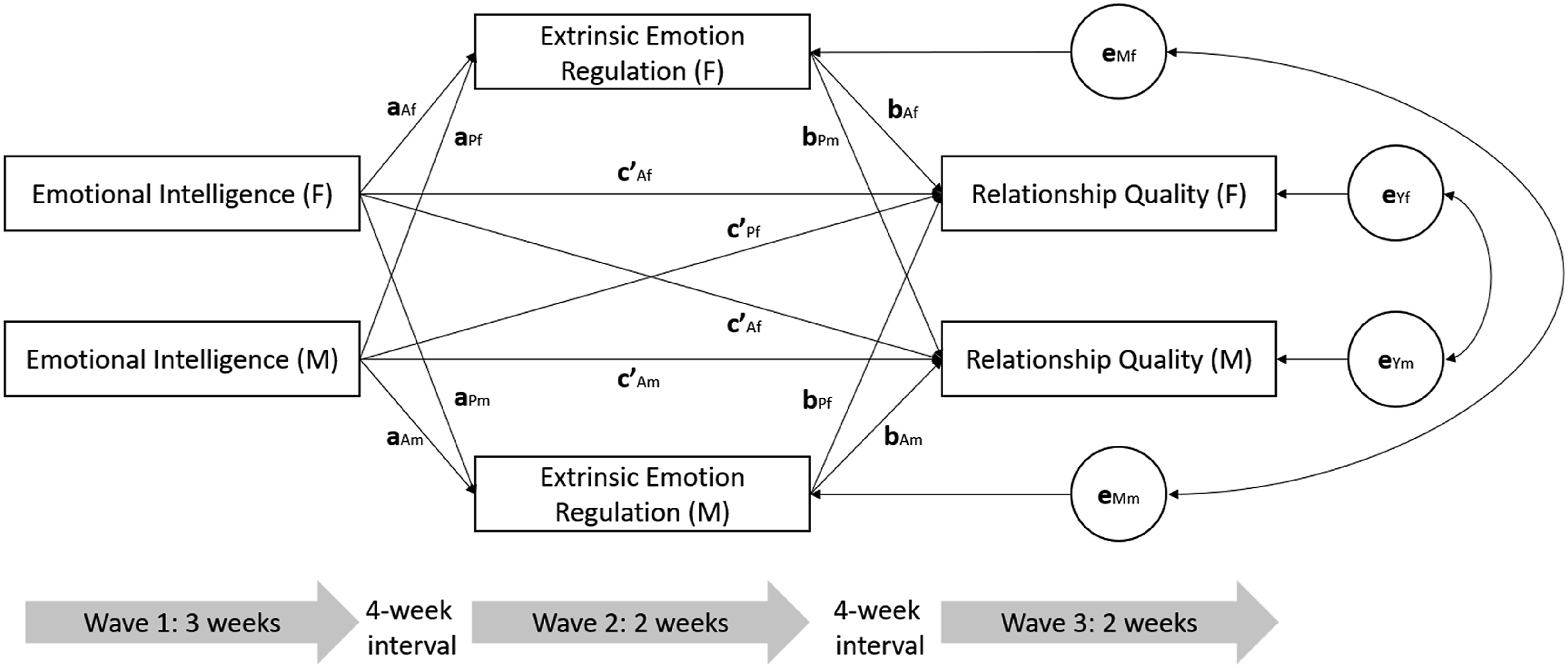
The dyadic data were analyzed by structural equation modelling in JASP (Version 0.17.2) (JASP team, 2023). To protect the statistical power for the models, we applied a bias-corrected bootstrapping procedure with 1,000 iterations following Hayes and Scharkow’s (2013) recommendation. We relied on the bootstrapped standard errors and bias-corrected 95% confidence intervals to make statistical inferences. As relationship length is generally related to relationship quality (e.g., Hadden et al., 2014; Rahaman, 2015), it was included as a covariate in all models. In additional analyses, we controlled for baseline relationship quality (Wave 1) alongside relationship length, thereby testing whether EI and high-engagement extrinsic emotion regulation predict residualized change in relationship quality at Wave 3 (i.e., the portion of variance unexplained by baseline relationship quality) (Castro-Schilo & Grimm, 2018; Selig & Preacher, 2009).
Supplemental analyses
To address the complexity of the study design, we conducted three sets of supplementary analyses. First, we analyzed each of the four subscales of Wong and Law Emotional Intelligence Scale (Wong & Law, 2002) (self-emotion appraisal, others’ emotion appraisal, use of emotion, and regulation of emotion) separately, to examine their unique associations with extrinsic emotion regulation and relationship quality. Second, we examined the four indicators of relationship quality individually in separate models. Third, in addition to the self-rated ability tested in the current study, we also tested two additional conceptualizations of EI (ability EI and mixed EI) (Ashkanasy & Daus, 2005) using corresponding measures. All supplementary analyses followed the same statistical procedures as the primary models. Full results of these analyses are reported in the supplemental materials.
Power analysis
In the present study, Monte Carlo simulation was used for power analyses after the sample size was determined, as the present study is based on data collected in a larger longitudinal project. Power estimation of total effects, direct effects, and indirect effects in APIMeM analyses (without controlling for baseline relationship quality) was performed with a sample size of 175 dyads and α = .05 following Ledermann et al.’s (2022) method to determine power for mediation APIM for distinguishable dyads. The power analysis was conducted in R (Version 4.2.3; R Core Team, 2023). Correlational coefficients between the test variables were used as input for power simulation, which were drawn from previous empirical research (e.g., MacCann et al., 2025; Malouff et al., 2014). The correlational coefficients used for power estimation, the R-code, and results are included in the online supplemental materials.
To summarize, the actor effects generally exhibited robust power (greater than .90) and the partner effects generally showed inadequate power (ranging from .12 to .76). The exceptions include partner effects involving valuing, where both the direct effects between valuing and target’s relationship quality, and the indirect effects between regulator’s EI and the target’s relationship quality via the regulator’s valuing, demonstrated strong power (greater than .90). Therefore, all actor effects are considered reliable based on the present sample size, whereas the partner effects with inadequate power should be interpreted with caution.
Results
Descriptive statistics and correlations
Descriptive statistics and within-gender intercorrelations of all variables.
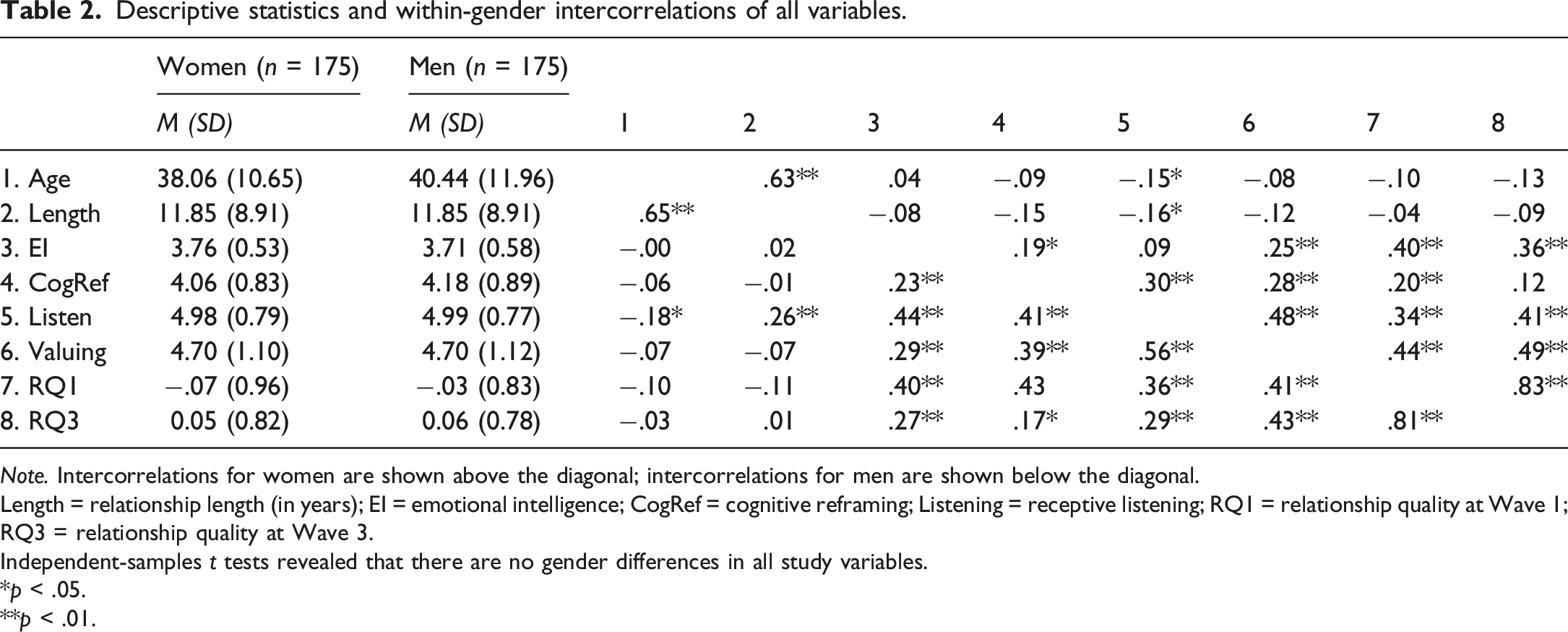
Note. Intercorrelations for women are shown above the diagonal; intercorrelations for men are shown below the diagonal.
Length = relationship length (in years); EI = emotional intelligence; CogRef = cognitive reframing; Listening = receptive listening; RQ1 = relationship quality at Wave 1; RQ3 = relationship quality at Wave 3.
Independent-samples t tests revealed that there are no gender differences in all study variables.
*p < .05.
**p < .01.
Between-gender (within-dyad) intercorrelations of all variables.
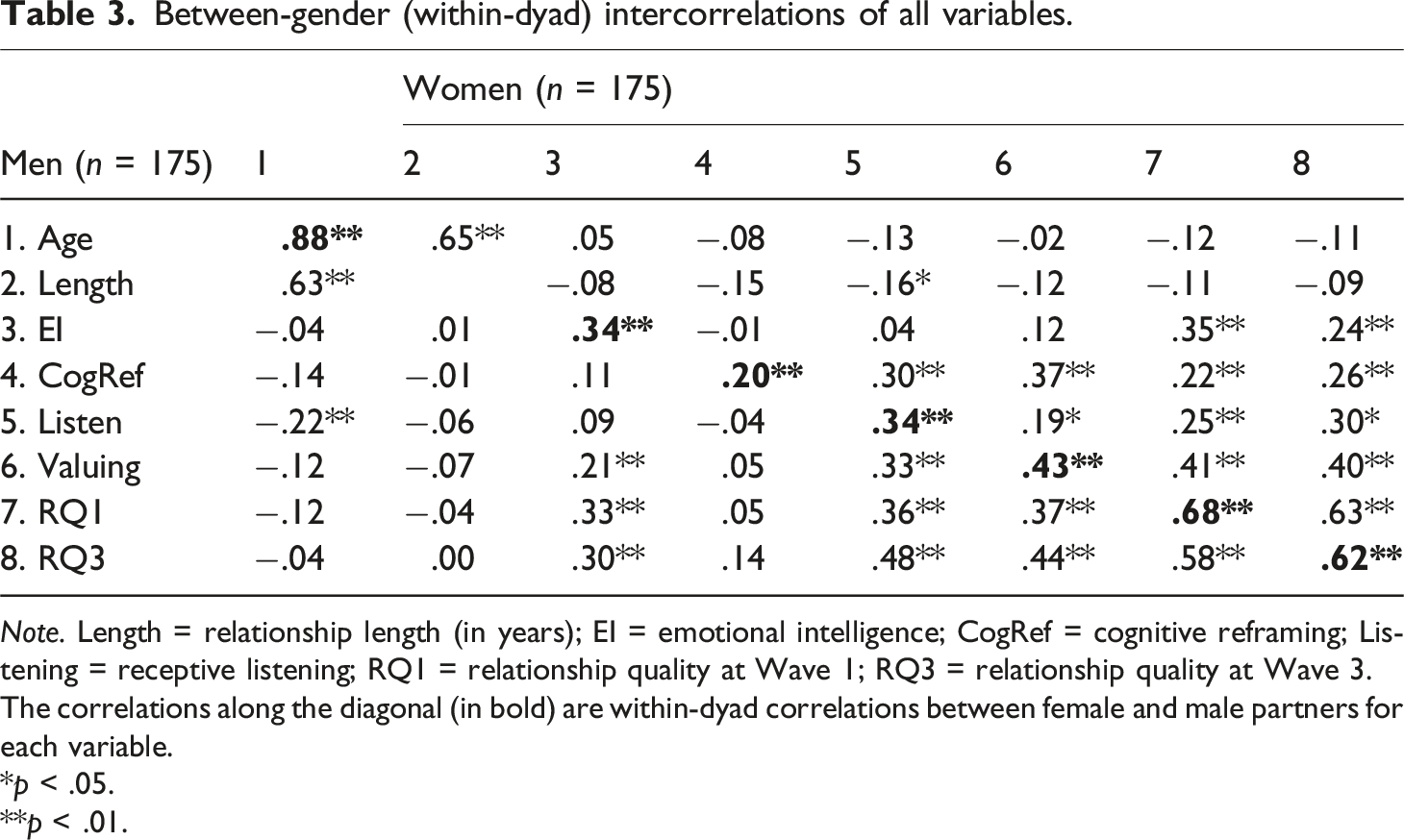
Note. Length = relationship length (in years); EI = emotional intelligence; CogRef = cognitive reframing; Listening = receptive listening; RQ1 = relationship quality at Wave 1; RQ3 = relationship quality at Wave 3.
The correlations along the diagonal (in bold) are within-dyad correlations between female and male partners for each variable.
*p < .05.
**p < .01.
By comparing the correlations using Preacher's (2002) method, two gender differences emerged. For within-gender correlations, EI–receptive listening link was stronger for men (r = .44, p < .01) than women (r = .09, p = .24), z = 3.54, p < .001. For between-gender correlations, women’s receptive listening was more strongly associated with men’s relationship quality at Wave 3 (r = .48, p < .01), than the reverse association of men’s receptive listening with women’s relationship quality (r = .30, p < .05), z = 1.98, p = .048.
Results of APIMeMs
Actor-partner interdependence mediation models (APIMeMs) without baseline adjustment.
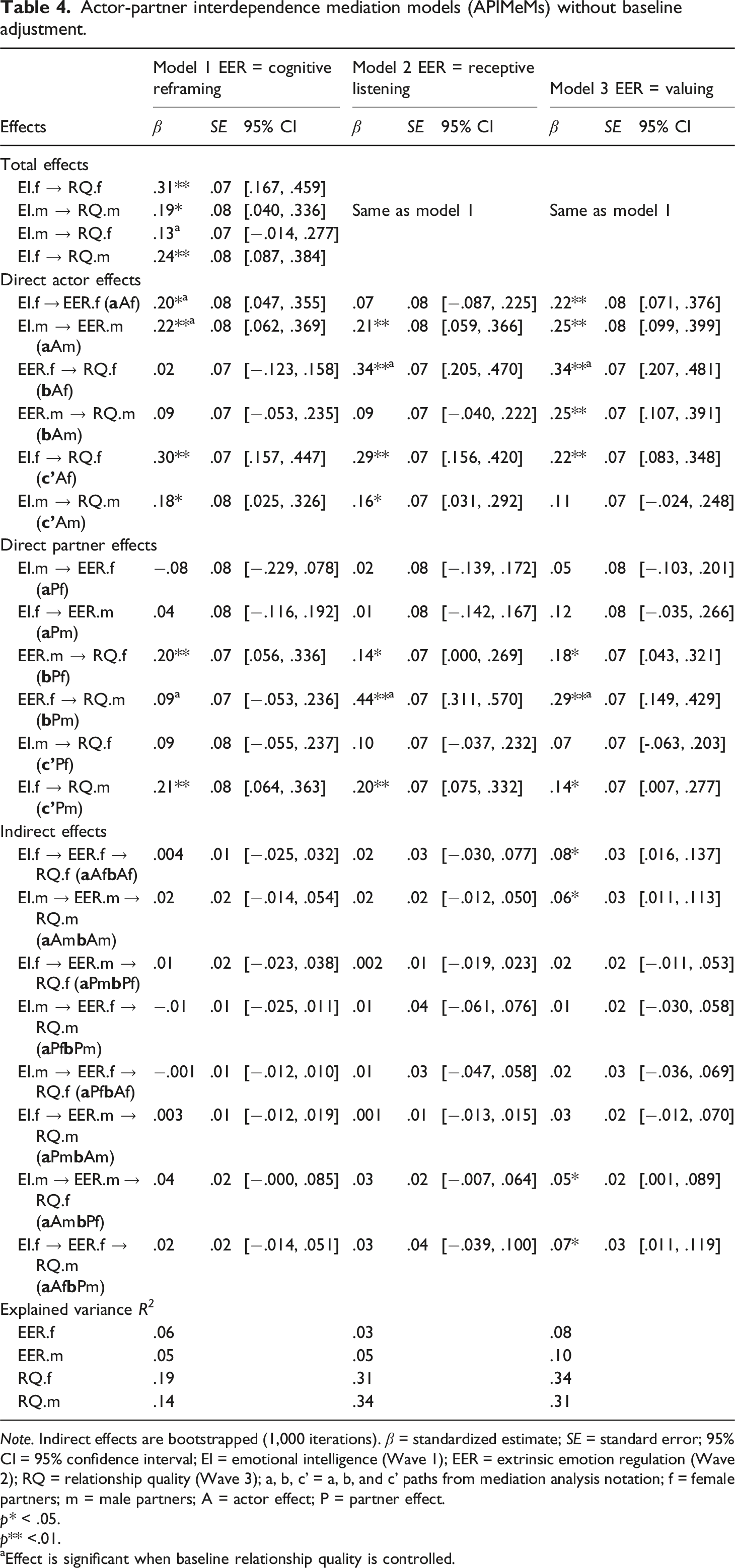
Note. Indirect effects are bootstrapped (1,000 iterations). β = standardized estimate; SE = standard error; 95% CI = 95% confidence interval; EI = emotional intelligence (Wave 1); EER = extrinsic emotion regulation (Wave 2); RQ = relationship quality (Wave 3); a, b, c’ = a, b, and c’ paths from mediation analysis notation; f = female partners; m = male partners; A = actor effect; P = partner effect.
p* < .05.
p** <.01.
aEffect is significant when baseline relationship quality is controlled.
When baseline relationship quality was controlled, the pattern of effects shifted: no indirect effects remained significant, but several direct actor and partner pathways emerged. Specifically, an unexpected partner effect of men’s EI on their female partner’s relationship quality was observed (β = −.10, p = .04), which did not appear in the unadjusted models. This suggests that men’s EI was associated with relationship quality outcomes for female partners below what would be predicted based on their baseline levels alone. Actor effects of EI on cognitive reframing remained robust after baseline adjustment for both men and women. For women, actor effects of receptive listening and valuing on their own relationship quality persisted, such that women’s use of listening and valuing predicted relationship quality outcomes above baseline predictions. Partner effects from women’s use of all three strategies (cognitive reframing, receptive listening, and valuing) similarly predicted relationship quality for their male partners beyond what baseline levels would suggest.
Discussion
The current study explored how EI predicts relationship quality among romantic couples through three high-engagement extrinsic emotion regulation strategies: cognitive reframing, receptive listening, and valuing. Analyses via Actor-Partner Interdependence Mediation Models revealed that valuing was the only significant mediator linking EI traits to positive relationship experience for both men and women. Emotionally intelligent individuals more frequently employed behaviours conveying appreciation and respect, which was linked to higher relationship quality for both themselves (actor effects) and their partners (partner effects). Although valuing emerged as the most robust mediator, direct associations were also observed for cognitive reframing and receptive listening, underscoring that multiple extrinsic regulation strategies may play roles in relationship processes even if they do not mediate the EI-relationship quality link.
These findings highlight valuing as a key mechanism linking EI to relational well-being for both partners. However, when controlling for baseline relationship quality, the mediation pathways became nonsignificant, though several direct actor and partner effects persisted. These divergent patterns suggest distinct mechanisms: although EI operates through valuing behaviours in the unadjusted models, residulized models suggest that EI and extrinsic regulation strategies may independently contribute to relationship quality variance not explained by baseline functioning. These differences highlight the need to distinguish between mechanisms that sustain existing relational well-being and those that predict individual variations beyond baseline levels.
Hypothesis 1: EI relates to higher relationship quality
Consistent with prior findings, EI was moderately associated with individuals’ own relationship quality for both men (r = .27) and women (r = .36), closely mirroring effect sizes reported in previous meta-analyses (e.g., Jardine et al., 2022; Lovis-Schmidt et al., 2024; Malouff et al., 2014). Between-gender correlations (r = .24 for women’s EI and men’s quality; r = .30 for men’s EI and women’s quality) similarly indicate that one partner’s EI moderately relates to the partner’s relational experiences.
In unadjusted regression models, EI positively predicted individuals’ relationship quality across genders. Notably, women’s EI also predicted higher relationship quality for their male partners, suggesting that women’s emotional competencies uniquely foster dyadic harmony. In contrast, men’s EI appeared to function primarily intrapersonally, benefiting only their own relationship experiences. However, given the limited statistical power for detecting partner effects between EI and relationship quality, these partner effect patterns should be interpreted with considerable caution and require replication in larger samples before drawing firm conclusions about gender differences in interpersonal versus intrapersonal EI benefits.
However, when controlling for baseline relationship quality, a surprising partner effect emerged: men’s EI predicted relationship outcomes for their female partners that were below baseline predictions. Although negative interpersonal outcomes of EI are rare in romantic contexts, the “dark side” literature suggests that emotionally intelligent individuals can leverage these abilities for strategic manipulation and deception (Davis & Nichols, 2016). Similar patterns have been observed in organizational settings, where high-EI individuals may exploit emotional skills to advance personal goals, especially in conjunction with dark personality traits (Hyde et al., 2020; Kilduff et al., 2010; Nagler et al., 2014).
Overall, these findings confirm the generally positive role of EI in relationship quality but highlight potential gender differences in interpersonal impacts. Future research should investigate how personality dispositions, gender norms, and contextual factors moderate both the beneficial and potentially adverse interpersonal effects of EI.
Hypothesis 2: EI relates to greater use of high-engagement regulation strategies
Consistent with prior work, higher EI in men was linked to increased use of cognitive reframing, receptive listening, and valuing, whereas for women, EI related primarily to cognitive reframing and valuing. All associations were small (β = .20–.25). After controlling for baseline relationship quality, only the actor effect from EI to cognitive reframing remained robust. These effects mirror prior findings that EI predicts more frequent use of high-engagement extrinsic regulation strategies (MacCann et al., 2025; Xiao et al., 2022), extending this link to romantic contexts.
Gender differences emerged for receptive listening: emotionally intelligent men were more likely to listen attentively and encourage expression from their female partners, and men with lower EI engaged less in listening. However, for women, EI did not predict listening behaviours toward male partners, suggesting women’s attentiveness remains consistent regardless of EI levels.
This gender distinction reveals an important mechanism behind receptive listening. It builds on Pence and Vickery’s (2012) findings that EI positively predicts active and empathic listening behaviours, though those studies did not explore how these behaviours vary between genders. Our results suggest a stronger association between EI and receptive listening in men, echoing Brackett et al. (2004), who reported that EI more strongly predicted social behaviours in male college students. These findings highlight that men’s EI may be particularly associated with attentive and empathic listening in romantic relationships.
Interestingly, supplemental analyses examining the effects of individual EI subscales revealed that men’s emotion regulation abilities negatively predicted women’s use of cognitive reframing (β = −.17, p = .03) and receptive listening (β = −.16, p = .04). These findings suggest that if men are good at controlling their emotions, their female partners will regulate their emotions less.
Hypothesis 3: High-engagement regulation strategies relate to higher relationship quality
Valuing and relationship quality
Among the three high-engagement strategies, valuing emerged as the most consistent predictor of a partner’s relationship quality, for both women and men, with partner effects showing adequate statistical power. When examining residualized change in relationship quality, women’s valuing uniquely predicted relationship quality outcomes above baseline predictions for both themselves and their male partners. The significant partner effects highlight that valuing one’s partner contributes positively to the partner’s relationship quality. This finding aligns with extant research demonstrating that perceived value fosters positive relationship dynamics, including increased care, commitment, and reduced negative interactions (Lemay & Spongberg, 2015). It also supports the broader conclusion that valuing is a cornerstone of romantic relationship well-being: feeling valued is not only essential across various interpersonal contexts but is particularly critical for the longevity and quality of romantic bonds (Cavallo & Holmes, 2013).
Additionally, the significant actor effects indicate that valuing one’s partner simultaneously links to one’s own better relationship quality. This suggests that valuing the partner is related to mutual benefits, associated with positive relationship experiences for both individuals involved. While previous research highlights how feeling valued provides an emotional buffer for the recipient (Murray et al., 2003), our findings demonstrate a complementary process—that actively valuing the partner may be associated with an equivalent emotional buffer for the individual expressing that value.
Valuing the partner, characterized by unconditional acceptance and a non-judgemental attitude toward the partner’s emotional experiences (Gaucher et al., 2012), appears to cultivate a relational environment that reinforces mutual satisfaction and trust. The bi-directional nature of the link between valuing and relationship quality suggests a potentially self-reinforcing cycle: high-quality relationships encourage partners to value one another, reinforcing a positive cycle of relational growth and emotional connection.
Receptive listening and relationship quality
The findings revealed gender differences in receptive listening and how it relates to relationship quality. Women’s receptive listening demonstrated positive associations with both their own and their male partner’s relationship experiences, which stayed significant even after controlling for baseline relationship quality. In contrast, men’s receptive listening showed significant partner effects only, predicting their female partner’s better relationship quality but not their own; and these effects were not significant when controlling for baseline relationship quality. Given the power for partner effects involving receptive listening was inadequate, these findings should be considered with caution in the current study. These findings support that listening behaviours may reflect the dynamics of healthy romantic relationships (Manusov et al., 2020; Ramos Salazar & Nguyen, 2020).
Receptive listening in the current study encompassed behaviours including attentive listening and encouraging emotional expression (e.g., “I let them talk to me about their troubles” and “I listen to them talk about their emotions”). However, men and women exhibit distinct listening approaches. Although both genders demonstrate comparable information processing capabilities, women excel at emotional perception and responsiveness during listening (Pence & James, 2015). In their work distinguishing between people-oriented and content-oriented listening styles, Lee Sargent and Weaver (2003) delineated similar gender-based listening variations: women prioritized attending to people’s feelings and emotions during listening, and men tended to focus on complex information and systematic evaluation, adopting a more analytically oriented approach during listening.
Interestingly, women’s receptive listening behaviours reflect reciprocal relational dynamics, linking to both their own and their partner’s better relationship quality simultaneously. Walker et al. (2024) also concluded that listening to the partner associates with one’s own higher relationship satisfaction. Doohan (2007) argued that listening attentively to the partner’s work-related concerns could foster quality interactions about work-life balance, which leads to greater relationship satisfaction in the regulator. Therefore, when women engage empathetically with their partner’s emotional expressions, they may feel emotionally needed or rewarded due to their preference for engaging with feelings and emotions, which further foster their own relationship quality.
Conversely, men’s listening behaviours manifest differently. While their attentive listening positively predicts their female partner’s relationship experiences, men do not appear to derive a comparable self-oriented improvement in relationship experience. This asymmetry potentially reflects deeper cognitive and emotional processing differences between genders, suggesting that receptive listening is not uniformly experienced or interpreted across gender lines.
Cognitive reframing and relationship quality
Men’s cognitive reframing predicted higher relationship quality for their female partners but had no impact on their own relational outcomes. In contrast, no significant actor or partner effects were observed for women’s use of cognitive reframing. However, when baseline relationship quality was controlled, women’s cognitive reframing predicted relationship quality for men above their baseline predictions. These findings suggest that cognitive reframing operates differently across genders and temporal contexts. Men’s cognitive reframing related to higher relationship quality of women in the future, whereas women’s cognitive reframing predicted higher relationship quality of men beyond men’s baseline predictions. As with receptive listening, the power for these partner effects was low, and thus these findings should be interpreted cautiously. The absence of actor effects supports Walker et al.’s (2024) findings that reappraisal efforts focused on the partner were not related to one’s own relationship satisfaction; and our findings further suggest that these efforts were not related to either future relational well-being or improvements in relational well-being.
Although men and women in the current sample reported using cognitive reframing at similar levels, women reported higher relationship quality when their male partners encouraged them to adopt a more positive mindset toward emotional situations, and men reported relationship quality above baseline predictions when their female partners used more cognitive reframing towards them. However, these positive effects contradict previous studies. For example, Niven et al. (2015) suggested that targets often view extrinsic reappraisal negatively, perceiving it as ‘splaining’ or an imposition on their own thoughts and feelings. Similarly, Santoro and Markus (2024) found that women felt more empowered and respected when men asked open-ended questions rather than offering unsolicited advice during discussions of troubling situations, suggesting women’s preference to express their opinions rather than receiving advice in discussions with men. Our findings, however, demonstrate that men’s extrinsic cognitive reframing could be positively received by female partners, and women’s extrinsic cognitive reframing could predict higher relationship quality of men beyond their baseline level.
These discrepancies may stem from methodological distinctions. Our study focused specifically on romantic relationships, whereas prior research did not. Moreover, in our study, participants were asked about their use of extrinsic emotion regulation strategies with the intent to make their partner feel better, a motivation which was not examined in earlier research. These distinctions underscore the importance of considering relationship context and motivation when evaluating the connections to extrinsic emotion regulation strategies, particularly extrinsic cognitive reframing. The partner effects of extrinsic cognitive reframing may vary between general interpersonal contexts and heterosexual romantic relationships, with notable differences emerging between men and women within these dynamics.
Hypothesis 4: Indirect effects of EI on relationship quality through regulation strategies
Among the three high-engagement extrinsic emotion regulation strategies, the only consistent indirect effect of EI on relationship quality was for valuing, where there were robust actor and partner effects for both men and women. Although mediation emerged only for valuing, the direct effects of cognitive reframing and receptive listening highlight that these strategies still play meaningful roles in relationship dynamics. Valuing should therefore be seen as a particularly powerful mediational pathway linking EI to relationship quality, whereas cognitive reframing and receptive listening may contribute to relational well-being through other mechanisms beyond emotional intelligence. Nonetheless, given the limited statistical power for detecting mediation effects involving cognitive reframing and receptive listening, the absence of these indirect pathways should be interpreted cautiously.
Further support for this interpretation comes from the supplemental analyses. Analyses using the individual EI subscales consistently showed that valuing the partner was the most robust mediator linking each EI subscale to higher relationship quality, but effects involving cognitive reframing and receptive listening were weaker and less consistent. Similarly, when the four relationship quality indicators (satisfaction, trust, closeness, and conflict) were examined separately, the same pattern emerged. Valuing reliably mediated the link between EI and greater satisfaction, trust, and closeness, as well as lower conflict.
These findings reveal a key mechanism by which emotionally intelligent individuals may benefit their own and their partner’s relationship experiences through the expression of valuing. This significant mediation through valuing, however, did not hold when predicting residualized change in relationship quality. This suggests that although EI operates through valuing behaviours in the overall prediction of relationship quality, this mediational process may not account for individual variations beyond what baseline relationship functioning would predict.
The robust relational dynamics associated with valuing set it apart from cognitive reframing and receptive listening. The outcome variable measured in this study is relationship quality, operationalized as a composite of relationship satisfaction, trust, closeness and (reverse-coded) relationship conflict. While cognitive reframing is a change-focused regulation strategy that involves encouraging the partner to adopt a positive mindset, receptive listening and valuing are relationship-focused strategies that emphasize the connection and intimacy between partners. Conceptually, this focus on relational dynamics aligns receptive listening and valuing more closely with relationship quality in romantic contexts than does cognitive reframing. Prior research has supported this conceptual link between valuing and relationship quality, suggesting that feeling valued or appreciated within a romantic relationship is related to positive relational outcomes such as increased care and commitment (Lemay & Spongberg, 2015; Murray et al., 2000, 2003). Valuing has also been identified as the strongest predictor of relationship satisfaction among all the extrinsic regulation strategies (MacCann et al., 2025; Walker et al., 2024), supporting its significant impact on fostering positive relationship experiences.
In addition to its strong association with relationship experiences, valuing distinguishes itself by its reciprocal nature. Drawing from MacCann et al.’s (2025) research, valuing shares similarities with gratitude interventions. In the contexts of romantic relationships, valuing encompasses expressions of appreciation for the partner’s presence, contributions, and the shared relational journey. Similar to expressions of gratitude, which are consistently linked to positive well-being outcomes (Dickens, 2017), valuing the partner therefore could not only improve the partner’s relationship experience but also enrich the regulator’s relationship quality.
Our findings parallel Geng’s (2018) research, which demonstrated that gratitude significantly mediates the connection between EI and well-being. Extending this perspective, our study reveals the key role of valuing in relational well-being of romantic couples. Through valuing, EI shows associations beyond the individual, relating to relational harmony and more positive relationship experiences for both partners.
Limitations and future directions
While the current study investigated whether EI is linked to relationship quality via the way couples regulate their partner’s emotions, there are other possible factors affecting the EI—Relationship quality link. As Jardine et al. (2022) highlighted, associations between EI and relationship satisfaction can be moderated by measurement choices (e.g., type of satisfaction scale) and reliability of EI instruments, as well as couples’ relationship status. While we conducted supplemental analyses examining various EI constructs, individual EI subscales, and disaggregated relationship quality measures (see supplemental materials), future research should consider expanding the scope of inquiry through more diverse relationship measures, ensuring robust internal consistency of EI scales, and interpreting findings within the context of these moderating factors.
Second, our reliance on the regulator’s self-reports to assess both extrinsic emotion regulation and EI may introduce bias. Walker et al. (2024) demonstrated that the target’s perspective—how partners perceive regulatory behaviours—more strongly predicts relationship quality. Additionally, only self-report EI was measured, ignoring partner-rated EI, which Smith et al. (2008) found to be equally predictive of satisfaction. Future studies should integrate informant reports from both partners and examine how self- and partner-rated EI interact with both regulator and target perspectives on emotion regulation.
We did not examine similarity in EI or regulation strategies between partners. Research shows that couples who share similar emotion regulation approaches (e.g., suppression; Velotti et al., 2016) and perceive equivalent EI levels (Smith et al., 2008)report higher satisfaction. Future work should assess dyadic similarity in EI and its interplay with individual regulation patterns.
The generalizability of the findings is limited by the diversity of our sample. As the current study primarily focused on white English-speaking populations, future research could explore the cultural contextual factors influencing extrinsic emotion regulation, including its manifestation in romantic couples across diverse cultural settings. As most of our participants reported having higher education, future research could also enhance sample diversity by including populations with a broader range of educational backgrounds. We did not collect information on participants’ disabilities, which limits our ability to examine how disability status may relate to the variables of interest.
The data was collected during the post-COVID-19 period, from August to October 2021. There is also a limitation associated with the time frame, as the varying degrees of pandemic recovery across regions may have influenced participants’ experiences. This variability makes it challenging to fully account for the pandemic’s influence during this period, and its potential effects cannot be entirely ruled out.
It is important to note that participants reported their use of emotion regulation strategies in situations aimed at making their partner feel better in a general context, rather than during conflicts. This supportive context likely involves different motivational and emotional dynamics than conflict situations, which have been the focus of much prior research. Although we advanced beyond cross-sectional designs by controlling for baseline relationship quality in longitudinal analyses, causality remains uncertain. To better understand whether these associations generalize to more challenging or conflictual contexts, future research could use laboratory experiments (e.g., Parkinson et al., 2016) to observe real-time extrinsic regulation during emotionally charged interactions using behavioural coding and psychophysiological measures. Additionally, experience sampling methods (e.g., Niven & López-Pérez, 2025) would capture daily regulatory fluctuations in naturalistic contexts, shedding light on situational moderators like conflict intensity or partner responsiveness.
There are limitations concerning the statistical power of the analyses. While the actor effects demonstrated sufficient power, the partner effects lacked adequate power except for those involving valuing. It should be noted the findings about valuing are all reliable, whereas the partner effects involving cognitive reframing and receptive listening lack sufficient statistical power, which should be interpreted with caution. Future research could address this issue by increasing sample sizes or employing methods better suited to detect partner effects.
Conclusions
This research offers a novel contribution by examining the role of extrinsic emotion regulation (regulating partner’s emotions) in linking EI to future relationship quality in romantic couples, specifically through both actor and partner effects. Unlike prior cross-sectional work on EI and relational well-being, we additionally controlled for baseline relationship quality, revealing that pathways linking EI and extrinsic emotion regulation to relationship outcomes shifted when accounting for temporal dynamics. Among the three high-engagement regulation strategies, valuing emerged as the only significant mediator. Importantly, this mediation did not extend to residualized changes in relationship quality. Nonetheless, receptive listening and cognitive reframing also showed important direct effects. These findings suggest that emotionally intelligent individuals are more likely to express valuing towards their partners, and these behaviours are associated with better future relationship quality for both themselves and their partners. However, this mediational mechanism does not predict relationship quality beyond what would be expected based on baseline level alone. These results highlight the complex nature of emotional processes in relationships, where certain mechanisms may sustain existing relational well-being while others contribute to deviations from expected trajectories. Understanding these distinctions has important implications for relationship interventions and theory development.
Supplemental Material
Supplemental Material - Valuing your partner more: Linking emotional intelligence to better relationship quality
Supplemental Material for Valuing your partner more: Linking emotional intelligence to better relationship quality by Hester He Xiao, Kit S. Double, Rebecca T. Pinkus, Carolyn MacCann in Journal of Social and Personal Relationships
Supplemental Material
Supplemental Material - Valuing your partner more: Linking emotional intelligence to better relationship quality
Supplemental Material for Valuing your partner more: Linking emotional intelligence to better relationship quality by Hester He Xiao, Kit S. Double, Rebecca T. Pinkus, Carolyn MacCann in Journal of Social and Personal Relationships
Supplemental Material
Supplemental Material - Valuing your partner more: Linking emotional intelligence to better relationship quality
Supplemental Material for Valuing your partner more: Linking emotional intelligence to better relationship quality by Hester He Xiao, Kit S. Double, Rebecca T. Pinkus, Carolyn MacCann in Journal of Social and Personal Relationships
Footnotes
Declaration of conflicting interests
The authors declared no potential conflicts of interest with respect to the research, authorship, and/or publication of this article.
Funding
The authors disclosed receipt of the following financial support for the research, authorship, and/or publication of this article: This work was supported by the Australian Research Council [grant number DP210103484].
Ethical considerations
This work was approved by the ethics committee at The University of Sydney (protocol number 2021/411).
Consent to participate
Respondents gave consent to participate in the study and to publish their de-identified data.

Open research statement
Supplemental Material
Supplemental material for this article is available online.
References
Supplementary Material
Please find the following supplemental material available below.
For Open Access articles published under a Creative Commons License, all supplemental material carries the same license as the article it is associated with.
For non-Open Access articles published, all supplemental material carries a non-exclusive license, and permission requests for re-use of supplemental material or any part of supplemental material shall be sent directly to the copyright owner as specified in the copyright notice associated with the article.
