




Abstract
Dominance and prestige reflect different forms of power and can affect relationship outcomes. Whereas dominance is a conflict-oriented way of dealing with people and grabbing status, prestige is derived from respect and esteem that is granted by others due to superior skills and knowledge. In this research, we tested three partially competing perspectives on potential associations of dominance and prestige with relationship quality (RQ). Sociobiological perspectives suggest that both concepts ensure the provision of valuable resources, and thus predict that both dominance and prestige would be positively linked to RQ. From a sociocultural perspective, men are expected to be dominant and prestigious whereas being dominant (and perhaps being prestigious) would violate the feminine gender-role stereotype; thus, both variables should relate positively to RQ only for men. From a personality perspective, dominance is characterized by undesirable attributes, whereas prestige is characterized by more desirable attributes; as such, only prestige should be positively related to RQ. We conducted four studies with individuals in romantic relationships in three different countries (Germany, Israel, and the US; Ntotal = 2,010 participants). The participants completed measures of dominance-prestige (as general attributes, as relationship-specific attributes, or in comparison with their partner) and measures of RQ. Although not entirely consistent across studies, our results were most consistent with the personality-based perspective. Prestige seems to benefit a relationship for both actors and partners whereas dominance is detrimental to relationship happiness. Yet, as some results showed that the negative link between dominance and RQ was stronger for women than for men, and the positive link between prestige and RQ was weaker for women than for men; thus some weak support for the sociocultural perspective was also found.
Keywords
Introduction
Social power is a basic force that pervades all human relationships (Agnew & Harman, 2019; Keltner et al., 2003). In romantic relationships, power affects the maintenance and quality of romantic relationships (Kim et al., 2019; Körner & Schütz, 2021). However, previous research on power in romantic relationships has usually not clearly distinguished between different kinds of power (Farrell et al., 2015; Murphy et al., 2022). In particular, whereas some relationship partners may exercise power through threats and intimidation, others may instead have power by virtue of being held in high esteem by their partner due to their knowledge, cooperative attitudes, and achievements.
According to the dominance-prestige framework of social rank (Cheng et al., 2010, 2013; Henrich & Gil-White, 2001), individuals follow very different pathways to achieving and exercising power: dominance, characterized by aggression, force, and intimidation, or prestige, which reflects voluntarily granted influence based on superior skills and abilities. A great deal of research has investigated the dominance-prestige framework as a general trait or strategy (e.g., Cheng et al., 2014) and in specific contexts, such as the workplace (e.g., Ohtsubo & Yamaura, 2022). Yet, very little research has investigated dominance and prestige in close relationships, such as romantic relationships. For example, although domineering traits have been studied in relation to relationship quality (see e.g., Sadikaj et al., 2017), to the best of our knowledge no research has yet explored how prestige and dominance, as conceptualized in the dominance-prestige framework, relate to general relationship quality. For example, do dominant and prestigious individuals tend to experience higher or lower levels of relationship quality? Do their partners? Does the relative perception of each couple member’s dominance and prestige relate to relationship quality?
The present article focuses on associations of dominance and prestige with relationship quality, via a multi-method approach to measuring these two concepts, including both absolute measures of them as well as relative measures (i.e., asking which of the two partners is more dominant or more prestigious). Although the provision of this much-needed information is the main contribution of this article, a complementary theoretical framework is presented by conducting initial tests of three partially competing perspectives on why and how dominance and prestige might be related to relationship quality: a sociobiological perspective, a sociocultural perspective, and a personality-based perspective.
Dominance and prestige as a dual power theory
Numerous studies have examined how social power, the ability to influence others and to make decisions, relates to relationship outcomes (Kim et al., 2019; Körner & Schütz, 2021; Murphy et al., 2022; Simpson et al., 2015; Sprecher & Felmlee, 1997). In previous research on power in couples, social power is typically analyzed as a unidimensional construct that reflects who has (or is perceived to have) more to say in the relationship. Yet, individuals seeking power or having power differ in their behaviors, which is why several power theories distinguish a more functional and collaborative form of power from a conflict-oriented and coercive form of power (Fast & Overbeck, 2022; Lenski, 1966; ten Brinke & Keltner, 2022).
To date, the most prominent such dual facet model of power is the dominance-prestige framework (Cheng et al., 2010, 2013; Henrich & Gil-White, 2001; Maner & Case, 2016). In this model, “dominance” describes the induction of fear, the use of threats, coercion, (psychological) aggression, and intimidation used to grab high social rank. Dominant individuals are typically agentic, and low in agreeableness, honesty, and humility (Cheng et al., 2010; Körner et al., 2023). They prioritize their own interests over those of others and display expansive body positions to enhance their perceived formidability (Körner et al., 2022a; Witkower et al., 2020). Thus, dominance is characterized by a specific set of behaviors, cognitions, and emotions that is also reflected in the person’s self-concept (Körner et al., 2023; Maner & Case, 2016).
Importantly, “dominance” within the dominance-prestige framework should be distinguished from the widespread and longstanding use of the term “dominance” in the personality literature (e.g., Jackson, 1965; Wiggins et al., 1988). In that line of research, dominance is often understood as a broad concept that reflects one’s hierarchical standing, without specification as to how that hierarchical standing is achieved. Dominance within the dominance-prestige framework is a more clearly defined construct, referring to coercive and threatening behavior to achieve rank.
From an evolutionary perspective, “prestige” is understood as social rank that is voluntarily granted to a person due to their superior skills, expertise, and abilities (Henrich & Gil-White, 2001). Prestige is associated with agreeableness and authentic pride (Cheng et al., 2010). Prestigious individuals tend to be high in both agentic and in communal traits. It is a prosocial strategy to achieve social rank because other people can benefit from prestigious individuals in learning from their skills (infocopying; Henrich & Gil-White, 2001). Like dominance, prestige is related to a specific set of behaviors, emotions, and cognitions and reflected in the person’s self-concept (Körner et al., 2023; Maner & Case, 2016).
Dominance and prestige in romantic relationships
Dominance and prestige have not been heavily studied in the context of established romantic relationships. There is, however, initial evidence that both variables are important to understanding preferences when selecting friends and romantic/sexual partners (e.g., Kruger & Fitzgerald, 2011; Snyder et al., 2008). Although the determinants of attraction and partner preference are not synonymous with the determinants of relationship quality in established relationships, research on the former has value in forming hypotheses about the latter.
Prior studies: Attractiveness ratings and mate retention strategies
In an early study, interpersonally powerful men were rated as being more attractive by a group of women; by contrast, women’s attractiveness was not affected by their interpersonal power (Sadalla et al., 1987). Yet, in one of the studies in that paper, whereas interpersonal power of men was attractive to women, domineering behavior and aggressiveness (characteristics associated with dominance) were not attractive. Similarly, a later study reported that women found men more sexually and physically attractive, more desirable, and more attractive as a dating partner when the men’s interpersonal power was coupled with prosociality (characteristics associated with prestige; Jensen-Campbell et al., 1995). Further research on romantic relationships supports the notion that women prefer men high in prestige (see also Schwarz & Hassebrauck, 2012). To the extent that dominant men may be preferred, limited evidence indicates this may only be the case in non-romantic competitive contexts (e.g., sports) or for brief sexual affairs (Kruger & Fitzgerald, 2011; Snyder et al., 2008). Relating these past findings to the dominance-prestige framework, it can be tentatively concluded that prestige in men is favored by women when evaluating men for longer-term relationships (but not vice versa), whereas dominance is not favored or perhaps is even disfavored.
Some research has investigated mate-retention tendencies especially in relation to the dominance-prestige framework. For instance, dominant individuals have been reported to use cost-inflicting mate retention strategies, such as surveilling a partner’s whereabouts or engaging in emotional manipulation, whereas prestigious individuals use benefit-provisioning mate retention strategies, such as buying gifts or providing care (Conlon, 2019). In a similar study, Zeigler-Hill et al. (2020) observed dominance was positively associated with engaging in cost-inflicting strategies (and very weakly positively associated with benefit-provisioning); prestige was weakly negatively associated with cost-inflicting strategies. More broadly, dominance-related behaviors, such as unwanted, negative, and intrusive touch, have been associated with relationship problems like conflict and aggression (Ostrov & Collins, 2007).
Links to relationship quality: Three perspectives
The studies described above linked dominance and prestige to attractiveness ratings and mate-retention strategies. To understand how dominance and prestige are related to happiness in ongoing romantic relationships, this present research examined these two hierarchy variables’ associations with relationship quality. Relationship quality is an individual’s overall subjective evaluation of one’s romantic relationship and is a strong predictor of not only relationship commitment, but physical and mental well-being more broadly (Gerlach et al., 2018; Jardine et al., 2022; Robles et al., 2014). Although relationship quality encompasses a wide variety of aspects of a relationship (e.g., trust, long-term potential, admiration of the partner, sexual satisfaction, not feeling unduly constrained), relationships researchers have long understood that self-reports from partners about their relationships and their relationship partners are heavily influenced by an overall gestalt feeling of positivity/negativity (e.g., Wang & Eastwick, 2020; “sentiment override” in Weiss, 1980), and this global judgment is captured in general measures of relationship quality.
This research considers three partially competing theoretical perspectives on how both variables might be related to relationship quality—for men and for women. From a sociobiological perspective, social rank and power potentially benefit a relationship because both ensure the provision of valuable resources. Dominance and prestige are theorized to have evolved as strategies to achieve high rank and to enable individuals to increase their genetic advantage over others by increasing the viability of their offspring (Henrich & Gil-White, 2001). Dominant individuals are capable of aggressively competing against rivals and can thus secure valuable goods for the relationship. Prestigious individuals can ensure benefits for the relationship by forming alliances with others who may provide them resources or help deter their opponents (Maner, 2017). As a consequence, high rank individuals (whether dominant or prestigious) may be more satisfied with their relationships than others because they may be respected by their partner due to their high rank. Also, their partners could be expected to be more satisfied with the relationship because valuable goods provided by the high rank individual may make their partner more satisfied with the relationship. Furthermore, the provision of valuable goods may increase the long-term potential of the relationship. Finally, as rank is also related to perceiving various situations as opportunities rather than as threats (Keltner et al., 2003), high rank partners may not feel constrained in their relationships. Therefore, both dominance and prestige might be positively related to relationship quality, especially for the high rank member of the couple.
From a sociocultural perspective, satisfaction in relationships may be partly determined by each member of the couple aligning with general expectations about appropriate behavior. Traditional gender roles prescribe men to be agentic, impressive, determined, ambitious, independent, aggressive, dominant, competitive, powerful, and intelligent (Bem, 1974; Spence, 1984)—in brief summary, an achiever (Sawyer, 1970) and high in dominance and/or prestige. By contrast, traditional gender role prescriptions for women are characterized by communion, tender-heartedness, cheerfulness, being yielding, gentleness, and modesty (Bem, 1974)—in other words being low in dominance. Further, gender role stereotypes of women are somewhat in line with prestige (e.g., communal behavior) but as female gender role prescriptions are often characterized by low agency (Bem, 1974)—a trait typical of prestigious people (Cheng et al., 2010), prestige does not seem to fully match the female gender role. Though greater egalitarianism in romantic relationships has been normalized in recent generations, general gender role stereotypes still remain relatively stable (Athenstaedt & Alfermann, 2011; Schneider et al., 2022).
Yet, most past research on gender roles stereotypes has not distinguished between various aspects of power, such as dominance and prestige. Thus, we tentatively start with the default assumption that both dominance and prestige are more typical of the masculine stereotype, but there is reason to question this assumption. Dominant behaviors may be masculine, but being respected is not necessarily more stereotypically masculine than feminine; for example, nurturing and communal women may be well respected by their peers, perhaps even being viewed and treated as leaders. Accepting our tentative default assumption, though, according to the sociocultural perspective, both dominance and prestige in men, but not in women, should be positively associated with relationship quality of both partners (fulfilling the stereotype may increase relationship happiness for the actor who is in line with role expectations—and the partner may also appreciate that the actor conforms to societal norms). This also applies to relative perceptions of dominance and prestige—men who see themselves as more dominant or more prestigious than they consider their partners should be happier than other men because they are in line with typical role expectations (Eagly, 1983). The opposite relation should apply to women.
Finally, desirable attributes typical for well-adjusted personalities might be at least as relevant for relationship quality as the aforementioned two perspectives. This personality-based perspective suggests that the sets of personality traits, emotions, and cognitions typical of dominance and prestige matter greatly. Dominance is linked to aggression and antisocial attitudes (Maner, 2017). Dominant people are selfish, arrogant, disagreeable, and use socially undesirable practices (e.g., threatening) to enforce their will (Cheng et al., 2010). Thus, dominance should be detrimental to relationship quality because the dominant actor experiences negative emotions and the partner will feel constrained by the dominant actor. Further, disagreeableness—which is typical of dominant people (Körner et al., 2023)—has been negatively linked to relationship quality of the partner (Weidmann et al., 2017).
By contrast, prestige is linked to cooperation, prosociality, and agreeableness. Prestigious people experience higher self-esteem, have a more communal orientation, and tend to be conscientious (Cheng et al., 2010; Körner et al., 2023). Thus, high prestige should be positively related to relationship quality because prosociality, agreeableness, and conscientiousness are linked with functional relationship processes (Barry & Wentzel, 2006) and both members of a dyad might consequently experience more trust, support, and togetherness. In fact, certain Big Five traits that are typical of prestigious individuals (i.e., agreeableness, emotional stability) have been linked to relationship quality of both partners (Weidmann et al., 2017). The latter view is in line with literature showing that high prestige partners are preferred for long-term romantic relationships and prestige is linked to benefit-provisioning instead of conflict-inflicting mate retention strategies (Conlon, 2019; Kruger & Fitzgerald, 2011; Snyder et al., 2008).
Yet, we expect the opposite pattern with respect to relative dominance and prestige perceptions. Dominance is disliked by others and considered a socially undesirable trait (Cundiff et al., 2015; Lease et al., 2002). Thus having a relatively dominant partner (in other words having relatively low dominance in comparison with one’s partner) may be linked to negative experiences such as being the target of aggression and not being able to fulfill one’s desires in a relationship. Thus, those who have more dominant partners (i.e., who report being less dominant than the partner) are expected to report lower relationship quality than individuals who feel they are the more dominant partner. On the other hand, prestige is linked to prosocial behaviors (Cheng et al., 2010). Thus, having a partner who is higher in prestige than oneself would be associated with positive experiences because the partner would be perceived as being trustworthy, and supportive. Relatively low prestige would thus be related to high perceived relationship quality.
The current studies
In this research, we studied the associations of dominance and prestige with relationship quality, both within and between romantic relationship partners, in four samples. In Study 1 (German dyads) and Study 2 (Israeli dyads), the links of absolute dominance and prestige measures with relationship quality were tested. In Study 3 (non-dyadic US sample) and Study 4 (dyadic US sample), relative measures of dominance and prestige were used.
This research aimed to add to the literature in the following ways: First, we study the link between two hierarchy variables that both reflect high power, but one in a cooperative way (prestige) and one in a conflict-oriented way (dominance), to provide initial findings on the links between dominance, prestige, and relationship quality in close relationships.
Second, both members of a couple were asked about their self-perceptions to test for intrapersonal and interpersonal associations. The Actor Partner Interdependence Model framework (APIM) was used to account for the mutual influence between both relationship members (Kenny et al., 2006). We tested for the moderating role of gender because the sociocultural perspective suggests gender differences in the links of dominance and prestige with relationship quality. Prior research on dominance and prestige has typically not observed gender differences in how both concepts relate to outcome variables (e.g., Cheng et al., 2013; Redhead et al., 2019), or found only subtle small differences (e.g., Suessenbach et al., 2019). However, prior research focused on contexts such as the workplace, not on romantic relationships. Gender role stereotypes are especially relevant in romantic relationships (Sprecher & Metts, 1989) and it thus seems plausible to expect gender differences in that realm.
Third, we tested associations in three different countries (i.e., Germany, Israel, US). This allowed us to increase the generalizability of findings.
Fourth, both dominance and prestige can be assessed (a) in a general manner (i.e., feeling domineering vs. respected vis-à-vis other people in general) as well as (b) in a relationship-specific manner (i.e., feeling domineering vs. respected in a specific relationship). We thus assessed dominance and prestige both with general and with relationship-specific measures. The latter approach accounts for the fact that people behave differently in different spheres of life (Chen et al., 2006; Mischel & Shoda, 1995; Roberts & Donahue, 1994). For example, researchers studying social power in couples often ask how powerful the individual feels in a specific relationship (Körner & Schütz, 2021). Whereas most research on dominance and prestige uses general measures, it is to be expected that relationship-specific measures would be a closer match when it comes to understanding how these two power forms are linked to relationship quality. Thus, global measures allow for comparisons of the results with previous research on dominance and prestige whereas relationship-specific measures allow for testing whether findings actually depend on the context.
Finally, some prominent theories of power in close relationships emphasize that relationship functioning is partly determined by perceptions of one’s power in comparison to one’s partner (e.g., Rollins & Bahr, 1976; Simpson et al., 2015). As such, research on power in romantic relationships very often measures relative power by asking participants to assess who has more influence or control (e.g., Farrell et al., 2015; Gordon & Chen, 2013; Righetti et al., 2015; Sprecher & Felmlee, 1997). To test associations across multiple different measurement methods, we adopted this approach as a third way to assess relative dominance and prestige (i.e., who is more dominant vs. respected in the relationship).
Studies 1 and 2 – Absolute & relationship-specific dominance and prestige
The first two studies sought to provide the first extensive investigation of self-reports of one’s own absolute levels of dominance and prestige (both as a general trait and specifically in the context of the relationship) in relation to self-report measures of relationship quality. Along the way, as a theoretical complement, we tested the three partially competing perspectives (sociobiological, sociocultural, personality-based) on how dominance and prestige might be related to relationship quality. According to the sociobiological perspective, both dominance and prestige are expected to be positively linked to relationship quality—for both actors and partners. Regarding the sociocultural perspective, men’s dominance and prestige is hypothesized to be positively associated with relationship quality for both partners. The opposite pattern should be the case for women. According to the personality-based perspective, dominance is expected to be negatively linked, and prestige positively linked, to both partner’s perceived relationship quality. Table 7 summarizes the hypotheses.
Method
Participants and procedure
German sample
In total, 252 opposite-gender dyads were recruited but two individuals of two different dyads were excluded due to implausible fast processing times (<2 SD than average processing time) leaving a total sample size of 250 dyads (men: Mage = 26.78, Md = 25.00, SDage = 8.66, Range: 18 to 68; women: Mage = 25.22, Md = 24.00, SDage = 7.80, Range: 18–63). Participants lived across southern Germany and were predominantly white. Most couples were not married (87.6%); some were engaged (4.0%) or married (8.4%). The average relationship duration was four years (M = 4.10, SD = 6.03, Range: 1 month to 43 years). Details about the procedure can be found in the OSF (https://osf.io/5ueqj/).
Israeli sample
In total, 163 opposite-gender couples participated (men: Mage = 34.66, Md = 32.00, SDage = 10.38, Range: 20 to 65; women: Mage = 32.11, Md = 29.00, SDage = 10.00, Range: 19–63), with none excluded for data quality reasons. Participants lived in the greater Tel Aviv area and were mostly white. Most couples were married (55.2%) but many were not (39.3%) and a minority were engaged (5.5%). The average relationship duration was approximately nine years (M = 8.87, SD = 9.00, Range: 1 month to 45 years).
Measures
Dominance and prestige
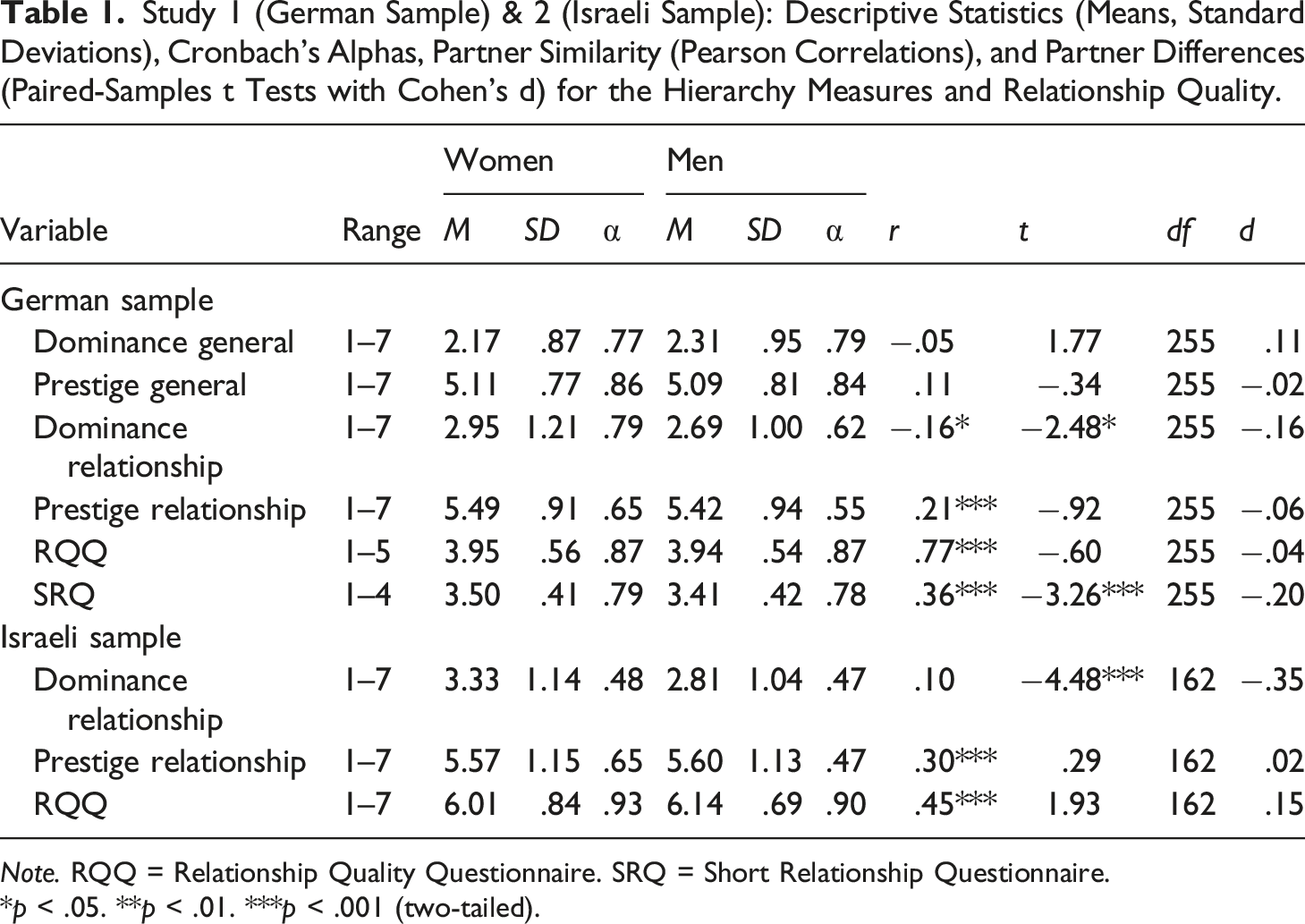
Study 1 (German Sample) & 2 (Israeli Sample): Descriptive Statistics (Means, Standard Deviations), Cronbach’s Alphas, Partner Similarity (Pearson Correlations), and Partner Differences (Paired-Samples t Tests with Cohen’s d) for the Hierarchy Measures and Relationship Quality.
Note. RQQ = Relationship Quality Questionnaire. SRQ = Short Relationship Questionnaire.
*p < .05. **p < .01. ***p < .001 (two-tailed).
In the German and the Israeli sample, we created a modified scale to assess relationship-specific dominance (3 items: “Sometimes I intimidate my partner”, “I dominate our partnership”, “My partner avoids arguments with me because he/she knows that I will get my way anyway”, mean inter-item rGermany/Israel = .41/.25) and prestige (2 items: “My partner sees me as successful”; “My partner admires me because of my knowledge and skills”, rGermany/Israel = .41/.40). Items of the DPQ that are appropriate for the romantic relationship context were selected and rephrased. The items showed medium to high corrected item-total correlations in the German (dominance: M[rit] = .38 and .56 for men and women; prestige: M[rit] = .39 and .48 for men and women) and in the Israeli sample (dominance: M[rit] = .30 and .31 for men and women; prestige: M[rit] = .32 and .48 for men and women). Reponses were given on a scale ranging from 1 (strongly disagree) to 7 (strongly agree).
Relationship quality
To assess overall relationship quality, the Relationship Quality Questionnaire (Siffert & Bodenmann, 2010) was used in the German and the Israeli sample. The RQQ consists of six subscales with a total of 26 items (e.g., “I find my partner attractive and desirable”). Answers were given on a scale ranging from 1 (disagree) to 5 or 7 (for Germany resp. Israel, strongly agree).
We used as an additional measure in the German sample the Short Relationship Questionnaire (SRQ; Kliem et al., 2012). The SRQ has ten items (three subscales and one single-item; e.g., “S/he tells me that s/he likes me”). Responses were given on a scale ranging from 1 (never/very seldom) to 4 (very often). Although both the RQQ and SRQ are general measures of relationship quality, they conceptually differ, and complement one another, in that the SRQ focuses on asking about the relationship behaviors received from one’s partner whereas the RQQ focuses on the feelings one has about that partner and the relationship.
Analytic strategy
A post hoc power analysis indicated that we were able to detect effects of βActor/Partner = .20/.15 with a power of .997/.94 for the German sample, and .96/.80 for the Israeli sample (α = .05; Ackerman et al., 2020).
Preliminary data analyses included paired-samples t tests and Pearson correlations to test for differences and similarities in the measured variables. Then, APIMs (Kenny et al., 2006) were computed to explore associations between dominance and prestige with relationship quality. Partner effects describe associations between the respondent’s predictor and the partner’s outcome (Kenny et al., 2006). To be consistent with APIM terminology, the term “effect” is used, but this does not imply causality. Analyses were done with Mplus 8.4 using maximum likelihood estimation for the SEM framework. Bootstrapped 99% confidence intervals (k = 5,000 samples) are reported. The total score of the relationship quality measures was modeled as a latent trait with the corresponding subscales as indicators. 1 Within the APIM analyses, we tested a saturated model (all effects freely estimated) against a nested equal-actor-equal-partner-effects model. The equal-effects model indicated the absence of gender effects and was favored when the likelihood ratio test was nonsignificant (p > .20; Kenny & Ledermann, 2010). When the saturated model was favored but the b coefficients were still very similar for men and women, we tested an equal-actor-different-partner-effects model or a different-actor-equal-partner-effects models against the saturated model. For the effect size, coefficient Δ was calculated (see Brauer & Proyer, 2018). Δ describes the change in relationship quality in standard deviations when dominance or prestige change by 1 point. The coefficient was calculated separately for men and women (ΔF/M = b/SDF/M) because they had different variances on the outcomes. Δ can be interpreted as the standardized regression coefficient. We interpret Δ = .10 as small, .20 as medium, and .30 as large effect sizes (paralleling those guidelines reported for correlations, Funder & Ozer, 2019). All data and codes are on the OSF (https://osf.io/5ueqj/).
Results
Preliminary analyses
In the German sample, relationship-specific dominance was negatively (r = −.16) and prestige positively (r = .21) correlated within couples. Yet, the correlations were negligible for general dominance and prestige (see Table 1). Thus, general measure were barely associated within couples but relationship partners showed slight divergence in relationship-specific dominance and slight similarity in relationship-specific prestige. Interestingly, women reported higher dominance in their relationship than men did (d = −.16) but men reported higher dominance in general than women (d = .10). There were no significant mean differences between men and women with respect to the prestige measures. Regarding relationship quality, there were strong positive correlations (rRQQ/SRQ = .77/.36) demonstrating robust interdependence between relationship partners. There was no partner difference regarding the RQQ but women reported higher relationship quality on the SRQ than men did (d = −.20); in other words, women reported receiving more positive behaviors from their partners than did men.
In the Israeli sample, relationship-specific dominance (r = .10) and prestige (r = .30) were positively correlated within couples. Thus, Israeli couples were slightly similar in their dominance and even more similar in their prestige ratings. Men and women did not differ in relationship-specific prestige but women reported higher relationship-specific dominance than men did (d = −.35). Regarding relationship quality, there was, as with the German sample, a strong positive correlation within the couples (r = .45) indicating robust interdependence between men and women. Further, men reported slightly higher relationship quality than their partners did (see Table 1).
Associations of general dominance and prestige with relationship quality
German sample
Results of Likelihood Ratio Tests for APIMs Predicting Relationship Quality from Different Dominance and Prestige Measures (Saturated Model vs. Equal-Actor-Equal-Partner Effects Model and Saturated Model vs. Equal-Actor or Equal-Partner Effects Models).
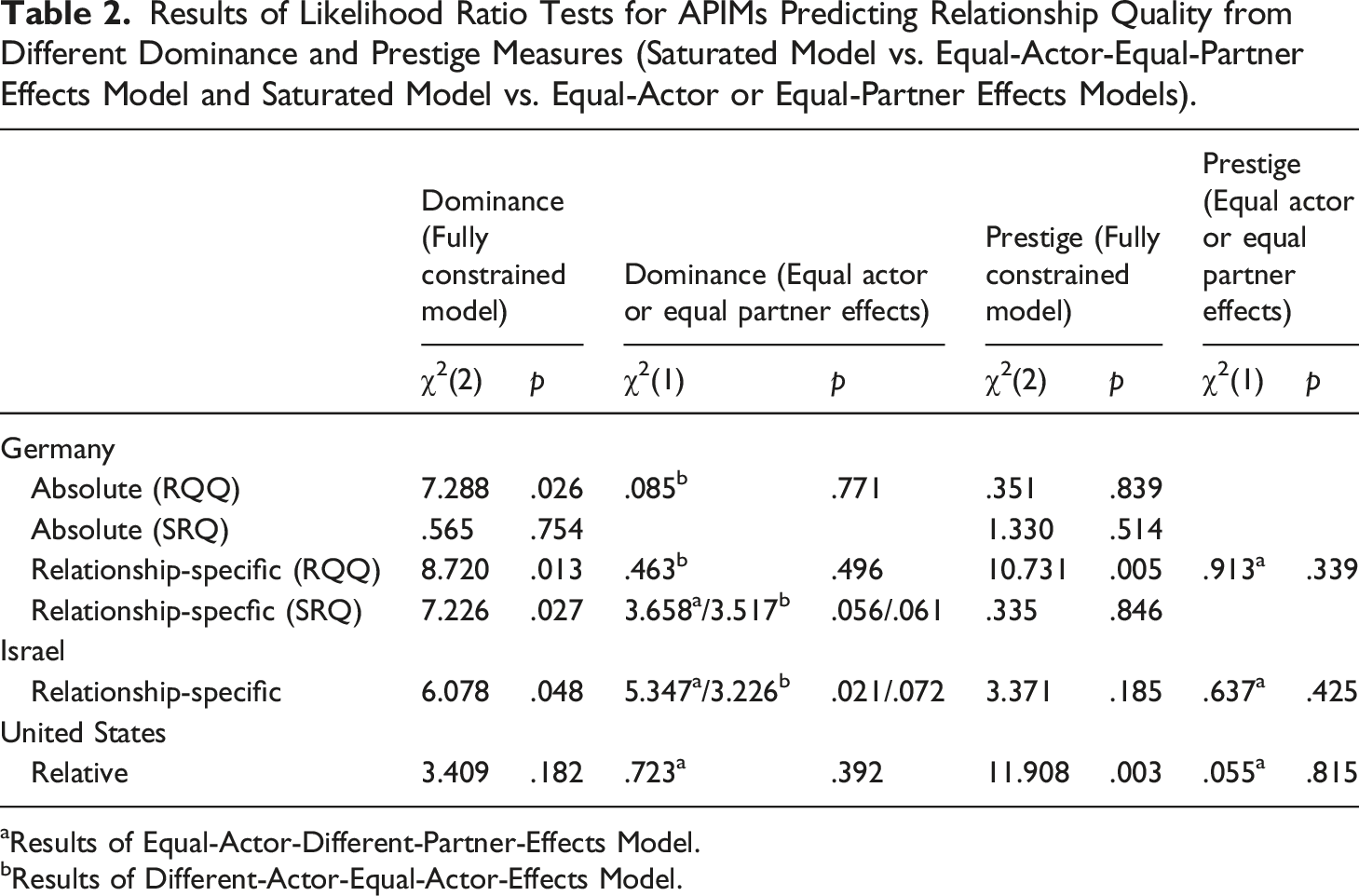
aResults of Equal-Actor-Different-Partner-Effects Model.
bResults of Different-Actor-Equal-Actor-Effects Model.
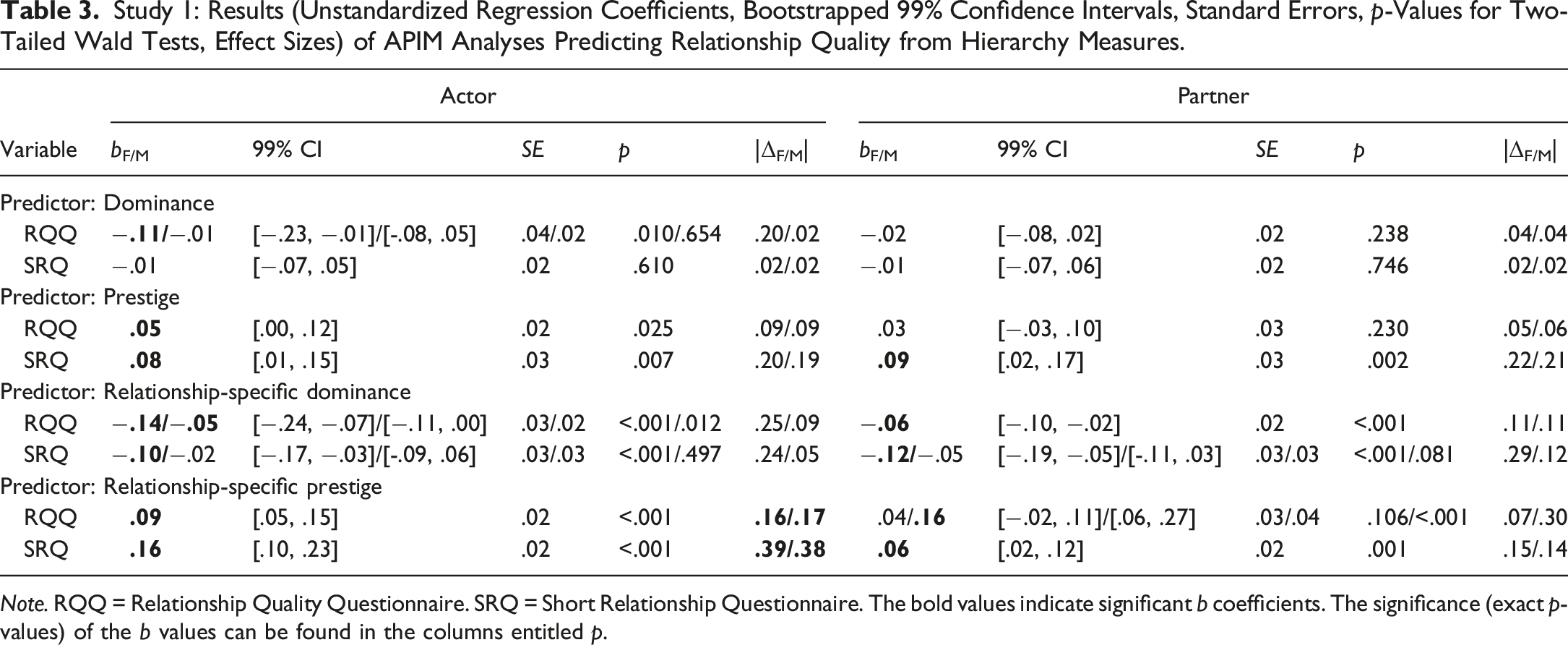
Study 1: Results (Unstandardized Regression Coefficients, Bootstrapped 99% Confidence Intervals, Standard Errors, p-Values for Two-Tailed Wald Tests, Effect Sizes) of APIM Analyses Predicting Relationship Quality from Hierarchy Measures.
Note. RQQ = Relationship Quality Questionnaire. SRQ = Short Relationship Questionnaire. The bold values indicate significant b coefficients. The significance (exact p-values) of the b values can be found in the columns entitled p.
Prestige was positively related to one’s own relationship quality, for both kinds of relationship quality measures (RQQ: b = .05, |ΔF/M| = .09; SRQ: b = .08, |ΔF/M| = .20/0.19). Whereas for the RQQ no significant partner effect was found, prestige of an actor related positively to partner’s relationship quality as measured with the SRQ (b = .09, |ΔF/M| = .22/0.21); in other words, prestige was associated with one’s partner reporting that they have received higher levels of positive behaviors.
Associations of relationship-specific dominance and prestige with relationship quality
German sample
For relationship-specific dominance, several actor and partner effects were found. For actors, dominance was negatively related to total relationship quality for both measures (RQQ: bF/M = −.14/-.05, |ΔF/M| = .25/0.09; SRQ: bF/M = −.10/-.02, |ΔF/M| = .24/0.05; see Table 3). Women’s relationship-specific dominance was more strongly related to global relationship quality than men’s relationship-specific dominance was. The same pattern emerged for the partner effects: Partners of dominant individuals reported lower total relationship quality for both measures (RQQ: b = −.06, |ΔF/M| = .11; SRQ: bF/M = −.12/-.05, |ΔF/M| = .29/0.12).
With respect to relationship-specific prestige, actor and partner effects differed less between men and women. Prestige was positively associated with total relationship quality for both measures (RQQ: b = .09, |ΔF/M| = .16/0.17; SRQ: b = .16, |ΔF/M| = .39/0.38; see Table 3). Women in relationships with prestigious men reported higher total relationship quality on the RQQ (bM = .16, |ΔM| = .30) and, independent of gender, partners of prestigious actors reported higher total relationship quality on the SRQ (b = .06, |ΔF/M| = .15/0.13).
Israeli sample
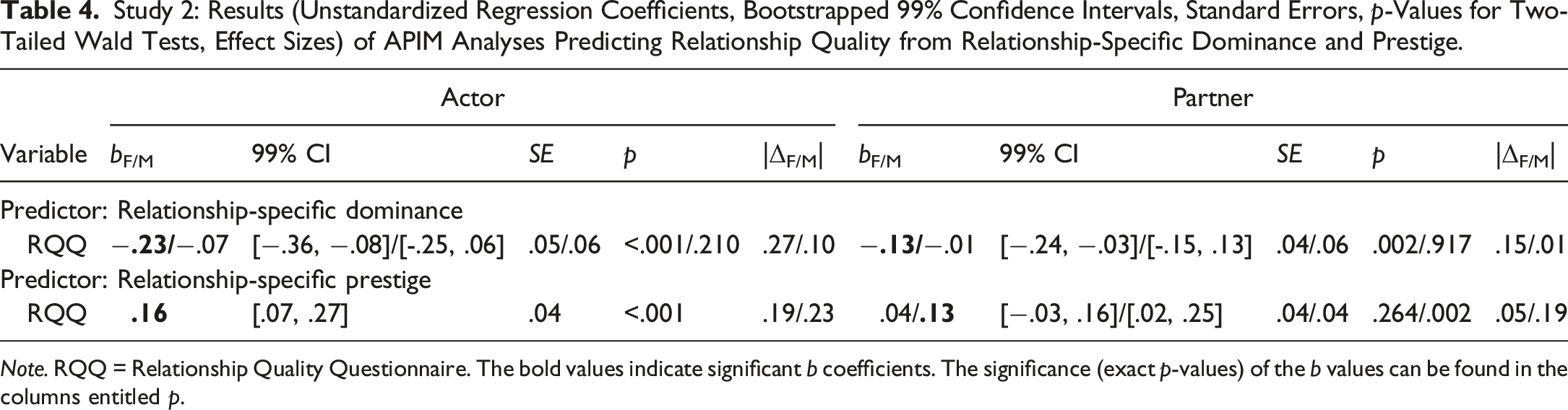
Study 2: Results (Unstandardized Regression Coefficients, Bootstrapped 99% Confidence Intervals, Standard Errors, p-Values for Two-Tailed Wald Tests, Effect Sizes) of APIM Analyses Predicting Relationship Quality from Relationship-Specific Dominance and Prestige.
Note. RQQ = Relationship Quality Questionnaire. The bold values indicate significant b coefficients. The significance (exact p-values) of the b values can be found in the columns entitled p.
Actor effects differed less between men and women for relationship-specific prestige. Prestige showed a positive association with actor’s total relationship quality (bF/M = .16, |ΔF/M| = .19/0.23). Only men’s prestige was positively related to total relationship quality (bM = .13, |ΔM| = .19).
Discussion
Studies 1 and 2 indicated that dominance (especially in women) was mostly negatively related to overall relationship quality. More specifically, general dominance was negatively related to overall relationship quality (at least for the RQQ) in women, but not in men. This finding suggests that more dominant women feel less satisfied in their relationship. Relationship-specific dominance exacerbated the negative links with relationship quality. Respondents who described themselves as intimidating and controlling in their relationship indicated lower relationship quality, as did their partners. This finding is in line with what is to be expected considering the behavior, emotions, and cognitions typical of dominant individuals (Cheng et al., 2010; Körner et al., 2023): Selfish and disagreeable behavior, aggression, and dishonesty are likely to inflict damage on a romantic relationship. The findings are also in line with research suggesting that non-dominant partners are preferred for long-term relationships (e.g., Kruger & Fitzgerald, 2011). Thus, the sociobiological perspective suggesting that dominance can help with reproductive success was not supported: Apparently, the costs of having a dominant partner outweigh potential rewards. For example, the dominant person may protect the partner but might also aggress against the partner and act in selfish, not relationship-oriented ways. This can also explain why the negative association with relationship quality was higher and more robust with relationship-specific dominance than with general dominance. With respect to the sociocultural hypothesis, some support was found: In Germany, only women’s general dominance—which violates gender-role stereotypes—was linked to lower relationship quality for women. For men, no such association occurred. Women’s relationship-specific dominance had stronger negative links to relationship quality than men’s relationship-specific dominance. In the Israeli sample, it was only women’s relationship-specific dominance that related negatively to their own and their partners’ relationship quality. In our samples, German couples were younger than Israeli couples, which may suggest that older couples are more strongly influenced by sociocultural factors than young, dating couples. Overall, dominance was not linked or negatively linked to relationship quality for men, but the negative link was stronger for women than for men (see Table 7 for a summary of the results).
General prestige was positively related to relationship quality overall. Moreover, relationship-specific prestige showed both positive actor and partner effects on relationship quality in German and Israeli couples. Thus, the prosocial, cooperative, communal-oriented, and confident personality of people high in prestige (Cheng et al., 2010; Körner et al., 2023) is apparently linked to high relationship quality—for both themselves and their partners. Also, some gender differences for partner effects were found, which provide weak evidence for the sociocultural perspective. Men’s relationship-specific prestige related positively to women’s relationship quality but women’s relationship-specific prestige was often unrelated to men’s relationship quality.
Overall, the results support the personality-based hypothesis: Dominance, characterized by antisocial and selfish traits, was mostly negatively linked to relationship quality, whereas prestige, which is associated with pro-relationship and desirable traits, was positively linked to relationship quality. However, the findings also provide weak initial support for the sociocultural hypothesis. Next, we tested whether we would find a similar pattern of results with relative instead of absolute measures of dominance and prestige.
Studies 3 and 4 – Relative dominance and prestige
In Studies 3 and 4, dominance and prestige were assessed with relative measures. The absolute measures discussed and analyzed in Studies 1-2 reflect a participant’s self-perception of their own dominance and prestige, but not what they think about their partner’s dominance and prestige. In contrast, relative measures of dominance and prestige reflect what participants think about their dominance and prestige in comparison to their partner’s. Experiences and satisfaction in one’s relationship are affected not merely by absolute levels of any given mate-value-relevant characteristic, but also by the degree of that characteristic in comparison to one’s partner (e.g., Sela et al., 2017). Further, an actor’s perception of her/himself in comparison to the partner is central in dyadic power theories (e.g., Rollins & Bahr, 1976; Simpson et al., 2015). As such, one very common approach is to have individuals rate their power, influence, or control relative to that of their relationship partner (e.g., Gordon & Chen, 2013). Whereas many absolute measures (e.g., general personality questionnaires) may implicitly prompt individuals to try to compare themselves to an “average” person of their same age (Lenhausen et al., 2023), this relative approach explicitly prompts them to treat their partner as the point of comparison. To provide a more thorough multi-method investigation of dominance and prestige in romantic relationships, our Studies 3-4 used this kind of relative measure of the two constructs.
With the relative measures, the sociobiological hypotheses cannot be tested (because high levels of dominance/prestige in both couple members should be linked to relationship quality—but the relative measures allow only for a pattern of differences). Regarding the sociocultural hypothesis, it was hypothesized that women’s dominance and prestige relative to that of their partner would be negatively or not at all, and men’s relative dominance and prestige would be positively, associated with relationship quality of both partners (mirroring the hypothesis for the absolute measures). Regarding the personality-based hypothesis, we expected that if actors perceive their partner as being more prestigious and less dominant (i.e., better adjusted than the actor) than they perceive themselves, this would raise actors’ relationship quality. Similarly, lower relative dominance and higher relative prestige in actors were expected to be positively related to partner’s relationship quality—for both men and women (partners would be more satisfied if the actor shows a more adaptive personality profile that is characterized by relatively low dominance and relatively high prestige).
Method
Participants and procedure
Individual US sample
Using CloudResearch, 986 online community participants were recruited on Amazon Mechanical Turk who reported currently being in a romantic relationship lasting at least 6 months. Of these participants, 116 failed our screening for carelesss responding,2 leaving a final sample of 870 individuals (330 men, Mage = 38.96, Md = 38.00, SDage = 10.41, Range: 18 to 76; 531 women, Mage = 36.74, Md = 35.00, SDage = 10.39, Range: 18 to 69; 9 participants reported nonbinary gender or agender and were not considered in the main analyses). The ethnicity of the sample was: 52.2% Caucasian/White, 15.9% Hispanic or Latino, 22.1% Black or African-American, 15.2% East Asian, and less than 5% for all other race/ethnicities. The majority of participants identified as middle class (51.5%) followed by working class (30.7%), upper middle class (12.2%), poor (5.2%), and upper class (.3%). Most individuals were married or engaged (76.4%) and heterosexual (86%) and minorities were bisexual (7.5%), gay or lesbian (4.9%), pansexual (2.9%), and asexual (.7%). Average relationship duration was 10.58 years (SD = 8.65, Range: 3 months to 43 years).
Dyadic US sample
In total, 198 community-dwelling couples from an urban/suburban area of the southeastern United States participated. 3 We removed same-gender couples and persons identifying as non-binary, resulting in 157 opposite-gender couples (men: Mage = 34.88, Md = 30.00, SDage = 13.91, Range: 19 to 79; women: Mage = 34.07, Md = 30.00, SDage = 13.68, Range: 16–76). The ethnicity of the sample was: 73.1% Caucasian/White, 9.1% Black/African-American, 8.3% East Asian, 7.2% Hispanic or Latino, and less than 2% other races/ethnicities. The majority of participants identified as middle class (50.0%) followed by upper middle class (25.8%), working class (19.1%), poor (2.5%), and upper class (2.5%). Most couples were engaged or married (63.7%). Average relationship duration was 9.91 years (SD = 10.15, Range: 6 months to 47 years).
Measures
Dominance and prestige
Study 4 (US Sample): Descriptive Statistics (Means, Standard Deviations), Cronbach’s Alphas, Partner Similarity (Pearson Correlations), and Partner Differences (Paired-Samples t Tests with Cohen’s d) for the Hierarchy Measures and Relationship Quality.
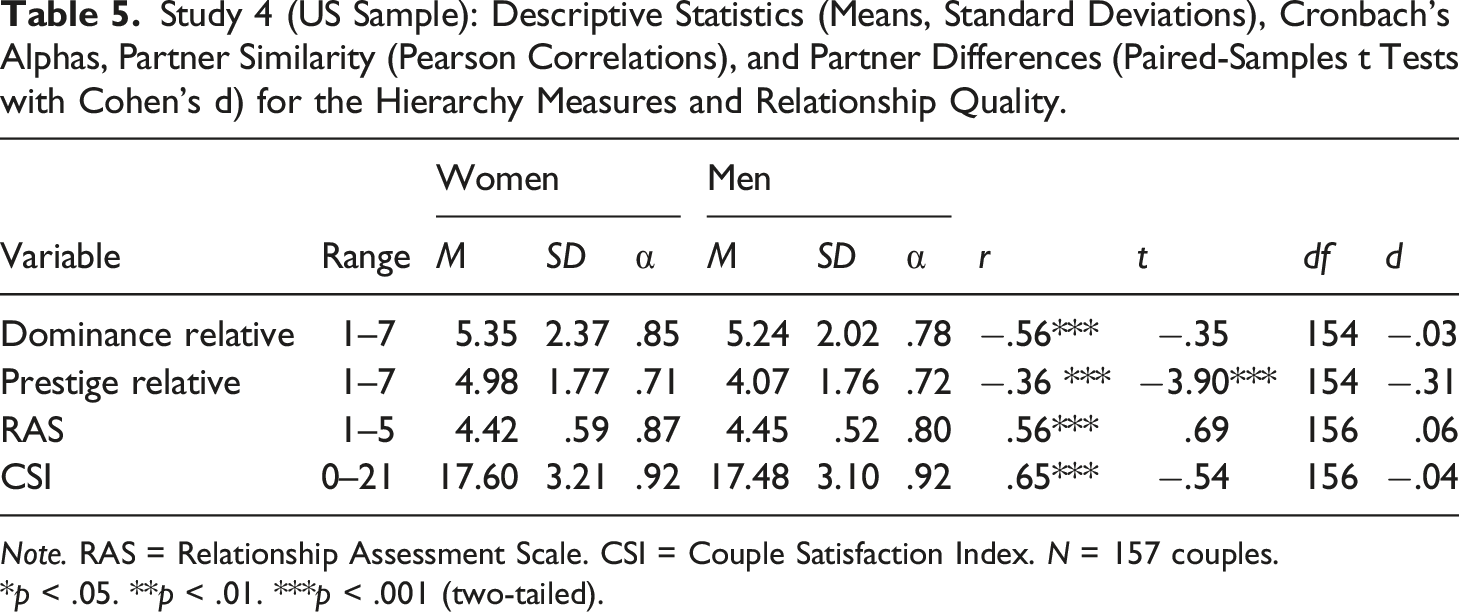
Note. RAS = Relationship Assessment Scale. CSI = Couple Satisfaction Index. N = 157 couples.
*p < .05. **p < .01. ***p < .001 (two-tailed).
Relationship quality
In the individual U.S. sample, overall relationship quality was assessed with the Relationship Assessment Scale (RAS; Hendrick, 1988). The scale comprises seven items (e.g., “How good is your relationship compared to most?”) with varying response formats. In the dyadic US sample, in addition to the RAS, we used the 4-item version of the Couples Satisfaction Index that also has varying response formats (CSI; Funk & Rogge, 2007; e.g., “I have a warm and comfortable relationship with XY”). The CSI is nearly equivalent to the RAS (e.g., correlated at r = .83 for men; .88 for women), so we z-scored them and averaged them together for the APIM analyses. Both scales are more conceptually similar to the RQQ than to the SRQ.
Analytic strategy
Analyses were done as in Studies 1-2. A post hoc power analysis indicated that we were able to detect effects of βActor/Partner = .20/.15 with a power of .96/.79 for the dyadic US sample (α = .05, Ackerman et al., 2020).
Results
Preliminary analyses
In the dyadic US sample, relative dominance and prestige were moderately to strongly negatively correlated between partners (see Table 5); that is, partners tended to agree as to which one of them is more dominant or prestigious. Men and women did not differ in relative dominance but women reported higher relative prestige than men did (d = −.31). Relationship quality measures were positively correlated within the couple, demonstrating robust interdependence between relationship partners.
Individual US sample
In the individual sample, for women, higher self-perceived relative dominance was moderately positively linked with relationship quality, r(528) = .20, p < .001. For men, self-perceived relative dominance was weakly positively correlated with relationship quality, r(328) = .11, p = .052. Thus, individuals reported slightly higher relationship quality if they judged themselves as more dominant than their partners. Women’s relative prestige was unrelated to relationship quality, r(527) = −.02, p < .687. For men, relative prestige was slightly negatively associated with relationship quality, r(328) = −.17, p = .002. Thus, evaluating the partner as being less prestigious than oneself is negatively linked to relationship quality for men.
Dyadic US sample
Study 4: Results (Unstandardized Regression Coefficients, Bootstrapped 99% Confidence Intervals, Standard Errors, p-Values for Two-Tailed Wald Tests, Effect Sizes) of APIM Analyses Predicting Relationship Quality (RAS and CSI Merged) from Relative Dominance and Prestige.
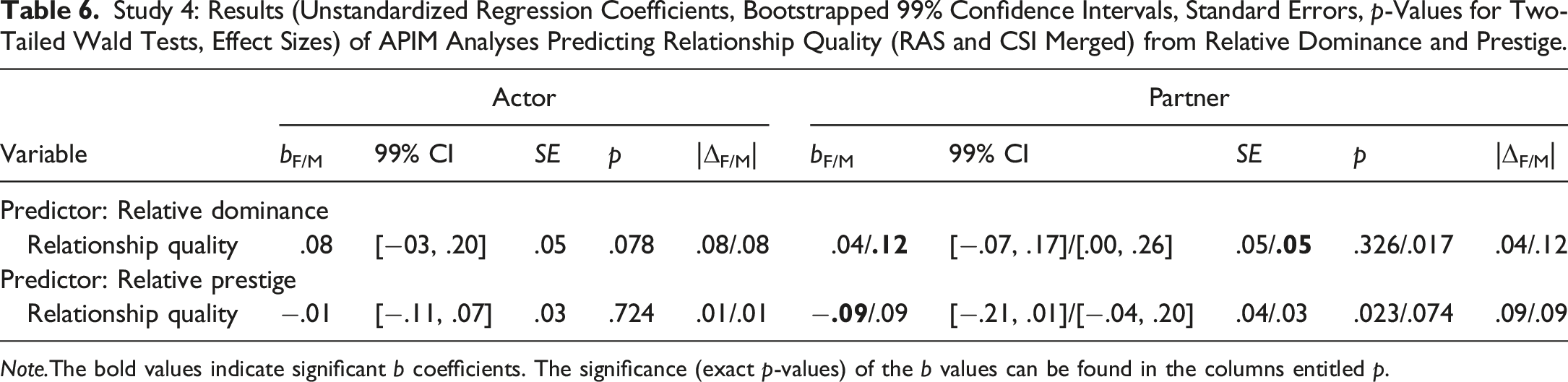
Note.The bold values indicate significant b coefficients. The significance (exact p-values) of the b values can be found in the columns entitled p.
Discussion
In Study 3 (non-dyadic sample), significant associations between relative dominance and prestige with relationship quality were found, but in the dyadic sample of Study 4, these associations were mostly small or non-significant. Importantly, romantic partners tend to agree about which one of them is more dominant or more prestigious. Thus, measures of relative prestige and dominance are likely to partly reflect some of the “ground truth” of prestige and dominance in relationships.
In the individual sample, higher relative dominance (i.e., judging oneself to be more dominant than the partner) was positively correlated with self-rated relationship quality. Thus, evaluating the partner as being less forceful and aggressive than oneself seems somewhat beneficial for an actor’s relationship happiness. The effect was stronger for women than for men. Thus, the personality-based perspective was supported because it predicted that relationship quality would be elevated when an actor judges the partner as being better adjusted (i.e., less dominant) than the actor. The sociocultural perspective was not supported because the direction of the associations of dominance with relationship quality was identical for men and women. In the dyadic sample, actor effects were not significant, but the directions of associations provide weak support for the personality-based hypothesis. This finding is in line with results of Studies 1 and 2: Relationship partners seem to be happier if their partners are less dominant than themselves. Some weak support was found for the sociocultural perspective in the dyadic sample, where men’s relative dominance (but not women’s) was positively associated with women’s relationship quality, suggesting that women are happier with the relationship if their male partner sees himself as more dominant.
In the individual sample we found that men who see their relationship partners as more respected and admired than themselves report higher relationship quality. Thus, the impression of being together with a prestigious partner benefits relationship happiness—at least for men. This finding is in line with literature which reports that prestigious individuals are preferred as relationship partners (Conlon, 2019; Snyder et al., 2008). This result also dovetails with the personality-based perspective and is opposite to expectations of the sociocultural perspective. In the dyadic sample, no significant actor effects were found but men’s relationship quality was negatively related to women’s relative prestige (which may fit the sociocultural perspective).
Overall, the findings of the individual sample provide strong support for the personality-based perspective. In the dyadic sample, we found additional weak support for the sociocultural perspective when considering partner effects.
General discussion
Summary of hypotheses (Expected direction for associations with relationship quality) and results (Actor effects).
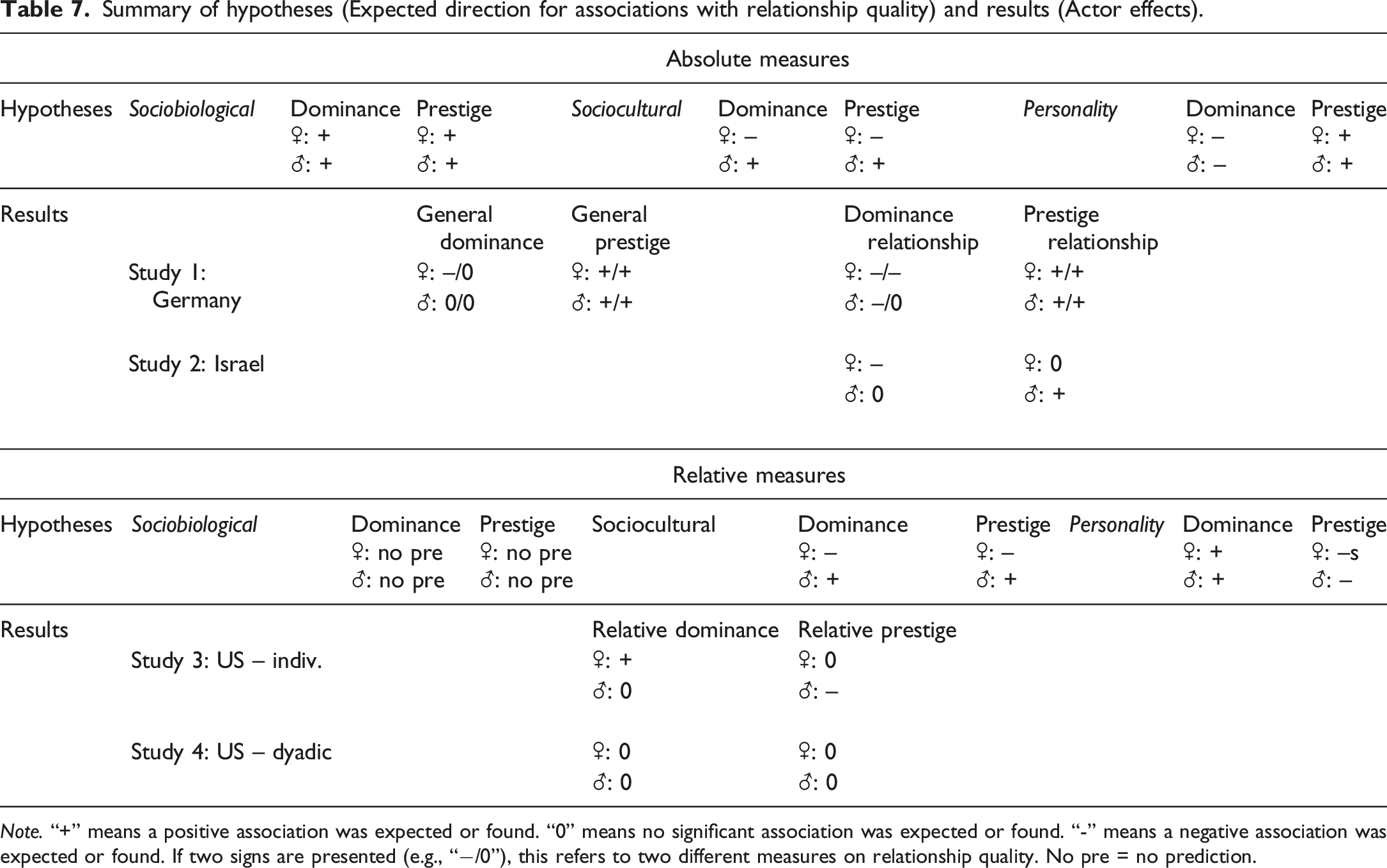
Note. “+” means a positive association was expected or found. “0” means no significant association was expected or found. “-” means a negative association was expected or found. If two signs are presented (e.g., “−/0”), this refers to two different measures on relationship quality. No pre = no prediction.
Main findings and theoretical implications
The results of the German, Israeli, and individual US sample provide converging evidence for the personality-based perspective, as absolute dominance was mainly negatively related to relationship quality and relative dominance was positively related to relationship quality. For prestige, the opposite pattern of results was found (i.e., absolute prestige was beneficial but relative prestige was detrimental to relationship quality). The findings thus provide additional evidence about the nomological networks of dominance and prestige in romantic relationships.
To the best of our knowledge, this is the first research analyzing intra- and interpersonal associations of dominance and prestige with relationship quality. Importantly, the findings generalized across different measures of dominance and prestige (i.e., absolute and relative) that focus either on one’s own perspective (absolute measure) or that take the partner’s level of the corresponding trait into account (relative measure). Further, we observed some gender differences in the German and Israeli sample; for example, the negative link between dominance and relationship quality was stronger for women than it was for men. And there were partner effects in the dyadic US sample; that is, men reported lower relationship quality if women reported higher relative prestige. Both findings provide some (weak) support for the sociocultural perspective that dominance and prestige in men are slightly more important for relationship quality than dominance and prestige in women. Note, however, that we found more robust findings with the absolute than with the relative measures.
These findings have important implications for understanding dominance and prestige in close relationships. Both concepts have been developed in the anthropological and evolutionary psychological literature (Henrich & Gil-White, 2001), however, their evolutionary functions seem less relevant in contemporary relationships (at least they cannot explain associations with relationship quality). Instead, the typical personality profile of cognitions, emotions, and behavior of people high in dominance or prestige seems crucial in understanding associations with relationship quality. The personality profiles linked to dominance and prestige differ, with dominance being linked to selfish, disagreeable, arrogant, and aggressive behavior, in contrast to prestige being linked to prosocial, agentic, and agreeable behavior. This distinction has the potential to explain variance in relevant relationship outcomes. Nonetheless, the sociocultural perspective, which highlights the influence of norms, expectancies, and gender role stereotypes, is slightly reflected in our data. Even though traditional gender roles have changed over the past decades, there are apparently still implicit convictions about which attributes are desirable in men and women; that is, women’s prestige did not matter for men’s relationship quality and women’s dominance was more strongly negatively related to relationship quality than men’s. Furthermore, this research highlights that gender differences should be considered when analyzing dominance and prestige in romantic relationships.
Implications for the broader power literature
As both variables showed different links to relationship quality, our findings further highlight the dual nature of power (e.g., ten Brinke & Keltner, 2022). Separately measuring prosocial and conflict-oriented forms of power allows researchers to obtain a more complete picture of the connection between interpersonal influence and relationship outcomes. Furthermore, it is possible that prestige is more closely linked to having power whereas dominance might reflect a strategy for obtaining power. Dominant individuals inherently are aiming to exert influence. By contrast, prestige is not necessarily linked to the power motive but instead describes a situation in which power has already been achieved. Future research could test associations between dominance, prestige, power motives, and potential influence (i.e., sense of power, decision-making ability, or visual attention) to better understand commonalities and differences between these concepts.
The findings are relevant for research on power in romantic relationships. Researchers studying social power rely either on absolute measures (“How much power do you have,” see e.g., the Personal Sense of Power Scale by Anderson et al., 2012) or, more frequently, on relative measures (“Who has more power in your relationship,” see e.g., Gordon & Chen, 2013; Righetti et al., 2015). Whereas high absolute power has been linked to positive relationship outcomes such as satisfaction and forgiveness (Körner & Schütz, 2021; Körner et al., 2022b), high relative power has been linked to negative outcomes such as less sacrificing and psychological aggression (Cuccì et al., 2020; Righetti et al., 2015). Thus, the power literature shows some findings similar to what we found with regard to prestige—and this is in line with the personality-based perspective (high absolute prestige and power both have positive relationship correlates whereas high relative power and prestige seem to have more negative correlates). The findings on dominance are opposite to those of power and prestige and suggest that power and prestige are more similar than are power and dominance. Moreover, we found stronger effects for absolute than for relative measures. The present research is thus one of the few works comparing absolute with relative measures of power and is in line with research showing that absolute power is more predictive of relationship outcomes than relative power (Rusbult et al., 1991).
In addition, power researchers highlight the importance for studying not only actor’s but also partner’s power (e.g., Overall et al., 2023). Actor’s power was reported to be more strongly associated with relationship quality than partner’s power (though both aspects do show positive links; Körner & Schütz, 2021). In the present research, a similar pattern was observed: In Studies 1 and 2 when absolute dominance and prestige were used, actor effects were typically stronger than partner effects were. However, in Study 4 with relative measures, only partner effects emerged. Apparently, absolute power measures are more important to understand an actor’s experience in the relationship but relative measures (in which respondents actively compare their own standing with that of the partner) can explain variance in partner’s satisfaction. These findings highlight the importance of considering the dyadic nature of romantic relationships. Dyadic theories of dominance and prestige in close intimate relationships should be developed to provide a better framework to understand intrapersonal and interpersonal associations of these specific power aspects with relationship outcomes.
Limitations and future research directions
The present studies show links between dominance, prestige, and relationship quality, but cannot speak to causality. Dominance and prestige likely do causally affect relationship quality but it is also possible that high relationship quality leads to changes in actors’ and partners’ self-concepts and behaviors. Longitudinal studies may tackle this question of causality.
Further, the sociocultural hypothesis relied on the assumption that both dominance and prestige are more typical of the masculine than the feminine gender role stereotype. However, this assumption is better supported for dominance; it is less clear how the feminine gender role stereotype is related to the concept of prestige. Future research could further address this issue in formulating and testing assumptions about the relation between prestige and the feminine gender role stereotype.
Moreover, in our multi-method approach, we constructed relationship-specific and comparative measures for dominance and prestige. Yet, these measures have not yet been rigorously validated and should be psychometrically tested in future studies. In either case, we believe that relationship-specific as well as comparative assessments of dominance and prestige can add to our knowledge of how these two variables pervade interpersonal relationships.
Furthermore, relative measures are implicitly based on two different estimates (e.g., one’s own and one’s partner’s level of prestige) and require participants to compare these two estimates when producing a response score. The resulting score thus has limited capacity for interpretation because it does not reveal to what extents the, say, relatively higher power of the participant or the relatively lower power of the participants’ partner drives the effect. Broadly speaking, this is the same conceptual limitation inherent in difference scores (for discussion of limitations of difference scores, see Edwards, 2001) and, to some extent, to any self-report rating that implicitly draws on a “reference group” (such as when a person “strongly agrees” that they are conscientious; it is unknown whether their score is elevated because of their own behavioral tendencies or because they may be comparing themselves to others who are particularly low in conscientiousness. For example, for discussion in cross-cultural research, see Heine et al., 2002).
Furthermore, dominance, prestige, and relationship quality were assessed using self-reports, which can be affected by response biases such as impression management and self-deception. Therefore, acquaintance ratings or behavioral indicators for dominance and prestige could be used in upcoming research to further test our findings. This approach could also be helpful to account for blind spots in self-reports (Gallrein et al., 2013).
Future studies should also collect more detailed data on sociodemographic variables (e.g., percentage students, socioeconomic status, disability status). Finally, all four studies investigated heterosexual couples in WEIRD (Western, Educated, Industrialized, Rich, Democratic) countries; it would be important to ascertain whether the findings generalize to non-WEIRD countries and beyond heterosexual couples. For instance, the sociocultural perspective might be less relevant outside heterosexual relationships as such relationships are less likely to conform to gender-role stereotypes (Doyle et al., 2015).
Conclusion
Overall, dominance and prestige are relevant variables in understanding relationship quality. Whereas dominance is mostly negatively related to relationship quality, prestige shows positive links. These findings primarily support a personality-based perspective suggesting that, in couples, the specific set of emotions, behaviors, and cognitions typical of people high in dominance or prestige is more important to relationship quality than (a) sociocultural norms and expectancies and (b) the evolutionary resource-provisioning functions of dominance and prestige.
Footnotes
Acknowledgements
We are grateful to Sara Algoe for grantwriting, study design, and administration regarding Study 4.
Funding
The author(s) disclosed receipt of the following financial support for the research, authorship, and/or publication of this article: Study 4 was funded by a John Templeton Foundation Grant (#62199).
Ethical statement
Informed consent
Informed consent was obtained from all participants who were included in the study.
Open research statement
As part of IARR’s encouragement of open research practices, the authors have provided the following information: This research was not pre-registered. The data used in the research can be publicly posted. The data and analysis code can be obtained at:  . The materials used in the research cannot be publicly shared but are available upon request via email.