




Abstract
The Strong Black Woman (SBW) schema prescribes a complex set of behavioral expectations for Black women, namely, that they render a guise of self-reliance, emotional and physical strength, self-sacrifice, and resilience in the face of adversity. Thus, this study sought to explore the role of SBW, a culturally salient gendered-racial schema believed to represent a central aspect of Black womanhood, on Black women’s experiences of romantic and intimate partnerships. We conducted eight focus groups (N = 16) with young Black women aged 18 – 30 (M = 22.13, SD = 3.46). Data were analyzed using the rapid and rigorous qualitative data technique and thematic analysis. Study findings revealed a multidimensional construct specific to SBW in the context of intimate partnerships: (1) Black women confronting expectations to uphold strength, (2) a commitment to independence while partnered, (3) efforts to conceal emotions with one’s partner, (4) aspirations to achieve equitable caretaking within the relationship, and (5) shielding to curate a positive relationship image. These findings provide unique insights into how young Black women are navigating gendered racial stereotypes to engage in romantic and intimate partnerships.
Scholars have theorized that the gendered racist stereotypes about enslaved Black women’s physical and mental strength were used to justify the dehumanization and exploitation of Black women within the institution of American chattel slavery (Collins, 2002; Harris-Perry, 2011; Thomas et al., 2004). While the systemic enslavement of Black women formally ended in 1865, stereotypical beliefs about their congenital superhuman strength and resilience persist. The prevalence and persistence of these gendered-racial stereotypes create pathways for the internalization of culturally specific gender schemas like the Strong Black Woman (SBW) schema, which prescribes a complex set of behavioral expectations for Black women. Namely, that they render a guise of self-reliance, emotional and physical strength, stoicism, self-sacrifice, and resilience in the face of adversity (Abrams et al., 2019; Baker et al., 2015; Jones et al., 2021; Thomas et al., 2004).
Given the heightened degree of structural violence, social injustice, and personal hardship that Black women have endured throughout history, the SBW schema has come to be understood as comprising tools and coping mechanisms that are essential to the survival of the Black family and community (Collins, 2002; Harrington et al., 2010; Shorter-Gooden, 2004; Watson & Hunter, 2016). Through pervasive exposure to depictions of the SBW archetype and intergenerational matrilineal gendered-racial socialization, Black women’s collective endorsement of its behavioral prescriptions is reinforced (Anyiwo et al., 2021; Davis & Jones, 2021; Stanton et al., 2017). As such, exuding strength while concealing vulnerability and pain is a behavioral mandate that is often praised and rewarded within Black communities (Collins, 2002; Harris-Perry, 2011). For example, Black women credit their fierce independence as contributing to their success in various areas of their lives (e.g., work, school, and family; Jones et al., 2021). This inclination to pursue success without the assistance of others is rewarded as a strong work ethic in the workplace.
Existing research on SBW and its relationship to various health outcomes echoes this paradox of the SBW schema for Black women. In 2022, a study investigating psychology research on SBW conducted by Thomas and colleagues found a total of 57 empirical articles focusing on its character, socialization practices, and consequences for Black women’s physical and mental health (Thomas et al., 2022). Endorsement of SBW schema was linked to poor mental health, including depression, anxiety, emotional avoidance, irregular sleep, binge eating, low self-esteem, smoking, and participation in risky sexual behaviors (Thomas et al., 2022). Conversely, it has also been theorized to help Black women successfully maneuver a discriminatory society, resist oppressors, and promotes a strong connection to other Black women (Davis, 2015). Yet, limited research has focused on how SBW schema influences romantic relationships. A recent scoping review exploring the role of SBW schema in the context of intimate and romantic relationships among Black women highlights potential adaptive functions of the schema (Debnam et al., 2025). The scoping review suggests that Black women’s sustained commitment to independence helps protect them from rejection and disappointment in relationships, and prioritizing self-reliance helps prevent them from becoming co-dependent in their partnerships. In this way, endorsing the SBW schema’s independence prescriptions may meaningfully contribute to the development of healthy partnership ideals, expectations, and behaviors among Black women.
However, some facets of the SBW schema may pose negative consequences for Black women in the context of intimate partnerships. For instance, research by Bent-Goodley (2001) describes how racial loyalty, manifesting as unconditional support for Black men, pushes Black women into the role of protector for Black men, which may compel them to withstand abuse in their romantic relationships in lieu of abandoning the relationship or seeking outside support (Bent-Goodley, 2001). Indeed, in a study with Black women who had experienced intimate partner violence (IPV), Monterrosa (2021) found that one of the reasons they did not report their abuse to the police was to protect Black men from discriminatory police treatment (Monterrosa, 2021). Moreover, Avery and colleagues (2022) found that Black women who reported high endorsement of the SBW schema also reported significantly lower perceived sexual communication assertiveness (i.e., the ability to communicate sexual likes and dislikes to intimate partners) and lower sexual refusal assertiveness (i.e., ability to refuse unwanted or unsafe sex), above and beyond the direct effects of a general tendency to suppress one’s thoughts and opinions (Avery et al., 2022). Finally, there is literature to suggest that some Black men may be motivated to enact partner violence in response to feelings of inadequacy to provide financially for their family as well as exerting control over the perceived independence of their Black woman partner (Hampton et al., 2003).
Current study
Despite the probable role of the SBW schema in the health and development of intimate partnerships for Black women, few studies have empirically explored this connection. Limited research has focused on how gendered-racial ideologies are present in intimate relationships for Black women. Thus, the present study sought to explore the role of SBW, a culturally salient gendered-racial schema believed to represent a central aspect of Black womanhood, on Black women’s experiences of romantic and intimate partnerships. For the purposes of the current study, intimate and romantic partners are defined as persons “with whom one has a close personal relationship that may be characterized by the partners’ emotional connectedness, regular contact, ongoing physical contact and sexual behavior, identity as a couple, and familiarity and knowledge about each other’s lives” (Stewart & Vigod, 2019; p, 736). While empirical research highlights how endorsement of the SBW schema may influence help-seeking for IPV survivors (Waller et al., 2022), very little extant research focuses on how SBW is operationalized in daily relationship behaviors. The guiding research question for this qualitative study was, “How do Black women see the behavioral expectations of SBW schema functioning in their romantic and intimate partnerships?”
Method
Conceptual framework
The present study was grounded in a constructivist research paradigm (Lincoln & Guba, 2016) in that the authors believed there were many different experiences to be uncovered and understood related to the role of SBW in intimate partnerships. Further, guided by constructivist paradigmatic assumptions, the authors acknowledge that participants’ experiences were shaped by social, cultural, and historical factors (i.e., ontology) and sought to collaborate with them in the research process (i.e., epistemology). As a result, focus group interviews as a methodological approach were used to solicit a range of perspectives and experiences among Black women to explore their realities and understand their contexts. Focus group interviews were also important to use in this exploration because they build on a group dynamic between participants. The conversation between participants became richer when they were able to build upon one another’s responses and explain their beliefs and behaviors in a way that they may not have done in an individual interview. Throughout descriptive data analysis, the authors attempted to remain close to the data and the surface of words and events, seeking an accurate portrayal of the participants’ experiences and their perceptions of the phenomenon under investigation. We also used an intersectional framework to guide our analysis. Intersectionality is a critical, theoretical, and analytical framework that highlights the co-constitutive ways in which multiple systems of oppression and identity interact to create unique experiences of marginalization and privilege (Combahee River Collective, 1983; Crenshaw, 1989). For example, the framework suggests that understanding Black women’s experiences with oppression and injustice requires moving beyond a single-axis approach (e.g., analyzing race or gender separately) toward one that considers their position within an interlocking matrix of domination—simultaneously examining experiences with racism, sexism, classism, and heterosexism (Collins, 2002). Central to intersectionality is a focus on centering the experiences of historically subordinated and understudied groups to challenge oppressive narratives and practices that buttress health inequalities, and a critical interrogation of the ways that interlocking systems of power and privilege function to obscure, produce, and maintain social and structural inequities (Bowleg, 2021; Cole, 2009). Accordingly, at each stage of data analysis, the research team examined the data through a frame of intersectionality; interrogating the responses for examples of how intersecting power relations (i.e., racism, sexism, heterosexism, and classism) contributed to Black women’s experiences and perceptions of vulnerability in their intimate partnerships. We also sought to identify hidden similarities and document inter- and intra-group differences (Cole, 2009), recognizing that Black women are not a monolith, and that there are likely multiple ways that Black women’s experiences of intersecting oppression shapes their endorsement and internalization of gendered racial schemas like the Strong Black Woman.
Positionality and reflexivity
The authors’ own identities and experiences contributed greatly to their approach to the study design, data collection, and analysis of results. Both authors are Black American cisgender women who have devoted their research careers to the study and upliftment of this community. The first author identifies as heterosexual and has considerable personal and professional experience studying IPV and uses qualitative methodology to amplify voices of marginalized communities who experience violence victimization. Informed by intersectionality and other critical empowerment-based frameworks, the second author identifies as a lesbian and uses multiple quantitative methods to explore how exposure to intersectional stigma and discrimination (e.g., gendered racism) impacts Black women’s identity development, sexual socialization, mental health, and experiences of sexualized victimization. With an awareness that our positionality impacted our research process, we intentionally created spaces to interrogate our own beliefs, biases, and perspectives. For example, the authors convened a small group of undergraduate and graduate students with marginalized identities during the data analysis process. Data analysis discussions centered around how gender, race, class, and sexual orientation influenced participant responses and emerging themes.
Participants
Participants constituted a convenience sample recruited through young adult-focused email listservs (e.g., undergraduate major programs) and social media advertisements (i.e., Instagram posting by the research team). In the recruitment advertisements, interested women were asked to complete a short online survey to confirm eligibility and provide follow-up contact information. Eligibility criteria included self-identified Black or African American women between the ages of 18 and 30 years, residing in or were citizens of the United States, English speaking, and having been in an intimate relationship in the past 12 months. Recruitment and focus group protocols received approval from the authors’ institutional review board (IRB).
Participant demographics.
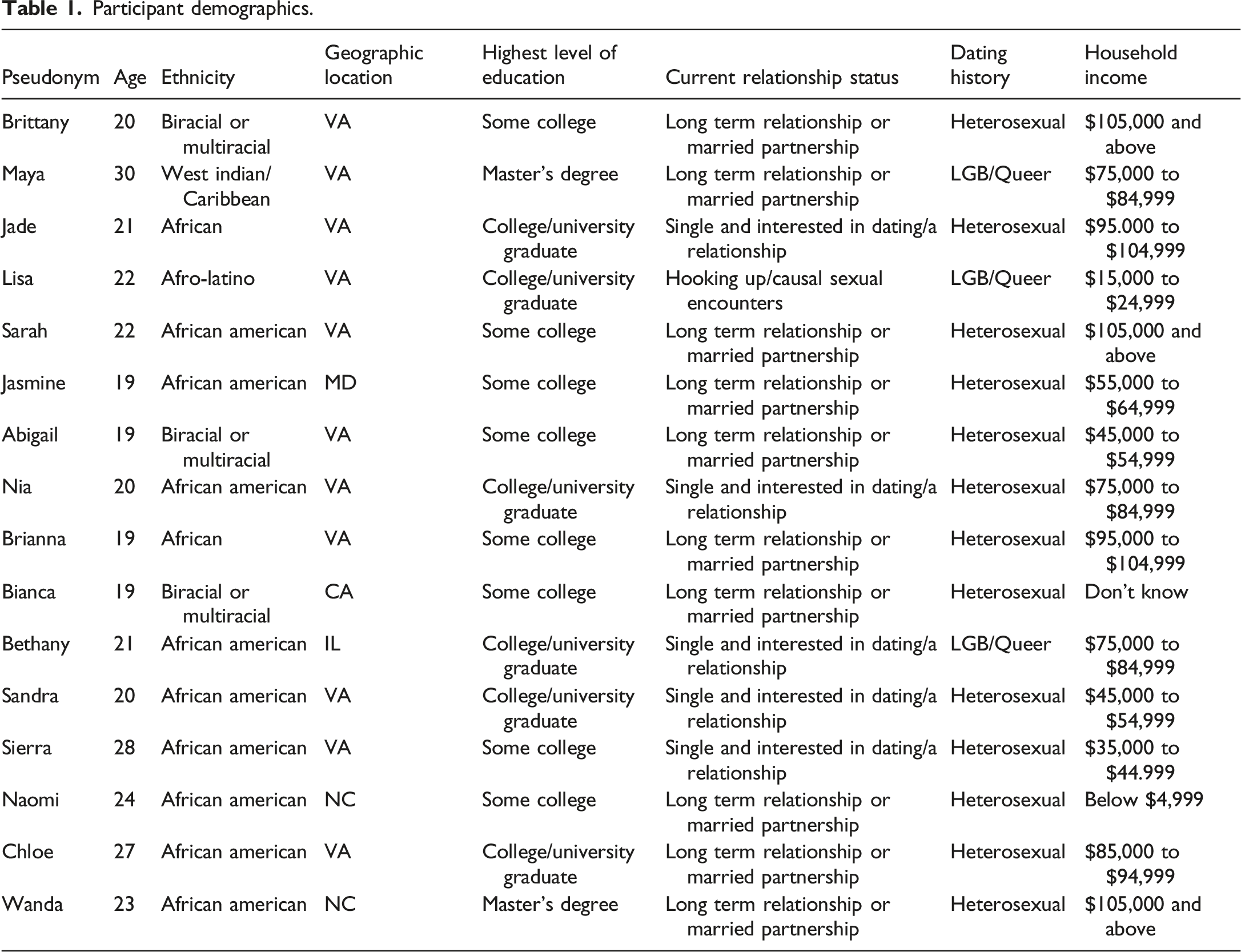
The majority of participants reported that they were currently in a long-term relationship or married partnership (62.50%), 45.45% reported that their current partner was African American, and 36.36% had a White partner. When asked to identify the gender identity of their recent dating and/or sexual partner(s), the majority of the sample indicated exclusively male partners (e.g., heterosexual; 81.25%; n = 13), and the remaining indicated responses consistent with LGB and/or queer sexual identities: women (6.25%; n = 1) and gender expansive folx (12.5%; n = 2). Eight focus group interviews were held; there was a mean of 2.33 participants per focus group interview with a range of two to three women across groups. Two individual interviews were held as a result of low attendance to the scheduled focus group.
Procedure
In recruitment advertisements, interested young women were given a link to complete a short online survey to confirm eligibility and indicate availability to participate in a focus group interview. Individuals who fit the eligibility criteria were contacted by the research team via email to again confirm their eligibility and provide additional information about the qualitative research study, including the date and time of the next scheduled focus group interview. Eligible women were also emailed a link to the consent form and a short demographic survey.
All focus group interviews were held via Zoom at a designated time, taking into consideration convenience for participants (e.g., midday, evening or weekend) and lasted 60–75 minutes. Prior to beginning each focus group interview, participant identities were visually verified by camera and consent forms were again reviewed with participants. Participants consented to have the focus group audio recorded. All participants were also given a resource listing of local and national hotlines and websites specifically geared toward relationship abuse along with a US$30 gift card. All participation was voluntary, and participants could withdraw at any time without penalty. The focus group interviews were facilitated by one of the study’s Principal Investigators or a graduate research assistant while another research assistant observed to take notes. Both FGI moderators were Black women, matching the participants race and gender. All focus group interviews were conducted in English. Each focus group interview was recorded using zoom and the recordings were transcribed by a transcription company.
Focus group protocol
The focus group interviews’ protocol included five sections, consistent with previous research suggesting five domains of the SBW schema (Debnam et al., 2025; Thomas et al., 2004). Those sections were: (a) preservation of one’s self-image and that of their relationship, (b) self-sacrificial caretaking of partner, (c) strength and perseverance, (d) emotional stoicism, and (e) independence. Questions in each section were designed to determine how each trait of SBW may influence or function within intimate partnerships. Participants were asked to share their own direct experiences or ones they have observed with friends and family. Example questions included: “How do your partners know when you need their help or support?” “How do you demonstrate your strength?” “When do you allow yourself to be vulnerable?” and “Do you think you become more or less attractive as a partner if you ask for support/help?”
Qualitative analysis
The Rapid And Rigorous Qualitative Data (RADaR) technique was used to organize and structure focus group interview data analysis (Watkins, 2017). As the data collected through the focus group interviews were a part of a larger study designed to develop a quantitative survey measure of SBW in intimate partnerships for Black women, this technique was an appropriate method to quickly and rigorously analyze the data collected. This method includes the use of tables and spreadsheets to systematically organize and summarize findings, specifically for applied research. First, all focus group interview transcripts were reviewed for accuracy and formatted consistently to ease the next steps in data reduction. In step 2, the all-inclusive data tables were created. Raw data from each focus group interview transcript was copied into a single workbook with multiple spreadsheets. Each spreadsheet represented one focus group interview transcript. Transcript data was copied into the spreadsheet organized into the SBW domains included in the interview protocol. Next in step 3 of the method, analysis of the transcript data by the first author and a research assistant were used to create shorter summaries of transcript data by each SBW domain. Thus, transcript data from the all-inclusive tables created in step 2 that was not relevant to the SBW domain was removed. A column of data was developed for each transcript, organized into rows for each SBW domain. In step 4, additional members of the research team joined the analysis process. In this step, a matrix of the data was created where each SBW domain represented a column and each focus group interview summary represented a row. Team members individually reviewed and analyzed the data to develop their own opinions and made notes about their impressions. Then the team met for 60–90 minutes each week for approximately eight weeks to discuss interpretations of the data and to develop consensus on themes within and across the SBW domains.
Trustworthiness
A number of steps were taken to enhance the rigor and ensure the trustworthiness of the data. Dependability and reliability was ensured by attending to the completeness and accuracy of data. Audio recordings of focus group interviews were transcribed verbatim by a professional transcription company (i.e., Rev.com). Each complete transcript was subsequently reviewed by the first author to assure accuracy and completeness. To ensure objectivity and confirmability, the method and procedure have been described in detail and the data have been retained for future analyses (Miles et al., 2014). The authors also reflected on their own biases throughout the research process (see positionality and reflexivity section). Furthermore, validity of the study is demonstrated through representative quotes from participants (Miles et al., 2014).
Results
Analysis of the data through the lens of established SBW schema characteristics resulted in a better understanding of how this schema may manifest for Black women in their intimate partnerships. Findings from the focus group interviews revealed five patterns demonstrating the unique ways that Black women’s adherence to SBW schema prescriptions are exhibited in intimate relationships: Black women’s confronting expectations to uphold strength, a commitment to independence while partnered, efforts to engage in emotional concealment with their partner, aspirations to achieve equitable care-taking in relationships, and a desire to portray a positive relationship image. The results presented below illustrate the nuanced ways that Black women exhibit qualities consistent with SBW schema prescriptions in their intimate partnerships, its benefits and liabilities, as described by participants. Each theme consists of a summary depiction based on findings, supported by illustrative quotes with the participants' pseudonym and age.
Confronting expectations to uphold strength
During the focus group interviews, participants were asked how they viewed other Black women and how others in society perceive Black women. It was no surprise that most participants reported that Black women are predominately depicted in society as “strong”. Indeed, participants shared that they agree with this depiction. This quote encapsulates participants’ feelings about being perceived as strong I love black women. I don't know. I love everything about them. I hate saying that we're strong, because I feel like we're strong out of necessity, not necessarily desire to be strong. But nevertheless, we are still strong, persistent, beautiful, smart. My whole life I've been surrounded by Black women and I can tell the difference when I have them in my life and when I don't have them in my life. (Sandra, 20, heterosexual)
Participants saw being strong as a positive attribute of their character. However, they also revealed that they want their strength to be seen as only one facet of their whole person. When asked about how they believe potential partners view Black women, participants provided a number of adjectives: “strong,” “independent,” “supportive,” “thoughtful,” “creative,” “innovative,” “dependable,” “reliable,” “resilient,” “feminine,” and “beautiful.” In all focus group interviews, participants noted that Black women are thought of as “strong” by their partners. While participants discussed that being strong is a positive characteristic, they also expressed frustration about not always being seen as a “whole person” and stated that they “aren’t superhuman.” Participants shared that they wished potential partners could see beyond the myopic characterization of Black women as only strong, and instead exhibit curiosity about the “whole person” they are inside and similarly value their other qualities. One participant explained it this way, “It creates this facade, of this really, extremely strong human that can do anything, and deal with anything and still have a smile, and go through life, when it’s not actually all peaches and roses” (Abigail, 19, heterosexual). 30-year-old Maya revealed I just want to be seen as a person who is flawed, but also strong and demanding. But also soft and knows what we bring to the table. … And I just would love if people would see us as flawed creatures who desire love, and partnership and companionship like anybody else. And not hold us to ridiculous standards (Maya, 30, queer)…
Many women also discussed the ways that the stereotypes attributed to them by society makes it even more challenging to engage in intimate partnerships. Participants described it this way, I think there can be a sense of fetishization of Black women. And it is hard to date, because you don't fully know if they actually like you for you, or they like the color of your skin, or they call you exotic, or something along those lines. I don't know, it's just hard (Abigail, 19, heterosexual). I feel like there's just no middle ground for Black women. We're either too demanding or we want too much, or we're easy or we're loose. I feel like we can just be all. I just want a little bit more grace extended to Black women in what they're expected in partnerships, but also just how we exist in spaces (Maya, 30, queer).
Knowing that they are viewed as strong by others, but also wanting to be seen as more than that, places Black women in a difficult position. They described beginning intimate relationships having to hold on to this schema to be seen as attractive to their partner, “this is why they’re attracted to Black women, because they can handle it all. Me feeling like I have to handle it all, so I can be attractive as a Black women” (Nia, 20, heterosexual). Sarah shared You have to show yourself as the best that you are, so when you see a Black woman, you see, Oh, she must be this strong, independent, very opinionated Black woman. I think that you bring that, some of that into the relationship in the beginning (Sarah, 22, heterosexual).
However, because Black women are not a monolith they varied in their perceptions of strength. For example, some participants shared how they believe that attempting to be vulnerable with their partner about their fears, concerns, anxiety, is one of strongest things they do in relationships. “What is me being strong? I think in a sense it’s me being vulnerable and being open with him and talking to him about everything” (Naomi, 24, heterosexual). Another example of their demonstration of strength was stated this way, “…and I feel like just emotionally when I’m in a partnership, I feel like I can build a stronger relationship and just a stronger trust when I’m vulnerable about my past relationships and just seeing strength in that” (Lisa, 22, queer). These quotes express how they saw sharing their vulnerability with their partner as a demonstration of their strength. Interestingly, seeing vulnerability as a demonstration of strength is somewhat counter to traditional conceptualizations of SBW where strength is defined as invulnerability.
Commitment to independence in partnerships
Despite a stated desire to be vulnerable with their partner as a demonstration of strength, it was clear from the focus group interviews that women struggled to do this in real-life situations. Participants described how difficult is to be both strong and vulnerable in their relationships, Because I don't want them to see me as weak, but I feel if they view me as strong, then they may have that perception that I'm emotionless or something like that. So, I guess a good balance in between. But not strong to the point where it's like I can overcome anything, but also not super weak to the point where I'd be fragile (Jade, 21, heterosexual).
Participants were careful to explain that since they believe themselves to be strong and want to uphold this belief for others, they don’t rely on their partners for most things. Thus, they remain independent even while in a partnership. For example, “At the end of the day, I don’t need my boyfriend, and I don’t really need him to do anything for me” (Bianca, 19, heterosexual). Participants described a “sense of pride” that comes from being independent and “being able to handle your own issues and things that you come across in life” (Bethany, 21, queer). Participants shared that they like knowing their partner is there to depend on, but they have very little intention on asking for help unless it is necessary. These two quotes exemplify this dichotomy, “I’m not really asking for help, so unless they offer it, then sure. But I wouldn’t ask specifically” (Jade, 21, heterosexual) …me and my boyfriend, we're two independent people, but we just happen to be together and it makes things better. And I'm appreciative of the fact that there is someone to lean onto if you're having a difficult situation or if you just have good news that you want to share and they're going to be there for you constantly (Brittany, 20, heterosexual).
Relatedly, there was also worry that asking for help would have negative consequences within a relationship. For example, one participant shared that she is reluctant to ask for help because she isn’t always certain how her partner will react. She shared that some Black women don’t ask for help from their partner because they don’t want to “deal with their reaction to you asking for help” (Abigail, 19, heterosexual). When probed about what that reaction from a partner looked like, she shared that it was being seen as a burden by her partner that she didn’t like. She explained it this way, “I think in past relationships, whenever I would express any want or need for help, it was often communicated as though I was being burdensome. And so then I stopped. I was like, it’s fine. I’ll just figure it out myself or I’ll go to somebody else” (Maya, 30, queer). Naomi communicated that becoming dependent on a partner often results in unwanted control over them, I feel like when a partner starts feeling a type of control that they can start doing whatever, that you'll never leave because you need them… you're dependent, that's it. That's giving the power in their hands. You can't do anything. And a lot of women just feel like they have to stay because they've given that power to them…and I've seen that happen a lot of times, numerous times… I don't feel like I ever want to be in a position where he can be like, Okay, I'm leaving you with nothing (Naomi, 24, heterosexual).
Having experienced negative outcomes after asking for help or depending on a partner, women are reluctant to relinquish their independence within a relationship.
Emotional concealment
The need to exemplify strength may have implications for women’s emotional well-being and the communication of their emotions. Participants expressed concern that too much emotional vulnerability could affect how their partner sees them and their relationship. Their efforts to conceal or restrain their emotions with their partner are also tied to their goal of maintaining independence, “I am only really vulnerable in private. I don’t know, I guess it’s just because I pride myself in being independent and self-sufficient, that I don’t really want to burden other people with my problems” (Bianca, 19, heterosexual). Naomi described her emotional concealment this way, “as much as I hate to admit it, I think we all have pride and ego and we all want to seem some type of way. Nobody wants to seem like a mess” (Naomi, 24, heterosexual).
Emotional concealment also came up in the discussion regarding dealing with conflict in their relationships. Participants admitted that they often strive to appear stoic or nonchalant during conflict or arguments with their partner. For example, Jade shared “I feel if I talk about things that may have hurt me or stuff like that, they might see that as leverage and see what I’m willing to tolerate and what I’m not willing to tolerate” (Jade, 21, heterosexual). Here, Jade is explaining that if she is open about being hurt about something that her partner did, then her partner may see this as a way to hurt her in the future. Naomi shared a story about a friend who apologized to her partner for showing her emotions. Her friend was concerned that showing her negative emotions would damage the relationship (Table 2). I don't think she's vulnerable enough and I think that is a source of their situation, a source of their problems…I feel like she's scared to lose him, so she just doesn't want to say the wrong things and she doesn't want to make him feel any type of way, which is why I said she apologized for even acting upset (Naomi, 24, heterosexual). Thematic categories with definitions and representative examples.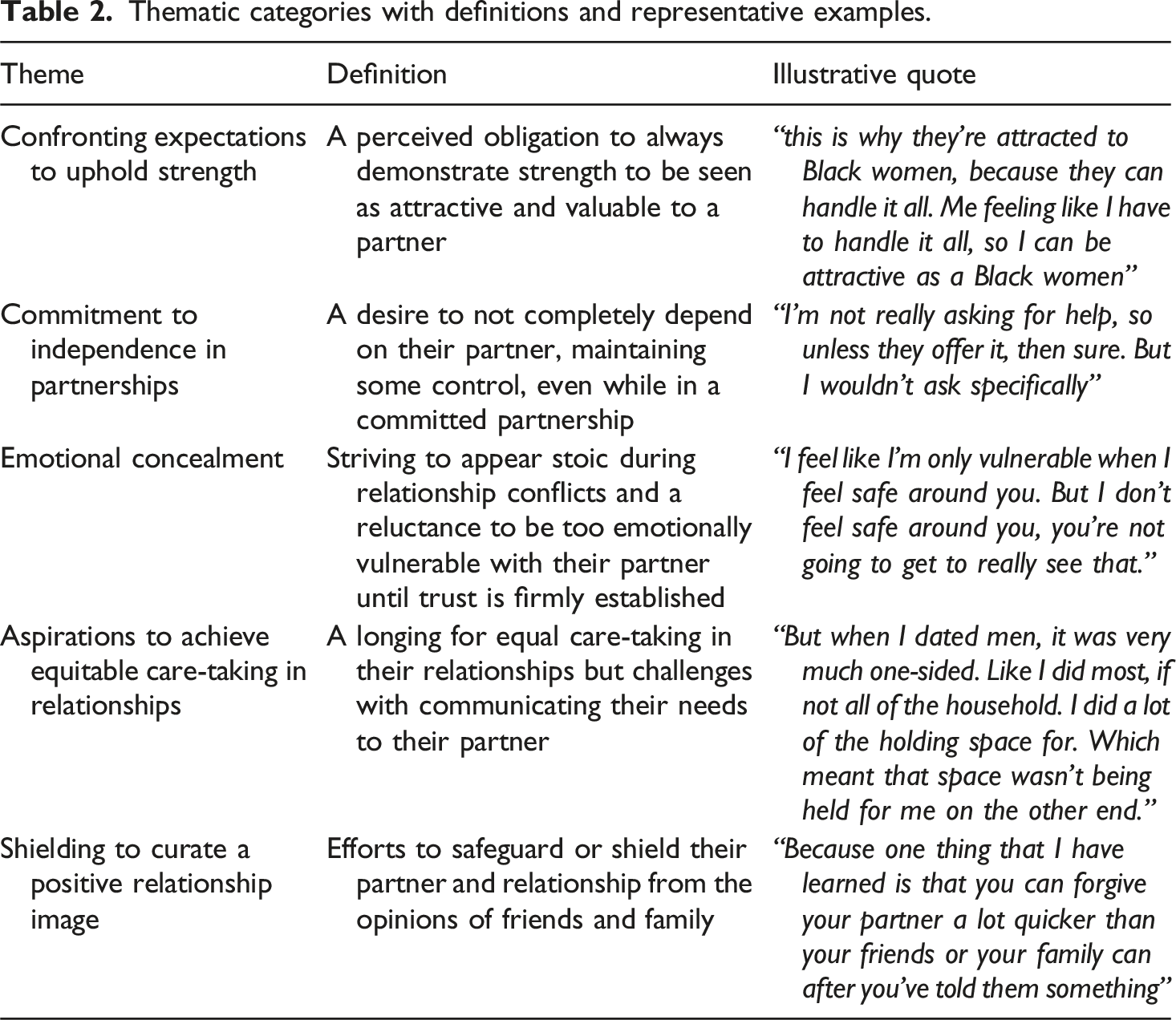
Participants shared that emotional vulnerability in the context of intimate relationships happens only when their partner has proven themselves trustworthy and supportive. There’s a level of trust that must be reached before they are willing to share their true feelings with their partner, described this way, “I can’t exactly pinpoint how or when, but it’s like that just feel of ease and vulnerability, … If something goes wrong, we’ll handle it together. But until then it’s more so I’m always ready to bat for myself” (Wanda, 23, heterosexual). Another participant described it this way, When I'm comfortable. I feel like that's a weird way to answer it, but when I feel like I can trust the person and be myself around them and they're not going to be judgmental. That's when I kind of open up a little bit more and let them see that vulnerable side of me. ... Sometimes I might, if I can trust a person, then I might sprinkle in a little bit, be a little vulnerable here and there and see how they take that. If they take it well, then I know that I can potentially open up more, but on the other hand, if I do that same thing and it's not received well, or I feel like they don't receive it well, then I know now not to go any further or be any more vulnerable than what I just tried (Jasmine, 19, heterosexual).
When trust has been achieved in the relationship, most women revealed that they were willing overcome their tendency to conceal to share their emotions and vulnerability with their partner. “[I’m] very quick to say if I’m sad or say if something made me angry. Just any type of, quote-unquote, negative emotion” (Jasmine, 19, heterosexual). Other participants shared that even when trust has been established, they are still hesitant to share their emotions, but they are actively trying to do this in their relationships Yeah, I was a bit hesitant, because I didn't want to make it seem like I was overreacting or something… but then I just ended up talking about it with them, because I didn't want to grow resentment or it to stem from something small but then become bigger. …he's more in touch with his emotions than I am, so he's able to tell me if something I did hurt his feelings or anything like that…For me, I've kind of, I don't want to say blocked my emotions, but just never expressed them, so I don't really know what it means to express it that much, but I'm learning (Jade, 21, heterosexual).
Aspirations to achieve equitable care-taking in relationships
Unlike the self-sacrificial care-taking of family described in established SBW schema conceptualizations, participants in the focus group interviews did not feel obligated to put the needs of their partner over their own. In fact, they frequently stated that it was important to communicate with their partner about their needs. However, in practice, there appeared to be some challenges with clear communication about emotional needs with their partner.
Women felt that there should be an even distribution of care-taking in intimate partnerships. Brittany shared an example of how volunteering to help with household tasks helped create a better division of caretaking in her relationship, “I feel like we pick up each other. We’re not like 50/50 all the time, but it kind of balances out to the point where no one’s feeling like they’re putting more into the relationship” (Brittany, 20, heterosexual). Others shared that the reality of equal caretaking in their past and current relationships was challenging. Participants described relationships in which they either struggled with inequitable care-taking or relationships where their needs were unfulfilled. Maya, who was partnered with another Black woman explained her experience this way …my wife and I are pretty I are pretty 50/50. But again, I really do think that's because we're both Black women, and we are both just very determined to care for other Black women, so it just kind of spills into our partnership. But when I dated men, it was very much one-sided. Like I did most, if not all of the household. I did a lot of the holding space for. Which meant that space wasn't being held for me on the other end (Maya, 30, queer).
Lisa described the lack of emotional care-taking this way, “you’re expected to be the glue, and your emotions and your wellbeing is not really prioritized. It’s kind of just expected of what you should be doing as a girlfriend” (Lisa, 22, queer).
Consistent with their demonstrations of strength, emotional concealment, and hesitancy to relinquish any independence, women disclosed that they often struggled with communicating their needs or sharing problems with their partner. Sometimes they were able to overcome this challenge and ask for what they needed, “I don’t want to be a burden, but I also don’t want to form this kind of resentment or emotion towards them. So I feel like it’s just better to explain it and communicate about it, than just keeping it in” (Abigail, 19, heterosexual). However, participants more commonly indicated a hesitancy to share their needs with partners. For example, Nia shared her struggle very openly I feel like something I've probably struggled with is taking on a lot of the care-taking … and that being one of the things I'm really trying to work on, not taking on too much of it… I can wear myself out very quickly. And then also, it makes it one of those things where, once you do a lot of the care-taking, you don't allow that other person to do anything really either, because you're kind of taking all of it. And it's not even if like you were forced to, you just chose, at this point. Now it's just how it is. It just becomes habit. So that being one of the things that has been a little bit difficult for me to step back from (Nia, 20, heterosexual)...
Sierra indicated her hesitancy to share and consequently not getting what she needs from her partner with this statement, “I don’t feel like I could do it, but closed mouths don’t get fed, but I’m just not getting fed over here” (Sierra, 28, heterosexual). Moreover, one of the college students in the sample shared a specific example of how she struggles to ask for help from her partner who was a student athlete “…. They’re also stressed out. They all have their own things. So it’s one of those things where, I feel like a burden if I’m like oh my god I have so many things to do” (Nia, 20, heterosexual). Consequently, women were engaging in self-management of their problems in order to not be perceived as a caretaking burden to their partner.
Shielding to curate a positive relationship image
Women also shared the ways in which they actively safeguard how their relationship is viewed by their friends and family. Women talked about a type of active shielding that they engage in to control the social perception of their partner and relationship more broadly. This shielding is a conscious effort to control their relationship presentation by prioritizing privacy and intentionally keeping secrets from other people about the relationship to protect their partner from harsh judgments. In other words, shielding is a specific SBW schema strategy that Black women employ to manage and control the flow of information in and out of the relationship. These quotes illustrate the shielding and privacy practices that participants engage in to curate and preserve a positive relationship image, I keep my relationship more on the private side rather than talking to other people about it, only because they aren't in the actual relationship. It's like, me and him is not me, him, plus X, Y, Z, so I typically don't, I guess, share any information outside of that relationship (Sarah, 22, heterosexual).
Abigail shared, but I feel like if it's something extremely personal about my partner, I don't think that I would go to someone else. Especially if I knew that, that would make them uncomfortable, then I feel like that's something that us as a couple can deal with, rather than bringing in other people's opinions (Abigail, 19, heterosexual).
When asked to explain why they felt this level of privacy was important, women disclosed that they didn’t want others to see them or their relationship in a negative light, you don't want your relationship to seem some type of way, maybe some way that it's not, I don't want it to seem bad because a lot of the time when you're talking to your girlfriends, you're only talking about the bad things. You're not talking about the daily good things. And sometimes when you are only talking about those things, it makes the relationship appear more negative than it really is (Naomi, 24, heterosexual).
This type of impression management of the relationship was important to participants. They felt responsible for constructing and controlling the image of their relationship with family and friends. Their positive relationship image can be established and maintained by protecting themselves against outward stressors and threats, including negative social judgment. The following quote summarizes this belief, Because one thing that I have learned is that you can forgive your partner a lot quicker than your friends or your family can after you've told them something. So it's best to get that neutral party who's like, I'm not going to see you, you're not going to see me. Nobody is mad at nobody for a business that's not their own (Wanda, 23, heterosexual).
Discussion
Summary of findings
Study results address several of the limitations within existing research identified by Debnam et al. (2025) in their scoping review of literature on SBW and intimate partnerships by using qualitative methods to give voice to Black women’s experiences. Findings from the focus group interviews illustrated five potential ways in which SBW schema exposes itself in intimate relationships: upholding partner expectations of Black women’s strength, a commitment to independence while partnered, efforts to conceal their emotions with their partner, ideally equal but practically inequitable caretaking of a partner within the relationship, and shielding to curate a positive relationship image. This multidimensional conceptualization of SBW schema in intimate partnerships builds and expands upon existing conceptualizations of the SBW (e.g., Superwoman schema; Woods-Giscombe et al., 2019). As discussed below and aligned with other SBW conceptualizations, participants identified an emphasis on strength, suppression of emotions, and a reluctance to relinquish independence. Findings deviated from prior SBW conceptualizations in the expressed desire for mutual or reciprocal caretaking over traditional self-sacrificial caretaking and what participants shared about efforts taken to actively protect their intimate relationships from external scrutiny. The functional implications for SBW schema in intimate partnerships may be both harmful and adaptative for Black women. More research is needed to understand the specific sources of socialization, changes in levels of endorsement across age and relationship contexts, and the unique circumstances that enable the schema to contribute to healthy or harmful relationship dynamics.
Consistent with the extant literature regarding the rich and multifaceted identifying characteristics of the superwoman stereotype and SBW schema (Abrams et al., 2019; Baker et al., 2015; Jones et al., 2021; Watson & Hunter, 2016), participants described various ways in which they see themselves as strong and how they demonstrated their strength in romantic relationships. Research has often focused on the negative health outcomes associated with SBW, but recently more scholars have examined the adaptive functions of SBW schema endorsement (for review, see Thomas et al., 2022). SBW has been used to exemplify the ways that Black women are able to achieve success in their personal and professional lives, while encountering daily gendered racial discrimination (Thomas et al., 2022). Davis and Jones (2021) assert, “Black women, are agentic people who can use our collective consciousness about the social world to subvert dominant ideologies and produce new knowledge about Black womanhood” (Davis & Jones, 2021, p. 303). Indeed, in the current study, participants reported that their ability to be vulnerable with their partner was a demonstration of strength; thus reinterpreting the stereotype that they possess superhuman strength. Many believed that the ability to draw on inner strength to let their guard down and be vulnerable with their partners was among the strongest things that they could do as Black women. However, what cannot be determined in the current study is how successful Black women are at exhibiting both strength and vulnerability in their relationships. As participants discussed, navigating a dichotomous exhibition of strength and vulnerability with romantic partners is challenging when social pressures to uphold SBW are pervasive and the consequences of schema violation are potentially detrimental.
A commitment to independence is another core attribute of the SBW schema. To embody the characteristics of the SBW, one must appear self-reliant in the face of all types of stressors without complaint (Baker et al., 2015; Beauboeuf-Lafontant, 2007; Romero, 2000). In the current study, Black women described their commitment to maintaining independence even while in relationships as a source of pride. They believed being self-sufficient was something to be admired by others while also preventing them from being overly dependent on their partner. Their sustained independence safeguarded them when and if the relationship ended. Many qualitative studies have specifically explored Black women’s commitment to self-reliance and independence, and Abrams et al. (2014) argue that there are two critical contextual routes to Black women’s internalization of this SBW schema prescriptions; volitional independence (i.e., personal choice to maintain one’s own sense of self) and obligatory independence (i.e., personal, social, and structural circumstances require it). Regardless of the type of independence, the extant qualitative literature demonstrates that Black women often disclose that they do things alone, by themselves, and without asking for help (Beauboeuf-Lafontant, 2007; Jones et al., 2021; Kelly et al., 2020; Nelson et al., 2016). Unfortunately, an unwillingness to ask for help from their romantic partners may also work against their efforts toward vulnerability. In the present study, participants expressed difficulty with appearing weak in front of their partner. When they were able to ask for support from their partner, they braced themselves for a disappointing reaction. Our findings are consistent with other research that shows Black women have been socialized by foremothers to be self-sufficient in relationships to prevent being disappointed or hurt by a partner when they aren’t able to support them (Woods-Giscombé, 2010).
SBW schema also encourages emotional concealment and restraint among Black women. This emotional concealment is thought to help maintain their public façade of strength. Self-silencing theory explains the sociocultural pressures to exhibit stoicism, strength, and invulnerability in their interpersonal relationships (Abrams et al., 2019; Avery et al., 2022; Harrington et al., 2010). Participants made it clear that attempts at emotional vulnerability with their partner would not occur until they had proven themselves trustworthy and supportive. Future research in this field should explore how or when a partner proves themselves worthy to see beyond their public façade of strength and how this may alter their relationship dynamics. The current study also exposed an additional reason for engaging in emotional concealment and self-silencing; a concern that too much vulnerability would be seen as unappealing to their partner. Again, the belief that their partner desires and expects them to present themselves as strong inhibits outward displays of emotion. More research is needed to understand how the reluctance to share vulnerability with a partner contributes to increased stress and anxiety among Black women. Yet, the implications for not receiving care for psychological distress and depression permeate public health research. Specifically, Black women are less likely compared to non-Hispanic White women to receive mental health services, and when they do receive care, it is more likely to be in poor quality (Misra et al., 2021; Satcher, 2001). As a result, Black women suffer disproportionately from a myriad of adverse health outcomes, including increased depression, anxiety, emotional avoidance, irregular sleep, binge eating, smoking, risky sexual behaviors, and poor self-esteem (Abrams et al., 2014, 2019; Avery et al., 2022; Harrington et al., 2010; Watson & Hunter, 2015).
Surprising results were found in relation to caretaking within relationships for Black women. In contrast to the self-sacrificial caretaking of family and children that has been described in the traditional SBW schema, participants shared that they did not feel any obligation to sacrifice their well-being in response to their partner’s needs. Participants admitted that caretaking, whether it included providing meals, financial support, or comfort, should be reciprocal in their intimate relationships. Participants were adamant that they expected mutual caretaking from their partner. The caveat to this belief is that women also expressed a hesitancy to burden their partner with their problems or needs. It is difficult to imagine how a partner could engage in mutual caretaking if Black women are withholding sharing their needs. A partner would have to anticipate a Black woman’s problems or needs in order to help them. The impracticality of this dynamic is compounded by Black women’s hesitancy to express vulnerability and ardent commitment to independence. It may create a cyclical pattern in which Black women continue to exhibit strength, emotional concealment, and independence because they don’t feel able to show their vulnerability, express discontent, or communicate their need for assistance and reciprocity. Thus, SBW is upheld.
Debnam and colleagues’ recent scoping review on SBW and intimate partnerships highlighted that the preserving both individual and collective self-image, a key aspect of SBW schema, has not been consistently addressed in the context of intimate relationships (Debnam et al., 2025). It was interesting in the present study that when asked about their efforts to present a positive image of their relationship, participants were also cautious to admit that they engage in this behavior. However, over the course of the focus group interviews, the ways in which they participate in impression management became clear. Described by Schlenker (1986), impression management refers to efforts by a person to create, maintain, protect, or otherwise alter an image held by a specific audience (Bozeman & Kacmar, 1997). As described by study participants, it was important that their relationship not be judged by family and friends. Specifically, women discussed engaging in beneficial impression management to protect their partner from negative judgment by others. The preservation of a positive relationship image or beneficial impression management requires an extreme level of privacy by Black women, only sharing details or challenges in their relationship with trusted individuals and sometimes still embellishing the truth when discussing their partner (Pontari & Schlenker, 2004). These actions serve as a form of self-protection, allowing Black women to retain agency over their relationship narratives. Previous research on help-seeking in response to IPV provides evidence for the negative influence of beneficial impression management that Black women participate in. For example, a qualitative study by Morrison and colleagues (2006) found that Black women did not want their family members to know about IPV occurring within their relationship, thus reducing their likelihood of help-seeking. More research is needed to understand other positive and negative effects of impression management on Black women and their romantic relationships.
The current study has a number of limitations to note. The demographic characteristics of participants, while needed to narrow the focus of the study and when using a constructivist research paradigm, limits its transferability to other populations of young Black women. Participants ranged from 18 to 30 and thus overwhelmingly included college students, young working professionals, and women without children. It is unclear how SBW schema in intimate partnerships may change in long-term relationships or relationships that include multiple children. It is possible that romantic relationship duration or length could have influenced participant responses. As noted by a few participants, some traits of SBW may fade with time and familiarity with their partner. Future research should consider a longitudinal design that examines the strength and presence of SBW characteristics over relationship duration. Finally, participants varied in the gender and race of their partners. It is likely that exhibiting SBW schema qualities in intimate partnerships varies as a function of the partner characteristics. For example, upholding the SBW schema may be a greater burden when the partner is White or male as compared to Black and same-sex. It is also possible that pressure to internalize or uphold SBW attributes may differ among Black women with differing ethnic backgrounds and cultures. Although this was not the specific goal of the current study, expectations to exhibit ideals and behaviors consistent with the SBW schema may differ for Black immigrant and refugee women. Future research should consider how multilevel risk and protective factors at the sociocultural level (e.g., heteropatriarchal norms and values) and individual level (e.g., employment and socioeconomic status, disability, literacy level, citizenship status, parental status) influence Black women’s perceived expectation to uphold strength prescriptions in their intimate partnerships. Other limitations align with the general weaknesses associated with focus group interviews. While every effort was made to ensure participants’ comfort with discussing these topics, it is possible that the women were reluctant to disclose their vulnerabilities and challenges; a key component of the SBW schema.
Despite these limitations, study findings provide useful insights into the role of SBW schema in intimate partnerships for Black women. The study addresses a critical gap in the literature for young Black women navigating gendered racial stereotypes to engage in romantic and intimate partnerships. Study findings reveal a nuanced multidimensional conceptualization of SBW that is specific to intimate partnerships. Future research is needed to measure this construct and examine its potential benefits and liabilities for healthy relationship development. A greater understanding of the effects of gendered racism on Black women’s romantic relationships and advancing ways to support them is an important area for future research.
Supplemental Material
Supplemental material - “It’s not actually all peaches and roses:” The role Strong Black Woman schema plays in Black women’s intimate partnerships
Supplemental material for “It’s not actually all peaches and roses:” The role Strong Black Woman schema plays in Black women’s intimate partnerships by Katrina J. Debnam, Lanice R. Avery in Journal of Social and Personal Relationships.
Supplemental Material
Supplemental material - “It’s not actually all peaches and roses:” The role Strong Black Woman schema plays in Black women’s intimate partnerships
Supplemental material for “It’s not actually all peaches and roses:” The role Strong Black Woman schema plays in Black women’s intimate partnerships by Katrina J. Debnam, Lanice R. Avery in Journal of Social and Personal Relationships.
Footnotes
Acknowledgements
The authors would like to thank the graduate students and undergraduate research assistants who contributed to the completion of the study, Nia Baker, Mia Brown, Kylie Lynch, Emily Luong, and Abigail Ronsonet.
Declaration of conflicting interests
The authors declared no potential conflicts of interest with respect to the research, authorship, and/or publication of this article.
Funding
The authors disclosed receipt of the following financial support for the research, authorship, and/or publication of this article: This work was supported by the National Institute of Minority Health and Health Disparities (R21MD016967). The opinions expressed are those of the authors and do not represent the views of the National Institutes of Health.

Supplemental Material
Supplemental material for this article is available online.
References
Supplementary Material
Please find the following supplemental material available below.
For Open Access articles published under a Creative Commons License, all supplemental material carries the same license as the article it is associated with.
For non-Open Access articles published, all supplemental material carries a non-exclusive license, and permission requests for re-use of supplemental material or any part of supplemental material shall be sent directly to the copyright owner as specified in the copyright notice associated with the article.
