




Abstract
Singlehood is often described as a binary: some single people struggle, while other singles thrive. Yet, single people likely experience challenging and beneficial aspects of singlehood simultaneously. We used qualitative approaches to provide insight about how single people navigate aspects of singlehood that are challenging and aspects that offer opportunities to thrive. Eleven single adults took part in 30–45-minute semi-structured interviews. Single participants were of diverse ages and ethnic backgrounds, represented a gender balanced sample, and reported diverse relationship histories ranging from never coupled to divorced. Using reflexive thematic analyses, we identified three themes that reflected broader complexities about navigating singlehood challenges and benefits: (I) whether and when should single people invest in singlehood, (II) balancing the tension between singlehood facilitating autonomy versus romantic relationships facilitating deep emotional connection, and (III) how to respond to feelings or experiences of societal pressure to partner that encourages romantic coupling. These findings shed light on how single people manage mixed feelings about singlehood and romantic coupling.
Introduction
Singlehood is becoming increasingly common across societies, with as many as 40–50% of adults reporting singlehood status (Kislev, 2019). Emerging studies highlight that single peoples’ experiences are incredibly diverse and complex (Girme et al., 2023; Pepping et al., 2024). Some people find singlehood challenging because they are involuntarily single for reasons such as difficulties finding and maintaining romantic partnerships (Apostolou et al., 2023) or experiencing social pressure to partner and discrimination for being single (DePaulo & Morris, 2005; Girme et al., 2022; Sprecher & Felmlee, 2021). In contrast, others find singlehood rewarding because they can pursue life skills (Apostolou & Christoforou, 2022), experience more autonomy (Wang & Abbott, 2013), and meet their needs for intimacy and closeness through non-romantic relationships (Park et al., 2021; Sarkisian & Gerstel, 2016).
Experiencing singlehood as challenging versus thriving may reflect different subgroups of ‘happy’ versus ‘sad’ singles (Hoan & MacDonald, 2024; Pepping et al., 2024). However, it is also likely that single people navigate the costly and beneficial aspects of singlehood simultaneously. For example, Ravi might struggle with fears of not having a partner, despite enjoying their ability to flexibly travel. The current study used qualitative methodology to offer rich insights into how single people experience – and grapple with – the ‘pushes and pulls’ of singlehood. Indeed, understanding ambiguous feelings surrounding singlehood is important for deepening the understanding of the singlehood experience beyond assumed subgroups of ‘happy’ versus ‘sad’ singles.
Challenges associated with singlehood
Much of the literature has focused on the challenges associated with singlehood status. One reason may be that single people experience difficulties due to individual characteristics. For example, approximately 78% of single adults report an insecure attachment orientation (Pepping et al., 2024), that is notably higher than the approximately 42% of insecure individuals typically observed in the general population (Bakermans-Kranenburg & Ijzendoorn, 2009). Relatedly, single people may also experience greater fears and anxieties about their singlehood status (Spielmann et al., 2013), which can undermine single peoples’ well-being (Adamczyk, 2017; Dennett & Girme, 2024). Anxieties around singlehood may be particularly difficult for those who wish to be in a romantic relationship but are unable to find a partner (i.e., involuntary single, Apostolou, 2021). Single people, compared to people in relationships, also tend to report being lower in extraversion and conscientiousness and higher in neuroticism, which also may undermine well-being (Hoan & MacDonald, 2024) and make it difficult for single people to enter and maintain romantic relationships, but also lead independent and satisfying lives as a single person.
Single people also experience challenges because of how they are treated by society and close others. One research area that has received much attention is “singlism,” which is the discrimination and negative stereotyping of single people (DePaulo & Morris, 2005; Morris et al., 2008). Singlism may occur due to societal norms and beliefs that place romantic relationships on a pedestal at the expense of singlehood (Day et al., 2011; Dennett & Girme, 2024). Indeed, single people are commonly viewed as having negative stereotypical traits (Dupuis & Girme, 2024; Greitemeyer, 2009). Singles also perceive lower social support and greater discrimination compared to coupled people, and these factors undermine single peoples’ life satisfaction and subjective well-being (Girme et al., 2022). Relatedly, single people also report feeling pressure from their social networks to partner (Apostolou et al., 2023; Himawan et al., 2018; Sprecher & Felmlee, 2021). Thus, single people may also experience challenges due to societal norms and pressures that emphasize romantic relationship norms – regardless of whether single people themselves desire a romantic partner.
Benefits associated with singlehood
Many single people thrive, which suggests that singlehood offers benefits alongside challenges. One common benefit single people report feeling is freedom and autonomy (Baumbusch, 2004; Mrozowicz-Wrońska et al., 2023). For example, Apostolou and Christoforou (2022) found that singles reported more time for themselves, being able to focus on personal goals, and having autonomy over decision making. Notably, these autonomy benefits might be particularly relevant for younger singles. Autonomy can help younger singles learn skills to help them achieve success in life (Apostolou & Christoforou, 2022), and younger singles may face less discrimination (Morris et al., 2008) or pressure to partner because they may be encouraged to work on themselves to gain the skills needed to be successful.
Single life may become more fulfilling as people reach middle-age (see Rauer & Jager, 2024). At approximately the age of 40, single people tend to become more satisfied with their singlehood and have less desire to be in a romantic relationship (Park et al., 2022). This may be because 40 years old is considered to be past the normative age of partnering (Rapp, 2018; see also Park et al., 2022), thus older singles may experience less pressure to partner. Moreover, as singles enter middle age, they may develop a clearer sense of who they are, and this may also extend to feeling more secure in their singlehood status (Lodi-Smith & Roberts, 2010). Thus, middle-aged singles may come to realize there are avenues to happiness that are not bound to societal expectations of marriage.
Single people may also uniquely benefit from having time to focus on their relationships with family and friends. Single people have more social ties than coupled people (Sarkisian & Gerstel, 2016), and singles put more effort into their friendships and reap better long-term friendship quality than coupled people (Fisher et al., 2021). Single people who report greater satisfaction with their familial relationships, friendships, and sexual life also tend to report greater life satisfaction (Park et al., 2021). Taken together, people may find singlehood to be an opportunity to focus on themselves and their relationships with family and friends.
Singlehood as a complex experience
Notably, it is unlikely that singlehood is experienced in terms of benefits versus costs – many single people likely experience benefits and costs simultaneously. Even people in romantic relationships report experiencing relational ambivalence towards their partners (see Zoppolat et al., 2024). Stein (1976, p. 65) describes the ‘pushes’ against and the ‘pulls’ towards singlehood, such that a single person may experience a ‘push’ towards marriage (through cultural expectations or pressure from parents) and the ‘pull’ towards singlehood (through increased freedom and mobility or psychological and social autonomy). This perspective maps onto qualitative work showing that people express singlehood benefits such as independence and freedom, but also costs such as loneliness and a lack of companionship (Baumbusch, 2004; Mrozowicz-Wrońska et al., 2023). Similarly, Park and colleagues (2023) found that while some singles are independent and satisfied with being single, a different subgroup of singles held ambivalent feelings about being single. However, it is less clear why aspects of singlehood may cause these ambivalent experiences.
Current research
Extant research has focused on identifying singlehood benefits versus challenges. In this study, our primary research question is to identify singlehood benefits and challenges that together reflect the complexity and nuances of singlehood that single people must navigate or grapple with. We chose qualitative methodology because it may give participants the time and space to explain the complex feelings, goals, or expectations they feel they must navigate. We conducted semi-structured interviews lasting 30–45 minutes with 11 single participants. Using reflexive thematic analysis, we created several themes that highlighted broader complexities to better understand single people’s lived experiences.
Methods
Research reflexivity and positionality statement
The authors remain mindful of how our identities inform the lens we used to interpret and communicate scientific research. The first and second authors come from a social psychology background and had in-depth knowledge of singlehood literature prior to this project. The third author has a background in criminology and expertise in qualitative research methods. All authors are cis-gendered women, and while all authors have had previous singlehood experience, they were all in romantic relationships at the time of this study. We remained mindful of our various identities as cisgendered women in romantic relationships (among other identities) that inform the lens with which we interpret and communicate scientific research.
Research methodology
Given that what it means to be “single” is often reflected in broader societal beliefs, expectations, and ideas about singlehood and romantic partnerships, we adopted several methodological approaches to understand the complexities surrounding singlehood with our participants. That is, we used an experiential approach to interview single people about their lived experiences to gain insight about how single participants see their own realities. We used a constructivist framework when considering the patterns of codes and themes that we felt were meaningful across participants. Furthermore, to best capture singlehood experiences, we used both inductive (i.e., bottom-up) and deductive (i.e., top-down) approaches. Deductive approaches were used in creating the interview questions that are situated in the research teams’ interests informed by singlehood studies. Specifically, the team were guided by literature highlighting that there are factors that are associated with single people struggling in their lives, and a different set of factors associated with single people thriving (see review by Girme et al., 2023). Building on this work, the research team were interested in understanding the nuances in single people’s lived experiences, such as how singles navigate the aspects of singlehood that are associated with struggling and thriving simultaneously.
The interview questions included the following topics: (a) how participants demographic information related to their singlehood (e.g., What role do you think your age plays in your singlehood experience?) (b) how participants felt about being single (e.g., How do you feel about being single?) (c) when participants felt their single identity was salient (e.g., When do you feel your single identity is obvious to yourself?) (d) their views on the benefits of singlehood and romantic relationships (e.g., What do you think are the benefits of singlehood/relationships?). Full interview questions are available on the Open Science Framework (https://osf.io/mr6tx). Furthermore, to minimize any biases that the research team may hold about singlehood onto the participants’ interview responses, we used an inductive approach to data collection and analysis. For example, during data collection, we did not pre-select any demographic traits for our participants. Rather, we came from the approach that all singles were equally able to share a rich story of their singlehood and lives. We placed advertisements on local online boards and responded to participants as they contacted us.
The flexibility of reflexive thematic analyses – i.e., using deductive questions and inductive coding while still being reflexive in the process – made it a good fit for our study aims (Braun & Clarke, 2006). Thus, we did not prepare any hypotheses, codes, or themes in advance. Rather, the research team engaged in the topics that came up for single participants based on their responses to the interview questions. We focused on topics and patterns that appeared in each individual interview and then identified topics and patterns that came up across participants. Afterward, we created codes from the ground-up based on our understanding of participants experiences using more semantic based codes (Braun & Clarke, 2022).
Participants and procedure
Participant demographics.
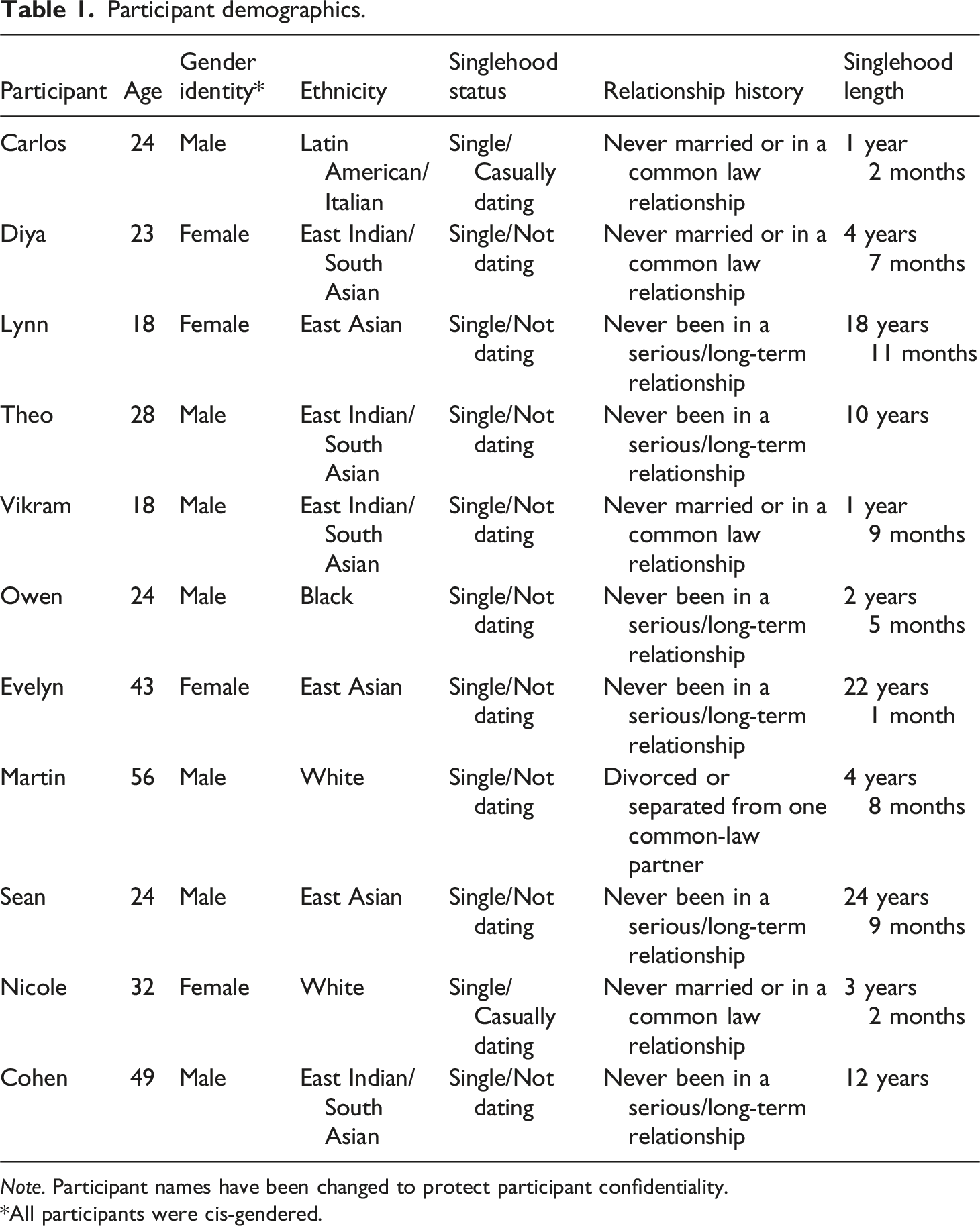
Note. Participant names have been changed to protect participant confidentiality. *All participants were cis-gendered.
We did not have a target sample size prior to data collection. Instead, because this project was part of a university seminar course, we aimed to conduct as many interviews as possible within the time frame of 4 months. Approximately 89 interested people contacted our research team, but after providing detailed information about the study only 24 people were interested in participating. Of these 24 participants, only 12 participants were eligible to participate in our study. However, one participant was dropped due to suspected fraudulence. All 11 participants completed a demographic survey and then completed a semi-structured interview about their singlehood experiences via Zoom. Participants were entered into a draw for a $25 Amazon gift voucher for completing the demographic survey and each received a $15 Amazon gift voucher for completing the semi-structured interview. Interviews ranged from 22 to 51 minutes (M = 35.35 minutes, SD = 9.31).
The first author conducted all interviews, and her aim in the interview was to allow participants to lead the interview, while being flexible on when to follow participants onto a new topic related to singlehood, and when to bring the conversation back to a prepared question, and in which prepared question to ask rather than following a strict, rigid order of questions (Braun & Clarke, 2013). Participants were also given space at the end of the interview to talk about anything pertaining to singlehood that they thought was not covered in the interview (Braun & Clarke, 2013). Ice breaker questions were dropped after 3 interviews due to the amount of interaction the first author already had with each participant during the screening phase. After the interview was concluded, the first author (i.e., the interviewer) made notes aligned with the reflexive thematic approach (Braun & Clarke, 2022) to reflect on ideas brought up by participants, and her own process in conducting interviews.
Qualitative data analysis
Data transcription
The audio files for each interview were transcribed by the first author and three research assistants who listened to the audio file and checked it against Zoom’s automatic closed caption to check for accuracy, removed personally identifying information, and added in symbols to represent the qualities of the voice that would be missing in text (e.g., pauses in speech). All transcriptions were checked by another person to ensure accuracy and quality of work. After transcriptions, the first author made notes on insights that came up during the transcription and coding process to continue to be reflexive (Braun & Clarke, 2013). The aim of this step is to have a transcript that accurately represents what the participants said in their interview, which can be used in the data coding process.
Data familiarity
The aim of this step of the reflexive thematic analysis process is to become familiar with the data (Braun & Clarke, 2022); however, the first author was already familiar with this data because she had conducted all participant screening, interviews, and listened to all interview audios again to either transcribe or verifying the accuracy of the transcriptions completed by research assistants.
Coding and themes
Following the reflexive thematic analysis guidelines (Braun & Clarke, 2022, p. 35), we created codes and themes. This coding process was iterative, which aligns with the expectation that qualitative research is often non-linear. The transcriptions were uploaded into NVivo 14 (Lumivero, 2023), a program designed for managing and coding qualitative data. To begin our coding process, the first author read each transcript, and identified ideas and patterns that showed up within each participants’ transcript and between transcripts across participants. The first author created a list of 25 codes (e.g., social pressure from friends) and signposted 10 potential themes based on the initial codes to be possible candidate themes (e.g., it is hard to be single in certain places or around certain people). After initial codes were created, the first and second author refined possible codes, including dropping some codes for lack of deep importance, combining codes, and adding in new relevant codes. Similarly, signposted potential themes were refined and developed later in discussion with the rest of the research team into candidate themes (following a similar process as the possible codes). Allowing the research team to place codes into candidate themes (e.g., social settings and interactions can put pressure on singles to partner). Next, the first author went line-by-line using NVivo 14 (Lumivero, 2023) to assign the created themes and codes to appropriate quotes throughout the transcript. After the line-by-line coding of the transcripts were complete, the three authors met to refine the candidate themes to create the final themes. The first and second author then chose quotes to best represent each theme and edited the quotes for brevity and readability by editing out filler words (e.g., “like”). Follow-up conversations were had between the first and second author about the naming of each theme.
Results
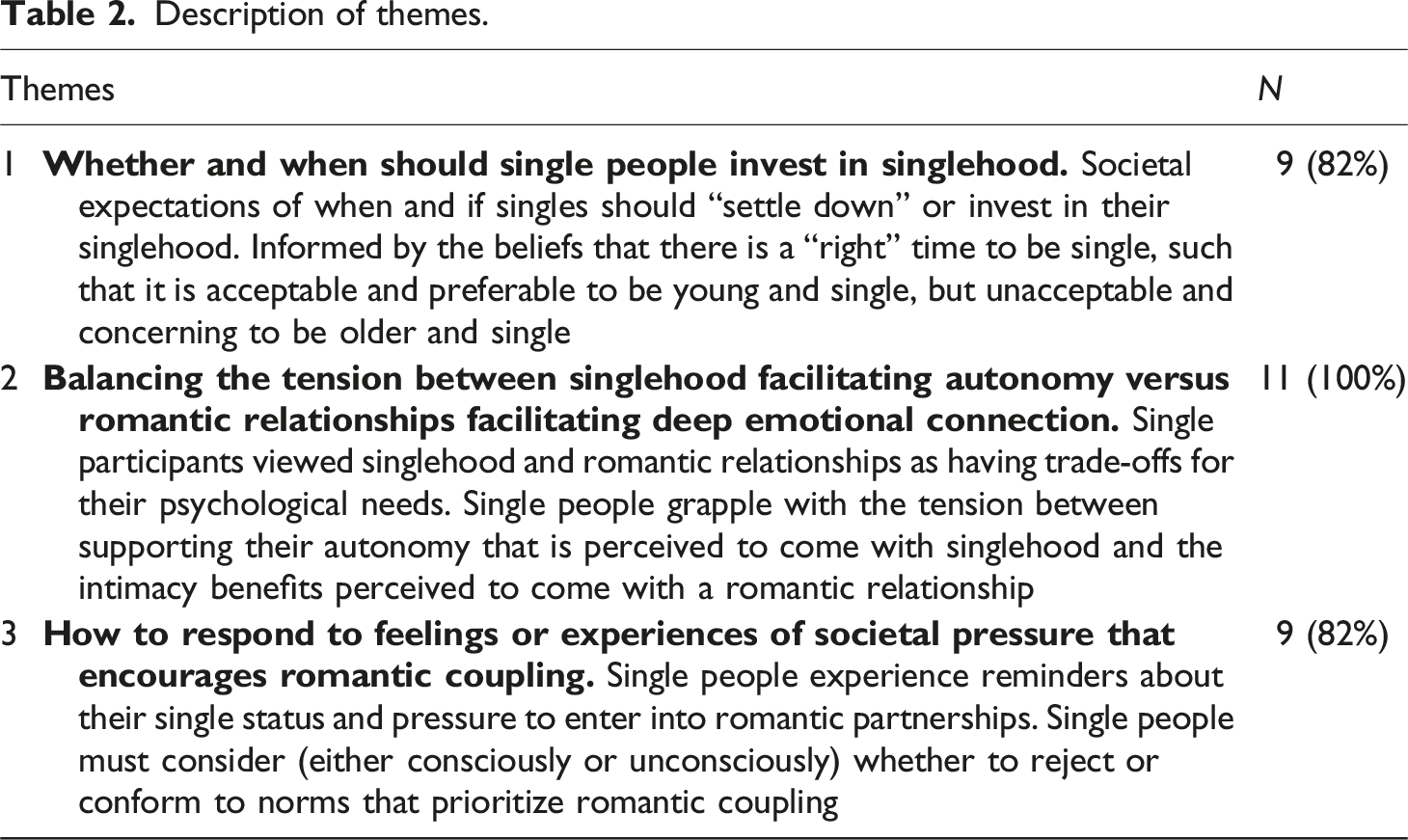
Description of themes.
Themes mentioned by each participant.
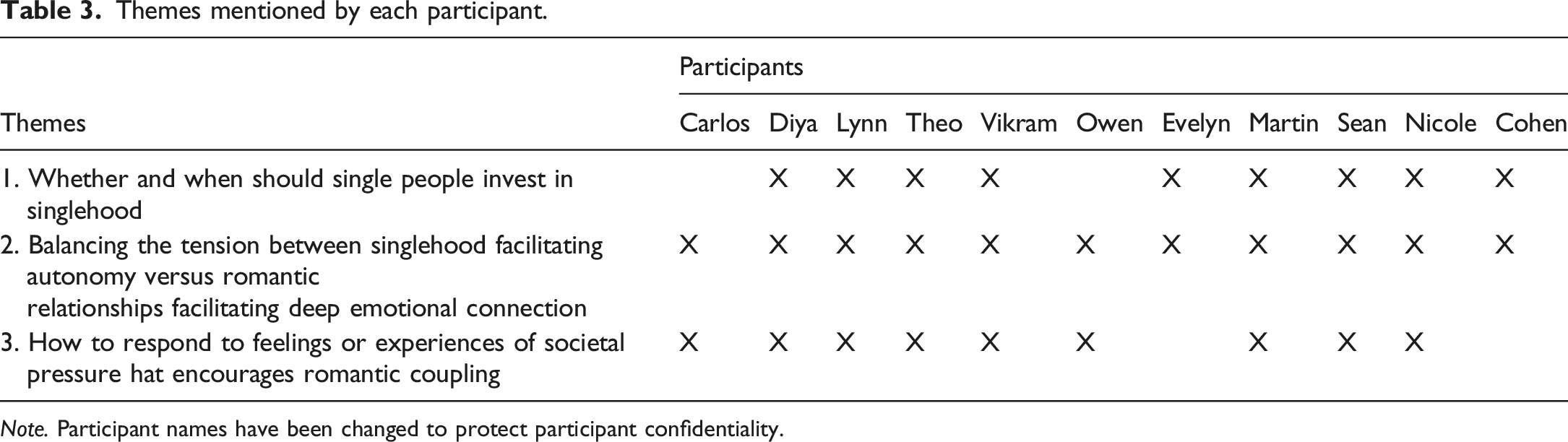
Note. Participant names have been changed to protect participant confidentiality.
Theme 1: Whether and when single people should invest in singlehood
One major complexity that singles mention having to navigate is making decisions about whether and when to invest in their single lives. These complexities occurred because most participants perceived or experienced societal messages that there is a “right” time to be single, which is delineated across the life span. For example, it was often seen as acceptable and preferable to be younger and single. One reason younger singles may feel that it is exciting to be young and single is because society views singlehood in younger age as more positive (Morris et al., 2008). It may be seen an opportunity for people to focus on personal development through gaining life experiences and career obtainment (see Apostolou & Christoforou, 2022). In our sample, participants felt that being young is a time to develop as a person, and therefore relationships do not necessarily need to be prioritized. As Vikram stated, their family had not started pressuring them about being single because they were still young and so it was seen as an acceptable time for them to focus on school: I think my family's pretty okay with it because I'm still pretty young so I’m not too stressed about it. So if I were a bit older, maybe it's like, ‘hey, you may be looking [for] someone’, but right now it's like, ‘hey, it's fine to focus on your studies for a bit, you're fine for now.’
Similarly, Sean felt that being younger and single was preferrable because they felt that they had freedom and autonomy in their youth. I'm still pretty young I guess. It's like the world is my oyster kind of thing and then I could just do anything I guess.
The idea that younger age is a time for self-development before one invests into a romantic relationship aligns with the temporal life-course perspective. This perspective posits that there are socially accepted and expected events people should do throughout their lives, and these events have a time and an order to be completed (Lahad, 2017). For example, people are expected to fall in love, then get married, and then start a family. Therefore, being younger and engaging in self-exploration is seen as part of a normative timeline.
However, if participants are single “too long”, the narrative of acceptance of singlehood shifts. That is, as single people continued to age from younger adults to older adults, singlehood seemed less acceptable and more concerning. This may be because people assume that older adults are no longer as focused on self-exploration and have begun to “settle down” having obtained an education or adequate job. It seems at this point, finding a romantic partner becomes the goal of the next phase of life. Especially in the cultural background I come from, I would definitely say as soon as you finish what you think is education, so it could be a bachelor’s or a master’s, and then the second you go into a full-time job, then all of a sudden there’s a switch…then you should be actively looking to end your singlehood.
However, if one continues being single during this ‘settling down’ phase of life, this may be perceived negatively. This may be because being older and single may be seen as violating norms for coupling and marriage (DePaulo & Morris, 2005). These violations against societal norms may happen regardless of whether singlehood was chosen or not (Apostolou, 2021) and may affect how single people view themselves. This was seen when Theo considered their potential future singlehood. I would definitely not be happy if I'm single and 50. At that point you should have some kids and [be] in a healthy relationship.
Similarly, violating norms and expectations may affect how others view and treat older single people (Lahad, 2017). As Evelyn stated, they received societal messages that they had ‘aged out’ of being desirable to partners or finding desirable partners. The message I get from the society is that younger women are more desirable. And in order to be truly desirable to a guy you have to be under a certain age. Once you're over a certain age it doesn't matter how successful you are, how beautiful you are, you’re not going to be as desirable.
Importantly, single people continually navigate these societal expectations as they age and reach certain life stages or milestones. Consistent with previous research, single people who are involuntarily single beyond a certain age may find singlehood particularly distressing (Hill Roy et al., 2022). We found that a few of the older participants spoke of an important transitionary ‘tipping point’ where they felt pressure to decide if they will navigate their life by investing in their identity as a single person or focus on waiting to “settle down” in a romantic partnership. Nicole discussed their internal monologue as they grappled with these decisions: It becomes quite challenging…at what point do you make those decisions? …And I think that's the hardest part, accepting the reality of ‘I don't know if I will ever find a partner to do this with’…I really want a dog but it is such a commitment …so I kinda had this thing in my head for the last couple of years like ‘oh I wouldn’t get a pet until I had a partner’ like a serious committed relationship…and now it’s like I don’t know, when do I just get the frigging dog and make it work?
Indeed, remaining single as an older person was not always something that people envisioned for their life. Yet, there were moments when some single people came to realize that they do not foresee themselves wanting or having a romantic partner in the future and decide to invest in their single life. Martin reflected on a conversation with their ex-partner about household tasks that brought up questions of how to invest in themselves as an older single: I was thinking this is just temporary; I had the family and I probably will have either [a new] family or being a couple. It took me probably several years and this conversation [with my ex-girlfriend] I wouldn't say was the pivotal moment, but it crystallized everything. It made me think well what if? What if it is true? What if there will be no new family or new couple and what if this is my life going forward and it is absolutely true that I have to take care of these things.
Finally, for some single people there was no definite decision-making process about when to invest in singlehood. Rather, some people wanted to partner but found themselves single long-term and slowly learned to become accustomed to single life. This process may align with Hostetler’s (2009) perspective that when things are out of one’s control (such as being unable to find a partner), that people adjust the self to their situation. We saw this more subtle adjustment from Evelyn and Nicole. I don't prefer being single, but if I have no choice then I'll be single and I'll be happy… – Sometimes I'm just busy or now that I've been single for so long I think I've kinda [got] into a routine or just found my own little group. –
Taken together, single participants seemed aware of the societal scripts that place different expectations for single people at different ages. While younger singles experienced fewer pressures to partner, older adults were more aware of the expectations to “settle down”. Notably, people who found themselves involuntarily single later in life talked about reaching a ‘tipping point’ where they grappled with whether to invest in their own singlehood, while other singles seemed to slowly become accustomed to single life.
Theme 2: Balancing the tension between singlehood facilitating autonomy versus romantic relationships facilitating deep emotional connection
Single participants were aware of their core psychological needs for both autonomy and relatedness need fulfillment (Ryan & Deci, 2017). However, single participants often felt that they had to make trade-offs between meeting their autonomy needs via singlehood versus meeting their relatedness needs via romantic relationships. For example, autonomy and freedom to live authentically is an essential part of people’s well-being (see Ryan & Deci, 2017) and was brought up as an important benefit of singlehood. Single people felt that their singlehood gave them the autonomy to choose what was important in their life, and the freedom and time to focus on their important goals as Carlos mentioned: Starting a relationship it’s like ‘hey I have limited time' because obviously I have work, I have family time, I have professional goals. I want to go to grad school. I love reading. I love doing my own thing.
Moreover, single people noted that their freedom and autonomy was a particularly salient benefit when they compared themselves to coupled people who they perceived as lacking freedom and autonomy. Some of my friends talk about how they have to ask a partner for permission before hanging out or if their partner doesn't want to eat at some place or doesn’t want to do an activity then they can't either. But for me I could just do exactly what I want because there's nobody that could say no to me.
While all participants mentioned that freedom and autonomy is a benefit of singlehood, there may be variation in how much people value autonomy. Participants who greatly value their autonomy may be more hesitant to enter into a romantic relationship because romantic partnerships may be seen as encroaching on their autonomy. For example, as Evelyn stated: I've always placed a lot of emphasis on my independence and my freedom. It's just the way I am I think it's really those [things] are really important things to me. And I don't want anything [to] threaten [it]. –
Notably, while all participants stated that singlehood has autonomy benefits, most participants simultaneously felt that romantic relationships have unique benefits that family and friends cannot replace. For example, Diya noted: I have my best friend. I have an inner circle. I have chosen family. But sometimes it feels like a relationship would just go that much more further.
The exact benefits that romantic relationships uniquely offer seemed to differ across participants, but generally included being able to experience deeper and more intimate connections than they could experience with their friends and family, such as how Sean mentioned: I feel like in a relationship [with a] partner it's much more close together [than] with friends and family. [It] might feel like a different sort of relationship where it's not as deeply emotional… [A romantic] someone that you could turn to and talk to – that is deeper and more intimate than just friends and family.
Notably, a few participants focused on the practical benefits of romantic relationships, such as perceiving social support availability that romantic partners may provide during difficult or stressful times: There are practical things like someone to look after you if you have bad health or [an] accident and someone's going to take care of you… mundane things. Like, when you take care of the necessary things that [are] not necessarily romantic but had to be done because it's part of everyday life it’s just easier to do it when someone helps you. –
Ultimately, the tension between meeting their autonomy needs via singlehood versus meeting their relatedness needs via romantic relationships left some single participants feeling ambivalent about their single status. As Cohen shared: It's double-edged sword, I mean being single you have a lot of freedom, but at the same time you wish you had someone there with you to support you when you're not doing so well in life. – Cohen
Moreover, grappling with the benefits of singlehood versus romantic relationships may also undermine single people’s ability to enjoy their freedom and autonomy as they may also feel conflicted and dissatisfied with their singlehood status. It goes in waves. Sometimes I'm more …eager…to find a partner or at least for the company or intimacy. And then other times I just don't have the time and I'm like, yeah, it's fine. I don't need someone right now or it doesn't really even cross my mind. So it comes and goes. –
Taken together, most single participants seemed to acknowledge that they reap autonomy benefits offered by singlehood, but also feel as if they lack unique benefits offered by romantic relationships. This perceived trade-off between autonomy and relatedness needs not only created ambivalent feelings about singlehood, but also influenced decision making about whether to remain single or seek romantic partnership.
Theme 3: How to respond to feelings or experiences of societal pressure that encourages romantic coupling
Finally, single participants frequently feel societal pressure to end one’s singlehood and enter a romantic relationship and thus had to consider (either consciously or subconsciously) whether to reject or conform to such relationship norms. For example, single participants commonly experienced situations that reminded them of their single status and made their single identity salient to them. At times, these reminders were indirect – that is, single people mentioned subtle cues that reminded them of their single status such as perceiving oneself as the only single person in a room/event or people talking about/posting photos of their romantic relationships or milestones that reflected marriage and family norms. Despite being indirect, these social situations still felt uncomfortable because they served as a reminder that single people were not conforming to societal norms about romantic coupling (DePaulo & Morris, 2005). In group [chats] it's all about… [people] in marriages or they're pregnant or they bought a house with their partner. I think that for me at least [it] emphasizes my singlehood. Sometimes when I'm eating at a restaurant, sometimes I eat alone and then surround[ed] around me are couples so at that moment I realized like ‘oh…I'm just by myself.’
Participants also commonly felt pressure to end their singlehood and enter romantic partnerships because of explicit remarks made by close others. These statements were designed to bring attention to one’s singlehood status, which would serve as a direct, explicit reminder of violating relationship norms and were more consistent with reports of social pressure in previous studies (Himawan et al., 2018; Sprecher & Felmlee, 2021). For example, participants noted that family or friends would contrast single peoples’ status with their own relationship status, offer to set up single participants with dating or marriage partners, or make explicit remarks that single participants should “settle down”. For example, as Martin noted: [Work colleagues] once in a while get into the subject ‘well you want me to introduce [you] to my friend?’ … there is a little bit of maybe we should help him…Maybe [a relationship] just didn't happen but he needs one little push and everything will work out.
In fact, Martin who is an older single adult even discussed how although close others’ direct attempts to pressure him to partner waned over time, that the idea of him pursuing a romantic relationship never fully went away: My mother in the beginning was saying ‘well you should remarry you shouldn't be alone,’ but as [the] years past she kind of stopped asking. Once in a while she asks am I still alone, [and] yes I am still alone, [and] once in a while she would kind of say something ‘well this isn't good you should find someone.’ –
So, how did single people respond to these experiences? Some single participants found that even indirect reminders that indicated that people around them were partnering was sufficient to feel an internal sense of pressure to end their singlehood and enter a romantic relationship. As Lynn says after looking at the social media of coupled people: You see other people on social media posting about their partner or their romantic lives. And, yeah, you might start wanting a relationship really bad.
Interestingly, pressure to partner also occurred among people who are happy being single. One possible reason may be that even happy singles may feel that singlehood is a “phase” and that eventually people need to exit singlehood to pursue life goals that may be predicated on being married, such as having pets, children, or home ownership. For me being single is fantastic but I think at some point that has to come to an end obviously… like you start to wonder that, ‘Hey when am I gonna get kids?’ And to get to that point, you have to have a girlfriend first…I'm also hoping, but there's an expectation subconsciously [that] between 28 to 30 I should be able to get married.
Notably, while some single participants succumbed to societal expectations or pressure from family and friends to partner, other singles also responded by rejecting and pushing back against the idea that they need to find a romantic partner. Single people who rejected societal or family pressure to partner did so for many reasons, including prioritizing their personal goals, having a low desire to partner in the moment, or a more general disinterest in romantic partnership. Yet, these individuals reported negative feelings when pushing back: It's frustrating…for example, I had come back from [country] after a year of service, and I was pretty burnt out [and] ready to relax and I think it was like the second or third day after I came back my mom had brought up a guy’s marriage resume and was showing it to me and I was like I am not interested. –
Some singles, however, reported a more positive and balanced outlook that acknowledged that people can be happy being single or coupled. For example, as Carlos noted, singlehood is a positive experience for them, and they wished that there were more societal examples that showcase the benefits of singlehood. The overarching theme of my singlehood is ‘hey, being single does not necessarily have to be a negative thing’. If anything for me it's been a positive thing. I just wish it would be portrayed more like that. –
Taken together, many single individuals experienced either indirect or direct forms of social pressure to partner. Singles had to make decisions (either consciously or unconsciously) how to react and respond to these pressures to partner. While some singles acknowledged that these pressures lead to conformity and an increased desire for romantic partnership, others actively rejected these expectations.
General discussion
Using reflexive thematic analyses, we generated three themes that highlight the complexities navigating the challenges and benefits associated with singlehood simultaneously: (I) whether and when should single people invest in singlehood, (II) how to balance the tension between singlehood facilitating autonomy versus romantic relationships facilitating deep emotional connection, and (III) how to respond to feelings or experiences of societal pressure that encourage romantic coupling.
Expectations about the “right” time to be single leave single people questioning themselves at various life stages
One theme that was developed is whether and when single people should invest in their singlehood. Related to recent developmental models of singlehood highlighting that singlehood may be associated with different consequences across the lifespan (see Rauer & Jager, 2024), our theme suggest that younger singles may feel that it is exciting to be younger and single because society views singlehood in younger age as an opportunity for people to focus on personal development through gaining life experiences and career obtainment (see Apostolou & Christoforou, 2022). After education and job obtainment is complete, however, singles are expected to settle down. Single people who do not find a partner and approach mid-life are seen as violating societal norms for coupling and marriage (DePaulo & Morris, 2005).
Research provides insight into factors that may predict greater commitment to single status, including fostering satisfaction with one’s relationship status, perceiving fewer alternatives to singlehood, and actively investing in one’s life as a single person (Beauparlant et al., 2024). However, rather than viewing some single people as more (or less) invested in single life, our findings highlight that many single people may find themselves questioning their single status when they reach life phases that are incongruent with their single status. Understanding that navigating these decisions are likely an ongoing process and therefore supporting people at these crossroads is an important avenue for future research. For example, our findings highlight that singles could reduce the incongruency between single status and age expectations by viewing singlehood as a legitimate lifestyle choice that requires investment (e.g., investing in friendships or hobbies) and rebuff beliefs that romantic relationships are a necessary first step for certain life goals (e.g., getting a dog, buying a house as a single person).
How to Balance the Tension Between Singlehood Facilitating Autonomy versus Romantic Relationships Facilitating Deep Emotional Connection?
Singlehood may be complicated because people need to navigate what they perceive as a trade-off: singlehood is seen as fostering autonomy at the expense of romantic connection, whereas romantic relationships are perceived as offering the security of deep emotional connection at the expense of autonomy. Notably, these lay theories about autonomy and dependence trade-offs are not necessarily supported by research. Although singles do report freedom and autonomy as a benefit of singlehood (Apostolou & Christoforou, 2022; Baumbusch, 2004; Mrozowicz-Wrońska et al., 2023), those in romantic relationships do not necessarily renounce their autonomy. Instead, people in healthy relationships report fairly high levels of autonomy (Deci & Ryan, 2014), partly because close others help support personal growth and goal attainment (Hadden & Girme, 2020).
Similarly, although single people perceived romantic relationships as being unique compared to other close relationships, emerging evidence suggests that being single does not necessarily mean a lack of dependency. In fact, relationships with family and friends are central to single peoples’ well-being. Being supported and integrated into a community is associated with better psychological well-being for single people (Kislev, 2019), and single people who report better quality relationships with family and friends report greater life satisfaction (Park et al., 2021). In fact, single people who endorse the importance of friendship (Kislev, 2020) and can meet their sexual needs outside of a romantic partnership are less likely to desire romantic relationships (Kislev, 2020; Park et al., 2021).
These beliefs about trade-offs may hold important implications for single people. For example, beliefs that romantic relationships encroach on one’s autonomy may lead some singles to actively avoid or delay entering romantic relationships or interfere with their ability to form secure interdependence with romantic partners (e.g., Pepping et al., 2024). Similarly, beliefs that romantic relationships provide unique benefits may leave some singles feelings dissatisfied in their singlehood and dismiss building bonds with close platonic others that would allow them the support that they crave. Understanding how to support peoples' ability to balance their autonomy and relatedness needs - regardless of single or coupled status - would be a fruitful avenue for future research.
How to respond to feelings or experiences of societal pressure that encourage romantic coupling?
Many societies promote the ideology of marriage and family, such that people are expected to enter romantic relationships and start a family (Day et al., 2011; Dennett & Girme, 2024). Our themes show that single people were subjected to such coupledom norms through indirect and direct relationship reminders and pressure to partner. For example, subtle experiences that may seem innocuous to others tended to prime singlehood among single people, especially if these experiences seem to be associated with prototypical romantic behaviour (e.g., eating together at a restaurant or making announcements about engagements or children). These experiences served as a reminder that singles are not adhering to the societal expectations. Of course, single people also experienced explicit pressures to partner, similar to what has been previously observed (Apostolou et al., 2023; Himawan et al., 2018; Sprecher & Felmlee, 2021). Single people may experience relationship reminders and pressure to partner because singlehood is perceived as an impermanent category which people can enter and exit. While our study illustrates that relationship reminders and pressures did spark a desire to partner for some, the implications are unclear, given that pressure to partner has been linked to greater fears of being single (Sprecher & Felmlee, 2021). Thus, while close others’ attempts to promote coupling may be well-meaning, it may make single people’s lives harder by perpetrating couple norms and invalidating the benefits of being single.
Notably, while responses to pressure to partner was a clear theme, singlehood-based discrimination was not. This was surprising given the large amount of research demonstrating that singles are stereotyped and discriminated against (Dupuis & Girme, 2024; Girme et al., 2022). It is possible that direct instances of pressure may lead to more persistent forms of discrimination over time especially when single people purposefully violate coupling norms by choosing to remain single. It is also possible that the interview questions did not lead single participants to consider broader institutional experiences of discrimination that single people as a group face (DePaulo & Morris, 2005; Morris et al., 2008). Understanding the ways in which single people think about and navigate singlism as it relates to the pressure to partner is an important avenue for future research.
Strength, caveats and conclusions
The current research drew on semi-structured qualitative interviews that offered deeper insights into the complexities of singlehood that single people navigate. Our sample of single adults was fairly gender balanced, reflected a range of ages (18–56 years old), and relationship histories (never partnered, never married, and divorced). The diverse backgrounds of our participants allowed us to explore singlehood from emerging adulthood to middle age, and those who were never partnered versus those who had some experience with romantic relationships which may be treated differently (see Rauer & Jager, 2024). Nonetheless, our sample lacked representation of older single people, who tend to feel more contentment in their singlehood (Park et al., 2022), but also express concern about who will take care of them at the end of life (Baumbusch, 2004) – ideas that were not brought up in our sample of singles. Future research is needed to continue clarifying how singlehood is perceived over the lifespan.
Although our data offered rich insight into tensions that single people must manage, our qualitative methods cannot examine the directionality of experiences. For example, while we argue that reminders about single status were associated with single people desiring a romantic partner, the opposite could also be true – single people who desire romantic partnerships may be more hypervigilant to romantic cues in their environment. Pairing the themes developed in our qualitative analysis with quantitative methods such as longitudinal or experimental studies could help determine directionality of some of our themes. Moreover, quantitative research could also assess experiences or outcomes that single people are unable to express verbally because they exist at the implicit level.
Nonetheless, this qualitative work highlights the complexities of the single experience because many single people experience both benefits and challenges of singlehood in tandem. Thus, rather than there being “thriving singles” versus “struggling singles”, the current research highlights that singlehood experiences ebb and flow. Single people navigate their single identity and experiences across the life span which may contradict societal expectations about life trajectories, single people may have to routinely balance the autonomy benefits that singlehood offer at the (perceived) expense of having deeply emotional connections with romantic partners and feel pressures to partner even if they are happy and fulfilled as a single person. By moving beyond simplistic perspectives of happy versus unhappy singles, this work encourages deeper investigation of the complex ways in which singlehood is experienced.
Footnotes
Declaration of conflicting interests
The author(s) declared no potential conflicts of interest with respect to the research, authorship, and/or publication of this article.
Funding
The author(s) disclosed receipt of the following financial support for the research, authorship, and/or publication of this article: This research was supported by the Graduate Travel and Research Award given by the department of psychology at Simon Fraser University.
Open research statement
As part of IARR’s encouragement of open research practices, the author(s) have provided the following information: This research was not pre-registered. The data used in the research cannot be publicly shared and cannot be shared with any person because it is in-depth qualitative interviews. The materials used in the research can be publicly posted and can be obtained at: 