




Abstract
Who is blamed for social exclusion often depends on how justified observers perceive the exclusion. Here we hypothesize that observers’ own similarity to the excluded person powerfully colors these perceptions. In particular, two studies (N = 496) examine whether observers blame a socially excluded person less if they perceive themselves as similar to that person. Study 1 uses a correlation design and shows that the more similar individuals feel to a person who is later excluded, the less they blame that person. In line with defensive attribution theory, this association is mediated by observers’ perceived vulnerability to end up in a similar situation. Study 2 experimentally tests the similarity-blaming link, showing that observers blame a similar target less than a dissimilar target. This link is fully mediated by greater compassion and liking for a similar target, which aligns with research on the similarity-attraction effect and social identity theory. Overall, the present findings indicate that similarity in behavioral tendencies and similarity in personal characteristics can influence how justified social exclusion is perceived, and that both affect observers’ attributions of blame. This is relevant as it highlights how (dis)similarity influences social judgements and may decrease support for dissimilar others following social exclusion.
Introduction
Being socially excluded, that is being left out or ignored by others, is a hurtful experience that negatively affects individuals‘ well-being and mental health (Büttner et al., 2024; Marinucci et al., 2022; Marinucci & Riva, 2021; Pancani et al., 2023; Reinhard et al., 2020; Williams, 2009). The extent to which excluded individuals cope well with social exclusion is critically influenced by the level of support they receive from others (Aureli et al., 2020). However, whether or not external observers of social exclusion support the excluded person depends on their judgements of the situation. Specifically, observers may side with the excluded person if they perceive the exclusion as unfair; yet, they may also blame the excluded person for what has happened to them if they assume the excluded person was in the wrong (Rudert et al., 2018; Rudert & Greifeneder, 2019). Consistent with the general tenets of social cognition research that judgments are subject to a variety of situational influences (e.g., Higgins & Bargh, 1987; Smith & Semin, 2004), we here examine one factor that may have a strong impact on observers’ attributions of blame, namely one’s own similarity to an excluded person. Similarity appears as a particularly interesting cue because evaluating oneself and others based on social categories is a fundamental process that often occurs on an automatic level (Macrae & Bodenhausen, 2000; Reimer et al., 2022; Turner et al., 1987). Consequently, in many everyday situations, people may automatically evaluate how similar they are to others whose behavior they observe, and these evaluations like influence their social judgements.
To explore whether similarity with a target of exclusion impacts blaming, we draw upon different lines of research, including defensive-attribution theory (Shaver, 1970), similarity-attraction (Byrne, 1961), social identity (Tajfel & Turner, 1979), and self-categorization theory (Turner et al., 1987). Our work further aligns with other research in the context of victim blaming (van den Bos & Maas, 2009; van der Bruggen & Grubb, 2014), demonstrating that observers sometimes assign blame to the targets of a misfortune.
Judgments of social exclusion
A large body of research has studied the consequences of social exclusion, that is, being left out or ignored by others (Wesselmann et al., 2023). Most research in the field has been conducted on the target perspective, that is, on those being excluded by others. Yet, an emerging body of research also considers the perspectives of sources (i.e., those excluding others; Rudert et al., 2023) and observers (i.e., those observing another person being excluded; Rudert et al., 2018). This research shows that people tend to exclude others from groups who they perceive to be potential bad group members, such as people low in conscientiousness or agreeableness (Hales et al., 2016; Rudert et al., 2021; Rudert, Keller, et al., 2020). As suggested by Rudert et al. (2023), decisions to exclude are usually based on considerations of who might be expandable for the group or who might even be harmful because they violate social norms.
In a similar vein, observers of social exclusion judge whether they side with the source or the target of exclusion based on whether they consider the motives for the exclusion to be justified or not (Rudert & Greifeneder, 2019). For instance, observers punish the source of exclusion for excluding a target that behaved in line with social norms, presumably because the exclusion was perceived as non-justified. However, observers punish the target of exclusion if the target violated social norms. In this case, the source’s decision to exclude the target is likely perceived as a justified mean of punishment (Rudert, Ruf, & Greifeneder, 2020).
Moreover, since motives for social exclusion are not always apparent, observers base their judgements about the justification of social exclusion on the available information in the given situation. For instance, research shows that people use the similarity between the target and the source of exclusion as a cue to infer motives for social exclusion (Rudert et al., 2018). Specifically, when the source and the target of exclusion are dissimilar in their personal characteristics, observers tend to attribute the exclusion to unfair motives (e.g., ingroup favoritism) and blame the source of exclusion more strongly than the target. However, when the source and the target of exclusion are similar in their personal characteristics, observers tend to assume that the motive for exclusion must be that the target of exclusion has violated a social norm and blame the target of exclusion more strongly than the source of exclusion (Rudert et al., 2018). Thus, to what extent observers blame a target of exclusion depends on how justified the exclusion is perceived which is often inferred based on the characteristics and behaviors of the source(s) and the target of exclusion.
However, it might not only be the similarity between source(s) and the target of exclusion that influences observers’ judgements of social exclusion, but also observers’ own characteristics and their perceived similarity with a target of social exclusion. This is suggested, for instance, by research on defensive attributions which have been shown to play an important role in the context of victim blaming. In the following, we elaborate on this line of research more closely.
Victim blaming
According to the just world theory, people have a desire to believe that the world is fair and everybody gets what they deserve (Lerner & Miller, 1978). As a consequence of this desire, people are motivated to justify adverse events by assigning blame to the targets of a misfortune. This phenomenon of so called victim blaming has been extensively researched in the context of sexual assault (van der Bruggen & Grubb, 2014) but also in few other context such as robbery (van den Bos & Maas, 2009) or transmission of diseases (Stinnett et al., 2023). Victim blaming is assumed to have a strong motivational basis, fueled by the inclination to reduce the dissonance between just world beliefs and victimization of innocent targets (Aguilar et al., 2022). Consistent with such a motivational perspective, research focusing on the reactions of targets of social exclusion finds that excluded individuals who hold stronger (compared to weaker) just world beliefs show less aggressive behaviors following exclusion as a result of the belief that they deserve what had happened to them (Poon & Chen, 2014).
Other accounts follow a similar line of reasoning, considering victim blaming as a motivational strategy to increase perceived control of similar events in the future. Specifically, research on defensive attribution theory postulates that people engage in harm avoidance by assigning responsibility to a target of a misfortune, such as a car accident, to make the misfortunate seem more predictable, and therefore avoidable in the future (Burger, 1981; Shaver, 1970; Walster, 1966). However, in situations where observers feel very similar to the target of misfortune and therefore vulnerable to end up in a similar situation, people’s strategy shifts to blame avoidance. That is, they would then blame the target of a misfortune less and/or a potential source of the misfortune more because they want to avoid being blamed should they ever end up in a similar situation (Pinciotti & Orcutt, 2020; Shaver, 1970). From this perspective, perceived vulnerability to end up in a certain situation is closely linked to perceived similarity. This is because individuals often feel vulnerable to experiencing similar situations as a target person when they tend to behave in the same way or have had similar experiences, that is, when they perceive experiential similarity. Due to this strong overlap, some authors argue that experiential similarity is redundant to the concept of vulnerability and should be distinguished from actual similarity, which is based on shared personal characteristics (Pinciotti & Orcutt, 2020; Workman & Freeburg, 1999).
Similarity to a target of a misfortune thus plays an essential role in victim blaming because it increases the perception of vulnerability and shifts individuals’ focus from harm avoidance to blame avoidance. This may also apply to judgments of social exclusion, as observers who feel similar to a target of exclusion may perceive themselves to be more likely to end up in a similar situation and may accordingly blame the target of exclusion less. We therefore assume that the motivation to avoid blame as suggested by defensive attribution theory might be one possible reason why observers tend to blame targets of social exclusion less the more similar they feel to them. Beyond the motivation of avoiding blame for themselves, feeling similar to another person—whether through actual or experiential similarity—may also have interpersonal consequences that influence target blaming. Specifically, to what extent individuals feel similar to another person affects how much they like the other person. Both similarity-attraction research and social identity theory support this claim and offer an additional framework for the present research, beyond defensive attribution theory. We elaborate on this in the next section.
Similarity in interpersonal relationships
People like similar others more than dissimilar others (Byrne, 1961). This similarity-attraction effect has been robustly shown across different contexts in the field and the laboratory (Montoya et al., 2008; Montoya & Horton, 2013). Notably, meta-analytic evidence suggests that both actual similarity in personality and attitudes as well as perceived similarity influence interpersonal attraction (Montoya et al., 2008). The similarity-attraction effect has widespread consequences on interpersonal relationships, because it affects people’s downstream judgments and behaviors. For instance, research suggests that people tend to empathize more with similar than dissimilar others and accordingly are more willing to help them (Batson et al., 1981; Krebs, 1975; McKeever, 2015; Salles et al., 2024). From a social identity and self-categorization perspective (Tajfel & Turner, 1979; Turner et al., 1987), similarity with another person on relevant dimensions may further result in categorizing the person as an ingroup (compared to an outgroup) member and accordingly more favorable judgements (Fiske, 2002). Moreover, classifying somebody as an ingroup (vs. an outgroup) members is associated with more empathic responding (Gutsell & Inzlicht, 2012) and a higher likelihood to intervene in bystander situations (Levine et al., 2005). Beyond increased perceived vulnerability as suggested by defensive attribution theory, similarity might thus influence blame because it goes along with stronger interpersonal attraction and ingroup favoritism. Specifically, we assume that greater perceived similarity to a socially excluded individual may reduce the tendency to blame them, as it increases liking and compassion towards the target.
The present research
Against the background of the outlined body of research, we here test whether observers’ perceived similarity with a target of social exclusion affects their judgements, particularly target blaming. Study 1 focuses on the defensive attribution mechanism in a correlative design, exploring whether perceived similarity with different targets of exclusion is associated with perceived vulnerability and blame. Study 2 uses an experimental design to confront participants with either a similar or a dissimilar target person. Implementing general tenets of the similarity-attraction hypothesis (Byrne, 1961), Study 2 tests vulnerability, compassion, and liking as potential mediators of the effect of similarity on blame.
In both studies, participants are presented with hypothetical social exclusion scenarios and are asked to evaluate the situation. This approach has several advantages: For example, unlike approaches that deceive participants into thinking they are witnessing social exclusion between real people when it actually only involves computer agents, using hypothetical scenarios avoids deception (for a discussion on the potential issues with deception, see Jauch et al., 2022). Furthermore, in many real-life situations, observers learn about social exclusion indirectly through reports from others. Therefore, the chosen approach may closely mirror how observers form judgments about social exclusion in everyday life.
Data, code and materials of the studies reported in this paper are openly accessibly via the OSF: https://osf.io/sbquy/
Study 1
Hypotheses
Study 1 examined whether the extent to which observers blame a target of exclusion for their misfortune depends on perceived similarity with the target person and perceived vulnerability to being excluded. Specifically, we predicted that: (H1) The more similar participants feel to an excluded target person, the less they blame the excluded person. (H2) The more vulnerable participants feel to end up in a similar situation as the excluded target person, the less they blame the excluded person. (H3) Perceived vulnerability mediates the association between perceived similarity and blame attributed to the excluded person.
An additional hypothesis was pre-registered that is beyond the scope of the present contribution and pertains to the role of implicit gender stereotypes on target blaming.
Methods
All hypotheses and analyses were pre-registered, please see: https://aspredicted.org/WJN_7FD
Sample size
We used G*Power (Faul et al., 2009) to determine the required sample size to detect medium effect sizes of interest in linear regression models (f2 = .05) with a power of at least .80 and an alpha error of .05. This analysis revealed a need of 159 participants. We used this estimate as a minimal sample size requirement but pre-registered a sample size of 220 observations to account for potential data exclusion and smaller effect sizes. Since we had no strong assumptions about the expected effect sizes, and time and financial resources allowed us to continue data collection, we ultimately stopped data collection after two weeks (N = 237 participants).
Participants and design
Participants (N = 237) were students from the University of Basel and other people affiliated with the university who took part in the study in the local laboratory. As pre-registered, we excluded participants’ data if they indicated insufficient levels of seriousness in answering the questions (<5 on a 7-point scale; n = 3) and/or answered “yes” to our question whether there was any reason not to use their data (n = 2). One additional observation was excluded from analyses because the participant had participated in the study twice. The final dataset consisted of N = 231 observations (Mage = 24.17 years, SD = 7.71, Median = 22, Range = 18 - 69). Of those 231 participants, 182 identified as women, 45 as men, 1 as another gender, and 3 choose not to indicate their gender).
Materials and procedure
Participants were informed that the current study investigates social interactions at the workplace. Upon giving their informed consent, participants were presented with five different scenarios and were asked to read them carefully. Each scenario introduced a target person and depicted a specific situation at the target’s workplace. Participants were randomly allocated to either a condition with only male targets or a condition with only female targets. Since the target’s gender is not relevant to this study’s primary focus, we did not consider this variable for our main analyses. However, exploratory analyses examining the effects of both the target’s and participants’ genders are available in the Supplemental Materials.
Means, standard deviations and cronbach’s alpha for all variables across exclusion scenarios in Study 1.
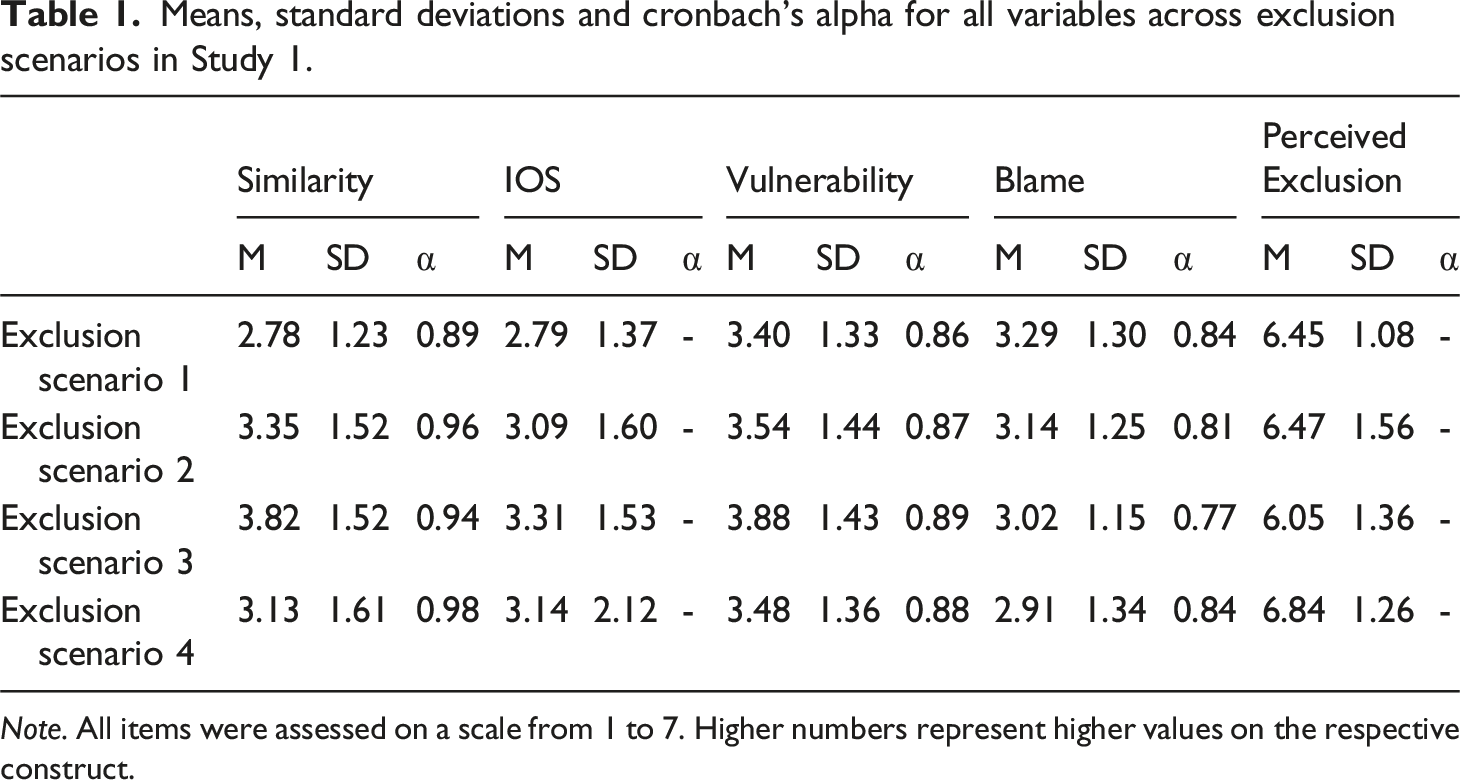
Note. All items were assessed on a scale from 1 to 7. Higher numbers represent higher values on the respective construct.
Results
All analyses were conducted in RStudio, version 4.3.3 (R Core Team, 2024). In addition to R’s base functions, the following packages were used: psych (Revelle, 2024) and rstatix (Kassambara, 2020) for descriptive analyses, Hmisc (Harrell, 2024) for correlation analyses, lme4 (Bates et al., 2015) for mixed model analyses, and mediation for causal mediation analysis (Tingley et al., 2014).
Manipulation check
For all exclusion scenarios, perceptions of exclusion were high (>6 on a 7-point scale) and significantly higher than for the distractor scenario (all p < .001). All exclusion scenarios thus successfully conveyed the impression that the target person in the scenario is a target of exclusion.
Bivariate correlations
Bivariate correlations between variables in Study 1.
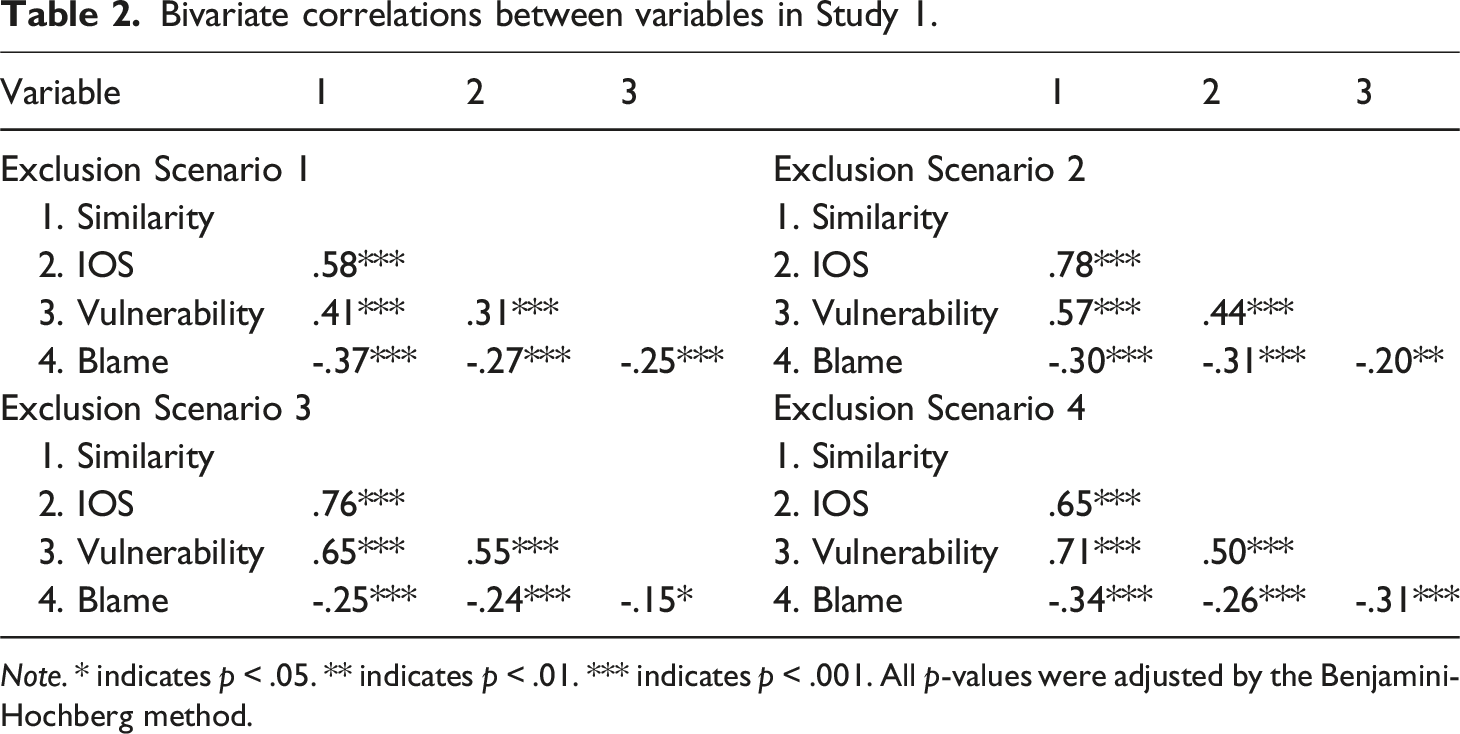
Note. * indicates p < .05. ** indicates p < .01. *** indicates p < .001. All p-values were adjusted by the Benjamini-Hochberg method.
Hypothesis tests
As the four exclusion scenarios were nested within participants (i.e., each participant was presented with each scenario), we calculated mixed effects models with a random intercept for participants to test Hypotheses 1 and 2. The variables blame, similarity, and vulnerability were z-standardized to obtain standardized coefficients (β). Model 1 included blame as an outcome variable, and similarity as fixed-effects predictor variable, while Model 2 included blame as an outcome variable, and vulnerability as fixed-effects predictor variable. As adding exclusion scenario as an additional predictor to the model did not alter the effect of similarity or vulnerability on blame, we here report the models without.
In support of Hypothesis 1, there was a significant association between similarity and blame in that the more similar participants felt to the target person, the less they blamed the target person for the exclusion, β = -.35, 95%CI = [-.40, -.29], p < .001. In support of Hypothesis 2, there was a significant association between vulnerability and blame in that the more vulnerable participants felt to end up in a similar situation, the less they blamed the target person for the exclusion, β = -.34, 95%CI = [-.41, -.28], p < .001. Finally, to test Hypothesis 3 that perceived vulnerability mediates the association between perceived similarity and blame attributed to the excluded person, we calculated a mediation analysis across all four exclusion scenarios. This analysis showed an average causal mediation effect of β = -.10, 95%CI = [-.14, -.05], p < .001, corresponding to a proportion of 28% of the total effect of similarity on blame being mediated by vulnerability.
Repeating the same mediation analysis for interpersonal closeness measures with the IOS-scale revealed a highly similar pattern, suggesting that 37% of the total effect of interpersonal closeness on blame (β = -.31, 95%CI = [-.37, -.25], p < .001) is mediated by vulnerability, β = -.12, 95%CI = [-.15, -.08], p < .001.
Discussion
Study 1 shows that individuals tend to blame targets of exclusion less the more similar they feel to the target. This association between perceived similarity and blame can partially be explained by perceived vulnerability; that is, people blame targets of exclusion less if they feel vulnerable to ending up in similar situation themselves. These findings are in line with defensive attribution theory (Shaver, 1970) and extend previous findings on victim blaming (e.g., Pinciotti & Orcutt, 2020) to the frequent and aversive context of social exclusion.
As a limitation, Study 1 is based on a correlation design, such that inferences about the causal effect of similarity on blame and the role of vulnerability have to be treated with caution. Also, one could speculate that the order of questions triggered demand effects in participants’ responding. Specifically, asking participants to reflect on their similarity to the target person before reading about the outcome of the scenarios may have influenced them to respond in a way consistent with our hypothesizing, regardless of their true inclination to blame the target. Furthermore, bivariate correlations between perceived similarity and vulnerability were notably high, raising the questions to what extent the measures capture different constructs or measure the same underlying phenomenon. Indeed, previous research highlights that similarity and vulnerability might be redundant when perceptions of similarity arise as a result of shared experiences and behaviors (Pinciotti & Orcutt, 2020). In the present study, participants likely based their judgements of similarity on the target person’s behaviors, as this was the only information available besides their gender. That is, rather than judging to what extent they share characteristics with the person in the scenario, participants may have considered how they themselves would have behaved in such a situation. Study 1 thus informs about the association between experiential similarity, perceived vulnerability, and target blaming, but remains silent with regard to the effect of similarity in characteristics on perceived vulnerability and target blaming. Lastly, vulnerability explained almost 30% of the effect of similarity on blaming. While this is a strong proportion, it also reflects that other factors may be at play.
Study 2
Study 2 aims to establish causal evidence for the effect of similarity on blaming, inducing perceptions of similarity by varying the extent of overlap in personal characteristic between participants and the target person. This approach allows to more clearly distinguish similarity in personal characteristics from experiential similarity and perceived vulnerability (Pinciotti & Orcutt, 2020). Study 2 furthers tests additional mediators for the effect of similarity on blaming. Specifically, a large body of research suggests that similarity is an important predictor of interpersonal attraction; that is, people tend to like others more who are similar compared to dissimilar to them. Further, research suggests that people tend to act more pro-socially towards others they like than towards those they dislike (Schreuders et al., 2018), and accordingly may also blame them to a lesser extent. In a similar vein, prior research suggests that people tend to be more empathetic towards similar than dissimilar others (McKeever, 2015; Preis & Kroener-Herwig, 2012; Salles et al., 2024; Stürmer et al., 2006) and that empathy with the target can reduce victim blaming (Bongiorno et al., 2020). Similarity might thus reduce blaming of a target person via increased liking and compassion for the target. In addition to perceived vulnerability, Study 2 therefore examines the role of liking and compassion in blaming targets of social exclusion.
Hypotheses
H1 to H3 were the same as in Study 1, with the only difference that the hypotheses including similarity were based on the effect of the experimental manipulation instead of perceived similarity: (H1) Participants blame a similar target person less than a dissimilar target person. (H2) Participants that are confronted with a similar (compared to a dissimilar) target person feel more vulnerable to end up in a similar situation as the target person. (H3) Perceived vulnerability mediates the link between similarity and blame.
We further predicted an effect of the experimental manipulation on compassion and liking: (H4) Participants that are confronted with a similar (compared to a dissimilar) target person feel more compassion for the target person. (H5) Participants that are confronted with a similar (compared to a dissimilar) target person like the target person more.
In addition to the directed hypotheses, liking and compassion are examined as additional mediators of the association between similarity and blame in an exploratory fashion.
Methods
All hypotheses and analyses were pre-registered, please see: https://aspredicted.org/KY8_YFW
Sample size
Based on the effect sizes obtained in Study 1 for the effect of similarity on blame (d = 0.6), we used a more conservative effect size estimate of d = 0.4 for the effect of the experimental manipulation in Study 2. To discover effects of that size in a one-sided t-test with a power of .80 at an alpha level of α = .01, 254 participants are needed. Accounting for the possibility that a small proportion of observations would be excluded from analyses, we aimed to collect a total sample of 270 participants.
Participants and design
A total of N = 270 participants were recruited via Prolific Academic in the US. Participants could take part in the study if they were between 18 and 65 years old and were fluent in English. As pre-registered, we excluded participants’ data if they indicated insufficient levels of seriousness in answering the questions (n = 5) and/or indicated another reason not to use their data (n = 0). The final dataset consisted of N = 265 observations who were randomly assigned to one of two conditions (similar target vs. dissimilar target) in a between-subjects design. Of those 265 participants, 153 identified as women, 109 as men, and 3 as non-binary (Mage = 37.95, years, SD = 10.89, Median = 36, Range = 19 - 65) 2 .
Materials and procedure
Example of the similarity manipulation used in study 2.
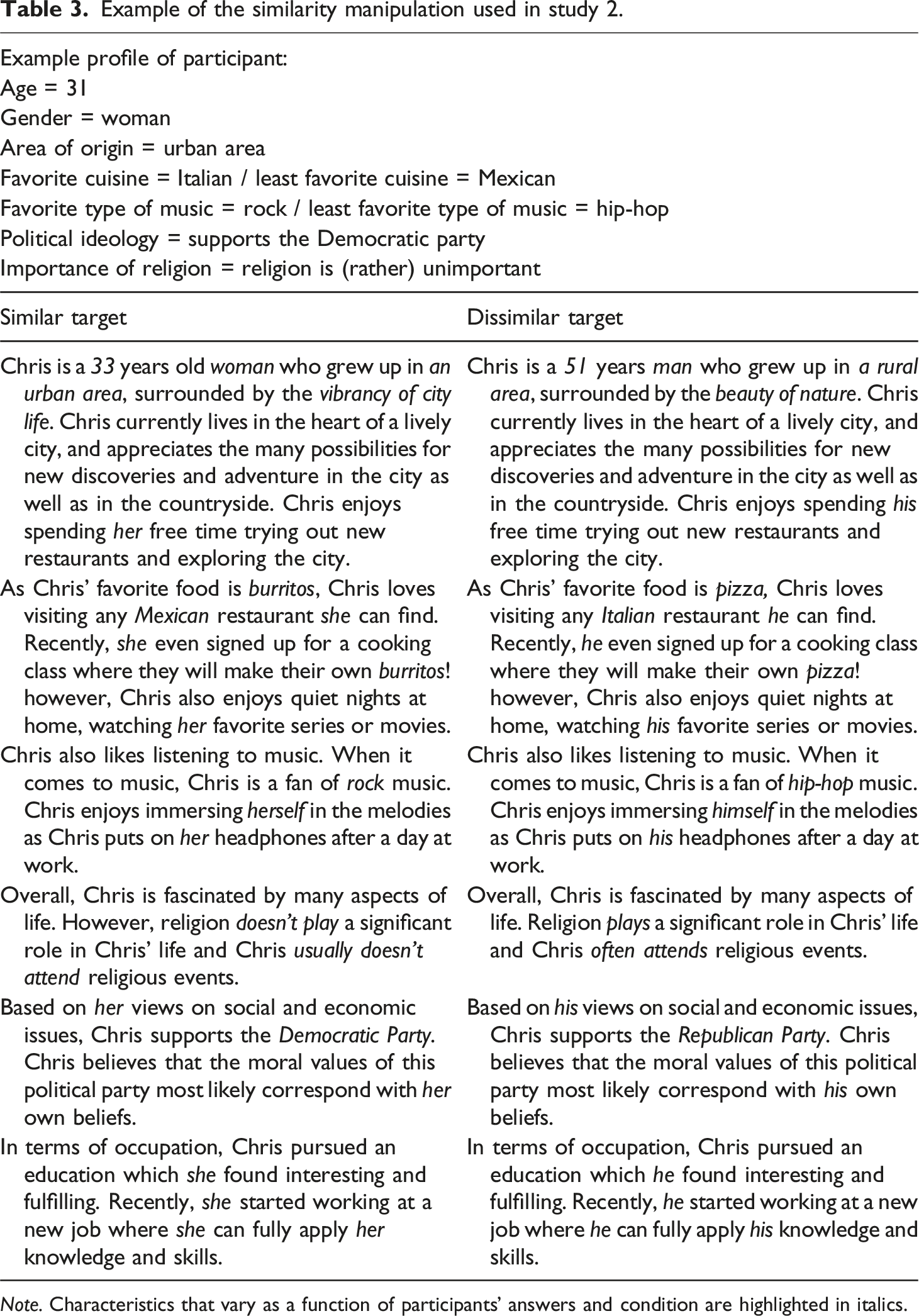
Note. Characteristics that vary as a function of participants’ answers and condition are highlighted in italics.
Means, standard deviations and bivariate correlations across experimental conditions for all variables measured in Study 2.
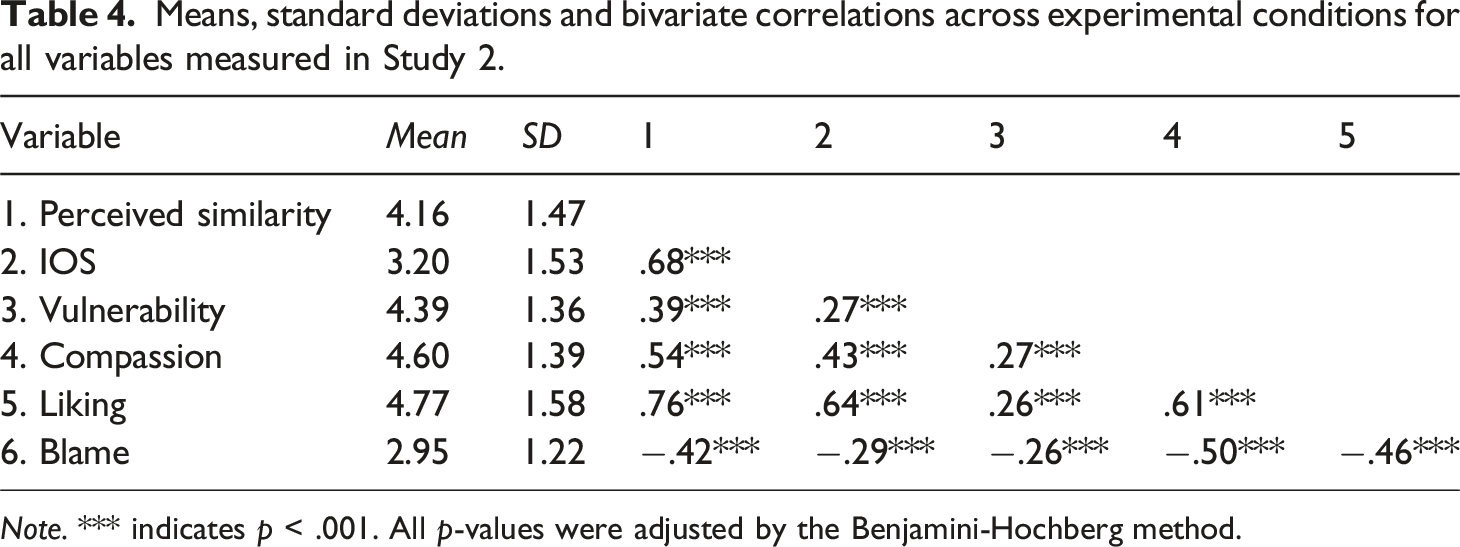
Note. *** indicates p < .001. All p-values were adjusted by the Benjamini-Hochberg method.
Results
In addition to the R-packages used in Study 1, lavaan (Rosseel, 2012) was used for parallel mediation analysis.
Manipulation check
Participants in the similar (compared to the dissimilar) target condition indicated more perceived similarity, t(260.20) = 11.80, p < .001, d = 1.45, 95%CI = [1.18, 1.72], and more interpersonal closeness, t(245.28) = 6.97, p < .001, d = 0.86, 95%CI = [0.61, 1.11], to the target person. The experimental manipulation thus successfully induced perceptions of similarity with the target person. There were no significant differences between the conditions in participants’ agreement with the statement that the target person was excluded, t(252.74) = 1.42, p = .158, d = 0.17, 95%CI = [-0.07, 0.42]. Thus, we conclude that the similarity manipulation we used did not influence the extent to which individuals perceived the situation as reflecting social exclusion.
Hypothesis tests
To test the effect of the experimental manipulation on the dependent variables, we conducted multiple one-sided t-tests applying an alpha level of α = .01 to account for multiple testing. In line with H1, participants in the similar compared to dissimilar target condition blamed the target person less, t(254.46) = -2.75, p = .003, d = -0.34, 95%CI = [-0.58, -0.10]. With respect to H2, a one-sided t-test of condition on vulnerability failed to reach the threshold of α = .01, t(262.77) = 1.72, p = .043, d = 0.21, 95%CI = [-0.03, 0.45], thus providing no support for the hypothesis that similarity results in higher perceived vulnerability. In support of H4 and H5, participants in the similar compared to the dissimilar target condition expressed more compassion towards the target of exclusion, t(255.32) = 3.12, p = .001, d = 0.38, 95%CI = [0.14, 0.63], and indicated that they liked the target more, t(244.61) = 9.74, p < .001, d = 1.20, 95%CI = [0.93, 1.46].
Due to the non-significant effect of condition on vulnerability (H2), we deviated from our pre-registered analysis plan for H3 and did not test a model only containing vulnerability as a mediator. Instead, we conducted a structural equation model (SEM) including vulnerability, liking, and compassion as potential parallel mediators of the effect of condition on blame.
Vulnerability and compassion were specified as latent variables, each measured by their respective scale items. The SEM included both the measurement model and the regression model. The initial model showed inadequate fit, so we examined modification indices and made theoretically justified adjustments. Specifically, we added covariances between the latent mediators and between certain items within the same latent construct. 3 This resulted in a model with a good fit, χ2(1, N = 52) = 109.95, p = .000, CFI = .968, TLI = .951, RMSEA = .065, 90% CI [.048, .082], SRMR = .046.
The model showed that the extent of blame was simultaneously mediated by liking and compassion, as the bootstrapped 95% confidence intervals for both the indirect effect of liking, β = -.106, b = -0.178, SE = 0.087, 95%CI = [-0.348, -0.008], and compassion, β = -.114, b = -0.191, SE = 0.072, 95%CI = [-0.333, -0.049], did not include zero. The indirect path via vulnerability was not significant, β = -.070, b = -0.059, SE = 0.033, 95%CI = [-0.124, 0.006]. Moreover, the direct path from condition to blame was not significant, β = .045, b = 0.075, SE = 0.116, 95%CI = [-0.152, 0.302].
The full SEM including the measurement model and regression paths is depicted in Figure 1. Structural equation model including the measurement model and regression paths of the indirect effect of similarity (condition) on blame via vulnerability, liking, and compassion. Note. Coefficients represent standardized effects. Regression paths of the mediation model are depicted in bold. The standardized coefficient between condition and blame, controlling for the mediators, is in parentheses. *p < .05, **p < .01, ***p < .001.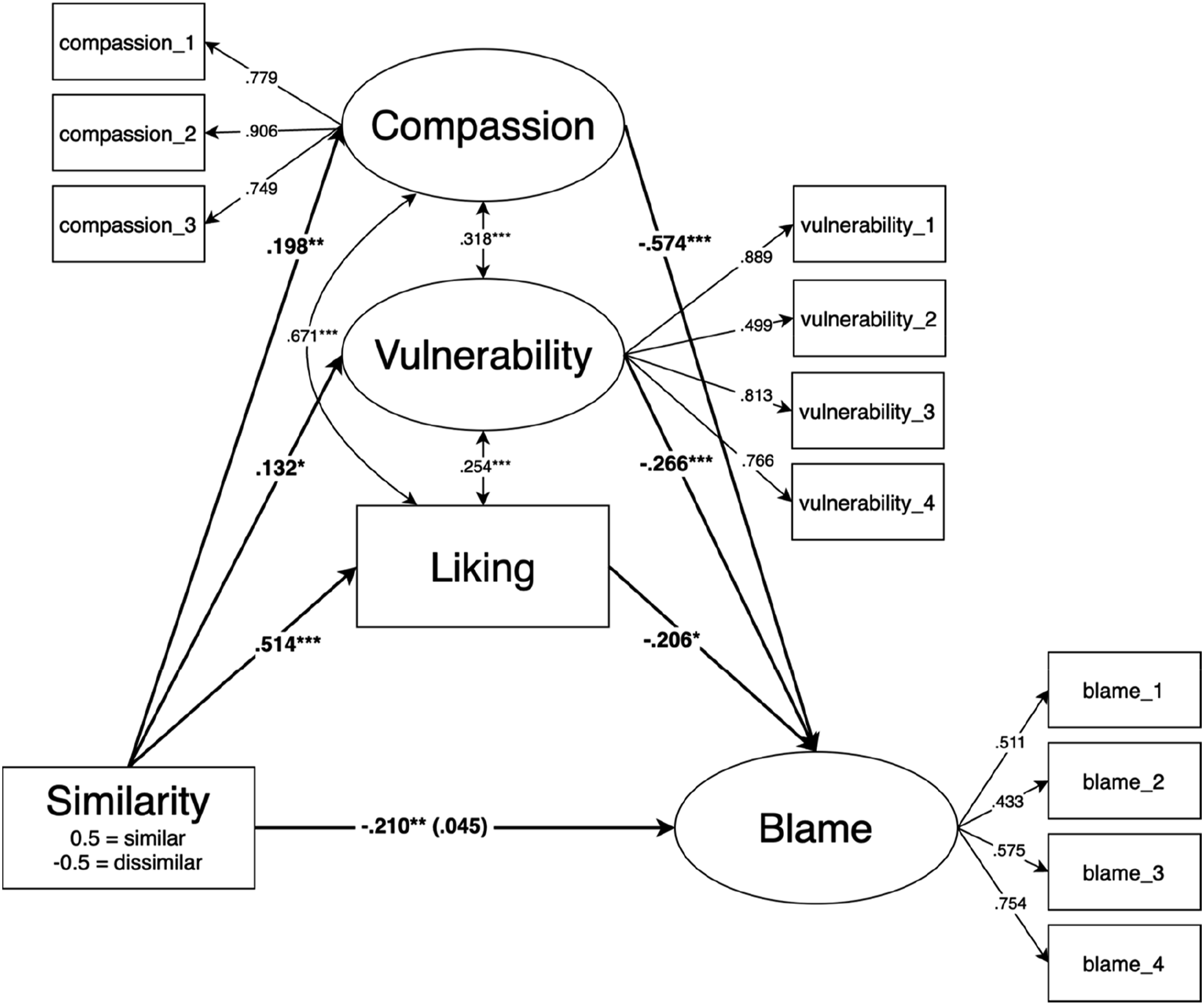
Discussion
In line with Study 1, Study 2 shows that similarity with a target of exclusion results in less attributions of blame. Extending the results from Study 1, the experimental design of Study 2 strongly suggests a causal link from similarity to blaming. Alternative explanations of this association, such as individual predispositions that go along with both higher perceived similarity with others in general and less blaming, can thus be ruled out. Notably, in Study 2, feelings of similarity likely resulted from shared characteristics rather than shared experiences or behaviors. This is reflected in a weaker association between similarity and vulnerability both when similarity is considered as experimental condition and as self-reported continuous variable. Arguably, as a result, vulnerability did not mediate the effect of similarity on blame. Rather, the effect was fully mediated by compassion and liking, with particularly large effects of liking. However, we hasten to add that the experimental design of Study 2 neither allows to establish the true process underlying the effect of similarity on blaming, nor to determine the causal order of the association between the mediators and blaming. As highlighted by Fiedler et al. (2011), it is possible to obtain a statistically significant mediation even when a process other than the tested mediator underlies an effect (i.e., a spurious mediator). For instance, our similarity manipulation may have triggered other effects that are different from but associated with liking, which could be the true cause of reduced target blaming. Moreover, the design of Study 2 does not allow to rule out the possibility that the causal direction of effects is opposite to that specified in the mediation model (i.e., a causal effect of blaming on liking rather than vice versa).
Yet, the assumption that liking drives the effect of similarity on blaming is line with the general tenet of the similarity-attraction literature (Byrne, 1961; Montoya et al., 2008) and speaks to the possibility that ingroup favoritism (Tajfel & Turner, 1979) plays a role in judgements of social exclusion. We elaborate on these ideas further in the General Discussion.
General discussion
Two studies provide evidence that when judging whom to blame in a social exclusion situation, observers of exclusion are influenced by their perceived similarity to the target of exclusion. Study 1 demonstrates that feeling more similar to a target person was associated with feeling more vulnerable to end up in a similar situation, which in turn was associated with attributing less blame to the target following social exclusion. Here, feelings of similarity and vulnerability likely resulted from participants’ perception that they would behave similarly to the target person in a given situation. Study 2 further shows that also similarity that results from shared characteristics with a target person influences attributions of blame. Specifically, individuals who were confronted with a similar compared to a dissimilar target person attributed less blame to the target following social exclusion, and this effect was fully mediated by liking and compassion. While the present work is only suggestive about the exact mechanisms underlying the effect of similarity on target blaming, we will in the following speculate on the potential processes involved to interpret our findings within a broader theoretical context.
Does similarity affect target blame via different processes?
Due to Study 1’s correlational design, causal inference about the associations between similarity and blaming have to be treated with caution. Yet, the pattern of association is consistent with the theoretical tenet of blame avoidance in defensive attribution theory (Shaver, 1970), indicating that individuals blame a target person less the more they expect to potentially end up in a similar situation in the future. This is likely driven by participants’ impression that they share similarities in their behavioral tendencies with the target person (i.e., experiential similarity). In line with prior theorizing (Pinciotti & Orcutt, 2020), the strong association between similarity and perceived vulnerability in Study 1 may indicate a strong overlap between these two constructs.
In Study 2, feelings of similarity were experimentally induced by varying the extent of shared characteristics between the participant and the target person. This experimental manipulation significantly increased individuals’ perceived similarity and interpersonal closeness to the target person. However, the effect on vulnerability did not reach our pre-determined threshold of significance. It is thus possible that due to the operationalization of similarity in Study 2, different processes underlie the association between similarity and blame in Study 2 compared to Study 1. Moreover, as a mediation analysis suggests, the effect of similarity on blame was mainly driven by liking. This aligns with research on similarity-attraction and points to more prosocial tendencies towards similar compared to dissimilar others (Batson et al., 1981; Curry & Dunbar, 2013). Intriguingly, some research suggests that likeability increases victim blaming in line with the theoretical tenet that a likeable (compared to an unlikeable) target poses a bigger threat to individuals’ just world beliefs and should therefore be blamed more (Haynes & Olson, 2006). However, on the contrary, our results suggest that liking reduces target blaming and thus does not provide support for this idea. Rather, our findings correspond to the large body of research on social identity and self- categorization theory (Tajfel & Turner, 1979; Turner et al., 1987), as outlined in the following.
The role of social identity in target blaming
According to social identity and self-categorization theory (Tajfel & Turner, 1979; Turner et al., 1987), similarities and dissimilarities with other people on relevant dimensions can result in perceiving another person as either ingroup out outgroup members. A large body of research documents the consequences of group membership (for a review, see Böhm et al., 2020), ranging from overt prejudice and discrimination to implicit biases (Fiske, 2002). For instance, research shows that a salient shared group membership with a target person (e.g., favorite sports team) can create perceptions of similarity and therefore promote empathic response and helping behavior (Levine et al., 2005; Stürmer et al., 2006). Recent research from the US further suggests that partisan identity, that is, whether a person supports the Democratic or the Republican party, drives disliking the political outgroup (i.e., affective polarization; Dias & Lelkes, 2022). Presumably, using partisan identity to induce feelings of (dis)similarity strongly contributed to the strong effect of the experimental manipulation on perceived similarity, interpersonal closeness, and liking in Study 2. Put differently, participants’ judgements in the similar (compared to the dissimilar) condition may have been driven by a shared social identity and the resulting ingroup favoritism.
We are aware of only one paper that examines the influence of social identity on evaluations of observed social exclusion. Specifically, Arpin et al., (2017) hypothesized that evaluations of observed social exclusion differ depending on whether the social exclusion incident involves people from one’s in- versus outgroup due to different attributions of responsibility. Amongst others, they based their theorizing on the black sheep effect (Marques & Paez, 1994), which states that negative behaviors by ingroup members should be judged more negatively than similar behaviors by outgroup members because they threaten the positive image of one’s social group. Accordingly, individuals might be more inclined to attribute a social exclusion incident occurring in one’s ingroup to norm violations of the target, while attributing a social exclusion incident occurring in one’s outgroup to malicious motives of the source. While Arpin et al. (2017) could not find evidence for this expected effect of group membership, the black sheep effect continues to offer an intriguing alternative perspective on the current research. In particular, the effects of similarity could also have occurred in the opposite direction (i.e., more instead of less target blaming when similarity is high) due to the tendency for negative judgements of norm-deviating ingroup-members. One potential explanation why neither we nor Arpin et al. (2017) observed harsher judgements for ingroup-members might be that in both cases, the exclusion scenarios were ambiguous and did not involve a clearly socially deviant ingroup member. Effects of shared group membership on blaming may thus be different in situations where the target of social exclusion misbehaved very badly.
Overall, the role of shared social identity in judgments of social exclusion is noteworthy as it emphasizes the practical relevance of our findings and alludes to potential remedies for intergroup biases in target blaming.
Practical relevance and future research
People’s social judgments are often influenced by information that is irrelevant to the situation at hand (e.g., Higgins & Bargh, 1987). We here show that this is also the case in the context of social exclusion, as observers’ own similarity with the target of exclusion affects attributions of blame. Notably, although one’s similarity to the target is likely irrelevant when judging a social exclusion situation, people may rely on this information automatically when forming judgments about others. Inferences about others’ characteristics happen fast (i.e., within less than a second) and are often based on minimal information such as facial appearance (Willis & Todorov, 2006). Moreover, people often automatically categorize others into social groups, classifying them as ingroup or outgroup based on perceived similarities and differences (Macrae & Bodenhausen, 2000; Reimer et al., 2022; Turner et al., 1987). We therefore conclude that similarity is an irrelevant yet dominant cue that likely influences observers’ judgements – such as whom to blame for a misfortune – in many social situations.
Prior research has predominantly focused on the association between similarity and blaming in the context of rape and sexual assault, showing that women engage in less victim blaming toward a similar compared to dissimilar target (Fulero & DeLara, 1976; Thornton, 1984). Here, we extended these findings to the context of social exclusion. Arguably, the mechanisms potentially underlying the link between perceived similarity and blaming outlined in this work reflect very basic motives. One may therefore speculate that the current findings are not specific to social exclusion but may generalize to other types of observed adversity.
Future research may fruitfully explore the mechanisms underlying the association between similarity and blaming and particularly examine the role of different types of similarity. As an example, a political opponent who is socially excluded is likely blamed more strongly than if the exact same situation had happened to a political ingroup member. However, this bias might be reduced if individuals perceive themselves as similar to the target person in their behavioral tendencies. That is, a person that can relate to a political opponent’s behaviors and experiences may feel more vulnerable to experiencing a similar situation and may therefore not attribute more blame to a political opponent than to an ingroup member. Put differently, stronger blaming of an out-group member based on (dis)similarities in characteristics might be prevented when people focus on shared behavioral patterns and experiences with the target person. This idea can be highly relevant in the context of affective polarization, where researchers are concerned with decreasing partisan animosities and bridging political divides (Iyengar et al., 2019). Moreover, from the target’s perspective, to avoid blame, it could be a useful strategy to highlight similarities with observers of social exclusion or point out observers’ vulnerability to experience a similar situation. Future research may thus address the interplay between shared behavioral tendencies, similarities in characteristics, and target blaming following social exclusion or related events. This might be particularly interesting in contexts that are less ambiguous than the present study, as we outline in the following section.
Limitations and future research
In both our studies, the exclusion situations participants were presented with were chosen because they reflect an ambiguous situation. Specifically, the target’s behavior that caused the exclusion could be perceived somewhat negatively by external observers, justifying the source’s decision to exclude them. The source’s exclusion decision was not depicted as completely unjustified, because this would likely have resulted in strong levels of source blaming and, conversely, floor effects in target blaming. At the same time, the target’s behavior was not depicted as clearly negative and norm-violating, because this may have produced ceiling effects in target blaming (Rudert & Greifeneder, 2019). As a consequence of this methodological approach, we cannot draw inferences about the role of similarity in less ambiguous exclusion situations. For instance, would individuals blame a less similar target more for being unfairly excluded, such as on the basis of blatant discrimination? And would individuals also blame a more similar target less for being excluded following a clearly norm-violating behavior, such as betraying one’s group? Further research may examine such less ambiguous situations and explore alternative accounts, such as the previously discussed black sheep effect (Marques & Paez, 1994).
Beyond participants’ gender identification, we did not collect demographic information that would allow examining the role of participants’ group status (e.g., sexual orientation, ethnicity, disability). Future studies may fruitfully continue on this pathway and test whether the effect of similarity varies based on the group status. For example, perceived similarity might differ when observers from a privileged group judge the social exclusion of disadvantaged outgroup members, or vice versa.
Conclusion
Feeling more similar to a target of social exclusion, whether based on behavioral tendencies or personal characteristics, reduces observers’ attributions of blame to the target of exclusion. This demonstrates that observers’ judgments of social exclusion are influenced by information that is irrelevant for the actual motives behind the exclusion. Consequently, those experiencing social exclusion may receive less support from dissimilar bystanders regardless of whether motives for exclusion are justified or not.
Supplemental Material
Supplemental Material - Similarity reduces blame: Consequences of observer-target similarity in social exclusion situations
Supplemental Material for Similarity reduces blame: Consequences of observer-target similarity in social exclusion situations by Melissa Jauch, Rahel Ingold and Rainer Greifeneder in Journal of Social and Personal Relationships
Supplemental Material
Supplemental Material - Similarity reduces blame: Consequences of observer-target similarity in social exclusion situations
Supplemental Material for Similarity reduces blame: Consequences of observer-target similarity in social exclusion situations by Melissa Jauch, Rahel Ingold and Rainer Greifeneder in Journal of Social and Personal Relationships
Supplemental Material
Supplemental Material - Similarity reduces blame: Consequences of observer-target similarity in social exclusion situations
Supplemental Material for Similarity reduces blame: Consequences of observer-target similarity in social exclusion situations by Melissa Jauch, Rahel Ingold and Rainer Greifeneder in Journal of Social and Personal Relationships
Footnotes
Acknowledgements
We would like to thank Sarah Imhof and Shannon Bhend for assisting in the preparation of materials and study programming.
Author contributions
M.J. and R.I. prepared the study materials, performed the statistical analyses, and planned and conducted the studies. M.J. prepared the tables and figures, and wrote the manuscript text. R.G. was involved in the planning of the studies, gave advice on the statistical analyses, and commented on the manuscript at different stages. All authors reviewed the manuscript.
Declaration of conflicting interest
The authors declare no potential conflicts of interest with respect to the research, authorship, and/or publication of this article.
Funding
The authors received no financial support for the research, authorship, and/or publication of this article.
Open research statement
As part of IARR’s encouragement of open research practices, the authors have provided the following information: This research was pre-registered. The aspects of the research that were pre-registered were hypotheses, materials, exclusion criteria, and analyses. The registration was submitted to: https://aspredicted.org/WJN_7FD and https://aspredicted.org/KY8_YFW. The data used in the research are available. The data can be obtained at:  or by emailing:
Ethical statement
Data Availability Statement
Data, code and supplementary online materials are openly accessible here: https://osf.io/sbquy/ (see Jauch et al., 2025).
Supplemental Material
Supplemental material for this article is available online.
Notes
References
Supplementary Material
Please find the following supplemental material available below.
For Open Access articles published under a Creative Commons License, all supplemental material carries the same license as the article it is associated with.
For non-Open Access articles published, all supplemental material carries a non-exclusive license, and permission requests for re-use of supplemental material or any part of supplemental material shall be sent directly to the copyright owner as specified in the copyright notice associated with the article.
