




Abstract
Social interactions that support people who are experiencing negative emotions are ubiquitous in a wide array of interpersonal relationships. These social interactions are referred to as supportive communication. Decades ago, Burleson and Goldsmith (1998) first noted a connection between supportive communication and emotion regulation, with the goal of explaining the underlying mechanisms by which supportive messages change the recipient’s negative emotions. Since then, contemporary emotion regulation theory has matured, and now can explain a broad range of supportive communication processes via the expansion of interpersonal emotion regulation research and the development of the process model of emotion regulation. This paper aims to describe how contemporary advances in emotion regulation theory and research can shed light on dynamic processes in supportive communication. We then discuss the implications of this updated view for both research fields and show how it can advance interdisciplinary research.
Keywords
Introduction
Across various interpersonal relationships—such as friendships, romantic partnerships, and parent-child relationships—individuals frequently engage in social interactions that offer support to those experiencing negative emotions. In the field of interpersonal communication, these social interactions are referred to as supportive communication (Albrecht & Adelman, 1984; Burleson & MacGeorge, 2002). In the late 1990s, Burleson and Goldsmith (1998) highlighted a connection between supportive communication and emotion regulation (which they discussed in terms of coping), seeking to explain the cognitive mechanisms through which supportive messages change the recipient’s negative emotions. They specifically argued that supportive communication aids distressed recipients by facilitating their emotion regulation through conversationally induced reappraisal. Building on this work, subsequent empirical studies on supportive communication have often measured the extent to which recipient’s reappraisal is facilitated as an outcome variable, alongside emotional change (e.g., Bodie, 2013; Cannava & Bodie, 2017; Jones & Wirtz, 2006; Matsunaga, 2011; Rains & High, 2021; Tian & Solomon, 2023).
In this way, Burleson and Goldsmith (1998) significantly advanced supportive communication research by introducing a theoretical framework from affective science to elucidate the mental processes through which supportive messages alter the recipient’s negative emotions; however, other key mental processes involved in supportive communication—both on the part of the recipient and the provider—remain insufficiently addressed. For example, it remains unclear what mental processes recipients engage in to decide whether to seek out others to alleviate their negative emotions. It is also unclear what mental processes providers engage in when deciding whether to respond, and if so, what to say to another person experiencing negative emotions. A deeper understanding of these processes is important for providing a theoretical framework to analyze what goes wrong when effective supportive communication is not being achieved.
To address this limitation, we propose an integration of supportive communication research with the contemporary theoretical framework of emotion regulation. Since the late 1990s, emotion regulation research in the field of affective science has evolved relatively independently of the field of interpersonal communication. Of particular importance is the expansion of interpersonal emotion regulation research, which incorporates social interactions into its investigation (Niven & Lopez-Perez, 2025; Zaki & Williams, 2013). Another major advancement is the development of the process model of emotion regulation, which draws on cybernetic/control theory to elucidate the broad mental processes underlying not only intrapersonal but also interpersonal emotion regulation (Gross, 2015a; Nozaki & Mikolajczak, 2020; Petrova & Gross, 2023a).
Given the substantial overlap between the research focus of supportive communication and interpersonal emotion regulation—and considering that cybernetics is also a major theoretical tradition in communication research (Craig, 1999)—we argue that it is time to reconnect these fields, as Burleson and Goldsmith (1998) once did. To this end, we begin with a brief overview of the main scope of supportive communication research and its connection to emotion regulation. We then explain recent trends in emotion regulation research, focusing on the rise of interpersonal emotion regulation research and the development of the process model of emotion regulation. Next, we explore how the contemporary emotion regulation perspective accounts for supportive communication processes. Finally, we discuss the implications of this proposed integration for both fields.
The main scope of supportive communication research and its connection to emotion regulation
Supportive communication refers to “verbal and nonverbal behavior produced with the intention of providing assistance to others perceived as needing that aid” (Burleson & MacGeorge, 2002, p. 374). This construct is derived from the tradition of social support research, which specifically investigates functions performed by others for a distressed individual (Burleson et al., 1994; Thoits, 1986). Therefore, although some provision of social support (e.g., advice regarding interview attire) may not be motivated by or function to influence the recipient’s emotions (Dixon-Gordon et al., 2015), supportive communication research has typically targeted support for a recipient who experiences negative emotions caused by acute or chronic stressful experiences, myriad upsets, and hassles that arise in everyday life (MacGeorge et al., 2011). Given that one main outcome of supportive communication is the improvement of recipients’ emotional state (Burleson, 2009), this paper focuses on this aspect of supportive communication.
A notable feature of supportive communication research is its direct focus on communicative interactions themselves, as opposed to other conceptualizations of social support such as integration within a social network of relationships or perceived availability of support (Burleson et al., 1994). Specifically, a central research topic in this area concerns supportive messages, which refer to “specific lines of communicative behavior enacted by one party with the intent of benefiting or helping another” (Burleson & MacGeorge, 2002, p. 386). Examples of research questions include how recipients attempt to elicit supportive messages from providers, what characteristics of supportive messages are associated with greater or lesser effectiveness for recipients, and what factors influence providers’ effective production of supportive messages and recipients’ effective message processing (MacGeorge et al., 2011).
Previous research has indicated that supportive communication is closely related to emotion regulation, which refers to attempts to influence which emotions one has, when one has them, and how one experiences or expresses these emotions (Gross, 1998, 2024). By reviewing emotion theories at the time, Burleson and Goldsmith (1998) first noted this connection and proposed a framework in which supportive messages are linked to the alleviation of the recipient’s emotional distress by facilitating the recipient’s reappraisal of events through conversation. Building on this research, subsequent empirical studies have often assessed the extent to which the provider’s supportive message facilitates the recipient’s own emotion regulation, specifically reappraisal, as a mechanism for their emotional improvement. This line of research has employed various methods including retrospective self-reports (e.g., Matsunaga, 2011), discrete message evaluation (e.g., Bodie, 2013; Tian & Solomon, 2023), evaluation of the overall characteristics of actual conversations (e.g., Cannava & Bodie, 2017; Jones & Wirtz, 2006), and examination of dynamic changes within conversations (e.g., Rains & High, 2021).
Recent trends in emotion regulation research: Interpersonal emotion regulation and the process model of emotion regulation
Although supportive communication research has engaged with the concept of emotion regulation in this manner, it has not been fully connected with recent advancements in emotion regulation research. This is not surprising because emotion regulation research has developed mainly in the field of affective science, which is different from interpersonal communication. Since its emergence as a field in the late 1990s (Gross, 1998), emotion regulation research has matured into a rapidly growing field over the past several decades (Gross, 2024). Particularly relevant to supportive communication research are the rise of interpersonal emotion regulation research and the development of the process model of emotion regulation, both of which will be explained in detail in this section.
The rise of interpersonal emotion regulation research
An important recent trend in emotion regulation research is a growing interest in interpersonal emotion regulation (Niven & Lopez-Perez, 2025). Traditional emotion regulation research focused primarily on the regulation of one’s own emotions by oneself (i.e., intrapersonal emotion regulation). However, given that individuals often attempt to regulate their own and others’ emotions through social interactions in daily life (Liu et al., 2021; Tran et al., 2023), contemporary emotion regulation research has increasingly incorporated this interpersonal aspect into its investigation (i.e., interpersonal emotion regulation).
While the scope of interpersonal emotion regulation overlaps with that of supportive communication, interpersonal emotion regulation includes not only hedonic but also counter-hedonic emotion regulation (e.g., increasing partner’s anger to facilitate competitive performance, increasing recipient’s worry to appreciate the seriousness of concern; Netzer et al., 2015; Niven et al., 2009; Nozaki & Kobayashi, 2024; Parkinson et al., 2016). In many cases, however, individuals engage in interpersonal emotion regulation with hedonic motives in everyday life (Tran et al., 2023). To illuminate a potential theoretical integration of supportive communication and interpersonal emotion regulation, this paper focuses on hedonic regulation.
Interpersonal emotion regulation is an umbrella term that refers to a range of interconnected but distinct processes. To facilitate interpersonal emotion regulation research, Petrova and Gross (2023a) proposed a conceptual framework that distinguished between emotion regulatory goals and means (Figure 1). First, the goals of emotion regulation can be divided based on whether the target of regulation is one’s own emotions (originally called intrinsic, now called self-focused) or another person’s emotions (originally called extrinsic, now called other-focused). Furthermore, individuals can attain these goals through social means (using other people’s resources) or non-social means (without assistance from other people). Emotion regulation through social means is the current main target of interpersonal emotion regulation research, such as how a recipient utilizes providers’ support to regulate their own emotions (self-focused social) and how a provider attempts to assist recipient’s emotion regulation (other-focused social). Examples of two categories of regulatory goals (self-focused and other-focused) accomplished via two categories of regulatory means (non-social and social). Note. This figure is adapted from “The future of emotion regulation research: Broadening our field of view,” by K. Petrova & J. J., Gross, 2023, Affective Science, 4(4), p. 610 (https://doi.org/10.1007/s42761-023-00222-0). Copyright 2023 by The Society for Affective Science. Adapted with permission.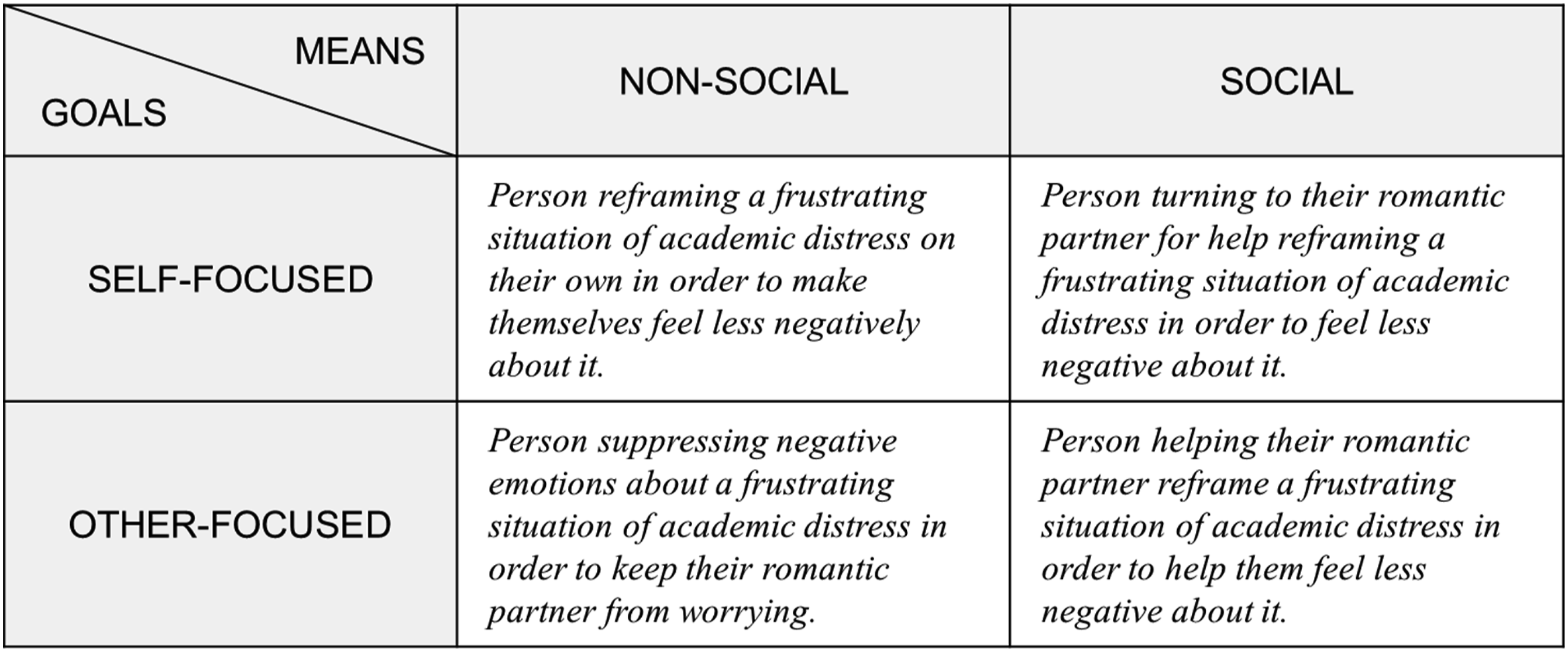
Whether their research focus is self-focused emotion regulation through social means (from a recipient’s perspective), other-focused emotion regulation through social means (from a provider’s perspective), or both, empirical research on interpersonal emotion regulation is expanding rapidly (Niven & Lopez-Perez, 2025). In particular, many recent studies have employed daily diary or experience sampling methods, which are seldom used in supportive communication research. In the daily diary method, participants complete an end-of-day survey about the day’s events and experiences, whereas in the experience sampling method (also referred to as ecological momentary assessment), participants complete multiple assessments throughout the day to report on momentary or recent emotions, behaviors, thoughts, and/or contexts in daily life (Kuppens et al., 2022). These methods are popular because they can capture interpersonal emotion regulation within close relationships in naturalistic settings.
Using these daily life methods, research from the recipient’s perspective has investigated the motives for seeking another person for the assistance of their own emotion regulation. Specifically, individuals are more likely to seek emotion-oriented assistance such as obtaining empathy relative to problem-oriented assistance such as obtaining advice (Liu et al., 2021; Tran et al., 2025). Furthermore, some studies have identified situational factors that influence the use of social means to regulate their own negative emotions. For example, individuals are more likely to initiate self-focused emotion regulation through social means when they perceive the environments to be higher in social support at that moment (Pauw et al., 2022) or when the situation is more unpleasant and their goals are interrupted (Thompson et al., 2024).
Another line of research from the recipient’s perspective has examined the effectiveness of interpersonal emotion regulation strategies. For example, humor has been shown to be an effective emotion regulation strategy that works through changes in the psychological intimacy of the partner (Horn et al., 2019). More comprehensively, Ruan et al. (2024) addressed a range of interpersonal emotion regulation strategies based on their popularity in the emotion literature, documented intrapersonal effects, and conceptual relevance to interpersonal processes. Their findings suggest that most strategies are perceived as effective by the recipients. Moreover, rather than focusing on the use of each strategy, the flexible use of different interpersonal emotion regulation strategies has been identified as a key factor in determining their daily adaptive affective consequences (Battaglini et al., 2023).
From the provider’s perspective, research has shown that individuals expend more effort regulating other’s emotions than regulating their own emotions through social means in daily life (Tran et al., 2023). They are more likely to provide problem-oriented supportive strategies such as problem solving than emotion-oriented supportive strategies such as encouraging expression contrary to the recipient’s motives (Liu et al., 2021; Ruan et al., 2024). Moreover, some studies have identified personal characteristics that facilitate engagement in other-focused emotion regulation. For example, high empathic concern promotes efforts to alleviate another person’s negative emotions in times of need (Double et al., 2024; Geiger et al., 2024). In contrast, individuals with high attachment anxiety are more likely to regulate others’ emotions driven by self-focused hedonic motives and impression management concerns (Springstein et al., 2023).
The development of the process model of emotion regulation
Another important advancement in emotion regulation research is the development of the process model of emotion regulation, which explains how individuals attempt to set and attain emotion regulation goals through non-social or social means (Gross, 1998, 2015a; Petrova & Gross, 2023a). While this model was originally proposed to explain the mental processes of intrapersonal emotion regulation (Gross, 1998, 2015a), its scope of application has been expanded to include interpersonal emotion regulation (Nozaki & Mikolajczak, 2020; Reeck et al., 2016). It was developed on the basis of existing empirical findings on emotion regulation and cybernetic/control theory (see Gross, 2015a, 2015b for a detailed background on its construction) and has been widely used as a theoretical foundation for a broad range of empirical emotion regulation studies, including those using the daily life methods outlined in the previous section (Koval & Kalokerinos, 2024).
Compared to when Burleson and Goldsmith (1998) reviewed emotion theories to explain the mental processes underlying changes in the recipient’s negative emotions, contemporary theory can explain a broader range of supportive communication processes through the development of the process model of emotion regulation. Indeed, the process model of emotion regulation, expanded to interpersonal emotion regulation, can provide a unified framework for describing processes in which the recipient attempts to elicit supportive messages from the provider, the provider attempts to produce supportive messages, the recipient reacts to the supportive messages, and the provider decides what more to do in response to the recipient’s reactions. Before discussing in detail how this model can be applied to the field of supportive communication, we will briefly outline its core features.
Negative emotion generation in the recipient
In order to understand how emotions can be regulated, it is necessary to consider how emotions are generated. Emotions consist of an episodic process in response to a perceived situation and are characterized by the evaluation of the situation in light of the individual’s goals and values (Scherer, 2022). Drawing on cybernetic/control theory (Carver & Scheier, 1998; Wiener, 1948), the process model of emotion regulation views emotions as arising through a series of iterative cycles consisting of four elements: (1) a situation that is experienced or imagined; (2) attention that influences which aspects of the situation are perceived; (3) evaluation or appraisal of the situation in relation to their goals and values; and (4) a response to the situation, including changes in subjective experience, physiology, and facial or whole-body behavior (Gross, 2015a, 2024; Figure 2). Emotion generation valuation system. Note. Emotions arise through a series of iterative cycles consisting of four elements: (1) a situation that is experienced or imagined; (2) attention that influences which aspects of the situation are perceived; (3) evaluation or appraisal of the situation in relation to their goals and values; and (4) a response to the situation, including changes in subjective experience, physiology, and facial or whole-body behavior. This figure is from “Conceptual foundations of emotion regulation,” by J. J., Gross, in J. J., Gross & B. Q., Ford (Eds.), Handbook of emotion regulation (3rd ed., p. 4), 2024 by the Guilford Press. Copyright 2024 by the Guilford Press. Reprinted with permission.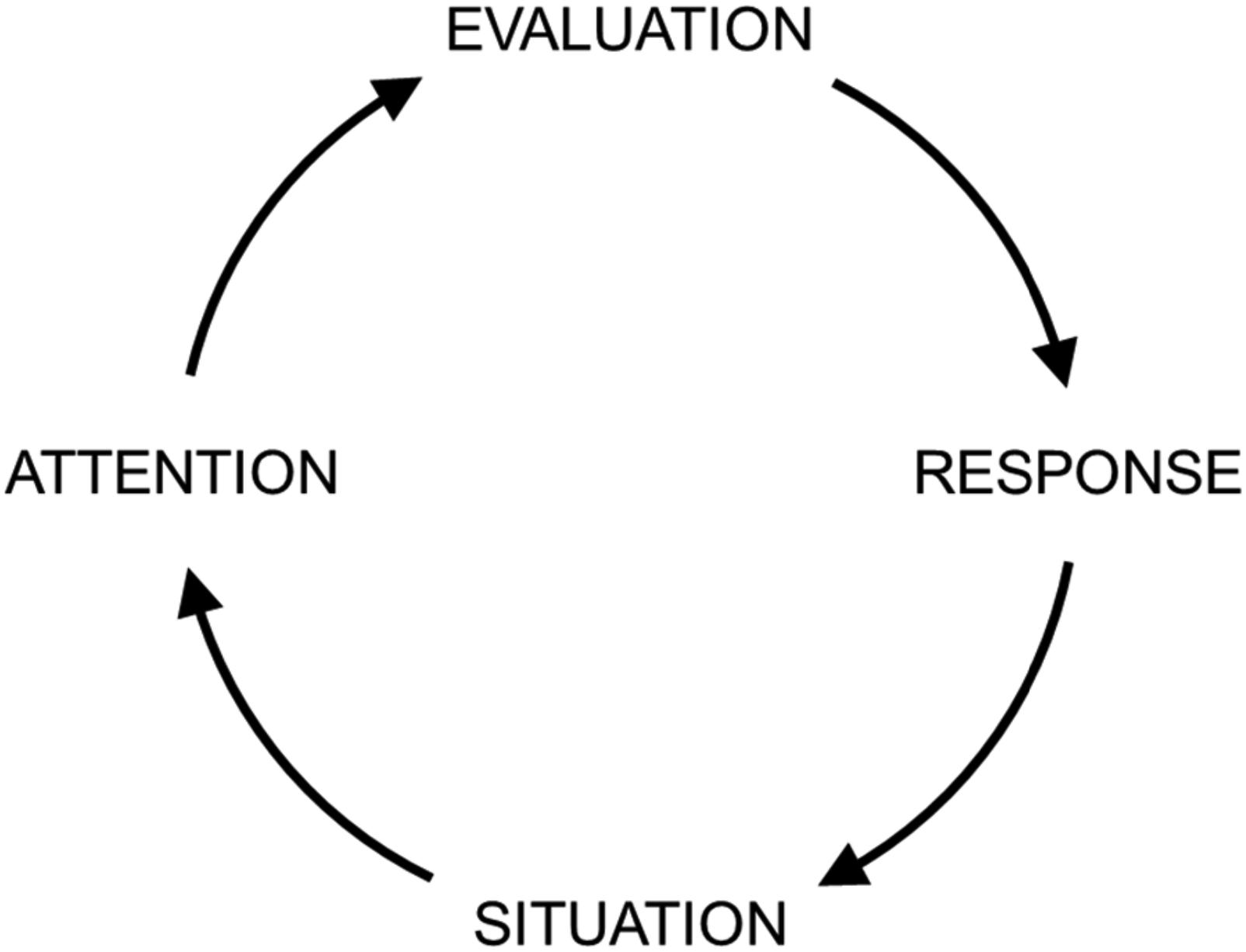
To illustrate, academic distress is one of the negative emotional experiences often targeted in both emotion regulation and supportive communication research (e.g., MacGeorge et al., 2005; Moeck et al., 2024). In this case, for example, when an individual encounters an important test (situation), they may focus on the possibility of failure as in the past (attention), appraise the situation as threatening (evaluation), and consequently feel anxious, sweat, and want to escape (response). Moreover, the emotional responses generated during one iteration of this cycle can become part of a situation that generates a subsequent iteration (Gross et al., 2019). For example, the heightened anxiety (situation) may cause that individual to pay more attention to the possibility of failure (attention), appraise the situation as more threatening (evaluation), and experience stronger anxiety (response). Negative emotions can unfold over time in this manner.
Self-focused emotion regulation by the recipient
When a recipient differentiates and perceives their own negative emotions, they may attempt to regulate their emotions (i.e., self-focused emotion regulation; Barrett et al., 2001). As illustrated in Figure 3, emotion regulation can be conceptualized as the functional coupling of two valuation systems (Gross, 2015a, 2024). In this view, a first-level valuation system that involves emotion generation becomes the input and target of a second-level valuation system that takes the emotion as its object. Specifically, the emotion regulation system pays attention to the emotion, evaluates whether the emotion is good or bad, and initiates regulatory attempts to modulate the emotion generation process as a response. Emotion regulation and emotion generation valuation systems. Note. Emotion regulation involves the functional coupling of two valuation systems, in which a first-level valuation system that is instantiating emotion becomes the object of a second-level valuation system that takes the emotion as its object. S = situation; A = attention; E = evaluation; R = reaction. This figure is adapted from “Conceptual foundations of emotion regulation,” by J. J., Gross, in J. J., Gross & B. Q., Ford (Eds.), Handbook of emotion regulation (3rd ed., p. 6), 2024 by the Guilford Press. Copyright 2024 by the Guilford Press. Adapted with permission.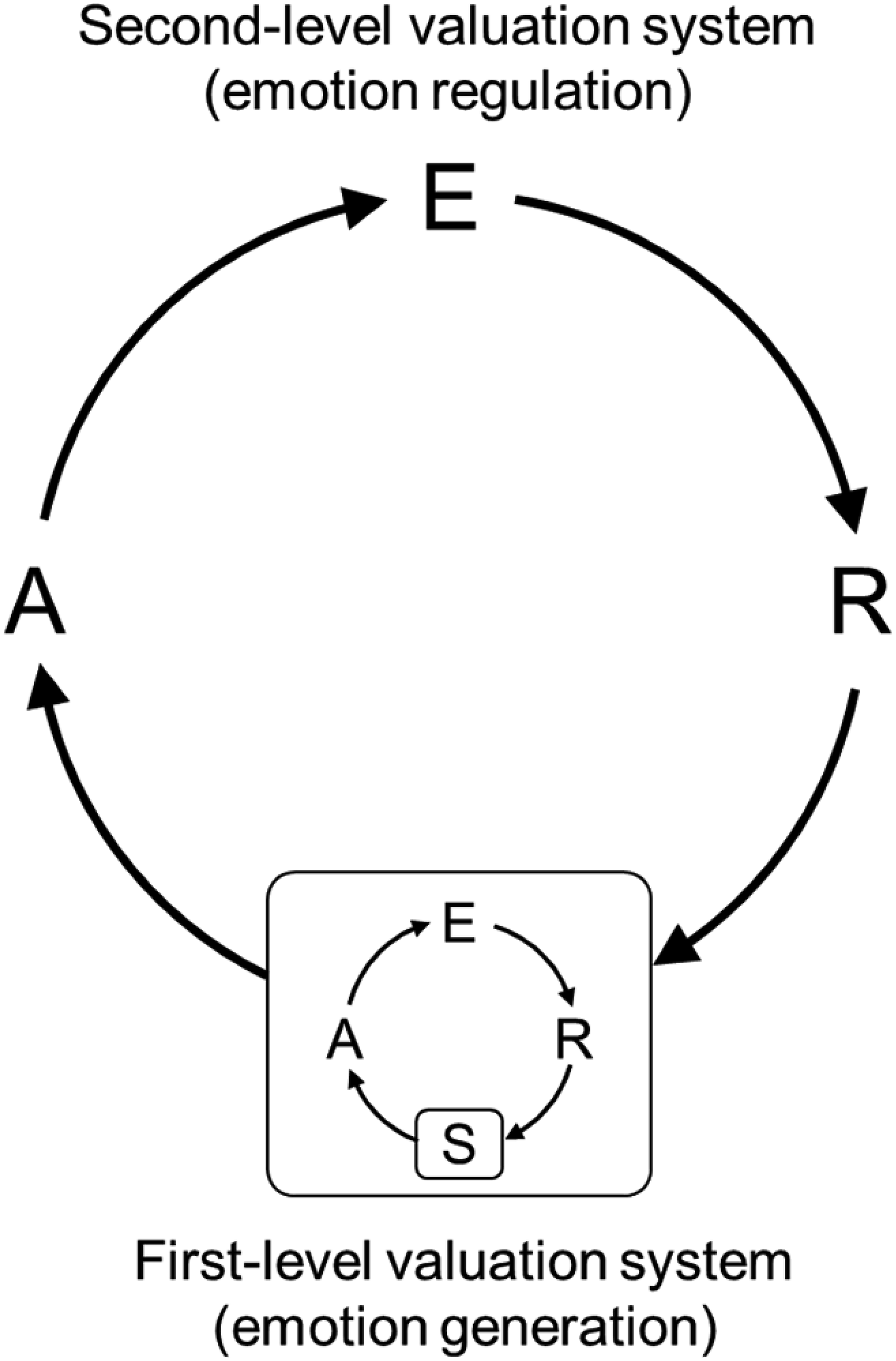
The process model of emotion regulation delineates four stages that underlie emotion regulation (Gross, 2015a, 2024; Figure 4). These include (a) the identification stage (concerned with whether to regulate the emotion), (b) the selection stage (concerned with what strategy to use to regulate the emotion), and (c) the implementation stage (concerned with implementing a particular tactic suited to the current situation), which correspond to the second-level valuation steps of attention, evaluation, and response, respectively. Moreover, in (d) the monitoring stage, individuals decide whether to maintain, switch, or stop the current regulatory attempts reflecting changes in the targeted emotion generation system as well as in the broader context. The process model of emotion regulation. Note. According to the process model of emotion regulation, four stages define emotion regulation. The first three of these correspond to the second-level valuation steps of attention, evaluation, and response. The fourth is the monitoring stage. Families of emotion regulation strategies may be distinguished based on where they have their primary impact on emotion generation. S = situation; A = attention; E = evaluation; R = reaction. This figure is adapted from “Emotion regulation in self and others,” by K. Petrova & J. J., Gross, in I. Roskam, J. J. Gross, & M. Mikolajczak (Eds.), Emotion regulation and parenting (p. 42), 2023 by the Cambridge University Press. Copyright 2023 by the Cambridge University Press. Adapted with permission.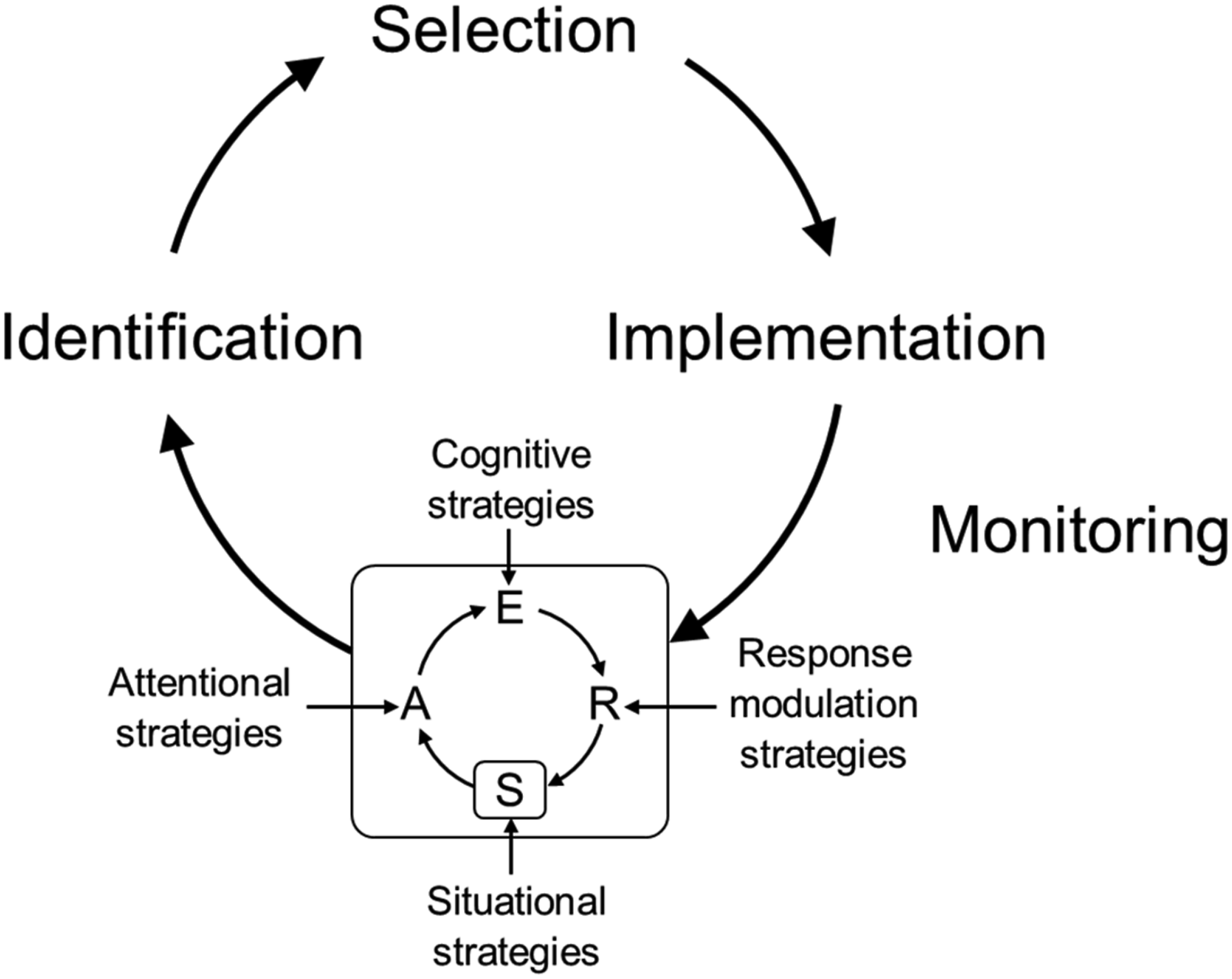
To modify the emotion generation system, the process model of emotion regulation distinguishes between families of emotion regulation strategies based on the point at which they primarily impact the elements of the emotion generation cycle, as illustrated in Figure 4 (Gross et al., 2019). These include (a) situational strategies (selecting or modifying the emotionally evocative situation, such as avoidance and problem solving), (b) attentional strategies (changing what aspects of the situation are attended to, such as distraction and rumination), (c) cognitive strategies (altering how to appraise the situation, such as reappraisal and acceptance), and (d) response modulation strategies (directly modulating emotion-related responses, such as suppression and relaxation). This classification offers a rationale for organizing diverse emotion regulation strategies. Importantly, the provider does not always select a single strategy, but may combine multiple strategies if they are sufficiently desirable, referred to as polyregulation in emotion regulation research (Ford et al., 2019).
A notable feature of the process model is that it can explain emotion regulation through both non-social and social means. Once an individual decides to regulate their own emotions in the identification stage, facilitated by their beliefs that emotions are controllable (Kappes & Schikowski, 2013), they may weigh the costs and benefits of relying on non-social versus social regulatory resources in addition to deciding what strategies to use in the selection stage (Petrova & Gross, 2023a). At this time, they consider situational factors. For example, as we reviewed in the Rise of Interpersonal Emotion Regulation Research section, they are more likely to select relying on another person as a social regulatory resource when they perceive greater social support in their environment or when the situation is more unpleasant and their goals are interrupted (Pauw et al., 2022; Thompson et al., 2024). They then implement a particular tactic suited to the current situation in the implementation stage.
Other-focused emotion regulation by the provider
When the provider notices that the recipient’s emotion generation system is producing an undesired emotional state, they may activate their other-focused emotion regulation system (Nozaki, 2015). The process model of emotion regulation segments the other-focused emotion regulation process into identification, selection, implementation, and monitoring stages as with self-focused emotion regulation (Nozaki & Mikolajczak, 2020; Reeck et al., 2016; Figure 5). The first three correspond to the second-level valuation steps of attention, evaluation, and response, respectively, as described in detail in this section. That is, this model describes three seemingly different components— emotion generation, self-focused emotion regulation, and other-focused emotion regulation—as valuation systems that share basic elements. Supportive communication processes through the lens of the process model of emotion regulation. Note. This figure is adapted from “Conceptual foundations of emotion regulation,” by J. J., Gross, in J. J., Gross & B. Q., Ford (Eds.), Handbook of emotion regulation (3rd ed., p. 7), 2024 by the Guilford Press. Copyright 2024 by the Guilford Press. Adapted with permission.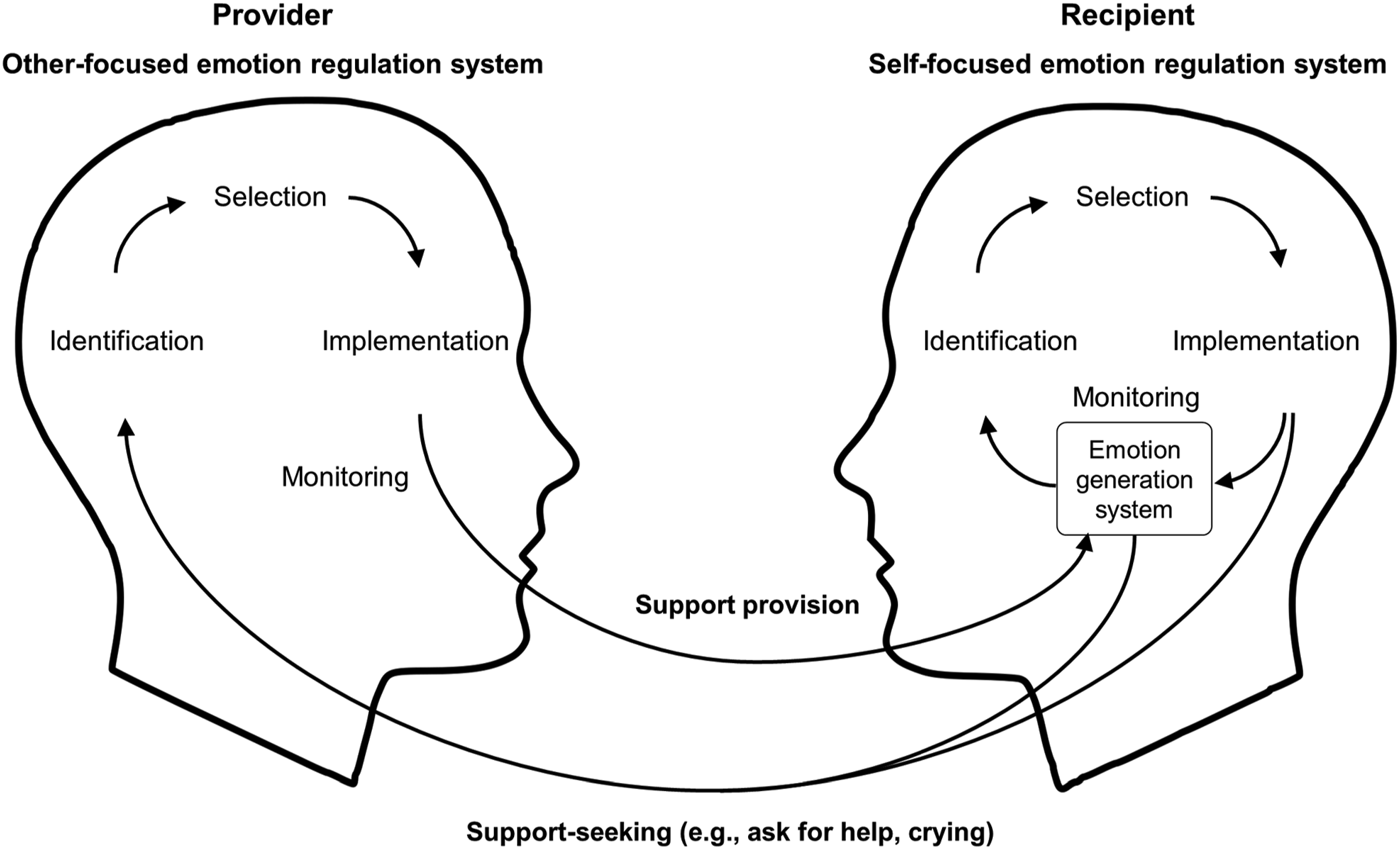
In the identification stage, the provider identifies whether the recipient’s emotion requires regulation and sets an emotion regulation goal if needed. This goal triggers the next selection stage. It is well known that there are individual differences in this valuation process (Niven et al., 2024). For example, as we reviewed in the Rise of Interpersonal Emotion Regulation Research section, individuals with high empathic concern are more likely to set a hedonic interpersonal emotion regulation goal (Double et al., 2024; Geiger et al., 2024). In contrast, individuals with high attachment anxiety are more likely to set an interpersonal emotion regulation goal driven by self-focused hedonic motives and impression management concerns (Springstein et al., 2023).
In the selection stage, the provider chooses one or more strategies to regulate the recipient’s emotions. As with self-focused emotion regulation, these strategies are organized according to where they approach the emotion generation process (i.e., situational, attentional, cognitive, and response modulation strategies; see Figure 4; MacCann et al., 2025; Nozaki & Mikolajczak, 2023; Ruan et al., 2024). In addition to individual difference factors (see Niven et al., 2024 for a review), situational factors are known to influence the choice of other-focused emotion regulation strategy. A well-documented finding is that individuals are more likely to choose distraction (a representative attentional strategy) over reappraisal (a representative cognitive strategy) when the intensity of negative emotions is high, whereas the preference reverses when the emotional intensity is low (Matthews et al., 2022; Xu et al., 2024).
In the implementation stage, the provider translates the selected strategy or strategies into situation-specific tactics and implements it. Although some empirical research on intrapersonal emotion regulation has examined this level (e.g., Livingstone & Isaacowitz, 2021; McRae et al., 2012; Vlasenko et al., 2024), empirical studies investigating interpersonal emotion regulation at the tactical level remain limited. As an exception, Sahi et al. (2023) divided the reappraisal strategy into the following three tactics: trying to get the recipient to adopt a temporally distanced perspective by emphasizing how things can change over time (i.e., temporal distancing), trying to get the recipient to focus more on the big picture and other positive experiences (i.e., positive focus), and trying to expand the recipient’s perspective by considering how others might be thinking or feeling (i.e., perspective taking). Among these tactics, temporal distancing was identified as the most comforting, helpful, and preferable reappraisal tactic.
Processing dynamics of interpersonal emotion regulation
Interpersonal emotion regulation typically involves a dynamic transaction between the recipient and the provider (Petrova & Gross, 2023b). Upon receiving a regulatory attempt from the provider, the recipient decides whether to maintain, switch, or stop their current regulatory efforts. Likewise, the provider monitors the outcome of regulation and decides whether to maintain, switch, or stop their efforts for the recipient. These processes are referred to as the monitoring stage. For example, if the regulatory effort continues to produce the desired outcomes, the individual can maintain it by adhering to the previously established identification, selection, and implementation decisions. However, if the emotional state remains unchanged or shifts in undesirable directions, the individual may switch the chosen selection and/or implementation decisions, or alternatively, stop the regulatory attempt altogether (Gross, 2024).
Similar to tactical-level research, while some research on intrapersonal emotion regulation has addressed the monitoring process using an experience sampling method (e.g., Bartolomeo et al., 2022; Li et al., 2024) or laboratory tasks (e.g., Birk & Bonanno, 2016; Murphy & Young, 2020), empirical studies addressing this stage in the context of interpersonal emotion regulation remain scarce. An exception is Williams and Emich (2014), who explored unsuccessful other-focused emotion regulation through the lens of humor. Their finding suggests that individuals with high affective perspective taking are more likely to adopt a different approach to regulate others’ emotions when an initial regulatory attempt fails, likely due to their sustained focus on the recipient’s need for positive emotions. In contrast, individuals prone to guilt over unsuccessful attempts are less likely to try a different approach, fearing that further unsuccessful efforts may harm their relationship with the recipient.
An emotion regulation perspective on supportive communication
In this section, we explain how the contemporary theoretical framework of emotion regulation can be applied to a wide range of supportive communication processes and update Burleson and Goldsmith’s (1998) foundational work. According to Burleson and MacGeorge (2002), supportive communication typically occurs in the following sequence: (i) support activation by the recipient, (ii) support provision by the provider, (iii) support receipt and accompanying reactions by the recipient, and (iv) responses to the recipient’s reactions by the provider (see also Barbee & Cunningham, 1995). Following this sequence, we map relevant theories and empirical findings on each supportive communication process onto the process model of emotion regulation to synthesize theoretical perspectives (Slater & Gleason, 2012), while drawing comparisons to the current state of interpersonal emotion regulation research.
Support activation by the recipient
Support activation typically occurs when the recipient’s emotion-generating system is not working in a desired manner. According to Burleson and MacGeorge (2002), it can occur intentionally by the recipient (e.g., the recipient asks for help, known as support-seeking) or without the recipient’s intention (e.g., the provider notices that the target appears upset and indicates concern). Supportive communication research has often discussed the former, which refers to “intentional communicative activity with the aim of eliciting supportive actions from others” (MacGeorge et al., 2011, p. 330).
The process model of emotion regulation explains support-seeking as a function of the recipient’s self-focused emotion regulation system that influences the potential provider’s other-focused emotion regulation system to attain an emotion regulation goal through social means (Figure 5). That is, this process involves weighing the costs and benefits of relying on non-social versus social regulatory resources in the selection stage, after the individual has decided to regulate their own emotions in the identification stage (Petrova & Gross, 2023a). Similar to interpersonal emotion regulation research, supportive communication research has identified factors that influence this valuation process. For example, although disclosing negative emotions has benefits such as receiving support, it often comes with psychological costs such as revealing unflattering information about support seekers and increasing the burden on the support provider (Goldsmith & Parks, 1990; Rains & Carter, 2024). Existing research has found that the perceived stigma or impression management concerns of the support seeker deriving from these costs inhibit the decision to seek support (e.g., Bishop & High, 2023; Rains et al., 2025).
Once the individual decides to rely on some degree of assistance from another person, they decide how to implement support-seeking behavior as a given tactic in the implementation stage. While tactical-level investigations remain scarce in the current interpersonal emotion regulation research, supportive communication research offers many ways to conceptualize support-seeking behaviors (see Forest et al., 2021 for a review). For example, a typical way that is more likely to facilitate provider’s support is to explicitly express a desire for help rather than to imply that a problem exists (direct vs. indirect support-seeking; Barbee & Cunningham, 1995; Williams & Mickelson, 2008). It is also known that expressing negative emotions through the recipient’s emotion generation system, such as crying, is more likely to facilitate support from a provider because it helps the provider understand the recipient’s need for support, as long as it does not overwhelm the provider (Forest et al., 2021; Zickfeld & Wróbel, 2024). In this way, the recipient’s self-focused emotion regulation system conveys a message to activate the provider’s other-focused emotion regulation system, either directly or through the recipient’s emotion generation system, or both (Figure 5).
Support provision by the provider
When the provider notices that the recipient’s emotion generation system is producing an undesired emotional state, they may try to produce a supportive message for the recipient (i.e., the activation of the other-focused emotion regulation system; Figure 5). Following the process model of emotion regulation, we review its mental processes based on the segmentation into identification, selection, and implementation stages.
Identification stage: The provider identifies whether they set a goal to regulate the recipient’s negative emotions
In the identification stage, the provider identifies whether to set a goal to regulate the recipient’s negative emotions. Even before the emergence of interpersonal emotion regulation research, the supportive communication literature has revealed various factors that influence the valuation of whether to provide support for a recipient (Ray et al., 2025; see also Burleson, 2003; Dunkel-Schetter & Skokan, 1990 for a review). Among them, it is well known that the provider’s own emotions play a crucial role in this valuation process (Burleson & Planalp, 2000). This is because emotions are linked to distinct motivational orientations called action tendencies, which influence value-based decision-making (Frijda, 1986; Lerner et al., 2015). Some emotions facilitate the provision of support, whereas others inhibit it.
Compassion, which includes a family of sympathy, pity, and empathic concern, is a well-studied emotion that facilitates support provision. Providers feel compassion when the recipient’s outcomes are relevant to the provider’s well-being (e.g., the recipient is emotionally close others), the recipient deserves help (e.g., the recipient is not responsible for their suffering), and the provider has sufficient resources to provide support (e.g., the provider has a secure attachment style; Goetz et al., 2010). Empirical findings have repeatedly shown that a provider’s feelings of compassion are more likely to provide support to those who suffer (e.g., Collins et al., 2014; Tamborini et al., 1993; Trobst et al., 1994).
Guilt also facilitates support provision because one social function of this emotion is to enhance communal norms such as mutual concern and positive treatment in the community (Baumeister et al., 1994). When deciding whether to regulate the recipient’s negative emotions, the provider feels guilt when they imagine not providing support, even though they have high responsibility (Tscharaktschiew & Rudolph, 2016). In this case, the provider attempts to provide support based on normative motivation (Burleson et al., 2005). Therefore, guilt, a certain type of negative emotion, promotes support provision through a different motivation from compassion (Miller, 2013).
By contrast, personal distress inhibits support provision. Individuals sometimes experience personal distress, which is a self-oriented aversive emotional response such as feeling upset, anxious, or disturbed when they witness another person experiencing relatively intense negative emotions (Batson, 1991). This personal distress could promote goal-setting to alleviate one’s own negative emotions rather than those of others, especially if the support provider can escape contact with a distressing target (Eisenberg & Eggum, 2009). Therefore, they do not prioritize the value of regulating the recipient’s negative emotions and are less likely to provide support (Reizer et al., 2012).
Anger toward the recipient also inhibits support provision. Based on attributional accounts of helping, the support provider’s anger toward the help-seeker increases when the provider perceives that the controllability of the situation is high and that the help-seeker is responsible for dealing with the problem (Weiner, 1995). Such anger leads to a decrease in the setting of support provision goals (MacGeorge, 2001). A meta-analysis has confirmed the robustness of this relationship (Rudolph et al., 2004).
Given that the provider’s own emotions play an important role in setting a goal to provide support, their self-focused emotion regulation system can also influence this identification stage process, which has been overlooked in the current interpersonal emotion regulation research. Regarding this point, supportive communication research has paid particular attention to the provider’s mindfulness (Jones & Bodie, 2014), a form of self-focused emotion regulation (Raugh & Strauss, 2024). Indeed, existing research has empirically demonstrated that provider’s mindfulness enhances support provision (e.g., Kou et al., 2022). Because the provider’s own emotion generation and self-focused emotion regulation systems are involved with the provider’s other-focused emotion regulation system in this way, researchers should consider the interactions of these valuation systems to capture the underlying mechanism of support provision.
Selection stage: The provider selects one or more strategies to regulate the recipient’s negative emotions
Examples of supportive communication strategies based on the process model of emotion regulation.
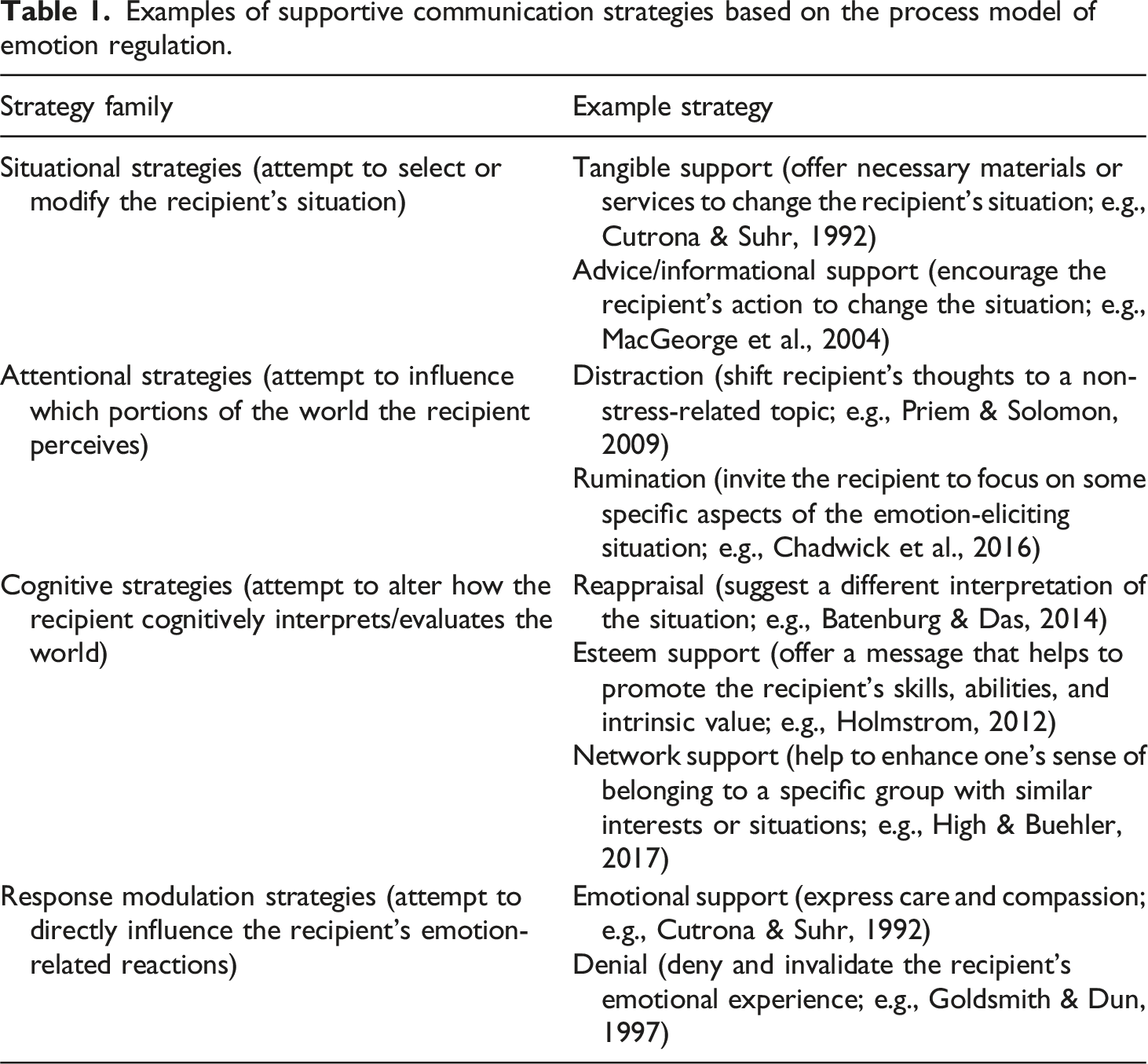
Strategy selection is important for support provision because strategies vary in their effectiveness. While interpersonal emotion regulation research has often focused on the effectiveness of individual strategies (e.g., Jurkiewicz et al., 2023; Nozaki & Mikolajczak, 2023; Ruan et al., 2024; Shu et al., 2021), supportive communication research has proposed theories that consider how the combination of multiple elements influences strategy effectiveness. For example, according to optimal matching theory, the positive effects of supportive communication are enhanced when its provision strategy matches the need for support. Originally, this theory focused on the nature of the distressing event; whereas uncontrollable stressors are best alleviated by emotional support, controllable stressors require more advice to help people solve their problems (Cutrona & Russell, 1990). More recent thinking on optimal matching theory suggests that effective outcomes are achieved not by matching support to a stressor, but by matching the support people receive to their desires (Davis & High, 2019; McLaren & High, 2019; Wang, 2019).
In addition, a number of supportive communication studies have found that the degree of person-centeredness in a message matters in reducing emotional distress (e.g., High & Dillard, 2012; Jones, 2004; Rains & High, 2021). Person-centeredness is conceptualized as “the extent to which the feelings and perspective of a distressed other are acknowledged, elaborated, and legitimized” (Samter & MacGeorge, 2016, p. 109). Existing research has often classified person-centeredness into three levels (the following descriptions are based on Burleson, 2008, p. 208). A highly person-centered message is characterized by explicitly recognizing and legitimizing the other’s feelings, helping the other articulate those feelings, and elaborating reasons for those feelings. A moderately person-centered message is characterized as affording implicit recognition of the other’s feelings by distracting attention from the troubling situation, offering expressions of sympathy and condolence, or presenting non-feeling-centered explanations of the situation intended to reduce distress. A low person-centered message is characterized as denying other’s feelings and perspectives by criticizing their feelings, challenging the legitimacy of those feelings, or telling the other how they should act and feel. From the perspective of the strategies listed in Table 1, high-, moderate-, and low- person-centeredness are considered a combination of emotional support and reappraisal, a combination of emotional support and distraction, and a combination of advice and denial without emotional support, respectively.
Implementation stage: The provider implements tactics to regulate the recipient’s negative emotions
Even if the broad categories of strategies are the same, their effectiveness will vary depending on the characteristics of particular behaviors or message features (Burleson & Goldsmith, 1998). Based on the process model of emotion regulation, it involves the distinction between general strategies and specific tactics (Gross, 2015a; Nozaki & Mikolajczak, 2020). In the implementation stage, the provider converts the selected strategy or strategies into tactics that are appropriate for the situation and puts them into practice. While empirical research on interpersonal emotion regulation at the tactical level is scarce, supportive communication research has often considered this level in its investigations. For example, each of the three major divisions of person-centeredness, described in the previous section, can be coded at three more detailed levels (i.e., nine levels in total), based on the detailed message features (Samter & MacGeorge, 2016). A variety of other tactical-level features have also been considered, including how to paraphrase the thoughts and feelings of support seekers in the supportive message (e.g., Bodie et al., 2016), what the volume, pitch, and rate are used to deliver the supportive message (e.g., Trees, 2000), and the extent to which non-verbal immediacy behaviors, such as eye contact, leaning forward, and smiling, accompany verbal supportive messages (e.g., Jones & Guerrero, 2001).
The most systematic research on this topic has been conducted on the tactics of advice. This line of research has often referred to the politeness theory (Brown & Levinson, 1987) and indicates the importance of facework in determining the effectiveness of advice (Goldsmith, 1992; MacGeorge et al., 2011). According to Brown and Levinson (1987), all individuals wish to maintain their self-image of being appreciated and approved (positive face) and their freedom of action and freedom from imposition (negative face) in interactions. However, advice is potentially face-threatening behavior. Giving advice can threaten the recipient’s positive face by suggesting that the recipient has handled a situation incorrectly or cannot act effectively (Goldsmith, 1992); it can also threaten the recipient’s negative face by imposing that the advice should be followed (Brown & Levinson, 1987). Therefore, facework, which refers to the communicative strategies involved in upholding these faces (Cupach & Metts, 1994; Goffman, 1967), plays an important role in preventing the distressed recipient from appraising the situation in a way that would lead them to feel even worse about things.
Previous research has consistently shown that advice that is more attentive to the recipient’s face needs is generally perceived as more helpful and effective than advice that is less attentive to the recipient’s face needs (e.g., Caplan & Samter, 1999; Goldsmith, 1994; Goldsmith & MacGeorge, 2000; MacGeorge et al., 2002). In addition, subsequent studies have gone beyond facework by incorporating other factors to comprehensively investigate the tactics of advice (e.g., Feng & Burleson, 2008; MacGeorge et al., 2004). The main findings of this line of research contribute to the development of advice response theory, which posits that message stylistic features (e.g., facework or politeness) and content features (e.g., whether advised actions are efficacious, feasible, and not having too many limitations) exhibit stronger effects on message outcomes than advisor characteristics such as expertise and trustworthiness (Feng & MacGeorge, 2010; Guntzviller et al., 2017; MacGeorge et al., 2016). This theory also proposes situational features and recipient’s traits as moderators of message effects (see Bodie & MacGeorge, 2021, for a review). In this way, supportive communication research also expands studies at the tactics level.
Support receipt and accompanying reactions by the recipient
After the provider implements support provision, the recipient processes this message. Although this process has been theoretically acknowledged in interpersonal emotion regulation research (Petrova & Gross, 2023a), it has yet to be investigated empirically. In contrast, supportive communication research has empirically examined this process based on the dual process theory of supportive communication outcomes (Bodie, 2013; Bodie & Burleson, 2008; Burleson, 2009; Holmstrom et al., 2015). When the recipient processes supportive messages, the degree of elaboration varies, which refers to the extent to which an individual thinks with respect to message content (Bodie & Burleson, 2008). At high levels of elaboration, recipients carefully reflect on the content of the message. In this case, message content has a considerable and lasting effect because it can facilitate reappraisal of a problematic situation, as Burleson and Goldsmith (1998) originally proposed linking supportive communication and emotion regulation. Individuals with high mindfulness are more likely to achieve this state (Jones et al., 2019). By contrast, at low levels of elaboration, recipients pay relatively little attention to the content of the message. In this case, environmental cues (e.g., the attractiveness of the provider) largely influence communication outcomes. However, these effects are limited to temporary changes, because they do not address the roots of the problematic situation (Bodie & Burleson, 2008).
Perceived responsiveness is another key construct related to the recipient’s message processing and facilitation of effective emotion regulation. This construct refers to the extent to which the recipient feels understood (believing that the provider comprehends the recipient’s core self, such as needs and desires), validated (believing that the provider respects or values the recipient’s view), and cared for (believing that the provider expresses affection, warmth, and concern for the recipient’s well-being; Reis & Gable, 2015). The formulation of perceived responsiveness is grounded in both the provider’s actual communicative behaviors and the recipient’s motivated interpretations of these behaviors (Itzchakov et al., 2022). Because perceived responsiveness facilitates the recipient’s positive appraisal that they can control the situation (Alonso-Ferres et al., 2020), its formulation plays an important role in effective emotion regulation.
Responses to the recipient’s reactions by the provider
The provider monitors the outcome of their support attempts based on the recipient’s reactions and decides whether to maintain, switch, or stop the current regulatory effort, which is known as the monitoring stage in the process model of emotion regulation (Gross, 2015a; Nozaki & Mikolajczak, 2020). In the field of interpersonal emotion regulation, empirical studies addressing this stage are scarce. In contrast, some recent studies on supportive communication have begun to address this stage. For example, Rains et al. (2023) analyzed turn-by-turn behavior during supportive conversations. They revealed that the support targets’ use of approach behavior was more likely to yield a higher level of person-centeredness in the immediate response from providers. By contrast, support targets’ use of avoidance behavior was more likely to yield a lower level of person-centeredness in the immediate response from providers. These results suggest that providers adjust their statements based on responses from the recipient. Like this, turn-by-turn level analysis during a supportive conversation is an emerging topic in supportive communication research (e.g., Brinberg et al., 2025; Solomon et al., 2022; Theiss et al., 2023). This line of research is expected to deepen our knowledge of the monitoring stage, which is an important research topic in capturing dynamic transactions.
Implications and future directions
So far, we have described how the contemporary theoretical framework of emotion regulation can capture supportive communication processes. We believe that an integrated view of supportive communication and emotion regulation, which have been developed in relatively separate fields, will capitalize on the strengths of each and open new interdisciplinary perspectives for future research. Here, we discuss how this integration contributes to each field to expand future research.
Implications for supportive communication research: Using a unified framework to analyze what goes wrong when effective supportive communication is not being achieved
Examples of potential failure points in supportive communication processes.
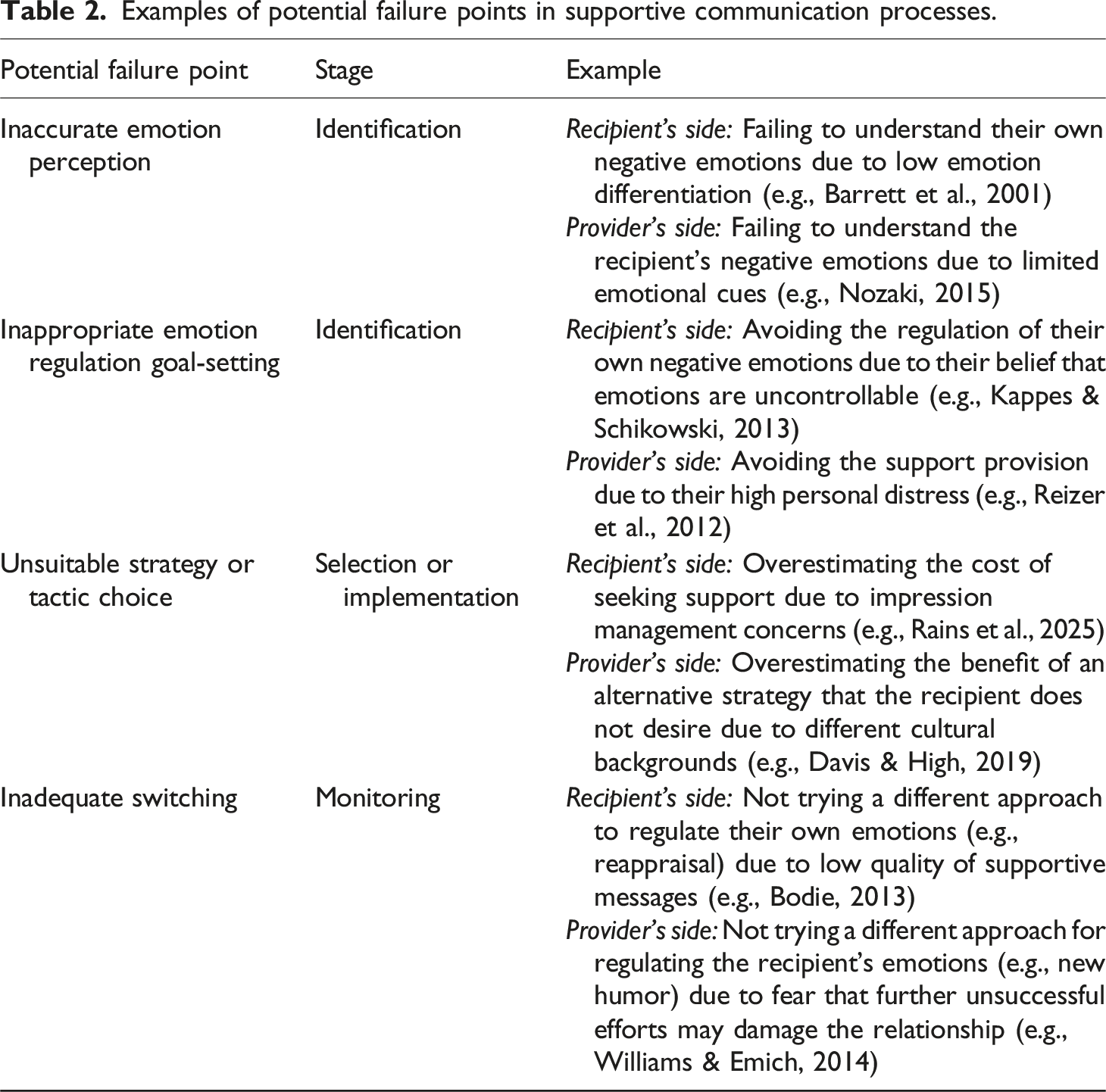
Such a comprehensive framework is particularly valuable for examining the dynamic and holistic processes of conversation, which have recently gained attention in the field of supportive communication. Solomon et al. (2023) noted that a major limitation of current research on interpersonal communication, including supportive communication, is that it typically addresses only discrete messages or overall features of the conversation and called for more research to elucidate the dynamics of dyadic conversations. To address this limitation, recent research has started capturing entire conversations and employing analytical frameworks that can examine turn-by-turn changes in conversational strategies and their associations with emotional change. Examples include state space grids (e.g., Brinberg et al., 2025) and sequence analysis (e.g., Rains & Carter, 2025; Solomon et al., 2022). While these studies are valuable in empirically demonstrating which communication patterns fail to improve the recipient’s negative emotions, they do not explain why these patterns are ineffective. Connecting with the process model of emotion regulation offers a framework for analyzing this issue. This line of research also holds practical significance for the development of training programs tailored to the characteristics of each dyad in the future.
Implications for interpersonal emotion regulation research: Capturing more tactical- level implementations and the interplay between self-focused and other-focused emotion regulation
A key strength of contemporary supportive communication research is that it has focused on the content of the supportive message itself, which has led to the accumulation of more knowledge about tactical-level implementation, in contrast to current interpersonal emotion regulation research. Petrova and Gross (2023b) noted that a future agenda for emotion regulation research is to increase the resolution to consider specific regulatory tactics to implement more general strategies. Indeed, existing research on interpersonal emotion regulation has mostly focused on the general strategy level rather than the tactics level for their investigation (e.g., Double et al., 2024; Kwon & López-Pérez, 2022; Nozaki & Mikolajczak, 2023; Ruan et al., 2024). However, given that the outcome of a general strategy in the same category could vary depending on how it is implemented, future research focusing on the tactical level is important to help individuals understand the characteristics of supportive interactions and improve their skills. The framework examined in supportive communication, such as facework (Cupach & Metts, 1994), can be used as a basis for advancing future research on the tactics level implementation of interpersonal emotion regulation.
Another strength of supportive communication research is that it has traditionally focused on the interplay between self-focused and other-focused emotion regulation. Petrova and Gross (2023b) indicated that the current emotion regulation research tends to draw a relatively sharp line between instances of self-focused and other-focused emotion regulation, even though these two types of regulation are often closely related during the same interaction. In contrast, supportive communication research has addressed their interplay by showing how providers’ self-focused emotion regulation can facilitate their other-focused emotion regulation (e.g., Kou et al., 2022), as well as how recipients process the messages of other-focused emotion regulation from the provider to facilitate their own self-focused emotion regulation (e.g., Burleson, 2009). These findings will play an important role in expanding future research to examine the dynamic interactions between self-focused and other-focused emotion regulation in interpersonal relationships.
Conclusion
As noted at the beginning of this paper, social interactions that support others experiencing negative emotions can occur in various interpersonal relationships, such as between friends, romantic couples, and parents and children. This paper has updated Burleson and Goldsmith’s (1998) foundational work by again bridging the gap between supportive communication research, which has developed mainly in the field of interpersonal communication, and emotion regulation research, which has developed in the field of affective science, based on trends in contemporary research. We hope that this paper will serve as a catalyst for further interdisciplinary research that incorporates the findings of both fields.
Footnotes
Authors’ note
A portion of this paper was presented at the 2025 Society for Affective Science Annual Conference in Portland, OR, United States.
Declaration of conflicting interests
The author(s) declared no potential conflicts of interest with respect to the research, authorship, and/or publication of this article.
Funding
The author(s) disclosed receipt of the following financial support for the research, authorship, and/or publication of this article: This work was supported by JSPS KAKENHI Grant Number 22K13807 and JST PRESTO Grant Number JPMJPR2467, Japan.
Open research statement
As part of IARR’s encouragement of open research practices, the authors have provided the following information: This research was not pre-registered. No data were collected or analyzed for this research.
