




Abstract
What helps couples to cope with stressful life events? And is their relationship satisfaction predominantly linked to individual-level or couple-level processes or both? To answer these questions, we developed a theoretical model based on aspects of the vulnerability-stress-adaptation framework, Bronfenbrenner’s ecological systems approach, and previous empirical findings. We investigated the relationship between pandemic-related external stressors and relationship satisfaction during the early months of the COVID-19 pandemic. Furthermore, individual well-being and dyadic coping were examined as mechanisms that underlie the stress-satisfaction relation. A total of 416 individuals indicating that they were in a relationship, aged 18–93 years (Mage = 42.88, SD = 15.74; 50.8% females), participated in a three-wave online survey in May (T1), June (T2), and July (T3) of 2020. Applying multivariate equation modeling, we examined three pandemic-relevant external stressors (i.e., general COVID-19 pandemic burden, financial burden, and childcare burden) and their respective link with relationship satisfaction via well-being and dyadic coping. Higher levels of stress at T1 were related to less well-being and dyadic coping at T2 which in turn related to lower levels of relationship satisfaction at T3. The overall result pattern supported the assumption that both individual-level and relationship-level adaptation mediated the relation between external stress and the relationship outcome. In tendency, the general stressor was linked to relationship satisfaction via well-being, whereas more specific stressors were linked to satisfaction via dyadic processes. Results highlight the importance of distinguishing between individual and couple mechanisms and emphasize the need to study both specific and general stressors with regard to relationship satisfaction.
Keywords
Introduction
How is societal-level stress linked to couples’ relationships? And what mechanisms may help couples remain resilient to stress and preserve relationship satisfaction? We aimed at answering these questions by shedding light on stress and couple outcome in pandemic times. Given their impact on numerous aspects of people’s lives, precursors and consequences of relationship satisfaction continue to be a major focus of relationship and family research (e.g., Johnson et al., 2023). The present study investigated how COVID-19 stressors were related to relationship satisfaction via individual well-being and dyadic coping, and proposed that the pandemic elicited certain (e.g., financial) strains, that negatively related to later relationship satisfaction. We expected that the way in which individuals coped with the stressors played a meaningful role in understanding the association between stress and relationship satisfaction. As the theoretical framework of our study, we integrated assumptions of the vulnerability-stress-adaptation model (VSA; Karney & Bradbury, 1995), Bronfenbrenner’s ecological systems theory (Bronfenbrenner & Morris, 2006), and the Transactional Model of Stress and Coping (i.e., the transactional model; Lazarus & Folkman, 1987), as well as relevant empirical evidence. To capture the multifaceted influences of the pandemic on couple relationships, we employed a systemic view (Bronfenbrenner & Morris, 2006) as it comprehends the complexity of contexts we covered in our study. Against the background of this theory, we categorized the external stressors deriving from the pandemic context to the macro level, the couples’ relationship characteristics to the meso level, and the individual mechanisms to the micro level. Thus, in line with this model, we investigated mechanisms on the meso and micro level within the same study.
In this study, we first discuss why COVID-19 is a meaningful context to study associations between external stressors, individual well-being and dyadic coping, and relationship satisfaction. Next, we focus on stress and specific stressors (e.g., financial, childcare stressors), and how they have been related to relationship satisfaction. Finally, individual well-being and dyadic coping are portrayed as adaptive processes linking stress to relationship satisfaction. From the resulting theoretical model, we derived hypotheses concerning the relations of stressors, adaptive processes, and relationship satisfaction, which are outlined in the present study.
COVID-19 – A unique context to study relationship satisfaction
In more recent years, scholars have progressively taken contextual conditions, such as life events, and their impact on relationships into account. For example, relationship satisfaction has been studied in various contexts like (the transition to) parenthood (Carvalho & Matias, 2024; Leonhardt et al., 2022), unemployment (Blom et al., 2020), different life stages (Johnson et al., 2023), and different cultural settings (e.g., Fivecoat et al., 2024). One study showed, that experiencing heightened levels of stress because of a life event still impacted individuals’ relationship satisfaction 50 years later, further emphasizing the relevance of studying context effects in relationships (Johnson et al., 2023). Taken together, this line of research supports the assumption that studying relationships in context is an important endeavor. Context factors have repeatedly been shown to directly relate to characteristics of couple relationships. Alongside studies aggregating empirical evidence for the importance of context, theoretical frameworks have suggested that stressful life events may threaten relationship satisfaction by interfering with individuals’ and families’ resources (e.g., VSA model by Karney & Bradbury, 1995). Relationship satisfaction itself has repeatedly been shown to predict important mental and physical health outcomes (e.g., Whitton & Whisman, 2010), necessitating research to further understand contextual factors and underlying mechanisms.
One unique life event that has challenged individuals, couples, and societies around the globe is the COVID-19 pandemic. It has simultaneously placed abrupt stress on numerous areas of couples’ lives (e.g., childcare, employment, health) and has therefore been of interest to many scholars as a context to study its impact on psychological processes (e.g., Luetke et al., 2020; Pietromonaco & Overall, 2021). However, instead of consensus, prior research found increased, decreased, and stable levels of relationship satisfaction as a function of pandemic-released stress (Schmid et al., 2021; Williamson, 2020). To provide a more comprehensive understanding of these interindividual differences in relationship outcomes, it seems crucial to examine processes involved in coping with the pandemic and thus shed light on the way in which pandemic-related stress is linked to couples’ relationship satisfaction.
One previously discussed way in which contexts exert impact on couples is that external stress spills over into the relationship, causing all kinds of intra-relational reactions among partners that affect relationship outcomes (Randall & Bodenmann, 2017). Randall and Bodenmann (2017) also propose that stress from one life domain (e.g., work) may spill over into another life domain (e.g., childcare). Research has repeatedly found that pandemic-related stress negatively affected relationship satisfaction (Balzarini et al., 2023; Luetke et al., 2020; Schmid et al., 2021). Undoubtedly, the consideration of context reached a previously unknown peak in the wake of the COVID-19 pandemic, during which contextual characteristics became disproportionately salient in couples’ lives and subsequently in research as well (Luetke et al., 2020; Pietromonaco & Overall, 2021).
The pandemic has influenced couples’ lives in manifold ways. First, it has infiltrated relationships in a variety of ways simultaneously, such as creating financial strain and increasing childcare duties (Czymara et al., 2021; Schmid et al., 2021). Therefore, unlikely previously studied contexts, some effects of the pandemic are both highly stressful for and specific to relationships (Pietromonaco & Overall, 2021). Second, because it has been shown that different couples reacted differently to this stressful context (Williamson, 2020), taking the COVID-19 pandemic as a context for studying relationships enables researchers to scrutinize the involved mechanisms and shed light on potential protective factors for couples’ well-being. Third, COVID-19 is a global phenomenon that affected couples of all backgrounds, ages, and living situations—albeit in different ways and with different intensities—making research on its consequences all the more pivotal (Balzarini et al., 2023; Fivecoat et al., 2024). Fourth, the pandemic has empirically been shown to affect couples’ relationships. For example, Luetke and colleagues (2020) found that more than one third of the participants reported COVID-related conflicts within their relationship. Lastly, the COVID-19 pandemic is both a very recent phenomenon and one that unfolded over a prolonged period. Thus, research on relationship satisfaction in this context may deliver promising directions for up-to-date evidence-based strategies for practitioners working in couples counseling, for example. In addition, relationship functioning is likely a valuable resource for couples coping with stressful life events, such as the COVID-19 pandemic (Williamson, 2020). Findings may thus be especially useful for researchers and practitioners concerned with increasing couples’ ability to adapt to stressful situations and maintain or regain well-being.
The present research was conducted in Germany. Right before our study onset in late April 2020, a series of political measures to limit negative consequences of the pandemic had been introduced. Public life was widely restricted. For example, in many federal states, schools offered solely online teaching, masks were required in most public spaces, and many shops and restaurants were closed or faced strict regulations.
Pandemic-related stress and relationship satisfaction
The present research addressed both pre-existing stressors exacerbated by the pandemic, as well as new stressors that arose during and due to the pandemic. The Cambridge Dictionary refers to burden as a situation or responsibility that is tough to endure and stressful for those who encounter it. In the context of this study, burden is used to describe a certain stressor activated by COVID-19, such as increased childcare or financial responsibilities on an individual or couple.
Previous studies on the relational consequences of pandemic-related stress have mainly focused on mono-dimensional stress (e.g., Donato et al., 2021). However, stress research has suggested that a multi-dimensional concept of stress influencing relationships facilitates a more multifaceted view on granular effects and takes into account the specific sources of stress (Lanz et al., 2023). Multi-dimensional stress refers to stress that is caused by different factors and experienced in, for example, different life domains. Thus, in order to gain a more holistic understanding of the impact of pandemic-elicited stress, we studied both specific facets of stress, such as financial and childcare-related stressors (i.e., financial and childcare burden) alongside a more general stressor (i.e., COVID-19 burden). Along these lines, general pandemic-related stress may be viewed as comprising various facets of tangible stressors. Affecting many aspects of couples’ lives all at once, the pandemic is ideal to study domain-specific stressors and their specific associations with relationship satisfaction.
Which specific burden did couples encounter during COVID-19? Even before the pandemic, a worsened financial situation threatened couples’ relationship satisfaction (Blom et al., 2020). During the pandemic, the number of couples facing financial strain due to reduced working hours and unemployment rose enhancing the prevalence of this burden on relationship satisfaction (Lanz et al., 2023; Schmid et al., 2021). Theory also suggests that financial pressure is one meaningful burden affecting relationship outcomes (Karney & Bradbury, 1995). Another burden affecting couples with children was heightened childcare demands. The additional stress couples experienced due to the need to navigate work and increased childcare demands, but also shutdowns of schools and preschool facilities, caused stress within the family, putting strain on relationship satisfaction from the beginning of the pandemic on (Kerr et al., 2021; Li et al., 2022). Previous research has further stressed the role of family contexts for well-being and stress during the pandemic (Landmann & Rohmann, 2022) and showed, for example, that the effect of family composition on children’s learning growth increased (de Leeuw et al., 2023). Like most other individuals, couples also dealt with burdens, sorrows, and fears related to the pandemic on a more general level instead of concerning specific areas of life (Owens et al., 2022). Thus, to capture the broader effects of COVID-19 and contrast these with relationship-specific effects, we also included the degree of burden individuals felt as a consequence of the pandemic in general. In sum, we expected general pandemic burden, as well as financial and childcare burden to be meaningful COVID-19 stressors that would negatively relate to relationship satisfaction.
From a psychological perspective, timing may be a crucial factor when considering processes affecting relationship satisfaction. The initial phase or onset period of a stressor’s influence is of particular interest for research on relationship satisfaction for two reasons. First, we suggest that for most couples, adaptation demands are especially elevated and relevant during the initial period after the stressor’s onset, when adaptation is particularly dynamic. Second, at this early stage, most couples may not have developed suitable adaptation behaviors for dealing with the situation. To cover the particularly dynamic early onset of stress, the present study concentrated on the first months of the worldwide COVID-19 pandemic.
Mechanisms of relationship satisfaction
The following section discusses processes that we expected to play a role in the relation between COVID-19 stressors and relationship satisfaction. According to the VSA framework (Karney & Bradbury, 1995), adaptive processes are the mechanisms that exert the effects of stress on relationship satisfaction; in other words, external stress affects relationship outcomes via coping behaviors. Extending the VSA model’s (Karney & Bradbury, 1995) implications, Pietromonaco and Overall (2021) adapted the framework to integrate the COVID-19 pandemic as a context facilitating the rise of various external stressors, which in turn activate dyadic processes that may be harmful to the couples’ relationship. The transactional model (Lazarus and Folkman, 1987) adds to this perspective as it posits that stressors are expected to affect individual and dyadic coping. The model emphasizes the person–environment transaction. It suggests that when stress arises, individuals and couples evaluate the relevance of the stressors (primary appraisal) and the available resources to cope with the stressors (secondary appraisal). In this study, we focused on the pathways from external stressors via coping to stress response (i.e., relationship satisfaction). That is, (a) stress elicited by COVID-19 is evaluated as being relevant and threatening by an individual or couple, (b) this appraisal leads to poor coping behaviors, such as providing less emotional support to one’s partner, (c) which in turn undermines relationship satisfaction. In line with this, individual well-being may also be conceptualized as an internal coping strategy, regulating feelings of anxiety and depression in response to stress. Thus, from a transactional perspective, well-being and dyadic coping on an individual and couple level are expected to be negatively related to stress and their buffer function in the stress-to-satisfaction relation is compromised.
A variety of studies in the context of the COVID-19 pandemic have supported the proposed associations between stressors, dyadic coping (i.e., how efficiently couples deal with stressful situations, communicate, and solve problems), well-being (i.e., indicating comfort and emotional welfare represented by levels of stress, anxiety, and depression), and relationship satisfaction. To begin with, enhanced stress predicted lower levels of well-being (e.g., Donato et al., 2021; Owens et al., 2022) and dyadic coping (e.g., Ogan et al., 2021). In addition, dyadic coping has repeatedly been found to predict relationship satisfaction indicating that positive forms of partner support and communication help couples feel happier about being together (e.g., Falconier et al., 2015). During the pandemic, studies have shown that higher relationship satisfaction was linked to higher levels of both well-being (e.g., Pieh et al., 2020) and dyadic coping (e.g., Bar-Kalifa et al., 2022). Also, studies demonstrated the role of well-being (e.g., Dion et al., 2023) and dyadic coping (e.g., Genç et al., 2021) as mediating the impact of stress on relationship satisfaction during the pandemic. Finally, a prior study demonstrated that pandemic-related stress affected the individual but not relational perception of stress (Fivecoat et al., 2024), supporting the call to scrutinize individual- and couple-level effects. Thus, stressful experiences create various challenges on both the individual level and the couple level. However, to date, they have mostly been examined separately in different studies (Balzarini et al., 2023). For example, Waddell et al. (2021) described the occurrence of unfair division of labor as triggering relationship problems in couples, while Maison et al. (2021) investigated individual COVID-related challenges, such as anxiety, social deprivation, and activity restrictions. However, most studies have predominantly focused on mediating processes on a dyadic, that is, on a relationship level (e.g., Genç et al., 2021). To our knowledge, no study has simultaneously investigated the role of well-being and dyadic coping as a link between stress and relationship satisfaction in the context of the COVID-19 pandemic, yet. Besides theoretical implications, there is a need for integrative studies from an applied perspective, as practical implications differ based on whether stressors are linked to relationship satisfaction through the individual or the couple.
We propose that, alongside dyadic coping, individual well-being may be seen as a key mechanism linking external stress to relationship satisfaction. In our theoretical model, we thus shift the perspective away from well-being as a mere outcome of stress, predictor of dyadic processes, or contextual variable of relationships toward well-being as a mechanism linking stress to relationship satisfaction. To disentangle the unique contribution of these two processes, we studied them alongside each other in the same longitudinal model. With this approach, we aimed at contributing to relationship research and informing practical work with couples. We expected well-being and dyadic coping to be adaptive coping mechanisms that link external stress to relationship satisfaction.
The present study
The goal of the present study was to investigate associations between external stressors, such as experiencing a pandemic, and relationship satisfaction over time. Specifically, we aimed at differentiating between underlying individual-level (i.e., individual well-being) and relationship-level mechanisms (i.e., dyadic coping). Multiple external stressors on different levels were investigated, namely the feeling of being generally burdened by the pandemic, feeling distress concerning caring for one’s child(ren), and level of satisfaction with the household’s financial situation. We expected COVID stressors to be related to couple satisfaction and this link to be mediated through individual well-being and dyadic coping.
To meet this objective, we analyzed latent multiple mediation models using longitudinal data we collected as part of our COVID-19 and Relationship Development Study (CARDS), covering three months close to the beginning of COVID-19 in Germany. The study was conducted during a key phase of the pandemic, as we expected couples to be highly engaged in coping behavior while not yet having established effective strategies for dealing with the pandemic. We set four-week intervals between T1 (May 2020), T2 (June 2020), and T3 (July 2020), respectively, to detect medium-term effects on relationship satisfaction. Extending previous findings and to disentangle mediation effects on the individual and couple level, we included both simultaneously in the models. As can be seen in Figure 1, we added a temporal component by using a longitudinal study design. Conceptual model of the present study. Figure 1 Conceptual model for investigating the link between external stressors and relationship satisfaction as mediated by individual-level and couple-level mechanisms in the context of the COVID-19 pandemic. We implemented three multiple mediation models – one for each burden. Panel I represents the pandemic context of the study. Panel II represents the longitudinal mediation model. T = measurement point; SES = socioeconomic status; LoR = length of relationship; RS = relationship satisfaction.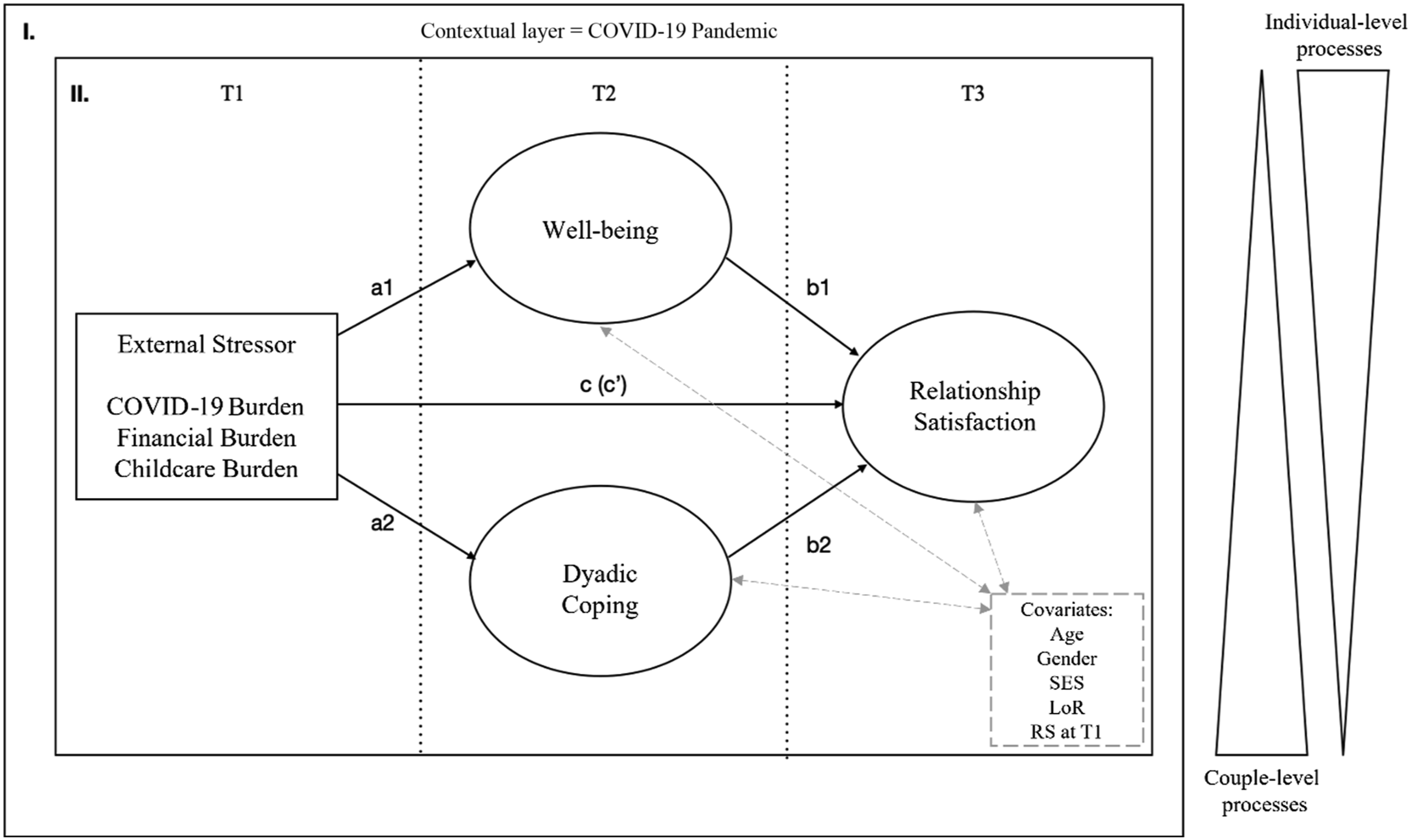
The present study tested the following general hypothesis: General pandemic burden, childcare and financial burden at T1 relate to both individual well-being and dyadic coping at T2, which in turn is linked to relationship satisfaction at T3. To test the general hypothesis, we implemented a multi-step analytical strategy which included testing the following sub-hypotheses:
Method
Procedures
The present study used data from the CARDS project conducted at the FernUniversität in Hagen, Germany. This longitudinal study was specifically designed to capture individuals’ personal and social development and relationship quality. By using intervals of approximately four weeks, we aimed at balancing two features of the pandemic. First, we aimed at utilizing the relative abrupt context change and its likeliness to cause stress in individuals. Second, we wanted to include the effects of stressors that may take a bit longer to unfold as well. We recruited participants via Respondi, a company offering sampling services, which sent out an invitation link to respondents. We instructed recruiters to generate a random sample including all age groups, marital statuses, and an even male-female ratio. Participants had to be registered with Respondi and older than 18 years old. Most participants completed all three surveys (NT1 = 671 [100%], NT2 = 595 [88.7% of T1], and NT3 = 481 [80.8% of T2]). Participants were only re-invited if they finished the preceding questionnaire. Participants gave their informed consent and received a small monetary compensation.
Sample
To meet the objectives of the present research, several cases were excluded from the original sample (N = 671) for the following reasons: (a) we discovered non-trustworthy response behavior or participants ended the survey prematurely (n = 5), (b) participants indicated being younger than 18 years (n = 8), and (c) participants did not have a partner at T1 (n = 242).
The final sample comprised 416 participants ranging from 18 to 93 years old (Mage = 42.88, SD = 15.74, Median = 42.00). Approximately 50.8% of participants identified as cisgender women, 49% as cisgender men, and 0.2% as nonbinary. Of the 416 individuals who were in a romantic relationship at T1, 80.8% lived together with their partner, 57.2% were married, and 52.6% had at least one child. Regarding their education level, 51.2% had completed a university entrance qualification, 42.1% had finished vocational training, and 37.5% had earned a university degree. At the first measurement, 76.7% were employed – of which 6.8% self-employed – 23.3% were unemployed or retired. Income distribution can be summarized as follows: Approximately 5% earned less than 1,000€ per month after taxes, 14% earned 1,001 to 2,000€, 31% earned 2,001 to 3,000€, 22% earned 3,001 to 4,000€, 14% earned 4,001 to 5,000€, and 14% earned more than 5,001€ per month. The vast majority (93.3%) held German citizenship.
Respondents’ partners mean age was M = 43.66 (SD = 16.95, Median = 42.00, range = 13–94), Approximately 46.4% of participants identified as cisgender women, 53.6% as cisgender men. German citizenship was held by 90.9%, 37.5% had completed a university-preparatory secondary school, 45.7% finished vocational training, and 33.9% earned a college or university degree. At study onset, 71.3% were employed – of which 7.5% self-employed – 28.7% were unemployed or retired. For analyses involving childcare burden, we used the share of the sample that indicated at T1 to have at least one child (n = 219, i.e., 52.6%).
Measures
Relationship satisfaction
We adapted the 4-item version of the Couples Satisfaction Index by Funk and Rogge (2007) to measure relationship satisfaction. Example items are Please indicate the degree of happiness, all things considered, of your relationship and I have a warm and comfortable relationship with my partner. Each item was rated on a Likert-type scale ranging from 1 to 6 (e.g., 1 = extremely unhappy or not at all true; 6 = extremely happy or completely true). Total scores were calculated so that higher scores indicate greater relationship satisfaction. Cronbach’s alpha reliabilities across all time points ranged between α = .93 and .95.
External stressors
We measured general COVID-19 stress using the item As how burdensome do you experience the COVID-19 pandemic?, which was rated on a Likert-type scale ranging from 1 not at all burdensome to 5 very burdensome. To measure specific external stressors (i.e., burdens), we considered two areas of life that have been shown to be most prevalently affected by the pandemic: childcare and (household) finances. The following two items were used: As how burdensome have you experienced childcare during the past four weeks? and All in all, how satisfied are you with the following areas of life: income/ financial security? Responses ranged from 1 to 5 (not at all burdensome to very burdensome and very satisfied to very unsatisfied, respectively). Thus, higher scores indicated higher burden and less satisfaction, respectively.
Individual well-being
The general well-being factor comprised the three subfactors stress, anxiety, and depressivity. Stress was measured by three items from the German version of the Perceived Stress Questionnaire (PSQ; Levenstein et al., 1993) by Fliege et al. (2001). Items were rated on a Likert-type scale ranging from 1 never to 5 very often. An example item is How often have you felt nervous or stressed this past week? We used two items to measure anxiety, one of which was How often have you felt able to stop or control your worries this past week?, which was inversely coded. Items were adapted from the Positive and Negative Affect Schedule (PANAS; Watson et al., 1988) and rated on a Likert-type scale ranging from 1 not at all to 5 on (almost) all days. Depressivity was measured using three items from the Allgemeine Depressions-Skala (ADS; Hautzinger & Bailer, 1993). Responses ranged from 1 very rare or not at all (less than 1 day) to 4 most/ all of the time (5 to 7 days) and an example item is During this past week, I was depressed/downcast. Before calculating a general well-being score, we z-transformed all eight well-being items to account for the differences in scaling. In addition, we reverse-coded applicable items so that higher scores indicated higher well-being. Cronbach’s alpha reliabilities ranged between α = .87 and .88 across all time points.
Adaptive dyadic relationship processes
Two perspectives on dyadic coping were assessed using 6 items from the Dyadic Coping Inventory (Bodenmann, 2008): supportive dyadic coping for the partner and oneself. To measure supportive dyadic coping for the partner, we asked participants, for example, When your partner is stressed out, how often do you react in the following ways? (1) I let my partner know that I understand him/her, and (2) I support my partner in concrete ways when he/she has a problem. Respectively, we asked When you are stressed out, how often does your partner react in the following ways? (1) My partner lets me know that he/she understands me, and so on, to assess supportive dyadic coping for oneself. Items were rated on a Likert-type scale ranging from 1 never to 5 always. Internal reliability across all time points ranged from α = .91 to α = .92. As described in Falconier et al. (2015), we calculated a general dyadic coping score using all six items.
Analytical strategy
We used a latent variable modeling approach to analyze the data. First, we calculated intercorrelations of all variables at T1, T2, and T3. Second, we analyzed the longitudinal associations of the three external stressors (i.e., COVID-19, childcare, and financial burden) at T1 and relationship satisfaction at T3. Third, we examined three multiple mediation models including one burden each and both mediators. The mediators were (a) individual well-being and (b) dyadic coping. Since childcare burden was only investigated for those participants who indicated having at least one child, a subsample emerged and led us to analyze three separate models.
All latent analyses were carried out using Mplus (Muthén & Muthén, 1998-2017). Model fit was assessed using the Chi square test, RMSEA, CFI, and SRMR (for cut-off values see Hu & Bentler, 1999). For the latent analyses, we used the full information maximum likelihood (FIML) procedure to optimally deal with missing values and applied a bootstrapping procedure (5,000 resamples). Participants’ age, gender, socioeconomic status, length of relationship, as well as levels of the outcome variable at T1 were included as control variables in all models.
Results
Descriptives and intercorrelations
Intercorrelations of Study Variables.
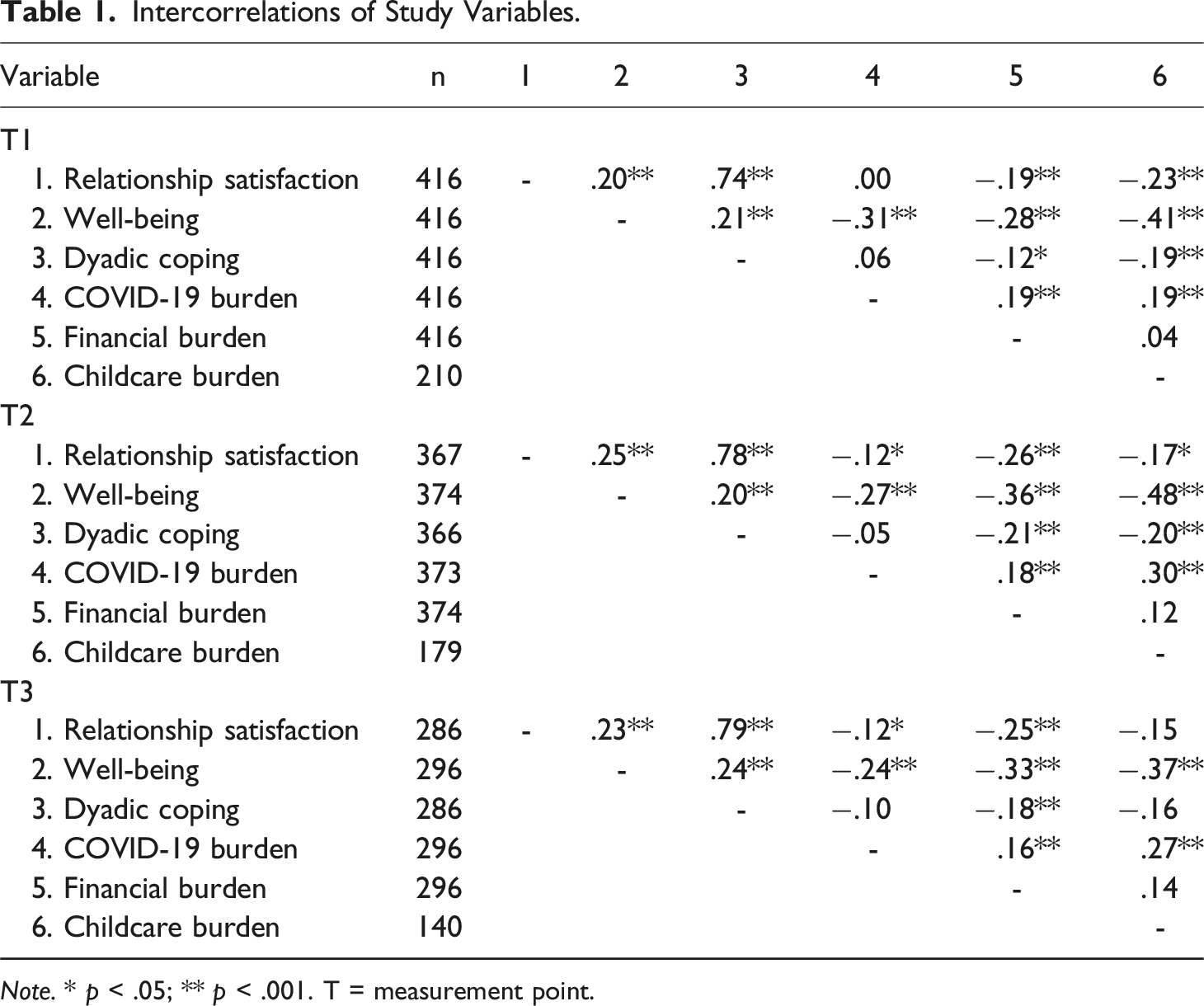
Note. * p < .05; ** p < .001. T = measurement point.
Variations in sample size within each measurement point resulted from sample composition, that is, we only included relationship data from individuals who indicated being in a relationship at the analyzed time point. Also, childcare burden only applied to individuals having at least one child at the time of measurement.
External stressors predict relationship satisfaction
Overall, the three univariate regression models fit the data well (χ 2 /df(55) = 99.284 to 105.556; ps < .001; CFIs = .977 to .980; RMSEAs = 0.044 to 0.047; SRMRs = .018 to .021). In line with our first hypothesis, we found significant negative direct effects of financial burden at T1 (b = −0.19; p < .001; 95% CI [−0.28, −0.11]) and childcare burden at T1 (b = −0.10; p = .046; 95% CI [−0.20, −0.00]) on relationship satisfaction at T3. But COVID-19 burden did not significantly predict later relationship satisfaction (b = 0.03; p = .480; 95% CI [−0.06, 0.13]).
Mediation of external stressor effects on relationship satisfaction
Results from Multiple Mediation Analyses.
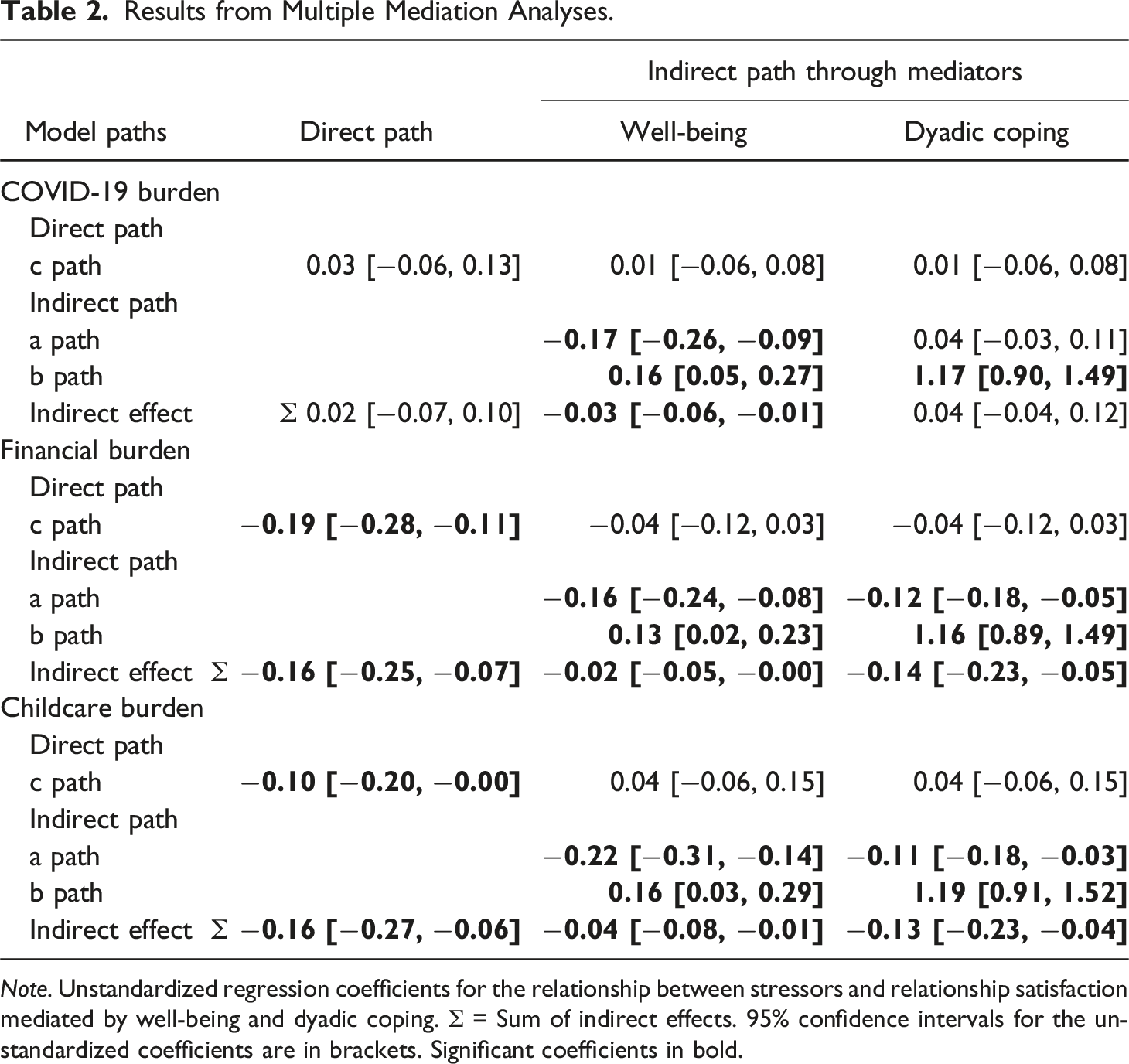
Note. Unstandardized regression coefficients for the relationship between stressors and relationship satisfaction mediated by well-being and dyadic coping. Ʃ = Sum of indirect effects. 95% confidence intervals for the unstandardized coefficients are in brackets. Significant coefficients in bold.
Effects of external stressors on well-being and dyadic coping (a1 and a2 paths)
In line with our hypothesis, well-being levels at T2 were negatively predicted by all three external stressors, that is by COVID-19 burden (b = −0.17 p < .001, 95% CI [−0.26, −0.09]), by financial burden (b = −0.16, p < .001, 95% CI [−0.24, −0.08]), and by childcare burden (b = −0.22, p < .001, 95% CI [−0.31, −0.14]). Furthermore, dyadic coping at T2 was predicted by financial burden (b = −0.12, p < .001, 95% CI [−0.18, −0.05]) and childcare burden (b = −0.11, p = .006, 95% CI [−0.18, −0.03]). However, COVID-19 burden did not predict dyadic coping (b = 0.04, p = .320, 95% CI [−0.03, 0.11]). Overall, external stressors had a significant effect on both mediators.
Effects of well-being and dyadic coping on relationship satisfaction (b1 and b2 paths)
Well-being predicted relationship satisfaction in all three models, that is in the COVID-19 burden model (b = 0.16, p = .007, 95% CI [0.05, 0.27]), in the financial burden model (b = 0.13, p = .026, 95% CI [0.02, 0.23]), and in the childcare burden model (b = 0.16, p = .018, 95% CI [0.03, 0.29]). Thus, a consistent pattern of associations between well-being at T2 and relationship satisfaction at T3 was found across models. Dyadic coping also strongly predicted relationship satisfaction across all three models: in the COVID-19 burden model (b = 1.17, p < .001, 95% CI [0.90, 1.49]), in the financial burden model (b = 1.16, p < .001, 95% CI [0.89, 1.49]), as well as in the childcare burden model (b = 1.19, p < .001, 95% CI [0.91, 1.52]).
The mediating role of well-being and dyadic coping (c’ paths and indirect effects)
We found several indirect effects, suggesting that both well-being and dyadic coping, are mechanisms that explain the effects of external stressors on relationship satisfaction across time (see Table 2, indirect effect). For well-being, the negative indirect effect was significant in the COVID-19 burden model (b = −0.03, p = .026, 95% CI [−0.06, −0.01]), the financial burden model (b = −0.02, p = .070, 95% CI [−0.05, −0.00]) and the childcare burden model (b = −0.04, p = .045, 95% CI [−0.08, −0.01]). Similarly, in line with our hypothesis, financial burden (b = −0.14, p = .002, 95% CI [−0.23, −0.05]) and childcare burden (b = −0.13, p = .009, 95% CI [−0.23, −0.04]) predicted relationship satisfaction significantly through dyadic coping. When dyadic coping was the mediator, we found no significant indirect effect for COVID-19 burden (b = 0.04, p = .322, 95% CI [−0.04, 0.12]). In sum, the pattern of results suggested that specific burdens are linked to satisfaction either through well-being or dyadic coping, while the more general burden is linked to relationship satisfaction exclusively through well-being. The total indirect effects taking into account both indirect paths through well-being and dyadic coping were significant for financial burden (b = −0.16, p = .001, 95% CI [−0.25, −0.07]) and childcare burden (b = −0.16, p = .004, 95% CI [−0.27, −0.06]), but not for COVID-19 burden (b = 0.02, p = .743, 95% CI [−0.07, 0.10]).
As we proposed, all significant direct effects (c paths) decreased or became insignificant when the mediators were added to the respective models (see Table 2, direct path and c paths). Results for the COVID-19 model were (c path: b = 0.03, p = .480, 95% CI [−0.06, 0.13]; c’ path: b = 0.01, p = .775, 95% CI [−0.06, 0.08]), for the financial model (c path: b = −0.19, p < .001, 95% CI [−0.28, −0.11]; c’ path: b = −0.04, p = .282, 95% CI [−0.12, 0.03]), and for the childcare model (c path: b = −0.10, p = .046, 95% CI [−0.20, −0.00]; c’ path: b = 0.04, p = .429, 95% CI [−0.06, 0.15]).
The general pattern of results suggested that well-being and dyadic coping are meaningful mechanisms that underlie the link between external stressors and relationship satisfaction. In addition, external stressors were shown to be associated with relationship satisfaction via a specific mechanism, that is either via well-being or via dyadic coping or both.
Discussion
In the present study, we investigated the relations between contextual stressors and relationships and the involved mechanisms therein. Accordingly, we examined three COVID-19 pandemic-related burdens (i.e., general COVID-19, financial, and childcare strains) and how they are related to relationship satisfaction. Also, we included individual-level (i.e., well-being) and relationship-level (i.e., dyadic coping) mechanisms that have been suggested to mediate this link. Disentangling relationship- from the individual-level adaptive mechanisms aimed at identifying practical implications for couple interventions, such as counseling, training, or therapy, and to reveal at what level they are likely to succeed. Furthermore, we hoped to deliver results that may be generalized to other crisis contexts and therefore help us better understand the effects of critical life events on relationship satisfaction and the involved mechanisms. Results can be summarized into two groups: first, associations between study variables, including direct effects of stressors on relationship satisfaction, and second, results from mediation models. We discuss the study results below before deriving implications for research and practice, indicating strengths and limitations of our study, and suggesting future directions for research.
How are external stressors, well-being, dyadic coping, and relationship satisfaction related during a stressful life event?
We found meaningful cross-sectional associations among almost all study variables at all measurement points. As expected, the overall pattern suggested a positive link between relationship satisfaction and the mechanisms, between COVID-19 burden and all other stressors, as well as between the individual and relational mechanisms. Thus, individuals who experienced a heightened burden in one area of life likely experienced burden in others as well. In addition, individuals with higher positive well-being levels also experience more dyadic coping and vice versa. Thus, how individuals feel about and deal with stressors in their relationship are interrelated. This result replicates studies conducted in other contexts (Falconier et al., 2015). As has been shown in already published pandemic-related research (Bar-Kalifa et al., 2022; Pieh et al., 2020), adaptation mechanisms were positively linked to the outcome; that is, individual well-being and dyadic coping seemed to be closely related to relationship satisfaction. This association corresponds with the hypotheses that we based on our theoretical model. Consequently, individuals who indicated higher well-being and more effective coping also reported being happier in their relationships, supporting the idea that how satisfied partners are with their relationship not only depends on how well they support each other in coping with stress but also on how well each partner feels and copes as an individual.
In most cases, we found that both the mechanisms and the outcome were negatively associated with the stressors, meaning that heightened levels of external stress are linked to lower well-being and less dyadic coping, but also to lower relationship satisfaction later on. These findings are not surprising considering the vast literature on stress-related effects on individuals and relationships, indicating that stress exerts detrimental impacts on several levels of healthy individual and couple adaptation (e.g., Johnson et al., 2023). On second sight, at the first measurement point, childcare stress was not linked to financial stress, nor was COVID-19 burden linked to relationship satisfaction. Because the first measurement point occurred at the beginning of the pandemic, heightened childcare demands may not yet have had the far-reaching financial consequences that emerged over time in some families. Also, for the same reason, general COVID-19 burden may not yet have had the time to unfold its linkage to relationships and their characteristics. Studies support this by suggesting that the effects of stressors on relationships take time to unfold their potentially harmful impact (Williamson, 2020). Accordingly, it was not until the second measurement point that childcare and financial burden as well as COVID-19 burden and relationship satisfaction were meaningfully linked.
From a longitudinal perspective, we found that both financial and childcare stress predicted relationship satisfaction, confirming our hypothesis (see Hypothesis I). However, more surprisingly, general COVID-19 burden was neither significantly correlated with nor a significant predictor of relationship satisfaction. We interpret this finding as indicating a more pronounced relation between more specific stressors and relationship outcomes. In sum, we presumed that COVID-19 burden resembles a more general kind of stressor, whereas financial and childcare burden are more specific and may be more acute and intense stressors affecting specific areas of life. Our results supported this distinction.
What role did the mechanisms play in linking earlier external stressors to later relationship satisfaction?
Moving beyond cross-sectional associations, we examined whether individual well-being and dyadic coping operate as mechanisms of the stressor-relationship satisfaction association. As predicted, all three stressors negatively predicted well-being across all models (see Hypothesis II). This finding is consistent with previous research suggesting that the COVID-19 pandemic had detrimental effects on individuals’ mental health (Owens et al., 2022). Dyadic coping was negatively predicted by financial and childcare burden, but against our expectations, not by COVID-19 burden, indicating that specific burdens may affect adaptive dyadic behaviors more easily than general stressors (see Hypothesis III).
In accordance with our hypotheses, multiple mediation models revealed that both individual-level and relationship-level adaptation positively predicted later relationship satisfaction (see Hypotheses IV and V). In multivariate models, well-being and dyadic coping predicted relationship satisfaction in the general, financial, and childcare burden model indicating that higher levels of adaptive processing as an individual and as a couple is related to higher satisfaction with the relationship. Thus, both individual well-being and dyadic coping are meaningful mechanisms through which stress and relationship satisfaction are linked. These findings are in line with the transactional model by Lazarus and Folkman (1987) in that it suggests that individuals’ and couples’ failure to successfully navigate pandemic-related stress likely contributed to decreased relationship satisfaction.
The association between adaptive dyadic behaviors and relationship outcomes has been theorized and well-studied (e.g., Bar-Kalifa et al., 2022). Nevertheless, the vulnerability-stress-adaptation model does not propose a direct link between individual well-being and relationship satisfaction, but rather an indirect path through dyadic coping (Karney & Bradbury, 1995). Based on our findings and previous literature (Dion et al., 2023), however, we suggested a theoretical model that integrates a direct path from individual well-being to relationship satisfaction and thus also an indirect path from stressors to relationship satisfaction through individual well-being. Present results support this view. Well-being seems to play a meaningful role in the relation between external stress and relationship satisfaction. However, previous studies offer two explanations for our results that indicate stronger links between dyadic processes and relationship satisfaction. First, pre-pandemic studies found dyadic coping to be (a) a stronger predictor of relationship satisfaction than individual coping (Herzberg, 2013) and (b) in contrast to well-being, a significant mediator between stress and relationship satisfaction (Falconier et al., 2015). Second, the direction of influence may be more pronounced when relationship satisfaction predicts well-being instead of vice versa, as Guzmán-González et al. (2023) showed during the pandemic. Our results may be interpreted along these lines. However, building on our findings, it is still worthwhile to consider both paths: stress effects through coping individually or as a couple (Fivecoat et al., 2024).
We found indirect associations for the mediation models that proposed a particular pattern (see Hypothesis VI). All stressors negatively related to well-being which in turn was associated with relationship satisfaction. In contrast, indirect relations were found in models examining the more specific stressors (i.e., financial and childcare burden) in which dyadic coping was the mediator. In fact, the general stressor did not relate to relationship satisfaction via dyadic processes. One possible explanation for dyadic coping not playing a role in how general COVID-19 stress related to relationship satisfaction may lay in differences in how couples reacted to the pandemic (Williamson, 2020). Financial and childcare strain may activate a more specific and acute stress response and cause detrimental communication or less effective problem-solving within a couple, whereas unspecific worries about COVID-19 may be more moderate in nature and may not have such intense repercussions. This idea is reflected in our finding that dyadic coping was not associated with COVID-19 burden, and a study showing that moderate stress intensity led to affiliative partner responses (Donato et al., 2018).
In sum, individual and couple characteristics mediated the relation between external stressors and relationship satisfaction. The general pattern of results pointed toward a specific mechanism facilitating the association between specific stressors and relationship satisfaction. Stress related to the way in which individuals had to cope on an individual and relationship level, which in turn related to how satisfied they were with their relationships. Individual-level mechanisms seem to operate regardless of the specificity of the external stressors. When facing more specific stressors, such as financial strain or childcare duties, dyadic coping may play a more prominent role. Our findings remained robust against different possible influences, such as demographic aspects (e.g., age, gender), socioeconomic status (e.g., income, employment status), and length of relationship.
What implications can we draw from our results for research and practice?
The implications of our results for future relationship research are manifold. First, COVID-19 indeed is a suitable context to study stress-relationship associations. Second, our findings support the assumptions of our theoretical model which states that COVID-19 stressors are related to relationship satisfaction and that individual well-being and dyadic coping play a role in explaining this association. In addition, we suggest the simultaneous study of individual- and couple-level processes as a pivotal strategy to gain valuable insights into the different ways stress relates to relationship outcomes. In this vein, we propose that individual well-being, besides dyadic coping, is a meaningful mechanism that plays a role in the relationship between stress and satisfaction. To better capture the idea that relationship outcomes are affected by both individual and dyadic coping processes, individual well-being should be integrated more prominently in models explaining stress effects on relationship quality, such as the VSA (Karney & Bradbury, 1995). Randall and Bodenmann’s study (2017) further supports this notion by proposing that stressful experiences not only affect couples’ unions but are also perceived as threatening to the individual partners. Third, as can be seen from our study, it may be informative for relationship research to investigate domain-specific stressors alongside more general stressors in order to shed light on the various levels of influence stressful contexts can exert on individuals and couples.
With regard to practical implications, both policymakers and practitioners in the fields of therapy, counseling, or prevention programs may be guided by the results of the present study. On the one hand, policymakers may develop suited support programs. As childcare and financial stress were shown to be negatively related to couples’ satisfaction with their relationship, we conclude that prevention and intervention strategies are needed to help couples with children and/or financial strain to live through times of heightened stress, such as COVID-19. If individual and dyadic coping resources suffer, those relationships are more likely to encounter stress and subsequently reduced relationship satisfaction. Examples might include offering immediate economic support and childcare resources in times of crisis. On the other hand, practitioners may use the insights from this study in different areas and stages of their work. Our results suggest that certain stressors (e.g., financial strain) are negatively related to individual and couple functioning, and these relations seem to depend on the kind of stressor. This may be a valuable piece of information for practitioners. That being said, individuals and couples may benefit from interventions designed to foster coping strategies with regard to a range of different stressors. Moreover, our findings revealed starting points for promoting couples’ adaptation, as lower well-being and dyadic coping were shown to negatively relate to relationship satisfaction. Prevention programs may help individuals avoid high levels of stress in the first place. Interventions may help individuals and couples grow robust against or recover from negative outcomes of stress (Pietromonaco & Overall, 2021). For example, risk factors such as high levels of stress or protective factors such as effective coping may be considered by practitioners. Another result of relevance for practice is that both individual- and couple-level processes are meaningful drivers of relationship satisfaction. Hence, integrating the two levels, for example by strengthening well-being or couple communication skills, may be important for successful counseling as they could work as a buffer against harmful effects of stress. Seen from a different angle, this could also mean that for couple therapy, for example, it may also help the dyadic relationship if both individual partners increase their own well-being (Fivecoat et al., 2024).
Strengths, limitations, and future directions
Major strengths of our study, we argue, lie in its longitudinal nature and the simultaneous inclusion of individual- and couple-level mechanisms in one model which allowed us to disentangle their unique relations with couple functioning. Studying domain-specific stressors alongside general stressors has been recommended (e.g., Lanz et al., 2023) and used in our study to shed light on the distinctive role of these two types of stressors with relationship satisfaction. Future research may wish to extend the repertoire of possible specific stressors and gain more insight into whether the effects we found continue to hold in further crises. In line with researchers suggesting that timing matters in stress research (e.g., Feiring et al., 2023), we investigated the relative beginning of the COVID-19 pandemic and argue that this is a very sensitive period because during the onset of the pandemic, couples were likely to experience greater levels of stress due to insufficient skills and resources to help them adapt to this new situation. However, it has been suggested that stress weighs heavier as time passes and with longer periods of social distancing or quarantine (Brooks et al., 2020). Thus, it would add to the understanding of effects of stress on relationships if further studies would go beyond the early stages of stressful life events. In this line, studies may consider longer intervals between time points. We, however, chose 4-week intervals to account for the dynamic nature of social and personal changes during the early stages of the pandemic. Additionally, further studies are needed to appreciate mechanisms with a more immediate onset using, for example, event-based measures, and to expand on the prediction period by implementing the proposed fine-grained measurements repeatedly over a prolonged period. Also, conducting prospective studies would deliver complementary insights into relationship development. This approach would also broaden the scope of results beyond correlative associations. To overcome similar methodological limitations of the present study, future research may also critically reflect on new standards for describing and testing theories that meta-researchers have put forward (e.g., Hilpert & Vowels, 2023). These standards promote a more consistent alignment of theory, hypotheses, models and interpretations. Also, to gain a more holistic picture of relationship processes and to understand how couples navigate stressful events, future studies may take on a dyadic perspective and examine longitudinal within- and between-partner effects. In addition, we conscientiously collected demographic information, however, in future studies, more specific details on participants’ backgrounds should be collected, such as respondents’ ethnicities, disability information, and sexual orientation. Finally, we acknowledge the call for more (e.g., culturally) diverse samples, especially when studying a worldwide phenomenon. However, as a first step, our sample comprised a wide age range among participants improving generalizability of results. To conclude, the present research highlighted that both individual and couple adaptation are vital for relationship satisfaction when wandering stormy roads.
Footnotes
Acknowledgements
Stefanie Gellner, Leonard Harmening, Caan Hollenbach, and Jascha L. Naumann assisted with data collection and preparation. We also thank Tina Conrad and Jascha L. Naumann for helpful comments on an earlier version of this article. Their support is gratefully acknowledged.
Declaration of conflicting interests
The author(s) declared no potential conflicts of interest with respect to the research, authorship, and/or publication of this article.
Funding
The author(s) received no financial support for the research, authorship, and/or publication of this article.
Open science statement
As part of IARR’s encouragement of open research practices, the authors have provided the following information: This research was pre-registered. The aspects of the research that were pre-registered were the key dependent variable and the overall data collection plan. The registration was submitted to:  . The data used in the research can be publicly shared but are available upon request. The data can be obtained by emailing: