




Abstract
One often overlooked challenge for families migrating to the United States is the pervasive impact of heritage language loss among immigrant children and how this loss affects family functioning and youth psychosocial development. This challenge becomes even more problematic when considering that immigrant parents often make only modest gains in their English language abilities resulting in the erosion of a common shared language with which parents and children can communicate. The dyadic process of child heritage language loss and parental failure to make significant advances in English language skills has been called, “Shared Language Erosion” (SLE). To the extent SLE leaves parents and their children proficient in different languages, it poses a threat to their ability to form the meaningful relationships necessary for healthy family functioning and child development. To better understand SLE and its effect on immigrant families, this study reports on 24 Hispanic immigrant mother-child dyads’ lived experiences with SLE through in-depth interviews. Findings indicate that: (1) SLE is an often-unnoticed characteristic of family communication, even among dyads experiencing severe SLE, (2) mother-child dyads with SLE communicate in different languages to each other but utilize tactics to overcome communication difficulties, including the use of other family members to translate between dyads, and (3) SLE can negatively impact mother-child communication.
Keywords
Introduction
Because the use of any language other than English has been historically suppressed in the United States (U.S.), some have referred to the U.S. as a “graveyard” for languages (Portes & Rumbaut, 2001; Rumbaut, 2009). The stigmatization of heritage language (HL) use in schools and society in general has led to stark declines in its use from the 1st to the 2nd and 3rd generations among immigrant families (Rumbaut, 2009); most immigrant children stop or significantly reduce their HL use by age 12 (Carreira & Kagan, 2011). To the extent that children lose their HL abilities and parents do not substantially increase their English language (EL) skills, the family experiences the loss of a common shared language, which is termed Shared Language Erosion (SLE) (Cox et al., 2021). Even among Hispanic immigrants, whose adults are among the strongest maintainers of their HL (Rumbaut & Massey, 2013), there are large decreases in Spanish use and ability among 2nd and 3rd generation immigrants (Rumbaut, 2009).
This erosion of a common shared language is significant because communication enables family members to express and share their needs, joys, aspirations, and concerns, as well as to resolve their problems and find help for their challenges. Because communication is a fundamental means by which family relationships are created and sustained (Tannen et al., 2007), speaking the same language is essential to facilitate intersubjectivity, or the shared thoughts and feelings (both conscious and unconscious) through which families co-construct their reality (Tirassa & Bosco, 2008) including their identity with and sense of belonging to a larger ethnic community.
Although it is logical to conclude that parents and children experiencing SLE will also experience relationship challenges, a recent scoping review (deSouza et al., 2022) revealed few studies examining how the erosion of a shared language is affecting family relationships and child developmental trajectories. Therefore, this study employs a qualitative, grounded theory approach to explore different ways in which the erosion of a shared common language may be affecting Hispanic immigrant families. Grounded theory is especially useful when studying novel or emerging work, as it involves an iterative process of simultaneous data collection and analysis (Strauss & Corbin, 1990).
Literature review
Studies have documented the decline of health and wellbeing from 1st to 2nd and 3rd generation immigrant youth (e.g., Marks et al., 2014), and prominent theories posit dysfunction in the parent-child relationship as a significant contributor to this transgenerational decline. However, few studies have explored SLE as a potential determinant of the kind of family functioning that could negatively influence adolescent developmental trajectories. In the following, we introduce several of these theories as a foundation for our study.
Acculturation theory
Acculturation theory posits that when emigration occurs, the behaviors, beliefs, and values of the immigrants shift as they adapt to their new host country’s environment (Berry & Padilla, 1980). A practical application of acculturation theory is hypothesized in the acculturation gap-distress model, which attributes family dysfunction and behavior problems among immigrant youth to discrepancies among members in their level of adoption of the host country’s cultural orientation and the loss of the heritage country’s cultural orientation (Schwartz et al., 2010; Szapocznik et al., 1980). These discrepancies are said to cause conflict in the relationship and separate youth from the protective influences of their heritage culture, leading to behavior problems (Schwartz et al., 2010). However, studies linking acculturation and negative youth outcomes have been mixed and show only small effects (Rudmin et al., 2017; Telzer, 2010). Contributing to these mixed findings is the assumption by scholars in many fields (e.g., psychotherapists, family scientists, developmental psychologists, public health scientists) studying acculturation that immigrant children are functionally bilingual. This assumption leads them to view language preference as only one indicator of acculturation and to weight it equally with other indicators of culture such as food and music preferences in their measures (e.g., Unger et al., 2007). However, many linguists have documented language attrition or the gradual decline in HL proficiency among school-age children (e.g., Montrul et al., 2004). Moreover, scholars studying bilingualism among HL learners find that HL proficiency varies by domain (e.g., schoolwork, romance) and should be viewed as a dynamic process between communicants rather than a static ability (e.g., Wright et al., 2015). That is, while immigrant children may function in their HL in routine home activities, their ability to express themselves and be understood in their HL in other domains may be more limited. Linguists have noted that the erosion of the child’s HL proficiency has the potential to affect family relationships (Fillmore, 1991) but have rarely pursued studying how this erosion affects the parent-child relationship and child psychosocial outcomes. SLE may also help explain the mixed findings of the acculturation gap-distress model as follows: To the extent that generational disparities in cultural orientations (e.g., acculturation gaps) affect parent-child relationship quality, SLE may exacerbate the phenomenon by limiting the family’s ability to communicate about those differences, resulting in increased family dysfunction and negative outcomes for children. In this case, SLE could be seen as a moderating factor influencing the degree to which parent-child acculturation gaps affect family relations and child outcomes.
The circumplex model of marital and family systems
The Circumplex Model (Barnes & Olson, 1985; Olson, 2000) is a three-dimensional model positing that optimal family functioning occurs when there is balance between two orthogonal dimensions: family cohesion (the emotional bonding between family members) and family adaptability (the ability of the family system to respond to situational and developmental stressors) with communication being a third and facilitating dimension driving this balance. The cohesion dimension refers to how family members balance their separateness relative to their togetherness with levels ranging between the extremes of being disengaged or enmeshed. The focus of the flexibility dimension is on how families manage change versus stability with levels ranging between the extremes of being rigid or chaotic. The communication dimension is assessed through a combination of listening skills (e.g., empathy, attentive listening), speaking skills (e.g., speaking for oneself rather than others), self-disclosure (e.g., sharing feelings about self and the relationship), clarity (e.g., misunderstandings), continuity tracking (e.g., staying on topic), and respect and regard (e.g., the more affective features of communication). According to Olson and colleagues, to the extent these aspects of communication are missing or poorly attained, family interactions tend toward the extremes becoming increasingly rigid, chaotic, enmeshed, or disengaged. Therefore, when families struggle to communicate effectively due to SLE, their interactional styles may become less healthy and more prone to dysfunction when faced with life’s tasks.
Family communication patterns theory
Similar to the Circumplex model, the Family Communication Patterns Theory (Koerner, 2006; Koerner & Fitzpatrick, 2006; Koerner & Mary Anne, 2002) posits that family communication is organized across two core dimensions: Conversation (how often and openly family members communicate with each other) and Conformity (the degree to which family members feel pressure to share the same beliefs, values, and attitudes). Most recently, Horstman et al. (2018) revised the scope of conformity to include behaviors that cultivate homogenous attitudes, beliefs, and values. These two dimensions interact with one another such that each moderates the other. In this way the communication types that emerge from crossing the two dimensions capture important qualitative differences that create four distinct family types: consensual (high conversation and conformity), pluralistic (high conversation and low conformity), protective (low conversation and high conformity) and laissez-faire (low conversation and low conformity). Both the Circumplex Model and Family Communication Patterns Theory suggest that families organize themselves in a certain style of interaction that is driven by communication pattens and that these patterns can affect how youth define their identity, sense of belonging, and behaviors.
Family language policy
Family language policies are defined as parental attitudes and goals concerning heritage and/or host language use. Studies indicate that using English in Hispanic immigrant homes produces positive gains in children’s English skills, but negatively impacts for their HL skills (Branum-Martin et al., 2014; Collins, 2014). In contrast, research in both Chinese and Hispanic immigrant families finds that HL use at home has no effect on children’s English acquisition but may have a small positive effect on children’s HL proficiency (Park et al., 2012; Tran, 2010). The specific use and practice of a HL supports children’s initial development in that language, whether it is between parents and children in Hispanic and Chinese families (Park et al., 2012; Tsai et al., 2012), parental use of the HL with each other in minority language contexts (Slavkov, 2016), or communication with extended kin and the HL community in Hispanic families (Tran, 2010). However, when siblings act as sources of the host language for each other, the opposite occurs. For instance, siblings’ exposure to an English-dominant school environment can establish English as the preferred language in sibling interactions (Bridges & Hoff, 2014; Slavkov, 2016).
Research on language use in immigrant families indicates that the HL has important implications for child outcomes (see Müller et al., 2020 for a helpful review). Studies examining immigrant populations from a diverse range of countries of origin find that when a family’s language policy encourages bilingualism via fostering HL use at home, it promotes positive psychosocial adjustment (Chung et al., 2019; Portes & Hao, 2002), self-esteem (Portes & Hao, 2002), secure attachment patterns (Tannenbaum & Howie, 2002), and allows children to preserve a strong ethnic identity (Arredondo et al., 2016; Mu, 2015). Despite the numerous positive implications of fostering HL in the home, many second-generation immigrant children are not able to fully acquire or maintain their HL. However, researchers have yet to explore the implications this has on the family system.
This study specifically explores the ways in which communication impacts family relationships in immigrant mother-child dyads as a result of SLE and asks the following: 1. How does language use and/or fluency in two languages impact parent-child communication in immigrant Hispanic families? 2. To what degree are family members aware of the ways in which language use and/or proficiency impact their communication and family relationships?
Methods
Procedures
Data for this publication come from part of a larger study examining Shared Language Erosion among Hispanic immigrant mother-child dyads. The study occurred in Tulsa and Stillwater Oklahoma, two new settlement areas for Hispanic immigration (Donato et al., 2007). Participants were mother-child dyads recruited from local schools and Hispanic-serving organizations. Mothers were eligible to participate in the study if they were 1st generation immigrants and spoke Spanish (except one mother who participated and was a second-generation immigrant). Youth were eligible to participate in the study if they were in 6th through 12th grade. The study was approved by the Oklahoma State University Institutional Review Board. Participants were contacted by trained bilingual research assistants who followed approved procedures to elicit parental consent and youth assent before data were collected.
Bilingual research assistants working in pairs conducted semi-structured interviews with both mothers and children in their language of choice (English and/or Spanish). Both the dyad and research assistant sat around the table and conducted semi-structured interviews. For the most part, each question was asked first to the mother and then to the child, apart from some questions which were only asked to mothers or youth (see Appendix A for an interview guide). When relevant, additional probes were utilized to ask about participants’ experiences and feelings concerning SLE (e.g., if they described SLE occurring with another family unit, questions were asked about that family). Interviews were video-recorded and ranged between 10 to 35 minutes long per dyad, for a total of more than 7 hours of interview data. Of note, interviews from dyads who did not experience high levels of SLE were relatively shorter than those that did experience high levels of SLE.
In addition, participants completed a survey that assessed a range of topics (family processes, well-being, etc.). Individuals were asked to report on their language fluency in Spanish and English in the survey. However, to better understand potential language gaps between mother-child dyads we also administered the Woodcock Johnson IV Test of Oral Language (WJIV; normed for individuals ages 3–94; Mather & Wendling, 2014) to assess language fluency in English and Spanish for both mother and child. The WJIV is a reputable standardized language proficiency test and was created with bilingual individuals in mind. Test administrators were trained following the protocols of the WJIV and administered several practice tests before testing study participants.
Participants
Demographic information.
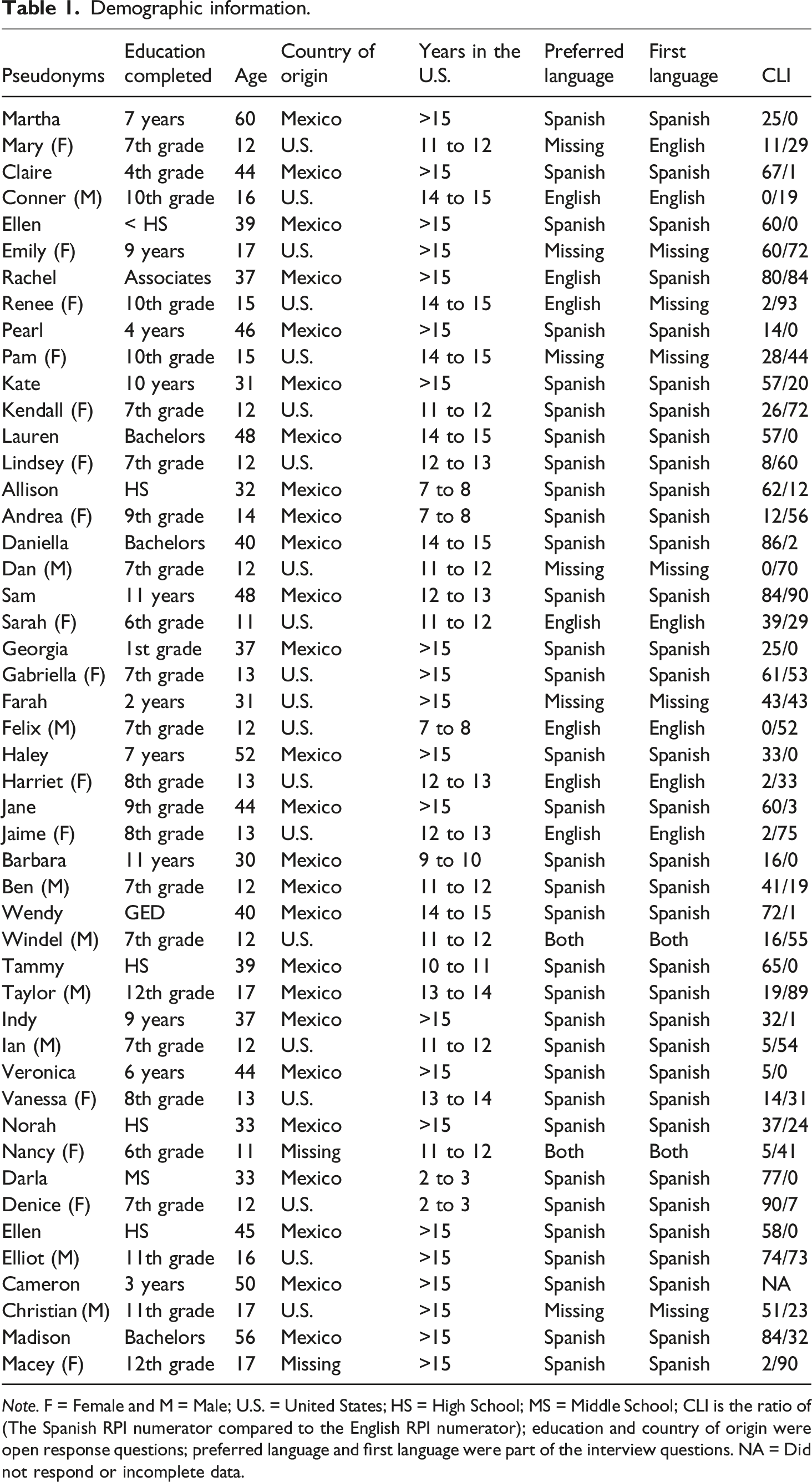
Note. F = Female and M = Male; U.S. = United States; HS = High School; MS = Middle School; CLI is the ratio of (The Spanish RPI numerator compared to the English RPI numerator); education and country of origin were open response questions; preferred language and first language were part of the interview questions. NA = Did not respond or incomplete data.
Each dyad was given pseudonyms beginning with the same letter, with the mother’s pseudonym listed first (e.g., Martha and Mary). Participants were not asked about their occupation status or income. We also report an indicator of Spanish and English language proficiency called the Comparative Language Index. According the WJIV manual (Mather & Wendling, 2014), the comparative language index (CLI) provides a method for comparing a person’s performance on two measures of the same underlying ability gathered from tasks administered in English and Spanish. The two tasks conforming the CLI are the numerators of the person’s two relative proficiency indices (RPI), one in Spanish and one in English. The RPI is an indicator of how a person is expected to perform on the different language tasks of the WJIV compared to their same age peers who perform those tasks at 90% proficiency. For example, if Pedro’s Spanish oral language tasks on the WJIV were 66/90, it would indicate that Pedro is predicted to perform similar oral language tasks with 66% proficiency when those tasks are presented in Spanish compared to his peers who on average perform those tasks in Spanish with 90% proficiency. Similarly, if Pedro’s English oral language tasks revealed 15/90 it would mean that he is predicted to perform similar tasks presented in English with 15% proficiency when youth his age perform those tasks in English with 90% proficiency on average. This results in a Spanish/English CLI of 66/15, signifying that Pedro performs with 66% proficiency those tasks in Spanish that he performs with only 15% proficiency in English.
Data analysis
Video-recordings of the interviews were transcribed verbatim and portions in Spanish were translated into English by the coding team 1 . Transcripts were uploaded and managed in the qualitative software program Nvivo (Ltd. Q. I. P, 2020). The coding team continually utilized both the transcripts and videos as necessary to guide the analysis and to ensure that the most accurate versions of participants’ experiences were taken into account as related during the interview process, in their own words and behaviors (e.g., head nods/shakes, tones). Data analysis was conducted using a Straussian approach to grounded theory, as described below (Strauss & Corbin, 1990).
First, each member of the coding team openly coded the same subset of five interviews to become familiar with the data and look for relevant themes pertaining to SLE (Strauss & Corbin, 1990). Next, the team worked together and reviewed features across their open coding and developed an initial coding scheme based on discussions. The team then conducted three more rounds of coding, with each coder taking 2–3 transcripts and applying the initial coding scheme. After each round of coding, the team met to discuss the emerging master codebook, further refining the superordinate and subordinate codes, adding new codes and collapsing codes as necessary. Then the team conducted coding of the entire data set in two batches. After meeting and addressing discrepancies and problematic codes (Saldaña, 2016), the team made revisions to the codebook by discussing and revising codes. All authors then explored the coded data, making observations about the most salient themes and connections between codes. In what follows, the clearest and simplest examples for each theme are discussed.
Findings
Introduction to SLE
Themes and subthemes: Organizational overview.
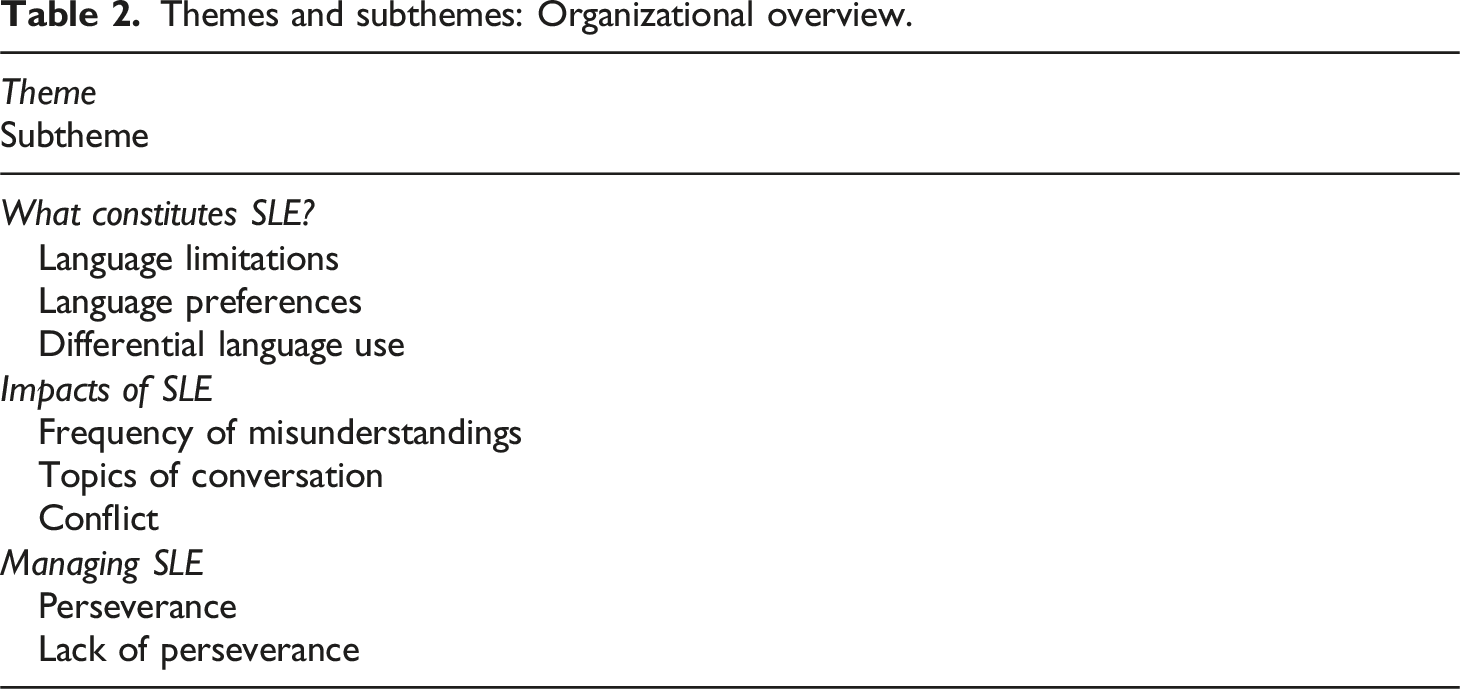
Despite growing evidence acknowledging HL loss across generations, little is known about how this process occurs within families or how it affects family relationships or child development. The interviews demonstrate clear evidence of SLE and that there is considerable between-dyad variation in the degree of SLE they may experience. Although the interviews only included mother-child dyads, the data suggest that SLE affects other subsystems within the larger family system, such as the father-child, sibling, and marital subsystems, creating challenges for the entire family system.
What constitutes SLE
Language limitations
In asking dyads about how the use of two languages impacts their communication, some dyads quickly acknowledged that there were barriers and challenges because both members of the dyad had limitations in one or the other language used. Although the English abilities of mothers varied between the dyads, only a small minority spoke English well. Most (21 of 24) mothers reported having limited English proficiency, and several attributed challenges in communication at home to their own language limitations. Martha, referring to her daughter Mary, reported, “Cuando se confunde. No me habla en inglés porque sabe que no entiendo” (When she gets confused, she doesn’t talk to me in English because she knows I don’t understand). Barbara expressed her desire to learn English because it affects her ability to understand her child. She reported, “pues a veces uno se queda viendo, se quede cómo qué dirán verdad? por eso le digo que quiero yo ir a clases de inglés para saber bien” (Well, sometimes we just look at each other like, “what did he say?” That’s why I tell you I want to go to English classes to know [English well).
Mothers expressed having differing levels of perceived proficiency in their English language abilities depending on which aspect of communication (e.g., speaking, listening) was occurring. For instance, some mothers like Indy had significant English language limitations in both aspects and said things such as: “Entiendo una o dos cositas, pero ya no mucho” (I understand one or two things, but not a lot.). Other mothers reported understanding more spoken English, but not enough to speak or carry on a conversation with fluency. In many cases their children agreed. For instance, Gabriella said “Por que se me olvida que ella no lo habla. Sí entiende (referring to English), pero no lo habla. Sé que si yo le digo algo, sí me entiende” (Because I forget she doesn’t speak it. She does understand (referring to English), but she doesn’t speak it. I know if I tell her something she will understand me). Gabriella’s comment also illustrates another common theme among these dyads; when youth converse with their mothers in English, they often assume that their mothers understand them. This occurs more frequently among dyads in which the mother’s English is improving. Youth become overconfident of just how much their mothers understand and are often not yet mature enough to engage in the kind of communication that would ensure accurate, mutual understanding. On the other hand, mothers may think they understand their child’s message when in reality they have not.
Mothers’ ability to understand spoken English also varied. Mother reported several factors that influenced their understanding such as speed or pace of the conversation, whether there were accompanying nonverbal cues, and the high-stakes nature of the conversation. Additionally, increases in generalized perceived stress were also associated with increases in SLE. For instance, Sam shared, “Pero si yo estoy con problemas, tengo presiones por acá, así me lo diga veinte veces la misma cosa (laughs) no voy a entender nada, ¿eh?” (But if I’m facing problems, if I feel pressure, it doesn’t matter if he/she tells me twenty times the same thing (laughs); I’m not going to understand anything). Sam’s report highlights how the daily hassles of life as an immigrant parent, the stress associated with poverty, and other such struggles can accentuate the experience of SLE making family life that much more difficult. Regardless of their best efforts, in immigrant families, parents may feel so overwhelmed it affects their ability to communicate properly with their children.
Whereas mothers were mostly monolingual in Spanish, we found considerable variation in Spanish proficiency among the youth. We found youth who seemed completely bilingual, switching effortlessly between English and Spanish across a wide array of topics. Others, however, struggled to speak in Spanish across numerous domains of life. Some even listed English as their first language despite having a mother whose preferred and first language were both Spanish and whose English portion of the CLI was 1 (i.e., extremely limited). For instance, when asked if he can speak Spanish, Connor reported “I don’t know, I try to speak in Spanish but I can’t. It’s hard to communicate with my mom. When I try, when I try to speak Spanish but I can’t. And I mostly speak English to her.” Despite being reared in Spanish-speaking homes, our data suggest that some youth struggle to communicate in their family’s HL, so much so, that it is difficult for them to express themselves or comprehend others except in English or through an interpreter. For the many professionals who assumed that youth growing up in immigrant families are functionally bilingual, this finding is remarkable and suggests renewed scrutiny of how we should understand immigrant family development.
These families’ experiences point to the development of SLE: the youths’ limited Spanish proficiency (LSP) coupled with the mothers’ limited English proficiency (LEP) affects their ability to communicate and function both inside and outside of the home. In most families, mothers and youth attributed communication difficulties to their combined limitations, rather than the proficiency of either the mother or the youth alone. Instead, they affirmed the inherent dyadic nature of SLE and that it is the absence of a shared common language that impacts family communication and function. This is an important distinction because acculturation theory tends to emphasize the youth’s proficiency, use, or preference of either the heritage or host language as merely an indicator of cultural assimilation rather than as a vital mechanism for maintaining family relationships and for transmitting culture from one generation to another. The shift away from conceptualizing language as simply a cultural marker to an essential mechanism through which parents bond with their children and socialize them into responsible adulthood in the host culture and an ethnic subculture has important implications for both theory and measurement development.
Language preferences
Whether English or Spanish would be prioritized and preferred in the family varied between mothers and their children and from one mother to another. While almost half of youth (10/24) expressed a clear preference for English over Spanish, almost the same number of mothers (11/24) expressed a desire for their children to prefer Spanish over English. Some mothers attributed this desire to their own struggles communicating with their children in Spanish due to their children’s Spanish limitations, or their experiences with other children that do not speak Spanish despite living in Spanish-speaking households. These mothers also believed that their children’s ability to speak more Spanish is important for developing a sense of family including relationships with extended family. For example, Jane stated that: “cómo digo su abuela- mi mamá acaba de llegar, ni la saluda ni nada, no más ‘hi’.” (like I keep saying, her grandmother- my mom, just arrived (to the U.S.), and she doesn’t greet her or anything, only ‘hi’). Although not part of our data, it is easy to imagine scenarios like the one above being the cause of friction developing in the family. It may be that to the extent grandparents blame their daughters or their daughters-in-law for their grandchildren not speaking the Spanish, this leads to a sense of disengagement in the family. Several mothers did express a sense of shame that their children did not speak the Spanish.
Although seemingly stating the obvious, it is important to note that youths’ language use and language preference is likely due to their perceived difficulties communicating well in Spanish. The CLI scores reveal that 17/24 youth had Spanish CLIs of less than 30, indicating that they are projected to perform at a 30% success rate when compared to only Spanish-speakers their same age. In general youth tend to spend their time in areas of perceived proficiency and comfort while avoiding areas in which they perceive themselves to be less proficient and, therefore, more likely to suffer embarrassment. Applied to language learning, when youth begin to experience decreases in their Spanish language proficiency resulting from their increased exposure and use of English at school, they are likely to reduce even more their Spanish language use to protect themselves from the threat of embarrassment. This, again, is remarkable considering that almost all the youth in the study reported that Spanish is their first language, and yet by adolescence, most of them have begun to see significant declines in their fluency. More remarkable still is that several youth initially reported ‘English’ as there first language, to which almost all mothers would quickly correct them saying that the only possible answer is Spanish – given that these mothers could not speak English. The assumption among these youth that their first language was English underscores the extent to which some youth have moved away from Spanish and provides evidence that over time, youths’ Spanish fluency is significantly diminished, which inevitably contributes to their ability to use the language and their overall preference for it.
In some cases, mothers intentionally prioritized their children’s English learning for at least two reasons. First, mothers reported that they themselves learned English as their children learned English. For instance, Daniella said, “Sí de hecho yo aprendi más inglés cuando ellos empezaron a ir a la escuela porque ahi, ellos pues practicamente te enseñan desde el principio como se dice las letras, como se pronuncia, y yo siempre he dicho que desde que ellos entraron a la escuela yo aprendi mas ingles junto con ellos” (“Yes, in fact, I learned more English when they started going to school because there, they practically teach you from the beginning how to say the letters, how to pronounce them, and I have always said that since they started school I learned more English alongside them.“) Second, mothers also felt that knowing English would protect their children against some of the negative experiences that the mothers themselves encountered in the host country due to their limited English skills. In contrast, other mothers reported regret for preferring English and/or failing to enforce Spanish usage at home because it led to their children’s Spanish loss. In several dyads, there was obvious tension between the need to prioritize English for job opportunities and social mobility and the need to maintain the heritage language to foster connections in family relationships and the larger ethnic community. Mothers also reported that the ubiquitous pressure in the United States to speak English impacted their desire for their children to speak their HL. For example, in acknowledging the demands of the host country, Jane said: “Sobre todo en este país el lenguaje principal es el inglés. Donde quiera que uno va, se requiere hablar inglés. Muchas veces por no hablar inglés uno se le van oportunidades de trabajo, uno a veces permite que le hagan discriminación, que lo traten mal en los trabajos porque uno piensa que ‘pues uno no sabe inglés’. Me ha pasado mucho a mí, pues yo por eso yo sí quisiera mejor aprender inglés quisiera que mi esposo aprendiera pero también quisiera que ellas aprendieran español. Más que nada ellas porque están más jovenes” (“Especially in this country, the main language is English. Everywhere one goes, speaking English is required. Many times because you don't speak English you miss out on job opportunities, sometimes you allow yourself to be discriminated against, to be treated badly at work because you think that ‘well you don't know English.’ It has happened to me a lot of times; that's why I would like to learn English better, I would like my husband to learn, but I would also like them (referring to her daughters) to learn Spanish. More than anything them because they are younger”)
Some mothers, although not directly stating a preference for Spanish, spoke of the need to motivate children to learn Spanish and avoid heritage language loss. For example, Georgia recommended motivation as a possible solution to recuperating their children’s language loss by saying “Que hay que motivar a los niños de papás mexicanos que les enseñen hablar español” (We need to motivate children of Mexican parents; they need to need to be taught to speak Spanish). In this same thread, some mothers emphasized the need for Spanish classes. Some mothers pointed out that current Spanish classes offered at schools are not helpful because the Spanish taught in these classes does not match the way they themselves use Spanish at home (i.e., because of different dialects). Jane highlighted this by saying that her daughter would say, “Es que esa señora no más me está dicidiendo que mi español no está- no está correcto’. (It’s that lady (referring to their teacher) is telling me (or perhaps deciding) that my Spanish isn’t-isn’t correct.). Another youth, Elliot, supported this by saying, “I had Spanish 2; in that class I learned a few words like car (carro) they told me that car had another word (coche) for me that was confusing”. This tension between ‘home Spanish’ and ‘academic Spanish’ represents yet another challenge these dyads face when attempting to maintain their heritage language in a linguistic minority community. Overall, families expressed different values and rationales for prioritizing either Spanish or English in their everyday family communication, but few anticipated the ensuing HL loss among the children and its potential impact on family relationships.
Differential language use
The language(s) family members used to communicate with each other often varied by subsystem. For instance, in 16 of 24 dyads the sibling subsystem spoke to each other in English. This aligns with prior research on EL socialization in immigrant families, which finds that siblings act as sources of the host language for each other (Bridges & Hoff, 2014; Slavkov, 2016). It appears that some youth, however, prefer to speak to their siblings in English despite their proficiency in their HL. For example, when Vanessa was asked if she spoke only English to her siblings because of HL limitations, she replied, ‘No ellos también pueden hablar español pero me acostumbro hablar a ellos en inglés” (No, they can also speak Spanish, but I’m used to speaking to them in English). This preference for English may be how the sibling subsystem influences a shift in the language policy of the home over time. When youth speak only Spanish to their mothers but primarily use English inside the home to communicate with their siblings, it may increase the overall amount of English children speak in the home and results in increasing levels of SLE between mothers and youth over time. This may especially be the case with younger children whose exposure to the HL may have been reduced due to the preference of the sibling subsystem to speak in English amongst themselves. To this point, some youth were very aware of the shift in the home language policy and were consciously attempting to counter the shift by using different languages with different siblings. As an example, Elliot emphasized why it is important for him to speak in the HL with his youngest siblings: “A los gemelos había partes que les empecé hablar inglés, Pero después me di cuenta de que no les quería hablar inglés si no iban a estar como mi otro hermano que se acostumbró más al inglés y como yo tuve más años hablando español, pues no es perfecto pero sí está bien (referring to his Spanish). Sí quiero que su español sí este bien por eso me esfuerzo en hablarles en español” (“There were times when I started to speak in English to the twins. But later, I realized that I didn't want to speak English to them or they were going to be like my other brother who became more accustomed to English and since I had been speaking Spanish for more years, well, it's not perfect but yes, it is fine (referring to his Spanish). I want their Spanish to be good, that's why I make an effort to speak to them in Spanish.”)
Notwithstanding some youth attempting to promote use of the HL in the sibling subsystem, communication among siblings was predominantly in English. Because SLE focuses on the erosion of a common language over time, language use in the sibling subsystem may play a vital role in this process. Although we did not collect data on the influence of the sibling subsystem on the family’s language policy over time, family systems theory suggests that changes in one subsystem (i.e., sibling) will always affect the larger family system (Keeney, 2017).
When asked about the primary language they use in the home, mothers reported a strong preference for speaking Spanish but commonly followed up with caveats explaining that this was not the case for her children. For example, Jane said, “Siempre estamos platicando todos en familia en español pero entre ellos entre mi hijo y niña pues si hablan el ingles” (We are always talking as a family in Spanish but between them between my son and daughter, they speak English). In fact, over half (13/24) of mothers reported that although they speak in Spanish to their children, their children reply back in English. For example, when asked to give a percentage of how often they speak each language, Rachel reported “English being the highest. I keep talking to her in Spanish and she’ll answer me in English.” Youth were also aware of their differential language use; Rachel’s daughter Renee agreed and said “She’s spot on. I know what she’s saying to me, but I won’t reply in Spanish.” Later when Renee was asked what the challenges of navigating two languages are, she responded with “Yeah, she’ll talk to me all she wants in Spanish and she understands my English, so I’ll go with English,” explaining that for her it is difficult to use both languages at home, so she resorts to English. However, our data suggests that differential language use often indicates the lack of a shared common language within the dyad to one degree or another. Interestingly, in the case of Rachel and Renee, Rachel and Renee both speak English quite well and, therefore, do not experience SLE between them. However, Rachel explained that she continued to insist that Renee speak Spanish at home because her husband, Renee’s father, and her mother, Renee’s grandmother, do not speak English and Renee’s lack of Spanish is affecting the family as a whole. Even though fathers were not interviewed for the current study, several mothers shared that their husbands (the fathers) often had strong feelings about using the English language at home. For instance, Jane shared with us “Mi esposo incluso, él sí se molesta porque dice ‘Por qué me hablan en inglés; saben que no sé?’ Porque mi esposo no sabe nada” (Even my husband, it bothers him because he says, ‘Why do they talk to me in English; they know I don’t know (it)?’ because my husband doesn’t know any (English).) Indy shared a similar experience. She told us that she does not mind when her children talk to her in English but that her husband dislikes it. She quotes her husband, describing how he says, “Es que en la casa yo quiero español. Y afuera, que hablen el ingles, porque aya afuera es que se necesita, en la casa no se necesita.” (It’s just that at home I want Spanish. And outside, they can speak English because outside is where it’s needed; at home it isn’t). Indy also shared that her husband would often attempt to enforce the family language policy with punitive statements such as, “Pa la otra ves que te oiga hablar ingles, te vas a levantar y te vas a ir afuera.” (Next time I hear you speak English, you’re going to get up and go outside). This illustrates the struggle some families experience in an effort to maintain the HL at home and how the different subsystems influence the evolution of the family language policy. Overall, there is evidence that the language spoken depends on the relationships and processes unique to that subsystem. In particular, when one subsystem (e.g., siblings) interacts in a language that is not shared with other family members, this may create a lack of cohesion between the various subsystems of the family.
Impact of SLE on the family
Frequency of misunderstandings
When introducing the topic of SLE with participants, we asked participants if they had trouble communicating with each other because of navigating two languages and grouped responses into three different categories based on how frequently they experienced problems. The categories were: ‘often’ (four dyads), ‘sometimes’ (10 dyads), and ‘never’ (10 dyads). First, four dyads reported experiencing problems with communication ‘often.’ These dyads responded strongly with “yes” when asked if they experience problems communicating due to language differences, with one mother saying “Pues no pero pues es o sea muy común’ (well no...but it’s very common). Interestingly, all four of these dyads then provided clear and specific examples as to why they experienced communication difficulties, all referring to language limitations as the key problem. These participants appear to be experiencing severe SLE; it impacts their daily life and everyday communication with their children. For example, Jane reported that her English limitations make it difficult for her to have a fluid conversation with her children, giving an example about how she asks her child to tell her something in Spanish because she doesn’t understand in English, and the child then just sighs and returns to her bedroom, effectively ending the conversation.
Participants who reported “sometimes” having trouble communicating with each other acknowledge that misunderstandings occur due to language differences but feel that the frequency of such occurrences is low. In the words of one child, misunderstandings “No mucho pasa” (doesn’t happen often). That is, they demonstrate awareness that they experience misunderstandings due to navigating two languages, but believe that is not very common in their daily lives. These participants are experiencing middling SLE; their lack of a shared common language is enough that they are aware of some misunderstandings, but it is not severe enough to significantly impact their day-to-day interactions.
Third, participants who reported never having trouble communicating with each other had brief responses (e.g., “Creo que no” (I don’t think so), “No”). At first glance it appears that these participants are not experiencing SLE. However, nine out of these ten dyads later reported on topics that produced misunderstandings due to the use of two languages in the home. This highlights one of the important dangers of SLE; the fact that it often happens in imperceptible ways that may impact daily communication between parents and their children without them noticing. Although not something that came out in the data, we speculate that what may be pernicious in these cases is, when SLE goes unnoticed, dyads are more inclined to make assumptions and less likely to take steps to ensure understanding before continuing. In Jane’s case, her daughter walked away due to the obvious SLE. While very frustrating to Jane, it was clear to her that the communication had faltered. However, in the “never” group, a parent may ask a child to do something and believe the child understood the request. When the child does not comply with the parent’s request, the parent is more likely to assume that the noncompliance is due to disobedience, apathy, forgetfulness or some other negative attribution rather than a simple misunderstanding due to SLE. To the extent that negative attributions begin to be an explanation for either child behaviors (from the parent’s perspective) or parent behaviors (from the child’s perspective), it could become a filter through which subsequent behavior is interpreted, leading to an escalating cycle of conflict and rejection (Watzalawick et al., 1967). Although these dyads may have less SLE than the ‘often’ and ‘sometimes’ groups, the data suggest that it still impacts their communication albeit in less obvious, but potentially harmful ways that may be underreported using traditional self-report measures.
Topics of conversation
To understand the conversations that presented challenges for dyads because of SLE, we asked participants whether there were particular topics that produced misunderstandings and difficulties communicating because of language. Overwhelmingly, 19 out of 24 dyads were able to identify specific topics that produce misunderstandings due to navigating two languages.
According to these dyads, SLE increasingly disrupts mother-child communication when they are attempting to address important complex topics related to adolescence. By far, the most common topic that participants identified was conversations about the child’s future schooling (10 dyads). For example, Claire said that “le digo ‘aquí en la escuela tienen muchas (becas)’ cómo me está diciendo usted y él no me entiende nada de lo que le estoy diciendo” (I tell him ‘here in the school they have a lot of (scholarships) ……… and he doesn’t understand anything I say). Other examples of complex topics that surfaced were things like communicating about religion and values (one dyad) and sexual health (one dyad). Regarding religion, Wendy discussed the Bible in particular, saying that “Si yo se la leo en español, la interpretación cómo que no la comprende.” (If I read to him in Spanish the interpretation, he doesn’t comprehend it). In terms of sex Claire said that she asks her older son to explain sexual education to her younger son, “y ya el otro grande me ayuda pero yo trato de explicarle y le digo ‘sí me entiendes?’ ‘sí’‘sí okay sí ya te entendí’ Pero trato de lo más que puedo porque pues muchas cosas no entiende” (the other older one helps me, but I try to explain it to him…I try the best I can but there are many things that he doesn’t understand).
SLE can also disrupt everyday family communication. Eight dyads described challenges with communication on everyday topics under the theme ‘daily life.’ For example, mothers described struggling to communicate with their children over topics as mundane as asking for food or simply sharing about their day. Four dyads described issues with youth understanding instructions. For example, Emily described a frequently occurring context for misunderstanding instructions, “Cómo cuando vamos a salir y estamos en una rush” (like when we’re going to go out and we’re in a rush). Her mother Ellen added an example of a time when her daughter did not understand what she wanted packed for a trip and missed packing something necessary. Discussing emotions was also mentioned as a difficult area, such as not being able to describe when they are sad or the correct use of emotional words. For instance, Ellen also described how Emily used the word ‘embarazada’ (a false cognate for the English term ‘embarrassed’) to express embarrassment, when ‘embarazada’ means ‘pregnant’ in Spanish. Finally, one dyad laughingly reported a time in which the dosage of a medicine had been miscommunicated from “twice a day” to “once every other day.” Fortunately for them, they caught the mistake quickly and corrected it.
In short, misunderstandings due to SLE can impact a wide range of topics from the mundane, seemingly trivial, to more important and complex themes. The effect of misunderstandings on relationships also varies from dyad to dyad. Depending on their frequency and importance, misunderstandings range from being comical and endearing to having the potential to corrode the relationship and cause conflict, to negatively affect health outcomes.
Conflict
Parent-child conflict was a common theme with 10/24 dyads acknowledging conflict due to having to communicate in different languages at home. For example, Rachel described the following: “There are times where dad (referring the child’s dad), his accent is thicker so there are times where he says something to them in Spanish or in English and they don’t understand what he is saying or what he is trying to say. So, I put it in different words for them so they can understand what he is trying to tell them. But sometimes it creates a slight argument.”.
In this example, SLE (the dad proficient in Spanish, the children in English) has the potential to cause conflict in the larger family system. Although Rachel was very proficient in English, she described how her husband would often become frustrated with the children because of his expectation that they communicate with him in Spanish. Furthermore, her ability to interpret between the father and his children helped to avoid the escalation of conflict and to facilitate the relationship between the children and their father, a point we expand on later.
Relatedly, siblings utilized language as a resource or strategy to avoid conflict or problems with their parent(s). Referring to her two daughters Ellen shared: “… Como ella con su hermana las dos hablan bien inglés. pero siempre hasta para pelear – bueno a veces para pelear para que yo no las entienda unas palabras las dicen en ingles.“(“her and her sister, they both speak English well. but always even to fight – well sometimes to fight, so that I don’t understand they say some words in English”). This purposeful use of language exemplifies that SLE is harnessed by the younger generation as a resource to avoid parental detection and potential admonishment. Mothers also described their inability to intervene in siblings’ conflict. For example, Claire described how with her four boys: “A veces están discutiendo por los juegos o así y voy yo según a mediar y le digo, regaño a uno y dice “ay es que no me entendiste es que él me esta haciendo esto” y a veces no entiendo lo que lo que están discutiendo” (Sometimes they’re fighting about games and stuff and I’m going in to mediate and I say, I discipline one and they say, ‘hey it’s that you didn’t understand me it’s that he’s doing this to me’ and sometimes I don’t understand what they’re fighting about). The significant implications of these examples are that parents are being excluded from important conversations that they otherwise would be privy to between their children. To the extent that this occurs, parents are likely unable to interject their advice and wisdom, incapable of arbitrating between siblings to help restore the relationship or correct the wayward child, and denied access to insights that might promote deeper parent-child relationships.
Our data suggest a clear intersection between conflict and family differential language use. All dyads who reported conflict due to communication difficulties also reported differential language use. i.e., the dyads who described conflict because of communicating in more than one language also reported speaking different languages (e.g., parents speaking in Spanish, children in English). Dyads experiencing SLE acknowledged the limitations in parental ability to monitor and guide the children when dealing with disagreements between siblings as well as conflict between themselves and their children. Unfortunately, when children recognize the limitations SLE creates in their parents’ ability to exercise their normal function as parents, they may exploit those limitations in ways that lead to unhealthy outcomes.
Managing SLE
Perseverance
We asked participants about the strategies they use to overcome the communication barriers created by not sharing a common language, and almost all (21/24) shared examples. That almost all the dyads were able to identify strategies illustrates two important points of our study: First, many dyads do not immediately recognize the presence of SLE, and second, they are resilient and creatively come up with ways to promote healthy, effective communication.
The most reported method of perseverance was teaching and learning. This included a variety of strategies mothers and children utilized to combat diminishing and/or limited child HL and limited mother EL. For example, Pearl said that, “Pero, poco a poco yo le voy a enseñarlo” (little by little, I am going to teach it to her), referring to teaching her child Spanish. Another reported correcting her children if they use a wrong word in Spanish. Other mothers talked about learning English from their children. For example, Allison said that, “A mi me ayuda para seguir como aprendiendo más y a veces ella me dice palabras que yo no sé o no sé que significa, y ella- a lo mejor me ayuda para que yo entienda.” (It helps me to continue learning more and sometimes she tells me words that I don’t know or I don’t know what they mean, and she - maybe she helps me so that I understand). Other mothers, such as Kate, reported using resources such as Google Translate to help them “practicarlo y aprender” (practice and learn it) the language. Several dyads considered having to navigate more than one language at home as an opportunity to teach each other and to learn from each other (both for children and parents).
Participants also became creative when trying to understand each other. As an example, Jaime shared that when she got stuck and didn’t know a word in Spanish she would say, “Umm I like try to avoid the word or like find other ways to say what I am trying to say”. Some spoke of conducting word searches to facilitate communication in everyday interactions (e.g., Pekarek Doehler & Berger, 2019), and others utilized technological resources like Google Translate to help them communicate effectively. Jane explained: “Si batallamos a veces (looks at daughter and asks 'verdad', daughter nods in affirmation). A veces le digo es así en español y ella dice 'I don't understand.' Ah buscanle en el teléfono a ver que significa lo que yo les estoy diciendo. Y lo que me están diciendo. Y luego ya nos entendemos. Y ya ellas me dicen cómo se dice esa palabra y yo les digo cómo se dice.” (Yes, we struggle sometimes (looks at daughter and asks 'right?', daughter nods in affirmation). Sometimes I tell her it's like that in Spanish and she says 'I don't understand.' Oh, look for it on the phone to see the definition of what I'm saying to you. And what they are telling me. And then we understand each other. And now they tell me how to say that word and I tell them how to say it.)
By utilizing technology, dyads demonstrate both their deep need and their creativity and resourcefulness to better understand each other when experiencing the erosion of a shared common language.
Another tactic the participants reported was switching languages, or code switching between English and Spanish when getting stuck in one language. In line with the vast literature on code-switching in general (e.g., Auer, 1984) and in family contexts (e.g., Meyer Pitton, 2013), participants reported many different types of code switching, often utilizing the common practice of code-switching between languages within a single turn (colloquially referred to as ‘Spanglish’).
Dyads also reported using other family members such as older siblings as a language broker to help translate from parent to child or child to parent. As mentioned above, the oldest child is often more proficient in the HL relative to subsequent children due to exposure to a more monolingual environment (e.g., no other siblings speaking English). For instance, one mother explained that when her child brings home papers from school, he tells her about them in English, and then she has to ask his older sibling to translate into Spanish for her. There is a large body of research examining the impact of language brokering in academic and professional settings such as in classrooms and doctor offices (e.g., Anguiano, 2018; Katz, 2014; Pines et al., 2017; Weisskirch, 2017), and youth translating formal documents, technology, and other forms of written communication for a parent (e.g., Shen et al., 2017). However, little is known about how SLE leads to what we are calling intrafamily language brokering (IFLB); i.e., instances in which one family member must interpret or translate between two or more other members of the same family (e.g., one child translating between a mother and her other child) to facilitate everyday discourse in the family. Although future work is needed to determine the impact of IFLB on family relationships, it is likely to disrupt the essential aspects of communication that promote nurturance and healthy attachment between, for example, a parent and their non-HL speaking child.
Activities such as patiently teaching and learning from each other, finding creative ways to say the same thing, using technology, code switching, and intrafamily language brokering are just some of the ways in which dyads experiencing SLE found a path to family resilience. This perseverance in the face of adversity demonstrates how adept these families are at adapting to their circumstances and speaks to the flexibility dimension mentioned by Olson and colleagues (2019) in their description of balanced family types. It may also help explain their reported low rate of misunderstandings; that is, these dyads are able to generate multiple paths toward understanding when their common language fails and disrupts their original attempts to communicate.
Lack of perseverance
An important minority of dyads (4/24) reported a lack of perseverance when faced with barriers to communication due to SLE. Unfortunately, these dyads who experienced the most severe form of SLE also did not describe any strategies to overcome language barriers in their communication with each other. Rather, they expressed intransigence, being stuck, or hopelessness when they did not understand each other. For instance, Haley described her own English limitations as impacting her communication with her children: “Entonces sí se me hace difícil como una conversación así más fluida, y puro inglés no puedo. Por eso yo se las digo en español y luego ellas salen con que no me entienden.” (So it is difficult for me to have a more fluid conversation like this, and I can’t do only English. That’s why I tell them in Spanish and then they say they don’t understand me.). These dyads paint a picture of ruptured family relationships resulting from their inability to communicate in a shared language. Interestingly, none of these dyads described these limitations in terms of children’s HL loss, all attributed the problems in communication to their mothers’ English limitations. It seems that a characteristic of families that struggle more with communication may be changing normative behaviors and cultural expectations. In these families, children are not expected to maintain the HL; rather, mothers are expected to adapt and learn English due to the family residing in the U.S. This may speak to other factors that interact with communication such as the family’s ethnic socialization of the children and how the family manages stigma and the pressure to acculturate to the host society.
Discussion
Despite longstanding discoveries from the field of linguistics, many scholars from fields such as psychothreapy, prevention science, and public health have assumed that immigrant children are functionally bilingual. As a result, language has largely been ignored as a factor contributing to immigrant family relationships, health, and wellbeing, or it has been treated as a single indicator of culture equally weighted with orther indicators such as music and food preferences. This study provides initial evidence for the potential pervasiveness of SLE and its impact on immigrant family functioning and youth development. In addition, this study identified mechanisms that some dyads use to mitigate SLE and enhance their ability to communicate. Importantly, these findings suggest that, in immigrant families, a focus on the youth or parent alone could limit understanding of child and family development in this population. Among immigrant families, the effect of language acquisition or loss between members of the family interacts rather than sums across family members. i.e., communication is more than the sum or average of two individuals’ or even a family’s level of proficiency. Family members unfailingly influence each other reciprocally through the strategies they use to overcome their language limitations. From the perspectives of the Circumplex Model and Family Communication Patterns Theory, even the lack of a strategy is a comment on the health of the family, because communication is the essential mechanism through which members of a family establish meaning, generate a set of common beliefs and values, and form a sense of identity and belonging. The concept of intersubjectivity suggests that to the extent to which SLE alters communication, it almost certainly changes the nature of family relationships and the meaning they co-create. e.g., when sibling subsystems speak in English amongst themselves at home, parents with limited English proficiency are excluded from those conversations, an important theme that emerged from the data. This could create divisions between subsystems and isolate some members, undermining a sense of belongingness to the family unit, an area that was not investigated in this study but warrants attention given the preliminary findings.
Furthermore, a logical conclusion of our findings is that as parent-child communication is diminished, the natural role of parents sharing wisdom, monitoring their children’s activities, and socializing their children to the larger ethnic community will also be reduced, leading to a loss of important protective factors against child negative developmental outcomes. This was seen in the interviews when parent-child dyads were asked about topics that produce misunderstandings due to language: Many mentioned problems with the ability of parents to offer advice or monitor their child adequately.
As indicated by the perseverance theme in the data, there is also evidence that most parents and youth find ways to communicate despite the presence of SLE. This suggests that SLE may foster creative coping mechanisms and strengthen positive family characteristics. For many dyads the communication difficulties caused by SLE enhanced their flexibility, which according to the Circumplex Model may lead to a more balanced and functional family type. Dyads also described flexibility regarding changes in roles and relationships because of SLE. e.g., when children serve as language brokers in conversations between a parent and a younger sibling, this promotes flexibility as children assume greater responsibility for family wellbeing. However, we also suggest that the prevalence and context of these occurrences may create imbalances in the family dynamics that threaten healthy family functioning. Future studies that examine differences between families associated with positive rather than negative adaptation to SLE will be important for developing potential interventions for immigrant families.
It also may be that in cases in which youth broker between their siblings and their parents, they act as a liaison between the subsystems rather than as a clear member of one or the other. For instance, if a child, as a member of the sibling subsystem, serves as a language broker for important or sensitive conversations between a sibling and a parent (e.g., the family in the study that mentioned ‘sex talk’), it may alter the relationship between siblings as well as between the parent and the children. The siblings may see the participation of the child who interprets as an intrusion and a violation of their privacy, leading to what the Circumplex Model refers to as disengaged relationships in the sibling subsystem, while simultaneously creating a sense of overdependence and enmeshment of the child who translates in the parent-child subsystem. Another potential ramification may include the youth receiving the interpretation assistance holding back on sharing critical details because of the presence of another sibling in conversations that were initially intended to be private.
Adding further complexity is that adolescence is a time during which youth instinctively seek more autonomy (Whitbourne & Davis, 2018). This new sense of autonomy naturally heightens their need for privacy concerning sensitive topics and of striking a suitable balance between their need for independence and their sense of belonging with their family. Children may have a harder time appropriately expressing their desire to be autonomous to their parents in a way that does not come across as disrespectful because of SLE. Likewise, parents may not understand their child’s needs because of SLE or be able to guide their children to a balanced level of cohesion. Because the efficacy of parental monitoring as a protective factor is based largely on child self-disclosure (Stattin & Kerr, 2000), children may become increasingly vulnerable to environmental risks. This aspect of the effects of SLE on parent-child relationships and youth outcomes was not explored in the current study but is one that merits consideration for future studies.
This paper adds to the existing body of work around acculturation and suggests that acculturation theory should ascribe a more fundamental role to language than has previously existed. Although transgenerational shifts in cultural values are important considerations to help explain why 2nd generation immigrant youth experience sharp declines in mental and behavioral health relative to their 1st generation counterparts (Alamilla et al., 2020; Marks et al., 2014), small effect sizes and mixed findings suggest other factors are involved. Adding SLE to the model as a predictor of acculturation gaps or as a moderator interacting with the effects of acculturation gaps may help explain the traditionally small effect sizes in these studies.
Heritage language attrition has been identified and studied by linguists for decades (e.g., Montrul et al., 2004). However, while noting that the erosion of the child’s HL proficiency has the potential to affect family relationships (Fillmore, 1991), linguists have rarely pursued studying how this erosion influences the parent-child relationship and child outcomes. On the other hand, scholars from other fields have largely assumed immigrant children are functionally bilingual. This has led them to address communication deficiencies in family-based interventions solely from the perspective of skill (e.g., active listening: Carver et al., 2016) rather than as the more basic absence of a common language essential to the exchange of information. While teaching families communication skills such as the “speaker-listener technique” is highly effective for more traditionally American families whose only language is English, it ignores the challenges faced by many immigrant families for whom such a skill would be irrelevant.
To the extent that shifts in cultural orientations affect parent-child relationships, SLE may exacerbate the differences by limiting the family’s ability to communicate about those differences leading to resolution. Even though parents from any immigrant background, regardless of English language fluency, may experience acculturation difficulties and barriers with involvement in their children’s schooling process in the US (e.g., Alexander et al., 2017), this does not explain the misunderstandings found in this paper related to things such as daily life, talking about sex, etc. Both the trivial and mundane conversations such as asking, ‘how was your day’ and the more important conversations such as those about sexual health, are necessary to foster healthy parent-child relationships. The extent to which these conversations are disrupted by SLE increases the potential of negative impacts on the formation and maintenance of healthy parent-child relationships and by implication, child emotional, behavioral, and physical health outcomes.
Future directions
The findings from this study point to SLE existing on a continuum, ranging from ‘severe’ to ‘minimal.’ At the ‘severe’ level are dyads in which communication is gravely impacted by the lack of a shared common language. At the ‘minimal’ end are dyads in which families experience few interruptions to communication and when they do, they often find strategies to overcome the barriers. Nevertheless, SLE may still have the potential to impact some aspects of communication among these families through subtle but important shifts in meaning that go unnoticed by family members. More work is needed to document differences between these groups, both in terms of characteristics and experiences with SLE as well as implications of SLE for health and well-being. For instance, although outside the scope of this study, research on linguistic discrimination (e.g., Zentella, 2014) likely plays a role in how parents and children experience differential language use. Work with larger sample sizes could determine which characteristics create opportunities for more severe SLE (e.g., more time in the U.S., parent education level, work environments, and number of siblings, etc.). Additionally, our data suggests that SLE also varies within families with some children needing someone to interpret between them and their parent and others serving as the interpreter. How SLE might affect sibling relationships is an important topic of future study.
In addition, understanding the differences between dyads who persevere toward reaching a common understanding and those who do not would be useful for establishing effective interventions. Interventions that teach adaptability along with increasing youth HL could help dyads with a tendency to give up when facing language-related communication problems. One clear corollary of this preliminary work is that there are limited opportunities for students to practice and use their heritage language at school, particularly in new settlement areas in the U.S. Even though some parents are actively teaching their children Spanish, research shows that this is not enough to curb or reverse children’s HL loss, with formal HL education being necessary to develop and maintain a HL (Hakuta & Garcia, 1989). One way to promote bilingualism in schools is to implement dual language (or bilingual) education. Dual language programs have been shown to promote bilingualism effectively and are increasing in the US (from 260 in 2000 to more than 2000 in 2011: Ramirez, 2016). As of 2017, 35 states and the District of Columbia reported having a dual language program (Anand, 2019). However, these programs remain unevenly distributed across the country. Many are inaccessible to immigrant children because they now serve increasing numbers of white middle-class children rather than the Hispanic HL learners for which they were designed (Cervantes-Soon et al., 2017; Palmer, 2010). Even in areas that do have dual language programs, age-appropriate proficiency levels in both languages can lag because classrooms frequently do not use both languages equally (Collins, 2014) or lack qualified teachers (Boyle et al., 2015). Furthermore, in areas with high concentrations of immigrant families, many school leaders inadvertently or purposefully promote English-only policies (Menken & Solorza, 2014). This English hegemony that predominates in most school systems lends itself to everyday forms of racist nativism (Huber, 2011). Furthermore, even though programming that includes English as a Second Language can provide English language support to immigrant children in school contexts, this might not be enough to help these children maintain relationships with non-English speaking family members and other support systems in their broader community.
Limitations
This study is limited in part by the population sampled (Mexican immigrants, mothers and their adolescent children). Language and culture differences in other immigrant groups may create different ways in which those immigrant populations experience SLE. i.e., although this sample is clearly not representative of all immigrant populations, it is a first step in depicting what immigrant families who speak a language other than English experience in the US. Similarly, this is a pilot study documenting participants’ experiences. More comprehensive work is needed to determine the scope and range of experiences with SLE. In addition, this study did not collect comprehensive demographic information (e.g., gender identity, disability, socioeconomic status), which could prove useful in future research.
In addition, parent-child dyads were interviewed together, which is a limitation of the study design. For instance, in some cases youth may have been reluctant to disclose information that could result in negative consequences from their parent, and mothers tended to dominate the interview conversations, resulting in more interview data from the mothers compared to the youth. However, interviewing both members of the dyad together, may have increased recall of certain events that would not have emerged otherwise. Because SLE is a phenomenon that occurs between individuals, rather than as an individual experience, using a dyadic approach allowed for parent-child cross-verification of events and in-depth explanations of events from the shared perspective of both individuals.
Conclusion
Although future work is needed to chronicle the pervasiveness, range of experiences, and impact of SLE on family life and individual health and educational outcomes, this paper is the first step at empirically documenting how immigrant families experience SLE. Because the ability to communicate in a common language is assumed in most, if not all contemporary family theories, the phenomenon referred to as SLE has largely been overlooked when studying immigrants. However, after acknowledging that most immigrant children lose some degree of their ability to communicate in their HL, it becomes relatively easy to see SLE as a factor that could explain significant variance in child and family developmental outcomes. While exploratory in nature, this paper has demonstrated that: (1) SLE is something that is being experienced by immigrant populations in the United States; (2) there is a wide range in the variation of how much SLE occurs in families; (3) many immigrant families seem to be unaware of SLE and are, therefore, more prone to the consequences that misunderstandings can cause in relationships; and (4) while some families are resilient and find other ways to accommodate if not overcome SLE, others are distressed and dysfunctional.
Footnotes
Declaration of conflicting interests
The author(s) declared no potential conflicts of interest with respect to the research, authorship, and/or publication of this article.
Funding
The author(s) disclosed receipt of the following financial support for the research, authorship, and/or publication of this article: The writing of this manuscript was supported by funding from the United States Department of Agriculture, National Institute of Food and Agriculture, Children Youth and Families at Risk Grants (2021-41520-35287 and 2023-41520-40371 to R. Cox), the National Council on Family Relations, Olson Grant (to R. Cox and D. deSouza), and the George Kaiser Family Foundation (R. Cox).
Open research statement
As part of IARR's encouragement of open research practices, the authors have provided the following information: This research was not pre-registered. The data used in the research cannot be publicly shared because of the confidential nature of this work. The materials used in the research cannot be shared with any person because of the confidential nature of this work.
