




Abstract
Trust and communication are both vital elements of successful couple relationships. Despite scholars positing that a sense of trust and quality communication could influence each other over time, few studies have sought to test these assumptions. The current study used a nationally representative sample of 2,168 couples to examine the bidirectional associations between trust and different communication topics across several years during the newlywed period. Specifically, three separate actor-partner interdependence (APIM) cross-lagged panel models were conducted to test the bidirectional effects between trust and general relationship communication, sexual communication, and financial communication. The results revealed bidirectional effects between trust and general relationship communication and financial communication across seven years. Different patterns emerged between trust and sexual communication, as it appeared that trust primarily predicted greater quality sexual communication across the first several years of marriage. This pattern then changed around Wave 5, where sexual communication started to predict trust more consistently. These findings emphasize the importance of both effective communication and a sense of trust across the first several years of marriage and especially underscore the salient nature of trust for quality sexual communication to take place.
Introduction
Trust and communication have long been considered fundamental elements of healthy relationships. Like most important aspects of couple relationships, trust requires vulnerability and risk as partners rely on each other to obtain desired outcomes (Simpson, 2007). Although trust could be defined in different ways based on the context, in couple relationships, a sense of trust has been conceptualized as the belief or confidence in one’s partner to act in a manner that benefits the relationship as a whole (Lambert et al., 2012; Leavitt & LeBaron-Black, 2025). Trust is essential for optimal dyadic interactions to take place (Wieselquist et al., 1999) but it could also be easily undermined if partners act in ways that hurt the relationship (Lambert et al., 2012).
Like trust, quality couple communication often requires vulnerability as partners allow each other to understand their feelings and experiences. Studies have generally indicated that positive communication patterns, such as validation, respect, and empathy, were associated with greater relationship satisfaction and stability, whereas more destructive communication patterns, such as hostility and withdrawal, may lead to poorer relationship quality and even relationship dissolution (Kanter et al., 2022). However, communication processes are often complex (Overall & McNulty, 2017), and the way communication shapes relationship outcomes likely depends on the quality and topic of communication (Weber et al., 2023; Williamson et al., 2013). For instance, vulnerable topics such as money or sex are often considered taboo (Atwood, 2012; Leavitt & LeBaron-Black, 2025) and are distinct from other forms of communication (Papp et al., 2009; Roels et al., 2022). Indeed, financial disagreements tend to be intense, long, and recurring compared to other types of marital conflict (Papp et al., 2009), and communicating about sex is shown to have a unique effect (beyond general communication) on relationship and sexual satisfaction (Montesi et al., 2011).
Despite scholars discussing the importance of trust and communication in relationships for decades (Gottman, 1994; Kanter et al., 2022; Simpson, 2007), few studies have empirically tested how trust is developed in couple relationships (Miller & Rempel, 2004), and the development of communication behavior is just starting to be understood as well (Williamson, 2021). Notably, several scholars have claimed that communication and trust are interlocking processes developed simultaneously (Gottman, 2011; Huston, 2000). Past research supports these ideas, indicating that trust is linked with better communication and conflict patterns (Balliet & Van Lange, 2013), and also that pro-relationship behaviors, which include quality communication patterns, could facilitate greater trust between partners (Wieselquist et al., 1999). To date, however, no studies of which we are aware have empirically tested the bidirectional, longitudinal associations between trust and couple communication across several years, which limits our understanding of how these processes influence each other over time. In light of these limitations, the current study will conduct three APIM cross-lagged panel models to examine the bidirectional associations between trust and different types of communication (i.e., general relationship communication, sexual communication, financial communication) across the first several years of marriage.
Theoretical framework
The current study is conceptualized using elements of the Money and Sex Model (Leavitt & LeBaron-Black, 2025) and the Mutual Cyclical Growth Model (Beck et al., 2024; Wieselquist et al., 1999). The Money and Sex Model posits that communication processes and couple-level factors (such as trust) have a bidirectional association, meaning that they influence and are influenced by each other (Leavitt & LeBaron-Black, 2025). Similarly, the Mutual Cyclical Growth Model demonstrates that each partner’s pro-relationship behaviors and trust can influence each other over time (while also incorporating other relational elements, such as dependence level and commitment, which will not be focused on in this study; Beck et al., 2024; Wieselquist et al., 1999). For instance, partners who have greater trust in each other may have more positive perceptions of each other’s intentions and character, which could lead to better communication processes across time. Additionally, conversations between partners can be “diagnostic,” meaning that especially when communicating about conflicting goals or vulnerable topics, individuals can sense their partner’s underlying motivations for behaving in a certain way (Holmes & Rempel, 1989; Wieselquist et al., 1999). Thus, partners who communicate in a way that benefits the relationship (e.g., pro-relationship behaviors) could foster a sense of trust between partners (Beck et al., 2024).
The Money and Sex Model further proposes that these communication patterns can be displayed generally, but may have differing effects on couple-level factors (such as trust) when communication involves vulnerable topics such as sex and money (Leavitt & LeBaron-Black, 2025). Indeed, money and sex are two aspects of relationships that have been among the top reasons for divorce (Hawkins et al., 2012), which may make effective communication in these relational domains particularly salient for relationship success. Some scholars suggest that conflict about finances may be due to not trusting one’s partner (Dew, 2016) and communication about sex may require an element of trust to be effective in creating a better sexual relationship (Gottman, 2011). Thus, successfully communicating about finances and sex could help partners develop a greater sense of trust that their partner can effectively navigate sensitive and vulnerable aspects of their relationship. Additionally, partners who trust each other with financial and sexual matters would probably feel more comfortable talking about sensitive topics in their related domains.
Both the Money and Sex Model and the Mutual Cyclical Growth Model drew upon Interdependence theory, which suggests that both partners can influence and be influenced by each other (Rusbult & Van Lange, 2008). In the context of this study, an individual’s trust in their partner could influence their own (actor effects) and their partner’s (partner effects) communication (and vice versa with communication predicting trust). For example, if an individual senses that their partner trusts them and has confidence in their character, they would likely not feel the need to be defensive or critical in their communication (i.e., partner effects). Additionally, an individual who trusts their partner likely does not feel the need to use more negative communication patterns to express their needs (i.e., actor effects).
Communication predicting trust
Although very little research has empirically tested associations between couple communication and trust, several scholars have suggested that positive communication patterns build trust between partners (e.g., Gottman, 2011; Huston, 2000; Murray et al., 2006). For instance, John Gottman (2011) has suggested that trust is built through “attunement,” or a process of noticing a partner’s emotions and responding to those emotions in an understanding, empathetic manner. Communicating about needs and emotions can be a vulnerable experience, and when people can expect that a partner will be responsive (Murray et al., 2006) and communicate in a warm, validating manner, trust can be built (Gottman, 2011). Indeed, pro-relationship behaviors have been shown to enhance partners’ trust (Wieselquist et al., 1999), suggesting that quality communication behaviors could lead to greater trust.
Communication about sensitive and vulnerable topics, such as money or sex, may be particularly influential in building trust across time. Learning how to communicate about sex can be a difficult process as partners bring up their desires, needs, or fears in their sexual relationship (Montesi et al., 2011). These conversations involve risk as partners reveal private, intimate information that is often perceived as threatening to oneself (Rehman et al., 2019). However, if handled well, these conversations provide an opportunity for partners to learn how to work through differences (Theiss & Solomon, 2007) and ultimately could benefit couples’ relationships (Mallory, 2022; Montesi et al., 2011). Additionally, as couples undergo changes in their sexual needs and desires, communicating about these preferences in a validating, respectful way could help partners feel better about their relationship as a whole (Roels et al., 2022).
As outlined in the Money and Sex Model (Leavitt & LeBaron-Black, 2025), quality communication about sex could build trust as partners facilitate openness and honesty about a vulnerable topic. Although no known studies have examined the associations between communication about sex and trust, sex communication has been linked with relationship and sexual satisfaction (Mallory, 2022; Montesi et al., 2011; Roels et al., 2022), which suggests that quality sexual communication could lead to greater trust as well. Constructive communication about sex is an essential part of learning to be responsive to a partner’s sexual needs (Vowels et al., 2022), which could ultimately help to facilitate a greater sense of trust as partners create a stronger emotional connection and understanding of each other (Gottman, 2011).
Likewise, financial communication could predict trust. Several studies have found that high-quality financial communication was associated with positive marital outcomes and that highly conflictual financial communication was associated with negative marital outcomes over time (e.g., Dew et al., 2012; LeBaron et al., 2019; Saxey et al., 2024). Navigating finances together well requires clear communication because partners’ motives and behaviors are easily misunderstood, partners are prone to blame each other for financial stress, and gender role expectations and power dynamics can influence how partners feel about money and each other (Britt et al., 2010, 2017; LeBaron-Black et al., 2024). Without high-quality communication around these sensitive issues, finances and ensuing conflict can erode trust. On the other hand, high-quality financial communication might directly build partners’ trust in each other and their relationship (Leavitt & LeBaron-Black, 2025), and might also indirectly build trust by facilitating healthy couple processes around finances which build trust, such as managing money together as a team, being transparent about finances, equitably dividing labor, and by giving both partners a greater sense of shared power and partnership in the relationship (Leavitt & LeBaron-Black, 2025; LeBaron-Black et al., 2024).
Trust predicting communication
Trust could also be important in facilitating positive communication between partners. Past research has suggested that a sense of trust could lead to more positive attitudes and behaviors towards others (Balliet & Van Lange, 2013; Lewicki & Wiethoff, 2000). For instance, a meta-analysis of trust and conflict indicated that a sense of trust was positively associated with cooperation (Balliet & Van Lange, 2013). More specific to couple relationships, individuals who had less trust in their partner reported more negative perceptions of their daily relationship conflict (Campbell et al., 2010). Additionally, trust and self-disclosure in close relationships were positively correlated (Larzelere & Huston, 1980), suggesting that a greater sense of trust could enable partners to feel more comfortable being open and vulnerable in their communication.
Despite the lack of prior research exploring connections between trust and sexual communication, past research indicates that sexual and relational domains are highly interconnected (McNulty et al., 2016), which implies that a general sense of trust in the relationship could help partners feel more comfortable talking about their sexual relationship. Indeed, personal and relational beliefs that help partners feel more confident in the relationship could promote a willingness to discuss vulnerable aspects of their sexual relationship. For instance, prior studies have found that belief that the sexual relationship was an opportunity for growth was associated with higher-quality sex communication (Busby et al., 2024) and that greater sexual self-esteem was associated with more communication during sexual activity (Bennett-Brown & Denes, 2023). Because conversations about sex often induce personal fears and insecurities, individuals may be more reluctant to bring up conflicting interests or hard conversations about sex with their partner (Rehman et al., 2019), especially if they feel like they cannot trust them (Weigel & Rupnik, 2024). Thus, an environment of trust could potentially reduce personal threats associated with sexual communication and help partners to be willing to engage in conversations about sex in a way that promotes intimacy.
Many negative financial conversations may stem, at least in part, from a lack of trust (Dew, 2016; Leavitt & LeBaron-Black, 2025; LeBaron-Black et al., 2024), supporting the argument that trust predicts financial communication. Indeed, scholars have argued that partners often have highly conflictual conversations about money because they do not trust one another to respect and protect them and their relationship, and money disagreements become a tangible symbol for these deeper issues related to trust (Jenkins et al., 2002; Leavitt & LeBaron-Black, 2025; LeBaron-Black et al., 2024). Although no study has yet tested bidirectional links between trust and financial communication, Saxey and colleagues (2023) tested longitudinal, bidirectional links between financial communication and marital satisfaction and found that marital satisfaction predicted financial communication more strongly than the reverse direction, suggesting that trust may also predict financial communication more strongly than the reverse.
Bidirectional effects between trust and communication
Although there is evidence that trust could predict communication and that communication could predict trust, no studies of which we are aware have examined the bidirectional associations between trust and communication in couple relationships. Additionally, little is known about the associations between trust and couple communication about different topics, such as communication about sex or finances. That said, several studies have found evidence for a potential bidirectional effect between trust and couple communication using similar constructs. Miller and Rempel (2004) found that both trust and partner-enhancing attributions at one time point predicted greater trust and partner-enhancing attributions two years later. Additionally, bidirectional effects have been found between relationship satisfaction and couple communication across several years (Lavner et al., 2016), suggesting that there may also be a bidirectional effect between trust and couple communication. However, it is unclear whether trust or positive communication would more strongly predict each other over time and how these processes are associated over several years.
Current study
This study examines how trust and different domains of communication (general relationship communication, financial communication, and sexual communication) influence each other across the first several years of marriage. Based on theory and past research outlined in the prior sections, the following hypotheses were made:
Bidirectional actor effects will be found between (a) trust and general communication, (b) trust and sexual communication, and (c) trust and financial communication across time.
Bidirectional partner effects will be found between (a) trust and general communication, (b) trust and sexual communication, and (c) trust and financial communication across time.
No statistical differences between actor and partner effects across spouses will be found. Due to little research exploring bidirectional associations between trust and communication, examining whether these processes change or stay the same across time will be exploratory. Additionally, although the Money and Sex Model proposes that relationship processes function similarly in sexual and financial domains, it is unclear whether that is the case for trust and different types of communication. This element of the study will be exploratory as well.
Methods
Data and sample
We utilized dyadic data from the Couple Relationship and Transition Experiences (CREATE) study, which is a longitudinal, nationally representative study of U.S. newly married couples (James et al., 2022). After IRB approval, couples were recruited using a two-stage cluster stratification sampling design. The first stage included sampling counties, which were selected based on county population size, marriage, divorce, poverty rates, and the racial-ethnic distribution of the county. The second stage included locating newlywed couples through publicly available marriage record information and inviting them to participate in the CREATE study. Letters were mailed to potential participants that included instructions on enrolling in the study. Participants were included in the CREATE study if they were married, had at least one partner in the dyad who was between 18 and 36 years of age, if it was a first marriage for at least one partner in the dyad, and if the couple was living in the U.S. at Wave 1 (W1). 2,177 couples met these inclusion criteria and were included in Wave 1 of the study. Most couples were married in 2014 (90%), with the remainder in 2013 (4%) and 2015 (6%).
We used data from Wave 1 (W1; collected in 2015-2016), Wave 2 (W2; collected in 2017-2018), Wave 3 (W3; collected in 2018-2019), Wave 4 (W4; collected in 2019-2020), Wave 5 (W5; collected in 2021), Wave 6 (W6; collected in 2022), and Wave 7 (W7; collected in 2023). All participants (N = 2,177) responded to all main study variables (i.e., trust, general relationship communication, and sexual communication) at W1. However, nine couples were dropped where either partner indicated they were separated at W1 (no couples were divorced), resulting in an analytic sample of 2,168 couples for the first two models.
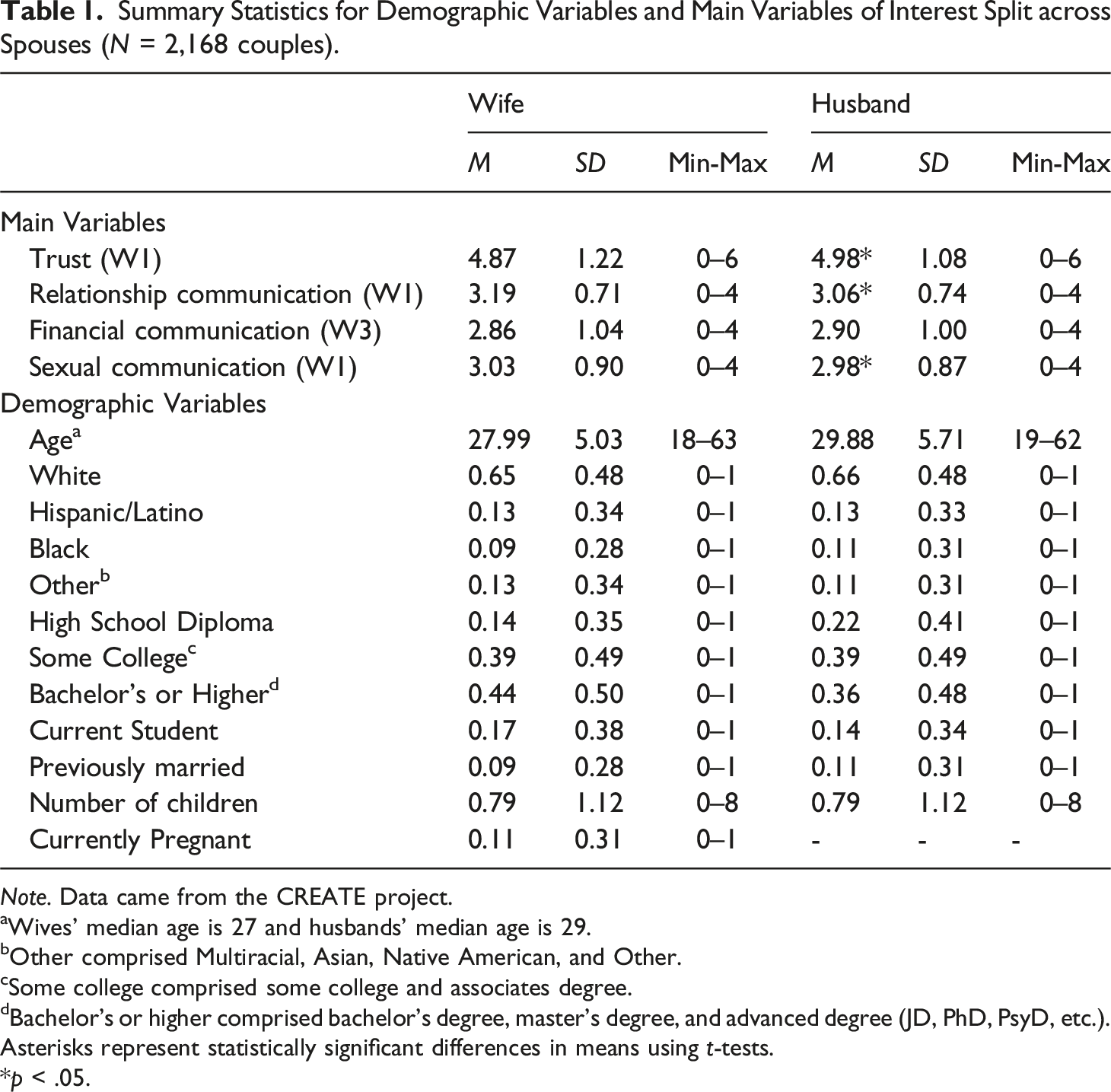
Summary Statistics for Demographic Variables and Main Variables of Interest Split across Spouses (N = 2,168 couples).
Note. Data came from the CREATE project.
aWives’ median age is 27 and husbands’ median age is 29.
bOther comprised Multiracial, Asian, Native American, and Other.
cSome college comprised some college and associates degree.
dBachelor’s or higher comprised bachelor’s degree, master’s degree, and advanced degree (JD, PhD, PsyD, etc.). Asterisks represent statistically significant differences in means using t-tests.
*p < .05.
Measures
Trust
Trust was measured using five items from Rempel et al.’s (1985) Trust Scale. The items were measured on 7-point Likert scale from 0 (Strongly disagree) to 6 (Strongly agree), and higher scores signified higher levels of trust in one’s partner. Example items include “I can rely on my partner to react in a positive way when I expose my weaknesses to him/her” and “I can rely on my partner to keep the promises he/she makes to me” (see Supplemental Materials for a list of all items). Reliability for the five items were acceptable for wives (W1 α = .87; W2 α = .89; W3 α = .90; W4 α = .89; W5 α = .89; W6 α = .89; W7 α = .90) and husbands (W1 α = .84; W2 α = .89; W3 α = .90; W4 α = .88; W5 α = .88; W6 α = .88; W7 α = .88).
General relationship communication
To measure relationship communication, we utilized a four-item scale (Busby et al., 2001, 2010), which indicated how well one perceived that they communicated in their relationship. Example items include: “I am able to listen to my partner in an understanding way” and “When I talk to my partner, I can say what I want in a clear manner.” Participants responded on a 5-point Likert scale ranging from 0 (Never) to 4 (Often), and higher scores denoted better general relationship communication. The five items achieved acceptable reliability for wives (W1 α = .86; W2 α = .84; W3 α = .84; W4 α = .83; W5 α = .81; W6 α = .84; W7 α = .82) and husbands (W1 α = .87; W2 α = .85; W3 α = .85; W4 α = .82; W5 α = .82; W6 α = .83; W7 α = .84).
Sexual communication
A two-item scale developed for the CREATE study was used to examine the quality of sexual communication. Participants were asked to answer on a 5-point Likert scale from 0 (Never) to 4 (Often) how much they agree with the following statements: “I talk openly with my partner about our sexual relationship” and “We are able to agree about what is acceptable in our sexual relationship.” Higher scores indicated greater quality sexual communication. Reliability for sexual communication was determined by calculating Pearson’s correlations because there were only two items. Correlations suggested acceptable or adequate associations for both wives (W1 r = .62; W2 r = .55; W3 r = .56; W4 r = .57; W5 r = .55; W6 r = .54; W7 r = .58) and husbands (W1 r = .56; W2 r = .57; W3 r = .50; W4 r = .51; W5 r = .47; W6 r = .56; W7 r = .52). Although a two-item measure was not optimal, there was adequate test-retest reliability for wives’ (r’s ranging from 0.54 to 0.62 from W1 to W7) and husbands’ (r’s ranging from 0.49 to 0.60 from W1 to W7) sexual communication.
Financial communication
Financial communication was a single-item measure developed for the CREATE study. The item asked, “How well are you and your spouse able to communicate about money?” Responses ranged from 0 (Extremely well) to 4 (Not well at all). This item was reverse coded so higher scores indicated better financial communication. We recognize that single items might not perform as well, psychometrically speaking, as multi-item scales. However, this single-item measure of financial communication has shown evidence of divergent validity from general relationship communication (Saxey et al., 2023); therefore, we assumed that this single item would adequately measure financially specific communication. Additionally, there was adequate test-retest reliability for wives’ (r’s ranging from 0.53 to 0.60 from W3 to W7) and husbands’ (r’s ranging from 0.55 to 0.61 from W3 to W7) financial communication.
Control variables
We controlled for variables that could confound the directionality analyses. All control variables were from Wave 1 and included the following: age, race, education, number of children, whether partners were in a same-sex relationship, and whether partners had been previously married. Age of both partners was coded continuously. Dichotomous variables were created for wives’ and husbands’ race indicating whether participants were White or another race/ethnicity (coded as 0 = all else, 1 = White). Education was measured for both partners as a dichotomous variable indicating whether participants had a Bachelor’s degree or higher (coded as 0 = all else, 1 = Bachelor’s degree, Master’s degree, and Advanced degree [JD, PhD, PsyD, etc.]). We also controlled for the number of children participants had (coded continuously) based on the wife’s response. Another control variable indicated whether either partner had been previous married. Participants were asked, “Not counting your current marriage, have you or your spouse been married before?” and responded Yes (1) or No (0). Lastly, we included a control variable for same-sex couples. This included couples where both partners reported their gender identity (at W1 or at W7) as “female”, both reported their gender identity (at W1 or W7) as “male”, or couples where either partner reported their gender identity as “other” (only at W7 because this was not an option at W1). Although it would be ideal to create separate variables for “same-sex female”, “same-sex male”, and “other” couples, cell sizes for these individual groupings were too small in this sample which is why they were combined into one variable.
Analytic approach
First, we estimated several preliminary analyses to explore connections between trust and general communication, trust and sexual communication, and trust and financial communication. Using Stata (version 18), paired sample t-tests were conducted to test for differences across spouses among main variables of interest, and bivariate correlations were examined to assess the connections between main variables of interest at baseline.
Following these preliminary analyses, measurement invariance tests were conducted in Stata (version 18) to examine whether husbands’ and wives’ latent constructs for trust and relationship communication appeared to be measuring the same thing (i.e., statistically measurement equivalent) across spouses at each wave and across time. All measurement invariance tests started with a configural model where the first latent mean was set at 0 and the first latent variance was set at 1, and factor loadings, intercepts, and error variances were freely estimated. Following the configural model, all factor loadings were constrained to be equal to test for weak measurement invariance (either across time or across spouses). If the CFI did not decrease by more than 0.01, strong measurement invariance was tested by also constraining parallel observed variable intercepts to be equal (Dyer, 2015). If the CFI did decrease by more than 0.01, then the least restrictive level of measurement invariance was assumed. If strong measurement invariance was achieved, strict measurement invariance was tested by also constraining parallel error variances to be equal using the same change in CFI criterion.
To estimate more parsimonious structural equation models, factor scores were saved for all latent constructs (trust, general communication) with constraints in place for the highest level of measurement invariance achieved (up to strong measurement invariance; Little, 2024). Due to the longitudinal nature of this study, factor scores were saved with measurement invariance constraints in place across time (e.g., both W1 and W2 saved in the first measurement invariance test, and following tests only saved the factor score for the next wave). Measurement invariance tests between spouses were only conducted to test for measurement differences between constructs across spouses.
Following these measurement invariance analyses, three separate actor-partner interdependence (APIM), cross-lagged panel models were estimated in Mplus (version 8.8) to examine the longitudinal associations between trust and different domains of couple communication. All endogenous variables were regressed on the control variables listed in the measures section, and Full Information Maximum Likelihood (FIML) was used to retain participants (thus, maximizing the sample size used in the analyses) and account for missing data in all models. Each model’s fit to the data was assessed using the Comparative Fit Index (CFI), Root Mean Square Error of Approximation (RMSEA), and Standardized Root Mean Squared Residual (SRMR) with Little’s (2024) recommendations for good (CFI > .95, and RMSEA/SRMR < .05) and acceptable (CFI > .90, and RMSEA/SRMR < .08) model fit in mind.
In the first model, wives’ and husbands’ trust and general communication were included at all seven waves. All trust and general communication variables were correlated between husbands and wives, and all exogenous variables were correlated with each other. Additionally, both actor and partner pathways between predictor (e.g., husbands’ and wives’ trust and general communication at Wave 1) and outcome variables (e.g., husbands’ and wives’ general communication and trust at Wave 2, respectively) were estimated in the model. Actor and partner pathways were estimated across one wave intervals between trust and communication for all seven waves. Stability coefficients were also included for trust and communication across one wave periods for all seven waves. To improve the fit of the model to the data, we also included statistically significant (p < .05) actor autoregressive paths across all seven waves. Thus, any statistically significant predictions in the endogenous variables represent relatively robust predictions of between-person changes. Because of the robust nature of the autoregressive paths, control variables, and estimating actor and partner paths in the same model, a statistically significant standardized regression coefficient—even with a small effect size (∼ .1; Cohen, 1988)—was considered practically significant. In the second model, the same model estimation pattern was followed, except that general communication was replaced by sexual communication, which was modeled as an observed variable. The third model followed the same pattern as the prior two models but with financial communication, which was also an observed variable, across the five waves of data from which that variable was available (W3 to W7).
As a post-hoc analysis, structural invariance testing was used to determine whether there were differences between wives’ and husbands’ structural paths using a series of Wald tests. Due to the large number of regression paths, we sought to do this systematically by (1) testing for differences across spouses for autoregressive paths across one wave (e.g., W1 to W2) one construct at a time (e.g., all trust paths, all communication paths), (2) autoregressive paths across more than one wave (e.g., W1 to W3) one construct at a time, (3) testing for differences across spouses among actor paths one wave at a time (i.e., simultaneously estimating the structural equivalence between W1 actor trust to W2 actor communication and W1 actor communication to W2 actor trust), and (4) testing for differences among partner paths one wave at a time (i.e., simultaneously estimating the structural equivalence between W1 actor trust to W2 partner communication and W1 partner trust to W1 actor communication). A non-statistically significant Wald test indicated that paths did not statistically differ across spouses.
Results
Descriptive statistics, bivariate correlations, and measurement invariance tests
Descriptive statistics can be seen in Table 1. Bivariate correlations among the observed main study constructs at baseline can be seen in Supplemental Table S1; all bivariate correlations between trust and the three measures of couple communication were statistically significant (p < .001) and in the expected direction (positive). In all but two instances for the latent constructs across time (see Supplemental Table S2 and Supplemental Table S3), the latent constructs achieved strict measurement invariance; in every instance, the latent constructs achieved at least strong measurement invariance. These measurement invariance findings provide compelling evidence that the latent constructs (trust and general communication) retained their conceptual meaning over time (i.e., appeared to be measuring the same construct across W1–W7) for both husbands and wives. As depicted in Supplemental Table S4, the trust latent construct achieved at least strong measurement invariance at six out of seven waves, which suggests that this construct usually appeared to measure a statistically similar construct for husbands and wives. Similarly, the general relationship communication latent construct achieved strict measurement invariance at six out of seven waves across spouses (see Supplemental Table S4); therefore, except at W1, general communication likely measured a statistically similar construct across spouses.
APIM, cross-lagged panel model of trust and general relationship communication
The trust and general relationship communication APIM, cross-lagged panel model fit the data appropriately (Little, 2024): CFI = .98; RMSEA = .02; and SRMR = .04. As seen in Figure 1, there were relatively consistent bidirectional actor effects for both husbands and wives—providing somewhat good support for H1 (bidirectional actor effects) in this model. This finding indicates that for both husbands and wives, trusting one’s spouse more at a previous time point predicts improvements in their own general relationship communication, and better general relationship communication at a previous time point simultaneously predicts improvements in their trust of their spouse. As seen in Supplemental Table S5, the actor structural invariance tests were largely non-significant, which provides general support for H3 (with very few differences across spouses manifesting). APIM, Cross-Lagged Panel Model of Trust and General Communication (N = 2,168 couples). Note. Data came from the CREATE project. Statistically significant (*p < .05; **p < .01; and ***p < .001), standardized regression coefficients are shown. HH: husbands’ actor effects (e.g., husbands’ W1 trust → husbands’ W2 relationship communication); WW: wives’ actor effects; HW: husbands’ partner effects (e.g., husbands’ W1 trust → wives’ W2 relationship communication); and WH: wives’ partner effects. Modeling the complex error structure, autoregressive pathways, and control variables pathways are not shown for parsimony. Ellipses represent latent variables saved as factor scores. Model fit: CFI = .98; RMSEA = .02; and SRMR = .04.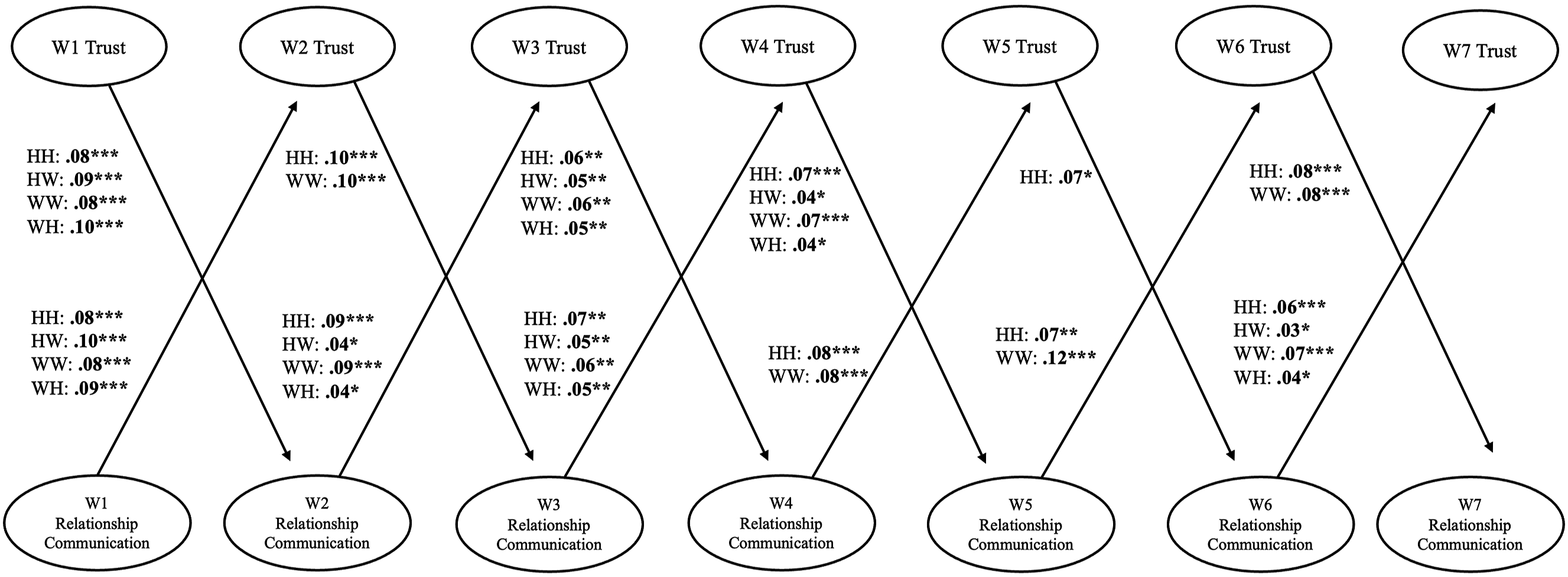
Although less than actor effects, there were still a notable number of statistically significant partner effects, providing some support for H2. The somewhat consistent partner effects denote that in some instances, a spouse’s trust in their partner can predict improvements in their spouse’s general relationship communication over time. Likewise, as a spouse uses better general relationship communication, this perception can also sometimes predict improvements in their spouse’s trust. As seen in Supplemental Table S5, there was no evidence for statistical differences in partner effects across spouses (H3).
APIM, cross-lagged panel model of trust and sexual communication
The fit of the second APIM, cross-lagged panel model to the data was either sound (CFI, RMSEA) or acceptable (SRMR; Little, 2024): CFI = .98; RMSEA = .03; and SRMR = .06. As depicted in Figure 2, there was only some evidence of bidirectional actor effects between trust of one’s spouse and sexual communication (H1). Relatively consistently, more actor effects from trust to sexual communication were statistically significant, which suggests that trust may predict improvements in sexual communication more consistently over time than sexual communication may predict improvements in trust over time. Nonetheless, there were a few instances, for both husbands and wives, where better previous sexual communication predicted more trust in one’s spouse over time. APIM, Cross-Lagged Panel Model of Trust and Sexual Communication (N = 2,168 couples). Note. Data came from the CREATE project. Statistically significant (*p < .05; **p < .01; and ***p < .001), standardized regression coefficients are shown. HH: husbands’ actor effects (e.g., husbands’ W1 trust → husbands’ W2 sexual communication); WW: wives’ actor effects; HW: husbands’ partner effects (e.g., husbands’ W1 trust → wives’ W2 sexual communication); and WH: wives’ partner effects. Modeling the complex error structure, autoregressive pathways, and control variables pathways are not shown for clarity. Ellipses represent latent variables saved as factor scores while rectangles represent observed variables. Model fit: CFI = .98; RMSEA = .03; and SRMR = .06.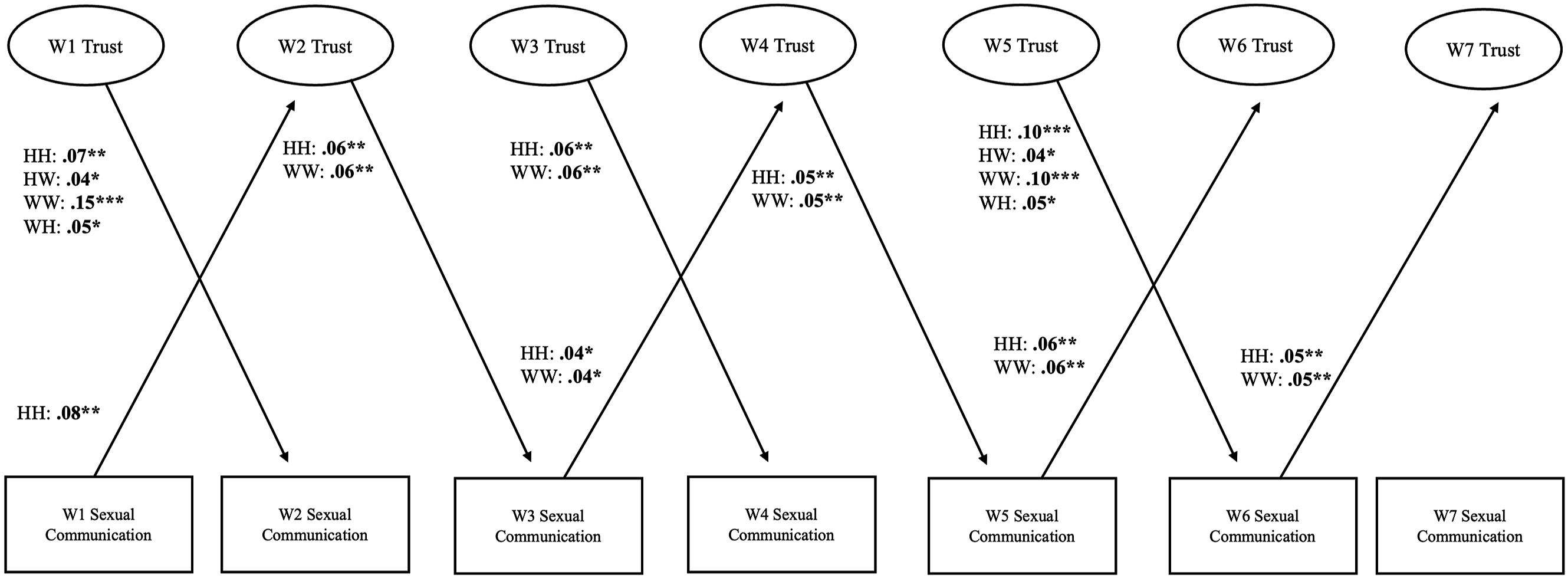
Like the first model, there was general support for statistically equivalent actor effects (H3). Also like the first model, there was one exception to this general trend (see Supplemental Table S5). H2 was not strongly supported, as very few partner effects were statistically significant. Indeed, the only statistically significant partner effects provided minimal evidence that one spouse’s trust could predict some improvement in their spouse’s sexual communication over time. Across the model, partner effects did not statistically differ across spouses (H3; see Supplemental Table S5).
APIM, cross-lagged panel model of trust and financial communication
The third APIM, cross-lagged panel model fit the data appropriately (Little, 2024): CFI = .98; RMSEA = .04; and SRMR = .05. As depicted in Figure 3, every actor effect in this model was statistically significant, which provided good support for H1. This is to say that for both husbands and wives, better previous trust of one’s spouse was related to improvements in their perception of financial communication in their marriage over time, and (simultaneously) better financial communication was related to improvements in trust of one’s spouse over time. Additionally, there was no evidence for statistical differences across spouses in the actor effects (H3; see Supplemental Table S5). Regarding H2, there was some evidence of partner effects—usually from trust to financial communication but also some partner effects from financial communication to trust. Thus, greater trust in one’s spouse (or financial communication) could predict improvements in their spouse’s financial communication (or trust of them). The partner effects were consistently statistically equivalent across spouses (H3; see Supplemental Table S5). APIM, Cross-Lagged Panel Model of Trust and Financial Communication (N = 1,612 couples). Note. Data came from the CREATE project. Statistically significant (*p < .05; **p < .01; and ***p < .001), standardized regression coefficients are shown. HH: husbands’ actor effects (e.g., husbands’ W1 trust → husbands’ W2 financial communication); WW: wives’ actor effects; HW: husbands’ partner effects (e.g., husbands’ W1 trust → wives’ W2 financial communication); and WH: wives’ partner effects. Modeling the complex error structure, autoregressive pathways, and control variables pathways are not shown for simplicity. Ellipses represent latent variables saved as factor scores, and rectangles represent manifest variables. Model fit: CFI = .98; RMSEA = .04; and SRMR = .05.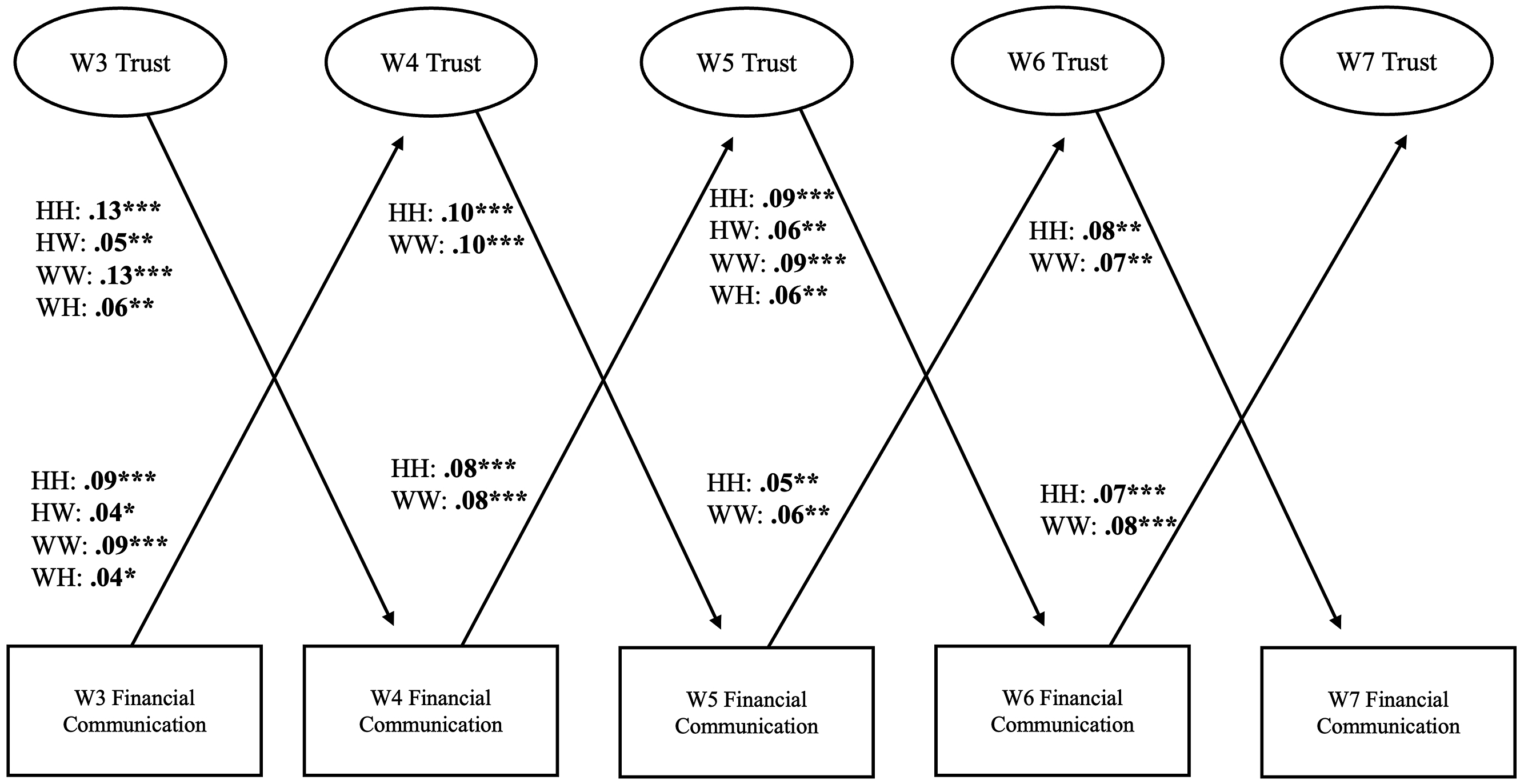
Discussion
Quality communication and a high degree of trust are essential for a relationship to thrive. Despite their importance, there is still a pressing need to understand the development of these integral aspects of relationships. Although scholars have theorized that the processes through which couples build trust and communicate are highly interconnected (e.g., Beck et al., 2024; Gottman, 2011; Huston, 2000; Leavitt & LeBaron-Black, 2025), few studies have empirically tested whether this is the case. Prior studies seeking to examine similar patterns used very few waves of data (e.g., Miller & Rempel, 2004) or used daily diary methodologies (e.g., Campbell et al., 2010). Although these are robust and important designs, the lack of longitudinal examinations of these processes across several years limits our understanding of how trust and communication may influence each other across extended periods of time. Indeed, studying the development of these processes across the first several years of marriage is particularly salient for this field of research, not only due to the longitudinal design of this study, but also because the newlywed transition is a period where many couples have to renegotiate relational norms (Solomon et al., 2016) and have a high degree of variability in their relationship satisfaction (Joiner et al., 2023), which could highlight the development of these processes in important ways. To address these gaps in prior research, this study used seven years of data from a nationally representative sample of newlywed couples to examine the bidirectional associations between trust and three distinct types of communication: general relationship communication, sexual communication, and financial communication.
In general, the findings from this study align with ideas proposed by other relationship scholars (e.g., Beck et al., 2024; Gottman, 2011) and indicate that at least for general relationship communication and financial communication, trust and communication appear to have a bidirectional association across time. These results are consistent with ideas proposed in the Money and Sex Model (Leavitt & LeBaron-Black, 2025) and prior work indicating that pro-relationship behaviors were associated with partners’ greater trust (Wieselquist et al., 1999) and that trust was linked with better communication patterns (Balliet & Van Lange, 2013; Campbell et al., 2010). Ultimately, these bidirectional effects underscore the importance of starting a marriage with a high degree of trust and quality communication behaviors, which could maintain and potentially improve communication and trust over time.
It should be noted that a unique yet important element of this study was the exploration of different topics of communication in relation to trust. Past research has found that the quality of communication has been shown to differ based on the topic of conversation (Weber et al., 2023; Williamson et al., 2013), yet very few studies have explored how different topics of communication differentially impact relationship outcomes (Weber et al., 2023). Although this study could not include all types of communication in the same model (which would indicate whether each type of communication uniquely explained variance in trust), our findings do highlight distinct patterns between trust and different topics of communication. General relationship communication and financial communication were fairly similar in terms of their associations with trust, demonstrating bidirectional associations between trust and communication across time. Given that financial communication often alludes to underlying relational issues (LeBaron-Black et al., 2024; Shapiro, 2007), it follows that levels of trust would impact financial communication. Given that financial communication often feels sensitive and vulnerable (Atwood, 2012; Leavitt & LeBaron-Black, 2025), it also follows that high-quality financial communication would engender trust.
However, these patterns differed when it came to the associations between trust and sexual communication. It was mostly a sense of trust that predicted better-quality sexual communication across the first few years of marriage, but towards the last few years examined in this study, sexual communication started to become a stronger predictor of increases in trust. It makes sense that an atmosphere of trust would be important for partners to open up about their sexual relationship, considering the high levels of threat inherent in sexual communication (Rehman et al., 2019) and the vulnerability that is required for quality sexual communication to take place (Montesi et al., 2011). Although both financial and sexual communication can be vulnerable (Atwood, 2012), the associations between trust and sexual communication may be distinct from financial communication because although conversations about money may elicit strong emotions, money (unlike sex) might not involve a complexity of hormones, which contribute to a strong intrinsic motivation for sexual experiences (Baumeister et al., 2001). Additionally, studies have primarily used sexual communication as a predictor of relationship or sexual satisfaction (Mallory, 2022; Roels et al., 2022), but the current study suggests that other relationship factors should also be considered as predictors of sexual communication. In sum, these findings about trust and sexual communication underscore the vital importance of a strong foundation of trust for partners to be willing to explore the deeper and more intimate parts of their relationship through sexual communication, especially in the first years of marriage. Moreover, once couples have built a strong foundation of trust, it appears that one’s sense of trust can be nurtured and expanded through a continuation of quality sexual communication.
Limitations, future directions, and implications
The current study provided important insight into the longitudinal connections between trust and couple communication, but there were several limitations. First, although this study is not causational, rigorous longitudinal analyses were implemented to get as close to causation as possible. Additionally, the Cross-Lagged Panel Model has received criticism for not distinguishing between within- and between-person effects (Mund et al., 2024), and it should be clarified that the analyses in this study largely captured between-person change. Thus, future research should also consider exploring similar patterns among trust and communication using methods that better capture within-person change. Although changes in general communication behaviors across the first several years of marriage have been examined in prior research (e.g., Williamson, 2021), little is known about how the quality of different topics of communication change across time, which could be an important avenue for future research. The CREATE study is a nationally representative study of over 2,000 newly married (mostly different-sex) couples, but the results may not be generalizable to other types of couples, such as dating, cohabiting, or same-sex couples. Some additional factors, such as gender identity or disability status, were not included in this study and should be potential covariates in future studies. In Wave 1, participants only reported their gender identity as male or female; gender identity at other waves is available upon request. Additionally, future research could continue to examine these associations earlier in the relationship development process, such as during relationship initiation and dating. During the early stages of relationships, relationship processes can be more diagnostic (e.g., Selcuk et al., 2024) as couples do not have much experience communicating and interacting. Thus, perhaps during relationship initiation and dating phases, communication would be a stronger predictor of trust than vice versa.
One of the most notable limitations and avenues for future research has to do with the measures for financial and sexual communication, which were one or two-item measures that only assessed partners’ overall satisfaction with or quality of communication. Although this can provide an idea of how well couples are communicating about these topics, there is a lot more nuance in these types of communication that could be examined. For instance, measures that capture the behaviors of both partners could provide more tangible evidence of how actor behaviors are associated with both partners’ outcomes as compared to perceptions of the quality of communication. It could also be interesting to capture the degree to which couples agree about the quality of their communication, which could potentially be very different between partners and could uniquely predict relationship outcomes. Additionally, other methodologies such as observational data or daily diary surveys could provide a better understanding of the connections between specific communication behaviors and trust in a more direct way (e.g., during an observational conflict discussion) or on a daily level, rather than looking at the levels of trust and communication across one-year intervals.
This study also has significant implications for couples and practitioners. For therapists who are helping newly married couples develop better communication patterns, the findings suggest that identifying areas in which partners could build trust in each other could help facilitate better communication patterns. Additionally, for newly married couples struggling to trust each other, strengthening their communication behaviors (particularly general relationship and financial communication) could help partners understand each other and develop a stronger sense of trust.
Supplemental Material
Supplemental Material - Can i trust you? Bidirectional, longitudinal associations between trust and various topics of couple communication
Supplemental Material for Can i trust you? Bidirectional, longitudinal associations between trust and various topics of couple communication by Ashley Forbush, Ashley B. LeBaron-Black, Matthew T. Saxey, Sofia Suxo-Sanchez, Erin K. Holmes and Jeremy Yorgason in Journal of Social and Personal Relationships
Footnotes
Author’s contributions
AF conceived of the study, designed the study, conducted main analyses, and drafted the manuscript; ALB and MT jointly drafted the manuscript; SS jointly drafted the manuscript and conducted descriptive analyses; JY and EH revised previous versions of the manuscript. All authors read and approved the final manuscript.
Declaration of conflicting interests
The author(s) declared no potential conflicts of interest with respect to the research, authorship, and/or publication of this article.
Funding
The author(s) received no financial support for the research, authorship, and/or publication of this article.
Open research statement
As part of IARR’s encouragement of open research practices, the authors have provided the following information: This research was not pre-registered. The data used in the research are not available. The materials used in the research are available. The materials can be obtained by emailing:
Ethical statement

Data Availability Statement
This study was not preregistered. The manuscripts data will not be deposited. Analysis code is available through email with the corresponding author.
Supplemental Material
Supplemental material for this article is available online.
References
Supplementary Material
Please find the following supplemental material available below.
For Open Access articles published under a Creative Commons License, all supplemental material carries the same license as the article it is associated with.
For non-Open Access articles published, all supplemental material carries a non-exclusive license, and permission requests for re-use of supplemental material or any part of supplemental material shall be sent directly to the copyright owner as specified in the copyright notice associated with the article.
