



Abstract
Expressions of gratitude are associated with many benefits in the context of social relationships. Indeed, Algoe’s (2012) find-remind-and-bind theory of gratitude proposes that expressions of gratitude serve the innately relational function of finding and drawing people closer to responsive relationship partners. Despite this prior work demonstrating the importance of gratitude to relationships, no prior research or theory has considered how a partner’s expressions of gratitude may influence the self. Based on sociometer theory (Leary, 1999, 2021), we hypothesized that partner expressions of gratitude signal relational value, thereby predicting enhanced self-esteem for the target of gratitude expressions. To test this novel proposition, we drew upon two archival studies. Study 1 used 11 years of longitudinal data in which 4,990 individuals (k = 33,846) in committed relationships reported on their partner’s expression of gratitude and their self-esteem at yearly intervals. In Study 2, undergraduate students (N = 119 people and k = 891) completed a 10-day diary survey in which they reported on a romantic partner or close other’s gratitude expression, their self-esteem, and their feelings of relational value. In both studies, greater partner expressions of gratitude were associated with greater self-esteem at the within- and between-person levels, even controlling for prior wave levels of self-esteem. Moreover, in Study 2, greater perceived relational value mediated the association between greater daily partner expressions of gratitude and greater daily self-esteem. These results provide initial evidence that gratitude expressions not only function to guide people to more meaningful relationships, but are also associated with enhanced relational value, and therefore greater self-esteem.
Introduction
When it comes to social relationships, a little appreciation goes a long way. Indeed, expressions of gratitude are associated with many relational benefits, such as increased relationship satisfaction, commitment, and greater intrinsic motivation for prosocial behavior within the relationship (Algoe, 2012; Algoe et al., 2008, 2010; Algoe & Haidt, 2009; Park et al., 2019). Moreover, according to the find-remind-and-bind theory of gratitude (Algoe, 2012), the social function of gratitude is to guide people towards finding, maintaining, and keeping responsive relationships (Algoe, 2012; Algoe et al., 2008).
Although extensive work has established that gratitude expressions beneficially influence relationships, no prior work has examined how they may influence the self. The sociometer theory of self-esteem states that an individual’s self-esteem is a function of one’s perceived relational value to significant others (Leary, 1999, 2005, 2021). While extensive research based on sociometer theory has examined how broad feelings of social inclusion or exclusion contribute to self-esteem (e.g., Mahadevan et al., 2019; Murray et al., 2003), prior studies have scarcely examined how specific relationship behaviors or interactions promote or undermine self-esteem. This is a notable omission given the diverse patchwork of key social behaviors and interactions that have been extensively studied within the literature on close relationships (e.g., conflict, social support, positive interpersonal processes; Algoe, 2012; Don & Hammond, 2017; Overall & McNulty, 2017). Here, we extend the find-remind-and-bind theory of gratitude (Algoe, 2012) by proposing that expressions of gratitude not only serve the function of alerting people to responsive others; they also signal to the individual their own relational value in the context of close relationships (i.e., they signal to the individual that they are accepted and valued by a close other). As such, we hypothesized that partner expressions of gratitude would be associated with greater individual self-esteem, and that this association would occur even while controlling for other important relationship behaviors. To examine these ideas, we drew on two studies: one longitudinal study in which participants reported on partner expressions of gratitude and self-esteem across 11 waves of data collection, and one daily diary study of university students in which participants reported partner gratitude, feelings of relational value, and self-esteem for 10 days.
Gratitude and its social functions
When it comes to close relationships, gratitude contributes to many benefits. Algoe’s (2012) find-remind-bind theory has guided much of the research examining gratitude in close relationships, and according to this theory, gratitude serves the critical social function of alerting people to the presence of caring, understanding, and validating (i.e., responsive) relationship partners. Moreover, find-remind-and-bind theory suggests this social binding function of gratitude applies to both the experience of gratitude for a partner, and partner expressions of gratitude for us.
Consistent with the find-remind-and-bind model, empirical research demonstrates that partner expressions of gratitude promote (a) perceived partner responsiveness, and (b) numerous other beneficial relationship outcomes. For instance, Algoe et al. (2013) demonstrated that when individuals engaged in a laboratory-based expression of gratitude, it uniquely predicted the recipient’s perceived partner responsiveness, which then contributed to improvements in relationship quality over 6 months. Similarly, expressions of gratitude can act as a “booster shot” to close relationships by contributing to increases in feelings of relationship quality in everyday life (Algoe et al., 2010). These findings are consistent with numerous other studies that document the relational benefits of gratitude (e.g., Gordon et al., 2012; Park et al., 2019).
Despite extensive work demonstrating the relational benefits of gratitude, little prior research has examined how expressions of gratitude in relationships influence the self. Given that self-esteem is inextricably linked with, and influences, social connections (Harris & Orth, 2020), there is good reason to suspect that gratitude in relationships also influences self-esteem. In what follows, we integrate find-remind-and-bind theory with a prominent model of self-esteem – sociometer theory – to suggest that another important function of partner expressions of gratitude is to signal relational value, thereby promoting self-esteem. Examining this has important theoretical implications for understanding the function of gratitude expressions in social interactions: prior research has, understandably, almost exclusively focused on the relational benefits and outcomes of gratitude expressions (e.g., Algoe et al., 2013; Gordon et al., 2012; Park et al., 2019). Demonstrating that the benefits of gratitude expressions extend to self-evaluations would advance existing work by suggesting that gratitude contributes to how people experience and evaluate the self. Such evidence would represent an important extension to existing theories of gratitude (Algoe, 2012), suggesting that the function of gratitude is not exclusively relational, but may also influence how people view and construct the self themselves.
Self-esteem and sociometer theory
Self-esteem, which is a person’s evaluation of their own self-worth, is closely connected to our interpersonal relationships (Leary & Baumeister, 2000). Leary’s (1999, 2005, 2021) sociometer theory posits that (a) humans have a fundamental need to belong and connect with people in the social environment, and (b) self-esteem operates much like a gauge or a meter that fluctuates based on social environmental cues of one’s own relational value (i.e., worth to others). Events that people perceive to lower relational value, such as rejection or ostracism, theoretically decrease the sociometer, and therefore one’s self-esteem. By contrast, positive social events, such as acceptance and positive evaluations of the self by others, increase perceived relational value to others, increasing the sociometer and thus, self-esteem.
Extensive research has examined the propositions of sociometer theory, and demonstrated that self-esteem is indeed closely linked to social inclusion (or exclusion) generally, and indicators of relational value specifically (Gerber & Wheeler, 2009; Leary, 2021). For instance, in daily studies, participants’ reports of social inclusion correspond their daily experience of self-esteem (e.g., Mahadevan et al., 2020; Murray et al., 2003). Experimental studies have similarly demonstrated that enhanced relational value causes increases in self-esteem (Blackhart et al., 2009; Leary, 2021). As such, existing evidence provides support for sociometer theory in suggesting that self-esteem is closely linked to cues to an individual’s relational value.
It is important to note that sociometer theory is not the only perspective on the factors that contribute to self-esteem. For instance, scholars have proposed other factors - such as social status - as key contributors to self-esteem, with some empirical support (Mahadevan et al., 2019, 2020). Moreover, other researchers have questioned whether self-esteem is truly an outcome of healthy social relationships, as sociometer theory proposes (e.g., Sorjonen et al., 2023). Despite these alternative perspectives, an extensive body of experimental and longitudinal literature supports the propositions of sociometer theory, demonstrating that social relationships and social acceptance are focal contributors to self-esteem (Harris & Orth, 2020; Leary, 2021).
Understanding sociometer theory in ongoing relationships: The role of gratitude expressions
Although existing research has provided extensive support for the broad notion that relational value contributes to self-esteem, extant research is noticeably lacking in understanding how specific positive relationship experiences and interactions predict self-esteem in everyday life. That is, almost all of the existing studies have examined the influence of relationships on self-esteem via experimental manipulations of social acceptance (or rejection; see Blackhart et al., 2009 for a review), or via broad or aggregated assessments of social inclusion that do not isolate the specific behaviors that contribute to the experience of relational value in everyday life (e.g., Mahadevan et al., 2020; Murray et al., 2003). For instance, consider a daily diary study by Mahadevan et al. (2020), where participants were asked to complete (among other measures) a daily assessment of their general sense of social inclusion, with items such as “most of the time I feel that people…” “…like me as a person”, and “…feel warmly towards me”. While this measure was (a) robustly linked to self-esteem in daily life, and (b) conceptually links to the individual’s broad sense of relational value discussed in sociometer theory, it overlooks the important following question: what, exactly, is happening in key social relationships that contributes to individuals feeling accepted and valued in everyday life? That is, by using these types of broad assessments of social inclusion or exclusion, the extant literature lacks understanding as to how specific positive relationship behaviors and interactions may contribute to feelings of relational value, and therefore self-esteem. Gratitude is an “other-elevating” emotion (Algoe & Haidt, 2009), one which signals that a partner cares, validates, and understands the individual (i.e., values them; Algoe, 2012). As such, we believe that partner expressions of gratitude are a specific, positive relationship behavior that may enhance feelings of relational value, thereby promoting self-esteem.
Importantly, we believe that partner expressions of gratitude are associated with benefits to the self that cannot be reduced to other key relationship behaviors and experiences. As such, we hypothesized that partner expressions of gratitude would be associated with greater self-esteem (via enhanced relational value), even while statistically controlling for other relationship interactions. In this research, when examining the association between partner gratitude and self-esteem, we statistically account for two types of other relationship experiences: relationship conflict and other positive relationship interactions. With respect to conflict, it is possible that the presence of gratitude interactions merely reflects the absence of conflict in one’s relationships, thus explaining why gratitude is associated with relational benefits. Given that prior research has demonstrated that conflict robustly predicts lower self-esteem (e.g., Murray et al., 2003), it is important to demonstrate that the association between partner gratitude and greater self-esteem occurs beyond any link between relationship conflict and self-esteem.
In addition, given that prior research has demonstrated that positive relationship experiences tend to generally be associated with better self-esteem, our goal was to show that the link between partner gratitude and better self-esteem cannot be reduced to other positive relationship experiences. As such, (where possible) we also statistically controlled for other positive relationship experiences, including capitalization (Gable et al., 2006) and shared laughter (Kurtz & Algoe, 2015). If gratitude is associated with greater self-esteem even while statistically accounting for these other positive relational experiences, it suggests that the association between greater partner expressions of gratitude and greater self-esteem is not reducible to these other behaviors, or merely a function of having more positive relational interactions overall.
Gratitude and self-esteem in daily life at the between- and within-person levels
To examine the possibility that partner expressions of gratitude would be associated with greater self-esteem, we felt it was especially important draw on longitudinal data, because longitudinal data allows for disaggregating between- and within-person variability in the variables of interest. Prior research demonstrates that while people tend to have a global sense of whether their partner appreciates them, expressions of gratitude tend to fluctuate within-persons throughout the course of daily life (e.g., Algoe et al., 2010; Don, Eller, et al., 2022, Don, Fredrickson, & Algoe, 2022). Similarly, extensive research documents that while individuals tend to have a global, person-level experience of self-esteem, people also experience fluctuations in self-esteem throughout the course of everyday life, and across the course of time (e.g., Heppner et al., 2008; Orth & Robins, 2014). Indeed, sociometer theory suggests that state self-esteem reflects the individual’s response to environmental feedback in a particular moment or situation, whereas trait self-esteem reflects the person’s overall sense of self-worth depending on accumulated past interpersonal experiences (Leary, 2012). As such, a between- and within-person perspective is needed to encapsulate the everyday experience of both gratitude expressions and self-esteem. We hypothesized that partner expressions of gratitude would predict greater self-esteem at both the between- and within-person levels. Specifically, we predicted greater than usual gratitude at a particular time point would be associated with greater than usual self-esteem at that same time point, reflecting the sensitivity of state self-esteem to the current environment. We also predicted greater between-person gratitude would predict greater between-person self-esteem, reflecting the association of accumulated experiences of partner gratitude and self-esteem at the global level. We also predicted that greater partner expressions of gratitude would predict greater feelings of relational value at both the between- and within-person levels, which would mediate the between and within-person associations between partner expressions of gratitude and self-esteem.
In examining these within- and between-person associations, it is important to acknowledge the potential for bi-directionality. Prior research demonstrates that people with higher self-esteem tend to see their partners through “rose-colored classes”, viewing them in a more positive light as compared to people with lower self-esteem (e.g., Murray et al., 2001). Because of this, in each of the analyses, we controlled for prior wave levels of self-esteem, to demonstrate that partner gratitude at the between and within-person level was associated with enhanced self-esteem even when accounting for whether the individual tended to already have high levels of self-esteem (Bolger & Laurenceau, 2013). 1
Relationship type and age as a moderators
Most research on gratitude has examined the nature and function of gratitude expressions in the context of romantic relationships (e.g., Algoe et al., 2010; Visserman et al., 2018). Despite this, some work has demonstrated that gratitude confers relational benefits within the context of other relationship types, such as friendships (Algoe et al., 2008). Furthermore, research suggests that different relationship types can have different consequences for self-esteem, such as one study which found that friendships did not contribute as strongly to self-esteem as marriage (Voss et al., 1999).
In light of the above literature, a secondary goal in this work was to explore whether gratitude expressions from different relationship partners contribute to self-esteem in different ways. Based on the prior literature, we suspected that partner expressions of gratitude would tend to be broadly associated with better self-esteem regardless of the relationship type, although we note some research suggesting that romantic relationships may be particularly salient to judgments of self-esteem (e.g., Voss et al., 1999).
Additionally, theory and prior research demonstrate that self-esteem is sensitive to age (e.g., Orth et al., 2018), meaning it is possible that the association between partner gratitude expressions and self-esteem may be different depending on age. As such, in addition to relationship type as a moderator, we also examined whether the age of the individual who was the target of the gratitude expression moderated the association between partner expressions of gratitude and self-esteem.
The current study
The current study investigated how expressions of gratitude in close relationships were associated with individual self-esteem via the mediating mechanism of greater relational value in two longitudinal studies. In Study 1, we used the German Family Panel study (Pairfam), a longitudinal panel study of German families in which participants reported on partner gratitude and self-esteem on an annual basis across time. We used 11 waves of the Pairfam data (N = 4,990, k = 33,846) to examine whether partner gratitude predicted individual self-esteem at the within- and between-person levels. Study 2 was a 10-day diary survey completed by undergraduate students (N = 119 people and k = 891 observations). We examined whether daily gratitude was associated with greater daily self-esteem, via greater daily relational value, while controlling for a number of confounds. We also examined relationship type and age as a moderators.
Study 1
Method
Procedure
We used data from the publicly-available Pairfam study, release 13.0 Brüderl et al., (2023). Pairfam is a longitudinal, nationally-representative study of German families, funded by the German Research Foundation. The study includes focal (also called “anchor”) participants, their partners, and starting in wave 2, the children of the focal participants. Because we were interested in how reports of partner gratitude contributed to individual self-esteem, anchor participants from the base sample were the focus of our analyses. Starting in 2008, the study enrolled 12,402 anchor participants from three age cohorts: ages 15–17, ages 25–27, and ages 35–37. Data from anchor participants was gathered annually via computer assisted personal interviews and (for sensitive questions) computer assisted self-interviews. All participants provided informed consent for their participation in Pairfam, and further information can be obtained the study’s website: https://www.pairfam.de/.
Participants and materials
We conducted analyses using anchor participants from the Pairfam base sample from Waves 1–11 who had at least 3 complete waves of data on (a) partner gratitude, (b) self-esteem, and (c) relationship conflict. Across the 11 waves of data collection, the final sample for analyses included N = 4,990 participants, and k = 33,846 observations. At first wave of data collection, the average age of participants was 26.87 (SD = 8.38). Participants identified as 43.3% men, and 56.7% as women. With respect to ethnicity, 84.3% identified as German native or ethnic German, 5.8% as half German, 2.7% came from a Turkish background, and 7.3% were from another non-German background. Depending on the wave of data collection (e.g., at Wave 11), the majority of participants were either married and cohabitating (53.4% of participants at Wave 11), not married but cohabitating (21.5% of participants at Wave 11), or living apart but in a committed relationship (10.0% at Wave 11). With respect to sexual orientation, 99.0% identified as straight, 0.4 identified as gay, and 0.6% identified as lesbian. The average household net income for the sample was M = 2,763.86 Euros (SD = 1,444.77). All data was collected in Germany.
Partner gratitude
Participants reported how often their partner demonstrated appreciation by answering an item which was adapted from the Network of Relationships Inventory (NRI; Furman & Buhrmester, 1985). The item was: “How often does [your partner] show that he/she appreciates you?”, and participants answered on from 1 = Never to 5 = Always. 2
Self-esteem
Self-esteem was assessed using three items which were based on the Rosenberg (1965) self-esteem scale. Participants responded a scale from 1 = Not at all to 5 = Absolutely to the following three items: “Sometimes I believe that I’m worthless”; “I like myself just the way I am”; and “All in all, I am pleased with myself.” Internal consistencies at each wave of data collection ranged from Macdonald’s ω = .70 to ω = .81.
Conflict
To assess conflict, participants completed two items also drawn from a subscale of the NRI. The items were “How often do you and your partner disagree and quarrel?” and “How often are you and your partner annoyed or angry with each other?” and participants completed the items on a scale from 1 = Never to 5 = Always. Bivariate correlations between the two items at each wave ranged from r = .61 to r = .72.
Analytic strategy
Syntax for analyses from Study 1 are posted on the Open Science Framework (OSF) page for this paper at the following link: https://osf.io/rsvb5/?view_only=45d432ae8a424b78b680c8bcdd3a5024. Although the Pairfam data are available to the public, the study’s data sharing agreements allow only licensed users to access the data, meaning we are not able to share our analysis data publicly on the OSF page for this study. Prior to conducting any analyses, we preregistered a secondary data analysis plan, which can be viewed at the following link: https://aspredicted.org/bktv-48m3.pdf. To test our hypotheses, we conducted an aggregated, multilevel analysis which utilized the longitudinal data to examine whether reports of partner gratitude at a particular wave (i.e., year) predicted self-esteem at the same wave. In addition, we included a number of covariates in the model. Specifically, we controlled for (a) prior wave self-esteem, (b) reports of partner conflict, (c) the wave of data collection, and (d) the gender of the individual providing the reports. Consistent with recommendations for longitudinal multilevel analyses (e.g., Bolger & Laurenceau, 2013), we also disaggregated within- and between-person effects for (a) gratitude, and (b) partner conflict in the analyses. Prior wave self-esteem was grand mean centered. The model included random intercepts, as well as random slopes for the within-person gratitude variable, within-person conflict, and prior wave self-esteem. We specified an unstructured covariance structure for the random term, and an autoregressive covariance structure for the repeated term, however if the model failed to converge, we reverted to an identity covariance matrix. We calculated r values as estimates of effect sizes for individual coefficients based on the method used by Kashdan and Steger (2006): r = √(t2/t2+df). All analyses in both studies were conducted using SPSS version 29.
Although we originally pre-registered that we would utilize 13 waves of the Pairfam data, we ultimately chose to use 11 waves of data, because data collection at wave 12 was interrupted by COVID, resulting in a change in methodology for many participants enrolled in Pairfam. Because this may have introduced additional complication and variance into the survey, we felt 11 waves of data was sufficient for our analyses.
We calculated post-hoc power using the summary-statistics-based power calculator provided by Murayama et al. (2022). Murayama et al. (2022) have argued that, in many cases where two-level multilevel models are specified, estimates of statistical power can be calculated using relatively simple summary statistics, as opposed to more laborious and information intensive methods, such as Monte Carlo simulation. Consistent with this approach, we used the estimates of effect size obtained from the results of our two-level multilevel model (presented below) to determine whether the between- and within-person coefficients were adequately powered in the analyses. Based on the effect sizes obtained in our analysis and 6.78 observations per person, the within-person finding (which was a small to medium-sized effect) would have reached a power of .80 with a sample of 268 people. Given our sample included 4,990 people, the within-person finding was well-powered. Similarly, based on the effect size for the between-person finding (which was a medium-sized effect), a summary-statistics-based power analysis suggested only 225 participants would be needed to achieve a power of .80, meaning this study was well-powered to detect this medium-sized effect. Reliability statitics for multi-item measures were calculated using the SPSS OMEGA macro provided by Hayes and Coutts (2020). For two-item meausures, we present bivariate correlations between the items.
Missing data
As in most longitudinal studies, there was some degree of attrition from one wave to another in the Pairfam study, ranging from 5%-23% depending on the wave. To account for missing data in the longitudinal study, we used full information likelihood estimation (FIML) in all analyses. Missing data, including differential attrition in longitudinal research introduces potential bias into estimates. Research in the quantitative literature suggests that in situations where missing data are present, FIML produces less biased standard errors, and therefore more accurate inferential statistics (Schlomer et al., 2010).
Almost of all the missing data in Study 1 was due to wave missingness, or because participants only completed some of the waves of data collection in the Pairfam study. Specifically, 25.0% of participants completed all 11 waves, 7.7% completed 10 waves, 12.1% completed 9 waves, 8.7% completed 8 waves, 9.8% completed 7 waves, 10.1% completed 6 waves, 12.1% completed 5 waves, and 14.5% completed 4 waves of data collection. When participants did complete a particular wave of data collection, item missingness (i.e., participants not completing measures at that wave) tended to be very small. For instance, item missingness was 0.30% for participants who completed 4 waves of data collection, and 0.60% for participants who completed 11 waves of data collection. As mentioned above, we used FIML estimation in our multilevel analyses to address missing data.
Results
Bivariate correlations for primary study variables in study 1.
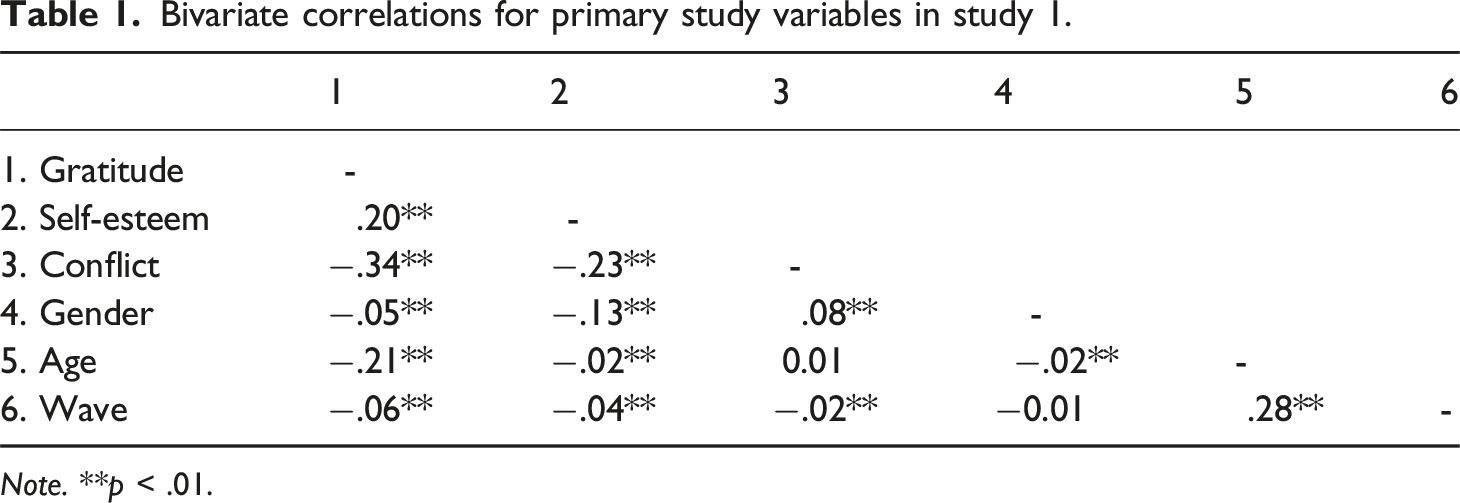
Note. **p < .01.
Results of a multilevel analysis examining whether partner gratitude predicts individual self-esteem in study 1.
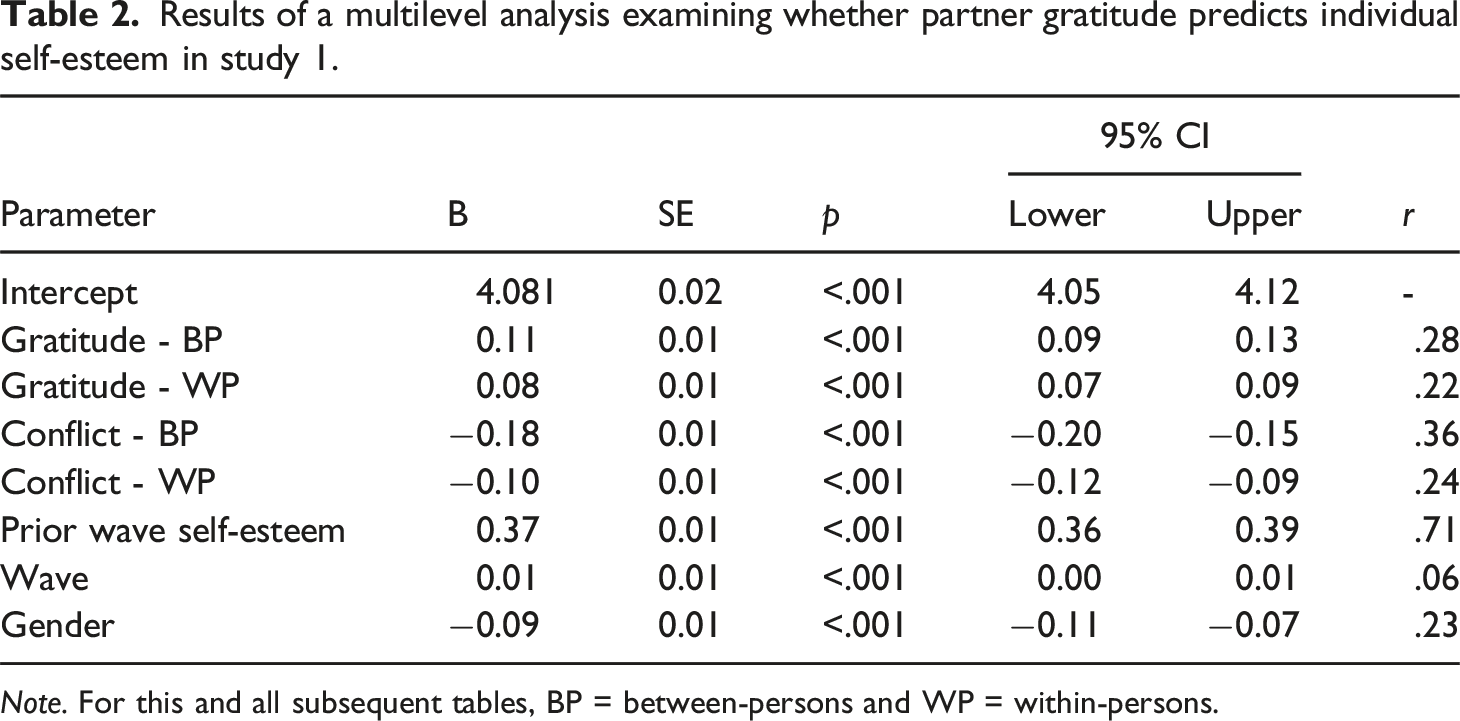
Note. For this and all subsequent tables, BP = between-persons and WP = within-persons.
Results of analyses examining age as a moderator are presented in Supplemental Table 2. The interactions between age and partner gratitude at the within- and between-person level were both statistically significant. As shown in Supplemental Table 2, although partner gratitude was highly significantly associated with greater self-esteem at the between and within-person levels for both older and younger participants, the between-person link between partner gratitude and self-esteem was stronger for younger participants, whereas the within-person association was stronger for older participants.
Study 1 discussion
Using a sample of 4,990 people (k = 33,846 observations) who reported on their relationship with their partner from up to 11 waves of longitudinal data collection, we found initial support for our hypotheses. Specifically, at the between-person and within-person levels, greater partner gratitude was associated with greater self-esteem. Both of these findings were true when controlling for conflict, prior wave self-esteem, gender, and the wave of data collection, which were all robustly associated with self-esteem.
Although Study 1 provides robust initial evidence for the proposition that partner gratitude is associated with greater self-esteem at the between- and within-person levels, we were unable to test numerous aspects of our research questions due to the nature of the Pairfam data. For instance, the Pairfam data did not include an assessment of participants’ feelings of relational value, meaning we could not examine the theorized indirect association of partner gratitude → greater relational value → greater self-esteem. Moreover, although we were able to demonstrate that partner gratitude was associated with self-esteem while accounting for relationship conflict in Study 1, in Study 2 we wanted to ensure that gratitude still significantly predicted daily self-esteem while controlling for other positive relational processes. In Study 2 we examined relational value as a mediator, and conducted analyses where we controlled for capitalization and shared laughter. Additionally, in Study 1 participants were exclusively in romantic relationships, whereas Study 2 included participants in many types of relationships. This allowed us to examine relationship type as a potential moderator of the daily link between partner gratitude and self-esteem.
Study 2
Method
Participants
Participants were undergraduate students from a university in Auckland, New Zealand. They were recruited as part of an assignment for course credit in which they completed daily reports about a close relationship in everyday life. 47.9% of the participants were involved in a romantic relationship at the time of the study, and 52.1% of the participants were not. Participants who reported about a non-romantic relationship instead reported on their relationship with a friend (48.5%), a parent (33.0%) or a sibling (18.4%). The relationship status of the participants in a romantic relationship were as follows: 70.1% = serious romantic relationship, 22.8% = steady relationship, 5.3% = married, and 1.8% = casual relationship.
Participants identified as New Zealand European (41%), followed by Asian (19.7%), Māori (9.4%), Indian (6.8%), Pacific (9.4%), or other ethnicities (20.5%). Participants could identify as more than one ethnicity, which is why these percentages do not add to 100%. With respect to gender, 79% of participants identified as women, 20.2% as men, and 0.8% as gender diverse. The average age of participants was 22.32 years old (SD = 5.37), with the youngest being 19, and the oldest being 63.
Procedure
First, participants completed an initial intake survey, which assessed background zinformation, such as demographics. Then, participants were emailed daily surveys for 10 days. The daily surveys contained assessments of gratitude from the partner and self-esteem. In the daily surveys, the researchers instructed the participants to think of a romantic partner and report about them. If they were not in a romantic relationship, they were instead instructed to report about a close other, which refers to a person they shared a close, non-romantic bond with in their daily life. Researchers sent the daily surveys via email at 6 p.m. each night; participants were instructed to complete the survey by the end of the day, and if they did not complete the survey by 12 p.m. on the next day, the data for that day’s survey was removed from analyses.
Measures
For all items below, participants were instructed to reflect on their experiences that day. For instance, they were provided with a prompt “Reflecting on your experiences TODAY, to what extent do you agree with each of the following statements?” and then provided with items that assessed various experiences or relationship behaviors.
Gratitude
We used items from the Appreciation in Relationships (AIR) scale (Gordon et al., 2012) to measure daily partner expressions of gratitude. Participants reflected on their experiences with their partner or close other that day on a 7-point scale (1 = strongly disagree to 7 = strongly agree). Participants completed 4 items (e.g., “My partner/close other expressed their gratitude for me,”), and internal consistency for this measure was good (romantic Macdonald’s ω = .84; close other Macdonald’s ω = .82).
Self-esteem
To assess self-esteem, participants completed two items that were based on the Rosenberg (1965) self-esteem scale. Participants rated how strongly they agreed with each item on a 5-point Likert scale (1 = strongly disagree, 5 = strongly agree). Items used were “I felt good about myself”, and “I felt worthy today” (romantic r = .85, p < .001; close other r = .78, p < .001).
Relational value
Participants responded to one item from the daily survey as an assessment of relational value. Participants responded on a scale of 1 = not at all 7 = very much to the statement “I felt accepted and valued.”
Relationship conflict
We used two items (e.g., “I experienced conflict or disagreement with my partner/close other”;romantic r = .77, p < .001; close other r = .76, p < .001) that have been used in previous research to assess daily relationship conflict (e.g., Overall et al., 2014). Participants responded on a scale from 1 = strongly disagree to 7 = strongly agree.
Capitalization
Daily capitalization from the partner was assessed with the following item: “My [partner/close other] shared something positive that happened in their life (good news) with me.” Participants indicated whether this happened that day by indicating 1 = no or 2 = yes.
Shared laughter
Daily shared laughter was assessed with the following item: “My [partner/close other] and I laughed together.” Participants indicated the extent to which this happened that day on a scale from 1 = not at all to 7 = very much.
Data cleaning
We rigorously cleaned the data and removed responses from the data for five reasons. First, we did not include participants who were in the class that completed the survey for the purpose of completing their assignment, but did not consent to have their data used for research or publication. Second, we did not include a participant’s responses on a particular day if they did not complete that day’s survey by 12 p.m. of the following day. Third, we removed participants who completed less than 3 days’ worth of surveys from the final data set. Fourth, we excluded participants who completed 40% or more of the responses on the wrong day. Finally, participants whose pattern of responses showed a clear lack of effort and engagement in the survey (e.g., all responses being the same, or little to no variance in the responses) were removed from the final dataset. Although there were 164 participants included in the initial data, after data cleaning, the final analysis data included N = 119 people and k = 891 daily observations.
With respect to missing data, the majority of missing data occurred due to wave missingness, as 37.0% of participants completed all 10 days of data collection, 26.0% of participants completed 9 days, 11.8% completed 8 days, 11.0% completed 7 days, 6.3% completed 6 days, 3.9% completed 5 days, and 3.9% completed 4 days. Only a small portion of participants completed a daily survey, but then were missing the key items of interest at that wave (i.e., item missingness; 0.9%). We again used FIML estimation in Study 2 to address missing data.
Analytic strategy
Data analytic syntax for Study 2 are posted on the OSF page for this paper. Due to confidentiality agreements we made with participants, we are unable to post data for Study 2 online. We analyzed the data in two steps. In the first step, we examined a set of models that tested whether partner expressions of gratitude predicted greater daily self-esteem. To do so, we followed the recommendations of Bolger and Laurenceau (2013) for daily data. We disaggregated participants’ reports of partner-expressed gratitude into between- and within-person components. All models included fixed effects that controlled for (a) the day in which the data was collected (centered around the mid-point of the study), and (b) relationship type. Additionally, we included prior day self-esteem as a covariate. In ancillary models, we tested relationship type and age as moderators of both the between- and within-person link between partner gratitude and self-esteem. All models also controlled for conflict at the between- and within-person levels. Following the recommendations of Bolger and Laurenceau (2013) the models were specified with random intercepts, and a random slope for relationship conflict, prior day self-esteem, and the within-person gratitude and conflict variables. Finally, in an additional model, we included partner disclosures of positive events (capitalization) and shared laughter as control variables at the between- and within-person levels.
In the second step of analysis, we tested whether enhanced feelings of relational value mediated the daily association between partner expressed gratitude and the individual’s self-esteem. To do so, we tested the a and b paths underlying the mediation using the same multilevel modeling strategy outlined above, and then used the RMediation macro to calculate the indirect effect (Tofighi & MacKinnon, 2011). The RMediation macro calculates unbiased estimates of the confidence interval for the indirect effect based on the coefficients and standard errors from the estimates of the a and b paths.
Results
Bivariate correlations among primary variables in study 2.
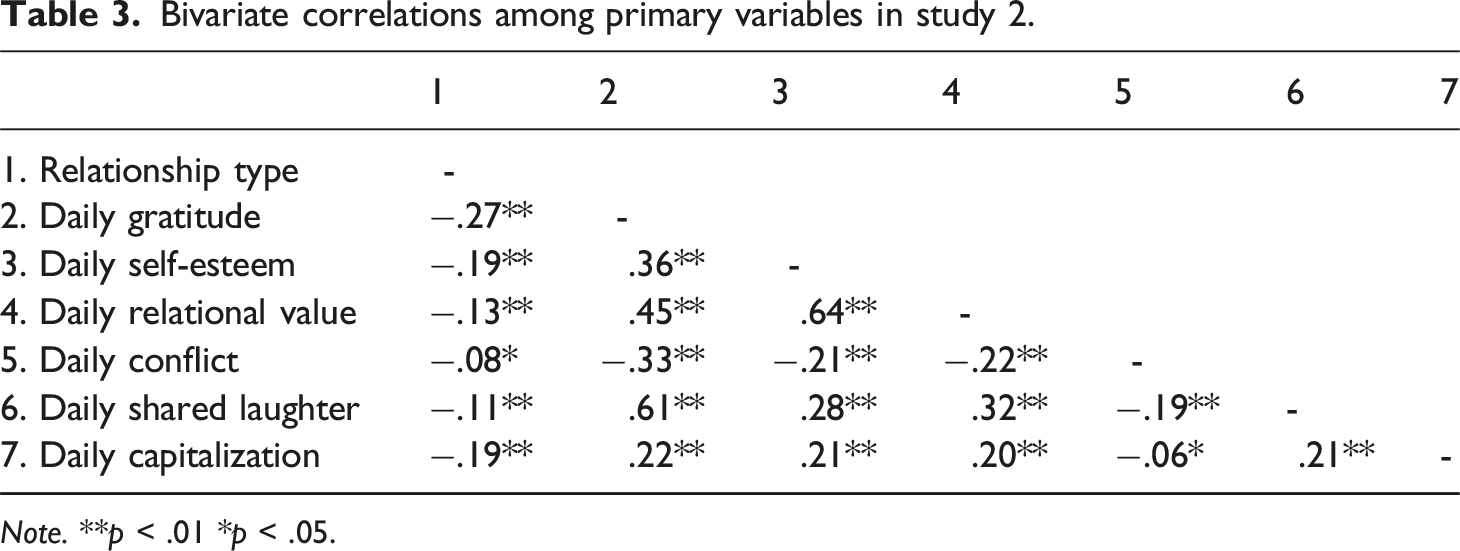
Note. **p < .01 *p < .05.
Partner expressions of gratitude and self-esteem in daily life
Results of a multilevel analysis examining how partner gratitude predicts self-esteem in daily life in study 2.
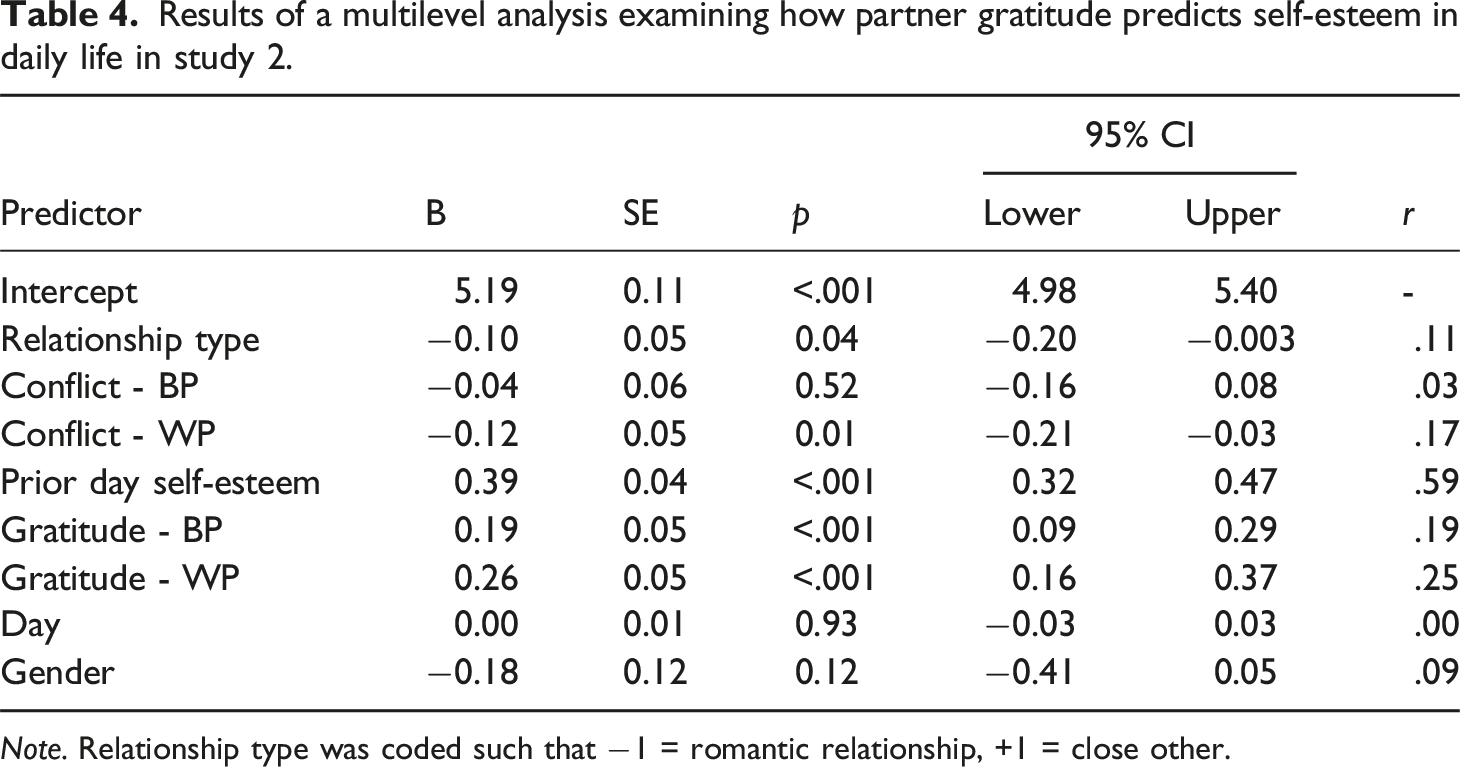
Note. Relationship type was coded such that −1 = romantic relationship, +1 = close other.
The bottom portion of Supplemental Table 2 provides results of analyses examining age as a moderator in Study 2. The interactions between age and gratitude at the within- and between-person levels were not associated with daily self-esteem.
Supplemental Table 5 presents results of an ancillary analysis in which we examined relationship type as a moderator of the daily between- and within-person association between gratitude and self-esteem. As shown there, a significant interaction emerged between relationship type and the between-person (but not within-person) parameter for partner gratitude in predicting daily self-esteem. Simple slopes analyses demonstrated that for participants in a romantic relationship, partner gratitude was significantly associated with greater self-esteem at both the between- and the within-person levels. For participants who reported on another type of relationship, partner gratitude was associated with daily self-esteem at the within-person level, but was not associated with self-esteem at the between-person level.
Results of analyses which control for daily (a) capitalization, and (b) shared laughter are included in Supplemental Tables 6 and 7. As shown there, substantive conclusions were the same as the primary analyses described above.
Mediation analyses: does partner gratitude predict daily self-esteem via enhanced relational value?
Results of multilevel mediation analyses from study 2.
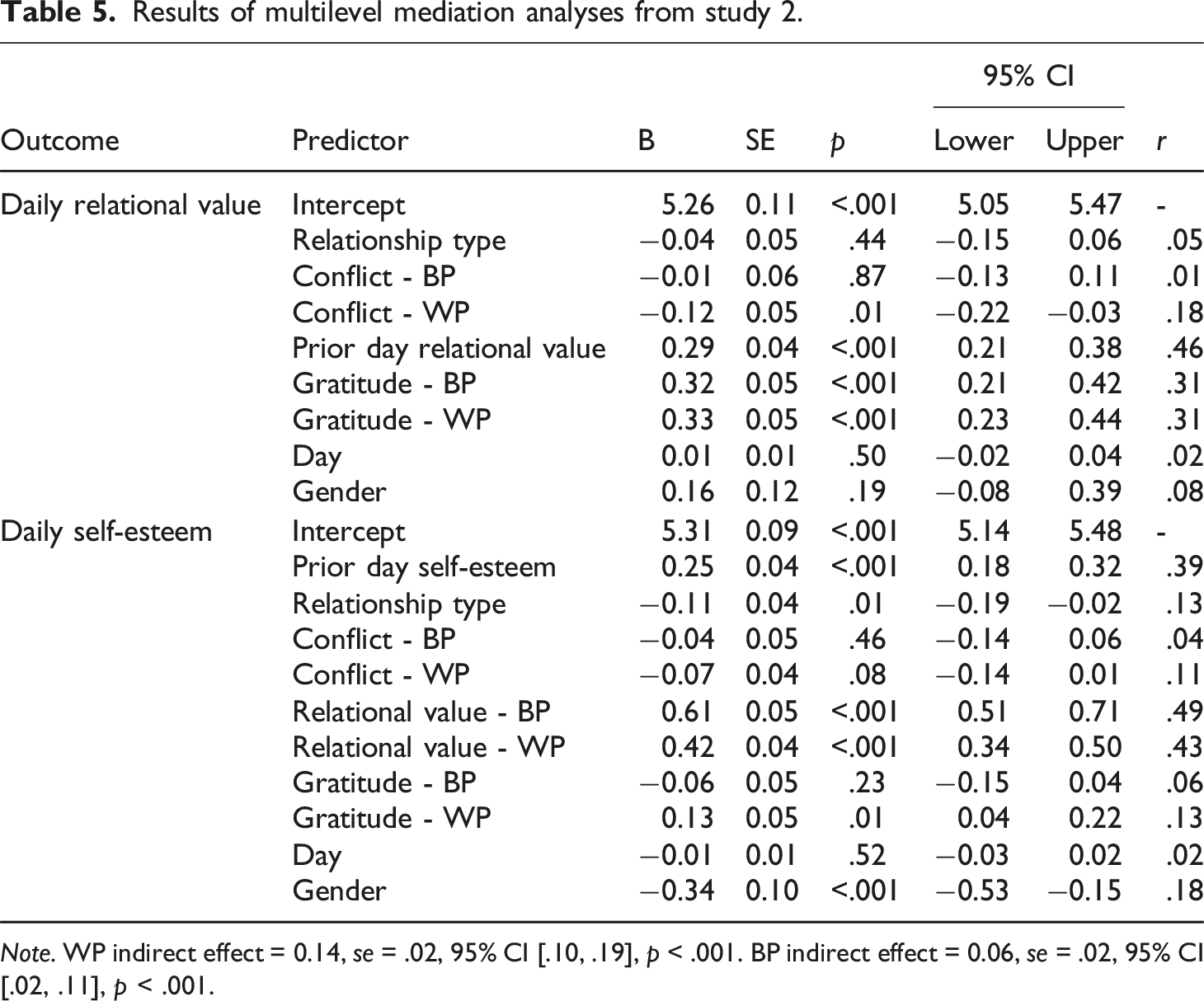
Note. WP indirect effect = 0.14, se = .02, 95% CI [.10, .19], p < .001. BP indirect effect = 0.06, se = .02, 95% CI [.02, .11], p < .001.
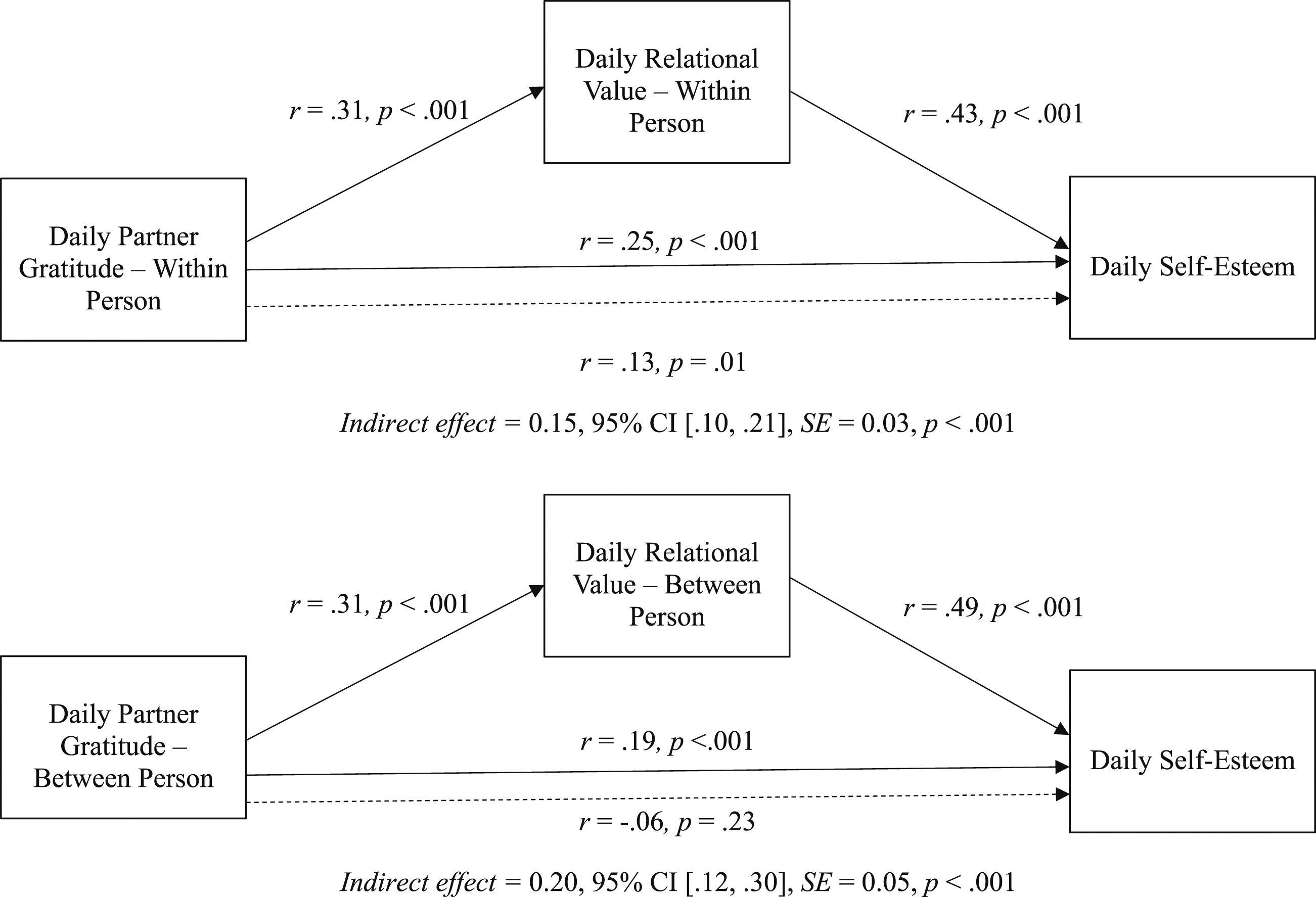
Indirect effects of partner expressions of gratitude on self-esteem via relational value.
Finally, we replicated the models testing the a (gratitude → relational value) and b (relational value → self-esteem) paths presented in Table 5 and Figure 1 while controlling for daily capitalization and shared laughter (Supplemental Table 8). Substantive conclusions of these models were identical to those presented above. 4
General discussion
The current research drew on theory in the positive interpersonal processes and self-esteem literatures to make the novel proposition that partner expressions of gratitude are associated with greater individual self-esteem, via their link with greater relational value. Using two well-powered longitudinal studies, we found robust support for our hypotheses. Specifically, partner expressions of gratitude were generally associated with greater self-esteem at both the between- and within-person levels, although in Study 2 this was only true at the between-person level for participants who were in a romantic relationship. Additionally, in Study 2 we found support for our proposition that daily partner gratitude is linked to greater daily self-esteem via its association with greater daily relational value.
The link between partner gratitude and the self: Extending the find-remind-and-bind model
This research makes an important extension to prior work on the social functions of gratitude. Based on the find-remind-and-bind model (Algoe, 2012), most of the prior work in this literature had documented the relational outcomes of partner expressions of gratitude (e.g., Algoe et al., 2013; Gordon et al., 2012). In this study, we made the novel proposition that partner expressions of gratitude not only predict relational benefits, but also extend to how people see themselves. Results generally supported our hypotheses at both the between- and within-person levels. 5 This was true even when controlling for prior wave levels of self-esteem in our longitudinal studies, which helps to rule out the possibility that participants who were higher in self-esteem simply view their partner through rose colored glasses, perceiving more gratitude as compared to those lower in self-esteem.
These findings have important broader implications for theory and research on gratitude. While gratitude is, at its core, a social emotion (Algoe et al., 2013), our work suggests that expressions of gratitude contribute to how people see themselves. As such, our findings provide suggestive evidence that expressions of gratitude from relationship partners may influence the self in numerous other ways. For instance, given that our work suggests expressions of gratitude contribute to self-esteem, they may also influence other important, self-relevant variables, such as self-compassion, narcissism, or pride. Our research, therefore, opens the door for future research to explore how expressions of gratitude within intimate relationships influence how people see themselves more broadly.
Age and relationship type and as a moderator
Contrary to expectations, we found that relationship type moderated the link between partner gratitude and self-esteem at the between-person level only: greater partner gratitude was associated with greater self-esteem at the between-person level from one’s romantic partner in Study 2, but this was not true when participants reported on another type of relationship partner, such as a friend or a family member. Some prior research had demonstrated that romantic relationships had a stronger influence on self-esteem than non-romantic relationships (e.g., Voss et al., 1999), and our results from Study 2 appear to be at least partially consistent with that. Indeed, at least in western cultures, romantic relationships tend to be one of the most important relationships in people’s lives, which could explain why partner gratitude was associated with greater self-esteem at the between-person level from intimate partners but not for other types of relationships. As such, we speculate that it is probably more important to the individual’s self-esteem that they feel appreciated at the person-level by a romantic partner because of this higher degree of interdependence with romantic partners, as compared to close others.
We also found partial evidence (in Study 1 but not Study 2) that age moderated the association between partner gratitude and self-esteem. One likely reason for the discrepancy between the two studies is differences in the two samples: while Study 1 drew from a wide range of participants in terms of age, Study 2 was comprised of university students (with a more limited age range). This likely limited our ability to detect significant interactions in Study 2. The results from Study 1 provide preliminary evidence that, although the link between partner gratitude and self-esteem is significant and positive at all ages, the relative magnitude of the between- and within-person levels may depend on age.
Bi-directionality and the association between partner gratitude and self-esteem in everyday life
Although we found consistent evidence supporting our hypotheses, it is important to note that our analyses were concurrent, meaning we examined how partner gratitude was associated with self-esteem at the same wave of data collection (in Study 1) or on the same day (in Study 2). We conducted the analyses in this manner for a specific theoretical reason: sociometer theory suggests that state self-esteem tends to be determined by one’s current environmental circumstances, meaning it is important to examine theorized predictors in close temporal proximity to hypothesized outcomes (e.g., Leary, 2012). As such, it was most theoretically appropriate to examine how same-wave and same-day partner gratitude were associated with self-esteem. Consistent with this line of thought, our ancillary analyses suggested that lagged partner gratitude (from the prior year in Study 1 or from the prior day in Study 2) was associated with greater self-esteem at the between-person level, but not at the within-person level. From a theoretical perspective, the between-person, lagged associations likely reflect the way that perceived partner gratitude can accumulate into a global sense positive social connection with the partner (Leary, 2012). By contrast, the lack of within-person lagged finding is consistent with our prediction that state self-esteem reflects a response to feedback in a particular moment or situation, explaining why deviations from one’s typical level of partner gratitude at one year or one day prior did not predict additional variation in self-esteem beyond person-level perceptions of partner gratitude. Additionally, while our study provides initial evidence in support of our theorizing that partner gratitude is associated with enhanced self-esteem, this research was based on concurrent associations, and (although these concurrent associations accounted for prior wave levels of self-esteem) this research does not fully establish directionality between the two variables of interest.
Strengths and caveats
The current research has many strengths, including drawing on two highly-powered, longitudinal studies of participants’ daily relationship experiences. Despite this, this study is not without limitations. First, as detailed above, this work is correlational. Although we were able to mitigate some of the concerns related to correlational data by including an extensive series of covariates, without an experimental design we cannot draw causal conclusions regarding our hypotheses. Additionally, although our two samples were drawn from two different countries, our study was still limited in its lack of cultural diversity (especially Study 1), which is important because people from different cultures may experience and express gratitude in different ways (e.g., Chang & Algoe, 2020). Similarly, we did not assess a few important demographic variables, such as sexual orientation and household income in Study 2, which limits the generalizability of these results. Finally, we note the important limitation that we did provide information about (a) the disability status of participants in either study, or (b) whether participants in Study 1 were students.
Conclusion
This study provided novel evidence that partner expressions of gratitude contribute to self-esteem via its association with greater feelings of relational value. This research highlights the importance of gratitude expressions influencing not just relationship experiences, but also in contributing to how people view themselves. Future research should continue to explore how gratitude expressions influence both relationships and the self, because such work may help to promote both individual and relational well-being.
Supplemental Material
Supplemental Material - A Boost to Relational Value: Examining the Link between Partner Expressions of Gratitude and Self-Esteem in Close Relationships
Supplemental Material for A Boost to Relational Value: Examining the Link between Partner Expressions of Gratitude and Self-Esteem in Close Relationships by Brian P. Don and Renato Ferrer in Journal of Social and Personal Relationships
Footnotes
Author’s note
The authors are grateful for Nickola Overall for the use of the data in Study 2 and Valerie Chang for her assistance in cleaning of the data in Study 2. This paper uses data from the German Family Panel pairfam, coordinated by Josef Brüderl, Sonja Drobnič, Karsten Hank, Johannes Huinink, Bernhard Nauck, Franz J. Neyer, and Sabine Walper. From 2004 to 2022 pairfam was funded as priority program and long-term project by the German Research Foundation (DFG).
Declaration of conflicting interests
The author(s) declared no potential conflicts of interest with respect to the research, authorship, and/or publication of this article.
Funding
The author(s) received no financial support for the research, authorship, and/or publication of this article.
Open research statement
As part of IARR’s encouragement of open research practices, the author(s) have provided the following information: Study 1 was pre-registered, but Study 2 was not pre-registered. The aspects of the research that were pre-registered were the secondary data analysis plan for Study 1. The registration was submitted to: AsPredicted. The data used in the research for Study 1 cannot be publicly posted, but are available upon request from the authors by emailing by emailing  .
.
Supplemental Material
Supplemental material for this article is available online.
Notes
References
Supplementary Material
Please find the following supplemental material available below.
For Open Access articles published under a Creative Commons License, all supplemental material carries the same license as the article it is associated with.
For non-Open Access articles published, all supplemental material carries a non-exclusive license, and permission requests for re-use of supplemental material or any part of supplemental material shall be sent directly to the copyright owner as specified in the copyright notice associated with the article.
