




Abstract
Communication style is critical in fostering and maintaining trust in private and professional relationships. Anecdotal evidence and applied communication strategies suggest that an informal communication style not only reflects but also causes feelings of closeness and trust. However, the experimental evidence on this is mixed, which suggests that the effects are contingent on boundary conditions. In the present article, we test four hypotheses about when and why informal communication in private and professional contexts increases or decreases the recipient’s perceptions of the sender’s trustworthiness in three important domains: ability, benevolence, and integrity. Across three experimental studies (N total = 1085), we find that (1) informality increases perceived sender benevolence both in private and in professional contexts, but that (2) informality reduces perceived sender ability in professional contexts, particularly when it violates formal communication expectations. The results further suggest that (3) informality increases perceived sender benevolence through communicating feelings of closeness and (4) informality decreases perceived sender ability in high-status professional roles through communicating a lack of role awareness. The effect of informality on perceived integrity was moderated by context. Integrity perceptions were decreased in professional but increased in private contexts after informality. These findings highlight the nuanced role of communication context and role expectations in determining the impact of informal communication on trustworthiness perceptions.
Keywords
Decoding the signals: What sender formality reflects
Linguistic formality – a feature of communication often expressed through personal address, greeting, closing, or word choice – indicates how the sender of a communicative act perceives their relationship with the recipient (Goffman, 1959). Particularly, the level of formality reflects the sender’s perceived closeness and relational status towards the recipient, with higher levels of formality reflecting increasing distance and higher recipient status (P. Brown & Levinson, 1987; Lakoff, 1973). As a third factor, the magnitude of the imposition plays a role: the more senders ask for, the more formally they communicate (P. Brown & Levinson, 1987). Interestingly, the linguistic markers for levels of formality vary across languages (Voigt et al., 2017; Yeomans et al., 2019). For example, in French, German, and Spanish, informality is often signaled using “T-forms” (“Tu / Du / Tú”) instead of “V-forms” (“Vous / Sie / Usted”), a differentiation not available in English. Nevertheless, politeness theories assert that the relationship-reflecting function of (in)formality is universal – irrespective of specific markers, culture, or language (P. Brown & Levinson, 1987; Locher & Watts, 2005; Spencer-Oatey, 1996).
This universality may underlie the intriguing phenomenon that around the world, etiquette guidelines (e.g., “Li” in China, “Knigge” in Germany, or “Emily Post’s etiquette” in the United States) and established language encyclopedias (Alonso, 1958; McArthur et al., 2018; Sin-Wai, 2016) univocally endorse formal communication in professional but less so in personal contexts. That formality is often expected in professional contexts also follows from the factors underlying formality use: the status asymmetries between sender and recipient roles that characterize professional contexts are associated with formality (P. Brown & Levinson, 1987). When formality norms and expectations are directed at the sender, linguistic formality becomes a Janus-faced communication feature. It can both point to the sender’s subjective perception of their relationship with the recipient and – at the same time – to their understanding of and compliance with the social structure the communication is embedded in. This implies that in professional contexts, informal language may violate recipients’ behavioral and communicative expectations towards senders.
A significant body of research has supported politeness theory’s core tenet that feelings of closeness and perceived relational status are reflected in formality use (R. Brown & Gilman, 1989; Danescu-Niculescu-Mizil et al., 2013; Holtgraves & Yang, 1990, 1992; Jeong et al., 2019; Voigt et al., 2017). Less attention has been paid to how formality use causally affects recipients’ perceptions of sender trustworthiness. This research gap is surprising given informality’s theoretical potential to shape trustworthiness perceptions in two distinct ways: through communicating closeness both in private and professional contexts, and through potentially violating formality expectations in professional contexts. In the present set of studies, we will address this gap and investigate when and why (in)formality decreases versus increases trustworthiness perceptions.
Trustworthiness and informality
Trust – an individual’s willingness to accept vulnerability based on positive expectations of the intentions or behavior of another individual (Rousseau et al., 1998) – is pivotal in interpersonal relationships and essential for effective cooperation, both personally and professionally (De Jong et al., 2016; Dirks & de Jong, 2022; Rempel et al., 1985). As initial interactions can significantly influence the development of trust (McKnight et al., 1998), the dynamics of trust under minimal acquaintance have become an increasingly vital research area (Dunning et al., 2014). The present research therefore examines (in)formality in initial messages.
The perception of trustworthiness – as ascribed by the trustor (the one who trusts) to the trustee (the one who is trusted) – is a key predictor of trust and can be shaped by senders from the very first message (Mayer et al., 1995; Schoorman et al., 2007). According to the Integrated Model of Organizational Trust (Mayer et al., 1995), trustworthiness perceptions are based on three distinct, yet interrelated facets: Ability (i.e., the extent to which a trustee has the necessary skills, competence, and characteristics to carry out their duties), benevolence (i.e., the extent to which a trustee is believed to want to do good to the trustor), and integrity (i.e., the perception that the trustee adheres to a set of principles that the trustor finds acceptable). These three facets can be mapped onto the “big two” of person perception (Abele-Brehm & Wojciszke, 2018; Fiske et al., 2002): communion/warmth (which corresponds to the benevolence, and – to a lesser degree – the integrity facet) and agency/competence (which corresponds to the ability facet). The three facets stem from and summarize a literature that has always been specifically interested in sender characteristics that make it more or less likely that recipients will rely on what senders tell them, including the seminal work done on source credibility (Hovland et al., 1953; Whitehead, 1968) and ethos (McCroskey, 1966; McCroskey & Teven, 1999; also see McAllister, 1995).
The three trustworthiness facets vary in their relative importance for trust across situations (Dirks & de Jong, 2022; Schoorman et al., 2007). For instance, ability perceptions become more predictive of trust when the trustee needs to have certain skills or competencies to meet the trustor’s expectations – a situation especially pervasive in the workplace, when the trustee is, for instance, a manager (Dirks & de Jong, 2022). Benevolence perceptions become more important when the trustor must believe that the trustee genuinely cares about their well-being and interests and is important in situations involving personal support and relationships, for instance, in childcare or mentoring relationships (Fleig-Palmer et al., 2018). Integrity perceptions play a central role for trust in situations that involve ethical considerations, and where honesty and reliability are central. For instance, integrity perceptions are important to maintain the public’s trust in politicians and political systems (Halmburger et al., 2019). Accordingly, the facets have been distinctly related to a myriad of antecedents and outcomes both in the workplace and in personal relationships (for reviews, see Balliet & van Lange, 2013Balliet & Van Lange, 2013; Dirks & de Jong, 2022; Mayer et al., 1995).
The role of linguistic formality in building trust is complex, especially when considering both private and professional contexts. In the professional world, many organizations try to exploit informal communication strategies to foster psychological closeness and trust among their employees. One of these strategies is to embed personal forms of address within the organizational culture (Bass & Avolio, 1994; Sundar & Cao, 2020). The idea is that this communication style that usually reflects the closeness and trust of private relationships also facilitates these relationship qualities when applied in professional contexts. However, prior research suggests that the strategy of fostering trust through informality is not infallible. Under certain conditions, informality can even backfire and reduce trustworthiness ascriptions in professional contexts (e.g., Gretry et al., 2017; Lowrey-Kinberg, 2018). In sum, the psychological links between informality and trustworthiness perceptions in private and professional contexts are not fully deciphered yet.
In this study, we propose that sender informality relates to trustworthiness ascriptions via two distinct psychological pathways, which explain why informality sometimes fosters and sometimes undermines trustworthiness.
Benevolence
Benevolence refers to the perception that the sender wants to do good to the recipient aside from an egocentric profit motive (Mayer et al., 1995). Substantial evidence suggests that the pathway from informality to increased benevolence ascriptions is mediated by reduced psychological distance. Research on how communication style influences psychological distance perceptions has shown that recipients feel closer (temporally and spatially) to senders who communicate informally rather than formally (Stephan et al., 2010). According to politeness theory (P. Brown & Levinson, 1987; Stephan et al., 2010), informality reduces distance perceptions because recipients read it as a signal of how close the sender feels to them. If informality indeed communicates that a sender feels psychologically close to a recipient, recipients should assume sender benevolence because closer relationships are characterized by higher levels of empathic concern and genuine regard for another’s welfare than more distant relationships (for reviews how closeness and benevolent motives are related, see Aron et al., 1992; Clark & Reis, 1988). In the temporal order of perceiving closeness and benevolence after informality, closeness takes precedent and therefore mediates the effect of informality on benevolence perceptions according to politeness theory (P. Brown & Levinson, 1987; Stephan et al., 2010).
Ability
Perceived ability—the second facet of trustworthiness—represents the expectation that someone possesses the “…skills, competencies, and characteristics that enable a party to have influence within some specific domain” (Mayer et al., 1995, p. 717). Recent empirical results suggest that expectation violations link informality to reduced ability perceptions in professional contexts (Altenmüller et al., 2023; Bullock & Hubner, 2020; Lowrey-Kinberg, 2018). Recent research on communication of police officers (Lowrey-Kinberg, 2018) and politicians (Bullock & Hubner, 2020) showed that an informal versus formal communication style reduced trustworthiness perceptions in the eyes of citizens. The authors explained these findings with the violation of expectations related to professionalism (Bullock & Hubner, 2020; Lowrey-Kinberg, 2018; also see Cheney & Lee Ashcraft, 2007). Similarly, recent research on a science communication strategy aimed at increasing warmth-related trustworthiness perceptions (benevolence and integrity) found that this strategy actually decreased competence-related trustworthiness perceptions in the eyes of laypeople (Altenmüller et al., 2023), arguing that this might be due to a misfit between the communication strategy and the stereotypical expectation how scientists should communicate. Indeed, shared linguistic norms across the globe (e.g., Alonso, 1958; McArthur et al., 2018; Sin-Wai, 2016) and status-asymmetries inherently associated with sender and recipient roles in professional contexts (P. Brown & Levinson, 1987) suggest that recipients generally expect more formality in professional than in private contexts, independent of the exact profession. In this sense, maintaining belief in sender ability in professional (though not personal) contexts should necessitate formality as it indicates role-awareness—acknowledgment of and compliance with behavioral and communicative expectations tied one’s role (Gecas, 1982). Violating such expectations related to professionalism should reduce the recipient’s expectation that the sender will fulfill other behavioral and communicative professional expectations, therefore undermining ability perceptions. In the temporal order of perceiving role-awareness and ability after expectation-violating informality, the expectation violation and the associated perception of role-awareness take precedent to ability perceptions according to expectation violation theory (Burgoon & Le Poire, 1993). However, direct experimental evidence for the claim that using informal communication in professional contexts (but not private ones) results in diminished ability ascriptions, and that perceived role-awareness mediates this effect, is still missing. Our research aims to fill this gap.
Integrity
Perceived integrity—the third facet of trustworthiness—reflects assumed adherence to a set of principles that the trustor finds acceptable (Mayer et al., 1995; Schoorman et al., 2007). In principle, integrity is a perception of moral character. Notably, it is difficult to define “acceptable principles” precisely – what qualifies as acceptable ultimately depends on the trustor’s own judgment in each situation (Mayer et al., 1995). Thus, integrity ascriptions are not the same as sender fairness or sense of justice; they also entail a sense of “value congruence,” that is, the perceived overlap between what the recipient and the sender think is right and fair (Mayer et al., 1995; Schoorman et al., 2007). Given that “right” and “fair” often reflect very different in things in private versus professional contexts (e.g., prosocial intentions, compliance with professional norms), it is not surprising that integrity perceptions are highly correlated with benevolence perceptions (e.g., Altenmüller et al., 2021) and, albeit to a lesser extent, also with ability perceptions (Colquitt et al., 2007; Dirks & de Jong, 2022).
In the context of informality use, integrity perceptions could therefore be affected by both pathways discussed (violating expectations in professional contexts, communicating closeness in both private and professional contexts). Violating expectations in professional contexts may also undermine integrity ascriptions. For example, a recent study suggests that voters suspect more deception from political candidates who use informal language on their professional social media (Bullock & Hubner, 2020), interpreting this effect in line with an expectation violation framework (Bullock & Hubner, 2020; Burgoon & Le Poire, 1993). At the same time, if informality indeed reduces psychological distance perceptions, recipients should assume that the sender shares more of their own values because people assume close others to be more similar to them than distant others (Aron et al., 1992). Thus, both the positive and negative effects of informality on integrity ascriptions are psychologically plausible, possibly depending on the context being private or professional.
The present research
Informed by the theorizing above, we tested the following four empirical hypotheses:
If a sender uses an informal rather than a formal communication style, recipients ascribe more benevolence to the sender.
The informality-benevolence effect is mediated by the recipients’ perception of closeness between them and the sender.
If a sender uses an informal rather than a formal communication style, recipients ascribe less ability to senders, but only in professional (and not in private) contexts.
In professional (but not in private) contexts, the formality-ability effect is mediated by the role-awareness recipients ascribe to the sender. Specifically, sender informality (vs. formality) reduces ascriptions of role-awareness only in professional (but not in private) contexts, and ascriptions of role-awareness positively predict sender ability perceptions.
To investigate these hypotheses, we conducted three experimental studies. Study 1 tested Hypotheses 1–3 with participants who received either informal or formal messages in a scenario involving a tenant and their landlord. In Study 2, we manipulated message contexts (private vs. professional) to test the boundary condition specified in Hypothesis 3. Study 3 replicated the previous studies, directly manipulated asymmetries between the sender and recipient roles, and measured ascriptions of role-awareness to test Hypothesis 4. Furthermore, we explored the effects of informality on perceived sender integrity in all studies. In all studies, we disclose all measures, manipulations, and exclusions, as well as the method of determining the final sample size. All data were collected in Germany. The raw data and materials necessary to reproduce all results are available on the open science framework repository (https://osf.io/c9rv8/).
Study 1
Study 1 investigated the effect of informal versus formal communication on closeness and trustworthiness perceptions, testing Hypotheses 1–3. In a hypothetical scenario, participants imagined applying for an apartment and receiving an email from the proprietor. Following previous approaches (Gretry et al., 2017; Stephan et al., 2010), formality of the email was manipulated in a 2 (formality of salutation and closing: high vs. low) × 2 (formality of appellation: surnames & V-form vs. prenames & T-form) between-subjects design. We chose salutation and closing together with appellation because (1) they were identified as central markers of formality, appellation being especially prominent (securing convergent manipulation validity, Gretry et al., 2017; Voigt et al., 2017), (2) the formality differences between the marker levels are unambiguous (causing less experimental “noise” in the manipulation), and (3) they can be manipulated by merely exchanging one or two words while leaving syntax and content of the message untouched (securing discriminant manipulation validity).
Manipulating both communication features independently allows exploring and comparing their respective (as well as their interactive) influence. More precisely, we assumed that both formality markers – appellation and salutation – should have main effects on perceived benevolence (H1), mediated via closeness (H2), and on perceived ability (H3). A synergetic interaction between the two aspects (i.e., effects on closeness, benevolence, and ability that cannot be explained by main effects alone) is plausible and something we aimed to explore in this study.
Method
Participants
We recruited participants via university-wide mailing lists including students and university staff members as well as via social media. We determined N = 300 as a target sample size to detect small- to medium-sized effects (in the range of f = .15–.20, extrapolated from effect sizes in comparable studies such as Gretry et al., 2017; Stephan et al., 2010) in 2 × 2 ANOVAs with a power of .80 and a significance level of .05 (two-tailed, Faul et al., 2007). We thus sent out weekly invitations until this sample size was surpassed.
In total, 325 participants completed the study during the two weeks it was online. As a reward, we raffled four vouchers worth 25€ each among all participants. Alternatively, participants could receive course credit. We excluded 28 participants due to (1) insufficient language skills (i.e., values of 3 or 4 on a 4-point ordinal scale: 1 = native speaker; 2 = fluent language proficiency; 3 = elementary skills; 4 = no skills; n = 7), (2) negative responses to a “use-me” item (“It is crucial for us to only use answers from people who thoroughly concerned themselves with the study. In your opinion, should we use your data in our analysis?” y/n; n = 6), (3) missing data on crucial variables (i.e., gender, pre- or surname; n = 15). Gender, pre- and surname are necessary preconditions to manipulate personal appellation correctly as the German equivalents of “Dear Peter” or “Dear Mr. Harris” are gendered. When including these 28 cases in the analyses, the only difference in results is that the effect of the Salutation factor on benevolence is not significant anymore, F (1, 320) = 3.35, p = .08, ηp2 = .010. All other results remain unchanged. The final sample size consisted of 297 participants aged from 17 to 77 (M = 26.9, SD = 10.1, Md = 24). 77% of participants identified as female, and 23% as male. 77% of participants were students, 22% were employees, 9% were occupied as freelancers or in other roles, and 7% did not indicate any occupation.
Manipulation and measures
After giving their informed consent, participants first indicated demographics (age, gender, occupation, and language skills), their pre- or surname, and responded to a 10-item version (Rammstedt et al., 2013) of the Big Five Inventory (John et al., 1991) as part of a cover story stating personality traits as object of investigation. All measures and manipulations were in German.
Manipulation
Formality
Next, we asked participants to imagine applying for an apartment and receiving an email from the proprietor. Depending on the randomly assigned formality condition, recipients received one of four emails, in which the formality of appellation (formal: V-Forms and surnames; informal: T-Forms and prenames) and the formality of salutation and closing were manipulated independently. For example, in the most formal condition with formal appellation and formal salutation and closing, the email read:
“Dear (German: Sehr geehrter) Mr. [Surname], thank [V-form] for [V-form] application. Could [V-form] please send me an ID copy? This is required for my documentation. Sincere regards, S. Schmidt”
In the most informal condition, the email read:
“Dear (German: Lieber) [Prename], thank [T-form] for [T-form] application. Could [T-Form] please send me an ID copy? This is required for my documentation. Best regards, Stefan.”
Measures
Closeness
Participants then indicated their impressions of the proprietor. We first measured interpersonal closeness with an adapted version of the Inclusion of Other in the Self Scale (IOS, Aron et al., 1992). Participants indicated how much closeness versus distance they perceived between themselves and the proprietor by selecting one out of seven increasingly closer and then increasingly overlapping pairs of circles labeled with “I” and “Proprietor.” We chose the scale due to its graphical intuitiveness and efficiency (for empirical evidence on convergent validity when adapting the scale to measure closeness, see Lemay et al., 2020).
Perceived trustworthiness
To measure perceptions of the three trustworthiness facets, we adapted a validated 15-item German version (Dreiskämper et al., 2016) of the Trustworthiness Scale developed by Mayer and Davis (1999). Three items of the ability subscale were nonsensical in the context of our scenario and were excluded (“X has special skills that can improve our performance.”, “X is known to be successful in the things he/she tries to do”; “X has a large knowledge about the things that need to get done.”). Thus, we measured perceived benevolence (e.g., “My needs and desires are very important to the proprietor”, 4 items, α = .92), integrity (e.g., “Sound values seem to guide the proprietor’s behavior”, 5 items, α = .88), and ability (e.g., “The proprietor is very competent in performing his tasks”, 3 items, α = .89) with 12 items in total. All trustworthiness items were measured on 6-point response scales ranging from 1 = strongly disagree to 6 = strongly agree.
Results and discussion
Correlations among and descriptive statistics for measured variables in Study 1.
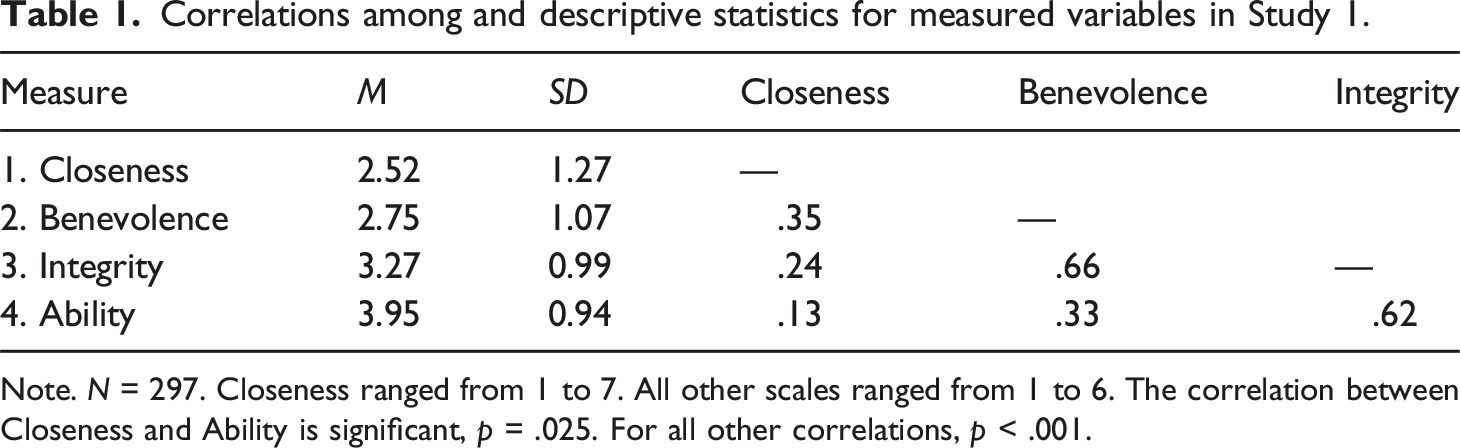
Note. N = 297. Closeness ranged from 1 to 7. All other scales ranged from 1 to 6. The correlation between Closeness and Ability is significant, p = .025. For all other correlations, p < .001.
Cell means, standard deviations, and N of measured variables in all experimental conditions in Study 1.
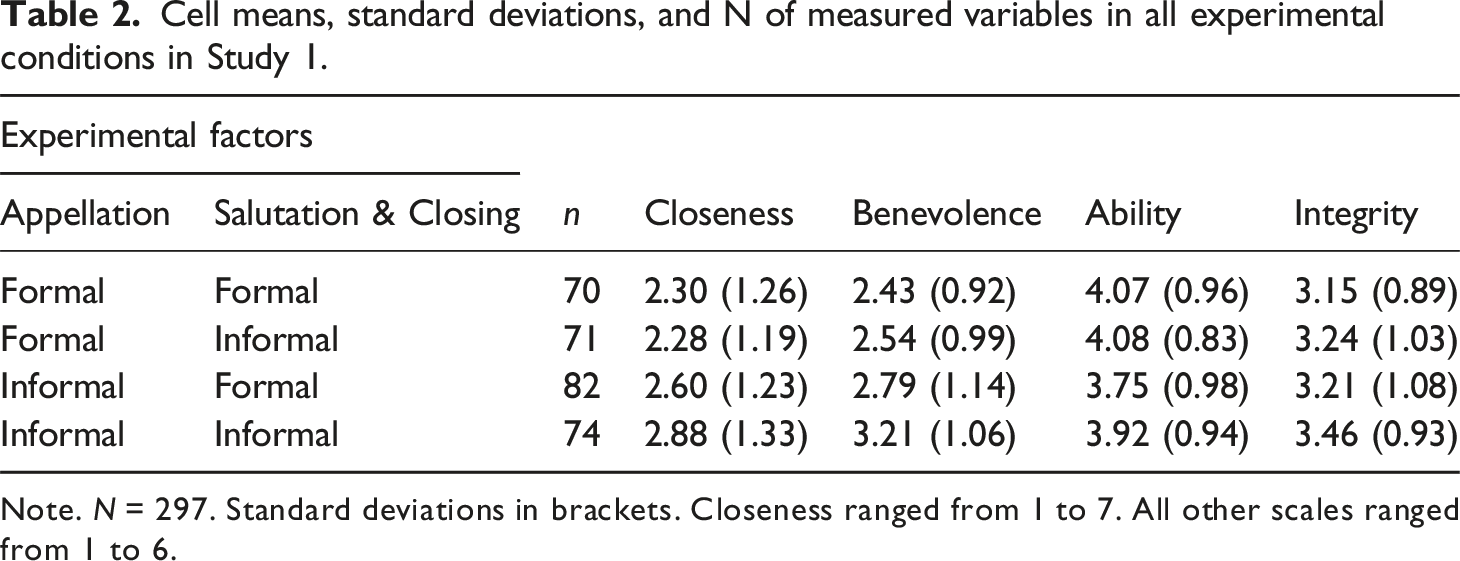
Note. N = 297. Standard deviations in brackets. Closeness ranged from 1 to 7. All other scales ranged from 1 to 6.
Two-way ANOVA of the effects of formality of appellation and formality of salutation and closing on closeness and trustworthiness ascriptions in Study 1.
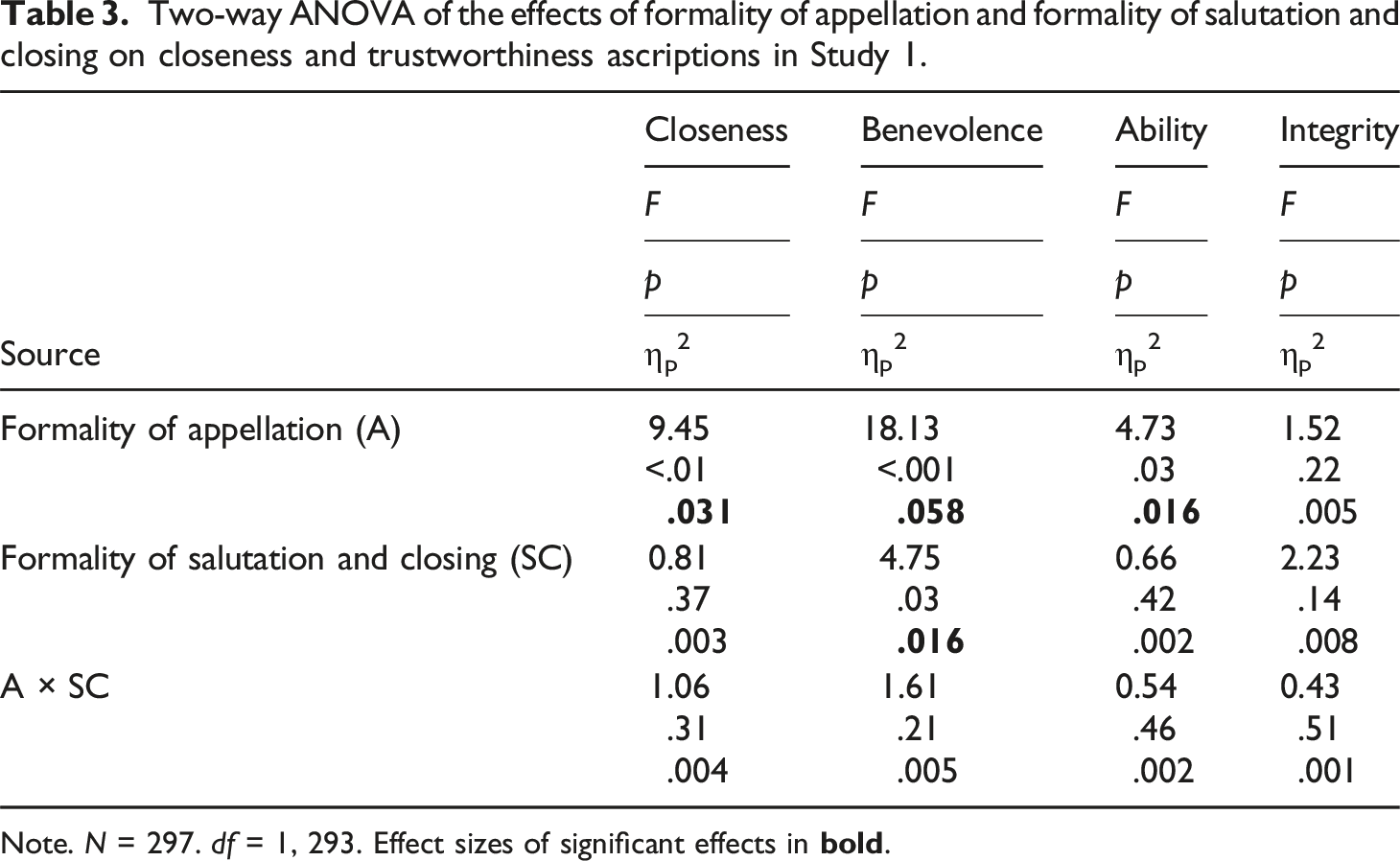
Note. N = 297. df = 1, 293. Effect sizes of significant effects in
Supporting Hypotheses 1 and 3, participants’ perceptions of the proprietor’s benevolence significantly increased but perceptions of the proprietor’s ability decreased, when the proprietor used informal instead of formal appellation in the email, with medium (benevolence), and small (ability) effect sizes. Formality of appellation did not significantly affect the perception of proprietor’s integrity.
Supporting Hypothesis 2, the indirect effect of informality on benevolence perceptions via closeness was significant, B = 0.12, SE(B) = 0.05, 95% CI for B [0.04, 0.23], as was the direct effect, c’ = 0.38, SE(c’) = 0.12, p < .01. Thus, recipients seem to interpret sender informality as a signal of closeness (as implied by politeness theory, P. Brown & Levinson, 1987), respond by perceiving closeness between the sender and themselves, and the closer they think their relationship with the sender is, the more they assume that the sender harbors benevolent motives towards them.
Finally, supporting Hypothesis 1 further, when the proprietor used informal (instead of formal) salutation and closing in the email, participants ascribed significantly more benevolence to the proprietor. No further significant main effects or interactions emerged (see Table 3). As there was no significant effect of the salutation and closing factor on closeness, we did not conduct a mediation analysis for the second experimental factor.
In sum, the results support that (H1) informality fosters perceptions of sender benevolence, (H2) closeness at least partly mediates the informality-benevolence effect, and that (H3) informality reduces perceptions of sender ability, at least in the present context (i.e., interaction with a proprietor). However, the pattern was clearer for appellation than for salutation and closing. The explanation for the latter result may be a methodological one: The wording used to manipulate salutation and closing were always directly followed by either prename or surname (as in “Dear Stefan”, or “Best regards, S. Schmitt”). As noted, appellation is the more prominent marker of formality (Gretry et al., 2017; Voigt et al., 2017), and likely overshadowed salutations and closings.
Since we did not manipulate context (professional vs. private) in Study 1, the results are not informative regarding the boundary condition stated in Hypothesis 3. Furthermore, the generalizability is limited by quite specific sender and message characteristics, and the sample was rather young and female. Study 2 was aimed to alleviate these issues.
Study 2
As some effect sizes in Study 1 turned out to be smaller than expected, we aimed to increase statistical power in Study 2 with a within-subjects design: Each participant read three emails with varying content (an invitation, an inquiry, and a reminder), and thus completed three trials. For each of these three trials, participants were randomly assigned to one of four experimental conditions in a 2 (Message Formality: informal vs. formal) × 2 (Message Context: professional vs. private) within-subjects design. We thus realized a “planned missingness” design: participants only completed 3 out of 4 combinations to reduce demand characteristics and participation time. Manipulating message context allowed testing the boundary condition stated in Hypothesis 3 (i.e., that informality should diminish ability ascriptions in professional, but not in private contexts), implying a Message Formality × Message Context interaction effect. To scrutinize generalizability, we additionally varied sender age and gender across vignettes.
Method
Participants
Recruitment followed the same procedure as in Study 1. Participants who indicated that they had already taken part in a previous study on “interpersonal perceptions in email communication” (i.e., our Study 1) were immediately redirected to a “thank you” page. In total, 429 participants completed the online study. We excluded 28 participants: two were younger than 18 years and 26 indicated obviously false or missing sur- and prenames that endangered manipulation validity of appellations (e.g., “X Y” or “A B”). Including these participants does not change any results. The final sample consisted of 401 participants between the ages of 18 and 77 (M = 28.17, SD = 10.87; Md = 24). 83% of participants identified as female, 17% identified as male. We compensated participants with lottery tickets for a raffle of vouchers or course credit.
Manipulation and measures
After giving informed consent, participants first indicated demographics (age, gender, and occupation) and general closeness preferences with an adaptation of the IOS scale (Aron et al., 1992) to explore the idea that inter-individual differences in closeness preferences might moderate the effect of informality on closeness. Since this idea is only marginally related to our theorizing, we will not discuss it in detail here; for transparency reasons, we will describe the respective results in the Supplementary Online Material (see Supplementary Analysis A, https://osf.io/c9rv8/).
Formality manipulation
We simplified our formality manipulation from Study 1 and realized two experimental conditions: in the formal condition, a formal appellation (surnames + V-form) was presented with a formal salutation and closing; in the informal condition, it was the other way around. For example, in the formal condition with formal appellation (surnames + V-form) and formal salutation and closing, a reminder mail from a male sender in a private context for a female participant read:
“Dear (in German: Sehr geehrte) Mrs. [Surname], hereby I want to remind [V-form] of the theatre group meeting on Monday, November 9 th , 5 pm. Sincere regards, E. Schreiber”
In the most informal condition, the same email read:
“Dear (in German: Liebe) [Prename], I wanted to remind [T-form] of the theatre group meeting on Monday, November 9 th , 5 pm. Kind regards, Emil”
All emails can be found online (https://osf.io/c9rv8/).
Private versus professional context manipulation
Each email was preceded by information about the context of the mail (“private” vs. “professional”). For instance, participants read: “Please imagine receiving an email from the following sender: context = private / name = Emil Schneider / age = 23”. To scrutinize generalizability, sender age (between 22 and 25 years vs. between 54 and 58 years of age) and gender (male vs. female name) were randomly varied.
Manipulation check
To check the effects of our context manipulation, we measured formality expectations with one continuous (“Which degree of formality do you expect in an email from this sender?”, 1 = not at all formal to 8 = very formal), and one dichotomous item (“Do you expect the sender to address you formally with ‘Sie’ or informally with ‘Du’?”), directly after the context manipulation. To explore whether the strength of expectations would differ between contexts, we additionally assessed the strength of the dichotomous formality expectation with a continuous item (“How strong is your expectation to be addressed formally with [expected Appellation: ‘Sie’ / ‘Du’] in the email from the sender?”, 1 = very weak to 6 = very strong).
Dependent measures
We measured closeness with the same adaptation of the IOS scale (Aron et al., 1992) as in Study 1. To measure trustworthiness perceptions, we adapted the 12 items from Study 1 to the new contexts by replacing “proprietor” with “person.” One ability item (“The person is highly qualified.”) appeared nonsensical in private contexts and was therefore removed. Thus, we measured perceived sender benevolence (e.g., “My needs and desires are very important to the person”, 4 items, α between .88 and .91), integrity (e.g., “Sound values seem to guide the person’s behavior”, 5 items, α between .81 and .88), and ability (e.g., “The person is very competent in performing his or her tasks”, 3 items, r between .66 and .74) with 11 items. Response scales ranged from 1 = strongly disagree to 6 = strongly agree.
Results and discussion
Descriptive Statistics for and correlations between measured variables in Study 2.
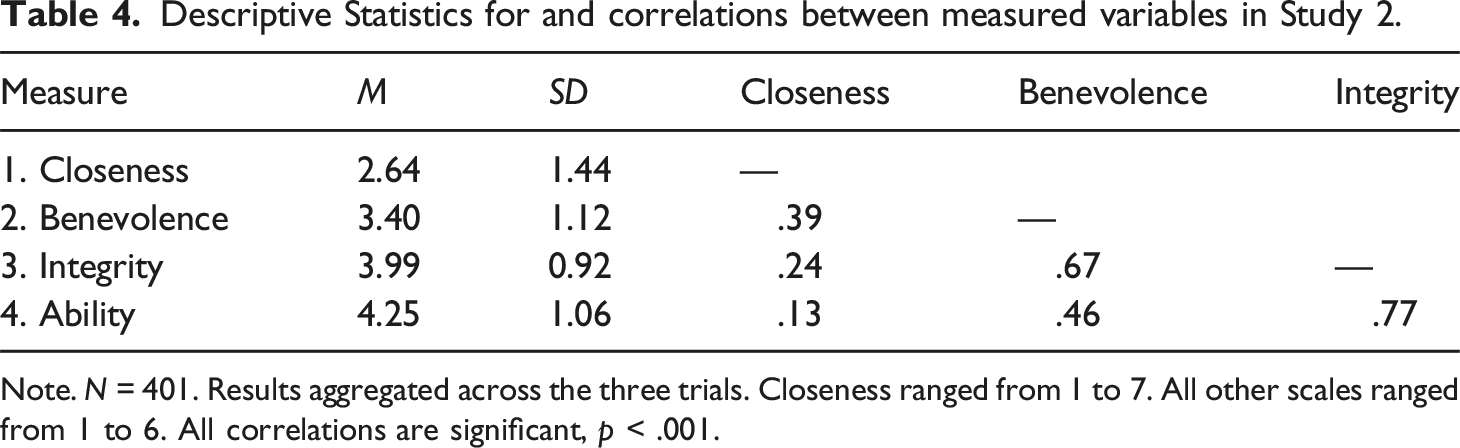
Note. N = 401. Results aggregated across the three trials. Closeness ranged from 1 to 7. All other scales ranged from 1 to 6. All correlations are significant, p < .001.
Due to the nested and planned missingness design (i.e., trials nested within participants, 3 out of 4 experimental conditions per participant), we manipulation checked our Message Context manipulation on formality expectations with a mixed model with participants as a random factor and Message Context as a fixed factor. As expected, recipients expected significantly more formality in a professional context, M = 5.95, SD = 1.56, than in a private context, M = 3.22, SD = 1.98, F(1, 1133) = 789.58, p < .001, d = 1.53.
To test our hypotheses, we tested the fixed effects of Formality, Message Context, and their interaction on perceived benevolence, ability, and closeness using mixed models with a random effect for participants. The estimated marginal means of the dependent variables in the four experimental conditions are depicted in Figure 1. The tests of fixed effects are reported in Table 5. To test the generalizability of our effects, we included additional fixed effects of Sender Age, Sender Gender, and their interaction terms with Formality into the models. No significant main effects nor interactions emerged regarding Sender Age and Sender Gender in any of the three models nor an integrity model, suggesting generalizability (see Supplementary Analysis B, https://osf.io/c9rv8/). Estimated Marginal Means of Recipients’ Feelings of Closeness towards Senders and Trustworthiness Judgments depending on Sender Formality and Message Context in Study 2. Error bars represent Standard Errors. Closeness ranged from 1 to 7. All other Scales ranged from 1 to 6. Mixed models tests of fixed effects of sender formality, message context, and their interaction on closeness and trustworthiness ascriptions in Study 2. Note. N = 401. Significant F-values in 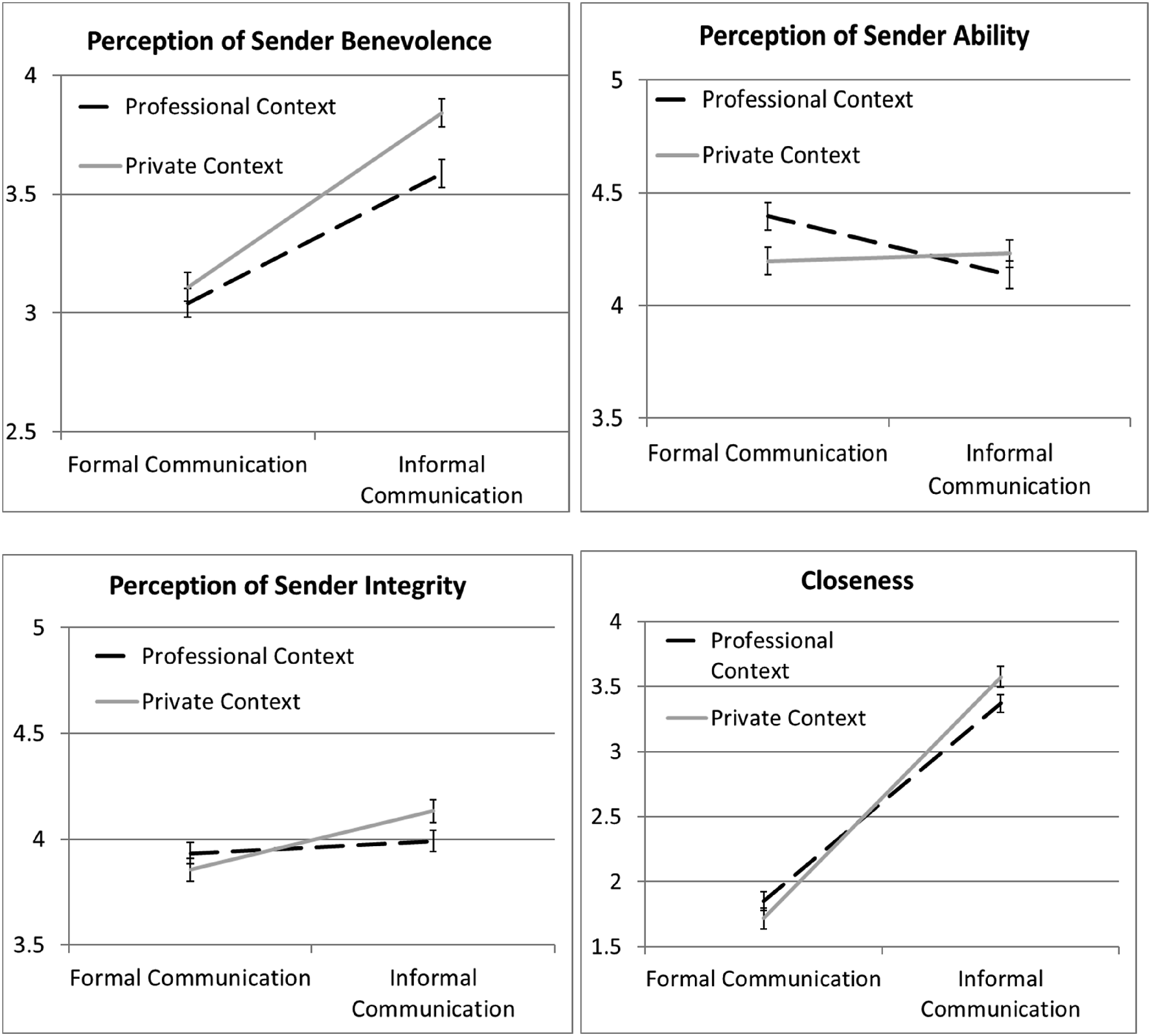
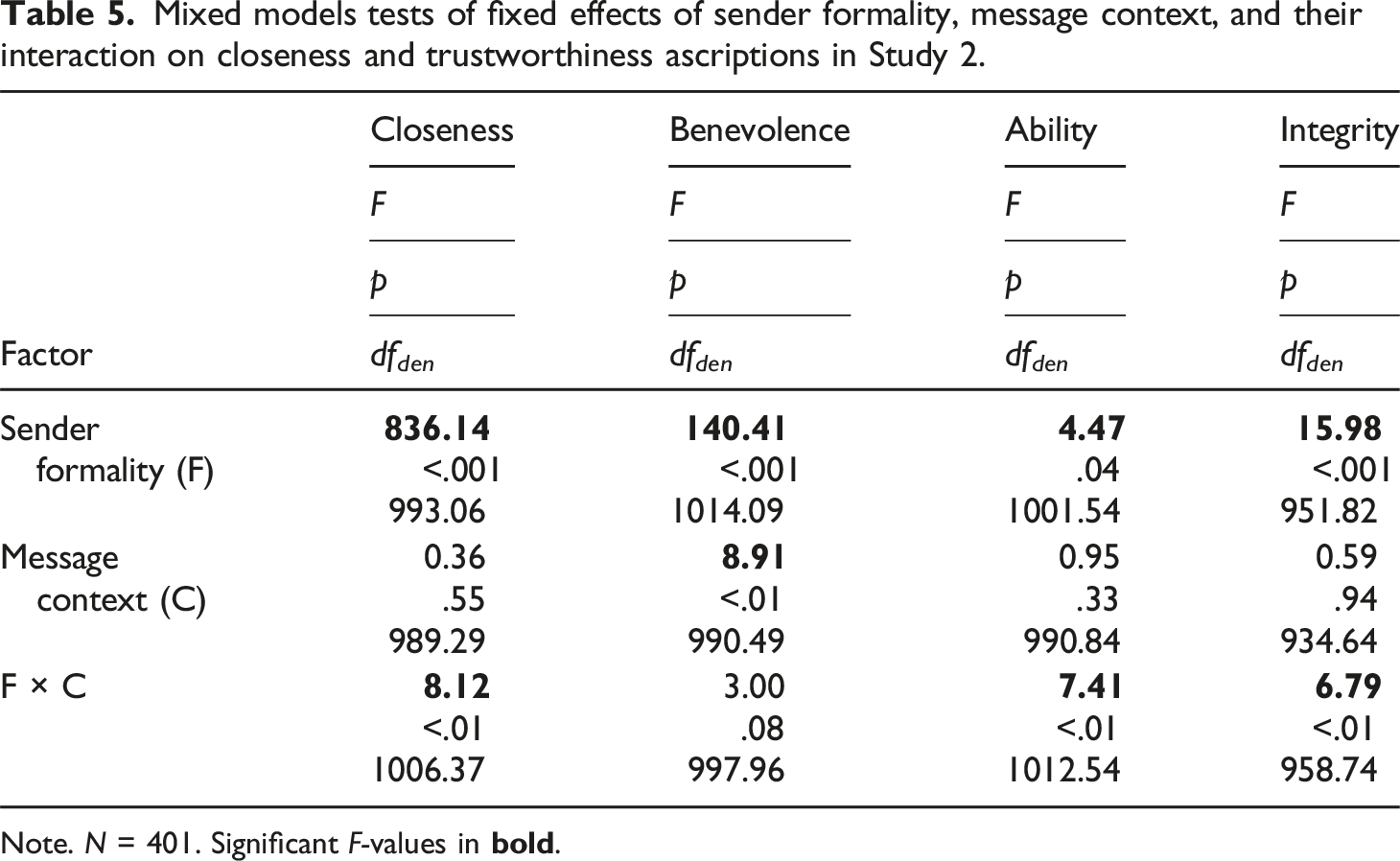
Supporting Hypothesis 1, participants perceived significantly more benevolence when senders communicated informally (M = 3.71, SD = 1.09) instead of formally (M = 3.07, SD = 1.07, p < .001), and this effect was not significantly moderated by context (p = .08). Supporting Hypothesis 2, participants felt significantly closer to senders communicating informally (M = 3.47, SD = 1.40) instead of formally (M = 1.78, SD = 0.93, p < .001); closeness significantly predicted benevolence judgments, and the indirect effect of informality on benevolence judgments via closeness was significant, B = 0.43, SE(B) = 0.06, 95% CI [0.32, 0.54]. Thus, the results replicate the results of Study 1. Across private and professional contexts, informal communication conveyed closeness and sparked trust in sender benevolence.
Supporting Hypothesis 3, participants perceived significantly less sender ability after informal communication (M = 4.18, SD = 1.10) in comparison to formal communication (M = 4.30, SD = 1.09, p = .04) but this effect was significantly moderated by Message Context, so that informality (vs. formality) significantly reduced ability judgments in professional contexts, B = −0.23, t(1, 432.56) = −2.99, p = .003, but not in private contexts, B = 0.05, t(1, 492.72) = 0.72, p = .47. Thus, informality indeed reduces ability ascriptions, but only if it violates professional norms tied to sender roles.
In sum, the results of Study 2 replicated and extended the generalizability of the effects found in Study 1. Yet, we did not manipulate sender roles directly, which leaves open possible alternative interpretations of the effects of message context, and the within-subject design might have created demand characteristics (Orne, 1962). Additionally, the results of Study 2 point to an interesting field of tension concerning roles tied to high professional formality expectations. The results suggest that even senders in such roles can gain perceived benevolence via conveying closeness with informality. At the same time, informality reduces perceived ability of senders in highly professional roles. To shed more light on the mechanisms underlying this effect, we ran a third study.
Study 3
In Study 3, participants imagined they were looking for someone to help them with a problem they had, contacted this person via email, and were now receiving an answer. Upon this answer they were asked to judge the sender and state their intentions to choose this sender to help with the problem. We manipulated the relative status differences between sender and participant roles with two levels: asymmetric in favor of the sender (i.e., lawyer-client, and medical doctor-patient) versus equal (i.e., work contacts), assuming that asymmetric roles would be associated with more formal communication expectations (P. Brown & Levinson, 1987). We instructed participants to imagine they were looking for help with a legal, medical, or work-related problem. Again, we manipulated sender formality with the two levels used previously (informal vs. formal appellation, salutation and closing), and realized a 2 (Sender Formality: informal vs. formal) × 2 (Relative Sender Status: higher vs. equal) between-subjects design to reduce demand characteristics. We additionally assessed role-awareness to investigate hypothesis 4 stating that informality from senders in roles of relatively higher (vs. equal) status would lead recipients to ascribe less role-awareness to the sender, and, thus, less ability, resulting in less willingness to choose the sender as someone to rely on to help with the problem.
Method
Participants
We planned our sample size with a focus on the indirect informality-awareness-ability effect and estimated the required sample size for detecting this effect with a power of .80 based on Fritz & Mackinnon (2007). Extrapolated from the informality-ability effect in professional contexts in Study 2, we conservatively estimated that the a-path of the indirect effect (informality-awareness) would be small (i.e., beta ∼ 0.14, see Fritz & Mackinnon, 2007). Assuming that the b-path would be at least of medium size (i.e., larger than beta = 0.26, Fritz & Mackinnon, 2007) we aimed to recruit at least 400 participants. Four-hundred and twelve participants completed the study. Consistent with the two previous studies, we excluded participants who indicated obviously false or missing sur- and prenames (e.g., “X Y” or “A B”), N = 20. Again, including these participants does not change any results. The final sample consisted of 392 participants between the age of 18 to 79 (M = 28.12, SD = 11.64, Md = 24). 75% of participants identified as female, 25% as male. Again, we compensated participants with lottery tickets for a raffle of vouchers or course credit.
Manipulation and measures
After giving informed consent, participants first indicated their age, gender, and occupation. We again measured general closeness preference (self-developed, one item: “How much distance to others do you perceive as optimal?”) with the same adaptation of the IOS scale as in Study 2 (again, reasoning and results see Study 3 Supplementary Analysis A, https://osf.io/c9rv8/). In addition, we assessed risk aversion and general trust to explore if they would moderate the relationships between perceived trustworthiness facets and the behavioral intention to rely on the sender (reasoning and results see Study 3 Supplementary Analysis B, https://osf.io/c9rv8/).
Manipulations
Relative sender status
We manipulated the status asymmetry tied to sender and recipient roles with two levels. Under high relative sender status, participants imagined having contacted a lawyer or a medical doctor because they were looking for help with a legal or medical problem. Under equal relative sender status, they contacted an unknown colleague in the same organization with a work-related problem.
Formality manipulation
Participants imagined receiving an answer to their inquiry. As before, the formality of the appellation, salutation and closing in the following mails was randomly varied (formal vs. informal). The formal mail for a female participant read:
“Dear (in German: Sehr geehrte) Ms. [Surname], Thank you for [German V-Form] inquiry. We can make an appointment for next week to discuss everything else. I am sure, we can resolve [German V-Form] concern. Sincere regards,
A. Müller”
The informal mail read:
“Dear [in German: Liebe] [Prename],
Thank you for [German T-Form] inquiry. We can make an appointment for next week to discuss everything else. I am sure, we can resolve [German T-Form] concern. Kind regards, Alex”
Measures
As before, we checked formality expectations with one continuous (“Which degree of formality do you expect in the following mail from this sender?”, 1 = not at all formal, 8 = very formal) and one dichotomous item (“Do you expect the sender to address you formally with ‘Sie’ or informally with ‘Du’?”), assuming that participants would expect more formal messages from senders in relatively higher than from relatively equal status roles. To reduce demand characteristics, we included distractor items asking about the expected length and spelling of the message. The strengths of the formality, length, and spelling expectations were measured with continuous items (e.g., “How strong is your expectation to be addressed formally with [‘Sie’/’Du’, depending on indicated expectation] in the email from the sender?”, 1 = very weak, 6 = very strong).
Replicating the procedure of the previous studies, we measured closeness with the adapted version of the IOS scale (Aron et al., 1992), and measured perceptions of sender benevolence (4 items, α = .82), integrity (5 items, α = .82), and ability (2 items, r = .70) with the same items as in Study 2. We assessed the awareness of role-specific expectations with three items (e.g., “The [lawyer/doctor/colleague] has no awareness of the role, in which he acts towards me.”, 1 = do not agree at all, 6 = fully agree, α = .87).
Finally, we added two items to assess the behavioral consequences of participants’ trustworthiness perceptions of their interaction partner, that is, their intention to rely on the sender (“I can rely on this [lawyer/doctor/colleague] with my problem.”, 1 = do not agree at all, 6 = fully agree; “Would you like to get help with your problem from this [lawyer/doctor/colleague], or a different one? Please indicate whether you would like to get help from …”, 1 = … a different [lawyer/doctor/colleague], 6 = … this [lawyer/doctor/colleague]). We expected all three perceived trustworthiness facets to be unique predictors of these two measures.
Results and discussion
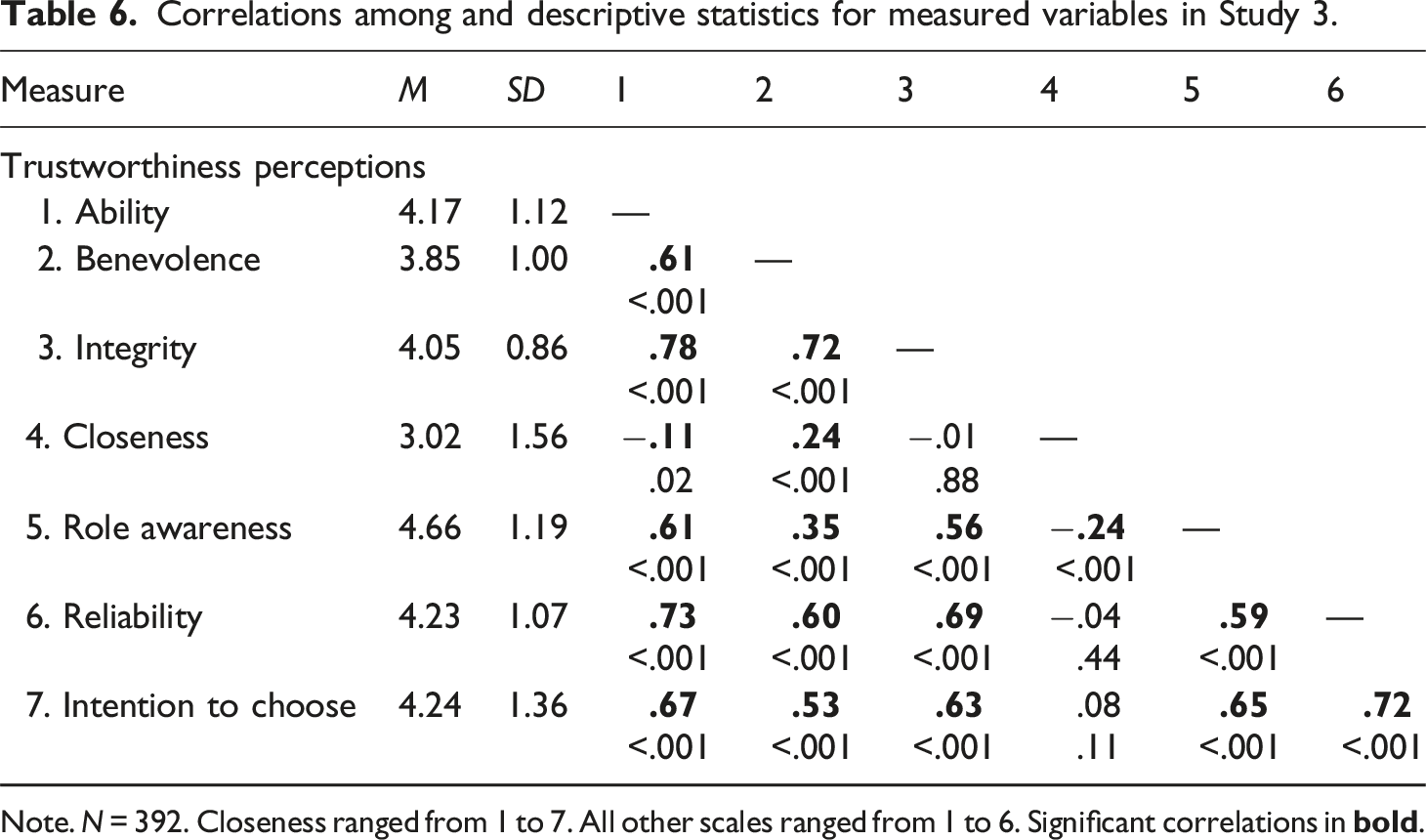
Correlations among and descriptive statistics for measured variables in Study 3.
Note. N = 392. Closeness ranged from 1 to 7. All other scales ranged from 1 to 6. Significant correlations in
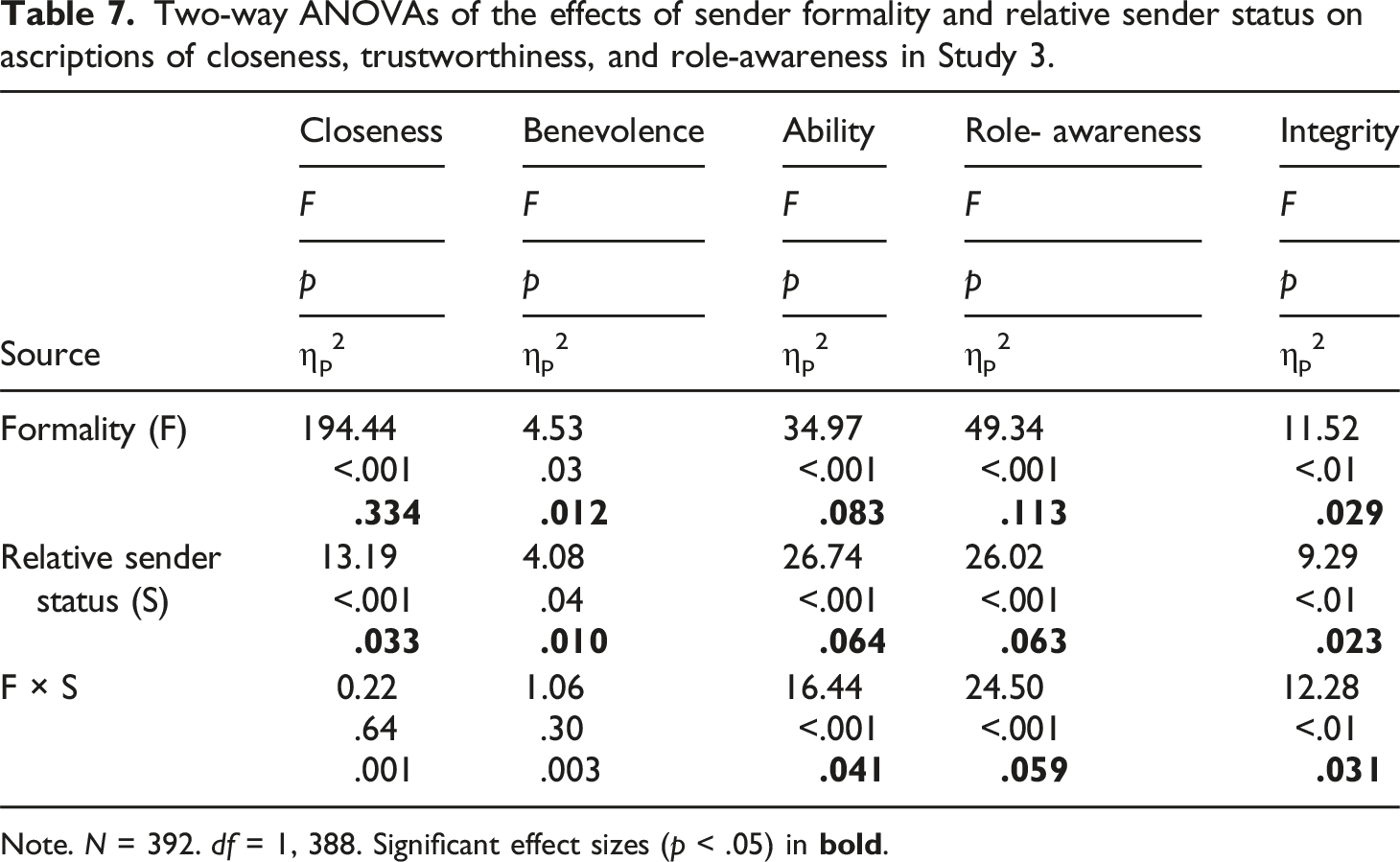
Two-way ANOVAs of the effects of sender formality and relative sender status on ascriptions of closeness, trustworthiness, and role-awareness in Study 3.
Note. N = 392. df = 1, 388. Significant effect sizes (p < .05) in
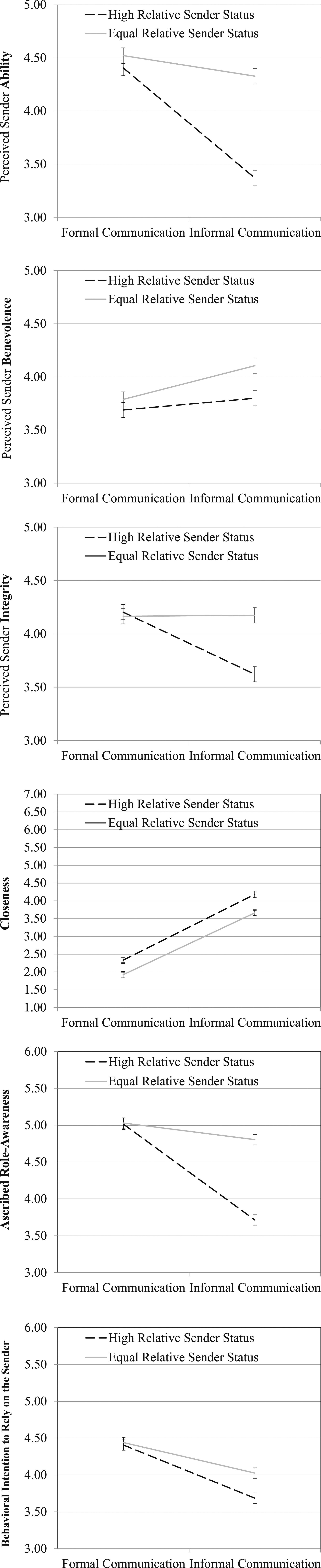
Means of perceptions of trustworthiness facets, feelings of closeness towards the sender, ascribed role-awareness, and the behavioral intention to rely on the sender in the four experimental conditions in Study 3. Error bars represent standard errors. Closeness ranged from 1 to 7, all other scales ranged from 1 to 6.
The manipulation checks of formality expectations showed the expected pattern: When awaiting a reply from an unknown colleague, 51% expected informal appellation (n = 98); by contrast, when awaiting a reply from a lawyer or a medical doctor, 97% expected formal appellation (n = 193), a significant difference, χ2 = 116.50, p < .001. Correspondingly, lawyers and medical doctors (M = 6.32, SD = 1.28) were expected to communicate significantly more formally than the work colleagues (M = 4.37, SD = 1.68), t(360,43) = 13.52, p < .001, d = 1.49.
Regarding Hypotheses 1 and 3, the results replicate the effects of informality (vs. formality) from the previous studies: When senders communicated informally (instead of formally), participants ascribed them significantly more benevolence, but significantly less ability, and the latter effect was significantly moderated by Relative Sender Status, so that participants only perceived informal senders of high relative status as significantly less trustworthy, B = −1.04, SE(B) = 0.16, 95% CI [-1.34, −0.73], p < .001, but not in informal senders of equal relative status, B = −0.20, SE(B) = 0.14, 95% CI [-0.47, 0.08], p = .17. This underlines that informality undermines perceptions of sender ability when informality violates professionality norms tied to professional roles of high relative status.
Regarding Hypothesis 2, we found a significant indirect effect of informality on perceived benevolence via closeness, B = 0.29, SE(B) = 0.07, 95% CI [0.14, 0.44], with a considerably smaller and non-significant direct effect of informality on benevolence, B = −0.06, SE(B) = 0.12, p = .59, compared to its total effect, B = .23, SE(B) = 0.10, p = .03. Looking at the moderated mediation testing Hypothesis 4, we found that the conditional indirect effect of informality on perceived ability via role-awareness was negative and significant when the sender was in a high relative status role, B = −0.71, SE(B) = 0.11, 95% CI [-0.94, −0.50], but not significant when the sender had a role of equal status, B = −0.12, SE(B) = 0.08, 95% CI [-0.28, 0.02]. This resulted in a significant index of moderated mediation, I = 0.58, SE(I) = 0.13, 95% CI [0.33, 0.85], substantiating the notion that informal communication erodes perceived ability of senders of high relative status because informal communication violates professional norms tied to professional roles of high (but not equal) relative status. From this violation, recipients infer that the sender is not aware of the expectations tied to their professional role or is not willing to adhere to them, which in turn reduces the perceived trustworthiness of the sender in terms of their professional ability.
Finally, the behavioral intention to choose the colleague, medical doctor, or lawyer to help with a problem was positively and uniquely predicted by perceptions of sender ability, B = 0.55, SE(B) = 0.07, p < .001, integrity, B = 0.30, SE(B) = 0.07, p < .01, and benevolence, B = 0.15, SE(B) = 0.11, p = .03, in a multiple regression analysis, explaining 48% of the variance in this behavioral intention. The same was true for ratings of the degree to which the sender could be relied on with the problem, with effects of perceptions of sender ability, B = 0.47, SE(B) = 0.05, p < .001, integrity, B = 0.23, SE(B) = 0.05, p < .01, and benevolence, B = 0.18, SE(B) = 0.08, p < .01, explaining 58% of the variance of recipients’ judgments of sender reliability. Importantly, even though all three sub-facets explain unique variance in the behavioral intention to rely on the sender, the large effect of ability ascriptions underline the potential costs of signaling a lack of role-awareness via informal communication when acting out of a high-status professional role.
General discussion
The present work aimed to elucidate when and why informality in initial messages fosters versus reduces trustworthiness perceptions. More specifically, we tested when and why informal versus formal messages lead to increased versus decreased perceived benevolence, integrity, and ability of senders in private and professional contexts. We argued that informality would convey closeness and should increase perceptions of sender benevolence both in private and professional contexts. However, when senders use informality in professional contexts, the formal communication expectations tied to their roles should cause informality to undermine perceptions of sender ability.
The results support the hypotheses that senders can use informality to create closeness and increase perceptions of their benevolence. To the best of our knowledge, no previous research has shown this effect. This effect was large across the three studies and held true across private and professional contexts. This suggests that recipients indeed attribute sender (in)formality to closeness, to exactly the factors underlying sender formality use according to politeness theory (P. Brown & Levinson, 1987). The result also fits and expands previous findings that informality reduces other forms of psychological distance (Stephan et al., 2010). Thus, based on these findings, using informality to signal closeness is a good strategy to increase benevolence perceptions, both in professional as well as in private relationships.
These positive effects of informality notwithstanding, informality reduces ability ascriptions when formal communication is expected. Especially when recipients’ trust-based behavior is heavily based on competence ascriptions (e.g., when hiring a lawyer, choosing which doctor to consult, etc.), senders in professional contexts may want to avoid informality because recipients infer a lack of awareness or willingness to comply with professionality expectations from it (Study 3). This skepticism of the sender’s professionality is associated with reduced perceptions of sender ability and reduced behavioral intentions to rely on them. These results fit well with previous research suggesting that in the relationship of informality and trustworthiness ascriptions, losses seem to outweigh gains for senders in high status roles tied to strong formality expectations (Lowrey-Kinberg, 2018). Moreover, a similar “trade-off” effect was also recently demonstrated for the impact of self-disclosure – a communication strategy supposed to increase closeness and warmth-related perceptions – on trustworthiness ascriptions in contexts with high expectations of professionalism (i.e., science communication; Altenmüller et al., 2023).
However, in less formal interactions, this “tradeoff” looks quite different. For example, informality in private contexts increased benevolence ascriptions without risking decreasing perceptions of sender ability.
Limitations
The present work faces limitations due to language, design, and sample characteristics. First, it is important to discuss the generalizability to other languages and cultures. Of course, the exact level of formality that a specific marker entails (e.g., a specific appellation like “Dear Sir or Madam” in English) is unique for a language and the exact effect size could thus not be generalized one-to-one to a study using a different language with a slightly different marker. However, all communication-theoretical approaches we based our reasoning on share the assumption that the socio-cognitive processes linking formality use and person perception are universal, even though the concrete markers may differ across languages (Brown & Levinson, 1987; Burgoon & Le Poire, 1993; Holtgraves, 2005). Additionally, the results fit into a coherent bigger picture with empirical results of studies in other languages (i.e., Dutch, English, Hebrew, Gretry et al., 2017; Lowrey-Kinberg, 2018; Stephan et al., 2010). Thus, at least very similar effect sizes would be expected. Nevertheless, replications in additional languages using more or different markers of informality would be desirable. Second, we looked at written communication and did so in online studies using artificial “as-if” scenarios. Although these characteristics mirror the digital environments in which people receive emails and messages in many ways, the artificiality of the setting could have prompted biases and given rise to demand characteristics (Orne, 1962). We did our best to disguise our research questions (e.g., by using cover stories, different experimental designs, distractor items, etc.), but we cannot fully rule out demand effects. Thus, studies testing the effects in less artificial settings and in other modalities of (written) communication are called for. Third, our samples stem from a WEIRD context (Rad et al., 2018), and were largely dominated by young, female participants, typically students. It cannot be ruled out that this subpopulation has characteristics that make it especially susceptible to the hypothesized processes (e.g., a preference for informality). However, the reported results were not meaningfully moderated by closeness preferences, risk aversion, or general trust (see Study 2 and Study 3 Supplementary Analyses, https://osf.io/c9rv8/). Nevertheless, a replication with a more diverse sample would be desirable. Future research could also extend the generalizability of findings by exploring their robustness across potentially relevant demographics (e.g., race/ethnicity, gender identity, or disabilities). Lastly, our ability measure was domain-unspecific. This differs from the original conceptualization, which defines ability-related trustworthiness perceptions as being specific to the task or domain for which trust is being placed (Mayer et al., 1995). This deviation does not represent a conceptual divergence but was implemented to minimize experimental noise that might arise from using target-specific ability measures.
Outlook and conclusion
The present work suggests that conveying closeness and signaling awareness of role-specific norms and expectations constitute two mechanisms underlying the effect of informality on trustworthiness ascriptions. However, under certain conditions, other mechanisms might become contextually equally or even more influential. For example, if a local communication norm prescribes informality (e.g., in organizations trying to foster closeness and commitment among their members via flat hierarchies), recipients may attribute informality less to senders’ intentions and competencies, but more to the organizational climate and local norms, reducing the effectiveness of the discussed processes. Thus, the role of explicit local communication norms as a moderator of the discussed processes might be an interesting venue for research illuminating the effects of informal communication in professional contexts further.
Secondly, we focused on perceptions of sender ability and sender benevolence while disregarding sender integrity. The high correlations between benevolence and integrity perceptions across the three studies (r = 0.66, r = 0.67, r = 0.72) suggest that these facets may be empirically indistinguishable in the context of informality effects and could potentially be collapsed into a “warmth-related” or “affective” trustworthiness factor, as some have argued (Altenmüller et al., 2023). However, integrity was similarly correlated with ability (r = 0.62, r = 0.77, r = 0.78), yet exhibited a unique results pattern. Whereas informality fostered integrity ascriptions in private (but not professional) contexts in Study 2, it undermined integrity ascriptions for senders in high relative status roles (but not equal status roles) in Study 3. This suggests that integrity should not be collapsed with either benevolence or ability. Instead, the complex relationship between informality and integrity perceptions warrants closer investigation. Informality seems to impact integrity ascriptions via both pathways: communicating closeness (in private contexts) and violating professional norms (in professional contexts). Future research should explore the moderators triggering and shaping these pathways, such as profession-specific norms and formality expectations, in greater detail.
Thirdly, we focused on degrees of formality inside of what Stephan et al. (2010) termed the “wiggle room,” that is, a context-specific range of conceivable communication choices that are more or less formal or informal without going into the extreme. Within this wiggle room, the results fit better with the proposed theoretical rationale of two pathways than with a general framework of expectation-violations (expectation-violating formality use decreases trustworthiness perceptions in all facets). As a point in case, across all three studies, expectation-violating informality never reduced benevolence perceptions, even though formality expectations were high in Study 2 and Study 3. In fact, in Study 2, informality even increased benevolence perceptions both in professional and in private contexts, that is, no matter if formality or informality was expected. The effects of informality on benevolence perceptions were also never moderated by other experimental factors, even though those factors significantly and strongly manipulated formality expectations. However, it is plausible to assume that (in)formality outside of the wiggle room violates expectations so strongly that it erodes trustworthiness perceptions in all facets, leading to inverse u-shaped relationships between formality and trustworthiness ascriptions across the full range of formality. This potential limitation of our theoretical rational in comparison to a more general approach of expectation-violations could be investigated with studies employing a broader range of formality levels and context factors manipulating formality expectations.
Fourthly, we examined initial messages and their influence on trustworthiness perceptions under minimal acquaintance. This approach has advantages, as initial trustworthiness perceptions guide trust development (McKnight et al., 1998), and minimal acquaintance reduces certain complexities, simplifying analysis. However, factors such as prior knowledge of the sender (e.g., their trustworthiness, communication style preferences) and pre-existing relationship qualities (e.g., closeness, relational status) likely moderate the impact of informality on trustworthiness perceptions (Brown & Levinson, 1987; Gretry et al., 2017). Future research could explore how exactly these moderators influence trustworthiness perceptions after informality, for instance, by shaping recipients’ formality expectations.
In closing, the nuanced interplay between informality in communication and trustworthiness perceptions is a bit clearer now. Whereas in personal relationships, senders can use informality to gain in their perceived benevolence-related trustworthiness without having to worry about side-effects, senders in professional relationships must strike a delicate balance between conveying closeness and maintaining professional credibility. As we move forward, these results can serve organizations and individuals in initiating and maintaining closeness and trust in their personal and professional relationships and scholars interested in the dynamics of linguistic formality and trustworthiness.
Footnotes
Declaration of conflicting interests
The author(s) declared no potential conflicts of interest with respect to the research, authorship, and/or publication of this article.
Funding
The author(s) received no financial support for the research, authorship, and/or publication of this article.
Open research statement
As part of IARR’s encouragement of open research practices, the authors have provided the following information: This research was not pre-registered. The data used in the research are available. The data can be obtained at:  or by emailing: