




Abstract
Past research has found that people often engage in one of three behaviours to resolve inconsistencies with others: validation, conforming, or distancing. While much of the social influence literature has assessed contexts in which conformity is more or less likely, little has explored alternatives to conformity, such as validation and distancing. The present research as aims to assess what underlying factors that affect these preferences. We used vignettes of inconsistency in relational contexts to assess people’s preferred responses. In Study 1, we assessed Canadian participants’ preferences responses following social inconsistency. We found that more perceived self-changeability increased preference for conformity and decreased preference for validation and distancing, while more perceived relational mobility increased preference for distancing and decreased preference for conformity and validation. In Study 2 we assessed how these behaviours may vary culturally. We found that compared to Canadians, Koreans expressed greater preference for conformity and less preference for validation. The patterns of results for perceived changeability and mobility were largely the same across Canadian and Korean, with Koreans demonstrating similar or smaller effects. Implications and limitations of these findings are discussed.
Introduction
In Jane Austin’s novel Persuasion, the protagonist, Anne Elliot, is faced with a dilemma. While she has a deep and growing love for Captain Fredrick Wentworth, her engagement to him is deemed unfavourable by Lady Russell, both a close friend of her late mother and her godmother. The core of Anne’s dilemma is the inconsistency between her perception of Wentworth and Lady Russell’s perception of Wentworth. For Anne this is a stark inconsistency between two people for whom she cares a great deal. Ultimately, Anne was persuaded to conform with Lady Russell’s perspective, changing her views toward Wentworth and severing her engagement. Most people could call to mind experiencing an inconsistency with another person like this. The ubiquity of this sort of experience makes it important to understand the behaviours people may choose in response, and why they may choose these behaviours. In the present research, we explore how factors of a person’s situation and broader culture may moderate the way that people approach resolution to social inconsistencies.
Social consistency
A common observation in the field of Social Psychology is that people are motivated to minimize inconsistency between themselves and others. In Balance Theory, an early conceptualization of relationship processes, (Heider, 1946; Newcomb, 1953), was among the first to indirectly discuss the importance of social inconsistency. Using social triads as an example, he posited that people would be motivated to obtain balance in their triads (i.e., consistency in attitudes about each other). For instance, for Anne, if Russell and Wentworth both liked one another, there would be mutual consistency, and the triad would be balanced. However, because Russell did not approve of Wentworth the triad was imbalanced, and thus Anne was motivated to achieve balance (even though it meant severing her relationship with Wentworth).
Like Anne, when forming opinions of novel individuals, people tend to adjust their attitudes to align with those they already hold in esteem (Gawronski et al., 2005). Similarly, research assessing the Chameleon Effect has demonstrated that when interacting with a new person, people tend to unintentionally adjust their behaviour to reduce inconsistency (Chartrand & Bargh, 1999) particularly when affiliation is motivated (Lakin & Chartrand, 2003). More broadly, across a wide range of topics, people are motivated to adjust attitudes toward alignment in relationships (Davis & Rusbult, 2001). Davis and Rusbult suggest this tendency to desire (and seek) alignment is part of the reason similarity is associated with greater attraction and relationship longevity (Feingold, 1988; Hill et al., 1976; Kandel, 1978; Lea & Duck, 1982; Neimeyer & Mitchell, 1988; Schoen & Wooldredge, 1989; Tidwell et al., 2013; Till & Freedman, 1978), and why individuals perceived to have similar attitudes are preferred as potential coworkers, friends, intimate partners, and marital partners (Byrne & Nelson, 1965; Nahemow & Lawton, 1975; Stroebe et al., 1971; Tidwell et al., 2013).
The goal of mutual similarity has been described as a shared reality (Echterhoff, Higgins, & Levine, 2009; Levine & Higgins, 2001). The motivation for attaining shared reality provides an explanation for the observations that people tend to grow more similar to friends and partners, (Anderson et al., 2003) and social groups more broadly, (Hoffmann & Miller, 1997) over time. i.e., people are motivated to adjust their selves (e.g., beliefs, attitudes, behaviours, etc.) to enhance similarity and reduce social inconsistency (Hillman et al., 2023). For clarity, we will broadly refer to the various examples of people adjusting attitudes, beliefs, and behaviours (e.g., attitude alignment and behavioural mimicry) as conformity (see Cialdini & Goldstein, 2004 for review).
Most research on social inconsistency has aimed to understand how people minimize inconsistency by adjusting their own behaviour to those around them (i.e., conform). However, consider again the example of Anne’s unbalanced triad. While one resolution is for Anne to change her beliefs to align with Lady Russell, this was not a satisfying solution for Anne, who comes to regret it over the course of the novel. Instead, Anne could have attempted to advocate for her love and the virtues of Wentworth, instead attempting to change Lady Russell’s beliefs. While this route may have been more likely to involve interpersonal conflict, it could have been a more satisfying solution for Anne in the long term, as she ends up rekindling her love with Wentworth eight years after ending her engagement. Alternatively, she could have resolved this inconsistency by distancing herself from Russell, either denigrating or potentially fully severing their relationship. While a great deal of work has helped elucidate when and why people conform, comparatively little work has assessed if and how people my prefer to engage in these validation-seeking or distancing processes.
Responses to social inconsistency
When confronted with social inconsistency, people may experience a tension between themselves and another. Some research (Hillman et al., 2023) has drawn connections between this experience and classic cognitive dissonance (Festinger, 1957). Like classic conceptions of cognitive dissonance, the most direct means of resolving the inconsistency is changing the offending cognitions. For an individual experiencing inconsistency then, they can conform, and directly change their own position to achieve consonance with others. Unlike classical dissonance, however, one of the offending cognitions is contained within the mind of another person. While most of the current work on inconsistency reduction in social relationships has assessed conformity, some work has illustrated alternative behaviours in which one may engage. Matz and Wood (2005) demonstrated that, aside from conformity, people may also petition inconsistent group members to change. In their work, the authors placed participants on the jury of a mock trial in which they had to reach a unanimous verdict with other jurors. When participants were faced with social inconsistency (i.e., a disagreement about the verdict), it generally negatively impacted their mood, and so they were motivated to rectify this by attaining consistency with their fellow jurors. Matz and Wood noted that three resolutions tended to emerge. Some people changed their verdict to align with the group (i.e., conform). However, others advocated for their verdict and petitioned others in the group to change their stance (i.e., sought validation). If the inconsistency were between two of one’s own cognitions these behaviours would be the same, however, because social inconsistencies involve other people’s cognitions, the corresponding rectification behaviours are notably different. Further, some participants chose to leave the group in hopes of finding another with whom their verdict already aligned (i.e., distance). This is akin to reframing in classic dissonance paradigms. By reframing the closeness, and thus importance, of a relationship one may be able to reduce their dissonance. Distancing may range from extreme measures (e.g., irrevocable severing of the relationship) to a much milder response (e.g., temporary limiting of communication). If one’s relative has objectionable political opinions, they may simply talk to that person less or avoid specific topics when talking to them. As such, to maintain social consistency within their relationships, people may aim to change themselves, others, or even the relationships themselves. While this work has been illustrative of what people may do in response to inconsistency, it is not clear what factors may influence these decisions, or in other words why people choose one resolution over another.
Antecedents to responses to social inconsistency
Social Verification Theory suggests that there are two key situational factors which may affect all three of these behaviours: the perceived ability to change aspects of one’s self, (such as identity or beliefs, which we will refer to as self changeability), and the perceived ability to change one’s social groups, (which we will refer to as relational mobility), (Hillman et al., 2023). Because conforming requires changing aspects of one’s self or one’s behaviour, it should be seen as a less viable option to dealing with inconsistency when the discordant domain is perceived as central to one’s self (or otherwise unchangeable). As such, when individuals perceive changeability to be low, they should be less likely to consider conformity as a response to inconsistency, and thus should prefer seeking validation or distancing. Conversely, individuals who view their relationships as having less mobility should be less likely to consider distancing as a response to inconsistency, and thus should prefer conformity or seeking validation. For instance, an individual may change their beliefs about an important issue when inconsistent with a close friend or spouse. However, the same inconsistency with an acquaintance may lead people to simply distance themselves from the acquaintance. While Davis and Rusbult (2001) did not directly assess changeability or relational mobility, they found that attitude alignment (i.e., mutual conformity) was higher when the inconsistency was peripheral to the self (i.e., likely more changeable) and for dating-partners rather than strangers (i.e., likely lower relational mobility). These findings are consistent with theoretical perspective we present here.
Culture and social inconsistency
An inconsistency in any relationship will always be embedded in cultural contexts of that relationship. As such, it is important to consider the how culture relates to responses to inconsistency. While research tends to show that Eastern individuals conform more than Western individuals, some work has suggested this heightened conformity is more about public perception than private changes to preferences or beliefs (Yamagishi et al., 2008). Further, seminal work on understanding cognitive differences across cultures has found that Eastern individuals are more willing than Western individuals to hold multiple inconsistent cognitions simultaneously (Peng & Nisbett, 1999). This tendency, along with strong social values on maintaining interpersonal harmony (e.g., Lim, 2009; Markus & Kitayama, 1991), may thus lead Eastern individuals to conform for the sake of appearing consistent, while still harbouring contradictory beliefs. This heightened conformity may enhance social harmony, but it would not resolve perceived social inconsistencies as the offending cognitions would remain unchanged. Both Western and Eastern individuals should be motivated to resolve social inconsistencies as they threaten belonging (Baumeister & Leary, 2017; Hashimoto & Yamagishi, 2013; Hillman et al., 2023). As such, it is unclear whether when conformity is framed as private conformity specifically (i.e., changing oneself, not simply appearing to change), if it will still be more desirable for Eastern individuals than Western individuals.
Validation-seeking may offer a viable alternative to conformity in situations when change is perceived as impossible or untenable. Matz and Wood (2005) found that (for their Western participants), validation was the only outcome which elicited positive emotions, rather than just reducing negative emotions, suggesting that validation-seeking can be highly rewarding. While validation-seeking is likely used in both cultures, it may carry some drawbacks for Eastern individuals which is does not for Western individuals. The inherent risk of conflict carried by validation-seeking may stand to disrupt group harmony, a highly desirable social state in many Eastern cultures (Lim, 2009; Markus & Kitayama, 1991), which may make validation-seeking seem less appealing than it might be to Western individuals. Eastern individuals do show a preference for self-assertion at least in close relationships where mobility is lower (Sugimura et al., 2009). However, Eastern individuals do often avoid other similarly disruptive behaviours in favour of maintaining group harmony, such as social support-seeking (Kim et al., 2006; Taylor et al., 2004). As such, Eastern individuals are likely to still pursue validation-seeking but unlikely to do it to the same degree as their Western counterparts.
While our review of conformity focussed on private conformity (i.e., true attitude change), public conformity may be employed along with distancing to maintain harmonious relationships. For instance, if one’s family member makes objectionable political statements, one may nod along when the topic comes up while disagreeing inwardly. Because this solution does not rectify the inconsistency, it is likely to be less satisfying than alternatives. However, for cultures which value harmony, it may be preferable to validation-seeking (Lim, 2009; Markus & Kitayama, 1991). In cultures where relationships are viewed as more stable once formed (e.g., Eastern cultures, see Kito et al., 2017), dissolution may be perceived as highly undesirable. However, perceiving relationships as fixed and reliable may make reducing communication for extended periods of time feel less threatening. As such, temporary avoidance could be used to alleviate inconsistency when changeability is perceived as low. Distancing as reduced communication rather than fully severed relationships may then be as common in Eastern individuals as Western individuals for different reasons.
Culture is unavoidably entwined with these processes as perceptions of both changeability of self and relational mobility often vary across cultural context. Generally, compared to Western individuals, Eastern individuals tend to view themselves as more changeable and less stable across time and situation (Campbell et al., 1996; English & Chen, 2007). Inversely, compared to Easterners, Western individuals tend to view their relationships as relatively mobile, more easily dissolved and reformed (Kito et al., 2017). At a broader level, approaches to resolving disagreement stemming from inconsistency often vary substantially across cultures as well (Schouten et al., 2023). For instance, Eastern individuals were more likely than Western individuals to prefer compromising and integrating (Cai & Fink, 2002). As compromises often necessitate some form of change in one’s self, this is consistent research suggesting that Eastern individuals tend to conform more than Western individuals (Bond & Smith, 1996; Cinnirella & Green, 2007; Kim & Markus, 1999).
The present research
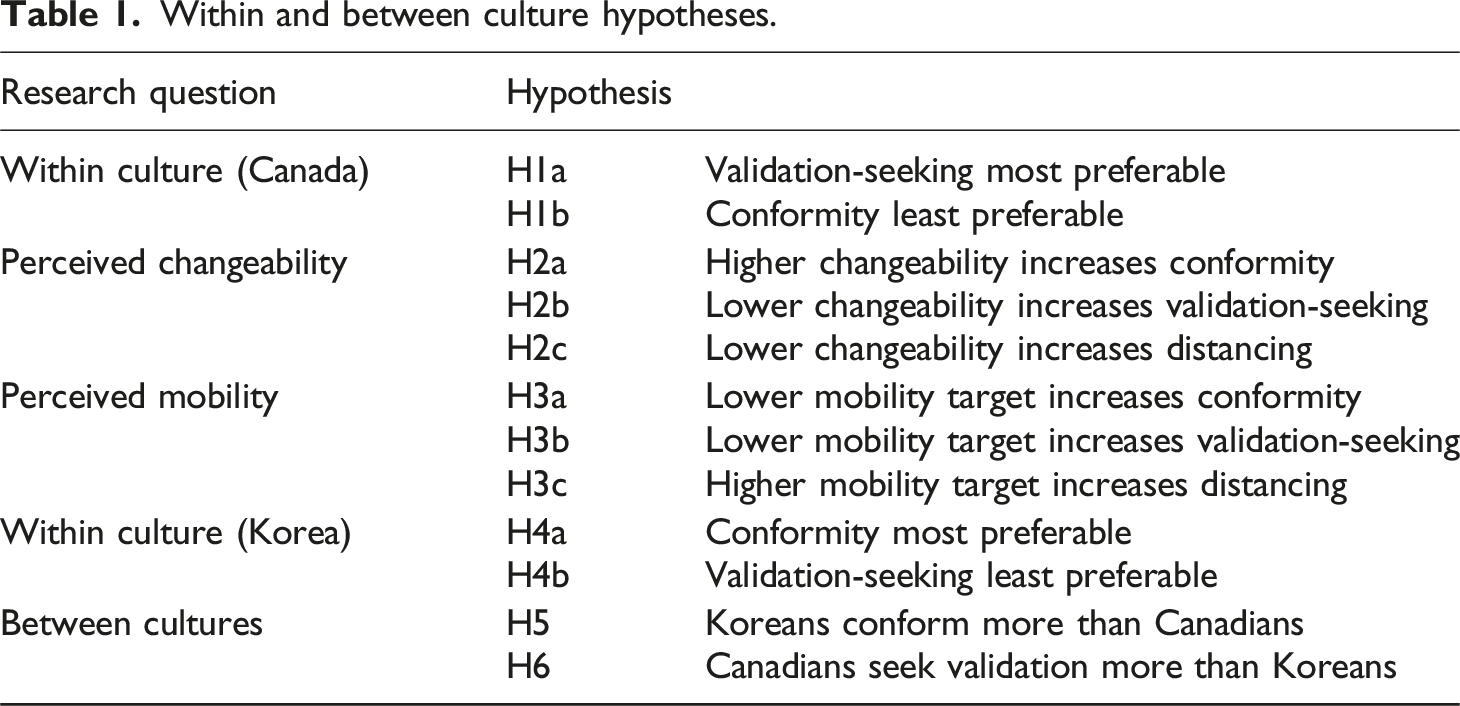
In the present research we assessed both the effects of changeability and relational mobility on preferences for responses to social inconsistency. In Study 1 we manipulated situational aspects of both changeability and mobility and assessed the preference for conformity, validation-seeking, and distancing across four situations for Western (Canadian) participants. Consistent with Matz and Wood (2005), we hypothesized that participants would prefer seeking validation the most (H1a), and conformity the least (H1b) across situations. Consistent with Hillman and colleagues (2023), in terms of changeability, we hypothesized that conformity would be preferable when changeability was high (H2a), that validation-seeking would be preferable when changeability was low (H2b), and distancing would be preferable when changeability was low (H3c). In terms of mobility, we hypothesized that conformity would be preferable when mobility was low (H3a), that validation-seeking would be preferable when mobility was low (H3b), and distancing would be preferable when mobility was high (H3c).
Within and between culture hypotheses.
Cultural moderators
While we aim to manipulate perceived situational changeability and mobility and control for dispositional changeability and mobility, culture may moderate our expected patterns of results for a variety of other reasons. For instance, while we expect that validation-seeking may be lower when speaking with a stranger than a close other, Eastern individuals may feel more pressure to behave harmoniously and thus this effect may be even stronger. Alternatively, while Eastern individuals should be motivated to deal with social inconsistencies generally (like Western individual), they may be more tolerant of the inconsistencies than their Western counterparts. As such, Eastern individuals may have smaller effects of mobility and changeability across all responses to social inconsistency. Because this is a relatively novel area of work, we refrained from generating additional extensive hypothesis about how these moderations may manifest. The specific effects of moderation are thus exploratory.
For both studies we report all measures, exclusions, hypotheses, and analyses. 1 Our hypotheses were not preregistered. All data and methods can be found on our OSF page. 2
Study 1
Method
Participants
We recruited 253 undergraduate students from a large Canadian university. Of these students 224 (88%) identified as women, 26 identified as men (11%), and 3 (1%) identified as non-binary. Ages ranged from 18 to 50 years, with an average age of 21 years (SD = 6.26). Participants completed the study on Qualtrics and were remunerated with course credit for their time.
Procedure
All permutations of topic and relationship.
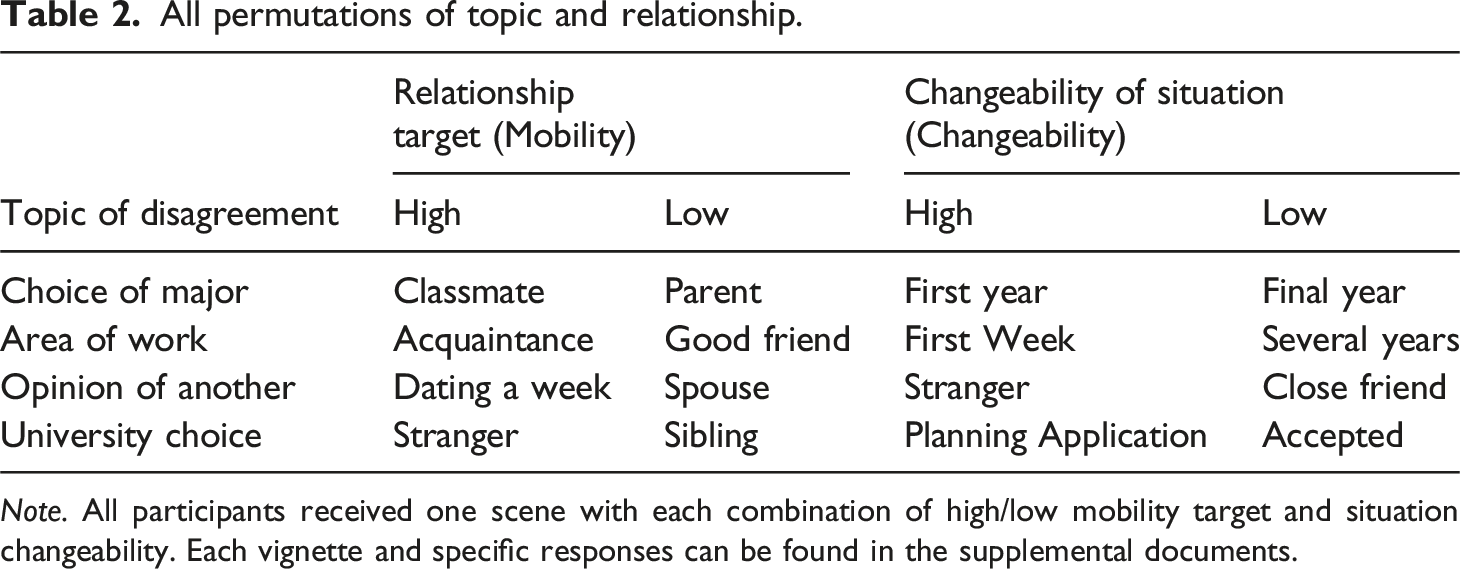
Note. All participants received one scene with each combination of high/low mobility target and situation changeability. Each vignette and specific responses can be found in the supplemental documents.
For each vignette, participants rated how much they agreed with each of three potential responses the character could take on a 1 to 7 scale (Strongly Disagree 1 to Strongly Agree 7). The first potential response was conformity (or change a characteristic about themselves to align with the other person, e.g., the university they want to attend), the second was seeking validation (petition the other person to change), and the final was distancing (increase social distance with the person, e.g., stop talking to the individual). To enhance immersion, all point-of-view characters in vignettes were matched to participants’ self-reported gender.
Results
Overall preferences
First, we assessed participants’ overall preference for conformity, validation-seeking, and distancing, using a within-subjects analysis of variance (ANOVA). The results indicated a significant difference among the means F (2,548) = 171.64, p < .001, η2 = .56. Follow-up LSD comparisons indicated that validation-seeking (M = 4.15, SE = 0.06) was seen as more desirable, on average, than conformity (M = 2.65, SE = 0.05), p < .001 and distancing (M = 3.34, SE = 0.06), p < .001. Distancing was also seen are more preferable than conformity p < .001. These data demonstrate that, as suggested by past research, Canadian participants preferred validation-seeking the most and conformity the least, supporting H1a and H1b.
Mobility and changeability
We also used factorial within-subjects analysis of variance (ANOVA) to assess the potential interaction between changeability and mobility for each potential response to inconsistency. For conformity there was a main effect of perceived mobility of target F (1,248) = 11.20, p < .001, η2 = .04, such that targets with high mobility (M = 2.49, SE = 0.06) were seen as less preferable for conformity than those with low mobility (M = 2.80, SE = 0.08). There was also a main effect of changeability F (1, 248) = 25.70, p < .001, η2 = .09, such that situations with high changeability (M = 2.87, SE = 0.07) were seen as more preferable for conformity than those with low changeability (M = 2.42, SE = 0.07). There was no interaction between situational mobility and changeability F (1, 248) = 0.14, p = .712, η2 = .01.
For validation-seeking, there was a main effect of mobility F (1, 246) = 83.46, p < .001, η2 = .25, such that targets with low mobility (M = 4.53, SE = 0.07) were seen as more preferable for validation-seeking than those with high mobility (M = 3.78, SE = 0.09). There was no main effect of changeability on preference for validation-seeking F (1, 246) = 2.73, p = .100, η2 = .01. As such there was no difference in preference for seeking validation in situations with high changeability (M = 4.09, SE = 0.08) and low changeability (M = 4.23, SE = 0.08). There was also no interaction between mobility and changeability F (1,246) = 0.72, p = .369, η2 = .01.
There was a large main effect of mobility on preference for distancing F (1, 246) = 255.19, p < .001, η2 = .51, such that targets with high mobility (M = 4.11, SE = 0.08) were seen as more preferable for distancing than those with low mobility (M = 2.57, SE = 0.07). There was also a main effect of changeability F (1, 246) = 6.56, p = .010, η2 = .03, such that situations with low changeability (M = 3.47, SE = 0.08) were seen as more preferable for distancing than those with high changeability (M = 3.21, SE = 0.08). As with prior behaviours, for distancing, there was no interaction between mobility and changeability F (1,246) = 0.21, p = .647, η2 = .01.
Discussion
Study 1 demonstrated that in response to social inconsistency Canadian participants preferred validation-seeking the most, and conformity the least. Further, these data demonstrated that more changeability (e.g., conflict regarding a novel vs. firmly held attitude), resulted in more willingness to conformity and less willingness to distance, supporting H1a and H1c. However, there was no support for a role of changeability in validation-seeking, thus H1b was not supported. These data also demonstrated that more relational mobility (e.g., a conflict in a transient vs. permanent relationship), resulted in less conformity, less validation-seeking, and more distancing, supporting H2a, H2b, and H2c. In Study 2, we assessed how culture may further shape the effects of changeability and mobility on preferred responses to social inconsistency. While we provide hypotheses for mean differences between cultures and the effects of perceived changeability and mobility across cultures, interactions between culture and changeability and mobility are exploratory.
Study 2
Method
Participants
We recruited a total of 587 participants. Of these, 297 were post-secondary students recruited from a large Korean university and 292 were post-secondary students recruited from a large Canadians university. Of the 292 Canadian participants, 263 (90%) identified as women, 26 (10%) identified as men. Ages ranged from 18 to 68, and the average age was 21 (SD = 7.34). In terms of race/ethnicity, 216 (73%) identified as European, 27 (9%) identified as East Asian, 15 (5%) identified as South Asian, 8 (3%) identified as Black/African, and 3 (1%) identified as Hispanic. An additional 22 (8%) selected ‘other’ and 4 (1%) declined to provide a response. Of the 297 Korean participants 173 (58%) identified as women, 124 (42%) identified as men. Ages ranged from 18 to 50, and the average age was 27 (SD = 5.44). No race/ethnicity data were collected for Korean participants, but all participants were domestic students. Canadian students were compensated with course credit and Korean students were compensated with 2000W (∼US$2.00 CAD).
Procedure
As with Study 1, participants viewed four vignettes and rated how much they agreed with each of the three potential responses (conformity, validation-seeking, and distancing). All materials were translated into Korean and back-translated by bilingual native Korean speakers.
As with Study 1, we manipulate perceived changeability and relational mobility across each scene. However, these variables are known to vary across culture as well (e.g., English & Chen, 2007; Thomson et al., 2018). To control for this potential dispositional variance, we included measures of perceived self-changeability and relational mobility. To measure dispositional perceptions of changeability, we used the self-concept clarity scale (Campbell et al., 1996) which measures the degree one feels their self is fixed or changes across time and context. This is a 15-item scale rated on 1 (Strongly Disagree) to 7 (Strongly Agree), which asks participants to rate how they feel each item applies to themselves. Example items include “I can be completely different around different friends” or “My beliefs about myself seem to change very frequently”. Past research has found differences in self-concept clarity between Eastern and Western participants, particularly due to the fixedness subscale (Campbell et al., 1996). To measure dispositional mobility, we used the Relational Mobility scale (Thomson et al., 2018). This is a 12-item scale rated on a 1 (Strongly Disagree) to 7 (Strongly Agree) which asks participants to rate how they feel each item applies to their social groups. Example items include “They are able to choose, according to their own preferences, the people whom they interact with in their daily life” or “Even if these people were not satisfied with their current relationships, they would often have no choice but to stay with them”.
Results
Differences in preference across scenes
Several of our hypotheses concerned differences in response tendency between and within nationality collapsing across the variables of changeability and mobility. For these analyses, we averaged across all four situations to assess general tendencies. Because this is a comparatively simpler model, we tested these comparisons first using a 2 (nationality) by 3 (response type) mixed-model ANOVA. We report the estimated marginal means for this comparison. The omnibus model demonstrated significant main effects of nationality F (1, 585) = 32.45, p < .001, response type F (2, 1170) = 100.02, p < .001, and a significant interaction between nationality and response type F (2, 1170) = 65.05, p < .001. We probed the interaction using a priori pairwise comparisons in line with our hypotheses.
Between nationality
Consistent with predictions, Koreans (M = 3.40, SE = 0.07) tended to prefer conformity more than Canadians (M = 2.64, SE = 0.07), t (1673) = 8.14, p < .001, whereas Canadians (M = 4.03, SE = 0.07) tended to prefer validation-seeking more than Koreans (M = 3.58, SE = 0.07), t (1673) = 4.79, p < .001. While we expected roughly similar levels of distancing between nationality at a general level, Koreans (M = 4.10, SE = 0.07) seemed to prefer distancing more than Canadians (M = 3.36, SE = 0.07), t (1673) = 7.95, p < .001.
Within nationality
Within nationality, Canadians tended to prefer validation-seeking (M = 4.03, SE = 0.07) more than both conformity (M = 2.64, SE = 0.07), p < .001 and distancing (M = 3.36, SE = 0.07), p < .001. Koreans, on the other hand had a small preference for validation-seeking (M = 3.58, SE = 0.07) over conformity (M = 3.40, SE = 0.07), p = .036, and preferred both validation-seeking and conformity less than distancing (M = 4.10, SE = 0.07), ps < .001. These results provide further support for H1a and H1b and replicate the findings of Study 1. However, they do not support H4a and H4b, as distancing was the most preferred response for Koreans.
Differences in preference between scenes
Mean differences between conditions within each nationality.
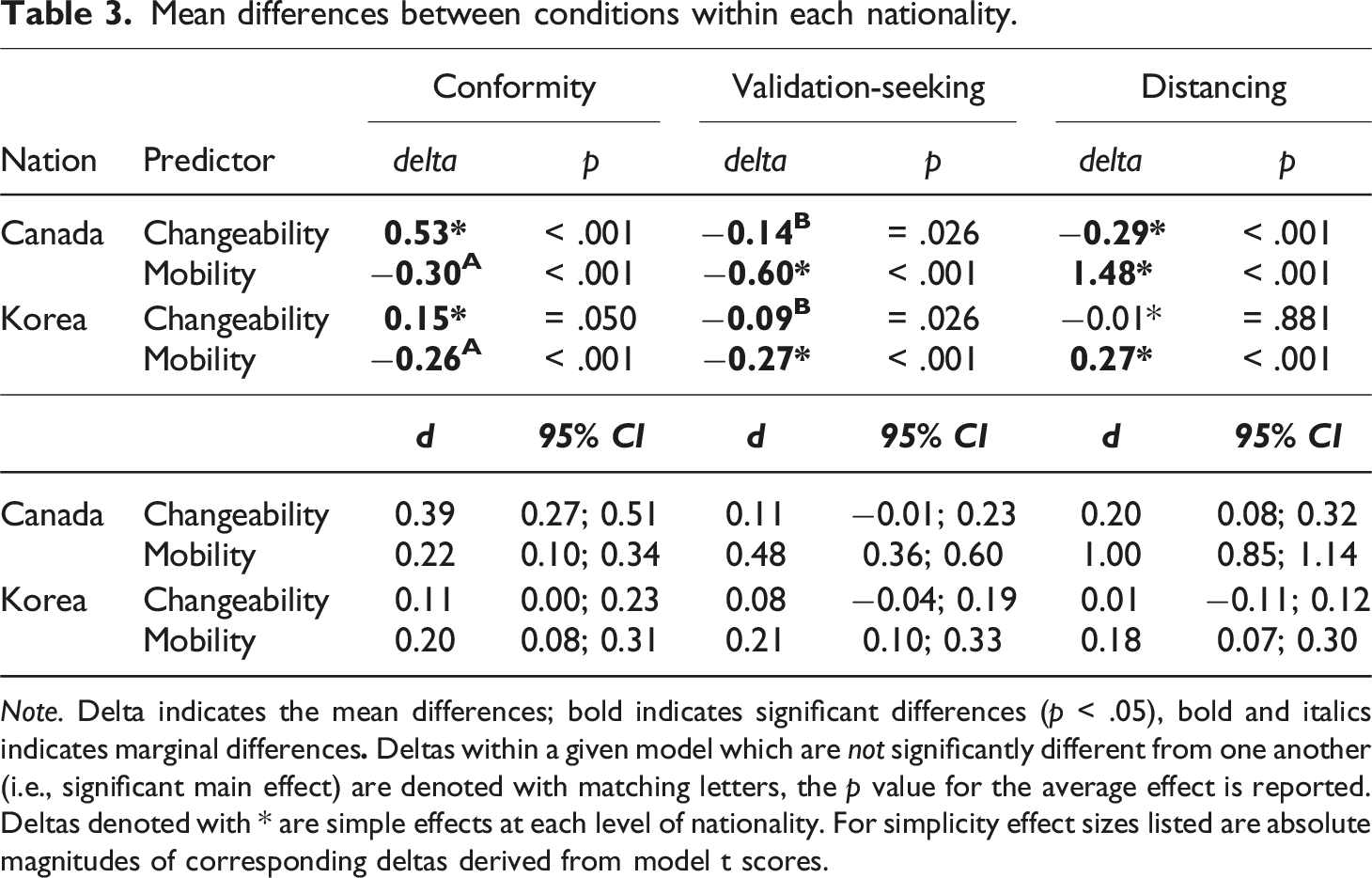
Note. Delta indicates the mean differences; bold indicates significant differences (p < .05), bold and italics indicates marginal differences
Raw means and standard deviations for situations and response types by nationality.
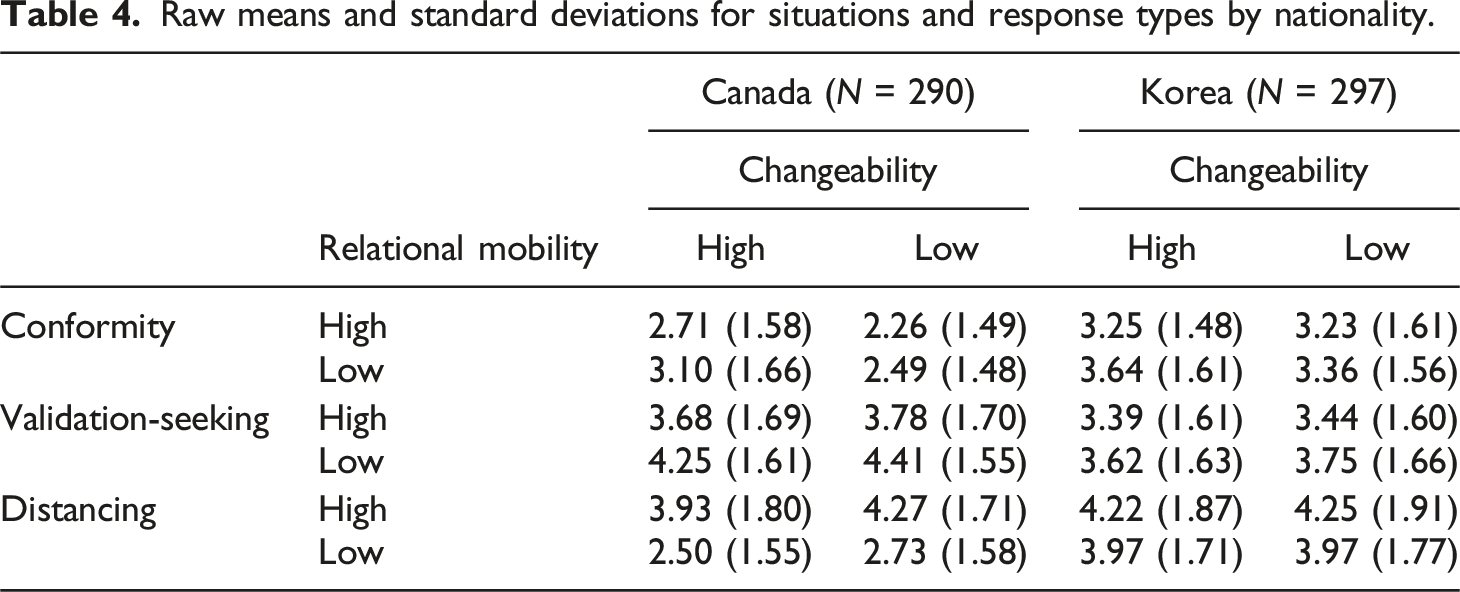
Conformity
The null random effects model demonstrated a moderate interclass correlation (ICC = .28). Indicating that a given individual’s preference for conformity across scenes were correlated at .28. Our predictive model fit the data significantly better than the null model χ2 (8) = 144.59, p < .001. This model accounted for 31% of participants’ variance in preference for conformity.
When assessing preference for conformity, there was an interaction between changeability and nationality b = −0.38, t (1753) = −3.40, p = .001. Follow-up analysis indicated that for Canadians, more changeability results in less preference for conformity b = 0.53, t (865) = 6.72, p < .001 and the same was true, but to a lesser extent, for Koreans b = 0.15, t (865) = 3.37, p = .042. As such both cultures tended to conform more when changeability was high, but this effect was smaller for Koreans. There was no interaction between target mobility and nationality, b = 0.03, t (1753) = 0.30, p = .766. There was, however, a main effect of relational mobility of target b = −0.28, t (1755) = 5.04, p < .001, such that higher mobility tended to decrease preference toward conformity. There was also main effect of nationality b = 0.71, t (582) = 7.83, p < .001, such that Korean participants tended to prefer conformity more than Canadian participants.
Validation-seeking
The null random effects model demonstrated a moderate interclass correlation (ICC = .41). Indicating that a given individual’s preference for validation-seeking across scenes were correlated at .41. Our predictive model fit the data significantly better than the null model χ2 (8) = 113.92, p < .001. This model accounted for 43% of the variance in preference for validation-seeking.
When assessing preference for validation-seeking, there was an interaction between relational mobility of target and nationality b = 0.34, t (1754) = 3.26, p = .001. Follow-up analysis indicated that for Canadians, more targets with higher mobility had less preference for validation-seeking b = −0.60, t (865) = 7.83, p < .001 and the same was true, but to a lesser extent, for Koreans b = −0.27, t (889) = 3.83, p < .001. There was no interaction between changeability and nationality b = 0.04, t (1751) = 0.43, p = .667. There was however marginal main effect in preference based on situational changeability b = −0.14, t (1756) = 1.88, p = .060, such that more changeability tended to decrease preference toward validation-seeking. Lastly, there was a main effect of nationality b = −0.45, t (582) = 4.29, p < .001, such that Canadian participants tended to prefer validation-seeking more than Korean participants.
Distancing
The null random effects model demonstrated a moderate interclass correlation (ICC = .26). Indicating that a given individual’s preferences for distancing across scenes were correlated at .26. Our predictive model fit the data significantly better than the null model χ2 (8) = 356.8, p < .001. This model accounted for 37% of the variance in preference for distancing.
When assessing preference for distancing, there was an interaction between changeability and nationality b = 0.28, t (1752) = 2.29, p = .022. Follow-up analysis of the changeability by nationality interaction indicated that for Canadians, more changeability results in less preference for distancing b = −0.29, t (1752) = 3.36, p = .001 however, situational changeability had no effect on preferences for distancing for Koreans b = −0.01, t (1752) = 0.15, p = .880. Lastly, there was also an interaction between relational mobility of target and nationality b = −1.21, t (1752) = 9.94, p < .001. Follow-up analysis of the target relational mobility by nationality interaction indicated that for Canadians, targets with mobility had more preference for distancing b = 1.48, t (1752) = 17.06, p < .001 and the same was true, but to a lesser extent, for Koreans b = 0.27, t (1752) = 3.11, p = .002. Lastly, there was a main effect of nationality b = 0.66, t (582) = 6.49, p < .001, such that Korean participants tended to prefer distancing more than Canadian participants.
Discussion
Within and between culture hypotheses.
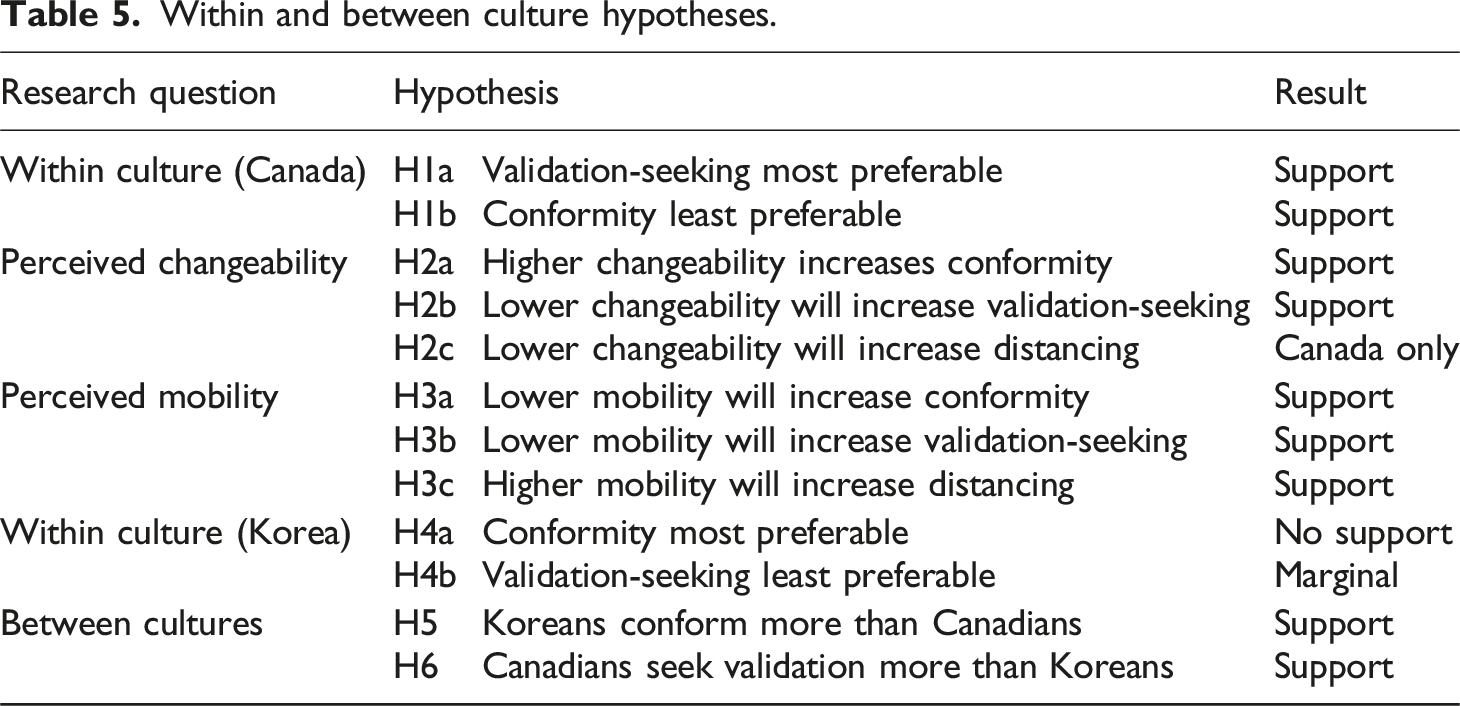
While we found main effects of both changeability and mobility, these effects never interacted, suggesting that the effect of these variables are largely independent of one another. This does not preclude, however, the possibility that there are contexts where these predictors do interact. While the effects of changeability and mobility did not affect each other, culture did affect the relationship between both changeability and mobility and subsequent behaviours individually. For conformity, the effects of changeability differed across culture, while for validation-seeking the effects of mobility differed across culture. For distancing effects of both changeability and mobility differed across culture. Across all effects, the results tended to show that the effects of mobility and changeability were the same direction but a smaller magnitude for Korean participants. This suggests that there are other factors playing a larger role in choosing these behaviours for Korean participants than for Canadian participants.
Our findings generally show that Western individuals (i.e., Canadians) are more likely to prefer seeking validation over other responses. To better replicate the findings of Matz and Wood (2005), we used a method of attaining validation which involved potential for interpersonal conflict. Our results broadly replicated and extended these findings; however, it is not clear whether these findings extend to other modes of seeking validation. While petitioning a discrepant other is one means of attaining validation, people may also seek validation from a third party. In the wake of experiencing inconsistency, an individual may present their experience to an alternate friend or family member, in hopes of being validated. Future research could extend the present findings exploring other kinds of validation. For example, other work shows Western participants (compared to Eastern participants), are also more likely to seek out social support (Taylor et al., 2004). Because validation is one specific type of social support, this suggests that our findings would demonstrate a similar pattern with third-party validation seeking behaviours. These cultural differences are important to understand, as some work has shown that validation is an important aspect of relationships across cultures (Hiew et al., 2015), and chronic invalidation can be deeply harmful in similar ways in both the West and East (Keng & Soh, 2018; Lee et al., 2022). Future research could benefit from more thoroughly exploring the role of social validation in relationships both within and between various cultures.
While most of our hypotheses were supported, our findings within Korea deviated somewhat from our hypotheses. While we hypothesized that conformity would be more desirable than both distancing and validation-seeking, this was not the case. Korean participants tended to prefer distancing more than both conformity and validation-seeking, and validation-seeking slightly more than conformity. Because there is no indication these interactions are ongoing conflicts that demand resolution, it may be more common for Korean participants to distance themselves initially and wait to see whether the inconsistency dissipates in time. This resolution could even be supported with higher levels of public conformity (i.e., telling the other party they will consider their perspective without any real intentions of doing so). In cases where the inconsistency is fleeting, this strategy could serve to satisfy the individual while also reducing interpersonal discord. However, in situations where the inconsistency arises frequently, it may be untenable as a long-term solution.
While a sizable amount of prior research has explored differences between groups in conformity, and predictors of conformity, little has assessed validation-seeking and distancing. However, our findings demonstrated that conformity is considered among the least desirable response to inconsistency across culture, with Canadians preferring validation-seeking and Koreans preferring distancing. As such, conformity in naturalistic settings is likely less common than either validation-seeking or distancing, which are comparatively much less studied. The present research has provided useful insight but also raises many questions for future exploration.
While the present work has centered social inconsistency as an aversive experience, it is important to note that inconsistency is not inherently negative. There are situations where inconsistency is beneficial, despite causing discomfort. The aversiveness of inconsistency allows people to calibrate their own perceptions. For instance, imagine an individual has a single negative interaction with a new colleague. They may make internal attributions and assume this colleague is a rude person. If they then find this perspective is inconsistent with all their other colleagues, they may feel inconsistency and thus shift this belief. To do so, they may instead presume instead an external attribution (e.g., perhaps their colleague was having a bad day). Social inconsistency can provide a useful means of identifying attitudes and beliefs which may need to be re-evaluated. When encountered infrequently, they may be a sign to reconsider perspectives, or follow-up. These situations and individuals’ perceptions of these situations could vary across culture, and so future research could benefit from further considering how inconsistencies may be perceived differently.
Limitations and future directions
To maximize control over the stimuli, we assessed participants’ preference for what an imagined character should do, rather than asking participants to recollect their own experiences. While this does ensure that all participants are responding to the same stimuli, this method is limited as behaviour participants may report they ought to do, or would prefer to do, instead of what they would actually do in a similar situation. Notably, the pattern of results for the Canadian participants was consistent with prior research that had assessed behavioral outcomes (Matz & Wood, 2005). Future work exploring if (and when) preferences may not align with behaviour in these regards could yield insightful results.
The relationships we used in our manipulations are likely to have high correlations between mobility and closeness. Both factors could impact these decisions differently. For instance, a relationship could be highly fixed but not close (such as a co-worker, boss, or teammate), which could lead to different preferences for behaviours (for instance less willingness to conform), than highly fixed and highly close relationships (such as a good friend or sibling). Future research could endeavour to disentangle these two aspects of relationships and how they may differently affect preferences for conformity, validation-seeking, and/or distancing.
Beyond just relationship differences, situational factors may have important interactions with individual differences. e.g., an individual high in attachment anxiety may be more likely to seek validation even in situational contexts where those low in attachment anxiety would not (i.e., when changeability or mobility are high). Alternatively, an individual high in attachment avoidance may prefer distancing even when those low in attachment avoidance would not (i.e., when mobility is low). The individual differences of one’s relationship partner may also play a role, in both one’s choice of behaviour, and how the choice is received. Future work could examine how these individual differences may interact with our findings. Dyadic research could be an insightful extension of this work, examining if and how people consider factors of their relationship partner’s situation in their engagement (e.g., if one views themselves as unchangeable but also feels their partner is unchangeable, neither conformity nor validation-seeking may be desirable).
Summary
The present research aimed to assess how people may respond to social inconsistency in relationships through seeking validation, conforming, or distancing. We found that validation-seeking tended to be preferred when one’s self and relationships were unchangeable, conformity tended to be preferred when one’s self but not relationships were changeable, and distancing tended to be preferred when one’s self was not changeable, and their relationships were. These tendencies emerged across cultures, however the role of changeability of both self and relationships tended to be smaller for Koreans than Canadians.
Footnotes
Declaration of conflicting interests
The author(s) declared no potential conflicts of interest with respect to the research, authorship, and/or publication of this article.
Funding
The author(s) disclosed receipt of the following financial support for the research, authorship, and/or publication of this article: This work was supported by the Research funded in part by the Barrie Frost Innovation Grant.
Open research practices
As part of IARR’s encouragement of open research practices, the authors have provided the following information: This research was not pre-registered.
Data Availability Statement
Data and methodology for all studies are available on OSF: https://osf.io/pnwvz/. The data used in the research are publicly posted. The data can be obtained at:  . The materials used in the research are publicly posted and can be obtained at https://osf.io/pnwvz/?view_only=4f14189022074d73acf351cf89ba88e5.