




Abstract
Managing relationship conflict is a difficult yet crucial task for romantic partners. We investigated how imagining a conflict’s resolution affects the engagement in resolving that conflict. For instance, people may indulge in positive fantasies about their future, or they may mentally contrast their desired future (successful conflict resolution) with the main inner obstacle (e.g., anger, frustration) in the current reality. In two experiments, we tested whether mental contrasting increases engagement in resolving ongoing relationship conflicts participants perceived as important (i.e., high incentive value) and solvable (i.e., high expectations of success). In Experiment 1 (N = 274, from predominantly satisfied relationships), mental contrasting compared to indulging improved the resolution of solvable conflicts over two weeks. This effect did not extend to conflicts of highest importance, which we found to be particularly severe. In Experiment 2 (N = 270, from less satisfied relationships), mental contrasting, compared to indulging and to working on a concentration task, increased mental engagement with highly important, more severe conflicts over two weeks. Results suggest that mental contrasting helps in resolving solvable conflicts. When facing more severe, less solvable conflicts, however, mental contrasting stimulated mental engagement with conflicts. Our findings suggest that teaching people mental contrasting may complement existing conflict management approaches (e.g., in counseling or in self-help apps).
Keywords
Conflicts in romantic relationships are common and often lead to considerable frustration (Fincham, 2003; Meyer & Sledge, 2022). Cognitive and motivational factors greatly influence a couple’s conflict management. According to expectancy-value theories (Atkinson, 1957), placing high importance on resolving a conflict (i.e., high incentive value) is a crucial factor that should lead couples to engage in conflict resolution (Bandura, 2001; Overall et al., 2006). Perceiving a conflict as solvable (i.e., high expectations of success) is another crucial factor that leads to engaging in conflict resolution (Darley & Fazio, 1980; Roese & Sherman, 2007; Snyder, 1984). Even so, according to Fantasy Realization Theory (Oettingen, 1999, 2012), perceiving a conflict’s resolution as important and solvable is no guarantee that makes couples engage in resolving that conflict.
Fantasy Realization Theory posits that whether high incentive and high expectations translate into engagement and goal pursuit depends on how people think about their desired future. For instance, sheer positive fantasizing about a desired future (e.g., spending a harmonious weekend with one’s partner) is the most common mode of thought (Sevincer et al., 2024; Sevincer & Oettingen, 2013). In fact, mere positive fantasies may prevent people from pursuing their desired futures even when they have high expectations, because positive fantasies tend to relax people rather than engage them in active pursuits by creating a sense of accomplishment (H. B. Kappes, Sharma, et al., 2013; H. B. Kappes & Oettingen, 2011). Thus, despite temporarily instilling good feelings, positive fantasies may prevent couples from engaging in resolving the issues that would make their relationship more satisfying in the long run (Oettingen et al., 2016). The relaxing effect of positive fantasies can be counteracted by mentally contrasting the desired future with the main inner obstacle of present reality (Oettingen, 1999, 2012). Mental contrasting spurs people to overcome the obstacle (e.g., overcoming reluctance to address the conflict) when the obstacle is deemed surmountable (high expectations) and to let go when the obstacle is deemed insurmountable (e.g., empathizing with the partner’s vulnerability, low expectations).
The effects of mental contrasting (vs. other modes of thought) on engaging in reaching feasible futures and refraining from trying to reach unfeasible futures have been demonstrated in various areas (e.g., health, interpersonal relationships, academia; Cross & Sheffield, 2019; Oettingen, 2012; Oettingen & Sevincer, 2018). However, the role of mental contrasting in regulating engagement in resolving ongoing relationship conflicts—raised by unresolved issues between romantic partners—remains unexplored. Understanding how modes of thought influence the engagement in resolving conflicts could complement existing conflict management approaches (e.g., in counseling or self-help apps; overview by Bradbury & Bodenmann, 2020) by understanding how to make people invest in resolving important, solvable conflicts. Here, we taught mental contrasting (vs. other modes of thought) to participants involved in predominantly satisfied (Study 1) and less satisfied (Study 2) relationships. We examined how their engagement in resolving a chosen conflict with their partner changes depending on their perceived importance and perceived solvability of the conflict.
Conflict and cognition
Relationship conflict between romantic partners is often characterized by disagreements, tension, or hostility and results from differing opinions, interests, needs, or goals (Randall & Bodenmann, 2009). Common conflict topics that romantic couples deal with include communication, personal or partner habits, household chores, finances, and parenting (Meyer & Sledge, 2022). There are inconsistent findings on the impact of romantic couple conflicts on relationship quality and longevity. While most studies suggest conflicts harm relationships (e.g., Fincham, 2003), others, especially longitudinal studies, indicate potential benefits (e.g., Gottman & Krokoff, 1989). Apparently, poorly managed conflicts destabilize and damage the relationship whereas well-managed conflicts offer opportunities for growth (Fincham & Beach, 1999; Karney & Bradbury, 1995). How couples manage their conflicts depends on various contextual factors (overview by McNulty, 2016a). In the current research, we focus on the perceived importance of conflict resolution, the perceived solvability of a conflict, and the mode of thought people use when imagining a conflict’s resolution.
Perceived importance
We refer to importance as the perceived value or attractiveness of resolving a conflict. People exert more effort towards outcomes that they place high (vs. low) importance on (Atkinson, 1957; Bandura, 2001). Thus, couples tend to engage in resolving conflicts that are important to them (Overall et al., 2006). However, high importance could become a burden when involving an unrealistically high standard (McNulty, 2016a). According to interdependence theory (Kelley & Thibaut, 1978) people are satisfied with a relationship if it meets or exceeds their standards. Having a very high standard could endanger a couple to become frustrated when trying to address a conflict that is difficult to resolve (McNulty, 2016b) ultimately leading to resignation. Furthermore, placing high importance on matters that are not important for the partner might decrease said partner’s willingness to cooperate. For instance, placing high importance on one’s own identity (e.g., one partner strives for his or her own reputation) decreased the solvability of a conflict as perceived by the second partner (Worley et al., 2021). This reduced subjective solvability may decrease the second partner’s engagement in trying to resolve that conflict.
Perceived solvability
We refer to solvability as the perceived likelihood—rather than the actual likelihood—that the conflict can be resolved. “Resolved” in this case means that the frustration about the issue has ended or is substantially reduced. Expecting a behavior or an outcome as likely to occur predicts outcome-directed engagement (Atkinson, 1957; Bandura, 1977; Mischel, 1973). Thus, couples should engage in resolving conflicts that they perceive as solvable. Further, regardless of actual engagement, people who expect a positive relationship tend to also perceive their partner’s behavior more positively (Roese & Sherman, 2007; Snyder, 1984), in turn, leading to positive evaluations of relationship outcomes (e.g., satisfaction; Joel et al., 2023; Murray et al., 1996). For instance, people who perceive a conflict as solvable report fewer arguments arising from violated expectations, less counter-complaining, less mulling, less discord in the relationship, and less withdrawal (Johnson & Roloff, 1998).
However, a longitudinal study found that expecting a positive relationship was only translated into high relationship satisfaction when couples had good conflict resolution skills. When couples had poor conflict resolution skills, expecting a positive relationship predicted lower relationship satisfaction (McNulty & Karney, 2004). Having high expectations may allow couples to remain satisfied momentarily, but if these expectations fail to get confirmed, they may lead to frustration in the long run (McNulty, 2016a). In summary, high perceived importance and solvability do not always result in engagement in resolving a conflict. Rather, the way people think about their conflict’s resolution may influence whether high importance and high expectations of success translate into engagement.
Mental contrasting
Fantasy Realization Theory (Oettingen, 1999) posits four modes of thought: Indulging (people only imagine the desired future), dwelling (people only think about the current reality), mental contrasting (people think about the desired future first and then about the current reality), and reverse contrasting (people think about the current reality first and then about the desired future). However, only mental contrasting has been shown to translate high importance and high expectations of success (here solvability) into engagement towards the desired future.
While mental contrasting—just as any mode of thought—can occur spontaneously (Sevincer et al., 2024; Sevincer & Oettingen, 2013), it can also be taught as a self-regulatory strategy (Oettingen, 2012; Oettingen & Sevincer, 2018). When used as a self-regulatory strategy, people identify an important and feasible wish (e.g., successfully resolving a conflict), identify and imagine the best outcome of wish fulfillment, and then identify and imagine the critical obstacle in themselves that may hinder them on acting to achieve the desired future. People then realize that the obstacle needs to be overcome in order to reach the desired future and thus strive for the fulfilment of their wish in line with the perceived surmountability of the obstacle (Oettingen et al., 2001).
If the obstacle seems surmountable, nonconscious associative links (i.e., connections between mental representations) are strengthened between the desired future and the obstacle (A. Kappes & Oettingen, 2014), as well as between the obstacle and the behavior instrumental to overcoming the obstacle (A. Kappes et al., 2012). Consequently, when people now mentally represent their desired future, they are more likely to also mentally represent their obstacle, and when they are confronted with their obstacle, they are more likely to engage in behavior instrumental to overcoming the obstacle.
For instance, someone might identify their wish of resolving an ongoing conflict and then imagine the happy resolution of the conflict. Instead of continued happy images of having successfully solved the conflict, they then identify and imagine their anger towards the partner as the internal and surmountable obstacle standing in the way of successful conflict resolution. As the associative link between the desired future and the obstacle strengthens, resolving the conflict becomes tied to the necessity of overcoming the anger. As the associative link between the obstacle and instrumental behavior strengthens, confronting the anger might help remembering to take a deep breath before speaking with the partner.
If the obstacle seems insurmountable, the reality is no longer perceived as an obstacle but as a definite block, and the nonconscious associative links between desired future and obstacle as well as between the obstacle and behavior instrumental to overcoming this obstacle are weakened or dissolved. Weak associative links, in turn, result in reduced goal-directed behavior or active disengagement. People may then abandon their desired future (e.g., accept that their conflict cannot be solved and accept their frustration) and thus can shift their focus and energy to other aspects of the relationship, or consider ending the relationship.
Mental contrasting’s effects depend on the importance of the desired future. In line with expectancy-value theory (Atkinson, 1957), mental contrasting aids individuals in pursuing and overcoming obstacles only when the wish is deemed important (Oettingen, 2000). For unimportant wishes (e.g., resolving a negligible conflict), mental contrasting does not increase engagement regardless of expectations of success.
In the other modes of thought (i.e., indulging, dwelling, and reverse contrasting), the present reality is not perceived as an obstacle standing in the way of the desired future (A. Kappes, Wendt, et al., 2013; Wittleder et al., 2020), and, therefore, no association between the future and the obstacle is established (A. Kappes & Oettingen, 2014). Thus, only mental contrasting instills the necessity to act towards the desired future and encourages finding solutions specific to people’s internal obstacle. Ultimately, only mental contrasting engages people in actively overcoming their surmountable obstacles and refraining from trying to tackle insurmountable obstacles. Mental contrasting’s effectiveness compared to other modes of thought has been illustrated through various life challenges (e.g., time management, physical activity, regulating emotions). In interpersonal relationships, mental contrasting has been found to help resolve interpersonal concerns (e.g., “settle an argument with my brother”; Oettingen et al., 2001) and to increase win-win solutions between negotiation partners (Kirk et al., 2011). In romantic relationships, mental contrasting fostered sensitive conciliatory behavior (Schrage et al., 2020), and, together with if-then planning (i.e., implementation intentions; Gollwitzer, 1999) reduced insecurity-based behavior in couples and increased relationship commitment (Houssais et al., 2013).
Findings outside the domain of mental contrasting further show that the way people anticipate and imagine an interpersonal interaction affects their behavior (e.g., Cloven & Roloff, 1995; Solomon & Samp, 1998). For instance, people who imagine how they convey information in an upcoming interaction search less information and act more evaluatively; people who imagine receiving information entertain a greater variety of thoughts and think descriptively (Cloven & Roloff, 1995).
In summary, mental contrasting helps people understand what future they really wish for, what obstacles in themselves are in their way, and how they can overcome their internal obstacles in present reality. In romantic partners, the obstacles might be experienced frustration or anger, feelings of disappointment or resentment. Mental contrasting should make people actively try to overcome their obstacles when they perceive their desired future as feasible but refrain from unrealistic or futile efforts. Thereby, mental contrasting may contribute to conflict management. Specifically, we hypothesize that mental contrasting (vs. other modes of thought) increases the engagement in resolving conflicts that are perceived as (a) important and (b) solvable.
The present research
In two online experiments, we tested the efficacy of mental contrasting for managing conflicts. In Experiment 1, we focused on relatively satisfied relationships and in Experiment 2 on less satisfied relationships. In both experiments, participants selected an ongoing relationship conflict to resolve within the next 2 weeks and self-reported the conflict’s importance and solvability. Participants were randomly assigned to either a mental contrasting or one of two control conditions. In the mental contrasting condition, participants mentally contrasted their desired future with their main inner obstacle. In the control conditions, participants instead indulged in the desired future (Study 1 and 2), dwelled on the negative reality (Study 1), or worked on a concentration task (Study 2). We assessed the engagement in resolving a conflict at baseline and after 2 weeks. We selected 2 weeks because participants can reliably self-report their behavior retrospectively over this timespan (Pedersen et al., 2012). Moreover, induced mental contrasting affected interpersonal outcomes (e.g., reconciliation), measured by retrospective self-report, over this timespan (Schrage et al., 2020). We measured the engagement in resolving a conflict as conflict resolution (Study 1 and 2) and as mental engagement (Study 2).
Study 1: Mental contrasting and conflict resolution: More satisfied relationships
Participants in romantic relationships selected a conflict to work on in the next 2 weeks. Afterwards, we assessed baseline conflict resolution, the conflict’s importance, and its solvability. Participants were then randomly assigned to one of three experimental conditions: mental contrasting, indulging, or dwelling. Two weeks later (T1), conflict resolution was reassessed.
Method
Participants
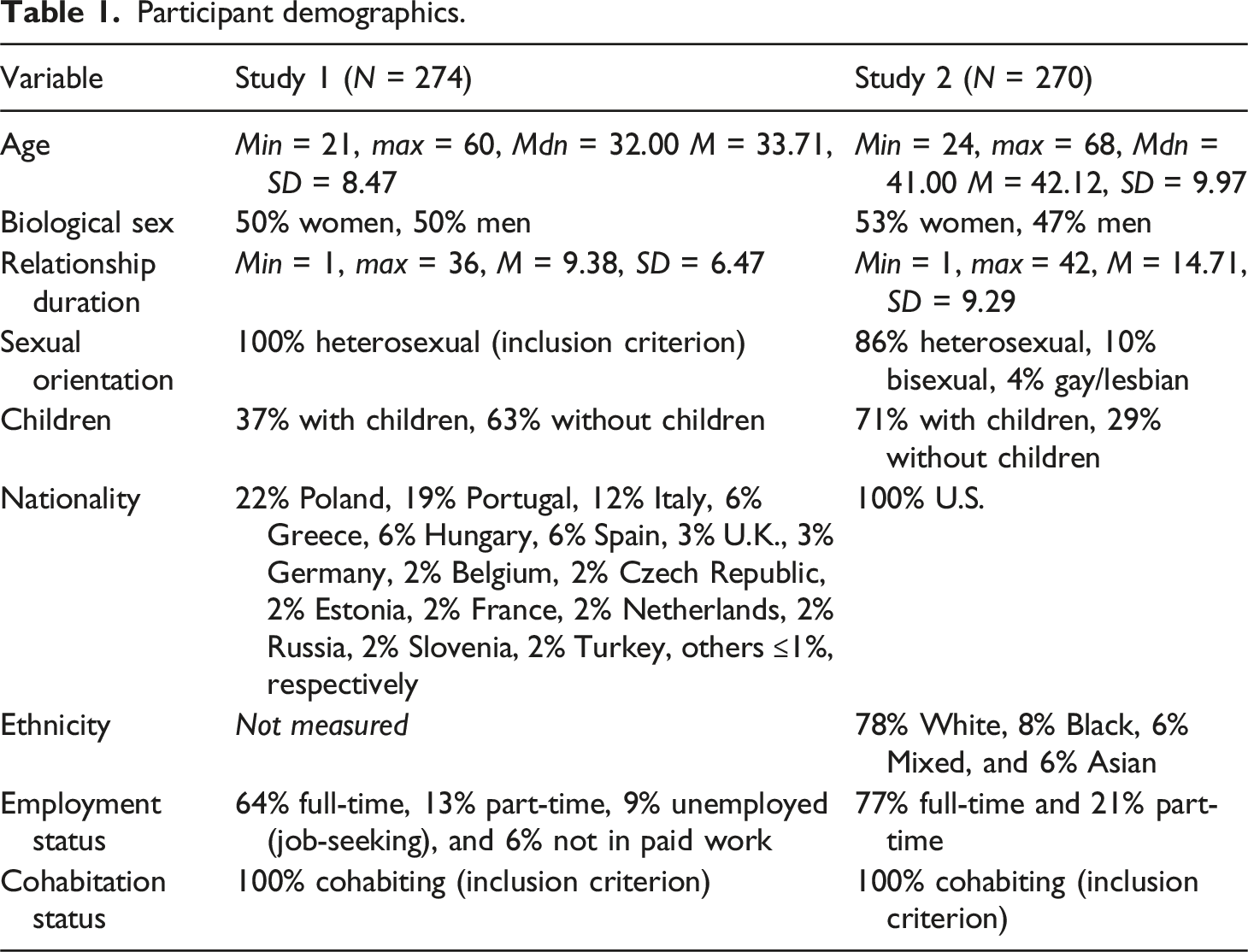
Participant demographics.
Procedure and measures
T0: Baseline relationship satisfaction
To assess whether differences in relationship satisfaction might affect the results, participants completed the 7-item Relationship Assessment Scale (RAS; e.g., “In general, how satisfied are you with your relationship?”; Hendrick, 1988) on a 7-point scale (1 = not at all, 7 = extremely satisfied; α = .90).
T0: Conflict selection
Participants were instructed to generate a list of three conflicts that had been sources of major disagreement in their relationship (adapted from Gottman, 1979). Participants were then asked to choose from their lists the “most significant unresolved conflict” they wished to work on for the next 2 weeks, ensuring high incentive value of resolving the conflict.
T0: Importance and solvability
We assessed participants’ perception of their conflict’s importance and solvability using single-item measures adapted from previous mental contrasting research (Oettingen & Sevincer, 2018): “How important is it to you that you resolve this conflict?” and “How likely is it that you will resolve this conflict?”. We used 7-point scales (1 = not at all, 7 = very much).
T0: Baseline conflict resolution
We used two items with 5-point scales (“To what degree has the conflict been resolved so far?”, 1 = completely unresolved, 5 = completely resolved, and “How satisfied are you so far with the resolution of the conflict?”, 1 = completely dissatisfied, 5 = completely satisfied). We combined the two items into one index (α = .87).
T0: Intervention
Participants followed the instructions on their computer and entered their responses into a designated field. Building upon mental contrasting research (Oettingen, 2012; Oettingen & Sevincer, 2018), we established three conditions: mental contrasting, indulging, and dwelling. In the mental contrasting condition, participants were instructed to first identify the most positive outcome associated with resolving the conflict (“Imagine you and your partner would resolve this conflict. What would be the best thing, the most positive aspect if you and your partner had resolved this conflict? How would resolving this conflict make you feel?”). Then, they elaborated on this outcome (“Now imagine this most positive aspect. Imagine it as fully as you can”). Subsequently, they were instructed to identify and elaborate upon the central inner obstacle that hinders them from effectively addressing the conflict (“Now, what is it within you that holds you back from resolving this conflict with your partner? What in you stops you from resolving it? What is your main inner obstacle?”). Example responses are in the Supplemental Material.
In the indulging condition, participants were instructed to first name and elaborate upon a positive outcome and then a second positive outcome, instead of an obstacle. In the dwelling condition, they were instructed to first name and elaborate upon an obstacle, instead of a positive outcome, and then name and imagine a second inner obstacle.
T1 measures
Two weeks later, we reminded the participants of the conflict that they had selected and again measured conflict resolution and relationship satisfaction using the same items as at T0.
Results
Descriptive analyses
Participants reported moderate to high relationship satisfaction (M = 5.67, SD = 0.90) and chose conflicts that were neither fully resolved nor unresolved (M = 2.89, SD = 1.06). On average, conflicts were deemed highly important (M = 5.83, SD = 1.26) with a medium solvability (M = 4.32, SD = 1.68). 2
Study 1: Means, standard deviations, and correlations of study variables (N = 274).
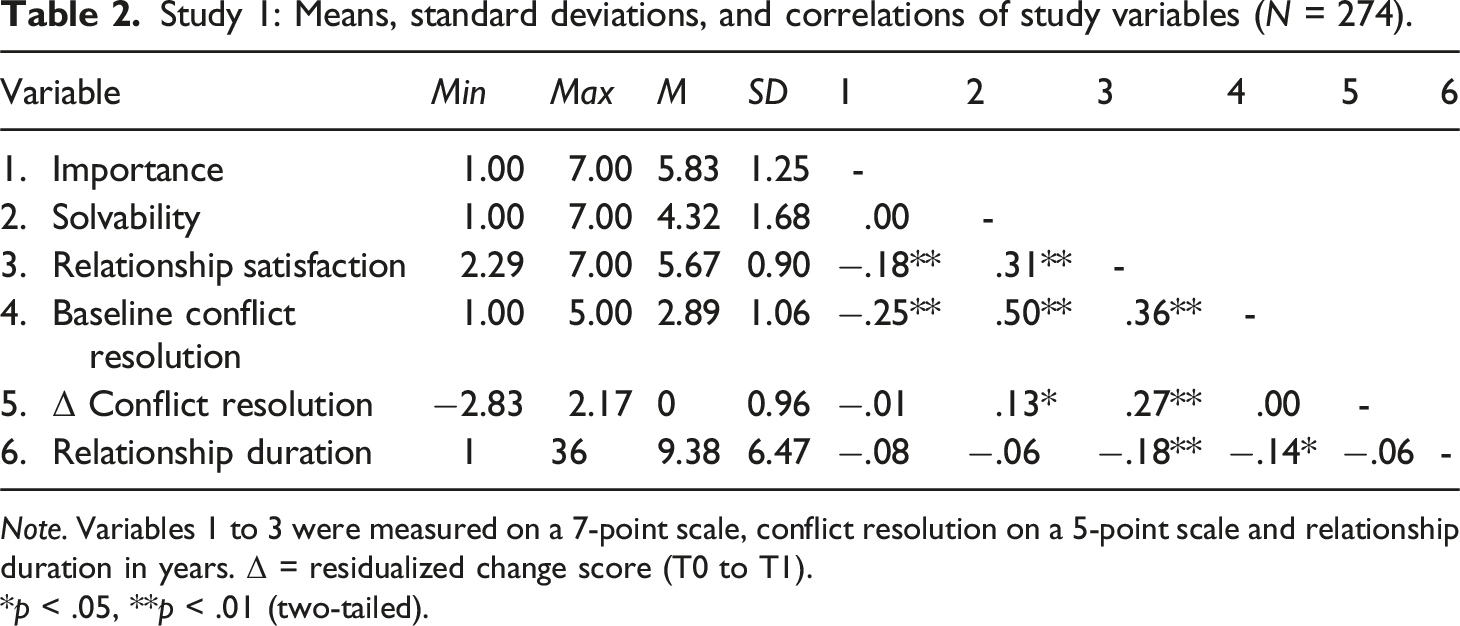
Note. Variables 1 to 3 were measured on a 7-point scale, conflict resolution on a 5-point scale and relationship duration in years. Δ = residualized change score (T0 to T1).
*p < .05, **p < .01 (two-tailed).
Conflict resolution
Study 1: Interactive effect of condition, importance, and solvability on conflict resolution.
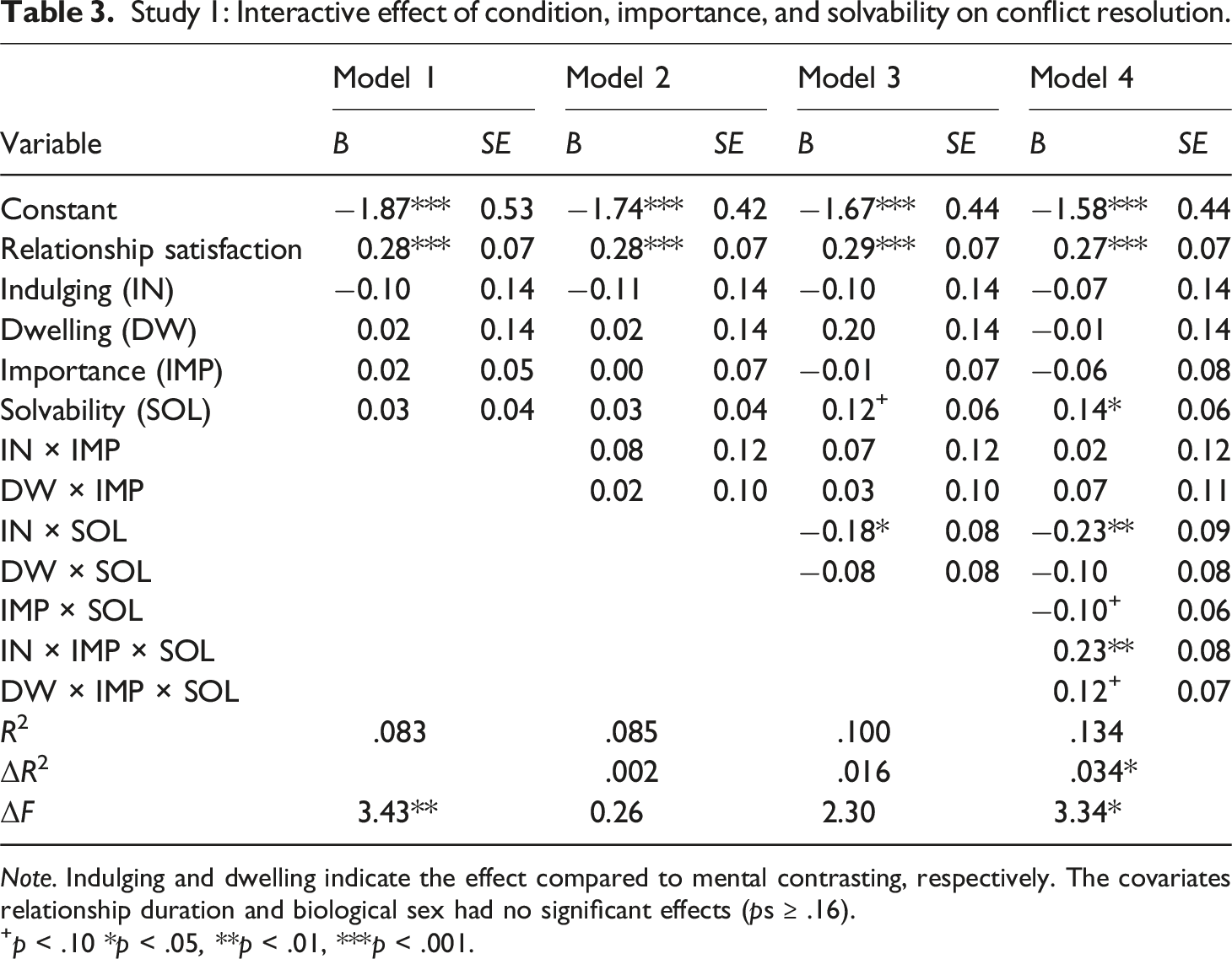
Note. Indulging and dwelling indicate the effect compared to mental contrasting, respectively. The covariates relationship duration and biological sex had no significant effects (ps ≥ .16).
+p < .10 *p < .05, **p < .01, ***p < .001.
Our hypotheses were that condition, importance, and solvability affect conflict resolution interactively, such that mental contrasting would lead to better conflict resolution than indulging and dwelling when importance and solvability are high. In support for our hypotheses, when we added the three-way interactions between conditions, importance, and solvability in Model 4, the model fit increased significantly to R2 = .134 (ΔR 2 = .034, ΔF (3, 259) = 3.34, p = .019). Thus, we will only interpret Model 4. In Model 4, the regression analysis revealed a significant three-way interaction for indulging with importance and solvability (b = 0.23, SE = 0.08, p = .003). For dwelling, the three-way interaction with importance and solvability did not quite reach significance (b = 0.12, SE = 0.07, p = .068). Observing no main effect of mental contrasting but an interaction effect is typical when participants’ success expectations (here solvability) span from low to high (e.g., A. Kappes & Oettingen, 2014). Mental contrasting shows main effects when participants generate wishes with high importance and high expectations of success, or when expectations of success are manipulated to be high (Oettingen et al., 2012). Here, solvability spanned from low to high, thus, revealing the predicted interaction effect.
To further test and probe the observed interaction, we used PROCESS Model 3 (Hayes, 2022). First, we tested whether the overall conditions-solvability interaction is significant at different importance levels. Given the generally high importance (M = 5.83, SD = 1.25), we use the terminology medium (−1 SD), high (M), and very high (max; as +1 SD exceeds the scale maximum, we used the max) importance. The conditions significantly interacted with solvability when conflicts had medium importance, F (2, 259) = 6.93, p = .001, and high importance F (2, 259) = 3.76, p = .025. Inconsistent with our hypothesis, at very high importance, this interaction was not significant F (2, 259) = .10, p = .909. The interactions are visualized in Figure 1. Study 1: Conditional effect of condition on conflict resolution. Note. Δ = residualized change score.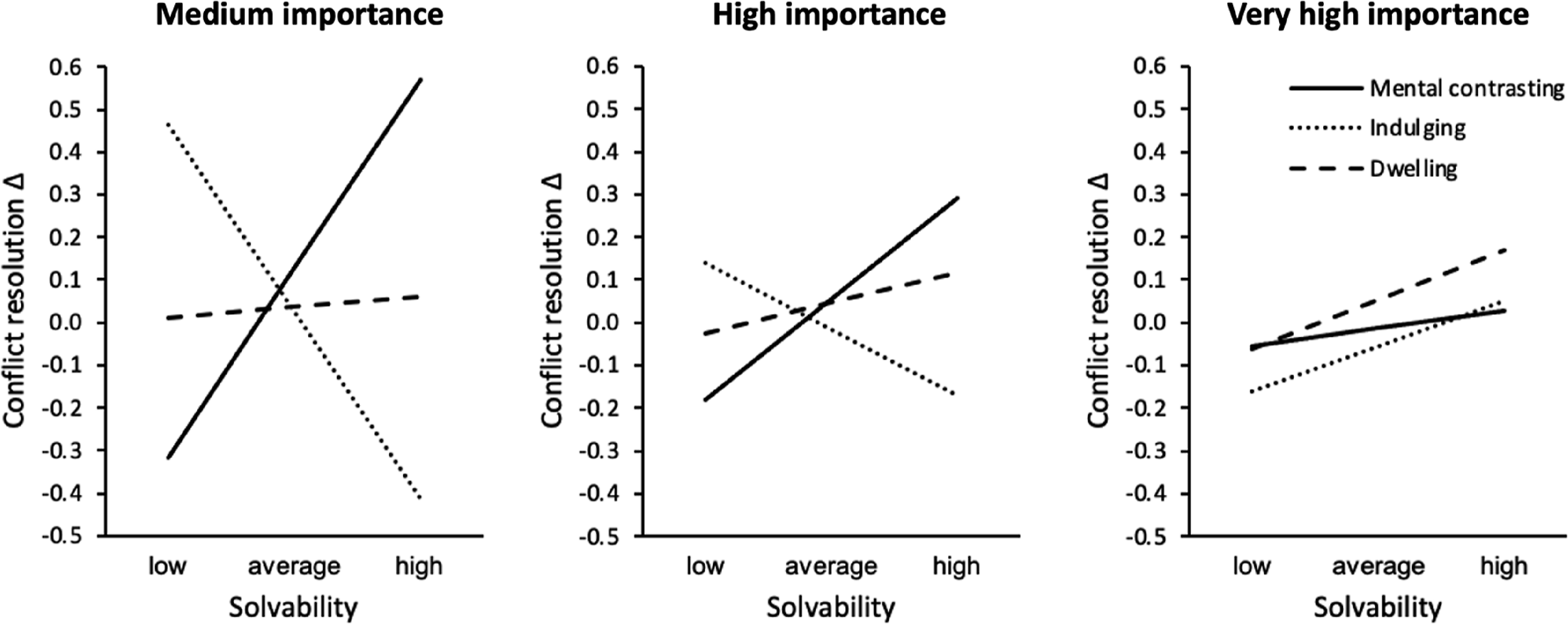
Given the significant conditions-solvability interaction at medium and high importance, we then probed this interaction (i.e., tested the conditional effect of the conditions on conflict resolution). Using simple slope analysis, we examined whether mental contrasting (vs. indulging and dwelling, respectively) improves conflict resolution with solvable conflicts (i.e., solvability is high = +1 SD) when these conflicts had medium and high importance. As hypothesized, mental contrasting compared to indulging led to better conflict resolution with solvable conflicts when the conflicts had medium importance (b = −0.98, SE = 0.32, p = .002), and high importance (b = −0.46, SE = 0.20, p = .021). For solvable conflicts, dwelling fared between mental contrasting and indulging but did not differ significantly from mental contrasting (at medium importance, b = −0.51, SE = 0.30, p = .092; at high importance, b = −0.17, SE = 0.20, p = .384). The non-significant conditions-solvability interaction at very high importance will be discussed below.
Discussion
We tested whether mental contrasting makes people solve ongoing relationship conflicts if the conflicts are deemed important and solvable. Participants in the mental contrasting condition showed better conflict resolution after 2 weeks with their solvable conflicts than indulging participants. Dwelling fared between mental contrasting and indulging. This pattern emerged for conflicts of medium and high importance, but, surprisingly, not for conflicts of highest importance.
Mental contrasting versus indulging in solvable conflicts
Mental contrasting leading to better resolution of solvable conflicts than indulging is consistent with previous research (Oettingen et al., 2001). That is, when participants in the mental contrasting condition fantasized about the desired future in which the conflict was successfully resolved, and, immediately after, imagined the main inner obstacle preventing conflict resolution, they capitalized on the solvability and resolved their conflict better than those who indulged. In contrast, indulging in positive fantasies prevented participants from making progress with resolving their conflict, possibly, because the desired future was mentally already achieved (H. B. Kappes & Oettingen, 2011).
Mental contrasting versus dwelling in solvable conflicts
Dwelling fared between mental contrasting and indulging but was not significantly different from either condition. This pattern has been observed in romantic relationships before (Oettingen, 2000). Because highly desired futures (e.g., harmony with partner) might involuntarily appear in the mind’s eye even when participants are not explicitly instructed to envision the future, participants might have already positively fantasized about resolving a conflict when they chose their conflict to work on. Prompting them to consider two obstacles immediately afterward, as was done in the dwelling condition, may have had an effect like mental contrasting.
When importance is highest
Conflicts at very high importance remained unaffected by mental contrasting, (i.e., conflict resolution was not improved regardless of solvability). In search of explanations for this finding, we considered the possibility that the severity of these highly important conflicts might have surpassed the capacity of mental contrasting to influence successful resolution within the designated 2-week period. In a content analysis (see Figure 2), we substantiated this suspicion. We regarded conflict topics as more severe that have been shown to be associated with lower relationship satisfaction and more dysfunctional conflict behavior, such as finances, parenting, communication, and sex (Meyer & Sledge, 2022). We regarded topics as less severe that have been shown to be associated with higher relationship satisfaction, such as household chores and time management. We disregarded topics that have been shown to be unrelated to relationship satisfaction, such as decision-making and personal or partner habits. The content analysis revealed that conflicts of very high importance also have a higher likelihood of being more severe. Thus, conflict importance and conflict severity appear to be related constructs. Study 1: Conflict topics at different levels of conflict importance. Note. Content analysis was conducted by two independent raters blind to conditions and importance (κ = .80). Each conflict was assigned to one of 20 topics (Meyer & Sledge, 2022). Less severe = time management, household chores; more severe = finances, parenting, communication, sex; other = e.g., personal or partner habits, decision-making. Topics at importance = 7 are distributed differently from topics at importance ≤5, χ2 (18) = 30.87, p = .021; Cramer’s V = 0.40.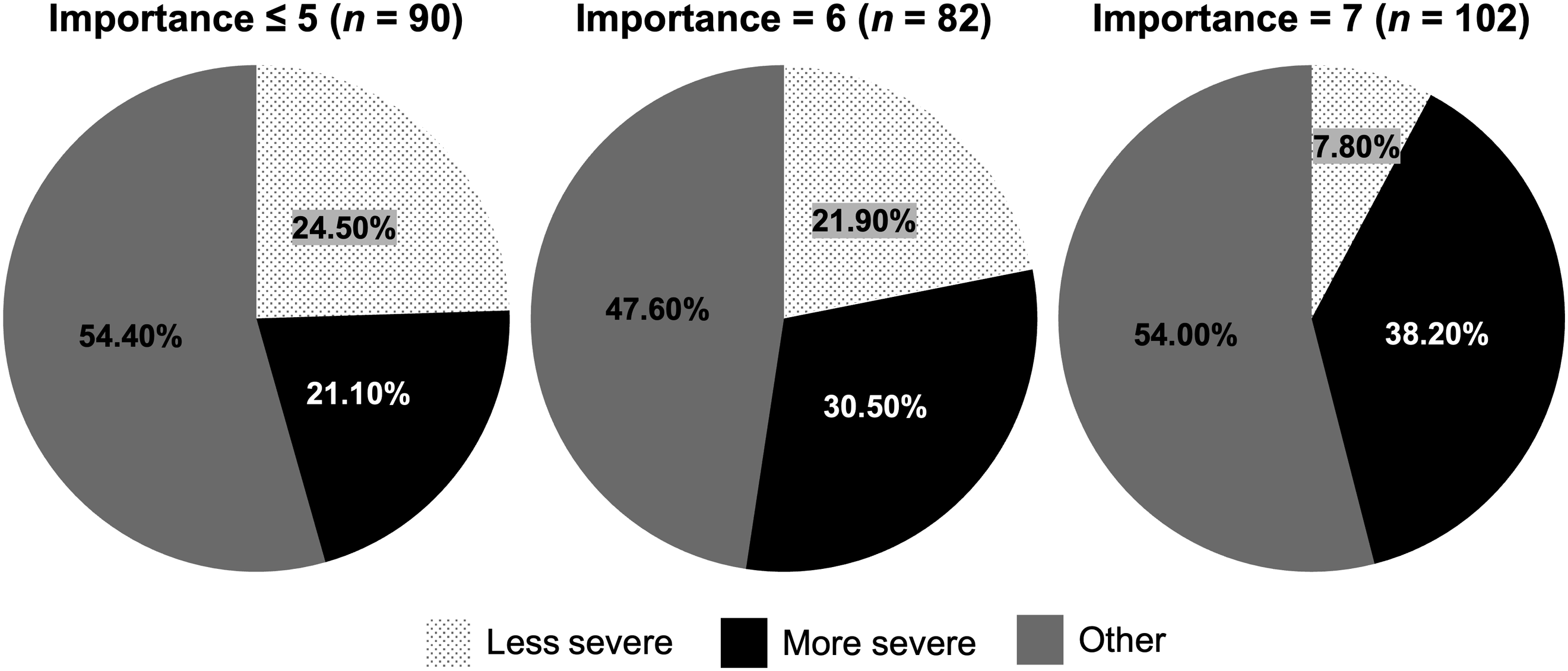
To test for alternative explanations, we had controlled for baseline relationship satisfaction, baseline conflict resolution, and presence of children. We had included these variables as covariates in our regression analysis. Cohabitation status and relationship type were kept constant as inclusion criteria. Thus, differences in these variables are unlikely to explain our non-effects at very high importance. Conflicts being too severe to be resolved within 2 weeks appears to be the more likely explanation.
Conflict resolution as an indicator of engagement
We measured conflict resolution by asking participants to report the degree to which their conflict has been resolved and how satisfied they are with the resolution. However, conflict resolution is subjective and could refer to different outcomes that may depend on conflict severity. For less severe issues like household chores, people may identify solutions more easily. Here, resolution could entail the mitigation of frustration among partners through the expression and mutual agreement of their perspectives. For more severe issues, such as habitual communication patterns (e.g., aggression-withdrawal cycles), people may struggle with identifying clear, tangible solutions. Here, participants might face ambiguity in understanding what conflict resolution means and how to achieve it. Thus, the issue triggering the conflict remains frustrating despite the partners’ well-intended efforts. Consequently, subjective conflict resolution might be more easily detected for less severe issues than for more severe issues. To investigate whether the engagement in resolving conflicts that mental contrasting elicits in more severe issues is different (i.e., in ways that have not led to clear conflict resolution) from the engagement in less severe issues, in Study 2, we focused on more severe issues by measuring mental engagement in less satisfied relationships.
Study 2: Mental contrasting and mental engagement: Less satisfied relationships
In Study 2, we again taught individuals in a romantic relationship mental contrasting geared towards resolving an ongoing relationship conflict in the upcoming 2 weeks. We used a design and procedure similar to Study 1. Changes included, first, pre-screening Prolific participants, inviting only those below the median in relationship satisfaction. Said less satisfied relationships should more often deal with more severe conflict topics (Meyer & Sledge, 2022). Second, to avoid spontaneous self-regulation strategy use, a concentration task was added as a control condition instead of a dwelling condition. Third, in addition to measuring conflict resolution, we focused on mental engagement with the conflict. When people commit to attaining a goal, they become more likely to think or dream about that goal (Klinger, 1971). Thus, being mentally engaged with a conflict qualifies as an indicator for being committed to resolving the conflict (Klinger, 1975).
Method
Participants
Power analysis, mirroring Study 1, indicated that we need 246 participants to detect an effect size of d = .46 with 90 % power. To be eligible, participants had to be in a relationship for at least 1 year and cohabiting with their partner. We pre-screened 800 U.S. Prolific users measuring relationship satisfaction (using the RAS; Hendrick, 1988). Invitations to the main study were extended only to participants with a relationship satisfaction below the median (Mdn = 5.86). The main study was advertised as an opportunity to improve romantic relationships, and 287 invitees participated. After drop-out (n = 10), excluding participants who ended their relationship (n = 2), failed attention check (n = 1), and those reporting an unrealistic change in relationship satisfaction (more than 3 SDs, suggesting inattentive responding) between measurements (n = 4) the final sample consisted of 270 participants. Participants received £2.60 as compensation. Sample demographics are provided in Table 1.
Procedure and measures
T0: Baseline measures, conflict selection, importance, and solvability
As in Study 1, we measured baseline relationship satisfaction with the RAS and gathered general relationship information. Participants then listed three major disagreement topics and chose the most significant unresolved conflict to work on for the next 2 weeks. To ensure practicality, we added the instruction “Please choose a conflict that is important to you and that you can address in the next two weeks.” Immediately after, we assessed the importance and solvability using the same items as in Study 1.
T0: Baseline conflict resolution
We used the same two items as in Study 1. To increase sensitivity to short-term effects of mental contrasting, we added two more items: “In the past two weeks, have you made progress towards resolving the conflict? (1 = no progress, 7 = a lot of progress) and “In the past two weeks, how satisfied have you been with the progress you’ve made towards resolving the conflict?” (1 = not at all satisfied, 7 = fully satisfied). We combined all four items into one index (α = .93).
T0: Baseline mental engagement
We assessed mental engagement with two items: “During the past 2 weeks, have you been thinking about the conflict?” and “During the past 2 weeks, have thoughts about the conflict interrupted your everyday life?” (7-point scales; 1 = never, 7 = constantly; α = .87).
T0: Intervention
Participants were assigned to one of three experimental conditions: mental contrasting, indulging, and concentration control. The mental contrasting condition and the indulging condition were the same as in Study 1. In the concentration condition, participants worked on an adapted version of the Concentration Performance Test (Düker & Lienert, 1965). They had to first solve two mathematical equations (e.g., 9 + 3 and 6 – 2), remember the results, and, if the first result was higher, subtract the second result from the first result. If the first result was lower, add the second result to the first. Participants had 3 minutes to solve equations, aligning with the duration of mental contrasting and indulging. 4
T1 measures
Two weeks later, we reminded the participants of the conflict that they had selected and measured conflict resolution, mental engagement, and relationship satisfaction using the same items as at T0.
Results
Descriptive analyses
Study 2: Means, standard deviations, and correlations of baseline variables (N = 270).
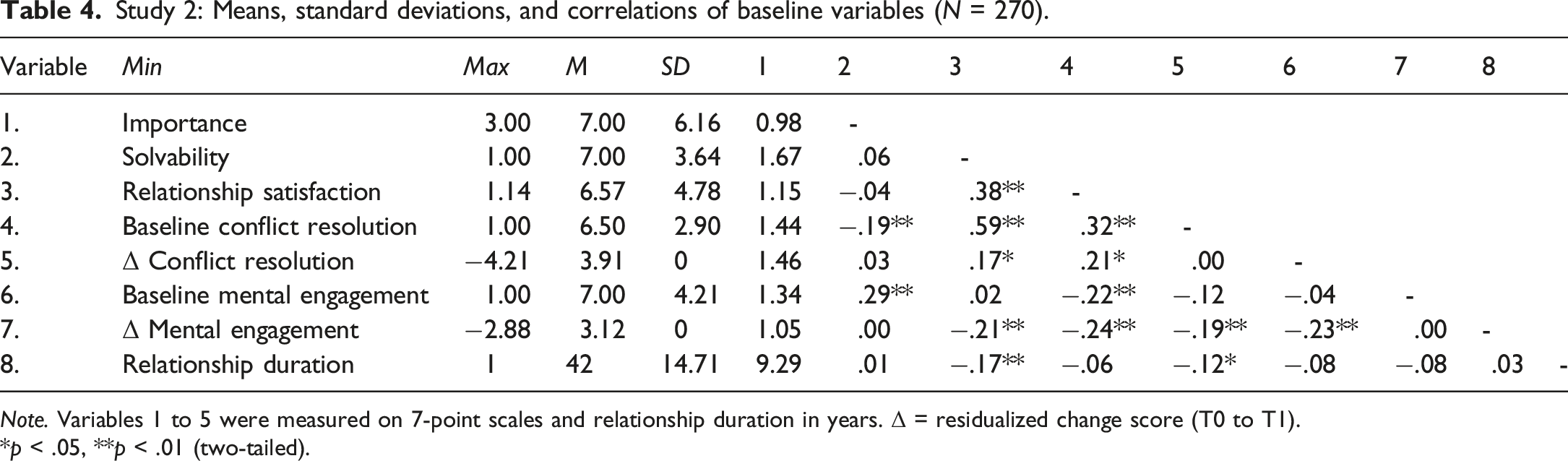
Note. Variables 1 to 5 were measured on 7-point scales and relationship duration in years. Δ = residualized change score (T0 to T1).
*p < .05, **p < .01 (two-tailed).
Randomization was successful: There was no difference between conditions in baseline measures (relationship satisfaction, conflict resolution, mental engagement, importance, solvability, age, relationship duration and having children; see Supplemental Material). Although sex ratio differed (mental contrasting 60 % women, indulging 44 % women, concentration 41 % women), F (2, 267) = 3.66, p = .03, we controlled for biological sex in all models.
Conflict resolution
We conducted a hierarchical regression using SPSS. Mirroring Study 1, Model 1 included condition, mean-centered importance and solvability, and the covariates. Again, we converted condition into two dummy variables (indulging and concentration, with mental contrasting serving as reference category). We added the two-way interactions in Model 2 and Model 3, respectively, and the three-way interactions in Model 4. We used the (residualized) change in conflict resolution as the dependent variable.
We could not replicate mental contrasting’s effect on conflict resolution (full results in the Supplemental Material). Although adding the conditions-importance-solvability three-way interaction significantly improved the model fit to R2 = .114 (ΔR 2 = .040, ΔF (3, 255) = 3.82, p = .011), the conditions-solvability interaction was not significant at medium (−1 SD), high (M), and very high (max) importance Fs(2, 259) < 2.50, ps > .084. Probing the conditions-importance-solvability three-way interaction revealed that mental contrasting (compared to both control conditions) does not lead to better (or worse) conflict resolution at any combination of importance and solvability (ts < 1.78, ps > .076).
Mental engagement
Study 2: Interactive effect of condition, importance, and solvability on mental engagement.
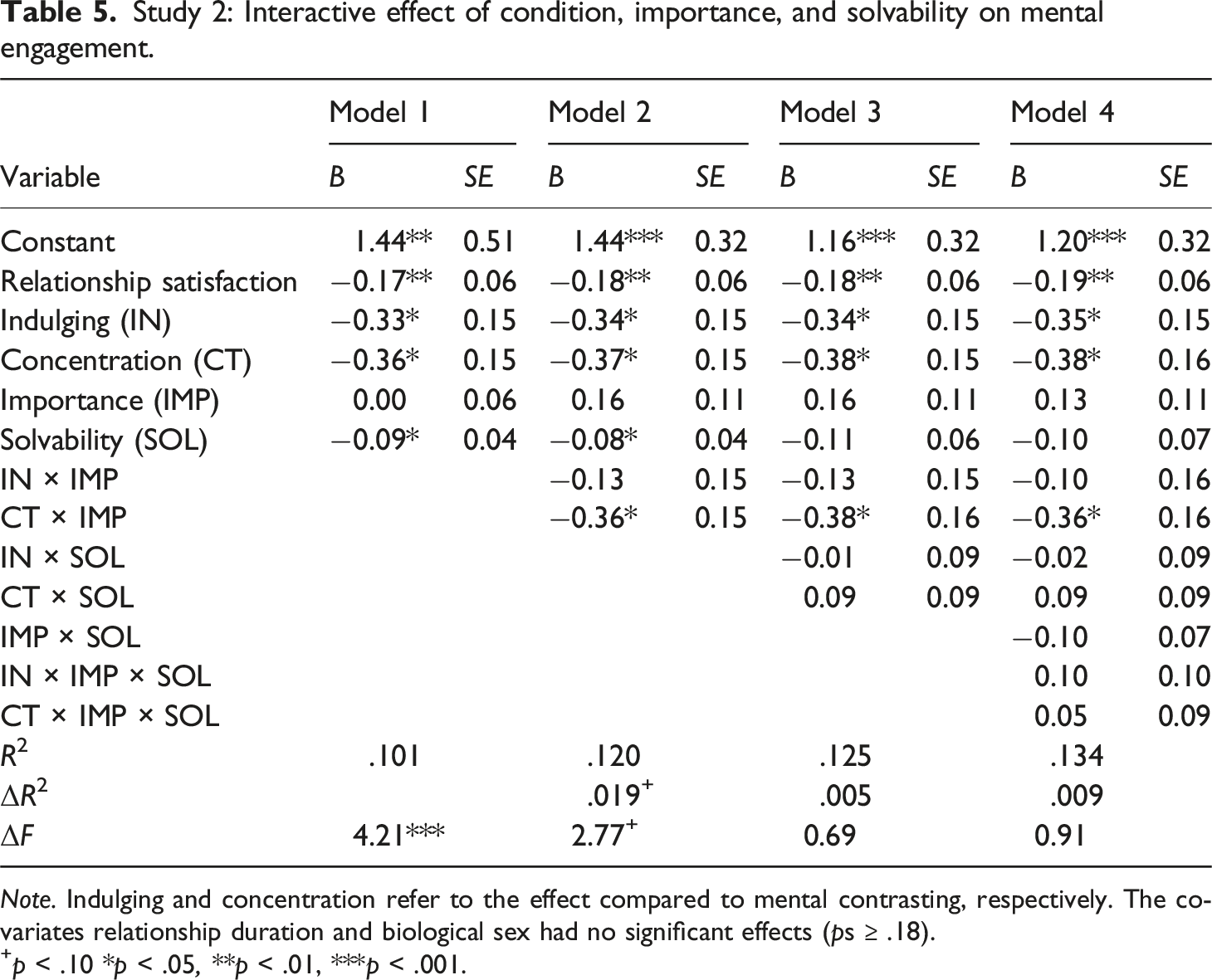
Note. Indulging and concentration refer to the effect compared to mental contrasting, respectively. The covariates relationship duration and biological sex had no significant effects (ps ≥ .18).
+p < .10 *p < .05, **p < .01, ***p < .001.
While this model fit increase was not quite significant, the regression analysis revealed a significant interaction between concentration and importance (b = −0.36, SE = 0.15, p = .021), such that mental contrasting compared to concentration led to higher mental engagement the higher the importance. The interaction between indulging and importance was not significant (b = −0.13, SE = 0.15, p = .41).
Given the significant interaction between concentration and importance, we then probed the conditions-importance interaction using PROCESS Model 1 (Hayes, 2022). Using simple slope analysis, we examined whether mental contrasting (vs. indulging and concentration, respectively) increases mental engagement with important conflicts (i.e., importance is high = M or very high = max). As hypothesized, mental contrasting led to higher mental engagement when the conflict had high importance compared to both indulging (b = −0.34, SE = 0.15, p = .025) and concentration (b = −0.37, SE = 0.15, p = .016; Figure 3). When the importance was very high, the effects remained significant for both mental contrasting versus indulging (b = −0.44, SE = 0.20, p = .025) and mental contrasting versus concentration (b = −0.67, SE = 0.20, p = .001). The conditions did not differ when conflicts had only medium importance. Study 2: Conditional effect of condition on mental engagement. Note. Δ = residualized change score.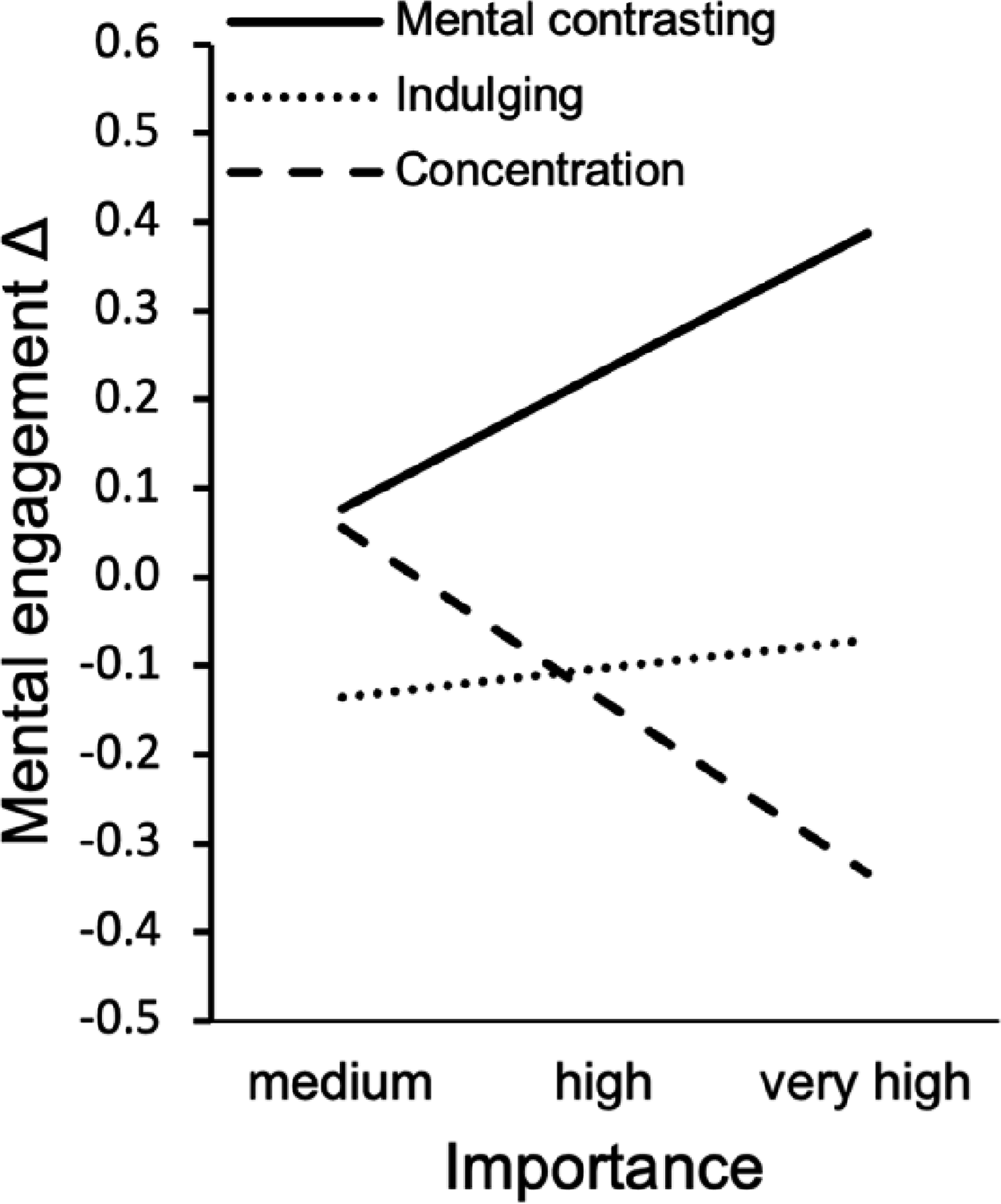
Discussion
We recruited individuals who were less satisfied with their relationship and mostly dealt with more severe conflicts. Mental contrasting did not improve conflict resolution, even when the conflicts were perceived as solvable. Instead, mental contrasting increased mental engagement when the resolution was highly important. Unlike in Study 1, the perceived solvability did not influence outcomes in Study 2—presumably because conflict resolution was generally considered less feasible (Footnote 5).
Mental engagement
As hypothesized, and consistent with the literature (Oettingen, 2012; Oettingen & Sevincer, 2018), participants in the mental contrasting (vs. indulging and concentration) condition were more mentally engaged with highly important conflicts—rather than just medium important ones. High mental engagement signifies strong commitment to resolving the conflict (Klinger, 1975). Even when solutions cannot be found quickly, mental contrasting participants might have actively tried solving these important conflicts thereby being tuned (Cloven & Roloff, 1995; Gollwitzer & Bayer, 1999; Zajonc, 1960) towards the sources of the associated frustrations. That way, mental contrasting might aid the implementation of long-term solutions with their partner. Prior studies showed mental contrasting enables integrative solutions between negotiation partners (Kirk et al., 2011), but it’s impact on long-term conflict management in couples requires further investigation. If mental contrasting reveals that the conflict is unsolvable and the frustrations associated with the conflict are unbearable, mental contrasting should contribute to ending the relationship, emotionally, cognitively, or behaviorally (Klinger, 1975; Oettingen & Gollwitzer, 2022).
In summary, in less satisfied relationships that face more severe conflicts, mental contrasting’s efficacy does not hinge on the perceived solvability, given the potentially unsolvable nature of these conflicts. Rather, mental contrasting’s strength lies in recognizing the importance of an issue and fostering the willingness to engage with the challenges associated with managing the conflict more effectively.
General discussion
Two experimental studies demonstrated the role of mental contrasting in facilitating resolution of conflicts in romantic relationships. In Study 1, mentally contrasting the desired future of a resolved conflict with the inner obstacle preventing the resolution, improved conflict resolution for solvable conflicts compared to only indulging in the desired future. However, for conflicts of highest importance, this effect diminished, as these conflicts are often more severe, making quick resolution unfeasible. Yet, individuals might mentally engage with these conflicts, attempting to find solutions despite unclear paths. In contrast to Study 1, in Study 2, mental contrasting did not improve conflict resolution, but instead increased mental engagement for highly important conflicts —an indicator for strong commitment to resolving the conflict.
Engaging in resolving important and solvable conflicts
According to interdependence theory, people in romantic relationships who do not meet their standards (i.e., they are not able resolve the issues that are important to them according to their standards), might become frustrated and dissatisfied with their relationship (Kelley & Thibaut, 1978). We showed that when facing important and more severe issues, people who use mental contrasting mentally engaged with their issues more than those who only indulged in the desired future. Further, those who only indulged in the future did not engage more with important conflicts than those who worked on a conflict-irrelevant concentration task. Mentally engaging with the issue at hand may facilitate addressing vital aspects in the context of the relationship’s long-term future.
Conflicts vary in perceived solvability (Miller & Roloff, 2006), and couples’ conflict resolution skills differ (Fincham, 2003). Perceiving a conflict as important and solvable should typically elicit strong engagement in resolving that conflict (Roese & Sherman, 2007; Snyder, 1984). However, when indulging in positive fantasies tempts people to feel already accomplished (H. B. Kappes & Oettingen, 2011), even seemingly solvable conflicts may lead to continued frustration and relationship dissatisfaction in the long run. Our findings demonstrate that mental contrasting of solvable and less severe issues translates perceived solvability into actual conflict resolution, while indulging prevents the translation of perceived solvability into effectively resolving the resolution. For more important and severe conflict issues, we observed that mental contrasting makes people mentally engage with these conflicts instead—regardless of solvability. While in other areas of life, people have the choice to just disengage from unfeasible wishes and goals (e.g., not running a marathon), in a romantic relationship, it might be more difficult to let go of a seemingly unresolvable conflict (e.g., disagreeing on parenting styles). Thus, no matter how unresolvable a conflict is perceived, it needs to be managed one way or the other. And even when perceived as solvable, the sources of frustration might be external or not controllable (e.g., finances, parenting), preventing a quick resolution. Mentally engaging with a conflict may allow couples to find a creative solution or to agree to disengage from trying to resolve the conflict. Or they may even disengage from the relationship. In summary, mental contrasting aids in both resolving solvable conflicts and engaging with more severe, less solvable conflicts when they are important for the relationship.
Limitations and future directions
First, the 2-week timeframe in both studies may not capture changes in more severe and perpetual conflicts. Studies using a longer time frame could offer a more comprehensive understanding of mental contrasting’s long-term effects on conflict management. Second, because our power in Study 2 was relatively low to detect the observed interaction effects (particularly the difference in slopes between mental contrasting and indulging), future studies should recruit larger samples. Third, our individual-focused studies may overlook the dyadic nature of relationship conflicts; future research should recruit couples. Fourth, as this work focused largely on participants’ cognitions about their relationship conflicts, future studies should use observational measures to explore mental contrasting’s impact on verbal and nonverbal relationship behavior (e.g., during discussions about the conflict). Fifth, mental engagement was measured as the frequency of conflict-related thoughts including positive, negative, and neutral thoughts. However, we could not distinguish between thoughts instrumental for conflict resolution and rumination. However, solvability might moderate the type of mental engagement that mental contrasting elicits (e.g., with high solvability producing active problem-solving; with low solvability producing active disengagement). Sixth, future work may also investigate whether people who spontaneously apply mental contrasting (Sevincer et al., 2024; Sevincer & Oettingen, 2013), manage their relationship conflicts more effectively. Lastly, future work should assess participants’ gender identity and disability status for a broader understanding of the extent to which mental contrasting effects can be generalized.
Conclusion
Our research highlights the nuanced role of mental contrasting in ongoing relationship conflicts. We demonstrated mental contrasting’s efficacy in enhancing resolution of solvable conflicts, but more severe conflicts posed challenges that diminished the direct impact of mental contrasting on successfully solving the conflict over the period of two weeks. For these more severe and highly important conflicts, we demonstrated the value of mental contrasting in fostering mental engagement, emphasizing its potential as a tool to manage perpetual conflicts in less satisfied relationships. Our findings underscore the interplay between conflict importance and solvability, with mental contrasting playing a dual role in facilitating resolution for solvable conflicts and promoting mental engagement with less solvable conflicts of high importance.
Supplemental Material
Supplemental Material - Mental contrasting and conflict management in satisfied and unsatisfied romantic relationships
Supplemental Material for Mental contrasting and conflict management in satisfied and unsatisfied romantic relationships by Henrik Jöhnk, A. Timur Sevincer and Gabriele Oettingen in Journal of Social and Personal Relationships.
Footnotes
Funding
The author(s) disclosed receipt of the following financial support for the research, authorship, and/or publication of this article: This research was supported in part by a fellowship by the Hanse-Wissenschaftskolleg - Institute for Advanced Study (HWK) for Timur Sevincer
Open research statement
As part of IARR’s encouragement of open research practices, the authors have provided the following information: This research was pre-registered. The aspects of the research that were pre-registered were the study design, sample size, and the outcome variables. Given the picture that both studies draw collectively, we focused on outcomes mentioned in the exploratory sections. The registration was submitted to: https://www.aspredicted.org/ (#91271 and #118180). The full data used in the research cannot be shared with any person because it contains sensitive information about the participants’ relationships. However, restricted data files, without identifiable information, can be publicly shared and can be obtained at:  or by emailing:
Supplemental Material
Supplemental material for this article is available online.
Notes
References
Supplementary Material
Please find the following supplemental material available below.
For Open Access articles published under a Creative Commons License, all supplemental material carries the same license as the article it is associated with.
For non-Open Access articles published, all supplemental material carries a non-exclusive license, and permission requests for re-use of supplemental material or any part of supplemental material shall be sent directly to the copyright owner as specified in the copyright notice associated with the article.
