




Abstract
Intuitively, personality traits may shape friendships differently from academic connections, potentially influencing social support development. Yet, this remains understudied, while it is crucial for student’s wellbeing. Therefore, this study investigates how the personality traits of the Five-Factor Model interact with the role friendships and preferred collaboration relationships. In a sample of 95 university students, socio-centric data were collected with questionnaires on personality traits and longitudinally on networks of friendship and preferences for collaboration networks. Utilizing stochastic actor-oriented models in RSiena, we showed that students more open to new experiences established more friendships, preferred more collaborations with their peers, and were also more popular in both networks than students less open-to-new-experiences. Students scoring higher on agreeableness were less likely to connect to their peers in both networks, whereas higher-achieving students were more likely to establish peer relationships in both networks. Furthermore, friends were preferred for collaboration (and vice versa), indicating an overlap. This study points to the importance of personality traits and achievement when students integrate into their social and academic environment.
The role of personality traits in the formation of friendship and preference for collaboration networks
The first year in higher education is an exciting but uncertain and challenging time for students in many respects. Students need to adjust to a new social and academic environment, pursuing academic success in a competitive setting and striving to integrate into a new community. Social capital theory (Coleman, 1990) elucidates that social resources are key to success in contexts such as the first year of higher education. Central to social capital theory is the notion that students can accrue benefits from their social relationships, emphasizing the significance of network formation in accessing resources and studying opportunities (Mishra, 2020). For instance, friendships are essential sources of support, help, or peer feedback to achieve academic success (Brouwer et al., 2018, 2022; Stadtfeld et al., 2019), while developing a network of reliable collaboration partners is important because students often need to work together, share study material, and undertake assignments (Blumenfeld et al., 1996; Brouwer et al., 2016; Lin, 1999). Students can thus derive social capital from different types of network resources; that is, friendships and collaboration relationships.
Despite its significance, the role of personality traits on network formation and subsequent social capital accumulation remains understudied, warranting further investigation. Personality traits are influential factors in shaping the structure of networks (Asendorpf & Wilpers, 1998; Deventer et al., 2019; Parker et al., 2012), extending to academic settings. Personality traits are often measured using the Five-Factor Model (FFM). FFM traits comprise agreeableness (altruistic, cooperative, kind), extraversion (sociable, outgoing, assertive), neuroticism (emotional instability, anxious, sensitive), openness to new experiences (creative, imaginative, curious), and conscientiousness (self-disciplined, organized, responsible) (DeYoung, 2015; McCrae & John, 1992). FFM personality traits act as a vital determinant of an individual’s behavior, network position, and relational choices (Brouwer & de Matos Fernandes, 2023; Fang et al., 2015; Harris & Vazire, 2016; Selden & Goodie, 2018; Selfhout et al., 2010; Shchebetenko, 2019; Zhu et al., 2013). For example, prior work shows that altruistic or extroverted students are more popular and have more friends than their introverted and neurotic counterparts. In comparison, individuals with a higher tendency for neuroticism have difficulties forming and maintaining relationships over time (Robins et al., 2002).
This study aims to investigate how one’s personality traits can serve as an important precursor for network formation and, by extension, the availability of social capital. We focus on the “who” and “what type” of person can provide social resources and inspect how individual characteristics play a role in network formation. We address a notable gap concerning this critical aspect of social capital theory. Namely, most research pays little attention to the notion that the role of personality traits in network formation may depend on the network’s content, that is, the meaning of different relationships. Social relationships are multiplex. Individuals have different relationships – such as friendships, work relations, collaboration, or advice relations – with different meanings (Kadushin, 2012; Kivelä et al., 2014; Stanley & Faust, 1994). More importantly, different traits have a distinct role in forming different types of relationships. Extraversion, agreeableness, and openness are more important for friendship formation, as individuals who tend to score high on these traits are more sociable, approachable, and willing to invest time and effort into each other (Selfhout et al., 2010; Shchebetenko, 2019; van Zalk et al., 2020), whereas self-discipline and conscientiousness are more important for work relationships (Fang et al., 2015). One’s traits can thus affect one’s network and, therefore, whether one has more or less access to social capital via social resources.
The role of personality traits and achievement in peer relationship formation
In network formation, academic achievement is important because it can play a role in students’ access to resources and opportunities within their academic communities (Choudry et al., 2017; Mishra, 2020). Additionally, students with higher academic achievements are more well-placed and connected in networks (Brouwer et al., 2018; Weber et al., 2020), which can further enhance their academic and professional prospects. That is why we examine the role of academic achievement and personality traits in network formation. The importance of academic achievement in networks aligns with social capital theory (Coleman, 1990), showing how access to social resources is key to academic success.
Moreover, research reveals a nuanced relationship between academic achievement and personality traits (Vedel & Poropat, 2020). Conscientiousness emerges, for instance, as a key predictor of academic success, with individuals exhibiting higher levels of this trait consistently achieving better grades (Hakimi et al., 2011; Jensen, 2015; Swanberg & Martinsen, 2010). Additionally, openness to new experiences is associated with a more creative and adaptive learning approach, positively influencing academic outcomes (Hakimi et al., 2011; Jensen, 2015; Komarraju et al., 2011; Mammadov, 2022; Paunonen & Ashton, 2001; Vedel & Poropat, 2020). These traits are associated with intrinsic motivation, a deep approach to learning, and learning goals, which in turn lead to higher grades (Jensen, 2015). The relationship between personality traits and academic achievement is further mediated by approaches to learning, with conscientiousness and openness being mediated by strategic and deep approaches (Swanberg & Martinsen, 2010). The interplay between personality traits and academic achievement underscores the importance of considering individual traits in educational contexts to tailor interventions and support strategies for optimal student success.
When establishing relationships in different types of – that is, multiplex – networks, students can also select each other based on achievement (Brouwer et al., 2018; Flashman, 2012; Kretschmer et al., 2018; Stadtfeld et al., 2019; Weber et al., 2020). For example, students with higher grades may be more popular as friends or often sought out if help is needed. This suggests that academic achievement is socially recognized and perceived as an important factor in forming network connections. Findings show that achievement segregation persists in social networks in which higher-achieving and lower-achieving students are more connected to similar others (Brouwer et al., 2018; Weber et al., 2020). The question arises concerning the role of personality traits and achievement in selecting peers in different types of networks.
The role of different relationships in peer relationship formation
This study investigates whether and, if so, how five fundamental dimensions of personality and academic achievement play a role in two types of relationships among first-year students: friendship and preferences-for-collaboration (PFC) networks. Both networks provide resources that are valuable for students. Unlike past research, which mainly focused on the role of personality traits on one type of network (e.g., Selfhout et al., 2010), this paper considers the overlap between these networks and the role of personality traits within different networks. While friendship can be expected to facilitate collaboration, in our academic context friends may not necessarily be the best collaboration partners. For example, research shows that students might benefit more from collaboration with higher-achieving others (Brouwer et al., 2018), while these higher achieving others are typically not their friends. This led us to test to which extent preferences for collaboration and friendship overlap or are different in our data. By exploring the alignment of these relationships, our research provides a more comprehensive understanding of network dynamics, avoiding the limitations of isolated analyses. For instance, being sociable (extraversion) or creative (openness to new experiences) may be necessary for friendship networks but may not be as defining for selecting a collaboration partner. Being conscientious (conscientiousness) or altruistic (agreeableness) may be more important for collaboration relationships than friendships.
Moreover, these different types of relations form and change simultaneously and cannot be seen as independent. Research shows that friends prefer to collaborate or work together or that preferred collaborators or co-workers become friends (Brouwer et al., 2018; Sias & Cahill, 1998; Zajac & Hartup, 1997). The overlap in relationships, the so-called multiplexity, can be problematic for students not well-connected in one network. Unlike students with many friends, students with few friends may miss out on information and resources available via collaboration relations. If different relations align over time, networks may increasingly cluster along multiple shared dimensions, such as friends being similar in gender and social class (Block & Grund, 2014; Hooijsma et al., 2020). Failure to account for multiplexity also risks overestimating the role of each network studied in isolation. Moreover, the alignment of network relations in multiple networks may lead to the formation of faultlines in which groups fall apart into subgroups that are homogeneous across multiple dimensions (Mäs et al., 2013). By examining both networks, we aim to uncover the multiplexity of students’ social connections, providing a more comprehensive understanding of how friendships and collaboration relation interrelate and affect social capital within educational settings.
The social selection network mechanisms
Social network selection refers to the process by which individuals actively choose their social connections and network partners based on various factors such as shared interests, values, or proximity (Snijders, 2017). Here, we are interested in the social selection based on personality traits. In this process, the “ego” represents the focal individual making choices about whom to interact with, while the “alter” denotes the individuals who are potential network partners. The role of ego – also often referred to as actor (Snijders et al., 2010) – involves making decisions regarding whom to initiate or maintain relationships with, while the alter represents the potential targets of these decisions, ultimately shaping the structure and composition of the individual’s social network.
Personality traits and achievement can play a role in peer selection through three social selection mechanisms: activity, popularity, and homophily (Snijders & Lomi, 2019; Wasserman & Faust, 1994). First, activity (outgoing connections) means that ego initiates a connection with other alters; for example, an ego can initiate a connection with someone more sociable or with a certain grade. Activity stresses that some students are more active in initiating network relations than others and that this activity – being more outgoing – depends on individual characteristics such as personality traits (Snijders & Lomi, 2019). For example, extroverted people are more active in their friendship networks (Selfhout et al., 2010).
Second, popularity (incoming connections) means that ego is connected by alters, for example, because ego has a high social status because of high grades. Popularity captures the opposite of activity: that is, people with a high value on a trait are often selected as network relations by others (Snijders & Lomi, 2019). For example, Fang et al. (2015) note that neurotic individuals are less popular for forming friendship relations with them or asking for help in case of need. Also, people high on agreeableness are more popular as friends (Selfhout et al., 2010). Fang et al. (2015) find that conscientious individuals are popular to be asked for work-related advice and more information.
Third, homophily refers to similarity in behavior, attitudes, or another dimension in networks. Homophily assumes that students with similar attributes (i.e., similar scores on FFM traits) are attractive as network partners because “they are like me” (McPherson et al., 2001). For example, it has been found that students high on openness (Brouwer & de Matos Fernandes, 2023) and agreeableness (Selfhout et al., 2010) tend to preferentially form connections with similarly creative and altruistic others to combine their ‘creative and altruistic forces’, respectively.
Linking personality traits, academic achievement, social selection and social capital in dynamic peer networks
During the transition to higher education, networks play a pivotal role in students’ access to resources, aligning with social capital theory (Coleman, 1990), which emphasizes the benefits accrued through relationships. The ability to form and maintain both friendship and collaboration relationships is essential for successful integration into academic and social spheres (Blumenfeld et al., 1996; Stadtfeld et al., 2019). In addition, more social capital is associated with better mental and physical health (Ehsan et al., 2019), elucidating the power of social capital. However, the formation of these networks is not uniform, and the types of relationships can differ, while the formation of ties is influenced by both personality traits and academic achievement. Personality traits such as extraversion, agreeableness, and conscientiousness shape who students choose to form relationships with and the types of connections they establish (Asendorpf & Wilpers, 1998; Fang et al., 2015).
Network formation, however, is not random. It is shaped by social selection mechanisms, such as homophily on academic achievement, where higher-achieving students form connections with similar others, reinforcing their access to social capital (e.g., Weber et al., 2020). Moreover, personality traits influence these selection processes, with traits like extraversion, conscientiousness, and openness making students more attractive as friends (Fang et al., 2015; Selfhout et al., 2010). The role of personality traits and academic achievement may also differ by network type, as relationships formed in one network (friendships) can influence relationships in another (preference-for-collaboration). Thus, the accumulation of social capital is contingent upon a multiplex network structure, shaped by the interplay between personality and academic selection processes. Given the lack of clarity on how these interrelated factors influence social capital, this study aims to explore how personality traits, academic achievement, and selection mechanisms combine to shape social capital development during the transition to higher education.
The current study
This paper utilizes stochastic actor-oriented models (SAOMs) of longitudinal data of the co-evolution of multiple networks and individual characteristics to address the following research questions: (1) To what extent and how do personality traits and achievement play a role in the selection of peers in friendship and preference for collaboration networks, and (2) to what extent do these networks overlap? SAOMs allow for assessing the co-evolution (development) of personality traits and relationships within different types of networks by using a combination of simulation methods and model selection for finding model specifications that yield the best fit between data and theoretical assumptions specified by the researcher (Snijders, 2017; Snijders et al., 2010, 2013; Steglich et al., 2010). Conventional methods, for example, OLS regressions, rely on the assumption of independent observations, but SAOMs overcome this assumption by considering the interdependency among observations (Snijders et al., 2010). Specifically, our SAOMs here allow to study (i) network changes over time, (ii), the role of structural features and social patterns in both networks, (iii) the role of personality traits in the formation of network relations, and (iv) the interrelatedness of friendship and PFC networks.
Methods
Sample and procedure
The sample consisted of 95 Dutch first-year students (61% women; 39% men). They were, on average, 19.46 years old (SD = 1.56). In the educational context, students were assigned to one of eight learning communities. Such communities encourage first-year students to connect to each other in a small group of 12 students. Students met weekly to learn about academic and study skills and share their academic experiences.
Respondents participated in three online questionnaires in the first semester (at the start, t = 0, and near the end, t = 1) and the second semester (t = 2). They completed the surveys within 20–30 minutes. They could obtain study credits for their participation, but it was emphasized by the researchers that their participation was voluntary. Respondents were informed about the aim of the study before giving informed consent to use their data for research purposes. Ethical approval was obtained from the ethics committee of the Faculty of Behavioral and Social Sciences at the University of Groningen, the Netherlands (ethics protocol number: ppo-013–215). The response rate was higher than 90%.
Overview of model connection with study design
This study employed a stochastic actor-oriented model (SAOM) to analyze the evolution of relationships within both networks, directly aligning with the current design focused on capturing changes in network relationships over time. The longitudinal (socio-centric) nature of the data, with repeated observations of network ties, made SAOM an appropriate choice, as it specifically models the decisions made by students to form, maintain, or dissolve relationships. By integrating both network effects (e.g., reciprocity, “If you are my friend, I am yours”) and individual factors (e.g., grades or gender), the SAOM made it possible to explore the underlying processes of network formation that were central to the current research questions. This modeling approach was tailored to the current design because it accounts for the complex, interdependent nature of social interactions, allowing to disentangle the contributions of different processes to explaining the network changes observed in the data. This ensures that the analysis accurately reflects the network dynamics we aimed to study. Furthermore, SAOMs are fitting for the current paper given its applicability to estimate the role of personality traits in the formation of two types of networks (friendships and PFC) while accounting for the interdependent structure of the network, which we have here.
Instruments
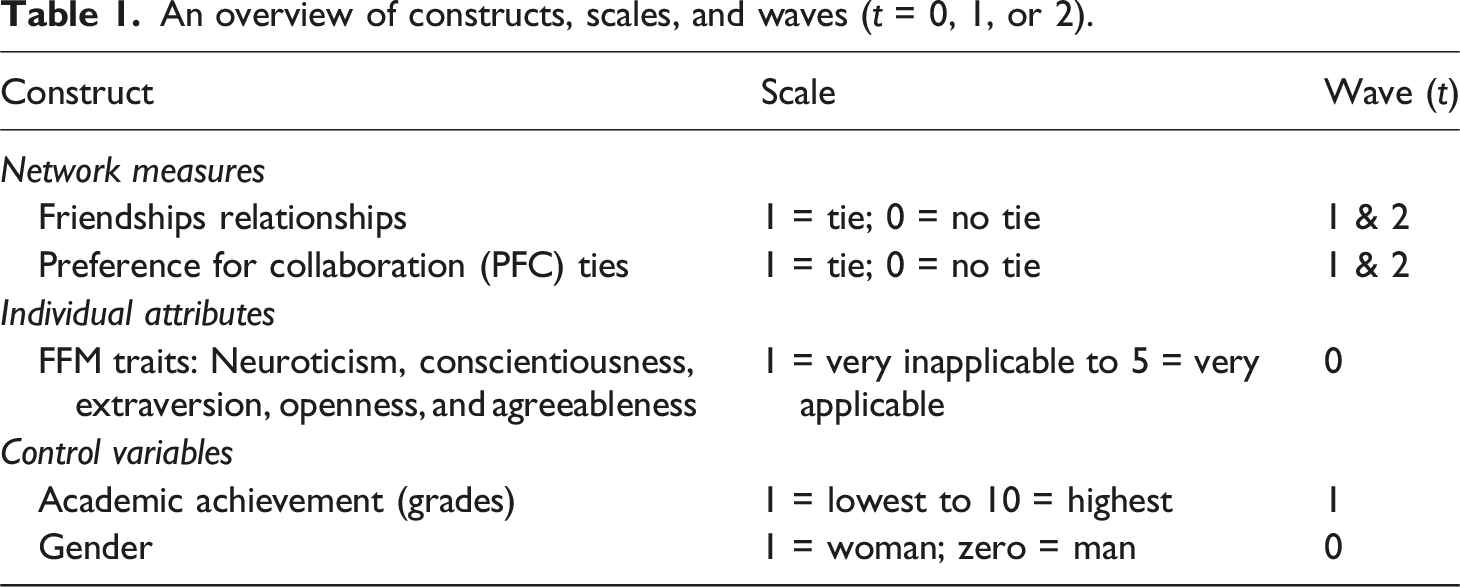
An overview of constructs, scales, and waves (t = 0, 1, or 2).
Friendship networks
The respondents nominated their fellow students as friends on a scale from 1 (“best friends”) to 6 (“I don’t know who this is”). Friendship relations were dichotomized to be able to do the analysis (SAOMs) from the 6-point scale: 1 = “best friends,” 2 = “friend,” and 3 = “friendly relationships” were coded as 1 (a friendship connection). Options 4 = “neutral, not much in common,” 5 = “only known from face or name,” and 6 = “I don’t know who this is” were coded as zero (no friendship connection). The current choice of dichotomizing friendship nomination categories into ‘no nomination’ (neutral, not much in common, unknown) and ‘nomination’ (best friends, friend, friendly relationship) is based on existing literature (for more information, we refer to van de Bunt et al., 1999).
Preference for collaboration (PFC) networks
Indicating with whom one prefers to collaborate followed the same procedure as friendship nominations. Respondents indicated at t = 1 and t = 2, “I would like to collaborate with [name].” They could rate each other on a 5-point Likert scale, ranging from 1 (“strongly disagree”) to 5 (“strongly agree”), with the option of 6 (“I do not know”). To elucidate whether a student prefers to collaborate with another student, we dichotomized the network tie. Specifically, the received nominations were dichotomized with the answering categories from strongly disagree (1) to neutral (3) as “0” (no relationship) and agree (4) to strongly agree (5) as “1” (relationship).
Personality traits
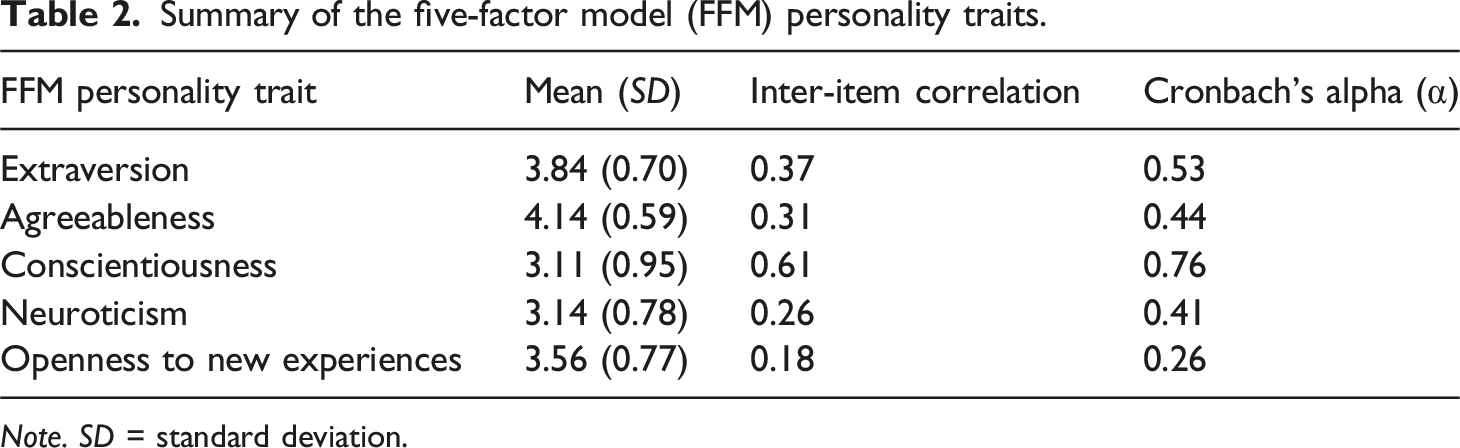
The Ten-Item Personality Inventory was used to assess the Five-Factor Model (FFM) personality traits (Gosling et al., 2003). FFM traits are assumed to be stable (DeYoung, 2015) and were only measured at t = zero (start of the academic year). Respondents answered the question “To what extent do the following statements relate to you?” separately for 10 items to capture the following five traits: extraversion (“I take time for a talk” and “I am easily enthusiastic”), agreeableness (“I try to avoid conflicts” and “I see myself as someone who is generally trusting”), conscientiousness (“I work in a structured manner” and “I am self-disciplined”), neuroticism (“I ignore adversity quickly” and “I can handle stress well”), and openness to experiences (“I am open to new experiences” and “I am interested in art”). Students indicated their choice on a 5-point Likert scale, ranging from 1 (very inappropriate) to 5 (very appropriate). The items for neuroticism were recoded because they were reverse-scored. Items corresponding to a specific trait were averaged to capture the latent trait accordingly.
Summary of the five-factor model (FFM) personality traits.
Note. SD = standard deviation.
Grades
The range of the grading system is 1 (min) to 10 (max). Grades resembles one’s GPA (finished courses) at the end of semester 1. Completing a course (grade ≥5.5) resulted in credit points. The average grade was weighted by the credit points obtained for courses divided by the maximum possible credit points possible and round the grade variable (M = 6.07, SD = 2.02, min = 1, max = 9).
Gender
Gender is a dichotomous variable: man (0) and woman (1).
Data analysis plan
Correlations and ANOVA’s
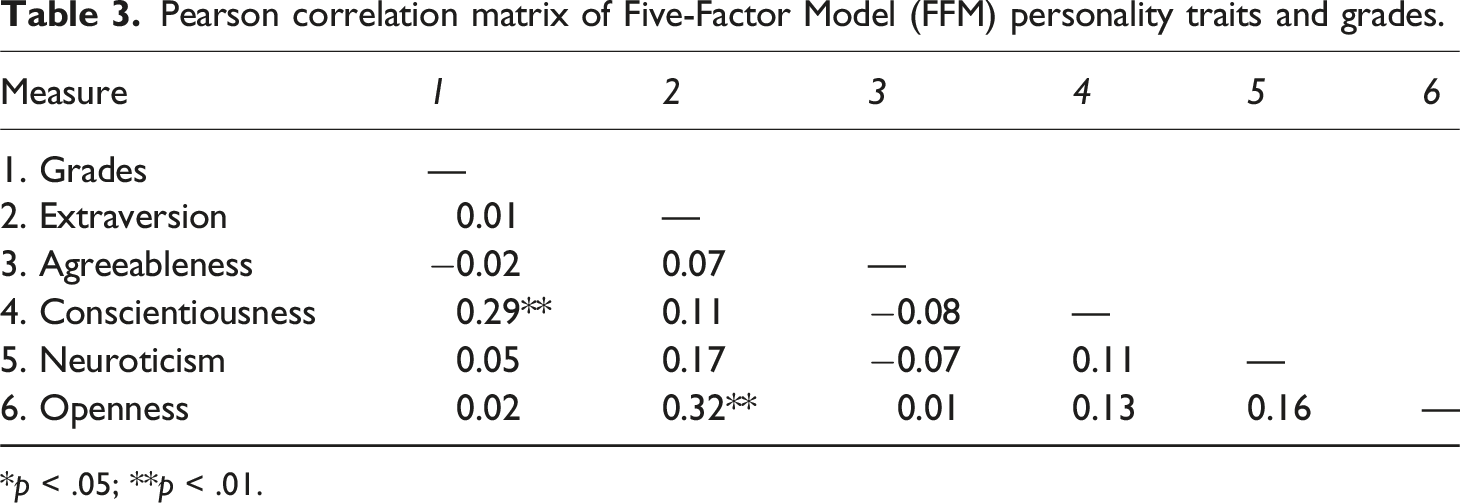
We first employed a combination of Pearson correlations and ANOVAs to examine the relationships between variables and test for significant differences among groups. Pearson correlations were utilized to explore the strength and direction of linear relationships between grades and FFM personality traits. ANOVAs assessed the mean differences among men and women per grade and FFM personality trait.
Stochastic actor-oriented models
The interdependence of network and individual attributes is explicitly addressed in stochastic actor-oriented models (Brouwer & de Matos Fernandes, 2023; Snijders, 2017; Snijders et al., 2010, 2013). Stochastic actor-oriented models (SAOMs) are an analytical tool to illustrate how a particular network configuration comes about. SAOMs are characterized by their stochastic nature, as they simulate changes in the network through an individual decision-making model that incorporates variability. SAOMs are actor-oriented in that they focus on modeling the decisions of persons (referred to as actors) rather than networks. In SAOMs, changes in the network are attributed to the ‘decisions’ made by these individuals. SAOMs are models as the framework builds on agent-based modeling (Snijders, 2017; Snijders & Steglich, 2015). SAOMs can assess which theoretically postulated social mechanisms best explain changes between observed waves.
SAOMs were estimated in R (R Core Team, 2022) using the package Simulation Investigation for Empirical Network Analysis (RSiena; Ripley et al., 2020). The SAOM simulation algorithm, in combination with statistical methods for model fitting and model selection, was used to assess which parameter values for the rate function (i.e., rate of relationship changes) and the included effects (capturing different processes of network formation) in a model yielded the best match with the empirically observed changes in network relations while controlling for personality traits, grades, and gender. A significant positive parameter means that a network change related to the specific effect is more likely to occur. For example, suppose a model of the friendship network contained a significant and positive parameter for reciprocity. In that case, it is more likely that a mutual relationship occurs between two students net of all the effects in the model. Generally speaking, the interpretation of the effects of SAOMs is similar to conventional logistic regression.
Jaccard index
A crucial metric in assessing network stability is the Jaccard index (Snijders et al., 2010). Intuitively, the Jaccard Index is assessed prior the SAOMs to test whether the longitudinal network data is sufficiently stable to expect a good model fit in the SAOMs. The Jaccard Index quantified the similarity between the networks over time, that is, network t = 1 and network t = 2. It assessed how much overlap exists between the networks at two time points by comparing the shared connections to the total number of connections in either set. The index ranges from zero to 1, where a value of 1 indicates complete similarity, meaning the networks did not change, and a value of zero indicates no overlap at all, that is, the networks changed too much. This measure is particularly useful for understanding how similar two networks are or examining the similarity between different groups within the same network. Ideally the value is equal to or more than 0.30. Then we can expect that the model will converge. Too much instability or stability would have negatively impacted the reliability of the statistical analysis. Some changes in the relationship formation over time are necessary for model convergence (see Ripley et al., 2020).
Selection model
We estimated a selection model to investigate the formation of friendships and preference for collaborations. This indicated whom of their fellow students (peers) the students select and that the dependent variables are the friendship networks and the preference for collaboration networks. In each model, we included standard network effects, cross-network effects, and effects of actor attributes (i.e., gender or personality traits). We include the standard network effects to control for structural network effects that are known to occur in each social network, such as the tendency to have connections or the tendency to reciprocate network nominations. 1 Effects of attributes specified whether certain characteristics of an actor (in our case, FFM personality traits, grades, and gender) plays a key role in the network’s formation or dissolution of connections. Cross-network effects captured whether connections in one network affect the formation of connections (or severing connections) in another, such as friends preferring to collaborate (or vice versa).
SAOM effects
To address the first research question regarding the role of personality traits and achievement in network selection, three interaction effects were included: activity, popularity, and similarity per attribute or characteristic (FFM personality traits, grades, and gender). A significant positive estimate – either activity, popularity or homophily – indicates whether an attribute plays a defining role in network selection. The activity effect elucidated to what degree higher values on an attribute (indicated via *) determined how active students were in sending out connections (i* → j). The arrow represents a nomination from one actor to another. Thus, activity modelled whether, for example, having a particular grade made one more likely to initiate a network connection. The popularity effect measured the opposite of activity, indicating whether students with a higher score on the attribute of interest were more likely to be nominated (j → i*). It captured whether an actor’s characteristics (e.g., man or woman) made one more likely to be nominated by others. Finally, homophily was measured via the similarity effect, capturing tendencies of unrelated students (i* and j*) to form connections with similar others or for related students to maintain connections (i* → j*). This effect captured if two similar students on a personality trait, gender, or grade were more likely to connect. 2
To address the second research question regarding the overlap of the friendship and PFC networks, three cross-network effects were included (see Snijders et al., 2013). A significant positive cross-network estimate indicates that a tie in one network influences creation or maintenance of the corresponding tie in the other network. The first effect modelled cross-network overlap: To what extent are friends more preferred as collaboration partners (and vice versa)? The second cross-network effect captured whether a reciprocated friendship relation spurred a PFC nomination and whether a reciprocated PFC relation spilled over to nominating the other as a friend. This is to capture the expectation that reciprocated relations indicated mutual and thus more stable selections as (respectively) mutual friends or collaboration partners. The third cross-network was the cross-network popularity effect. This effect captured whether two actors were more likely to connect in one network if they were both nominated by the same alter in another network. To be clear, the effect captured whether both i and j being nominated as friends by k made i and j more likely to form a PFC relationship. Moreover, whether i and j were nominated as a PFC partner by k made i and j more likely to form a friendship relationship.
Relative importance
Each included effect’s relative importance (RI) was extracted from the network selection model using the sienaRI function (Indlekofer & Brandes, 2013). We include RI percentages to provide information beyond standard significance values, elucidating whether and to what degree (non-)significant estimates affect changes in the network. RI quantifies the degree to which a specific effect explains network selection in comparison to other effects within the selection model. That is, it provides a relative measure of how much one variable compared to other variables correlates with friendship or PFC selection. Specially, the RI showed in percentages to what extent observed changes in the network can be attributed to a specific effect. Combining all percentages in either friendship or PFC selection cumulatively leads to 100 percent. The convergence of the RSiena algorithm was automatically provided in the SAOM output by reporting t-ratios for each effect and overall model convergence. Convergence statistics for both selection models adhered to the standard criteria for convergence (for more information, see Ripley et al., 2020). All effects had a t-ratio below 0.10, and model convergence ratios were below 0.25.
To provide a lay interpretation of RI using the example of openness to new experiences and friendship selection: Imagine that when students choose their friends, various factors influence their network formation, such as how open they and others are to new experiences or their academic achievement. The relative importance of openness tells us how much this trait specifically drives friendship formation compared to other effects included in the model. For instance, if openness has a higher RI, it suggests that students who are more open to new experiences are more likely to form friendships based on this trait than on other factors like academic achievement or gender. Including RI aids understanding not just whether which effect influences friendship selection, but how strongly it does so relative to other effects.
Results
In what follows, we first provided descriptive statistics of personality traits, grades, and gender, followed by statistics concerning the stability of both networks. Then, we focused on the first research question: To what extent and how do personality traits and achievement play a role in the selection of peers in friendship and preference for collaboration networks? We finally discussed the overlap between the two distinct networks, thereby answering the second research question: To what extent do these networks overlap?
Descriptive statistics
Pearson correlation matrix of Five-Factor Model (FFM) personality traits and grades.
*p < .05; **p < .01.
Furthermore, we employed ANOVAs to inspect whether there were differences in grades and FFM traits per gender. We found in our sample that women had a significantly higher mean score on conscientiousness than men, F1, 81 = 4.26, p = .04. There were no statistically significant gender differences on agreeableness (F1, 81 = 0.47, p = .50), neuroticism (F1, 81 = 0.16, p = .69), openness (F1, 81 = 0.49, p = .49), and extraversion (F1, 81 = 3.34, p = .07). Furthermore, there were no significant gender differences in grades, per the ANOVA analysis result of F1, 86 = 1.80, p = .18.
The Jaccard index – a crucial metric for network analyses because it inspected the degree of stability in the network over time – of 0.381 for the friendship network showed sufficient stability over time. Jaccard index scores equal to or similar to 0.30 indicate sufficient stability for SAOMs (Snijders et al., 2010). There were, in total, 581 friendship connections at t = 1 and 474 at t = 2 (out of 8930 theoretically potential relations). Specifically, there were 473 changes in friendship connection presence when comparing t = 1 and t = 2. From t = 1 to t = 2, most connections (n = 8166) remained absent. 183 connections were formed, whereas 290 connections were severed over time. 291 connections remained present from t = 1 to t = 2. The network density decreased from 0.065 (581/8930) to 0.053 (474/8930). The average degree decreased from the first to the second semester from 6.12 to 4.99, meaning that students had 5 to 6 friendship connections on average.
The PFC network was also stable over time. The Jaccard similarity index of 0.375 showed enough stability in PFC between t = 1 and t = 2. A total of 499 changes in PFC relations occurred over time. Out of 8930 theoretically potential relations, we had 8131 PFC connections that remained absent over time. 216 PFC relations were formed from t = 1 to t = 2. 283 PFC relations were severed, and 300 remained present over time. The average degree decreased from the first to the second semester from 6.14 to 5.43, meaning the students had, on average, 5 to 6 fellow students with whom they preferred to collaborate. The total number of connections decreased from 583 (t = 1) to 516 (t = 2). The density of the PFC network decreased from 0.065 (583/8930) to 0.058 (516/8930).
Research question 1: The role of personality traits and grades in peer networks
In what follows, we showed that agreeableness and openness play a defining role in forming friendships and students’ preferences for fellow students to collaborate, while grades are important in both networks. Each reported SAOM effect shows the number of the estimate, the estimate itself, and the relative importance (RI) percentage. The standard network effects are discussed in the Supplemental File.
Selection of friends in peer networks
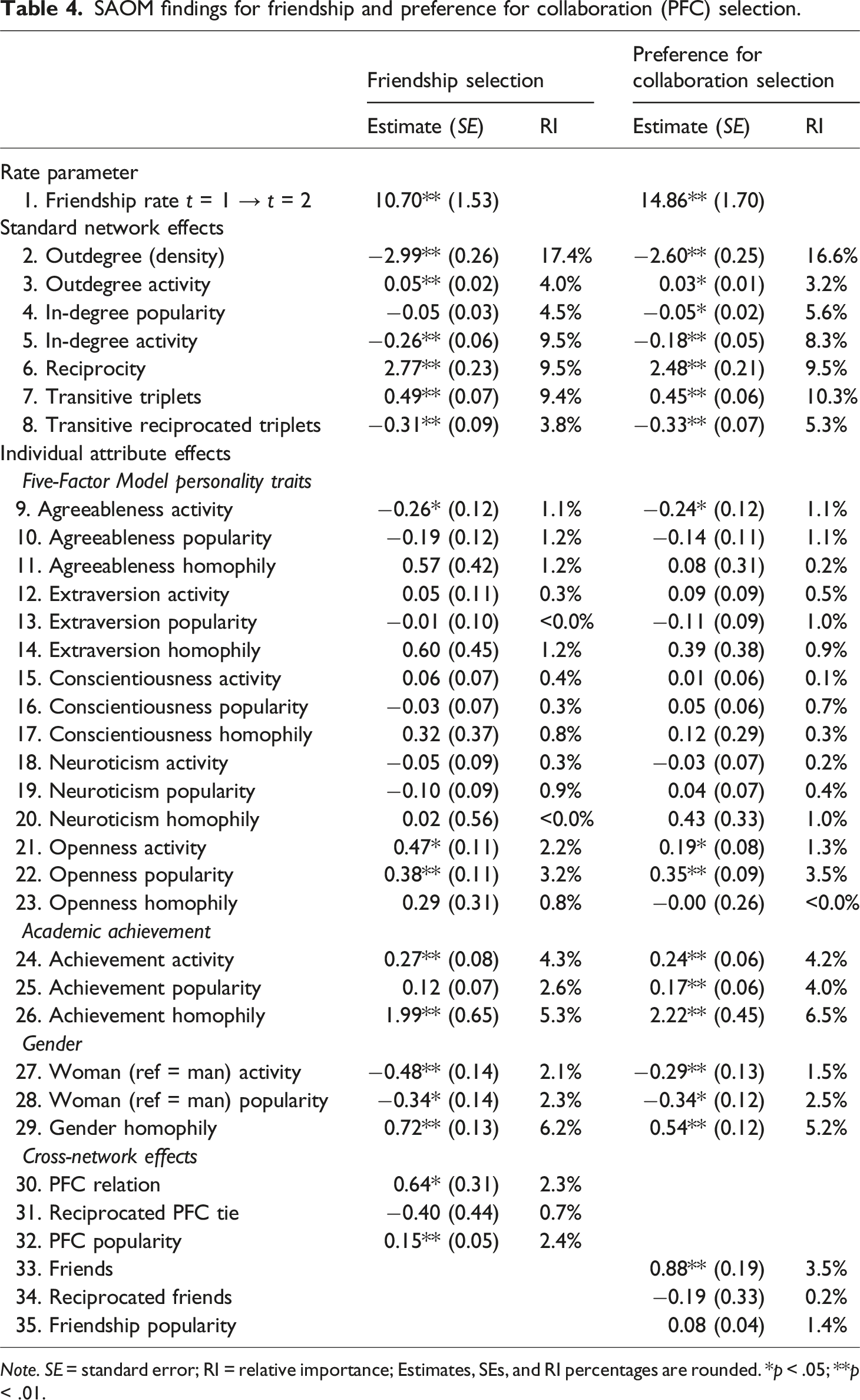
SAOM findings for friendship and preference for collaboration (PFC) selection.
Note. SE = standard error; RI = relative importance; Estimates, SEs, and RI percentages are rounded. *p < .05; **p < .01.
To explain how important certain mechanisms and effects are in friendship selection, we reported RI percentage. The RI percentages showed that FFM personality traits explained combined 13.9% of friendship selection, while openness to new experiences takes up 6.2% of the total of 13.9%. Academic achievement and gender 3 effects had a relative importance of, respectively, 12.2% and 10.6%. The results showed that the relative importance of standard network features was the largest: A combined total of 58.1%.
Selection of preferred collaborators
Openness to new experiences was a dominant personality trait characteristic for activity (#21, estimate = 0.19, RI = 1.3%) and popularity (#22, estimate = 0.35, RI = 3.5%) in preferring other students as collaborator. What is more, students with the same grade (#26, estimate = 2.22, RI = 6.5%) tended to seek similar others out for PFC relations. Also, students with higher grades were both more active (#24, estimate = 0.24, RI = 4.2%) in selecting preferred collaborators, as well as more popular (#25, estimate = 0.17, RI = 4.0%) than students with lower grades.
Finally, we reported RI percentage to explain to what extent observed network changes can be attributed to a particular effect or mechanism. The relative importance of FFM traits estimates in the PFC network comprised 12.3%, of which nearly 4.8% were attributed to openness. Academic achievement and gender 4 effects had a relative importance of, respectively, 14.7% and 9.2%. Especially academic achievement had a relative important role in explaining the selection of preferred collaborators. Again, the block of standard PFC network effects was most important for explaining PFC selection – 58.8% – compared to other SAOM estimates.
Research question 2: Overlap in friendships and preference for collaborations
To answer research question 2, we found a substantial overlap between the friendship and PFC network, both descriptively and analytically. Each reported SAOM effect shows the number of the estimate, the estimate itself, and the relative importance (RI) percentage.
Network overlap
The overlap between the friendship and PFC networks was inspected descriptively in two ways: (i) by descriptively comparing the in-degrees and (ii) by visualizing the overlap in network connections (Figure 1). First, the correlation between the in-degree – “being popular” – in the PFC and friendship network was significantly positive: r = 0.87 (p < .001) and r = 0.91 (p < .001), for t = 1 and t = 2, respectively. Students popular in one network tended to be popular in the other. Second, 78 and 83 percent overlap existed for network connections measured for t = 1 and t = 2, respectively. Figure 1 reported two Venn diagrams showing the overlap between friendship and PFC connections. One may intuitively argue that students tended to want to collaborate with their friends and tended to be friends with those with whom they wanted to collaborate in the higher education context. We tested this intuition formally using SAOMs. The overlap between preference for collaboration (PFC) and friendship network. Note. Two Venn diagrams of the count of relationships that overlap (purple) in the preference for collaboration (blue) and friendship (red) network at t = 1 (left) and t = 2 (right).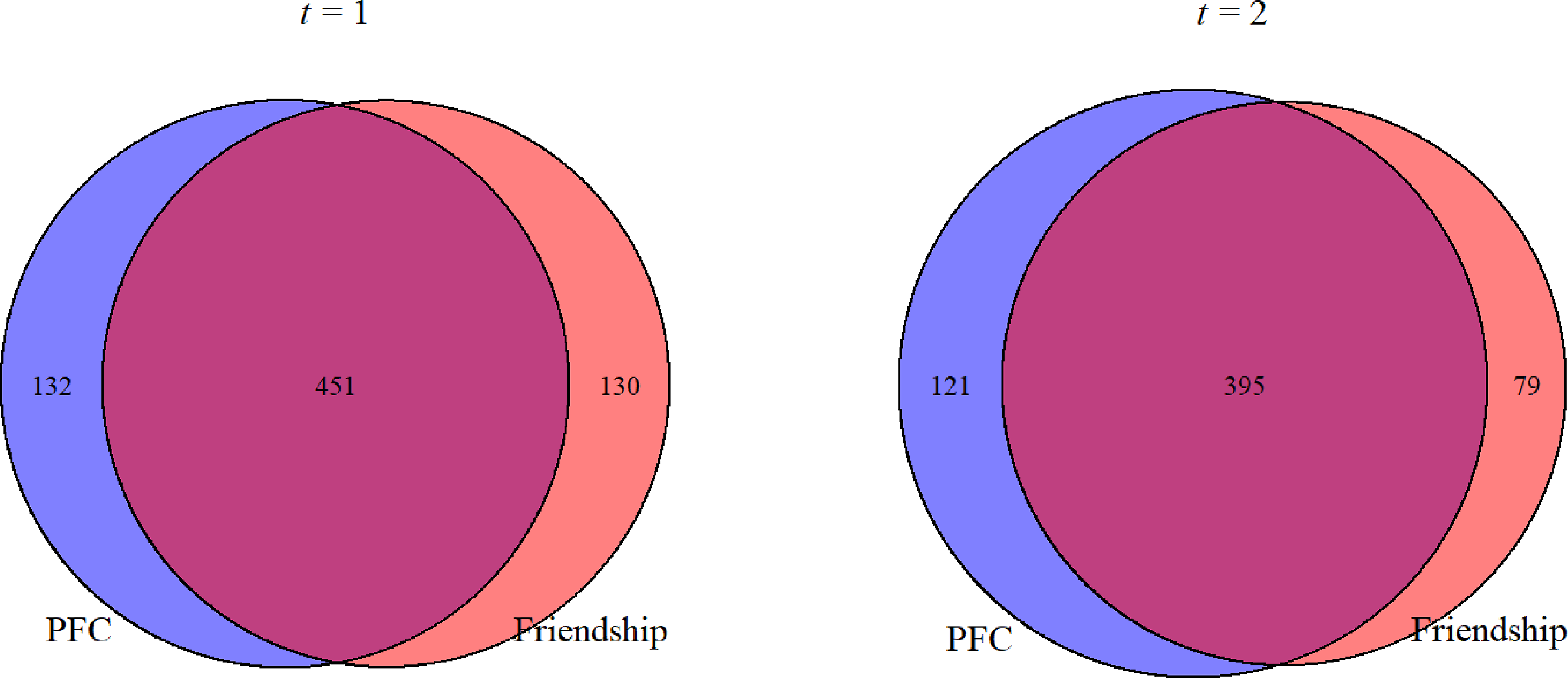
Multiplex network dynamics
To answer research question 2, we showed that friends were preferred for collaboration (#30, estimate = 0.64, RI = 2.3%) and that students who consider each other to be preferred collaboration partners tended to become friends (#33, estimate = 0.88, RI = 3.5%). 5 A notable second finding was that being popular in the PFC network made forming a friendship relationship more likely (#32, estimate = 0.15, RI = 2.4%). This effect suggested that students perceive PFC popularity as valuable in forming a mutually beneficial friendship relationship. Given that achievement homophily was present in both networks, PFC popularity may be associated with high grades, and students with high grades tended to select each other as friends and PFC partners. At the same time, the results did not support that popularity in the friendship network spilled over to the formation of PFC relationships (#35, estimate = 0.08, RI = 1.4%). This was consistent with the interpretation that high grades made an individual popular in the PFC network, while friendship popularity did not contribute to higher grades.
Finally. we showed that cross-network effects explained approximately 5% of connection changes in both selection models. Thus, cross-network effect have a relatively low explanatory impact on network selection compared to personality traits, academic achievement, and standard network effects.
Discussion
Students can derive social capital from friendships and collaboration relationships, but most research (Fang et al., 2015; Selfhout et al., 2010; Shchebetenko, 2019; van Zalk et al., 2020) paid little attention to the notion that the role of personality traits on network formation (i.e., social capital) may depend on the network’s content. Therefore, this study addressed a critical gap in the existing literature exploring the relationship between personality traits, achievement, different types of networks, and the multiplexity of networks.
Our first research question was: To what extent and how do personality traits and achievement play a role in the selection of peers in friendship and preference for collaboration (PFC) networks? This study highlighted the role of openness to new experiences (creative, imaginative, curious) and agreeableness (altruistic, cooperative, kind) for friendship formation and students’ preferences for fellow students to collaborate during study assignments. Students who were more open to new experiences established more friendships and had more preferred collaborators among their fellow students than students who were less open to new experiences. These students were also more popular in both networks than their less open-to-new-experiences counterparts. Conversely and counterintuitive, more agreeable students were less likely to connect to their peers in both networks. Even so, we found that personality traits do not play a different role in friendship or PFC formation. Also, higher achieving students were more likely to establish peer relationships in their friendship and PFC networks. By addressing these complexities, we provided insights into the multifaceted role of personality traits and achievement in network formation.
The second research question considered to what extent friendship and PFC networks overlap. Our study underscored significant overlap of network relations: Friends were preferred for collaboration (and vice versa), while popular collaborators select each other more often as friends, suggesting that clustering occurs across domains. Contrary to current work exploring how achievement and personality traits play a role in network formation (Selfhout et al., 2010), we showed that elucidating multiplexity is important for understanding network connectiveness: Friends and collaboration partners stick together. Although we found a substantial overlap between friendship and PFC networks, it was important to disentangle the unique and overlapping contributions of these two types of relationships to network dynamics. Research shows, for example, that higher-achieving students often connect with similar higher-achieving peers (Brouwer et al., 2018), while friendships may result in collaborating with one another, thereby fostering academic success (Stadtfeld et al., 2019).
Alignment previous research and unexpected findings
In line with previous work (e.g., Brouwer & de Matos Fernandes, 2023), our findings showed that students with higher openness to new experiences were more likely to form both friendships and prefer collaborations with their peers. A potential reason can be that the adaptability and exploratory nature of open individuals can make them key players in building social capital, particularly in environments that value collaboration and peer support. Overall, our study contributes to the personality theory (McCrae & John, 1992) and previous literature about personality development in networks (e.g., Deventer et al., 2019; Fang et al., 2015; Harris & Vazire, 2016; Selfhout et al., 2010) by showing that the personality trait openness to new experiences plays a role in not only selecting friends but also preferred collaborators.
The current finding that students with similar academic performance tend to assort and that those with higher grades are more popular and active in both networks align with previous research (e.g., Brouwer et al., 2018; Weber et al., 2020). This result can be interpreted through the framework of status theory within networks (Krackhardt, 1990). In educational contexts, academic achievement – or in terms of status, expertise – can function as a marker of status, with higher grades conferring a form of social capital that enhances a student’s attractiveness as a peer (Choudry et al., 2017; Mishra, 2020). Social capital theory, as articulated by Coleman (1990), posits that social networks and the associated norms of trust, reciprocity, and status within these networks are valuable resources that contribute to the achievement of individual and group goals. This potential elevated status likely contributes to the popularity of high-achieving students within their networks, as peers may seek to affiliate with them to access academic resources or social validation. The proactive behavior of high-achieving students in forming connections could be indicative of their strategic use of their status to consolidate and expand their influence within the network.
Contrasting earlier work (e.g., Harris & Vazire, 2016; Selfhout et al., 2010), our study found that agreeableness did not facilitate the formation of friendship and collaboration networks, which contrasts with existing literature that typically associates agreeableness with friendship formation. The unexpected agreeableness outcome in the current study may be due to the academic context, where agreeable students might avoid forming too many connections to maintain harmony and prevent conflicts in competitive environments. Additionally, in settings where academic success is prioritized, strategic networking may overshadow the benefits of agreeableness, leading to fewer peer connections.
Strengths, limitations, and future directions
This study’s notable strength was its investigation into the interplay between personality traits, academic achievement, and peer selection within distinct types of networks. Understanding how peer relationships are formed may help students become more aware of their network opportunities and inform study advisors and psychologists about the role of personality traits and academic achievement in network formation. They need to consider individual features when they help students integrate into their community. Also, the significant overlap between friendship and collaboration networks observed in our study underscores the importance of multiplexity in social network dynamics. This finding suggests that students often select the same peers for both personal and academic relationships, reflecting interconnected networks that may enhance cohesion and resource flow.
This study has some limitations. First, the data was gathered among students in one study program and one study year, limiting generalizability. For example, prior work shows that economics students tend to be less altruistic than students in other fields (Marwell & Ames, 1981; Wang et al., 2011) or that Western, Educated, Industrialized, Rich, and Democratic (WEIRD) and non-WEIRD samples can have different findings (Henrich et al., 2010). Our WEIRD social sciences student sample may thus be more collectively oriented, meaning relational choices may be directed to ensure community building instead of pursuing self-interest and higher grades (thus making relational choices to realize higher grades). Therefore, future research should replicate this study in other study programs.
Second, another limitation pertained to students indicating their preference to work with someone and not the extent to which they actually collaborated. Conscientiousness is highly related to good grades (Hakimi et al., 2011; Jensen, 2015) and might play a role in actual collaboration in teams, whereas we did not find an effect in the preference for collaboration networks. Strategic choices might influence collaboration in terms of pursuing good grades. Focusing on team formation (de Matos Fernandes et al., 2024; Hoffman et al., 2023) rather than working preferences can be extension for the future.
Third, students indicated with whom they are friends and preferred to collaborate but did not indicate why they selected those students. Future research with a qualitative or mixed methods design can shed light on the motivations for peer selection (Froehlich et al., 2020; Pantić et al., 2022). Relatedly, we consider either the presence or absence of network ties. Yet, network relations can differ in quality, from barely knowing one another to being best friends (e.g., Elmer et al., 2017). For example, Asendorpf and Wilpers (1998) show that extraverted people tend to maintain more social ties (i.e., a wider network) than more introverted people, but that the overall quality of these relationships is comparable. Future work may want to explore the distribution of relational quality instead of solely focusing the ties being present or not, particularly in academic and professional settings, where both the breadth and depth of network relationships ties may impact integrations and academic success.
Fourth, another limitation of this study is the omission of certain demographic and identity-related characteristics of the participants, such as socio-economic status (e.g., Rubin, 2012), first-generation students (e.g., Spiegler & Bednarek, 2013), and other potentially relevant individual and social identifiers (e.g., Mishra, 2020) which creates diversity in a network. These factors could have provided additional insights into how different social identities and experiences play a role in the formation of friendship and collaboration networks, as well as the role of personality traits and academic achievement in these processes. The lack of this information limits our ability to fully understand the diversity of experiences within the study’s sample and potentially overlooks important intersectional dynamics. Future research could aim to include these variables to explore whether and how they impact network formation and the interplay of personality traits and academic success in more nuanced ways. By doing so, future studies can contribute to a more comprehensive understanding of the factors that shape social and academic networks in diverse student populations.
Practical relevance and conclusion
The findings have some practical implications. Personality traits are often overlooked when students must form teams to undertake assignments. This study showed that openness to new experiences played a role in creating connections with peers, whereas agreeableness reduced the likelihood of creating peer connections. Students need to be aware of the role of their personality in facilitating interactions and that having good grades can facilitate the formation of different types of peer relationships. This awareness helps them prepare for future professional careers in which networking often plays an important role since social capital theory (Coleman, 1990) stresses that social resources are key to success in contexts such as higher education.
The relevance of friendship and collaboration networks reaches beyond the context of higher education since social capital plays a defining role in various domains. Indeed, friendship relationships play a significant role in companies and organizations, influencing trust, personal acquaintance, and ethical behavior (Bäckström & Nel, 2009). Even so, multiplex relationships also pose challenges for organizations. Namely, the combination of friendships and collaboration relationships can lead to conflict due to incompatible relational expectations, potentially undermining work-related outcomes (Grayson, 2007), resembling theoretically a weakness-of-strong-ties (Flache, 2002) or a bad-barrel-spoiling-a-good-apple (de Matos Fernandes et al., 2022). Therefore, while friendship relationships are important for organizations, they require careful management to ensure they do not negatively impact business operations. In many organizational, collective, and societal settings, individuals are confronted with the need to navigate many (in)formal relations on different levels within the same group of people with different personalities, for example, in a work organization in which colleagues have social and professional interpersonal relations—this paper pointed to the importance of different network relations in such settings.
Supplemental Material
Supplemental Material - How do personality traits affect the formation of friendship and preference-for-collaboration networks?
Supplemental Material for How do personality traits affect the formation of friendship and preference-for-collaboration networks? by Carlos A. de Matos Fernandes, Dieko M. Bakker, Andreas Flache, and Jasperina Brouwer in Journal of Social and Personal Relationships
Footnotes
Acknowledgements
Carlos de Matos Fernandes and Andreas Flache acknowledge that this study is part of the research program Sustainable Cooperation – Roadmaps to Resilient Societies (SCOOP) funded by NWO and the Dutch Ministry of Education, Culture, and Science (OCW) in its 2017 Gravitation Program (grant number 024.003.025). Research time of Jasperina Brouwer is funded by VI.Veni.191S.010 since 01.01.2020. Dieko Bakker and Andreas Flache acknowledge financial support from the Netherlands Organization for Scientific Research (NWO) under the 2018 ORA grant ToRealSim (464.18.112).
Declaration of conflicting interests
The author(s) declared no potential conflicts of interest with respect to the research, authorship, and/or publication of this article.
Funding
The author(s) disclosed receipt of the following financial support for the research, authorship, and/or publication of this article: This work was supported by the Netherlands Organization for Scientific Research (NWO) and the Dutch Ministry of Education, Culture, and Science (OCW) (024.003.025), Netherlands Organization for Scientific Research (NWO) (464.18.112), Netherlands Organization for Scientific Research (NWO) (VI.Veni.191S.010).
Open science statement
As part of IARR’s encouragement of open research practices, the authors have provided the following information: This research was not pre-registered. The data used in the research cannot be publicly shared and are not available upon a request because participants in the study did not give consent to data sharing. The materials (R-scripts) used in the research are available upon a reasonable request. The materials can be obtained via contacting the main author: dr. Carlos A. de Matos Fernandes,

Supplemental Material
Supplemental material for this article is available online.
Notes
References
Supplementary Material
Please find the following supplemental material available below.
For Open Access articles published under a Creative Commons License, all supplemental material carries the same license as the article it is associated with.
For non-Open Access articles published, all supplemental material carries a non-exclusive license, and permission requests for re-use of supplemental material or any part of supplemental material shall be sent directly to the copyright owner as specified in the copyright notice associated with the article.
