




Abstract
This article addresses singleness as a state of being and not a transition for childfree, never-married single women of color. As the characterization of adult romantic relationships has evolved, the meaning of singleness has also gone through a transformation. My research applies the theoretical framework of feminist standpoint theory through an intersectional lens to explain how women of color experience love and relationships in a non-traditional way and how they create a singular corridor that allows them to exist on the boundaries of heteronormative marriage and romantic love. I examine the research question: How do childfree, never-married single women of color experience and feel about romantic love, singleness, sex, and attachments in society? My study utilized a qualitative research methodology with an inductive inquiry approach. I conducted forty semi-structured interviews with women between 36 and 61. I argue that these women have a unique positionality in society. They are women who have remained free from the heteronormative obligations to a husband or children, and they are also women who have not had the privileges of some of their white counterparts. Therefore, they have a group-based experience and knowledge rooted in group oppression.
Introduction
Fewer Americans are marrying today, with forty-five percent not married, and that percentage is even higher for African Americans (DeLoach McCutcheon et al., 2021; Tumin & Zheng, 2018). However, we still have only a modest amount of data about the socialization processes that shape women’s beliefs about being a wife and marriage (DeLoach McCutcheon et al., 2021). In this article, I address how childfree, never-married single women of color experience and feel about romantic love, singleness, and their attachments to society. Various studies have a marginalized view of single women as dysfunctional to the social order, as it has been a long-held belief that if you are single lifelong, there must be something wrong with you (Reynolds & Wetherell, 2003). My research further explores these aspects and proposes to answer the following question: How Singular WOC experience and feel about romantic love, singleness, and attachments in society? I apply the theoretical framework of feminist standpoint theory through an intersectional lens to examine the social and personal contexts that shape the identities of Singular WOC.
I am using Singular WOC to describe the women in my study. The participants have all self-identified as voluntarily childfree, never-married singles. Therefore, the term Singular WOC will serve as a shorthand description of my sample. I argue that Singular WOC also have a unique positionality in society. They have group-based experiences and knowledge. Singular WOC share a common history and social oppression. Singular WOC are women who have remained free from the heteronormative obligations to a husband or children, and they are also women who have not had the privileges of some of their white counterparts. In addition, these women are often disregarded in social spaces, which offers them a better vantage point from which to observe and critique social structures and processes (Cooper, 1892). My study examines Singular WOC’s relationship experiences. As DeLoach McCutcheon et al. (2021) states, the socialization processes that shape women of color’s beliefs about marriage are largely unknown.
Therefore, my research addresses three gaps in the current literature: 1) much of the literature on single women focuses on their relationships and not on their perceptions of being single themselves (Bay-Cheng & Goodkind, 2016); 2) my research will focus on how Singular WOC construct their identity through their personal experiences which is historically and culturally positioned and rooted in self-reliance (Simpson, 2016); and 3) the current scholarship does not capture the full experiences of women of color. My research contributes to the current scholarship in single studies as it brings women of color into the conversation. It also places singles studies and childfree studies in dialogue with each other. In this article, I address the relevant literature, my methods and design, and my research findings are separated into four sections: 1) heteronormative relationship standards and experiences, 2) experiences with romantic love and dating, 3) health, happiness, and healing, and 4) the feminization of freedom.
Literature
The category of single itself is not homogenous, as women are single for different reasons, such as by choice, a divorce, or being widowed (Taylor, 2012). Compounding the issues of feeling invisible, these categories of singles are often intertwined in social research. Thus, it is important to study single women by choice as an independent field of study. DePaulo and Morris (2006) coined the term singlism to describe the stigmatizing of adults who are single. Comparable to sexism and racism, singlism can have an impact on a person’s social and personal well-being. Since the meaning of being single is a socially constructed category, there are multiple variables in studying singleness. The category of singlehood can also be described as a dependent identity (Lahad, 2013). Singleness is often assumed to be an expression of individualization and the expanded freedom of people’s choices (Adamczyk, 2016). Freedom and individualism are concepts that seem particularly linked in the lives of single women.
In film and television, there is often a cultural representation of a fun, flirty, free single girl who is always up for a good time. The Independent Single Woman discourse describes a woman living a life outside of the typical marital restrictions and making her own choices (Addie & Brownlow, 2014). She is happy, liberated, embracing her agency, or sad, lonely, and unattractive. Single women without children have historically been shamed by society for being selfish or unsympathetic, but there is a new definition of a woman who is unashamed and privileged. Addie and Brownlow (2014) refer to an asset identity that allows single women to construct an identity that is not seen as deviant or dysfunctional. Williams and Nida (2005) also are changing how never-married single persons are perceived by society. These women describe someone committed to a lifestyle of singleness by choice as seriously single, which is not viewed as an undesirable identity. Feminist social movements have created social changes in all aspects of social life (Swank & Fahs, 2017). These movements challenge social norms and institutions. As singleness is challenging the heteronormative standards, women who remain single can be described as being part of a feminist social movement.
In Francesca Cancian’s (1986) article The Feminization of Love, she argued that the style of love known as romantic love is actually a feminized form of love. A love that keeps women preoccupied with interpersonal relationships and limits their productivity in the public sphere. She refers to this phenomenon as the feminization of love. She states there are two styles of love - expressive and instrumental. Cancian (1986) argued love, or what is known as romantic love, is actually a feminized form of love. Women have traditionally been associated with the home, family, and expressive forms of love such as love letters, poetry, declarations of love, and gifts. The focus on love – finding it – keeping it – has become a preoccupation with women, leading them to focus on interpersonal relationships instead of economic or political gains. Women’s focus on romantic love is to the advantage of men and the disadvantage of women. Swidler (2001, p. 167) states that “one demonstrates one’s value before others by showing that one is an autonomous person.” Thus, social power comes from the demonstration of one’s independence, and being dependent is not considered a position of power in a society that values dominance; being dependent is seen as a liability.
Coontz (2016, p. 65) furthers this case by arguing that “once people are defined as essentially self-reliant and independent, due nothing by virtue of their common dependencies but earning rewards solely for their individual efforts and achievements, then families and love affairs become the only place for noncontractual giving of services.” As women are more associated with the matters of the family, they are less likely to be rewarded for their individual achievements. Their successes come in relation to the family and the accomplishments of the family unit, whereas individual achievements at work define a man’s successes.
In The Way We Never Were, Coontz (2016, p. 51) discusses the creation and division of female domesticity and male individualism. This dichotomy was “an alternative to more widely dispersed social bonds, emotional ties, and material interdependencies.” Similar to Cancian, Coontz considers how men and women have been socialized to perceive love differently. She argues that “love became a unique relationship because it established an arena of life in which calculative rationality and cost-benefit analysis were not supposed to occur. This individualism manifested itself outside the family and was only possible when men did not have familial responsibilities; women made it possible for men to be independent. Coontz (2016) argues that men were able to be self-reliant and independent because women took on the dependent role that dealt with emotion and compassion in the personal sphere. As Engels (1884/1972) argued, under capitalism, marriage for women became about selling oneself once and for all, instead of the economics of the prostitute who lets out her body like a wage worker. For Singular WOC both of the above prospects seem equally untenable.
Methods and design
My study utilized a qualitative research methodology. Qualitative research and Feminist Standpoint Theory put positionality at the center of methodology (Timmermans & Tavory, 2012). This method gives voice to groups that have been excluded, which is a goal of feminist qualitative research (Blum & Deussen, 1996). The theoretical lens of Feminist Standpoint Theory also underpins the importance of privileged knowledge, which states that knowledge cannot be disconnected from those who created that knowledge. Consequently, standpoints must be judged by their placement in hierarchical power relations (Collins, 1997).
Feminist Standpoint Theory would argue that the prominent narrative is that of heterosexual, middle-class, white men. Therefore, when you expand the idea of what knowledge is and who can create it, you are able to capture the experiences of all members of society, including marginalized members such as the Singular WOC (Hooks, 2000). In examining marginalized groups such as Singular WOC, I challenge epistemic inequality, as these groups provide an opportunity to encompass a more equitable representation of knowledge production. Collins (1997) states that race, gender, social class, ethnicity, age, and sexuality should not be considered solely descriptive categories of identity but elements of social structure. These structures can then maintain social inequality, which may result in group creation. The group moves beyond individual experiences to develop solidarity based on marginalization or group oppression (Collins, 1997). Therefore, this shared social location provides a basis for studying common narratives and interpretations of Singular WOC’s experiences.
I recruited women on social media platforms such as Twitter, Instagram, and Facebook groups, and I was successful in having them contact me, demonstrating their interest in the study. I conducted my research during the COVID-19 pandemic, and although interviewing via an online platform has its limitations, being able to interview my participants in their own homes was advantageous to my study. The use of online interviews, particularly the use of the Zoom platform, has been found to help with rapport and allow for more flexibility in qualitative data collection (Oliffe et al., 2021).
I used an inductive inquiry approach that was best suited to my study in that it allowed me the freedom to explore emerging data without being constrained by specific hypotheses. Semi-structured interviews are less scripted and create space for more open-ended questions and responses, allowing for follow-up questions that flow from the answers of the participants. The design of a semi-structured interview process also allows for themes to emerge from the participants’ responses. Through the lens of my research questions, I was able to identify common social contexts and themes. This approach allowed me to analyze my data without forcing a predetermined result.
The first phase of my analysis was to take the recorded videos from Zoom and have them transcribed using the otter.ai platform. The semi-structured interviews lasted approximately 60–120 minutes, with the average interview lasting around 90 minutes, and yielding between 20–30 pages of transcript. As I verified the accuracy, I developed preliminary categories to group them into theoretical themes later. This phase of my analysis was iterative, allowing me to create and revise my descriptive data, and I was able to develop my eventual theoretical arguments (Tracy, 2020). I analyzed the data using inductive coding techniques, creating categories within the data and analyzing themes.
During the first round of interviews and data collection (6–8 interviews), I determined if the questions provided data that would enable me to answer my research questions. After analyzing some of the primary interviews (12 interviews), I saw some common themes emerge, and I continued with that line of questioning. At the same time, I phased out those questions that did not provide insight. For example, a question about vacations and what the participants did on vacation did not offer much useful data for answering my research questions.
After I watched the interviews for a second time and edited the transcripts, I pulled quotes and information that were significant in answering my research questions. I used these notes to form what I was calling an after-interview file. This file comprised the bulk of what I would use to create different coding categories based on emerging themes. After placing some quotations and information into the after-interview file, I noticed themes from the interviews and separated the data into individual files as those themes developed. Once I developed a new theme, I created a new file. Most topics ended up having multiple subcategories.
Sample
Singular WOC breakdown by age.
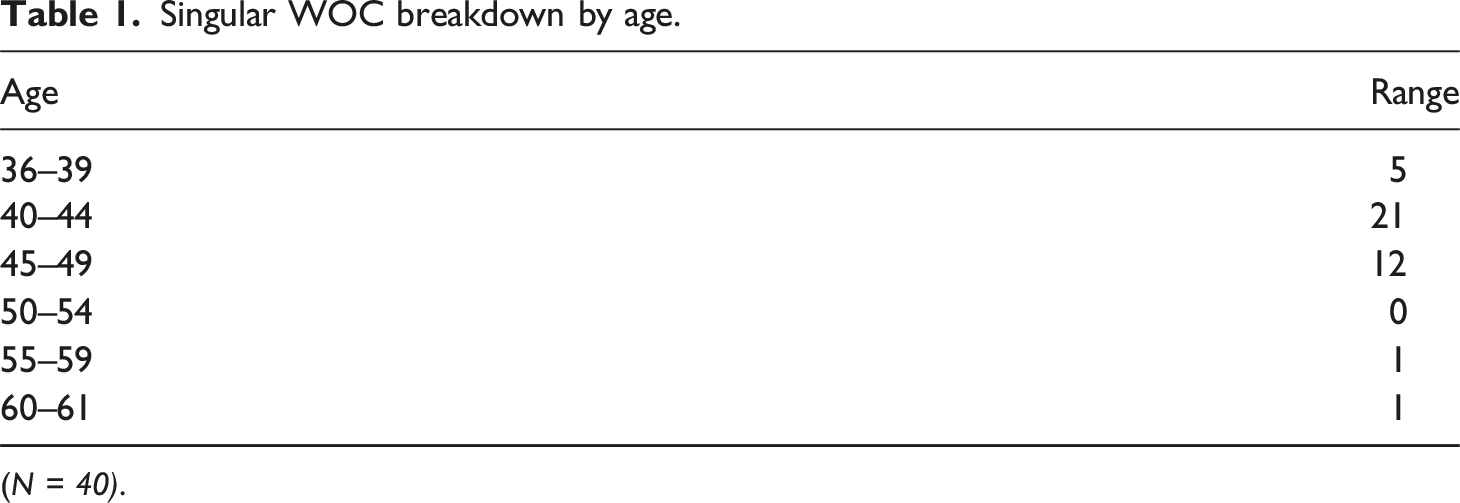
(N = 40).
My interviews were conducted via the Zoom.com platform. This medium allowed me to interview women from all over the United States, including the following: California, New York, Illinois, Texas, Georgia, Colorado, Maine, Florida, Michigan, New Jersey, New Orleans, Maryland, Minnesota, Arizona, Pennsylvania, and Massachusetts.
The women in my study were able to self-identify their ethnic backgrounds. For my research, I am using the term women of color (WOC). The term women of color was coined at a National Women’s Conference in 1977 when Black women wanted to create a coalition with other minority women. The identity of women of color was created through social activism to include the discussion of racialization in relation to white supremacy (Zavella, 2022). When referring to a specific woman, I will refer to her with the term(s) in which she has self-identified. The women of color (WOC) in my study self-identified in the following categories: African American, Black, Black American 37.5%; Afro-Caribbean, Haitian American 7.5%; Latina, Latinx, Mexican American, Ecuadorian, Columbian, Dominican 27.5%; Asian, Asian American, Indian, Indian American, South Asian, Chinese American 17.5%; and Multiracial/Biracial 10%.
The sample includes queer and cis-women who have never-married, including a common-law marriage, and who are currently single (not living with a romantic partner or have been in a committed dating relationship for at least six months before the interview). The study encompassed celibate, asexual, and sexually active women. The women self-identified their sexual identity, sexual history, and ethnic backgrounds—approximately 90% of participants identified as cisgender women, and 10% identified as queer. The sexual behavior of my participants varied, with 65% of the participants reporting they were either celibate or not engaging in sexual activity with another person. Many of the participants were not currently sexually active due to the COVID-19 pandemic and referred to this time as being “celibate by circumstance.” 85% identified as heterosexual. 10% identified as being either bisexual or queer, and 5% described themselves as virgins. Two of the women reported having a miscarriage or abortion.
My cohort overwhelmingly represented highly educated women, with twenty-nine 73% having advanced degrees consisting of Master’s degrees, Doctorate degrees, MBAs, and law degrees. 55% make over $75,000 a year. However, I also had participants who were unemployed, underemployed or worked sporadically. Education was an important aspect of these women’s lives as children. 45% have worked, or continue to work, in educational roles such as administrators, teachers, professors, deans, and counselors. Ten percent of the women interviewed were unemployed and worked as home caregivers, making very little income. Others worked part-time, lived with family members, and had recently graduated or left careers.
Heteronormative relationship standards and experiences
The decision to forego the possible benefits of marriage and the social respectability of motherhood make Singular WOC a group worthy of study from a feminist standpoint perspective. Heteronormative social structures are the instruments that maintain inequality which results in group creation. Therefore, my study is not about individual experiences, but how a shared social positionality shapes women of color’s experiences in similar ways. Collins (1997) maintains that the ideology of standpoint refers, not to an individual’s viewpoint, but to a group’s historically shared experiences. I argue that Singular WOC have a group-based experience and their knowledge is rooted in group identity. This section establishes my participants understanding of the cultural and social standards for women, in order for them to fulfill the heteronormative benchmarks of marriage, dating, and sexual behavior.
Ingraham (1999), Swidler (2001), and Wolkomir (2009) have all studied love and analyzed how our romanticism of heterosexual marriage has impacted relationships and social arrangements. Swidler (2001) states that love is rooted in the structural reality of marriage. As the institution of marriage is the primary model for love relationships, the pressure to connect love, marriage and sex is tangible. Sierra articulated her understanding of this pressure to adapt to these heteronormative models: The thing that has evolved is my understanding of how much like socialization in the sense of like, broad sort of mainstream US cultural socialization tries to orient people towards romantic relationship being the centerpiece of their life. Sierra, 42
Monogamy and romantic fairytales do not entice everyone. The women in my study are not afraid to go against convention and style their own relationships, but that does not mean they do not feel the pressure to do so. Eartha was not looking for the one. In fact, she wasn’t even looking for one partner: I’ve been in non, non-monogamous relationships for most of my adult life. And I really prefer that especially as somebody who really values my independence and spends a lot of time home alone, by choice. Having to be the sole need of like entertainment or companionship for any one person … a very equal exchange of finding the relationship type that works for you in that particular person, and not having to fit all of your relationships into the specific mold of what our society says a relationship should look like. Eartha, 40
Love can be a great experience and many of the women said they enjoy romance, but what makes them different is they are not basing the foundation of their life on a romantic relationship. As I interviewed an older cohort, women like Gertrude talked about their feelings about love and romance changing as they became older: I think there was definitely the like, someday I’m gonna get married right? There was a whole kind of like, and there’s gonna be a dress and it’s gonna be a wedding and it’s gonna be great and we’re gonna have the daddy-daughter dance. And then the like older I got and the more I like, found myself in like the dating world... like, I just didn’t want to pursue it, right? Like I just wasn’t interested in like, making all the compromises that it would take to create a relationship with someone to then be like to just head down that path, right? Gertrude, 47
The institution of heterosexuality is organized around the concept of gender, and gender sets the norm for all male/female relationships (Ingraham, 2008). This norm in relationships is referred to as heterogender. Therefore, with the centering of heterosexual marriage and heterogender relationships, romantic love and the want of romantic partners is prolific throughout American culture. Alana experienced being labeled the “failed daughter” and dislikes that she is introduced by her mother to other family members by her marital status first. She wants to be seen as more than this, and to be appreciated for her personhood and not whether she is married or a mother: I’m like the failed daughter. Because even with talking to relatives and stuff, the first thing relatives, especially relatives abroad will ask is ... how’s your family? Oh, you know, good. And my mom, the first thing she’ll say is, you know, my boys are married and have kids, my one of my girls is two, but one of them, you know, still hasn’t. Like, that’s how it’s presented before anything else before Oh, she’s got a master’s degree. And she’s working on her PhD and takes care of me every day, before any of that, that sometimes that ends anyway. It’s always about the marital status first. Alana, 41
For Louise, being in a relationship was important to her. She referred to it as being “my ultimate goal. That was the one thing I wanted more than anything else… Yeah, if you know, I am not that person that says Oh, I’m so glad to be single. I love it. I’ve accepted it. And I’ve had to go through mental counseling to accept it.” However, she said she had to fire two therapists who encouraged her to continue dating, even though she wanted to work on being happy with her life as it was, and not what a partner could bring to it: The hardest problem I had was seeing counselors who did not want to help me accept it. They wanted me to …Well, you know, what, if you, why don’t you go out a little bit, you know, if you go and put a profile. Louise, 44
Wolkomir (2009) explains how marriage is the hegemonic form of heterosexuality. Marriage is the mainstage for sociosexual relationships – a relationship that reproduces and interlocks the current gender dynamics. The women universally spoke about family members and even strangers asking about their relationship status and future. Sasha relayed a story of an Uber driving asking her why she isn’t married yet: I think that it’s also an assumption that if you’re not married, and if you’re not having you don’t have any kids that you just haven’t yet. It’s not a conscious decision. It’s just like, oh, what’s wrong with you? I had to tell my Uber driver the other day... Oh, I’m sorry. I’m so I’m like, What? No, you and you are now invested in like my relationship status, now come on. Sasha, 42
Marriage is a heteronormative invention that creates a space in which sex is acceptable, and yet, these women are finding sexual avenues outside of these prescribed relationships. Mia thinks sexuality and gender are more fluid and that a person’s desires can fluctuate throughout their lives: Very fluid and with gender, both gender and sexuality, I think people can choose at different points in their life, what they’re feeling like. I don’t think people should be held in these social constructs for their entire lives, you know. Mia, 41
In heteronormative and heterosexual relationships, women are often taught they should want to care for others because that is what love means. So, in order to be a good wife or a good woman you must be a nurturer and caregiver to others. However, Daria stated she was not interested in being a caretaker: I didn’t get to move out until I could find a decent job. And that was tough to do, because I was chained to the house. I guess part of me is concerned that if I marry someone, and he gets sick, I’m going to be chained to that too. Yeah, that could be a thing. So having been made to help care for someone I didn’t exactly plan on makes me even more, not so much into the whole marriage thing. Because if he’s my husband, I’m obligated to take care of him and look after him, or visit him. And I think I’ve had enough of that for one lifetime. And so, you know, my I don’t want to go through that again. So not getting married, so I don’t have to worry about. Daria, 56
Coontz (2016) reasons that the gender divisions that led to the idealization of romance for women, created the circumstances that men could be more angry or violent toward the women who do not meet that ideal. Although none of the women in my study reported they were in physically abusive relationships, some spoke of emotional abuse and the emotional toil of dating. Jackie stated that romantic love is important “but not so important that I’m gonna hurt myself to do.” Natasha Fatale is Indian and stated that her mother was supportive of her not dating Indian men, because the women she knew who had dated Indian men were not happy: The woman must take care of the man and I’ve seen a bad turn, bad for a lot of women. And none of those women seem happy. And so, I’m just like, if you don’t seem happy, I’m not doing that. Natasha Fatale, 46
Natasha Fatale comes from a culture where women are taught to take care of the men in their lives. However, she saw happiness as the most important relationship outcome. Some of the women discussed how other heteronormative structures such as the Catholic Church have had an impact on relationship decisions and choices. Dora used to attend church and she felt good about being part of that community, but then COVID-19 forced churches to close. So, Dora started praying on her own: I started praying and doing things on my own, like praying, I meditate every day. So, like doing my prayers, it just felt more personal, I feel more spiritual now without having the structure of religion. But more so on my own. And then, you know, obviously, I started really questioning the church and, you know, they’re still sexual abuse cases, the residency school, you know, remains of children that they’ve, they’re finding Pope Francis saying that, you know, women who choose pets are selfish. It’s just one thing after another. I, I can’t support that. I mean, it’s not I can’t say I’m pro that I’m a feminist and I’m a child advocate and then practice Catholicism. It just doesn’t feel right. Dora, 47
Dora felt she could no longer be a Catholic and follow the doctrine of church, and also be a feminism. Erica was also raised in the Catholic Church and spoke of her experience and the expectations of marriage: I think in high school, I started going…it was a youth group at a church at a Catholic Church. Right. So yes, so there was the idea of like, getting married, having a family, too, cuz that’s kind of what you do in life, right? And the church says like that, that’s what you do. So, I think in my 20s, I was looking to get married, looking to fall in love, but always like doing it the right way. Right. And so that means getting married in the church, then having a family. Erica, 43
As Engels (1884/1972) has connected monogamy, marriage and Christianity to the subjugation of women by men, the women in my study who grew-up within a religious doctrine started to question the role religion had in their lives, and if Catholicism could coexist with how they wanted to live their lives. As these Singular WOC question the heteronormative structures in their lives, they examined what purpose, if any, romantic love had for their lives. Swidler (2001) claims the culture of love is necessary to provide hope that adult, loving relationships are possible, and without the culture of love, people would not aim to fulfill the expectations of lifelong relationships. People would have relationships, lovers and children, but they would not feel beholden to make marriages work. Therefore, the idea of an everlasting love would be reduced to the fables for children, but the focus on romance and romantic love has routinely been directed at women. This would make finding love a preoccupation with women, leaving little room for thoughts of government, politics and economics (Cancian, 1986).
Experiences with romantic love and dating
Love, or more pointedly, romantic love has become the venue of women. Consequently, love and the pursuit of love has become the playground, the war room, and the trophy case. A woman who is loved, is a woman who has achieved success. A woman is also supposed to find fulfilment in loving and caring for others. Ingraham (2008) recognizes an imaginary form of romance. She describes this as an illusion that is focused on heterosexual imagery and is recreated through romantic mythology. This mythology helps to create gender and normalizes heterosexual relationships (Wolkomir, 2009). Love is supposed to keep heterosexual relationships together. However, most of the women in my study did not ascribe to this mythology. Therefore, dating does not always have the same objective for them. For some women, dating has become more a burden than a desire. Geraldine stated that she felt it was a disservice to yourself as a woman to center your life around romance over all other relationships: But even in the best circumstances, when those romantic relationships work out, I feel like as a woman, you are doing yourself a great disservice if you set your romantic relationships with men, over the myriad of other interpersonal issues, dealing with family, with friends, etc., Geraldine, 46
Geraldine is not opposed to romantic relationships, but she does not place them ahead of other bonds in her life. Nancy talked about not being in a relationship just to be in a relationship. In order for her to even consider a partnership, it would have to be a situation that enriched her life in some way: And I think for me, it’s more about making sure that I have, that I’m in a relationship that is healthy, fruitful, and you know, a good partner. Because outside of that, my life is pretty awesome and pretty rich. And so that has shifted, you know, how I approached dating. Nancy, 44
Singular WOC are not dating with the desire to redesign their lives. They are looking for someone who can add something positive to their already full life. Louise addressed how the pursuit of love can be self-destructive and she did not want to continue harming herself: I probably went on every single dating app. It just, it just never worked. Never worked. And I got tired of that constant disappointment, because you don’t feel good about yourself when things don’t work out, you put all this work in … So, it was just I can’t keep doing this to myself. Louise, 44
When Louise decided that dating was more harmful than heartening, she made the decision to focus on what made her happy. Romantic relationships can be the makings of fairytales, but these fables do not necessarily find themselves amalgamated into the real lives of women of color. The fantasy of a handsome prince galloping on his equally handsome horse to sweep you off your feet, and solve all your problems is a bourgeoisie fairytale, but not everyone is promised a happy ending. Nancy was not interested in a fairytale: No, marriage was never a priority for me … Did I make decisions right with the expectation right, that marriage would happen? And the answer’s no, I think my priority was always centered on … just more about the quality of the life that I wanted to live. And I think I’ve made decisions based on does this align with the lifestyle and the life that I want to have for myself. But I’ve never thought about, you know, marriage as a priority. Nancy, 44
Some of the women stated that they are open to having romantic love in their lives. Jackie, for example, was able to juggle multiple dating partners: It’s like, all bets are off. I’m totally fine dating, like, I just my maximum is probably like, four or five, because after that, it just gets confusing. Ideally, it’s like three, but for some reason, that seems to be a magic number for me, like I feel it’s really nice to have like three guys around. Jackie, 43
This is in line with modern love relationships being more about personal choice and motivations, instead of social obligations such as ending family feuds, uniting alliances, or financial advancement for a community, Swidler (2001). Women can now seek out a romantic relationship without relenting to the social pressures to marry: Like, I don’t go out looking for romance. But if love knocks at my door, and I’ll give it a chance, you could come in and visit for a while. We’ll see where it goes. Sankofa, 61
Sankofa is open to having love in her life, but she is not sure if she wants it to visit or move in. Therefore, she is not beholden to a particular practice of romantic love, and is open to explore new configurations of relationships. Mina also is open to romance, and unlike Sankofa, she longs for a romantic partner in her life: And it is I think, the thing about my life that I am saddest about… but like I do, okay without it, right? Like I’m not like wandering around sad and crying all of the time or anything. But I think it’s very important and it’s something that I don’t have. Mina, 44
Although Mina does lament the absence of a romantic partner in her life, the overall sentiment of my participants is that the pursuit of love has become more of a problem than a pleasure. Singular WOC have other interests and goals that have taken precedence over finding a partner. Similarly, these women do not see their sexual behavior as being bound to the sole purpose of finding a mate. Women of color have often been barred from enjoying the freedom to live their lives according to their own dictates. Although there have always been Singular WOC throughout history, the women of color in my study are keenly aware of their unique positionality. Singular WOC are women who have remained free from the heteronormative obligations to a husband or children, and they are also women who have not had the privileges of some of their white counterparts. In addition, these women can offer a better vantage point to observe and critique social structures and processes (Cooper, 1892).
Health, happiness, and healing
Singular WOC can provide crucial information on how they have built their own ecosystem by being cognizant of the demands on their energy and time and being attentive to their interests and health. This section illustrates how these women are crafting a divergent path by prioritizing their health and healing and cultivating community and interpersonal connections that are supportive and restorative. One of the characteristics of my sample is their desire for personal space, free from the boundaries and barriers of cultural and social expectations. For these women, their time, peace, and serenity are sacrosanct. As outside forces often work to narrow women’s opportunities, creating a personal world of serenity is what has centered these women to then be able to meet the intersecting challenges of classism, sexism, and racism these women face daily.
Lisa stated that her “happiness and peace of mind are more important than money.” And Lala concurs “there’s those few things that I’m very protective of, and my time is definitely one of them. It’s easier to get money out of me than to get my time.” Lisa and Lala are similar to many of the women in my study. Women of color are a racialized group in the United States, and their interactions with social institutions can be traumatizing due to racism, white supremacist ideologies, and misogyny. Therefore, Singular WOC are protective of who they spend their time with and situations that require their energy. This desire for personal space is noteworthy also because of the cultural expectations of being a wife and mother. What these women have in common and what defines their positionality in society is their ability and want to live on the outskirts of cultural norms and standardized relationships.
Singular WOC have people in their lives that they care deeply about - some are family members, and some are friends. However, they do not compromise on their yearning for personal space and time. Singular WOC are also extremely intentional with how they spend their time. Devi stated that she does not define her life in terms of happiness, but in terms of her peace of mind. “I honestly really don’t even like the word happiness. I think for me, my biggest life goal is peace of mind.” Singular WOC are not driven by money or symbols of success like titles and promotions. These are women who care about their communities, and many work in fields that either support or provide public services, but they are not women who put themselves last: There’s an abundance of things out there. And why would I not give when I’m led to give, whether it’s information, jokes, money, I am led to give myself care is non-negotiable. I protect my peace at all costs; boundaries are so important. And so that is a huge, huge value of mine. Brandy, 41
Brandy speaks of her boundaries and how she values her peace. This discussion of peace of mind is a continual throughline in my interviews. However, instead of a vow of silence, these women have made a commitment to their tranquility. The pursuit of internal harmony is one of the attributes that signifies them as a group. A group of Singular monastics who put the peacefulness of self above money, work, or family. Although many people care about their peace of mind, my participants have followed it like an internal compass that points north. Nancy described it this way: I’m at the point in my life where I’ve defined that success is like, do I feel like what I do is meaningful, right, and, and centered, with what I feel are important values in my life. Nancy, 44
However, what is important to them now is more about internal factors and external forces. Mia spoke of authenticity: If you’re doing something that makes you either content or happy, and contentedness and happiness are different for each person, right? So just being authentic to yourself, and not allowing outside forces to kind of color that for you. Like, for me, that is what makes a person successful. Mia, 41
Social networks often view women who do not marry or have children as selfish or immature. Yet, these women are very mindful of their words and their choices. Singular WOC are not wandering through life, making hapless decisions and disrupting other people’s lives along the way. Natasha Fatale spoke of self-nurturing: I think one of the biggest things that people, especially as humans, you have to kind of stop and just kind of say, like, my ability to trust myself and take care of myself, like, I got a whole new level of respect for myself at that point. You know, I, most humans walk around, I think, not liking themselves very much. I can trust myself. I mean, I really do. You know, it’s like, I have taken really good care of myself considering everything I’ve been through, you know. And so, I don’t think a lot of people can say that, though. Natasha Fatale, 46
Geraldine even wondered if she loved herself too much. As a woman you are socialized to put other’s needs above your own. This group of women is not doing that. Singular WOC are not people-pleasers: But I remember that moment so vividly. Because I laugh at it now and think like I literally was, was wondering if I love myself too much. That was my concern. I was concerned about if I love myself too much. Why am I not attaching all of this anxiety to someone choosing me? What’s wrong with me? Geraldine, 46
Jessica Moorman found that Black women are engaging in a form of singlehood called strategic singlehood. Strategic singlehood refers to those who intentionally remain single to further their personal growth and well-being (March 2023). Brandy stated that she was thirty-two when she had a relationship break-up. She wanted to give herself time to heal. She recalled thinking that she was going to remain single longer than she thought: I remember calling or texting my best friend. And I said, Girl, I think I’m, I’ve been called to be single, or I’m going to be single for a lot longer than I initially thought. And that just gave me some peace. They’re like, wait a minute, single is such a blessing. Marriage is a blessing, too; being single is such a blessing. So yes. Did I have that in my - marriage at 25 Kids 28 Absolutely Brandy, 41
All of these women have described living a lifestyle conducive to their health, happiness, and healing. As Collins (1997) warns, feminist standpoints should not be confused with a woman’s point of view, and that standpoint should not describe a stagnant position. The emphasis should be on the social conditions that construct groups, not individual experiences. This group of Singular WOC is constructed by the social conditions they are protecting themselves from or rebelling against. The social conditions of misogyny, white supremacy, and coloniality have necessitated women of color to maintain their own defenses. In addition to their positionality of being a marginalized group, Singular WOC also are contending with the expectations that women center the aspirations of others above their own. Singular WOC are not placing themselves last. These women are placing their health and healing first. Singular WOC are not looking for someone else to complete them; they are using their resources and their energy to become their best selves. Not to be someone’s partner but to be a better person.
Feminization of freedom
Singular WOC have an internal dialogue that provides them a safe harbor from a world of intersecting demands on their time and energy. Francesca Cancian (1986) argued in the feminization of love that the style of love known as romantic love is a feminized form of love. Men are socialized to believe their value in the world comes from what they do, not who they love or how they love. On the other hand, women are socialized to see their value through their relationships and the success of those relationships. For example, if a husband cheats, it is the wife’s fault because she wasn’t giving him what he needed. However, if a woman cheats, then that is a lack of character and morality on her part, or if a child acts out violently, then the mother wasn’t providing the structure that child needed at home. Consequently, society defines women by the love they attract or lack. Traditionally, there has been an assumption that single women are single because no one chose them (Reynolds et al., 2007).
Coontz (2016) states that as women took over the caretaking role of the family, self-sufficiency was denied them, and individualism was intended for men only. Women are defined by their love relationships, and men are associated with their work. This led women to take more pride in their romantic relationships, as well as feeling the pressure to keep those relationships intact. However, my participants have different ideas about what should be important to their lives. For Natasha Fatale, self-reliance is something she takes pride in; “I like myself enough to know that I can take care of myself, and I trust myself enough to know I can take care of myself.” For Geraldine, she worried traditional marriage would be stifling: So, what I think it would have to be, I cannot, I can never really fully articulate how important my autonomy is to me … But I cannot ever explain how much my freedom means to me. And how suffocated I would feel if I did marriage in the way that everybody says you supposed to do it. Geraldine, 46
Geraldine is expressing how, for these women, their freedom and autonomy are the criteria for success, not a husband. A man’s success is rooted in his career, his professional pursuits, winning championships and trophies, his bank account, and, to some extent, the success of his children. A woman’s success is measured by her interpersonal relationships (Cancian, 1986; Coontz, 2016). However, Lourdes does not believe her life is a failure. She stated “I didn’t fail at life because I didn’t find a partner.” Willie also bemoans the way women’s accomplishments are not acknowledged: I don’t know why. I guess it would be like sometimes the set of emotions around not having married feel more complicated not because of what I have truly desire. But just like how society does not recognize or reward your accomplishments if you haven’t been married. Willie, 45
Marsh (2023) found that the most common characteristics identified by the Love Jones Cohort (single African Americans) were a positive outlook on their lives and that they valued freedom, self-reliance, and independence. My participants would also be in concurrence with these characteristics. There is infinite time on this planet, and the women in my study are not interested in devoting a large percentage of that time to finding a partner. Singular WOC have decided to spend their time elsewhere and enjoy the time they have, and they want to spend it with the people they care about, when they want, how they want, and without the pressure of searching for ever-lasting love.
The search for a partner can be exhausting and expensive. It costs your time and your energy. Many of the women disliked the dating process, but others found dating disinteresting altogether. Either way, these women feel that is a cost too high to pay, especially when you could use your resources to travel the world instead. As men have been encouraged to pursue self-fulfillment, women have not always been afforded that space. Thankfully, freedom and independence are no longer associated only with the political and economic causes of men. Freedom and independence now apply to women’s intimate lives and choices (Budgeon, 2016). Therefore, the masculinity of rationality is being questioned by the feminization of freedom.
Discussion
Remaining a Singular WOC is not just about one’s relationship status. These women lead very intentional lives. Nevertheless, they desire the sanctity of deliberate solitude more than they want to share their life with a romantic partner or sexual companion. Romantic love is not a pivotal concern for every woman, and nor should it be. When romantic love is not the focal point of a Singular WOC’s life, she can devote more time and energy to other relationships in their life. Women who are not focused on romantic love can explore their interests and ambitions. Harmful narratives can suppress a woman’s agency and individualism outside of heterosexual romantic relationships (Sandfield & Percy, 2003). These narratives can be a hindrance to unmarried women embracing their lifestyles and presenting them as an acceptable alternative to marriage. These descriptions also do not allow for the possibility that women may actively choose to remain single and they have made a choice other than marriage. Therefore, remaining singular is not an easy road to take, and these women have taken it anyway. Singular WOC receive pressure and unwelcome probing questions from their family, coworkers, and strangers about their marital status. They have been introduced as the unmarried daughter and told their time will come.
The feminization of love is the inspiration and foundation for what I am referring to as the feminization of freedom. This concept explains how Singular WOC have made freedom accessible and acceptable for all women (Coontz, 2016). Singular WOC are not dependent on the family unit, nor are they financially dependent. Their successes can come from their work in the public sphere. Individuality is not just for men anymore. Women can now carve out individualized lives free from the demands of the private sphere and create personal spaces for themselves. Singular WOC are now in the blazing, bright light of self-sufficiency without shelter. Individualism has been a dangerous place for women, especially women of color. Singular WOC are unpartnered and without dependents. Their fate lies in their hands alone.
I argue that the women who have remained singular have feminized freedom, meaning they have made freedom, individualism, and independence acceptable to associate with women. Singular WOC have normalized being financially independent and having their successes come from the public sphere and not the domestic one. These women have claimed their right to self-governance, a right that has been historically denied them. I am not saying that married women do not also have freedom or the ability to make their own decisions. Too often, we have pitted women against each other who have made different choices or led different lives. Western social structures have created dichotomies and placed women in them: the virgin versus the whore; the single girl versus the wife; the mother versus the childless; and the mother who works outside the home versus the stay-at-home mother. These dichotomies are used to divide women and create hostilities and chasms between them, which helps to maintain a patriarchal arrangement that yields heterogender divisions. Therefore, there is value in recognizing women who have built upon their own knowledge production with the purpose of self-determination.
Challenges and limitations
The limitations of my study include being conducted during the time of COVID-19. My recruitment procedures were altered by the inability to travel, and remote interviews became the solution. I also ended up with a highly educated sample. This may have to do with my methods of recruitment and also that this sample of women is more likely to be educated. I did not ask explicit questions about disabilities in my study. In the tradition of Black Feminism, I center the experiences of childfree, never-married single women of color. Black feminists started to assert their narratives in the feminist discourse and argued for a more holistic approach to gender studies that included gender, race, and class. Therefore, my findings may not be generalizable to other populations.
Conclusions
Singular WOC did not talk about having it all. In fact, they did not want it all. They did not want to have a family and a career. They have removed those expectations and freed themselves from the cultural norms of being a selfless vessel for others or a go-getting corporate climber. They are not trying to get to the top. Not because they are lazy or unmotivated. But because they like the view right where they are. They have been criticized and vilified for being selfish and cold. Yet they are neither. They love, nurture and find joy, just not in the traditional places. I am not attempting to glorify their choices but to neutralize any adverse assumptions and to bear witness to their humanity.
In this article, I have introduced the concept of feminization of freedom. The feminization of freedom refers to women who have remained single and how they have feminized freedom. This means they have made freedom, individualism, and independence more acceptable to associate with women. I have aimed to demonstrate that Singular WOC circumnavigate their choices about romantic love, sex, and interpersonal relationships. These women, who have remained singular, have a distinct point of view, and their accounts could provide pertinent information to the variances and cultural shifts in gender norms, patriarchy, capitalism, and heterogender family structures in American society. bell hooks argues that the experiences and knowledge of women of color should be at the center of feminist theorizing and activism in order to have an improved understanding of all lived experiences (Ferguson, 2008). In addition, historically, the experiences of marriage and motherhood have been disparate for women of color in America (Davis, 1983). Therefore, the focus on single, white women’s experiences excludes the challenges and particularities that face women of color. My research adds a distinctive voice to the discussion of remaining a Singular WOC.
Footnotes
Author’s note
The “The feminization of freedom: an analysis of love, happiness and freedom from the perspective of childfree, never-married single women of color” was presented during the Women’s Economic Decision-Making Panel at the Work Family Researchers Network (WFRN) Conference in June 2024.
Declaration of conflicting interests
The author(s) declared no potential conflicts of interest with respect to the research, authorship, and/or publication of this article.
Funding
The author(s) received no financial support for the research, authorship, and/or publication of this article.
Open research statement
As part of IARR’s encouragement of open research practices, Kimberly Martinez Phillips has provided the following information: This research was not pre-registered. The data used in the research can be publicly posted and shared. The materials used in the research can be publicly posted.
